Your business deserves a legal partner who thinks like you do.
From small startups to international corporations, Kirton McConkie meets all clients with legal guidance built on trust.
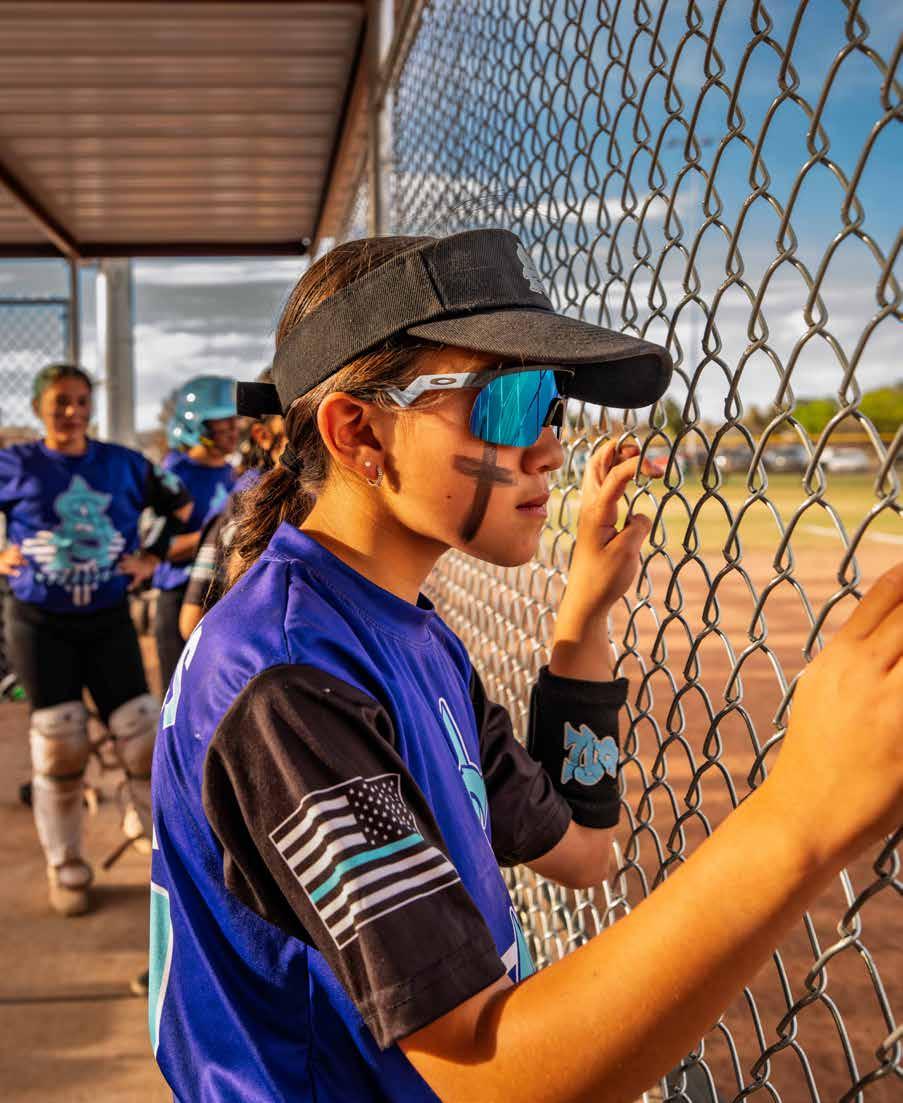
“Youth sports are too expensive, critics say. Too exclusive. Too demanding of kids who just wanna have fun.”
BY ETHAN BAUER
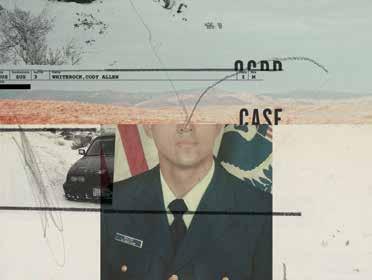
A HOUSE DIVIDED THE FIGHT FOR CONTROL WITHIN THE HERITAGE FOUNDATION.
BY ERIC SCHULZKE
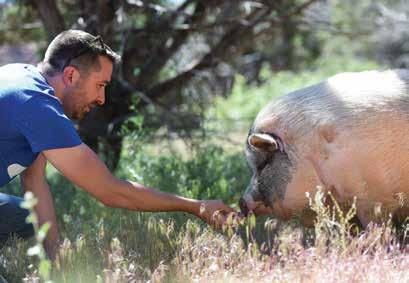
DOWN AT RIDDLE RANCH
LAUREN STEELE
TH I S I S A P E R S O N A L
B E ST
“People need to understand that their lives are in their hands.”
BRAYLOVSKIY
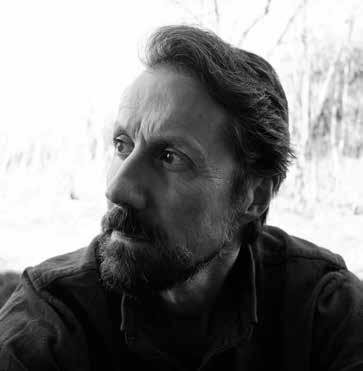
Kingsnorth is an English writer and thinker living in the west of Ireland. He is the author of 10 books of fiction, nonfiction and poetry, including the novel “The Wake,” which was longlisted for the Man Booker Prize. An excerpt from his book “Against the Machine: On the Unmaking of Humanity” is on page 66.
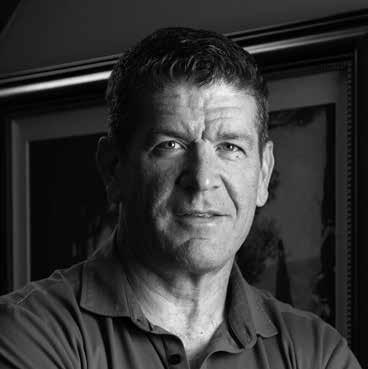
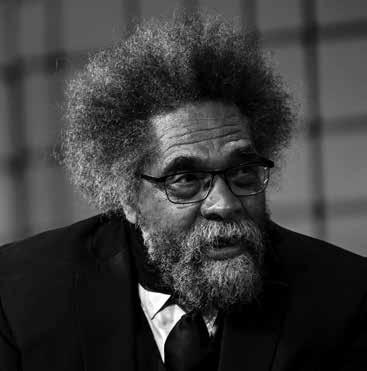
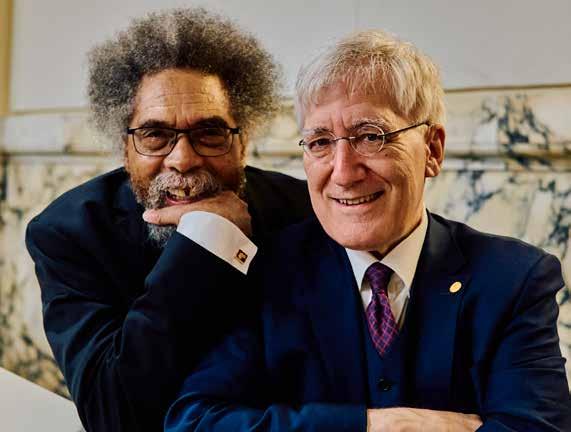
The Dietrich Bonhoeffer Chair at Union Theological Seminary, West is a former professor at Harvard and Princeton universities. He has authored 20 books and edited 13 other volumes. He most recently co-authored “Truth Matters” with Princeton professor Robert P. George. A conversation with the two men on their friendship, civil dialogue and the pursuit of truth is on page 70.
Giles is CEO of Braver Angels, a national nonprofit that helps bridge partisan divides in communities and across the nation. A Braver Angels volunteer for five years before his appointment, Giles has two decades of experience starting mission-driven organizations and building high-trust teams across differences. His commentary on civic duty is on page 13.
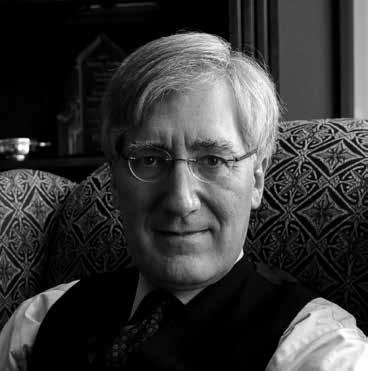
George is director of the James Madison Program in American Ideals and Institutions at Princeton University, where he is also a professor. A recipient of several awards for his service and scholarship, George is a past chairman of the U.S. Commission on International Religious Freedom. A conversation with his longtime collaborator on civil dialogue, Cornel West, is on page 70.
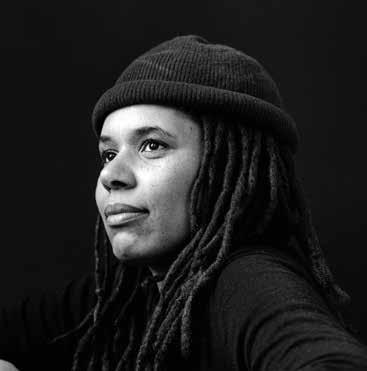
Based in Berlin, Ejaita works in the fine arts, illustration and textile design. Her work pays homage to her Nigerian origins, bringing together influences from Europe and West Africa. Her clients include The New Yorker, The New York Times, The Washington Post, The Economist, the Financial Times, and many other publications and companies. Her illustration is on page 67.
Chávez is a photographer from the U.S.-Mexico border whose work spans editorial, commercial and documentary projects. His photos have been published in The New York Times, Marie Claire France, New Mexico Magazine and Texas Highways. Chávez’s photography accompanies a feature story on youth sports on page 32.
CHRIST CHÁVEZ
PAUL KINGSNORTH
MAURY GILES
DIANA EJAITA
CORNEL WEST
ROBERT P. GEORGE
AMERICA’S GAME
When my daughter stands in the outfield, she looks like a ballerina.
My wife, who grew up dancing, pointed this out to me.
“She’s standing in fourth position,” she said. I had no idea what this meant.
She always stands in fourth position, my wife pointed out, or third when she’s waiting between pitches.
Anna has a body built for ballet, and, in all likelihood, a natural aptitude. But when we took her to her first ballet class, she didn’t just cry, she became undone, as if the prospect of putting on tights and ballet shoes deeply offended her soul.
Instead, she grew up at the ballpark, watching her brothers play. Starting in the second grade, she started to play too, and by fourth grade she was drawing pictures of yellow softballs on her notebooks at school.
Anna is the youngest of our four kids, and looking back, I didn’t really understand how youth sports worked until it was too late. I didn’t know there were rec leagues and comp leagues and travel leagues, or that if you didn’t get your kid into that system early enough — by fifth grade, say — it might be too late to play by junior high or high school, when sports can matter most.
In those early years, I quietly judged the parents who signed their kids up for competitive teams, assuming they were pushing too hard or living through them. I didn’t realize, until Anna, that many of these parents are simply trying their best to give their kids the thing they really want: to be able to keep playing.
We sent Ethan Bauer to Las Cruces, New Mexico, to understand
what’s become of youth sports, and what impact it’s having on kids (“The Price of Play,” page 32). In some ways, it’s a story of what America has become. As recently as the 1990s, rec leagues were still robust, built on the idea that sports should be widely accessible. Today, nearly every sport operates within an expensive, time-consuming system that leaves many kids out.
I’ve seen this firsthand. When Anna played in rec leagues, we sometimes didn’t have all three bases, and the umps were high school kids who didn’t know the rules. Now, she plays in tournaments where games are streamed live on an app, and her stats are tracked over seasons. She’s 13.
None of this is by design. And no parent I’ve talked to thinks this is ideal. And yet here we are.
The same could be said of so much of life in America today. We operate within a system that ruthlessly rewards efficiency, competition and return on investment. Over time, that logic has extended well beyond the marketplace, shaping institutions that were once built around different ideals.
The result is something highly efficient but often strangely misaligned with what many of us actually want.
This isn’t to say that the system is broken beyond repair. It’s on each of us to operate within what we’ve built and to push to make it better.
Anna, for her part, would find all this absurd if I tried to explain it: if I told her I saw some metaphor about America in youth sports. Instead, she stands in the outfield, her feet drifting into fourth position, her attention fixed entirely on the game in front of her.
For now, that is enough.
EXECUTIVE EDITOR HAL BOYD
EDITOR
JESSE HYDE
CREATIVE DIRECTOR ERIC GILLETT
MANAGING EDITOR MATTHEW BROWN
DEPUTY EDITOR CHAD NIELSEN
CONTRIBUTING EDITORS
MCKAY COPPINS, JAMES R. GARDNER, LAUREN STEELE
EDITOR-AT-LARGE DOUG WILKS
STAFF WRITERS
ETHAN BAUER, VALERIE BRAYLOVSKIY, NATALIA GALICZA
CONTRIBUTING WRITERS
LOIS M. COLLINS, JENNIFER GRAHAM, KEVIN LIND, MARIYA MANZHOS, MICHAEL J. MOONEY, ERIC SCHULZKE
ART DIRECTORS IAN SULLIVAN, BRENNA VATERLAUS
COPY EDITORS
SARAH HARRIS, VALERIE JONES, CHRIS MILLER, CAMILLE SMITH
POSTMASTER: PLEASE SEND ADDRESS CHANGES TO PO BOX 2220, SALT LAKE CITY, UTAH 84101.
PUBLISHER BURKE OLSEN
CHIEF FINANCIAL OFFICER ERIC TEEL
SENIOR VICE PRESIDENT SALES TRENT EYRE
VICE PRESIDENT MARKETING EMILY HELLEWELL
VICE PRESIDENT SALES SALLY STEED
PRODUCTION MANAGER RHECE NICHOLAS
DIRECTOR OF CIRCULATION SYLVIA HANSEN
THE DESERET NEWS’ PRINCIPAL OFFICE IS 55 N. 300 WEST, STE 400, SALT LAKE CITY, UTAH. COPYRIGHT 2026, DESERET NEWS PUBLISHING CO. ALL RIGHTS RESERVED. PRINTED IN THE USA.
DESERET
PROPOSED AS A STATE IN 1849, DESERET SPANNED FROM THE SIERRAS IN CALIFORNIA TO THE ROCKIES IN COLORADO, AND FROM THE BORDER OF MEXICO NORTH TO OREGON, IDAHO AND WYOMING. INFORMED BY OUR HERITAGE AND VALUES, DESERET MAGAZINE COVERS THE PEOPLE AND CULTURE OF THAT TERRITORY AND ITS INTERSECTION WITH THE BROADER WORLD.
OUR
READERS RESPOND
The cover story for our annual STATE OF THE WEST issue revealed how women have long wielded power and influence in the West (“How Women Won the West”). Staff writer Natalia Galicza explained that, beginning in the late 19th century, Western states were not only the first to grant women suffrage but to elect women to political office. And the tradition continues today with Nevada, Colorado and New Mexico to become the first states to have women hold a majority of seats in their respective state legislatures. One reader who identified online as Montanaguy wrote that government works best when it represents the broader population. “Organizations I worked for, and those I led, in my career always flourished with a diverse workforce and leadership. Was it ‘woke’ or just common sense? Didn’t matter, as it was just better.” But many readers took exception to the story, warning against making gender a factor in effective leadership. “I’m all for celebrating women’s leadership,” wrote Nathan Lofland. “But saying any group was ‘meant’ to do something is the same kind of box we’ve been trying to get out of.” Contributing writer Mark Dee explored how the race to build infrastructure for a booming tech industry is gobbling up farmland water in Idaho and why these competing visions for the West could reshape the rest of the country (“The Magic Valley’s Next Trick”). Despite the promise of jobs and investment that companies like Meta would bring to the local economies, readers fear for Idaho’s future. “Better there than here,” lamented RealSLC50, a commenter from another state. “That place will never be the same.” The plight of the American family farmer was explained by staff writer Valerie Braylovskiy (“No Bailouts”). Her story detailed how the growth of corporate farms could drive the nation’s remaining 1.6 million small and midsize farmers out of business within three generations. Reader and former dairy farmer George Evans offered this hopeful, but unlikely, solution: “Farmers could stay in business without subsidies if consumers were willing to pay the true cost of food production. That, however, would be politically too unpopular to ever happen.”
“Organizations always flourished with a diverse workforce and leadership group. Was it ‘woke’ or just common sense? It didn’t matter, as it was just better.”
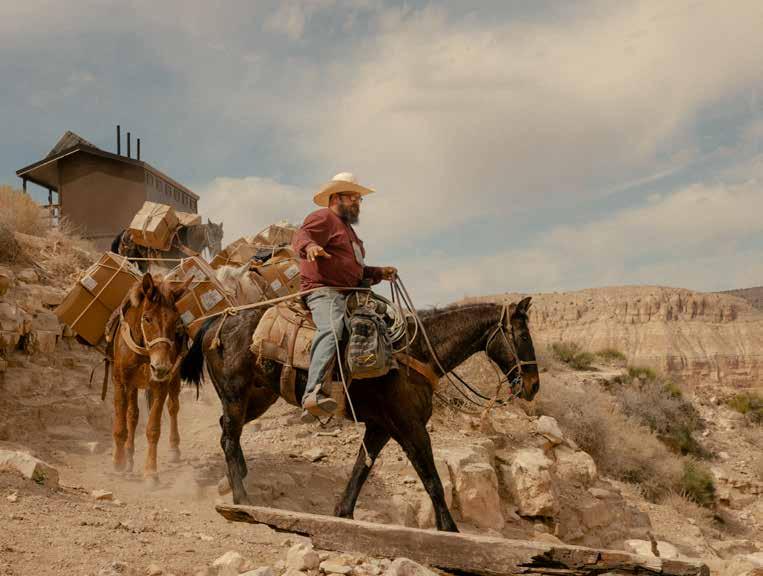
UNITED STATES POSTAL SERVICE CONTRACTOR NATE CHAMBERLAIN DELIVERS MAIL FROM ONE OF THE MOST REMOTE POST OFFICES IN THE UNITED STATES IN SUPAI, ARIZONA, AT THE BOTTOM OF THE GRAND CANYON.
PHOTOGRAPHY BY ELLIOT ROSS
CIVIC DUTY
GOOD GOVERNMENT BEGINS WITH YOURSELF
BY MAURY GILES
Life brings change. Some changes come quietly. Others arrive as a calling, a recognition that something essential requires your full attention.
Eight months ago, I left a 30-year career to lead Braver Angels because I had to do more to address what I see happening to our civic culture. Toxic polarization is fracturing relationships, distorting leadership and eroding our capacity for self-government. For me, the decision was rooted in something deeply personal: I do not want my grandchildren growing up believing that the only way to stand for something is to tear someone else down. If not us, who? If not now, when?
Most states have entered the primary election season, a time that often rewards intensity over wisdom. Primaries matter. They shape who appears on November’s ballot and what kind of leadership emerges. Yet this stage of the process also amplifies factional loyalty and discourages participation from those who feel exhausted by the noise. When only the most animated voices show up, candidates are incentivized to appeal to the edges rather than to the whole.
But the deeper problem is not merely political mechanics. It is cultural. We have been conditioned to believe that those who disagree with us must value entirely different things. In reality, most Americans share many of the same core values. What differs is how we weigh those values in particular circumstances, shaped by our lived experience. That difference in weighing leads to different concerns and preferred solutions.
Instead of exploring those differences with curiosity, we often are pulled into an outrage cycle, a system engineered to provoke us. In such a world, choosing not to react is an act of self-mastery. It takes zero civic muscle to fire off a response to a headline, a comment or a statement in a family text thread. It takes discipline to pause and ask, “What is really happening here?”
This is not about abandoning conviction. It is about governing our response so we can collaborate. Agency is not the freedom to do whatever we feel in the moment. It is the power to govern our response. And self-government only works when the self is governed.
The U.S. Constitution restrains power. It does not restrain contempt. That work belongs to us. So what does this look like in practice during an election year?
First, strengthen relationships before you debate ideas. Let people in your life know they matter to you beyond their political positions. Trust is the soil in which productive disagreement grows into collaborative action.
Second, check your intent before you engage. If your primary motivation is to win, score points or expose flaws, step back. Those motivations feed the outrage cycle. Enter a conversation when you are prepared to seek understanding, even while holding firm to your beliefs.
Third, when you encounter a view that frustrates or alarms you, ask a better question: “Tell me more about your life experience that shapes how you see this issue.” People experience their opinions more than they choose them. When you understand someone’s story, you begin to see the values beneath it.
Fourth, reflect back what you heard before presenting your own perspective. It signals dignity.
Then share your own experience, not as a weapon, but as a contribution. Look for where your values overlap, even if your policy prescriptions differ. That is the space where durable solutions are built. Together.
Courageous citizenship, the discipline we train at Braver Angels, is the choice to act instead of react across political differences. It means coming to the table, not to the middle. It means solving for shared American interests without surrendering principle. It is not a personality trait; it is a practice.
None of this is easy. It is not rewarded by the current environment. Outrage spreads faster than restraint. But the renewal of our constitutional republic will not come from winning arguments. It will come from cultivating citizens resilient enough for self-government.
As the elections unfold, resist the temptation to withdraw or to escalate. Participate. Vote. Engage. But do so with discipline. Model principled disagreement in your homes, your faith communities, your workplaces and your relationships.
History will not ask whether we shouted the loudest. It will ask whether we preserved the conditions necessary for a free people to govern themselves.
The next chapter of our country’s story is not written by social media algorithms or political pundits. It will be written by Americans who choose courage over contempt.
Let’s write something worthy of those who will inherit it.
MAURY GILES IS CEO OF BRAVER ANGELS, A NATIONAL ORGANIZATION DEDICATED TO BRIDGING PARTISAN DIVIDES.
OLD DOG, NEW TRICKS
THE MANY LIVES OF AMERICA’S MOST ADAPTABLE CANINE
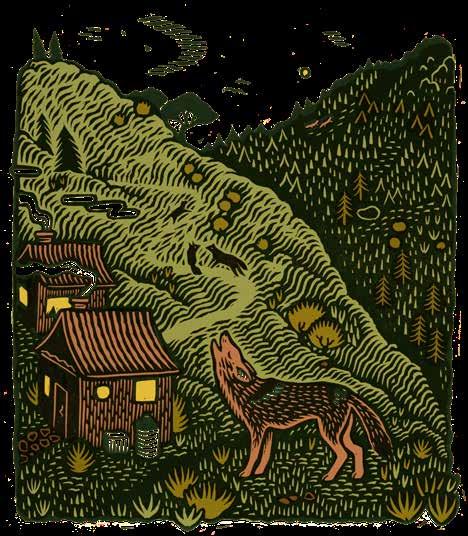
AS A COUGAR falls sedated on the streets of San Francisco, a smaller creature prances by, curious but unconcerned. This recent scene, broadcast live by a TV news crew, shows the coyote in its new habitat. The “prairie wolf” or “American jackal” is the opposite of an endangered species. While other animals struggle with human sprawl, this canine has expanded its range from the deserts and mountains of the West to the farthest reaches of the continent, infiltrating every major city and thriving in the suburbs. Are coyotes too good at this? Here’s the breakdown.
—ETHAN BAUER
UP TO 4.7 MILLION
That’s the high estimate of the national coyote population today, with 859,510 in Texas, 200,000 in Arizona and at least 250,000 in California. Typical litters produce four to seven pups, some as high as 19. Their pre-Colombian range was limited to Mexico and today’s southwestern United States. Westward expansion and eradication of the gray wolf — coyotes’ main predator — cleared their path to the Atlantic. By 1990, coyotes had set up shop in South Florida.
45 MILES PER HOUR
The real-life coyote is more than fast enough to catch a roadrunner (20 mph), which can make for an occasional meal. Still, it has to work to evade its own predator, the mountain lion (50 mph). The coyote can match a greyhound in a footrace, and can also jump 12 feet in distance or 8 feet high. Using its front paws for leverage, it can clear some barriers up to 14 feet tall.
1930
COYOTES MOVE INTO THE BRONX, N.Y.
74 LBS
COY O TL
IS THE ROOT WORD IN NAHUATL, A UTOAZTECAN LANGUAGE
11 VOCALIZATIONS
From yips and howls to barks and yelps, coyotes are the most vocal mammals in North America. They have pointed, triangular ears and reddish-brown fur. Males weigh up to 40 pounds and stand almost 2 feet tall at the shoulder, similar to a border collie. Nineteen subspecies vary in size, coloring and muzzle shape. The “Eastern coyote” — aka “coywolf” — is a genetic mix of coyote, wolf and domestic dog, big enough to thrive in cities along the Atlantic Seaboard.
LARGEST KNOWN COYOTE (WYOMING, 1937)
“I CALL THIS COYOTE MATH. IT’S LIKE TWO MINUS ONE EQUALS FIVE. BECAUSE YOU HAD TWO COYOTES, YOU REMOVED ONE, AND NOW ALL THESE OTHER COYOTES ARE GOING TO COME IN TO TRY TO TAKE THAT SPOT. THEY’RE JUST SUPER ADAPTABLE. WE’VE TRIED TO GET RID OF THEM. ... IT NEVER WORKS.”
NORTH CAROLINA STATE UNIVERSITY PROFESSOR ROLAND KAYS
CATHEMERAL, DEPENDING
That means coyotes can operate day and night. In remote areas, they’re busier in the daylight; in cities, they become more nocturnal, perhaps avoiding humans. Coyotes hunt alone, except when they don’t. They’re known to partner with badgers, which flush prey from underground burrows for the coyote to catch. A study in 1992 first observed such a team hunting Uinta ground squirrels together, but similar pairs have been reported across the West.
20% CAT FOOD
Feline remains were found in one-fifth of urban coyote scat in Los Angeles during a 2020 study by the National Park Service, compared to just 4 percent in suburban samples. Coyotes also eat rats, prairie dogs, groundhogs and other rodents, ornamental plants and house pets. Last December, coyotes killed two dogs in a small town near Boston. There have been just two known fatal coyote attacks on humans.
$50 PER JAWBONE
That’s the bounty paid by Utah’s Division of Wildlife for each coyote kill, documented with at least two-thirds of the lower mandible. That rate doubles in prime mule deer habitat. Wyoming and South Carolina run more limited programs, as do certain counties in other states. But coyotes often become even more abundant in areas where they’re hunted. Half a million are killed nationwide each year, apparently without making a dent.
BAD OMEN?
A coyote sighting can be viewed as a portent of death or evil in Navajo culture, although the meaning depends on the context. Coyote is a deity in many Native American spiritual traditions. To the Salishan tribes of the Northwest, he is an ancestor, the protagonist of many tales that explain human knowledge. In Aztec lore, he gave them fire. To these and many others, he is a trickster: sly, clever, duplicitous, sometimes playful, always ingenious.
VARIETY SHOW
IS HOLLYWOOD’S DIVERSITY AN EMPTY TROPE?
HOLLYWOOD BEGAN WITH a few dreamers on a dusty patch of farmland near Los Angeles. Now it’s the global capital of filmmaking, our dominant cultural language, a mirror that shows our biggest dreams and blind spots. For most of its history, the latter included race. A decade ago, an outcry over the Oscars prompted a concerted effort to change that. Now it’s common to see a Black superhero, an immigrant sitcom family, or a multicultural bank heist. For some, that’s overdue progress. For others, it’s proof that Hollywood is fluent in DEI talk, not genuine storytelling. Is what we’re seeing a breakthrough or just another performance?
—VALERIE BRAYLOVSKIY
ADJUST THE SPOTLIGHT
HOLLYWOOD HAS BUILT stereotypes, so it should take them down. The stories we see on screen shape our worldview and show us who matters, who’s the bad guy and who saves the day. For most of its history, white male heroes have pushed others out of the frame. But children suffer lower self-esteem when they don’t see people like themselves on screen, and audiences grow more accepting of minorities when they see them in movies and TV shows. As our national demographics evolve, the industry needs to adapt for the sake of society.
Diverse casting is more true to life. It’s our perceptions that come up short. America was 42 percent nonwhite in 2024, but only 1 in 5 lead roles in streaming comedy and drama series was played by an actor of color. The world has always been fluid, particularly in ports and trading centers, from Ancient Rome to medieval Scandinavia and modern-day New York City. Ride the subway and you’ll hear a chorus of languages. “It’s not a trend, it’s a reality,” director Ava DuVernay said at the Producers Guild Awards in 2018. “Think of (diversity) as an absolute must.”
Audiences reward representative casting. As business ventures, films with diverse casts consistently outperform those without. Women and people of color now drive much of the box office as viewers, but even broader audiences are drawn to fresh voices and talent. The 2024 film adaptation of “Wicked” — a Broadway musical built around the witch character from the “The Wizard of Oz,” itself adapted to the screen in 1939 — grossed over $650 million worldwide, in the year’s top 10, with actors of color playing nearly half the cast. Underestimating that demand, the McKinsey consulting firm estimates, costs Hollywood up to $30 billion each year.
Why not use art to imagine a better world? If films can take us through wormholes and across galaxies, into the past and the future, they can also help us to understand each other here and now. Casting characters from all walks of life models empathy instead of division. “Diversity guarantees our cultural survival,” Martin Scorsese wrote in a 1993 letter to the editor in The New York Times. “When the world is fragmenting into groups of intolerance, ignorance and hatred, film is a powerful tool to knowledge and understanding.”
TELL IT LIKE IT IS
FILM AND SCREEN should not push an agenda. Bowing to political pressure doesn’t make for good storytelling. How it can't be good for business? No viewer buys a ticket to sit through a lecture. We go to the movies or stream at home to laugh, cry, sit on the edge of our seats and lose ourselves for a few hours in another life or another world. Anything that takes us out of that moment is a distraction. When casting becomes a marketing tool, when every artistic choice is a volley in the culture war, the magic of cinema fades before the lights do.
Artificial diversity is jarring. In Hollywood’s rush to fix old wrongs, the industry has confused quotas with progress. What appears on screen isn’t honest representation but flat storytelling wrapped in a new tokenism. Characters who exist just to check a box stand out for all the wrong reasons, pulling audiences out of the story instead of drawing them in. How are we supposed to connect with someone whose main purpose is to signal a studio’s virtuous moral image rather than advance the plot?
Forcing representation tends to rewrite history. Some period dramas now assemble diverse casts with little regard for context. Consider Netflix’s “Bridgerton,” which reimagines a multiracial court with a Black queen and Indian nobles in 19th-century England — when the British colonial empire was exploiting those populations for sugar and silk production. As University of Winnipeg English professor Kerry Sinanan and other scholars wrote on Medium, “that would be a pleasant fantasy if the series offered an alternative instead of denial and erasure.”
Filmmakers should just tell great stories. Instead of obsessing over casting, the industry should be authentic and intentional about diversity. “Hollywood was right that audiences were hungry for different stories,” wrote Kabir Chibber for The New York Times. “The industry’s failure was in not finding enough creative ways to satisfy that appetite.” Instead of slapping a multiracial veneer onto the latest sequel like a “fresh content” label, try exploring life from new points of view, reflecting different ethnicities, political beliefs and religions. Put a variety of people into writers’ rooms, director’s chairs and studio offices, then diversity on screen won’t feel like an obligation anymore.
THE WEDDING SPEAKER
HOW TO FIND
WORDS WORTHY OF OLD MEMORIES AND NEW BEGINNINGS
BY ETHAN BAUER
It has to be funny,” I was told. What did I know? I’d never seen or heard a wedding speech. I’d never been to a wedding, any wedding, period. Nowadays, I might consult some chatbot for general advice, just to help me get started. Maybe I’d search for a “best wedding speeches” compilation on YouTube. Ask the internet for advice. But, even back then, 10 years ago and with my first go at being a best man, that felt like cheating. I turned to an old college professor instead. “It just has to be funny,” he said again. Funny. OK, I told myself. I can do funny. Right?
I had so much time to prepare. My college roommate asked me to do the honors many months before, along with a succinct explanation of my duties: I had to plan the bachelor party and deliver a wedding speech. The bachelor party had long since come and gone. But I’d waited until a few days before the ceremony to collect my
thoughts and put them to paper, hence my last-minute trip to the halls of my alma mater. Part of the trouble was that I didn’t really understand what a good wedding speech
THE INTIMIDATING MOMENTS WHEN WE’RE CALLED TO SPEAK ABOUT OUR ADMIRATION FOR OUR LOVED ONES ARE “PROBLEMS” WORTH GRAPPLING WITH PERSONALLY.
was supposed to do. And so, seated outside my professor’s office, I started there. What should I say in a best man’s speech? It was a good question then, in 2019, and
an even better one now, when AI services promise stress-free speeches in just “three steps.” Need to sum up your father’s life or a 20-year friendship quickly and without thinking too much? Get started by clicking here. Reddit is overrun with posts from people asking whether it would be “unethical” or “disrespectful” if they had a chatbot compose wedding speeches or eulogies. The stakes are framed as a tradeoff between crisp, concise and clean over something potentially awkward and messy, but also human. But what are life and marriage if not the latter?
“Make it funny,” I told myself as I began typing away outside my professor’s office. All the while worrying no one would laugh.
IT WAS A warm day in January. The day had come, and I was sweating. Under my much-too-small rented white dress shirt and my matching purple vest and bow tie,
THE STAKES ARE FRAMED AS A TRADEOFF BETWEEN CRISP, CONCISE AND CLEAN OVER SOMETHING POTENTIALLY AWKWARD AND MESSY. BUT WHAT ARE LIFE AND MARRIAGE IF NOT THE LATTER?
stashing props under the DJ’s tablecloth, oh yes, I was sweating.
The scaffolding that held the speech together was “SpongeBob SquarePants,” the Nickelodeon hit we’d both grown up watching. The very first line of the thing was a callback to the original “SpongeBob SquarePants” movie, and concluded with me calling my friend a “ GREAT BIG JERK .” The idea was to use a show-stopping line he would recognize, but that almost no one else would, to call everyone’s attention to the speech. Perk up, it was meant to say, because you’re about to hear something different.
The audience had just listened to the maid of honor’s lovely, if somewhat predictable, dedication to the bride, in which she talked about how the couple was “perfect for each other” and “blessed by God” and the like. My speech, in contrast, for better or for worse, was going to be a stand-up comedy routine.
Thankfully, the jokes got better. They started landing. And by the time I reached under that table for my main prop, the room was ready to explode. My friend, I told the crowd, was a big fan of creative gifts over the four years we lived together. When we were seniors, and my birthday fell just a few weeks before we were set to move out and start our adult lives, he outdid himself. I retrieved it from under the table, so they could see it and believe it before I explained it: a life-sized cardboard cutout of himself. “So that I could, and I quote,” I told the crowd, “‘be with him wherever I went.’”
It was ridiculous. It was sincere. And it was funny.
I was pretty pleased with myself. But a few years later, when I was asked to give another wedding speech, I couldn’t shake the nagging feeling that I’d forgotten something.
THE BRIDE! I hadn’t mentioned the bride! I didn’t know, in fairness, that I was supposed to, at least as a courtesy — one that makes a lot of sense, given that a wedding is a celebration of a new union rather
than a rehashing of past lives. I also, upon listening back to my original speech and several other wedding speeches over the next few years, thought my initial attempt lacked much depth. It was funny, yes, but I hadn’t realized that the funny parts should be more like dressing. The best speech I’ve ever heard was at my own wedding, in 2021, from my wife’s maid of honor. It was funny at times, sure, but it was more heartfelt than anything, drawing on memories of a friendship that began in prekindergarten to tell a complete, complex story about why that day was so special — for her, for my wife, and even for me. It was masterful. And I was jealous.
My opportunity to try something similar came nearly five years after my first wedding toast. My own best man, who I’d known since third grade, asked me to do the honors. This time, my goal looked something like: “Share some stories about your friend that show who he really is — and what makes him a good match for his wife.” I started in familiar territory: humor. I told of the time we detonated a ketchupand-baking soda bomb in my parents’ kitchen, and when he helped me cheat on a physics assignment in 11th grade that ended up winning my school’s science fair. As an overdue thank-you, I presented him with the trophy.
But later on, I shifted toward something new and much more uncomfortable: sincerity.
I offered some very serious wisdom (I was 28) about “what makes people compatible.” And, nested in a joke about how my friend once manufactured and sold counterfeit lunch tickets, I praised his new wife, who “speaks up against injustice, and always centers genuine concern for others” as a valuable counterweight to some of his scammer tendencies.
Then I finished with a dedication “to friendship, to companionship, and to never being without the people who make us who we are.”
This second rendition felt like I’d learned the right lesson the first time, but
WHAT SHOULD I SAY IN A BEST MAN’S SPEECH? I DIDN’T REALLY UNDERSTAND WHAT A GOOD WEDDING SPEECH WAS SUPPOSED TO DO.
also overcompensated and swung too hard the other way.
I still wanted to get it right.
THERE WAS NO best man this time. This third friend, rather, assigned all his groomsmen character classes from Dungeons and Dragons. The groomsman deputized to pick the location of the bachelor party, for example, was the “Scout.” I was the “Bard” — an “inspiring performer,” per the official “Player’s Handbook.” That was certainly one goal of mine.
Like before, I gathered stories about my friend. I made sure to balance those stories with some sincerity — but not too much this time — and more of a spotlight on his bride. I thought I had it down to a science. But at the last minute, my friend threw in an extra wrinkle: Since he’s also good friends with my wife, he asked that we share the speech. This presented some technical challenges — I had to write the final version like a script, which I enjoyed — but what better way to impart wisdom
about marriage and commitment than to share such a duty with my own bride?
I got to tell funny stories of my own. Like the time my friend, just two months older than me, got a haircut and the barber gestured in my direction before asking my friend whether his “son” was also getting a haircut. But to bridge our parts together, we framed the speech around something this friend did in high school, when he was a student TV reporter. At a statewide competition, he needed to find a story. He was struggling, but he was as clever then as now: What if the search for a story, he thought, was the solution to the problem? And so, his story became his search for one. Our speech was accordingly titled, “The solution to the problem of marriage.”
Ironically, he’s now a cutting-edge AI leader, and would probably evangelize ChatGPT’s ability to help with a wedding speech. Or maybe not. In past conversations about AI more generally, he’s always framed the future as a question
of priorities. Not only in terms of easy cost-cutting, but in a more deliberate, comprehensive way. Rather than what can be outsourced to technology, he asks what should be. And I hope he’d agree that the intimidating moments when we’re called to speak about our most amusing memories and the admiration of our loved ones are “problems” worth grappling with personally. Foremost, because of the sheer delight of thinking through the memories. But also because, in general, it’s good to grapple with hard things. To take on challenges that scare you. Like being funny. Or embracing sincerity and vulnerability in a landscape invaded by irony. Or, ideally, doing both at the same time, even if it’s a bit messy.
That was the goal for my wife and me as we attempted to answer the question, “How do we solve the problem of what we should tell you about our wonderful friends tonight?”
To borrow from our script: “I think we just did.”
IDENTITY CRISIS
INSIDE THE LEGAL BATTLE TO UPEND BIRTHRIGHT CITIZENSHIP IN AMERICA
BY NATALIA GALICZA
Within hours after being sworn into office on January 20, 2025, President Donald Trump sat behind the Resolute Desk in the White House to sign 26 executive orders — more than any other president on their first day. The directives ranged from tackling inflation to pausing the federal ban on TikTok. One in particular, an order to end birthright citizenship as we know it in the United States, prompted immediate backlash from around the world. Largely because it sought to change a right enshrined in the Constitution and upheld by courts for more than a century.
“Birthright,” Trump said as he readied to sign the document. “That’s a big one.”
“What about that one in the courts?” a reporter in the room asked. “That one is likely to be challenged.”
“Could be,” the president replied, still scribbling his signature with a black
Sharpie. “I think we have good grounds, but you could be right. I mean, you’ll find out.”
Not even two hours after the ink dried, immigrant rights activists in New Hampshire challenged the order through a lawsuit. The
“THERE’S BEEN SOME CHATTER AT VARIOUS TIMES ABOUT WHETHER BIRTHRIGHT CITIZENSHIP MAKES SENSE. BUT NO PRESIDENT HAS SOUGHT TO RESTRICT IT.”
next day, attorneys general from 22 states sued to block it. Opponents decry the president’s move as inhumane and in direct violation of the 14th Amendment, which has
legally granted citizenship to all persons born or naturalized in the U.S. since 1868. Proponents say ending so-called birthright citizenship would decrease illegal immigration rates, limit “birth tourism” and protect the value of American citizenship.
Courts have interpreted birthright citizenship in the Constitution to mean that those born in the United States are citizens, regardless of whether their parents are citizens. Trump’s executive order would effectively change that to mean a baby born stateside would not have American citizenship if the father is not a citizen or legal permanent resident (also known as a green card holder) and the mother is undocumented or has legal temporary status. While it’s not the first time the principle of birthright citizenship has faced scrutiny, the current legal battle marks the most ambitious attempt yet to redefine it. “There’s been some chatter at various
“IT’S A NEW WORLD. IT’S THE SAME CONSTITUTION.”
times about whether birthright citizenship makes sense. But no president has sought to restrict it,” says Kevin R. Johnson, a professor of law and director of the Aoki Center for Critical Race and Nation Studies at the University of California, Davis. “It’s quite extraordinary.”
At least six federal courts thus far have sided with opponents to Trump’s order. On April 1, as Trump sat on the first row of the public seating area of the Supreme Court — the first time a sitting president has attended a high court hearing — the justices heard oral arguments for Trump v. Barbara, a nationwide class action lawsuit backed by the American Civil Liberties Union that has blocked the order from taking effect anywhere in the country. A ruling is expected late June or early July — a decision that could have seismic ramifications. It could leave countless children stateless, unable to access federal programs or perform civic duties. It could complicate obtaining proof of citizenship and giving birth for immigrants and native-born citizens alike. “If somehow the court comes up with a way of avoiding the clear constitutional rule, then all bets are off in terms of any kind of immigration action by the president or Congress,” Johnson says. “If immigrant rights advocates lose this, they’re gonna have a hard time winning anything.”
For both sides, the stakes go beyond the ongoing immigration debate and contest to build up or break down obstacles to citizenship. The laws that define what it is to be American could be amended. And in a nation built by immigration, that leaves any sense of identity in flux.
AMANDA FROST DIDN’T waste much time arguing legalities. The University of Virginia law professor summarized the precedent for birthright citizenship before the Senate Judiciary Subcommittee on the Constitution in March, which gathered senators and legal experts to discuss the 14th Amendment ahead of the Supreme Court hearing arguments in Trump v. Barbara. She raised the defining legal precedent from United
States v. Wong Kim Ark, a Supreme Court ruling in 1898 that granted citizenship to a son of Chinese-born parents. The landmark decision solidified that birthright citizenship extends to every person born on American soil, regardless of race or parental citizenship status. Frost also reminded the panel that half a dozen federal judges had already deemed Trump’s order unconstitutional, including Reagan-appointed District Judge John C. Coughenour in Washington state. Yet for the bulk of her time, she focused not on matters of history or ideology or on technicalities, but on consequences.
Should the order take effect and revoke birthright citizenship, it would affect anyone born on or after February 20, 2025. A key factor that differentiates this moment from past challenges is that it isn’t just targeting immigrants living in the country illegally. The executive order would also deny citizenship to some children of “temporary legal residents.” That includes parents with student, work, family, tourist and humanitarian visas. People who have opted for legal pathways like the three plaintiffs identified by pseudonyms in Trump v. Barbara. They include Barbara, a Honduran asylum-seeker who had a child in October; Susan, a Taiwanese citizen in the U.S. with a student visa whose daughter was born last April; and Mark, a Brazilian citizen who has applied for permanent legal residence and had a son last March who initially received an American passport. They allege the executive order unlawfully revokes their children’s citizenship as guaranteed in the 14th Amendment, and they’re suing in part to maintain their kids’ access to services like Social Security, SNAP and Medicaid.
On average, more than 250,000 children born in the U.S. each year over the next 50 years would begin their lives as noncitizens. Research from the Migration Policy Institute and Penn State’s Population Research Institute found that would actually increase the nationwide population of immigrants lacking permanent legal status by 2.7 million people in the next two decades, and by 5.4 million people in the next half-century.
Many of these children, Frost pointed out in her testimony, might face deportation on the first day of their lives. “It doesn’t just affect the children of immigrants,” Frost says. “It would unwind the citizenship of enormous numbers of people in the country.”
State-issued birth certificates would no longer count as final proof of citizenship. Instead, citizenship could only be proven by verifying the parents’ immigration status at the time of the child’s birth. With about 10,000 children born nationwide every day — or more than 3.6 million every year — the shift would require hospital and state workers to take on screening new parents about their citizenship status, requiring proof of immigration status or their own birth certificates and naturalization documents. A study from the National Foundation for American Policy estimated the added hurdles would cost immigrant parents $600 per child in government fees and anywhere from $600 to $1,000 in associated legal fees. The federal government would also likely have to create a new layer of bureaucracy dedicated to proving citizenship status. “I don’t think anybody is safe,” Johnson says. “Since changing birthright citizenship could affect the rights of people we think are citizens now, I think the ramifications are much more far-reaching than one could imagine.”
WHEN VOTERS RATIFIED the 14th Amendment on July 9, 1868, it granted birthright citizenship to “(a)ll persons born … in the United States, and subject to the jurisdiction thereof.” The jurisdiction clause is central to Trump v. Barbara.
Supporters of the executive order contend that children of immigrants living in the country illegally cannot express allegiance or take an oath to renounce foreign ties, and that heritage tied to other countries implies they owe allegiance abroad. In other words, they would not be subject to the complete jurisdiction of the United States. “Because ‘subject to the jurisdiction thereof’ excludes individuals born owing allegiance to a foreign country, the phrase excludes children
born to illegal immigrants,” writes New York University law professor Richard Epstein in a Supreme Court brief supporting the administration’s position and echoed in oral arguments. “Even the most precocious newborn babies cannot renounce foreign ties. Only their parents can. And illegal aliens, by definition, have not done so.”
Epstein’s filing is one of 73 briefs submitted to the court: 46 against the executive order, 26 in support of it and one taking neither side. Authors range widely from professors, labor organizations, religious organizations to senators, nonprofit groups, law firms and former attorneys general.
Regardless of what the experts and advocates say, Americans are clearly divided
THERE’S A REGULATION THAT CAN BE ENFORCED, AND IF THERE’S A PROBLEM, LET’S ENFORCE THE REGULATION. DON’T GET RID OF EVERYONE’S CITIZENSHIP.
on matters of birthright citizenship. Pew Research Center reported in June that half of adults support citizenship for people born in the U.S. to parents who immigrated illegally receiving citizenship, while another 49 percent say they should not. Meanwhile, 94 percent of adults say the children of parents who immigrated legally should be considered citizens in the eyes of the law.
At the time the 14th Amendment was ratified, American borders were largely open. The new right was written as a response to the end of slavery, extending citizenship to formerly enslaved African Americans who had not yet been considered equal citizens despite their newfound
freedom. Nearly 30 years after the amendment’s ratification, the Supreme Court heard oral arguments for the Wong Kim Ark case, which concerned a Californiaborn son of Chinese parents who was denied reentry to the U.S. after visiting China. The justices ruled that Wong Kim Ark was a rightful American citizen, and could not be denied citizenship based on his parents’ nationality.
The modern concept of “illegal” immigrants didn’t exist at the time. And Congress didn’t begin introducing bills to end birthright citizenship until 1991, nearly a century after the Wong Kim Ark ruling. That year, a representative from California introduced a bill proposing only children born to mothers who are legal residents ought to be considered citizens. It died in committee but garnered significant support and started a pattern in anti-immigration policy. Republicans in every single Congress since then have introduced similar legislation attempting to end birthright citizenship.
Another reason why birthright citizenship remains such a divisive and at times emotional issue is that it deals directly with what it means to be an American. For many immigrants who have paid thousands of dollars and waited years to become naturalized legal citizens, the idea of automatic citizenship granted to children of immigrants who did not opt for legal pathways can feel like cheating or jumping the line to gain access to government entitlements and other benefits of citizenship. Especially disconcerting to proponents of Trump’s order is “birth tourism,” where noncitizens travel to the U.S. with the sole intention of giving birth and securing citizenship status for their children.
Though many legal experts argue birth tourism is far from a threat, numbers indicate that fears are not entirely unfounded. The Center for Immigration Studies, a nonpartisan and nonprofit research organization, estimates that as many as 26,000 women with tourist visas give birth to children on American soil each year. That’s less
than 1 percent of babies born annually, yet enough to sound the alarm for proponents of Trump’s executive order, relevantly titled “Protecting the Meaning and Value of American Citizenship.” Outside of the courtrooms, Republicans in Congress have moved to cover their legislative flank on the issue, proposing laws like the “One Nation, One Visa Policy Act,” introduced in February by Florida Sen. Rick Scott and Wisconsin Rep. Tom Tiffany, which they say will “close a massive loophole that is allowing Chinese nationals, many with ties to the Chinese Communist Party, to exploit birthright citizenship.” Republican Sen. Ted Cruz from Texas cited a report in his Supreme Court brief for the Trump v. Barbara case that claimed anywhere from 750,000 to 1.5 million Chinese nationals have been born in the U.S. as citizens within the past 15 years.
But it’s unclear whether doing away with birthright citizenship would decrease any problems related to the number of immigrants living in the U.S. without legal permission. It could disincentivize birth tourism and long-term residency, but those aren’t the main reasons why people flock to America. Most immigrants do pursue official pathways to citizenship, not exploit loopholes. The American Immigration Council reported in 2024 that more than three out of every four immigrants eligible for naturalization in the U.S. have become naturalized citizens. “The Trump administration is not attempting to restructure naturalization. So, anyone who was born outside of the United States, then moved to the United States and successfully navigated the citizenship application process, is absolutely unaffected by the executive order and by any decision from the Supreme Court, even if the Supreme Court sides entirely with President Trump,” says César Cuauhtémoc García Hernández, a professor of law at Ohio State University. “The people who do stand to be affected are people who receive citizenship at the moment of birth by virtue of being born in the United States, and that’s the vast
majority of people who are alive today and are U.S. citizens.”
ON THE MORNING of April 1, the government’s Solicitor General D. John Sauer drilled down on the term “domicile,” mentioned about 20 times in the high court’s Wong Kim Ark ruling more than a century earlier. The justices then agreed 6-2 that Wong should be granted citizenship due in part to the fact that his parents had already domiciled stateside, or established a home in connection with the United States, before their son was born in 1873. Immediately after Sauer’s opening remarks, both conservative and liberal justices alike picked apart his reasoning.
“We have an unusual situation here because our immigration laws have been ineffectively and in some instances unenthusiastically enforced by federal officials,” Justice Samuel Alito said. “So, there are people who are subject to removal at any time … but they have, in their minds, made a permanent home here and have established roots and that raises a humanitarian problem.” Justice Neil Gorsuch pointed out that foreigners were able to take up residence easily in the 1860s, when the amendment was written. Modern immigration laws didn’t exist then and “that was perfectly fine,” he said.
Trump watched the case alongside spectators for more than an hour as Sauer compared immigrants in the country illegally to “temporary sojourners” and that we live “in a new world” calling for a new interpretation of the 14th Amendment. “It’s a new world,” Chief Justice John Roberts agreed. Then he reminded Sauer, “It’s the same Constitution.” Roberts earlier described supporting points of the administration’s argument as “very quirky,” and fellow conservative Justices Amy Coney Barrett and Brett Kavanaugh also expressed skepticism about the administration’s case. They asked whether the executive order, even though it was written to only apply to children born on or after a certain date, could open up an opportunity for officials to later retroactively question the citizenship of those already born in the U.S.
and considered citizens — creating a massive underclass of stateless people.
Shortly after Trump left the hearing during ACLU attorney Cecillia Wang’s opening argument, he’d already taken to Truth Social, where he posted that “We are the only Country in the World STUPID enough to allow ‘Birthright’ Citizenship!” Actually, more than 30 countries offer birthright citizenship, but the president’s reaction signaled that even if the court doesn’t side with him, this fight may be far from over. In addition to current legislation targeting Chinese nationals, lawmakers could amend the 1952 Immigration Nationality Act, which codified birthright citizenship. There are also sanctions the government could impose on parents from other countries who are in violation of immigration laws. In 2020, during Trump’s first term, he sought to limit temporary visitor B-1 and B-2 visas to anyone entering the U.S. for the primary purpose of birth tourism.
Even the 14th Amendment isn’t impenetrable. To change it, the proposal would have to pass either two-thirds of both houses of Congress or a constitutional convention called for by two-thirds of state legislatures. Then, voters in 38 states would need to ratify the change. More than 11,000 amendments have been proposed in the course of American history, yet only 27 have ever been ratified. And those that have cleared those hurdles — the 14th included — have altered and defined American life for generations.
Amending the Constitution wisely requires a strict procedure to avoid succumbing to polarized and fleeting political agendas. And some American values are far too sweeping to tinker with. “There’s a regulation that can be enforced, and if there’s a problem, let’s enforce the regulation, which says you’re not allowed to get a tourist visa to come to give birth and gives the Customs and Border Protection the power to bar someone coming into the United States who’s visibly pregnant,” Frost says. “Don’t get rid of everyone’s citizenship. Enforce the regulation.”
AFTER THE FALL
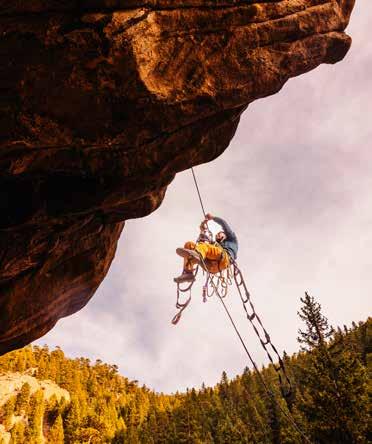
IN THE BACKCOUNTRY, A CHAIN OF SMALL DECISIONS CAN CARRY ENORMOUS CONSEQUENCES
BY VALERIE BRAYLOVSKIY
Only when the rope went slack did Donald Bearie know something was wrong. He was less than halfway down a climbing route in South Platte, Colorado, paused mid-rappel to clean a piece of gear. The rock blurred into bits of blue sky. For an instant, it felt like he was hovering. But he was falling.
“Take!” he yelled — a request in most climbing situations, now a futile plea to get some, any, tension on the rope.
He hit a ledge first. Both heels shattered. He ricocheted off the rock, instinctively jerking his shoulder up to shield his head. When his back struck the ground, something deep in his spine cracked. Dust rose around him.
“Everything’s broken,” he whispered. Aaron Sprengeler, on the other end of the rope, stood frozen, tears streaking his face. Bearie tried to stand. His legs buckled.
THAT SEPTEMBER MORNING in 2021 had started like dozens before. Bearie, 29, packed up his favorite climbing shoes — still dusty from the weekend before — and
OUTDOOR RECREATION’S CULTURE HAS LONG RESTED ON THE DOCTRINE OF ASSUMED RISK: YOU ACCEPT THE INHERENT DANGER OF WHAT YOU’RE DOING.
headed from his house in Denver to the climbing area about an hour away. An audio engineer working long hours at a recording studio in the city, he looked forward to Saturdays spent outside.
A self-described “Gumby,” he’d been climbing barely a year. Instead of starting in gyms or on bolted sport routes, he’d jumped straight into traditional, or “trad,” climbing, which requires climbers to place their own anchors to protect from falls instead of relying on permanent bolts.
His usual partners were busy on the day of the accident, so he texted Lauren Bourguignon, his ex-girlfriend, who was now dating Sprengeler, a longtime gym instructor. He also invited his new girlfriend, who’d never climbed outdoors.
The group had met at a dusty Interstate 70 pullout before heading into the Front Range. Dense pine forests thinned, revealing granite walls as Highway 285 wound deeper into the mountains.
By the time they hit Pine Valley Road, cell service had disappeared. Sprengeler picked the route. Classic Dihedral, a 5.7 he’d done
over half a dozen times. The route glowed in the afternoon sun, 160 feet of granite split by a crack running up the right like a crease in an open book.
The wall looked intimidating.
“Hey man, what do I need?” Bearie asked, tightening his helmet.
“Just the anchor and some cams,” Sprengeler replied. Then, almost to himself, he added that he wished they’d brought an 80-meter rope.
Bearie laughed. He didn’t ask why. He grabbed the 70-meter rope from Sprengeler and tied a figure eight through his harness. No one tied a stopper knot in the rope’s tail, a simple safeguard that prevents the rope from feeding entirely through the belay device. An hour later, that’s exactly what happened.
At the base of the route, Bearie lay crumpled but alive. Sprengeler sprinted toward the road until he found cell service, returning with rescue crews and a sheriff. When a helicopter circled overhead, Bearie refused an airlift — he’d recently canceled his insurance. The EMTs got him onto a stretcher and into an ambulance instead.
“What’s wrong?” Bearie asked a pale medic in the front seat. “Please, just tell me what’s going on.”
The man hesitated. He was a climber too and had done that route himself. Most people didn’t survive falls like this, he told Bearie. And the “golden hour,” the critical window to treat internal bleeding, was ticking down.
Bearie would survive, but as he spent days in the hospital — recovering from surgery with casts on all four limbs and in a back brace, unable even to use the bathroom — he replayed the day on a loop. Each tiny oversight, pieced into the worst day of his life. How had he forgotten the knot? How had Sprengeler, who knew the route, not realized the rope was too short?
OVER THE PAST two decades, America’s backcountry has become a playground for all. According to the Outdoor Industry Association’s 2025 trends report, more than
AS MORE AMERICANS PARTICIPATE IN OUTDOOR SPORTS EVERY YEAR, THE CHANCES OF SERIOUS ACCIDENTS INCREASE.
181 million people, nearly 60 percent of the population, participate in some form of outdoor recreation. Climbing, skiing, hiking and camping have seen record growth for nine straight years. The benefits are real: better health, lower stress. But safety is never guaranteed.
Outdoor recreation’s culture has long rested on the doctrine of assumed risk: You accept the inherent danger of what
you’re doing. Yet, with more entry points into the backcountry and myriad ways to be educated about how to stay safe out there, it’s increasingly unclear who fully understands those risks. Some learn from certified guides. Others from YouTube, friends or trial and error.
“At a young age, we think that nothing can go wrong,” says Ron Watters, a lifelong recreator and former director of outdoor
education at Idaho State University. “With time and experience, you learn that there are dragons out there, and you need to watch out for them.”
When a group ventures into remote terrain — into a canyon or steep slopes, down a whitewater river, up a mountain — each person brings their own experience and comfort with risk. In the backcountry, those differences can collide in unpredictable ways. A single misjudgment or lapse in communication can determine whether everyone gets home safely. Sometimes, accidents are unavoidable. But usually, they are the chain reactions of simple choices.
On February 15, a group of 11 skiers and four guides set out on a three-day backcountry trip to the Frog Lake huts near Lake Tahoe’s Castle Peak, despite forecasts of a major storm and an avalanche watch issued that morning by the Sierra Avalanche Center. Blackbird Mountain Guides assured participants that it would “manage the risks” and terrain navigation, as reported by The Associated Press. Two days later, as the group rushed back ahead of worsening conditions, an avalanche above 8,000 feet struck, killing nine people — the deadliest avalanche since 1981 in the United States.
Ever since the accident, the backcountry community, the families of those lost and even investigators have been trying to figure out what went wrong.
This kind of counterfactual thinking — trying to figure out how an outcome could have been different if different choices were made — can reveal a lot about an accident. In the weeks after Bearie’s fall, he was still trying to figure out where it went wrong. Certain details surfaced in his mind — Sprengeler distracted at the belay while arguing with another climber in their group, the rope brushing the ground during the climb. But it can also lay the groundwork for blame.
Online, Sprengeler posted that Bearie had fallen about 25 feet, blaming an untied knot and rushed safety checks. But climbers who returned to the route to retrieve Sprengeler’s gear estimated the fall
much higher, at least 75 feet. According to guidebooks, Classic Dihedral requires two 50-meter ropes for descent. A knot would’ve stopped the fall, but a 70-meter rope was always too short.
He never saw Sprengeler, who didn’t respond to requests for comment, again. A month later, they had a brief phone call where he apologized, the closest thing to closure Bearie would get. Back home, his mom and brother moved from Michigan to help him navigate daily life, taking shifts with his roommate to carry his wheelchair upstairs and help him shower. He didn’t work for three months.
But Bearie never considered suing. He knew mistakes were made. But he had agreed to that climb. He hadn’t tied the knot. He hadn’t questioned the rope. He may have been the Gumby, but he understood the risks.
In the United States, lawsuits typically target organizations — ski resorts, outfitters, climbing gyms — not individuals. After the Lake Tahoe avalanche in February, the Nevada County Sheriff’s Office and California’s workplace safety agency opened investigations into whether criminal negligence was involved and why Blackbird Mountain Guides proceeded with the trip despite recognizing the hazards. Although participants likely signed liability waivers, those agreements protect a company only from ordinary negligence, not gross negligence — a distinction that hinges on whether or not the company consciously and recklessly disregarded the likely harms of their actions.
“PEOPLE NEED TO UNDERSTAND THAT THEIR LIVES ARE IN THEIR HANDS.”
DESPITE AMERICA’S LITIGIOUS reputation, there are few cases of backcountry partners suing one another after an accident. But the line between what’s an accident and what’s negligence is being drawn. In 2025, a British climber sued his partner for $1.3 million, after a fall left him with a broken neck and the possibility of double-leg amputation, claiming the belayer let go of the rope. This past February, an Austrian court convicted a mountaineer of gross negligent manslaughter after he abandoned his girlfriend on Austria’s highest peak — she died alone less than 200 feet from the summit — sentencing him to five months in jail and fining him around $11,000.
Others have been held at fault for accidents that have led to deaths in the outdoors. In Austria, for instance, prosecutors identified nine separate mistakes made by the amateur climber that led to his girlfriend’s death — the most serious being his decision to take her on an alpine route the court determined was beyond her ability. But determining ability is somewhat of an abstract concept in the outdoors, when often you only learn that you are capable of something if you make it out safely.
Despite the squishy nature of liability in the outdoors, as participation grows, some Western states have determined it best to create new regulations and pass laws that shield against certain negligence claims before litigation takes precedence.
In Oregon, new laws have restored the legal power of liability waivers for ski areas, gyms and outfitters, allowing them to protect against lawsuits for “ordinary negligence,” and defined which activities qualify for protection on public and private land. Idaho’s SB1051, passed in March 2025, limits how or if people can sue licensed guides or outfitters, even if they’re harmed by negligent, reckless or intentional conduct. Bill sponsor and Idaho Republican state Sen. Todd Lakey has said that “we do these things in places or in ways that are inherently dangerous. But frankly, that’s part of the fun.”
Utah’s laws recognize the “inherent risks” of certain activities, and have recently expanded the rights for outfitters and guides to be protected by liability waivers, although, generally, the state operates under a modified comparative negligence rule — meaning that if a plaintiff is determined to be 50 percent or more responsible for their own injury by the courts, they cannot recover damages.
Most of the new legislation in the West minimizes the opportunity for personal injury or wrongful death lawsuits, because, can you regulate risk in an activity built on it? Many, including Bearie, doubt it.
“The only person that can keep yourself safe is yourself,” he says. “That’s the accountability you’re taking every time you go out.”
PETE TAKEDA HAS spent much of his life studying what goes wrong in the mountains. In 2009, he traveled to China to search for his friend Jonny Copp after an avalanche swept him away on Mount Edgar, a 21,713-foot peak summited only three times. By then, Takeda had nearly three decades of climbing experience from the Andes to the Himalayas. He and Copp had survived close calls before
together, as partners. But this time, Copp didn’t come home alive. Takeda and five other American climbers recovered his body from the debris and brought him back to Colorado.
More than a decade later, in 2021, Takeda became editor of the American Alpine Club’s annual “Accidents in North American Climbing” report, documenting se-
OTHERS HAVE BEEN HELD AT FAULT FOR ACCIDENTS THAT HAVE LED TO DEATHS IN THE OUTDOORS. BUT CAN YOU REGULATE RISK IN AN ACTIVITY BUILT ON IT?
rious incidents since 1948 to identify patterns that lead to accidents. Now overseeing the annual publication, he collects reports and firsthand accounts, traveling to big walls and mountain ranges to understand what can go wrong, and how to avoid making similar mistakes. Today, he says,
the leading cause of accidents isn’t equipment failure. It’s inattention.
He’s watched as outdoor sports have grown in popularity since the 1980s and ’90s, when he first started. Now, he says, participating in outdoor sports can resemble “an amusement park” — social, accessible and commercial. People can join at any level without fully grasping the stakes. When things go wrong, blame is easier than sitting with your own faults. Takeda says finger-pointing does little to prevent the next accident. Careful reporting and pattern recognition matter far more.
The goal isn’t to eliminate risk. It’s to confront what Takeda calls the outdoors’ central paradox: pushing our limits while recognizing how thin the margin for error truly is, before an accident forces that lesson.
“People need to understand that their lives are in their hands,” he says.
Some lessons crystallize only in the shadow of death. Bearie remained conscious through his rescue. His mind flickered through broken reels of memory. Growing up in Grand Rapids. Road trips with friends. Days spent with his brother. Every route he had ever tied into.
“That 45 minutes is the reason why I climb now,” he says. “Although it could’ve been the end of everything, it also showed me that life’s precious. You need to live it while you have the chance.”
Six months after the accident, he returned to climbing. But his mindset has fundamentally changed.
He reads accident reports. He triplechecks knots. He’s overprepared, sometimes overly communicative, and never hesitates to ask for clarification when uncertain about a route. Above all, he chooses partners carefully, going out with people he trusts on and off the rope.
In December 2024, more than three years after the fall, he returned to Classic Dihedral with his roommate to finish the route. The sky was the same deep blue. The slab smelled of pine sap and sun-warmed dust. But it no longer loomed so large. This time, they brought two ropes.
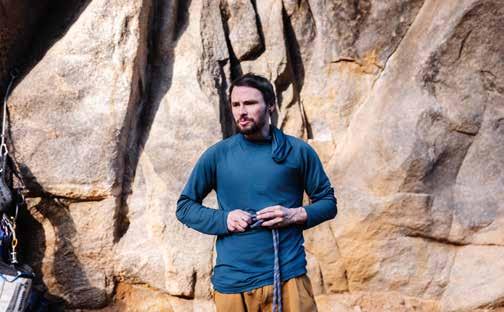
DONALD BEARIE, WHO WAS SEVERELY INJURED WHILE CLIMBING IN 2021, SAYS HE ASSUMES THE RISK OF CLIMBING.
the price of play
in the shadow of america's new youth sports machine, families weigh the cost of athletic dreams against the fear of not doing enough
by ethan bauer
photography by christ chavez
ready felt
allate in the day for Auggie Valladares even though it was still midmorning. He sat at a tall table under dim lighting, up against the wall of an indoor batting cage in Las Cruces, New Mexico. In the next room, his daughter, Amaya, hurled heaters and change-ups into a catcher’s glove. Pop. Pause. Pop. From where he sat, he could hear it but couldn’t see it.
He knew well enough what it looked like. Amaya, a left-hander with bangs cut just above her brows, was working hard. Windmilling pitch after pitch to perfection. He rarely misses the chance to see her do it, even though sometimes he wonders why.
Between softball and basketball, Amaya practices upwards of 10 hours per week. Tournaments take the family around the country most weekends. Auggie, who works in heating, cooling and refrigeration
at a nearby NASA facility, estimates they spend $7,000 annually, “if not more.” His wife, Hope, works for a health insurance company and has taken a second job working concession stands. And this morning, he’s been up since 3, because last night they were five hours away in Midland, Texas, for an All American team tryout and had to get back to Las Cruces in time for a 10 a.m. practice. He knows the sacrifices he and his family are making for softball are bound to prompt questions. “Why are we so into this?” Auggie asked, tugging at his gray goatee on that morning in early March. “Why are we spending all this money?”
I’d come to Las Cruces because I had similar questions. My son is only two, so my questions aren’t as urgent, but my wife and I know we’ll need answers soon enough. Both of us grew up playing sports, and we AUGGIE VALLADARES AND HIS FAMILY TRAVEL TO A DIFFERENT
want our son to have the chance to play, too. But we also want his experience to be better than ours. Amaya Valladares’ team from Las Cruces, the Aftershock, seemed like a good model of what to anticipate, though admittedly an extreme one.
According to United States Specialty Sports Association rankings, the Aftershock finished the 2025 softball season with an overall record of 100-30-2 — a slate just 30 games shy of a Major League regular season. Their success gave them the highest points total of any 10-and-under B Division team in the country, crowning them official national champions, with bejeweled rings to prove it. Perhaps, by spending a day
with them, I could learn something about the journey ahead, for better or worse.
I’d heard plenty about the worse. Youth sports are too expensive, critics say. Too exclusive. Too demanding of kids who just wanna have fun. The complaints are legitimate. Families are spending nearly $1,500 per child per year on average, with families earning over $100,000 spending more than $2,300 per child. Even just between 2019 and 2024, average family spending on their child’s primary sport rose 46 percent — a rate far exceeding inflation — as the U.S. youth sports industry’s total annual revenue reached $40 billion. And while it could be tempting to roll your eyes and
AMAYA VALLADARES, STAR PITCHER OF THE AFTERSHOCK, TAKES A PRACTICE SWING IN THE BATTING CAGE.
Between 2019 and 2024, average family spending on youth sports rose 46 percent — a rate far exceeding inflation.
blame the “crazy sports parent,” a trope that certainly exists, the truth of today’s youth sports insanity is much more complicated. Most parents are not Earl Woods or Marv Marinovich. Most parents just want their kids to have fun, compete and learn about winning and losing. Most parents just want to give their kids an opportunity to play, period. A 2025 Aspen Institute survey found that half of parents felt pressured to have their kids specialize in one sport early — not to play in college or go pro, but simply to make their high school team. Many of them eventually brush up against the same questions Auggie has. That I have. Where’s the sweet spot between enjoyment, access
and not pushing too hard if the kid isn’t into it? What’s really necessary for a kid to keep playing? How much investment should that require?
Watching Amaya hone her pitching skills in the cage, some of those questions dissolve. Look at her focus. Look at her slinging that grapefruit-sized yellow ball at top speed. Look at the determination in her eyes; you can almost see her desire to keep playing in college someday. But who knows? Amaya is 11. For now, she’s one of the taller girls on her team, and she dominates. Yet the stats aren’t in her favor. Only 1.6 percent of high school softball players reach the NCAA Division I level, much less a powerhouse like her dream school, the University of Oklahoma. At 11, sure, dream big. Why not? But what if it doesn’t work out?
Would all this tournament-chasing and title-winning still impart the life lessons and lifetime of memories common to youth sports in generations past? Or would the wallet-busting pursuit of achievement end up consuming Amaya’s childhood, my son’s childhood and every parent’s sanity?
IT WASN’T ALWAYS this way.
The system was genuinely different in the 1980s and ’90s, says Jon Solomon, community impact director at the Aspen Institute’s Sports and Society program. Local, recreational competition took priority, with much more room for unofficial, kid-led pickup games, “The Sandlot” style. Travel sports existed, too, but of a lesser magnitude, with most taking place within an hour’s drive and perhaps one big tournament per year. “These days, of course,” Solomon says, “you can be traveling every weekend.”
So what changed?
Solomon points to milestones like the opening of Disney’s Wide World of Sports complex in 1997. That facility began hosting major youth tournaments, which brought kids and parents from all over down to Florida for vacation. Municipalities across the country took notice and started investing in their own sports complexes to draw out-of-state club teams, a new revenue driver, “viewing children as a tourism (and) economic engine,” Solomon said. The Great Recession of 2008 became an
THE AFTERSHOCK, OF LAS CRUCES, NEW MEXICO, COMPETE IN ELITE-LEVEL YOUTH SOFTBALL TOURNAMENTS ALL OVER THE SOUTHWEST AND BEYOND.
accelerant, with many local governments cutting back on recreational sports.
It was right around this time that my own youth sports journey was winding down. I was not an athlete of any particular ability, but I loved playing — particularly baseball. I started in second grade with a coach-pitch team at a league run by my Catholic elementary school. The league was fun and simple; not quite the suburban idyll of “The Sandlot,” but closer than much of what exists today. Yet “fun” didn’t make me a very good baseball player. I didn’t make my school’s team in fifth grade, nor in sixth, at which point I abandoned baseball altogether.
My wife, meanwhile, played competitive club softball for most of her life. She traveled to faraway tournaments, from Disney World to Colorado. She played on her high school team. She talked with college recruiters. She loved softball. She also hated softball, depending on the day. It was demanding, and she’d moved teams several times, leaving her with few close friends in the dugout. By the time college arrived, she was done with it.
would all this tournamentchasing and title-winning still impart the life lessons and lifetime of memories common to youth sports in generations past?
Looking ahead to our son’s youth sports future, we don’t want him to get burnt out like her, nor do we want his opportunities to be limited like mine. But today’s landscape is much more complicated, and commercialized, than it was even back then. Private equity has started pumping even more money into youth sports of late, viewing it as a reliable investment opportunity. The industry’s annual $40 billion revenue is more than the NFL and Major League Baseball combined. Travis Snider, a former first-round MLB draft pick who spent eight seasons in the Majors, now leads 3A Athletics, a company that promotes a new path for youth sports. The way he understands it, the youth sports industry is awash in bad incentives. “I don’t think all the ideas behind monetization are cruel and evil,” he told me, “but I think this thing has really taken off in a direction where it’s tough for (stakeholders) to really separate what is best for the kid and what is best for the financial health of the program.”
What Solomon sees in all these anecdotes and all this data is a story of a hollowed-out middle. “There’s almost like a middle space that’s missing,” he says, “in between the highly competitive travel sports environment
versus the really local, beginner programming.” Steve Magness, one of the world’s top long-distance running coaches, blames parental “safetyism” that ultimately prioritizes control and monetization. But parents struggle to make any sense of the system to begin with. Many parents don’t want the system we have but feel like they have to play the game — or else. “I don’t blame (them),” Solomon adds, “because they’re entering into a very fragmented, confusing youth sports system that has pretty much no regulation. It’s hard to understand the right pathway.”
BACK AT THE indoor batting cage, I met David Melendez, known as “Chubbz” to the girls when they’re not calling him coach. He’s 36, short and stocky with a goatee and a perpetual ballcap. He got into this as a volunteer T-ball coach for his daughter, then decided to go out on his own. “I felt like I could make a difference and elevate these girls to another level,” he told me. “I fell in love with it. It’s everything I always wanted for the kids, and I treat them like they’re my kids.” Auggie feels like that’s appropriate. “He’s a kid himself,” he said. “He makes it fun.” Chubbz has been bringing the Aftershock to this facility, The ClubHouse, since it opened in 2020. “They work hard, and they’re in here all the time,” ClubHouse owner Luisa Solorzano told me. “We’ve seen the kids grow.”
Amaya most of all. “(She) started doing lessons with my daughter when we first opened,” Solorzano said, “and she was teeny tiny.” Amaya actually played basketball first, starting when she was two. One night Auggie asked if she also wanted to play softball. She said no. He asked a few more times over the next few years, and around the fourth time, she finally said yes. She started playing at five, with a squad called the Nitro Cuties. When that team disbanded, Auggie found the Aftershock, and they’ve never left. It’s been six years now, and his phone’s camera roll overflows with evidence of her progress.
One clip from the All American tryout in Midland — the one that caused him to wake up at 3 that morning — shows her wearing
AFTERSHOCK COACH DAVID MELENDEZ, AKA “CHUBBZ.”
a tucked yellow jersey, staring down the hitter. No pause, no deep breaths, just right into it: The hitter hacks halfway, and misses. Not even close. Next a called strike. Then a change-up, fouled off. Barely. Zip — a fastball, swing and miss, strike three. These days, her heater tops out at 49 miles per hour. She still plays basketball, but softball reigns supreme. To Auggie, it’s been obvious since the beginning. “That was it,” he remembered of her earliest days playing softball. “She fell in love with it.”
The trophies and medals Amaya has amassed — somewhere around 70, her father guesses — fill the Valladares home. So many championship and MVP rings that she needs two display cases. In a nook of the family living room, a statue of the Virgin of Guadalupe presides over a stack of softballs. Amaya prays before and after every game. She tries to be grateful.
Not only for all these physical manifestations of success, but most of all for the pieces that aren’t so visible. The friends, the travel, the purpose softball gives her. In the cages this morning, to an unknowing observer, she’s just another pitcher. But in her mind, when she’s in there, she’s the pitcher, destined for greatness at OU. She says so all the time. She even scrawled it on a piece of paper and taped it to her parents’ refrigerator. Just like her dad said, she fell in love with softball, and that’s why she plays.
AMBER CORRALES, WHOSE daughter joined the team last year, lives across the state border in El Paso, about 40 minutes from The ClubHouse on a good day. She makes the drive twice a week for softball — and twice a week for basketball practice, too. Most of these girls are multisport athletes, including several wrestlers. The calculus for Amber, and for all the others who spend weekends schlepping to and from some tournament, is simple: “She’s happy,” Amber said. “And the competitiveness, the coaches, the environment, the culture — it’s unlike any other team.” Yet when I asked whether it ever feels overwhelming, just about every single parent nodded.
Auggie’s wife, Hope, told me they’d just had a conversation about it this morning on the way back from Midland. “As a mom,” she’d said, “you don’t realize what we take on.” Hope also recently started that second job working concession stands through a special program that allows her to use her income only for her daughter’s sports expenses; she has to document how she’s using the money with receipts. All of them, it seems, exist in a near-perpetual state of fundraising.
From across the circle of parents, Bernice Barela leaned on a cane and spoke as a grandparent. The difference between raising her own children in youth sports versus
A NOOK IN THE VALLADARES FAMILY HOME. AMAYA PRAYS BEFORE AND AFTER EVERY GAME.
watching her granddaughter, she said, cannot be overstated. She stands in awe of her granddaughter’s dedication, which Barela attributes to the demanding nature of modern youth sports. But she’s just as awed by the parents. “I don’t know how they manage these days, with all the competition and the traveling and the expenses,” she told the group. “I just give them a lot of credit.”
When this is all over, Auggie hopes Amaya will pay it forward with her own children. That she’ll say, “My parents did this for me. I want to do this for my kids.” It’s a very natural impulse.
“We, as parents, want to see our children succeed, and one very public arena of success for young people is sport,” said Travis Dorsch, a former NFL placekicker who now leads the Families in Sport Lab at Utah State. “It’s easy to post on social media, and it reflects well upon us as parents.” And that’s fine, as long as the child is still taking the lead. “We shouldn’t dissuade young people from having big goals. I love that,” Dorsch said. “At the same time, we have to recognize what the odds are of those kids making it, and ensure that … there isn’t an expectation of some return on investment.”
But a return on investment can take many forms. After I finished talking to the circle of parents, I headed into the cages, where practice was humming along at four different stations. Chubbz tossed batting practice
lobs from behind a net. Metal bats clanged and leather gloves popped. Veronica Garcilazo, a mother wearing a $30 custom-made Aftershock hoodie, lamented the expenses. She’s a pharmacy tech. Rachelle Serna, seated beside her, is a middle school social studies teacher. Assistant coach Juan Gomez is a K-9 unit police officer. It’s sometimes a stretch to make this work. But when it does, they agreed it’s sublime.
It’s Chubbz lobbing soft tosses and offering encouragement. It’s their daughters running an agility relay race to close practice — diving over each other, running into each other. It’s setting up a bounce house for an afternoon birthday party at The ClubHouse, then taking a spin inside themselves. The investment doesn’t have to be out there somewhere. It can be right here, right now — as long as they don’t lose sight of what’s right in front of them.
AFTER PRACTICE, THE team had lunch together at the astroturfed back patio of a sports-themed grill across town. I sat down beside two 11-year-olds who were absolutely kinetic: Kaitlyn Barela wore braces and tortoiseshell transition frames and a necklace announcing her nickname, “Honey”; Autumn Corrales was taller with hoop earrings, her hair held back in a ponytail. Amaya sat at a table with the other girls, picking at plates of nachos and tossing fries into
one of the casualties of the move toward a more commercialized model has Been the erosion of free play.
fellow players’ mouths. Aftershock kids and parents get together like this all the time. It’s part of their success, they say: the bonding that comes from so many practices, games and tournaments together. From all those moments in between.
If success is measured in wins and losses alone, it’s hard to argue. The Aftershock is a national championship-winning team, and coach Chubbz is proud of it. “We teach them to be dawgs,” he told me. “We teach them to challenge each other, to compete.” Sometimes they’ll organize bouts of tug-of-war. Pushup competitions. Relay races. Because nothing — nothing — matters more than competition. “Everything’s a competition,” Chubbz explained. “There’s no participation awards. It’s a competition because everything in life is a competition as soon as you step up.”
That’s often how adults frame it, but kids tend to disagree. “When we survey youth around the country, the top reasons they tell us for why they play sports are to have fun and be with friends, by far,” Solomon says. “Winning ranks lower.”
Sure enough, “I like the bonds we get to make, and all the friends,” Honey said when I asked what she loves most about softball. “It’s just — it’s something I can look forward to.” Autumn agreed. “Just being around the girls and making these special relationships with them,” she added, “and just having fun.” Amaya also said nothing about winning. She liked getting to play with her friends — and, actually, traveling to faraway tournaments with her parents and friends on the team. Yet winning, whether the girls realize it or not, might just be the engine that enables the rest of it.
The Aftershock, unlike many successful youth sports programs, is not part of some conglomerate or national chain of clubs with different squads filling slots at every age. It is its own entity, which will disband when these girls are done playing. That’s a refreshing throwback to an earlier era, but it also makes the team vulnerable. Larger entities sometimes try to lure away their
players. Winning helps swat those entities away, and for that, parents and coaches alike are grateful. “For me, that’s just not what I wanted for my daughter,” assistant coach Efren Corrales, Autumn’s dad, said of the bigger clubs. They’re too serious. Too concerned with perfection — and with consequences. It starts looking like a job. “They have to perform well,” he said. “Here, there’s really no consequences.”
That also leaves plenty of room for pure enjoyment, even if the players can feel just as overwhelmed as their parents. “Sometimes it’s fun,” Honey told me, “but on days when you’re really tired, it’s like, ‘Softball practice? Ugh. I just wanna go to sleep.’”
Sometimes they’d rather imagine their futures. Honey wants to be an anesthesiologist, or a lawyer. Autumn would like to work helping people, maybe as a therapist. Amaya, meanwhile, sees herself as a future college softball player.
Or maybe a teacher, perhaps of reading or P.E.
NEW MEXICO STATE University’s softball complex mimics the desert that surrounds it: sparse, understated, unassuming. Yet like in the real desert, looks can be deceiving; what appears somewhat barren and minimal can teem with life. After lunch that Saturday afternoon, a pair of 11-year-olds stood at the stadium’s gate sporting matching purple jerseys pressed with “Aftershock” and bedazzled blue jeans. They’d gathered to attend a college softball contest between New Mexico State and Louisiana Tech, but also to receive the biggest prize of their young lives.
Soon more kids arrived wearing those same jerseys. Five of them spilled from the back bench of a bright-red Toyota Tundra driven by Chubbz, then dashed toward their friends, running to the rhythm of the stadium speakers blasting “Suavemente” by the Puerto Rican pop star Elvis Crespo. After parking, Chubbz hurried over himself in square-toed cowboy boots, carrying a pair of plastic Ziploc bags.
Inside the stadium, the girls in purple jerseys, by then numbering 12, gathered behind the third-base dugout. Coach Chubbz called on one girl named Delina. Then he called on Amaya. He told them to face each other for a game of rock-paper-scissors. The winner would get to throw out a ceremonial first pitch.
“Frick!” screamed Delina.
Amaya would take the mound.
She felt nervous right away. The stands were packed with several hundred people, and they’d all be watching her. She wanted to deliver. Even in her off-day Uggs and jeans, she wanted everyone to see the best version of herself. But she only had one chance to get it right.
AMAYA AND THE AFTERSHOCK WERE
THE NO. 1 RANKED 10-AND-UNDER GIRLS SOFTBALL TEAM IN THE UNITED STATES IN 2025, AND WON THE USSSA SOUTHERN NATIONALS.
No matter. She’d faced pressure before. Last year, in a tournament representing the state of New Mexico in Florida, she faced a 3-1 count in the fifth inning, with runners on first and third, two outs, tied at seven. She needed to get back in the count to keep her team in the game, and she’d done so. She calls it her proudest softball moment. Overall in that tournament, she struck out 33 while allowing just two hits and no earned runs. “She’s a natural,” Auggie told me, and what a thrill it’s been to see her grow into her God-given talent. But there’s something else.
That morning, back at The ClubHouse, Auggie had said so. They’re really here, spending all this money, all this time, because of something few parents readily admit.
Because of fear.
Where would his family be if not here? Watching TV? Sitting on the couch? Without all this, Auggie believes his daughter’s opportunities would be squandered, and like a lot of parents, that ranks among his greatest terrors. Besides, look at the day they’d had. What softball-loving kid wouldn’t want to be at a first-rate facility on a Saturday morning, have lunch with her teammates in the afternoon and attend a college softball game where she’s the guest of honor at night? What parents wouldn’t want this for their kid? And if it squashes that pesky, lingering fear of not doing enough, well, all the better. “It makes mom and dad feel that much more confident,”
Auggie told me, “that she’s gonna give the same effort in life as she gets older.”
I want my son to at least have the option of playing in high school, if he wants to, and I’m afraid that if I don’t start early, he’ll lose that chance. But I’m also not so sure about the tradeoff of turning play into practice. When you’re practicing 10 hours a week and playing in tournaments every weekend, it doesn’t leave much time to do anything just because, and that’s really how I want him to see sports: something you do because you want to, rather than as a means to a hypercompetitive end. The trick is striking a good balance. Amaya is clearly on track to make her high school team and then some. She has high goals for herself, including playing on a college field like this one. She admits it’s challenging, “just going from place to place, practice after practice.” But is it worth it? “Yes sir,” she said. Because it leads to moments like the spirited rock-paper-scissors match, and what came next.
“C’mon, ladies,” barked the guy running things. He led them onto the field. Chubbz followed, still carrying those plastic Ziploc bags. Amaya toed the rubber in her off-day Uggs, wound up and tossed a leather-popping strike. Mission accomplished. Sort of.
“No!” she said upon jogging off the clay, a half-smile stretching her lips. “I got my Uggs dirty!”
THE GIRLS SETTLED into the back row of the bleachers as the game between the Aggies and Bulldogs began. I sat in the front row next to Chubbz. We were all waiting until the end of the third inning, which is when the contents of those Ziploc bags would be distributed.
The moment arrived quickly. A video board displayed a photo of the Aftershock, and the PA announcer welcomed the team, listing off its accomplishments. National champions. State champions. Then, with enthusiasm: “Please welcome Kaitlyn Barela!” The guy running things reached into the plastic Ziplocs to hand her two shimmering title rings. One of them fell, but she kept walking and didn’t look back.
That happened a few more times as the announcer hurried through the list of names. The actual rings, provided by the USSSA, were too big for most 11-year-old fingers. The girls put them on anyway, flashing their new bling for pictures. The whole thing was over in about a minute.
Back in the stands, I joined the girls to watch the game. They seemed to care little if at all. They were too busy going nuts for the chance to snag a free T-shirt, sneaking away to record TikTok dances, chasing down a rogue foul ball. Between distractions, they munched on Sour Patch Kids and Van Holten’s Pickle-in-a-Pouch, which soured the air with vinegar. “They’re gas,” Honey told me, which I took as young-person slang for something between “cool” and “exceptional.”
Now this reminded me of my own youth sports experience, and what made those memories special. Not the winning or the trophies, but the moments in between. The postgame trips to Pizza Hut, the way we’d practice our victory handshakes even when we were losing. The way the girls eventually started getting more invested in the game, together.
The Aggies soon took the lead, then sealed it. With many adults clapping tepidly from beneath blankets and hoodies, the girls stomped the bleachers, none of them wearing so much as a light jacket.
After the game, a few of them found their way onto the field, running up the first-base line, laughing all the way. They followed that up with some cartwheels. With another TikTok dance. When the sun had vanished and the temperature was still dropping, the girls kept running, still sweaterless, their laughter echoing off the empty bleachers.
Who wouldn’t want this for their kid, I thought. I have no idea whether that means I’ll end up becoming a good sports parent, or just another sucker who’s lost the plot. “Aren’t you guys cold?” I asked at one point. They looked at me like a teacher who’d said algebra is “gas.” Of course they weren’t cold. They were just getting started.
A HOUSE DIVIDED
the Heritage Foundation once de ned what it meant to be conservative. but as populist forces reshape the right, its traditional gatekeepers are losing control
By
SCHULZKE
ERIC
Illustration by PETE RYAN
Awarm, gusty wind was whipping through Washington that morning, rattling the bare branches along
Massachusetts Avenue and sending scraps of paper skittering down the sidewalks. The National Weather Service had issued a red-flag warning — gusts up to 45 miles an hour in air so dry that any spark could run. The sky had that washed-out autumn glare that makes the city feel brittle.
Inside the Heritage Foundation’s headquarters, the air felt just as charged.
The all-hands meeting had been called in the foundation’s main conference room, paneled in dark wood. Roughly 200 chairs faced a small stage, where deep blue curtains framed a marble backdrop, lending the room an institutional gravity, as if it were an annex of the U.S. Capitol a few miles away. By the time the meeting began, every chair was filled and staffers who couldn’t get a seat stood in the back.
A bitter internal dispute had erupted inside the conservative think tank — one that pitted Jewish staff members and their allies against younger nationalist colleagues. Six days before, on October 30, 2025, the Heritage president had posted a video defending the foundation’s close ties to Tucker Carlson, the former Fox News host who had
recently come under intense fire for hosting extreme figures on his popular podcast.
Rather than disavowing Carlson, or the figures he’d platformed, the Heritage president, Kevin Roberts, had doubled down. Now he stood at the front of the room, hoping to calm the maelstrom before it devolved into open mutiny.
“This old professor wants to have office hours with you,” he said, smiling faintly.
He assured the staff that there would be no recriminations. Tough feedback was welcome, he insisted. Turning slightly, he gestured toward Richard Stern, at the time the Jewish director of Heritage’s federal budget program, who sat in the first few rows.
“I think Richard Stern has proved that over the last few years,” Roberts said.
Then, addressing Stern directly, he added, with a tone that was meant to sound jovial, “If I may, sir … I not only don’t mind it. You’ve probably discovered I kind of like it.”
The room was silent, not even a ripple of nervous laughter. The tension hung — palpably unbroken for a beat or two. Then he opened the floor to questions.
For some time, Carlson had been problematic for Heritage. Since leaving Fox News in 2023, his influence within segments of the conservative movement had, if anything, grown. Unbound by network constraints, he now leaned fully into conspiracy theories. His podcast increasingly featured figures and ideas Fox would never have allowed. Carlson hosted Daryl Cooper, who has promoted Holocaust revisionism and narratives sympathetic to Adolf Hitler. He welcomed Alex Jones, the Infowars founder whose conspiracy theories include claims about global cabals controlled by Jews.
All of that was already festering when Carlson hosted the far-right provocateur Nick Fuentes, an openly antisemitic podcaster who has said “Jews have no place in Western civilization” and that women should not have the right to vote. Fuentes once mocked the Holocaust — asking how long it would take the Cookie Monster to bake six million cookies — and he openly embraces authoritarian imagery. “My problem with Trump,” he had said in one podcast, “is that he is not Hitler.”
Fuentes touched on some of these themes in a rambling dialogue with Carlson
in which he professed his admiration for Joseph Stalin. Carlson listened respectfully and didn’t push back.
To many long-time Heritage employees, including some of the most prominent policy analysts, the interview crossed a line. Heritage had spent significant sums advertising on Carlson’s podcast. Carlson himself had been the keynote speaker at the foundation’s lavish 50th anniversary gala in 2023.
But instead of disavowing Carlson or even distancing Heritage, Roberts had released a video defending him. Carlson, he said, would “always be a close friend of the Heritage Foundation.” His critics, on the other hand, belonged to a “venomous coalition” and a “globalist class.” And while he said he abhorred some of Fuentes’ views, he declined to condemn Carlson for giving them a platform. Twice, he invoked Christianity to frame his defense of Carlson.
Now, in the conference room that windy morning on Massachusetts Avenue, those words hung in the air — unspoken but unmistakably present — as Roberts opened the floor to questions. A hand shot up. A veteran of the foundation spoke next, invoking William F. Buckley, a lion of the
What was unfolding inside Heritage was not just an internal dispute but rather a fight over the future of the conservative movement.
SINCE LEAVING FOX NEWS, TUCKER CARLSON HAS INCREASINGLY PLATFORMED FRINGE VOICES ON THE RIGHT WHO ADVANCE EXTREME AND RACIST THEORIES.
WHEN HERITAGE PRESIDENT KEVIN ROBERTS STOOD BY CARLSON, RATHER THAN CONDEMNING HIM FOR HOSTING THE WHITE SUPREMACIST NICK FUENTES ON HIS SHOW, IT CREATED A FUROR INSIDE THE HERITAGE FOUNDATION.
conservative movement, who had insisted conservatism must expel its “lunatics.” As an example, he brought up David Duke, the Ku Klux Klan grand wizard whose brief ascent within the Louisiana Republican Party in 1989 ended in total repudiation. “Did we cancel David Duke? Yes. You don’t even know who David Duke was, probably most of you,” he said to junior staffers, some of whom were in their early 20s.
From there, the meeting devolved into a fracas. Jewish employees and their allies said bluntly that the institution they worked for was now amplifying figures who trafficked in antisemitism, echoing his warning. Younger staffers aligned with the movement’s rising nationalist wing pushed back, arguing that their religious convictions and anti-interventionist views were being unfairly policed and that legitimate disagreements over foreign policy were being recast as bigotry.
At one point, the argument turned to a Shabbat dinner suggested as a gesture of solidarity with Jewish colleagues. A young Catholic staffer said he could not attend, explaining that Fridays were reserved for “prayer” and “abstinence.” He also worried the dinner might become an “informal litmus test.” Victoria Coates, a senior Heritage official who co-chaired the foundation’s antisemitism task force, called that claim a “gross mischaracterization,” saying he had twisted what was meant as a “generous offer” into a “personal attack.”
As the disputes droned on, Roberts tried to hold a stoic face while gripping his hands tightly together. He had called the meeting in hopes of restoring his squandered authority, but little that transpired seemed to confirm those hopes. That afternoon, to no one’s surprise, the leaked full video of the two-hour meeting appeared on the Washington Free Beacon website.
Many conservatives inside and outside Heritage saw the leaks as justified, even necessary, because what was unfolding inside Heritage was not just an internal dispute but rather a fight over the future of the conservative movement.
For half a century, the Heritage Foundation has shaped conservative thinking — translating ideology into policy, staffing Republican administrations, influencing judicial selection, and, at critical moments, deciding which ideas and allies belonged inside the coalition and which did not.
From Ronald Reagan to Donald Trump, no think tank in Washington has exerted more influence (Heritage, after all, was the architect of Project 2025, the policy blueprint for a second Trump presidency).
The institution that had long enforced the movement’s boundaries was struggling to define them. Facing a frayed staff on that gusty November morning, an embattled Roberts tried to contain the damage. He acknowledged a “terrible choice of words” and his use of antisemitic “tropes.” He blamed the video on his since-demoted chief of staff. He said he had not known Fuentes’ body of work. He did not accept blame, nor did he call out Carlson.
Once the video of the two-hour meeting leaked, the fallout was immediate. The Atlantic described the episode as a conservative movement “convulsed” by its own contradictions, while The Wall Street Journal warned
WHEN CHARLES LINDBERGH (CENTER) SPOKE AT MADISON SQUARE GARDEN IN OCTOBER 1941, WILLIAM F. BUCKLEY FOUND IT “TERRIBLY EXCITING.” ONLY LATER WOULD HE RECOGNIZE THE DARKER UNDERCURRENTS OF LINDBERGH’S AMERICA FIRST MESSAGE.
that Carlson’s embrace of Fuentes had triggered an “earthquake” inside the right.
Across the conservative movement — among think tank staff, donors, pundits and elected officials — the same question was beginning to surface: What, exactly, did the label “conservative” still mean, and who had the authority to define it?
ON OCTOBER 30, 1941, Charles Lindbergh took the stage at Madison Square Garden, the cavernous arena packed with 22,000 supporters of the America First Committee. Thousands more stood outside in the cold, listening over loudspeakers as his voice echoed through the streets of Midtown. Inside, the crowd rose in waves — applause rolling up toward the rafters, flags and placards lifted above their heads.
Somewhere in the audience sat an adoring fan: William F. Buckley Jr., a lanky teenager with a wide, toothy grin and a penchant for tailored clothes, weeks shy of his 16th birthday. “It was all terribly exciting,” he would later recall.
Buckley, who would go on to found the National Review and become the de facto gatekeeper of American conservatism, had already started an America First chapter at his high school in Sharon, Connecticut.
Buckley may have been too young to grasp the darker side of Lindbergh’s appeal. Weeks before the rally, Lindbergh had warned that the push toward war came from “the leaders of both the British and Jewish races,” adding that Jews wielded outsized influence over American media and government. The speech triggered national denunciations and threatened to fracture the anti-war coalition.
Pearl Harbor ended America First overnight. What remained was not a movement so much as a loose collection of impulses: hostility to FDR and the New Deal, Midwestern isolationism, Southern resistance to integration, suspicion of international institutions, religious traditionalists, philosophical libertarians, and country club conservatives. After two years in the Army and four at Yale, Buckley set out to bring those strands together. The challenge was
WILLIAM F. BUCKLEY, FOUNDER OF NATIONAL REVIEW, BELIEVED ONE OF HIS ROLES AS AN INTELLECTUAL LEADER OF THE CONSERVATIVE MOVEMENT WAS TO POLICE ITS FRINGES.
the insurgent movement William Buckley had fought to shape was no longer scrappy. It had money, real estate and a permanent address in Washington.
not simply to unite these factions but to decide what did not belong.
Buckley’s answer was enforcement.
In 1955, with the founding of National Review, he set out to define the boundaries of American conservatism — who was inside the coalition, and who had to be kept out. That required drawing lines against figures whose rhetoric or ideas threatened to discredit the movement.
He began with the fringes. When The American Mercury, once a respected conservative journal, drifted into open antisemitism, Buckley severed ties, barring anyone from serving on both mastheads. He refused to give oxygen to Jew-hatred.
He moved next against conspiracists. In 1962, he publicly confronted Robert Welch, founder of the John Birch Society, after Welch accused President Dwight Eisenhower of being a communist agent. Anticommunism, Buckley insisted, had to remain grounded in reality. Otherwise, the movement risked becoming what he called a “lunatic asylum.”
These decisions carried real costs. The Birch Society had thousands of members and deep grassroots energy. But Buckley understood the tradeoff. Influence required credibility. And credibility required boundaries.
He did not always draw those boundaries cleanly.
In 1957, National Review defended segregation in the South, arguing that federal intervention was unwarranted. Buckley later repudiated that position, acknowledging that he had been wrong and that federal
action had been necessary. The episode revealed both the limits of his judgment and the difficulty of holding together a coalition built from incompatible parts.
Even at his peak, Buckley never fully resolved those tensions. In 1963, he set out to write a definitive statement of conservative principles. After two months and 60 pages, he abandoned the effort. As his biographer Sam Tanenhaus discovered when he examined the manuscript, Buckley’s problem was that he “didn’t know where to begin.” The failure became “the single greatest disappointment in Bill Buckley’s intellectual life.”
BY 1970, the conservative coalition was gaining momentum. After the GOP nomination of Barry Goldwater in 1964 — and especially after Ronald Reagan became governor of California in 1966 — real power appeared within reach. But translating electoral victories into governance is another matter.
A set of allies in the business world had already begun working out that problem, and had begun laying the policy groundwork. In 1938, a group of New York businessmen opposed to the New Deal launched the American Enterprise Association, which produced studies on taxes, housing, regulation and labor policy, distributing them to congressional offices, not as manifestos but as usable analyses. In 1962, it renamed itself the American Enterprise Institute for Public Policy Research. It built on what Buckley had started with National Review but took it a step further, translating ideas into governing tools.
This represented a breakthrough, and yet, as influential as AEI would become, it could also frustrate policymakers.
In the spring of 1971, for example, a young GOP congressional aide named Ed Feulner watched his side lose a heated floor debate over the supersonic transport, or SST. The next morning, a detailed study arrived on his desk — fully persuasive and completely useless because it arrived too late. When Feulner called the think tank to ask about the delay, its president replied that they “didn’t want to try to influence the vote.” The tardy paper is widely understood to have come from AEI. Feulner drew a lesson. AEI knew how to get the policy right. The institution he would build would make sure it got there before the vote.
Feulner imposed the “briefcase test”: policy papers short enough to fit in a congressional briefcase and be read during a debate. In emergencies, the think tank produced one-page memos within 24 hours.
Occasionally, the briefcase burst. When Ronald Reagan won the presidency in 1980, Heritage handed him a 20-volume, 3,000-page handbook titled “Mandate for Leadership,” with more than 2,000 recommendations. At his first Cabinet meeting, Reagan distributed the massive “Mandate” to his Cabinet secretaries.
Heritage opened its headquarters in 1983, two years after Reagan took office. The insurgent movement Buckley had fought to shape was no longer scrappy. It had money, real estate and a permanent address in Washington. It had moved from the margins to the center of power.
The “Mandate for Leadership” would become a governing blueprint. By Heritage’s own accounting, roughly 60 percent of its recommendations were adopted or attempted in Reagan’s first year. Roughly 15 Heritage staff moved into roles across the administration.
And yet, the relationship was at times tense. One Reagan official described Heritage as both “very helpful” and “a hindrance,” the White House guest who sleeps on the couch and criticizes the cooking.
Heritage didn’t just advise — it evaluated, publicly grading Reagan’s performance against conservative priorities (The Washington Post reported that the new Heritage report card scored Reagan at “about 60 percent” his first year).
The tension was a sign of something larger. The movement Buckley had tried to discipline now had an institutional engine — one capable of shaping policy, staffing government and enforcing expectations from the outside.
For a time, it worked. And then came the end of the Cold War. The question was no longer how to govern. It was what the movement actually believed.
THE BUCKLEY-REAGAN COALITION was built on a shared commitment to free markets and cultural traditionalism. But what truly unified it was anticommunism. When the Cold War ended, that unifying force disappeared.
George H.W. Bush inherited the movement at precisely that moment. His presidency was marked less by ideological ambition than by pragmatism — budget deals, compromises and a governing style that prioritized stability over transformation.
Ed Feulner warned that the conservative message was in danger of being “sullied by a visionless White House pretending to be conservative.” By October, The Atlantic called Bush “the gravedigger of the revolution.” In other words, Bush had abandoned the hallmarks of the Reagan Revolution — small government, free markets unburdened of meddlesome regulations, low taxes. To movement conservatives, Bush was neither an ideological conservative nor a revolutionary. He was a caretaker of the status quo.
In December 1991, former Richard Nixon speechwriter Patrick Buchanan declared his candidacy and challenged Bush in the New Hampshire primary the following February. Buchanan’s announcement speech blended nationalism, immigration restrictions and foreign-policy isolationism. “Americans must have first claim on American jobs, American resources and American markets,” he said. The America First message that had captivated Buckley way back in 1941, listening to Charles Lindbergh at Madison Square Garden, had returned.
And with it, some familiar baggage. As war against Iraq loomed in 1990, Buchanan published a column claiming that the diesel engines at the Nazi Treblinka death camp could not have produced enough carbon monoxide to kill 900,000 Jews. The diesel story had circulated in Holocaust-denial polemics for decades.
Months later, during the Gulf War debate, Buchanan blamed the conflict on “the Israeli Defense Ministry and its amen corner in the United States,” at the expense of
American lives. The tropes, dating back to Lindbergh, were difficult to ignore.
Buchanan was not alone. In December 1991, Buckley revived his role as enforcer, publicly rebuking Joseph Sobran, a National Review editor who had grown increasingly fixated on Jews. Buckley concluded that Sobran had become “contextually antisemitic” and, after a prolonged dispute, forced him out of the magazine.
But when it came to Buchanan, Buckley hesitated.
The difference appears to have been political. Buckley believed Bush needed to be disciplined, and Buchanan was the instrument at hand. On the eve of the New Hampshire primary, National Review urged a “tactical vote” for Buchanan.
It was a revealing compromise. The man who had spent decades policing the movement’s boundaries was now bending them.
The result was collapse. In November 1992, Bush won just 37.6 percent of the popular vote — worse than Barry Goldwater’s showing in 1964, long considered the low point of modern conservatism. Buckley had tried to discipline Bush without breaking the coalition. Instead, the coalition broke anyway.
Republicans retook Congress in 1994,
holding on to the House until 2006. But the movement’s fiscal discipline and sense of purpose were fading. The federal government moved from a $128 billion surplus in 2001 to a $412 billion deficit by 2004. Conservatives still held power, yet increasingly seemed unsure what conservatism required in practice.
In September 2008, the financial markets crashed, followed by controversial corporate bailouts. On February 19, 2009, CNBC commentator Rick Santelli erupted from the floor of the Chicago Mercantile Exchange, denouncing the bailouts and calling for a “Chicago tea party.” The outburst ignited nationwide protests. Much like Buckley had wielded Buchanan against Bush, the tea party movement now began targeting Republican incumbents. Its first scalp was Utah Sen. Bob Bennett, a three-term incumbent. Others followed, including veteran Indiana Sen. Richard Lugar in 2012 and House Majority Leader Eric Cantor in 2014.
Other tea party-related groups began targeting incumbents, and the Heritage Foundation joined in. In 2010, it launched Heritage Action to pressure Republican lawmakers. Party leaders were not amused. Senate Minority Leader Mitch McConnell urged donors to cut off Heritage funding. For years, Heritage scholars had been regular participants in the Republican Study Committee’s weekly meetings. But in 2013, after Heritage Action helped derail a major farm bill, the committee barred Heritage representatives from the room.
One kindred spirit in the Senate was Sen. Jim DeMint of South Carolina. He openly preferred ideological purity to winning elections, often quipping that he would “rather have 30 Marco Rubios in the Senate than 60 Arlen Specters.” (That was before Rubio himself joined a bipartisan immigration reform effort and got hit by Heritage attack ads.) In early 2013, DeMint resigned his Senate seat to become president of the Heritage Foundation. Years of factional warfare followed, as Heritage turned its fire on Republican incumbents.
SEN. BARRY GOLDWATER’S POOR SHOWING IN THE 1964 PRESIDENTIAL ELECTION WAS BOTH A LOW POINT IN MODERNDAY CONSERVATISM AND THE BEGINNING OF ITS ASCENDANCE TO POWER IN THE 1970S AND 1980S.
After 2016, DeMint hoped to forge a close partnership with the new Trump administration. Instead, DeMint was himself pushed out in April 2017, amid complaints that under his leadership the think tank had become too “bombastic and political” at the expense of its research mission. Heritage tried to recover its institutional gravitas, hiring Kay Coles James, a former George W. Bush administration official. During her brief tenure, James attempted to refocus on policy analysis, while broadening the foundation’s appeal and softening its tone. In the summer of 2020, after the killing of George Floyd, she wrote a column describing Floyd’s death as “senseless” and calling racism America’s “cancer.” Some populist conservatives, including powerful voices in MAGA, took umbrage to those comments, making clear how narrow the space for moderation had become.
The institution Buckley had imagined as a stabilizing force was now struggling to hold the movement together.
BY EARLY 2020, Tucker Carlson was routinely attacking Heritage from his Fox News perch. In December 2019, he had told his audience that Heritage “no longer represents the interests of conservatives.” He urged Heritage donors: “You may have sent them money — hopefully for the last time.”
The clash revealed a shift in the power balance. William F. Buckley Jr. had launched National Review in 1955 to give conservatives a voice and elite gravitas. Heritage had then inherited and institutionalized Buckley’s mantle as both legitimator and enforcer. Now, Heritage was itself under fire from populist media figures who answered to no one.
The morning after the January 6, 2021, Capitol riot, James called the violence the work of “a band of criminals” and warned that conservatives must never abandon the Constitution “to maintain power for a preferred candidate.” Carlson ran the other way. While not endorsing violence per se, Carlson framed the rioters’ motives as
understandable. “Millions of Americans sincerely believe the last election was fake,” he told his viewers. “You can dismiss them as crazy, call them conspiracy theorists, kick them off Twitter. That won’t change their minds.”
Carlson left unsaid how those millions of voters came to believe the election was stolen.
Of course, Carlson himself repeatedly told them so in the weeks between the election and the riot. In particular, he warned viewers not to trust voting machines. “The people now telling us to stop asking questions about voting machines are the same ones who claimed that our phones weren’t listening to us,” he said. “They lie. We all know that.”
James’ ouster in March 2021 was one more symptom of coalitional drift. The leadership swings from DeMint’s insurgent activism to James’ recalibration and on to the combative hire that followed reflected a deep identity crisis. For decades, Heritage had served as the movement’s policy engine, translating ideology into
governing proposals. Now it seemed unsure whether it was a conservative policy tank or a platform for pushing emerging populist waves.
James was replaced by Kevin Roberts, the combative former head of a conservative Texas policy shop. He brought Carlson with him, not as an employee but as a sort of mascot. On April 21, 2023, Carlson headlined Heritage’s 50th anniversary gala. The timing was strange. That same evening, his final broadcast aired on Fox News. Three days later, the network fired him, just a week after it settled a $787.5 million defamation lawsuit with Dominion Voting Systems over false claims about the 2020 election. No statements were made, but most assumed Carlson’s dismissal was linked to that settlement. Reports also suggested that emails surfaced in the Dominion case had bled into another lawsuit by a former Carlson producer alleging antisemitism in Carlson’s Fox program.
None of this dampened Heritage’s enthusiasm for Carlson. Soon Heritage was
for decades, Heritage had graded elected officials using consistent principles. Now, it was celebrating maga figures whose positions veered opposite directions.
“A lot of the new right is about lockstep. You’re with us or against us.”
promoting Carlson’s new independent media platform, paying advertising fees to the same pundit who had recently urged donors to cut off the institution’s funding.
As Donald Trump began his second presidency, Heritage expressed unqualified support. In January 2025, Michael Warren argued in The Dispatch that Heritage had “sold its birthright.” For decades, Heritage had graded elected officials using consistent principles. Now, it was celebrating MAGA figures whose positions veered opposite directions. Heritage produced a video praising Trump’s choice to put Robert F. Kennedy Jr. — a longtime supporter of socialized medicine and abortion on demand — in charge of national health policy. Heritage produced a similar video for Tulsi Gabbard, Trump’s choice for director of National Intelligence. Her congressional voting record had earned a 10 percent score from Heritage itself, and Heritage had pilloried her foreign policy positions.
After Russia invaded Ukraine, Heritage flew a Ukrainian flag. Now, as MAGA energy favored Moscow, the flag was gone. Heritage now favored tariffs — rejected by Heritage scholars in dozens of studies over decades of work defending free trade — as necessary corrections to “globalist-crafted, America-last policies.” With pivot after pivot, Warren demonstrated that the Heritage Foundation now seemed intent on proximity to MAGA power — at any cost to coherence.
IN THE WEEKS that followed the fracas at Heritage, the fallout came hard and fast. Three board members resigned, along with several key policy analysts. More than a dozen members of the foundation’s legal and economic brain trust departed soon after, many landing at Advancing American Freedom, a group founded in 2021 by former Vice President Mike Pence.
On a rainy Friday morning three months after that incendiary Heritage meeting, the city felt more settled. The rain had passed, but the streets along Pennsylvania Avenue
were still slick, shallow pools gathered along the curbs, reflecting a slowly clearing sky. The city was unusually quiet, and not just from the weather. Congress was out of session. The usual churn of staffers, aides and motorcades had thinned.
A few blocks from the Capitol, inside a polished office building on Pennsylvania Avenue, the growing staff of Advancing American Freedom was settling into an expanded headquarters. The main offices occupied the eighth floor, but the influx of staff from Heritage had forced a quick expansion. The new space was functional, with no security at the door and none of the polished woodwork or high ceilings that defined the Heritage Foundation.
It was in a conference room on that lower floor — functional, recently assembled, still carrying the feel of a temporary solution — that economist Richard Stern and legal expert John Malcolm, two of the Heritage exiles, met. They had convened just moments after a 6-3 Supreme Court decision striking down Trump’s sweeping trade tariffs, imposed under emergency powers. Two of the three Trump appointees had voted against the president. The ruling had sent a jolt through Washington and framed their conversation.
Stern, the Heritage economist Kevin Roberts had referenced in the November all-hands meeting as proof that leadership welcomed dissent, now worked out of these offices. Malcolm, who for years had led Heritage’s legal program, joined him that morning. A former federal prosecutor, Malcolm framed the court’s decision in constitutional terms. “Separation of powers, individual liberty and the rule of law are very important,” he said. The test of a policy, in his view, was not simply whether the president wanted it or whether the base demanded it. “I don’t feel comfortable with ‘the president wants to do it and therefore it must be fine.’”
When the conversation turned back to Heritage, the same concerns surfaced. Stern and Malcolm described an organization that had ratcheted up internal conformity,
echoing the fealty Trump demanded from his base. As Heritage lost coherence, they said, conformity tightened further. “Your value was how much you serviced their interest,” Stern said of senior leadership. “If you were speaking up against it, you were mad. There was no intellectual freedom.” Conformity without coherence. The ends justified the means, and even ends were fungible. “Conservatives understand that good outcomes follow from good process,” Stern said. “But a lot of the new right is about lockstep. You’re with us or against us. There’s no room for process.”
Malcolm also objected to the rhetoric of national emergency that now infused Heritage. Roberts and his team often spoke as if the country faced a final, existential struggle requiring immediate and sweeping victories at whatever cost. Malcolm rejected that premise. The United States had worked through crises before, and its system was designed to manage change through law and persuasion. “A lot of that is going to be through the rule of law,” he said, “and just plain trying to persuade legislators and fellow Americans that my vision is the right one. It’s not going to be by bludgeoning them.”
Stern suggested the deeper problem was a trade of principles for proximity to power. “A lot of what happened at Heritage,” he said quietly, “was a naked sacrifice of principles to chase influence — really to chase the perception of it.”
Both Stern and Malcolm expressed cautious optimism that Vice President JD Vance and Secretary of State Marco Rubio — the leading candidates to succeed Trump — would prove more constructive once Trump has left the scene. Malcolm pointed to Vance’s personal background as a Catholic convert married to a Hindu as a likely indication of less extreme views. “I certainly have not given up on JD Vance at this stage,” Malcolm said. “I wish he would distance himself a little bit more from Tucker Carlson. ... I have no hope for the Tucker Carlsons and Candace Owens of the world. I still have hope for JD Vance.”
The role that AAF plays in the conservative movement and the GOP going forward may depend on how Malcolm’s hopes are borne out.
For decades, the conservative movement relied on legitimating institutions like National Review, AEI and Heritage. Those institutions did not eliminate
HERITAGE HAD A CLOSE RELATIONSHIP WITH PRESIDENT DONALD TRUMP DURING HIS FIRST TERM AND PLAYED A KEY ROLE IN DRAFTING PROJECT 2025, INTENDED AS A POLICY PLAYBOOK FOR THE ADMINISTRATION.
factional conflict, but they imposed intellectual authority and coherent boundaries. Someone had the authority to steer the ship and repel boarders. If the crisis at Heritage revealed anything, Stern and Malcolm suggested, it was that capacity was gone — and the movement was now grappling with what comes next. Malcolm reflected on the role Heritage once played in shaping conservative policy debates and preparing conservative leaders to govern. In recent years, he suggested, the emphasis had shifted — from building to breaking, from persuading to prevailing. The instinct now was to dismantle, to clear the field, to win the immediate fight. What would follow — what would replace what had been torn down — was less clear.
Outside, the city moved on as it always does, the gray afternoon settling into evening. The ruling would be parsed, the factions would realign and the arguments would continue, louder and more certain than before. But inside rooms like this one, among the people who had once tried to give the movement its shape, there was a quieter recognition: It is one thing to blow something up. It is another thing entirely to build it back.
ing and disappearing behind the sagebrush. The wind was blowing hard, the snow falling down like a curtain outside the glass. His pistol, heavy with loaded rounds, was nearby, just in case.
Jackson, who’s in his mid60s, had looked out onto this horse pasture thousands of times. After his parents moved from California to Owyhee County, Idaho, they formed a business partnership with the Riddle family, the original owners of this ranch — the Riddle Ranch. In 1958, his parents bought the Riddles out, and he’s “been here ever since.”
Like quail, the figures flushed from the ditch.
One of the men, a police officer, clambered over the bank, losing ground. Jackson didn’t know the officer’s name. Just
that of the one being chased.
Not many people knew Cody Whiterock, but he was raised on this land, which has been a home to generations of his Shoshone relations, living and dead, for nearly 1,000 years. Splitting across the state lines of southwestern Idaho and northern Nevada, this was one of the last places within the Lower 48 to be mapped. But many knew the corridors of its canyons and the contours of its hills long before it was called Owyhee County or Duck Valley Indian Reservation.
It’s one of the most isolated regions in the continental U.S. — more than 90 miles in any direction just to reach an interstate that can get you to a population of more than 20,000 people. The town at the center of the reservation, also called Owyhee, is home to around 800. Surrounded by a checkerboard of sprawling private ranches and unincorporated
communities alongside federal public lands, the only indication a person has that they’re driving into or out of the reservation is a faded welcome sign full of bullet holes and a rusted cattle grate interrupting the sun-bleached asphalt.
That morning, March 2, 2024, had already been tumultuous at Riddle Ranch. Cody Whiterock was visiting his girlfriend, Megan Garity, who lived and worked there as one of Jackson’s ranch hands. Things had gotten out of control. Whiterock, a meth user, was intoxicated and shouting and banging on the bunkhouse doors, upset about something.
Jackson needed his ranch hands to get to work. So he called the Bureau of Indian Affairs, or BIA, police station on the reservation at about a quarter before 9 a.m., telling the dispatcher that Whiterock, the man with a recent warrant out for his arrest for evading police, was on his property, maybe
even with a gun on him; he’d been seen with one before. Jackson wanted him gone.
“I know we’re off the reservation,” Jackson told the BIA dispatcher. “But he’s also somebody that is of interest to you, I think.”
“Yes,” the dispatcher responded. “My officer is going to be heading that way. And I do believe he has shared info with Owyhee County, as well.”
Jackson explained that he hadn’t called the county sheriff’s department — he didn’t think they’d be able to get to the ranch in time before things escalated. The deputies on patrol are almost always at least an hour away.
Together, Owyhee County and the Duck Valley Indian Reservation cover nearly 8,000 square miles — an area roughly the same size as the entire state of New Jersey. On any given day, somewhere between four and eight officers from the sheriff’s office, the Bureau of Indian
Affairs and the Idaho State Police are responsible for all of it. Each agency largely keeps to its own jurisdiction — Indian Country, the county or the state. But there are never enough officers to cover the ground.
The radio waves carried their messages into the storm.
BIA officer Joshua Garoutte was already in his patrol unit and on his way. The drive from his station to the ranch was only about 20 minutes. Owyhee County dispatched its nearest deputy, but as Jackson suspected, that deputy was in Mountain Home, a town far enough away that, with the snow slowing him down, it would be two or three hours before he could get there.
Garoutte switched his lights on when he turned into the property and saw Whiterock’s BMW 325iS. Whiterock was at the wheel, backing up to leave.
Garoutte drew his gun.
“Stop!” he yelled into the wind.
In the past handful of years, county, state and BIA officers in the region have shot at least eight men during use-of-force incidents.
IDAHO’S OWYHEE COUNTY LIES IN ONE OF THE MOST ISOLATED REGIONS IN THE CONTINENTAL U.S.
Instead, Whiterock peeled out of the bunkhouse driveway, tires spinning up snow. He only made it a little over a third of a mile before Jackson watched the car slide off the icy dirt road. Garoutte caught up and drew his pistol again. “Cody, get out of the car! Show me your hands!” he yelled. Whiterock got out of the car and ran.
Garoutte called for backup. The chances of getting it were slim. He was the only officer on duty at the reservation that morning.
But Officer Mitchell Bacon had his radio on. He was off duty. When he heard Garoutte’s call for backup, he decided to go to Riddle Ranch anyway.
When Whiterock had taken off into the fields, running, it was Bacon who took off after him. That’s who Jackson could see through the lenses of his binoculars, trained on the gaps between the brush. Seeing Bacon tear off his ballistic vest and toss it into the snow, Jackson picked up his pistol, got into his truck and drove down to the fenceline of the horse pasture. He knew exactly where the vest
In sprawling, rural areas, law enforcement agencies often lack the training, staffing and resources required for maintaining oversight.
was. The radio transceiver was still attached. He dusted it off and tried to get a message out to Garoutte and Bacon — whoever could hear.
No one responded.
He got back into the cab and kept driving along the fenceline, then up to the highway, watching for any movement. He remembers seeing the figures of two men appear. They were BIA officers Garoutte and Bacon, walking back to Garoutte’s truck. He hadn’t seen Whiterock being cuffed in the brush. And they weren’t walking him in. As he handed the vest over, he glanced into the back of the patroller, but Whiterock wasn’t there, either.
“Are we all done?” he asked.
At 10:49 a.m., the Owyhee County coroner got the call. There was a man down on the Riddle Ranch. When he arrived nearly eight hours later, at 6:38 p.m., he found Whiterock face down in the sage with eight bullet wounds to his face and body, a blanket of snow covering him.
“I don’t know what happened out there,” Jackson said recently, looking back on that day. “I don’t
know if it’s ever been said exactly what had happened out there.”
CODY WHITEROCK GREW up riding motorbikes from the reservation far into the Owyhee mountains and casting lines into fishing holes hardly anyone in the world knows about. When he was 17, he left. He moved to Ely, Nevada, met a girl, and started a life with her. They had a son. Then two sons. They moved to Oregon, where he found work as a tire technician. In September 2023, when he was 39, he moved back to the reservation.
He spent that Christmas with his sons. The first time in a long time. When they were little, he’d wrestled with them between the Christmas tree and piles of presents in their grandparents’ living room, and, of course, he let them win. Those were happy memories. Now the boys were 18 and 16, but being back together on the reservation for a week, it seemed like making happy memories was still possible.
It hadn’t been easy. The 19 years he’d spent with their
mother, Haylie Hume, had been punctuated with violence. She often blamed it on the liquor he drank. But after years of distance, Whiterock was working on making amends with his sons. With Hume, too. They were getting along. However fragile and new it felt, it felt good, too.
Whiterock was a member of the Ely Shoshone Tribe, but Owyhee was home. It’s where he learned to ride horses through the bunchgrasses with his sisters, and to play five-card at tables shared with his mom and dad. He joked that in another 10 to 15 years, he’d be here, old like them.
The weeks since Christmas had tumbled by, and his sons were back in Oregon.
On the evening of March 2, Haylie Hume was at home in Cottage Grove, Oregon — in her little house with the big front porch — when her oldest son, Eliyah, called her. “Mom, my dad is dead,” he said on the other end of the line. “They killed him.” He couldn’t say much more than that. Both of her and Whiterock’s sons were at her house 20 minutes later.
They packed up and were gone by the time the sun rose, headed toward Owyhee. As they drove, Hume felt the shock settle in. There were so many questions. She told herself they would be answered once they got there. Instead, she found herself at the funeral parlor, answering questions about Whiterock to identify his body. Eliyah couldn’t sleep. Neither could she. When the Idaho State Police, or ISP, called the Whiterock family and told them about Cody’s death, they said the shooting happened during a pursuit from the Duck Valley Reservation to the Riddle Ranch. “But there was never a police chase from Nevada to Idaho, because Cody was at Megan’s house that morning,” Hume said. What the ISP told Hume and her sons wasn’t adding up, and she didn’t believe everything they said about what had happened. Neither did Eliyah. On one restless night before Whiterock’s funeral, he told his mom, “Something’s not right with the situation.”
Two days after Whiterock’s death, the Idaho State Police published a news release about the shooting. It was only 150 words long, restating the same series of events that officials had told the family; that “ BIA law enforcement pursued a vehicle from the Duck Valley Reservation in Nevada into Idaho,” and that “once in Owyhee County, the male driver ran from his vehicle and shots were fired.” It closed with the assurance that the incident was under investigation, and “updates will be provided when available.”
The updates that the police statement promised never came. Whiterock’s family began searching for answers — they even hired a private investigator and a lawyer. “Families, they don’t know what to do,” said Hume. “They’re so defeated. … No one has heard anything from the feds; from the BIA, nothing.”
In these lonely corners of Idaho and Nevada, there are plenty of reasons why people are wary of law enforcement officers. One member of the Shoshone-Paiute
Tribes of Duck Valley said in passing that it’s easy to feel that law enforcement is “out here just killing Indians,” because “that’s what it seems to be.” In the past handful of years, county, state and BIA officers in the region have shot at least eight men during use-of-force incidents. Whiterock’s cousin, Kirby Paradise, was one of them.
Native people like Whiterock are killed in police encounters more than any other racial or ethnic group in the United States, dying during law enforcement interventions at a rate that’s nearly five times the rate for white Americans and double the rate for Black Americans. Almost all the victims are male, mostly in their 30s, killed by gunshot wounds that are most likely to happen in a home or alongside a road.
On March 11, one week after the ISP’s news release was published, ISP detectives Kirill Fomin and James Millar asked Peter Jackson Jr. about what he had seen on his ranch that day. At the end of the interview,
THE SHOOTING UNFOLDED ON A LATE-WINTER MORNING, AT A RANCH JUST OUTSIDE OF THE DUCK VALLEY INDIAN RESERVATION.
Jackson had a question for them. Why were the details of the official public statement from the ISP so wrong?
Fomin brushed it off, responding as if it hadn’t been written by his own agency. “We saw that as well, and I don’t know where they got that statement from,” he said. “Or maybe it’s the news, and they made it up.”
In sprawling, rural areas, law enforcement agencies often lack the training, staffing and resources needed to do the job. The result is “completely lawless, and people are getting hurt and there’s no faith,” said John Heenan, a lawyer in Billings, Montana, who represented a Native client in a recent case that awarded her $1.6 million in damages from the BIA after an officer pleaded guilty to coercing the woman into sexual intercourse under the threat of arrest. “When the community loses faith in the police, it creates all kinds of ripple effects.”
With few details available, speculation about what happened at Riddle Ranch that
first Saturday in March spread through Owyhee County. A former Owyhee County dispatcher, who still works in law enforcement and requested anonymity out of fear of retribution, told me that “this whole case is very, uh, sketchy, I guess I could put it. Just the way it all occurred.”
Mitchell Bacon is the only person alive who knows exactly what happened.
he’d clicked them before. He has read everything that’s been published about the incident, although he’s never been named before in media reports as the officer who shot Cody Whiterock. He’s not even sure that the community knows that it was him. He wasn’t officially on duty that day.
before him — had come from.
Some things had changed since he was here last, but most hadn’t. The land could still make a person think the whole world is covered in scrub and sage, only dotted with the occasional double-wide as you get closer to town.
THE DOOR TO the BIA Office of Justice Services in Owyhee, Nevada, was open. Inside, Mitchell Bacon sat at a desk underneath a thin blue line flag, his laptop open, and a camouflage hat sitting next to him, embroidered with the fictional Dutton Ranch brand from the TV show “Yellowstone.” His thick, dark hair was cut short, his tactical Coyote Tan boots neatly laced.
He leaned back in his worn office chair and Googled “Owyhee County BIA officer shoots man,” then deleted “man,” and typed in “suspect.” When the page loaded, all the links were purple;
Bacon’s return to Duck Valley was similar to Whiterock’s in some ways. The land has a way of reclaiming its own, as if there’s a tether. Bacon’s father, Alfred, was born on the reservation, but he had raised Bacon, who is a member of the ShoshonePaiute Tribes of the Duck Valley Indian Reservation, in California. After high school, Bacon joined the U.S. Coast Guard, which took him from Virginia to Bahrain. Alfred, meanwhile, moved back to the reservation.
In the summer of 2023, Bacon did too. He hadn’t been here much since he was a boy, running alongside the unhurried shallows of the Owyhee River
Remote, rural margins of America like Owyhee County and Indian reservations like Duck Valley share struggles that exist cheek to jowl with isolation: poverty, crime, unemployment, drug and alcohol addiction, stagnated economies, a lack of oversight from authorities, and a sense that the rest of the world has forgotten about this place.
The use of drugs and alcohol on reservations like Duck Valley is higher than national averages, especially among youth, which is more than twice that of the general population. On the reservation, the poverty rate is nearly 40 percent.
Violent crime is a problem, too. Research from the Department of Justice shows that crime rates on Indian reservations are more than double the national average. The BIA estimates there are over 4,200 missing and murdered Native women cases that are unsolved due to the complex legal jurisdictions of Indian Country and under-resourced law enforcement, including the case of Agnes Marlene Thomas, a retired nurse and tribal elder who was found shot dead in her truck on the reservation in March 2021.
When Bacon moved to the reservation, he was 27 years old. He knew he wouldn’t be there for long — he was only there
to help his dad, and he had a girlfriend he missed in Texas — but he wanted to do something good for the community in the time he had. He wanted to be a leader. It was something he didn’t see much of on the reservation or in the region. So, he took a job as the school resource officer at Owyhee Combined School, but was frequently pulled to patrol duties.
There just weren’t enough officers, and the BIA needed him to work double-duty. The roles of the job weren’t defined, the hours were long, and the responsibilities became overwhelming. He recalls working 12-hour mandatory shifts that were often extended due to new calls coming in. There were always new calls coming in.
So Bacon decided to apply for the permanent lieutenant position. He thought it would offer him a more manageable schedule and the opportunity to help change patrol operations.
But he was only an interim lieutenant until he completed additional training at the United States Indian Police Academy Advanced Training Center at Camp Grafton in North Dakota. That’s where he was headed on the morning of Saturday, March 2, 2024.
It was just after 9 a.m., and he had loaded his bags into his patrol unit when he heard Officer Joshua Garoutte on the radio. Garoutte sounded scared. Bacon called into dispatch to ask what was happening. Buried under the frizzling static, he picked up that Garoutte was at Riddle Ranch, answering a call to remove Cody Whiterock from the property.
Whiterock, yelling for him to stop. That he was police. Bacon pushed him down, and they both collapsed into the snow. Whiterock got up and kept running.
Bacon’s body seemed to be reliving that day as he told the story of the shooting, temples sweating and breath tough to catch.
He knew how it felt to be the only officer on shift and decided that Camp Grafton would have to wait. He drove north, his tires bumping over the cattle grate at the border of the reservation, until he saw Garoutte’s patrol truck, its lights flashing off the snow, parked on the left shoulder of the road.
When he pulled up and asked Garoutte what was going on, he got hurried and disjointed details — Owyhee County asked BIA patrol to help with the call, Whiterock was out of hand, and was armed and dangerous with warrants out for his arrest. Bacon said Garoutte told him Whiterock had tried to hit him with his car, twice, and then veered off the road and got stuck before fleeing on foot.
Bacon put on his ballistic chest plates, grabbed his AR-15 duty rifle, and told Garoutte that they should go find Whiterock. When Garoutte suggested they split up, one officer on the road and
one in the field, Bacon didn’t think much of it and took off into the brush. It made sense to try to close in on Whiterock from different directions.
It was hard to see in the storm, but Bacon kept moving, following the footprints in the snow. When he got within eyesight of Garoutte, he yelled out to Garoutte to hurry up and get into the field. He had found Whiterock. He was only about a hundred yards away.
Whiterock ran, and Bacon took off after him. After running about a half-mile, crossing ditches through deep snow, he was exhausted. He took off his chest plates to drop weight, but before he left them behind, he remembered to grab his Taser, which had a camera on it, out of the vest pocket. He didn’t have his belt on with his baton or pepper spray, so if he needed a less-lethal weapon with him, this would have to be it.
He said he caught up with
When Bacon caught up with Whiterock again, he discharged two Taser rounds.
Bacon said he hit Whiterock with the Taser, but Whiterock didn’t fall. He just kept running. The Taser was a mass of tangled wires now, so Bacon threw it, and the camera on it, into the snow, leaving it behind.
He kept shouting at Whiterock to stop. In between yelling and ragged breaths, he called for backup on the radio. Garoutte didn’t answer.
Three times, he said, he caught up to Whiterock and knocked him over, telling him to stay down. But Whiterock always stood up and kept running. Except this time.
Instead of running away, Bacon said Whiterock turned toward him and charged. When he closed the gap, he closed it quickly.
Bacon had a choice to make.
He had another duty firearm on his hip — a pistol. He was spent, and didn’t want to be fighting with two loaded guns, or three, if Garoutte was right about Whiterock being armed. He pulled the rifle up above his shoulder, muzzle next to his ear to keep it out of Whiterock’s reach. Then he fired two rounds.
It happened so fast, he wasn’t sure if he had shot Whiterock. When Bacon told this part of the story, he switched from calling Whiterock a “guy” to saying things like “target” and “threat.”
“The threat stopped in its immediacy as I fell back. He fell down to his hands and knees, but immediately got back up and started coming back after me. I noticed, it’s pretty graphic, but his whole face was split open. … I reengaged — I always count my shots. This time it was four, four rounds, before he stopped and fell back down to his hands and knees. And then that was it.”
He yelled as loud as he could for Garoutte as Whiterock died. Bacon didn’t radio medical. Instead, he called dispatch on his satellite phone. “I need you to notify the FBI that there has been a shooting,” he told them. “There is one male suspect down. I don’t have any known injuries. I don’t know where the heck the other officer is. I just need response out here immediately.”
No one came.
There were no lights, no sirens. Every other responder was still far away. The ringing in Bacon’s ears faded, and the fallen snow dampened the sound of anything else. There was just wind now.
He started counting telephone poles to figure out the distance from his patrol vehicle to Whiterock’s body. But before he walked back, he checked Whiterock’s pockets and waistband to see if the weapon he had been warned about was there. All he found was a syringe.
As he made his way back to the road, Bacon saw Peter Jackson in his truck.
“Hey, are you OK?” Bacon remembers Jackson asking when he handed over the vest. “I heard what happened.”
When Bacon went back to the car where Garoutte was waiting, he asked if he had heard his radio calls, his shouts for help, the gunshots. Garoutte said he hadn’t, and has declined to talk about his experience of that day since.
Bacon’s body seemed to be reliving that day as he told me the story of the shooting, temples sweating and breath tough to catch.
“I know that I did everything that I could.”
He knows there are bad cops doing bad things. It happens everywhere, he said, but “I’m not one of those guys. Even if somebody thinks I’m a piece of crap and whatever they want to think, I’m still going to do the right thing, the best that I can.”
But it bothers him when he sees the news stories and the chatter online, or when he hears about the officers who “executed” Whiterock.
“They have no idea what I did. They have no idea what I was going through.”
He paused.
“It wasn’t the outcome that I wanted. But it’s one that I have to deal with.”
He had been waiting for everyone to hear that the officer involved in the shooting had been cleared, that the investigation was over — something that might confirm, publicly, what he had been telling himself privately: that he hadn’t done anything wrong.
“The only reason that I like law enforcement is because it should be black and white, but it’s really not. Like the incident, it’s not very black and white.”
He didn’t reach for anything to wipe the tears from his face. He just let them roll.
should remain dead. After his trick, Coyote’s son dies, leaving him to plead with Wolf to bring the son back to life. Wolf refuses, reminding Coyote of his own belief that the dead should not be resurrected, holding Coyote to his word and to his loss. That, the Shoshone say, is the day death came to the land. Ever since, the people have also come to know the deep sadness of mourning.
Cody Whiterock’s body lay in the mortuary for 31 days after his death, awaiting a second autopsy his family requested. It never happened.
THERE’S A SHOSHONE story that explains the origin of death. It begins with Coyote’s resentment of his brother, Wolf. The people greatly respected Wolf and his power to bring the dead back to life. Thinking that he could change the people’s opinion of his brother, Coyote manipulates Wolf into agreeing that the dead
The first autopsy records eight total bullets, not six, like Bacon accounted for. This report had not previously been released, despite the Whiterock family’s request for the BIA to disclose its findings. The bullet count contradicts the property log taken by ISP detectives Fomin and Millar for the investigation’s evidence report after the shooting. Fomin and Millar took possession of Bacon’s AR-15, a magazine loaded with 24 rounds, and three
unused magazines loaded with 30 rounds each, the total number of bullets each magazine can hold. Only six bullets were missing from Bacon’s rifle. Later, the autopsy would show the discrepancy between how many bullets were used from Bacon’s rifle and how many bullets were recorded in the examination. But the detectives did not take possession of his duty pistol or Garoutte’s weapon at the scene. It was three days later, on March 5, when they arrived at the BIA police station in Owyhee to collect dash camera, Taser video, and dispatch audio for evidence. No dash camera footage was released or submitted. That’s because, Bacon says, footage that shows anything doesn’t exist now.
But each of the pathways recorded in the examination is plausibly consistent with Bacon’s account of the shooting. There were, however, no indications of Taser wounds documented in the autopsy report.
Questions also remain about who was responsible for investigating what happened at Riddle Ranch that day. The FBI is tasked with investigating all shootings on reservations; they, along with the Department of the Interior’s Office of Justice Services, would both be expected to look into shootings involving a BIA officer. But the FBI notified the county that it would not be investigating because the shooting happened outside of Indian Country. The Idaho State Police took over the investigation instead.
Mitchell Bacon isn’t sure that the FBI would have shown up, even if the shooting had
occurred on the reservation. He estimates that in his time with the BIA police, there have been more than 20 deaths that require investigation that his office can’t investigate on its own, and the FBI has been requested to lead. They’ve never shown up. “We can’t get them out here if we wanted to,” he said.
During the ISP investigation, Bacon hired a lawyer. He voluntarily participated in interviews with investigators. He kept showing up to work on the reservation and was placed on administrative leave. Officers placed on leave during open shooting investigations typically continue to receive their full salary and benefits. But Bacon said the BIA took his badge, reduced his pay and reported him AWOL when he requested to take medical leave. He was living check-to-check. It got to the point where his lawyer sent a letter to the agency, threatening legal action for how his superiors were handling Bacon’s employment during the investigation. “We don’t really have any level of management in this entire agency,” Bacon said.
Derris Waukazoo, the acting chief for the BIA’s Eastern Nevada Agency at the time of the shooting, had been removed from the Northern Cheyenne Reservation before his transfer to the Duck Valley Reservation. At that time, the Northern Cheyenne tribe wrote a letter to the BIA regarding its resolution to ban Waukazoo from its territory, citing disrespectful and unprofessional behavior.
In March 2025, a year after the shooting, the Owyhee County prosecuting attorney
sent a letter to the BIA’s Western Region Office stating that after a thorough review of ISP ’s investigative report, he had determined that “there is insufficient evidence to support a criminal charge against the officer and the shooting of Whiterock was justified.”
In December, with his name cleared, Bacon resigned.
Just two months later, Cody Whiterock’s family filed a federal civil rights lawsuit against three previously unnamed Bureau of Indian Affairs police officers — Joshua Garoutte, Mitchell Bacon, and their supervisor, who, at the time, was Chief Derris Waukazoo. The lawsuit claims that Bacon, Garoutte and Waukazoo “falsified or withheld evidence to escape accountability.”
“No one ever really brought any light to anything,” Haylie Hume, Whiterock’s ex, said. “But what I care about more so than anything is that we keep trying to spread the awareness of the extent of what’s happening on tribal land. If Cody didn’t have a family to back him, they would’ve killed him that day and that’s where it would’ve landed. It would’ve been just another body, no big deal.”
The lawsuit’s core argument is that Garoutte and Bacon, as BIA officers, had no jurisdiction on Riddle Ranch — and that without it, the force used against Whiterock was illegal. Owyhee County Sheriff Larry Kendrick had deputized Bacon just 38 days before the shooting, extending his jurisdiction outside the reservation, but now there are questions of whether that deputization
was legal in the state of Idaho. It’s never been clarified whose badge Bacon was acting under that day. As far as public statements from the ISP go, it’s also never been clarified what their investigation concluded.
“There’s just no trust,” said Heenan, the lawyer in Bozeman. “Not only in the officers, but the entire system. So, how do we regain trust? More oversight, more funding, more accountability, and consequences in both the civil and criminal justice systems when people break the rules. These are all things that I think are fairly easily solvable. I just don’t think anybody really cares.”
In Owyhee, the BIA police force is down to two patrol officers in a condemned building with no dispatch. After a separate investigation, dispatch was disbanded, and now, all communications to Duck Valley come through Fort Duchesne, about 400 miles away on the Uintah and Ouray Reservation in Utah.
“Any normal person would not want to do this job,” Bacon said. “It’s extremely dangerous. There’s no radio communications, there’s no backup. It’s just horrible.”
As patrol forces within the BIA and other agencies dwindle, the officers who do remain are left to work longer shifts with less training, and to work alone. The result is infrequent, but volatile, interactions between some of the most underserved communities in the country and those tasked with protecting them, and a lack of resources to investigate crimes or prevent them from
happening in the first place. In response to these increasingly high rates of violent crime in and around Indian Country, the FBI has initiated multiple six-month investigative efforts through what it calls Operation Not Forgotten, which places FBI agents on temporary duty to investigate unsolved and open BIA cases. So far, the operation has supported efforts on more than 700 of over 4,100 open death and violent crime cases, resulting in 1,260 individuals charged and 1,123 arrests made in 2025 alone. But this support only comes after loved ones are lost. In these corners of the country, it feels like those who aren’t here choose to look away, and those who can’t stand to look anymore leave.
One morning last December, Mitchell Bacon packed up his old white Dodge diesel truck. It was time to go. He remembered his dad telling him, “Son, I think this area is cursed because we can never get things going right.” The best they could do was to know they tried. When they hugged goodbye, Bacon felt the old man hold on a little longer than usual.
The truck was aimed toward southern Texas. He wanted to spend his 5-month-old daughter’s first Christmas with her. He already had a job lined up as an investigator with the U.S. Customs and Border Patrol, and he had a few weeks before training started.
Ten miles down the road, he passed the faded sign riddled with bullet holes as his tires bumped over the rusted cattle grate. He wasn’t in Indian Country anymore.
HOME WRECKER
TECH’S WAR ON THE FAMILY
WBY PAUL KINGSNORTH
ENDELL BERRY’S 1980 essay “Family Work” is a short meditation on the meaning of home, its disintegration under the pressures of modernity, and how it might, to some degree at least, be restored. Like so much of Berry’s work, it locates the center point of human society in the home, and explains many of the failures of contemporary Western — specifically American — society as a neglect of that truth. The home, to Berry, is the place where the real stuff of life happens, or should: the coming-together of man and woman in partnership; the passing-down of skills and stories from elders; the raising and educating of children; the growing, cooking, storing and eating
of food; the learning of practical skills, from construction to repair, tool-making to sewing; the conjuration of story and song around the fire.
Universally, across the world and across cultures, the family and the home, however they were quite constituted, have always been the heart and root of culture. It follows, therefore, that what I call the Machine — the technological capitalism that is hollowing out humanity — must uproot both in order that culture may be destroyed and replaced with a marketplace in which we can buy and sell products, identities and ideologies while our ground source heat pumps maintain a constant and inoffensive temperature around us. Self-sufficient people, skilled people, independent people, thinking people: These are anathema. The home must go, so that the Machine might live.
In my lifetime, in my part of the world in the U.K., the notion and meaning of “home” has steadily crumbled under this external pressure until it is little more than a word. In a Machine anticulture, the home is a dormitory, probably owned by a landlord or a bank, in which two or more people of varying ages and degrees of biological relationship sleep when they’re not out being employed by a corporation, or educated by the state in preparation for being employed by a corporation. The home’s needs are met through pushing buttons, swiping screens or buying-in everything from food to furniture; for who has time for anything else, or has been taught the skills to do otherwise? Phones long ago replaced hearth fires. Handily, a phone, unlike a fire, can be kept under the pillow in case something urgent happens elsewhere while we sleep. We wouldn’t want to miss anything. Even back in 1980, Berry recognized that the home had become an “ideal” rather than a practical reality — and it had become an
ideal precisely because the reality had been placed out of reach for many. “I do think that the ideal is more difficult now than it was,” he writes. “We are trying to uphold it now mainly by will, without much help from necessity, and with no help at all from custom and public value. For most people now do seem to think that family life and family work are unnecessary, and this thought has been institutionalized in our economy and in our public values. Never before has private life been so preyed upon by public life.”
What killed the home? Three things, said Berry back then: cars, mass media and public education. The first — “automobiles and several decades of supposedly cheap fuel” — meant that both work and leisure could, for the first time in history, happen a long way from home. The second — “TV and other media” — have, since the mid-20th century, “learned to suggest with increasing subtlety and callousness — especially, and most wickedly, to children — that it is better to consume than to produce, to buy than to grow or to make, to ‘go out’ than to stay home. If you have a TV, your children will be subjected almost from the cradle to an overwhelming insinuation that all worth experiencing is somewhere else and that all worth having must be bought.” It’s sweet how old-fashioned those sentences seem now. Bittersweet, rather.
Finally, says Berry, the school system — a machine of its own — is designed “to keep children away from the home as much as possible. Parents want their children kept out of their hair; education is merely a by-product, not overly prized.” Much public education, says Berry, is more like “a form of incarceration.” Schools exist to train children to fit into the Machine world being built for them, to inculcate and normalize its ethics and goals, and to prepare children for a life serving the Machine’s needs. What could we add to this list now? The triumph of supermarkets, for one, and the whole panoply of long-distance shopping and global supply chains that go along with them. Back in 1980 it wasn’t common to
buy avocados in winter in the Northern Hemisphere, let alone endless streams of screen-based gadgets put together by slave labor in China. It wasn’t common either to ship the resulting waste to Turkey or West Africa, where the poor would sift through it for pennies. It’s not only the homes of Western consumers that are devastated by the global supply chain of the Machine.
We could add “careers,” too, and perhaps this is the main culprit. What the Luddites called the “factory system” (we should maybe call it the “office system” now that all the factories have been shipped off to China) was the main reason that the home was broken into in the first place. The premodern home was, as few homes are today, a workplace.
SELF-SUFFICIENT PEOPLE, SKILLED PEOPLE, INDEPENDENT PEOPLE, THINKING PEOPLE: THESE ARE ANATHEMA.
THE LUDDITES WERE handloom weavers running literal cottage industries, and their rebellion against the rise of industrial capitalism was a rebellion in defense of the home as a place of both work and domesticity. That work was shared by men and women, who would each have their domestic spheres of influence whatever the particular business of the home was.
In this sense, there is a case to be made that the premodern woman, working in her home with her husband and family, had more agency and power — in that sphere at least — than her contemporary counterpart whose life is directed from outside the home by distant commercial interests.
Certainly the feminist movement, by accident or design, has either been hijacked by or has morphed into Machine capitalism. The “liberation” of women has often translated into the separation of women from their self-sufficiency, as men were separated before them, and their embedding instead into the world of commerce,
whether they want it or not. Today’s “liberated” woman is liberated from her home and children, who will be looked after by a paid stranger while she is out adding numbers to the gross national product like the men were before. “Freedom,” the highest prize, is always to be sought and won away from home, family and place.
My point is not that women should get back into the kitchen: it is that we all should, and into the other rooms of the home too. Machine modernity prized the men away from the home first, as the Industrial Revolution broke their cottage industries and swept them into the factories and mines, where their brute strength could be useful to the Machine.
Later, the women, who had been mostly left to tend the home single-handedly, were subject to the same “liberation,” which was sold to them as a blow struck against inequality. Perhaps it was, but it was also a blow struck against the home, for both sexes. In this context, the accelerating attack on traditional family structures, “gender roles” and more recently gender and biology themselves — while presented as yet more liberation from the tyranny of both tradition and biology — can also be seen as propaganda in the interests of the Machine. Making a home requires both men and women to set their own desires below the needs of the wider family — but this kind of sacrifice does not feed the monster. Only by unmooring the human being from his or her roots in community and place can the emancipated individual consumer and self-creator be born. Only by promoting the fulfilment of individual desire as the meaning of a human life can the selflessness that we once prized as a cultural ideal be transmuted into the selfishness that the Machine needs to thrive.
I thought about this most recently when I came across a BBC story about “the limitations of motherhood.” Here we met the screenwriter of a new TV show, “The Baby,” who explained how “excited” she was “about the possibility of exploding cultural ideals around motherhood” in her work. A true child of the culture of inversion, she explained how the
traditional way of thinking about motherhood “reinforces the idea that ‘the mother’ is cis, female, straight, middle-class, white, caring and nurturing.”
The job of writers like her was to “explode” such outdated notions. Caring, nurturing mothers? Female mothers? Perish the thought. Could it be, after all, that motherhood itself is problematic?
It is, of course. To the Machine, biology and family and home and place and anything at all with borders and limits always will be. Reading that article took me back to the days when I had a TV and found myself watching an episode of the British current affairs blatherfest “Newsnight,” also courtesy of the BBC. Some talking head or other was arguing that the government should give all women the “right” — which sounded more like a veiled obligation — to put their newborn children into paid child care at just six weeks old and get “back to work” to help “grow the economy.” What the children might grow up to feel about this was never considered. Nor was the notion that any mother might be horrified at the thought. Liberation and profit, again, were proving a seamless fit.
Maybe this is all misplaced nostalgia; or at least, the shutting of the stable door long after the horse has been turned into dogmeat. Perhaps people leave homes, or don’t make them, because they just don’t want them much anymore. Maybe we are all loving our liberation.
When I was a teenager, I certainly wanted to escape my family and its values — as we mostly do — and I did in the end. But I suppose I always assumed there would be something to come back to. That the act of rebellion, of leaving, would not somehow diminish or demolish the thing being rebelled against. That I, in my turn, would grow up to be the thing that was pushed out of the way so that the world could be opened up before the young.
But I wonder if we can make that assumption now. I wonder especially if young people can. How does it feel to grow up in a society whose young can barely afford
anywhere to live, let alone dream of owning a family home? In a world in which mothers should not be assumed to be female, and “chestfeeding” is something that daddy can do too? Among the manic promotion of radical individualism, with greed and lust and pride not warned against but sponsored? With a generational fear of the future which leads increasing numbers to not want families at all? With everything pointing, always, toward movement away, toward not looking back, toward progress?
The loss of the security of a home is, in some way, the loss of the heart of things, and the most local and personal manifestation of triumph of the Machine. But it is also potentially the most reversible. The war against
WE CAN BEGIN TO REGAIN OUR FOOTING IN THE PLACE WE ALL CAME FROM. THE HOME CAN BE A FRICTION AGAINST THE MACHINE. IF THIS IS A WAR, IT IS LONG PAST TIME TO BEGIN FIGHTING BACK.
home manifests on the human scale, which means we can reverse it — at least to some degree — under our own steam. In these times, any blow struck for the survival or the revival of the home and the family is an act of resistance and of rebuilding.
Back in 1980, Wendell Berry ended his essay by suggesting some actions that could be taken in this direction. He suggested that we should “try to make our homes centres of attention and interest,” to make them as productive and nurturing as we can. Once you rid yourself of the propaganda of the corporate media-entertainment complex (“a vacuum line, pumping life and meaning out of the household”), you will see new possibilities begin to open up. You will see, in Berry’s words, that “no life and no place is destitute; all have possibilities of productivity and pleasure, rest and work, solitude
and conviviality that belong particularly to themselves,” whether in the country, the city or the suburb. “All that is necessary,” he suggests, is “the time and the inner quietness to look for them.”
The “all” in that sentence is doing quite a lot of work — more than ever, perhaps, 40 years on. Where is time and inner quietness to be found now? It is hard; but perhaps it always was. Even so, it is worth searching out. Home work is, perhaps, the most important work of all, and it will certainly teach you things. Since we moved to our home eight years ago, I’ve learned a whole suite of new skills, from construction to tree planting, chicken-keeping to breadmaking, hedging to unblocking drains.
HOME-MAKING, IT TURNS out, is not something to flee from in pursuit of freedom, as I wanted to do when I was younger. It is a skill, or a whole set of them: a set I have come to value maybe above anything else I do. I am still not very good at it; but even so I feel, on my best days, that I could walk with some of my ancestors and be recognized by them as a fully qualified human being. Maybe this will turn out to be my greatest achievement, in the end.
Back in the day, John Michell concluded that the loss of the fireplace from the heart of the home had driven society mad without it quite knowing. “We knocked the center out of it,” he wrote, “and ever since we have been fumbling around looking for it, mistaking our own or other people’s obsessions for the real thing.” The Machine’s war against home knocks the center out of our lives in the same way. It throws us all off balance — but we can begin to regain our footing in the place we all came from. The home can be a friction against the Machine. If this is a war, it is long past time to begin fighting back. I recommend starting with the TV, and working out from there. You might be surprised what emerges.
A CONSERVATIVE CATHOLIC AND A PROGRESSIVE PHILOSOPHER HAVE SPENT TWO DECADES MODELING HOW TO DISAGREE DEEPLY AND STILL SEEK TRUTH
PROFESSORS ROBERT P. GEORGE, at Princeton University, and Cornel West, from Union Theological Seminary, are unlikely friends.
George is a leading conservative voice. West is a lifelong progressive activist. George is white. West is Black. George is Catholic. West, an unaffiliated Christian. Yet, the admiration they each have for one another is so genuine it projects a rare collegiality and respect in today’s climate of political and cultural confrontation. As they stand firm in their personal convictions, they co-teach college courses and co-author books, and their joint appearances showcasing civil dialogue between people with starkly different points
of view draw large audiences in person and online. The pair recently sat down with Deseret News Editor Sarah Jane Weaver in a wide-ranging conversation about their history together, what can happen when you “put truth above your infatuation with your own opinions” and the transforming effect of centering life around vocation rather than career. The interview has been edited for length and clarity.
SARAH JANE WEAVER: The best place to start is your friendship. How did you meet?
ROBERT P. GEORGE: We first met at Princeton University. I was a very young assistant professor. Cornel West was
already Cornel West when he came and joined our faculty from Yale. We’re both interested in the same subject areas in moral and political philosophy, religion, ethics and so forth and initially got to know each other participating in some faculty seminars on those topics. But it wasn’t until 2005, more than 20 years ago, that we really got to know each other when one of our common students asked me to do an interview with Cornel as a faculty interviewer of another faculty member for a new student magazine. And so, of course, I was delighted to have the opportunity to do that. We had the interview, and boy, did we have a raucous four hours. It was supposed to be one hour, and it actually went beyond four hours.
As a result of that, when we got an invitation from the dean of our faculty to teach freshman seminars, I conceived the idea that Cornel and I should just carry on that dialogue with 16 or 18 of these brilliant Princeton freshmen. So we proposed the course and the university was very enthusiastic about it. And we began teaching together. And from that very first moment in the classroom, I knew we had something special. You’ve heard about people having chemistry. We had magic, and
we had a great semester. And so we just kept going, kept doing it, teaching our freshman seminar, Adventures of Ideas, we called it, until Cornel abandoned me and went to Harvard. And then once we were no longer able to teach together because we weren’t in the same place, we took our show on the road.
And over the years, we’ve gotten to not only be dear brothers, but get to know each other’s families and love each other’s families. And his daughter is really like a niece to me. She calls me Uncle Robbie. And my kids have a similar relationship to Cornel. So it’s been a beautiful thing. And one of the great blessings of my academic career.
CORNEL WEST: Absolutely. Part of it is just being able to revel in my dear brother’s humanity at the deepest level. He’s someone of integrity, honesty and decency. So even given our political and ideological disagreements, I know that he is his mama’s child and his daddy’s kid. And it’s that kind of common, human bond and trust that makes all the difference in the world. Intellectually, he flows out of Aristotle and Thomas Aquinas and Edmund Burke. And I flow out of, well, in the way I flow. And personally, we are just blessed to be brothers.
WEAVER: There’s a growing cynicism over higher education, even among young people. How do you help them understand that education matters?
WEST: It’s important that we recognize there’s never been a golden age where cynicism didn’t exist, where elites were not corrupt. It has always been a challenge to muster the courage to think critically. And how have those in the past responded? You have to make examples and be examples so that young people can feel as if there are alternatives to the superficial models, paradigms, frameworks that are pervasive in any moment. Right now, the superficial models are celebrities, markets, money, status, manipulation, transaction. Those things we know are old, but they take a particular form these days.
GEORGE: Those things are not necessarily bad, but they’re not good in themselves. What distinguishes things that matter are those that are worthwhile for their own sakes. David Brooks has a nice way of putting it. He says there are some things, like wealth and power and status and money, that we might call the CV virtues, the things you put on your CV. But what we really need to prioritize and care about, even when we’re 18, 19, 20, 21, 22 years old, are what Brooks calls the “tombstone virtues.” What do you want it to say on your tombstone? Summa cum laude, Harvard Law School, Goldman Sachs? No. You want it to say: faithful husband,
PUT TRUTH ABOVE YOUR INFATUATION WITH YOUR OWN OPINIONS.
CORNEL WEST (LEFT) AND ROBERT P. GEORGE HOLD JOINT APPEARANCES TO SHOWCASE THE ART OF CIVIL DIALOGUE.
IF YOU HAVE A CONCEPTION OF YOURSELF TIED TO SOMETHING THAT’S BROADER, IT MEANS YOUR SENSE OF CALLING IS DEEPER THAN JUST YOUR SENSE OF CAREER.
loving father, loyal friend. Those are the things that really matter. And I think this is why the great Greek thinkers always say consider things from the perspective of your death, because it’s from that perspective that you can get your values in the proper order.
WEAVER: We have disagreements that are tearing apart families — the very core unit of society. What do we do to help people prioritize relationships above opinions?
WEST: We both believe that each person’s made in an image and likeness of a loving and almighty God, and therefore they have a certain sanctity, dignity to be affirmed in all circumstances, no matter what color, no matter what gender, no matter what sexual orientation, no matter what national identity they have. And how do you hold on to that, given all of the messiness thrown at us by young people every day? You see, that’s a matter of practical wisdom. It depends on the kind of lives we live and hope that others actually can find attractive.
GEORGE: You know, the great Saint Francis of Assisi is credited with saying: “Preach the gospel always. If necessary, use words.” Now, I’ve always loved that because I think there’s so much truth, and it’s such a deep truth in that. But I’d amend it just a little bit. I think when it comes to teaching the value of loving people across your
differences, despite your disagreements, we do need to do a little preaching. But it’s even more important to model the behavior that we want students to appreciate and therefore adopt.
And much of the witness Cornel and I try to bear is in that mode. Now, we do a lot of talking because we’re a couple of talkers, but I think we probably have a greater impact on our own students just by virtue of what we model: that you can disagree deeply about very important things and still love each other, learn from each other.
Put truth above your infatuation with your own opinions.
WEAVER: What can we do to make character, integrity, truth — some of these virtues that you were just talking about — matter more?
GEORGE: I believe those things have a certain luminosity about them, such that when we see them in practice, we can’t help but admire them and can’t help but be inspired to at least want to emulate them. The problem is, there are things that obscure those virtues so that we don’t see them.
Some of them are just normal human vices, the deadly sins of greed, lust, envy and so forth. They can also be blocked by ideology. And so if we’re deeply in the grip of an ideology so that we are so deeply in love with our opinions that we prefer them to truth, that ideology will block our vision of the truth.
It’s like something being put up in front of the sun, like an eclipse, like when the moon blocks them, blocks the sun. The sun is very luminous, you know, it’s a grand thing if you see it, but if something’s blocking it, you don’t see it. So I think part of our effort needs to be to remove those blockages. And again, I think example is even more important than precept. That modeling is even more important than teaching. You do that by showing that you’re a person who is open to critique, to challenge, to criticism. You engage in a truth-seeking spirit. Then you’re setting a wonderful example that will remove what’s obscuring the luminosity of the virtues.
WEST: I’m thinking of the great John Bunyan, who wrote “The Pilgrim’s Progress” while imprisoned for 12 years. The conception of life in which you are a pilgrim or sojourner, moving through time tied to something bigger than you, even beyond time, means you’re going to be less likely to succumb to the forms of idolatry. If you have a conception of yourself tied to something that’s broader than just time and space, it means your sense of calling is deeper than just your sense of career. Me and Robbie encounter this all the time when young people come and say, “We love your brand.” We say, “No, we don’t have a brand.” We have a cause. We have a calling. And it’s beyond just history and time
and space. And historically, it’s been those figures who had a sense of what (jazz musician) John Coltrane called the bigger picture that connects us to the smaller picture that allows us to persevere with levels of integrity and love and honesty that make no sense in the eyes of the world.
GEORGE: You know, Cornel, I wonder if we talk too much in general in the education sphere about careers and career choices?
WEST: Oh, no doubt about it.
GEORGE: Maybe we should just stop with our young people speaking the language of career choice and start asking, “Have you discerned your vocation?” A vocation is fundamentally a way of serving. And if I ask, what is your vocation, I’m asking, what is the way you have been called to serve others? Now it might be as a lawyer, as a doctor, as an accountant. But the focus then is not on how much money I can make or on how much social status I’ll have. That’s not bad, but those things are made secondary, and what’s primary is how am I going to serve? How am I going to use the talents, abilities, opportunities that God has given me to serve other people?
WEST: Absolutely. That sense of calling means there’s got to be some voice, some standard, some being that’s bigger than you. Socrates had his Daimonion calling
him. Christians have some grand set of standards and criteria calling them. Even the great artists, you know. (John) Coltrane said I want to put a smile on Johnny Hodges’ face. Miles Davis said I want to put a smile on Charlie Parker’s face. Aretha Franklin said I want to put a smile on Marion Williams’ face. These are people who set higher standards, and it’s not a matter of being for sale. Integrity is not for sale. You’re not for sale. Your divine mission is not for sale.
GEORGE: You know, maybe, Cornel, that’s where the concept of the transcendent comes in, it’s so important in our practical living, because it’s a burden if you don’t have that in your life, if you don’t have an openness to something great. When we ask the question: What am I going to do with my life? I think the temptation will be to try to calculate or reason out what would make me happy or what would make me happiest. But we know from all of human experience, the worst way to find happiness is to pursue it. To be obsessed with it. I think when you’re open to the transcendent, you shift from what’s going to make me happy in that psychological sense of how can I accomplish my mission.
WEAVER: Can each of you share one quality that you’ve observed in the other, that you think could help bless or strengthen this nation?
GEORGE: Well, and in brother Cornel’s case, I think it’s the way he combines being a person of conviction, who’s willing to act on his convictions, with being open to challenge, open to critique. If he weren’t open to challenge, open to critique, he would have thrown me out the window a long time ago. But intellectual humility, his willingness to recognize that he could be wrong does not paralyze him and make it impossible for him to act. But he acts, having in view that there’s always the possibility that, “I’m off track here, so I need to remain open.” That’s a deeply admirable quality that Cornel possesses that I try to emulate.
WEST: I would say, Robbie has both integrity and sincerity. He says what he means. He means what he says. He doesn’t pose and posture. He doesn’t act as if he’s X when he’s Y. He is who he is. And there’s a certain kind of integrity and sincerity that you can always trust that what he’s saying and what he’s doing is something he’s putting his whole self into. And that is too rare these days.
THE SOFTEST POWER
EUROVISION, MUSIC AND WESTERN IDENTITY
BY NATALIA GALICZA
On April 6, 1974, millions of people from Dublin to Helsinki and Palermo gathered around radios and televisions to root for their countries, but this wasn’t the Olympics. A British woman clad in pink introduced the contest in English, then French. One by one, acts from 17 countries took the stage, decorated in high ’70s style. Olivia Newton-John, draped in a long blue gown, crooned for the United Kingdom. Peret strummed a Spanish guitar, rumba-style, and wiggled in black velvet bell-bottoms. Six men wearing sweater vests sang hopefully in Hebrew: “there’s enough air for one country or two.”
The music was upbeat at the 19th edition of the Eurovision Song Contest, but times were troubled. The Cold War cast the darkest shadow; the U.S. and Soviet Union conducted 46 nuclear tests that year. Military regimes in Greece and Portugal were teetering. An oil embargo had quadrupled
the price of crude. The U.K. had responded to labor unrest among coal miners with a nationwide three-day workweek to conserve energy. Irish revolutionaries had bombed an English bus carrying British soldiers
EUROVISION HAS BECOME AN ACCIDENTAL SYMBOL OF WESTERN VALUES AND A TOUCHSTONE FOR A CONTINENTAL IDENTITY THAT DID NOT EXIST BEFORE.
and their families, so security was beefed up that night at the Brighton Dome.
You wouldn’t guess any of that from the broadcast. A Swedish conductor took his turn at the baton dressed up as Napoleon.
On stage, a man in knee-high silver boots played a star-shaped guitar while his bearded bandmate hunched over a piano and two women dotted with sequins and sparkling chains started singing a pop song as jaunty as their get-ups. Eurovision songs often have a hopeful tone, even saccharine, calling for unity and compassion, mixing romantic and political metaphors. “Waterloo” fit right in. “The history book on the shelf,” ABBA sang, “is always repeating itself.”
This May, as Eurovision celebrates its 70th anniversary in Vienna, Austria, the region is again in turmoil. Wars rage in Ukraine and the Middle East. Old alliances are strained and new ones threaten to alter the landscape as economic turbulence erodes once-mutual trust. Spain, Ireland, Slovenia, Iceland and the Netherlands are all boycotting the event to protest Israel’s war in Gaza. Still, viewers will watch in every corner of the globe, from parties in
WINNING EUROVISION IN 1974 LAUNCHED ABBA TO GLOBAL FAME.
LAST YEAR, JJ CELEBRATED HIS VICTORY IN BASEL, SWITZERLAND.
FRANCE’S SLIMANE NEBCHI COMPETED IN EUROVISION IN 2024 AFTER WINNING THE FRENCH VERSION OF “THE VOICE” IN 2016.
CELINE DION BECAME A STAR AFTER WINNING IN 1988.
Seattle to cafes in Bangkok (which will host the finale of a new Asian edition this fall). Perhaps they’ll see someone like ABBA, whose victory that night in 1974 made them an international sensation. Or maybe they’ll just find a little hope.
EUROVISION BEGAN AS a technical experiment. Television was young when the European Broadcasting Union created the contest in 1956. The EBU, an alliance of the region’s public media organizations headquartered in Switzerland, wanted to test their new international infrastructure with an audience, creating a live broadcast across Europe and the Mediterranean rim. There seemed to be a growing demand for programming that brought the world into viewers’ living rooms. But the exact format and outcome were largely afterthoughts.
The continent was still reeling from World War II, which had destroyed infrastructure, dismantled economies and displaced tens of millions of people. In its wake, the Cold War had divided East and West. The North Atlantic Treaty Organization was founded in 1949, the Warsaw Pact in 1955. In the democratic West, economic cooperation was seen as a boon for peace and stability. The European Coal and Steel Community, formed in 1951, laid the foundation for what later became the European Union. The EBU was just one more example of pragmatic collaboration across borders.
The EBU’s committee of executives was no cabal of creativity, so they copied something. Italy’s Sanremo Music Festival had first graced a television broadcast in 1955, and its contest format seemed to work. The first Eurovision was held a few hours north in Lugano, Switzerland. Acts from Italy, France, Belgium, Germany, Luxembourg and the Netherlands each played, but the host country prevailed, with Lys Assia singing the plaintive “Refrain” in classic French Swiss chanson style. More importantly, the broadcast was a hit.
The show didn’t bring peace — a few months later, the Soviet military killed thousands in a brutal crackdown on
Hungarian rebels — but it offered respite from a dreary and frightening period in global affairs. Over the next seven decades, Eurovision showed that music is a shared language that can transcend cultural divides. It launched sensations like Italy’s “Volare,” which became history’s biggest non-English pop hit after placing second in 1958. It expanded into the Mediterranean in the 1960s and 1970s as aging dictatorships crumbled and economies boomed, and into Eastern Europe after the Berlin Wall fell in 1989. Even Iran has made indirect appearances, via emigres representing their countries of residence.
Today, Eurovision has become a global symbol of progress and solidarity. It offers unique costumes, intricate stage design and original music to an audience of 200
Thiên Vương,” choreographed like a scene from a video game. “He remained in history for thousands of years,” the lyrics say, “like a young man who saved his own.” Stateside, the American Song Contest, a private attempt at replicating the format in 2022, lasted for a single season. Some may see echoes in “American Idol” or “The Voice,” but these shows focus on individual success and fame, whereas Eurovision comes back to common values.
The viewing public and professional juries share equal power in determining the winners. Participants and voters alike transcend borders, cultural divides, political tensions and linguistic barriers. “It’s about European identity,” says Christina Öberg, a professor at Sweden’s Linnaeus University and author of the article “Eurovision Song Contest: From Apolitical to Mega-Political?” in the journal Politics & Policy. “It has always been celebrated for its ‘we can do this together’ attitude.”
“IT’S A WAY FOR THE EUROPEAN COUNTRIES TO NEGOTIATE THEIR CENTURIES OF WARTORN ANIMOSITIES.”
million people — more than the population of Russia. In 2020, Ipsos found that more than a third of people in China and Saudi Arabia had watched the contest, which now represents some 40 countries, including geographic outliers like Australia. And it’s attracting a new generation. Last year, 58 percent of the audience was ages 15-24, the highest rate of young viewers on record.
The contest is pretty unique in the world. The Soviet Union did launch its own “Intervision” contest in 1965. It was held sporadically across the 1960s, 1970s and 2000s, and revived again by Russia last fall, near Moscow. Vietnam’s Đức Phúc won with the hip-hop-tinged “Phù Đ ổng
That’s one big reason the contest endures. Not to mention the bouncy, familyfriendly, feel-good music.
IVAN RAYKOFF RECEIVED a video cassette in the mail in 1998. At the time, he was struggling to find any information about Eurovision. The results weren’t printed in any of the newspapers available to him in San Diego, where he was studying music performance. So he’d gotten friends in Europe to send him a recording of the show. It took him a week to get it converted from the European PAL system to the American NTSC . It was all worth it when he could finally watch as the Israeli artist Dana International, with long brown hair and a shimmering gray dress, wowed the crowd with “Diva,” dedicated to strong women in history.
Raykoff’s parents had fled Eastern Europe as refugees after WWII. He grew up stateside, but became eager to unscramble his own continental identity. So he turned to academia — and to Eurovision. He became a professor of music at The New School in New York City. He co-edited
“A Song for Europe: Popular Music and Politics in the Eurovision Song Contest” and authored “Another Song for Europe: Music, Taste and Values in the Eurovision Song Contest,” a follow-up focused on the music itself. “Even though I’ve been European American since my childhood, I’m still going into Eurovision not knowing most of the languages,” he says. “It teaches me and reminds me I’m a foreigner wherever I am.”
That kind of realization can become the seed of empathy — seeing others for who they are, but also recognizing who we are to them. Music is uniquely effective at reflecting our identities and representing them to the world. In a 2018 study by Live Nation, respondents across three generations and five continents reported that “music expresses more about who they are as people than their hometowns, religions, political beliefs, race, cultures or social media profile.” In the modern world, it’s a mental, physical and social thumbprint.
No wonder scholars have come to see Eurovision as a tool for soft power, global influence and public diplomacy. Ph.D. theses have explored the subject, spawning an entire field known as “Eurovision Studies,” and annual conferences devoted to dissecting the contest. A 2024 study published in the Journal of Contemporary European Studies found that the contest had become an effective if unintended diplomatic tool, increasing sympathy for the EU among viewers outside the continent. “A cultural event,” the authors write, “unrelated to the EU but reflective of the cultural notion of Europe, is evidently relevant for external perceptions of the EU,” showcasing principles like tolerance and democracy.
Raykoff agrees. “It’s a way for the European countries to negotiate their centuries of war-torn animosities, which culminated in World War II, in a healing, unifying process through culture and music,” he says. “Music is a convenient vehicle for this attitude of peaceful unification and overcoming old rivalries and wars. … On one hand, it’s so subjective. We all have our personal
understanding and interpretation of the music we love. And yet it’s a very familiar language in terms of tonality or certain rhythms that’s very accessible to people.”
A WOMAN IN white stood on a grid of blue and purple lights that crossed the stage floor in a darkened auditorium. “You who are flying towards the year 2000,” she belted out in French with shocking vocal power, “don’t leave without me.” With curly brown hair and a bevy of awkward but earnest gestures and facial expressions, Celine Dion blew away the crowd in the same part of Dublin, Ireland, that hosts many foreign embassies. She won the Eurovision title for Switzerland that night in 1988, with “Ne partez pas sans moi,” a ballad of hope for the future.
Tobin, Raykoff’s co-editor on “A Song for Europe” and a former professor at Clark University. Spain won the contest in 1968 and 1969, in the waning years of dictatorship under Francisco Franco. Turkey won in 2003, as the country campaigned to join the EU. When Estonia became the first former Soviet Republic to win in 2001, Prime Minister Mart Laar bragged: “We are no longer knocking at Europe’s door. We are walking through it singing.”
THAT CAN BECOME THE SEED OF EMPATHY — SEEING OTHERS FOR WHO THEY ARE, BUT ALSO RECOGNIZING WHO WE ARE TO THEM.
If anything, the EBU has tried to keep politics at a safe distance, but ideas and opinions have a way of finding platforms for their expression. Franco was accused of rigging Spain’s first victory. Portugal’s song in 1974 was used as a code to trigger a coup against its own dictatorship. In 2009, Georgia withdrew in protest after the EBU deemed the lyrics of its song, “We Don’t Wanna Put In,” an attack on Russian Prime Minister Vladimir Putin. Explicitly political lyrics are banned, but in 2016, Ukraine won the contest with “1944,” widely considered a veiled response to Russia’s annexation of the Crimea two years earlier. Russia was banned in 2022 following its latest invasion of Ukraine. Some speculate that the U.K.’s last-place finishes in 2019 and 2021 were backlash for Brexit. Even this year’s protest over Gaza — the largest and most organized yet, though its impact remains to be seen — speaks to the contest’s political resonance.
That was an optimistic time in Europe. Spain, once a dictatorship, had joined NATO. The Cold War was thawing, amid visible camaraderie between the Soviet and American heads of state, Mikhail Gorbachev and Ronald Reagan. And within a few years, the EU would unite most of the continent under a shared government with common values, a sea change from their history of violent disagreement. This would all mean, among other things, changes to Eurovision itself.
“Success in the Eurovision Song Contest has often come as countries move toward the liberal, inclusive, pluralistic, democratic ideals of Europe,” wrote Robert Deam
It is perhaps a happy accident that Eurovision has become a symbol of Western values and a touchstone for a continental identity that did not exist when the contest was created. “It was a rare example of Europeans watching the same television show at the same time,” says Dean Vuletic, a historian who also lectures the world’s first university course on Eurovision at the University of Vienna and Charles University in Prague. “That coincidence between the development of television technology and that of European integration meant that Eurovision did take on a Europeanist meaning, even though the organizers never had that intention.”
CLOSE SHAVE
AN ODE TO THE STRAIGHT RAZOR
BY ETHAN BAUER
The straight razor feels heavy in my hand, a proper tool for a mature gentleman. It looks timeless, just two lengths of polished steel attached by a narrow bolt that forms a basic hinge, with no branding or colorful markings. My reflection flashes across the polished handle: a blue eye, a receding hairline, a patch of stubble white with lather. That is my target and I want it gone. I want a closer shave than I could ever get with my usual razor, the plasticky kind you can pick up at the grocery store. So I pinch at the blade and pull it open, revealing a long, perfect edge.
A clean shave sends a signal. It says that a man is capable and ready for anything. It shows that he handles his business. It’s a sign of honesty, showing the world that he has nothing to hide, that he can present himself openly, without hesitation or adornment. A smooth face exudes confidence and comfort in a man’s own skin. I want to feel that fresh, to cut against the grain and leave not so much as a prickle. I’ve done my research and found the right instrument for the job. A straight razor is a simple device. I’ve never shaved with one, but it looks safe enough.
I used to watch in the mirror as my barber finished off my haircuts in his tiny shop on State Street in downtown Salt Lake City: a dollop of warm shaving cream against my neck, a metallic flicker,
the tug of cold steel and a clean wipe across smooth skin. There was something hypnotic, almost meditative, in his precise, methodical work. It always left me feeling like a better version of myself. But now I live across the country. My last barber left his razor on the shelf and those peevish whiskers intact. I guess it’s up to me. Catching my breath, I press the blade against my cheek and slide it down. The edge crackles right through those little hairs, leaving a clean vertical stripe. So far, so good. But on the next pass, I misjudge the angle, and that’s all it takes to derail the experience. I nick the skin by my right ear, notch a slice near my lip and scramble for tissue paper to clean myself up. This undertaking requires more skill than I had accounted for, but I can’t stop halfway. “Just go for it,” I keep telling myself as I inch along, chalking up new damage despite my caution.
A splash of aftershave stings against every scrape and scratch, but it’s a relief to be done. The razor leaves me with a parting gift as I snap it shut, a little taunting wink of a slice on my finger — a reward for my hubris. In the mirror, I see the same face, dotted with wads of paper, more cut than clean, somehow a little older and hopefully wiser. The wounds are temporary and I can see past that. I’ve tried something new and learned a bit about myself. I’m no technician, just a man with a clean shave.
ELEVATING T H E NATIONAL DISCOURSE
Journalism is so much more than clickbait headlines and one-sided finger pointing.
Join us as we examine the “why” behind today’s most important stories.
SCAN TO SUBSCRIBE
I RAN FROM MY DEATH
BY ALEX CALDIERO
I ran from my death— I built walls between me & my death— I went thru doors, bolted them behind me, I wanted to put distance between me & my death— I barred one door after another— I went down corridors turning—dashing into one room & then another— And when I had locked the final door behind me, And when I had entered the last room, And when I stopped running, There was my death waiting for me all the while sitting on an easy chair— It looked at me and said, “Just testing. Just testing.”
ALEX CALDIERO WAS A BELOVED POET, SAGE AND “SONOSOPHER” WHO BLENDED SOUNDS, WORDS AND IDEAS TO CREATE A UNIQUE FORM OF LITERATURE, OFTEN PERFORMED. BORN IN SICILY, ITALY, AND RAISED IN BROOKLYN, NEW YORK, HE DIED IN UTAH IN FEBRUARY 2026. THIS POEM FIRST APPEARED IN “VARIOUS ATMOSPHERES,” PUBLISHED BY SIGNATURE BOOKS IN 1998.
THE DESERT COLOR COMMUNITY’S 2.4-ACRE, 4-MILLION-GALLON PRIVATE SWIMMING POOL IN ST. GEORGE, UTAH, IS FED BY GROUNDWATER WELLS AND RANKS AMONG THE 10 LARGEST FRESHWATER POOLS IN THE WORLD.
PHOTOGRAPHY BY ELLIOT ROSS
UNFORGETTABLE EVENTS
L o c a t e d i n t h e h e a r t o f S a l t L a k e C i t y , t h e J o s e p h S m i t h
M e m o r i a l B u i l d i n g o f f e r s s t u n n i n g c l a s s i c a r c h i t e c t u r e a n d v e r s a t i l e r o o m s t h a t a d a p t t o y o u r v i s i o n .