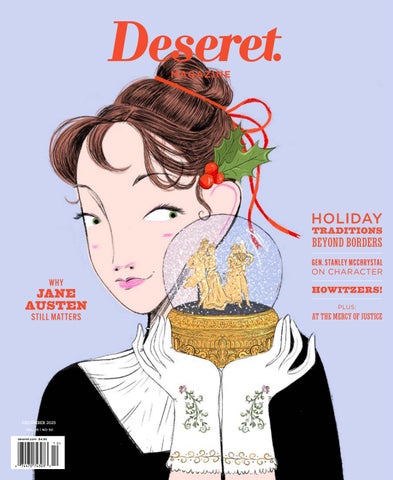
HOLIDAY TRADITIONS
BEYOND BORDERS
GEN. STANLEY MCCHRYSTAL
ON CHARACTER
WHY
HOWITZERS!
JANE AUSTEN
PLUS:
STILL MATTERS SERET MAGAZINE UPC REFERENCE MARCH
APRIL
MAY
JULY
SEPTEMBER
OCTOBER
DECEMBER 2025 VOL 05 | NO 50
DECEMBER
deseret.com $4.95
AT THE MERCY OF JUSTICE
Honoring seven decades of shared purpose. Member-owned. Values-based. Local teams who know your goals. From everyday banking to home and auto loans, we've stood by our members for generations. From Mission Savings Accounts that help future missionaries prepare to serve, to financial guidance and resources that support them before, during, and after their missions, we’re here for every step of the journey. Whether you’re managing everyday banking, purchasing a home, or planning what comes next, Deseret First is here to help you live your values with confidence. Learn more at dfcu.com Membership eligibility required. Federally insured by NCUA.
CONTENTS
30 PRICE OF REDEMPTION IMPRISONED SINCE 14, A MAN TESTS THE LIMITS OF RESTORATIVE JUSTICE. BY ETHAN BAUER
“He’s trying to restore his humanity and the community’s trust in him.”
52 THE LEGACY THAT COUNTS A RETIRED GENERAL EXPLAINS WHAT WILL DEFINE HIM — AND US. BY STANLEY MCCHRYSTAL
HOLIDAY TRADITIONS
BEYOND BORDERS
GEN. STANLEY MCCHRYSTAL
ON CHARACTER WHY
HOWITZERS!
JANE AUSTEN
PLUS:
STILL MATTERS DESERET MAGAZINE UPC REFERENCE JANUARY
MARCH
APRIL
MAY
JUNE
JULY
SEPTEMBER
OCTOBER
AT THE MERCY OF JUSTICE
44
WHY JANE AUSTEN STILL MATTERS
DECEMBER 2025 VOL 05 | NO 50
NOVEMBER
DECEMBER
deseret.com $4.95
O N THE COVER I L LUSTR ATIO N BY L EX I K. N IL SO N
THE BRITISH AUTHOR STILL CAPTIVATES AUDIENCES, 250 YEARS AFTER HER BIRTH. BY NICOLE JACOBSEN
DECEMBER 2025
3
CONTENTS
“We skim over packed snow like a rock skipping across still water.”
ODE
78 DOWNHILL FAST An ode to a plastic sled. BY ETHAN BAUER
INTERVIEW
FROM THE CROSSROADS OF THE WEST
62
A conversation with the hosts of “Deseret Voices.” BY JESSE HYDE
IDEAS
HAS IT ALWAYS BEEN THIS WAY?
66
Finding hope in uncertain times. NATIONAL AFFAIRS
COMMENTARY
THE GIFT OF BEING SEEN
COSTLY ARRIVALS
13
How recognition and love changes us.
Why it’s so expensive to have a baby in America.
BY JILLIAN OLMSTED
BY NATALIA GALICZA
BREAKDOWN
THE WEST
TALK SHOPS
14
SILENCE IN THE SNOW
Podcasting has taken over.
BY REBECCA MASON
22
26
The new science of avalanche prevention.
BY NATALIA GALICZA
BY HEATHER HANSMAN
CULTURE
CHASING CLICKS MODERN FAMILY POINT/COUNTERPOINT
TRASHED
16
ALL MY CHRISTMASES WERE AFTER DIWALI
Does plastic recycling work?
Holding onto holiday traditions in a multicultural world.
BY VALERIE BRAYLOVSKIY
BY MEERA DATTANI
72
Why we love old film cameras.
18
BY NATALIA GALICZA
REMEMBRANCE
THE ENVELOPE
81
BY SUSAN EASTON BLACK
DECEMBER 2025
5
CONTRIBUTORS
STANLEY M c CHRYSTAL
NICOLE JACOBSEN
CARLOS ARROJO
A retired four-star general, McChrystal is a senior fellow at Yale University’s Jackson Institute for Global Affairs and the co-founder of McChrystal Group, a leadership consulting firm. Before retirement, he served as commander of International Security Assistance Forces — Afghanistan. An excerpt from his book “On Character: Choices That Define a Life” is on page 52.
Jacobsen is a writer and teacher from the San Francisco Bay Area. Her writing explores the interaction of locations and literature and pop culture’s influence on society. A co-author of “Jane Was Here: An Illustrated Guide to Jane Austen’s England,” her feature story about why Austen still matters is on page 44.
Arrojo is a freelance illustrator from La Coruña, Spain. His clients in editorial and publishing fields include The New York Times, The Washington Post, El País, Volkswagen and UNICEF. His illustrations have been recognized by the World Illustration Awards, among others. Arrojo’s work can be seen on page 14.
JILLIAN OLMSTED
MEERA DATTANI
REBECCA MASON
Olmsted is executive director of The INN Between, a hospice and medical respite center for people experiencing homelessness in Utah. A sought-after speaker and advocate, she wrote the foreword to the book “Too Poor to Die” and has appeared on the podcast “American Fever Dream.” Her commentary on the effect of being seen and heard is on page 13.
A freelance travel and culture journalist, Dattani is executive editor at award-winning publication Adventure.com. Her writing has been published by Condé Nast Traveler, National Geographic Traveler, Wanderlust, BBC Travel and other publications. Her story on preserving family holiday traditions is on page 18.
Mason is a historian and writer, and an editor for History Workshop magazine. An expert in women’s legal history and early modern Scottish history, she consults for television and publishing projects and has presented her research on radio and podcasts. Her essay on finding hope in uncertain times is on page 66.
6
DESERET MAGAZINE
THE VIEW FROM HERE
FINDING WHAT’S GOOD
T
he year 1968 was one of the most politically tumultuous in American history. The country witnessed an escalation in the Vietnam War, followed by the assassinations of both the Rev. Martin Luther King Jr. and Robert F. Kennedy. But nearing the year’s close, somet hing truly inspiring happened 200,000 miles away from Earth. Apollo 8 became the first spacecraft to orbit the moon. On Christmas Eve 1968, a worldwide audience divided by a Cold War tuned into the broadcast to hear from three American astronauts — Frank Borman, Jim Lovell and Bill Anders — who dared to leave the safety of Earth’s gravity for the first time in human history. Although their mission focused on the moon, what struck them was the view they had of their planet. “We came all this way to explore the moon,” Anders later observed, “and the most important thing is that we discovered the Earth.” Anders captured the iconic “Earthrise” photo, which showed humankind a new view of their home. As they circled the moon, the astronauts were told that on Christmas Eve they would have the “largest audience that had ever listened to a human voice.” The only instructions they received from NASA in preparation were to “do something appropriate.” They chose to read from the Book of Genesis. Anders said during the broadcast: “We are now approaching lunar sunrise. And, for all the people back on Earth, the crew of Apollo 8 have a message that we would like to send to you. “In the beginning God created the heaven and the earth. And
the earth was without form, and void; and darkness was upon the face of the deep. And the Spirit of God moved upon the face of the waters. And God said, Let there be light: and there was light. And God saw the light, that it was good: and God divided the light from the darkness.” At this same time of year, Christians commemorate the birth of Jesus Christ, followers of Judaism observe Hanukkah, and others look also upward for unity and peace during this season of giving and looking ahead to the new year. In that same spirit, this holiday issue’s cover story by Nicole Jacobsen pays homage to the continued influence of author Jane Austen, explaining why she’s attracted legions of new readers 250 years after her birth (page 44). Staff writer Ethan Bauer explores the action of redemption when a man sent to prison for murder at age 14 meets the judge who imposed the sentence (page 30). Retired Gen. Stanley McChrystal explains how conviction and discipline define a person’s character (page 52). And scholar Susan Easton Black shares a Christmas story that reminds us God provides even in unexpected ways (page 81). As they are now, times were tense in 1968 when the crew of Apollo 8 signed off with the verse from Genesis that reads “God saw that it was good.” Frank Borman then said on behalf of the crew of Apollo 8 — and I would add from the crew of Deseret Magazine — “good luck, a Merry Christmas, and God bless all of you, all of you on the good Earth.” —HAL BOYD DECEMBER 2025
7
DESERET NEWS PUBLISHING CO.
EXECUTIVE EDITOR HAL BOYD
PUBLISHER BURKE OLSEN
EDITOR JESSE HYDE
CHIEF FINANCIAL OFFICER ERIC TEEL
CREATIVE DIRECTOR ERIC GILLETT
SENIOR VICE PRESIDENT SALES TRENT EYRE
MANAGING EDITOR MATTHEW BROWN
VICE PRESIDENT MARKETING EMILY HELLEWELL
DEPUTY EDITOR CHAD NIELSEN
VICE PRESIDENT SALES SALLY STEED
CONTRIBUTING EDITORS MCKAY COPPINS, JAMES R. GARDNER, LAUREN STEELE
PRODUCTION MANAGER RHECE NICHOLAS DIRECTOR OF CIRCULATION SYLVIA HANSEN
EDITOR-AT-LARGE DOUG WILKS STAFF WRITERS ETHAN BAUER, VALERIE BRAYLOVSKIY, NATALIA GALICZA WRITER-AT-LARGE MICHAEL J. MOONEY
THE DESERET NEWS’ PRINCIPAL OFFICE IS 55 N. 300 WEST, STE 400, SALT LAKE CITY, UTAH. COPYRIGHT 2024, DESERET NEWS PUBLISHING CO. ALL RIGHTS RESERVED. PRINTED IN THE USA.
CONTRIBUTING WRITERS LOIS M. COLLINS, JENNIFER GRAHAM, KEVIN LIND, MARIYA MANZHOS, ERIC SCHULZKE ART DIRECTORS IAN SULLIVAN, BRENNA VATERLAUS COPY EDITORS SARAH HARRIS, VALERIE JONES, CHRIS MILLER, CAMILLE SMITH
DESERET PROPOSED AS A STATE IN 1849, DESERET SPANNED FROM THE SIERRAS IN CALIFORNIA TO THE ROCKIES IN COLORADO, AND FROM THE BORDER OF MEXICO NORTH TO OREGON, IDAHO AND WYOMING. INFORMED BY OUR HERITAGE AND VALUES, DESERET MAGAZINE COVERS THE PEOPLE AND CULTURE OF THAT TERRITORY AND ITS INTERSECTION WITH THE BROADER WORLD.
DESERET MAGAZINE (ISSN 2537-3693) COPYRIGHT © 2025 BY DESERET NEWS PUBLISHING CO. IS PUBLISHED MONTHLY EXCEPT BI-MONTHLY IN JULY/AUGUST AND JANUARY/FEBRUARY BY THE DESERET NEWS, 55 N 300 W, SUITE 400, SALT LAKE CITY, UTAH. TO SUBSCRIBE VISIT PAGES.DESERET.COM/SUBSCRIBE. PERIODICALS POSTAGE IS PAID AT SALT LAKE CITY, UTAH POSTMASTER: PLEASE SEND ADDRESS CHANGES TO PO BOX 2220, SALT LAKE CITY, UTAH 84101.
AWA R D -W I N N I N G J O U R N A L I S M A B O U T T H E P L AC E W E C A L L H O M E T H E P H I L A N T H R O PY I SS U E
THE
STATE OF THE
WEST
SAVING THE
GREAT SALT LAKE
WILL AMERICA
THE COMPASSION OF
ABBY COX
BUU NYGREN
GO IT ALONE?
AND THE FUTURE OF THE
NAVAJO NATION + ARTHUR BROOKS I LYA S H A P I R O LY N N G . R O B B I N S
THE PATHWAY A UNIQUE APPROACH TO
EDUCATION IN AFRICA
IS COLLEGE FOOTBALL DOOMED?
POWER OF THE HIVE:
THE BROKEN PROMISE OF
50 THE DESERET
AMERICAN EDUCATION BY CLARK G. GILBERT & SHIRLEY HOOGSTRA
AN ODE TO THE TRAMPOLINE
DESERET MAGAZINE UPC REFERENCE
DESERET MAGAZINE UPC REFERENCE
D E TO U R F R O M
DEMOCRACY JANUARY
MARCH
APRIL
MAY
JANUARY
MARCH
APRIL
MAY
THE 2024 ELECTION�S POISON PILL DESERET MAGAZINE UPC REFERENCE
MAY 2024
JANUARY
MARCH
APRIL
JUNE
JULY
SEPTEMBER
NOVEMBER
DECEMBER
VOL 04 | NO 34
MAY
deseret.com $4.95
A DISNEY GIRL JUNE
(SUDDEN)
FALL OF
IS THE BULWARK
DESERET MAGAZINE UPC REFERENCE
THE FUTURE OF
CONSERVATIVE MEDIA?
JANUARY
THE NEW RAINMAKERS
ARE RELIGIOUS PEOPLE REALLY HAPPIER?
SEPTEMBER 2023
JULY
VOL 03 | NO 27
SEPTEMBER
OCTOBER 2025
OCTOBER
JUNE
JULY
NOVEMBER
DECEMBER
SEPTEMBER
VOL 05 | NO 48
OCTOBER
deseret.com $4.95
deseret.com $4.95
I N A D I S N E Y WO R L D
OCTOBER
THE RISE AND
THE PEOPLE AND IDEAS CHANGING PHILANTHROPY
TAKEOVER
MARCH 2023
DECEMBER
VOL 03 | NO 22
JANUARY
VOL 05 | NO 45
MARCH
APRIL
MAY
JUNE
JULY
SEPTEMBER
OCTOBER
NOVEMBER
DECEMBER
deseret.com $4.95
DESERET MAGAZINE
DEI
WHEN HIKERS
GO MISSING
WHO FINDS THEM?
A PEEK INTO
JUNE
JULY
SEPTEMBER
OCTOBER
OUR FUTURE
deseret.com $4.95
PLUS: JEFF FLAKE ON WHY SOFT POWER STILL MATTERS
NOVEMBER
SCAN HERE TO SUBSCRIBE
8
MAY
JUNE 2025
PLUS: GAIL MILLER, JEAN OELWANG AND RAJIV SHAH
NOVEMBER
APRIL
A RGE N T I NA :
DESERET MAGAZINE UPC REFERENCE
THE HOMESCHOOL
MARCH
DECEMBER
THE BUZZ
KAT E DE HLE R
Our OCTOBER issue celebrated 50 people, organizations and ideas changing how we think about giving (“The Deseret 50”). The magazine was distributed to guests attending the philanthropy session of the Larry H. Miller Summit, held in October at the Montage in Deer Valley Resort, Utah. Deseret Magazine was a presenting sponsor for the event, headlined by keynote speaker Meg Whitman, that brought together many of the region’s leading philanthropists — including Lisa Eccles, Christena Huntsman Durham, Jim Sorenson, Kristin Andrus and Gail Miller. The issue also featured an in-depth story by Mariya Manzhos on The Bulwark, a media outlet wrestling with the meaning of “conservatism” in the time of scrambled political party coalitions (“Center Stage”). Manzhos’ examination of Reagan-era conservatives and centrist Democrats struggling to find a place within their political parties resonated with many readers. “This is an excellent and even-handed description of a complicated and important issue for modern political conservatism,” wrote retired federal appellate court Judge Thomas Griffith. “This is the most honest depiction of what has happened to the GOP and the Democrats,” added online commenter known as Eastcoastcoug. “Like the comment (by Bulwark founder and publisher Sarah Longwell), I am more concerned with right and wrong than I am about left and right.” Another commenter, who goes by FJSL, also praised Longwell and The Bulwark for appealing to humanity’s “better angels.” “The content is intelligent and informed, and the moral grounding is in honesty and integrity.” Contributing writer John D. Sutter explained the history of cloud seeding and the increasingly important role it plays in addressing the West’s historic drought (“Up In The Air”). A reader with the online tag of dataman has no problem with innovative humans manipulating Mother Nature. “For many decades, I have heard and read naysayers present the false choice of mass flooding or drought. I think we should seed heavily. This is not playing God, it’s just doing what God put in our power to do.”
HANNAH YO EST
OUR READERS RESPOND
“I am more concerned with right and wrong than I am about left and right.”
DECEMBER 2025
9
OPENING SHOT
SNOWY SUNRISE, BRYCE CANYON NATIONAL PARK, UTAH
PHOTOGRAPHY BY AUSTIN PEDERSEN
10
DESERET MAGAZINE
DECEMBER 2025
11
C O M E T O A F R I CA Experience personal growth, humanitarian service, and cultural exchange.
Apply for a summer expedition at MothersWithoutBorders.org/Expeditions
COMMENTARY
THE GIFT OF BEING SEEN HOW RECOGNITION AND LOVE CHANGES A PERSON
BY J I L L I A N OL M ST ED
D
uring my time at The INN Between, I’ve met many people who tell me they’ve spent years feeling unseen, passing quietly through streets, shelters or hospital rooms. Many residents arrive with little more than the clothes on their backs and a hospital bag of paperwork. But what they’re missing most isn’t possessions. It’s recognition. It only takes something small to change that. Someone remembers their name. Someone looks them in the eye. Someone celebrates their birthday or sits with them over a meal to learn about their life. In that moment, their whole demeanor changes. The act of being seen reminds them that they are still human, still known, still loved. To me, that is the truest form of generosity. Generous people often call us and ask, “What do you need?” Food, clothing, Christmas gifts, donations. Those things all matter. They keep people alive and bring comfort during a medical crisis. But after nearly a decade of providing care and housing to terminally ill and medically frail homeless adults, I’ve learned that what most people crave, what truly heals them, is being seen. Living without stable housing or consistent medical care can make invisibility feel normal. It changes a person. We are wired for connection, and when that connection is lost, it’s easy to become closed off, depressed and hopeless. Sometimes, simply being acknowledged can begin to undo years of isolation. I remember one resident, Renaud. His case manager brought him to us and explained that he had been living unsheltered for ILLU STR ATION BY KY LE H I LTO N
many years. He didn’t seem agreeable to living within four walls and didn’t really trust the medical system. Much to everyone’s surprise, Renaud did a complete 180 within a few weeks. He began following medical advice and even started working toward permanent housing. I’ll never forget the day he was preparing to leave for his new apartment. He stood outside The INN Between with his single hospital bag and a small box, waiting for his case manager to pick him up. It was cold, and I asked if he’d rather wait inside. He smiled and said, “No, my case manager is always early. I don’t want to be late getting my keys.” A week later, Renaud came back. This time with a money order in hand. He told us he now had an income and wanted to give back to the place and the people who gave him hope. “You helped me believe healing was possible,” he said. That moment has stayed with me. The gift of being seen costs nothing, yet it has the power to restore dignity, connection and hope. When someone recognizes your worth, it becomes easier to see it in yourself. A story with a different ending is that of a resident who recently died at The INN Between. Brad was in his mid-40s and, somehow, was at peace with his end-of-life diagnosis. It’s rare for friends or family to be closely involved during one of our residents’ final stays, but Brad was fortunate to have several family members by his side through his last days. They later attended his memorial — a service planned and led by fellow residents — and listened as our resident advocate shared stories about Brad’s kindness. He described him as a “gentle giant,” someone who went out of his way to be kind, even when he was only days from dying. I believe we were able to give Brad’s family a great gift. Not just a warm bed and compassionate care, but the comfort of hearing that their son was a good man — kind, loved and remembered — until his very last breaths. In a season devoted to giving, I’ve learned that the greatest generosity doesn’t begin with what we purchase or wrap, it begins with how we see one another. We can’t always fix someone’s circumstances, but we can let them know they are not invisible. At The INN Between, we often say that no one should have to die alone. But what we truly mean is that no one should have to live unseen. Each day, I witness people who have been forgotten by society rediscover their worth through small, human gestures, a shared laugh, a warm meal, a moment of eye contact that says you matter. Each day, I’m reminded that the greatest gifts we can give, especially during this season, are presence, recognition and love. Those are the gifts that don’t cost a thing, and yet they are the ones that change everything. J I L L I A N O L M S T E D I S E X E C U T I V E D I R E C T O R O F T H E I N N B E T W E E N , W H I C H P ROV I D E S E N D - O F - L I F E C A R E F O R H O M E L E S S M E N A N D W O M E N I N U TA H .
DECEMBER 2025
13
THE BREAKDOWN
TALK SHOPS HOW PODCASTING TOOK OVER THE MEDIA LANDSCAPE
SOME SAY THAT the 2024 presidential campaign came
education and entertainment. These digital audio — and sometimes video — programs with elements of radio style, often streamed on a smartphone or computer, may be the most successful new medium of the internet era. How did podcasts become such a powerful force? Here’s the breakdown.
down to a simple decision: One candidate appeared on a podcast called “The Joe Rogan Experience” and prevailed, while the other didn’t and lost. Even the perception is shocking in a media landscape long dominated by newspapers and TV networks, but podcasts have become a go-to source for news, analysis,
— N ATA LIA GA LICZ A
ROSTOV-ON-DON, 1989
A PODCAST A DAY
As the USSR crumbled, dissidents in this city just east of Ukraine launched “The Illusion of Independent Radio,” a program of music and interviews distributed on cassette tapes — an audio zine some consider the podcast prototype. Internet radio let users in the 1990s download and play audio files at will; automated downloads were added in 2003. Two years later, Apple added podcasts to its popular iTunes music software, making them broadly accessible.
One in 7 Americans listen to a podcast at least once a day. More than half — 158 million, or 55 percent — listen to at least one episode each month; 115 million listen every week. Apple hosts 2.8 million series, from investigative narratives to banter-driven history recaps, with about 107 million episodes. Just 432,000 of those series are active, with new episodes released in the last 90 days. Industry revenue is estimated at $7.3 billion, projected to reach $17.6 billion by 2030.
14
DESERET MAGAZINE
73%
OF AMERICANS HAVE HEARD OR WATCHED AT LEAST ONE PODCAST
88,242 YEARS A WEEK
That’s how long Americans ages 13 and older spend listening to podcasts, equivalent to 773 million hours, up 355 percent over the last decade. The average podcast lasts about 40 minutes; news and politics programs are typically a half-hour long, while comedies trend closer to an hour. It’s common to listen to podcasts at 1.25x speed, a quarter faster than normal. On Audible, an intrepid 5 percent push that to 1.50x.
42%
OF AMERICANS PLAY PODCASTS WHILE COMMUTING
26 MILLION VIEWS
A three-hour interview with presidential candidate Donald Trump on “The Joe Rogan Experience” hit that number within 24 hours. The video, in a casual talk show format, reached 40 million views by Election Day — more than the population of California — on YouTube alone. That does not account for the “multiplier effect,” or the additional engagement, exposure and influence digital clips garner when they’re shared. ILLU STR ATION BY C A R LOS A R R OJ O
“ P O D C A S T S G I V E YO U THE IMPRESSION OF S H A R I N G K I TC H E N TA B L E B A N T E R W I T H A COUPLE OF FRIENDS. T H AT M AY E X P L A I N WHY MILLIONS TUNE I N R E G U L A R LY A N D L I S T E N TO LO N G - F O R M E P I S O D E S T H AT D E F Y ALL COMMON-SENSE K N OW L E D G E A B O U T THE SHORTNESS OF O U R AT T E N T I O N S PA N .” JULIETTE DE MAEYER, A S S O C I AT E P R O F E S S O R O F JOURNALISM, UNIVERSITÉ DE MONTRÉAL
40% UNDER 50
About 4 in 10 adults in this age range often or sometimes get their news from podcasts. A similar number have attempted a lifestyle change as a result of something they heard on an episode. Consumers trust brands about 20 percent more when they’re advertised on podcasts than anywhere else. Thirty-one percent of Republicans and right-leaning independents trust podcasts more than other news sources, compared to 15 percent on the left and 23 percent of all adults. FRIENDSHIP SIMULATORS
Four in 5 listeners say they’re loyal to the host. Fifty-nine percent say they’d quit listening if the host left. More than half never miss their favorites. Podcasts stimulate parasocial interaction — a one-sided relationship with a fictional character or media figure. At least half of Americans have experienced parasocial relationships, though only 16 percent admit it.
2026
THE GOLDEN GLOBE AWARDS WILL INCLUDE PODCASTING
DECEMBER 2025
15
POINT / COUNTERPOINT
TRASHED DOES PLASTIC RECYCLING MATTER?
PLASTIC IS A key component of modern life. This cheap, tough, yet pliant material is
everywhere you look, from kitchen utensils to laptop computers, from drain pipes to the International Space Station. First derived from petroleum in the mid-19th century, its production boomed after World War II, revolutionizing industries and transforming our lives. But we still haven’t figured out its afterlife. Plastic is durable to a fault, persisting for centuries in landfills. It has proven more difficult and expensive to recycle than it is to create. What’s the answer? —VA LERIE B RAYLOVSK IY
16
DESERET MAGAZINE
SMART STEWARDSHIP
A COSTLY MYTH
WE DEPEND ON plastic, so we need to manage it
PLASTIC RECYCLING JUST doesn’t work. Sorting
responsibly. Plastic doesn’t just enable modern industry; it’s also an industry of its own, supporting nearly two million jobs and shipping over $700 billion in product annually. But disposal is haphazard. Eight million tons of plastic end up in the ocean each year — a truckload every minute. In the wake of revelations that “recycled” plastic was actually being shipped to landfills in Asia, it’s understandable that people don’t trust the process. Still, it’s our best option. The system is imperfect, but it beats the impact of making new plastic. Most recycling is mechanical, grinding the material and heating it up to melt it into new forms. Our current infrastructure struggles to sort the seven types of plastic resin and handle each one appropriately. Production of new plastic from crude oil or natural gas is worse, on pace to surpass coal in climate-damaging emissions by 2030. A 2019 study by the Association of Plastic Recyclers found that using certain commonly recycled plastics saves up to 88 percent of the energy it would take to make new plastic. Recycling is a more realistic solution than banning plastic altogether, an extreme measure favored by some environmentalists. The material is simply too ubiquitous and too capable of solving specific problems to be easily eliminated. Any new restrictions on the national level would disrupt supply chains across industries, raise consumer prices generally and complicate access to essentials like sterile medical tools and safe food packaging. Instead of abandoning a flawed system and undoing decades of innovation, we should make it a priority to improve it. In fact, plastic recycling could become an economic asset with the right investment. Chemical recycling, an emerging field, uses solvents to break plastics down into their basic components. Chemists at Northwestern University recently created a nickel-based catalyst that can even recycle mixed plastics without sorting. Methods like this could curb waste and grow the plastic recycling industry, which is already projected to hit $300 billion by 2035. “The solutions are here today,” writes UBQ Materials chairman and CEO Albert Douer. “What we need is the will to act and the foresight to recognize that the future of waste isn’t disposal. It’s renewal.”
is slow, melting is expensive and the material itself degrades with each reuse. Besides, it relies on volunteer efforts and costly infrastructure that simply aren’t there. Today, after decades of public service announcements, only 15 percent of discarded plastic is collected and 9 percent is recycled, mostly into lower-quality items. And it’s still cheaper to make new plastic. “There is no technology capable of doing what the plastics industry promises, and there is nothing to be gained by pretending one exists,” writes Davis Allen, researcher at the Center for Climate Integrity. Plastic recycling actually pollutes the environment. For one, consider the emissions from shipping plastic between sorting and processing sites as far away as Malaysia (more than half of the world’s plastic recyclables went to China until that country stopped accepting most waste in 2018). Melting plastic pollutes the air. And chemical recycling often relies on pyrolysis — a high-heat process that mostly produces fuel — which the EPA doesn’t even consider recycling. Rather, it’s classified on a lower tier called “energy recovery.” Recycling plastic also harms human health. A 2023 study found that a single U.K. recycling facility would discharge up to three million microplastic particles daily into the local wastewater if filtered — 6.5 million pounds if not. These particles can bypass some filters and accumulate inside of the plants around us, the animals we eat and of course the human body. Recycled plastics contain chemicals linked to cancer, infertility and hormone disruption. Nearby communities, often low-income, face the highest risks. We have a stark choice: live with the impact of plastic, or go without it. Recycling may feel productive, but it doesn’t safely manage our waste. Nearly half of U.S. states have banned single-use plastics like grocery bags. Seven have passed extended producer responsibility laws, which hold companies responsible for the cost of cleaning up after the products they create. “We can’t recycle our way out of the plastic-waste crisis,” says Alexis Goldsmith, national organizing director of nonprofit Beyond Plastics. “We need to require the world’s biggest plastic polluters to reduce the amount of plastic that they’re pumping into the market in the first place.”
ILLU STR ATION BY PH I LI PP BE C K
DECEMBER 2025
17
MODERN FAMILY
ALL MY CHRISTMASES WERE AFTER DIWALI HOLDING ON TO HOLIDAY TRADITIONS IN A MULTICULTURAL WORLD BY M E E R A DATTA N I
I
t’s Christmas 1982, the school gym packed with parents and students. I’m six years old, wearing a white dress, draped in a shawl, carrying a bundle shaped to resemble a baby. Next to me, a blond, blueeyed boy asks if there’s “room at the inn.” We shuffle about the small stage, from innkeeper to innkeeper, until we’re offered a barn. A few weeks earlier, a teacher had asked to meet me in the cafeteria, and then asked if I’d play the role of the Virgin Mary in the school Nativity play. I could be a shy child, but I was thrilled. Then word got around. It turned out it wasn’t a universally popular casting decision. “You don’t look like Mary!” scoffed one classmate. “My mum says Mary has blond hair. You’re so dark,” said another. They were right. I looked nothing like the Marys depicted in books, on stained 18
DESERET MAGAZINE
glass in churches, in paintings. That Mary was pale-skinned, often blond and blue-eyed. I was brown, dark-haired, dark-eyed, and, well, Indian. But on that
HOW DO YOU INTEGRATE WHILE RETAINING A SENSE OF WHERE YOU’RE FROM? IT’S A QUESTION PEOPLE OF ANY DIASPORA, ANYWHERE IN THE WORLD, MULL OVER.
stage, easing my bundle into the manger, my dad’s words of reassurance from earlier in the month came back to me. “You look more like Mary than most,” he’d said,
telling me the Virgin Mary, like Joseph, was likely a first-century Palestinian. Without realizing it, this was my first foray into my cultural identity and who I was allowed to be, or not. Playing Mary is my first tangible memory of Christmas — a holiday not traditionally part of my family religion, Hinduism, nor my ancestral culture of Gujarat, western India, but intrinsically part of my life. Being part of such a Christian tradition at such a formative age may even have kick-started my love affair with this time of year, where I’ve embraced British traditions, mixed some with Indian ones, and created my own version of “Christmas.” You could say growing up as a child of exiled Ugandan Asian Gujarati immigrants in 1970s and 1980s Britain was a test of both assimilation and identity maintenance. How do you integrate while retaining a
ILLU STR ATION BY M A Ï T É FR A N C H I
DECEMBER 2025
19
MODERN FAMILY
I LEARNED TO WEAR MY CULTURE AND ITS COUTURE WITH PRIDE. AND IT SEEMED I’D FOUND MY NOOK, SITTING SNUGLY BETWEEN TWO CULTURES.
20
DESERET MAGAZINE
sense of where you’re from? The question is hardly unique; one that most people of any diaspora, anywhere in the world, mull over — particularly now, as populations become more diverse, resulting in more interracial marriages and children growing up with dual identities. According to 2023 data, while 58 percent of the U.S. population identifies as non-Hispanic white, the Hispanic population has grown from 23 million in 1990 to 65 million in 2023, and Asian or Pacific Islanders from seven million to 21 million. Adopting cultural traditions is often an easy “in” into a society that isn’t historically yours. As a South Asian child keen to be “accepted,” I soon embraced carol-singing, card-making and tree-decorating far more than I did lighting diyas (candles) and warding off evil from our house for Diwali, the New Year for Hindus, Jains and Sikhs, which typically takes place in October or November, new moon depending. The school Christmas fair was my nonreligious equivalent of attending temple or church; the “event of the year” in my small-world, small-town of Chadwell Heath, a suburb in the southeastern U.K. county of Essex on the eastern border of London proper. But even at this traditional festive event, we found a way to fuse cultures. My mum’s samosa stand, with its savory, triangular, vegetable-filled pastries, was always a sellout. “Do you celebrate Christmas?” I’d still get asked. “Do you put up a tree?” “Will you have turkey for Christmas lunch?” Not all of us did, of course, but our family did. With December 25 also being my father’s birthday, I always felt we had our own Father Christmas, right there in our midst. David Bomark, a sociologist at the University of Glasgow, believes it’s become easier to create your own identity and traditions since the middle of the 20th century. “We’ve become less reliant on being handed a prepackaged identity, due to globalizations and more media representations of other cultures and ways of leading one’s life,” he says. That’s exactly what we had done. On Christmas Day, our Indian family
would get together, just like any other, but the dinner table might look a little different. There may well be turkey — the traditional meat of choice at a British Christmas lunch — but alongside Indian dishes such as chilli paneer (spiced, fried, marinated Indian cheese) and kachori (lentil-filled pastries). Then we might play games, exchange Secret Santa gifts, eat mince pies and feast on a cheeseboard. Cheese may not scream Asian heritage, but for us, it does. Our paternal grandfather ran a grocery store, Avenue Grocers, in Kampala, Uganda, which became known for importing exciting international foods, such as cheese, and that palate is now four generations strong. It’s comforting, in the chaos of modern life, to do, eat and enjoy the same things your forefathers did, in the hope the generation after us will do the same. Conversely, Diwali was somewhat less flamboyant, a simple get-together with our culturally if not religiously Hindu family. I do recall enthusiastically celebrating the nine-night festival of Navratri preceding Diwali, with traditional Gujarati folk dances of “garba” and “dandia” at a local leisure center, in what resembled something like a dance hall. These late nights on school days felt precious, giving me a sense of community, but I also was self-conscious in public while wearing traditional garments. Over time, I learned to wear my culture and its couture with pride. And it seemed I’d found my nook, sitting snugly between two cultures, if not two religions. WHILE CHILDHOOD CHRISTMASES are their
own world, leaving home for university in the mid-’90s marked a new era. As friends returned home to spend Christmas with family, a new ritual of “Christmas Eve pub night” began, meeting in our former teenage haunt, The George pub. This was a set piece for several years, until parents moved away, friends married, had children, and subsequently rotated Christmases between families. Our hometown was no longer our HQ.
WE’RE EACH PART OF MULTIPLE, EXTENDED FRIENDSHIP GROUPS AND FAMILIES NOW, AND AS OUR PARENTS AND RELATIVES GET OLDER, TIME WITH THE WIDER FAMILY FEELS PRECIOUS.
I’d experienced another change. Before I left for university, my parents divorced, a life event that created a new dynamic, uprooting historic patterns and shaping new customs. I’d continue to spend December 25 with “Father Christmas,” but the following day, Boxing Day, evolved into a “second Christmas” with my mother. A superb cook — and myself an excellent “taster” — I was always in for a treat, and over time, her cooking has become increasingly more imaginative and delicious. A competitive game of Scrabble sealed the day. “Peace on earth, goodwill to men” may be in the Bible, but absent from our ferocious attempts to reach the highest score. It was after my first solo backpacking trip in 2004, in my late 20s, a four-month extravaganza during which I spent Christmas on a white-sand beach in Thailand, snorkeling and swimming, that my Christmases became less cozy and more adventurous. A new tradition, if you will, to escape both singledom and winter in what sometimes felt like a dreary, loveless London; despite the friends, family and buzz, the city can also be a lonely place. For several years, around November, I’d pack my rucksack and laptop and migrate south with a plan to return in the spring. I felt free, like a bird on its migratory path. I spent Christmases on the beach in Vietnam, in a riverside town in
Uruguay, in the forested hills of Cambodia, on safari in South Africa, and many more times in Southeast Asia. Christmas Day passed by with random, fun new friends, most of whom I never saw again, but I’d always miss family. No Christmas Day went by without a trip to the internet café, and, as technology developed, Skype and WhatsApp video calls. Research published in the Frontiers in Psychology journal found the use of digital technologies and devices increased during and since the pandemic for older people. But the Covid-enforced digitized Christmas also reinforced the importance of physical presence. Researchers also found that “digital devices were not viewed as a direct replacement for face-to-face connections.” Conversely, the pandemic also allowed people to enjoy alternative Christmases, perhaps with friends and away from uncomfortable childhood dynamics. “Some may think the individualization of society means that people have become more egotistical, but that’s not the case,” says the University of Glasgow’s Bomark. “It’s just a different way of relating to society; not as part of a collective monolith, but as a singular individual in a network which enables people to make choices that fit them.” Just before Christmas 2017, as I was approaching 42, my own life took a turn
when I met a man who’d become my life partner. The number 13 may be unlucky for some, but that first date on December 13 in a wintery, bustling, twinkling London, would change the course of our lives. Almost eight years later, we have only recently left behind our own apartments of our 30s and 40s, places of memory, pivotal moments and transformations, and created our first home together. As Christmas beckons, it’s our chance to mix-and-match our festive ways. Some traditions had long changed for me, such as staying close to home over this time versus overseas adventure. We’re each part of multiple, extended friendship groups and families now, and as our parents and relatives get older, time with the wider family feels precious. As an only child, I’ve found my partner’s nuclear family of 10 to be a revelation. I hope to reprise old customs too, such as hosting an annual “leftovers” party in those blurry days between Christmas and New Year, as one way of addressing the overconsumption and food waste that occurs this time of year. And to get “crafty” again as I once used to, making cards, pies, decorations. As non-parents, to host a day of creativity with the juniors in our lives, our nieces, nephews, friends’ children. And maybe, I’ll reprise my role as Mary for those who missed the debut 45 years ago. DECEMBER 2025
21
NATIONAL AFFAIRS
COSTLY ARRIVALS WHY IT’S SO EXPENSIVE TO HAVE A BABY IN AMERICA
BY N ATA L I A G A L I C Z A
A
s a first-time mother, Charlene Covarrubias understood she had plenty to worry about over the course of her pregnancy: the brain fog, the emotional roller coaster from her body producing 100 to 1,000 times her usual concentration of hormones, the constant nausea that — contrary to its epithet — strikes not just in the morning, but any time of day. She had anticipated the mental and physical exhaustion of carrying a baby to term. What she didn’t realize was that the actual birth would cost her thousands of dollars. Covarrubias is 32 and lives with her husband in Salt Lake City, Utah. She’d started saving to have her first child through her employer’s insurance and Health Savings Account long before she hit 26 weeks of pregnancy in October. She knew that having a baby would be expensive, that it would be stressful figuring out where the delivery 22
DESERET MAGAZINE
would take place — maybe the University of Utah hospital in Salt Lake City or the Redwood Health Center, a clinic also in Salt Lake City. But once the bills for standard
“I DON’T KNOW WHAT ‘COVERED’ LOOKS LIKE, TO BE COMPLETELY HONEST. IT’S GOING TO BE COVERED TO A POINT, BUT I KNOW IT’S STILL GOING TO BE A BIG BILL.”
prenatal care screenings and checkups started stacking up in her third trimester, some individual visits nearing $1,000, she started to worry about the cost of that
fateful hospital delivery bill more than any unknown that still lingered in the months ahead. “I don’t know what ‘covered’ looks like, to be completely honest,” she says. “It’s going to be covered to a point, but I know it’s still going to be a big bill.” For the vast majority of people in the United States, it doesn’t just cost money to raise a child. It costs money to give birth. A lot of it. The Kaiser Family Foundation found that 19 percent of women are insured through Medicaid, which in most states covers prenatal care, ultrasounds, postpartum care and some delivery services. But the 72 percent of women who are insured through their employers, private coverage or Medicare are often still responsible for copays and deductibles that can add astronomical financial burdens onto families before they even begin paying the lifetime of expenses inherent to having a child. The average
ILLU STR ATION BY K AT H E R I N E ST R E E T E R
DECEMBER 2025
23
NATIONAL AFFAIRS
out-of-pocket cost for childbirth is nearly $3,000 for insured Americans. When complications arise, such as preeclampsia or the need for a cesarean section, that price can grow steeper by the thousands. No other nation in the world charges more. “It’s kind of similar to somebody who gets their degree and pays for it in loans, then they’re still paying off their loans in their job field,” Covarrubias says. “You’re still paying for the birth or delivery of your child while you’re preparing for the future.” Last year, the fertility rate in the United States reached a record low of fewer than 1.6 children for every woman, as reported by the World Bank. The rate needed to sustain the current population without any decline is 2.1 kids per woman. Fears that a smaller population could fuel unemployment rates, labor shortages and poverty, diminish infrastructure and innovation, and strip welfare programs with fewer tax dollars to go toward Social Security have sent citizens and policymakers into a tailspin. Pew Research Center surveys show more than half of Americans believe this decline in births is going to negatively affect the state of the country, which has led to a slew of policy proposals like offering new moms $5,000 “baby bonuses” or reducing the cost of in vitro fertilization. Perhaps the most surprising, though, is the effort to make childbirth free for the first time in American history. In May, Republican Sen. Cindy HydeSmith from Mississippi, Republican Sen. Josh Hawley from Missouri, Democratic Sen. Tim Kaine from Virginia and Democratic Sen. Kirsten Gillibrand from New York introduced the Supporting Healthy Moms and Babies Act. The bill requires that private insurers cover all costs related to childbirth from prenatal to postpartum care. It would make birth free for all Americans, not just those under Medicaid. “For a lot of people in the middle, where they make too much money to qualify for Medicaid but they don’t have great insurance, they’re facing some pretty substantial fees,” says Karen Guzzo, director of the Carolina 24
DESERET MAGAZINE
Population Center at the University of North Carolina. “We need to make sure we’ve built a society where everyone has a chance of reaching stable circumstances that are widely considered to be appropriate for having children.” The bipartisan bill has drawn support from groups that are otherwise diametrically opposed on matters of reproductive health, like the American Medical Association and Americans United for Life. Giving prospective parents the access and tools to start a family should they choose to do so is rare common ground that could act as a bridge between political aisles and get the nation on track with the rest of the developed world by advancing health care. It’s
“WE NEED TO MAKE SURE WE’VE BUILT A SOCIETY WHERE EVERYONE HAS A CHANCE OF REACHING STABLE CIRCUMSTANCES THAT ARE WIDELY CONSIDERED TO BE APPROPRIATE FOR HAVING CHILDREN.”
hailed as a step toward reversing a waning population, but in the context of what it means to afford life and family in the United States, it’s also a single cog in a much larger machine. D E S P I T E T H E FAC T that billions of births
have taken place over the course of human history, Emily Oster felt like it was easier to find questions than answers when she was pregnant with her daughter Penelope in 2010. Could she eat sushi? What about deli meat? Why wasn’t it easier to know what options she had, what advice to follow? She started to write down her queries and conducted research to answer them. That process is the basis for her 2013 book
“Expecting Better,” and the reason she launched ParentData in 2020, a website and newsletter where expecting parents can find clear guidance. Oster, who is also an economics professor at Brown University, knew firsthand that new parents are swamped with countless considerations. In the five years she’s run ParentData as its chief executive officer, she’s noticed many users are preoccupied with the economics of parenthood. “People think a lot about how kids are expensive,” she says. Yet the financial matters that take up most of their mental real estate revolve around long-term investments like schooling and pediatric care, not the upfront cost of delivery. Hundreds of videos on social media where new mothers break down their hospital bills after giving birth showcase that same truth — somehow, the cost of birth is universally mysterious for Americans, regardless of how childbirth remains the foremost reason for hospitalization nationwide. “Our health care is expensive because of the way that prices are negotiated,” Oster says, “and other things about our health care system that have nothing to do with birth specifically.” A lack of transparency is a primary reason behind the elusive price tag. Like most services offered at hospitals, the cost of childbirth is extremely variable. What a parent pays out-of-pocket depends on factors like what insurance coverage they have. It also depends on what hospital they’re at, what that hospital charges for each billable expense — from room and board to the price per ibuprofen — and what specialists like anesthesiologists charge as their personal rates. Most insurance companies now offer portals where patients can find an estimate of what the procedure will cost them, but those estimates are based on averages and can’t account for specific circumstances. That leaves a majority of parents unsure what delivery will cost them until they receive an itemized bill. Hospitals have made headlines for charging parents who want to hold their child after a cesarean section $40 “skin to skin” fees. A 2021 study in
the JAMA Health Forum found about 1 in 5 parents cite their unusual charges average more than $700 on their final hospital bill, while a third are hit with thousands of dollars in surprise charges. Another in the Milbank Quarterly found that 40 percent of people who spend more than $1,000 on out of pocket expenses for a commercially insured birth then worry about affording health care bills. One in 5 respondents who make less than $60,000 a year even had medical debt in collections as a result. “The price can be twice as high for two different patients in the same hospital, depending on the negotiated rates between that provider and that patient’s insurance,” says John Hargraves, director of data strategy at the Health Care Cost Institute in Washington, D.C. “It’s unlike almost anything else we purchase. You can’t cost compare. There’s no Costco alternative.” Americans spend nearly double the amount on health care per person than citizens of any peer nation. The insurance landscape is notoriously complex and operates largely outside of government control, which means there are effectively no checks and balances on what profit-driven hospitals can charge patients. Nearly 70 percent of the world’s population has some form of universal health care — especially in developed nations — and several countries cover childbirth as an inpatient admission. Should the Supporting Healthy Moms and Babies Act become law, it would classify prenatal care, postpartum care and birth as essential services under the Affordable Care Act. Insurance companies would eat the cost, and although premiums would increase, it would only cost policyholders an estimated $30 more each year. For first-time parents like Covarrubias, the thought of scrounging up $30 more each year instead of thousands of dollars upfront feels encouraging. For those on the fence about starting a family, maybe even more so. It’s no wonder then that it’s attracted both the ideologically left and right; whether framing the bill as expanding health care access and social service or
framing it as a pronatalist push to procreate, families could stand to grow and benefit because of it. If it materializes. AFTER THE SUPREME Court made the bomb-
shell decision to overturn Roe v. Wade in the summer of 2022, a vacuum suddenly appeared within a reproductive rights debate that had been so singularly focused for half a century. The Atlantic staff writer Elizabeth Bruenig wrote a piece in an attempt to chart a path forward with a new legislative priority: free childbirth in the United States. It directly inspired a proposal that acted as a predecessor to the Supporting Healthy Moms and Babies Act in 2023 and built the political momentum necessary for the present push.
“THE THINGS THAT MATTER MOST ARE CHILD CARE INFRASTRUCTURE THAT IS AFFORDABLE, ACCESSIBLE, HIGH QUALITY AND PAID LEAVE.”
This new reproductive reality arrived in tandem with a steadily declining fertility rate, projected cuts to Social Security within the next decade, historically low participation in the armed forces, more than half of the nation’s farmers aging out of work without replacements, and a destabilizing economy. The mishmash prompted a belief that America’s social structure is built for a population that grows, or at least stays steady, not one that shrinks. Guzzo points to evidence that the declining fertility rate doesn’t pose immediate or catastrophic consequences, but the alarm can’t be unrung. “The evidence suggests that people generally still want to have kids,” she says. “People just don’t feel good about
their lives. And I think what’s important about that is, having a child is making a long-term commitment to the future. … I don’t think people’s futures feel very predictable right now.” As well rounded as support for free childbirth is, it’s not universally held as the most effective solution to build and support families. A majority of adults find more tax credits for parents, required paid family leave and free child care more urgent. Gen Z and millennials are facing one of the worst labor markets in years. Americans owe nearly $1.8 trillion in student loans, and some nine million defaulted on their loans in 2025 alone. Most can’t afford to buy homes. Head Start, a federal child care program that serves more than 730,000 low-income families, is targeted for budget cuts. Guzzo suggests social services that ease the financial burden of long-term investments, more than one-time costs like hospital delivery, are better incentives for younger generations to feel safe starting families. “The things that matter most are child care infrastructure that is affordable, accessible, high quality and paid leave,” Guzzo adds. “They boost the total fertility rate by about 0.1 to 0.2 percent, which doesn’t sound big, given that we’re at 1.6 and that would get us to maybe 1.8, but that’s still hundreds of thousands of births.” Though paid leave and free child care are far more ideologically contentious among lawmakers than free childbirth. Regardless of what the future holds for reproductive policy, Covarrubias has to confront her own due date in the winter. It will cost her. She’s hopeful that cost won’t set her back too much, that whichever hospital she chooses to give birth at doesn’t embellish her final bill with surprise charges. She’s even more hopeful that her daughter will grow up to have more options than she did. That’s all any parent can do. Besides, Covarrubias has access to emotional support from the strong women in her family, and material support through her insurance. “I think I’m one of the more fortunate ones,” she says. DECEMBER 2025
25
THE WEST
SILENCE IN THE SNOW THE ECHO OF HOWITZERS KEPT SKIERS SAFE. IS THERE A BETTER WAY TO STOP AVALANCHES? BY H E ATH E R H A N S MA N
O
n the afternoon of March 23, 2005, a bomb fell out of the sky and exploded in Scott and Lori Connors’ backyard in Pleasant Grove, cratering their lawn, sending shrapnel into their living room and shattering their shed. The errant explosive, three miles off course, was a shell from a military howitzer the Utah Department of Transportation uses for avalanche control, a practice that started in the steep, slide-prone terrain of Little Cottonwood Canyon in the 1940s, where pioneering snow scientists developed protocols that would come to be used all over the world. If you’re a skier in Utah, you’ve likely heard the boom of artillery or been stuck in a building in the canyon for an interlodge (safety protocol during avalanche danger), where the windows rattle with the reverberation of the howitzer’s blast. But that’s changing. The military is asking for those weapons back — Alta has already returned all of its guns — and now ski 26
DESERET MAGAZINE
areas and the transportation departments that have used them for decades are figuring out new tools to manage slides in the avalanche prone canyons of the Wasatch and beyond.
“TO USE THIS WEAPON OF WAR TO SAVE PEOPLE’S LIVES IS VERY POIGNANT. YOU CAN KIND OF COMPARE IT TO WARFARE, IT FUELS THE ROMANTIC NOTION.”
THE PRACTICE OF using explosives for ava-
lanche control started in Little Cottonwood Canyon just as skiing started at Alta. In 1939, the U.S. Forest Service hired Douglass Wadsworth as its first snow ranger and directed him to minimize the avalanche
danger in the area. Once an avalanche has happened, the danger goes away, so Wadsworth experimented with things like dynamite to try to create controlled avalanches to clear the ski runs and the road. He was the first recorded person to do so. But the practice of using explosives to make avalanches really kicked off after World War II, when 10th Mountain Division veteran Monty Atwater was hired as a snow ranger in 1946. Atwater was an iconoclast. He wrote children’s books, and he almost always had a cigarette in his mouth, even when he was handling dynamite. In Europe, he’d seen avalanches triggered when they shot artillery, and he started to think that maybe, in the postwar era, they could use the weapons for safety instead of destruction. In 1952, Atwater convinced the Utah National Guard to bring a 75 mm French howitzer up to Alta. He told them where to shoot it, and the National Guard soldier loaded and launched the gun, triggering big avalanches.
S N OWB IR D HAS U S ED HOWITZE R S S I N C E 1 97 1 . E R IC M U R A KA M I (R IGHT A N D B E LOW ), D I R E C TO R O F S N OW SA F E TY AT T HE R E SO R T, SAYS T HE GUN S WE R E “ COW B OY” B UT P OWE R F UL A N D E F FE C TIVE .
MONT Y AT WAT E R , A WORLD WA R I I V E T, CON V I N C E D T H E U TA H N ATI O N A L GUARD TO B R I N G H OWITZE R S TO A LTA F OR AVA LA N C H E CONT RO L I N 1952.
PHOTOGR AP H Y BY I SA AC H A LE / D E S E R E T N E WS
DECEMBER 2025
27
THE WEST
In December 1973, they shot the gun from the plaza, aiming at a slide path on the other side of the road. The avalanche they triggered ran down the mountain, across the road and up onto the plaza deck, splashing their ski boots. An employee named Valerie was still in employee housing, which was supposed to be cleared, and she got stuck in the slide. They were still figuring out their range and protocols. Howitzers are incredibly effective at creating the kind of large avalanches that stabilize slopes, minimizing human risk, but
“THERE ARE VERY FEW PLACES ON EARTH WHERE THE AVALANCHE PROBLEM IS SO FRONT AND CENTER.”
they’re also military weapons that take a ton of expertise to run, and which come with embedded hazards, like fragmentation, which can be hazardous around recreational users, dud shots and very rare misfires, like the one in Pleasant Grove. In the early 2000s — particularly after 9/11 made everyone hyperaware of where the nation’s firepower was — the Army and the Forest Service came together with the
ski areas and highway departments who had artillery and made a more formalized, streamlined plan. They agreed that they would all use the same guns — M101 howitzers, a Korean War-era piece of artillery that was in good supply — so that munitions and training would be standardized. They formed the National Avalanche Center to oversee the Forest Service program and complement the Avalanche Artillery Users of North America Committee that had been formed in the ’80s to give the users common tools and practices. Civilians, like ski patrollers, can’t just get access to military weapons, so there is a complicated chain of command for the guns. The Army still owns them, and then a government agency, like the Forest Service or the state transportation department, leases them. That agency then provides oversight, regulates training and buys ammunition for the private entity like the ski area, so they can put it to use. Then, on early stormy mornings, patrollers will load chairlifts in the dark or hike up to gun towers to load the weapons and shoot the charges, always being respectful of the howitzer’s energy. “To use this weapon of war to save people’s lives is very poignant. You can kind of compare it to warfare, it fuels the romantic notion,” says Lexi Dowdall, Alta’s communications manager.
M ARRIOTT LIBRA RY/U NI VE RS IT Y O F UTA H
It worked so well that the Forest Service decided to keep the guns in the canyon for avalanche control. But the logistics were tricky. The military said only soldiers could fire it, but the National Guard base was down in the valley, which meant they often couldn’t get up to the mountain when it was snowing and their work was needed. Atwater, a former infantry man, broke the rules and fired it himself a few times to get the road and the ski area open. After he was caught and disciplined by the Forest Service, the Army decided to change the policy so snow rangers and then ski patrollers could fire the gun. They developed a training and deployment program that is now used in seven ski areas across the West, and which was quickly adopted by state departments of transportation to clear highways that cut through avalanche terrain. Utah, Colorado, Washington, Wyoming and Alaska also brought in artillery because the guns worked so well. Utah still has three howitzers in use, says Steven Clark, UDOT’s avalanche program manager. “They were powerful and effective,” says Eric Murakami, Snowbird’s snow safety director. When Snowbird opened in ’71, the ski area started using artillery, too. But he says it was still kind of cowboy. The patrol had guns it would move around the mountain, including one the workers could roll out onto the plaza deck.
IN U TAH ’S L IT T L E COT TONWOOD C ANYON, H U TS ARE U S E D TO STORE H OWITZ E RS U S E D BY ALTA AND S NOWB IRD.
28
DESERET MAGAZINE
T H E FO R E ST S E RV I C E A N D M I LI TA RY PE R S O N N E L D E V E LO PE D T H E U S E O F H OW I TZE R S FO R AVA LA N C H E CO N TR O L A FT E R WW I I .
It’s worked really well for more than 75 years, but in 2023, a 903-inch snowfall year, the deepest on record, Alta shot its M101 howitzer for the last time. The Army had asked the groups using its weapons for avalanche control to start making plans to decommission the guns. They weren’t worried another shell would land in someone’s yard, they were worried about aging weapons and supplies (for instance, the guns use a singular kind of fuse that’s no longer produced), changing administrative priorities and a diminishing number of people who know how to use and maintain the weapons, which are delicate. The hard part about transitioning away from artillery is that slides still need to be managed on a large scale, especially in steep, popular areas like the canyons of the Wasatch — “There are very few places on Earth where the avalanche problem is so front and center,” Dowdall says — and the guns are a really good tool to do so. They can shoot long distances with accuracy. They can be shot in the dark, or over buildings, and their visual impact is small. They can be deployed at a distance to shoot targets in hard-to-reach wilderness — a technique UDOT uses to control the Twin Peaks Wilderness and is planning to continue to do. Now the challenge is finding other tools to fill their place. And Utah has been on the leading edge of doing so, as it was with artillery nearly a century ago. THOSE NEW TOOLS have to create similar avalanche-starting blasts to the howitzer, without the long-range projectile. The main alternative is what are called RACS, or remote avalanche control systems, permanent towers that hold explosives that can be triggered from afar. There are different models that use varying techniques: Gazex, which Snowbasin has been using since 1999, shoots hot flammable gas into the snowpack via a tube, while Wyssen Towers, which UDOT started installing in 2016, becoming the first place in United States to do so, drops charges from above.
They can create the kind of explosions necessary to create avalanches, but they don’t move, so they have to target specific places, which can be complicated to plan; they are expensive to install and labor intensive to maintain. And they create a kind of visual impact on the landscape, which the guns did not. If you have spent time in Little Cottonwood Canyon lately, you can see a chain of RACS just below the ridge of Mount Superior. They’re emblematic of a changing era. In 2017, Alta installed four O’BELLX exploders on Mount Baldy, and a year later, UDOT started installing Wyssen Towers on Emma Ridge. Since then, the ski area, the first in Utah to get rid of its gun, has brought in a mix of different RACS, including one of three existing Boom Wooshes, an exploder developed in Jackson Hole.
“IT’S KIND OF FULL CIRCLE. THIS IS THE BIRTHPLACE OF AVALANCHE CONTROL AND WE’RE STILL PUSHING WHAT’S NEW.”
Snowbird, which is planning to get rid of its weapon by 2030, has installed 21 Wyssen towers. Murakami says they chose to exclusively use them because they like the simplicity and the worker safety. They can be installed in high-hazard areas with overhanging threats of avalanches, so ski patrollers don’t have to go into those spaces. He pushed to have the RACS installed, and he said he was incredibly nervous when the first few were deployed. “When we put our first one in it was $2 million of infrastructure. I was holding my breath; thank goodness it worked.” No state transportation department has fully stopped using the guns, and Utah is no exception. The department has installed more than 60 RACS, which Clark says adds up to over 100 in the canyon — the highest density of RACS in North America. But he
says that switch comes with challenges. For instance, they can’t get a permit to install towers in wilderness areas, and he says it’s logistically illogical to do so in a lot of places. “From one location, you can mitigate the whole mid and lower part of the canyon with a gun,” he says. “In order to cover that amount of terrain, it would take 50 or 60 RAC systems. Out there, they’re also a piece of technology in a really harsh environment, with the potential for not working.” There’s also the issue of public response and acceptance. Clark says they didn’t have much public opposition to the RACS until they planned them on Mount Superior, a popular backcountry skiing zone, and then the pushback was significant, especially from backcountry recreators who he says saw it as an assault on a beloved landscape, both because of the infrastructure’s visual impact and the construction. But he says that since they’ve been installed, the response has been minimal, in part because the impact on recreation hasn’t been much different than the howitzers’ charges. If anything, Murakami says, it might be better in places, because it’s allowed them to be more efficient and control multiple areas at the same time. He says the locals are starting to learn that the road, or some of their favorite areas, might be open sooner. But, he says, there’s still some nostalgia and resistance to the change, because it’s the end of an era of an important piece of history, in avalanche control, in innovation and in the history of the military working well with citizens. “When someone comes to interview for a job here, we joke, ‘When are they going to ask when they can shoot the gun?’” he says. “Some people really have a hard time letting go of them. I know that’s industrywide.” But even when the weapons go away, the rhythm of avalanche control will remain the same. There will still be stormy mornings and road closures, and the blast of bombs in the mountains. “It’s kind of full circle,” Dowdall says. “This is the birthplace of avalanche control and we’re still pushing what’s new.” DECEMBER 2025
29
HE WAS CHARGED WITH MURDER AT 14. WHAT DID HE DESERVE THEN, A JUDGE WONDERED — AND WHAT DOES HE DESERVE NOW?
30
DESERET MAGAZINE
BY
Ethan Bauer PHOTOGRAPHY BY
John Sibilski
DECEMBER 2025
31
IN THE EYES OF THE COURT,
WAS CONSIDERED A MAN. TO THE EYES IN THE COURTROOM, he was visibly a boy. At 5-foot-5 and 120 pounds, his standard-issue orange jumpsuit pooled at his feet and dragged. Shackles jangled around his skeletal wrists and ankles as a bailiff led him into a sunless chamber in downtown Milwaukee. Facing decades in prison, his fate hinged on one woman’s decision. “All rise,” said the bailiff. And in walked Judge Janine Geske. Appointed to the bench in 1981, Geske had seen it all in this dusty old courtroom. Sometimes she joked that when she dies, she’d like her ashes scattered in the hallway; then she could be sure they’d stay there forever. Geske’s caseload over 12 years on the circuit had included many of Milwaukee’s 32
DESERET MAGAZINE
rapes and homicides. She’d seen her city’s worst — killers who’d made her, however briefly, reconsider her steadfast opposition to the death penalty. But she’d never seen anyone like James Price. He’s just so young, she told herself. Fourteen years, nine months and a day. He was even younger, one-hundred and ninety-eight days younger when the crime happened, November 11, 1992. How could this kid, this boy, have done what few men would? It was senseless beyond senseless. Geske didn’t understand it, and to some degree, she didn’t have to. The facts were not in dispute. On that night in 1992, Price had rolled down the window of a stolen minivan and
opened fire on Geronovic Spade and Francine Cook, two teenagers standing along East Garfield Street on Milwaukee’s north side. Spade fell and was later pronounced dead. Cook, wounded in the gunfire, screamed and ran inside her home dripping blood. Price and his buddies drove away. Price had been charged as an adult but avoided a trial by entering an “Alford plea,” where he could maintain his innocence while acknowledging the state likely had enough evidence to convict him. The choice of what to do with him at sentencing was Geske’s. Her wiggle room was limited. Wisconsin law demanded Price be sent away for at least 20 years. But was that already too much — or not nearly enough? Geske
prided herself on decisiveness: weigh the facts, render judgment, move forward without regret. Some of those facts, in this case, were clear: Price, then barely 14 years old, committed a decidedly adult crime. But the sheer depravity threatened to overshadow important context as she pondered his sentence, and his potential to rise above what he’d done: What shaped James Price? What did justice for his victims require? And what should redemption cost — for Price, and for the rest of us?
MORE THAN 30 years later, Mary Triggiano
sits down across from me at the café inside Marquette University’s law school. Triggiano has known Geske and Price for years because of their shared interest in something called “restorative justice.” The concept differs fundamentally from traditional criminal justice. While courts simply determine what law was broken, who broke it and how they should be punished, restorative justice sees each crime as a community fracture that needs repair. The court’s jurisdiction terminates once punishment is handed down. If the victim wants to forgive the offender, that’s fine. If the offender wants to better themselves in prison, terrific. But those things are beyond
a judge’s purview as we know it. Restorative justice takes a more big-picture view. One that sees beyond punishment alone. Restorative justice brings all parties — offenders, victims and the communities they share — together voluntarily to begin the hard work of mending what has been broken. When Triggiano asks her students whether they associate the word “healing” with the criminal justice system, no hands rise. Yet restorative justice, when all parties are open to it, can heal. And it starts with understanding the facts and circumstances. At the time of Price’s crime, 18 was widely understood as the age of adulthood because it corresponds with the end of puberty. He was tried as an adult because of his crime’s severity, as many other youth offenders were, and are. That’s despite evidence that emerged, around the turn of the 21st century, suggesting the brain takes far longer to develop than reproductive organs or muscle mass. In particular, the brain’s prefrontal cortex — which manages impulse control — does not reach full working capacity until 25. Should that change how Price appears in the eyes of justice — whether criminal or restorative? It’s a very live question, still debated in wide-ranging places. Some state courts have in recent years struck down and even
reversed life sentences without parole for youth offenders, calling such a punishment “cruel and unusual.” The Supreme Court, starting with a case called Roper v. Simmons that banned the death penalty for minors in 2005, has also steadily accounted for emerging brain-development research. And in 2016, Utah joined a growing number of states, including Nevada and Wyoming, to ban life-without-parole sentences for minors. “They’re not the same people when they’re 16, 17, 18 as they are when they’re 40 and 50 years old,” state Rep. Lowry Snow, a Republican, told The Washington Post at the time. “Utah is very prone to a recognition that there can be redemption.” But the application of precedent can be fickle these days. North Carolina passed a law in 2019 that moved 16- and 17-year-olds into the juvenile system — only to reverse that law and override the governor’s veto in 2024 as concerns mount nationwide about youth crime and delinquency. The White House pointed to this perceived delinquency to justify the federal takeover of Washington, D.C., back in August, arguing that “caravans of mass youth rampage through city streets at all times of the day.” Public opinion, meanwhile, is even less settled — especially when victims of youth violence offer vivid,
DECEMBER 2025
33
J U D GE JA N IN E GE SK E A LWAYS WO N DE R E D W H AT HA P P E N E D TO T HE TE E N AGE R SHE S E NT E N C E D IN 1 9 92.
34
DESERET MAGAZINE
horrifying testimonials, often followed by condemnation. When youth and violence collide in our justice system, it challenges the stories we tell ourselves about mercy, punishment and the chasm between them. It forces a confrontation with the open-ended arithmetic of what justice requires. Of what is owed, and to whom. Restorative justice, Triggiano insists, offers one answer. And even if forgiveness and redemption are not requirements, “if you have both of those things as part of it,” she adds, “it can be transformative.” Restorative justice dares to ask, she explains, what can be accomplished when we see past justice as punishment. And it teaches that redemption, if it can be achieved at all, starts not with one person, but with people who believe it is possible. People who don’t need redemption themselves, but who believe in the idea of redemption anyway. People like Judge Janine Geske.
G R OW I N G U P I N 1950s
Cedarburg, Wisconsin — a settlement 30 minutes north of Milwaukee, then caught somewhere between its mill town past and suburban future — Geske was raised by schoolteacher parents. In their close-knit community where families walked to school and church and rarely drove anywhere, she was the model child, never daring to misbehave after her mother promised she’d always get caught. In 1966, her parents allowed their even-tempered, well-mannered daughter to spend 11th grade at a Belgian boarding school. “By the time I came back a year later,” Geske says, “I was dreaming and thinking in French.” She also brought back a more global perspective to overwhelmingly white Cedarburg, informed by young women from the then-Belgian Congo, Jewish girls and more. “All sorts of other things,” she adds, “that I had never been exposed to in Cedarburg.” Which led her to start asking some big questions. Among
them: What did she believe? And what did she really want to do with her life? Her divorce at 30 prompted a spiritual quest through Milwaukee’s churches — Lutheran, Episcopal, Methodist, Unitarian — until finding a Catholic parish that drew people “from 40 ZIP codes.” Around that time, in 1979, she also befriended a fellow Marquette faculty member and Jesuit scholastic who decided to drop his pursuit of the priesthood after seven years of training. They married in 1981 and both remain practicing Catholics.
R E S T O R AT I V E J U S T I C E TA K E S A B I G - P I C T U R E V I E W. I T S E E S E V E RY C R I M E A S A C R AC K I N T H E S O C I A L FA B R I C T H AT N E E D S T O B E R E P A I R E D . P U N I S H M E N T C A N B E P A R T O F T H AT, B U T I T ’ S N O T T H E O N LY P A R T.
Originally wanting to pursue juvenile law, Geske found her professional calling in criminal court. Following graduation from Marquette’s law school in 1975, she took a job at the Legal Aid Society of Milwaukee. “I started with about 700 clients, all with court cases,” she says. “I was in court from early morning till night, and then working with clients afterward.” It was here that her developing sense of justice became more pronounced. “I got to see courtrooms and processes that were fair to people who had nothing,” she says, “and I got to see many places where people didn’t have any respect for (them).” That informed her judicial perspective when she was appointed to the bench in 1981 by Republican Gov. Lee Sherman Dreyfus. “Justice — whatever justice is, and whatever your judicial viewpoint of justice — you can arrive at it in most cases, not always, by using a good process,” she says. Meaning everyone is heard; every point is considered; and you keep an open mind. Or so she told herself. DECEMBER 2025
35
JAMES PRICE REMEMBERS himself as a good
kid. As a kid who earned As and Bs; whose favorite subject was science. Growing up in the ’80s, he rode bikes. He was a soft-spoken Boy Scout who perked up around his friends. He hooked bluegill and softshell turtles on summer afternoons. And he loved sports. Football. Baseball. Basketball. He idolized Michael Jordan. Price wanted to be an athlete, too, back in those days. He wasn’t sure what kind. Maybe a boxer. He was always good at fighting. Born in Illinois in 1978, Price bounced between a smattering of towns there and urban Milwaukee. His mom, a descendant of the Great Migration, which saw five million African Americans flee the South starting in 1910, endured the long, unpredictable
“ H E ’ S T R Y I N G T O R E S T O R E H I S H U M A N I T Y. T R Y I N G T O R E S T O R E T H E C O M M U N I T Y ’ S T R U S T I N H I M .”
hours of a nurse. His dad worked in Illinois steel mills. They’d separated before Price was old enough to notice or understand what that meant. For most of the year, he lived with his mom and three half-siblings in a brown, four-bedroom house where he was taught to cook for himself when she wasn’t home. In the summer, he lived with his dad, alone, because he was his dad’s only son. People often told him he was well on his way, in those days, to becoming a real man. That he was a leader. But he had questions. And without his dad around for most of the year, he started looking for answers elsewhere. Some came from extended family. He was especially close with his cousin, Ishé. They were inseparable. Always competing, playing basketball. He recalls family barbecues, with Motown hits on the speakers 36
DESERET MAGAZINE
and hot coals searing burgers on the grill. “Us all being together,” he says. “Family being family.” Other answers came from the street. His neighborhood was a multicultural melting pot of Latinos, Vietnamese immigrants and more. He was Black, but his best friends were Puerto Rican. “We always knew never to be alone,” he remembers. “When we walked each other home, and it came down to the last two people, we always stayed at the house.” Outside those houses, Wisconsin’s murder rate was steadily climbing, from fewer than 200 every year before 1990 to 240 by 1991. Gang presence was also growing, with the several groups establishing territory in Price’s neighborhood of Walker’s Point. Many of the men around him were already members. He saw in them a sense of brotherhood. A sense of belonging he’d found nowhere else. They fancied themselves protectors of the neighborhood. He was happy to indulge these role models who told him he was a good guy, a good man, for standing up for himself and his community. He knew, after all, that the neighborhood could be violent. He’d heard the pop of gunfire, seen the blood it left behind. He’d once tripped over a loaded handgun hidden inside a 25-cent bag of Doritos. It scared him then. But where he grew up, gang membership wasn’t really a choice. It was the default expectation. “I didn’t even know I was in a gang,” he admits. But soon enough, Price was affiliated with a well-known Latino group. And soon after that, he’d toss around “check the chip bag” as a useful concept for hiding firearms in plain sight. Price learned many things from his gang life, but the most consequential was this: If someone hits you, you hit them back harder. Don’t back down, for any reason. To do so was to show weakness, and in his environment, weakness would get you killed. Price was shot at for the first time at 12. By 14, he’d dodged bullets multiple times. A friend had killed himself playing Russian roulette. Another had been shot in the face.
And one more he’d seen die in his friend’s mother’s arms. “That damaged me,” he says. “I was hurting, and I needed someone to talk to, and I didn’t know who to talk to.” He hid his questions from his mom, who didn’t know about his gang involvement. As far as she could see, he was just hanging out with friends. He kept it that way on purpose. A man wouldn’t burden his mother with his own pain. She was the type of mom to stay on top of his grades; to insist he work hard in school. But he was still doing enough boy things — playing flag football, or shooting hoops — to keep her from looking more deeply. She worked, and she had four kids to raise, after all. She figured her son was fine. The summer before Price’s life changed forever, a series of coincidences catalyzed an already-brewing catastrophe. First, for unknown reasons, he didn’t stay with his dad that summer. His cousin, Ishé, had also just moved to Las Vegas. Ishé’s mom asked James’ mother to let him spend the summer with them, but no, James’ mother told her. He was her baby. She wanted to keep him close. Finally, an electrical fire
tore through their brown, four-bedroom house, destroying a lifetime’s worth of family history. Combined with the influence of his gang, that summer turned into a crucible. Price didn’t know how to express his feelings amid so much change. He didn’t think men were supposed to express feelings, in fact. Real men fought their way out of trouble. Friends called him Compton, for his fandom of the LA-based rap group N.W.A. He developed a reputation. A name to defend. He was a man, he believed. A man who didn’t need guidance. He was not to be messed with. He would show anyone who tried. Even someone who didn’t.
PRICE WAS LOOKING for vengeance when he
stole a tan minivan on the evening of November 11, 1992. Maybe vengeance for the friend who’d been shot a few months earlier. Maybe for the multiple times he’d been shot at himself. The exact reason is fuzzy, but this much is clear: He and two friends
headed to north Milwaukee with retaliation on their minds. “We believed,” he says, “we knew where the people was who did it.” Vengeance was one thing. Killing was something else. Their intent was not to kill, but to instill fear. That’s how gang retribution worked: You hit us, we go into your neighborhood and hit whoever we can find. “That’s how it was played then,” Price says. Still, he would shoot low. That was his plan, and he was deliberate about it. The seismic risks involved did not register with his 14-year-old mind. Of course he could shoot at someone without killing them. Cruising along East Garfield Street, in an area dominated by triangular-roofed family homes, power lines and tall, leafless trees, Price found what he was looking for: Two teenagers, a girl and a guy, who was wearing a cap tilted to the right. That was a signifier. “If it wasn’t straight forward or straight back, you belonged to something,” Price says. “It identified you.” His own gang wore their hats to the left. So this guy, whose name was Geronivic Spade, was a rival. Whether he was involved in any of the violence that had inspired Price and his friends to make this trip, he had no idea. But targeting him would send a message. One of his friends handed Price a handgun. “Shoot the flake,” the friend said, which identified their target as an outsider. “What’s up, flake?” Price shouted through an open window as he started firing. Spade pushed his girlfriend, Francine Cook, out of the way and ducked. Price shot about six times, and he saw Geronovic Spade stagger and fall. Francine Cook screamed, then stood in shock as they sped away. Price didn’t consider the possibility Spade could die. He’d shot low, after all, and didn’t intend to kill. On the way home, Price and his friend argued over directions. Their erratic driving attracted police attention, which led them to flee. Price was caught, at which point he thought he’d be going down for the stolen van. But his friend still had the gun on him. He didn’t know it had become a murder weapon. And since he hadn’t ditched it, law DECEMBER 2025
37
enforcement had hard, physical evidence tying Price and his friends to the crime. When questioned by police, the friend told the whole story. Geronovic Spade was dead by then. When he ducked, he’d been shot twice in the back of the head. And Francine Cook had seen it all: three young faces that she was able to identify, made visible only by the flash from each spent bullet. Price was charged with first-degree murder.
G E S K E H A D R E A D about the shooting in
the newspaper. And it was horrific. Normally, she tried to consider all viewpoints in a crime. She tried to walk around in everyone’s shoes. With Price, with what he’d done, it was a challenge. “It was not sympathetic,” she says. “You got a kid that just blows away another kid because his hat’s tipped wrong.” She’d had juveniles charged as adults, but usually they were 16 or 17, charged with armed robberies and other “lesser” crimes. Back then, she believed “they ought to be treated like adults because they’re committing adult crimes.” She said so publicly. But a 14-year-old with a murder charge was unprecedented in her courtroom. She nevertheless tried to approach it like any other case: by considering punishment, protection, rehabilitation and deterrence. Judge Geske never much believed in deterrence on murder cases. Punishment was obviously needed, meanwhile, and protection was certainly warranted. The tricky piece was rehabilitation. “How cold-hearted is this kid?” she wondered. “Is he so ruined that he’s always going to be dangerous?” That’s the question she returned to again and again: Is this kid savable? The kid himself remembers tearing up in the dusty old courtroom. He remembers apologizing to his victim’s mother. He explained that he never intended to kill. But he’d also begun to reckon with the fact that he did. Especially in the face of testimony from his victims and their loved ones. They told stories of potential snuffed out 38
DESERET MAGAZINE
too soon. Of fear that followed them everywhere. Price doesn’t remember much about that now, he admits. At the time, he was focused on his own fate. Heading into sentencing, Price thought he faced a maximum of 13 years. That was incorrect. Since he’d been charged as an adult, he faced the same potential sentence as any adult killer: life in prison. The exact numbers on a “life” sentence varied in Wisconsin at the time, giving judges somewhat wide discretion to set parole eligibility. “I obviously wanted to give him a chance,” Geske remembers. So she decided to make him eligible for parole after 25 years. By then, he’d be 40 years old. Price was stunned. His life was over. He said so aloud. “No,” Geske told him. Price could use his time in prison to turn things around. “Your life is not over,” she said. The words didn’t register with Price in the moment. He didn’t even notice them until several years later, when he requested his sentencing transcript. Even then, he didn’t believe Geske believed them. He hardly believed them himself.
AT 14, PRICE was mistakenly sent to Dodge
Correctional Institute — a maximumsecurity prison — before a warden’s daughter noticed his age. Her father, admitting the mistake, had Price transferred to Ethan Allen School for Boys. But the juvenile facility proved equally dangerous. His choices were to be victimized, or to fight. He fought. By 16, he’d returned to adult facilities, where his gang affiliation offered some protection. In 1994, he briefly crossed paths with Jeffrey Dahmer, the infamous cannibal serial killer, at Columbia Correctional. Five days into Price’s stay there, Dahmer was murdered. If killers could get to Dahmer, he thought, they could get to him. So once again, he fought. Hard and often, which led to lengthy stays in solitary confinement. Between 1993 and 2001, Price estimates he spent a total of about five years in “segregation.” In an 8-by-8
cell, 23 hours per day, underneath a ceaseless fluorescent light. To pass the time, he mostly read, wrote and slept. He learned a lot about who he was, and who he wanted to be. With nothing but time to ponder those big questions, he requested his old court transcripts and scoured them, line by line, hoping to find — something. Perhaps a mistake that would grant him an early release. Or maybe just something to hold on to. Whatever the intent, Price stumbled upon the parting words of Judge Geske. Words that meant nothing to him in the courtroom, but meant something in his cell. “Your life is not over.” He turned the phrase over in his mind. He also earned his GED, took up beadwork as meditation and found Islam. Though raised Christian, he was drawn to the faith after noticing Muslim inmates were consistently the most principled and peaceful across every facility. Wanting what they had, he converted in 1996. By the early 2000s, Price was trending away from fighting. His prison journey reached a climax during a three-year stay at a supermax facility, followed by a few more tame stops. He was no longer classified as high-risk. Which, eventually, led him to the medium-security Fox Lake. There, between an endless march of soy-based meals, essentially the only protein the mess hall served, he met a chaplain who taught classes in restorative justice. The process involved sitting with other convicts, victims and community stakeholders — cops, neighbors, whoever — and listening. Price felt like he’d never been listened to, until then. “It made me feel human again,” he says. Approaching his release date, he was growing into something new. And he wasn’t the only one.
after Geske sentenced Price to life in 1993, another Republican governor appointed her to a 10-year term on the Wisconsin Supreme Court. Sometimes, during those years, she thought A FEW MONTHS
about Price. But more often, she thought about what she really wanted. After five years interpreting statutes, she attended a Jesuit-led religious retreat in the Dominican Republic. After a rigorous process of discernment, she decided to leave the Supreme Court early in 1998. She wanted to work with people instead of laws. She’d long been visiting prisons, honing her skills in the hard work of restorative justice. She facilitated victim-offender dialogues. And at Marquette, she capped her career by founding the Andrew Center for Restorative Justice. It wasn’t just her work that had evolved; so had her views. Those old quotes about how youth offenders ought to be treated like adults now make her cringe. And advancements in our understanding of adolescent brain
P R I C E S T U M B L E D U P O N T H E PA R T I N G W O R D S O F J U D G E G E S K E . W O R D S T H AT M E A N T N O T H I N G T O H I M I N T H E COURTROOM, BUT MEANT SOMETHING IN HIS CELL. “ Y O U R L I F E I S N O T O V E R .”
development suggested she had been wrong. Many youth offenders, she realized over time, grow out of a desire to commit crimes. By the time they reach middle age, they tend to either be in for life — or completely reformed. The latter bunch, she came to believe, could find redemption by “turning (their) face toward the holy.” By using bad experiences from their past to become wiser, and by using that wisdom to “serve God and live out (their) faith,” if they’re religious. If not, making a positive difference in the lives of others works, too. That’s what her Catholic faith tells her — especially the Jesuit influence, given the order’s guiding light of living as “men and women for others.” Through it all, she’d still sometimes remember that 14-year-old boy. When the
Supreme Court ruled that minors couldn’t be sentenced to life without parole, for example, she couldn’t remember whether she’d condemned him to such a fate. Sometimes she looked through old newspaper clippings, trying to figure out what had become of him. But she couldn’t remember his name. Price, meanwhile, would never forget hers.
RELEASED IN 2020 at age 41, Price celebrat-
ed his freedom with a feast at Applebee’s, though a full night’s sleep remained elusive. Despite prison construction experience with Habitat for Humanity, steady employment also proved challenging. He worked odd jobs and hazardous waste removal until finding his calling in 2021. Through the Medical College of Wisconsin’s Comprehensive Injury Center, Price was hired that June as a “violence interrupter” with an outfit called 414 Life. The job puts him right back where he was as a boy: on the front lines of youth violence in Milwaukee. He’s supposed to be someone kids can trust, given his similar life experience; someone who gets to know them — and has the credibility to guide them away from the bad choices he knows all too well. He works mostly with victims and perpetrators of gun violence. Whenever there’s a shooting involving youth in the city, Price is there to try and deescalate. It doesn’t always work. “The most difficult part of the job is not being able to help people,” he says. “Not being able to put the fire out when you know that you can, but they don’t want to.” But it can also be fulfilling. He’s seen kids graduate high school. Go to college. Start businesses. And that begins, he believes, with a willingness to meet them where they are, without judgment. He’d like to continue that work — eventually by leading his own nonprofit that will help kids process their trauma. That will give them the listening ears he never had. He really likes a DECEMBER 2025
39
PRI CE AND GESKE WERE REUNI T E D IN 2 024, MORE T H AN 3 0 Y E ARS AF T E R S H E S E NT E NC E D H IM.
line from a song he heard recently: “Hurt people hurt people.” Some of his past is still hard to approach. When his employer participates in an annual R&B festival along Garfield Avenue each July, he stays away. Even though the festival doesn’t overlap with the precise location of his crime, the street name alone is too close. “I don’t attend,” he says. “I don’t care what’s going on — I just don’t want to be a part of it.” He does, however, take every opportunity to say his victims’ names, as a testament to their memory. And he lives with his childhood sweetheart in Oak Creek, about 20 minutes southeast of where he grew up. They reconnected in 2020, and he plans to marry her even 40
DESERET MAGAZINE
though he still struggles with life outside prison. He calls dinner “chow” without thinking. He’s had to adjust to smartphones. And for years, he never — not once — slept through the night. Not until a recent trip to Rwanda, where he visited a village that had been ravaged by killing. He sat in justice circles with survivors and “perpetrators” alike, listening. He wanted to know how they could live together. In the aftermath of the 1994 genocide, forgiveness and redemption were the only way Rwanda could move forward, they told him. There was simply no other way to make progress. “You hear the story from a perpetrator that might have killed 50 people because of propaganda, right?” Price says.
“And then you have the survivors that forgave. Whole ’nother level.” Price wanted to know how that was possible. The answer was stunningly simple: We’re capable of more than our worst moments. And if we really want to move forward, we should never forget victims — but we also need to remember that redemption is not something that can be earned alone. It must also be given. Sleep finally found him. Yet something else still nagged. Back in Milwaukee, Price was attending philosophy classes at Marquette, thanks to the school’s Education Preparedness Program. He and other former convicts discussed ideas like Plato’s allegory of the cave.
In that story, people are chained to a wall and can see only reflections projected from the outside. This becomes their entire reality. Socrates, the parable’s narrator, suggests that if these prisoners were to be released, many of them would walk into reality and find that it burned their eyes. They’d beg for a return to the comfort of the cave. It tends to resonate with former prisoners. “I might have to go through a little bit of this struggle with my eyes hurting,” Price says, “but it probably ain’t that bad.” Then one day in early 2024, he happened to have a class that took him to Marquette’s law school. There, the new James Price spotted an old name on a door.
HE KNEW WHO she was immediately. You
never forget the person who sent you away. “That’s the lady,” he thought then, “that gave me all that damn time.” Just to make absolutely sure, he checked with program director Theresa Tobin. Is that the Janine P. Geske who was a judge? Yes. The one who served Branch 23, of the circuit court courthouse, who went on to be a Supreme Court justice? Yes, again. He asked to set up a meeting, but first, he did some research. Before meeting Geske, he wanted to understand her. He learned about her eventual turn toward restorative justice, and he realized she was doing valuable work with communities he knew. But in meeting her, he had an objective. He wanted to know why Geske gave him as much time as she did. And, though he wasn’t fully conscious of it, he also had something to say to her. Tobin organized the meeting at Marquette’s law school café in early 2024. For Geske, then 74, the details were vague. She knew there was a guy who wanted to meet her named James. She knew she’d sentenced him. But she didn’t know what for, and she didn’t want to embarrass him by asking. It would come out eventually, she figured. The group walked inside together. Price,
then 45, insisted on buying everyone’s lunch. Then, near one end of a squiggle-shaped table that rests beneath a cluster of dangling, oblong light fixtures, with his face hidden beneath the brim of a ballcap, he started talking. And for about 45 minutes, he did not stop. Geske’s curiosity grew. As Price talked about his work as a violence interrupter, she kept wondering why he’d wanted to meet with her. Why he’d felt compelled to be there. When he mentioned his time in prison, she knew she must’ve sentenced him to incarceration. With his gray stubble and full build, she didn’t then suspect she’d sentenced him as a kid. Then he mentioned he’d been sentenced as a juvenile. That got her closer. She hadn’t had many juveniles. Finally, he mentioned shooting someone. It couldn’t be, she thought. “Was it a tipped hat?” she asked. She had her answer. Here was the very same kid she’d thought about all those years, doing important, dangerous work. Here was that boy, made man at last. Price, meanwhile, never did ask about why she’d given him so much prison time. At least not directly. But between that meeting and more research, he started to understand. Geske had spent her career working with victims of violence, and she wanted to be fair to them. By the end of their conversation, she was asking him to join some of her restorative justice work. He was happy to. Both were pleased, finally, to have closure. Especially following a bombshell from Price; that “something” he’d had on his mind all these years. He could’ve told her his sentence was unfair; he sure thought it was. Instead, he told her about finding her words in that court transcript, and how they stuck with him through his time in prison. “Your life is not over.” In the same way she sometimes pondered him and his fate, he’d ruminated on those words. Thought through their significance time and again. Redemption, if he could achieve it, started with him — but it ended with others believing in him. And here was someone who, before many others, did.
Beneath the oblong light fixtures, surrounded by otherwise preoccupied law school students, Geske fell on her bad knee. Price helped her up from the hard linoleum. “You’ve fallen for me already?” he joked, impressed that she laughed off her fall. Then the two of them hugged, judge and convict no more. The moment bookended a story over 30 years in the making. Yet something about it felt incomplete.
I found Price’s one living victim. Price himself had long ago decided against reaching out. His mission was one of atonement; not necessarily forgiveness. And it would be disrespectful, he concluded, to intrude on Francine Cook’s life more than he already had. He had never, for the same reason, so much as searched her name on Facebook. Francine Cook was 15 at the time of the shooting. She had been dating Geronovic Spade, 17, for about a year, she told me. At 6-foot-4, Spade towered over her, but it was his personality that really won her over. Within their group of friends at Fulton Middle’s after-school program, he was just so funny, so charming. “It would catch anybody’s eye,” she told me. Spade was also an amateur barber, but most of his free time was spent on the basketball court. He had multiple college scholarship offers. On their last night together, Spade walked Cook home after dark. At her house, they listened to the radio. It was getting late, and Spade knew he had to be home by 11. Before he left, though, Whitney Houston’s “I Will Always Love You” belted across the airwaves. It was the first time Cook had heard it. Spade, she remembers, dedicated the song to her. When it was over, they walked downstairs, hugged, kissed and opened the front door. They spotted a van idling on the corner. “It was a rough neighborhood,” Cook admits, “but everybody knew everybody on that block.” Cook playfully grabbed Spade’s hat. She giggled as he asked for it back and EARLIER THIS YEAR,
DECEMBER 2025
41
tossed it onto his head, where it happened to land tilted toward the right. “As soon as they seen that,” she remembers, referring to the van, “they pulled right up.” The hail of gunfire, from her perspective, came fast and slow at once. The shooting never left Cook, physically or mentally. Fear became her constant companion — fear of the dark, of letting her children out of sight, of being around strangers. She’s haunted by what-ifs. Like what if she hadn’t teased her boyfriend about his hat? Today, she remembers her own version of what Geske told Price at his sentencing. “This was a senseless act that should never have happened, and now I have to sentence children to prison,” she remembers Geske saying. Then she remembers the judge turning to Price. “You still have your life, and you can get out, and you can turn your life around.” Cook was fine with that at the time, because with Price behind
“ONE OF THE TERRIBLE THINGS ABOUT OUR C U LT U R E R I G H T N O W I S T H AT P E O P L E D O N ’ T B E L I E V E ( I N R E D E M P T I O N ) .”
bars for at least the next 25 years, she had the security she needed to start moving on. Which, back then, was all she really wanted: A chance to rebuild knowing the man who took so much from her was off the streets. Once, about 15 years ago, she looked him up, and found that he was still locked up. Good, she thought then. When she learned he was out now, she had a question. She wanted to know whether he had changed. I told her what I knew. About his work with at-risk youth. About restorative justice. His quest to make amends through his actions. One part of her, she admitted, was frightened to know she could run into him at any 42
DESERET MAGAZINE
time. But mostly, she sounded — happy. “I didn’t feel like he had a soul at the time,” she said. “But now, (hearing) he changed his life around, that’s good for him.” She closed our conversation by saying she might even be open to, someday, sitting down with the man who shot her.
A YEAR AND a half after their first meeting,
Geske and Price met again. This time, in September, I joined them in the same café, under the same oblong light fixtures. There were fewer mysteries hanging between them, but a few big ones still lingered. Geske sat beside Price and mulled one of the questions I’d flown to Milwaukee to ask: Was Price’s sentence, with the benefit of 32 years hindsight, fair after all? “I think it was fair for what I knew at the time,” she finally said. “But it’s hard to say.” What, after all, makes a sentence “fair”? Justice, she argued, isn’t as absolute as we sometimes like to imagine. It requires a careful examination of many factors. Redemption, even more so. “One of the terrible things about our culture right now is that people don’t believe (in redemption),” she says. “They think that if you’ve committed a crime, you ought to be ostracized. You ought to not have a job. You shouldn’t get an education. And so we isolate people, which only creates more of a problem.” For anyone who thinks that way, she points toward Price. Look at the incredible work he’s doing. Look at who he’s become. Mary Triggiano, who now leads the restorative justice center Geske founded, doesn’t see it as redemption, exactly. The better word, she believes, is restoration. “He’s trying to restore his humanity,” she explains. “Trying to restore the community’s trust in him.” He’s done enough to that end that when she happened to see him in the café, she stopped in to say hi and offer a hug of her own. Geske understands why the sentence would come across, from Price’s perspective, as unfair. But she doesn’t regret it. “I didn’t think it was an unfair sentence,” she
told me, “even though he was really young.” She had to think about the victims and risk to the community. About Geronovic Spade and Francine Cook, and what they were owed for what had been taken. Price, with his own decades of hindsight, appreciates that now, too. Not a day goes by, he insists, that he doesn’t think about what he did. “That’s something I’ll wrestle with my whole life,” he said. If he could give his life for Spade’s, he adds, he would. But like Price learned in Rwanda, redemption is not something that can be earned alone. It must also be given. Geske gave the then-14-year-old Price a harsh sentence, yes. But she also gave him something else. She told him he could be redeemed. She only grew more convinced of that potential over the years. As, thanks in part to her, did he. Now, more than 30 years since cruel circumstances first brought them together, they’re working in unison toward the same ends: reducing violence and encouraging
redemption. “I don’t know if ‘friends’ is the correct term,” Price says, “but we talk to one another, which is pretty cool.” One time he mentioned he was visiting Door County, in upstate Wisconsin, to pick cherries. Geske told him she had a guest house up there; that he’s welcome any time. Yet in Price’s line of work, legends still tell of Compton. He loves that. He’s glad people still whisper about Compton and what Compton did. Because then they meet him, and he is not Compton. He is the opposite of Compton. He is James. A man. What kind of man? The kind who picks cherries upstate. The kind who proves himself not through violence, but through de-escalation. And the kind who said he, too, would be open to meeting with Francine Cook and anyone else who loved his victims. “My door is always open,” he told me. “They don’t have to, but I would like to tell them that I’m sorry.” Most of all, though, Price is the kind
of man who would not trade his life now for anyone’s. He said so in September, emerging from an elevator into the reverberant law school parking garage alongside Geske. He has regrets, to be sure. If he could change the past, if he could give his life for his victim’s, he would. But he tries not to let those regrets define him. Instead of dwelling, he fawned over his Acura MDX, which he purchased after five years of saving. It’s also the same car Geske drives. And when Geske mentioned her husband was getting new tires at Costco, Price smiled. Reaching into his wallet, he pulled out a black slab of plastic: an executive-level Costco card. It wasn't the first time he’d said so that day, nor would it be the last, but it was worth repeating: “I wouldn’t trade this life for nothin’ in the world,” he said, holding the card up to Geske. She smiled, too. And beneath the brim of his straight-ahead ball cap, James Price is probably smiling still.
G E S K E A N D P R IC E N OW HAVE A SHA R ED G OA L: R E D UC IN G V I OLE N C E IN THE CO MMUN ITY.
DECEMBER 2025
43
250 years after her birth, the Regency-era British author is capturing legions of new readers
by Nicole Jacobsen illustration by Lexi K. Nilson 44
DESERET MAGAZINE
DECEMBER 2025
45
aggles of giggling girls (and a few fine gentlemen) joined together in cinemas across the world this past April. Some sported bonnets, others toted buckets of popcorn, and all were there for one reason: to witness “Pride and Prejudice” on the big screen. Only this wasn’t a new adaptation of Jane Austen’s best-known work, it was a rerelease of the beloved 2005 film starring Keira Knightley as Elizabeth Bennet and Matthew Macfadyen as Mr. Darcy. This 20th anniversary screening grossed $7.5 million globally and played in nearly 1,400 cinemas — a fitting birthday gift for Jane herself, born 250 years ago on December 16, 1775. From Hollywood to Bollywood and on both sides of the Atlantic, Jane Austen has captured the hearts and minds of millions. The ongoing accessibility to her stories through repeated adaptation has contributed to her lasting legacy and success. With a new “Pride and Prejudice” series in the works at Netflix and dozens upon dozens of adaptations and derivative works to return to, Austen has never been bigger. In the U.K. alone, Austen’s sales are spiking. At 46
DESERET MAGAZINE
least 78,000 copies of her books have sold there in the first half of 2025, up 14,000 over all of last year, and the highest sales since 2009, when BBC aired an adaptation of “Emma.” In the U.S., a new illustrated “Pride” appeared in the top 10 young adult books throughout the summer, according to the American Book Sellers Association. After centuries of rapidly evolving societal change, why does Jane Austen still draw such a crowd? Any sincere attempt at answering this question acknowledges a host of potential reasons. Firstly, Jane Austen’s words, while rooted in a 19th-century lexicon, continue to provide incisive commentary on the human spirit. Her observations, often filtered through the voices of her characters both sardonic and naïve, expose a world of money, love, social class and propriety. Austen writes in “Emma” that “human nature is so well disposed towards those who are in interesting situations, that a young person, who either marries or dies,
is sure of being kindly spoken of.” It is no wonder that in Utah, the state with the highest marriage rate, readers and moviegoers are particularly drawn to Austen’s œuvre. “Austenland,” directed by Utah-based Jerusha Hess, maintains a local cult following on par with “Napoleon Dynamite” (directed by Hess’ husband, Jared). The Jane Austen Society’s Utah chapter hosts birthday luncheons and lectures. And Janeites relish Regency retreats, trivia nights and dance societies statewide. The marriage plots in her novels often center tensions over class, social standing and sources of wealth, while today’s young adults also face questions about religious duty and expectation, emotional preparedness and commitment. But undergirding both the 19th- and 21st-century anxieties about marriage is the same question: Does love conquer all? Although romantic plotlines have existed since ancient times, the popularity of and demand for such stories has grown exponentially in recent years. Austen made the enemies-to-lovers trope what it is today with Elizabeth and Darcy, and some of the most sought-after romance books and movies now follow a similar arc. For those who seek out clean and wholesome literature, where better to turn than the chaste social mores of Regency England?
family tales, detective notes from mysterious elementary school goings-on, and my imagination of a future life as a gainfully employed adult. Now armed with a job and a computer, my writing follows similar themes, with its settings and dreams altered for my present circumstances and broader worldview. As a teenager, I read Austen’s most popular works, “Pride and Prejudice” and “Sense and Sensibility.” Around the same time, a church leader gave each teenage girl in my congregation a “Jane-a-Day” journal with her quotes on each page and a place to write each day for five consecutive years. Coming back to her words daily made me more aware of Jane’s wisdom and wit, something I’ve always admired. My high school years saw me poring over the YouTube series “The Lizzie Bennet Diaries,” my college years introduced me to “Persuasion” on study abroad in London, and suddenly I was feeling a pull to be in England as often as I could. In late 2017, I was contacted by illustration students during my junior year at BYU to participate in a grant-writing project that would eventually lead to the creation of the
Austen’s words, while rooted in a 19th-century lexicon, continue to provide incisive commentary on the human spirit.
I G R E W U P alongside the BBC “Pride and
Prejudice” miniseries, which first aired in the U.S. in 1996 when I was six months old. My mom’s love of the adaptation carried her through subsequent pregnancies, with me by her side. My first memory of my parents being away was for an early anniversary trip to England. The photos and tales of these adventures sowed the seeds for my future affinity for the British Isles and its literature. My own “Juvenilia,” as Austen’s early works are called, is contained in a plastic pink notebook with highlights such as
T H E AU T H OR (L E F T ) WIT H H E R COL L AB ORATORS O N “JANE WAS H E RE ,” DE VY NN DAY TON AND L E X I K . NIL S O N .
DECEMBER 2025
47
book “Jane Was Here: An Illustrated Guide to Jane Austen’s England.” In preparation for creating this guide, I spent the following summer dedicated to everything Jane Austen, diving into each of her novels, reading all I could about her life and watching every screen adaptation I could get my hands on. After researching on paper, the time came to hit the streets for the thousand-mile road trip of a lifetime. As I navigated the winding narrow roads of the English countryside with my friends, we fell in love with Jane and her characters all over again. Walking in Jane’s footsteps and through the backdrops of the movie sets based on her work made her all the more real to me. Her home in the small Hampshire village of Chawton, now the Jane Austen’s House Museum, features a humble writing desk, less than 18 inches across. At this table, Jane began to experience professional success, and with it, a degree of
independence that allowed her to seek publication for her work more productively. Later, in 2020, I had the privilege of seeing “Jane Was Here” on store bookshelves. Seeing my name on the cover of a book I wrote at a portable digital desk smaller even than Jane’s dodecagonal walnut one was a profound experience, in no small part due to the legacy Jane Austen left. As an unmarried woman who died fairly young in a time when women had little power, Jane transcended the boundaries set for her, both systemic and implicit. When people sing “Happy Birthday” this December for a woman who has laid at rest in Winchester Cathedral for more than two centuries, they are honoring the endurance of storytelling and the power of words. Her name is a reminder that women’s voices and experiences matter. And that maybe love, in all of its complexity, is worth fighting for.
On Holiday with the Gardiners ‘Elizabeth was delighted. She had never seen a place for which nature had done more, or where natural beauty had been so little counteracted by an awkward taste. They were all of them warm in their admiration; and at that moment she felt that to be mistress of Pemberley might be something!’
98
48
DESERET MAGAZINE
She made the enemies-to-lovers trope what it is today, and some of the most sought-after romance books and movies now follow a similar arc.
‘ T H E R E I S N OT A F I N E R COUNTY IN ENGLAND T H A N D E R BY S H I R E .’ CAROLINE BINGLEY
‘If it were merely a fine house richly furnished, I should not care about it myself; but the grounds are delightful. They have some of the finest woods in the country.’ Mrs GARDINER
‘But surely,’ said she, ‘I may enter his county with impunity, and rob it of a few petrified spars without his perceiving me.’ ELIZABETH BENNET
99
The
GARDENS
N AT I O N A L TRUST R e s ta u r a n t
T EMP LE of AP OLLO A KA
Matthew Macfadyen as
‘Gazebo of FITZWILLIAM DARCY heartbreak’ Keira Knightley as elizabeth bennet
T D O NO H TOUC
Duck bums and lily pads
For rain or shine
BLUE- GR
EEN
h grows in Algae, whic rly hot particula s summer
Palladian B R I D G E
79
DECEMBER 2025
49
Timeline Walking in Jane’s footsteps and through the backdrops of the movie sets based on her work made her all the more real to me.
1785
16 December 1775
Jane Austen’s birthday
Jane and Cassandra enroll in the Abbey School in Reading
1783
Jane and Cassandra go to Oxford to begin their formal education, move to Southampton with their teacher, Mrs Crawley, and then back home after typhoid breaks out oxford
Southampton
14
50
DESERET MAGAZINE
1790
Jane completes Love & Freindship (sic), a novella dedicated to her cousin, Eliza de Feuillide
BATH
1814
Mansfield Park is published
C H AW T O N C O T
E TAG
1813
1805
Jane’s father dies 1793
Pride and Prejudice is published 1809
Jane moves to Chawton Cottage with her sister and mother
1801
Jane writes Lady Susan, Jane moves to Bath an epistolary novel with her family
1815
Emma is published 1817
Jane dies
1803–1804
Jane visits Lyme Regis three times with family members
1811
1818
Sense and Sensibility Northanger Abbey is published and Persuasion are 1806 published by Jane’s Jane moves to Southampton brother, Henry with her mother and sister to live near their brother, Frank
15
HIGHLIGHTS OF AU S T E N ’ S C A R E E R F RO M T H E B O O K “ JA N E WA S H E R E : A N I L L U S T R AT E D G U I D E T O JA N E AU S T E N ’ S E N G L A N D ” BY N I C O L E JA C O B S E N , D E V Y N N DAY T O N A N D L E X I K . N I L S O N . PU B L I S H E D BY Q UA D R I L L E O N AU G 5 , 2 0 2 5 . C O PY R I G H T © N I C O L E JA C O B S E N , D E V Y N N DAY T O N AND LEXI K. NILSON; I L L U S T R AT I O N S © LEXI K. NILSON.
DECEMBER 2025
51
THE LEGACY THAT COUNTS BY
STANLEY
McCHRYSTAL
A RETIRED GENERAL ON HOW CONVICTION AND DISCIPLINE, MORE THAN CIRCUMSTANCE, DEFINE WHO WE BECOME
52
DESERET MAGAZINE
DECEMBER 2025
53
CAR OLY N COLE /LOS ANGE LE S TIME S VIA GE TTY IMAGE S
F I’M ULTIMATELY BURIED AT ARLINGTON NATIONAL CEMETERY,
my grave, by regulation — and just like my father’s — will be marked with a 13-by-42-by-4inch white marble headstone, upon which a maximum of 11 lines of text will record my name, dates of birth and death, military service, final rank and perhaps the wars in which I served. On the other side will be my wife’s name and the dates of her life. Those lines are not much to record the essence of who we were, but they aren’t intended to. That reality, more difficult to define, cannot be recorded in dates, accomplishments or even perceived successes and failures. It is found in our character — the most accurate, and last full measure, of who we choose to be. Every other metric is superfluous. Character, the appropriate destination of our life’s journey, is not a trait inherited at birth or a gift from a learned mentor. It does not automatically come from education, position or experience. Character, instead, is a choice. It is built upon the convictions, or deeply held beliefs, that we embrace and the discipline we muster to live up to them. Despite its deeply human nature, it is curiously mathematical: character = convictions x discipline — meaning, if we lack either substantive convictions or discipline, the resulting product (our character) lacks all value. It is as simple and as thunderously consequential as that. Through a fascinating, and sometimes tumultuous, military career and all of life before and after, I’ve reached a set of convictions that serve as the load-bearing pillars of who I am. And to the extent of my personal discipline to live up to them, they define my character. Candidly, neither my convictions nor my character are all that they could be, 54
DESERET MAGAZINE
or even all that I wish they were. But they remain a work in progress that can still improve, and they benefit from my attention. When I remember to challenge my thoughts or actions against the standards of the character I aspire to, I am better for it.
20 miles into a forced march carrying weapons and heavy rucksacks, and the hike seemed to engulf and overwhelm the young man’s small frame. It was peacetime, before the post-9/11 years of war, but soldiering still held many of the traditional pains. When we briefly halted, I asked the ranger to remove his jungle boots so I could check his feet, expecting a blister or two we could stanza of the creed we all lived by. Less than informally treat before it was time to move 19 years old, less than a year in uniform, again. Instead, the ball of his left foot was and less than 160 pounds soaking wet, this covered with a red oval larger than a silver young man had made a decision of persondollar, the skin scraped completely away, al conviction. In that instant, he embodied leaving a deep divot, as the character I admired though a chunk of his and envied. callused foot had been Life, I’ve learned, is mostly about who we carved out with a dull IT IS NOT WHEN decide to be. There knife. Just looking at it OR WHERE WE are variables we don’t made my stomach turn LIVE, BUT HOW control, such as the — walking must have WE LIVE. THE physical traits we inbeen excruciating. SCORE REFLECTS A I went to find a nearherit and many of the GAME’S OUTCOME, circumstances surby medic to tell him BUT THE MANNER we’d leave the ranger in rounding us. But what OF PLAY DEFINES place for later evacuaand whom we choose ITS QUALITY. to believe in, and how tion. But when I turned back, the man was althose beliefs shape our character, is up to us. ready retying his boot, clearly committed to continuing. Looking We often talk about character, but it’s eluat me with a determined stare, he simply sive. The combination of behaviors, motivasaid, “Recognizing that I volunteered as a tions and bedrock values that reflect some ranger ...” and continued to recite the first intangible essence of a person are difficult
PAULA B RO NST EIN/GET T Y IM AGES
THE RANGER WAS limping. We were about
G E N . STA N LE Y M CC H RYSTA L, W H O S E RV E D AS A CO M M A N D E R O F U. S . A R M E D FO R C E S I N A FG H A N I STA N ( A B OV E A N D O N O PE N I N G PAG E ) FR O M 20 0 9 - 2010, W R I T E S T H AT C H A R AC T E R I S A C H O I C E TO LI V E U P TO O U R D E E PLY H E LD B E LI E FS .
DECEMBER 2025
55
56
DESERET MAGAZINE
RO BERT N EU BECK ER
KEV IN CA RT ER/GE TT Y IM AG ES
T HE HE A DSTO N E S AT A R LIN GTO N N ATIO N A L C E M E TE RY LO O K THE SA ME A N D R E VE A L LITTL E A B O UT WHO THE D E CE ASE D WE R E AS P E OP LE . THAT C A N B E F O UN D IN O UR C H A R AC TE R — THE M OST ACC UR ATE M EASUR E O F WHO W E C HO OSE TO B E .
to assess. And yet, ultimately, character is it as the sum of your thoughts, feelings and actions over time. It is who you are what matters most. We tend to bemoan a shortage of charac- and the only thing you truly own. It both ter in those with power, money and celebri- defines and is defined by what we do. But ty. But we still willingly give them our votes, it is also something greater than the sum money, social media of our actions. likes and attention. Reflexively, we think We are vaguely aware of character as somethat the soaring ideals thing good. A person LIFE IS MOSTLY of character is most of heroes and philosoABOUT WHO WE often assumed to be phers differ markedly DECIDE TO from those of our daione of strong, admiraBE. THERE ARE ly experience. But we ble values and positive VARIABLES WE don’t think too deeply intent. But if character DON’T CONTROL, beyond that. is what we do, we know BUT WHAT AND Character, when we from experience that it WHOM WE CHOOSE need it most, is seemcan have a dark side. A TO BELIEVE IN, ingly nowhere to be person’s character can AND HOW THOSE found. At the same faithfully reflect evil as BELIEFS SHAPE time, we’re uncomeasily as it can good. OUR CHARACTER, IS UP TO US. fortable proclaiming It can also be conits death. Faced with flated with strong faith an often frightening or unwavering adherworld, we at least want ence to ideas, ethics to believe the combination of attributes and and values that may or may not be good. behaviors we call “character” are still im- One person’s fanatical suicide bomber is another’s martyr. There’s room here for portant — perhaps more than ever. honest argument, but character that is So, what is it? Character has long been the subject of se- closed to differing perspectives is problemrious thought. Marcus Aurelius identified atic. We tend to salute the individual who suffers, even dies, for what they believe, but what if their beliefs are ones we abhor? It is not so easy then. Still, I most often consider character in the positive. If I describe someone as a person of character, I typically mean they represent values and behavior I respect and admire. But I’ve also come to separate character from intellect, charisma, courage and countless other qualities. Individuals of seemingly endless talent and impressive achievement can be vessels empty of the character I consider important. Contemplating character is helpful to understand what other thoughtful people have concluded. Aristotle connected character with virtue, celebrating those who could maximize their virtues — which he defined as courage, justice, prudence and temperance — while limiting their vices. DECEMBER 2025
57
58
DESERET MAGAZINE
U. S . G E N . STA N LE Y M CC H RYSTA L AT T H E U. S . C A PI TO L TO T E ST I FY B E FO R E CO N G R E SS I N 20 0 9. I N H I S LAT E ST BOOK, HE WRITES T H AT FE E LI N G G U I LTY W H E N W E D O N ’ T LI V E U P TO O U R PE R S O N A L CO N V I C TI O N S I LLU STR AT E S T H E PU LL O F C H A R AC TE R TO STR I V E FO R A H I G H E R PLA N E .
SAUL LO EB /AFP VIA GET T Y IM AGES
Confucius extolled wisdom, benevolence one. We should mine the wisdom and exand courage, and identified the principle perience of others, but ultimately, defining of ren: a combination of compassion, em- character and charting our journey is up to us. We must examine ideas and develpathy and humanity. The Enlightenment produced some of op convictions that become a mirror of our character’s most familiar analyses. Im- soul and a lens through which we view life manuel Kant held the individual respon- — then use them to create the person we’d sible to invoke reason, rationality and a like to be, and attempt to be that. respect for humanity. More than a century Put even more simply, it’s a choice and later, Jean-Paul Sartre continued a similar a discipline. theme, focusing on a person’s free will and personal choice in defining themselves. Who we are, they reasoned, is largely who we choose to be. I ’ V E S P E N T A lifetime studying leaders, Friedrich Nietzsche, famous for his heroes and scoundrels, with more than a statement “That which does not kill us few individuals who are justly categorized makes us stronger,” reflected a more cyn- in all three groups. We seek to define each ical view. Strength and person’s character so personal will, he reathat we can venerate or denounce them, but soned, were necessary INDIVIDUALS in most cases, cleanly to overcome challenges OF SEEMINGLY defining who a person and formed the bedrock ENDLESS TALENT is proves elusive. Many of a strong individual. AND IMPRESSIVE of us struggle to know The more recent exACHIEVEMENT perience and later writwhat even our own charCAN BE VESSELS acter is. ings of James Stockdale EMPTY OF THE connect on a strikingly This raises the obviCHARACTER visceral level. The naous question of whethI CONSIDER val aviator’s seven-year er character is real or IMPORTANT. a useful construct to brutal captivity in North advocate for selected Vietnam, recorded in values and behaviors. his frank description of both human frailty and Many of us profess faith stunning strength, brings the concept of in things we can never confirm, like mircharacter into sharp, sometimes frighten- acles, but we accept them anyway. Could character be the same? Might what we ing focus. Stockdale found character anything but venerate, the bedrock of values supporting the product of serendipity or fate. “I think a superstructure of worthy behaviors, be character is permanent, and issues are tran- nothing more than an ideal? Is it dead, dorsient,” he said in a PBS interview in 1999. mant or simply difficult? Virtue was an essential part of character I was blessed to have loving parents of and critical to society, he felt, writing in admirable character, mostly good sports “Thoughts of a Philosophical Fighter Pi- coaches and some excellent military comlot”: “Those who study the rise and fall of manders. I was exposed to decades of civilizations learn that no shortcoming has values-oriented education and training. been surely fatal to republics as a dearth Raised in an era when even my elemenof public virtue, the unwillingness of those tary school unabashedly advocated for pawho govern to place the value of their soci- triotism and ethics, then molded at West ety above personal interest.” Point through a narrative of service, disOur journey to character is not a simple cipline and an unequivocal honor code, I
wouldn’t have been able to dodge thinking about character. Then there was the real world. We’re all unsurprised when people we don’t respect validate our estimation of them by being dishonest, disloyal or selfish; it’s strangely satisfying to both be right and feel morally superior at the same time. We’re also disappointed when leaders we esteem prove all too human and friends, family and teammates fail to live up to the standards we’ve hoped for. We make excuses for those we love, but when they deviate from what we expect, it hollows out our faith in their character. Hardest of all is when we see this lack in ourselves. No doubt there are people who celebrate their ability to circumvent or undercut laws and norms, but most of us hope not to be that way. Still, in moments testing our integrity, compassion and commitment to things we’ve embraced, most
of us remember when we were not the person we’d hoped to be — when our ambition, ego, impatience and greed led us to act in ways we might describe as “out of character.” But maybe the question is whether this is just our real character revealed. Nothing hurts quite so much as admitting we’re not the person we claim to be. If we watch people of poor character win elections, accumulate riches or achieve unprecedented popularity, the obvious question is whether character ultimately matters — and did it ever? It did. Or at least, so we said. Regardless of what they say or write, the people of every era consider themselves less worthy than those who came before. Reading literature, admiring architecture or squinting in the sunlight at imposing statues of intimidating personalities of old, we believe “they” were wiser, braver
and better than we are now. Explorers, inventors, queens, soldiers and all those who shaped their respective epochs had character. We stand in reverence of Tom Brokaw’s “Greatest Generation” and admit that we’re unsure we could, or would, do the same today. We have reason to feel this way. For centuries, we’ve told stories, painted pictures, written poetry, and sung of men and women of character. As a child, I was told young George Washington could wield an axe well enough to cut down a cherry tree but was incapable of lying about the deed. We are long haunted by the shadow of our forebears. Our fascination with character is more than idle celebrity worship. There has always been an intuitive understanding that life in the world, as English philosopher Thomas Hobbes described it, could be “solitary, poor, nasty, brutish, and short.” Incentives abound to reward power and wealth, DECEMBER 2025
59
while only a fragile web of ethics, values and social mores — often connected to religion — reinforces concepts of justice, mercy, generosity and benevolence. Without the pull of character on a person’s conscience, things could be a lot worse. In the past, people were expected to behave with admirable character, even if only superficially. Integrity was openly demanded and countless duels were fought over questions of honor. Newspapers and pamphlets routinely charged prominent people with misbehavior and the articles were reliably followed by strident denials and counter-accusations. America’s Founding Fathers — a gifted but often thin-skinned collection of patriots — claimed to be guided by an ideal of character but also masterfully constructed a system of governance that accounted for a lack of it. In most ways, the innate character of our ancestors differed little from our own. The world knew cruelty, greed and hatred in doses we can scarcely comprehend today, and they constructed an imperfect but still valuable latticework of rules, norms and ideals that sought to control things as best they could. Character has never been perfect. Heroes were often also slaveholders, philanderers or crooks. But there was an understanding that while we could pretend not to notice those misdeeds and shortcomings, it was essential that there be a standard. We might rarely, if ever, embody the ideal of character, but some set of benchmarks should enact a gravitational-like pull to a higher plane. We may periodically be despicable, but we should feel guilty when we do. That is the importance of character. Superficial talents or qualities can confuse us about who a person really is, even when we are that person. Character is revealed and sometimes shaped by situations, especially when we must make fundamental choices about right and wrong, obligation over advantage, and courage over cowardice. The West Point Cadet Prayer captures the essence of behaving as we should, 60
DESERET MAGAZINE
regardless of the costs: “Make us to choose the harder right instead of the easier wrong, and never to be content with a half truth when the whole can be won.”
DEPENDING UPON THE weather, the gather-
ing may be quite small. But I’m sure to be on hand. The day of my funeral — hopefully some years in the future — along with that of my birth on August 14, 1954, at Fort Leavenworth, Kansas, will bookend my life.
Finally, there will be no more earlymorning workouts, sleepless nights, long meetings, lines to wait in or difficult decisions to make. Like I would at the end of a 30-mile foot march, I can drop my rucksack and relax — for a very long time. Not even my old regimental sergeant major will be able to force me to get back up and keep marching. That’ll irritate him. If buried at Arlington, I’d be not far from my father and mother, my wife Annie’s parents and brother, and the pre-Civil War home of fellow West Pointer Robert E. Lee.
For different reasons, both Lee’s and my long careers in the Army didn’t end as we’d envisioned. And with life in general, I think that’s often the case. In the end, it is what it is — or, more correctly, what it was. By custom and protocol, my remains will be brought to the grave site on a horse-driven caisson and followed by a riderless mount, symbolizing the fallen soldier’s trusted steed. I never rode a horse during my time in uniform, but families, as well as tourists, love the idea of it. Immaculately uniformed and well-drilled soldiers of the Old Guard will move the remains, fold the flag and fire three volleys in salute, and then another will play a hauntingly beautiful version of “Taps.” That’ll pretty much end the proceedings. Annie and other family will mingle briefly, then move to their parked cars. Any friends in town for the funeral may gather for drinks and funny stories afterward, but there will be flights to catch and lives to carry on. It will be over sooner than it started.
RO BERT N EU BECK ER
DESPITE ITS DEEPLY HUMAN NATURE, CHARACTER IS CURIOUSLY MATHEMATICAL: CHARACTER = CONVICTIONS × DISCIPLINE.
Soldiers have always pondered the value of their service. On a grand scale, defense of the nation, defeat of evil dictatorships and the freeing of enslaved people provide absolute clarity of the sacrifice. But on a more granular level, from the height of a soldier’s eyes, the worth of a hill captured or a terrorist killed is less clear when lofty objectives are never attained or simply abandoned. That’s the reality of the world, and soldiers know it. But knowing something doesn’t change the question: Does all this matter? Does any of it? In the same way, it’s natural to question the true value of our character. If every road leads to the same grave site, why traverse difficult terrain carrying a heavy
load? There are easier routes. Arlington cemetery’s ceremonies for veterans of both admirable and poor character are exactly the same, so the final chapter doesn’t vary. The burdensome discipline required to develop sound convictions and translate them into a life of character would seem to be energy wasted. I’m reminded of the military axiom that the most difficult battles for soldiers to fight are those in which there is no hope of victory. But often, those battles must still be fought, and the real victory lies in the effort. The willingness to fight for what matters, regardless of outcome, is a concept that is difficult to explain, but essential to understand. Without it, we might ask, “If we’re all going to die, what’s the point of living?” In the end, living is the point. Yet it is not when or where we live, but how we live. The score reflects a game’s outcome, but the manner of play defines its quality. The character we reflect summarizes our lives as no other metric can. Until the end, I will judge that my greatest challenge lies in closing the gap between the character I display and what I was capable of. We often hope players will “leave it all on the field,” and our pursuit of character should do nothing less. Once the family and Old Guard soldiers depart, the grave will be filled in. Several weeks later, after cemetery officials ensure the inscription is correct, the headstone will be placed. More frequent at first, then only rarely, family members will come. Occasionally, tourists or visitors in search of another grave will recognize my name and perhaps pause briefly, maybe to relate a story of service we shared or something they heard. Life continues. And if each of us lives by our convictions, I believe it will be better for us having lived.
F RO M “ O N C H A R A C T E R : C H O I C E S T H AT D E F I N E A L I F E ” BY G E N . S TA N L E Y M C C H RY S TA L , PU B L I S H E D BY P O RTF O L I O, A N I M P R I N T O F P E N G U I N PU B L I S H I N G G RO U P, A D I V I S I O N O F P E N G U I N R A N D O M H O U S E , L L C . C O PYR I G H T ( C ) 2 0 2 5 BY M C C H RY S TA L G RO U P L L C .
DECEMBER 2025
61
INTERVIEW
FROM THE CROSSROADS OF THE WEST A CONVERSATION WITH THE HOSTS OF ‘DESERET VOICES,’ A NEW PODCAST AND MONTHLY FEATURE FOR DESERET MAGAZINE
S
62
DESERET MAGAZINE
INCE THE LAUNCH of Deseret Magazine nearly five years ago, McKay Coppins has worked behind the scenes as a consultant and vital sounding board — helping shape our tone, our ambitions and our sense of what stories matter most to readers who care about faith, family and the forces reshaping American life. Now, with the launch of “Deseret Voices,” McKay takes on a more public role. As a contributing editor and co-host of a new podcast, he’s helping expand Deseret Magazine’s mission beyond print, bringing thoughtful conversations about culture, religion and public life to a broader audience. Each week, McKay and his co-host, the award-winning journalist Jane Clayson Johnson, will sit down with thinkers, political
figures and newsmakers for in-depth conversations that reflect the same spirit of curiosity and moral clarity that animates this magazine. Starting this month, we’ll feature one of those podcast episodes in every issue of Deseret Magazine, publishing a full transcript of a conversation that we think deserves a permanent place in print. Think of it as a bridge between mediums — a way to let these ideas live both in your earbuds and on your coffee table. McKay needs little introduction to most of our readers. He’s a staff writer at The Atlantic and the author of “Romney: A Reckoning,” the bestselling biography of Sen. Mitt Romney that we excerpted in 2024. His reporting and essays — sharp, empathetic and deeply reported — have
made him one of the most prominent political journalists in America. Jane also needs little introduction. Like McKay and me, she graduated from BYU then began her journalism career at Salt Lake City’s KSL-TV (which broadcasts a few floors down from the magazine’s offices), before rising through the ranks of network news. She reported for ABC’s “Good Morning America,” “World News Tonight” with Peter Jennings, and “Nightline” with Ted Koppel — covering everything from the O.J. Simpson civil trial to NATO’s airstrikes in Kosovo. She co-anchored “The Early Show” on CBS alongside Bryant Gumbel, reporting live from Ground Zero in the aftermath of 9/11, and later became a respected voice on public radio, hosting NPR’s “Here & Now” and WBUR’s “On Point” from 2005 to 2020. Along the way, she’s interviewed presidents, first ladies, world leaders and cultural icons, earning Emmy and Edward R. Murrow awards for her work. Together, Jane and McKay bring a blend of depth, empathy and experience uniquely suited to the Deseret mission. In our conversation below we talk about why this moment calls for a new kind of dialogue, and what they hope “Deseret Voices” will bring to the national conversation. — JESSE HYDE
Jane, you’ve done so many things in media, from “Good Morning America” to “The Early Show” to “NPR,” but what is it, for you, that speaks to you about this particular project? JANE CLAYSON JOHNSON: Well, I do think there’s a lot of noise right now. There’s a lot of cynicism, and I think we desperately need spaces where people can listen and learn and maybe leave with more understanding than when they arrived. People want to be uplifted, to feel hope and joy. That should be a big part of this project. I hope it will be.
McKay, you and I have talked off and on about the podcast, but what’s the current vision? MCKAY COPPINS: Similar to Jane, when I think about this political moment that we’re in, I think we’re dealing with two separate but interconnected problems. One of them is division, and the other is disengagement. Everybody can feel how divided we are, and people who are following the news really closely seem to be increasingly polarized. Something about our information landscape seems to make people angrier and angrier at each other all
“WE DESPERATELY NEED SPACES WHERE PEOPLE CAN LISTEN AND LEARN AND MAYBE LEAVE WITH MORE UNDERSTANDING THAN WHEN THEY ARRIVED. PEOPLE WANT TO BE UPLIFTED, TO FEEL HOPE AND JOY.”
DECEMBER 2025
63
INTERVIEW
the time. If this show could provide a space where people could talk about difficult, contentious, important issues, but without turning them against each other, that would be a huge success. And then the other problem is disengagement. A lot of people are exhausted by the news at this point, and they’re exhausted by politics, they’re exhausted by the culture war, and they just don’t want to like, deal. So much of media now makes you feel like you’re going crazy. It’s designed to make you angry and outraged, and that is exhausting for a lot of people. I hope that what Jane and I can do is edify and enlighten and inform and also just not exhaust people (laughs). Jane, you have a lofty goal, and it’s one the magazine shares, and I believe that people do want something different, but I’m curious how you both think about how you get people to actually tune in. Because I think it’s fair to say you’re sort of going against the grain. JCJ: Back to what McKay was saying, it just feels like the public square, wherever it is, wherever we are, it feels like a battlefield. It’s not a gathering place. It’s not a place where we have respectful exchange of ideas. And you know, my friends, the people I interact with, they do want something different. They do want substance. They don’t want shouting matches. And I still believe that conversation still has the 64
DESERET MAGAZINE
power to heal and to inform, even in the moment that we’re in culturally. And so if this project can bring different voices together from across the political spectrum, voices that people are interested in on both sides of the aisle, civic leaders and writers and thinkers and faith leaders, and everyday folks who can help us better understand each other, to think more deeply about what unites us rather than what divides us, I do still think there’s an appetite for that, even during this time of deep division. The proof is in the pudding, though. The conversations that we have, the quality of the product will speak for itself, and people will choose.
“I STILL BELIEVE THAT CONVERSATION STILL HAS THE POWER TO HEAL AND TO INFORM, EVEN IN THE MOMENT THAT WE’RE IN CULTURALLY.”
MC: I say this as someone who covers politics, but I think too much of the media over the last 10 years has become fixated almost exclusively on politics, and it’s led to a kind of apocalyptic feeling in the media and in the country, where people feel like we’re being torn apart, and we might be at the end of the American experiment.
Somebody sent me this C.S. Lewis quote. It was the 1940s, when everyone was afraid of the atomic bomb. And C.S. Lewis said, “If we’re going to be destroyed by an atomic bomb, let that bomb, when it comes, find us doing sensible and human things — praying, working, teaching, reading, listening to music, bathing the children, playing tennis, chatting with our friends, not huddled together like frightened sheep, and thinking about bombs.” I’ve been thinking about that because I do feel like, having spent the last 10 years almost exclusively covering politics, politics has become a cultural atomic bomb, where it’s ruining friendships, marriages, even communities. And as important as I think it is that we talk about the issues that underlie politics and that we continue to talk about politics, I also think we need to put politics in its proper context and talk about the wider kind of range of human experience. That’s something we’ll do with our show, too. To that end, what sort of guests do you hope to have? It sounds like some will talk about politics, but it also sounds like you’re going to have people talk about other things. MC: I want to talk to people from across the political spectrum, including people who are well to the right or to the left of me. I actually think, especially in this era of extremes in our politics, that it’s important to try to
have calm, curiosity-driven conversations about where people are coming from. I want to talk to Ben Shapiro about political violence and the state of political rhetoric in this country that I think people like him have helped create. I want to talk to Ross Douthat about being a conservative religious voice, speaking primarily to the secular liberal audience of The New York Times, and what he’s learned about persuasion and explaining his viewpoint to people who might be naturally hostile to it. I want to talk to Sarah Longwell, the head of The Bulwark, which started as a Never Trump conservative publication, and has now found its own identity. She runs regular focus groups with Trump voters, and all kinds of voters, and I want to talk to her about what she’s learning from those conversations. I want to talk to Wes Moore, the governor of Maryland, about the future of the Democratic Party and where he thinks it’s gone astray. The only litmus test I’ll apply to guests is whether I feel like I can have a good faith conversation with them, regardless of their political views. Will they answer my questions candidly? If they will and they’re interesting, I want to book them. JCJ: I hope to speak with Supreme Court Justices Amy Coney Barrett and Sonia Sotomayor, who are sort of stepping out from behind the bench to model
“POLITICS HAS BECOME A CULTURAL ATOMIC BOMB, WHERE IT’S RUINING FRIENDSHIPS, MARRIAGES, EVEN COMMUNITIES. AND AS IMPORTANT AS I THINK IT IS THAT WE TALK ABOUT THE ISSUES THAT UNDERLIE POLITICS, I ALSO THINK WE NEED TO TALK ABOUT THE WIDER KIND OF RANGE OF HUMAN EXPERIENCE.”
respectful disagreement. They appeared earlier this year before the National Governors Association, and it was so interesting to hear these ideological opposites offer this rare display of disagreement grounded in respect. I want to talk to people like Princeton professors Robbie George and Cornel West. Again, ideological opposites and best friends. They teach. They co-author essays. They attend church services, public events, side by side. Their conversations are fascinating, and they have a shared commitment to humility and truth and faith, and again, come from opposite ends of the political spectrum. I want to talk to them about how we come together. I want to talk to people like Doris Kearns Goodwin, the Pulitzer Prize-winning historian. She has explored what civility looks like in politics, from the Lincolns to the Roosevelts to other American presidents. I would love to talk to chef José Andrés, whom I’ve interviewed before. He goes to war zones in Ukraine and Haiti and Gaza and shows up where hope is lost and starts cooking for people. I want to hear what he’s learned from those experiences about human dignity, about having compassion and moral courage in the middle of chaos. I’d love to have a conversation about the new NCAA rules that govern name, image and likeness, and how that’s affecting places like BYU that have a real mission to follow as a faith-
based institution, and how they’re balancing mission and money. I think that’s a really interesting conversation about their core values. I want to end on a moment of hope and inspiration. McKay, you mentioned that we live in a time where we’re kind of increasingly obsessed by and defined by politics, and it wasn’t always that way, and there’s so much more to life. I’d love to hear from you both: talk about why, in spite of these challenges we face, you’re optimistic about the future of America. MC: We are in a very pessimistic moment in our national life. A lot of people in the national media have made a lot of money by predicting doom for the union and apocalypse for the world. But I find hope in the fact that there is such a strong backlash to this kind of politics of division that we’ve had over really this whole century, but especially the last decade or so. It suggests to me that if we could productively channel that energy, it could pull the country out of the kind of muck of divisive politics and into something better. On the other hand, the fact that so many people are disengaging is not good. It’s not good for the civic health of our country. But what it means is that the vast majority
of Americans do not want to live in a country like this, where everybody is defined by politics, where everybody’s at each other’s throats all the time. Most people don’t want that. The thing that will save American democracy is the only thing that’s ever saved American democracy, and that’s the people. It’s us. The American people are the ones who are going to finally decide that they’ve had enough of this and that we want something better. In a very small way, that is the kind of bet that this show is making, that there are at least some people out there who want something different than what’s being served up. JCJ: I couldn’t agree more. I have always thought that journalism, as I have experienced it, has tended to lean more pessimistic. I personally am an optimist, and I believe in the American spirit. I believe that people are desperate for civility. They’re desperate for unity and they want to feel inspired, to be connected again. And I can’t think of a better way to be part of that solution than coming together in a project like this, where we can offer that, where we can lift voices and create a platform where people feel that there is something more, something more united and inspiring, and that we can move out of this space of negativity and division.
“ D E S E R E T V O I C E S ” W I L L B E R E L E A S E D O N T H U R S D AY S O N S P O T I F Y, A P P L E P O D C A S T S , T H E D E S E R E T N E W S YO U T U B E C H A N N E L A N D AT D E S E R E T. C O M/ P O D C A S T S . V I D E O C L I P S O F I N T E RV I E W S W I L L BE POSTED ON THE DESERET NEWS SOCIAL MEDIA CHANNELS I N C L U D I N G YO U T U B E , I N S TA G R A M , FA C E B O O K A N D X .
DECEMBER 2025
65
66
DESERET MAGAZINE
IDEAS
HAS IT ALWAYS BEEN THIS WAY? FINDING HOPE IN UNCERTAIN TIMES
I BY REBECCA MASON
ILLU STR ATION BY M AT T C H AS E
T IS A truism in our moment in history that we live in an age of uncertainty. In a world driven by complex and varied interactions, using new technologies, and undergoing rapid economic and social change, we are experiencing new problems on a global scale. It seems like everything is unprecedented, unparalleled or new ground. Every day we are reminded of the terrors of domestic and international strife, war in Europe and the Middle East, turbulent economies, climate emergencies, natural disasters, fraught communities, political polarization, starving communities, those with no home, the rise of artificial intelligence … the list goes on. Every day, we experience, on
an individual and collective level, fear and anxiety about our chaotic reality. But is this feeling unique to us? Humans have, throughout history, confronted the weight of their past and the uncertainty of their present world. But does that history help us now? Over a decade ago, I moved to Glasgow, Scotland, from my hometown in Belfast, Ireland, to pursue a Ph.D. in history. Like many newcomers to Scotland, I visited Edinburgh during the world-famous Fringe Festival. Since 1947, for three weeks in August, Edinburgh welcomes creative people, projects and art from around the globe, drawing in thousands of performers and crowds from Berlin to Chicago. Wandering around Edinburgh’s Old Town, I tried to imagine what it would have been like to walk through the city hundreds of years ago. Admittedly, as someone who grew up in a society marred by sectarian conflict and violence, I often find myself looking out for evidence of the cruelties of history when visiting other countries. To a present-day tourist, historical Edinburgh would have been both familiar and unfamiliar. By 1560, the onset of the Scottish Reformation, when Scotland officially became a Protestant nation, the city was populated by around 12,000 inhabitants (a mere fraction of today’s population of more than half a million). Yet, the significant landmarks that draw visitors to the city to this very day — Edinburgh Castle, St Giles’ Cathedral, the Royal Mile — already dominated the city’s landscape by the 1300s. There are, however, few tangible reminders of the various tragedies that beset the inhabitants of Edinburgh throughout history. The city has faced sieges, plagues, wars, riots, mighty fires and building collapses. During the high point of witch hunting in the early modern period, an DECEMBER 2025
67
IDEAS
outsized percentage of accused witches came from this region. The plague of 1645 was one of Edinburgh’s most devastating epidemics, killing half of the population. A city scarred by tragedy, yet revered for its heritage and beauty. This history is, of course, not unique to Edinburgh — it’s present, yet often invisible, in every town, city and country on the planet. No matter where I am in the world, I often find myself wondering about how the inhabitants of bygone eras acted and reacted in the face of terrible changes and disasters, and how they coped with the uncertainties of life.
would become known as “the Great Fire of Glasgow” ripped through the houses of her friends and neighbors, the shops she patronized. The flames devoured the community, destroying about a third of the city. And there was no one but the people of Glasgow itself who could save them. Residents formed human chains, passing buckets of water between them in attempts to put down the flames. But Wood went further. She ran back into buildings that were engulfed in flames, attempting to rescue those trapped inside. In the face of a literal wall of fire, she moved forward, endeavoring to save anyone she
It’s easy to learn about what happened in the past by definition of historic events, but it’s easier to forget the people who existed and persevered in the days and moments before and after the entries of textbooks. We forget to remember the nameless who kept going while facing tragedy, and those who refused to give in despite the hardship surrounding them. Every person alive today is the result of thousands of people who, against all odds, survived past tragedies. As humans, we have the capacity to be resilient, to come up with ideas, to transform who we are — especially in the face of uncertainty. who we are and our place within an uncertain world often feel unique, but they’re tethered to the past. Literally and figuratively. Our ancestors faced angst and anxieties provoked by events and existential questions that feel eerily modern. Even prescient. It is rare for historians to have access to eyewitness accounts of tragic events from nearly 2,000 years ago, and to learn how ordinary people reacted in the face of calamity. But in A.D. 79, the eruption of Mount Vesuvius, which buried the Roman cities of Pompeii and Herculaneum under ash and volcanic mud, was documented in two letters from Pliny the Younger, who witnessed the catastrophic eruption from a distance. In his letters, Pliny gives a detailed account of the eruption, describing how he refused to leave his mother behind despite her urging him to run and take shelter from the looming ash. He recounts the tragic death of his beloved uncle, the Roman author, naturalist and scientist Pliny the Elder, who perished in Stabiae while attempting the rescue of a friend and his family by ship. In his second letter to Roman historian and politician Tacitus, Pliny recalls a scene of utter disorder: “You could hear women lamenting, children crying, men shouting. Some were calling for parents, others for children or spouses; they could only recognize them by their voices.” Vesuvius has erupted many times over the years, including in 1631 when a major OUR IDEAS ABOUT
A H I STO RY P R O F E SS O R once told me that
“we cannot ever seek to understand our present, let alone imagine a different future, without looking to our past.” It was then I learned that the study of history isn’t just collective — it’s personal. It requires us to look for answers to many of our existential fears, including our place within society, our hopes and dreams for the future, and how we can cope with the harshness of the world during the times in which we live. History is a driving motivation to understand the facts and fictions of the world. It is a tool to comprehend the purpose of human existence and behavior. As historians, we often seek to provide answers to questions that remain inherently difficult, if not impossible, to answer. In his book “The Terror of History,” historian Teofilo F. Ruiz reflected on Western humanity’s efforts to escape from history and its terrors — from natural disasters to the endless succession of wars and other human-made catastrophes. Ruiz described such acts as the “terrors of history” that uncomfortably sit alongside our own societies. Yet rather than focus on the historical event, Ruiz sought to shine a light on those people who were tested greatly, yet managed to continue with their lives. Here, we find small sacrifices and acts of courage in the face of uncertainty. In June 1652, Jonet Wood, an ordinary woman from Glasgow, watched as what 68
DESERET MAGAZINE
WHEN I BEGAN AS A HISTORIAN, I SOUGHT ANSWERS TO FUNDAMENTAL QUESTIONS LIKE THE NATURE OF PROGRESS. TODAY I FEEL COMFORTABLE KNOWING THAT NONE OF US REALLY KNOWS THE VAST MAJORITY OF WHAT HAPPENED IN THE PAST, OR WHAT IS GOING TO HAPPEN IN THE FUTURE.
could. From a journal entry preserved from this time, we discover that the town council paid a local surgeon to cure Wood’s burns and nurse her back to health — a powerful measure of human resilience and kindness in the face of devastation. When I look to history, I am most interested in these types of stories — the ones that have become easy to neglect. The stories of people who carried on with the grim and sometimes mundane details of everyday life. The people who endured while facing the unpredictability and chaos of life. The people who risked their own lives to save others.
NOW, WHEN I LOOK TO HISTORY, I AM MOST INTERESTED IN THE STORIES OF PEOPLE WHO CARRIED ON WHILE FACING THE UNPREDICTABILITY AND CHAOS OF LIFE.
eruption killed more than 3,000 people and rained ash as far as Istanbul. Researchers believe that Vesuvius will erupt again — but not for a few hundred years. And so the cycle continues. If nothing we are facing together as humanity right now is novel in our history, then why does it feel as if we are unique in our struggles? Has the world really become more uncertain? Things might feel more uncertain today as negative events tend to be etched into our minds deeper than positive ones. According to economist Ian Stewart, perceptions that we live in increasingly volatile times arise partly because we are comparing the period since the global financial crisis of 2008 to the period that preceded it. That era, from the mid-1980s to 2007, was one of sustained growth and macroeconomic stability in much of the industrialized world. There is some cultural nostalgia for the 1990s and early 2000s, which can be viewed as a form of escapism from the current unsettled world. For many of us, the familiarity of a time before the internet and social media became pervasive and technology felt like a runaway train is comforting in an increasingly digital world. But even preceding the internet and social media, there was an unsettling relationship with information, and the power it has to shape history. Prior to the internet, the biggest invention to impact the dissemination of information in the Western world
and lead to moral panic was the printing press. The Western printing press is credited to Johannes Gutenberg in Germany around 1440, and it quickly transformed society by standardizing language, spreading ideas and increasing literacy. Print was revolutionary — it introduced a new world of debate and discussion by creating the possibility of the circulation of ideas beyond borders. For all intents and purposes, it was the internet before the internet. Therefore, it also terrified people, particularly the elites. The fear among elites was that “irreligious” and “rebellious” ideas and thoughts might spread among the poor if there was no control over what was printed and read. Our modern world is obsessed with the proliferation of false and misleading information online, but early modern people also feared what we would now call “fake news.” Historian Francis Young found that the current news situation has striking parallels with mid-17th-century England. In 1642, strict government regulation and censorship of printing fell to the wayside as the War of the Three Kingdoms intensified. According to researchers at the English historical and cultural journal The Many-Headed Monster, more printed material was published in 1642 than in the entire 165 years preceding the first printing press that began operating in London in 1476. The absence of editorial control of newsbooks and pamphlets meant that this
material resembled today’s user-generated content. According to Young, “all that was required to create news was access to a printing press and the willingness of stationers (the Mark Zuckerbergs of the 17th century) to provide a platform for new printed material.” From a historical perspective, what hits home is not the evolution of these social concerns around the invention of new technology and the spread of new information, but the fact that the whole drama did indeed repeat itself. As human knowledge expands and technology continues to develop and grow, our ability to forecast the future improves. And yet, as our knowledge of the world deepens and increases, any persisting uncertainties might appear more unsettling — because shouldn’t we know what’s going on if we can know? It’s an interesting thought experiment to consider that the news of a ship lost, completely untraced at sea, is likely to prompt greater unease now than in past centuries. We may seek to investigate the truth of past events, but in a time of more knowing than ever, we are still somewhat unwilling to accept the reality that much is unknown and that many questions simply defy answers. Despite it all, we must ultimately accept that uncertainty is — whether we like it or not — a permanent feature of human existence. As an emotion, uncertainty can be managed and diminished, but cannot be entirely eliminated. DECEMBER 2025
69
IDEAS
WHY ARE WE so terrified of the unknown?
Why do so many of us live in fear of the future? As humans, we are afraid of change because our brains are hardwired for stability and predictability, a survival trait from our ancestors who were faced with assessing the unknown for potential threats. We collectively fear losing our sense of control in the face of uncertainty. For our entire collective sentient existence, philosophers, writers, thinkers and leaders have sought to provide comfort and meaning amid misfortune. The philosopher Epictetus, born in modern-day Turkey around 55 A.D., said that “it is not events that disturb people, it is their judgments concerning them.” This idea is one of the founding pillars of the philosophical school known as Stoicism, a school of thought that strived to give people a guide to the good life even when the world around them was troubled. For Stoics, it isn’t the event or thing itself that causes you turmoil; it’s how you think about it. Stoicism urges us to recognize what we can and can’t control. It tells us to remember that change (and loss) are constant, and that we should not fear something that is beyond our control. And yet, we have and do inherently struggle with this in practice. It feels like the world has changed a lot since I first wandered the streets of Edinburgh with these questions in my mind over a decade ago. I lost my dad to cancer last year, and that experience tested my outlook on uncertainty and its place in our collective history, as well as my own personal history. I now find myself liberated by the many fears I had of the unknown that consumed me as a young adult, at least in aspects of my personal life. Grief, while intensely painful and unpredictable, is an important practice in what we can control: our reactions and our ability to let go of what’s not important to recenter what is. I used to worry about what I would now consider trivial things. What sort of job I would end up with after I finished my studies. The news cycle, and being swirled into 70
DESERET MAGAZINE
feeling incredibly anxious about the state of things. I carefully calculated the harms of walking alone on a dimly lit street, making sure I was aware of my surroundings at all times. I didn’t own a car for years as I lacked confidence behind the wheel. In my head, I imagined fake scenarios with those ever-lurking catastrophic outcomes. For a long time, I felt safer in my own company, in my own home, as it was one of the few places where I could control my emotions and my surroundings. Like many people, I can still get caught up on many of these thoughts and feelings, but I can now let go, too. I no longer focus on what is ultimately unknown. Losing my dad has taught
THE CERTAINTY WITHIN EVERY UNCERTAINTY IS THAT WE EACH FACE DECISIONS IN HOW TO RESPOND, AND IF WE WILL RESPOND IN ACCORDANCE WITH OUR VALUES. WHEN ALL OF OUR RESPONSES ARE ADDED UP, HISTORY IS SHAPED.
me that I can comfortably live with doubt, uncertainty and not knowing. Today I live in the moment, knowing that I am certain of only one thing — it will, at some point, come to an end. When it comes down to it, we all face uncertainties alone — where we might live, what career we might have, who we might fall in love with, when we might lose a loved one. And, in the big picture, we all face uncertainties together — where the economy is headed, what technology will be developed, when natural disasters might strike, which conflicts might reshape our lives and
our nations as we know them. But whether it’s war or a pandemic, our relationships or finances, no matter how challenging our lives might feel, we can still thrive. The assurance within every uncertainty is that we each face decisions in how to respond, and if we will respond in accordance with our values. When each of our individual responses is added up, history is shaped. How we navigate the world around us, how we show up for others — particularly those in need — creates certainty where it can exist. This includes coming to terms with our responsibility to our collective future history through our own actions right now. When I started my career as a historian, I sought solid answers to fundamental questions about humanity, such as the origins of ideas, the meaning of life and the nature of progress. Today I feel more comfortable in the knowledge that none of us really knows the vast majority of what happened in the past, or what is going to happen in the future. Humans are complex and messy, and so is history. While we might not be able to individually resolve geopolitical issues or determine the endpoint of artificial intelligence, we can collectively make a difference in society by living authentically and aligning our decisions and actions with our personal core morals, ethics and beliefs. After spending years in the archives studying the ordinary lives of people from hundreds of years ago, the only thing I can confidently say is that uncertainty is a natural part of human existence. It is not a feeling to be feared or avoided. It is a feeling felt by our ancestors and one that will be felt by future generations for centuries to come. And that’s OK. So now, when I walk through the streets of Edinburgh, I now imagine all of us as future inhabitants of a bygone era that carried on with their daily lives — with courage and compassion — in the face of uncertainty. REBECCA MASON IS A WRITER AND HISTORIAN IN E A R LY W O M E N ’ S L E G A L H I S T O RY A N D E A R LY M O D E R N S C O T T I S H H I S T O RY.
CULTURE
CHASING CLICKS INSIDE THE FILM PHOTOGRAPHY REVIVAL
BY N ATA L I A G A L I C Z A
T
his is not how the digital age was supposed to look. A tall, bearded photographer fusses with a large camera mounted on a tripod, with rubbery black bellows like an accordion, adjusting for the light in the room and the distance between the lens and his famous subject. “This is a process,” explains Carlo Alberto Orecchia, “but it’s worth it.” The subject, an elderly man with long white hair, is Keith Richards, lead guitarist of the Rolling Stones and the actor behind Captain Jack Sparrow’s father in the “Pirates of the Caribbean” movies. “High tech, old style,” says Richards, clad in mint green and a black velvet jacket, filling the awkward moments as he waits beside a grand piano. Whenever he can, Orecchia shoots on film. He loves the visual texture of prints made from negatives, compared to the sterile perfection of digital images. Besides, there’s a meditative quality to the process: visualizing an outcome, bending the light to capture it, developing the negative and making prints in the darkroom, with a 72
DESERET MAGAZINE
careful dance of chemistry. And there’s demand for it. Based in Hollywood, Orecchia has shot film portraits of actor Clint Eastwood, director Quentin Tarantino, and musicians from Dolly Parton to Bruce Springsteen, among others. “OK,” he announces. “Three, two, one.” Click.
PHOTOGRAPHY WAS SYNONYMOUS WITH FILM. UNTIL IT WASN’T.
These days, Orecchia is not alone. Two decades after technology seemed to signal the demise of film, this old medium is experiencing a quiet resurgence. It can’t replicate the utility of digital cameras, with their stunning shutter speeds and embedded editing software, as handy as the phones in our pockets. Digital makes it easy to document a family dinner or post an old dress
on eBay. But when artistry is the goal, a growing market of young photographers is reaching for good old-fashioned film. The camera clicks and whirrs. “One last one,” Orecchia pleads, swapping out the cartridge and reframing for a close-up on Richards’ craggy features. An assistant offers to adjust the tripod and Richards plays along. “No, let me do that for you,” he says, his rasp devolving into a chuckle, then a cough, the moment captured during the filming of a documentary in New York City in 2025. His time with Richards is running short, but Orecchia trusts his medium. Three, two, one. Click. been intertwined with technology, as rooted in science as it is in the arts. The first known camera obscura, a dark room where light passing through a small aperture projects an inverted image of the outside world onto the opposite wall, was built around 1000 C.E. by the polymath Alhazen, who used it to view an eclipse in Cairo, Egypt. His P H OTO G R A P H Y H A S A LWAYS
NICÉ P H OR E NIÉ P CE
N I C É P HO R E N IÉ P C E C AP TUR E D THE F IR ST P HOTO GR A P HIC I M AGE IN 1 826 .
KEYSTO NE-FRANCE\GAM M A-RAPHO VIA GET T Y IMAGE S
P O R TIA R OWB URY P R O C E SSE S P R IN TS — A N D E MOTIO N S — IN T HE DA R K R O O M.
PAU L ADA MS
PAU L ADA MS
KODAK F OU NDE R GE ORGE E AST MAN TOOK P H OTOGRAP H Y MAINST RE AM WIT H B OX C AME RAS L IK E T H E B ROWNIE .
DECEMBER 2025
73
writings on optics inspired European thinkers like René Descartes, Johannes Kepler and Leonardo da Vinci, who famously relied on a camera obscura in his art. Cameras still operate on the same principle, much like our eyeballs. By the 18th century, inventors were experimenting with photograms, ephemeral images captured on beds of chemicals or minerals that would inevitably disappear. But it was in 1826, when a Frenchman named Nicéphore Niépce captured the first fixed, permanent image on a substrate of pewter coated with bitumen, that photography was born. Niépce died in poverty before his invention became a commercial success, but a colleague named Louis Daguerre carried on his work. In 1839, Daguerre introduced the world to the first mass-produced camera and a process called the daguerreotype, which stored images on sheets of copper, showing his works to the French academies of science and fine arts in Paris. The new medium was largely seen as a tool of record, useful for documenting still subjects like buildings and patient individuals like Andrew Jackson and Brigham Young. One show at London’s Crystal Palace in 1851 drew such a crushing review against the idea of photography as art that its creator pivoted to a career in the portrait studio — now a well-trod path. The art form largely developed outside the public eye, among dedicated photographic societies and Victorian-era hobbyists who didn’t need the money, like Lewis Carroll, author of “Alice’s Adventures in Wonderland.” The advent of the ambrotype disrupted the market in the 1850s, recording images of stunning clarity on glass plates known as “collodion positives.” Surviving examples include portraits of Abraham Lincoln and Frederick Douglass. That process was outpaced a decade later by the “tintype,” an errant allusion to its reliance on thin iron plates. Cheaper, faster and better suited for a journey by wagon, tintypes preserved images of common soldiers in the Civil War, tourists at seaside resorts and even 74
DESERET MAGAZINE
M AT HEW B RADY
CULTURE
Old West outlaws like Henry McCarty, also known as “Billy the Kid.” In the same era, paper prints made photographs both portable and shareable. All these processes required unwieldy devices and long exposures, leaving little room for spontaneity or expressiveness. That started to change in 1888, when George Eastman released the “Kodak,” a made-up name for a hand-held box camera that captured negative images on paper or celluloid strips covered with a light-sensitive emulsion: film. That camera was a luxury item, but in 1900, his Eastman Kodak Company followed up with the “Brownie.” This simple, reloadable camera sold for $1, taking photography to the masses. Soon Brownies were everywhere, and so were photographers. Soldiers carried Brownies at the front during World War I. The daughters of Russia’s last czar used Brownies to document their ill-fated lives. Even the iceberg that sank the Titanic in 1912 was later photographed with a Brownie. In 1916, a California father gave one to his 14-year-old son, Ansel Adams, during a family trip to Yosemite National Park. That inspired his lifelong pursuit to not just master the medium but expand its capabilities, beyond capturing to creating the images he wanted, using dark room
processes the way a painter would use a brush. Few doubted whether it was an art form anymore. A global industry boomed across the 20th century, producing cameras of all sizes, technical capabilities and price tags for every kind of photographer. Families documented summer vacations and holiday dinners with Polaroid instants, Kodak Instamatics or other one-click cameras easily loaded with 110 cartridges they could get developed at drive-thru booths. Professionals shot street scenes with Leica Rangefinders and football games using powerful zoom lenses attached to 35mm Nikon SLRs, which offered extensive technical control. Fashion-centric artists refined portraiture, using artificial lighting and larger negatives to capture the detail required for magazine covers and gallery reproductions — like Annie Leibovitz with her medium-format Mamiya RZ67 or Richard Avedon with his large-format Deardorff. Photography was synonymous with film. Until it wasn’t. “FILM IS NOT Dead,” reads a black sign em-
blazoned across the façade of a white brick storefront in downtown Provo, Utah. The message is not subtle. Purple neon in the window directs passersby to “Buy Film
M ATHE W B R A DY D O C UME N TE D THE U. S . C IVIL WA R USING A PO R TA B L E DA R K R O O M A N D THE “ WET P L ATE CO L LO DIO N ” P R O C E SS, SIMIL A R TO T HE A MB R OTYP E .
MARRIOTT L IBRA RY/U NI VERS ITY O F U TAH
B R IG HA M YO UN G F E ATUR E D IN A DAGUE R R E OTYP E C AP TUR E D IN 1 850.
Here.” Inside, shelves behind the front The basics of film photography can seem counter are stacked with rolls of film in lit- arcane, but that’s often the point. Above all, tle boxes like it’s 1989: Kodak, Ilford, Fuji- film requires attention to detail. A standard film, CineStill. Blue neon hangs overhead roll of 35mm film has an average of only 24 repeating the mantra: “Film Is Not Dead.” to 36 photos, so there’s no freebies and few Then there’s the business name: theFIND- opportunities for do-overs. “It forces you to lab. Guess what F-I-N-D stands for? It’s ei- be present,” Canlas says. ther wishful thinking or commitment to the bit. Unless they’re right. I N T H E DA R K R O O M at theFINDlab, Portia It’s a digital world now, isn’t it? Kodak Rowbury carefully holds a film strip by the tried to keep up by making its own line of edges and slides it into an enlarger. The digital cameras but filed for bankruptcy in projector device flicks on with a white flash, 2012. Its perilously close again after accu- casting a light against the light-sensitive mulating $477 million in debt, but don’t photographic paper on the table below. She miss this detail: half of the company’s film watches the paper and waits, her five-panel manufacturing team was hired within the hat and dark brown ponytail tinged red last three years to meet rising demand. in the dim glow of the lab’s safelight. AfElsewhere, Ricoh released the Pentax 17 ter about 10 seconds, she can faintly see last year, the first new the black-and-white film camera from a maimage emerging. Be“BEING ABLE jor brand in two decades. hind the oversized preTO COME BACK The global market for scription lenses of her TO SOMETHING film cameras is now exwire-rimmed glasses, THAT YOU CAN HOLD IN YOUR pected to grow by 5 perher eyes light up. HAND IS A REAL, cent annually, reaching T hough she also POWERFUL THING more than $387 million works as a wedding phoTHAT WE CAN’T UNDERESTIMATE.” tographer, this is just the by 2030. On a smaller scale, second time Rowbury has developed her own theFINDlab develops 500 to 600 rolls of color film every day at its prints. But there’s more to this particular mail-in processing facility in Orem, where process than novelty. Last summer, a week dozens of Gen Z and millennial film afi- before she gave birth to her first child, her cionados work to develop, scan and edit cousin took his own life. In grief, she found images. Foot traffic at the Provo location, herself replaying one of her last conversaor “analog community center,” seems to tions with him, about how people say that back that up. Here, they can test out cam- fish don’t feel pain when in fact they do, eras, buy photography books, rent time in how dads hide that difficult reality to spare a dark room or a studio bathed in natural their children’s feelings while fishing. More light, and even display their work in a small than ever, she wanted to be present. So she gallery. A warehouse space behind the shop turned to film, working on a photo series hosts classes and other events. she calls “Fish Don’t Feel Pain.” Jonathan Canlas started the company as The sound of running water echoes off an offshoot from a workshop with the same the walls as she moves the photo paper to name, and still sees education as central to a developer bath and sloshes it around. its mission. There are even tutorials on- “You have to agitate it to make sure that line, like Shooting Film in Snow or How the chemical covers the whole surface,” she To Capture The Perfect Christmas Morn- says. She continues to stir for two minutes ing on Film. A certain how-to component straight. The bath smells faintly of vinegar is necessary in an age when people are used or ammonia. Then, as if out of thin air, her to cameras that do the thinking for them. son’s tiny legs materialize in little jeans DECEMBER 2025
75
CULTURE
PAUL ADAM S
GE N Z AND MIL L E NNIAL S ARE CONNE C T ING WIT H F IL M T H ROU GH COMPANIE S L IK E P ROVO’S T H E F INDL AB , F OU NDE D BY JONAT H AN C ANL AS .
beside a couple of small fish. Once she’s sure the hues are as dark as she wants, she moves the print to the fixer bath, which stops development. “Art is a cool way to process things, to make something sad or ugly into something beautiful that you can then feel a little bit of peace about,” she says, moving the paper into the next bath, which makes the picture permanent, before a final rinse. “There’s also something fun about not knowing what your image is going to look like until later on.” After making sure the print is clean, Rowbury scrapes off the liquid, steps out of the glowing red room into harsh fluorescent lighting, then sets her photo on the drying rack, still damp and glistening.
photography at Brigham Young University. “As artificial intelligence and all the digital things force us into these other realms, being able to come back to something that you can hold in your hand is a real, powerful thing that we can’t underestimate.”
IF THE IDEA of film seems nostalgic, that
Film is an inherently imperfect medium, with flaws built into the materials, the machinery and the people using them. Historically, serious photographers have worked deliberately, relying on math and chemistry and projection to craft the images they envisioned. But for those accustomed to seeing the finished product on a screen before they even click the shutter, the idea of guessing
may be part of the charm for people who’ve grown up in an age where everything is available all the time, but nothing ever seems to last. “Underlying this entire conversation is the desire to hold something in your hand, to have that artifact that’s going to possibly outlive you,” says James Swensen, a professor of art history and the history of 76
DESERET MAGAZINE
IN AN AGE WHEN PEOPLE ARE USED TO CAMERAS THAT DO THE THINKING FOR THEM, THE BASICS OF FILM PHOTOGRAPHY CAN SEEM ARCANE, BUT THAT’S OFTEN THE POINT.
at the outcome — and the potential element of surprise — is entrancing. Old cameras “require you to think it through, to do a little guesswork and to record not knowing instantly what you’re going to get,” Swensen says. Orecchia learns that lesson after his shoot with Richards. In the rush, he accidentally reloaded the same film. But the resulting double exposure, also in black and white, produces a remarkable image. Richards sits on a piano bench, straight-faced and lax with his hands on his knees. His close-up is superimposed, magnifying the white tufts of hair that poke out of his black cap, and the hard-won grooves around his cheeks and eyes — encircled with his characteristic eyeliner. His polka-dotted scarf contrasts in texture with the Persian rug under his feet. A light leak adds a kind of auric quality, but the film is what brings it home. “T he thickness and the threedimensionality of the silver grain and the way that magical chemistry helps tell a story, because it’s not just a flat image, it’s a three dimensional-experience,” Orecchia says. “It’s an energetical thing that I feel is really entangled in the negative.”
ODE
DOWNHILL FAST AN ODE TO A PLASTIC SLED
BY E TH A N B AU E R
I
’m holding up the line. Perched atop a shaggy white slope, with a lime-green plastic disc in my freezing, ungloved hands, I stare down a ribbon of ice where sledders have already packed down the snow. Children glare at me, unaware that their parkas don’t fit. Neither does mine, honestly, but the difference is they don’t care. Elsewhere on the hillside, more kids zip down other trails just like they breathe: without thinking. Unlike them, I continue to think. The scent of pine hangs in the air. When I finally succumb, I sit on the saucer and launch myself like an Olympic luger. At least that’s my intention. My sled is round and dimpled, about two feet across, with upturned edges and cutout grips on either side. It smells like new plastic and looks like an old garbage can lid. It’s just thick enough to feel solid, with tiny ridges ringing the “Flexible Flyer” label. What it lacks, compared to the other sleds that I did not choose off the shelf at the store, is any kind of steering mechanism. No rope, no rails, no channels or pointy parts. Just gravity and momentum, which sounded great in the store and less ideal on the side of a snowy mountain. Still, it goes. The going is slow, at first, plastic scraping against the ice. I paddle, but it’s not pretty. Manageable, I think, for a Florida kid who’s never been on a sled. Then, out of nowhere, we’re moving. Me and 78
DESERET MAGAZINE
the disc. We skim over packed snow like a rock skipping across still water. Bumps send me airborne and thumps bring us back together. Tears flow as cold air rushes into my eyes. The kids disappear, leaving me only sky, snow, trees, rocks and my little circle of safety. The ground churns like the ocean. Or maybe that’s just me. I try to be a stable person. I mean, I work at it. That often means trading spontaneity for a sense of control and direction. But there are times when life reminds us how powerless we are. For example: Halfway down the hill, as my world blurs into a white rustling and rippling sensation, my senses in a blender, the disc itself starts to circle. I try, but I can’t hold it steady. Soon I’m facing uphill with no idea what’s waiting behind me. I dig in my boots like anchors, but it’s useless. I surrender. There is nothing but the moment. It’s terrifying. And it’s delightful. Then it’s over. The saucer stops with a lurch and sends me tumbling toward my wife’s feet. “I’m fine,” I tell her, brushing ice from my sopping jeans — another rookie mistake. I scoop up a handful of powder and let it sift like sand through my aching pink fingers. Then I chase down my trusty green Flexible Flyer, which is now scratched up like a scraped knee, but otherwise fully itself, neither improved nor diminished, and together we head back up the hill.
ILLU STR ATION BY KY LE H I LTO N
DECEMBER 2025
79
Sometimes a story hits home. Now the merch can, too. Shop.Deseret.com
REMEMBRANCE
I knew it didn’t matter on December 20, but it would matter on December 25. The next morning, self-pity marred my face. “What’s wrong?” I was asked at the university. My trite reply, “Nothing,” didn’t satisfy the inquisitive. Arriving home, I methodically pulled mail from the mailbox. A curious, typewritten envelope addressed “To a very, very, very, very, BY SUSA N EASTON BL AC K very Special Lady” caught my attention. I gazed at the envelope and wondered if it was meant for me. Hoping it was, I tore it open. To my surprise, there were several dollar bills inside but no note. As I entered the home, my children gathered around me. Together we counted money, examined the envelope and expressed wonder at the anonymous gift. There was enough money to buy a gift for each son. It wouldn’t be a lavish Christmas, but it would be good enough. “Where had the money come from?” I mused. “Could it be from he days my parents struggled in the Great Depression were only whispers of yesteryear when I was born. By a neighbor, a classmate or someone at church?” Neighbors assured then, mink had replaced wool and the country club societal whirl me the money was not from them. Calling friends elicited clever rehad captured my parents’ fancy. For them, Christmas was an ex- sponses. “If you find out who’s giving away money, tell them to send cuse to lavish each child with a fairyland of unrestrained wants. some my way.” Classmates made similar comments. I concluded the After opening one gift after another, I would tote my new acqui- money must have come from our Latter-day Saint bishop. When he sitions up and down the street so neighbors would know Santa denied being our benefactor, curiosity got the best of me. I read the typed envelope again: “To a very, very, very, very, very loved me best. From a background of material prosperity, it seemed natural for Special Lady.” This time I noticed the “e” and “i” were misshapen me to fantasize that when I had children of my own, extravagant letters, evidence of an old typewriter ribbon. I also noticed that giving at Christmas would continue. If that had been the case, I the dollar bills had been folded and refolded many times, as if would not have had a memorable Christmas — just more of the each dollar was of infinite worth. My desire to discover the dosame. Stuffed animals may have been bigger, nor’s identity grew, as did a gnawing resolve to clothes fancier and gadgets more sophisticated, return the money. The misshapen letters and STUFFED ANIMALS but ho-hum can be found in the abundant life. folded bills evidenced the generous donor also MAY HAVE BEEN In 1977, my Christmas took a strange twist. I had financial difficulties. BIGGER, CLOTHES was no longer the little girl expecting a parental I couldn’t sleep that night as I asked myself, FANCIER AND handout, I was an adult making my own way in “Who was it?” I can’t really describe how I finalGADGETS MORE SOPHISTICATED, life — completing a doctoral degree and raising ly knew, but about 2 o’clock in the morning I BUT HO-HUM CAN three small sons alone. Like other graduate stuknew who my benefactor was — my three sons. BE FOUND IN THE dents, I was struggling to meet my financial obliI awoke the donors. Blurry-eyed, each asked, ABUNDANT LIFE. “What’s wrong?” I replied, “Nothing’s wrong. gations. Having more “month than money” was You gave me the money. You gave me all your my norm. No matter how I worked the budget, five days before Christmas I knew there would be no gift buying money!” Opening their bedroom closet door, I pulled out three this year. Cuddling my sons, I explained our financial plight. My empty jars that had once contained their treasured fortune. emotions surfaced as the children said, “Don’t worry, Santa Claus They were silent for a few moments until nine-year-old Brian will give us presents.” punched his younger brother Todd. “You told!” he exclaimed. Hop“Santa is also having a bad year,” I said. ing to fend off further blows, Todd said, “It wasn’t me. It must have With certainty my son Brian declared, “On television his sleigh is been John.” John yelled, “It wasn’t me,” as his brothers pounced on filled with toys. He’ll have plenty for us.” His brother Todd added, him. In unison they asked me, “How did you know?” “The Lord told me,” I said. “In the still of night, God told me it “Besides, Santa won’t forget us. We’ve been good this year.” As my three sons nodded in agreement, I did too. Yet, in spite of their was you. I should have known for Jesus taught, ‘Suffer the little children to come unto me ... of such is the kingdom of heaven’” goodness they would be disappointed on Christmas Day. That night, I pleaded with the Lord for a glimmer of hope that (Mark 10:14). I had searched outside my home for the answer — Christmas would be better than I imagined. My prayers awakened but the answer was within. For me, Christmas 1977 was a merry Brian. “Don’t worry about presents,” he said. “It doesn’t matter.” Christmas worth remembering.
THE ENVELOPE
T
DECEMBER 2025
81
PARTING SHOT
SUNRISE POINT IN BRYCE CANYON NATIONAL PARK, UTAH | PHOTOGRAPHY BY AUSTIN PEDERSEN
82
DESERET MAGAZINE
Stay at America’s most pet-friendly hotel and visit the nation’s largest no-kill animal sanctuary.
Take a free tour Volunteer with animals Adopt a new best friend
bestfriends.org | Kanab, Utah | Open daily
Best. Gift. Ever. ST. GEORG E | OREM | DRAPER | SUGARHOUSE | LAYTON | SOUTH OG DE N | LOGAN
50% off
WITH CODE DESERET50
*VALID ON FULL PRICED BLANKETS ONLY. OFFICIALLY LICENSED PRODUCTS EXCLUDED. EXPIRES 3/31/26