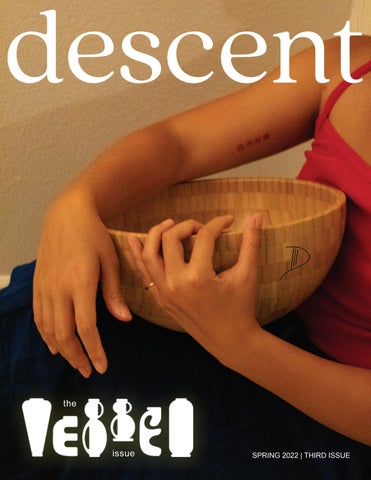
SPRING 2022 | THIRD ISSUE
descent m a g a z i n e
Descent is a student-run arts magazine at USC. We produce a semesterly online magazine featuring works by APIDA creators at USC. Our mission is to elevate and amplify APIDA voices by nurturing a space where they can showcase the their artwork, stories and other creations.
EDITORS IN CHIEF INTERNAL OUTREACH Nancy Liu, Long Le Cecilia Li FINANCE PARTNERSHIPS Charlene Huang Angelica Boaquina PUB. RELATIONS PUBLICATIONS Sreenidhi Boopathi Mendy Kong Connie Deng WRITING EDITOR VISUAL ART EDITOR Emi Ching Angela Rong WEB PRODUCTION STAFF PHOTOGRAPHERS Steven Gong Marissa Ding, Alex Lam STAFF WRITERS COMM. ENGAGEMENT Ally Guo, Sophia Pelaez, Emily Chen, Ethan Woo Alicia Luo, Echo Tang
v e s s e l s v e s s e l s
s
table of c o n t e n t s 04 | Editor’s Letter
12 | the life cycle of the sun 06 | Military Man
SOPHIA PALAEZ
ECHO TANG
16 | I Am Inspired by Possibility ALLY GUO
28 | 酸双手 / 金柠梦 ALICIA LUO
22 | Watermelon Rind EDDIE SUN
Hey there,
lett fro th edit
We’re thrilled to be bringing you the third issue of Descent Magazine, VESSELS! It’s our mission to build a community of APISA* artists, and our hope that these works bring you some comfort or joy. We’re proud to present the hard work of our writers, artists, editors and designers, and none of it would be possible without the other members of our board and the Descent community. The theme of this issue, VESSELS, came out of a desire to expand our scope of work and present a fun, original challenge to our contributors. “Vessels” can be whatever you want it to be: a boat, a vase, a body. It came from the question, “How do we carry things that are important to us?” We wanted to focus on the container, more so than the contents.
4
ter om he tors
Our first issue came out almost exactly a year ago! We’ve grown immensely as editors, learning how to manage an incredibly talented team, and doubling the size of our team. We’re also so proud to have witnessed the growth of our writers and editors through each issue and we’ve been so lucky to have such a brilliant, supportive team. Each issue gives us more opportunity to learn from each other and grow as artists and people. We are proud to present our final issue as Editor-in-Chiefs and cannot wait to see how the next team will grow Descent Magazine moving forward. We hope you enjoy the third issue of Descent Magazine, VESSELS.
Long Le and Nancy Liu
*We have previously used “APIDA” to refer to the Asian, Pacific Islander, and Desi American community. In light of recent efforts to acknowledge South Asians that don’t identify as Desi and Asians that don’t identify as American, we’re making the switch to “APISA” to refer to “Asian, Pacific Islander, and South Asian”.
5
ECHO TANG
Military Man My 爷爷1 is gone. It was January 5, I remember, and almost midnight. I was perusing through the emails that I had accumulated over winter break when my dad emerged silently from his study. His rigid back and his clenched jaw were all I needed to see to know what had happened. “I just got off a call with your aunt,” he said, unusually calmly. “And…and 爷爷 already passed away. A few minutes ago.” I’ve only seen my dad cry twice. The first time, I forced him to go watch The Fault in Our Stars with me when I was in middle school. The second time was that day, January 5, the day my 爷爷 passed away. I didn’t know what else to do except wrap him in a hug, and for the first time in my life, my body shook with my dad’s racking sobs. It rumbled deeper than any earthquake, bubbling inside me like a maelstrom, and I shoved that storm down my throat because now it was my dad’s turn to be a son and not a father. I wondered how long I would have to keep that storm down until it reached my lungs and 1 Yéyé, paternal grandfather
6
My 爷爷 was a police officer. It was obvious in the way he did everything. He woke up at 7 o’clock sharp. Stretched a little, rubbed his eyes and swung his arms. Poured water in the steamer. Put buns in the steamer basket. Waited eleven minutes for the water to boil. He was wise and weathered, keeper of knowledge in his small apartment that didn’t even have wifi. 爷爷 was as close to invincible as a human could get. He moved through his community like a river, faster than people a quarter his age. He never wore earbuds either, Beijing opera drifting through crowds and signaling his presence. Just like he commanded his subordinates, he commanded the sidewalk next to the street vendors. “Captain Tang is here, Captain Tang is here,” they would murmur and then clamor to give him their best deals on peaches and tomatoes. With the way that he picked up his downstairs neighbor’s grandchildren from elementary school and taught the aunties in the park the best way to fold dumplings, he might as well have been the captain of the entire town, not just his police squadron from decades ago. His secret to health? “Exercise. Exercise everyday. Eat your meals. And be happy.” I tried to follow that to a tee, at least as best as I could. How in the hell did he end up with tuberculosis? It was one of those things that the universe couldn’t answer. “Do you exercise regularly? Do you smoke? Do you drink? Are you vaccinated?” I always thought the doctors were so stupid for asking those questions. My 爷爷 was the strongest man in the world to me. In this poor city where he still had to ration out hot water for showers, he worked himself
like an ox, making sure he got meals on the table and the bills paid. But they didn’t know my 爷爷 like that. They couldn’t see all the vitality he embodied to me. They only saw a sick, old man in his eighties who was so pathetically incapacitated by a curable illness. -----The doctors couldn’t figure out why things weren’t working for my 爷爷. My guess was that some higher being made his body so pure that none of the medications were going through, trying to preserve its sanctity. (Not that I would ever tell him that. He didn’t believe in God. “What’re you talking about? Everything about me, I got it by myself. That just means my body isn’t strong enough.”) The medication left him clinging to the rails of his hospital bed, vomiting out all his meals. Those hands that once picked me up, held my hand as I crossed the street, and rolled dough and chopped scallions for dinner were white at the knuckles and gripping the cold metal of the hospital bed. How lonely must it have been? How painful? I overheard my mom on the phone with my uncle a week after he died. She said she couldn’t pinpoint exactly why he passed away, but she thinks that he probably starved to death by choice. “That stubborn old geezer,” she said, half bitter and half nostalgic. “He got his way even when he died.” Jesus Christ. My 爷爷, who woke up before me for high school zero period just to
7
2
make sure I didn’t skip breakfast? My 爷爷, who always stuck to his rule of four dishes one soup for every dinner no matter how early or late we would eat? How did he come to suffer so much that he rejected the possibility of merely being alive?
11 2 1
12
My 爷爷 taught me how to play Minesweeper after I watched my cousin playing it on his mom’s huge computer, one from the late 90s. “Girls shouldn’t be playing games about bombs,” he said, but he still taught me anyways. “Don’t get me wrong, girls still shouldn’t be playing games with bombs. It’s a strategy game. You can play that.”
3
I won’t ever know. 1 1 1 11 ----1 1 1 My 爷爷 was a mili- 1 1 tary man. I knew that before anyone even 1
1
2
2 2 11 1 1 2 11
told me. Before I was born, he was detained at the Los Angeles airport because he refused to renounce his membership of the Chinese Communist Party from the time he was a police officer, even though he was retired for several years. My dad had to drive an hour there at midnight to convince the customs officer that he was not a spy, that he was there to be a grandfather and not a cop.
3
My dad told him to let go of his pride, that he needed to do that in order to take care of a child. I can imagine my 爷爷 scoffing, maybe clicking his tongue. “What are you talking about? I’m still a soldier until the end of my days. All soldiers are.” Something like that.
11 11 1
For years, whenever I visited China, I played Minesweeper on the plane while the lights were off and my parents were snoring away. It was one of those things I played so many times that I expected to win. After all, my 爷爷, the military man taught me. Why would I not win? “My granddaughter won’t go to a famous university. She’ll end up becoming a soldier,” he’d joke.
13 1 11 2 1 11 11 11 1 11 3 111 1 1
11 2 2 1 1
I’d like to think that he realized that he can be all of those things.
8
1
3
1 1 1 1
I didn’t want to be a soldier though. After a while, I stopped playing. It had become boring, almost routine. But the night that he died, I found myself redownloading the game on my phone. My phone charger cord was too short, and I ignored the cramping in my shoulder as I contorted my body on my bed to see my screen.
When did I become so bad at this game? Maybe I couldn’t visualize the numbers and grids anymore? Was I out of practice? Or was it my screen becoming so blurry with tears that the
1 1 1 1 1
2
1
2’s looked like 3’s and 3’s looked like 5’s? I wondered if my cousin was also playing the game, twelve hours across the Pacific, maybe on his phone like me or trying to force start that old computer if it was still even there at all. Maybe his tears dripped down his nose like mine, running through the crevices of the keyboard like rivers. Tears leaving our bodies the way that 爷 爷 snaked through the streets of his hometown. ---My 奶奶 loved his name. Tang Gaomei was an auspicious name, she said. Tall plum tree. Plum blossoms symbolized the end of winter and the beginning of spring, right? Chinese people love plum trees. She was always the most superstitious of my grandparents, trying to find some meaning out of everything. On the other hand, my 爷爷 couldn’t care less. It was a name straddling the line between masculinity and femininity, strength and fragility. Too many meanings for a military man. I got that plum tree inked on my forearm, cradled by a crescent moon. The moon was a sign of resilience, the plum blossoms a reminder that things will get better. My 爷爷 never saw my tattoo. I don’t even know if he would have approved of me having a tattoo, even if it was his namesake on my body for eternity. But what I do know is that he loved my 奶 奶 very much. He was always yelling at her, partially because she was almost deaf in both ears, partially because anything she did annoyed him. She has a bad right leg, and I swore I could hear him grumbling at how slow she was from a mile away. But when he thought no one was
looking, I’ve seen him go back up a flight of stairs just to hold her hand on the way down, cut newspapers to line the kitchen tile to dye her hair every month, swear at the bus driver for not stopping long enough for her to get on and pay her fare. And I know she loved him too. The way she wore her emerald engagement ring every day, no matter how many times she complained how ugly it was. The way she hated cooking, but always washed his vegetables three times for him. The way she clutched his urn with hands weathered by time hiding under wool gloves, standing in front of his grave in the gray January sun. The way she knows she’ll truly, truly never hear his voice again. At his funeral, they used a recording of a piano piece I played when I was in elementary school. I didn’t even know it was me until my aunt sent me a video of his funeral ceremony; the metallic timber and out-of-tune keys were unmistakably from that dusty upright Yamaha that we finally sold four years ago. If only I was across the Pacific Ocean, in a cemetery twenty minutes away from that tiny apartment without wifi, because my family couldn’t afford a better burial site. If only I could’ve heard that he treasured me so much that even his veteran buddies and police subordinates had to stand in the cold listening to his granddaughter playing piano from over ten years ago. If only. If only I didn’t lose my 爷爷. ----The day after he died, my family scraped together a makeshift memorial for him. My sister and I silently and meticulously chose white candles in the home decor section
9
of Target, while my mom called every Asian market within a six mile radius to find some white chrysanthemums. My dad dismantled a family picture and replaced it with a military mugshot of my 爷爷. So dignified, even in death. The more I thought about it, the more it was unfit for him. His photo was placed on a stack of self-help and baking books. The vases we dug from the storage cabinet were unequal in size, chrysanthemum leaves falling limply out of the mouth in all different directions. We were unprepared for him to die. But what else could we have done? We moved the candles so they were symmetrical, arranged the flowers so it wouldn’t block the picture frame. We pulled up my dog’s rug and moved her toys aside so that we could kneel on it and touch our heads to the floor knowing that the next time we see him, he’ll be nothing but a slab of marble on the hillside facing the freeway instead of a koi pond like we wanted. For three days, my dad didn’t sleep. He watched over my 爷爷, lighting the candles again when the flames went out, watered the chrysanthemums, knelt on the white rug until it was time to eat and dog hair and lint peppered his pants. Somewhere halfway across the world, my aunts were doing the same. “Traditionally, the son protects the grave for the longest,” my mom said. Again, I was reminded that who I was looking at wasn’t just my dad, but also a son missing his father. And whose unmoving face I was staring at, perched on top of books I don’t read, wasn’t just an old man who died of a curable disease.
10
Military man, Captain, Tall plum tree, My 爷爷.
11
SOPHIA P E L A E Z
the life cycle of the sun Her room has no bed. It has no books in its bookshelves, no clothes in its wardrobe. As she stands in the doorway, her only companion is the falling dust made visible by the afternoon light pouring in from her window. She sees all the chips in the paint and all the cracks in the hardwood floor and her heart grows to the size of an elephant.
12
We sat at the edge of my bed, on top of a freshly washed floral comforter with our backs against a lilac wall that was plastered with the posters of bands whose members I was sure would one day lock eyes with me in a sea of fans at their concert and immediately fall in love.
My voice rose at the sentence’s end, piping up, becoming another attempt to make myself taller so I’d be able to reach her eyes. But she never looked down, never at me, there was always something else ahead, something and someone else waiting for her.
“Lils, do you want to go rollerskating this Friday? I know Luisa and them were thinking of going. We can just meet them there.”
And we never really ended up going. But the idea of having a tomorrow together was all I needed.
She always made plans—and thank God for her. I hadn’t been roller skating in years, and the last time I went, I ended up with more bruises than I knew how to count—which, to be fair, I couldn’t quite count past five— but the memory of scraped purple knees and swollen feet was never a fun one to recount. Oh, but that didn’t matter. If your friends jumped off of a cliff, would you? The second they suggested it, I’d have run to the edge of the cliff and done a backflip off of the hanging dirt. “Yeah! I have my permit test in the afternoon, but if we’re going like sometime after six, I’ll be there for sure.” She beamed. “Oh, no okay, that’s perfect, we’re probably going later anyway. My parents are out of town, do you think your mom could drive us?” When she looked at you, you were her world. “I’ll ask, but I think it should be fine!”
-----She kept every postcard she was sent. She kept every letter, packed with a barely legible cursive that ran from hole punch to margin, that she was given. She kept the tickets from movies they saw together and the receipts from their weekend outtings. She held onto it all and displayed it on her wall like a university diploma. But now her walls are empty and every box is filled. She clings and remembers and dwells and collects. -----“You should really give yourself more credit. You’re one of the hardest workers I know, but literally nothing is ever good enough for you.” We were sophomores in high school. All I could think about was how our senior year was inching closer and closer, and yet I’d done little to make anything of myself that a middle-aged white man mulling through the applications of teens desperate to be let into their overpriced institution would consider noteworthy.
13
Maybe she took notice that my polished nails were bare and jagged and chewed down until there was more skin on my nail bed than nail or that my black hair was thinning and littered with gray strands. I think, over time, I started counting on her to take notice. She took me by the hands as we sat across each other on the floral comforter. My hands were in hers, and she leaned in, closer. I had this urge, this impulse, to pull away. I could feel anything and everything in my body, every food I ate that day churned and jumped in my stomach and all of the heat in the room found its way to my palms. “You have so many people who are so proud of you—me included.” Her eyes met mine. “You’re a star.” -----But it’s been two years since you came by her house. She hung onto the stray threads of your hand-painted lightwash denim jacket, and you couldn’t even remember to greet her on her birthday. Or maybe she never told you the day. Maybe it was her fault. ------
I got my driver’s license exactly two weeks ago. It was two in the morning on a Thursday, and she had just been broken up with. I was the first person she told, she said to me over the phone. She didn’t know what else to do. I rushed out of my bedroom and into my dad’s beaten-down Toyota Prius, hoping I wouldn’t be responsible for another dent on its passenger car door. Then we came back to my house. We sat on my bed, and I held her, and I told her if he couldn’t see your worth he didn’t deserve you, he was toxic, she was in the right, she did nothing wrong, things will be okay, she was better off without him. I ran my hands through her hair as she wept. She told me she loved me. “I don’t know what I’d do without you in my life.” She told me I was different, that she had never felt this deeply about a friend before. I felt the same. I was eager to reciprocate; I was overflowing with admiration. She made me want to be bolder. She took steps without caring where she fell. She was always smarter than me—and she knew that—and she’d win any sort of debate we got into with ease. She spoke with a confidence I could never emulate. She led a life I could never live. “I don’t know what I’d do without you either.” ------
14
It is the last day of June. Every plushie she shoved under her bed after she turned fourteen (but would rather die than throw away) filled the brim of a cardboard box. She had packed every dust-coated yearbook, every AP class notebook, every auntie-gifted dress she never lost enough weight to fit into, every novel with a broken spine. None of it was useless, nothing ever was. Maybe, she thinks, she’ll find a use for them one day. Outside, her dad has the car running. She takes one last look. I miss you and I miss you.
15
I Am Inspired by Possibility ALLY GUO
16
The first time Genia entered her father’s study, she knocked over a stack of battered notebooks, and her tiny sticky hands scrambled to catch them as they fell. The final time Genia entered her father’s study, a battered stack of notebooks didn’t fall, and her hands weren’t quite as small anymore. It was almost tradition for Felix to sneeze whenever they were in the old sanctum, and this time was no different. The dainty sound flew forth periodically like a fairy, sending the open pages in front of him fluttering. If a sneeze could be seen, Genia had no doubt it would’ve sparkled in the air for a few moments before dissolving away. Felix had certainly changed over the years, but that twinkling sneeze remained eternal. “Why is there always so much dust?” he grumbled, rubbing his nose. “We clean this place every time we come. But it always goes back to being a mess.” Genia rubbed her own nose with one hand, turning a page in the book on her lap with the other. “Didn’t auntie say that’s why she doesn’t like to come up here?” “The dust?” Felix frowned. “Hardly. The entire house would be covered in it if papa wasn’t obsessed with cleaning.” “No, not the dust. I know auntie is incapable of taking care of herself. But didn’t your mother say–about my father’s study– it’s like it knows–” Felix gasped. “–like it knows that he’s de–” He let out an awkward cough. “–gone. So it always assumes it’s going to be abandoned whenever anyone leaves.” Genia nodded. “Obviously, auntie doesn’t know that’s the case, but… yeah.” She glanced around the sprawling space. “It really does feel that way.”
“Buildings are so strange,” Felix said, voice reverent. “They pick up too much of the magic of the people within them, so you never know how they’ll react and change.” He shook his head, trying to hold back another sneeze, but there were hints of childlike excitement bouncing within his large eyes. Genia grinned, a delighted glimmer flitting across her face. “But if normal buildings are this strange, think of what all those unexplored temples and ruins are like. There are so many places we have to investigate. Where do you think you’d want to go first? We’ll be leaving soon, so we ought to finalize some plans.” Felix scrunched his face, as if thinking deep into the past. “Well, I’m not so sure yet… But mama and your father wrote a lot about that, didn’t they? We can look through some more of these to decide.” He gestured toward the countless journals, maps, and volumes scattered across their legs and the floor, arms whirling in large swooping motions. “It’s going to be so hard choosing just a few to take with you. I wish you could bring the whole archive on the road. There’s so much information here. It’s like the shelves never end.” The room was fairly dim, lit only by the hovering lights darting to-and-fro above them. Three wax-carved birds, melting wax collecting at the ends of their feathers but never quite dripping off, danced above them on snowy wings. Delicate flames, sparked to life by the spell Felix had cast earlier, burst from slender wicks, which protruded from where their heads should’ve been. Everyone had always told Genia that although her father had had an affinity for all living things, able to coax even the most stubborn of cats and cacti, birds had been his favorite. The avian candles he’d brought to life only seemed
17
to prove that partiality. As one dove swooped low over a ragged binding of her father’s sketches, Genia couldn’t help but marvel at the charcoal strokes and letters he’d printed on the torn pages. It was a cluster of ancient gnarled trees, their branches strikingly bare despite the strength and rigidity of their trunks. And scrawled all around the image was her father’s barely legible script: In the depths of the forest stands the bones of a dead god. Or perhaps “dead” isn’t the right word. Carla wasn’t sure what to make of it when I told her, but that’s what I expected. She never understands these things anyway. But when I touched that tree, I could feel it. This tree–it’s not quite dead and it’s not quite alive. But it’s very, very angry. Genia couldn’t help but grin. Felix might now know where he wanted to go first, but she certainly did. She liked learning magic as much as any of her friends did, but why repeat the same tired enchantments when there was undiscovered and unexplained magic writhing in walls and valleys humanity had barely glimpsed? Even her father’s notes, as extensive as they were, only captured a fraction of the world. After all, how much could you really learn, confined to one single place? But after ten years of climbing through the local forest, of clinging to Felix’s parents whenever they ventured beyond town, it was
18
finally time to leave. “I can’t believe auntie is giving me all of these. I really can’t decide which ones to bring with us.” Felix looked up, finger hovering respectfully over some flowers pressed between the pages describing them. “Well, they were always technically yours. Mama was just taking care of things until you wanted them. She has her own research, anyway.” Genia found it funny that aside from their tendency to trespass through the ancient forests and sacred temples of long-forgotten gods, their parents had never seemed to have anything in common. But most of their time had been spent journeying through faraway lands, so perhaps their partnership hadn’t been so strange after all. She made a face. “I always felt like auntie deserved them more than me. She was the reason my father was able to write half of these anyway. The two of them on all their travels. Just like we’ll be doing.” She nudged Felix playfully before reaching for another map. “Haha, yeah…” Genia glanced up quickly, his tone unusually muted. His gaze was focused intensely on the journal in front of him, but they seemed dull and disconnected. “Felix?” He seemed to snap out of a daze, head jolting. “Oh, uhm, sorry! I just remembered something that was bothering me.”
He hastily turned to the next page, and before Genia could press further, his eyes brightened, the signature vibrancy returning to his face. “Look at this!” Genia leaned over, peering curiously at the sickly yellow flower splayed across the page. There was something about pale petals that seemed distinctly ill, like it was hungering for something that could give it more life. “What’s this?” Felix puffed up in a mixture of embarrassment and pride. “Remember those weird plants Honey brought back from the south. Well, Channary and I have been experimenting with them to make a new formula. It’s for clearing enchanted disturbances in the eyes. You know the eyes are hard to work with, right?”–Genia nodded–“Because a lot of magic is concentrated there. But the flowers have this property–I think it has to do with the way they extract magical energy from pollinators–that makes them really compatible with man-made magic. It’s a little grotesque if you think about it, all those poor little beetles and bees having their life force sapped, but it works so well for healing brews.” He paused, a hand coming up to rub his neck sheepishly. “Ahh, sorry, I’m rambling again.” Genia waved her hands in front of her. “No, not at all. I love hearing you ramble. And that’s really incredible. You’re so skilled with healing magic. You really deserve all those apprenticeship offers.” Felix brightened again, straightening up like a freshly-watered sunflower. “You really think so?” “I know so,” Genia declared firmly. Felix almost seemed to blush, a gummy smile dawning on his face. He was still beaming when he looked back down at the volume. “It’s amazing how much knowledge there is here. We’ve been climbing up since we were kids, and we still haven’t finished looking at all the books and diagrams.” “And to think we made such a big deal
sneaking into this place all those years ago,” Genia laughed. “When all we had to do was ask auntie for the key.” Felix chuckled. “All these years later, they still haven’t fixed that dent we left in the wall.” “I hope they never do,” Genia said. “I like the reminder that we were here. It’s like we made our mark.” Like she’d made a mark in an important corner of her father’s life, even if they’d never met. Felix seemed to sense her thoughts because he fell silent, eyes flattening over. “You know… I don’t think mama ever got over what happened to your father. She didn’t have anything to do with it, but… I think she still feels guilty for not being there.” Genia paused, hand frozen in the air from where it had been reaching for another book. She slowly pulled it back to her lap. “And I guess, I’m a little scared about you, too. You’re always running about everywhere, and I’m just… What if something happens to you?” Genia tried for a grin, tapping him lightly on the shoulder. “Well, I’ll have you there to patch me up, won’t I?” The pause lasted just a moment too long. “Felix?” He fiddled with his hands, a habit Genia had come to recognize. An indication that he knew what he wanted to say but not how to say it. It made Genia’s own pulse quicken in dread. “You know, I’ve always thought Black Willow was too small for you,” Felix started. “It’s a bit different here–in your father’s study, I mean–but normally, you’ve always hated being in one place. You always preferred going to the forest over attending class. And I never minded being in the classroom; it was fun, even. But hearing you talk about all the possibilities out in the world around us, it made me want to
19
P do whatever you were going to do, too.” “But you don’t want to.” It wasn’t a question. “But I don’t want to.” Felix swallowed. “At least not anymore.” “Uhm…” Genia rubbed her hands together awkwardly, not sure what to say. “Are you going to take an offer then? One of the apprenticeships?” “Uhh, yeah. That’s the plan.” “I thought you told me you weren’t going to take any of the apprenticeships,” Genia mumbled slowly. “I didn’t realize… uhm… I wouldn’t have been all like that if I’d known.” “No! You didn’t do anything. I… still really wanted to travel with you at first. But then, this past year, well… so much happened. And I realized, there were so many possibilities in Black Willow, too. I mean– the salve Channary and I made. It was just with one type of herb, and there’s so many herbs in the world. So I guess I just… I started to change my mind.” His eyes looked watery, the hint of tears dangling from a precipice. “I’m sorry.” “There’s nothing to say sorry about. I’m happy for you.” But she couldn’t quite make her tone sound upbeat. They sat in silence, both of them staring listlessly at the pages in front of them, not really comprehending anything. Their shadows danced glumly across the walls, distorting grotesquely in tune with the flight of the doves. Genia’s nerves prickled, her heart beating uncomfortably fast. Her entire body was tense, and she squeezed her eyes shut. The silence felt oppressive, crushing her on all sides. Prying her eyes open slightly, she could see that Felix’s hands were balled tightly into fists. “I’m gonna miss you, y’know!” she suddenly blurted. Felix jolted in surprise, but Genia pressed on, voice rising as she pointed a finger at him. “You have to always write to me! Let me know what new crazy plants and potions
20
you’ve come up with. You’d better not forget even a single day! And I’ll write back, too.” Felix stared at her with wide eyes before the corner of his mouth tilted upward. “Are you sure about that?” he began. “You can never remember to write to anyone. Did you forget about–” “Okay, yeah, maybe I’ll forget. But I know you won’t! So you’d better not ever miss a day.” She hesitated. “Okay, maybe if you’re sick or something, but you know what I mean!” Felix beamed gratefully at her. “Of course. You know I will. I’ll miss you, too.” Genia nodded, heart still racing but satisfied. “I know.” Felix dropped his gaze to the book on his lap again, still open to that sickly yellow flower. As if he was trying to hide his face. Genia felt her own smile slip, a deep tiredness seeping back into her bones. Her entire body slumped, the journal sliding off her lap. It hit the floor with a slight thud and lay there, slightly crumpled. “Hey, Genia… I’m really sorry I’m not more like you.” “What do you mean?” He was still looking down. “Uhm, just a lot of things. That I’m not as adventurous as you. Curious. Inspired–” “No, please stop.” Genia shook her head wildly. “Please don’t say that. You’re not–just because–” She took a deep breath. “It’s like you said earlier, when you were talking about healing magic. You’re inspired by all the possibilities. Just not the same possibilities I’m looking for.” Felix opened his mouth, but Genia rushed on, not wanting him to argue back. “It’s like what Honey always says! I’m dumb, reckless. But you’re not! And that’s not a bad thing. So what if you don’t want to spend the next several years trekking through mud and avoiding traps? You’ll be finding antidotes to creepy poisons and fighting carnivorous flowers instead.
Possibility Sounds just as adventurous to me. There’s so much in the world to discover, and not all of them are found in ancient castles.” Her breathing sounded loud in her ears, and Felix’s mouth was still agape in shock. He cleared his throat and swallowed thickly. “Uhm, thank you. Really, thank you.” He rubbed his eyes. “Really, that means a lot. Just thank you.” “Of course.” Genia reached out to lay a hand against his. “Of course.” Two shy smiles met in midair, one watery and one out of breath, but their arms curled around each other softly, and perhaps that’s what really mattered in the end. The rest of the afternoon was spent in silence, but unlike before, it wasn’t an uncomfortable one. The room felt warm, loving, like it was holding them in a tender embrace. Occasionally, one of them would pipe up, point out something interesting they’d found in the yellowed pages of a book, but other than that, they sifted through the volumes quietly, merely enjoying each other’s presence. The day drifted by gently, and as the sun fell outside and the air in the attic chilled, Genia began placing a select few papers into her bag, and Felix finally spoke again. “I’m really going to miss you,” he said, voice slightly wavering. “But I don’t think I’m going to regret my decision.” “Of course not. I don’t think I’ll regret mine either.” Genia nodded. “And I meant what I said earlier. I’m happy for you. I wish you endless fortune and great discoveries.” She swept her arm dramatically. “You’re going to do great things. I just know it.” “Thank you. You’re going to do great things, too. Just please don’t come back missing an arm. You’ve always been curious, but don’t be that curious.” “I could say the same thing to you,” Genia joked. “Don’t go trying all your brews on yourself now, or your nose might fall off one day.” Felix grinned. “What can I say? According to you, I am inspired by possibility.” Genia returned his smile. “It’s true! And I’ll say it about myself, too. I am inspired by possibility.”
21
EDDIE SUN
Waterme R i n 22
elon n d
Laolao was conditioned to make things out of scraps. Before her mentals progressively worsened and before I grew up enough to understand why, I would peruse around the house, fascinated by her meticulousness and inextricable focus in doing the most minor of tasks. One of these was her preparation of xi gua pi, watermelon rind, sometimes thought of as an herbal remedy in our culture, but to me just a dish that was equal parts savory and enigmatic. When we ate watermelon in the house, the leftovers were saved in a recycled tofu carton or styrofoam tray that packaged raw meat. In the instances I accidently threw the peels in the trash, Laolao would scold me, then fetch it out of the bin. She always had something to be angry about. Once the peels overflowed from its container, Laolao, equipped with cutting board and knife, would separate the green exoskeleton of the watermelon from the sweet, red flesh it protects, leaving just the rinds, which are tough, flavorless, and the translucent green complexion of jade. They were sliced into paper-thin strips and stir fried with soy sauce and dou chi, fermented black beans. The watermelon’s original sweetness evaporates save for a few botanical hints, replaced by the ingredients’ umami flavors. Xi gua pi can be eaten on its own, but in the house, it usually served as a pickle for our morning rice porridge. Laolao kept herself busy. If she wasn’t working with watermelon rind, she would be dicing and pickling the ends of broccoli and daikon, or separating the stems and leaves of kong xin cai, a leafy green regional to her hometown. Bits of leftover meat were minced and cooked to complement tofu dishes. The last drops of milk in the carton or eggs in the mixing bowl were saved as fertilizer for the tomato plants
23
she tended to in the backyard. If there was nothing left in the kitchen to be preoccupied with, Laolao would put on cleaning gloves, the oversized neon yellow ones that envelop your entire forearm, and scrub down the nearest surface. I never questioned why Laolao did all this. She wasn’t conservationist, at least in an academic sense; her knowledge of worldly things was limited. She worked with the odds and ends of ingredients, but had no aspirations of being a chef. If she had personal ambitions or inclinations that necessitated this work, it was never obvious. But it definitely wasn’t a labor of love. Laolao did these things with a brooding look and a frown on her forehead, a frown I’ve always known. I think I learned to frown before I could smile. She complained often about her knees hurting or the skin cracking from the palm of her hands. The work was anything but necessary since we were well off enough to afford Laolao peace of mind in perpetuity. But it was an inescapable mindset; she only understood the gruel of indefinite toil and couldn’t imagine an identity outside of it –– a purgatory of work without frills. Laolao was very bitter, and with every passing year, became more convinced that she was divinely cursed. At the same time, bitterness gave her life. She wasn’t religious, maybe spiritual at best, but she could always be resentful of the nebulous powers that be for her destiny to an existence of eternal unhappiness. Being raised by Laolao was a luxury and a curse. I was the kid who stood by the countertop to watch her slice xi gua pi, and eagerly waited at the dinner table for her meals. I devoured her cooking and would tell her how delicious it was. I think it made her happy. She cared deeply that I would grow up alright. Sometimes, she would crack a deflated smile and call me
24
guai, a favorite word of her’s, which meant good or obedient and carried a patronizing tone. I wore it like a badge. Laolao was satisfied in brief moments, until her bitterness reappeared and she found something to complain about. She went to tremendous lengths to make me happy, but it was impossible for me to reciprocate. If I asked her now about why she never stopped working, I think she would scold me and say that it was all because she cared about me, and I would feel the warm glow of affection and the piercing hurt I always felt all over again, those two feelings forever inseparable from each other. ... Laolao means grandma in Chinese, but it’s only used for the mother’s side of the family. Lao by itself is the word for old, but when said twice, it becomes something much more endearing. Nainai also means grandma, but only for the father’s side. The first words you learn are to call for your caretaker, so she was and is always Laolao to me. I’ve never been able to translate this distinction to English in ordinary conversations. If I said grandma, which one was I referring to? Grandma on mom’s side was too wordy, and maternal grandma sounded like nomenclature. People around me cared about which side of the family I took after more. The answer was undeniably my father’s, at least in appearance. Though I could see for myself, family and friends reminded me of it so often that I would have believed it anyways. Mom held on to the pieces for dear life. Look at how similar our noses are, she’d say while we FaceTimed my uncle, her voice beaming. Maybe it was the language, or maybe it was the upbringing, but I never understood family as a nuclear concept. I perceived myself as just pieces of Mom, or Laolao, or my father, drawn to one’s love,
estranged by one’s mistakes, molded by one’s baggage. Laolao never brought up her past. I think she thought it was unimportant, or maybe she just repressed memories of it altogether. The whole family was good at hiding the things that made us hurt. We covered up our wounds from each other so that it rotted us from the inside instead. Mom didn’t share much about Laolao either, but the rare stories she did tell were revelations. Laolao was beautiful, even in old age. Her beauty made her sought after, but she ended up in a cold marriage devoid of affection. Laolao was a schoolteacher, which was a lowly occupation in Mao’s China. During the Cultural Revolution, around when Mom was born, she was sent to the countryside as part of the regime’s labor programs, and raised two children on her own. After ten years in the states, Mom made enough to retire Laolao from her job, so she could help look after my sister and me. I think all these things programmed Laolao for domesticity without love. Of course she would never talk about it, but it was palpable in her work ethic and bitterness. It made her so cold and heartless, but a completely devoted caretaker.
A few months into college, my dorm held a student event about expressing love languages. I was unfamiliar with the concept, and after looking it up I was initially repulsed, like hearing about an exotic dish. It was easy for others to do things that felt foreign to me, like give gifts and compliments and make people feel good. Growing up with Laolao introduced me to a lot of difficult feelings. She was a manipulator, so I picked up sympathy and guilt. Her anger taught me patience and the art of holding grudges. Through her, I learned to be untrusting and independent. Laolao communicated pain and hurt in so many ways that I saw it in hundreds of shades. I carried those feelings in a palette. It wasn’t until I left for college, and Laolao moved back to China for good, that I made sense of her twisted guidance as affection. She loved through her work, and put more work into me than anyone else. It almost felt like a hug. ... I woke up in downtown Brooklyn last May, a couple months after the Atlanta shootings. Stop Asian Hate, as a decree and slogan, stuck around like glue. The Filipino barber who cut my hair that morning was candid about his thoughts on it all.
25
He suggested that we, the young Asian men, had to do more to assert ourselves. That we were the ones strong enough to fight back. They pick on the women and elderly, he said, because we don’t stand up for them. I couldn’t have disagreed more, but nodded along. I would’ve much rather talked about the Knicks, or literally anything else. It was a ridiculous idea, that puffing out our chests and making a statement about our slighted machismo would resolve the targeted violence against us, but I don’t blame him for having those sentiments. The victims of these hate crimes were often portrayed as fragile and vulnerable people who deserved more protection. I think this narrative was harmful because it stoked flawed ideas about masculinity and security and the poisonous institutions these ideas informed, like policing. The woman who asked for my order at the Xi’an Famous Foods that afternoon looked just like Laolao. She was too old to
26
be working in that environment. She was skinny, almost ghastly. I imagined Mom telling her that she needed to eat more, like she would to Laolao. I ordered my food in Chinese, but she spoke fairly good English. She looked exhausted. This woman had the kitchen to herself; she took the orders, cooked the food, plated them in takeout trays and begrudgingly told everyone to have a good day. It feels wrong to call it a kitchen, which should be a cozy, loving place in the corner of a home, a shrine. This was industrial, metallic, lifeless. Steel vats of boiling water and prepared sauces lined a perimeter of glass panes that separated her from the customer. The woman worked the dough, kneaded and stretched it into ribbons, and dropped it in the water to boil. It’s a sort of entertainment to watch us cook, one of those inefficiencies that people enjoy. If the hibachi restaurants and the chefs who do spatula tricks are a circus act, then this woman, behind her glass cage, was a zoo exhibit.
It was inconsequential, but I suddenly cared deeply for this woman, despite having no connection to her. I hoped her shift would end soon. I hoped her home wasn’t too far away. And if she had to walk or take the train for a while, I hoped she was safe. She probably had to wake up the next day and live through the same thing, and the day after next. I wondered how the woman learned to make noodles from scratch. Maybe it was passed down to her from someone she loved dearly. Working with dough might have been precious to this woman, but in the establishment, she was reduced to nothing more than the bowls of noodles she produced. It clearly drained the life out of her. This, too, was violence. Our social machinery took her love and devotion and twisted it into something transactional; it took something that should’ve made her happy and turned her lifeless instead. In that moment, I missed and loved Laolao tremendously. Her love never felt more precious. Work could be such a destructive force, grinding away at people until they turn to gruel. I was grateful she poured her life into me. I suppose labor is a site of exploitation, but because of Laolao I understood it first and foremost as an act of love. I wonder if it’s any solace to love Laolao now, three years since she moved back to China, when I last saw her. Maybe it would make her happier.
27
酸双手 / 金柠梦 ALICIA LUO
Mother chases– Mother flees– Hides, spies, watches carefully– Water / wind / earth / gone– Mother, mother, where did you go?
28
An empty whisper of MOTHER fled from my mouth this morning. I hadn’t expected to become a cat today, but perhaps fate wanted me to meow at you. Is that the secret to putting you together? Meowing? (And of my mother, only the crumbs of lemon bars remain.) Armor on. Darts check. Notes prepared. Tea steeped. And here I am, feet floating along the familiar path so instinctively that I’ve barely glimpsed at intricately inlaid reliefs before my hand raps on the burgundy spirals of your Brazilian rosewood door, FLAK FLAK, flakes from my fingers trailing lightly across the ocean’s waves on the knocker you’d painted. Should I have made flowers to color in your pristinely white room? Is that too much like an embarrassingly late grave visit? As though you’d get a gravestone when your mother would probably build you some horrendous monolith bedecked in jewels and golden inlays and engraved with flowering lies in boldface. I can hear your swift complaints, attacking the emptiness, the missed chances to paint in rainbows, the loneliness of your terribly placed central casket. But I’ve worn the armor you gifted me when you’d complained at the plainness of mine, rambling about how clothing should be a happy surprise and swapping my grey jacket with yours in the same nagging breath. Your own blossoms, petals so vibrantly shining, paint smears combating the blandness of soft cloth will have to suffice for now. Your mother looked like she’d eaten too many of her legendary lemons when she opened the door for me, all hissed words and unveiled disgust, the veil cast aside by my magnificent entrance of course. You should’ve seen the transformation to her face when she realized I wasn’t going to stop, the “dirty–” drifting aimlessly for no one to hear as I made my way to you. As she whipped out a cloth to wipe my knocks away, I wanted to run my dirty hands across your marble floors to see if she’d wipe every trace of my existence away.
Mother haunts, in meandering trails That reek enough to condense the air Mother’s lemons rotting away 妈妈, 妈妈1 you call to a shade Who stares through you with cruel, golden eyes Hungry for– 妈妈,看饕餮在吃, 混沌在。。。2 妈妈我怎么记不住了?3 Mother where have you placed my words? You clipped a bird’s wings so it couldn’t fly/ you shattered her and recast with you / so she wouldn’t remember she was alive– Awake, awake again/ or is it still a dream? / horses of night they charge in/ as spirits play around the veil/ she became gold where there was not/ some pyrite little dream/ she– She is small again, though she is always small, in the place with traveling corridors. In the vast expanse between her vines and the ceiling, monsters of sharp light and infinite hunger wage war, the shrieking of metal on metal and screams of agony echoing and echoing. 1 Mama, mama 2 Mama, look, the Taotie is flying, the Hundun is… 3 Mama why can’t I remember the rest?
29
She still harbors in her heart a little ship of azure, filled with , reaching for /She hasn’t learned to flinch from the pretty, melodic tinkling of crashing shards– When life gives you lemons, always remember the five virtues of excellence. Number one, efficiency. You must utilize every last drop of that lemon, from juice to pulp to seeds to skin. Zest it, drink it, plant it, cook with it, you must use every bit of that lemon. Number two, remember to follow rule one. Number three, resourcefulness. Go pilfer other people’s lemons if you’re not satisfied with your own. Number four, hasty exits. Do not fall apart at– You’re falling apart, look at your arms, you leave behind crystalline feathers of yourself everywhere you go. Don’t laugh and say it’s a pretty trail of snow. Do you just want to be a murky puddle on the floor? Whose life will you change then? No, no, the children who splash don’t count. Are you really equating yourself to one fond memory? What am I to do with you? But here they are, sunset trails against my nightfall, you said it wouldn’t matter, that you’d be fine on the edge, spiraling lines exposing your qing hua ci1 heart. Your sarcophagus looks tight today, your purpled fingers almost trailing along frosted windows. I still think your mother’ll get a custom ticket to Yan Wang2 for this, but what does that make me who is going along? Will you see fireworks of flowers when you find the sunset trails in your heart? Will you blame me? Could you blame me though?
30
1 A style of Chinese 2 King of the Underworld
I want to see what the sunrise looks like, painted across your frame, but I’ll have to settle for what your coffin refracts. You can’t blame me for doing the same thing that you did for me now can you? Besides, will I even be gone? Just look to your heart. FLASH, lightning sears– Illuminates the darkening heart Back in the chair, little puppet king That monstrous, twisted chair that looms High behind your head– Your crooked crown hangs across your eyes A blindfold, 歪了1, indigo hands, crawling vines reach They pass through, no longer blue 妈妈,你送我的名字,怎么不说了?2 这样,我该怎么知道自己呢?3 Titles, they occupy space, where once you’d placed– What had you placed there? Where did it go? She frantically overturns boxes upon boxes, empty, all of them. Where’d the egg go? In her hurry, she kicks a silvered bump, which flies into the air, cerulean petals sparkling tauntingly under the 1 It’s crooked 2 Mama, the name you gave me, why don’t you speak it anymore? 3 Like this, how am I supposed to know myself?
reddening sun as she lunges to catch it, collapsing onto the floor. “Oh my little [insert name here, ]” she whispers to the egg, as tremors rock through her body. “It won’t be long now until you hatch.” And then, all the running, trading the beautiful language of her … people, so melodic even when used to hurl blades of words for unfamiliar crudeness, it would be worth it. Twitching in response, the egg rolls off, CRASH, into a box, THUNK, and another, zigzagging wildly and sending a shower of lemons her way and– Darkness coalesces over the egg, cloaking and warping it. Light leaves, time itself ceases in a sandstorm cut off, and there, lying on the ground, is a gurgling doll of a child–untouched, unmolded, unbloomed. Hers. –Your crown you must pass down. Just look at it, so marvelous, magnificent, meant to be admired. You’ve bled so much for it, this gorgeous massive diadem. You must take your place at the head, your legacy spanning for centuries more. Pass down your– The frame returned, familiar orchids sliced with lavender and cerise but whole nonetheless. It was working, working, the starry heart stuttering to life, but it’s not enough. Those bright, glittering eyes refuse to light. A hot streak along her arm counts down her fleeing moments of freedom, of clarity, and she rushes to offer her hand as a sacrifice as well. As heat engulfs her last vestiges of ebony, she smiles weakly. It’ll end with me.
Is it … oh, my voice went / this time that I’ve borrowed / has almost fully returned / to you / and I wonder, selfishly / whether your voice shall ring new / with timbres of mine / every whisper a joint effort / or if you will sing gloriously still / with no traces of me at all Swirling bits of pewter and The faintest memory of periwinkle The silver river returned to earth But eclipsed by bloodied hands offered At crumpled times, little mooncakes shared Gazing at the tidebringer Monochrome you’d take any day And drop your colors over that shaking frame Rice flour and honey and red bean and dates It would have been honor enough to stand There or not at all To see whirling ribbons of red splashed with silver Perhaps a single bud of lán1 Osiria rose that you are Nightfall receding to falselight Oh to be any sunset seen with / you Oh sunrise, to be seen / I implore that as 1 Pinyin for the both the color blue and orchid
31
you hide the stars / beneath your ombre curtains / that you hide a glimpse of darkness in that / freezingly distant light of yours / hendiadys or not I implore / won’t you remember that I … / that I … / could have touched the sun / with you Like the sun, the gold spreads and burns everything it touches. Absent-mindedly watching the gold continue its steady march towards her heart, she’s interrupted by a small tug at her sleeve. 妈妈,the child asks, offering a colorful book to her, 妈妈跟我读?1 One last time, she promises herself, before nodding. –Everything fits in a box. If it doesn’t, you’re not shoving hard enough. Try harder. There is nothing more beautiful than a room of neatly organized boxes. That’s what your mind should look like too. Hurry up. There’s clearly too much clutter there. Shove it in if you must. Everything fits– 好,宝贝。She smiles as the child eagerly opens up the book and points at the pictures. 对,孩子,这是饕餮,哇,它很会吃啊。2 哦,看,它头歪了,歪,看是不和正。3 妈妈,看,在飞,我也想飞!4 As the child reweaves and crafts the 1 Mama, mama read with me? 2 Yes, child, this it Taotie, wow, it can eat so much. 3 Oh, look, its head is crooked, wai/crooked, look it’s not and straight on top of each other 4Mama, look, they’re flying, I want to fly too!
32
adventures of the child four evil beasts, hot inky liquid flows down your face. 妈妈,你哭了?妈妈看,混沌,宝宝 给 你做?1 The child reaches up, staining chubby fingers into 山水画2 of baby buds and wisps of night. 对不起啊,宝贝,我只能给你这么多了。 自己也忘了。时间也没了。可是,妈妈爱 你,别忘了。从今天起只能叫Mother了3 What is an apology / when cut up and restitched / it simply forms emptiness / words that once had some meaning / meaningless again / just wastes of an exhale / silence returned to silence Oh, the pieces you were in / could not be called pieces at all / and were it not for those stolen moments / forever bordering seconds / spent tracing and wandering / mapping and admiring / though never did I think it’d come to use here / could I have puzzled together / little by little / a facsimile of you again / so skeletal and false / like some cruel spirit / who knows but a paltry part / trying to masquerade as the magnificent whole / so hollow / so crumpled The grimy wreck her heir presents looks like some deity’s attempt at aesthetic murder, all wounds and widly splashed blood, scars inseparable from veins of deep crimson. Her heir stands before it so defiantly that something inside of her, featherless yet dreaming 1 Mama, you’re crying? Mama look, Hundun, I’ll make you some [wontons] (the word for wonton sounds like Hundun) 2 A type of watercolor ink painting typically depicting scenes from nature 3 I’m sorry, my darling, I can only give you so much, I’ve forgotten it, and there’s no time left, but Mama loves you, don’t forget that, but from today you can only call me Mother
of flight, sings. Fine. She shall leave the mess for her heir. Perhaps it’ll make a fitting bodyguard and repay– Always say yes. You’ll miss out on too many chances otherwise. Don’t question the way of things, just say yes and go along. Imagine the doors you’ve closed by saying no. Always say yes. Success is just one rightly placed yes away. –There’s surprisingly little blood, like the life had all evaporated long before this moment, like this husk poorly masquerading as her vibrant heir…child was simply waiting for a wind strong enough to crumple it to dust. When had things gotten here? When had all the life been leached from those curious, glistening eyes? No time to waste. She’ll have to make use of the filthy commoner that her child still pays too much attention to and recalibrate the re-casting parameters. It would have come to this anyway. Better to re– No, she should let her child drift away. You’re floating in, you’re drifting– You don’t have eyes anymore. Flaming cyan blazes in a strip across your forehead, casting the world in sparking, electric color. Droplets rush swiftly down ruby and sapphire panes while languidly behind trails a small army of shimmering ice crystals. Fading embers rain down your face, searing twin channels. Who are you mourning for?
Whose name escapes your voice of soot? Who can no longer hear the lilts in your calls? Who is listening at all? The world listens loudly / silent watcher, bored observer / but whether it knew or not / it has no cares / and I will rise / along tides and shallow springs / the babbles of the brooks themselves / a companion enough / in the face of yours / in fealty and friendship alike / could a king have risen / if only / if only “My heir– my heir–” she chokes, as the cup crashes, the hauntingly familiar melodies of collapsing fragments warping the world back into– He had been so tall until that moment, father/ the winds had played with his disintegrating pieces / left the chilling visage to echo / then let the earth reclaim his ichor and gold inlays / she wondered why the earth remained so kind / when fire had been so cruel– You must have weight in your actions, poise in your movements. Use heavy items, avoid lightness at all costs. Light is reserved for color and justice. You must weight yourself down, lest you succumb to a daring desire to fly. Train, so that you convey power in the most miniscule of actions. –ablaze, ablaze / running currents of magma / beat apart to memories of fragments / burnt to ash / recast and cast aside / nothing elegant or glorious / just sorrow and pain
33
Her heirloom lemons, those precious honey-yellow orbs now splattered on her ebony floor, with the remains of the husk of her heir, oh, her heir… Her… Child? Some sliver of her old self, still fighting a lost battle, bursts free from golden shackles and– You gasp awake, vision lost, blazing gold. Armor, where is your armor? There, on your tiny throne. Shrugging it on, you frown. Was it always so tight on your shoulders and shy on your arms? Your elbow waves hello, flowering blues on silver veins, to the grey sleeve, so colorless. Where are the flowers you’d stitched on, the colors that had smeared and set?
34
Mother rushes in, a whirlwind of liquid sunlight and speckles of black platinum. Her warm arms wrap around you, gently like you’d break at any moment. You’re back, she breathes, and you wonder where you went. “Have the winds been cruel?” You murmur. The subtle scent of lemon dances, pleasant and tangy–home. Home--lemon bars and candied haws, chosen by crimson, marred so disastrously--home--endless halls and warring monsters, screaming and echoing and screaming--home– Home?
35
dissent