January 16, 2026 | Lone Tree Arts Center Tickets at LoneTreeArtsCenter.org 720.509.1000
Ailey II's J. White, J. Gerken, and C. Brooks. Photo by Nir Arieli.
2 | Denver Urban Spectrum - www.denverurbanspectrum.com - January 2026
10075 Commons Street Lone Tree, CO 80124
MESSAGE From The Publisher Volume 39 Number 10 January 2026
PUBLISHER Rosalind J. Harris MANAGING EDITOR Karen Davis COPY EDITOR Tanya Ishikawa COLUMNISTS Barry Overton Dr. Dedrick Sims CONTRIBUTING WRITERS James Michael Brodie Elena Brown Anissa Durham (Word In Black) Helen Rigmaiden Thomas Holt Russell Gabrielle West SPECIAL PROJECTS ASSISTANT Tanya Ishikawa ART DIRECTOR Bee Harris GRAPHIC DESIGNERS Jody Gilbert – Kolorgraphix Marion Boston Sekar Uthayasuriyan DISTRIBUTION Lawrence A. James
Denver Urban Spectrum is a monthly publication dedicated to spreading the news about people of color. Contents of Denver Urban Spectrum are copyright 2026 by Bizzy Bee Enterprise. No portion may be reproduced without written permission of the publisher. Denver Urban Spectrum circulates 7,500 copies throughout Colorado. Denver Urban Spectrum welcomes all letters, but reserves the right to edit for space, libelous material, grammar, and length. All letters must include name, address, and phone number. We will withhold author's name on request. Unsolicited articles are accepted without guarantee of publication or payment. Write to Denver Urban Spectrum at P.O. Box 31001, Aurora, CO 80041. For advertising, subscriptions, or other information, call 303-292-6446, email publisher@urbanspectrum or visit the Website at www. denverurbanspectrum.com.
A New Year, A New Phase: Welcome to 2026
A
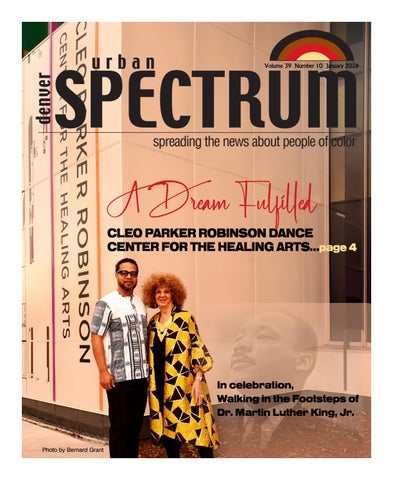
s we step into 2026, many interpret the year through a lens of new beginnings. Numerologically, 2026 represents fresh starts, leadership, initiative, originality, and forward motion. It is often associated with transition— emerging from periods of uncertainty and restructuring and stepping confidently into a new phase. At Denver Urban Spectrum, this meaning feels especially timely. We enter the new year following a season of growth, transition, and thoughtful restructuring. With the continued support of our readers, advertisers, media partners, and community allies, we are grateful to move forward stronger and more focused than ever. I am personally thankful for our new team members who are learning, growing, and building alongside us as we shape the next chapter of DUS. Our cover story embodies the spirit of renewal. Writer Elena Brown explores the remarkable transformation of a once-scarred landmark church in Denver’s Five Points neighborhood into the Cleo Parker Robinson Dance Center for the Healing Arts. This historic space—now home to four
stories of state-of-the-art rehearsal and performance studios—stands as a powerful testament to healing, preservation, and the enduring legacy of Black dance. Its upcoming grand opening marks a new beginning that will inspire generations to come. Longtime contributors James Michael Brodie and Helen Rigmaiden reflect on a darker chapter in Colorado history, revisiting a time of profound uncertainty following the tragic killing of the University of Colorado Denver’s first Black Studies director Roosevelt Hill, Jr., who was fatally shot on July 14, 1970, at a gas station in Colorado Springs. Their piece honors memory, context, and the importance of truth in our collective narrative. As Denver prepares to host the Transplant Games this June, we continue our commitment to covering organ donation and health equity. In “Organ Donation 101: Here’s What to Know,” Word In Black health contributor Anisa Durham offers vital insights as part of her Unborrowed Time series— timely information that empowers informed choices and saves lives. Political analyst Thomas Holt Russell examines the nation’s crossroads in his thought-provoking
article, “How Storytelling, Division, and Denial Are Ushering in American Authoritarianism.” He explores whether America’s democratic guardrails can withstand growing polarization and the reemergence of dangerous ideas. Rounding out the issue, Gabrielle West covers local developments that signal movement and momentum— from the election of new Aurora City Council members, to Denver City Council’s acknowledgment of the Webb administration’s leadership, to upcoming initiatives honoring the life and legacy of Dr. Martin Luther King Jr. As we welcome 2026, one thing is clear: new beginnings belong to all of us. We are each leaders in our own way, and together, we can continue moving forward with purpose, courage, and hope. Happy New Year to our readers, supporters, and community. Peace and blessings,
Rosalind “Bee” Harris DUS Publisher
LETTER TO THE EDITOR Running for Family Values Small Business, and Transportation An op-ed by Tracy Winchester
I
am excited to share that I am running for State Representative for House District 2. My campaign is rooted in a simple belief. Families in our district deserve the chance to put down roots and raise their children with confidence, and Denver must remain a place where that is possible. My commitment to public service began early in life. Growing up during the civil rights movement taught me the importance of fairness, opportunity, and speaking up for what is right. Those values led me to earn my degree from Boston College, work
on Capitol Hill for Senator Edward Brooke, and complete my law degree at Georgetown University. For decades, I have brought those values to my work in Denver. I have served on boards dedicated to housing and community development, supported people experiencing homelessness through years of volunteer work, led the Five Points Business District, and served in senior roles for both the State of Colorado and the City of Denver. My career has been focused on strengthening neighborhoods, supporting small businesses, improving transportation connectivity, and expanding opportunities for families.
As a mom, I understand the real challenges families are facing today. I speak with many young people in Continued on Page 14
Denver Urban Spectrum - www.denverurbanspectrum.com - January 2026
| 3
CLEO PARKER ROBINSON’S DREAM COMES TO LIFE IN DANCE CENTER EXPANSION Center For The Healing Arts Grand Opening January 15 To 18
Founder and Artistic Director Cleo Parker Robinson and President and CEO Malik Robinson at the East Wall of the new Cleo Parker Robinson Center for the Healing Arts. The symbols on the solar panel cladding are the choreography movement Labanotation from “Mary Don’t You Weep,” from Parker-Robinson’s masterwork. It was performed January 20, 1986 at the first national birthday observance for Dr. Martin Luther King, Jr. at his alma mater, Morehouse College. The custom solar panels are unique on the globe and the first installation of this technology in the U.S. Photo Credit: Bernard Grant. Architecture: Fentress Studios: A Populous Company.
By Elena Brown
D
enver’s Five Points neighborhood stands as a cultural landmark — a place where Black ancestors sowed dreams along redlined streets as jazz horns pierced segregation’s veil and civil rights chants channeled a cultural heartbeat. As Five Points grapples with gentrification and fading jazz-era legacies, the expansion of Cleo Parker Robinson Dance (CPRD) Center For The Healing Arts transforms a KKKscarred church into a $25 million hub
for healing arts, ensuring Black dance endures for generations amid urban change. Born in resistance, Cleo Parker Robinson Dance, located at the intersection of Park Avenue West, East 20th Avenue, and Washington Street, has blossomed into a vibrant force, memorializing Five Points’ layered generational heritage through every dancer’s step and sway. Anchored by the storied Shorter Community African Methodist Episcopal Church, the 25,000-square-foot expansion will fuse
4 | Denver Urban Spectrum - www.denverurbanspectrum.com - January 2026
the 100-year-old landmark with fourstories of state-of-the-art rehearsal and dance studios, including a 28-foot-high Studio A, an underground Flex Space theater, community gathering spaces, and a solar-paneled atrium.
design team. Fentress designed the Denver International Airport, Colorado Convention Center, Denver Art Museum’s latest update, and Pentagon Memorial’s Visitor Education Center honoring 9/11 victims.
The glass-paneled addition contrasts sharply with Shorter AME’s historic blond brick, fusing the local landmark with contemporary architecture to more than double the facility.
The expansion was constructed by Mortenson, a company with 12 offices nationwide including a Denver location.
Kayhun Lee served as project architect for Fentress Studios (a Populous Company) on the building’s
“These walls have seen Hattie McDaniel and Madame C.J. Walker, the light and beauty of a strong community,” said Cleo Parker
Robinson, founder and artistic director of the organization bearing her name. “I am deeply honored that this extension — and its new walls — etch my choreography and timeless story into them.” CPRD’s expansion houses its five pillars: four dance ensembles, Artsin-Education, Arts-in-Wellness, facility rentals, and the CPRD Academy. Robinson views The Center for the Healing Arts as a vessel for healing, memory, and cultural rebirth — one that honors the institution’s roots while propelling its mission of ‘Together we are building a legacy that will inspire for decades to come.’ Cleo, a Denver dance pioneer who founded CPRD in the 1970s, envisioned this rebirth —infusing her modern and African dance legacy into every curve. The new wing’s bold lines echo her choreography, fusing African diaspora roots with universal movement. Icon and friend, Katherine Dunham pioneered dance anthropology, decoding how dances embed power structures, gender roles, and communal values — reading movement as cultural text, not isolated performance.
“And freedom is what this space truly represents.” The spaces are designed to draw an estimated 12,000 theatergoers and 2,500 students annually, breathing new life into Five Points year-round, according to CPRD’s news release. These figures underscore the expansion’s role as a bustling cultural engine, sustaining programs amid neighborhood change. Along with the opening ceremony, a four-day festival will premier films, showcase emerging talent, honor elders, and host the inaugural performance of ‘Raise the Roof’ featuring the CPRD ensemble, Lil Buck, Philidaanco, and others. The celebration will celebrate the power of partnerships, in particular Black philanthropy. Black households donate a higher percentage of their income to charity than white households—25% more annually—with nearly two-thirds giving about $11 billion yearly, often through churches, family traditions, and community networks, according to a report by Giving Gap (2024).
While some walls talk, these dance. A labanotation transcription of Cleo’s masterwork in ‘Spiritual Suite’—a core work from “Mary Don’t You Weep” that she choreographed for the first national MLK Day in 1986—pulses alive, etched on the east-facing solar panels that generate power. Labanotation employs abstract symbols to specify movement direction and level, the body part involved, its duration, and dynamic quality. These urban hieroglyphs weave choreography into sustainable architecture, preserving dance history. Above the labanotation panels, floor-to-ceiling vertical panes of glass flood the main Marcelline Freeman Studio with light and color. This space honors the memory of Freeman, a principal dancer and rehearsal director with CPRD for more than 35 years.
A Grand Celebration of Healing The new building’s grand opening with ribbon cutting is January 17, 2026, during the Martin Luther King Jr. holiday weekend, scheduled fittingly 40 years after the debut of Robinson’s iconic choreography honoring the civil rights leader. “Healing cannot advance without freedom,” Cleo said.
“It’s a powerful reminder of the arts’ remarkable power to shatter barriers, foster understanding, and reveal our shared humanity,” he said. Malik has more than a decade of experience shaping CPRD, and contributing to the international dance community, including his role as board treasurer for the International Association of Blacks in Dance. CPRD launched two giving societies to honor major donors fueling the $25 million expansion: Sankofa Society for $50,000 to $99,000 gifts and Aya Society for $100,000 gifts. Words derived from Akan symbols originating from West Africa, “Sankofa” means go back and get it, while “aya” signifies endurance and resilience. Faith and spirituality fueled the fundraising campaign. Malik speaks often with grandfathers and icons like Dunham who are in the spirit realms. “Dancers gone on have had a hand— spiritual, metaphysical, in-the-flesh. I hear Dad cheering, ‘Go ‘head, Mo!’—my childhood nickname,” he said with a warm smile. When the weight of legacy presses, Cleo slips to the park, where she finds peace watching geese glide, hiding furious, synchronized paddling beneath, much like dancers’ grace covering up sweat and strain. And when the geese take flight, slicing skies in a perfect formation? It’s natural choreography: purpose, partnership, and unity pulsing through every wingbeat. “They show us that it doesn’t take away your wings to fly together,” Cleo explained.
Malik Robinson
“The community—and organizations like Black Resilience in Colorado (BRIC) and AYA—really came through for the expansion,” said Malik Robinson, son of founder Cleo who serves as CPRD’s president and CEO. “There’s a real story here about Black philanthropy in Colorado.” Groups like BRIC and AYA are community-focused organizations dedicated to supporting Black entrepreneurs and professionals. The expansion smashed past its $11 million goal through grants, New Markets Tax Credits, donors, and community drives. About 10% came from Black donors—in a city where the population is 8.8% Black.
The Intersection of Social Justice and Performing Arts Gentrification has recast Denver’s historic Five Points, slashing its Black population from over 90% of the neighborhood’s total in 1930 to just 12.76% by 2016. Luxury condos, soaring rents, displacement, and cultural erosion have driven these changes, according to the Urban Displacement Project—a research initiative using community-centered data to promote equitable urban futures. As jazz landmarks like the Rossonian — once hosting entertainment legends like Duke Ellington and Ella Fitzgerald — languish vacant or face redevelopment pressures, CPRD’s success in preserving the area’s Black heritage is significant.The organization’s
Cleo Parker Robinson
expansion anchors artist rentals and promises to revive Five Points’ soul— Harlem of the West According to the 2020 U.S. Census, the area is home to approximately 22,000 people – 61% are white, ages 25 to 34, living in residences ranging from the mid-$300,000s to $1.3 million. The updated CPRD Theatre and studios will open for rentals in January 2026, fueling community arts, rehearsals, and events and sustaining the neighborhood’s heartbeat. The goal is to earn from diverse revenue streams that support the artistic and educational development as well as health and wellness of the community. CPRD preserves a lasting legacy — training leaders and uniting diverse communities. It provides a community anchor, Black artistry archive, and launchpad for future stars, where alumni like Gary Abbott, Lisa Johnson-Willingham, and Karah Abiog sharpened their skills. CPRD also revives vanishing Black cultural treasures like Chuck Davis and Talley Beatty, whose works fade from national stages. Its repertoire boasts more Donald McKayle pieces than any U.S. company, while keeping Dunham’s masterpieces alive through ongoing Dunham Technique training. “Cleo Parker Robinson Dance is at the intersection of social justice and the performing arts,” said attorney Skip Netzorg. He was one of the many community leaders who helped raise funds for the facility. Judith Lawrence, 62, a certified mortgage advisor at MoneyMax Mortgage Inc. who trained at CPRD for a decade, credits the program with building her continued confidence. Continued on Page 6
Denver Urban Spectrum - www.denverurbanspectrum.com - January 2026
| 5
Cleo Parker Robinson’s Dream Continued from Page 5
When Lawrence worried her body was “too big” to dance, Cleo showed her photos of troupe members with similar builds: “Look at them. Their bodies look like yours—and they dance.” That moment shattered body shaming and shaped Lawrence’s career, blending arts passion with technical precision. “Dance taught me to believe in myself... especially when encouragement didn’t always come easily,” she said. “Dance also helped me develop the courage to try things that felt hard or intimidating. Institutions like CPRD let “little girls like me... dream—and believe that anything is possible,” said the Denver native, noting her Shorter AME ties from ages 7 to 18 reinforced
Cleo Parker Robinson Dance marks the new facility’s debut amid Denver’s Dr. Martin Luther King Jr. celebrations with these public events: • Friday, Jan. 16: Film Festival in the new CPRD Theatre. • Saturday, Jan. 17: Ribbon-cutting and tours, 10 a.m.–1 p.m.; inaugural dance performance of Raise the Roof at 7:30 p.m. • Sunday, Jan. 18: Community church service in the historic Shorter A.M.E. Church space. • Monday, Jan. 19: Joins Denver’s MLK Marade. • Friday, Jan. 23: Arts-in-Education student movement session. • Saturday, Jan. 24: CPRD Academy Open House with free dance classes.
community roots. The expansion means “access, opportunity, and visibility” for Black dancers, she said. “My mom always told me I could do anything, and seeing Black dancers on stage reinforced that message.”
The milestone of the opening in January celebrates the ancestors whose stories are etched into Five Points’ cracked sidewalks—a testament that Black legacy keeps dancing, alive and triumphant.
Founder and Artistic Director Cleo Parker Robinson with Associate Artistic Director Winifred Harris with CPRD’s professional dance artists: CPRD Ensemble and Cleo II, The Second Company; John E. Roberts-Lambert and Cedric Hall, Cleo II Co-Directors. Photo Credit: Martha Wirth.
6 | Denver Urban Spectrum - www.denverurbanspectrum.com - January 2026
When Cleo glances up at geese slicing overhead in a perfect V-formation, it hits her: no one soars that high alone. Each wingbeat lifts the one behind, just like the community now gathering inside, rising together in their own joyful migration. Her dream takes shape through living choreography: a monumental expansion carrying Black dance forward on wings powered by sheer grit, shared strength, and ancestral power that nothing can shatter. ♦ Editor’s note: For more information, visit cleoparkerdance.org or Cleo Parker Robinson Dance on social media: Facebook, Instagram, and LinkedIn.
INFO: cleoparkerdance.org
Denver Urban Spectrum - www.denverurbanspectrum.com - January 2026
| 7
NEWLY ELECTED Aim to Change Relationship AURORA CITY COUNCIL MEMBERS with Community By Gabrielle West
D
ivisive rhetoric, the defunding of vital, equity-centered research, programming, and hiring practices across sectors, disinvestment in historically disenfranchised communities, and the overall violation of civil rights are having a moment in American politics. While this dangerous trend is often perpetuated by our nation’s political leaders and permeates government at every level, a different movement is arising in local politics. A cohort of young politicians are stepping forward with plans to restore civility, accountability, and communityfocused governance to public office. From New York City to Aurora, their voices are being raised. Aurora’s newly elected City Council members Alli Jackson, Amy Wiles, Gianina Horton, and Rob Lee Andrews combined resources, knocked doors together, and plotted a path forward. “We truly built a coalition as candidates, especially in those last couple of months, identifying our shared values, identifying where we could share resources, and where we could tag team,” said Horton, Aurora City Council Ward 1 Representative. “And that is where, with all of our
collective efforts, we were able to succeed. It wasn’t one of us leading the way. It wasn’t any of us backing out. It was coming together and figuring out how we win this. And that speaks volumes, and I’m excited to see how that translates into our governing.” Horton didn’t come from a politically engaged family, but after years of waking up to the realities of systemic injustices facing those around her, running for office became a no-brainer. As the oldest of six children, her experiences growing up as the eldest sibling in a multiracial family, as well as being the daughter of an immigrant, molded her personality and leadership style. Among her priorities during her term, she plans to focus on establishing greater oversight of the Aurora Police Department by securing a civilian monitor, as well as building more accessible and affordable housing for residents. Tensions among the Aurora City Council and with community members have been high, as demonstrated by well-publicized interactions over the years. Community members have reported the exclusion of their voices and disparaging rhetoric by
8 | Denver Urban Spectrum - www.denverurbanspectrum.com - January 2026
the council about residents, as well as mistreatment of people of color by the Aurora Police Department. Rob Lee Andrews, a husband, father, and longtime businessman, has been demonstrating his commitment to restoring unity both on the council and within the community through his actions. From setting up meetings
to get to know his new colleagues to hosting block parties for Aurora residents, Andrews has made bringing people together a central focus of his leadership. During his first year in office, he plans to usher in the relocation of the registered apprenticeship program to Aurora, work with the Aurora Police Department to restore community policing,
and develop workforce housing to incentivize those working in healthcare, education, and public safety to live, work, and play in Colorado’s All-American City. Pointing out the challenges ahead, he acknowledges there may be disagreements, but he vows not to be disagreeable. Alli Jackson, a 30-year-old wife, mother, and social worker, considers herself a true “Aurora baby.” Born and raised in the city, she got her first taste of City Hall as a child, trailing behind her mother, who worked for the Aurora Police Department. Watching her mom serve the community inspired Jackson’s own sense of responsibility to care for the same city that cared for her. The youngest of five in a mixed-race family, she is no stranger to diversity or embracing the culture of others. When she began hearing what she described as racist and discriminatory language used by Aurora council members directed at her neighbors, she knew she had to be the change she wanted to see. Now that Democrats hold a majority on the council, Jackson hopes they can “really pass some policies to reshape how the city flows,” from criminal justice to housing development.
Amy Wiles, newly elected Ward 2 City Council member, is a mother, grandmother, longtime Aurora resident, and community advocate, which seems to be her edge. Having previously served on the City of Aurora Human Relations Commission and the Community Advisory Council for the Aurora Police Department Consent Decree, she has experience navigating city government, although she never really saw herself as an elected official. After years of feeling ethically and morally misaligned with her Ward 2 representative, and believing he was not acting on behalf of her community, she ultimately decided to run. Now that she’s won, her focus will be on securing more retail grocery options for residents, improving infrastructure, investing in safer roads, and building muchneeded libraries and recreation centers for residents to enjoy and experience a true sense of community.
Experience a spring season of extraordinary performances!
KINGS RETURN / FEB. 19
A cappella jazz with R&B
“You can build a bunch of houses, but houses alone do not build a successful community,” said Wiles. “You need all the other things that bring people together.” ♦
THE LANGSTON HUGHES PROJECT / FEB. 28 Multi-media jazz concert
Tickets start at
Tickets now on sale! The REMARKABLE TRUE STORY of
THE SMALL TOWN
THAT WELCOMED THE WORLD March 27 - May 10, 2026
Tickets on sale at ArvadaCenter.org or 720.898.7200
$
33
LAKEWOOD CULTURAL CENTER
Lakewood.org/LCCPresents 303-987-7845 Denver Urban Spectrum - www.denverurbanspectrum.com - January 2026
| 9
DENVER CITY Honors Webb for “Visionary Leadership and Enduring Contributions” COUNCIL By Gabrielle West
A
s the saying goes, you should give people their flowers while they can still smell them. On December 15, the Denver City Council did just that–presenting the city’s first Black mayor, the Honorable Wellington Webb, with a proclamation recognizing his legacy. As council members took turns reading from a document so packed with accomplishments it could not be delivered by a single voice, the magnitude of Webb’s impact, both past and present, was clear. As a former mayoral communications staffer myself, I was highly impressed by the collection of facts its writers managed to fit into one document. Once the proclamation was read, each council member took a moment to share personal experiences with Webb and reflect on his influence on their careers. City Council President Amanda Sandoval shared a tearful story of Webb standing closely beside her during her father, former State Senator Paul Sandoval’s passing, and throughout her own rise in city leadership. Webb and her father were childhood friends who went on to support one another’s political careers and ultimately became like family. Sandoval referred to Webb as her “godfather.”
Councilwoman Shontel Lewis, whose office sponsored Denver’s Proclamation 25-2082, called the moment “deeply personal.” She recalled watching Webb’s mayoral election unfold during her childhood, and how seeing him literally walk the entire city connecting with people face-to-face helped shape her view of leadership, and ultimately, her career path. Lewis was referring to Webb’s noteworthy 1991 “Sneaker Campaign,” in which he and his wife, the Honorable Wilma Webb, a powerhouse in her own right, trekked across Denver and stayed in residents’ homes to get to know Denverites from all walks of life ahead of his eventual victory. “That image showed me that leadership is about presence. Leadership is about being among the people you serve, and leadership is about listening with humility and acting with boldness,” said Lewis. From Denver’s east side to the White House, Webb remains an ever-present figure in Colorado politics—standing just as tall as his physical stature. While it’s a gargantuan task to capture the full scope of Webb’s political achievements on behalf of Coloradans, a few notable accomplishments include: the completion and opening of Denver International Airport; the establishment
of the Denver Health Authority; the cofounding of the Blair-Caldwell African American Research Library in historic Five Points; and the revitalization of the Central Platte Valley, now home to Ball Arena, parks, housing, and retail.
there’s one thing to protect, it’s your kids.”
When Webb stepped to the mic to acknowledge the proclamation, the former Colorado state representative, Denver auditor, and regional director for the agency formerly known as the U.S. Department of Health, Education, and Welfare proudly recognized former staff members, community leaders, and of course, his family who were present to witness the honor. He shared a few personal stories, offering insight into the behind-the-scenes realities of mayoral life as Denver’s first Black mayor.
The full, signed proclamation can be read online: https://denver. legistar.com/LegislationDetail. aspx?ID=7779742&GUID=72A27D04B233-4420-9445DC7D2A0456D2&Options=&Search=
Out of everything he shared, I was most drawn to the message he directed to his children and the advice he offered everyone else in the room. Dave Hallet and Marge Price served as Mayor Webb’s federal lobbyists. They helped Denver secure funding and support for the billions of dollars in projects Mayor Webb led during his 12 years in office. Wayne Cauthen (center) served as the Chief of Staff for Denver Mayor, Wellington Webb. Photos courtesy of Andrew Hudson 10
| Denver Urban Spectrum - www.denverurbanspectrum.com - January 2026
“I want to apologize to my children. They never got the full breadth of me because I was gone,” Webb admitted. “And I would say to each of you, if
As a mother, I’m all ears—and deeply grateful for the reminder that legacy begins at home.
IN DR. KING’S FOOTSTEPS: DENVER’S MARADE MARKS 40 YEARS By Gabrielle West
O
n Monday, January 19, 2026, people from across Colorado will gather at City Park for the 40th Annual Dr. Martin Luther King Jr. Denver Marade, commemorating four decades of public remembrance, civic unity, and action inspired by the life and legacy of Martin Luther King Jr.. The Denver MLK Marade — short for march and parade — was established in the mid-1980s as a living expression of Dr. King’s call for peaceful assembly,
shared responsibility, and community engagement. From its earliest days, the Marade was envisioned not merely as a procession, but as a public declaration that Dr. King’s ideals of justice, dignity, and nonviolence must remain visible, relevant, and actively upheld. The very existence of the Marade is rooted in the tireless advocacy of Wilma J. Webb, widely regarded as the First Lady of Denver. A former state legislator, educator, and longtime community leader, Webb played a pivotal role in ensuring that Dr.
Martin Luther King Jr. Day would be officially recognized and meaningfully observed in Denver. Her leadership helped galvanize public support and institutional commitment at a time when national recognition of the holiday was still new and, in many places, contested. Through her efforts — and those of countless community advocates — Denver embraced the MLK holiday not simply as a day off, but as a day on: a call to service, reflection, and collective action. Over the decades, the Marade has grown into one of Colorado’s most enduring tributes to Dr. King, drawing families, faith leaders, educators, elected officials, and grassroots organizations from across the region. Attendance has fluctuated at times due to extreme winter weather, particularly when safety concerns affected elders, children, and other vulnerable populations. In recent years, the event has also faced mounting financial challenges as economic uncertainty tightens corporate and nonprofit budgets and as national support for equitycentered initiatives continues to wane. This year’s observance arrives amid a broader national climate in which racial equity and civil rights commitments have been increasingly
deemphasized. That shift has surfaced in subtle yet consequential ways, including the removal of both Dr. Martin Luther King Jr. Day and Juneteenth from the National Park Service’s list of free-entry holidays under the current presidential administration. Still, as the Denver MLK Marade marks its 40th anniversary, the message remains resolute: the work — and the walk—must continue. Both Aurora and Denver will host a full slate of commemorative events honoring Dr. King’s enduring vision, including community service projects, educational programming, humanitarian awards, and a special concert featuring the Colorado Symphony Orchestra — offering opportunities for people of all ages and backgrounds to participate. Now more than ever, continuing to honor the people and institutions carrying Dr. King’s legacy forward is not optional — it is a shared civic responsibility rooted in history, sustained by community, and demanded by the future. ♦ Editor’s note: For more information on how to participate, visit drmartinlkingjrchc.org and auroragov. org/mlk.
Your retirement... DREAM or NIGHTMARE? Myra Donovan, CFP Financial Adviser*
2000 S. Colorado Blvd., Tower 2, Suite 1100 - Denver, CO 80222 303-871-7249 Office • www.myradonovan.com
Call today for a free consultation! *Registered Representative for NYLIFE Securities LLC (Member FINRA/SIPC), a Licensed Insurance Agency. Financial Adviser for Eagle Strategies LLC. a Registered Investment Adviser. Eagle Strategies, LLC and NYLIFE Securities, LLC are New York Life companies.
Denver Urban Spectrum - www.denverurbanspectrum.com - January 2026
| 11
REMEMBERING Roosevelt Hill, Jr. The Killing of UDC’s First Black Studies Director long time, and Roosevelt got out of the car and went in to see what was taking so long. Everyone was tired after a long day and ready to get back home.” According to Mines, an argument ensued between Hill and the clerk, Ellis Leon Little, over the validity of the card. Little, a 21-year-old Fort Carson soldier, was working part-time at the station. According to the Fort Carson Information Office, Specialist 4th Class Little, a Vietnam veteran, was assigned to the 59th Transportation Company and had been there since August 1969. His hometown was listed as Richmond, Kentucky. By James Michael Brodie
July 14, 1970 Roosevelt Hill, Jr. and his wife, Myrtes, had just taken six University of Colorado-Denver students to the Colorado State Penitentiary in Canon City to speak to inmates. The topic was “Awareness of the Black Man.” The goal was to encourage inmates to pursue college once their sentences were completed. The students included Reginald Mines, Thaddeus Bynum, Toye Moses, Lawrence Hardy, Donna Pugh (AKA Opalanga Pugh), and Julia Minter. Minter, who was 17, lived with the Hills, who promised her parents that they would look out for her. Hill stopped at a Taco Bell in Colorado Springs to get everyone a bite to eat, before driving the state-owned station wagon into the nearby Ivywild Mobil service station to fill the tank. He gave one of the three attendants on duty a Colorado state-issued credit card for payment, according to police reports. After a lengthy wait, he went into the station to check on his payment. Myrtes, Hill and Minter walked into the store a few minutes later. Mines soon followed. Mines recalled, “We pulled in and waited for the attendant. He came out, put gas in our vehicle, took the credit card that was given to Mr. Hill by the school, and went to process the payment,” then added, “This took a 12
Mines entered as Hill was engaged in an argument with Little. Hill, seeing that Little would not accept the CU card, began to reach into his pocket to make a cash payment. Then there was a gunshot. Hill turned, facing Mines, and fell into Myrtes’ arms and then to the floor, blood spurting from the chest wound from the .38-caliber pistol. Chaos ensued. Mines, panicked, moved to a pay phone to call the police. He turned to Little, who was now next to him and still holding the gun. Mines asked him for a dime, then lunged at Little in anger and punched him. Mines slipped on the blood on the floor and soon found himself facing away from Little, who now held the gun to the back of the student’s head. Myrtes’ voice stopped him. “You don’t have to shoot anybody else!” she screamed, holding Roosevelt in her arms. “You already killed my husband!” Mines watched as Hill’s life slowly drained away. He had only been on the job for two weeks. El Paso County Sheriff’s Deputy Gary E. Vitcovich initially reported that “a carload of Black men apparently drove into the station and an argument ensued when the unidentified attendant attempted to check a credit card,” the Colorado Springs Gazette Telegraph reported.
| Denver Urban Spectrum - www.denverurbanspectrum.com - January 2026
Hill was taken to St. Francis Hospital where he was pronounced dead on arrival. Helen Ringmaiden, a fellow student, was supposed to have been on that trip but somehow had been left behind. When Mines returned late that night, he went directly to her home, his clothes still covered in Hill’s blood.
commission in the U.S. Army. Rather than joining the military and taking the commission, he chose to move to Denver and teach at Whittier Elementary School. However, in 1970, driven by the Black Student Alliance, the University of Colorado-Denver (UCD) created the Black Studies Department, and Hill was chosen to lead it.
“He kept saying ‘I tried to put him back together; I tried to put him back together.’ He later said that he didn’t remember the blood,” Rigmaiden recalled. “Colorado Springs was not the Deep South. We didn’t know what to do, and quite frankly, neither did the CU dean, who simply told us to hire somebody else.”
“The group kicked down the door of the dean’s office. The dean tried to ignore us. We got his attention,” said former UCD student Helen Rigmaiden. “Then the dean said we needed to hire a director. We picked Mr. Hill.”
State Senator George Brown called on the Colorado Bureau of Investigation to launch a full-scale investigation into the shooting. In an interview with the Gazette, he expressed outrage over the incident. He said Hill was a “widely respected member of the Black Community. It is urgent that fast action be taken in this case. The Black community is obviously disturbed over the situation.”
Friday, July 24. Ten days after the shooting.
But El Paso County District Attorney Robert L. Russel told the Gazette Telegraph that Brown had no grounds to call for an investigation because the Colorado Springs Police Department was handling the investigation “fairly and properly.” In a letter to Russel, Suzanne T. Rogers, president of the NAACP Colorado Springs branch, demanded “that a complete report of findings be made public to preclude the possibility of any suspicion that any facts have been misrepresented or concealed.”
Who was Roosevelt Hill, Jr.? Roosevelt Hill, Jr. grew up in Bessemer, Alabama, in Jim Crow South, graduating from high school in the mid-1950s. As a student at Tennessee State University, he pursued his dream of being a sax player. He majored in music, and became president of the college marching band, also known as “The Aristocrat of Bands.” He pledged Alpha Phi Alpha, marched with The Student Nonviolent Action Committee, and earned his
The Outcry
The El Paso County Grand Jury decided not to indict Little on a Thursday night, but did not make a public comment until the next day at a crowded press conference held by Russel. The jury convened over three nights, hearing approximately 10 hours of testimony from 16 witnesses including Myrtes and Little. It took the grand jury one hour to reach its decision. “When we returned to Colorado Springs for the grand jury hearing, we all went in individually and told our stories,” Mines said. After the hearing, we gathered outside the court only to find there had been no indictment.” State Public Defender Rolle R. Rogers said of the incident, “All agree the untimely death of Mr. Hill was a most unfortunate incident.” According to the Gazette Telegraph, before the grand jury announcement, Little was put on a train and transferred by the Army to his home in Kentucky. The decision caused considerable controversy both in Colorado Springs and Denver, and Russel was severely criticized by those who said the case should have been tried in open court. A request to reopen the Hill-Little matter was made in district court on August 6. Denver lawyer Irving P. Andrews filed on behalf of Myrtes and student-trip participant Bynum.
The UCD Black Students Association requested a parade permit from the City of Colorado Springs to demonstrate disapproval of Russel’s actions. Meanwhile, Black law students in Denver wrote to the Denver Post and accused Russel of improper use of the grand jury. “It is the function of the proceedings of a grand jury to ascertain whether prima facie grounds for a criminal prosecution have been made out sufficient to warrant a trial by jury,” the complaint read. “A grand jury, however, is not authorized to try the case and determine guilt or innocence of the accused, or to pass on the credibility of the testimony presented to it.” On August 12, Urban League of the Pikes Peak Executive Director John S. Holley also weighed in. He wrote: “The fact that Hill was a Black man while the man allegedly holding the gun was White is ample reason to take every precaution to ensure that a just decision is rendered in the case, since there has been substantial history in the United States courts of dealing lightly with the death of Negroes where Caucasians are involved.”
District Court Judge William M. Calvert refused to reopen the case. It was never revisited. And then it was over. Cecil Glenn, who had been considered for the director position at the time of Hill’s hiring, was hired as his replacement.
multiple efforts to reopen the case have been unsuccessful.
No one was ever the same. Their innocence was gone.
Many of the students impacted by the killing left the school, with some blaming themselves for El Paso County not bringing an indictment against Little. Minter dropped out. Moses and Rigmaiden transferred to CU-Boulder.
“After Mr. Hill was killed I took incompletes and took the summer off,” recalled Rigmaiden, who eventually graduated in 1977.
To this day, few of those who knew Hill and were impacted by his killing speak about that night, still traumatized by it and the grand jury decision. His body was flown back to Bessemer, Alabama, his hometown. Myrtes moved to Chicago, where she eventually remarried. She passed away in her 80s.
“We were so young,” she said. “This stuff doesn’t just go away. Roosevelt Hill should never be forgotten.” ♦
Several Black leaders viewed Hill’s killing as another instance of racial injustice within the legal system. The failure of El Paso County to issue an indictment has sparked outrage and many calls for justice over the past five decades. After all the community protests and appeals for further investigation,
SCHOLARSHIP HONORS LEGACY OF ROOSEVELT HILL, JR. By Helen Rigmaiden
T
he Rev. Dr. Martin Luther King, Jr.’s speech in 1965 during the march from Selma to Montgomery, Alabama had a powerful message, one with beautiful cadence and refrain: “How long? Not long.” In the case of the murder of Roosevelt Hill, Jr. 55 years ago, not much was done by the University of Colorado-Denver community. At the time of his death, he was director of the Black Studies Department. He was murdered while purchasing gas in Colorado Springs by a Fort Carson soldier who worked part-time at the station. Mr. Hill, a former member of the Student Nonviolent Coordinating Committee, was reaching into his pocket when he was shot in front of his wife and two students – the youngest of whom was only 17. How long? Not long. The seeds of Black Studies at the University of Colorado-Denver were sown by a determined group of students. Among them was Hiawatha Davis, a visionary leader
whose story is as remarkable as it is inspiring. Davis served 18 months at the Colorado Correctional Facility in Canon City for refusing to fight in the Vietnam War. The conscientious objector emerged from incarceration with a renewed commitment to social justice. After his release, he enrolled at UCD and became a driving force behind the creation of the university’s first Black Studies Department. It was Davis and his peers who organized Mr. Hill’s fateful prison visit in 1970, convinced that it would transform lives inside and outside of the prison walls. I was a UCD student when Mr. Hill was murdered. In 2023, I revisited his story. I was moved to action after learning that CU-Boulder had honored six Latinx students who lost their lives in a 1970 car bombing. I resolved that Mr. Hill’s sacrifice had gone unrecognized long enough. I reached out to CU President Todd Saliman and requested that the university formally honor Mr. Hill’s
legacy. Saliman agreed, setting into motion a collaboration effort with UCD Vice Chancellor Antonio Farias and the Black Studies faculty and involving the six students who had travelled with Mr. and Mrs. Hill. I felt the it was my responsibility to ensure that Mr. Hill’s story would not be forgotten. Honoring him would bring healing for those students, as well as the community, who still carry deep wounds from that horrible night. After 18 months of dedicated work, the Roosevelt Hill, Jr. Endowed Scholarship was established this year. This scholarship will offer current inmates in Colorado the opportunity to enroll in UCD’S Prison Education Program, where they can earn certificates and build pathways to brighter futures.
For those students who knew Mr. Hill, this initiative is both a tribute and a fulfillment of his mission, and ours. As the community gathers to remember Mr. Hill, the first director of the Black Studies Department, and a tireless advocate for justice, we reaffirm our commitment to the values he embodied. This scholarship is more than a memorial. It is also a promise to keep his vision of hope, education, and equality alive for generations to come. How long? Fifty-five years. For more information regarding this program, you may email me at hprigmaiden402@gmail.com. If you would like to donate to the Roosevelt Hill, Jr. Endowed Scholarship fund, go to:
• https://www.givecampus.com/campaigns/47958/donations/ new?designation=roosevelthilljrscholarshipfund&?a=11319128 • https://digitalcollections.ppld.org/nodes/view/997883 • https://www.nytimes.com/1970/08/02/archives/colorado-negroes-amusedby-slaying.html • https://storymaps.arcgis.com/ stories/24dc4154c7bc4a84a3b54a09ad665b22 Denver Urban Spectrum - www.denverurbanspectrum.com - January 2026
| 13
SEE YOURSELF
ON STAGE Theatre Education at the DCPA
Letter to the Editor Continued from Page 3
Small Businesses and Worker Protection
our district who dream of starting a family but feel unsure whether they can afford to stay in Denver. They worry about housing costs, the rising cost of raising children, and whether their families will have access to opportunity. No one should feel that the future they want is out of reach.
Small businesses are the heart of our local economy, and workers are the backbone of our community. My years leading the Five Points Business District taught me the importance of access to capital, innovation, fair wages, and strong local business corridors. I will work to protect workers, expand opportunity, support entrepreneurs, and help small businesses continue to grow and create jobs.
Why I am running
Education & Community Engagement
PreK - Adult | No Experience Required | 1-Day Workshops Multi-Week Courses | Daytime, Evening, and Weekend Classes Sponsored by
ENROLL TODAY
DENVERCENTER.ORG/EDUCATION Photo by McLeod9 Creative
I am running because families in our district deserve stability, opportunity, and a future they can build with confidence. I hear from parents and young people who want to stay in Denver, raise their children here, and remain rooted in the communities they love, but feel overwhelmed by rising housing costs and economic pressure. I hear from workers and entrepreneurs who want a fair chance to succeed. I hear from neighbors who want safe, connected communities that reflect our shared values. Our district needs leadership that understands these realities from lived experience, from community work, and from years of service in government. I am ready to bring that experience to the State Capitol.
Family Stability and Opportunity Every family in our district deserves the chance to thrive. Affordability touches every part of life, from housing to the cost of raising children to overall economic security. With years of experience on housing and development boards, I understand how essential stability is for families. I will fight for policies that keep our district livable and ensure that people can remain rooted in the communities they love.
14
| Denver Urban Spectrum - www.denverurbanspectrum.com - January 2026
Transportation Connectivity and Infrastructure Repair Our neighborhoods deserve safe streets, reliable transit, and infrastructure that supports growth and opportunity. I have worked directly on projects that connect communities, improve mobility, and strengthen business districts. I will focus on repairing roads, bridges, and tunnels, supporting the Colfax BRT process, and improving regional and local transit options so people can move through our district safely and efficiently. Throughout my life, I have believed that strong families create strong communities, and strong communities create a stronger future for everyone. I am running to bring forward a vision that reflects our shared values and ensures that every family in our district has the opportunity to succeed.
Tracy Winchester
Candidate for Colorado State House District 2 For more information, visit https://winchesterforco.com/
Denver Urban Spectrum - www.denverurbanspectrum.com - January 2026
| 15
ALL THINGS BOYS Helping Boys of Color Start the Year with Purpose By Dr. Dedrick Sims, CEO, Sims Fayola Foundation
J
anuary is often framed as a fresh start. New goals. New habits. New expectations. But for boys of color, the start of a new year does not always feel hopeful. It can feel heavy. Many begin January already carrying the weight of how the world sees them, judges them, or limits them. They hear messages about what they should fix long before they hear messages about who they are becoming. If we want boys of color to start the year strong, we must do more than push resolutions. We must help them build purpose. Purpose is not about pressure or perfection. It is about identity, belonging, and direction. Through the lens of the Sims Framework, purpose emerges when belief, structure, practice, alignment, and predictability work together to create systems where boys of color feel seen, supported, and guided by caring adults.
Belief: Helping Boys of Color See Themselves Clearly The Sims Framework begins with belief because belief shapes everything that follows. For boys of color, belief is often challenged by dominant narratives that focus on deficit rather than potential. Research consistently shows that young people rise or fall to the level of belief communicated by the adults in their lives. Pedro Noguera reminds us that “the most powerful weapon of marginalization is the internalization of inferiority.” Mentors play a critical role in disrupting that process. Starting the year with purpose means adults intentionally affirming boys of color for who they are, not just what they achieve. Effective mentoring begins with listening, naming strengths, and holding high expectations paired with care. When belief is reinforced through consistent relationships, boys begin the year grounded in confidence rather than fear. 16
Structure: Creating Environments That Support Purpose Belief alone is not enough. Boys of color also need structure that reinforces purpose. Structure includes routines, expectations, and environments that feel emotionally safe and predictable. For boys who experience instability across systems, January can amplify uncertainty if adults rush straight to performance demands. Best practices in mentoring emphasize the importance of consistency. Showing up when you say you will. Following through. Creating rituals that help boys anticipate what comes next. Structure becomes an act of care when it communicates reliability. As bell hooks wrote, “Care is a dimension of love, but simply giving care is not enough. We must care in ways that do not undermine the dignity of those in our care.” Purpose grows when boys experience structure that respects their humanity.
Practice: Turning Purpose into Daily Action Purpose becomes real through practice. Boys of color do not need abstract speeches about success. They need opportunities to practice purpose through daily actions that connect identity to behavior. Effective mentors focus on coaching, not controlling. They help boys reflect on choices, learn from mistakes, and try again. The Sims Framework emphasizes practice as intentional repetition. When mentors highlight effort, growth, and accountability, boys begin to see themselves as capable decision makers. Paulo Freire reminds us that “reflection and action upon the world in order to transform it” are inseparable. Purpose is strengthened when boys are guided to act with intention and reflect with honesty.
Alignment: Connecting Identity, Action, and Environment Alignment is where purpose deepens. Boys of color often move through systems that send mixed messages about who they are allowed to be. Mentoring best practices stress the importance of cultural affirmation and authenticity. Boys should not have to disconnect from their identity in order to succeed.
| Denver Urban Spectrum - www.denverurbanspectrum.com - January 2026
When expectations are aligned with affirmation, boys experience coherence instead of confusion. The Sims Framework calls for alignment between values, actions, and systems. Mentors help boys bridge this gap by validating their lived experiences and helping them navigate environments without losing themselves. Alignment allows boys of color to move through the year with clarity and self-respect.
center purpose help boys understand that setbacks are part of growth, not evidence of failure.
Predictability: Building Stability in an Unpredictable World
January should not be about fixing boys of color. It should be about affirming them. Purpose is not about becoming someone else. It is about becoming more fully who they already are. Through the Sims Framework and through intentional mentoring relationships, we can help boys of color start the year rooted in belief, supported by structure, strengthened through practice, aligned with their identity, and anchored in predictability.
For many boys of color, unpredictability is a defining feature of life. Inconsistent systems, disrupted relationships, and shifting expectations can erode trust. Predictability is a core best practice in mentoring because it builds emotional safety. Predictability does not mean rigidity. It means consistency in care, boundaries, and presence. When boys know adults will remain steady even when they struggle, they are more willing to take risks and imagine possibility. As Dr. Bruce Perry’s work on trauma reminds us, regulation and safety come before learning and growth. Purpose takes root when boys feel secure.
Purpose as Protection and Possibility For boys of color, purpose is both protective and empowering. It guards against internalizing harmful narratives and provides direction when systems fall short. Mentors who
When belief, structure, practice, alignment, and predictability are present, boys begin the year with more than goals. They begin with grounding. They understand that someone sees them, expects greatness from them, and is committed to walking alongside them.
When boys of color start the year with purpose, they do not just endure what lies ahead. They grow through it with confidence, clarity, and care. ♦ Editor’s Note: The Sims Fayola Foundation is a Denver-based nonprofit dedicated to improving the life outcomes of young men of color through direct programming and systems change. We envision a world where every boy is affirmed, challenged, and equipped to fulfill his potential. Learn more at www.sffoundation.org or contact us at 720-557-8443 or dedrick@ sffoundation.org.
Gumbo Grits and Good Vibes
Grilled Chicken & Sausage Gumbo
Daily Specials Grilled Catfish Poboy
Shrimp & Grits
Location: 9668 E Arapahoe Rd. Greenwood Village, CO 80112 Hours: 10 AM to 7 PM - Tuesday through Saturday Phone: 720-434-5755 Email: coloradocreolecafe@gmail.com Website: www.coloradocreolecafe.com
Denver Urban Spectrum - www.denverurbanspectrum.com - January 2026
| 17
THE VA LOAN
PLAYBOOK By Barry Overton
with minimal upfront capital — an essential ingredient for wealth creation.
F
or many veterans, the VA home loan is viewed as a one-time benefit: a path to homeownership with no down payment and favorable terms. That perception is understandable — and it mirrors my own first experience using VA benefits. My initial VA purchase was a single-family home, used in the most traditional sense. I lived in it as my primary residence, focused on stability and homeownership, not on strategy or long-term investing. At the time, I wasn’t thinking like an investor; I was thinking like a homeowner. There is absolutely nothing wrong with that approach. In fact, traditional owner-occupied homeownership is often the right starting point. What I did not yet recognize, however, was that the
18
A Practical Approach to Turning Homeownership Into Long-Term Investment Strategies for Veterans
What matters most is not the loan itself, but how the loan is used over time.
VA loan can be far more powerful when viewed through a strategic lens. Used intentionally — and always within the rules — it can become a foundational tool for building long-term wealth and an investor portfolio, often earlier and with less capital than traditional real estate paths. The key is understanding that the VA loan is not merely a housing benefit; it is a leverage tool.
| Denver Urban Spectrum - www.denverurbanspectrum.com - January 2026
The Strategic Advantage of the VA Loan VA loans offer several structural advantages that are difficult to replicate elsewhere: no down payment, competitive interest rates, no private mortgage insurance, and flexibility in qualifying. Together, these features allow veterans to control real estate
It is also critical to clarify that VA loans are intended for primary residences. The veteran must occupy the property, typically within about 60 days of closing, and lenders generally expect the home to be used as a primary residence for approximately 12 months. Every legitimate wealthbuilding strategy involving VA loans begins with honest intent and compliance with this requirement.
Owner-Occupied Multi-Unit Properties: The Wealth Accelerator One of the most effective strategies available to veterans is purchasing a small multi-unit
property — such as a duplex, triplex, or fourplex — while living in one unit and renting the others. This approach, often called “house hacking,” allows rental income to offset or even eliminate personal housing expenses. Instead of paying rent or carrying a full mortgage alone, tenants help cover the cost. Over time, the property builds equity, rents often increase, and the veteran gains firsthand experience managing income-producing real estate. After fulfilling occupancy expectations, the property can later be converted into a full rental, creating a long-term income asset.
Reusing the VA Loan Over Time A common misconception is that a VA loan can only be used once. In practice, many veterans can reuse their VA entitlement multiple times. By purchasing a primary residence, living in it, and later moving — whether due to career changes, relocation, or lifestyle shifts — a veteran may convert the former home into a rental and purchase another primary residence using remaining or restored entitlement. Over time, this approach can quietly build a portfolio of rental properties, each acquired with little money down and held for long-term appreciation and income.
Improving and Refinancing to Recycle Capital Some veterans choose to purchase properties that need light improvements. After making strategic upgrades, the property’s value and rental income increase. Refinancing into a conventional loan may then unlock equity and restore VA entitlement for a future primary residence purchase. This approach emphasizes patience and discipline rather than speculation, allowing capital to be recycled instead of remaining trapped in a single asset.
Leveraging New Construction and Builder Incentives VA loans are also commonly used for new construction purchases, often paired with builder incentives such as closing cost credits or interest-rate buy-downs.
Newer properties typically require less maintenance, attract stable tenants, and perform well as longterm rentals. While appreciation may be steadier rather than dramatic, the predictability appeals to veterans seeking sustainable growth.
Assumable VA Loans: A Hidden Opportunity One of the least understood strategies involves assuming an existing VA loan. In certain situations, veterans can take over another borrower’s VA loan — sometimes at interest rates far below current market levels. When structured correctly, assumable loans can significantly improve cash flow and purchasing power, particularly in higher-rate environments.
A Long-Term Perspective on Wealth My first VA purchase gave me stability. Later, understanding the broader potential of the VA loan gave me strategy. Both matter. Real estate wealth is rarely built overnight. It grows through time, consistency, and sound decisionmaking. When used ethically and as a primary residence first, the VA loan can become more than a benefit — it can be a blueprint for lasting financial security. The VA loan was designed to help veterans secure stable housing — and it succeeds at that mission. But for those willing to think beyond a single transaction, it can also serve as a gateway to thoughtful, disciplined wealth building.
ENROLL NOW
Open Enrollment is Nov 1 - Jan 15
Enroll in quality coverage Apply for financial help to lower the costs of health insurance Get free enrollment help from local, certified experts Compare health insurance plans
Used ethically, patiently, and always as a primary residence first, the VA loan is more than a benefit. It is an opportunity to build something enduring. ♦ Editor’s note: Barry Overton is a Denverbased real estate advisor, veteran, and mentor. He helps investors, homeowners, and agents unlock wealth-building opportunities across the country. Follow him for more insights on market trends, AI in real estate, and personal development for entrepreneurs. Contact him at 303-668-5433.
ConnectforHealthCO.com 855-752-6749 Denver Urban Spectrum - www.denverurbanspectrum.com - January 2026
| 19
rgan Donation
Here’s What to Know
We asked experts to break down the top 10 questions about how the transplant system works — and why equity matters. By Anissa Durham
sign up while you register to vote. If you register as an organ donor after you’ve been issued a driver’s license or state identification card, you won’t automatically be issued a new one. So not everyone who is registered will immediately have the donor icon on their state-issued ID.
T
his article is part of “On Borrowed Time” a series by Anissa Durham that examines the people, policies, and systems that hurt or help Black patients in need of an organ transplant. This story is copublished with The Markup was published November 13, 2025. Teenagers aren’t supposed to struggle to breathe. But two years ago, Micah Clayborne, a then-active 13-year-old middle school tennis player, knew something was wrong. Still, he pushed through the symptoms — persistent sweating and shortness of breath — for six months before finally telling his parents. They rushed their son to the hospital. Within days, doctors diagnosed Micah with Danon disease — a genetic condition that thickens the heart muscle. His heart was failing — and he was dying. Within weeks, doctors added his name to the national heart transplant waiting list. He ranked second in line. His birthday passed. And then, 10 months later, he finally received his new heart. Now 15, Micah says the experience changed how he sees life — and opened his eyes to the toll it takes to be on a transplant wait list. “Not everyone gets transplants often,” Micah says. “Getting a transplant has shown me how it’s affected other people.”
20
101
Illustration by Demis Courquet-Lesaulnier.
Micah was one of thousands of Americans each year who unexpectedly find themselves needing an organ transplant. Last year marked a new record in transplantation, with 48,000 Americans receiving a new organ. But there’s still a shortage of organs. And about 17 people die every day waiting for a transplant. Micah Clayborne, 15, a heart transplant recipient poses for a portrait at Lions Park in Ennis, Texas, on Saturday, Oct. 4, 2025. CREDIT: Desiree Rios for Word In Black In Word In Black’s “On Borrowed Time,” series, we’ve explored why there is so much mistrust among Black folks toward the organ donation process, what barriers block their access to care and the equity and ethical issues surrounding organ donation. We also put a spotlight on the Black lives changed through the transplant system.
| Denver Urban Spectrum - www.denverurbanspectrum.com - January 2026
We’ve compiled a list of 10 common questions, and well-informed answers, to help explain the process of organ donation, procurement, and transplantation. Here’s what experts shared with us.
1. What does it mean to be a registered organ donor? A registered organ donor is someone who has decided that, when they die, their organs or tissue may be donated to someone in need. Donors can decide which organs they want to donate, and any adult can register. People under 18 can register with a parent or legal guardian’s consent. There are several places where adults can register. Any local Department of Motor Vehicles service location, through a local organ procurement organization, or the Donate Life America national registry. Some states even let you
Today, about 170 million Americans have registered as donors. Unless you remove your name from a donor registry, organ donation is legally binding — even if your family objects. State laws follow the Uniform Anatomical Gift Act, which protects a person’s right to donate after death.
2. Who needs an organ transplant? More than 105,000 people are on the national transplant waiting list as of 2025 and about 92,000 of them need a kidney. Black Americans make up the second largest group of people on the wait list, with roughly 32,000 people waiting for a kidney transplant.
3. What are OPOs? Organ procurement organizations, or OPOs, are nonprofit entities in each state responsible for recovering organs from deceased donors. The federal government oversees 54 OPOs nationwide through two federal agencies in the U.S. Department of Health and Human Services: the Centers for Medicare & Medicaid Services (CMS) and the Health Resources and Services Administration (HRSA).
In 2020, CMS updated the requirements OPOs must meet to receive Medicare and Medicaid payments. Every four years, CMS evaluates and ranks OPOs and places them in one of three tiers based on their performance. Those in the lowest tier lose certification. The current recertification cycle ends on July 31, 2026.
4. How are organs allocated for transplantation?
The U.S. Organ Procurement and Transplantation Network, or OPTN, managed by UNOS — the United Network for Organ Sharing, a nonprofit organization which plays a key role in allocating organs. A computer system matches donors and recipients, filtering out anyone who doesn’t meet the criteria — mismatched blood type, height or weight, or immune system incompatibility matching for a kidney or pancreas.
Dr. Joseph Keith Melancon, director of transplantation at the George Washington University Hospital, photographed on June 17, 2025. CREDIT: Anissa Durham for Word In Black.
Organs can only survive for a short time after removal from the donor. They can’t be frozen or stored for days or weeks. Because they expire quickly, a transplant can only occur when the recipient is within a certain distance of the donor. Priority goes to recipients closer to the donor’s hospital.
Congress passed the National Organ Transplant Act in 1984, which prohibits the sale of human organs and established OPTN to manage organ allocation and national registries. The law aimed to address the shortage of organs available and improve the matching process.
Alexandra Glazier, professor of health policy at Brown University and president and CEO of New England Donor Services, which runs an OPO, says part of her work focused on reforming the use of designated service areas, or DSAs. These geographic zones, defined by OPTN, were initially
Micah Clayborne, 15, a heart transplant recipient poses for a portrait at Lions Park in Ennis, Texas, on Saturday, Oct. 4, 2025. CREDIT: Desiree Rios for Word In Black.
Denver Urban Spectrum - www.denverurbanspectrum.com - January 2026
| 21
used to determine the allocation of organs — meaning, organs were first offered to candidates within the donor’s DSA. But, opponents of the system argued, this often overlooked candidates who were sicker and increased inequities. Now, the system uses a 250 nautical mile circle around the donor hospital as the primary means for allocation, a system that has its own critics. “We’re in a moment of flux in these reforms. We have the opportunity to do better,” Glazier says. “We’re better than we were with some of the disparities I was focused on, but we need the feedback and data to be continually evaluated … towards that goal of improvement.” UNOS generates a ranked list of potential recipients for each organ. OPOs then share detailed medical information about the donor with transplant teams. Ultimately, it’s up to the surgeon who is offered an organ to accept it for their patient.
5. Is it true physicians won’t work as hard to save my life if I’m a registered donor? A common belief in Black and Brown communities is that if you are a registered donor and you end up in the hospital in critical condition, physicians might cut corners or allow you to die to “harvest” your organs. But several key facts show why this is a myth. If you die before getting to the hospital, your organs can’t be used for transplant. Viable organs require oxygen and blood flow up to the point of removal. On average, only 1% of people die in a way that allows them to be an organ donor.
save them. In most cases, emergency room doctors don’t even know whether a patient is a registered donor. If a patient is near death, a separate team, like one provided by an organ procurement organization, manages organ recovery. There are nearly 5,000 hospital emergency departments in the U.S., but only about 250 transplant centers to which donated organs need to be moved.
6. How many Black Americans are registered organ donors? Donate Life America, which has access to the national organ donor registry, does not track data on race and ethnicity. A few states collect this demographic information, but it is still optional for an individual to provide this information. In a recent survey conducted by Word In Black, we asked 1,588 Black Americans about their attitudes, behaviors, and motivations around organ donation. When asked “Which of the following best describes your current organ donor registration status?” nearly 50% said they’re registered organ donors. About one in four said they aren’t registered, and either don’t plan to register or would like to learn more about it. Another 8.5% said they were previously registered but are no longer.
7. Have racial bias and disparities played a role in organ transplantation? Dr. Joseph Keith Melancon, director of transplantation at the George
Because most donated organs come from deceased donors, very specific circumstances must occur for someone to qualify. The two main types of death that allow organ donation are brain death — when a patient’s heart is beating but a physician has declared them brain dead — and donation after circulatory death, when a patient is taken off life support, the heart stops, and the patient is declared dead. The Emergency Medical Treatment and Labor Act is a federal law that requires doctors to treat and stabilize patients, regardless of insurance status. When someone arrives in critical condition, physicians are expected to do everything possible to 22
| Denver Urban Spectrum - www.denverurbanspectrum.com - January 2026
Washington University Hospital, is a kidney and pancreas transplant surgeon. He says that more than 20 years ago, when he began his career, the system wasn’t as equitable as it is today, for a few reasons. Since the late 1970s, computer algorithms have matched organ donors with recipients. But these systems are susceptible to biases that contribute to or exacerbate the existing racial disparities in organ allocation. In 2003, the United Network for Organ Sharing, or UNOS, led a process to rewrite the kidney transplant algorithm to address equity issues. “I thought it was truly happenstance that the system was discriminatory because I thought it was biological,” Melancon says. “Over time, rules were changed to make access better for Black people.” Black people are nearly four times more likely to develop kidney failure than white people, and more than one-third of dialysis patients are Black. On average, dialysis centers make anywhere from $35,000 to $150,000 per patient per year from Medicare or private insurance reimbursements. And for decades, some doctors failed to refer their mostly Black patients for transplants — even though kidney transplantation is cheaper than dialysis. In 2019, President Donald Trump launched the Advancing American Kidney Health initiative and signed an executive order that created a new payment system for kidney treatment. Five new payment models, introduced by the Centers for Medicare and
Medicaid Services, incentivize clinicians to focus on preventive care and kidney transplants and shift away from facilitybased dialysis. Medicare Part B is now required to pay for immunosuppressive medications for the lifetime of a kidney transplant recipient. “Some people are surprised when I tell them that equitable access to transplant increased during the first Trump administration more than it did during the Obama administration or the Biden administration,” Melancon says. “So this was a ‘win-win-win’ sort of legislation.”
8. Why are organs discarded? Each year, about 28,000 donated organs are discarded nationwide, according to the U.S. Organ Donation and Transplantation System. Kidneys are discarded the most — even though they’re also the most indemand organ. Although organ procurement organizations recover organs, hospitals make the final call on whether to accept a donated organ. Some of the most common reasons organs get discarded include quality concerns, logistical challenges, and transplant center standards. Many transplant surgeons don’t want to accept an organ that doesn’t meet their hospital’s standards, or that they feel isn’t the best match for their patients. If one surgeon declines, the organ is offered to the next candidate’s transplant team. Melancon said some donors are categorized as higher-risk, for example older patients with more comorbidities like diabetes or hypertension. If no surgeons accept their donated kidneys, they will end up discarded. “Our primary responsibility is to our patients, transplant surgeons are reluctant to use kidneys that may not work well,” Melancon says. Dr. Joseph Keith Melancon, director of transplantation at the George Washington University Hospital, photographed on June 17, 2025. CREDIT: Anissa Durham for Word In Black
9. How does insurance coverage play a role in who gets an organ transplant? In the U.S., people without health insurance rarely make it to the transplant wait list or receive an organ transplant. Out-of-pocket costs range
from $1.6 million for a new heart to $409,000 for a pancreas transplant. Health insurance determines access to care, placement on the wait list, surgery, and post-transplant anti-rejection medication. On the other hand, a deceased donor doesn’t need health insurance — highlighting a deep injustice in the organ transplantation system. Poor, uninsured people can donate an organ, but they usually can’t receive a transplant even if they need it. LaVarne Burton, president of the American Kidney Fund, explains the twofold challenge with living donation. Of the 92,000 Americans on the kidney transplant list, roughly 27,000 are Black Americans. Most will receive a kidney transplant from deceased donors. An organ from a living donor is better, but transplanting it entails significant social and financial risks for donors. For example, living donors may face insurance denials, higher premiums for life, disability, and longterm care insurance, and there are no federal protections against job loss from a donation-related leave. In July, Congress passed the “One Big Beautiful Bill Act,” a sprawling tax measure that reaches deep into the nation’s social and environmental safety nets, including reshaping programs like Medicaid and Medicare. The Center for American Progress estimates that the law will result in $490 billion in cuts to Medicare from 2027 to 2034.
About 60% of adult kidney transplant recipients rely on Medicare coverage. “Throughout our existence, we’ve worked with every administration and every political party,” Burton says. “We’re dealing with life and death here. People who are in kidney failure are at a very high risk of dying. We want to do everything we can to make sure they have access to care.”
feedback and recommendations to improve performance, compliance, and quality.
Get Word In Black directly in your inbox. Subscribe today. ♦
“This area of health care has an extreme amount of oversight,” says Glazier, who previously served as a committee member on the MPSC board. “It’s still a human process, so it’s never going to be perfect, but compared to other parts of our medical system, there is a lot of oversight.”
Editor’s note: Anissa Durham reported this story as one of the 2025 U.S. Health System Reporting fellows supported by the Association of Health Care Journalists and the Commonwealth Fund. The Commonwealth Fund also supports Word In Black’s health reporting.
10. What kind of government oversight does the organ donation and transplant system have? The Department of Health and Human Services, or HHS, oversees multiple organizations that oversee the organ donation and transplantation system. These include the Centers for Medicare and Medicaid Services, which oversees OPOs. HHS also oversees the Health Resources and Services Administration which oversees the Organ Procurement and Transplantation Network. OPTN operates under a federal contract managed by UNOS. As a result, UNOS enforces oversight through a peer review process managed by the Membership and Professional Standard Committee. The committee reviews applications for membership in OPTN, reviews identified risks to patient safety, and evaluates OPTN members by providing
Denver Urban Spectrum - www.denverurbanspectrum.com - January 2026
| 23
COMMUNITY Provide Pathways to Help
ORGANIZATIONS Denver Students Succeed By Cassis Tingley
A
s high school seniors get ready to graduate, many are thinking about what comes next. The cost of going to college continues to rise, with tuition in Denver ranging from about $5,000 to over $20,000 per semester for traditional four-year colleges. When you add fees, materials and the rising cost of living, it can become quite expensive. Fortunately, many nonprofits and foundations offer scholarships and support for students who still wish to pursue college. Around 50% of high school graduates in Colorado choose to pursue a college education. There are also programs that provide apprenticeships or credentials, offering another pathway to good careers for Colorado’s high school graduates. Governor Jared Polis has been supportive of these programs by signing executive orders in recent years to enhance apprenticeships, credentials and work-based learning opportunities. These programs focus on fields like construction, healthcare, graphic arts, culinary and administration, allowing students to complete their education in a much shorter time period and typically leading to immediate job opportunities. Training programs for these professions also have a smaller price tag, and financial help is often available through grants and foundations. The African American Trade Association (AATA) is one group working to support students interested in apprenticeship or credential
programs to work in a specific field. Founded in 2020, AATA bridges education, capital, and employment gaps in the African American community and industry by generating access to diverse, skilled talent through partnerships and innovative recruitment technologies. Their programs include entry-level certifications and Registered Apprenticeships in healthcare, renewable energy, and construction — programs that position students for immediate employment and long-term advancement in careers with economic mobility. In addition, AATA supports students with wraparound services including stipends, case management, GED/ math tutoring, and driver’s license assistance. They also give young people a clear view of their future careers through tours, field trips, and hands-on experiences with working professionals in construction. AATA offers a five-week “bootcamp” to prepare students for HVAC and Electrical Registered Apprenticeship Programs and a concurrent enrollment Certified Nursing Assistants program, allowing high school students to take college courses. Leslie Broadus, who recently completed AATA’s pre-Registered Apprenticeship Program says, “Being in that classroom changed my life. The knowledge I gained wasn’t just technical; it was real, practical wisdom that prepared me for interviews and gave me the confidence to chase success. The teachers, coaches, and mentors pour themselves into your growth. Everything about that class— the whole association—is built for your success.” Drew Jackson, AATA Field Director, credits the support of community partners like Prosperity Denver Fund, which helps ensure that opportunities for young people – especially people of color – are not limited by financial barriers. Using a small sales tax approved by Denver voters
Drew and students Prosperity & Progress.
24
| Denver Urban Spectrum - www.denverurbanspectrum.com - January 2026
PDF staff at Prosperity & Progress.
in 2018, Prosperity Denver works to build career and educational opportunities for Denver’s young people by providing financial support to local nonprofits. Prosperity Denver is a unique model and one of its kind in the country. Many of their partner organizations, like Drew chats with ed leaders. the AATA, work with high school students and recent graduates from Denver’s Black and Latino communities, who continue to be underrepresented in higher education. So far, Prosperity Denver has distributed $65 million to local nonprofits, benefiting nearly 64,000 students in the Denver area. During the fall 2025 funding cycle, Prosperity Denver awarded AATA more than $73,300 in funding for high school support services and credential programs. At a recent event, Jackson shared, “The collaboration with Prosperity Denver is more than a partnership — it is a lifeline. A beacon of hope in a time when college is becoming impossible to afford, technology is reshaping entire industries, and young people are navigating more barriers than ever.” ♦
KGNU Community Radio and CFCZ Kick Off the New Year with Annual Mardi Gras Bash Featuring Koray Broussard & The Zydeco Unit
K
GNU Community Radio, in partnership with the Colorado Friends of Cajun/Zydeco Music and Dance (CFCZ), invites the Front Range to celebrate Mardi Gras in grand style on Saturday, January 31 with an evening of high-energy music, dancing, and revelry. Now in its 13th year, this signature event is widely recognized as the largest Mardi Gras celebration along the Front Range featuring an authentic Zydeco band. Headlining the night is Koray Broussard & The Zydeco Unit, one of today’s most dynamic Louisiana Zydeco acts. Born into Zydeco royalty, Broussard represents a remarkable musical lineage. His grandfather, Delton Broussard, led the legendary Lawtell Playboys; his father, John Broussard, fronted the Zydeco Blazers; and his uncle Jeffrey helped pioneer the influential Nouveau Zydeco sound with Zydeco Force. Raised in a family that also helped shape the modern, eightcount Zydeco dance style, Broussard
EVENT DETAILS • • • • • • • • • • •
was destined for the stage. A musical prodigy, Broussard became a professional drummer at age eight and soon mastered accordion, guitar, and bass— largely self-taught. After high school, he toured with Zydeco greats including Roy Carrier, Curley Taylor, and André Thierry, who mentored him in every idiom of the genre. Today, Broussard is celebrated for his versatility, seamlessly blending traditional, Nouveau, and R&Binfluenced Zydeco. The Avalon Ballroom’s expansive dance floor will come alive with nonstop motion and joy. Guests are encouraged to dress boldly — the gaudier, the better — for a chance to win prizes in the popular costume contest. Shiquita Yarbrough, Longmont City Councilwoman and KGNU Board Vice-Chair, will serve as
What: KGNU–CFCZ Mardi Gras Dance Benefit Featuring: Koray Broussard & The Zydeco Unit When: Saturday, January 31 | 6:30 to 11 p.m. Where: Avalon Ballroom, 6185 Arapahoe Road, Boulder, CO 80303 Tickets: Available at KGNU.org or at the door (Online prices include fees) Early Bird: $40 (through Thursday, January 8) Advance: $45 (through Friday, January 30) At the Door: $50 Students: $20 with valid student ID (door only) Dance lesson included with admission Table Package: Be your own Kingfish — 6 seats for $240
emcee. Attendees can also enjoy Creole gumbo for purchase by Chef Louisiana Glynn, along with wine and beer. Complimentary King Cake will be served following the costume contest. Doors open at 6:30 p.m., with a Zydeco dance lesson at 7 p.m., and Koray Broussard & The Zydeco Unit taking the stage at 8 p.m. Proceeds benefit KGNU Community Radio and CFCZ, both dedicated to preserving culture, community, and music on the Front Range. For more information, contact Dan Willging, email dwillging@mail.com or call 303-870-1156.
ABOUT THE ORGANIZERS: KGNU Community Radio has served the Front Range for 47 years, broadcasting at 88.5 FM, 1390 AM (Denver), and 98.7 FM (Fort Collins). Learn more at kgnu.org. Colorado Friends of Cajun/ Zydeco Music and Dance (CFCZ) is a nonprofit organization dedicated to bringing Louisiana French culture, music, and dance to the Front Range. Learn more at cfcz.org. ♦
Denver Urban Spectrum - www.denverurbanspectrum.com - January 2026
| 25
HATS OFF TO Honored with AWARDS Honoring Chief Sonya Gillespie: First African American Female Division Chief
T
Colorado Women’s Chamber of Commerce Celebrates Legacy, Leadership, and Allyship at 2025 ATHENA Awards
T
he Colorado Women’s Chamber of Commerce (CWCC) hosted the 2025 ATHENA Leadership Awards at the Denver Art Museum, honoring exceptional leadership, service, and commitment to advancing women. The prestigious ATHENA Leadership Award was presented to the Honorable Christine M. Arguello, U.S. District Court Judge for the District of Colorado, in recognition of her professional excellence, lifelong dedication to justice, and commitment to mentoring future women leaders through initiatives such as Law School… Yes We Can! CWCC also introduced its inaugural Ally Award, presented to Rob Cohen, CEO of IMA Financial Group, recognizing his intentional
26
and unwavering support of women’s leadership and economic equity. The evening featured a compelling keynote by Jonna Mendez, former Chief of Disguise for the CIA, whose powerful stories of courage and resilience highlighted women’s extraordinary contributions, often under the most challenging circumstances. The ATHENA Leadership Award is a lifetime achievement honor presented annually to individuals who exemplify professional success while actively supporting women in realizing their full potential. For more information about the Colorado Women’s Chamber of Commerce and its programs, visit www.cwcc.org. ♦
| Denver Urban Spectrum - www.denverurbanspectrum.com - January 2026
he Denver Sheriff Department (DSD) recognized Division Chief Sonya Gillespie as she retired November 30, 2025, for her historic appointment as the first African American female to hold the position of Division Chief in the department’s 123-year history. She served for more than 33 years with the DSD. Throughout her distinguished career, Chief Gillespie held numerous leadership roles, most recently serving as Division Chief of the Administration Division. Her leadership was instrumental in advancing employee well-being, equity and inclusion, and strategic growth across the department. “Chief Gillespie’s appointment to Division Chief was not only a historic milestone — it is a testament to her unwavering dedication, integrity, and compassion,” said Sheriff Elias Diggins. “She spent her career lifting others, advocating for wellness, and leading with heart. Her leadership will continue to shape the future of our department and inspire generations to come.” Chief Gillespie’s influence extended beyond
Denver. She served on national platforms, including the Board of the American Jail Association and the American Correctional Association/ Bureau of Justice Assistance Staff Wellness Advisory Committee. Chief Gillespie attributes her strength and resilience to her deep faith and strong family bonds, which she considers foundational to her leadership. The Denver City Council recognized and honored Chief Sonya Gillespie with a proclamation during its meeting on December 1, 2025. She was recognized for her extraordinary dedication, distinguished career of public service, and enduring contributions to the Denver Sheriff Department, the broader Denver community, and the advancement of public safety locally and nationally. ♦
Ed Dwight Honored with Inaugural Justice Is Served Award finally reached space in May 2024 at age 90, becoming the oldest person to do so. Space for Humanity (S4H), a Denver-based nonprofit dedicated to expanding equitable access to space, partially sponsored his seat in recognition of both his legacy and continued impact as a renowned sculptor and cultural storyteller.
T
railblazer Ed Dwight was honored with the inaugural Justice Is Served Award at Space for Humanity’s first-ever Celestial Soirée, held last month in Denver. The evening celebrated not only Dwight’s historic return to space aboard Blue Origin’s NS-25 mission, but a lifetime defined by perseverance, creativity, and justice. America’s first Black astronaut candidate in the 1960s, Dwight
“This moment is more than recognition,” the organization shared. “It reflects our mission to democratize access to space and foster the transformative Overview Effect—one that reminds us we are one planet, one people.” The evening was punctuated by moving video tributes from NASA legends Leland Melvin, Bernard Harris, Joan Higginbotham, and Victor Glover, who spoke to Dwight’s enduring influence. U.S. Senator Michael Bennet and NS-25 crewmate Mason Angel presented the award, marking a powerful moment of justice fulfilled—at last. ♦
Eye Sore Scrap Removal
Do you have a site for sore eyes that need to be removed?
Eye Sore Scrap Removal
is here to help.
Ready to remove those unwanted appliances? For a quote or to schedule a pickup:
Call Lawrence at 303-359-4412 Washers • Dryers • Stoves • Refrigerators • AC Units • Water Heaters • and more Denver Urban Spectrum - www.denverurbanspectrum.com - January 2026
| 27
How Storytelling, Division, and Denial Are Ushering in American Authoritarianism By Thomas Holt Russell
A
fter Trump’s election win, many people asked for my opinion on where America was headed. I did not want to do like some people and press the panic button. Instead, I wanted to see how the guardrails would hold up against his worst
ideas. Those guardrails held steady during his first election. However, this time around, things look and feel different. We do not have to look far to see that the building blocks of fascism that worked for many other countries in the past are being used to build the
same totalitarian system in the United States. Storytelling is a huge part of this societal change. The false idea of a past America has been romanticized; a time when the nation was stronger, religion was the guiding light, and society was ethical. That myth differs
from reality. Maybe things were much simpler in the 1950s, but that is not true for the majority of Americans. The mythological America differs significantly from the weakness of today’s America, where immorality is the standard, and the only way to counter that is to return to that mythological past. Mussolini knew the power of storytelling. And he used it to capture the minds of Italians. After the First World War, he claimed Italy was the victim of atrocities and was suffering from moral and political decay. He suggested a return to an age where the nation was imagined as a unified society based on Roman values. His story would help him put an end to what he saw as a weak nation and promised that Italy and Italian culture would once again rule the world. In all cases, once the acceptance of the story takes hold, the promise is to create an us and them narrative. The them in the narrative are usually the group of people who are blamed for the country’s downfall. It turns into a battle for power between the two groups. They have to be opposed because they are not included in the national family. Differences are made on the lines of race, religion, culture, and politics. When the divisions are firmly in place, it is framed that the opposition is actually destroying the fabric of the nation, and this gives them the impetus to attack the institutions they think are at the core of the nation’s degeneration. Once the us versus them is accepted as a fact, the next thing is to shift people away from reality. If we all actually shared the truth of things, it would not be easy to promote division. So they build their own vision that is far from reality, and they stick to it.
28
| Denver Urban Spectrum - www.denverurbanspectrum.com - January 2026
Institutions such as universities are blamed for promoting diverse perspectives that poison the minds of students. The history of fascism starts with attacking universities, and accusations of indoctrination are a standard tactic. Universities are accused of being run by out-of-touch elites. Suppose the universities are opposed to fascist tactics. In that case, they face accusations of being biased or part of some shadowy underground group bent on the nation’s destruction. When the adults in the room, or just sensible people, become silent, unreality takes over. Misinformation, lies, and conspiracy theories become part of the brainwashing of people. They do not have to actually believe the nonsense because the goal is to spread doubt, suspicion, and mistrust throughout society. In 1903, a text titled The Protocols of the Elders of Zion was fabricated nonsense. It claimed Jews were plotting global domination. This became the cornerstone of Nazi ideology, and the rest is history. Complex issues are reduced to slogans and catchphrases. Steve Bannon helped Trump’s 2016 campaign with phrases such as “Lock her up,” “Build the wall,” and “Drain the swamp.” These phrases helped to build anger and fear, and moved them towards Trump, because he promised to act on these empty slogans. They worked up the crowd to victory. Hitler’s book, “Mein Kampf,” emphasized the need for propaganda to be simple, concise, and repeated millions of times. This is the style of politics today. There are no thoughtful debates among the politicians, and they set a terrible example of civility. Their leader, the man at the top, acts in a way that would get most people kicked out of office, suspended from school, fired from a job, or even put in jail. Arguments are based on emotion, and facts do not matter. Victimhood is cultivated. Minorities and oppressed groups are the enemy, not the people in power. The people in power are the victims. President Andrew Jackson vetoed the 1866 Civil Rights Act because he said the formerly enslaved people would receive more protections than white citizens. This is where we are now. This country is a shit show. Currently, the government is being transformed by the right-wing politicians, via Project 2025. The aim is to consolidate executive power,
politicize the federal workforce, and eliminate checks and balances. Project 2025 promotes a Christian Nationalist agenda by dismantling protections for LGBTQ and reproductive healthcare. Money is being poured into mass departure at the expense of all else that is important. Economic plans help the wealthy by slashing taxes for the rich, while the middle class pays the lion’s share of the taxes that support both rich and poor people. Worker protections are being eliminated, and financial oversight is being rolled back. Project 2025 rejects mainstream science, dismantles clean energy programs, while boosting fossil fuel interests that helped terrorist nations. They are doing their best to purge wokeness from security agencies. Ideological loyalty will get you a top position, expertise be damned. The foundations of our society are being weakened.
We Make a Great Team
Did you hear? Dr. Janice Jarrett of Mayfair Vision Clinic will be joining the Eye Envy Vision Team in August! Dr. Jarrett will continue to provide you with exceptional eye care, just at a new facility Book your appointment today!
Mayfair Vision Clinic
Dr. Janice Jarrett. O.D
Eye Envy Vision, Inc
A familiar face in a new place EYE ENVY VISION
700 S Buckley Rd, Unit K Aurora, CO 80017 Phone: 720-762-4290 Website: EyeEnvyVision.com
Jazz by Yaz Straight-ahead jazz on alto and tenor sax for events and recordings. www.riverstonejazz.com yasuo@riverstonejazz.com
As I write this, divisions are widening and hate is growing. The things that used to bind us together as America, though always thin in the first place, are being torn apart. The guardrails I hoped would hold this country together are being torn down every day. Trump told his followers that if everything goes well, they will not have to vote anymore. There were no outcries from this statement, not even from Democrats, who seem to be a cowardly bunch of neutered pussy cats. Leaderless and rudderless is the democratic party. Prominent Blacks, such as entertainers and athletes, are busy making money on “beefing” with each other on podcasts. It would be great if they took that same vigor and energy against the problems that they will soon have to contend with, like the rest of us. It is essential to recognize these processes as previously unthinkable political workings are being normalized. Fascism is not creeping up on us slowly like crabs in a pot. Instead, we are being microwaved. I am not pushing the panic button presently. There are still a couple of guardrails that have not been destroyed yet. However, if the Supreme Court clears the way for Trump to run again… ♦ Editor’s note: Thomas Holt Russell is the founder and director of SEMtech. He is a writer, educator, photographer, modernday Luddite, existentialist, and secular humanist. For more information, visit http://thomasholtrussell.zenfolio.com/
Denver Urban Spectrum - www.denverurbanspectrum.com - January 2026
| 29
30
| Denver Urban Spectrum - www.denverurbanspectrum.com - January 2026
Denver Urban Spectrum - www.denverurbanspectrum.com - January 2026
| 31
A QUINTESSENTIAL WESTERN WITH A NEW KIND OF HERO
WORLD PREMIERE
COME EARLY & SAVE UP TO 29% JAN 30 – FEB 22 KILSTROM THEATRE
Godspeed
OFFICIAL TICKETS DENVERCENTER.ORG
SEASON SPONSORS:
ADDITIONAL SUPPORT:
By Terence Anthony Directed by Delicia Turner Sonnenberg Supported in part by the DCPA’s Women’s Voices Fund