2 iBelieve Empowerment Magazine 2026
iBelieveMpower.com
Volume 01
Issue 02
March 2026
Publisher Marion L. Boston Editor Angela Boyd Director of Operations Dr. Jamal K. Bowen Director of Marketing Bishop Timothy Boston Columnists Richie Robinson Lynn Wilson Marion L. Boston Art Director Marion L. Boston Contributing Writers Bishop Timothy S. Boston Dr. Jamal K. Bowen Digital Director Ashleigh Collins-Bowen Director of Sales Richie Robinson Graphic Design Michelle Collins Layout Designer Sekar Uthayasuriyan Special Projects Rochelle White Email: info@ibelieveMPower.com Phone: 720.778.1601 www.iBelieveMPower.com iBelieve Empowerment Magazine is a monthly publication dedicated to inspiring belief, empowering action, and elevating lives through transformative stories, practical insights, and faith-centered wisdom. Through uplifting journalism and community-centered storytelling, we celebrate purpose, amplify diverse voices, and equip readers to walk boldly in their calling.
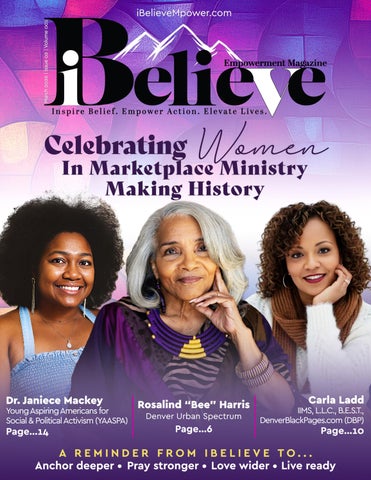
About Celebrating Women in Marketplace Ministry Making History
I
n every generation, God anoints women who refuse to separate faith from leadership, calling from commerce, or purpose from platform. This issue of iBelieve Empowerment Magazine honors three visionary CEOs whose work proves that the marketplace is not separate from ministry—it is often the mission field itself. They are builders. They are system shapers. They are legacy architects. And they are making history. A Defining Thread: What unites these three women is not industry—it is obedience. Each lead in a different arena— media, business development, youth civic engagement—yet all three demonstrate the same spiritual throughline:
FAITH IS NOT DECORATION. IT IS FOUNDATION. They show us that marketplace ministry is not limited to church walls. It lives in boardrooms, editorial meetings, economic summits, community hubs, and policy forums. It requires endurance, discernment, prayer, boundaries, and courage. This issue of iBelieve Empowerment Magazine celebrates women who are not waiting for permission to lead. They are building legacy while remaining anchored in service. They are shifting systems without surrendering their values. They are modeling what happens when faith moves like
strategy and leadership flows from calling. History is not only written in textbooks. Sometimes it is built platform by platform, summit by summit, youth council by youth council. And in this season, these women are building it.
Marion Boston, Publisher
Our vision is to ignite faith, confidence, and purpose in every reader—empowering lives, strengthening communities, and inspiring lasting change. All contents © 2026 iBelieve Empowerment Magazine. Reproduction without written permission is prohibited. Circulation: Colorado, and online: iBelieveMpower.com, Facebook, Instagram, YouTube and more to come. Letters must include name, address, and phone number. Unsolicited submissions accepted without guarantee of publication or payment. Write to: iBelieve Empowerment Magazine 10730 E Bethany Dr, Ste 195, Aurora, CO 80014 Contact: 720.778.1601 info@iBelieveMpower.com or iBelieveMPower.com
March 2026 3
4 iBelieve Empowerment Magazine 2026
iBelieveMpower.com
TABLE OF
CONTENTS
06 10 Rosalind Bee Harris
Meet Carla Ladd
14 18 21 22 Dr. Janiece Mackey
The Modern Day
Ask iBelieve
Weekly Spiritual Guide
March 2026 5
ROSALIND Faith, Ink, and Integrity: How Bee Harris Built Denver Urban HARRIS Spectrum Into a Calling
BEE By Dr. Jamal A. Bowen
W
hen you meet Rosalind “Bee” Harris, you notice something immediately about her presence: she is steady. Not loud. Not performative. Just rooted. Harris has always described herself as a private person— someone who prefers doing the work rather than drawing attention to herself. Yet the work she has done for nearly four decades has been anything but quiet. Through Denver Urban Spectrum, the publication she founded in 1987, Harris has helped shape how Denver’s Black and Brown communities are seen, heard, and remembered. In a city that has grown rapidly and changed dramatically— culturally, economically, and politically—Denver Urban
Spectrum has remained a constant voice. For generations of readers, the publication has served as both mirror and archive: reflecting the dignity, complexity, and achievements of communities often overlooked by mainstream media. “I have always been a private person working in a very public space,” Harris says calmly, reflecting on her role. That statement captures the tension she has carried throughout her career—telling other people’s stories while carefully guarding her own life with humility, discipline, and faith. Though Harris rarely speaks about her spirituality in dramatic language, it shapes every part of her leadership. “My relationship with God has
6 iBelieve Empowerment Magazine 2026
always been first and foremost in my life,” she says. Raised in the Baptist church, Harris developed a faith that is quiet but constant. It does not demand attention; it provides direction. In the media world—where pressure is relentless, funding unpredictable, and the pace unrelenting—that spiritual grounding has made all the difference. “My relationship with God guides everything I do—my leadership, my decisionmaking, and how I serve the community,” Harris explains. “When you are responsible for telling people’s stories and stewarding a platform, you quickly realize you cannot do it on your own.” For Harris, publishing has never simply been about headlines
or circulation. It has always been about people—about preserving truth, honoring community history, and documenting lives that might otherwise disappear from the public record.
A CALLING BORN FROM NECESSITY
In the mid-1980s, Denver was experiencing demographic shifts and cultural growth. Yet many stories from communities of color were missing from mainstream coverage. Harris noticed the gap. When those communities did appear in traditional media, the stories were often framed through narrow narratives— focusing on crime, hardship, or controversy while overlooking leadership, achievement, and everyday life.
iBelieveMpower.com
Instead of waiting for the narrative to change, Harris decided to create a platform where the stories could be told accurately and authentically. That vision became Denver Urban Spectrum. Looking back, Harris does not describe the decision as an act of ambition. She describes it as a responsibility. “I would not describe it as a burden,” she says. “It was a necessity. It was an obligation. It was a calling—and ultimately, a blessing.” From its earliest issues, the publication aimed to provide something deeper than news. It sought to tell the full spectrum of community life—highlighting culture, business, education, faith, public policy, and everyday achievements. Over time, the magazine became a trusted platform for stories that might otherwise remain untold.
ENDURANCE IN A CHANGING MEDIA LANDSCAPE
Operating an independent publication for nearly four decades requires persistence. Harris speaks candidly about the challenges of sustaining community journalism. “My faith has been tested from the beginning—and it still is,” she says. “Every day.” Like many small media outlets, the greatest challenge has often been financial sustainability. “Finances have always been a primary challenge,” Harris explains. “You can have vision and credibility, but sustainability requires resources.” Community publications face unique pressures. Advertising revenue fluctuates, technology changes rapidly, and audiences increasingly consume news digitally rather than in print. Yet despite those pressures, Denver Urban Spectrum endured.
“Providing a platform where stories could be told authentically—stories that might otherwise go unheard— has been a blessing from the beginning,” Harris says.
Part of that endurance came from credibility. Early in its history, the publication earned the trust of readers who saw their communities represented with dignity and balance.
That commitment has never changed.
“Thankfully, our credibility was established early, and that consistency has carried us for 38 years,” Harris says. As the media industry evolved, Harris adapted. The publication expanded into online and digital platforms, allowing its reach to grow beyond traditional print distribution. Still, the mission remained unchanged: tell the stories that matter with integrity. When uncertainty threatened progress, Harris often returned to scripture.
“One scripture I live by is Psalm 46:10: ‘Be still, and know that I am God,’” she says. “In moments of uncertainty, I have learned to be still, listen, and trust.” In a profession driven by deadlines and constant activity, Harris views stillness as discipline—an intentional pause that allows clarity to emerge.
THE SACRED WORK OF STORYTELLING For nearly four decades, Denver Urban Spectrum has carried a simple phrase beneath its masthead: “Spreading the news about people of color.” For Harris, those words are more than branding. “That is not just a tagline,” she says. “It is a calling.” She sees journalism as a form of stewardship. Every story entrusted to the publication carries weight. Sometimes the editorial team searches for stories. Other times the stories seem to arrive on their own—through community connections, recommendations, or unexpected encounters. “Sometimes we seek stories; other times, they find us,” Harris says. “I truly believe many of them are divinely guided to our pages.” Publishing, in her view, is not simply about content production. It is about preserving truth, honoring legacy, and ensuring that readers encounter narratives that uplift and inform. “Everyday publishing looks like discernment, responsibility, and care,” Harris says. Then she pauses and adds a phrase she often returns to when describing her work: “It is sacred work.”
CHOOSING THE STORIES THAT MATTER
One of the lesser-known challenges of community journalism is abundance. There is never a shortage of important stories to tell. “The need is vast, and the voices are many,” Harris says.
COVER STORY
“Our stories were either overlooked or misrepresented,” Harris recalls.
Each year the publication features twelve cover stories. Deciding which voices to highlight is not easy. “We publish twelve cover stories each year, and choosing among deserving narratives is not easy,” Harris explains. Behind each published feature lies hours of research, interviews, editing, design, and distribution. Those unseen hours reflect the responsibility of honoring someone’s story. “I believe our stories are Godgiven and God-directed,” Harris says. “The greater challenge today is not finding stories—it is having the resources to fully support the work.”
WHEN JOURNALISM BECOMES MINISTRY
Some stories leave a deeper imprint. Harris recalls one such moment involving ultramarathon runner Essie Garrett, who ran across the country raising funds for charitable organizations. Despite her extraordinary generosity, Garrett passed away with very little. Before her death, she specifically requested that Denver Urban Spectrum tell her story. “That responsibility was sacred,” Harris says. Continued on Page 8 March 2026 7
heritage months or special observances. “Our full stories are still too often confined to those moments,” Harris says. Faith shapes her response to that imbalance. “Every person carries divine worth,” she explains. “Our responsibility is to present a fuller narrative—one that preserves accomplishments, context, and truth.”
INVESTING IN THE NEXT GENERATION Continued From Page 7
Another difficult story involved six-year-old Broderick Bell, whose death during a period of gang violence shook the Denver community. “Telling that story required compassion and courage,” Harris explains. More recently, the publication’s “Colorful Stories” series highlighted women who endured tremendous adversity yet emerged with resilience and faith. Those narratives, Harris says, inspired readers and moved many toward action. “When storytelling is handled with integrity, it can be a ministry.” In Harris’s view, ministry does not only happen inside churches. It happens whenever truth lifts burdens, encourages hope, or moves people toward compassion.
TRUTH WITHOUT SENSATIONALISM
Since its founding, Denver Urban Spectrum has committed to telling the full story of the community. “Since 1987, we have shared the good, the bad, and the sad,” Harris says.
Difficult topics require careful balance. “Sensitive issues require truth without sensationalism and compassion without compromise,” she explains. Whether covering Hurricane Katrina and hosting the “Spectrum of Hope” community event, examining systemic racism, highlighting immigration challenges, or documenting the pressures pastors faced during the pandemic, the publication followed one guiding principle: Honor people while telling the truth. “Honoring God means honoring people,” Harris says.
WHAT MAINSTREAM MEDIA STILL MISSES
Harris does not speak with bitterness when discussing mainstream media’s shortcomings—only clarity. “Historically, mainstream media focused on deficits rather than contributions,” she says. While representation has improved over time, she believes communities of color are still too often highlighted only during designated
8 iBelieve Empowerment Magazine 2026
Harris believes the future of journalism depends on developing young storytellers who understand both the power and responsibility of media.
Technology will continue to evolve. Media platforms will change. But those principles serve as the publication’s compass. If Harris could give Denver one message today, it would be simple: “Speak up. Stand firm in faith. Support one another. Lead with love.” For entrepreneurs navigating uncertainty, she offers equally timeless advice: “Always pray. Always trust. Always put God first—not only in business, but at home and in every area of life.” Then she adds a final reflection that captures the foundation of her life’s work:
“Young aspiring journalists must understand the power of their voices beyond social media,” she says.
“When the pressure is high and the path is unclear, faith is not a strategy of last resort. It is the foundation.”
Through the Urban Spectrum Youth Foundation journalism camp, more than 200 young people have received mentorship and hands-on training over the past decade.
Bee Harris did not simply launch a publication.
Many have gone on to pursue careers in media, communications, and public service. “Developing young voices is not optional,” Harris says. “It is necessary for the future of informed communities.” In that way, Harris has done more than preserve stories. She has helped cultivate the next generation of storytellers.
She built a platform that has preserved community truth for decades—an archive of resilience, a mirror of dignity, and a witness to stories that might otherwise have been forgotten. And through every era—print, digital, and whatever comes next—she continues to do what she has always done: serve the community, discern the story, and tell it with integrity.
A MESSAGE FOR THE CITY As Denver Urban Spectrum continues to grow digitally, Harris remains clear about the values that must never change. “Integrity. Faith. Family values. Moral responsibility,” she says.
Article by Dr. Jamal K. Bowen
iBEM, DOO, Empowering Community Entrepreneurs-CEO, empoweringentrepreneurs17@ gmail.com Rosalind Bee Harris: publisher@urbanspectrum.net iBelieveMpower.com
March 2026 9
Carla Ladd
BUILDING BLACK BUSINESS INFRASTRUCTURE IN DENVER—WITH FAITH, STRATEGY, AND STAYING POWER
C
arla Ladd is a seasoned entrepreneur and business leader with more than two decades of experience spanning community-based economic development, financial services, and high-level project management. She is the Founder and President of IIMS, L.L.C., operating as DenverBlackPages.com (DBP)—a digital marketing platform launched in 2002 to empower and promote Colorado’s Black-owned businesses. Under her leadership, Denver Black Pages grew into an ecosystem: quarterly Strictly Bizness networking events, The Little Black Book – Entertainment & Resource Guide (print), and the widely attended annual Success Summit & Expo. In 2005, Carla expanded her mission beyond visibility into infrastructure—launching
the Mountain Region Black Economic Summit (MRBES), a nonprofit created to advance economic self-sufficiency in historically marginalized communities. After a brief hiatus, she revived and rebranded the organization in 2022 as the BIPOC Economic Success Trust (B.E.S.T.), widening its reach to support Black-led nonprofits, small businesses, professionals, and youth across Colorado. Her entrepreneurial and nonprofit leadership has earned her multiple awards and public recognition for long-term impact in economic empowerment and community development. Before becoming a full-time community builder through business and nonprofit leadership, Carla built her career in the aerospace and defense sector—serving as a Systems Test Engineer at Hughes Aircraft Company (1986–1996) and later
10 iBelieve Empowerment Magazine 2026
as a Systems Engineer and Project Manager at Lockheed Martin (1996–2007). That technical foundation shows today in the way she leads: structured, outcome-driven, and clear about what systems must exist for people to thrive. Carla is also a devoted member of Rising Star Missionary Baptist Church, where she has served since 1997 in various leadership roles, including Deaconess Board Team Leader and Co-chair of Debutantes & Beaus for Christ. In 2023, she joined the Trustee Board and was unanimously elected Chairperson in January 2024, overseeing financial and operational stewardship during a critical season of transition and renewal. Across business, nonprofit, and church governance, Carla’s throughline is consistent: service, sustainability, and long-term community impact.
“AT MY CORE, I’M CALLED TO HELP ENTREPRENEURS BUILD LEGACIES.”
For Carla, identity is not a title— it’s a foundation. “I am a follower of Jesus Christ, first and foremost,” she says. “That shapes how I see people, purpose, and the work I feel called to do.” That calling is clear in this season: supporting entrepreneurs—especially Black entrepreneurs—in building sustainable businesses and generational legacies. Entrepreneurship isn’t new to her; it’s personal history. “I grew up surrounded by it—my father, stepfather, maternal grandmother, and even my grandmother were all entrepreneurs,” Carla shares. “It’s in my blood.” iBelieveMpower.com
“I often describe it as both a blessing and a curse—this journey comes with incredible highs and very real lows, sometimes in the same day,” she says. “Entrepreneurship is not for punks.” Still, she believes the work is worth it—because entrepreneurship creates freedom, opportunity, and pathways for generational impact.
WOMEN’S HISTORY MONTH: REFLECTION—AND RESPONSIBILITY
Carla views Women’s History Month as more than celebration. For her, it’s a moment to honor legacy and recommit to expanding access. “It’s a time to honor the women— especially Black women—whose resilience, vision, and sacrifice created the opportunities many of us now have,” she says. “It also reminds me that leadership isn’t just about personal success; it’s about making sure others have access to the same doors, or better ones.” That belief shows up directly through B.E.S.T. and the platforms she’s built: expanding economic opportunity, amplifying voices, and creating spaces where collaboration isn’t just encouraged—it’s designed. “At its core, my goal is simple,” she says. “To lead in a way that makes it easier for the next generation of women to thrive—
not just during Women’s History Month, but every day.”
IBELIEVE EMPOWERMENT LENS: FAITH THAT MOVES LIKE STRATEGY
Carla doesn’t separate faith from leadership. She leads from it. “My faith is the foundation of how I lead and why I lead,” she says. “I believe stewardship is a calling, so whether I’m working through Denver Black Pages or B.E.S.T., I see the work as serving people—not just running organizations.” She’s also clear-eyed about the gap between talent and access. “Growing up around entrepreneurs taught me that talent is everywhere, but access is not,” Carla says. “That truth fuels my commitment to building spaces where Black-owned businesses can be visible, supported, and connected to real opportunities for growth.” And what does she want readers to believe is possible right now? “Black-owned businesses in Denver are not just surviving— they are building, innovating, and leading,” she says. “There is real momentum. I want people to see that scalable success, generational success, community-changing success is possible right now—and when we support Black businesses, we strengthen the entire city.”
THE “WHY” BEHIND DENVER BLACK PAGES—AND THE TOOLS THAT MOVE DOLLARS WITH INTENTION Denver Black Pages didn’t start as a grand plan. It started as a need. “When I first moved to Denver, I wasn’t trying to start a platform—I was just trying to find my people,” Carla recalls. “I wanted to know where the Black-owned businesses were, what events were happening, and how to feel connected in a new city.” When she couldn’t find a comprehensive place online, she built what she needed. DBP began as a simple online calendar with a handful of businesses—but it grew because the need for visibility and connection was real. The next evolution was practical: moving from discovery to action. “The Little Black Book came next as a tangible way to showcase the richness and range of Black-owned businesses,” she says—helping the community turn intention into habits. Today, that same vision continues through tools like the Your Community Hub app, offering real-time access to businesses and events. “Together, they’re tools that help us circulate dollars with intention,” Carla says. “Choosing community not just when it’s convenient—but when it counts.”
LEGACY AND PURPOSE: “I WANT THE NEXT GENERATION TO INHERIT ECOSYSTEMS.”
When Carla talks about legacy, she doesn’t talk about applause. She talks about access—and infrastructure.
“I think about the version of us who are coming behind— brilliant, creative, full of vision—and how much farther they can go if the road is a little less lonely and a lot more resourced,” she says. Her goal is bigger than motivation. It’s systems. “The legacy I’m intentionally building for Black women entrepreneurs is one of infrastructure, not just inspiration,” Carla shares. “Platforms, networks, spaces where our ideas are seen, our businesses are supported, and our leadership is normalized— not as an exception, but as an expectation.”
COVER STORY
But she doesn’t romanticize it.
Her hope is that the next generation inherits ecosystems—not just encouragement.
IMPACT THAT CAN’T BE DENIED: WHEN ONE’S CONVENING BECOMES A MOVEMENT For Carla, impact isn’t measured only in event attendance—it’s measured in ripple effects.
“One story that captures the impact is the evolution from the Mountain Region Black Economic Summit to what is now B.E.S.T.,” she says. “It began with a simple but powerful question: What would truly move our community forward?” She remembers rooms where business owners, professionals, and nonprofit leaders sat at the same table— each bringing perspectives, needs, and hopes. From those conversations, the Summit was born—intentional, strategic, and centered on Black economic empowerment. “Through the Success Summit & Expo, we created a space where Black-owned businesses could be seen—where our community Continued on Page 12 March 2026 11
means the foundation is being strengthened.” 2.
Continued From Page 11
could learn and connect—and where real partnerships took root,” Carla says. “The ripple effects—new collaborations, increased visibility, and a stronger sense of possibility—go far beyond any single event.”
BARRIERS AND BREAKTHROUGHS: THE UNSEEN WEIGHT OF CARRYING VISION
Carla is honest about what it costs to lead—especially as a Black woman building in spaces that often underfund, undervalue, or misunderstand the work. “One of the biggest obstacles has been financial support, which is something many Blackled nonprofits face,” she says. “There have been seasons where the vision was clear and the need was obvious, but the funding just wasn’t there yet.” And then there are the lessons that require discernment. “I’ve encountered situations where people presented themselves as supporters but were really more interested in access—to ideas, relationships, or resources—than advancing the mission,” she says. So, what keeps her steady? “My faith and a deep sense of calling,” Carla says. “I lean on prayer and the people who truly believe in the work. Over the years, I’ve learned to set better boundaries, stay rooted in purpose, and trust that
every challenge is part of the preparation.” About the B.E.S.T. Success Summit: Designed for action, not just inspiration The mission is clear: assemble entrepreneurs, professionals, and community leaders around one purpose—advancing Black economic empowerment through access to knowledge, networks, and opportunities. But Carla’s focus is what people leave with. “What I want attendees— especially women entrepreneurs—to walk away with is something tangible,” she says. “New connections they can follow up with, collaborations already in motion, and resources they can plug into right away.” The goal is application. “A potential client. A funding lead. A strategic partner. A tool that improves how they run their business,” she says. “The Summit is designed so people can take what they learn and apply it immediately.”
ADVICE TO WOMEN ENTREPRENEURS: CONSISTENCY OVER HYPE Carla’s guidance is both practical and encouraging— especially for the slow seasons. 1. P rogress isn’t always loud. “When results feel slow, it doesn’t mean nothing is happening—it usually
12 iBelieve Empowerment Magazine 2026
You don’t have to do it alone. “The right relationships— mentors, collaborators, peers—can accelerate your growth in ways hard work alone cannot.”
3. C onsistency will take you further than motivation. “There will be seasons where you’re excited and seasons where you’re simply committed. Both matter.”
WHAT’S NEXT: THE NEXT 6–12 MONTHS— AND HOW THE COMMUNITY CAN SHOW UP
Carla’s focus is forward: the upcoming B.E.S.T. Success Summit & Expo and continued investment in tools that strengthen connection across the community. “One of the biggest needs we’ve heard is for a centralized Community Calendar,” she says, “which is why we created the Your Community Hub app.” How can readers support in a real way? • Register and attend the Success Summit & Expo (and bring someone with you) • Use and share the Your Community Hub app • Add events to the calendar (free) • Partner or sponsor to expand access and impact across the region “Whether through sponsorship, partnership, or simply showing up,” Carla says, “participation helps us expand access and impact across the community.”
STAYING GROUNDED: LEADERSHIP
DOESN’T HAVE TO BE LONELY
Carla returns to practices that reconnect her to purpose. “Prayer is first—it gives me clarity, perspective, and peace,” she says. “Quiet and reflection time are essential. And I’ve learned not to carry vision alone.” She leans on trusted people who offer wisdom and honest perspective—especially when leadership feels isolating. “That reminds me that while the responsibility is real, I don’t have to hold it all by myself,” she says.
CALL TO ACTION: ONE SIMPLE MOVE THAT CAN SHIFT MOMENTUM
“If every reader did just one thing this month,” Carla says, “I would ask them to intentionally choose a Black, woman-owned business for something they already plan to spend money on—and then tell someone else about it.” Why that one action? Because intentional spending creates real economic impact: helping businesses grow, create jobs, and reinvest into the community. And sharing your experience multiplies the effect. “One decision, multiplied across a community, can shift momentum,” Carla says. “That’s how stronger ecosystems are built.” Article by Dr. Jamal K. Bowen iBEM, DOO, Empowering Community Entrepreneurs-CEO, empoweringentrepreneurs17@ gmail.com Contact: Carla Ladd, https:// www.bestsuccesssummit.org http://yourcommunityhub.me/ https://denverblackpages.com/ little-black-book/
iBelieveMpower.com
March 2026 13
DR. JANIECE MACKEY FROM ACTS OF OMISSION TO YOUTH POWER: REIMAGINING SYSTEMS, RESTORING DIGNITY
S
ome leaders are shaped by opportunity. Dr. Janiece Mackey was shaped by absence.
She approached a counselor for guidance on the college process. Instead of support, she encountered dismissal. No roadmap. No encouragement. No strategic follow-through.
Not dramatic exclusion. Not public humiliation. But something quieter— more administrative, more procedural, more common. She calls them “acts of omission.” The counselor who does not follow up. The advisor who withholds critical information. The policy that becomes a wall because no one bothers to explain how to move around it.
Years later, in college, after becoming pregnant, she was advised to drop out. Not because she lacked intelligence. Not because she lacked drive, but because the institution had limited imagination for her future.
Those omissions did not just inconvenience her. They clarified her calling. Today, Dr. Janiece Mackey serves as Founder and CEO of Young Aspiring Americans for Social and Political Activism (YAASPA)—an organization committed to dismantling systemic barriers and building authentic civic, academic, and economic power for Black youth. But YAASPA did not begin as an abstract vision. It began as a lived reckoning with how systems quietly shape who gets access—and who does not.
WHEN THE SYSTEM SAYS NOTHING AT ALL In high school, Dr. Mackey did what many first-generation students are told to do: she asked for help. 14 iBelieve Empowerment Magazine 2026
The message was subtle but lasting: figure it out yourself.
Then came the financial aid gap. Near graduation, she nearly missed walking across the stage—not because of academic failure, but because of a funding technicality. A barrier that felt immovable— until one staff member chose to intervene and resolve it. That moment changed her. The obstacle was not inevitable. It was maintained. And if it was maintained, it could be dismantled. This realization now sits at the core of YAASPA’s mission: systems often fail young people not through overt hostility, but through quiet neglect. Through incomplete information. Through withheld access. Through indifference. And indifference can be disrupted.
iBelieveMpower.com
Founded in 2010, YAASPA emerged from a recognition that while structured career pipelines exist for STEM, business, and healthcare, there was little organized support for youth pursuing careers in the social sciences—public policy, civic leadership, public administration, behavioral health, advocacy, education, and justice work. Yet these are the fields that shape how resources are distributed. These are the spaces where decisions are made about schools, housing, healthcare, and community safety. YAASPA was created to build intentional academic and career pathways into those fields— especially for Black youth who are disproportionately impacted by policy decisions but underrepresented in policymaking spaces. But Dr. Mackey did not want to create another youth program built on symbolic engagement. She wanted to redistribute power.
BEYOND YOUTH VOICE: BUILDING YOUTH POWER
“Youth voice” has become a common phrase in education and nonprofit spaces. Listening sessions. Panels. Advisory boards. Dr. Mackey is clear: voice without authority becomes performance. YAASPA intentionally shifts from youth voice to youth power—structural, measurable authority embedded within the organization’s DNA. At YAASPA: • Youth participate in hiring processes. • Youth manage portions of organizational budgets.
• Youth co-author white papers and research documents. • Youth design and lead civic events. • Youth hold political candidates accountable in public forums.
COVER STORY
WHY YAASPA WAS NECESSARY
The organization’s first hires were youth interns. Its first full-time staff member was a former participant. This is not mentorship as symbolism. It is leadership as structure. Through initiatives like the Youth Council, middle and high school students identify pressing community issues—from transit equity to multilingual student access— and develop strategies to share their research with policymakers. Through Civic Engagement courses offered for elective credit, students build civic literacy, racial identity awareness, and academic self-efficacy while studying the systems that shape their daily realities. YAASPA’s Y Incubator further deepens this model by providing paid internships and fellowships in social science fields such as behavioral health, education, public administration, and public health. Paid. Not exposure. Not unpaid “experience.” Compensation. Because civic engagement should not be reserved for those who can afford to volunteer. Young people are not being prepared to lead someday, they are leading now.
A SHIFT TOWARD HEALING
As YAASPA’s work expanded, youth began articulating something deeper than ambition. They were exhausted. Continued on Page 16 March 2026 15
Continued From Page 15
Exhausted from being asked to educate others about racism. Exhausted from reliving trauma for institutional learning. Exhausted from being the case study instead of the architect. In response, YAASPA pivoted toward a healing-centered engagement model and adopted a mantra that now anchors its culture: “Your awakening is no longer our emergency.” The statement is firm but not hostile. It establishes a boundary. It affirms that Black youth are not responsible for accelerating someone else’s consciousness at the expense of their own well-being. It signals that liberation work must include care, joy, and restoration. Healing is not an accessory to justice. It is part of justice.
COMMUNITY AS INFRASTRUCTURE YAASPA’s work extends beyond youth programming into physical and relational infrastructure.
Through coalition partnerships— including the Aurora Black Consortium (ABC) Coalition— Dr. Mackey helped lead the transformation of a former elementary school into a community hub dedicated to healing, workforce development, civic engagement, and intergenerational programming. What was once an empty building is now filled with youth activity—policy institutes, summer activism programming, wellness initiatives, and community gatherings. This is more than adaptive reuse.
Dr. Mackey’s approach is long-term and place-based. YAASPA does not operate as a temporary initiative. It builds ecosystems—spaces where youth can access mentorship, skill-building, healing, and economic opportunity within the same environment.
THE PHILOSOPHY BENEATH THE STRUCTURE Dr. Mackey’s leadership philosophy is rooted in reflection. She believes: “The very thing that frustrates you may be what you are called to solve.” Her frustration with omission became her blueprint for intervention.
It is symbolic reclamation.
But she is also honest about the emotional costs of leadership.
A closed school becomes a living civic space. A building that once represented loss becomes a site of possibility.
There are moments when she chooses not to publicly defend herself—not because she lacks truth, but because
16 iBelieve Empowerment Magazine 2026
she values protecting dignity over winning arguments. There are conflicts that remain unresolved. Not every chapter closes cleanly. And she reminds young leaders of a critical truth: you cannot want something more for someone than they want for themselves. These lessons guard against burnout and saviorism alike. They allow her to build without collapsing.
FAITH AS FOUNDATION
At the center of Dr. Mackey’s resilience is faith. Not as symbolism. Not as branding. But as foundation. Through seasons of unpaid labor. Through moments when expectations were misplaced. Through resistance from institutions uncomfortable with youth-led power—faith anchored her.
iBelieveMpower.com
She translates it plainly: “Get rid of everything that slows us down.” That clarity informs her boundaries—exercise without email, protected family time, intentional laughter. These practices are not luxuries. They are sustainability strategies.
And what is constructed can be reimagined.
COVER STORY
Her guiding scripture for 2026 comes from Hebrews 12:1: “Let us throw off everything that hinders and the sin that so easily entangles.”
Through YAASPA, she is not waiting for systems to improve themselves. She is modeling what change looks like when youth are treated not as future leaders—but as present power. Article by Dr. Jamal K. Bowen iBEM, DOO, Empowering Community Entrepreneurs-CEO, empoweringentrepreneurs17@gmail.com Contact: Dr. .Janiece Mackey: janiece. mackey@yaaspa.net
Because leadership without boundaries becomes depletion. And depleted leaders cannot build durable movements.
A REDEFINED MODEL OF YOUTH DEVELOPMENT
YAASPA challenges traditional models of youth engagement. It does not frame young people as problems to solve. It does not romanticize struggle. It does not tokenize participation. Instead, it builds dignifying ways of being—where youth are trusted with responsibility, authorship, and governance. It builds pathways into policy and public leadership so youth can influence the systems that influence them. It builds economic opportunities into civic development. And it builds cultural boundaries around emotional labor and healing. Dr. Janiece Mackey’s journey— from a student navigating omission to a leader reshaping civic engagement—reveals a critical truth: Barriers are rarely natural. They are constructed.
March 2026 17
THE MODERN DAY APOSTOLIC AND PROPHETIC MINISTRY AND THE POLITICAL SYSTEM By Bishop Timothy S. Boston, D.D.
The Ark International Worship Center
A
sa bishop of the Lord’s Church, I begin with this truth: I love God, and I love people. Any theological, prophetic, or apostolic engagement with society—especially with politics—must flow from those two foundations. Scripture is clear that God’s heart is inclined toward mercy for all humanity. The Bible declares, “The Lord isn’t really being slow about his promise, as some people think. No, he is being patient for your sake. He does not want anyone to be destroyed, but wants everyone to repent” (2 Peter 3:9, NLT). From a biblical and theological perspective, God
shows mercy to all, while still calling all to repentance and righteousness.
THE TIMES WE ARE LIVING IN
We are living in politically charged times—marked by division, violence, corruption, deception, and moral confusion. These realities exist across systems, parties, and ideologies. Scripture reminds us that this is not new. Jesus Himself compared the last days to “the days of Noah” (Matthew 24:37, NLT). Genesis records that “The LORD observed the extent of human wickedness on the earth, and he saw that everything they thought or imagined was consistently and totally evil” (Genesis 6:5, NLT). Violence filled the land, truth was corrupted,
and righteousness was marginalized. In such times, a critical question arises: Where does the modern-day apostolic and prophetic ministry stand in the midst of political systems and social unrest?
THE BIBLICAL MANDATE FOR JUSTICE
Throughout Scripture, God makes His position unmistakably clear—He loves justice. • “The LORD loves righteousness and justice; the unfailing love of the LORD fills the earth” (Psalm 33:5, NLT). • “For I, the LORD, love justice. I hate robbery and wrongdoing” (Isaiah 61:8, NLT). • “No, O people, the LORD has told you what is good… to do what is right, to love mercy, and to walk humbly with your God” (Micah 6:8, NLT). Justice is not a political invention; it is a divine attribute. Therefore, apostolic and prophetic ministry cannot be silent when injustice prevails— especially toward the poor, the vulnerable, and the oppressed (Proverbs 31:8–9; Isaiah 1:17).
PROPHETS AND APOSTLES: VOICES OF GOD, NOT POLITICAL REPRESENTATIVES As a bishop of the Lord’s 18 iBelieve Empowerment Magazine 2026
Church, I understand my role clearly: I am a voice of God to the people, whereas politicians are voices of the people for the people. This distinction is critical. Apostolic and prophetic ministries are not called to echo partisan agendas but to echo the heart, will, and purposes of God. The modern-day apostolic and prophetic ministry is first called to: • Speak the heart of God • Reveal the mysteries of God to this age • Call sin what God calls sin • Proclaim righteousness without fear or favoritism Isaiah declared, “Shout with the voice of a trumpet blast. Shout aloud! Don’t be timid. Tell my people Israel of their sins” (Isaiah 58:1, NLT). To “cry loud and spare not” does not mean to abandon mercy or grace. Rather, it means to refuse bias—calling out unrighteousness wherever it exists, regardless of position, power, or political affiliation.
BIBLICAL EXAMPLES OF COURAGEOUS JUSTICE
The Scriptures give us numerous examples of prophets and leaders who stood for justice: • Nathan confronted King David over his sin (2 Samuel 12:1–7). • Elijah boldly rebuked King Ahab and Jezebel for iBelieveMpower.com
In the New Testament, Jesus Himself rebuked religious and social hypocrisy: “You ignore the more important aspects of the law—justice, mercy, and faith” (Matthew 23:23, NLT). The apostolic and prophetic tradition has always required courage, clarity, and compassion.
extremism, and moral compromise are subtle dangers that can pull the Church away from its true mission. We—as apostles, prophets, pastors, evangelists, and teachers—must do what God has always required: • Proclaim truth • Defend justice • Extend mercy • Call people to repentance and salvation
We are not the voice of the people speaking for the people. We are a prophetic echo of God’s redemptive plan for the world.
CONCLUSION
In conclusion, the modernday apostolic and prophetic ministry is called to stand out, not fit in. We must love deeply, speak truth boldly, and remain anchored in righteousness. As Amos declared, “I want to see a mighty flood of justice,
an endless river of righteous living” (Amos 5:24, NLT). May the Church rise with clarity, courage, and compassion— faithful to God, committed to justice, and unwavering in its proclamation of Christ. Article by: Bishop Timothy S. Boston, D.D. The Ark International Worship Center
DANIEL: FAITH WITHOUT COMPROMISE
Daniel stands as a powerful example for today’s leaders. Though many historians recognize him as both a prophet and a statesman, Daniel refused to compromise his faith. “Daniel resolved not to defile himself with the royal food and wine” (Daniel 1:8, NLT). Alongside Hananiah, Mishael, and Azariah—better known as Shadrach, Meshach, and Abednego—he stood firm in holiness while serving within a pagan political system. Their faithfulness reminds us that it is possible to engage society without surrendering conviction. Hebrews declares, “Therefore, since we are surrounded by such a huge crowd of witnesses to the life of faith…” (Hebrews 12:1, NLT). These witnesses testify that obedience to God must always supersede cultural pressure.
THE CHURCH’S ROLE IN THE END TIMES
In the end times, the Church must be more focused than ever on the message of Christ—the One who came to redeem humanity. Scripture warns us not to be distracted by “doctrines of demons” and deceptive spirits (1 Timothy 4:1). Political idolatry, ideological March 2026 19
INSPIRATION
injustice and idolatry (1 Kings 18; 21). • Jeremiah spoke truth to kings and officials despite persecution (Jeremiah 22:3).
20 iBelieve Empowerment Magazine 2026
iBelieveMpower.com
WHEN NATIONS RAGE: HOW SHOULD A CHRISTIAN RESPOND? ? Question 1:
Should Christians be afraid when we see war escalating in the Middle East? iBelieve Responds: Concern is human. Fear does not have to govern you. Jesus addressed this directly: “You will hear of wars and rumors of wars. See that you are not troubled.” — Matthew 24:6 He didn’t deny conflict. He commanded composure. War reminds us that the world is broken — but it does not mean God has lost control. Faith Forward Action: • Limit anxiety-driven media consumption
Check Your Spiritual Posture
When you read global news, ask yourself: • Am I reacting emotionally or prayerfully? • Is my peace anchored in Christ or in political outcomes? • Am I consuming more headlines than Scripture?
This Month’s iBelieve Challenge
The Unshaken 7-Day Reset For the next 7 days: 1. Begin each morning with Psalm 46. 2. Pray intentionally for global peace. 3. Fast one hour of news consumption daily.
• Pray before reacting • Speak calm into your household
• Prioritize repentance and obedience • Live missionally now
? Question 2:
? Question 3:
Is this a sign of the end times? iBelieve Responds: Wars have existed in every generation. While Scripture speaks about prophetic fulfillment, Jesus emphasized readiness over speculation. “Therefore you also be ready.” — Matthew 24:44 The believer’s focus is not decoding timelines — it’s living prepared. Faith Forward Action: • Strengthen your daily walk 4. Encourage someone who feels anxious. 5. Give financially or prayerfully toward missions. 6. Reflect on your eternal citizenship (Philippians 3:20). 7. Close the week with gratitude for God’s sovereignty.
How should I pray in a situation like this? iBelieve Responds: Scripture gives us direction: “Pray for the peace of Jerusalem.” — Psalm 122:6 “Prayers… for kings and all who are in authority.” — 1 Timothy 2:1–2 Pray for: • Civilians caught in conflict • Wisdom for world leaders • Protection for believers in the region • De-escalation Faith Forward Action: Create a 7-day prayer plan for peace and protection.
? Question 4:
What if economic instability follows? iBelieve Responds: Conflict can affect oil, markets,
Faith Forward Action: • Review your financial stewardship • Avoid fear-driven decisions • Lead your workplace or business with steadiness Faith in the marketplace becomes real when headlines test your leadership.
? Question 5:
How do I talk about this without becoming politically divisive? iBelieve Responds: The Christian’s identity is rooted in Christ first. “Blessed are the peacemakers.” — Matthew 5:9 You can hold convictions without hostility. You can care deeply without attacking others. Faith Forward Action: • Speak truth with gentleness • Refuse inflammatory rhetoric • Reflect Christ in tone and posture
Final Word Global conflict may test the world. But it also reveals the believer. The question is not: What is happening? The question is: How will I respond? Faith forward. Unshaken. Rooted in Christ.
Ask iBelieve is a dedicated SAFE space in the iBelieve Empowerment Magazine created just for you—a place where questions are welcomed and faith conversations can grow. Whether you’re seeking clarity about the Bible, wondering how to live for God in everyday life, exploring what faith really means, or simply wrestling with questions about believing, this segment is designed to meet you right where you are. There are no “too small” or “too big” questions. Ask iBelieve exists to encourage honest inquiry, biblical understanding, and practical guidance rooted in
God’s Word. Our goal is to help strengthen your faith, deepen your relationship with God, and remind you that you’re not alone in your journey. Readers are invited to submit their questions at iBelieveMpower.com/ AskiBelieve, and selected questions will be thoughtfully addressed in the magazine by faith leaders and contributors who are committed to truth, love, and encouragement. Your question could be the very one that helps someone else grow. Because faith grows when we ask, seek, and believe—Ask iBelieve. March 2026 21
ASK IBELIEVE
ASK iBELIEVE
and global trade. But Scripture draws a distinction between worldly shaking and spiritual stability. “We are receiving a kingdom that cannot be shaken.” — Hebrews 12:28 Practical wisdom and faith are not opposites.
Weekly
SPIRITUAL FITNESS
SPIRITUAL GUIDE
WEEK 1-2 WEEK 3-4 Devotional: Gentleness Is Not Weakness - Power under control builds trust. Scripture: “A gentle answer turns away wrath.” — Proverbs 15:1 Strength without gentleness feels unsafe. Authority without empathy feels oppressive. Gentleness is controlled strength. It looks like:
• Lowering your tone. • Slowing your response. • Listening before correcting.
Protecting dignity even in disagreement. If people brace themselves when you speak, something needs refining. Gentleness doesn’t mean compromise. It means composure. Reflection Questions: When do I become sharp? Who experiences my impatience? What insecurity drives my harsh tone?
Invite Others Into the Battle
Scripture: “As iron sharpens iron, so one man sharpens another.” — Proverbs 27:17 Growth accelerates in community. If you fight flesh alone, you’ll rationalize. If you manage time alone, you’ll drift. If you lead alone, you’ll burn out. Invite another trusted advisor into your real life: • • • •
Your discipline goals. Your temptations. Your growth plan. Your calling.
Accountability isn’t control — it’s protection. Strong men and women don’t hide struggles. They build brotherhood and sisterhood. Reflection Questions: Who challenges me spiritually? Who knows my actual battles? Who could I invite into deeper accountability?
Action Step: Practice deliberate calm in your next tense interaction.
Action Step: Schedule a recurring monthly check-in with a trusted friend in Christ.
Prayer: Father, refine my tone and posture. Make my strength safe for others. Teach me to correct with compassion. Amen.
Prayer: Lord, remove pride that isolates me. Surround me with peers and elders who sharpen and strengthen me. Amen.
22 iBelieve Empowerment Magazine 2026
iBelieveMpower.com
March 2026 23