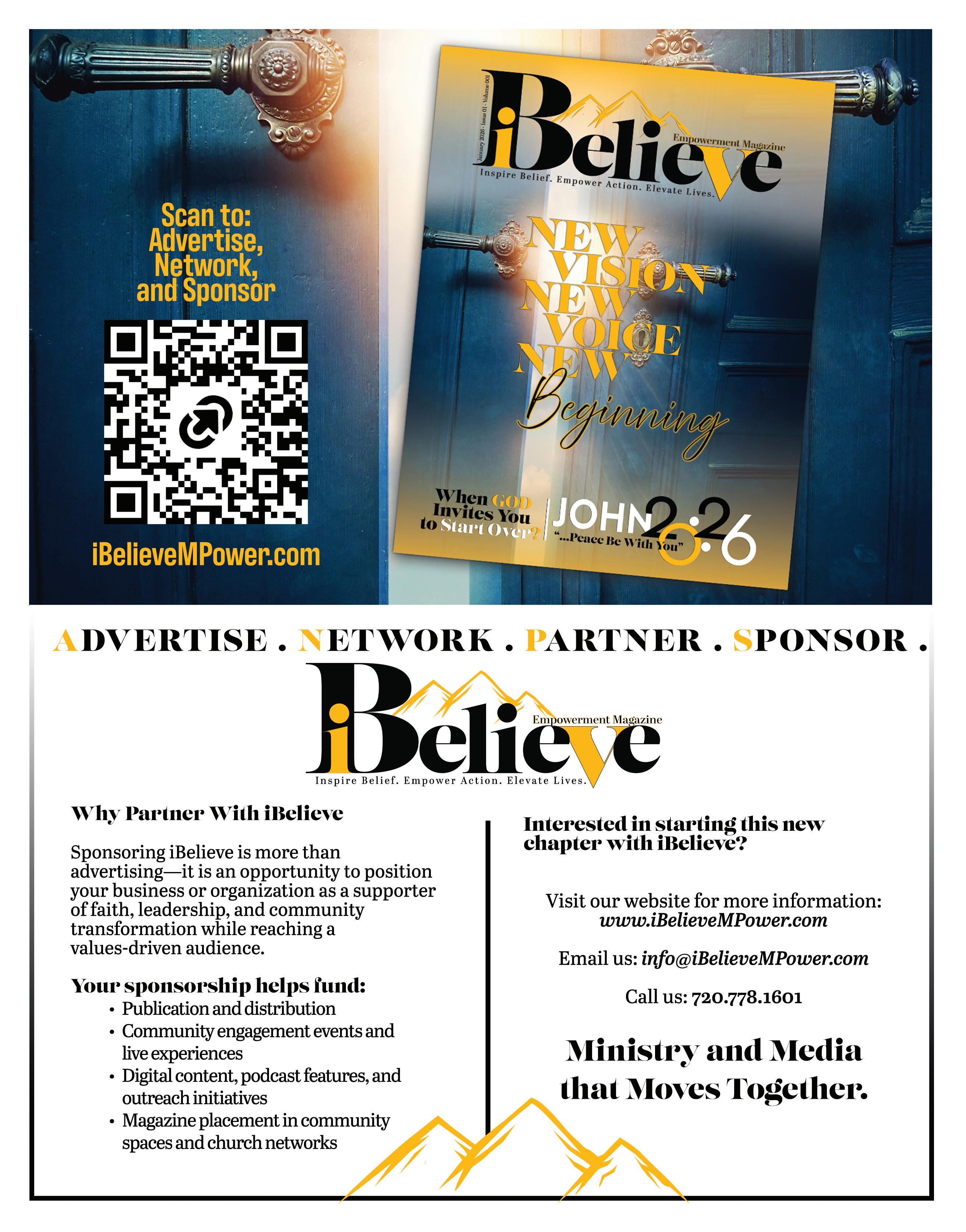
To ignite faith, confidence, and purpose in every reader—empowering lives, transforming communities, and inspiring lasting change.
Our vision is to become a leading voice of faith-based empowerment, where every reader discovers their divine purpose, walks confidently in their identity, and lives a life of impact and influence. iBelieve Empowerment Magazine envisions a world where belief births bold action, empowerment fuels transformation, and elevated lives inspire lasting change across generations.
New Vision New Voice
Colorado is home to one of the fastestgrowing and most diverse Christian communities in the nation. From the mountain towns that echo with worship to the bustling urban centers of Denver, Aurora, Centennial, Commerce City, and Colorado Springs, believers across the state are seeking deeper connection, practical wisdom, and spiritual empowerment for modern life. In the midst of this evolving landscape, a new and much-needed voice is emerging—iBelieve Empowerment Magazine.
ANSWERING A GROWING NEED
The Colorado Christian community stands at a unique crossroads. Families are navigating new cultural pressures, churches are rebuilding and redefining ministry in a changing world, and believers are searching for teaching that is both biblically anchored and relevant to everyday challenges. While Colorado is rich with faith, leadership, and ministry, many have expressed a longing for a platform that speaks directly to their lives, their communities, and their experiences. iBelieve Empowerment Magazine was created in response to that call.
We are stepping forward as a publication devoted to uplifting, equipping, and empowering believers across Colorado. Our mission is simple: to strengthen the body of Christ by providing content that inspires spiritual growth, fosters unity, highlights community leaders, and offers practical guidance for living out faith in today’s world.
A PLATFORM FOR LOCAL VOICES
One of the most powerful aspects of iBelieve is its commitment to amplifying local
stories. Colorado is filled with pastors, entrepreneurs, creators, youth leaders, nonprofit founders, educators, and everyday believers whose testimonies carry the potential to encourage and transform lives. Yet many of these voices go unheard.
As a new voice in the Christian community, iBelieve offers the platform they deserve.
We are dedicated to featuring local ministries, spotlighting community impact, celebrating Christian leadership, and sharing reallife testimonies that demonstrate God’s power at work in Colorado. By elevating these voices, we hope to strengthen connections across regions and denominations while reminding believers that they are part of a larger, thriving movement of faith.
FAITH THAT MEETS REAL LIFE
In every issue, our mission is to bring faith into everyday spaces—homes, workplaces, businesses, schools, and communities. Readers will find content that addresses real-life needs, including:
• Spiritual growth and personal development
• Leadership and community influence
• Business, entrepreneurship, and financial wellness
• Mental and emotional health from a Christian perspective
• Marriage, family, and relationship empowerment
• Youth and next-generation development
• Ministry insights and church spotlights
Through a blend of practical wisdom and biblical truth, iBelieve Empowerment Magazine seeks to help Colorado believers navigate life with confidence, clarity, and courage.
A MOVEMENT OF EMPOWERMENT
We believe God is stirring something powerful throughout Colorado. Churches are rising, prayer movements are expanding, and believers are stepping boldly into their callings. iBelieve is honored to be part of this new season—serving not just as a publication, but as a movement of empowerment, unity, and spiritual growth.
As we give voice to the unique experiences of Colorado Christians, we carry the heart of Ephesians 4:12 “to equip the saints for the work of ministry, for building up the body of Christ.” Every article, feature, and story is designed with that purpose in mind.
iBelieve Empowerment Magazine is more than ink on paper or words on a screen.
It is a gathering place.
A resource.
A community connector.
A new voice rising with hope, truth, and vision for Colorado’s future.
And this is only the beginning.
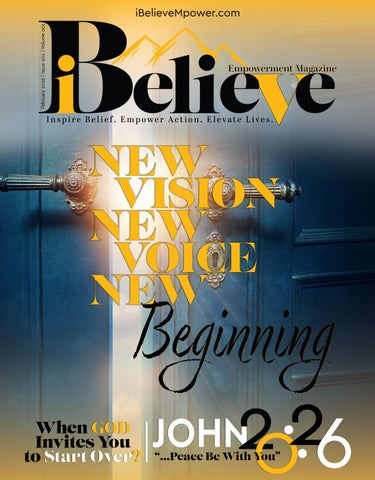
A NEW BEGINNING: When God Invites You to Start Over
By Marion Boston, based on John 20:26
There comes a moment in every believer’s journey when life feels like it has closed in—when disappointment, fear, or failure makes it seem as though the story is finished. But the good news of the Gospel is this: with God, the end is never the end. Every closed door is an opportunity for Christ to step in and say, “Peace be with you.”
John 20:26 paints a picture of new beginnings in the most unexpected place. The disciples were behind locked doors—afraid, uncertain, and unsure of what the future held. They had walked with Jesus, believed in His promises, and then watched Him die. Everything familiar had collapsed. Yet Scripture says:
Days later His disciples were again in the house, and Thomas was with them. Though the doors were shut, Jesus came and stood among them and said, ‘Peace be with you.’” — John 20:26 In their locked room, Jesus brought a new beginning.
YOUR LOCKED ROOMS DON’T STOP JESUS
Some seasons feel like a room locked from the inside—a place where fear, shame, or confusion keeps us trapped. Maybe it’s a failed relationship, a dream that didn’t happen, a mistake you regret, or simply a season where life hasn’t gone the way you expected.
“But
closed doors don’t stop Jesus. Locked rooms don’t block His presence. Your doubts don’t disqualify His love.”
Just like Thomas, you may have questions. You may be unsure. You may feel unworthy of a fresh start. Yet Jesus steps right into your uncertainty and offers you peace, not punishment; restoration, not rejection.
GOD’S INVITATION TO BEGIN AGAIN
A new beginning is not something you earn—it’s something God invites you into. From Genesis to Revelation, God reveals Himself as the God of fresh starts:
• He gave Noah a new beginning after the flood.
• He gave Joseph a new beginning after betrayal.
• He gave David a new beginning after failure.
• He gave Israel a new beginning after exile.
• He gave Peter a new beginning after denial.
• And Jesus Christ, He gives ALL of us the chance to begin again.
Your story is still being written. God is not intimidated by your past or your pain. He specializes in resurrection— bringing life to things that look dead, breathing hope into situations that feel over.
WHAT A NEW BEGINNING LOOKS LIKE
1. Peace where there was fear. Jesus didn’t rebuke the disciples for hiding; He brought peace. Your new beginning starts with His presence, not your perfection.
2. Clarity where there was confusion. When Jesus appeared, everything made sense again. A new beginning brings direction, fresh vision, and renewed purpose.
3. Faith where there was doubt. Thomas’ uncertainty turned into the boldest declaration of all: “My Lord and my God.” Your doubt is not the end—God can transform it into deeper faith.
4. Movement where there was stagnation. The disciples didn’t stay behind locked doors; they walked into their calling with new power.
YOUR INVITATION IS HERE
Maybe you’ve been holding onto guilt.
Maybe you’ve been stuck in grief.
Maybe fear has held the pen of your story for too long.
But hear the voice of Jesus today saying:
“Peace be with you. I am not done with you.”
A new beginning is not about erasing your past; it’s about redeeming it. God takes the very places of pain—your locked rooms—and turns them into testimonies of grace.
HOW TO STEP INTO YOUR NEW BEGINNING
Surrender the old. Release what God never meant for you to carry.
Trust His timing. The disciples waited a week before Jesus came again—your breakthrough may be closer than you think.
Invite His presence. Even if the door is locked, He can enter.
Walk in faith. Don’t stay where fear found you—move into the future God has prepared.
You Are Not Stuck. You Are Being Set Up.
Your new beginning may not look dramatic. It may be quiet, like Jesus stepping into a locked room. But it is powerful. God restores. God renews. God rewrites.
If you’re breathing, God is still working. If your heart is open, God is still leading. If Jesus has stepped into your story, resurrection is already happening.
So lift your head. Straighten your shoulders. Take a deep breath.
YOUR NEW BEGINNING STARTS NOW.
Marion Boston, Publisher of iBelieve Empowerment Magazine; info@ibelievempower.com
LIVING WITH PURPOSE
1. Calling: Your Purpose in Action
Your calling is the work you’re drawn to—the kind of purpose that tugs at your heart no matter how many other options you have. It’s the long-term career or mission you feel compelled to pursue, even if it’s not the most profitable.
Maybe you’re multi-talented and could succeed in several industries, but you feel most alive when mentoring teens, working with unhoused communities, or empowering small business owners. That’s your calling. It’s not always glamorous, but it’s deeply meaningful.
2. Cause: The Specific Issue You’re Meant to Address
Once your calling is clear, narrow it down to a cause—a specific issue you feel personally assigned to. This could be sparked by your background, identity, or the burdens you see others carry.
For example, if your calling is to help the unhoused, your cause might become food insecurity. That specific focus gives your work clarity and direction. As Matthew 25:34-36 reminds us, Jesus values the acts of compassion we extend:
DISCOVERING YOUR CALLING, CAUSE & CRUSADE
By Prof. Lynn Wilson
In today’s fast-paced world, it’s easy to chase titles, money, or status while losing sight of what truly matters. But fulfillment comes when your life and work are driven by purpose. That’s where the 3 C’s
Framework—Calling, Cause, and Crusade—comes in. This approach helps you align your passions with how you serve others, whether in business, school, ministry, or everyday life.
Crusades don’t have to last forever, but they’re powerful tools for change. They inspire community, raise awareness, and push your mission forward. What starts with one voice can multiply into a collective effort that transforms lives.
Living It Out
Ask yourself:
• Calling: What kind of work brings me life and purpose?
• Cause: What specific issue within that calling do I feel led to solve?
• Crusade: How can I invite others to help drive this change?
Even as a business owner or professional, your work can reflect this framework. Maybe a percentage of sales supports a nonprofit. Maybe you host workshops, join a community coalition, or mentor others with similar passions. However, you express it, integrating your 3 C’s means your work becomes worship.
Ultimately, our callings, causes, and crusades are not just about us—they’re about serving others and glorifying God through action. When your career aligns with your convictions, you’re not just making a living—you’re making a difference!
LIFESTYLE
“For I was hungry and you gave me something to eat... I was a stranger and you invited me in.”
This kind of focused service honors both your purpose and God’s command to care for others.
3. Crusade: Turning Passion into Movement
A crusade is a seasonal campaign or initiative where you organize efforts around your cause. It might start with you bringing food to a local shelter, but when others join you, that action turns into a movement. Maybe it evolves into a monthly food drive or holiday outreach.
Prof. Lynn Wilson is founder of SparqU, Inc. and creator of Level Up Academy, a Christ-centered program empowering youth with business, digital literacy, and leadership skills. A former business professor of 15 years, he champions STEAM education, workforce certifications, and purposedriven training for underserved communities nationwide. See our website at www.sparqu.com
Faith in the Market place
HOW BUSINESS AND CHRISTIANITY COME TOGETHER
By Dr. Jamal Bowen
For generations, many Christians treated faith and business like two different languages. Sunday was sacred; Monday belonged to the grind. Productivity dominated the marketplace, while spirituality was reserved for the sanctuary. But Scripture never separates faith from work. Instead, the Bible teaches that what we believe should shape how we build, lead, hire, budget, innovate, and treat people.
Today, God is raising entrepreneurs, executives, and marketplace leaders who refuse to choose between purpose and profit, between leadership and love, between success and surrender to Christ. Believers are stepping confidently into boardrooms, classrooms, construction sites, nonprofits, startups, restaurants, and real estate with kingdom conviction. Faith is not a separate compartment—it is the foundation.
Most Christians have been taught how to serve God in church, but not how to serve Him in the marketplace. Yet Scripture is clear that our labor is worship: “Whatever you do, work heartily, as for the Lord and not for men.” (Colossians 3:23). When we work for the Lord, business becomes more than a paycheck—it becomes an altar. Excellence is not about impressing people; it’s about honoring God. Preparedness, quality craftsmanship, and treating clients with dignity are all expressions of worship. Work done with integrity becomes a testimony.
Trust is the true currency of business. People may buy once because of marketing, but they return because of character. God speaks plainly about business ethics: “A false balance is an abomination to the Lord, but a just weight is his delight.” (Proverbs 11:1). In ancient times, crooked merchants manipulated scales to cheat customers. God
didn’t call it “unfair”—He called it an abomination. Today, integrity looks like honoring contracts, transparent pricing, telling the truth even when it costs us, and doing right when no one is watching (Luke 16:10). When our character is consistent, clients trust us. And when trust grows, business grows. Integrity is not only spiritual—it’s profitable.
The world teaches ownership. Christianity teaches stewardship. Jesus’ parable of the talents (Matthew 25:14–30) shows that God entrusts money, opportunities, relationships, and influence—and expects us to multiply them. He rebukes the servant who hides the talent out of fear. God rewards effort, not excuses. “For everyone to whom much is given, from him much will be required.”
(Luke 12:48). Stewardship means budgeting wisely, hiring responsibly, investing generously, and treating employees fairly. We don’t build businesses to boast about ownership—we build to steward impact.
Some Christians fear the idea of profit because they have seen it abused. But Scripture never condemns profit. Proverbs teaches that diligent labor leads to abundance (Proverbs 14:23), and Moses reminds Israel that it is God who gives the power to get wealth (Deuteronomy 8:18). God is not against wealth; He is against wealth controlling us. Jesus said, “Seek first the kingdom of God and his righteousness, and all these things will be added to you.” (Matthew 6:33). Profit becomes a problem only when it becomes the purpose. For Christian entrepreneurs, profit is fuel— funding ministry, opportunity, and transformation.
Worldly leadership uses authority to dominate. Kingdom leadership uses authority to serve. Jesus taught, “Whoever wants to become great among you must be your servant.”
(Mark 10:43). In business, servant leadership looks like listening more than speaking, elevating others, celebrating team wins, and making decisions that benefit people,
not ego. When leaders cultivate environments where people feel valued, innovation thrives, and loyalty deepens. Philippians 2:3–4 challenges us to look beyond our own interests and to the interests of others. Servant leaders build strong organizations because they build strong people.
James reminds us that faith without action is dead (James 2:14–17). Christian entrepreneurship becomes a ministry of compassion and justice: “Learn to do good; seek justice, correct oppression.” (Isaiah 1:17). This includes fair wages, ethical sourcing, and providing opportunity for the overlooked. When businesses create jobs and restore dignity, they participate in God’s justice.
Faith aligns us with God’s wisdom and peace. When others panic, we pray. When others fear uncertainty, we trust God’s plan. When others quit, we persevere. Hebrews 11 shows us leaders who built boldly because they believed God, and Romans 8:28 assures us that God works all things for the good of those who love Him. Faith gives entrepreneurs an advantage—not by guaranteeing outcomes, but by giving courage to act, resilience to continue, and hope to endure setbacks.
Christian business leaders don’t just pray over meals; they pray over decisions. Practical rhythms include praying before strategy meetings (Philippians 4:6–7), creating a values covenant (Proverbs 15:22), and discerning partnerships wisely (2 Corinthians 6:14). When God is invited into planning, He influences the outcomes. Bring Him into the boardroom and allow Scripture and prayer to shape your mission, policies, and culture.
The marketplace is the new ministry field. Jesus recruited disciples who were business owners, fishermen, tax collectors, and tradesmen— people who understood work, systems, and leadership.
God still calls marketplace missionaries. “Let your light shine before others, that they may see your good works and give glory to your Father in heaven.” (Matthew 5:16).
You may never preach a sermon from a pulpit, but your business preaches every day. Your integrity is a sermon. Your generosity is a sermon. Your excellence is a sermon. Business is not just a way to make money—it is a way to make an impact.
Christianity doesn’t weaken
business—it strengthens it. When we lead with integrity, steward with excellence, treat people with dignity, and pursue purpose over profit, the marketplace becomes a platform where the world sees Christ. Let your business be a kingdom tool. Let your leadership reflect Jesus. Let your work preach without a single word.
Build boldly. Lead faithfully. Steward well.
Because business is not separate from faith—business is ministry.
Dr. Jamal Bowen President & Founder EMPOWERING COMMUNITY ENTREPRENEURS
God’s Ancient Grain
By Richie Robinson
Why do you think that the almighty God references wheat and barley as part of the promise land? In God’s eye, provision has always been represented in the bible (Abundance).
Let’s start with the parable of the mustard seed. Even though a mustard seed is not a grain it is used to illustrate faith in the bible, but I will get back to ancient grains shortly.
You may ask what can I do with a mustard seed? You can crush it to create a paste, that is how mustard is made but my favorite is
mustard crusted prime rib, or you can use it as part of pickling spices, marinades, and sauces.
1. Take a prime rib and coat the outside with any mustard and let it marinate overnight.
2. The next day, in a roasting pan, put down ½ layer of kosher salt (the salt will enhance the flavor of the prime rib, help breakdown the proteins, resulting in a more tender and juicy texture)
3. Cook the prime rib in a roasting pan with a rack so the prime rib will not touch the kosher salt.
4. Add salt and pepper or allow the seasoning in the mustard to enhance the unique flavor of the prime rib.
5. Pre-heat the oven to 450o, put the prime rib in uncovered and the mustard will create a brown crust on prime
rib and after you see the crust browning turn down the oven to 350o and cook until internal temperature is 145o-150o F.
6. Pull the prime rib out of oven and allow to sit for 1 hour to let the juices settle
GOD’S PROVISION STAPLE OF SURVIVAL
KEY COMPONENT OF WORSHIP WHEAT BARLEY SPELT MILLET
Cut and serve with your favorite steak sauce or it is delicious all by itself.
Even a mustard seed can lead to important outcomes, does that sound familiar? Faith in a Christian life is important enough that Jesus illustrated the significance of mustard seed faith in Matthew 17:20.
Now let’s get back to ancient grains. God’s ancient grains.
In Egypt there was a famine that was predicted by Joseph, the grains were so important that sometimes grains were used for money. God provided an abundance of grain for seven years and a worldwide famine for seven years.
In Genesis 41:5, God uses wheat in Pharoah’s dream. Barley, farro, spelt, rye, and maize, are all part of ancient grains of the bible which contribute to God’s provision. Without the grains Egypt would have died due to malnutrition.
God’s ancient grains were a staple of survival and used for bartering and trading. Monies ran out, and the people ended up exchanging or trading animals and land (Genesis 47:17-18) for wheat. You will find grain trading all throughout the bible and as the resident chef, I want to do recipes using ancient grains, God’s ancient grains.
In my next contribution I want to make something from the old with a new culinary twist to it.
Ancient grains were so important that God accepted it as a sacrifice; wheat or flour finely ground was mixed with oil and frankincense, and salt was a traditional grain offering (Leviticus 2:1). Absolutely no yeast was in the product because yeast represented sin, corruption, and evil (1 Corinthians 5:6-8).
This is my introduction as the Resident Chef for iBelieve Empowerment Magazine, we will indulge in some of the holiest foods of the Old Testament with a modern flair on it. The objective is to introduce the new with the old and see what we come up with.
Sounds exciting? A culinary adventure of the same
ingredients that Jesus ate with a modern-day flair. We will also except recipes that you may think are delicious and we can add it to our repertoire.
My name is Chef Richie, and I look forward to cooking with the same ingredients that Jesus ate.
– Bon Appétit
UPON THIS ROCK WILL I BUILD MY CHURCH:
UNDERSTANDING THE CHURCH POST-COVID
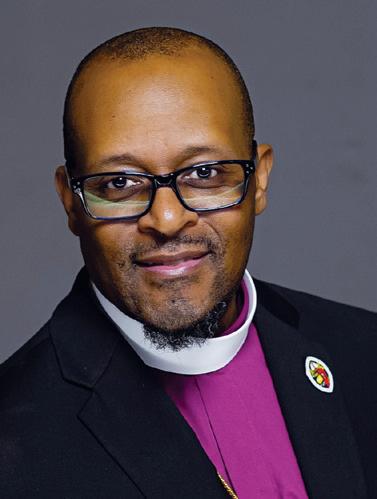
By Bishop Timothy Boston, D.D
Senior Pastor, The Ark International Worship Center
“NOW I SAY TO YOU THAT YOU ARE PETER (WHICH MEANS ‘ROCK’), AND UPON THIS ROCK I WILL BUILD MY CHURCH, AND ALL THE POWERS OF HELL WILL NOT CONQUER IT.”
— Matthew 16:18 (NLT)
A PARABLE FOR OUR TIME
There was once a small village that gathered every week at the same old well. For generations, it was where everyone came to draw water and share life. But one year, a great drought came. The old well ran dry, and many believed the village would not survive. Yet one wise elder said, “The source is not gone—only the well we used has
changed.” So, they dug deeper and discovered a fresh stream beneath their feet. The water was still there; they just had to draw it in a new way.
So, it is with the Church of Jesus Christ today. The Source—our Savior, our mission, our message—has never changed. But the way we draw from that Source must adapt if we are to bring living water to a thirsty generation.
THE REALITY WE FACE
Across the United States, reports estimate that as many as 15,000 churches could close in 2025. That’s roughly a quarter of the nation’s congregations projected to close their
doors in the coming years. Prior to the pandemic, churches were already facing decline—averaging 3,000 new plants each year against 4,000 to 7,000 closures. The reasons are many: declining attendance, aging memberships, financial strain, cultural shifts away from organized religion, and the lasting impact of COVID-19 on worship habits. Yet even with these sobering statistics, 94% of pastors still believe their church will endure. Why? Because faith tells us that Jesus’ promise still stands: “The gates of hell shall not prevail.”
SMALL CHURCHES, BIG IMPACT
It’s important to know that church size does not equal church strength. A small congregation can have just as much impact as a megachurch when it embraces new models of ministry and community.
In fact, smaller congregations often have greater flexibility—they can pivot faster, personalize discipleship, and form deeper relationships. These are priceless advantages in a time when people crave connection, authenticity, and belonging more than polished performance.
Post-COVID, many churches discovered that ministry is no longer limited to pews and pulpits. The most fruitful congregations—large and small—are those who have learned to embrace hybrid ministry: connecting both in person and online, serving their local neighborhoods
while also reaching hearts across digital platforms.
The message and mission of the Church has not changed: to preach Christ, to make disciples, and to love people. But the methods must change to reach a changing world. We can no longer simply invite people to come; we must go to where they are—digitally, relationally, and missionally.
LEARNING FROM THE CHURCH IN ACTS
When we look to the early church, we find the blueprint for revival in Acts 2:42-46 (NLT): “All the believers devoted themselves to the apostles’ teaching, and to fellowship, and to sharing in meals (including the Lord’s Supper), and to prayer... They worshiped together at the Temple each day, met in homes for the Lord’s Supper, and shared their meals with great joy and generosity.”
The early believers didn’t have buildings, budgets, or branding. What they had was community. They were committed to learning, loving, praying, sharing, and living life together. The result? “Each day the Lord added to their fellowship those who were being saved.”
Church growth in the book of Acts wasn’t driven by programs—it was driven by healthy relationships and Spirit-filled community. They adapted to persecution, poverty, and change—but never lost sight of the mission.
HOW WE CAN BUILD AGAIN
To thrive in this post-COVID world, churches must:
1. Stay rooted in mission, flexible in method. The gospel is timeless, but the tools of ministry must be timely.
2. Invest in digital and local presence. Use online platforms as mission fields, not marketing tools.
3. Develop healthy leaders. Pastors and volunteers need renewal, support, and vision to sustain the work.
4. Build genuine community. Whether 20 or 2,000 members, churches must cultivate spaces of belonging and discipleship.
5. Serve outwardly. The church is not a fortress—it’s a force for transformation in every neighborhood it touches.
A WORD OF ENCOURAGEMENT
The world may say that the church is fading, but I believe we are witnessing not a funeral—but a refining. God is reshaping His Church to meet the needs of a new generation.
If we, as His people, will remain faithful to the message, flexible in the method, and focused on community, then what was once dry ground will again flow with living water.
The Source has never changed. The well may look different— but the Rock remains the same.
Bishop Timothy Boston,
D.D
Senior Pastor, The Ark International Worship Center
THE CONTENDER
FIRST STEPS TO GREATNESS: THE RISE OF LOCAL MULTI-SPORT ATHLETE GEONA WHITE
By Rochelle White
Steps to Greatness: The Rise of Local Multi-Sport Athlete Geona White
From grassroots beginnings to Olympic podium dreams, every athletic journey begins with a single step—whether it’s the first practice, the first game, the first victory, or even the first defeat. For local rising athlete Geona White, that first step came early, and it set the tone for a path marked by courage, versatility, and faith.
A Childhood Spark
Geona’s passion for competition first appeared when she was just four years old. In a playful sibling 50-meter dash—where the prize was a sucker, and loud encouraging cheers—she found a thrill that would shape her future. What began as innocent fun quickly revealed a natural competitive spirit that propelled her into the national spotlight before she reached her teens.
Track Triumphs Before Twelve
SPORTS
By age twelve, Geona had already built an astonishing athletic résumé. She became a USATF Junior Olympics finalist, earned the title of 11–12 Girls Athlete of the Year, and consistently won her sprint events across local and regional meets. One of her standout achievements was advancing to the national semifinals in the 200-meter dash at the iconic Hayward Field in Eugene, Oregon.
These experiences taught her discipline, humility, and the importance of perseverance— qualities she would soon bring into a new chapter of her athletic career.
A New Beginning on the Basketball Court
Transitioning from track to basketball was a bold and defining move for Geona. When asked what it felt like to start over in a new sport and what it took mentally to believe she could excel again, she expressed a sense of joy and curiosity:
“It felt exciting because it was a new opportunity to be able to be a multitalented kid! It felt good to explore what I felt was fun and good for me to grow my talent as a strong female basketball player.”
Beginning on practice squads to learn the fundamentals, Geona quickly demonstrated natural ability and an eagerness to grow. Her dedication earned her a place with the Colorado Basketball Club, where her height and presence made her a strong force in the paint. Beyond her physical strengths, her compassion, teamwork, and determination made her stand out on and off the court.
Her impact was recognized immediately—Geona earned All-Tournament Team honors during her first year as a traveling competitor.
Wisdom for Young Female Athletes
Geona’s journey hasn’t been defined merely by medals or
trophies, but by the character she has built along the way. When asked what advice she would give young female athletes who may be afraid to try something new, she didn’t hesitate to share the principles guiding her own path:
“Put God first always and do what you love. Never backing down from anyone!”
Her words reflect the confidence and faith that fuel her competitive spirit and inspire others watching her rise.
Geona’s Forward Encouragement
Geona carries a sense of purpose that goes beyond sport. She ended our conversation with a message of hope and strength for anyone striving toward their dreams:
“Just believe in yourself and know that through it all to trust God, because He will walk with you through the high and low times. It may be rough but never lose your faith!”
A Journey Just Beginning
From sprinting across playgrounds to dominating the paint on the basketball court, every step of Geona White’s journey reflects passion, resilience, and a deep belief in her calling. Her story proves that the first step—no matter how small—can lead to extraordinary places when taken with courage and faith.
And for Geona, this is only the beginning.
ASK iBELIEVE
IS IT WISE TO USE MY 401(K) TO BUY A HOME?
Question:
I’ve heard about a proposal that could let people use their 401(k) for a home down payment without a penalty. Is this something believers should consider—or avoid?
Ask iBelieve Responds:
This is an important question because it sits at the intersection of faith, finances, and future planning.
A new proposal being discussed could allow first-time homebuyers to use money from their 401(k) retirement account for a down payment without the usual 10% early-withdrawal penalty. Today, that penalty often stops people from even considering this option.
But just because something becomes possible doesn’t mean it’s always wise.
What’s Different From Before?
Under current rules:
• Using your 401(k) early usually comes with penalties and taxes
• Loans must be repaid and can create stress if your job changes
• Many buyers delay homeownership for years Under the proposed change:
• Funds could be used specifically for a home down payment
• The penalty would be removed
• Buyers could move forward sooner
Ask iBelieve is a dedicated SAFE space in the iBelieve Empowerment Magazine created just for you—a place where questions are welcomed and faith conversations can grow. Whether you’re seeking clarity about the Bible, wondering how to live for God in everyday life, exploring what faith really means, or simply wrestling with questions about believing, this segment is designed to meet you right where you are.
There are no “too small” or “too big” questions. Ask iBelieve exists to encourage honest inquiry, biblical understanding, and practical guidance rooted in God’s
Word. Our goal is to help strengthen your faith, deepen your relationship with God, and remind you that you’re not alone in your journey.
Readers are invited to submit their questions at iBelieveMpower.com/ AskiBelieve, and selected questions will be thoughtfully addressed in the magazine by faith leaders and contributors who are committed to truth, love, and encouragement. Your question could be the very one that helps someone else grow.
Because faith grows when we ask, seek, and believe—Ask iBelieve.
This shift reframes homeownership as part of long-term wealth—not just an expense.
A Faith Perspective
Scripture reminds us that God cares about how we steward what He has entrusted to us. “Moreover, it is required in stewards that one be found faithful.”
YOUR TESTIMONY MATTERS
Revelation 12:11 declares, “They overcame by the blood of the Lamb and by the word of their testimony.”
Your story has power. What God has brought you through can become the very encouragement someone else needs to keep believing. We invite you to share your testimony—how God healed, restored, provided, delivered, or strengthened you—so it can be published in the printed magazine and on iBelieveMpower.com to bless others around the world.
When you speak, faith rises. When you share, hope is released. Let your testimony be a living witness of God’s power and love. Submit your story today at iBelieveMpower. com/testimony and help others overcome through the Word and your testimony.
For some, using a portion of retirement savings to secure stable housing may be a faithful step—especially if it provides consistency for family, ministry, and future growth.
For others, patience and continued saving may still be the better path.
Faith-based financial decisions are not about chasing opportunity; they are about seeking alignment.
Questions to Pray Through Before Deciding
Ask yourself:
• Am I responding to pressure— or peace?
• Have I sought wise counsel and prayed for clarity?
• Will this decision strengthen my long-term stability?
• Am I trusting God with both my present needs and future provision?
“Trust in the Lord with all your heart and lean not on your own understanding.”
— Proverbs 3:5
Ask iBelieve Takeaway
Using a 401(k) to buy a home is not automatically right or wrong. It is a tool—and tools must be used with wisdom.
When faith leads the decision:
• Fear loses its voice
• Impulse gives way to intention
• Stewardship becomes an act of worship
If this proposal becomes reality, it will open doors—but believers are still called to walk through them prayerfully.
401(K) DOWN PAYMENT PROPOSAL
THE FLOAT PLAN TO LET HOMEBUYERS TAP 401 (K) FUNDS FOR DOWN PAYMENTS
Contributor: Marion Boston, Real Estate Professional
Date: January 16, 2026
Source: Latest reports including Realtor.com and Reuters
Our current administration is preparing to unveil a major proposal that could change how Americans use retirement savings to buy a home — a move aimed at addressing the ongoing housing affordability crisis. The proposal, set to be officially announced by President Trump at the World Economic Forum in Davos next week, would allow Americans to withdraw funds from their 401(k) retirement accounts and use that money toward a home down payment.
What’s Being Proposed
According to White House officials, including National Economic Council Director Kevin Hassett, the plan would permit 401(k) distributions for home down payments without the
usual penalties that currently apply to early withdrawals. The exact mechanics are still being worked out, but one concept being discussed would let homebuyers put down a standard down payment and then transfer some home equity back into their 401(k), so the retirement account reflects the home’s appreciating value over time.
This initiative forms part of a broader suite of proposals intended to enhance housing affordability — including earlier directives to have Fannie Mae and Freddie Mac buy $200 billion in mortgage bonds to lower mortgage rates.
How the Rule Differs from Current 401(k) Policy
Under current federal tax and retirement rules, using 401(k) funds for home purchases is limited and costly for most participants:
Why This Matters for Homebuyers
The combination of higher mortgage rates and soaring home prices has pushed down payments and monthly payments out of reach for many first-time buyers. Realtor. com notes that typical down payments have roughly doubled in recent years, making it harder for aspiring buyers to accumulate sufficient savings without tapping into other resources.
By letting people access retirement savings more easily — and potentially without penalties — the proposal seeks to reduce one of the biggest barriers to homeownership: the upfront cash needed to secure a mortgage.
Critics’ Concerns
Financial experts warn that using retirement accounts for home purchases may risk future economic security:
• Traditional early withdrawals from a 401(k) before age 59½ usually trigger a 10% early withdrawal penalty plus ordinary income taxes.
• Hardship withdrawals may be permitted under some plans for a primary residence purchase, but taxes and penalties still generally apply.
• 401(k) loans are allowed under many plans (often up to 50% of your vested balance or $50,000), but they must be repaid with interest and can become due quickly if you leave your job.
Realtor.com highlights that current tax law offers an exception for IRAs, not 401(k) s: first-time homebuyers can withdraw up to $10,000 from an IRA penalty-free for a home purchase, though income tax may still be owed. Changing how 401(k) plans are treated would be a significant departure from that status quo.
• Retirement savings loss: Tapping a 401(k) early can reduce long-term compounded growth, especially for younger workers.
• Legislative hurdle: The 401(k) penalty provisions are part of the federal tax code, and changing them likely requires Congressional action, not just executivebranch policy.
Next Steps
Details of the plan are expected to be fleshed out and publicly released at the World Economic Forum in Davos. Lawmakers, financial planners, and housing industry stakeholders will be watching closely to see exactly how the plan would be structured, including eligibility parameters, distribution limits, and whether the home equity portion would indeed be recognized as part of retirement savings.
401(k) Withdrawal for Home Down Payment
Use of Funds for Home Purchase
First-Time Homebuyer Exception
Taxes on Withdrawals
Equity Credit Back Into 401(k)
Legislative/Regulatory Status
Impact on Retirement Savings
Generally not permitted without penalty for home purchases. Withdrawals before age 59½ typically incur a 10% early withdrawal penalty plus ordinary income tax.
Can take a loan from a 401(k) (often up to $50,000 or 50% of vested balance), but must repay with interest and rapid repayment may be required if employment changes.
The IRA first-time homebuyer exception allows up to $10,000 to be withdrawn penalty-free from an IRA, but this exception does not currently apply to 401(k) plans.
Early withdrawals are taxed as ordinary income, and penalties apply unless an exception exists.
No mechanism exists today to credit home equity back into retirement accounts.
Current rules are established under the Internal Revenue Code and ERISA, requiring statutory and regulatory authority.
Would allow penalty-free withdrawals specifically for down payments on a home. Final structure still being finalized.
Plan is expected to eliminate the need for loan repayment in the traditional sense — funds could be used directly without the typical loan restrictions. Details pending.
Would create a new exception allowing 401(k) holders to use funds for down payments, similar in spirit to IRA rules but on a larger scale.
Proposed plan is expected to waive the penalty; ordinary income tax treatment may still apply — specifics not yet public.
One conceptual approach under discussion would allow a homebuyer to transfer a portion of home equity back into the 401(k), treating it as an asset that grows over time.
Proposal would likely require either regulatory reinterpretation or new legislation to amend retirement distribution rules.
Administration asserts that new rules could allow retirement accounts to grow with home equity increases, though critics remain skeptical.
At a Glance: Key Differences
• Penalty Treatment: Today’s 401(k) rules penalize early withdrawals for home purchases; the proposed plan would eliminate that penalty for down payments.
• New Use Case: Buying a home would become a qualifying purpose under 401(k) distribution rules, similar to a provision that currently exists only in IRA law.
• Equity Concept: For the first time, retirement savings might be linked directly to home equity, not just cash distributed.
• Tax Treatment: Penalty waivers are proposed, but income tax on distributions may still apply (details forthcoming).
Side-by-Side Snapshot
How the Proposal Could Work in Practice
Under the floated proposal, a first-time homebuyer could use money from their 401(k) to help cover a down payment, without facing the standard earlywithdrawal penalty that exists today. While final rules have not been released, the intent is to treat homeownership as a wealth-building asset, similar to retirement savings.
The big change: Access without penalty, instead of forcing buyers to rely only on savings, gifts, or risky 401(k) loans.
What Happens to Retirement Savings?
This is where the proposal introduces a new concept:
• The administration has suggested that home equity
growth could be recognized as part of long-term wealth, potentially allowing some form of value recognition tied back to retirement planning.
• While details are still unclear, the philosophy is:
A primary residence is not “lost money, but a wealth-building asset.
Why This Matters for FirstTime Buyers
For many younger buyers:
• Retirement accounts are often their largest pool of savings
• Down payments — not monthly payments — are the biggest hurdle
• This proposal aims to unlock ownership sooner, rather than forcing people to wait until prices rise even further
Important Caveat
This proposal is still conceptual, and:
• Final rules would matter greatly (limits, taxes, eligibility)
• Financial advisors caution against draining retirement accounts
• Congressional or regulatory approval may still be required
In Short
Before: “You have money — but you can’t use it.”
After (Proposed): “You can use what you’ve built to buy stability and long-term wealth.”
FAITH
& FINANCE
REFLECTION
Faithful Stewardship or Risky Shortcut?
The Bible reminds us that wisdom and stewardship go hand in hand:
“The plans of the diligent lead surely to abundance.”
— Proverbs 21:5
This proposal raises an important question for believers:
Is using retirement savings for a home an act of wisdom or impatience?
Homeownership has long been viewed as a pathway to stability, legacy, and generational blessing. A home can provide shelter, consistency, and a foundation from which families grow and serve others. In that sense, a home is not just an expense — it is an asset with purpose.
At the same time, Scripture cautions us not to act hastily or without counsel.
“Without counsel plans fail, but with many advisers they succeed.”
— Proverbs 20:18
Using a 401(k) to buy a home should never be automatic. It requires prayer, planning, and wise advice. For some, waiting may still be the better path. For others, this proposal could open a door that leads to stability and long-term growth.
A Balanced Takeaway
Faith-filled financial decisions:
• Seek God’s guidance first
• Consider both short-term opportunity and long-term impact
• Use new tools wisely, not impulsively
Whether renting or owning, our security is ultimately not in property or portfolios — but in God’s provision and direction.
“Commit your work to the Lord, and your plans will be established.”
— Proverbs 16:3
Weekly
SPIRITUAL GUIDE
WEEK 1
Loving God Fully: Growing closer to God by aligning my beliefs, choices, and daily habits with His purpose for my life
Scripture:
“You shall love the Lord your God with all your heart and with all your soul and with all your mind.” Matthew 22:37
Loving God is not about intensity in one moment but surrender over time. Jesus names the heart, soul, and mind—our emotions, identity, and thinking—as places where love for God must live. Spiritual fitness begins when we stop compartmentalizing God and invite Him into all of who we are.
Meditation Questions:
• Which part of me (heart, soul, or mind) is easiest to give to God?
• Which part do I protect or hold back?
• What competes most for my affection and attention right now?
Action
Write one intentional way you will love God today (example: choosing gratitude, turning off distractions during prayer, obeying quickly).
Prayer
“Lord, teach me to love You fully—not halfway, not when it’s easy, but with my whole life.”
Song: Falling In Love With Jesus
SPIRITUAL FITNESS
WEEK 2
Learning to Be Still
Psalm 46:10
“Be still, and know that I am God.”
Devotional:
Stillness is a spiritual discipline in a world addicted to noise. God often speaks not through urgency, but through quiet assurance. Being still doesn’t mean inactivity—it means intentional attention. When we slow our bodies and minds, we make room for God’s presence to become clear. Stillness helps us slow down and remember that God is in control. When we pause, we make space to hear Him and trust Him.
Heart Prep (quiet moment):
• What distractions are making it hard for me to be still and slow down?
• What might God want to show me if I stop rushing?
Prayer – PRAY Framework
P – Pause:
Sit in silence for 5 minutes today. No music. No phone. The first 60 seconds of silence, think about the awesomeness of God. Simply breathe slowly and tell God “I am here.” Listen to God’s voice with scripture by repeating Psalm 46:10 Be still, and know that I am God.
R – Reflect / Rejoice:
Listen to what God tells you. Then respond, “God, You are present and in control. I rejoice that You are already at work fixing my life.”
A – Ask:
Lord, help me quiet my thoughts and recognize Your voice throughout the day.
Y – Yield:
I give You my pace, my worries, and my need to control. I choose to rest in You.
Optional Group Share:
Text one word that describes how being still felt today (was it peaceful, hard, calm, awkward, refreshing?).
“What a Friend We have in Jesus” sung by Ella Fitzgerald
WEEK 3
Hiding God’s Word in Our Hearts
Proverbs 7:1–2
“My son, keep my words and treasure up my commandments with you… keep my teaching as the apple of your eye.”
Focus:
God’s Word isn’t just meant to be read—it’s meant to be remembered. When we hide Scripture in our hearts, it helps guide our choices and strengthens us throughout the day.
Heart Prep (take a quiet moment):
• What competes for space in my heart right now?
• Why do I want God’s Word living inside me?
Memory Verse Exercise (3 easy steps):
1. Write the verse once.
2. Say it out loud.
3. Paraphrase it in your own words. Tip: Cover part of the verse and try to say it from memory.
Reflect:
How could this verse help guide your choices this week?
Closing Prayer (ACTS):
Adoration – God, You are wise and good. Confession – Forgive me for the times I don’t treasure Your Word.
Thanksgiving – Thank You for giving me truth to guide my life.
Supplication – Help me keep Your Word in my heart and live it out daily.
Amen.
Group Share:
Text one word that describes how today’s verse made you feel.
WEEK 4
Strengthening Spiritual Endurance
Isaiah 40:31
“But they who wait for the Lord shall renew their strength…”
Devotional:
Spiritual fitness requires endurance. Waiting on God is not passive—it’s trusting without rushing. When we rely on God’s timing rather than our own urgency, He renews our strength in ways we could never manufacture. Depend on Him, even when we feel tired or discouraged.
Heart Prep (quiet moment):
• How do I usually respond when answers take longer than expected?
• What currently challenges my endurance?
Take Action:
Choose one area where you feel impatient today (timing, answers, people, progress).
Pray and release it to God using Scripture. You can pray one of these aloud:
• Isaiah 40:31 — “Lord, I choose to wait on You. Renew my strength.”
• Psalm 27:14 — “Help me wait for the Lord and be strong.”
• 1 Thessalonians 5:18 — “Thank You, God, even while I’m waiting.”
Prayer – ACTS Framework
A – Adoration: God, You are faithful and strong. You never grow tired, and You always keep Your promises.
C – Confession: Forgive me for the times I rush ahead, complain, or try to rely on my own strength instead of Yours.
T
– Thanksgiving: Thank You for being my source of strength and for renewing me when I feel weary.
S – Supplication: Lord, help me wait on You with trust and patience. Renew my strength today and help me keep going.
Group Share:
After your quiet time, text one or two words that describes what you are currently waiting for the Lord to fix right now