Denver Urban Spectrum is a monthly publication dedicated to spreading the news about people of color. Contents of Denver Urban Spectrum are copyright 2026 by Bizzy Bee Enterprise. No portion may be reproduced without written permission of the publisher.
Denver Urban Spectrum circulates 7,500 copies throughout Colorado. Denver Urban Spectrum welcomes all letters, but reserves the right to edit for space, libelous material, grammar, and length. All letters must include name, address, and phone number. We will withhold author's name on request. Unsolicited articles are accepted without guarantee of publication or payment.
Write to Denver Urban Spectrum at P.O. Box 31001, Aurora, CO 80041.
For advertising, subscriptions, or other information, call 303-292-6446, email publisher@urbanspectrum or visit the Website at www. denverurbanspectrum.com.
MESSAGE “Gardens bloom in every aspect of our lives”
July has always been one of my favorite times of the year.
Each summer, we celebrate Summertime in the Rockies — a season filled with music festivals, family reunions, neighborhood gatherings, and opportunities to slow down, reflect, appreciate the graces of God, and enjoy the warmth of the sun alongside family and friends.
This year, however, our cover story highlights a different summertime tradition that offers many of those same feelings of joy, connection, gratitude, and renewal.
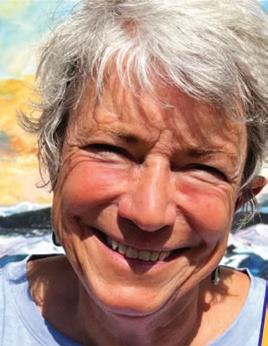
I have known Tracy Williams for many years and only recently discovered her passion and talent for gardening after attending one of her Gardening 101 workshops. In this issue, contributor Chandra Whitfield shares Tracy’s inspiring journey and commitment to helping others cultivate not only healthy gardens, but healthier communities as well.
My own gardening adventure began unexpectedly after receiving a generous collection of vegetable, fruit, and herb seeds from Elbra Wedgworth. Before long, those seeds found a home along the side of my house. Following in the well-worn “dirty gardening shoes” of several friends and with guidance from The Late Bloomer, I embarked on a gardening journey of my own.
That experience led me to an important realization: gardens bloom in every aspect of our lives.
Some gardens produce vegetables and flowers. Others cultivate dreams, talents, opportunities, and future leaders. As I reflected on the stories featured in this issue, I found a common thread woven throughout them all — the power of planting seeds and nurturing growth.
Like Tracy, who helps others cultivate their dreams, many of the individuals and organizations featured in these pages have been tending their own gardens for years.
New contributor and journalism student Jordan Coburn spoke with Catherine Ross about the 2026 Winter Park Jazz Festival, where flowers will
From The Publisher
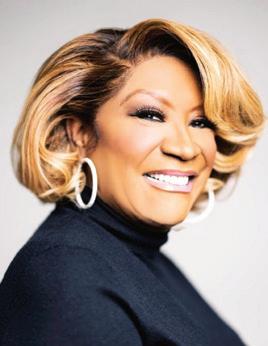
once again bloom throughout the mountains as friends and families gather for food, fellowship, and unforgettable performances from artists including headliners Patti LaBelle and Brian Culbertson.
The Colorado Black Arts Festival will bring its own vibrant garden to Denver’s City Park, blossoming with African art, drumming, culture, food, and an eclectic mix of jazz, R&B, gospel, and spoken-word performances. Under the Mile High summer sun, festival-goers will enjoy a rich harvest of creativity and community, including the sounds of pianist Kofi B.
In August, audiences will witness another flourishing garden when 13 community leaders step into the spotlight for Cleo Parker Robinson Dance’s 16th Annual Dancing With The Denver Stars. Their months of preparation, dedication, and courage will blossom on stage in support of arts education for future generations.
For 16 years, Colorado BeautillionCotillion has been cultivating a remarkable garden of young leaders. The success of its annual gala serves as a powerful reminder that when young people are planted in fertile
Photo by Steven Boyd
ground, nurtured with support, watered with encouragement, and challenged to grow, they often exceed even the highest expectations.
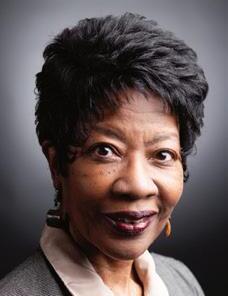
This summer, we also celebrate the individual blooms found in the lives and accomplishments of Rosemarie Allen and Denise Nicholas, two remarkable women whose stories remind us that growth, purpose, and impact continue to flourish throughout every season of life.
As you enjoy this month’s issue, I hope these stories inspire you to consider the gardens in your own life — the people, passions, dreams, and communities you are helping to cultivate.
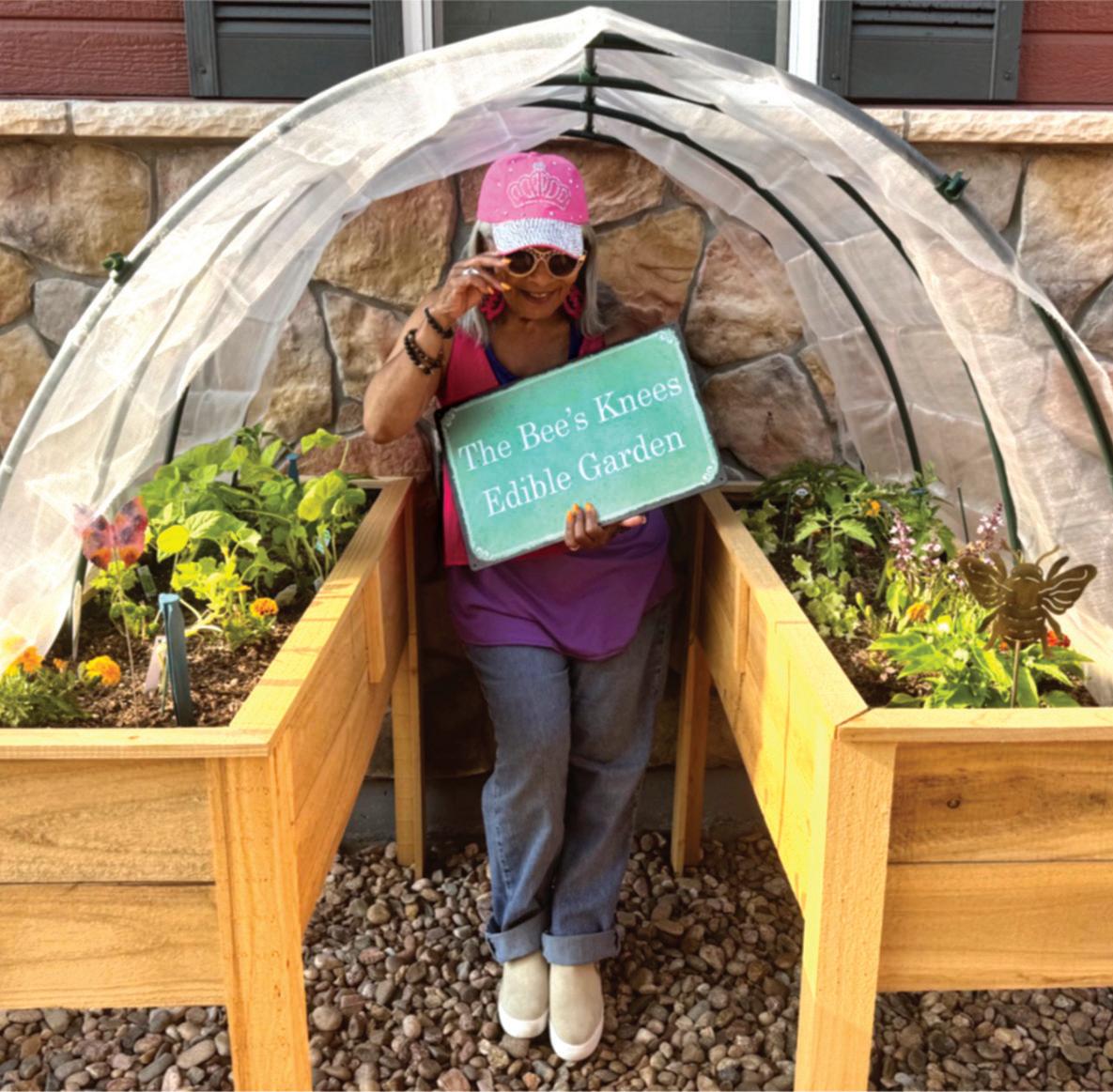
As for me, I’ll be spending some time in my own Bee’s Knees Edible Garden, reflecting on life’s blessings, giving thanks for the graces of God, and enjoying the warmth of the summer sun.
Happy Summer.
Rosalind “Bee” Harris
Publisher
Denver Urban Spectrum
‘
THE GROW UP Meet Aurora’s Tracy Williams Garden Guru Extraordinaire
By Chandra Whitfield
Tracy Williams only wanted to grow a
Relegated to a tiny outdoor space at her quaint townhome, she asked her mother to use her backyard to try out the little experiment.
Mom said, have at it. And by the time that first set of plump, crimson-colored tomatoes sprouted on the vine she was officially smitten. A garden enthusiast was born.
“I just lost my mind; I couldn’t believe that I grew that,” she remembered.
That moment of completion in her mother’s Denver backyard set off what would become both a personal passion and a growing business rooted in food, family and community.
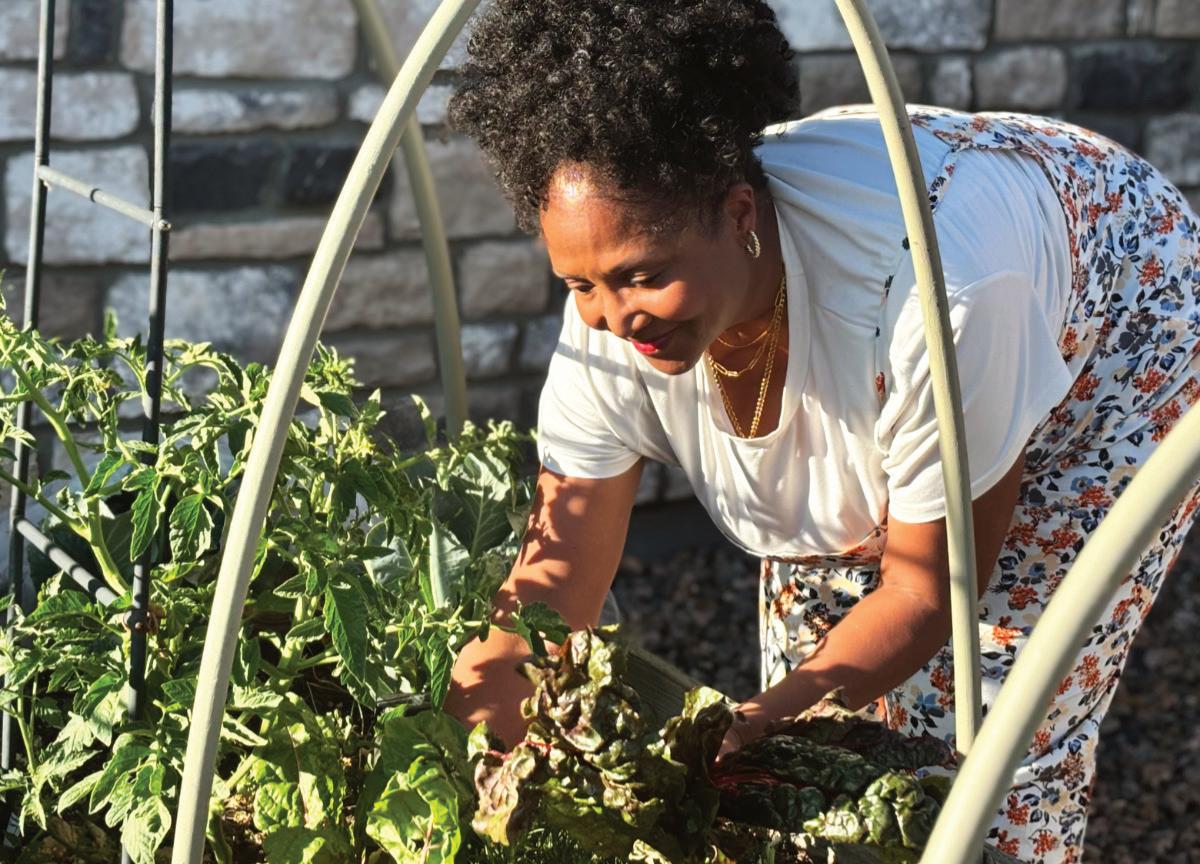
Williams, an Aurora resident and founder of The Late Bloomer Edible Gardens, now helps others build and sustain their own gardens across the Denver metro area. Her company, launched in May 2025 after she completed a garden consultant certification, specializes in garden design, installation and maintenance.
“We specialize in installing and coaching people and helping people maintain raised-bed, edible gardens,” she said. “The concept celebrates the art of cultivating food at any stage of life.”
Williams’ connection to gardening is deeply tied to place. Born in Texas
but raised primarily in Denver’s Montbello neighborhood, the University of Colorado Boulder alum soon found herself returning frequently to her mother’s home with her young twin sons in tow, as her idea of seriously focusing on growing food took root.
“Then I added squash and I was like, ‘well, now I need to throw in some greens,’” she recalled.
Her gardens expanded quickly. When she finally moved into a house of her own in Aurora with a backyard, she installed four raised beds. By the end of that first summer, she had doubled it.
“I was always trying to figure out what to plant next,” she said. “It became my favorite pastime.”
That pastime soon evolved into a profession. After noticing friends and followers asking for advice on social media, Williams enrolled in a six-week certification course focused on both gardening and business fundamentals.
“I was like, ‘what, I can do that for a living?’” she pondered. “Then I jumped right in!”
Today, her business offers a range of services depending on client needs. Some hire her for a single consultation, either in person or virtual, to diagnose issues and recommend solutions. Others engage her for full-scale projects that include design, installation and ongoing maintenance.
“In a nutshell, as a garden consultant, that could have been all
that I did,” she said of one client. “But because she hired me to also plant her garden, I ended up doing the heavy lifting, laying out the vegetables, providing a maintenance plan and tending her garden.”
Clients say that hands-on approach has transformed not just their yards, but their confidence.
“I cannot say enough wonderful things about my experience with Tracy Williams,” said Barbara Bonner of Denver’s Whittier neighborhood. “Tracy helped me turn my backyard into a beautiful garden space by building two gorgeous beds for my vegetables and flowers. She took all the stress out of the planning with her helpful design visuals and she even picked out the
Bonner said the experience shifted her mindset.
“Gardening doesn’t feel overwhelming anymore; it feels inspiring,” she said.
For first-time gardeners, that guidance can be critical. Yesima Sherrod of Denver’s Skyland neighborhood said she initially felt intimidated by the process.
“Working with Tracy was one of the best decisions I made as a first-time gardener,” Sherrod said. “She took what felt like an overwhelming project and turned it into something approachable, organized and genuinely enjoyable.”
Sherrod credited Williams’ structured approach for her success.
“Her easy-to-follow system and detailed garden map made it simple to know exactly what was planted and where, giving me the confidence to start gardening,” she said. “Thanks to her
gardening sessions at local venues, as well as providing a specialized curriculum for older adults or those figuring out how to work with limited space.
“I not only make friends, but we sit and talk and talk about gardening,” she said. “Everyone was so eager to share their stories or start their gardening journey.”
Beyond the business, gardening has become a family affair. Williams’ now teen sons help out with the business in different ways when they can.
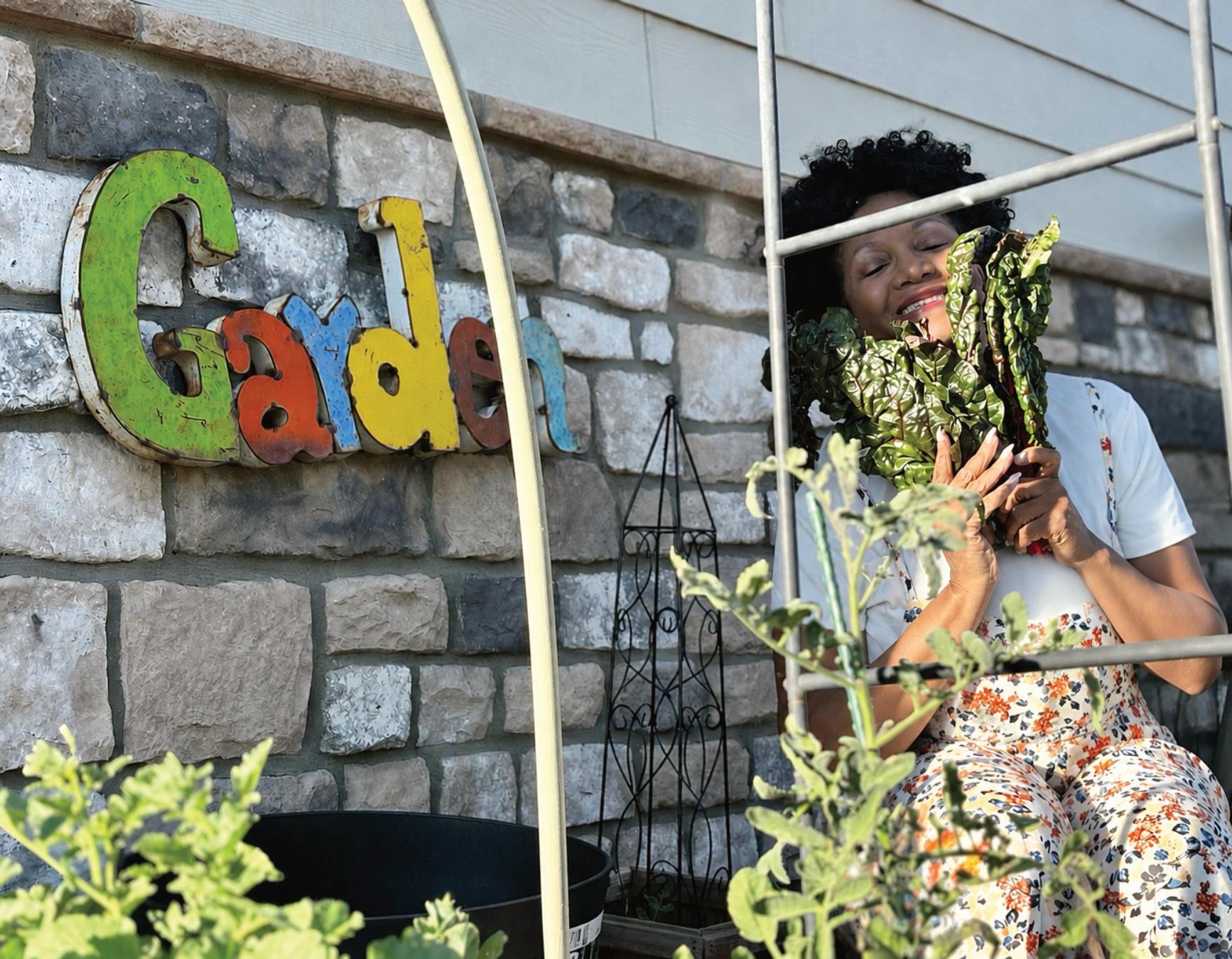
“My garden is my sanctuary; it is my happy place,” she said. “It makes me slow down.”
She said it also has been a space for both grief and deep reflection.
“It’s been a place where I have gone to grieve some losses in my life, but it’s also been a place where I go to celebrate,” she said.
Williams also sees gardening as a tool for empowerment, particularly within the Black community.
guidance, and honestly, the very kind hand holding, I successfully grew my very first vegetable garden.”
Williams said she often provides detailed diagrams, seasonal guidance and even harvest support.
“I consulted, designed, installed, coached and maintained,” she said of one of her early clients. “I also helped her harvest her garden and told her what to do to put her garden to bed for the year.”
In the year since her official transition from gardening as a hobby to gardening as a business, her work has expanded through word of mouth, community events and workshops. She regularly hosts beginner-friendly
“They’ve gone from helping me plant and harvest to now they’re out there with cell phones videotaping what I’m doing,” she said.
And her passion extends beyond productivity. She describes her garden as both an escape and a creative outlet.
“Black people ought to have a way to grow at least some of their own food,” she said. “Every time I can go into my backyard and get something I know I need, and I don’t have to go through someone else to get it, it is so empowering.”
For beginners, her advice is simple.
“I say just start, and start small,” she said. “All I wanted to do was grow a couple of tomatoes.” ♦
Editor’s note: Williams’ next gardening workshop is scheduled for Saturday, August 8, from 11 a.m. to 1 p.m. at the Pauline Robinson Branch Library, 5575 E. 33rd Avenue in Denver. For more information and to register, visit www. thelatebloomer.net
Returns to Winter Park Jazz DIVERSE MIX OF MUSICIANS
By Jordan Coburn
The 43rd Annual Winter Park
Jazz Festival returns in the middle of July with a lineup of 10 bands performing in the midst of the mountains over two days at the Rendezvous Event Center. The festival on Saturday and Sunday, July 18 and 19 ,will include a variety of genres from its namesake jazz to R&B and soul.
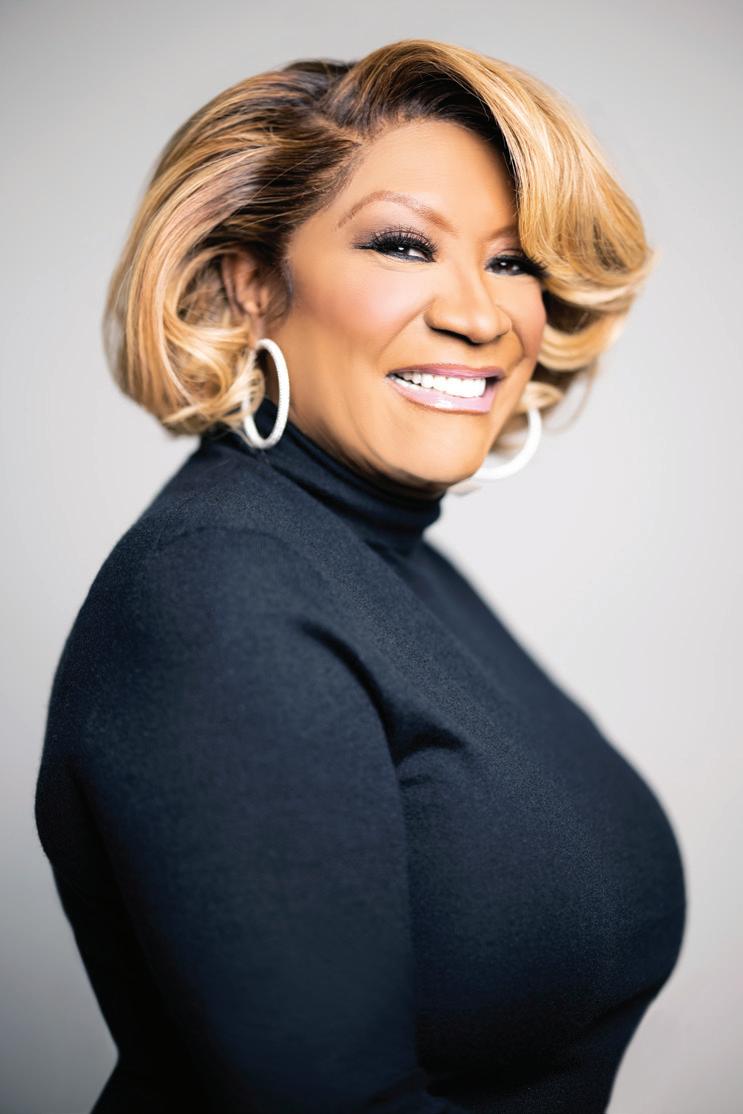
Saturday’s lineup includes headliner and singer Patti LaBelle who is “The Godmother of Soul” and a two-time Grammy Award winner, violinist Damien Escobar, saxophonist Najee, and Colorado guitarist Gregory Goodloe. Completing the musical experience is Purple Magic featuring Marcus Anderson, BK Jackson, and Adrian Crutchfield.
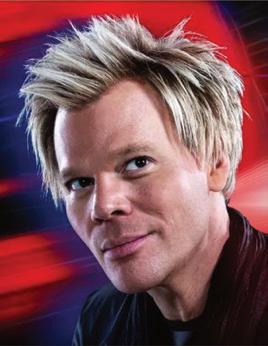
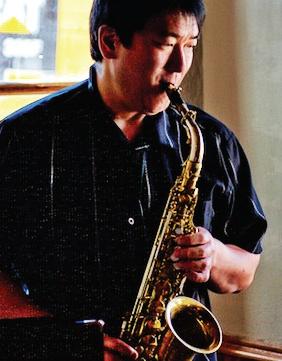
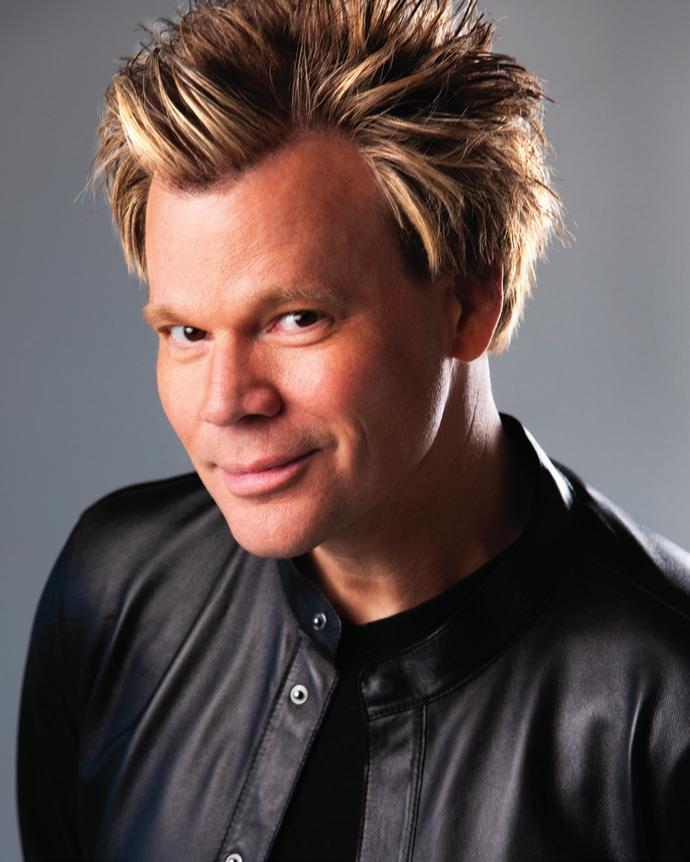
Sunday brings another five musical acts including headliner and keyboardist Culbertson, saxophonist Kim Waters and his daughter keyboardist Kayla Waters, and another Coloradan musician, saxophonist
Nelson Rangell. Rounding out the day is JJ Sansaverino with Lin Rountree and Art Sherrod Jr.
their love of music in the mountains. The entire Winter Park community looks forward to continuing the great tradition of jazz and seeing our friends.”
Ross also shared why she thinks the jazz festival has remained such a beloved event for more than four decades, explaining, “The mountain setting, beautiful music and reuniting with friends makes the festival special for everyone.”
For 2026, the festival has a mixture of first-time performances and long-time favorites. Organizers have also added some new vendors and merchandise chosen by festival
“Many of the performers have been requested by our attendees in the annual satisfaction survey. We are excited to be responsive to the requests,” she said.
Commenting on Winter Park’s hosting of a jazz festival since 1984, Winter Park and Fraser Chamber Executive Director Catherine Ross said, “The 43rd anniversary is a testament to our loyal audience and
Ross noted the importance of both the cultural and economic impacts locally.
“Culturally the impact is significant that people and performers from all over the country and bring new perspectives to our mountain town. Economically, the community benefits from the strong support our audience shares with our small business owners,” she said.
Ross even had some words of advice for individuals attending the jazz festival for the first time.
Being an outdoor festival in the Colorado mountains, she recommended that festival goers come prepared for any type of weather.
One of the main goals of Winter Park Jazz is to ensure a diverse atmosphere where all attendees not only feel comfortable but also have a great time. As Ross described, “The Winter Park, Colorado community welcomes all people, music and fun times the festival brings into our town.” ♦
Editor’s note: For tickets, visit AXS. com. To stay updated with the event, follow the festival’s Facebook page and for more information on the schedule and event policies, visit www. playwinterpark.com.
Process ELECTION
Voting in June Primaries and November Elections Impacts Lives
By Gabrielle West
The midterm elections are when voters can influence how our government manages funding for education, streets and highways, healthcare and small business support, as well as civil and voting rights protections, policing, safeguarding families, and many other issues. All of these governmental decisions can have major impacts on the lives of everyday people.
So, why is it that so many folks skip out on non-presidential elections?
And yes, if you’re reading this and forgot to turn in your primary ballot, you missed the boat. But, you’re not alone.
Political analysts have long pointed to several factors driving lower voter turnout in midterm and off-year elections, including less media attention, lower voter awareness, fewer high-profile campaigns, and of course, the absence of a presidential race to generate national buzz. Not to mention, many people are burnt out and apathetic.
Still, what’s at stake in these elections is nothing to ignore, and there is still time to lean in.
Midterm elections shape the makeup of the U.S. Congress, state leadership, and a wide range of local and statewide offices that directly affect daily life and can shift communities for generations. From housing policy to healthcare access and economic development, decisions made by the people elected in these off-year cycles are felt in neighborhoods across the state.
This November, Colorado voters will choose the state’s next governor, secretary of state, attorney general, U.S. senator, members of Congress, and numerous other state and local leaders. As Election Day draws closer, I spoke with the Honorable Elbra Wedgeworth, a former Denver City Councilmember and longtime Colorado political leader and advisor, about what she thinks is on the line.
“I think we should be very concerned,” Wedgeworth said. “A lot of things we thought were done, you know, in terms of civil rights, voting rights, they’re coming under attack again…Everything is on the table. So, we have to be ready to push back and fight back if we have to and need to.”
Her reflections echo a broader tension in modern politics, rooted in
the stark realization that progress is not always permanent. Issues many believed were settled decades ago, including voting rights, are once again re-emerging in today’s policy debates.
Her call to action for voters, elected officials and community members alike is simple but urgent, “Be educated on the issues. Collaborate and coordinate, and work to protect our rights,” both “the ones we have now and the ones we should have, but don’t.”
And in Colorado where ballot participation is often higher than the national average, the voting system is designed to be accessible. Since 2013, Colorado has been a universal voteby-mail state. In other words, ballots are automatically mailed to every active registered voter, with in-person voting options and 24-hour drop boxes
available across the state. Voters can also sign up for the Colorado Secretary of State’s BallotTrax system, which sends email or text updates when a ballot is mailed, received and counted.
Even with that ease and accessibility, voter participation still fluctuates depending on the election cycle.
If rising costs, ongoing global conflict, and renewed attacks on the rights of people of color and other marginalized communities aren’t enough to motivate civic participation, it’s time to ask, “What will?” ♦
Editor’s note: To register to vote, check your voter registration, preview your sample ballot, or find important election information, visit GoVoteColorado.gov.
Celestia Multisensory Arts Experience Debuts at St. John’s Cathedral
By Gabrielle West
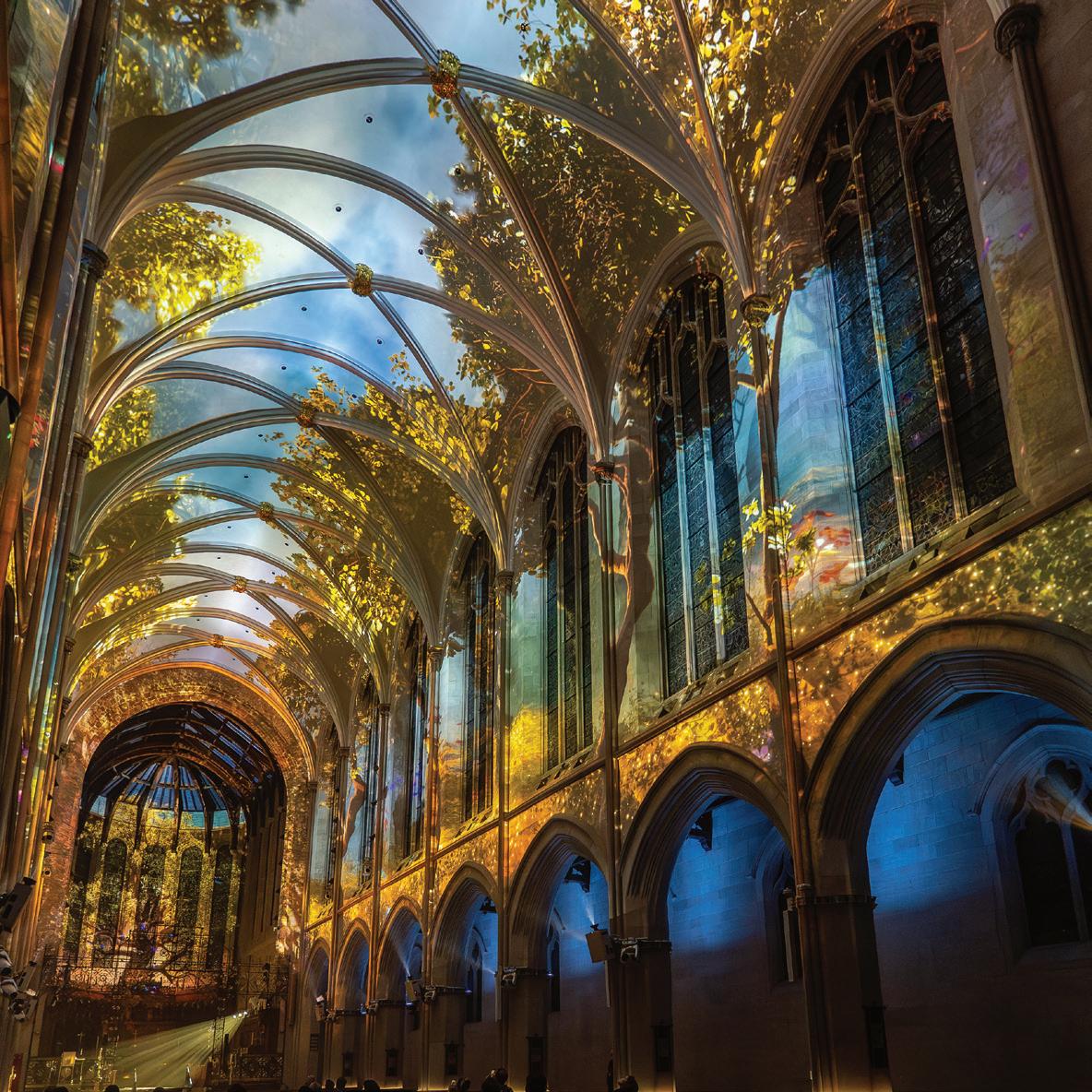
These days, life moves so quickly that it can be difficult to find time to pause and simply take in the world around us. With so much going on in the world, many of us could use a break from the constant stream of headlines, notifications and doomscrolling. If you’re looking for a temporary escape from the chaos, you may want to check out Celestia, a new immersive light experience making its world premiere at St. John’s Cathedral in downtown Denver.
More than 100 people spent 1,000plus hours producing the show, which is designed to bring people together through a shared experience of light, music and storytelling. Hosting the production inside a cathedral was intentional, according to Kurt Baker, head of marketing for Canadian-based Paquin Entertainment Group, the company behind the experience.
“Cathedrals have historically been places for communities to come together,” said Baker.
Paquin Entertainment Group is known for producing immersive exhibitions including Beyond Van Gogh, Beyond Monet and Beyond Tut, all of which have drawn audiences around the world, including in Denver.
Celestia is making its global debut in the Mile High City, a decision Baker attributes to Denver’s thriving arts scene, younger demographic and residents’ willingness to embrace new experiences. When the production team first stepped inside the 115-yearold cathedral that now serves as the
backdrop for the show, they knew they had found the perfect venue. The soaring ceilings, intricate architecture and stunning stained-glass windows create a sense of awe before the show even begins.
The show runs about 45 minutes, which Baker considers the perfect length of time even for children, who are welcome to attend. So, what can visitors expect? Imagine stepping into a dreamlike garden illuminated by thousands of lights, dramatic musical scores, unexpected imagery and a
live choir that transform the historic cathedral into an immersive work of art.
For attendee Stephen Oni, however, the most memorable part of the evening wasn’t the technology.
While waiting for the show to begin, Oni and I struck up a conversation. Outside of myself and my two children, he was one of the only other Black attendees I noticed that evening. To pass the time, we quickly moved from small talk to discussing everything from our experiences navigating racism in different U.S. cities to faith, family and what brought him and his wife to Denver.
Our conversation reinforced what Oni believes makes Celestia special. While the visuals are impressive, at its core, the experience offers something increasingly rare – an opportunity to gather together. In a time where so much of life happens through screens, notifications and social media feeds, simply being present with others can feel refreshing and organic.
His wife was among the eight singers from the University of Denver choir selected to perform during certain Celestia showings. Their voices echoed throughout the cathedral, blending with the music and lights to create a vibe that feels both intimate and expansive. It is a reminder that while technology powers the experience, people remain at its heart.
That human connection may be what makes Celestia stand apart.
While the visuals are breathtaking, the experience is about more than lights and music. It’s an invitation to slow down, be present and reconnect with wonder, creativity and community. In a time when many of our interactions happen through screens and headlines, Celestia offers a rare opportunity to step into something beautiful and simply exist in the moment.
Baker hopes visitors leave feeling uplifted.
“I hope everyone feels like they’ve taken time out of their day to let their stress go away, reconnect with who they are and who they’re with, and simply enjoy the experience,” he said.
Whether you’re looking to do something a little different for date night, want to get the family out the house, or enjoy a solo evening to break away from the monotony of the daily grind, Celestia offers an opportunity to pause. And for Denver, a city that continues to embrace innovative arts and cultural experiences, it is a fitting place for a world premiere designed to remind us that even amid uncertainty, there is still room for joy, beauty and awe. ♦
Editor’s note: Celestia is showing on Thursdays, Fridays, Saturdays and Sundays through Sept. 6 at St. John’s Cathedral in Denver. For tickets and more information, visit celestiaexperience.com.
WHAT ARE AMERICAN Celebrations to the African American?
The United States is 250 years old this year. And my alma mater, the University of Colorado, marks 150 years. There are a lot of celebrations on both fronts. Both institutions also share a common origin thread: African Americans were not welcomed at the founding in either place.
So, with apologies and attribution to Frederick Douglass and his July 5, 1852, speech, “What to the Slave is the Fourth of July?” I will expound on his landmark oratory. Sadly, much of what he wrote back then is relevant today. My attempt here is to reframe his argument.
My subject is the American Dream, not as the popular fantasy dream, but as the living nightmare it is from the perspective of the African American. Like Douglass, I do not hesitate to declare, with all my soul, that the character and conduct of this nation – reflected also in my alma mater in Boulder – look worse to me in the year 2026, as it must have appeared to Douglass in 1852.
So, I will not be celebrating the nation’s independence. Africans were not citizens and were not regarded as human. We were no more valued than cattle. Juneteenth (June 19, 1865) is the occasion of my reverie. On that day, Union soldiers arrived in Galveston, Texas to enforce the Emancipation Proclamation, which had actually freed enslaved Blacks in the South two years earlier. While it made my freedom a possibility, many legal and cultural obstacles have remained over the ensuing years.
Likewise, I am sitting out the remembrance of CU-Boulder’s
anniversary, instead paying tribute to Lucile Berkeley Buchanan Jones, the first African American to graduate from the campus back in 1918. CU officials refused to allow her to walk on stage to receive her degree at the graduation ceremony. An unnamed woman, declaring herself to be Buchanan Jones’s “partner,” handed Buchanan Jones her degree and disappeared. Buchanan Jones never went onstage at her own graduation ceremony and never returned to the University of Colorado. Her humiliation made my graduation a possibility, but many legal and cultural obstacles have remained over the ensuing years.
Whether we look to past declarations of independence of the founders, to the pronouncements of today’s leaders, or to those who yearn for a past greatness that never was, the conduct of the nation is still equally hideous and revolting.
“America is false to its past, false to its present, and solemnly commits itself to being false to its future,” Douglass said.
Like him, I mourn on this occasion of American independence for my people, who continue to rise despite attempts to hurt, to crush, and to diminish – “in the name of humanity which is outraged, in the name of liberty which is fettered,” in the name of a Constitution being ignored, a Bible being bastardized, an education system that whitewashes it history – I, like Douglass, call
Guest editorial by James Michael Brodie
America, Douglass said. Is it not astonishing that now, like then, we are ploughing, planting, reaping, designing all manner of mechanical and technological tools, building houses, building infrastructure, building communities, reading, writing, working in offices and stores, as entrepreneurs, secretaries, lawyers, doctors, ministers, poets, authors, editors, orators, sanitation workers, teachers, students, and as every imaginable occupation.
Now, like then, we are engaged in all manner of enterprises common to humans: living, moving, acting, thinking, planning, and being husbands, wives, and children. And yet, we are still called upon to prove that we are human in a society that celebrates our pain while simultaneously demonizing and monetizing our talents.
What, then, to the African American, is the 250th birthday, when, at the nation’s founding, our ancestors had no rights as citizens, no rights as humans, and were exploited in the fields for our labor, for profit?
What, then, to the African American, is the 150th anniversary of the University of Colorado, which in its very creation prohibited the presence of the African on its campus, in a city built on covenants that prohibited Blackness, and even when it didn’t, we were exploited on different fields for profit?
“Your celebrations are a sham,” Douglass said. “Your boasted liberty, your national greatness, swelling vanity,
And yet, in 2026, too many people cling to “patriotism” as if it were the anchor of all their hopes and dreams.
In 1865, Douglass said, “No nation can now shut itself up from the surrounding world, and trot round in the same old path of its founders without interference.” He warned that “long established customs of hurtful character that could formerly fence themselves in and do their evil work with social impunity” must come to an end.
I share his belief that knowledge confined to and enjoyed by the privileged few must end.
He declared that “walled societies had become unfashionable. Intelligence is penetrating the darkest corners, making its path known. Oceans no longer divide, but link people together. Space is comparatively annihilated. Thoughts expressed on one side of the world are distinctly heard on the other. No abuse, no outrage, can now hide itself from the all-pervading light.”
who earned their freedom from bondage, freeing us. And I will tip my hat to Buchanan Jones for her solitary journey, paving a way for us.
“Allow me to say, in conclusion, notwithstanding the dark picture I have this day presented, of the state of the nation, I do not despair of this country,” concluded Douglass. “There are forces in operation which must inevitably work the downfall of slavery.”
As a nation, today, we are that force. The question is: do we, as humans, have the will? ♦
your sounds of rejoicing are empty and heartless. Your denunciations of tyrants, and your shouts of liberty and equality, all hollow mockery. Your prayers and hymns, your sermons and thanksgivings, with all your solemnity, pomp and circumstance are mere bombast, fraud, deception, impiety, and hypocrisy. The celebrations are a thin veil to cover up crimes, which would disgrace a nation of savages. There is not a nation on the earth guilty of practices more shocking and horrific than are the people of these United States at this very hour.”
I would add that university fight songs and pledges given to graduating classes are just as meaningless.
As publicly declared in Project 2025, the determination today is to return the United States to segregation and exclusion. These actions render America’s so-called patriotism as fake, humanity as a base pretense, Christianity as a lie, and the education system as nothing more than hollow propaganda dressed up as intellectual discourse.
“They destroy your moral power abroad and corrupt your politicians at home,” Douglass said. “It is the antagonistic force in your government, the thing that disturbs and endangers your Union. It fetters your progress. It is the enemy of improvement. It is the deadly foe of education. It fosters pride. It breeds insolence. It breeds intolerance. It promotes vice. It shelters crime.”
In this era of social media, Douglass’ insights are truer now more than ever.
So, in the spirit of Frederick Douglass, I will drink a toast to those
Editor’s note: James Michael Brodie, a University of Colorado graduate in English, is a Baltimore-based journalist, author, and activist. His books include Created Equal: The Lives and Ideas of Black American Innovators and Sweet Words So Brave: The Story of African American Literature. Brodie has also edited books on Black history, including The Story of Ruth, U.S. Civil Rights Trail: A Traveler’s Guide to the People, Places, and Events That Made the Movement, and was a contributing editor on Black and Golden: Fifty Years of the National Association of Black Journalists, 1975-2025.
By Dr. Dedrick J. Sims
Many boys learn early that certain emotions are acceptable and others are not. They learn that confidence is welcomed, while fear is questioned. Anger is tolerated, while sadness often makes people uncomfortable. Strength is celebrated, while vulnerability can be misunderstood. Whether these lessons are taught directly or absorbed through observation, boys pay attention to them.
Over time, many boys begin managing how they appear rather than understanding how they feel. They learn to hide disappointment, push through hurt, and keep moving even when they are overwhelmed. To the adults around them, this can look like maturity. In reality, many boys are simply becoming skilled at emotional concealment. The problem is that emotional suppression and emotional regulation are not the same thing.
Suppression Is Not the Same as Regulation
One of the biggest misunderstandings we have about boys is assuming that because they are not expressing emotion, they are handling emotion. Those are two very different things. Emotional regulation means understanding what you are
ALL THINGS BOYS
The Cost of Teaching Boys to Suppress Emotion
feeling, recognizing how it affects you, and responding in healthy ways. Suppression skips that entire process.
Many boys are praised for being tough, but toughness is often confused with silence. A boy who never talks about what he is carrying may be viewed as resilient. A boy who never asks for help may be viewed as independent. A boy who never shows emotion may be viewed as strong.
Sometimes those assumptions are true. Often, they are not. Many boys are carrying emotions they have simply learned not to show.
Where Unprocessed Emotion Goes
Emotions do not disappear because they are ignored. They usually find another way out. Sometimes they emerge as anger. Sometimes they appear as anxiety. Sometimes they show up as withdrawal, disengagement, conflict, risk-taking, or emotional numbness. Adults often focus on the behavior without recognizing the emotion underneath it.
The student who constantly challenges authority may be carrying frustration he has never learned to express. The young man who seems disconnected may be carrying disappointment he has never talked about. The boy who jokes about everything may be using humor to protect parts of himself he does not feel safe sharing. When we only respond
not emotional performance. The goal is emotional competence. Boys need language for what they are experiencing. They need trusted adults who can help them make sense of complicated emotions. They need opportunities to reflect before problems become crises. They need environments where honesty is not punished and vulnerability is not treated as weakness.
Most importantly, they need adults who understand that emotional development is not separate from leadership development. It is part of it. A young man who understands his emotions is often better equipped to navigate conflict, build healthy relationships, make thoughtful decisions, and respond to adversity. Emotional awareness is not the opposite of strength. It is one of its foundations.
to behavior, we often miss the story behind it.
The Environments Around Boys Are Teaching Emotional Lessons
When people talk about boys and emotions, the conversation often focuses on individual choices. Why won’t boys open up? Why don’t they talk more? Why don’t they ask for help? Those questions matter, but they ignore something equally important. Every environment around boys is teaching emotional lessons whether it intends to or not.
Families teach emotional lessons. Schools teach emotional lessons. Sports teams teach emotional lessons. Friend groups teach emotional lessons. Social media teaches emotional lessons. Boys are constantly receiving messages about what emotions are acceptable and what emotions should be hidden.
If a boy repeatedly learns that vulnerability leads to embarrassment, he will avoid vulnerability. If he learns that sadness makes adults uncomfortable, he may stop sharing sadness. If he learns that asking for help is interpreted as weakness, he may stop asking. Eventually, many boys begin carrying emotional burdens alone because they believe that is what strength requires, however, it does not.
What Boys Actually Need
The goal is not for boys to express every emotion publicly. The goal is
What Adults Must Understand Now
If we want boys to become healthy men, we have to stop measuring emotional health by how little emotion boys show. We have to stop rewarding emotional suppression and then acting surprised when boys struggle to communicate, regulate, or seek support later in life. Many boys are not struggling because they have emotions. They are struggling because they were never taught what to do with them.
That responsibility belongs to the adults, institutions, and communities surrounding them. The question is not whether boys are emotional. The question is whether we are creating environments where they can learn how to navigate those emotions in healthy ways. Because boys do not become emotionally healthy by ignoring what they feel. They become emotionally healthy when they learn how to understand it.
If this conversation resonates with you and you would like to continue the dialogue around mentoring, adolescent development, or building stronger systems of support for boys and young men, you can reach me directly at dedrick@djsventures.org. ♦
Editor’s note: Dr. Dedrick Sims is the Founder and CEO of the Sims-Fayola Foundation and author of the monthly All Things Boys column in The Urban Spectrum. For more on adolescent development and mentoring young men of color, visit www.sffoundation.org.
THE SUNSHINE Advantage
The $13,000 Opportunity Hiding in Plain Sight
By Barry Overton
For many families
across Colorado’s Front Range, homeownership can sometimes feel like a moving target.
Just when interest rates seem to stabilize, home prices rise. Just when a buyer saves enough for a down payment, closing costs create another hurdle. For countless renters throughout Denver, Colorado Springs, Aurora, Thornton, and surrounding communities, the dream of owning a home can feel just out of reach.
Yet for a growing number of buyers, a unique program is helping rewrite that story.
The Hoper Program is not about shortcuts. It is not about gimmicks. It is about creating a pathway that helps buyers become more educated, more prepared, and more financially equipped to step into homeownership with confidence.
And in today’s market, that can make all the difference.
Turning Education Into Opportunity
One of the biggest misconceptions about buying a home is that the down
payment is the only obstacle. In reality, many buyers successfully save for a home only to discover that closing costs, prepaid expenses, reserves, and moving expenses can place significant strain on their finances.
That is where the Hoper Program creates a unique opportunity.
Through participation in an educational and research initiative designed to study homeownership outcomes, eligible homebuyers may receive compensation of up to $13,000, or as much as 3.5% of the home’s purchase price. Participants complete a brief homeownership education course before closing and receive financial mentorship after becoming homeowners.
The result is a program that rewards preparation and financial education while helping buyers enter homeownership with greater financial stability.
Imagine purchasing your first home and still having money available for emergency reserves, home improvements, furniture, debt reduction, or future investments.
For many families, that financial breathing room can be life-changing.
The Power of Homeownership Meets the Power of Solar
While the financial incentive often gets the initial attention, the long-term
benefit may actually be found on the roof.
Participants in the program agree to include a fully owned solar energy system as part of their home purchase. Unlike many solar programs that rely on leases or separate financing agreements, the solar system is incorporated directly into the FHA mortgage and becomes part of the property itself.
That distinction is important.
Many homeowners have heard stories about solar leases creating
complications when selling a home. Monthly lease payments, escalating costs, and transfer requirements can sometimes create challenges for future buyers.
With the Hoper Program, the solar system is owned by the homeowner from the beginning. There is no separate solar company controlling the system. No lease payments. No thirdparty ownership.
The solar panels simply become another asset attached to the home.
Why Colorado Is Built for Solar Success
Few states are positioned as well for solar energy as Colorado.
The Front Range enjoys more than 300 days of sunshine each year. Combined with Colorado’s higher elevation and thinner atmosphere, solar panels often operate with exceptional efficiency compared to many other parts of the country.
That means homeowners have an opportunity to harness one of Colorado’s most abundant natural resources—sunlight.
As utility costs continue to fluctuate, many homeowners appreciate the predictability that solar energy can provide. While every household’s savings will vary, reducing dependence on traditional utility costs can create long-term financial benefits that continue year after year.
For many families, that translates into something every homeowner values: more control over their monthly budget.
Building Wealth Beyond the Closing Table
Homeownership has long been considered one of the most powerful wealth-building tools available to American families.
When buyers combine homeownership with energy-efficient improvements and financial education, the benefits can compound over time.
Many studies have suggested that homes with owned solar systems may command higher resale values than comparable homes without solar. In addition, homeowners who complete qualifying solar installations may also be eligible for federal tax incentives that can provide additional financial benefits after closing.
While individual results vary, the potential advantages extend far beyond move-in day.
Instead of simply purchasing a house, participants are investing in a home designed to help support longterm financial success.
Understanding the Program
As with any financial decision, buyers should fully understand how the program works.
The Hoper Program operates as an independent research and education initiative. It is not affiliated with, endorsed by, or approved by the U.S. Department of Housing and Urban Development (HUD) or the Federal Housing Administration (FHA).
Compensation received through participation is generally treated as taxable 1099 income, and eligibility requirements vary depending on the buyer, lender, loan program, and property.
That is why buyers should work closely with qualified mortgage professionals and real estate advisors to determine whether the program aligns with their specific goals and circumstances.
A Different Kind of Homeownership Story
The most compelling part of the Hoper Program is not the solar panels.
It is not even the possibility of receiving up to $13,000.
It is the opportunity for families who have worked hard, saved diligently, and remained committed to their goals to finally take a meaningful step toward homeownership with additional education, financial support, and long-term planning built into the process.
In a housing market that often feels challenging and unpredictable, programs that help create opportunity deserve attention.
For the right buyer, Hoper may represent more than assistance with a home purchase.
It may represent a chance to begin building wealth, creating stability, and establishing a legacy for generations to come.
And for many Colorado families, that dream is worth pursuing. ♦
Editor’s note: Barry Overton is a Denver-based real estate advisor, veteran, and mentor. He helps investors, homeowners, and agents unlock wealth-building opportunities across the country. Follow him for more insights on market trends, AI in real estate, and personal development for entrepreneurs. Contact him at 303-668-5433
GENERAL EDUCATION Manifest Destiny & Whitewashed History
By Thomas Holt Russell, III
Last September, Mark Bauerlein, writer and Professor Emeritus at Emory University, spoke on general education at Chapel Hill. As he spoke about necessary courses for the school that included courses on the King James version of the Bible, a young man, whom Bauerlein described as surly (of course he was!), asked, “Why not the Quran?”
Bauerlein: I answered that the Bible was present in our language and literature, our form of government, our jurisprudence, our morals, our manners, and our habits from the start. It was fundamental to our civilization in a way the Quran was not.’
If you take his sentence and replace the words the Bible with slavery, you will still have an accurate statement. However, slavery is the part of building this country they don’t want you talking about, especially in classrooms and public discussions.
This distinction matters because I, say I am a liberal for simplicity, agree with conservative Bauerlein’s
broad assessment of our education system. Thanks to an incoherent trove of electives, general education has suffered. The humanities — literature, philosophy, religion, and art — have lost popularity and been replaced by unserious electives like the music of Tiny Tim.
In a National Affairs article, “The Opportunity of General Education,” Bauerlein argues that we should return to the common principles of education. I agree with that basic premise: students need a well-rounded education. General education should cover the core courses every American should know. Education is more than building skills or preparing for a career.
The goal of a liberal education is a wellrounded American citizen.
Bauerlein indicates that the offspring of old White men are not interested in their granddads’ version of history. That is Bauerlein’s assessment. He indicates a big problem with education is, “Too many young adults do not see themselves as beneficiaries of a praiseworthy inheritance.” He is certainly not speaking about young Black adults. Using phrases such as “praiseworthy inheritance” is a dead giveaway. I do not think there is an educator, parent, or politician, regardless of political stance or race, who would expect any Black person to be celebrating the benefits of our praiseworthy inheritance.
African Americans as a whole are just as patriotic as any other American, but when we celebrate the 4th of July, it has nothing to do with liberation. It’s just a day off to barbecue and spend time with friends and family. We are not going to describe our position in this country as a praiseworthy inheritance. I am even having trouble writing those words. Black people do have a praiseworthy inheritance, of course, but it has nothing to do with history, civic interactions, or anything Bauerlein writes and speaks about. We carry our praiseworthy inheritance in our blood.
That praiseworthy inheritance he writes about was denied to students because of those M#**^@# liberal teachers! A denial of our heritage, he calls it. He wants to see things taught, such as the words of James Madison, the music of Beethoven, and Manifest Destiny. There is no argument with me for learning those things. As a matter of fact, I demand those topics are taught. But if you are going to teach my children about Manifest Destiny, could you please add, at some point,
the view of how Native Americans felt about it? Or even a history book written by a Native American and used as a textbook. Their view of American history would be very different. But the most important thing is the story does not change. Tell the good, bad, and ugly. Conservatives would not like that. A mandatory class and textbook about American History from the Native American view? Oh, no! That’s un-American!
South Carolina’s REACH Act requires undergraduates to complete a threecredit course at a minimum the reading the Emancipation Proclamation, U.S. Constitution, Declaration of Independence, five Federalist Papers, and one document foundational to the African American Struggle. First, almost any element of African American history will already have ample struggle baked into it. However, to frame this study as African American Struggle, students can easily bypass the social, political, artistic, and scientific accomplishments of African Americans to go straight to the lynchings, rapes, enslavement, and other disrespects. The fact that they framed this as “African American Struggle” clearly indicates what they think of the African American experience. Yes, they acknowledge there were struggles, but at the same time, those experiences and stories are not to be confused with the “finer” points of American history, according to Bauerlein. I can imagine some liberals thinking that they are doing African Americans a favor by helping to highlight the suffering that African Americans have been through. It is actually insulting.
The problem.
Bauerlein, like most conservatives, also states that we must teach students the background and highlights of American civics and culture. A quick examination of that statement finds no ills. There is nothing wrong with that idea. However, when someone brings up the lowlights in American history, right-wingers turn feral. Whenever someone writes the word slavery in a paragraph or even a sentence in a history book, conservatives’ feelings are hurt because it does not fit their rosy view of America and themselves. For people like Bauerlein, slavery, redlining, lynching, voting rights, and so on are not something we should pay much attention to. He is not interested in teaching unbiased history. He is interested in erasing the uncomfortable parts of history. For him, whitewashing history is a tool for promoting ideas
that deify the actions of the White race. He and others like him think we should teach our children that White people were ordained to conquer land and people. It gave European settlers a purpose that would erase all atrocities as long as it was made in the name of God. He also complains, “…an American heritage of finer things and brilliant conceptions, courageous deeds don’t exist) in American schools! In reality, he just described how most history textbooks depict America. The word “finer” in that statement is key. Because if something is finer, that means something else must not be fine. His “fine” is European and American art, politics, architecture, etc. You will not find in his suggestions anything other than an Anglo view of the world, as if no one outside Europe had made any contributions to Earth’s history.
The Manifest Destiny Example
It’s easy for me to understand why the Manifest Destiny idea is important to racists. Religion has always been an effective tool (used by Earthlings) to justify violence. I say, teach it to my children and me. We want to know about such an important event in American History. But I want the whole story. Give me the Andy Rooney version. Not some sugarcoated fantasy of how God had chosen (only) White people to expand Westward. Use more than a paragraph to explain the displacement and slaughter of Native Americans, the expansion of slavery in Texas, and how the Mexican-American War was all in the name of this manifest destiny thing. The truth is always better, no matter how painful it may be.
I am a retired high school STEM teacher. I teach my two grandsons at home. This is not homeschooling; they go to public school. I am not satisfied with the whitewashed version of American history they want to teach in school. That is why I supplement their education by also teaching them at home and filling in all the blanks (history, math & STEM) that public schools leave out. This is my practical reply to people like Bauerlein. People always complain. But I back up my words with action.
And more importantly, my outrage at this so-called conservative academia stuff does not end at airing grievances, as so many others do. I handle my outrage with action. Taking control of my grandchildren’s education is my duty, and it should be the duty and responsibility of all parents and caretakers of children to ensure their
children receive an education that helps them beyond simply finding a good job. I teach my grandsons the full story of American history. Some of it is horrible, some of it is beautiful. I teach them that lying, cheating, stealing, and violence, as absurd as it sounds, can be a very effective way to get ahead in life. Bauerlein’s conservative leader is a morally bankrupt and cognitively limited man. The barren-spirited, cot-quean, viperous man in the White House does not come close to emulating the best of America or the type of education Bauerlein laments Americans lack. Ironically, the leader of the conservatives is himself a textbook example of what is wrong with America’s education and political system. I see a civilization and a political machine ripe with corruption, blatant stupidity, fantastic ineptness, and immorality. I am not leaving my grandchildren’s education to these awful people. Bauerlein should note that his view of history is dying out as the oldschool baby boomers are thinning out. There is fear among some White people that their race is being eliminated or replaced. I believe this has much to do with the desperate clinging to a false narrative about what America is. Instead, I will teach my grands the truth, and they will decide themselves what makes a good Earthling.
I feel that they are forcing my grandchildren to be taught a canon that is too Western, too male, too elitist, and too politically loaded. I am uncomfortable with that, so I am not going to let it happen to my family. Conservatives don’t understand that the world has multiple stories from multiple angles, and they are not interested in seeing it through anyone’s eyes other than their own, and they want to force us to adopt their view. No matter how hard they try, that is not going to happen. History belongs to everyone. I want all children to receive a general education that will give them deep understanding of civilization, ethics, beauty, music, and architecture. It may be unrelated to their jobs, capitalism, or it can be detached from any financial incentives. Knowledge for the sake of knowledge. That makes better Earthlings; better Earthlings make a better World. I am not interested in learning the grandness of life from just one very narrow perspective. ♦
Editor’s note: Thomas Holt Russell is the founder of SEMtech (Student Engagement & Mentoring in Tech), a writer, educator, photographer, modern-day Luddite, Existentialist, and secular humanist.
New Adult Day Program Centers Seniors, Safety, and Community A PLACE TO THRIVE:
By Luciana Juanita
Editor’s note: This is the planned vision narrative for the Melior Adult Day Care. Projected to open this fall. It will be located at 1555 S. Havana St., Unit W. in Aurora, Colorado, 80012.
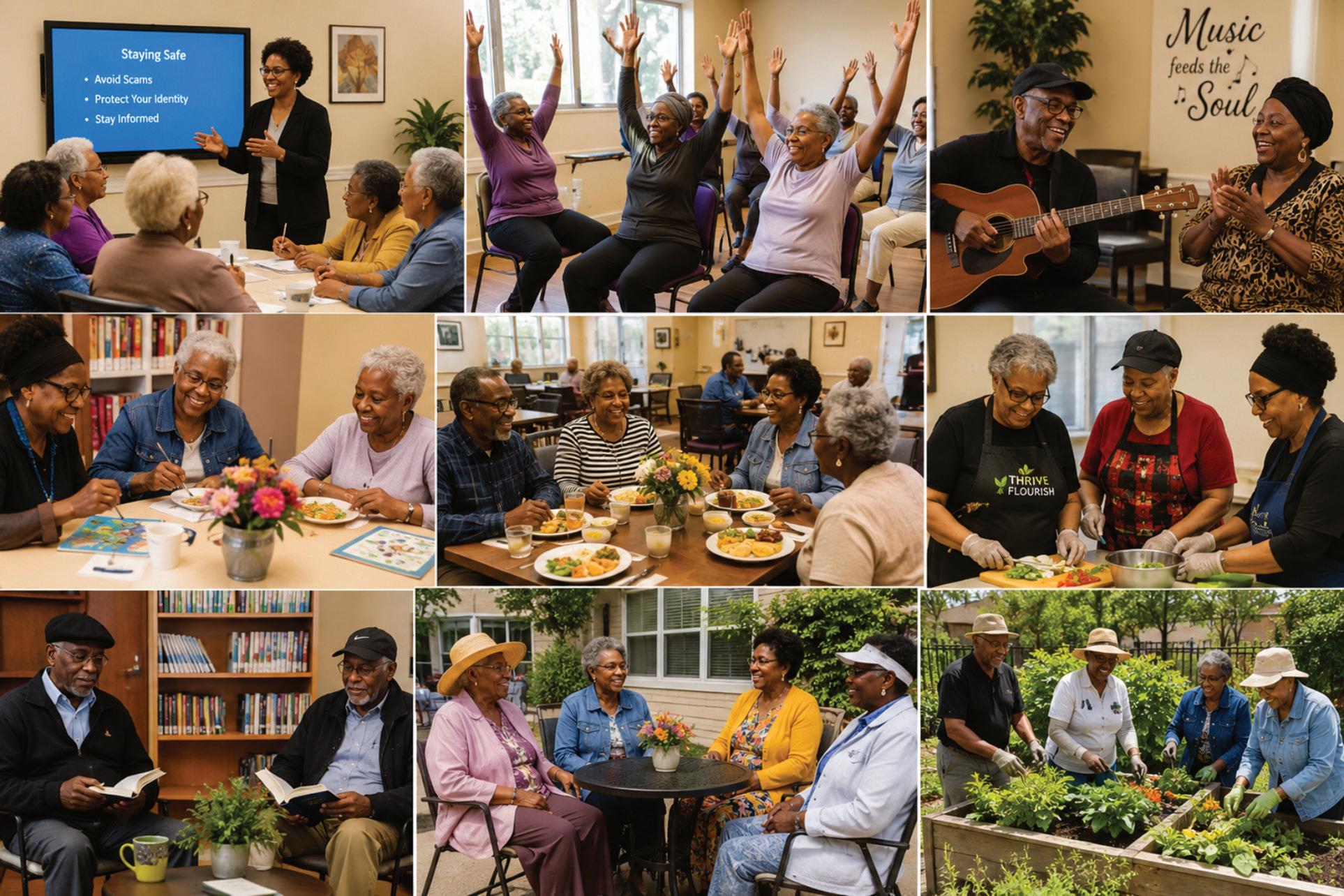
In a quiet room filled with conversation, laughter, and the gentle rhythm of music, a group of seniors gathers—not just to pass time, but to engage, to learn, and to be seen.
It’s the kind of space many families say is increasingly hard to find.
Across Denver and Aurora, the need for structured daytime support for seniors is growing. As more older adults choose to age in place, families are navigating a delicate balance— seeking environments that offer safety, stimulation, and social connection without sacrificing independence.
That need is what led to the creation Thrive & Flourish, a new adult day program at the Melior Adult Day Care that is designed to support seniors through a combination of wellness, education, and daily engagement.
“This is about more than care—it’s about connection,” said Rosalind “Bee” Harris, founder of the program and publisher of Denver Urban Spectrum. “We want our seniors to feel valued, informed, and protected, while also experiencing joy in their daily lives.”
More Than a Day Program
Unlike traditional models that focus primarily on supervision, Thrive & Flourish takes a more comprehensive approach.
Three days a week, participants attend one-hour sessions led by professionals covering topics such as health management, financial literacy, and fraud prevention—an area of increasing concern for older adults.
On the remaining days—and woven throughout the week—participants engage in activities designed to nourish both body and spirit: music therapy, chair yoga, mindfulness sessions, cooking demonstrations, and book discussions.
The goal is to create a rhythm that feels both purposeful and uplifting.
A Growing Need for Protection and Awareness
The program is also grounded in a deeper mission—one tied to safety and advocacy.
Developed in partnership with the Ruth Boyd Elder Abuse Foundation, Thrive & Flourish incorporates education around elder abuse, scams, and personal safety into its core programming.
For many seniors, these risks are not abstract. Financial exploitation, isolation, and vulnerability remain pressing concerns, particularly for those living alone.
By bringing these conversations into a supportive, educational setting, the program aims to equip participants with the tools to recognize and respond to potential threats.
Supporting the Whole Family
For caregivers, the need is equally urgent. Adult children and family members often find themselves juggling work, family, and the growing needs of aging loved ones. Reliable daytime programming can offer both relief and reassurance.
Programs like Thrive & Flourish provide a middle ground—supporting seniors’ independence while ensuring they are in a safe, engaging environment during the day.
Turning Personal Loss into Community Purpose
For Harris, the program is not just professional—it’s deeply personal.
“This work is inspired by my mother, Ruth Boyd,” she said. “Her life—and her loss—reminded me how important it is that we protect and honor our seniors. This program is one way of making sure that what happened to her helps prevent harm to others.”
That sense of purpose is woven throughout the program, shaping not only its structure but its spirit.
A Community-Based Approach to Aging Well
As communities continue to rethink how they support aging populations, programs like Thrive & Flourish reflect a shift toward more holistic, communitycentered care.
The program is now enrolling participants, including both Medicaideligible individuals and those seeking private-pay options.
For families searching for a place where their loved ones can remain active, connected, and supported, it offers something simple—but powerful: A place to belong. ♦
Editor’s note: Families, caregivers, and referral partners can learn more about Thrive & Flourish, by visiting https:// melioradc.com/. For registration information, call 720-535-6378 or 877-7553669 or email, info@meliorhealth.com.
Denise Nicholas Reflects on Identity, Family and Resilience MORE THAN A TELEVISION STAR:
By Luciana
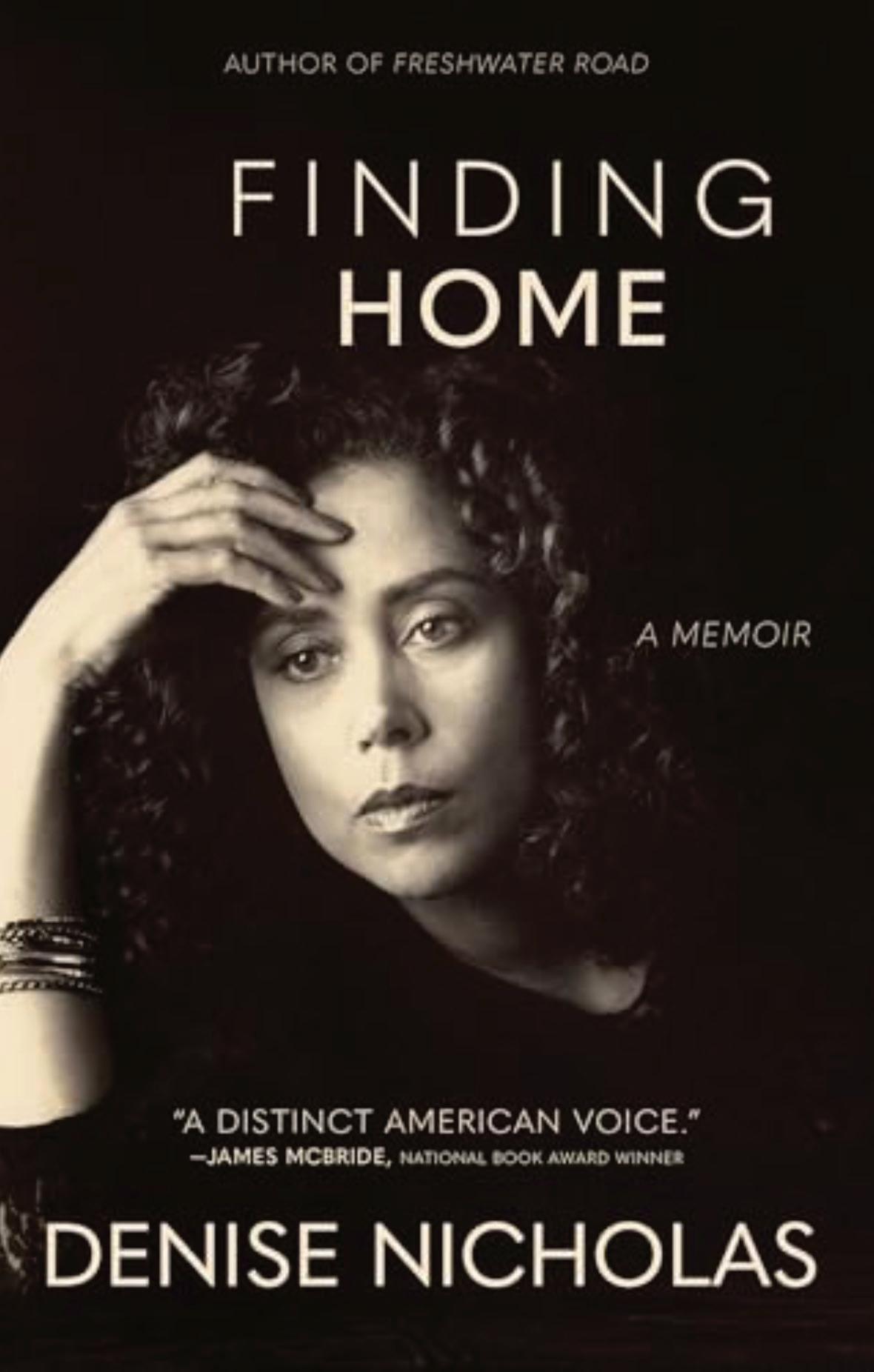
For many Americans, Denise Nicholas will always be remembered as the talented actress who broke barriers on television through her memorable roles on Room 222 and later In the Heat of the Night. But in her deeply personal autobiography, Nicholas reveals a story that extends far beyond Hollywood, offering readers a candid exploration of family, selfdiscovery, and the lifelong pursuit of understanding who we are.
Nicholas’s memoir is not simply a chronicle of a successful acting career. Instead, it is an honest and often moving examination of the experiences that shaped her as a woman, artist, and activist. Through thoughtful reflection, she invites readers into a journey marked by triumphs, heartbreak, personal growth, and an unwavering determination to find her place in a world that often imposed limits on Black women.
Born in Detroit in 1944, Nicholas describes herself as a bright, bookloving child who struggled with insecurity despite her intelligence and curiosity. Growing up during a time when opportunities for African Americans—particularly Black women—were severely constrained, she quickly learned that excellence alone did not guarantee acceptance.
Her childhood was further complicated by questions surrounding her identity. Long before the truth was revealed, Nicholas sensed that something about her family history remained unspoken. As a young adult, she would eventually learn that the man she believed to be her father was not her biological parent. The revelation confirmed years of uncertainty and opened a new chapter in her understanding of herself and her family’s complicated past.
While the memoir explores these deeply personal issues, it also chronicles Nicholas’s remarkable rise in entertainment. Readers are given a behind-the-scenes look at her experiences navigating television and film during a period when opportunities for Black performers were expanding but remained limited. Her work on Room 222, one of television’s earliest
programs to address social issues and racial diversity, helped establish her as a groundbreaking presence on the small screen.
Nicholas later built an impressive career that included film and television roles that showcased both her talent and versatility. Yet, unlike many celebrity memoirs that focus primarily on professional accomplishments, Nicholas uses her career as a backdrop for larger reflections about identity, relationships, and purpose.
Throughout the book, she writes with striking honesty about the successes and setbacks that shaped her life. She openly examines her own choices, vulnerabilities, and personal relationships, refusing to present herself as flawless or immune to life’s challenges. That willingness to confront difficult truths gives the memoir its emotional power.
Equally compelling are Nicholas’s reflections on race in America. Having come of age during the Civil Rights Movement and spent decades witnessing social change, she offers a perspective grounded in both personal experience and historical context. Her observations reveal the persistence of systemic racism while also highlighting the resilience required to confront it.
What makes Nicholas’s memoir especially relevant today is its exploration of questions that transcend generations: How do family secrets shape our identities? How do we reconcile our public successes with private struggles? How do we maintain hope and purpose in the face of adversity?
These themes resonate far beyond the entertainment industry. They speak to universal experiences of belonging, self-discovery, and healing. In sharing her story, Nicholas reminds readers that identity is often forged not only through achievement, but through the courage to confront difficult truths and embrace life’s complexities.
For longtime fans, the memoir offers a richer understanding of the woman behind the celebrated television roles. For readers unfamiliar with her work, it serves as a
compelling introduction to a thoughtful storyteller whose life reflects many of the challenges and triumphs experienced by African Americans over the past several decades.
Ultimately, Denise Nicholas’s autobiography is about more than fame or success. It is about resilience. It is about finding one’s voice amid uncertainty. And it is about the enduring quest to understand where we come from so that we can better understand who we are.
In an era often dominated by carefully curated public images, Nicholas offers something far more valuable: authenticity. Her story
is honest, reflective, and deeply human—a reminder that every life contains chapters of struggle, growth, and redemption.
For readers seeking a memoir that combines personal insight with cultural significance, Denise Nicholas delivers a powerful and unforgettable narrative. ♦
Editor’s Note: Finding Home: A Memoir by Denise Nicholas (Agate Bolden, 328 pages, $30, ISBN 978-1-57284-353-0) is available through major booksellers and online retailers. FINDING HOME is also available as an audiobook read by Denise Nicholas.
Named next Dean of School of Education at Metropolitan State University of Denver DR. ROSEMARIE ALLEN
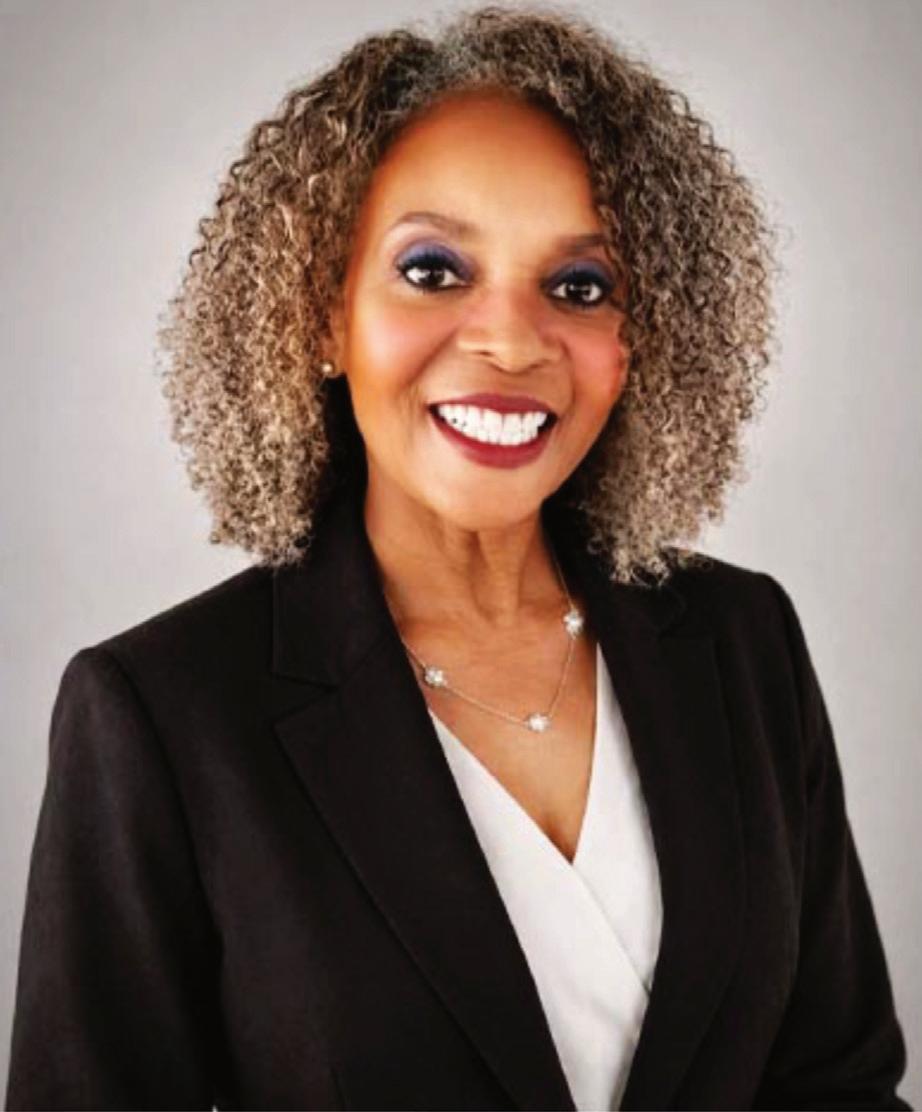
Rosemarie Allen, Ed.D., a professor of Early Childhood Education at Metropolitan State University of Denver, has been named the next dean of the School of Education.
Allen will assume her new role on July 1, succeeding Elizabeth Hinde, Ph.D., the school’s founding dean, who is retiring in August after 40 years in education. The transition period will allow Allen to work alongside Hinde, who has led the School of Education since 2014.
A University search committee selected Allen following a national search, praising her leadership, extensive experience in education and unwavering commitment to student success.
“Dr. Allen’s work reflects a profound understanding of the structures that shape educational opportunity,” said Provost Matt Makley, Ph.D. “She is both a strategic thinker and an actionoriented leader, capable of translating bold vision into impactful, sustainable practice.”
Makley noted that Allen has been nationally recognized for her work to ensure access to high-quality early childhood programs that are developmentally and culturally aware. She has dedicated her career to improving educational outcomes for all learners, especially those from historically underserved communities.
Allen’s research focuses on addressing the disproportionate rates at which children of color are
expelled and suspended from early childhood programs and advancing culturally responsive teaching practices. Her own experiences being suspended multiple times as a young student, when she was described by teachers as “disruptive,” inspired her life’s work.
In 2023, she received the prestigious T. Berry Brazelton Friend of Children Award, joining a list of previous honorees that includes former first ladies Hillary Rodham Clinton, Laura Bush and Rosalynn Carter, as well as Dolly Parton, Morgan Freeman and Fred Rogers.
Named a Global Leader for Early Childhood in 2009, Allen represents the United States at international World Forums, sharing expertise and learning from peers worldwide. She is also president and CEO of the Institute for Racial Equity and Excellence, which works with the U.S. Department of Education, 48 state Departments of Education, and the Public Broadcasting Service to ensure equity in educational practices.
A faculty member at MSU Denver since 2004, Allen has extensive experience at the intersection of policy, practice and community. She previously served as director of the Division of Child Care at the Colorado Department of Human Services, where she oversaw child care programs, redesigned the state’s quality rating and improvement system, and helped create Colorado’s early learning guidelines.
Allen holds a bachelor’s degree from California State University, Long Beach; a master’s degree in Education from Lesley University in Cambridge,
Massachusetts; and a doctorate in Equity and Leadership in Education from the University of Colorado Denver.
Makley expressed confidence that Allen will carry forward Hinde’s legacy as a strong leader who advocates for practical, forward-thinking solutions to Colorado’s most pressing educational challenges.
“Dr. Allen brings a rare combination of academic rigor and real-world classroom experience,” Makley said. “She has demonstrated ability to lead within state systems, engage institutional partners and advance meaningful change across diverse educational settings.”
Allen and her husband, Don, established the Dr. Rosemarie Allen Family Endowment in 2021, providing an annual $5,000 scholarship for a student of color studying Early Childhood Education or Elementary Education at MSU Denver. She is one of the first current faculty members in the School of Education to endow a scholarship. ♦
COLORADO BEAUTILLION-COTILLION
By Denver Urban Spectrum Staff
For 16 years, Colorado BeautillionCotillion, Inc. has helped shape the next generation of leaders by providing young people with opportunities for personal growth, leadership development, community service, and cultural enrichment. That tradition continued this spring as the organization celebrated its 16th Annual Formal Student Presentation and Gala, honoring 52 high school juniors and seniors for their achievements and commitment to excellence.
Held before an audience of proud families, educators, community leaders, and supporters, the formal presentation recognized students who have distinguished themselves through academic achievement, athletic excellence, leadership, community involvement, and strong personal character.
The annual event serves as both a celebration of accomplishment and a reflection of the organization’s mission to prepare young people for success in higher education, careers, and community leadership.
“This program is about more than a single evening,” organizers noted. “It is about helping students develop the confidence, discipline, and leadership skills that will serve them throughout their lives.”
The evening’s program was hosted by State Representative Dr. Regina English and community leader Topazz McBride, who guided attendees through a celebration of student achievement and perseverance. Award-winning journalist Chandra Thomas Whitfield and her husband, Judge Joseph Whitfield, introduced the students and shared highlights of their accomplishments, underscoring the dedication and hard work that brought each participant to this milestone moment.
A highlight of the evening was an inspiring keynote presentation by former NFL player, coach, fitness advocate, and motivational speaker Ricky Sapp. Addressing the students, Sapp encouraged them to embrace
Celebrates 16 Years of Developing Tomorrow’s Leaders
challenges, remain resilient in the face of adversity, and pursue their goals with determination and purpose.
The formal presentation itself showcased the students’ poise, confidence, and preparation.
Choreographed by MiDian Shofner and Beautillion-Cotillion alumna Devionne Fugett, the presentation reflected months of practice and mentorship. The carefully coordinated program highlighted not only the students’ accomplishments but also the personal growth they experienced throughout their participation in the organization.
Since its founding in 2010, Colorado Beautillion-Cotillion has become a respected leadership development program for young people across the Denver metropolitan area. Through workshops, mentorship opportunities, community service projects, scholarship support, and cultural programming, participants gain valuable life skills while building lasting relationships with peers and community leaders.
The organization continues to emphasize the importance of investing in young people and providing pathways for future success. Programs such as Colorado Beautillion-Cotillion help
reinforce the value of education, civic engagement, leadership, and service at a time when positive opportunities for youth development are more important than ever.
As this year’s class joins a growing network of alumni, organizers are already looking ahead to the future. Recruitment is underway for the upcoming fall class, with enrollment open to exceptional high school juniors and seniors interested in leadership development, scholarship opportunities, community service, life skills training, cultural enrichment, and personal growth.
The success of the organization’s 16th annual gala served as a powerful reminder that when young people are supported, challenged, and encouraged, they rise to meet expectations and often exceed them.
For Colorado Beautillion-Cotillion, the mission remains clear: building leaders, celebrating excellence, and transforming lives—one student at a time.
Editor’s note: For information about enrollment in the upcoming fall class or more information, call the Colorado Beautillion-Cotillion, Inc. at 720-217-8291.
Denver Leaders Lace Up Their Dancing Shoes for a Worthy Cause
By Luciana
This summer, some of Denver’s most recognizable business, civic and community leaders traded boardrooms, television studios and executive offices for the dance floor as they prepare for the 16th Annual Dancing With The Denver Stars, one of the city’s most anticipated fundraising galas.
Presented by Cleo Parker Robinson Dance (CPRD), the event supports a mission that extends far beyond performance. Funds raised through the annual competition help bring dance education and cultural arts programming to students throughout the Denver metro area, introducing
young people to diverse global cultures through movement, creativity and artistic expression.
The 2026 gala, scheduled for August 22 at the Sheraton Denver Downtown Hotel, will feature 13 community leaders who have agreed to take on the challenge of learning and performing an original two-minute dance routine before an audience of more than 800 supporters.
This year’s theme, “We Are Family: Celebrating Musical Families and Dance,” pays tribute to legendary musical families and the connections that unite generations through music, culture and performance.
Community Stars Take Center Stage for Cleo Parker Robinson Dance Gala.
Over the several weeks, participants have selected music, collaborated on costumes and are working closely with professional dancers from the acclaimed Cleo Parker Robinson Dance Ensemble and Cleo II, the organization’s second company. Guided by renowned choreographer and cultural arts pioneer Cleo Parker Robinson, each participant will help develop a unique performance that reflects both their personality and the spirit of the chosen music.
Serving as co-chairs for the 2026 event are Michelle Griego of CBS Colorado and Chris Ross of U.S. Bank. Karen McNeil-Miller, president and CEO of the Colorado Health Foundation, will serve as honorary chair.
This year’s cast represents a crosssection of leaders from business, nonprofit, education, transportation, energy, construction, conservation and media sectors.
Among those stepping onto the dance floor are Jeremy Fusilier, assistant vice president and senior operations manager for U.S. Bank; Kourtny Garrett, president and CEO of the Downtown Denver Partnership; Andrew Holder, director of community relations and local government affairs for Xcel Energy Colorado; and Dr. Jimmy Johnson, senior director of wildlife health and conservation for the Denver Zoo Conservation Alliance.
The lineup also includes Mike Katz, market CEO for BOK Financial; Annie Lee, president and CEO of Colorado Access; Dr. Janet Lopez, senior director of policy, partnerships and learning for the Denver Foundation; and Nick Lopez, CEO of the Latin American Educational Foundation.
Additional participants include Jonna McGrath, vice president of airport operations for United Airlines at Denver International Airport; Kevin Sullivan, managing director of Southwest Business; Jaco Swart, vice president of PCL Construction; Srinivas
Vallem, technical lead in information technology for CoBank; and CBS Colorado anchor and reporter Kelly Werthmann.
While many of the participants are accomplished leaders in their respective fields, few would describe themselves as professional dancers. That is precisely what has made Dancing With The Denver Stars a beloved community tradition. The event challenges participants to step outside their comfort zones while supporting arts education and helping ensure that students throughout the region have access to transformative cultural experiences.
For CPRD, the gala serves as both a fundraiser and a celebration of the organization’s longstanding commitment to community engagement through the arts. For more than five decades, Cleo Parker Robinson Dance has used dance as a vehicle for cultural understanding, education and social connection, reaching audiences locally, nationally and internationally.
As rehearsals begin and fundraising efforts ramp up, supporters will have the opportunity to cheer on their favorite star dancers while investing in programs that bring the joy and power of dance into classrooms across the region.
When the curtain rises on August 22, the evening will undoubtedly showcase more than choreography. It will celebrate leadership, courage, community and the belief that the arts have the power to inspire, educate and connect us all. ♦
Editor’s note: For information about sponsorship opportunities, tables and tickets, contact Hillary Harding (hillary@ cleoparkerdance.org) at Cleo Parker Robinson Dance.
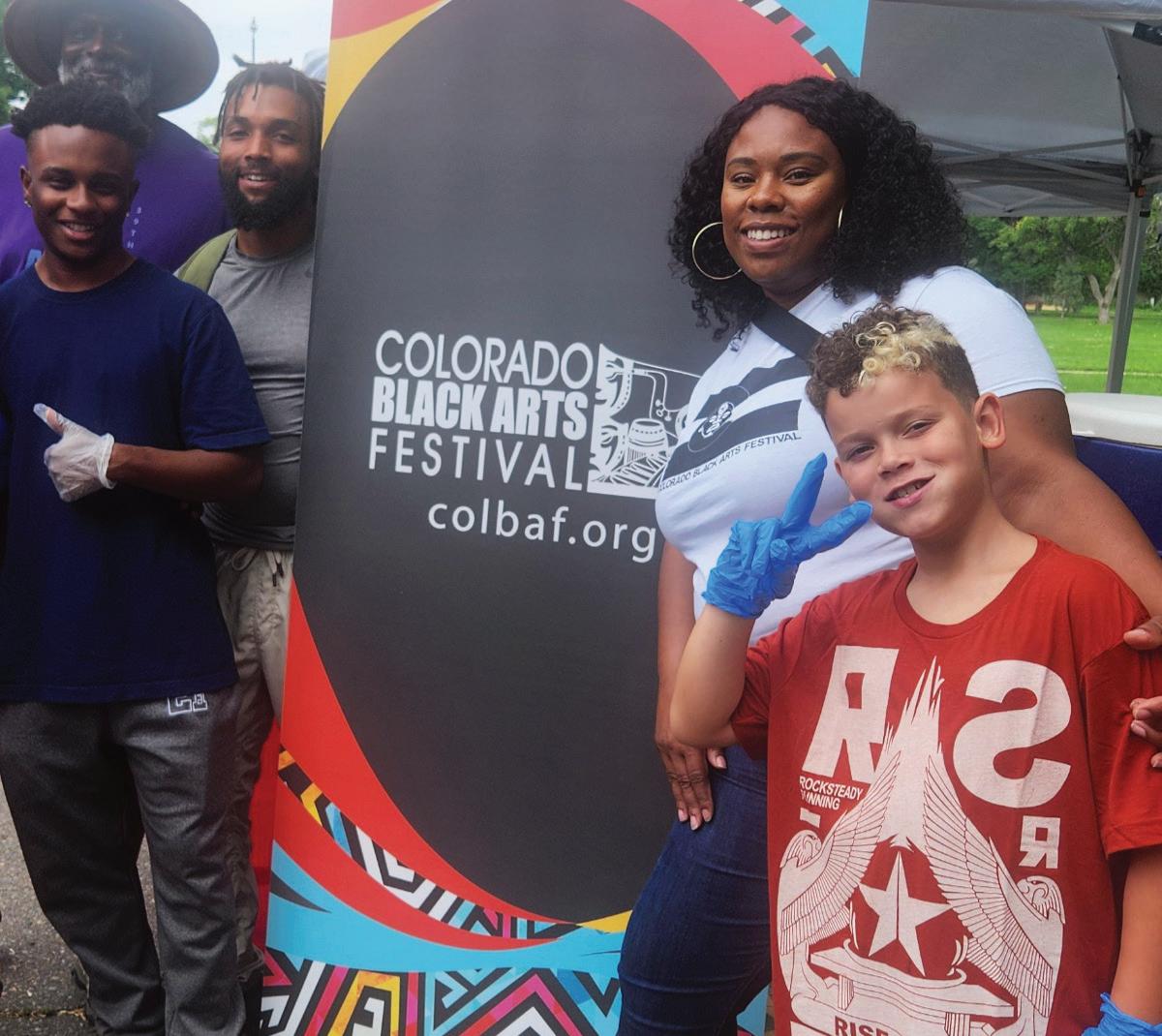
COLORADO BLACK ARTS FESTIVAL
By Denver Urban Spectrum Staff
For four decades, the Colorado Black Arts Festival has served as one of Denver’s premier celebrations of Black art, culture, history and community. This summer, the beloved event reaches a major milestone as it commemorates its 40th anniversary with a theme that honors both individual expression and collective identity: “Through Our Eyes.”
Scheduled for July 10–12 in Denver’s City Park West, the free, family-friendly festival is expected to draw more than 20,000 attendees for a weekend filled with music, visual arts, food, education, storytelling and cultural celebration.
What began as a vision to showcase the talents and contributions of African American artists has grown into one of Colorado’s largest and longestrunning cultural festivals. Today, the event features more than 100 vendors, artists, performers and community organizations, creating a vibrant gathering place where culture, creativity and community converge.
A Theme Rooted in Perspective
The 2026 theme, Through Our Eyes, reflects the many experiences that connect people across the African diaspora while celebrating the unique perspectives that shape Black culture.
Festival organizers describe the theme as an exploration of how stories, traditions, memories and artistic expression come together to form a larger narrative of resilience, pride and self-determination.
Through music, visual arts, cuisine, dance, storytelling and community engagement, attendees will experience the richness and diversity of Black culture while gaining insight into the experiences that continue to shape communities around the world.
At its core, the theme emphasizes that cultural pride and identity are essential building blocks for longterm stability, empowerment and prosperity.
Music Takes Center Stage
As always, music will be a major highlight of the festival.
Festivalgoers can enjoy performances across three stages featuring an eclectic mix of genres including jazz, R&B, gospel, blues, traditional African drumming and contemporary sounds.
Among this year’s featured performers is acclaimed pianist Kofi B., who will appear on the Kuumba Stage on July 11 at 7 p.m.
A three-time Emmy Awardnominated pianist from Akron, Ohio,
Celebrates 40 Years of Culture, Creativity and Community
Kofi B. has gained national recognition for blending music and storytelling in ways that resonate with audiences of all ages. His growing influence has extended beyond the concert stage, including portraying Whitney Houston’s pianist in the film I Wanna Dance With Somebody and collaborating musically with renowned producer and musical director Rickey Minor.
In 2024, Kofi B. was named the official Ambassador of Engagement for the 47th Kennedy Center Honors, becoming part of a historic celebration recognizing the legendary Apollo Theater.
Gospel music enthusiasts will have an opportunity to experience the powerful voice of Stephanie Summers, winner of Sunday Best Season 10. Summers will perform on the F. Cosmo Harris Gospel Stage on July 12 at 6 p.m., bringing her signature blend of inspirational lyrics and soulful arrangements.
Organizers anticipate her performance will provide a fitting conclusion to a weekend focused on faith, culture and community.
Art as a Reflection of Community
The Oye Oginga Artist Pavilion remains one of the festival’s signature attractions and serves as a centerpiece for visual artists from across the region.
This year’s exhibition challenges artists to interpret the Through Our Eyes theme by reflecting on life, beauty, struggle, joy, memory and community.
The pavilion celebrates the power of artistic perspective and highlights how individual experiences contribute to a collective story. Through paintings, mixed media, sculpture, photography and other artistic expressions, visitors will encounter works that reflect both personal journeys and shared cultural experiences.
The exhibit also underscores the role artists play as historians, storytellers and visionaries who help communities see themselves through new lenses.
A Parade Tradition Continues
The festivities officially begin with the return of the Boogaloo Celebration Parade on July 10 at 10 a.m.
A longtime festival tradition, the parade showcases Denver’s talented dance, drill and drum teams alongside community organizations and cultural groups. The colorful procession sets the tone for the weekend while celebrating the creativity, energy and spirit that have defined the festival for 40 years.
For many attendees, the parade serves as both a reunion and a reminder of the festival’s enduring role in bringing communities together.
Inspiring the Next Generation
Families will find plenty to enjoy at the Opalanga Pugh Children’s Pavilion, which returns throughout the three-day festival.
The pavilion offers youth-centered performances and interactive activities designed to encourage creativity, learning and cultural exploration. Community partners including The Art Garage, the Denver Museum of Nature & Science and Downtown Aurora Visual Arts will provide hands-on experiences for children and families.
This year’s pavilion will also pay tribute to the late Opalanga Pugh, a respected griot and West African historian whose storytelling preserved and celebrated the histories of African and African American communities. Organizers say the tribute reflects her lifelong commitment to ensuring that future generations understand the stories of those who came before them.
Wellness Through Creativity
The festival’s Health and Wellness Pavilion will explore the growing connection between artistic expression and overall well-being.
Programming will focus on how creativity can contribute to healthier lifestyles, emotional wellness and community healing. Exhibits and demonstrations will include topics such as gardening, movement-based healing practices, mental health awareness and even artistic approaches to understanding science and the human body.
The pavilion reflects a broader recognition that health extends beyond physical wellness and includes emotional, cultural and spiritual wellbeing.
A Cultural Landmark
For 40 years, the Colorado Black Arts Festival has created opportunities for artists, entrepreneurs, performers and community organizations to connect with audiences while celebrating the richness of Black culture.
Its continued success speaks to the power of cultural institutions that preserve history while creating space for innovation and future generations.
As the festival celebrates this historic anniversary, organizers hope attendees leave with a deeper appreciation for the many stories, traditions and artistic expressions that continue to shape the African diaspora.
More than a festival, the Colorado Black Arts Festival remains a living testament to the creativity, resilience and enduring contributions of Black communities in Colorado and beyond. ♦
Editor’s note: The Colorado Black Arts Festival will be held at the Denver City Park West on Friday, July 10 from 11 a.m. to 7 p.m.; Saturday, July 11 from 10 a.m. to 8 p.m. and Sunday, July 12 from 11 a.m. to 7 p.m. For more information, email Jaleesa. McIntosh@du.edu, visit https://colbaf.org/ or follow the festival on social media.
DENVER FILM AND DMNS LAUNCH 2026
Sci-Fi Film Series Featuring Jaws, Interstellar and Project Hail Mary
Denver Film and the Denver Museum of Nature & Science announced the line-up for the 2026 Sci-Fi Film Series, beginning July 1 and running through July 29 at the Sie FilmCenter, 2510 E. Colfax Ave. and the Denver Museum of Nature & Science’s Sturm Infinity Theater, 2001 Colorado Blvd.
Founded in 2011, the weekly series showcases classic sci-fi films followed by discussions led by museum scientists examining the intersections of science and cinema, debunking or proving the film science against real facts and theories. The 2026 season launches July 1 with a presentation of Steven Spielberg’s 1975 blockbuster thriller Jaws. A landmark in suspense cinema that helped define the modern summer blockbuster, the film follows a small beach town terrorized by a massive great white shark lurking just offshore. The series will conclude July 29 at the Denver Museum of Nature
& Science’s Infinity Theater with a presentation of Project Hail Mary, the 2026 sci-fi blockbuster starring Ryan Gosling based on Andy Weir’s bestselling novel. The film follows a lone astronaut on a high-stakes mission to save Earth and quickly became one of the year’s biggest box office hits.
In between, the series delivers Christopher Nolan’s Interstellar presented on 35mm film, a 40th anniversary screening of James Cameron’s Aliens: The Director’s Cut, and Hayao Miyazaki’s imaginative animated fantasy epic Princess Mononoke.
“This is a series that entertains and educates audiences as they experience iconic films in a completely new way,” said Denver Film CEO Kevin Smith.
“Kicking off with the always terrifying suspense of Jaws to the heroism of Interstellar and the emotional optimism of Project Hail Mary, the 2026 program
Film Members/$65 non-member, and individual film tickets are $13 for Denver Film Members/$16 non-member. For the full schedule, tickets and passes, visit https://www.denverfilm.org/ programs/sci-fi-series/.
FILMS IN PROGRAM:
JAWS (Director Steven Spielberg) Wednesday, July 1 at 6 p.m. at the Sie FilmCenter
is going to create some amazing conversations and scientific insight. Our long-term partnership with the Denver Museum of Nature & Science continues to elevate this series by connecting the science of these big-screen stories with real-world discovery.”
Each film presentation begins at 6 p.m., followed by a discussion immediately after the film hosted by writer Lisa Kennedy. Scientists include Genomics Scientist Dr. Bridget Chalifour, Director of Zoology & Health Sciences and Curator of Ornithology Dr. Garth Spellman, Assistant Curator of Space Science Ka Chun Yu, Ph.D., Research Assistant in Anthropology Emmy Dawson, Ph.D., and Research Astrophysicist and Planetary Scientist Dr. Kimberly Ennico-Smith.
“Summer officially starts for me when we announce our lineup for the Sci-Fi Film Series!” says Austin Terrell, Experience & Event Producer at DMNS.
“We are so excited to partner with Denver Film once again for an exciting summer of thrillers, sci-fi classics, and this year’s runaway blockbuster, Project Hail Mary. This year’s lineup has a versatile range of scientific topics from ocean biology to exoplanet astronomy to anthropology, and our Science Division is ready to dive into the details with our amazing audience. We’ll see you at the movies!”
Editor’s note: Passes and individual tickets are on sale now at denverfilm. org. Series passes are $50 for Denver
When the seaside community of Amity finds itself under attack from a great white shark, Martin Brody, the town’s chief of police (Roy Scheider); Matt Hooper, a young marine biologist (Richard Dreyfuss); and Quint, a grizzled shark hunter (Robert Shaw) embarks on a desperate quest to destroy the beast before it kills again. Featuring an unforgettable Oscarwinning score by John Williams that evokes pure terror, Jaws remains one of the most influential and gripping adventures in motion picture history. When the seaside community of Amity finds itself under attack by a dangerous great white shark, the town’s chief of police, a young marine biologist, and a grizzled hunter embark on a desperate quest to destroy the beast before it strikes again.
INTERSTELLAR
— on 35mm film! (Director Christopher Nolan) Wednesday, July 8, 6 p.m. at the Sie FilmCenter
From director Christopher Nolan comes the story of a team of pioneers undertaking the most important mission in human history. Academy Award® winner Matthew McConaughey stars as ex-pilot-turned-farmer Cooper, who must leave his family and a foundering Earth behind to lead an expedition traveling beyond this galaxy to discover whether mankind has a future among the stars. Also starring Academy Award® winners Anne Hathaway and Jessica Chastain.
ALIENS: THE DIRECTOR’S CUT — 40th Anniversary! (Director James Cameron) Wednesday, July 15, 6 p.m. at the Sie FilmCenter
Fifty-seven years after surviving an apocalyptic attack aboard her space vessel by merciless space creatures, Officer Ripley (Sigourney Weaver) awakens from hyper-sleep and tries to warn anyone who will listen about the predators. Although she is ignored at first, when contact with colonists on a planet thought safe is suddenly lost, Ripley and a military team are sent to confront the aliens.
PRINCESS MONONOKE (Director Hayao Miyazaki) Wednesday, July 22, 6 p.m. at the Sie FilmCenter
From the legendary Studio Ghibli, creators of Spirited Away, and Academy Award®-winning director Hayao Miyazaki, comes an epic masterpiece that has dazzled audiences worldwide with its breathtaking imagination, exhilarating battles, and deep humanity.
Inflicted with a deadly curse, the young warrior Ashitaka heads west in search of a cure. There, he stumbles into a bitter conflict between Lady Eboshi, the proud people of Iron Town, and the enigmatic Princess Mononoke, a young girl raised by wolves, who will stop at nothing to prevent the humans from destroying her home and the forest spirits and animal gods who live there. Featuring the voice talents of Gillian Anderson, Billy Crudup, Claire Danes, Minnie Driver, Jada Pinkett Smith, and Billy Bob Thornton.
PROJECT HAIL MARY (Directors Phil Lord, Christopher Miller) Wednesday, July 29, 6 p.m. at the Denver Museum of Nature & Science Sturm Infinity Theater
Science teacher Ryland Grace (Ryan Gosling) wakes up on a space ship light years from home with no recollection of who he is or how he got there. As his memory returns, he begins to
uncover his mission: solve the riddle of the mysterious substance causing the sun to die out. He must call on his scientific knowledge and unorthodox ideas to save everything on Earth from extinction… but an unexpected friendship means he may not have to do it alone.
About Denver Film
Founded in 1978, Denver Film is a membership-based, 501(c)(3) nonprofit cultural institution that produces film events throughout the year, including the award-winning Denver Film Festival and the popular, summertime series Film on the Rocks. With a vision to cultivate community and transform lives through film, Denver Film provides opportunities for diverse audiences to discover film through creative, thoughtprovoking experiences.
The permanent home of Denver Film, the Sie FilmCenter is Denver’s only year-round cinematheque, presenting a weekly-changing calendar of first-run exclusives and arthouse revivals both domestic and foreign, narrative and documentary - over 600 per year, all shown in their original language and format. Denver Film’s one-of-a-kind programs annually reach more than 200,000 film lovers and film lovers-intraining.
About Denver Museum of Nature and Science
The Denver Museum of Nature & Science is the Rocky Mountain Region’s leading resource for informal science education. Our mission is to be a catalyst and ignite the community’s passion for nature and science. The Museum envisions an empowered community that loves, understands and protects our natural world. A variety of engaging exhibits, discussions and activities help Museum visitors celebrate and
understand the wonders of Colorado, Earth and the universe. The Museum is located at 2001 Colorado Blvd., Denver, CO, 80205. To learn more about the Museum, visit dmns.org or call 303.370.6000. Many of the Museum’s educational programs and exhibits are made possible in part by the citizens of the seven-county metro area through the Scientific & Cultural Facilities District (SCFD). The Museum is accredited by the American Alliance of Museums. Connect with the Museum on Facebook, Instagram, YouTube, TikTok, LinkedIn, and BlueSky ♦