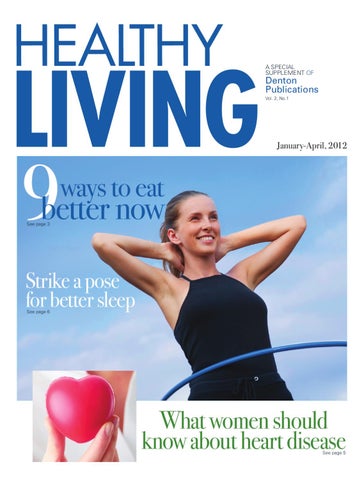
HEALTHY
LIVING
A SPECIAL SUPPLEMENT OF
Denton Publications Vol. 2, No.1
January-April, 2012
9better now
ways to eat
See page 3
Strike a pose for better sleep See page 6
What women should know about heart disease See page 5
2 • Healthy Living, January 2012
Healthy resolutions for the year ahead As the calendar turns to a new year, the focus of men and women often shifts as well. After the hectic holiday season has come and gone, many people re-dedicate themselves to their personal health and well-being. That renewed dedication might be thanks to all those big holiday meals or it might just be a result of the new calendar year being symbolic of a fresh start. Regardless of the reasons behind this renewed vigor, the opportunities to make the next 12 months a healthier 12 months abound. While losing weight might the most popular resolution, there are a host of other health-related resolutions individuals can make to improve their lives over the next 365 days. Resolve to reduce stress
Resolve to exercise more
Resolve to quit smoking
Stress is a major part of most adults' lives, and that's especially so after the hectic holiday season when men and women are pulled in so many different directions. Work is a common cause of stress, but family and personal finances, especially nowadays, are big sources of stress as well. This year, resolve to reduce stress in all aspects of life. At the office, analyze ways in which you can manage time more effectively, including how to best prioritize work projects so you don't always feel as if you're up against a wall. Outside the office, recognize the importance of maintaining a personal life and its relation to reducing stress. Spending time with friends and family can relax you and provide a welcome respite from the stress of the office.
Much like changing a diet, exercising more is often seen as a means to weight loss. While that's a positive side effect of daily exercise, the goal should not be to lose weight. Instead, the goal of daily exercise is to get healthier. According to the American College of Sports Medicine, exercise helps lower the risk of heart disease and hypertension by 40 percent while lowering the risk of depression by 30 percent. In addition, men and women with a family history of diabetes should know that regular exercise lowers their risk of type 2 diabetes by nearly 60 percent. So while exercise is a great means to losing weight, it's even better at helping reduce the risk for serious disease.
To nonsmokers, keep up the good work. For smokers, perhaps this statistic is enough to get you on the path toward quitting smoking:
Resolve to eat better Losing weight and adopting a healthier diet are not necessarily the same thing. While a healthier diet might help you lose weight, the goal of adopting a healthier diet is to improve overall health. A healthy diet can strengthen the body's immune system, making it easier to fight cold, flu and other ailments. A healthy diet can also help in the battle against any preexisting conditions. For example, replacing salt with healthier and flavorful herbs can help reduce high blood pressure, and many people cannot even taste the difference once they start eating.
When incorporating exercise into a daily routine, start slowly and gradually work your way up to more vigorous exercise regimens. Going full speed from the outset is a great way to increase risk of injury, which could actually restrict your ability to exercise for some time.
16 Degrandpre Way, Suite 400, Plattsburgh, NY 12901
• More than 150,000 Americans were projected to succumb to lung cancer in 2011, according to the National Cancer Institute.
If those statistics aren't enough to get men and women serious about quitting smoking, consider the negative effect secondhand smoke has on your loved ones. The American Cancer Society notes that roughly 3,000 nonsmoking adults experience lung cancer caused by secondhand smoke in the U.S. each year. When making a resolution this year, smokers' top priority should be to quit smoking. When making resolutions at the start of a new year, men and women often focus on healthy resolutions. But healthy resolutions go beyond losing a few extra pounds, and many involve dedication throughout the year to improve overall health this year and for years to come.
(518)563-1900
American College of Radiology Accredited
12 Board Certified Radiologists
Associates in Radiology & CVPH
MRI • CT SCAN • ULTRASOUND “WALK-IN” XRAYS WELCOME “Wide Open” Highfield MRI • Including Breast MRI 28842
Healthy Living, January 2012 •
9now
3
ways to eat
better
Doctors, fitness professionals and nutritionists all have ideas on what men and women should and should not eat. Choosing the right foods can help save waistlines and lives.
The country is growing larger, and that has nothing to do with the population. Individuals are heavier than ever before. About one-third of Americans are considered obese. No state in the U.S. has an obesity level less than 20 percent. The Centers for Disease Control and Prevention states that 36 states had a prevalence of 25 percent or more; 12 of these states (Alabama, Arkansas, Kentucky,
1
Use a smaller plate. This will trick the eye and brain into thinking you are eating a lot. A large plate seems empty with smaller portions, prompting many men and women to eat more than is necessary. Using a smaller dish can give the impression of eating from an overflowing dish.
2
Make vegetables a priority, not an afterthought. Fill up on vegetables and make meat and other higher-calorie foods the afterthought, instead of vice-versa. In fact, two-thirds of your dish should be consumed by vegetables, with the remaining portion for a protein or starch.
3
Avoid family style meals. That means placing large serving dishes full of food directly on the table. It encourages going in for seconds when you really may not be hungry. It takes the brain at least 20 minutes to register feeling full. So serve yourself from the stove and wait to see if you're still hungry before going back for more.
4
Rely on seafood protein. Eating fish once or twice a week is an excellent way to cut calories and enjoy a food that is rich in essential fatty acids.
Louisiana, Michigan, Mississippi, Missouri, Oklahoma, South Carolina, Tennessee, Texas, and West Virginia) had a prevalence of 30 percent or more. Although it is widely known that eating a healthy diet and exercising frequently are the key ways to maintain a healthy weight, it's easy to fall into bad habits. Some men and women find it difficult to avoid temptation and stay on track with diet. But balance and portion control are great ways to enjoy food without gaining weight. Here are some tips to live by.
5
Switch to skim products. It is widely known that dairy products are an important component of healthy living. However, whole-milk varieties tend to be heavy on calories and saturated fat. Opt for skim milk whenever possible. Today, there are ultra-pasteurized varieties of skim milk that are creamy and filling.
6
Experiment with herbs, not salt. A lot of sodium in a diet may not be good for blood pressure and it can lead to water retention. Instead, reach for herbs to add flavor to foods. Keep a fresh selection of parsley, chives, cilantro, basil, and other herbs at the ready and chances are you won't even miss the salt.
7
Go sparingly on dressings and sauces. You can quickly turn a healthy salad into an unhealthy meal if you drizzle on too much creamy salad dressing. Studies show that some fast food salads have more fat than other fast food fare, including hamburgers. Opt for the dressing on the side, or select among fat-free alternatives. Use only about 1 to 2 teaspoons for flavor.
8
Indulge once in a while. Depriving yourself of everything that is tasty can lead to binge eating or overeating. Just remember to keep the portions of sweets or fattening foods modest and try not to over-do it the rest of the day.
9
Don't forget the exercise. The American College of Sports Medicine offers benefits of exercise beyond simply helping you to lose weight: • Lowers risk of heart disease by 40 percent. • Lowers risk of breast cancer by 20 percent. • Lowers risk of depression by 30 percent. • Lowers risk of hypertension by 40 percent. • Lowers risk of type 2 dia betes by 58 percent.
4 • Healthy Living, January 2012
How to enjoy eating healthy A healthy diet is often mistaken for one that is devoid of desirable foods. But just because a diet is healthy doesn't mean it can't be delicious as well. A few easy modifications to your favorite recipes can make a diet healthier without sacrificing taste.
Oatmeal Raisin Muffins
1 teaspoon baking powder
1/2 cup sugar
1 cup oats
1 teaspoon baking soda
1/2 cup applesauce
1 cup skim milk
1 dash salt
1 teaspoon vanilla extract
Many nutritionists say that the average person should consume between 1,600 to 2,000 calories and 45 to 80 grams of fat per day. There are many different diet plans available that curb carbs, beef up protein and greatly reduce fat intake. However, it is universally agreed that moderate caloric reduction and an increase in activity are the best bets for healthy, long-term weight maintenance.
1/2 cup all-purpose flour
1 teaspoon cinnamon
2/3 cup raisins
1/2 cup wheat flour
2 egg whites
Ideas to curb caloric intake include using cooking sprays instead of heavy oils to grease pans; replacing butter and salt with herbs and spices to add flavor; or trading regular white breads and pastas for whole wheat varieties. Scaling back portion sizes of meats and increasing portion sizes of vegetables to feel full is another healthy approach.
Preheat oven to 375 F and spray muffin tins to grease. Soak oats in the milk for several minutes. Sift together the flour and dry ingredients. Mix together the egg, sugar, applesauce and vanilla. Blend the wet ingredients and the oats. Fold in the dry ingredients, then the raisins. Spoon batter into muffin tins. Bake for 15 to 20 minutes.
For those who love a muffin in the morning but want a healthy option, try this Oatmeal Raisin Muffin recipe.
hy t l a e H g n i Eat SEASONAL FRUITS & VEGETABLES Growing since 1945
28843
Honeycrisp • McIntosh • Fuji Red Delicious and lots more Applewood • Honey Open till the snow flies • 470 Union Road, Peru • 518-643-9806 537 Union Road • Open all winter • 518-643-9718 • Mon-Fri 8-4 Sat 8-Noon
PERU
3 Gorman Way, Village Plaza Peru, NY 12972
518-643-2318 Emergency 643-2324 • Full Prescription Service • School & Office Supplies • Home Health Supplies • Photocopying & Fax Services • LARGE GIFT SELECTION • Hallmark Greeting Cards & Gifts • Blue Mountain Arts • Yankee Candle • Russell Stover Candles • Vinyl & Latex Inflated Balloons • Jewelry • Cosmetics • Kodak Digital Film Developing PHARMACY HOURS: Mon. - Fri. 8AM - 7PM • Sat. 8AM - 3PM • Sun. 9AM - 1PM STORE HOURS: Mon. - Fri. 8AM - 7PM • Sat. 8AM - 6PM • Sun. 9AM - 5PM
Clinton County’s #1 Martial Arts Studio for Over 26 Years LET FRED VILLARI STUDIOS HELP YOUR CHILD Make New Friends Learn Self-Defense Get Fit • Master Goal-Setting Become a Leader • Develop Focus Learn Discipline Get Better Grades & Have a Blast!
518-561-8592
28839
www.villarisofplattsburgh.com
Teaching Men, Women and Children, ages 4 and up.
NOW OFFERING BIRTHDAY PARTIES! 28938
Healthy Living, January 2012 •
What women should know about heart disease Millions of women around the country live with cardiovascular disease and may not know it. The consequences of being uninformed can be fatal. According to the National Coalition for Women With Heart Disease, heart disease is the leading cause of death in American women. More women die from heart disease than breast cancer in any given year, and the Public Health Agency of Canada says that heart disease is the leading cause of death among Canadian women over the age of 55. That's a frightening reality that might surprise some.
What puts women at risk? There are a number of factors that can put a woman at risk for heart disease.
• Obesity: The chance for heart disease increases with a woman's weight. Even losing a little bit of weight can help diminish the chance.
• Hypertension: High blood pressure can exert extra stress on blood vessel walls and make them more likely to get clogged.
• Diabetes: High blood sugar can damage the arteries that supply blood to the heart.
• Cholesterol levels: Cholesterol in the blood can build up on the inside of blood vessels and lead to blockages that can cause a number of different problems.
• Family history: A woman with blood relatives who were diagnosed with heart disease is at a heightened risk of developing heart disease.
• Smoking: Women who smoke have a higher risk of heart attacks than nonsmoking women. Those who smoke and take birth control pills are at an even higher risk.
• Lack of physical exercise: Inactivity can promote heart disease. Daily physical activity can go a long way to help the heart and prevent heart disease.
Preventing heart disease Recognizing the risk factors for heart disease is just the beginning when it comes to prevention. Once those risk factors are known, it's up to women to take steps to live a more healthy lifestyle. Fortunately, there are many ways women can do just that. • Exercise daily. Thirty minutes of exercise per day is recommended. This can improve cardiovascular health by getting the blood moving through the body. It can also help women lose weight, decreasing risk for other ailments as a result. • Quit smoking. Do not use tobacco products. Smoking is one of the biggest risk factors for developing heart disease. Smoking narrows the arteries in your heart and can also contribute to the hardening of arteries, called atherosclerosis. This condition can ultimately lead to a heart attack. Carbon monoxide in cigarette smoke replaces some of the oxygen in the blood, according to the Mayo Clinic. This can raise blood pressure and force your heart to work harder.
• Eat healthy. Eating foods that are low in cholesterol and sodium can help with heart disease risk. A diet rich in fruits, vegetables, whole grains, low fat dairy products, and other sources of whole fiber can help. Consumption of fish, which is high in omega-3 fatty acids, is also beneficial. • Maintain a healthy weight. A doctor or nutritionist can help you determine a healthy weight for your body type and height. Most use calculations to determine a body mass index, or BMI, which considers certain factors, including height and weight, to determine if you have a proper amount of body fat. Waist circumference is also a tool used to measure how much abdominal fat a person has. • Go to the doctor regularly. A doctor can run certain tests to discover any red flags for potential heart problems. He or she will check blood pressure, cholesterol levels, conduct screenings for diabetes, and discuss family history. With all of this information, the doctor will be able to make certain assumptions about heart disease risk and guide you on the path to finding a program that will be effective for you.
Although heart disease is the foremost killer of women in North America, it can largely be prevented and risk factors managed with adequate health care. Women living with any of the aforementioned risk factors should make an appointment with their doctor to determine a course of action.
5
6 • Healthy Living, January 2012
Strike a pose for better sleep Health experts have long been professing the "back is best"mantra to new parents. As it turns out, the back also may be best for adults. Placing an infant to sleep on his or her back is essential to reducing the risk for Sudden Infant Death Syndrome and has been part of the advice given to new parents for decades. Sleeping on one's back can also be ideal for improving the health of older children and adults, offer sleep experts. Misalignment of the body during sleep can put strain on different areas of the body, most especially the spine, neck, shoulder, hips and jaw. Stressing these areas can affect how you feel the next day. People who cannot find a comfortable sleeping position also may have trouble drifting off to sleep in the first place.
Sleeping on the back is the preferred position if a person wants to improve personal health. The advantages to resting on the back are numerous. Sleeping on your back enables the spine, head and neck to remain in a neutral position, alleviating or preventing strain on these areas of the body. Those with acid reflux may find sleeping on their backs helps reduce symptoms, especially if the head is slightly elevated with a fluffy pillow. Back sleeping is also good for preventing premature wrinkling. That's because nothing -- like a pillow or mattress -- is pressing up against the face for a long period of time. Some medical experts also say that sleeping on the back supports a woman's breasts.
Although mattress and pillow comfort, room temperature, noise levels, and the level of darkness play a large role in getting a good night's sleep, sleep position can also help or hinder the quality of sleep.
28841
Sleeping on the back is not good for everyone, however. Heavy snorers or people who suffer from sleep apnea should avoid this position because the tongue can fall inwards and block the breathing passage. It isn't adviseable for pregnant women to sleep on their backs, either. This is because the weight of the uterus when lying on the back is placed on a large blood vessel called the inferior vena cava, reducing the flow of blood back to the heart. This in turn may staunch blood flow to the fetus. It is best for pregnant women to sleep on their left sides, or at least place a pillow under the right hip to slightly angle the body toward the left, which promotes stronger blood flow. Side sleeping is the next best position if the back is not comfortable. According to experts, the worst positions for sleeping are the fetal position or on the stomach. This is
because these positions cause the body to be curved in unnatural shapes that can strain the spine and neck. Arthritic people may be in agony the next day. Although people spend significant portions of their lives asleep, few give sleep much thought until it becomes a problem in their lives. The Better Sleep Council says sleep is essential to health, and people should strive to get 7.5 hours of sleep every day. There are tips for promoting better sleep, which include maintaining a consistent sleep schedule, avoiding eating or exercising close to bedtime, and reducing factors that diminish one's ability to fall asleep. Choosing a more healthy sleep position can be one of the things people do to get a better night's sleep.
28936
Healthy Living, January 2012 •
Winter's arrival coincides with the arrival of other things as well. The holiday season. Snow days from school. Weekends spent skiing and snowboarding with family and friends. While each of those things is something to look forward to, one thing also synonymous with winter is never welcomed with open arms. Cold and flu season impacts nearly every household each winter, forcing kids and adults alike to put life on hold as they rest and recover. To many people, flu shots are enough to keep them going strong through cold and flu season, but not everyone has access to flu shots. Even those who do might still get colds if they don't take steps to stay healthy when the mercury drops. This winter, people wanting to avoid the worst of cold and flu season can take several precautions to reduce their risks of getting a cold or the flu.
Winterizing a home is perhaps the best thing a homeowner can do to make a home safer and warmer. Install storm windows and caulk around doors and windows to keep warm air in the home and prevent cold air from coming in. If winter has yet to arrive, inspect the heating system. If winter has already arrived, schedule an inspection as soon as possible. Make sure the system is working properly and is clean and ready for the winter that lies ahead. Ideally, the heating system should be serviced by a professional to ensure the ventilation is working properly. Homeowners with functioning fireplaces in their homes should have the fireplace inspected and cleaned before using it for the first time.
Addressing Attire
Around the House People can take several steps to make their homes safer and warmer, which should help them reduce their risk of cold and flu.
Winter weather should never catch adults or children offguard with regards to their wardrobe. Once cold weather arrives, dress appropriately whenever leaving the home to
H a vin g a b a b y?
Prepare for Emergencies If a winter weather emergency arrives, cold and flu won't shut down and stop working just because schools close or power outages occur. In fact, during an emergency the chances are strong that families will be stuck inside for extended periods of time. When locked indoors for long periods of time, cold and flu viruses can spread easily. Men and women should prepare for such a scenario by having an air filter on hand to ensure air quality remains clean and healthy. In addition, stock up on items such as soup or cold and
cough medicine to ensure that anyone who succumbs to cold and flu during a weather emergency will have remedies at their disposal should they be confined to the home. Parents of infant children should keep extra formula and diapers on hand and be sure there are extra batteries around the house should the power go out. For infants on medication, consult the child's physician before cold and flu season and devise a plan of caring for a sick child should a weather emergency occur.
Get Outside and Exercise Staying indoors all winter might seem like a great way to avoid cold and flu, but it might actually make adults and children more susceptible. Staying indoors could be trapping you indoors with stagnant air where cold and flu germs are floating around. Stay inside during weather emergencies, but be sure to get outside in the fresh air and exercise when the weather allows. Regularly working out boosts the body's immune system, which helps ward off cold and flu.
HEARING AIDS IN YOUR DRAWER? T . HEY MAY NOT HAVE BEEN FIT CORRECTLY
The IPO Program can help.
Call today to take advantage of the Most AGX devices are covered by our AGX Protection Plan: * 75-day trial * 3-year warranty * 3 years loss and damage insurance * 3 years free batteries
The Improved Pregnancy Outcome Program provides support from a nurse to help you: Learn about pregnancy Stay well during pregnancy Have a healthy baby
1-2-3 Refitting Offer.
1 2 3
We will evaluate your current fitting no matter where you purchased your instruments. If we think we can improve your fitting, we’ll adjust your devices at no charge. 3 months after your refitting, we’ll give you a free clean and check to make sure your new adjustments have been working well for you. If you’d like to upgrade your technology, we offer a $500 trade-up credit toward a new AGX two-device hearing system.
SCHEDULE YOUR FITTING TODAY! CALL (518) 324-5707
565-4848
32 Court Street, Plattsburgh, NY www.clintonhealth.org
Sharon Macner, Au.D. 28991
For more information call:
reduce the risk of cold and flu. Appropriate attire includes wearing outdoor clothing, such as winter coats, scarves, gloves or mittens, and wool ski hats. Those who live in areas with heavy snowfall should also wear waterproof boots whenever going outside. It's also important to dress in layers throughout the winter. Doing so provides extra insulation, and layers trap air effectively, ensuring that all that warm air produced by your body won't escape but will stick around and keep you warm.
7
Doctor of Audiology 38646
176 U.S. Oval, Suite 3 Plattsburgh, NY 12903 (518) 324-5707 • www.cvaudiology.com
8 • Healthy Living, January 2012
You Are What You ... Drink People have long been told by doctors and health experts that the foods they eat have a direct correlation to personal health. But the beverages individuals choose to drink could be equally as influential.
There are a number of foods today that contain probiotics or prebiotics -- dietary fibers that stimulate the growth of probiotic bacteria in the stomach. Now there are beverages that have these helpful bacteria boosters, too. Cutting back on unhealthy beverages and replacing them with better ones can be one way to get fit and feel great. But where to start? First, a person can take inventory of the types of beverages he or she drinks on a regular basis and make some easy switches.
The average person swallows 400 calories from liquids each day. A study in the American Journal of Clinical Nutrition indicated that around 37 percent of individual's total daily liquid calories come from sugar-sweetened drinks. In addition, these sugar-sweetened drinks could be more likely to cause obesity than fatty foods.
• Ban the booze.Alcoholic beverages may be the go-to drinks at parties and other social occasions, but they can pack on pounds quickly because of the calories. The average glass of wine contains between 110 to 120 calories.
• Boost tea drinking. Tea contains antioxidants that can fight diseases and promote overall health. Tea may also rev up metabolism. • Monitor fruit juice consumption. On the surface, fruit juices would seem to be healthy. But it's better to eat whole fruit, because many fruit juices have more calories or even added sugar than an equal serving of whole fruit. It's important to remember that beverages play a big role in personal health. Choosing low-calorie, healthy drinks is a way to maintain a healthy weight while simultaneously boosting general well-being. To learn more about PRE products, visit www.preusa.com.
• Say so long to soda. Sweetened sodas are a no-no, but even diet soda can ruin diet plans. Diet sodas contain artificial sweeteners, which studies are starting to suggest lead to weight gain.
Another health topic of interest lately is probiotics for promoting health. Probiotics are healthy bacteria that work in concert with the digestive tract to improve overall digestion and boost immune system function. Probiotics can help with a number of digestive ailments, including constipation, diarrhea, stomach ulcers, irritable bowel syndrome (IBS), and acid reflux.
• Choose zero-calorie drinks.Hot or cold, tea is calorie-free when consumed without added sugar or milk. Coffee can be this way, too, if you skip the cream and sugar. Of course, water is the go-to beverage of choice if a person wants to cut out liquid calories -- but there are other options, too.
Also, research indicates that 70 percent of the immune system is located in the digestive tract, which means probiotics can benefit other parts of the body, too. The intestines are necessary for absorbing important vitamins and minerals and weeding out wastes. When they are not working properly certain conditions may arise, such as vitamin deficiency, fatigue, and susceptibility to illness.
• Switch to low-fat milk and dairy products. While highfat, high-calorie whole milk items may wreak havoc on waistlines and contribute to cholesterol levels, low-fat milk is the ideal way to receive essential vitamins and calcium. Plus, Researchers at the University of Tennessee at Knoxville found that having three servings of low-fat dairy per day can lead to weight loss of 10 percent or more.
Here are other ways to make beverages work for the body.
Providing life-enhancing supports for people with developmental and acquired disabilities
RESOURCES
INCORPORATED
XÇ{tÇv|Çz _|äxá yÉÜ
of the Empire State
EH lxtÜá
(518) 643-0100/0300 • Fax (518) 643-0200 Residential Resources, Inc., licensed Home Healthcare Agency strives to enhance the quality of life for people with developmental and acquired disabilities by ensuring their presence and participation in community life. It is our belief that such participation is contingent on a person’s ability to make choices for themselves. To the end, we provide supports that encourage self-confidence, self-esteem, and the ability to establish meaningful and long-lasting relationships in the community. Services that are offered: • New York State Department of Health Traumatic Brain Injury Medicaid Waiver Service Coordination, Independent Living Skills Training, Home and Community Support Services, Structured Day Program • New York State Department of Health Nursing Home Diversion Transition Waiver Service Coordination, Independent Living Skills Training Home and Community Support Services New York State OMRDD Services • Medicaid Service Coordination, Day Habilitation, Residential Habilitation, and Respite Services 28845
Wellness WOMEN ONLY FITNESS CENTER Your 24/7 Women only Fitness Center Treadmills, Ellipticals, Bikes, Strength Training and more! Motivational Weight Loss Group Meets Thursdays 5 - 6 pm One Stop Shop. We have tried to combine all of your needs in one convenient location. Massage, Hair, Nails, Facials & Spa Treatments, Waxing, Tanning, Gym, Gifts, Jewelry & more. Our hours of operation are kept flexible to meet the needs of more people. Call for additional information or to make an appointment. Always leave a message, as we feel our clients time is important and they deserve our complete attention. We will get back to you as soon as we can. (with in 24 hours)
Owner: Charmain Fennoff, LMT & Cosmetologist Aimee Adams, Cosmetologist Kristy Bassarab, LMT & Esthetician
8 William Street, Elizabethtown, NY
(518) 873-3270 / 524-6520
28387
RESIDENTIAL
Healthy Living, January 2012 •
9
Simple ways to reduce cancer risk Millions of people have had their lives touched by cancer. Whether dealing with their own diagnosis or that of a loved one, men and women often wonder what, if anything, they can do or could have done to prevent cancer from becoming a part of their lives.
While cancer risk depends on a host of factors, some of which are beyond an individual's control, there are certain preventative measures men and women can take to reduce their risk of cancer. * Stop smoking. In the United States, the Centers for Disease Control and Prevention note that smoking causes 90 percent of lung cancer deaths in men and nearly 80 percent in women. However, within 10 years of quitting, an ex-smoker's risk of dying from lung cancer is cut in half while the risk for other cancers, including cancers of the mouth, throat, larynx, and cervix, decreases as well. * Reduce alcohol consumption. In a study examining the relationship between cancer and alcohol consumption, researchers working with the World Health Organization found that daily consumption of roughly 50g, or less than two fluid ounces, of alcohol doubles or triples the risk for mouth, voice box and throat cancers compared with the risk in nondrinkers. Additional studies have shown a link between alcohol consumption and cancers of the liver and colon. What's more, no fewer than 100 studies have found an increased risk of breast cancer with increasing alcohol intake. Men and women should consult their physicians about what constitutes a healthy consumption of alcohol. * Be safe in the sun. Though a deep tan might look good, individuals must emphasize protecting their skin from the sun. Skin cancer is the most common form of cancer in the U.S., and exposure to the sun's ultraviolet (UV) rays plays
a significant role in the development of skin cancer. When going out in the sun, apply sunscreen with a minimum sun protection factor, or SPF, of 15; wear loose fitting clothing and a protective hat, as many skin cancers happen on the face and neck; and always wear sunglasses, preferably those that provide UVA and UVB protection. * Maintain a healthy weight. Being overweight or obese brings forth a host of potentially deadly side effects, not the least of which is increasing a person's risk for cancer. A report from the National Institutes of Health that examined being overweight and obesity in men and women found that carrying excessive weight substantially increases an adult's risk of getting breast, colorectal, endometrial (uterine), and prostate cancers. Healthy weight varies depending on the individual, so men and women concerned about their weight should consult a physician about the best ways to lose weight and maintain a healthy weight. More information is available at www.cancer.ca or www.cancer.org.
FREE
Colon Cancer Screening Kit Men & Women 50+ with no health insurance. Easy to use in the privacy of your own home. Call today for your free kit. 562-7112 Kjell Dahlen, MD, Benjamin Vilbert, MD Frederick Shaw, MD, Robert Raut, MD, Phil Dafler, MD, Joseph Rini, MD, Alexander Chop, MD Stanley Hatch, OD, David Kirkpatrick, OD, Richard Erenstone, OD, Bradley Catton, OD, Kate Reidell, OD 28840
28933
www.clintonhealth.org
10 • Healthy Living, January 2012
Best Exercises for the Over-50 Crowd The human body needs exercise to operate at full capacity. Exercise is important at any age, but can be particularly beneficial for individuals in their golden years. The key is finding exercises that are both safe and effective.
Benefits of Exercise
Engaging In the Right Exercises
The Centers for Disease Control and Prevention report that 28 to 44 percent of seniors ages 65 to 75 are inactive, meaning they don't get enough daily exercise for optimal health. Studies indicate that there are many reasons that seniors should engage in regular exercise.
While it may have been the norm to do multiple, rigorous repetitions of exercises during one's youth, older adults should employ different strategies. Certain exercises are better than others and can help reduce the risk of injury.
• It can help stave off illness and chronic conditions by keeping the immune system healthy. • It paves the way for better sleep, including falling asleep easier and sleeping more deeply. • Exercise releases natural endorphins, which help a person feel good about him or herself and can boost mood. • Regular exercise can promote weight loss, especially when done in conjunction with a healthy diet. • Improved muscle tone can take pressure off of joints and help with mobility. • Research indicates that exercise can boost brain function and keep dementia at bay. • When participating in social exercise, seniors realize companionship and stress relief. • Exercise can keep systems of the body in check, reducing constipation and helping circulatory issues.
Before starting any type of exercise regimen, seniors should talk with a physician about the pros and cons of certain activities. The doctor may be able to provide guidance as to which activities are better for specific conditions a person has. For example, an individual with arthritis may want to seek low-impact workouts, such as water aerobics. Once a doctor gives the go-ahead, here are some exercises many 50+ people can try. • Walking: Walking remains one of the best exercises for people of any age. The pace and resistance can be set by each individual by walking faster or slower, uphill or downhill. Adding light weights can make the workout even more effective. Walking is also easier on the legs and knees than jogging, but can be just as effective a cardiovascular workout. • Leg extensions: Repetitions of leg extensions stretch the muscles of the legs and flex the knee joint. This can promote longevity of the knees and keep knee replacements at bay. • Swimming: Enrolling in a local gym or YMCA that has a pool can be a boon to seniors. Swimming is a low-impact workout that targets most areas of the body as well as providing a cardiovascular workout. Plus, since swimming can be relaxing and enjoyable, it's an exercise that many people don't mind doing. • Strength training: Moderate weight lifting can keep muscles strong and promote a healthy metabolism, considering muscle burns more calories than fat. • Endurance exercise: Just about any activity that gets the heart rate up for an extended period of time is good for the body. This can be raking leaves, mowing the lawn, walking, bicycling, playing a game of catch, etc. Be sure the doctor cleans any such activities beforehand.
Healthy Living, January 2012 •
11
Healthy Aging Includes Safe Driving It's common for men and women to periodically reassess their lifestyle as they age. With a goal toward healthy aging, most people can recognize the role their lifestyle plays in their overall health. An often overlooked part of healthy aging is how some, if any, physical changes have affected how a person drives his or her automobile. Any adult who has had to discuss driving with an elderly relative knows how difficult such a discussion can be, as automobiles have long represented a certain level of independence no adult wants to give up. But even those who have yet to reach retirement age should assess their driving to determine if aging has begun to affect their driving. Such an assessment can help men and women determine if it's time to take steps to make themselves safer drivers.
Assess Eyesight
Assess the Vehicle
A driver's eyesight is integral to his or her safety on the road. Fortunately, eyesight can be corrected with prescription glasses or even surgery. Men and women who have trouble reading street signs or seeing street markings might need an eye examination. Also, if dusk or nighttime driving has grown more difficult it might be time for an eye exam.Difficulty seeing while behind the wheel puts drivers and their passengers at significant risk, but such a problem might be solved by a new eyeglass prescription.
As men and women age, they may find it is more difficult to control a motor vehicle. Strength, coordination and flexibility diminish as a person ages, and this can affect a person's ability to drive. But such physiological changes don't necessarily mean a person has to give up driving. It might just mean it's time to find a car that's easier to drive. For example, many drivers prefer vehicles with manual transmissions, feeling such cars are more fun to drive. However, as a person ages, the ease of driving a vehicle with an automatic transmission, power steering and power brakes can make it much safer for that driver to be on the road. Older drivers often find smaller vehicles are easier to control, and such drivers should consider smaller cars if they're having trouble controlling their current vehicle.
Poor visibility might have nothing to do with a driver's vision. It could be a byproduct of certain external factors. Drivers having trouble seeing might consider adjusting their seat. According to the National Highway Traffic Safety Administration, drivers should be able to see at least 10 feet in front of their own vehicle. A seat that is too low can decrease visibility. In addition, when taking a vehicle in for routine repairs, ask the mechanic to inspect the headlights to make sure they are working and aimed correctly.
Assess Personal Feelings Toward Driving How a driver feels toward driving can also play a role in that driver's safety. Drivers who feel nervous or overwhelmed when driving don't necessarily need to abandon their vehicles and embrace public transportation. Such feelings might be caused by a driver's medication. Medication can make people sleepy or cause dizziness. Either of those side effects can lead to confused drivers who are easily overwhelmed when entering traffic. Discuss any symptoms with a physician, who might know alternative treatment options that enable drivers to safely stay on the road.
For more information, visit the National Highway Traffic Safety Administration at www.nhtsa.gov.
87019
12 • Healthy Living, January 2012