WEREWOLVES! ZOMBIES! ANDROIDS! CREEPY RETURNS WITH A SPECIAL HORROR COMMEMORATIVE
WERWULF UNLEASHED:
INSIDE THE MIND OF ROBERT EGGERS
PLUS OBSESSION’S UNLIKELY INSPIRATION MIKE FLANAGAN’S NEW TAKE ON CARRIE GHIDORAH VS. GODZILLA IN COUNTDOWN TO MINUS ZERO
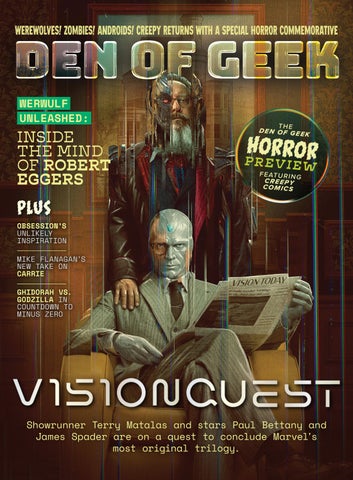
Showrunner Terry Matalas and stars Paul Bettany and James Spader are on a quest to conclude Marvel's most original trilogy.
2
DEN OF GEEK
SXSW 2025 | DEN OF GEEK
3
4
DEN OF GEEK
SXSW 2025 | DEN OF GEEK
5
INSIDE THE ISSUE
VISIONQUEST
What is Vision if not Ultron persevering? Showrunner Terry Matalas and the team behind VisionQuest take us behind the scenes of the thrilling final chapter of Marvel’s most successful TV trilogy. PG. 30
Before Katniss Everdeen there was Haymitch Abernathy. Director Francis Lawrence and stars Mckenna Grace and Joseph Zada put on a Quarter Quell to remember in this Hunger Games prequel. PG. 10
GODZILLA MINUS ZERO PG. 10
Director Takashi Yamazaki previews the long-awaited Godzilla Minus One sequel and reveals why Ghidorah had to be a part of it. PG. 26
PG. 26
PRIME VIDEO’S CARRIE
Horror auteur Mike Flanagan talks about updating Stephen King’s classic novel for the social media era and finding the right Carrie and Margaret White. PG. 38
ROBERT EGGERS MACABRE VISION PG. 38 6
DEN OF GEEK
Acclaimed director Robert Eggers guides us through his career of dark historical chillers from The Witch and The Northman, to Nosferatu and the upcoming Werwulf. PG. 48
PG. 48
IMAGE CREDITS: MARVEL/DISNEY+, MURRAY CLOSE/LIONSGATE AMAZON PRIME VIDEO, TOHO STUDIOS, FOCUS FEATURES
THE HUNGER GAMES: SUNRISE ON THE REAPING
FROM THE DEN
ILLUSTRATION CREDITS: CREEPY/ RICHARD CORBEN
Illustration by Richard Corben featured in Creepy Comics #12 published in May 2013.
The Thrill of Chills
HORROR IS ETERNAL That is probably not surprising to read around these parts. Spooky season is, after all, the most wonderful time of the year at Den of Geek. Black cats and witches; vampires and haunted houses; a kaleidoscopic ménage of orange and maple red piled beneath a treeline at sunset can be as warm and fuzzy as any holiday light and sparkly ornamentation dangling from a
Douglas fir. So many of our October issues, including the one in your hands, are among our favorites to design and build. And yet, it feels like horror has come—if not of age— certainly into the respect it’s long been overdue. Barely a year ago, industry prognosticators and talking heads assured the world that “horror fatigue” was real, and audiences
would soon tire of all that goes bump in the night. The thing about those nocturnal bumps, though, is we’ve been sharing them and the tingles they invite since the days of Neoliths sitting around a campfire, and definitely since Le Manoir du Diable, the 1896 Georges Méliès film that translates to “The Devil’s Manor,” and which is widely considered to be the first horror movie ever made. It definitely wasn’t the last. Horror can ebb and flow in popularity and fashion, whether it is in cinema, on the page, or in the traumatized works of any age. But ghost stories always haunt us. They linger as an outlet to terrify and unsettle, sure, but also to process our world and the experience of living in it. Whether in a crowded theater surrounded by strangers in the dark or at a slumber-party marathon of slashers in your childhood home, there is nothing more visceral than thrills and chills, and the catharsis they release. The industry—surprise, surprise— learned that lesson again this year when Curry Barker’s Obsession became the second highest-grossing independently produced movie of all time, a neat trick we can claim to be on the upswing of since Barker and star Inde Navarrette appeared in the March issue of Den of Geek magazine after a buzzy debut on the festival circuit. And Kane Parsons’ Backrooms is hardly far behind, complete with A24 backing the 20-year-old’s gargantuan hit from top to bottom. It’s a fresh reminder that whether you’re a Zoomer or Boomer, terror resonates when it articulates the anxiety of its time—even if spoken through an ancient funhouse lens. Indeed, one of the filmmakers most credited with launching our current golden age of spooky cinema, Robert Eggers, broke onto the scene at Sundance in 2015 with a folk horror DEN OF GEEK
7
movie so sinister that it exploited our modern dread of Puritanical zealotry while nonetheless submerging us into early modern mindsets fixated on witchcraft and satanic bargains. We speak with him about those Old World paranoias and his new film Werwulf in this issue, just as we welcome other genre masters in the den like Mike Flanagan, who is cracking a new perspective on a Stephen King classic via Carrie. Meanwhile, Godzilla Minus Zero revisits the postwar despair that made an atomic lizard nightmare fuel for the generation who lived through Hiroshima, Nagasaki, and the firebombing of Tokyo. In a special section, we even invite you back into the cult of Creepy Comics, the iconoclast line that defied CCA censorship in the mid-20th century to keep Jungian boogeymen like vampires, mummies, ghosts, and definitely werewolves alive in a suffocated medium. They even caught the eye of Guillermo del Toro and Steven Spielberg once upon a time, and to this day, Ti West and Osgood Perkins are among their fans. “There was EC Comics but [after the censorship crackdown], there was really only Creepy,” notes Daniel Braun, who is the consulting editor on Creepy and Eerie at Dark Horse Comics, and co-owner of the brand. “There were no vampires in comic books between 1954 and 1964, or if there were, they were more toned down than you can imagine.” In an era when Marvel and DC swung solely to capes, Creepy was sat on newsstands next to Time and Playboy. It left an impression on a generation of those who find light from looking in the dark. Horror shines like that. Join us as we see where it will take us next.
David Crow, Senior Editor-at-Large 8
DEN OF GEEK
ILLUSTRATION CREDITS: CREEPY/ MANUEL SANJULIÁN
FROM THE DEN
Illustration by Sanjulián featured in Creepy Comics #7, published in Jan. 2012.
Yaniv Ben-Atia | CEO
Matthew Sullivan-Pond | PUBLISHER Chris Longo | CHIEF CREATIVE OFFICER E DITORIAL
PROD UCT ION
David Crow
Kyle Christine Darnell
SENIOR EDITOR-AT-LARGE
MAGAZINE PRODUCTION
Alec Bojalad
Rosie Fletcher
MANAGING EDITOR
MAGAZINE SUB EDITOR
Michael Ahr
Sarah Litt
NEWSLETTER EDITOR
MAGAZINE COPY EDITOR
PHOTO & VID E O PROD UCT ION
Nick Morgulis
SENIOR VIDEO PRODUCER
Andrew Halley
HEAD OF VIDEO PRODUCTION
ART
Jessica Koynock | ART DIRECTOR
Keegan Kelly
Serena Tara
MANAGING EDITOR
SOCIAL MEDIA MANAGER
Michael Strauss
Sylvester P. Smythe
HEAD OF VIDEO
INTERN
SPECIAL THANKS TO CRACKED ARCHIVAL EDITOR CHET REAMS.
BACK COVER: CREEPY NO. 4 ILLUSTRATED BY FRANK FRAZETTA, © NEW COMIC COMPANY CREEPY AND EERIE ARE TRADEMARKS OF NEW COMIC COMPANY LLC © AND TM 2026
Literally Media is a network of legacy, iconic internet brands, boasting the #1 humor network on comScore, and creating content daily in the meme, comedy and entertainment space.
COVER PHOTO CREDIT: MARVEL | ISSUE 23 ©2026 LITERALLY MEDIA ALL RIGHTS RESERVED
DEN OF GEEK
9
Rebel Without A Quell Hunger Games masterminds Francis Lawrence and Nina Jacobson, plus stars Joseph Zada and Mckenna Grace, light the spark for a movie determined to keep the flame of resistance alive. BY VALERIE COMPLEX
10
DEN OF GEEK
THE CAPITOL has always been good at making murder look pretty. That contradiction is baked into the Hunger Games, in which children are sent to die, but first they get costumes, parades, interviews, constructed reality-TV storylines, and an audience trained to consume suffering with indifference. In Sunrise on the Reaping that structure will be operating at full capacity. The world is brighter, grander, more colorful. Even the arena is resplendent… this makes the whole ordeal much, much worse to witness. For Joseph Zada and Mckenna Grace, filming the 50th Hunger Games (or: the second Quarter Quell) against beautiful, mountainous terrain on location in remote Spain was something closer to watching a horror movie take place in the daytime, like Midsommar, than a traditional YA fantasy. That deceptively chilling image gets to the heart of what makes
the film’s story so messed up. There is no dark corridor obscuring the violence in this arena. Everybody can see it. The Capitol just makes sure you see it the way the Capitol wants you to. More unsettling still, audiences already know where our hero Haymitch Abernathy ends up. Sunrise on the Reaping isn’t just about watching someone survive; it’s witnessing a hopeful, vibrant boy turn into the haunted, bitter old man Woody Harrelson introduced to us in the original films. Director Francis Lawrence calls Sunrise on the Reaping “by far the most emotional story that Suzanne Collins has written,” precisely because tragedy and hope are allowed to exist at the same time. That emotionality matters because young Haymitch is nothing like the man audiences first met in The Hunger Games. Producer Nina Jacobson describes original
PHOTO CREDIT: MURRAY CLOSE/LIONSGATE
NEW RELEASE
Mckenna Grace as Maysilee Donner and Joseph Zada as Haymitch Abernathy in the arena after the games have begun.
Elle Fanning as Effie Trinket, originally played by Elizabeth Banks.
series hero Katniss Everdeen as “a much more stoic character” than Haymitch. Whereas Haymitch is “a heart on his sleeve boy,” Katniss survives this world partly by compartmentalizing. Haymitch arrives
without that armor. That is already a lot to ask of a young actor; luckily, Zada was hardly doing it all in a vacuum. In addition to the vast travelogue scale of the arena, Zada and Grace also found themselves
surrounded by a ridiculous amount of acting firepower, including Jesse Plemons, Glenn Close, and Elle Fanning. The funny part is that neither actor knew just how stacked the ensemble would become when they signed on. Grace reveals that she discovered many of her castmates through The Hunger Games social accounts, at one point reacting, “Elle Fanning’s in our movie!” Zada similarly recalls watching the announcements roll out online day after day, remembering it as “a crazy way to find out you’re working with some of the best actors in the world.” For two young actors stepping into roles carrying enormous franchise baggage—with Zada especially tasked with making audiences believe this boy becomes Harrelson’s burned-out drinker— there is something poetic about Sunrise pairing its new generation with performers who already come with serious star power. As Lawrence notes, we first encountered Haymitch as “a drunk, bitter, dissolute, and cynical man who appears to have thrown in the towel” a decade ago. Sunrise asks the obvious question: What did it take to turn that boy into that man? The answer is not just the games, but the entire system surrounding them. Author Suzanne Collins has never been particularly subtle about the politics of Panem, nor should she be. Lawrence says Collins begins with questions about “the consequence of war and PTSD, and even propaganda,” but Sunrise pushes further than ever before for this franchise. “This time around,” Lawrence says, “Collins became interested in this idea of implicit submission,” asking why people simply accept being told what to do even when they are unhappy with those making the decisions. That enigma changes how the Games function. Jacobson describes the Games as a manufactured product, pointing to the hidden hand that shapes what audiences see in order to keep people in their place. It’s a product designed to tell people they have no power to take on the Capitol. Even Haymitch himself becomes DEN OF GEEK
11
complacent. “You’re not necessarily seeing what really happened,” Lawrence adds. And he’s right. The Capitol shows people what it wants them to see, not the way things are. They create a carefully crafted narrative for Haymitch in the new movie, but nothing about it is based on his life in District 12, or who he is as a person. It is not enough to control someone’s body; the Capitol wants ownership over the story of what happens to that body afterward. Hence even the clothing becomes part of the cruelty. Grace and Zada note that the tributes’ 1970s-inspired costumes are their own form of torture: tight pants, capes, pristine white outfits, and Doc Martens, all while these kids are preparing to fight to the death. Grace sums up the absurdity perfectly: “I feel like it’s very President Snow and very Capitol how impractical those costumes are, and just like, the ridiculousness of it to send out all of these kids in these pristine white outfits.” It is funny until you think about what she is actually describing. These children are being dressed for somebody else’s entertainment. Literal human sacrifices to an elite’s passing distraction. Lawrence wanted the physical suffering underneath all that pageantry to remain visible. Zada remembers that whenever the cast performed a stunt sequence, the director would sometimes have them do the entire sequence again even if production only needed a small piece of footage, forcing them to carry the characters’ exhaustion into the shot. “It felt like a punishment at the time,” Lawrence says, “but you watch it, and it looks incredible.” That distinction between looking incredible and feeling terrible might as well be the Capitol’s mission statement. The thing is, The Hunger Games: Sunrise on the Reaping is not interested in suffering for suffering’s sake. Its larger argument is about what happens when resistance fails to produce immediate gratification. That may be where Haymitch differs most significantly from Katniss. She eventually gets to lead a revolution; 12
DEN OF GEEK
Haymitch doesn’t. Jacobson describes resistance as something where participants may make “profound sacrifices” without ever knowing whether anything changed. The point, she argues, is that resistance itself sets an example that, eventually, somebody else will follow and respark. It inspires the next era of resisting until circumstances finally allow that resistance to threaten the status quo.
STANDING UP FOR WHAT YOU BELIEVE IN MAY NOT REWARD YOU IMMEDIATELY, [BUT] YOU MAY BE PAVING A WAY FOR SOMEBODY LATER DOWN THE LINE.
The young cast reached almost the exact same conclusion. Zada says he hopes audiences understand that “change takes longer than that a lot of
The four tributes from District 12 are sent to their fates in pristine white uniforms.
the time and not to give up.” Grace takes the idea even further, pointing directly toward the franchise’s future. “Standing up for what you believe in may not reward you immediately,” she says, but “you may be paving a way for somebody later down the line.” That is Haymitch’s tragedy, and maybe his victory? He does not get to be the Mockingjay. He does not get the posters or the armies. He gets absorbed by the Capitol system he fought to survive and then perpetuated for decades. Yet somewhere underneath it all, something survived. Katniss becomes the face of resistance. Something she wouldn’t have been able to do without Haymitch. Haymitch belongs to the generation that had to keep the damn thing alive long enough for her to exist. Sunrise on the Reaping is the story of what that kind of survival actually costs when you are the one forced to carry the spark before anyone knows it will become a fire. The Hunger Games: Sunrise on the Reaping is in theaters on Nov. 20.
SXSW 2025 | DEN OF GEEK
25
FIVE THINGS TO KNOW ABOUT…
Adria Arjona From Bix in Andor to super-soldier slayer in Onslaught, the Latin American actress is fast becoming a genre heavyweight. BY JACKSON MCCOY PHOTOGRAPHY BY NICK MORGULIS
1
Adria Arjona’s father Ricardo Arjona is one of the best-selling Latin American musicians of all time. His blend of Tejano and Norteño music earned him fame, chart success, and a Grammy award. Her father’s success did not make Arjona’s path to Hollywood any easier, though. She worked as a waitress to support herself during acting school.
2
Arjona’s grandmother, who was a major inspiration for her, immigrated from Guatemala to Puerto Rico, where she worked in a toy factory. Adria was born in San Juan but was raised in Mexico City (and on the road during her father’s tours) until she was 12, when she moved with her mother to Miami.
3
When she didn’t get a role in Solo: A Star Wars Story (as Qi’ra), Arjona was so disappointed that she decided to try skydiving to clear her mind. She later secured the role of Bix Caleen in the award-winning Star Wars series Andor and developed a love for jumping out of planes. Although an extreme form of therapy, it works for her.
5
4
Arjona voices two characters in the long-running multiplayer battle royale game Fortnite, providing lines for Ramirez and Wildcat. The unassuming recording process for Fortnite made Arjona believe it was an indie game. Its massive cultural impact completely caught her off guard, she told Inverse.
The Morbius actress is set to be a part of the James Gunn-helmed Superman sequel, Man of Tomorrow, though her role has yet to be disclosed. Rumor has it she plays Maxima, the super-powered warrior queen of Almerac who believes Superman is her only suitable mate in the universe. Other whispers point to none other than Wonder Woman.
14
DEN OF GEEK
THE BEST OF GEEK
Say What?
Quotes of the month from Den of Geek exclusive interviews. BY DEN OF GEEK STAFF
“IT WAS WONDERFUL TO WATCH SOMEONE SO FEARLESS BECAUSE WHEN I LOOK AT HER, I REMEMBER MYSELF WHEN I FIRST STARTED OUT.” — Michelle Yeoh on working with
Hunter Schafer.
PHOTO CREDITS: SAMIR HUSSEIN/WIREIMAGE, HLL/IMAZINS VIA GETTY IMAGES, BERTRAND CALMEAU/CBS, NICK MORGULIS
“There’s a lot of humanity [in him]. I liked Chris; I was sort of amazed by him, but these little moments make you realize, ‘Oh, there’s a really deeply kind person inside this genius that we revere.’” — Anne Hathaway on working with Christopher Nolan three times.
“I would say forensic anthropology is totally metal.” — Deborah Ann Woll on new movie The Cycle
“‛Is this dog replaceable? How hard is it going to be to find a dog that looks exactly like this?’ ...I think he’s letting you know.” — Brian Posehn on what happened to Cinnamon in The Big Bang Theory finale.
“He’s the hero we’ve all been waiting for! He’s like Luke Skywalker.” — Matthew Lillard on Principal Henry Grayle in Prime Video’s Carrie.
“Just to be clear, we’re not chugging wine on screen. It’s beet juice.” — Allegra Edwards on playing a blood-drinking vampire in CBS comedy Eternally Yours.
“PASS. I LIKE CHICKEN WINGS. I’VE NEVER ORDERED THEM THAT HOT IN MY LIFE. I’LL TELL YOU WHY: I’M NOT A MANIAC.” — Jake Johnson on not doing Hot Ones.
V I S I T D E N O F G E E K . C O M F O R T H E L AT E S T I N T E R V I E W S , R E V I E W S , N E W S , A N D F E AT U R E S . DEN OF GEEK
15
4
DEN OF GEEK
SXSW 2025 | DEN OF GEEK
5
COMEDY
IN COLLABORATION WITH
Treehouse Obsession
The Simpsons writers Al Jean and George Meyer talk about becoming the unlikely inspiration for the next generation of horror cinema. BY TONY SOKOL
CURRENTLY IN ITS 38TH SEASON, The Simpsons’ influence over television, culture, and merchandising seems almost frightening. But the impact of their annual Halloween special is what’s really terrifying. It’s an insidious pop culture truth that was resurrected in a big way this year when director Curry Barker cited “The Monkey’s Paw” segment of “Treehouse of Horror II” as the break that sparked his second film: instant
Inde Navarrette stars as Nikki in Curry Barker’s Obsession.
18
DEN OF GEEK
horror classic and indie box-office miracle, Obsession. And it started with a joke. Airing on Halloween night 1991, the second Halloween special was at the time following up on an especially popular Simpsons one-off episode. “It opened a world up to us,” says Al Jean, a former Simpsons showrunner and original writer on the series. “We already had the field to ourselves. We were the only animated show on
WHERE COMEDY & CULTURE COLLIDE In 2001, The Simpsons satirized Harry Potter Mania by sending Bart and Lisa to “Springwarts School of Magicry.” It was standard Treehouse spoofing fun then, but a quarter-century later, “Wiz Kids” remains undyingly topical.
primetime. It was so different from anything you could see on television.” Despite the massive ratings success, the writers don’t recall any need to either outdo or even revisit the first “Treehouse” episode. “It was just the usual pressure,” former Simpsons writer George Meyer tells us. “We used to love doing the Halloween shows because they were wilder. We can get a little gorier.” To change things up, however, the writers dropped the gimmick of setting the events around a treehouse, tying the episode together instead with a trio of bad dreams brought on by Halloween gluttony. “The first suggestion was Sam [Simon] saying ‘The Monkey’s Paw,’” Jean recalls. “The segment was [written by] George Meyer, solo. I always mention W.W. Jacobs, the original author. It was the most successful short story ever, but he gets no money off adapting it after he’s dead.” Good stories never die, though, they are repackaged, rebooted, spoofed, and satirized. This was how Simpsons writers came to Jacobs’ tale of dangerous wish fulfillment. In the original short story, a family acquires a mummified monkey’s paw with the power to grant three wishes, but each comes with grave consequences. In “Treehouse,” Homer similarly buys a cursed artifact while the family is vacationing in Marrakesh, where Bart wishes for fame and fortune. Things quickly spiral out of hand. “I had seen ‘The Monkey’s Paw’ on an Alfred Hitchcock Hour TV show, and it really scared me,” Meyer remembers. “Though I might have read it in an Alfred Hitchcock Horror Anthology.” “It’s typical,” Jean says. “People say: ‘Obsession is based on that Simpsons segment.’ I go, ‘Well, yes, except that the segment was clearly because of the short story.’ It’s funny how if you’re the first thing kids see as a reference, people think you started it, even though it’s clearly something you got DEN OF GEEK
19
COMEDY
IN COLLABORATION WITH
as a kid from something else.” This is common practice in creating spoofs. “I had so many heroes growing up in comedy,” Meyer says. “And I always liked shows that broke out of the boundary of reality, like Batman or Get Smart.” Each segment in “Treehouse of Horror II” has origins in other stories, such as when Lisa’s nightmare merges “The Monkey’s Paw” with a global peace that triggers an alien takeover, which is a riff on a 1980s episode of The Twilight Zone revival. Similarly, the third segment in the episode spoofs “It’s a Good Life” from the original, classic Rod Serling TV show. “The Twilight Zone/Billy Mumy episode definitely was John Swartzwelder,” Jean says. “That was all John in his original draft.” The final Simpsons installment, “Homer Simpson, Robot,” reassembles Mary Shelley’s Frankenstein into “the greatest breakthrough in labor relations since the cat-o’-nine-tails.” The segment appears to predict that AI robots will take over jobs. “Of course, we knew that,” Jean confesses. “I’m glad you spotted it. Yes, we are from the future! Clearly, that’s the proof.” 20
DEN OF GEEK
Even by the third season, The Simpsons was already pulling from its own history. Hence, “The Monkey’s Paw” pokes fun at how the show’s oversaturation was torturing the world at large. “People don’t remember this now, but when The Simpsons came out, it was so huge that everybody was talking about it everywhere,” Jean says. “If you opened the newspaper, you would find an article in front. I’d walk down the street and I’d hear people talking about The Simpsons. I went to Disney World and I heard kids singing [a bit from the Christmas episode]. It was nuts how big it was.” The writers’ response was as groundbreaking as cathartic. “Shows didn’t refer to themselves that much back then, and we were doing a joke most shows wouldn’t do,” Jean says. “There was such a lag between the time when things happened and the time we could respond,” Meyer adds. “It wasn’t like South Park where they could create an entire episode in a week. It was nice just to be able to give people a wink and refer to the phenomenon.” Obsession is riding a similar wave. “It’s funny, I saw Obsession and
Backrooms the same week because obviously you think, ‘Wow, these guys are revolutionizing the business,’” Jean says. “Obsession really held together well. The whole thing about ‘if you die, the spell is broken,’ and the way she reacted when you knew she was possessed, and then suddenly she was free, was perfect. Inde Navarrette was sensational, and she’s going to have a long career. Somebody pointed out that the real grandfather of that movie is The Exorcist. That’s what it really reminded me of.” The two films, which treat possession so differently, also produced marked changes in the horror industry. “I haven’t seen the movie,” Meyer says. “You know how I heard about it? Somebody told me [Barker] did a joke that was in [‘The Monkey’s Paw’ segment]. I always say steal from the best. I always find it flattering when people imitate my stuff because I just feel like, hey, I got it from another guy. So keep passing it along.” The writer of such classic episodes as “Homer the Heretic” also understands the mass appeal of Barker’s provocative thriller. “Ironic comeuppance is something that you always remember,” Meyer notes. “Any
PHOTO CREDIT: PICTURELUX / THE HOLLYWOOD ARCHIVE, FOCUS FEATURES
Nikki in bed with Bear (Michael Johnston) who has made a wish for her to love him, leaving her possessed.
WHERE COMEDY & CULTURE COLLIDE story that has a gotcha at the end is going to stick with an impressionable young person, because they’re usually not being told how treacherous the world is in school or at church or in synagogue or mosque. They have to find it out for themselves.” For his part, Jean is thrilled when any of the work is paid forward. “It’s so amazing every time to me,” Jean says. “Then people say: ‘Oh, it was The Simpsons, and I saw it as a kid,’ and it means the world. I’m not saying in terms of credit. It just means you reach somebody, and they’re remembering something that you had a part in. I mean, the ‘I Choo-ChooChoose You’ Valentine was one I actually got in third grade, and now that’s like the most famous Valentine in the world. It’s amazing.” Good things likewise appear to be looming over Springfield in future Halloween seasons. “I think they have taken it into some fascinating new places,” Meyer says. “[Simpsons writer] Carolyn Omine was telling me about one that was truly scary. That was something we didn’t think about too much: making it terrifying. In the early days, [Simpsons co-developer] Jim Brooks had us doing the disclaimer that it’s too intense for kids.” The past few seasons saw “Treehouse of Horror” branching out. “Now they do two Halloween shows, the regular with the segments, and an It parody as a full episode,” Jean says. “Two weeks in October. We do fewer shows, and more are Halloween!” Because of its horrifying popularity, might Obsession make a good candidate for parody on The Simpsons’ Halloween special? “I don’t know what episode they’re up to,” Meyer says. “They’re just scratching, like a chicken, little specks of corn that haven’t been picked up. I would imagine they probably will. But that would be a really strange thing. That would be like a Klein bottle or a Möbius strip, at least, because it’d be folding in on itself.”
CRACKING THE SIMPSONS CODE 1. CRACKED 256/257 Bart Simpson makes his Cracked debut in September 1990 and then stayed on the cover for three straight months. A newly cinematic Dick Tracy and Jim Henson’s Ninja Turtle designs dates the trifecta significantly.
1
2. CRACKED 258
2
The parodical “interview” with Bart Simpson in the November 1990 Cracked issue took a few shots at then-President George H.W. Bush, unintentionally forewarning the late statesman’s famous feud with the series.
3. CRACKED 326
3
Cracked satirized the exploding adult animation industry in July 1998—well before The Simpsons, King of the Hill, and South Park knew that Family Guy would soon create for them a common enemy.
4. CRACKED 349
4
The Simpsons paired well with a fresh hit series called The Sopranos, making a mash-up parody in November 2000. Cracked had Homer throw a duck barbecue. DEN OF GEEK
21
COMEDY
IN COLLABORATION WITH
Lights, Camera, Cracked! Cracked Comedy Club gives up-andcoming stand-up comedians the opportunity to shoot their very own micro special. BY KEEGAN KELLY
THE STREAMING INDUSTRY REVOLUTIONIZED STAND-UP COMEDY. Now Cracked is revolutionizing streaming comedy. Over the last 20 years, the stand-up comedy scene has had to dramatically adjust the traditional formula for success in order to meet modern audiences where they are. Ten years ago, the milestone that separated a road dog from a bona fide, stadium-filling superstar in the stand-up industry was landing a Netflix comedy special. Today, streaming still reigns supreme, but more and more comics, ranging from up-and-comers to A-listers, see YouTube as the preferable option to a paywall. That’s where Cracked comes in. Cracked Comedy Club is a live stand-up showcase series that features the best and brightest comedians from across 22
DEN OF GEEK
the country who haven’t yet scored their first streaming deal. Comics get 10 minutes to put their best material on display in front of a sold-out crowd and a multi-camera setup, then Cracked mixes and edits the recordings into high-quality mini specials that stream for free on the Cracked Comedy Club YouTube channel. While Cracked Comedy Club first launched in the hyper-competitive New York City comedy scene, it is now taking the show on the road and touring some of the largest entertainment conventions in the country. In March, Cracked Comedy Club partnered with the Netflix animated comedy series Mating Season to produce and shoot a showcase at SXSW in Austin, Texas, where Emmy-nominated Saturday Night Live writer Alex English, tore the house down with his routine about the
politics of the Lubriderm Lotion Instagram account. Then, in July, Cracked Comedy Club teamed up with National Lampoon’s comedy club The Yellow Door to entertain international nerddom at San Diego Comic-Con. The multihyphenate entertainer Willie Macc headlined the SoCal trip with his reflective routine about becoming a parent at a young age and having fathered a child with the running back on his high school football team—you read that right. When not on the road, Cracked Comedy Club calls Brooklyn home, where Greenpoint Comedy Club and co-owner/comedian Jeremy Pinsly are regular collaborators. The September show at the venue proved to be one of the brand’s most raucous parties yet. Look out on our YouTube channel for Natasha Vaynblat’s explosive set about
WHERE COMEDY & CULTURE COLLIDE
Paris Sashay riffs on parents, dating, and the search for free stuff during the Cracked Comedy Club showcase at South by Southwest.
DEN OF GEEK
23
COMEDY the delights and double standards of child-free living. The goal of Cracked Comedy Club is to give the comics representing the future of the funny business an opportunity to produce bite-sized, professional-grade stand-up specials that can compete with the power
IN COLLABORATION WITH players on all modern content platforms. Under the guidance of producer/director/promoter Michael Strauss, Cracked Comedy Club offers free, high-quality stand-up content to fans and a platform to rising artists who are about to take the next step.
So when next you’re looking for a fix of free, inspired, and unmissable stand-up comedy, check out Cracked Comedy Club on YouTube. Catch your new favorite comedians before they inevitably end up behind a paywall—tickets to a Madison Square Garden show aren’t cheap.
Clockwise from top left: Jake Cornell, Matt Banwart, Sophie Buddle, Alex English, Paris Sashay, Vanessa Gonzalez, and Britt Migs backstage at Cracked Comedy Club SXSW.
PHOTO CREDIT: PERRY HALL
Above: Veteran TV writer Alex English’s work streams on Netflix, HBO, Peacock, and the Cracked Comedy Club YouTube channel. Right: Willie Macc in Cracked’s team-up with National Lampoon: The Yellow Door.
24
DEN OF GEEK
SXSW 2025 | DEN OF GEEK
25
Zero Hour
Godzilla Minus Zero director Takashi Yamazaki follows up the Oscar-winning Godzilla Minus One by doubling down on Japan’s biggest export. BY DON KAYE THE RELEASE OF GODZILLA Minus One in 2023 marked a watershed moment for the legendary giant monster, whose screen exploits began nearly seven decades earlier with the original Japanese release of Ishirō 26
DEN OF GEEK
Honda’s Gojira (1954). Written and directed by Takashi Yamazaki, Minus One was the first Godzilla movie since the original to be set in the immediate aftermath of World War II, when a defeated and traumatized Japan was
left with nothing and forced to rebuild itself in the wake of the devastating atomic attacks on Hiroshima and Nagasaki. Perhaps even more explicitly than any other Gojira follow-up, the monster was once again positioned as a metaphor for the emergence of nuclear weapons and their devastating physical and psychological toll. Yamazaki also added not just fully fleshed-out human characters to the mix, but also approached Godzilla’s
IMAGE CREDITS: TOHO STUDIOS
NEW RELEASE
Left: Godzilla Minus Zero sees the legendary kaiju back to tackle a new foe. Above right: Hidetaka Yoshioka reprises the beloved role of Kenji Noda.
attacks on the populace with an intensity and realism previously unseen in the franchise. Audiences around the world responded with Minus One becoming the highestgrossing Japanese Godzilla film ever made and the Academy awarding it Best Visual Effects, a first for both the Oscars and the Big G. Now the King of the Monsters is back, and Yamazaki has returned to write and direct Godzilla Minus Zero, picking up the story of the found
family comprised of former kamikaze pilot Kōichi Shikishima (Ryunosuke Kamiki), his partner Noriko (Minami Hamabe), and their adopted daughter Akiko (Sae Nagatani). “I’m very attached to the family,” Yamazaki explains, even as he acknowledges revisiting human characters in this franchise is rare. “I wanted to see what was going to become of this family going forward… I also wanted to see how people would try to deal with a situation where an
even fiercer catastrophe befalls them.” Not that it should be a surprise, but just as the Shikishima family and their compatriots attempt to return to a normal life after the events of the first film, a still-recovering Japan is threatened once again—but not by a re-emergent Godzilla. At least not initially.
I DIDN’T WANT TO DEPICT GODZILLA AS A BEING THAT IS ON THE SIDE OF HUMANITY. HE IS NOT OUR FRIEND. In the opening moments of Godzilla Minus Zero, Yamazaki boldly introduces his version of another DEN OF GEEK
27
reigning kaiju from the Shōwa era of Toho Studios: Ghidorah, the gigantic, three-headed, dragon-like beast from space whose history with the franchise goes back more than 60 years. “I have a special sentiment toward this kaiju, because Ghidorah first appeared on the screen in 1964, and I myself was born in 1964,” says Yamazaki, who notes that Ghidorah was his first and only choice for the film out of Godzilla’s long list of monstrous enemies. “It was also the first time a kaiju came [on screen] to my hometown of Matsumoto. So I 28
DEN OF GEEK
have particular memories about this, and a sense of nostalgia for the kaiju. It had always been in my mind to have Ghidorah appear if I were to make a second film, and I never really strayed from that idea.” While Godzilla has been and continues to be a metaphor for human-made nuclear horrors, Ghidorah represents something different for Yamazaki. “The way in which he interacts with or affects the weather is a metaphor for a natural disaster… which Japan suffered a lot,” the director explains. “There were a lot of disastrous typhoons that we had
Above left: Minami Hamabe as Noriko Oishi. Below: Ryunosuke Kamiki as Koichi Shikishima.
to survive through in our postwar era, which is also a reason that our postwar recovery was a bit delayed as well. So it does symbolize the turmoil and catastrophe that we had to survive in that era in Japan.” A towering monster capable of flattening cities with its sheer size, lightning breath, and massive disruption of the skies themselves, Ghidorah seems unstoppable until a regenerated Godzilla rises from the ocean. The question thus becomes: can human beings somehow point Godzilla toward Ghidorah and force the legendary behemoth into battle on Japan’s behalf? The answer to that question is far from straightforward in Godzilla Minus Zero. Without spoiling too much, it involves direct references to the tragedies at Hiroshima and Nagasaki, certain plot strands left unresolved at the end of Minus One, and even ideas first hatched all the way back in the original 1954 film. It also reexamines a concept that Yamazaki touched on in Minus One: Godzilla is not just a monster, but in some ways, a god. A coldly indifferent one. “I didn’t want to depict Godzilla as a being that is on the side of humanity,” Yamazaki says. “He is not our friend.
Here, he is depicted not as a complete god, but as a presence somewhere between beast and god. Therefore, the human beings who are left to battle against him have to resort to certain methods and means that are absolutely taboo for human beings… [That] we, as humankind, should not step into this taboo is the idea that I’m depicting here, and I wanted to portray the internal conflict that comes with that.”
THE HUMAN BEINGS WHO ARE LEFT TO BATTLE AGAINST [GHIDORAH] HAVE TO RESORT TO CERTAIN METHODS AND MEANS THAT ARE ABSOLUTELY TABOO FOR HUMAN BEINGS.
It’s this rich brew of metaphor, subtext, character study, and, of course, giant monster battles that has allowed Yamazaki to reach a whole new audience with his vision of Godzilla, and should he have the opportunity to direct a third film—for which he muses he might create his own original kaiju to battle the title character—he’s more than ready to move forward and carry Godzilla and his legacy into an astounding eighth decade on screen. “As a filmmaker and a Godzilla fan myself, given that Godzilla has had a very long history of 70 years, to be part of the continuation of this tradition and this history gives me a sense of immense responsibility,” Yamazaki says with reverence. “I want to make Godzilla a very spiritual and sublime figure. And because of my absolute love for this kaiju, going forward it makes me very happy to have so much support, and I’m very thankful for that.” Godzilla Minus Zero opens in U.S. cinemas on Nov. 6. DEN OF GEEK
29
30
DEN OF GEEK
Star Paul Bettany and showrunner Terry Matalas take us on a VisionQuest, exploring the complexities of Marvel’s greatest artificial intelligence. BY JOE GEORGE
HE LAST TIME AUDIENCES
saw Vision and Ultron together, the two of them disagreed. Convinced that humanity was doomed to destroy itself, Ultron (a synthetic big bad voiced by James Spader) tried to save the world by starting it over. Conversely, Paul Bettany’s altruistic Vision saw something beautiful in humanity despite—or due to—our failures. When Ultron sneers, “You’re hopefully naive,” Vision responds, “Well, I was born yesterday.” Many days have passed since that conversation at the end of 2015’s Avengers: Age of Ultron, but that question lingers over Vision and Ultron’s reunion in the Disney+ series VisionQuest. “That conversation is very much the launching point for the show,” series creator and showrunner Terry Matalas tells us. “In Age of Ultron, Vision wanted to be ‘a real boy.’ In VisionQuest, he’s not so sure it’s a good idea to be a real boy.” The star, and a steward of Vision’s journey for more than a decade now, would agree. “VisionQuest is a mash-up of the Pinocchio and Frankenstein stories,” explains Bettany. “Vision’s having an existential crisis at the beginning of the show. He’s asking questions like, ‘Who am I? What am I for? What is my purpose? Who made me?’” Set after the events of WandaVision, VisionQuest finds Vision (still Bettany) unsure of who he is. He was killed by Thanos, rebuilt as a mindless automaton by S.W.O.R.D., and received the memories of the Vision conjured back to life by the magic of Wanda Maximoff
DEN OF GEEK
31
(Elizabeth Olsen). But this new Vision doesn’t feel like his old self. Hence the journey to determine a different identity. Helping him along is a collection of AIs he keeps in his Mindspace, a virtual mansion where he lives with the butler J.A.R.V.I.S. (James D’Arcy), personal assistant F.R.I.D.A.Y. (Orla Brady), security expert E.D.I.T.H. (Emily Hampshire), and handymen U (Jonathan Sayer) and D.U.M.-E (Henry Lewis). And then there’s Ultron (James Spader), whose consciousness Vision has been keeping in the Mindspace since the events of Age of Ultron. Why does Vision keep Ultron around, and why does he consult the supervillain when going on his journey of self-discovery? “Ultron’s been imprisoned for a long time and has been consuming humanity’s artistic efforts. He has a slightly different perspective,” points out Matalas. “But he’s also considering that maybe burning everyone to ash is still the best call.” “Vision just thinks Ultron is interesting,” Bettany adds. “Vision is fascinated by Ultron’s chaotic impulses.” As much as VisionQuest involves sentient robots, relentless bounty hunters, and the spirit of a magical boy possessing a speedster, at the center it’s about a guy trying to figure out his identity, all while dealing with his tumultuous father. In other words, VisionQuest is a very human story.
Fundamentally, every Vision story is a human story. Created by Roy Thomas and John Buscema for 1968’s Avengers #57, Marvel Comics’ Vision was an update of the Golden Age Human Torch, an advanced android that burst into flames when exposed to oxygen. When the evil robot Ultron wanted to emulate his creator, Dr. Henry Pym, a.k.a. Ant-Man, by making his own robot, he repurposed the Human Torch’s body into the red-skinned Vision. Moreover, Ultron copies the “brainwaves” of the fallen Avenger Wonder Man, giving Vision the capacity to feel emotions. Of course, the plan backfired, and Vision turned against his creator, becoming a mainstay among Earth’s Mightiest Heroes. Vision’s MCU origin more or less follows the same structure, just swapping out Hank Pym and Wonder Man with Tony Stark and J.A.R.V.I.S. 1.0. In both comics and live action, Vision is a thoughtful, inquisitive synthezoid… whatever that is. “A synthezoid is an artificial human being!” Bettany declares with confidence. Matalas would agree with some added context. “A synthezoid means that he’s not just a robot. There’s a consciousness and self-awareness to him that goes beyond your typical android,” the creator affirms. “He’s a self-aware artificial intelligence with a quantum computer for a brain,
32
DEN OF GEEK
The Vision in his human form (Paul Bettany) sees his creator/enemy Ultron in his full robotic glory.
but he had human parents in some ways, with Stark and Bruce Banner. He also has a robot dad in Ultron. It’s a complicated question, which is the point of our show. He’s a character who is trying to decide how human he is and how much he’s still his older versions.” It’s a question that Matalas has dealt with before, having come to VisionQuest from the highly successful third season of Star Trek: Picard, which brought back the android Data (Brent Spiner) and his positronic brain. “I started having meetings at Marvel because Kevin Feige’s a huge Star Trek fan. It set up a great back and forth that continues to this day. Same thing with Brad Winderbaum [head of Streaming, Television and Animation at Marvel Studios],” notes Matalas. “Star Trek is your way into so many kinds of stories, because it offers reference points to big ideas.” That said, he does distinguish differences between each brand’s synthetic lores. “Data wasn’t a big influence on VisionQuest because, in a lot of ways, Vision is the anti-Data. Data always wanted to be human, whereas Vision’s a little bit more uncertain
PHOTO CREDIT: MARVEL
PRE-VISIONS
about it, especially when we meet him.” Vision may be uncertain about his own humanity, but the person who plays him is not. “I haven’t really troubled myself with trying to play a robot because they give me a costume and prosthetics that make me look like a robot. I’m quite lazy, so if the job’s done for me by the costume and makeup, then I get on with the stuff I have to do,” Bettany laughs. Bettany makes that job sound easy enough. But then you remember his work involves going toe-to-toe with James Spader, and you realize the daunting task before him.
THE SECOND AGE OF ULTRON
Much of the first episode of VisionQuest involves Vision once again facing off with Ultron. But where they previously argued about the relative merits of mass genocide, Ultron and Vision now disagree mostly about the
latter’s tendency to shut himself off from the world. “You’re meeting the two characters when they’re on the fence about humanity. And Ultron might have a better perspective than Vision on what it means to be human at this point,” Matalas teases. For that reason, Ultron had to be the central antagonist of VisionQuest, at least as far as Matalas was concerned. “I really didn’t know what else it could be,” he admits. “It was vital that Paul have someone of equal adult stature to play off against, and we didn’t have Elizabeth Olsen’s Wanda. So the only answer was Ultron.” However, to get Ultron, Matalas had to get Spader, the performer who brought him to life 11 years ago but hasn’t returned to the MCU since. “I flew to New York to have lunch with James and tell him this gonzo idea. I was told that I would be met with reservations about him returning,” Matalas confesses. “Whether or not that was true, I did go in with the fear that I could easily screw this up. But I just gave him my honest enthusiasm and started pitching some scenes. James
DEN OF GEEK
33
and Spader since Vision and Ultron often take human immediately jumped into the process and started adding form, allowing the actors to share the screen without capes ideas. We immediately hit it off, and by the end of the or robot prosthetics. lunch, he wanted to do it.” “There is a significant amount of time in the costume, and Matalas’ commitment to bring back Vision paid off as with new costumes and new makeup,” Bettany points out. soon as Bettany and Spader got on set together. “This “But it is more comfortable to play show is a delivery system for the part without the costume, and I everything you love about Paul think it’s a big part of Vision’s quest Bettany,” Matalas promises. “Paul in the series. He’s trying to figure is a highlight in everything you out who he is and to understand see him in, and it felt so natural “WHAT DO I WANT human beings. It makes sense that putting him front and center. It’s TO HEAR JAMES he would move through the world about time he’s been the focus, SPADER TALK ABOUT? incognito, disguised as a human to because he wears the hero’s cape THE BEST PART OF further that quest.” so well.” “You’ll definitely see plenty of Indeed, Bettany has been part of A JAMES SPADER robot action,” Matalas concurs. the MCU since the very beginning, PERFORMANCE… IS “But I just love it when you get to voicing Tony Stark’s original AI HEARING HIM see Vision look like Paul Bettany. J.A.R.V.I.S. in 2008’s Iron Man. Yet MONOLOGUE ABOUT It’s a way to access the human side Bettany’s characters have always of these characters. There’s a story been in a subordinate or HUMANITY AND reason for Vision and Ultron to supporting role, whether that’s THE THINGS THAT look like people, but ultimately I advising Iron Man, standing PLAGUE US.” wanted to watch Paul and James alongside Wanda, or serving with chew the scenery, so that’s what the Avengers. — TERRY MATALAS, SHOWRUNNER we did.” However, Bettany sees the In fact, that desire to let his Vision of VisionQuest as a new actors show off informed many of person with a different Matalas’ creative decisions. When relationship from his previous it came to writing Ultron’s dialogue, the showrunner asked incarnations. “Vision was really a big reset from himself, “What do I want to hear James Spader talk about?” J.A.R.V.I.S., because there was a birth in Age of Ultron,” he He adds with a laugh, “The best part of a James Spader explains. “VisionQuest feels like a major reset too. When performance—whether it’s Boston Legal, The Practice, or The Vision was first born, he was both omnipotent and Blacklist—is hearing him monologue about humanity and entirely naive, like a sort of omnipotent ingénue. That the things that plague us. [He] has a relentless enthusiasm was fun to play, yet this is something different,” he for stirring the pot. I was ready for grenades, but he always observes. “I did go back and watch Vision’s previous had a ‘yes, and’ spirit of improvisation. James, Paul, and I appearances to remember his mindset.” never had a real, strong creative disagreement.” VisionQuest also offers a new challenge for both Bettany
Left: The series introduces Thomas Shepherd (Ruaridh Mollica), a.k.a. Speed, a.k.a. Tommy Maximoff. Right: After playing the titular big bad in Avengers: Age of Ultron, James Spader appears in the flesh for the first time in the MCU.
34
DEN OF GEEK
JOINING THE QUEST PARTY
It’s a good thing that everything is so copacetic behind the scenes of VisionQuest, because on the screen it’s all turmoil and chaos. Vision’s attempts to hide out and define his identity on his own terms get disrupted by the arrival of the relentless mercenary Paladin (Todd Stashwick). Matalas promises, “Paladin’s going to be a really interesting point-of-view character because he allows us to consider what it means to be a bounty hunter in the MCU. It’s not an easy life, so we want to know what makes him tick.” Joined by his sarcastic assistant, played by Diane Morgan of Cunk on Life fame, Paladin has potential to be a comedic buffoon, but Matalas insists that’s not the case. “He’s a guy with his own code. He’s committed to this bounty hunter life, for better or worse. But he doesn’t know how many years he has left to do this, and he’s thinking about what he wants to be and what he wants to pass down.” Paladin actor Stashwick previously worked with Matalas on 12 Monkeys and Star Trek: Picard, and was the only choice to portray a morally complicated tracker. “Todd can play a monster, someone ruthless and by-the-book,” Matalas adds. “But he can still be likable and maybe even understandable. He has a dry sarcasm that grounds big
ideas about hunting a robot, and that makes him easier to write.” Further complicating things is the arrival of Thomas Shepherd (Ruaridh Mollica), a.k.a. Speed, a.k.a. Tommy Maximoff. Like his twin brother Billy, Tommy was created by Wanda’s hex to be her son with Vision. As we saw in Agatha All Along, when Wanda’s hex dissipated and the twins disappeared at the end of WandaVision, Billy’s soul entered the body of young William Kaplan, who became the superhero Wiccan. A similar thing happened to Thomas Shepherd in VisionQuest, something the show addresses head-on. “We lean into the zaniness of Thomas’ story. It would be pretty screwed up to have the soul of some made-up entity drop into you,” Matalas observes. More than just a matter of canon-keeping and faithfulness to the source material, Thomas’ plight ties into the central themes of VisionQuest. “This show has a lot of characters going through identity crises,” the showrunner notes. “You have Vision asking if he’s who he used to be, or if he’s something new. You’ve got Ultron wondering if he really wants to destroy the world, and you have this kid, Thomas Shepherd, who suddenly has all these memories of a life he didn’t live. I think that gives you a great family that’s trying to find itself.” According to the writer, those questions of family, identity, and especially maturity drew Spader back into playing Ultron again: “James’ perspective was that the
DEN OF GEEK
35
Ultron of Age of Ultron was a bit of a teenager, wrestling with others and petulant. The Ultron of VisionQuest is slightly older and wiser. That doesn’t mean he’s any less villainous, but it does mean that he has a more erudite and sophisticated take on humanity than he had previously.” For Bettany, those themes also give VisionQuest a pressing urgency, especially to adolescents and young adults in the audience. “Vision has all these memories and no ability to connect them to himself. He feels alienated, and I think that’s what makes him interesting to young people. When you’re a kid, it is urgent business to discover who you are. Vision’s always in the process of change because of his super-intelligence and having a dizzying array of options. Young people today are faced with a dizzying array of options for how they identify themselves. So the major contract with the audience that the character of Vision makes is that he must always be in a moment of decision.” That contract with the audience matters because VisionQuest doesn’t just set out to be a simple superhero story; it wants to tackle the ultimate mystery of what it means to be human.
Vision often takes a human form, allowing the actor to forego the usual cape and robot prosthetics.
36
DEN OF GEEK
Vision is joined in his “Mindspace” by fellow AIs F.R.I.D.A.Y. (Orla Brady), J.A.R.V.I.S. (James D’Arcy), U (Jonathan Sayer), and D.U.M.-E. (Henry Lewis).
ENVISION THE BIG PICTURE
Even though the series involves AIs figuring out how to be human beings, VisionQuest isn’t going to grapple with the real threat of artificial intelligence in our current society. “This isn’t really the show to debate whether or not AI is going to take our jobs or siphon off our creativity,” Matalas says. “We’ve been working on this for almost two and a half years. By the time you write something, it’s immediately obsolete by the technology that’s come out. Just look at the advances in artificial intelligence in the last week. We would never be able to keep up, so it was never going to be that show.” He continues, “VisionQuest does focus on our role as parents of this creation, and how it’s up to us to bring them into the world in the right way. There’s a family tree here from humanity to AI.” Bettany also keys into the familial connection of this whole unlikely trilogy as one of its greatest appeals. “This is a show about grandfathers, fathers, and sons,” the actor muses. “It asks big questions about identity and purpose in a really fun, adventurous way.” For him, the
appeal of the MCU has always been balancing the big questions with the fun. He adds, “I often think about the big swing that Captain America: Civil War took, asking whether the Avengers needed a governing body like the United Nations or if they had the right to unilaterally decide to invade another country and affect its political outcome. As we were going around the world doing press, Robert Downey Jr. would always come out on stage and ask who was Team Cap and who was Team Iron Man. Everywhere we went in America, two-thirds of the crowd were on Cap’s side. They believed we absolutely have the right and, indeed, we have the onus to police the world. And everywhere else in the world, it was two-thirds on Iron Man’s side. That’s fascinating. Of course, these are entertaining movies, but they also are a really broad church to have these kinds of discussions, in a fun way that I think was quite revealing.” As Bettany’s observation reveals, messiness and complexity are essential parts of his character. Vision and Ultron may not know how they feel about themselves, each other, or humanity, but such disagreements aren’t flaws. It’s just who they are. VisionQuest debuts on Disney+ on Oct. 14.
DEN OF GEEK
37
PROM QUEEN Carrie showrunner Mike Flanagan and stars Summer H. Howell, Samantha Sloyan, and Amber Midthunder discuss bringing Stephen King to the Mean Girls generation. BY ALEC BOJALAD
M
ike Flanagan understands your skepticism when it comes to modern horror reboots. After all, the prolific horror auteur already had to address one notable genre fan’s qualms before embarking on Carrie, Prime Video’s TV miniseries based on the classic Stephen King novel. “I went to Stephen King and said, ‘We’re talking about doing Carrie. I of course won’t do it without your express blessing,’” recalls the TV showrunner and King aficionado. And King, ever the veteran of screen
38
DEN OF GEEK
adaptations himself, was quick to ask the obvious question: why? It’s been done. “I said, ‘I know, but what if we make some pretty fundamental changes?’ I walked him through the proposal, and he got very excited.” Few in Hollywood have a better understanding of why the industry feels compelled to return to the ghosts of horror past than Mike Flanagan, especially when it comes to King. After jump-scaring onto the scene with indie horror darlings like Oculus and Hush, the Salem-born writer/director became the go-to guy for any and all things King: from
psychological thriller Gerald’s Game to the unlikely Shining sequel Doctor Sleep, and even the miraculously feel-good The Life of Chuck. But despite that impressive portfolio, adapting Carrie presents a much steeper challenge than your typical TV transfer. Originally released in 1974, Carrie was the soon-to-be legendary author’s first-ever published novel. It tells the story of Carietta “Carrie” White, a naïve 16-year-old girl dealing with an extreme mother, high school bullies, and her own burgeoning telekinetic powers. The book was adapted into the massively successful 1976 film directed by Brian De Palma and starring Sissy Spacek as the titular telekinetic firestarter. Several cinematic sequels and reboots followed, with the most recent offering being a 2013 remake starring Chloë Grace Moretz.
Summer H. Howell steps into the iconic role of Carrie White in Prime Video's Carrie.
“The themes in Carrie about human cruelty and empathy feel more relevant today than they did 50 years ago.” –MIKE FLANAGAN
TELEVISION That’s why when presented with the opportunity to reboot Carrie as part of his overall deal with Amazon MGM Studios, Flanagan initially balked before considering a fresh approach. The only way to remake Carrie was to remix it, he realized, in a similar fashion to Flanagan’s Netflix horror shows The Haunting of Hill House, The Haunting of Bly Manor, and The Fall of the House of Usher, which drastically updated the works of Shirley Jackson, Henry James, and Edgar Allan Poe, respectively. “The themes in Carrie about human cruelty and empathy feel more relevant today than they did 50 years ago,” Flanagan says. “So why not put those characters through the looking glass into these familiar but unfamiliar distortions of the characters we expect, and see what story grows out of that? That became a bit irresistible for me.”
Finding Carrie White
PHOTO CREDIT: AMAZON PRIME VIDEO
Sue Snell (Siena Agudong) looks on in horror as Chris Hargensen (Alison Thornthon) exploit Carrie in a vulnerable moment.
Many of those distortions start with Carrie herself. While the TV iteration of the character is every bit as naïve as her literary counterpart, she’s also much more hopeful, optimistic, and bright. Following the death of her father Ralph at his construction job, Carrie is discovered by the state’s child protective services and forced to attend a public school for the first time in her life, an opportunity the secret bookworm cherishes. After an audition process that screened more than 1,400 young actors, Flanagan and casting director Anne McCarthy honed in on Summer H. Howell, a young actress with the ability to capture Carrie’s sense of wonderment at a modern world long kept hidden from her. “I’m a sensitive girl, and I like to use that when I can in my acting. Luckily, Carrie is sensitive as well,”
DEN OF GEEK
39
Summer H. Howell as Carrie and Samantha Sloyan as Margaret White share a slightly different mother/ daughter dynamic from Stephen King's novel.
Howell tells us. “She’s excited for the world and to experience things because she’s been kept in her home her whole life. So I connected with that a lot, just growing up and wanting to get out there as a teenager, so eager and wanting to experience new things.” In both King’s book and De Palma’s film—in which she’s played with intense religiosity by Piper Laurie— Carrie’s mother Margaret looms large over the White household and feels like the real locus of power in a story that features literal telekinetic powers. For Flanagan, the choice of who to embody the conspiracy-minded Margaret was among the easiest he had to make. “It was instant. It was: ‘We’re doing Carrie. Sam Sloyan is Margaret White.’ There was never another candidate for me.” A Flanagan collaborator since 2016’s Hush, Samantha Sloyan is best known for playing villainous church busybody Bev Keane in his 2021 Netflix series Midnight Mass. On paper, Bev and Margaret have much in common, including a penchant for bending religious doctrine toward their own selfish means. But according to Sloyan, there’s a key difference between the two. “Beverly has complete belief in what she says because she needs that authority. Margaret wants Carrie to love her, but she just keeps going. She expects to be able to behave the way that she’s behaving and still have the love and respect of her daughter, and she can’t have both.” Carrie and Margaret’s relationship
40
DEN OF GEEK
“I’m a sensitive girl and I like to use that when I can in my acting. Luckily Carrie is sensitive as well.” –SUMMER H. HOWELL forms the creative and emotional backbone of the proceedings as the pair lead a cast that’s a mix of high school characters (Siena Agudong, Alison Thornton, Joel Oulette) and the adults who supposedly have their best interests in mind (Matthew Lillard, Amber Midthunder, Rahul Kohli). The world of Carrie isn’t confined solely to Ewen High School, however. As Flanagan points out, King’s original text is explicit about the fact that Carrie isn’t the only person in the world to exhibit telekinetic abilities. The show explores some of the other carriers of the so-called “TK gene.” “There’s a much larger world that Carrie belongs to that she doesn’t
know about,” Flanagan says. “I think one of the tragedies of King’s story is that she never finds out. We had a chance to change that. It also helps with one of the show’s biggest themes: a young woman discovering the legacy of the community to which she belongs. Our Carrie has been sequestered away from any community her whole life in an effort to protect her.”
Mean Girls
Many of the other changes involved in remixing Carrie are simply inherent to taking a story from 1974 and updating it for 2026, especially when it comes to high school. Himself the father of three children,
one of whom is a high school sophomore, Flanagan invited teenagers into the writers’ room to get their perspective of what a modernday high school looks like. Their input helped inform the look and feel of the show’s high school set (filmed on location in a real, out-of-use high school in Vancouver)—from Gen Alpha lingo to metal detectors at the doors to intense active-shooter drills. The depiction of the lattermost moment is sure to be one of the series’ most horrifying scenes for anyone who has not yet witnessed someone posing as an armed intruder pointing a terrifyingly realistic gun in a child’s face. Not only has the previously homeschooled Carrie never experienced such a drill, but neither had the Canadian actor who portrays her. “That was one of the scenes I was most nervous for, actually, because I’ve never been in that situation,” Howell says. “It added this extra bit of pressure. We had certain drills when I was younger but nothing like somebody banging on the door and trying to scare the children.” And then there’s that damned internet. While Stephen King has always been known to craft a particularly vicious brand of literary bully, even Carrie’s tormentors had to clock out at the end of the day in 1974. Now social media makes the bullying of our nation’s youth a 24/7
proposition, as the miniseries’ iteration of Carrie discovers to her horror when frenemy Chris Hargensen (Alison Thornton) launches an “@CarrieRed_” Instagram handle full of compromising material. The profile photo of said account is a snapshot of Carrie’s pained face, amid an updated version of the original’s devastating locker room scene. When the undernourished 16-year-old experiences her first period in the locker room after gym class and believes she is injured or dying upon the sight of blood, her classmates, naturally, prove to be less than empathetic to her ignorance. The moment is not only a turning point for Carrie, her classmates, and her teachers, but for everyone else on set that day. “Mike does a really beautiful job of making sure we all pause and acknowledge what a big deal a moment is before it passes by,” says Amber Midthunder, who plays supportive gym teacher Rita Desjardin. “I mostly witnessed the locker room scene and what an intense day that was. I think it’s one of the most upsetting scenes I’ve ever experienced just because of the nature of it.” Of course, even a remixed version of Carrie wouldn’t be complete without the tale’s fiery prom finale. By now, the sight of Prom Queen
Carrie White in a high school gymnasium, wide-eyed, vengeful, and covered in pig’s blood from a cruel prank is as American as apple pie and about as sticky. “I don’t know if I even want to know what’s in the blood,” Howell reports of the red concoction she was doused in. “I’d have to stand in the perfect spot, and they’d lower a tennis ball to my head to make sure it’s lined up. The blood knocked off my tiara once, and they were like, ‘Oh, we can’t use that one.’” Filmed over the span of two weeks, the bloody prom and its equally bloody aftermath serve as the union between the classic King version of Carrie and the blended elements that Flanagan seeks to incorporate. The series’ star didn’t fully appreciate that synthesis until seeing De Palma’s film for the first time at a special screening in Vancouver that the showrunner put together for the cast, crew, and locals. “It was the coolest way I could have seen the film, having just filmed a whole series based on it,” Howell says. “We capture the iconic moments, but just slightly differently because we have more time. Seeing the differences was very jarring but super cool. Sissy Spacek is clearly an incredible actor, and it’s hard to fill her shoes, but I hope I made her proud.” Carrie premieres Oct. 7 on Prime Video.
Principal Henry Grayle (Matthew Lillard) tries to keep the school together amid chaos. DEN OF GEEK
41
Ed Weeks and Allegra Edwards play married vampires feeling the bite of eternity together.
Nocturne Apple TV is continuing its rollout of strong thrillers and dramas with the Liev Schreiber and Zazie Beetz-led series, Nocturne. Details about the show have remained quiet, but what we do know is incredibly tantalizing. Nocturne is based on The Sandman and Lazarus, two novels from the 10-book “Joona Linna” series by Lars Kepler. The story follows Joona Linna, a brash Swedish detective who has solved more homicide cases than any other officer in Scandinavia. In the book series, Linna’s unstoppable pursuit of the truth leads him and his companions into increasingly dangerous situations. Linna, reimagined as ex-soldier Jonah Lynn (Schreiber) for the TV show, moves to a rural Pennsylvania
42
DEN OF GEEK
Zazie Beetz plays FBI agent Saga Bauer in Nocturne.
town after leaving his job as a homicide detective in Philadelphia. Once he arrives there, however, the quiet hamlet becomes terrorized by imprisoned serial killer Jurek Walter (played by Adolescence standout Stephen Graham). Beetz is set to play Saga Bauer, a young detective and crime-solving prodigy who Linna seeks out in the
novels frequently for help. Her screen role shifts the character’s background into being Lynn’s surrogate daughter and an FBI agent that must face down Walter. Beetz’ performance on Atlanta alone should be enough to convince any people on the fence about Nocturne that they should tune in when it premieres. — JACKSON MCCOY
PHOTO CREDIT: BERTRAND CALMEAU/CBS, APPLE TV, A24/PEACOCK
OCT. 30, 2026 / APPLE TV
THE 500YEAR ITCH
TELEVISION Linda Cardellini as Pamela Voorhees gazes into Crystal Lake.
Eternally Yours, the latest CBS supernatural sitcom from Ghosts’ showrunners Joe Port and Joe Wiseman, has had a long, strange journey to television. BY ISABELLA ARDETTO OCT. 8, 2026 / CBS | They say love never dies, but after 500 years, it might at least need a nap. CBS’ newest supernatural comedy asks what happens when forever starts to feel a little too long. Eternally Yours follows Charles (Ed Weeks) and Liz (Allegra Edwards), vampires married for five centuries who’ve long since lost their spark, going through the motions of eternity alongside their eccentric coven in modern-day Seattle. Their stagnation gets upended when their daughter Emma starts dating Max, a wellmeaning human, forcing the couple to reckon with whether their marriage—and forever itself—is worth holding onto. The series’ pilot has an againstthe-odds origin story, originally being written in 2015 by Joe Port and Joe Wiseman, the same writing duo behind Ghosts. Weeks first read the script in 2019 for the podcast Dead Pilots Society, which stages readings of pilots that were bought but never picked up. Seven years later, the script resurfaced, with CBS greenlighting the project after the success of Ghosts. As Weeks recalls, “I guess in the interim, Ghosts had become a huge success, and CBS had given Eternally Yours another chance, and we’re all so relieved they did because it’s been a dream.” The long wait didn’t dampen the
rest of the cast’s enthusiasm once the script landed in their hands. “Anything that makes me laugh out loud while I’m reading it is always a good sign, and that happened every page,” Edwards says. Helen J. Shen (who plays Emma), a fan of vampire lore, appreciates that humor, admiring how the show took something dark and was able to “spin it and have a heartwarming element to it” as well. Parker Young (Jesse) feels similarly, sharing that he “was so thrilled just to have the opportunity” to be part of the project. Having such a fun script to work with, Jaren Lewison (Max) summed up the resulting bond the ensemble shares now: “We have kind of become a bit of a coven.” That camaraderie extended beyond the Eternally Yours cast. Asked if the Ghosts gang offered any advice on working with CBS, Lewison recalls, “I think the biggest thing is they said, ‘You’re just going to have the best time.’ They were like, ‘You’re going to be so taken care of. You’re going to have so much fun; just enjoy it.’” The connection naturally raised the question of a crossover between the two CBS supernatural comedies. Edwards (who guest starred as Donna on Ghosts) doesn't rule out a visit, saying, “I would love to go to Woodstone as a family. A little traveling vacation to Woodstone! They could put us anywhere.”
Crystal Lake OCT. 15, 2026 / PEACOCK
Crystal Lake, an A24-produced Peacock original series, is a prequel to the original Friday the 13th, bringing the genre-defining franchise its first look at the moments before Pamela Voorhees’ murder spree. In the familiar setting of Camp Crystal Lake, counselors are hunted down after young Jason supposedly drowns, a story that his mother Pamela (with Linda Cardellini taking over the role from original film actress Betsy Palmer) doesn’t believe. Fans of the Friday the 13th franchise will not only get to see the bloodsoaked lead-up to the foundational slasher film that defined ’80s horror, but will also get a first look at a baby Jason. The iconic movie monster’s childhood will seemingly play a larger role in the new show, with child actor Callum Vinson joining the list of actors to play the hockey-masked serial killer, just without the mask. Based on early teaser trailers, Crystal Lake will follow in the footsteps of the original Friday the 13th and keep the brutish depiction of Jason off stage, instead offering his murderous mother some more screen time. With homages to the original 1980 film, and plenty of blood and guts, Crystal Lake promises to be a vicious return to the cursed campgrounds. — JACKSON MCCOY
DEN OF GEEK
43
The Next Generation of
HORROR DIRECTORS A sneak peek at the weavers of your nightmares for the next 10 years… BY KIRSTEN HOWARD AND DAVID CROW
Jane Schoenbrun We’re All Going to the World’s Fair, I Saw the TV Glow, and Teenage Sex and Death at Camp Miasma have established Jane Schoenbrun as one of the most significant horror directors of the 2020s. Through a nostalgic lens, Schoenbrun explores themes of loneliness and identity and has become a powerful voice in 44
DEN OF GEEK
independent cinema, giving audiences much to think about after the credits roll with their unique brand of surreal and unsettling horror. While discussing TV Glow with us last year, Schoenbrun said, “I think I’ve always been drawn to work that is kind of mutant, that is swimming between different genres, and certainly both of the feature films that I’ve made so far, if they’re not horror movies, then they’re horror movies about people who love horror movies.”
PHOTO CREDIT: NICK MORGULIS, SELA SHILONI/A24.
CUTTING REVIVALISTS
YOUTUBE YOUNG GUNS
DIRECTORS
The Philippou Brothers
Kane Parsons
Well before the come-to-Mr. Beast moment of Hollywood at last taking notice of YouTube filmmakers this past summer, there was Danny and Michael Philippou. Australian twin wunderkinds who blazed a trail from the Adelaide Outback to the snowy slopes of Sundance, and finally landing at A24, the pair were once best known for their extreme pranks and spooky games on the RackaRacka YouTube channel. These days, they’re instead celebrated for their absolutely devastating and nihilistic summer 2023 sleeper hit, Talk to Me, and the arguably even bleaker follow-up, Bring Her Back. The unrelenting dread in their portraits of growing up in despair seems deliberately at odds with the young guns’ joie de vivre, but as Danny told us last year, “It’s a way to exorcise all those things and talk about the dark things and express them in a way that’s fun. All art is expressive and tapping into that stuff. You put them on the screen, and then you live nice and happy.”
Kane Parsons’ modern, distinctive style catapulted him into the spotlight after he likewise moved from YouTube to feature films, bringing his fascination with liminal spaces and found footage to the multiplex with this year’s indie blockbuster, Backrooms. The project, which grew out of an internet creepypasta and Parsons' own web series, became A24’s biggest opening weekend ever and the biggest opening ever for an original film directed by a first-time feature helmer. At just 20 years old, Parsons also became the youngest filmmaker to have a film open at number one globally, inspiring a wave of industry bods to wonder if the next swath of horror directors are already online and ready to make their move.
Curry Barker popular nightmare of the year, Curry The mastermind behind the most
Barker seems to be living the sprightly inverse of his doomed (anti)heroes in Obsession. Technically a second feature after Barker elected to release his debut, Milk & Serial, straight to YouTube, Obsession was produced for under $1 million before triggering an old-school bidding war at TIFF 2025 and launching, via Focus Features, to a historic box office run. Not counting inflation, it is among the five highest-grossing chillers ever. The ingeniousness of the movie is how sadistic its twist on the “Monkey’s Paw” short story slowly turns out: not only does a “nice guy” named Bear jinx himself by wishing his crush Nikki would love him… but after he realizes she is essentially possessed, he does almost nothing to fix the situation. As Barker teased us back in the spring issue of this magazine, “Nikki can’t even give consent to hold hands. She’s not there. So nothing is real. That was really a dark and interesting concept to play with.” No kidding.
up-and-coming Adrian Chiarella Promising Australian filmmaker Adrian
Chiarella made a splash this year with his debut feature film Leviticus, which combines supernatural horror with personal and social themes. The movie follows two teenage boys whose burgeoning romance is obliterated by an extremely violent entity. The demonic force occurs because their families have put them through a disturbing conversion-therapy ritual, which, as Chiarella tells us, might have been less about taking a devil out than it was about putting something unholy in: “They’re infecting people with a fear of their own feelings and their own desires,” Chiarella explained to us last summer. “That’s really how I came up with the idea of this monster that takes the shape of the person you’re most attracted to.” Chiarella’s fresh approach to queer horror, and retro distrust of parents for kids better off hidden behind latchkeys, has made him a startling new voice in the genre.
Chris Nash Canadian filmmaker Chris Nash worked in the horror genre for a while before stepping behind the camera for his debut feature film, In a Violent Nature, which flipped a Friday the 13th-style story on its head by following its slasher killer instead of his victims. Along with its impressive gore, the movie’s slow, observational pacing felt fresh and fascinating, and drew comparisons to Gus Van Sant’s celebrated Death Trilogy. Naturally, a sequel is forthcoming with Nash returning to write and produce.
DEN OF GEEK
45
FRANCHISE MAVENS
Zach Cregger
HORROR HEARD AROUND THE WORLD
Damian McCarthy If you have watched any of Irish filmmaker Damian McCarthy’s three films to date—Caveat, Oddity, and Hokum—you are aware this is a filmmaker who gets a lot of mileage out of the dread that comes from stillness. Especially when it involves a grotesque inanimate object, be it the wooden golem in a clairvoyant’s cursed home in Oddity or the spooky Victorian tchotchkes in a haunted honeymoon suite in Hokum, the filmmaker has mastered turning a cutaway into a shortcut straight to the willies. “I edited my first film and my short films,” McCarthy explained to us this year, “and it’s always been that handy thing where if I need to cut to something or build out a certain pattern, just being able to go to an interesting prop or any kind of production design in the room… there’s something creepy about these figurines watching somebody who’s struggling to get out. It isolates them even more that they’re being watched and are there for someone else’s entertainment.” Ours too. 46
DEN OF GEEK
PHOTO CREDIT: DUŠAN MARTINČEK, NICK MORGULIS, DAVID LEE/NETFLIX, MUSTAFA YALCIN/ANADOLU VIA GETTY IMAGES, MAYA DEHLIN SPACH/GETTY IMAGES,
As a founding member of the sketchcomedy outfit The Whitest Kids U’ Know, Zach Cregger eventually figured out that much of what he’d learned about timing and how to surprise his audience was transferable to horror. He’s been building a directorial career out of subverting the audience’s expectations ever since, delighting us with the multi-perspective Barbarian and Weapons before moving on to his biggest swing yet: a new Resident Evil adaptation for Columbia Pictures.
there’s one exciting new voice in horror this Nia DaCosta Ifdecade who knows a thing or two about
making a franchise her own, it’s Nia DaCosta, the one-time indie sensation who made the sparkling Little Woods with Tessa Thompson and Lily James, and who has followed it up with a string of bold studio films that reinvented familiar brands—most successfully in the realm of horror via Candyman (2021) and this year’s 28 Years Later: The Bone Temple. “I really love gore,” DaCosta said at a Candyman event we attended with her producer and co-writer, Jordan Peele. “What’s fun about working with Jordan is our horror settings are different. Jordan’s really brilliant at not showing everything, and my instinct is to do the exact opposite. There’s a good amount of things you just don’t want to see that I make you look at.” We can’t look away either.
Emilie Blichfeldt
James Ashcroft
After training as an actor, James Ashcroft built a successful career in theater, serving as artistic director and chief executive of Taki Rua Productions. Turning his attention to horror in the early 2020s, he has since directed two New Zealand psychological horror films that have drawn significant attention: Coming Home in the Dark, which premiered at Sundance, and The Rule of Jenny Pen, which earned him a best director award at Fantastic Fest. His latest film sees him explore the crime thriller genre with an adaptation of Alex North’s novel The Whisper Man, starring Robert De Niro, but we sense he’ll return to horror, as he says he enjoys playing in the dark.
Following a string of acclaimed short films, Norwegian director Emilie Blichfeldt made her feature film debut last year with The Ugly Stepsister, a body horror movie inspired by the Brothers Grimm’s spin on Cinderella. Rather than following a beautiful girl who dreams of marrying a prince, Blichfeldt instead focuses on one of her ugly stepsisters, forced to undergo a series of horrifying transformations to make her body more appealing to the altogether unworthy prince. Though it’s packed with extreme, grotesque imagery, Blichfeldt intentionally explores anxieties about appearance and femininity rather than using the film’s gore for shock value, making her one of the most interesting up-and-coming directors.
Genki Kawamura is our “one to Genki Kawamura watch!” The Japanese filmmaker produced anime hits Your Name and Weathering with You before deciding to direct a live-action feature, and last year’s sophomore effort certainly turned heads. Exit 8, a psychological horror film in which a man becomes trapped in a seemingly endless subway corridor and must identify strange anomalies to escape, was even selected for Cannes and other major film festivals. Critics and audiences were extremely impressed by Kawamura’s ability to turn such a simple concept into a tense, visually arresting film.
DEN OF GEEK
47
A CAREER IN MOONLIGHT The director of The Witch, Nosferatu, and this Christmas’ Werwulf unleashes his scariest movie yet, while also opening up about a career lived deliciously.
BY DAVID CROW
48
DEN OF GEEK
R
obert Eggers is in the midst of transformation. When we catch up with the 21st-century maestro of the macabre, he is in a pitch-black room (of course) at his London studio, supervising the final mix of sound and effects for Werwulf. Like other Eggers films that are now staples of modern horror, Werwulf is a meticulously researched, borderline fanatical period piece, this one set in a 1300s England so authentic every character speaks in Middle English. Stars Aaron Taylor-Johnson and Lily-Rose Depp even practiced each line with a phoneticist.
Aaron Taylor-Johnson and Lily-Rose Depp as husband and wife in Werwulf.
FILM
Yet like Taylor-Johnson’s cursed hero, Eggers is still carefully watching the gory details take shape when we meet. Originally conceiving the film as a black-and-white chiller (better to obscure the bloody bits), he and constant DP Jarin Blaschke ultimately opted for an orthochromatic look that drains light from characters’ faces while maintaining a hellish, flame-lit glow. The makers are still manipulating the film grain, but the goal is to echo the shadowy nihilism of The Lighthouse without sacrificing the color in the viscera. Eggers admits medievalists might wince at a 1300s England where everyone’s covered in darkness, not to mention shit, but, he grins, “That is the world of this movie.” Below is our conversation about that world, the obscure werewolf lore which informs it, and a career dedicated to reviving the demons we’ve pretended to forget.
You obviously grew up with a fascination for monsters, cinematic and otherwise. Was there a moment where you discovered The Wolf Man at a public library?
Director Robert Eggers on set of Werwulf, a movie he describes as his darkest ever.
Nosferatu had this beautiful origin story that was really easy to describe and fold into the press. This doesn’t have quite such a magical moment of discovery, but the movie werewolf that actually affected me the most was Gary Oldman’s wolf-man in Bram Stoker’s Dracula. I saw him ravaging Sadie Frost on that bench and I was way too young to see that, and it was pretty scary. Also, my younger brother Max, who wrote The Lighthouse with me, when he was quite little believed he was a werewolf, sincerely, for like six months. And I was also very afraid of werewolves at night when we lived on a dirt road in the middle of nowhere, and I had to drag our garbage cans down the bottom of this long hill to the road. I would always run back up the hill
DEN OF GEEK
49
It could have been your brother.
[Laughs] It could have been. What started this fascination was, similar to vampires, reading Montague Summers’ collection of historical vampire lore when I was in high school. Unlike vampires with Dracula and Salem with witches, there’s not a single historical text or event the modern American mind associates with werewolves. You could have gone back to Ancient Greece for this, or the Beast of Gévaudan. Why 14th-century England?
If you were trying to be the most archetypally grounded in werewolf lore, 18th-century France or early
50
DEN OF GEEK
modern Central Europe would probably make more sense. But you’re always trying to raise the bar, and after Nosferatu I was just sitting at my desk, thinking: what’s the scariest movie I can write? I’m not saying I succeeded in this, but that was the idea, and I definitely succeeded in darkness, I’ll tell you that! But immediately, werewolves came into my mind because the historical werewolves, who you’ve clearly been reading up about, these Central European stories tend to be humans who are doing things that are so extreme and taboo and frightening that the community and the magistrates can’t wrap their minds around them being human, so they’re saying you’re a werewolf. And then I live in England, so I thought it’d be great to shoot it here so my son can stay in school; but I
quickly discovered there’s not a ton of British werewolf lore because there are no wolves in England [by the 18th century]… so if I was gonna make it English, it was going to have to be this early. We tend to think of the 14th century as the seeds for the Renaissance, but that’s really elsewhere in Europe. Is it fair to say that England in this period is kind of a backwater?
I don’t think that’s unfair. [Laughs] Certainly the French historian that we worked with would say so, but he’s French. Willem Dafoe’s character is based on a knight/hunter, and we don’t see his life outside the hunt. But if you got into his psychology and in his worldview—his strata of society—it would be more complex and along the lines of reaching
PHOTO CREDIT: FOCUS FEATURES
as fast as I could, because of werewolves.
“So much of this job is when do you listen to the people around you who are more experienced than you, and when do you know this is my time to reinvent the wheel?” –ROBERT EGGERS
Slaughtered sheep point to why wolves (and werewolves?) were hunted to extinction in England.
toward Renaissance thought. Dafoe is a hunter in this, and he was a hunter in Nosferatu. What are the differences between that archetype where someone is post-Enlightenment and this medieval character Willem is playing?
[Nosferatu’s] von Franz has mixed feelings about the Enlightenment but he is an intellectual. He’s not Hugh Jackman, vampire hunter. He doesn’t even know if the fucking stake is gonna work. He just read all of it in books. But this guy uses his hands. He’s a skilled swordsman; he hunted for sport and prestige when he was younger, for sure. The first popular werewolf narrative in England was a German account, The Damnable Life and
Death of Stubbe Peeter. Did you look at that for this movie?
That’s definitely a great source that I definitely looked at. It’s not Aaron’s character’s story, but it’s certainly among the best. Peeter was probably a serial killer and admitted to eating children. You’ve made some gruesome movies, but does this material feel gorier or more violent than you’re used to?
The movie is very dark and it is very extreme, and it goes further than some of my other films. The world itself is part of what makes it so frightening. When my cinematographer Jarin Blaschke read the script, he was like, “Does this thing take place in hell?” And I was like, “Not literally or metaphorically, but it is hell for Aaron’s character.”
You are going to embark on a very dark journey, but if you know my films, there are a couple jump scares in here, but it’s psychological horror. Even if there are extreme acts, and even if there is gore, that’s not what’s scary about it. You just worked with Aaron on Nosferatu. Did you write this role specifically for him?
I did, yes. With Aaron, there is no one else who could have played the role, because with his dance background, he’s able to do things athletically that I don’t think a lot of actors of his stature could. And then he is very beautiful in a traditional masculine way, which is really appropriate for the character. He also is good at conveying a haunted quality when this man is cursed—and cannot escape his curse—so that is massive. Then getting to know Aaron behind the scenes, he is a really warm person, an incredible father, a devoted father. Warm in a way that when he meets my son, he’s hanging out with him. He’s not a dark person. He is not into any of the same shit I’m into. So having someone with so much light and warmth trapped in this cursed, dark, hellish world, I thought would be very exciting. You were comfortable with Early Modern English before The Witch because your father was a Shakespearean professor. Did you have a similar familiarity with Middle English before this?
No, and I can write fluently in Early Modern English if anyone ever needs that! I can do it! But Middle English was a huge challenge. I am familiar with it, but it is more like approaching a different language. That’s really cool because you can see here’s Old English, that’s a Germanic language, and here’s the Norman influence of French [in Middle], and you see them getting smashed together and figuring it out in real-time when you read Middle English. But one of the things that
DEN OF GEEK
51
Willem Dafoe plays a veteran werewolf hunter in the new film.
Norse even though I wanted to, I can actually do it in the language of the period. If you read Chaucer or Sir Gawain and the Green Knight, there’ll be a sentence where you realize it’s basically Modern English; it’s just spelled weird, and then the next sentence you can’t make it out at all. Then there are a few more you can’t make out, and then another one that you can totally understand. So if I worked hard to keep it in the realm of those understandable sentences, and just kept the
THE WORKS OF ROBERT EGGERS
52
DEN OF GEEK
vocabulary minimal, I could create a Middle English that a contemporary audience can understand. But I needed help. So unlike with Early Modern English, I had two scholars, Eleanor Baker and Daniel Wakelin from Oxford, which is kind of nuts. What is the hardest skill or subject you found yourself having to master in preparing one of your films?
This language was the most challenging. The transformation was also a challenge. One thing that I was really excited about with doing a werewolf movie, which was something that was a real challenge for me on
The Witch
The Lighthouse
⊲ A key film to usher in “elevated horror” (a controversial term for recent high-quality, often arthouse genre films), The Witch was the first chiller to win the Sundance Best Directing Award and was Anya Taylor-Joy’s breakout.
⊲ A classic two-hander, this starred Robert Pattinson and Willem Dafoe as a couple of 19th-century lighthouse keepers (or wickies) who slowly drive each other mad during a brutal nor’easter.
PHOTO CREDIT: A24, FOCUS FEATURES
also excited me about doing it in this movie and in this period was being able to play in this world. I thought that, in making it so dark and super primal and visceral, the less dialogue, the better. I try to do this with all my movies, but I think maybe this is the most successful, where you can put the movie on mute. You don’t need to hear what anyone’s saying; none of the Middle English matters. The visuals tell the story. That excited me because unlike The Northman, which I couldn’t do in Old
Nosferatu, is not showing the monster. In Nosferatu, when we meet Orlok, he’s in the shadows; he doesn’t want Hutter to know he’s a rotting corpse, so he’s got a big hat and all this stuff, but then once the coffin reveal happens, it’s kind of done. But here I get to use the Ridley Scott Alien and Jaws rules of keeping the monster hidden as much as possible to keep it exciting in your imagination. And like in Alien, we worked incredibly hard to create a beautiful, practical monster design that is also seen.
first tested with audiences and other filmmakers, you kept receiving notes to replace the dialogue about “wouldst thou love the taste of butter and a pretty dress?”
the benefits for me in having Chris as a mentor is that he is one of the geniuses of traditional Hollywood dramaturgy, and I’m like, such an arthouse, arty-farty fucker that sometimes I need someone to pull my head out of my butt, and certainly with Nosferatu that was designed to be something that would appeal to a broader audience while still being my thing. Chris would always be saying, “Where is this story beat in the storyboards? It’s in the script, and I don’t see it visually. If I don’t see it visually, it’s not gonna be there.”
There’s a school of thought among historians and filmmakers that it’s crucial to draw clear lines between the past and the present to make sure that, whether it’s the Middle Ages or Puritan New England, the past resembles debates and concerns of today. As a storyteller, do you resist that?
What lessons did you take from the experience of being told to essentially modernize these aspects of the story, and then it’s a T-shirt?
You previously said about The Witch that while the Puritans did not leave a lot of art behind, their whole lives were a work of art. Do you feel that way about most of the periods or eras you’re drawn to as a storyteller?
Yes. I do. I don’t live in a vacuum; things come out unconsciously— there’s just no way they don’t. If I were making The Witch for a Puritan audience or The Northman for a Viking audience, no one would buy tickets because they’re dead; but obviously I find it more compelling to understand who we are and where we’re going as a society [by looking at] where we came from. I think it’s more interesting to see how people are both incredibly different in thinking, but somehow we’re still the same. Isn’t that interesting? Is it true that when The Witch was
Yeah. [Some] were like, “What the fuck does that have to do with the rest of the movie?” It’s not super thematically cohesive, but I was like, “that’s what the Devil offered!” I read accounts of young girls saying the Devil offered butter, and I thought it seemed right. Now it’s on T-shirts and tattoos.
I guess the proof happens to be in the pudding in that particular example. So much of this job, like any job, is when do you listen to the people around you who are more experienced than you, and when do you know this is my time to reinvent the wheel? Who is a filmmaking hero who became a mentor to you in the last decade?
It’s no secret that I have a close relationship with Chris Columbus, so I turned to Chris often. What is a piece of advice that has really stuck with you from Chris?
There’s no clever little answer, but I think Chris, on Nosferatu, was really hard on Jarin and myself during the storyboarding process. I think one of
Yes. Like in the medieval mind, everything is of significance, you know? In Werwulf, people are living hand to mouth for the most part. It couldn’t be a more brutal world, so it’s hard not to think that it’s completely nihilistic, but it’s not! Everything is of significance, and everything is sacred and means something, and that is a way of thinking that appeals to me even though I don’t subscribe to it in my everyday life. I went back and rewatched The Lighthouse. When Robert Pattinson’s character is fantasizing about the mermaid, he’s also reliving a murder. It occurred to me that, with the exception of The
The Northman
Nosferatu
⊲ Actor Alexander Skarsgård approached Eggers about doing a Viking movie set during the English invasions. The director became persuaded after visiting Iceland and moving the setting there.
⊲ A remake of the most revered vampire film in cinema history, Eggers’ obsession with Nosferatu goes back to discovering a picture of the 1922 classic in a library as a child and later adapting it for the stage while in high school. DEN OF GEEK
53
Northman, all of your films associate sex with violence. Do you see that as a difference between movies set in a Christian world versus a pagan one?
I think you hit it right on the head. Both Nosferatu and The Lighthouse are Victorian-ish, but that late 19thcentury world and the Puritan world are very repressed societies. So the more you push that stuff down, the more it comes bubbling up. As von Franz [argues], in order to defeat darkness, you have to understand it. Obviously, the revenge cycle and the worship of violence in Old Norse society is not something I admire or aspire to; but, in theory, a pagan worldview that can embrace the dark side of life could be healthy. Your family raised you with an interest in the classics and Early Modern English. Do you think that’s partially where your obsessions come from?
For sure. And my grandfather also collected antiques and artifacts, and I was very close with him as well. I’m sure that’s part of it. What were their notes on The Witch?
I don’t remember. My wife’s my first reader, but I usually send it to my parents at some point early on, too. Could you ever see yourself doing a direct adaptation of Shakespeare?
I’d be more than happy to if the right one happened. Would it be Titus Andronicus?
I think not. Julie Taymor did such a great job with that movie; it’d be hard to top it. But I also wouldn’t mind
54
DEN OF GEEK
Aaron Taylor-Johnson stars as a husband and father cursed since childhood.
doing a stage production. Would you like to do more stage productions in general? Or novels?
I don’t know if I’d be a good novelist. Like, I can write dialogue, but my prose isn’t strong enough to be a novelist. I’m just not. But theater directing I would love to go back to at some point.
When you made The Witch, you had written screenplays previously but concluded that only a genre movie would get financed. It worked, but you’ve stayed in these waters. What keeps drawing you back?
Everyone has a kind of primal narrative, unless you’re Shakespeare or Mark Twain, so you kind of keep telling the same story over and over again, and there ain’t nothing you can do about it. [Laughs] But I think again it comes back to this Dafoe quote, and that’s why I’m interested in horror movies. It’s not for the scare, but what it can tell us about ourselves. So many of my goth and ex-goth and metalhead friends and acquaintances, and fans that I’ve met along the way, and horror movie junkies, are the nicest, chillest, most well-adjusted people because they’re cool with the darkness. Are you considering any monster movies right now? Maybe a mummy?
This movie’s world is so dark, I was sick to my stomach writing some of it. It’s been fairly brutal, so I wouldn’t mind not doing a horror movie next, but you know Hollywood is a mysterious place, so who knows? I might very well be talking to you about the mummy or a haunted house, even though I’m hoping for a nice Edwardian picnic. Are you still hoping to do A Christmas Carol with Willem?
I hope that does come to light one day. Obviously there are obstacles on the horizon, but it would be great. When did you realize on The
Lighthouse that Willem was kind of a muse for you?
Willem was a muse for me before The Lighthouse. I didn’t know that he was gonna be a repeat collaborator in the way he has been, but I remember the first time that I met him, he took me out for lunch—and I felt embarrassed thinking it—but I was like, “I get along with this guy! I’m talking the same language as Willem Dafoe; how weird is that?” But I think one of the things that I learned on The Lighthouse, and I think it’s a good lesson for young directors, is that when we were doing the rehearsal period, it’s the same thing I was doing in community theater and children’s theater and in high school. It just happened to be with Robert Pattinson and Willem Dafoe. Same stuff. It’s like a child’s imagination of “Let’s make this happen.” Also Willem is cool, so is Rob, and he isn’t trying to be anything other than a performer in service of the piece. So it’s easy to do the work and not have it turn into something else about ego or anything. Nolan has said he looked at Michael Caine as a bit of a good luck charm for his movies. Do you feel similarly superstitious about Willem?
I don’t know if there’s any superstition per se, but it is just like with all these repeat collaborators, when you have that level of trust and familiarity, you can push each other further because all the other stuff is already out of the way. Jarin’s and my set is slightly unconventional, so if you’ve had experience there or maybe it’s your first time, but you’re there with Willem and Lily [-Rose Depp], and Ralph Ineson and Kate Dickie, then you’re learning from them too. It’s about the work more than the superstition, but on the other hand, I would feel maybe naked if I ever made a movie without him. Werwulf opens in theaters on Dec. 25.
DEN OF GEEK
55
56
DEN OF GEEK
X
A DEN OF GEEK MAGAZINE
SPECIAL COMMEMORATIVE SECTION Creepy #1 illustrated by Jack Davis, Nov. 1964, © New Comic Company LLC
A CRASH COURSE IN
CLASSIC COMICS CURSEDNESS If you don’t know Creepy, you’re missing out on an essential piece of horror history.
chosen for inclusion here, is unique. With a story by comics fandom pioneer Larry Ivie, “Werewolf” is notable for being illustrated by legendary fantasy artist Frank Frazetta, marking one of his final
stabs at sequential storytelling. Frazetta would return to Creepy’s interior in the following issue for the single-page recurring feature, “Creepy’s Loathsome Lore,” appropriately detailing a brief history
BY MIKE CECCHINI
C
reepy remains one of the most influential horror publications of all time. The early issues of Creepy are a perfect example of the kind of classic horror that was once again fashionable in the mid-1960s, a particular brand of scares that hadn’t been seen in comics since the Comics Code Authority had driven EC Comics’ Tales from the Crypt, The Vault of Horror, and The Haunt of Fear off the stands nearly a decade earlier. Creepy not only continued but improved on those comics’ tradition of excellence, offering a parade of beautifully illustrated, terrifying short stories, all hosted by the lovably macabre Uncle Creepy (soon to be joined by Cousin Eerie in companion magazine, Eerie). While Creepy and Eerie have lived on thanks to collected editions from New Comic Company and Dark Horse Comics, it’s rare that you get to see a vintage Creepy cover on a new magazine, let alone one of its stories reprinted outside of its usual context. While the back cover of this issue is the werewolf-themed Creepy #4, the story reprinted in these pages actually comes from the very first issue of Creepy. “Werewolf,” the tale
58
DEN OF GEEK
"Werewolf" illustrator Frank Frazetta painted many covers for Creepy in the following years.
PHOTO CREDIT: CREEPY COMICS/NEW COMIC COMPANY LLC.
of werewolf legends. Fortunately for horror fans, his paintings would frequently grace the covers of Creepy and Eerie in the coming years. But “Werewolf ” contains another odd piece of Creepy history: its host, Julius. While Uncle Creepy and Cousin Eerie have an invitingly light touch to their appearances, Julius is genuinely unsettling: a hooded, skull-faced wraith appearing from the shadows in the opening panel to introduce the tale and never to be seen again in a horror mag. Frazetta’s depiction of Julius is so menacing that you could imagine him as the antagonist of a horror tale, not just its host. Horror was everywhere during the monster craze of the 1960s, which saw ghoulish delights reach a zenith in popular culture. With syndicated packages of classic (and not-soclassic) monster flicks on late-night television, monster-themed model kits and other collectibles in toy stores, and even classic comedies like TV’s The Munsters and The Addams Family, Creepy was right at home on magazine racks. From its very first cover by the legendary Jack Davis to pages packed with a murderers’ row of horror luminaries like Joe Orlando, Reed Crandall, the aforementioned Frazetta, Gray Morrow, Angelo Torres, and more, it’s hard to imagine not just better horror comics, but comics period. In Creepy #1 alone, that 35-cent cover price bought you zombies, underwater societies, our werewolf story in this issue, witches, two vampire tales, and a scathing indictment of comic strip “ghost artist” practices with Archie Goodwin and Al Williamson’s wonderfully sardonic “The Success Story.” The brand of horror that Creepy and Eerie championed still echoes today. Fans of anthology horror films and TV, from Tales from the Darkside to V/H/S or Creepshow, would do well to seek out copies of the Creepy Archives, put on some spooky tunes, and settle in for a sleepless night.
X
The Original Art of CREEPY BY CHRIS PARENTE AND SCOTT MAURIELLO One of the more remarkable chapters in Warren Publishing’s history involves the original artwork created for Creepy, Eerie, and the company’s other magazines. The art was “twice up,” which meant the artists had a huge palette to work with and which allowed detailed work to be reproduced beautifully in printing. During much of Warren’s run, as was the unfortunate standard of the time, original art pages weren’t routinely returned to the artists, leaving an enormous body of work stored in the company’s offices. By the time Warren’s financial troubles reached a breaking point in the early 1980s, much of that artwork was in danger of being lost or stolen. In 1983, as Warren was facing bankruptcy, comic art collecting was only just beginning to emerge as a serious hobby, and the idea that production art from comic books and magazines might one day become valuable collectibles was still relatively new. While the artists had long understood the potential value of their work, a small group of collectors and dealers had already begun acquiring original art. Among them was Joe Parente, owner of the first comic book shop and gallery, The Little Nemo Shop, in Forest Hills, Queens. Over the years, Parente assembled a substantial collection of complete stories and individual pages from Creepy and Eerie, including work by legends such as Gene Colan, Alex Toth, John Severin, Dan Adkins, and many others. Much of the Warren artwork in collectors’ hands today exists because people like Parente recognized its importance before the broader market did. Today, that story has come full circle. Joe Parente’s son, Chris
Parente, and his business partner Scott Mauriello—co-founders of Crash Media Partners—are now stewards of a collection containing more than 500 pages of original Creepy and Eerie artwork. The collection is becoming a cornerstone of Crash Media Partners’ online gallery project, The Illustrated Word, where the goal is not simply to sell original art but to preserve and present the stories behind it. That same philosophy carries into Crash Media Partners’ collaboration with Den of Geek on its collectibles show, The Two Mikes: Mike’d Up! which combines the energy of live collectibles selling with the storytelling and pop-culture perspective of Den of Geek. For its Warren-themed programming, the show will draw directly from the Parente collection, bringing original Creepy and Eerie pages back into the spotlight alongside vintage horror comics, magazines, and other spooky collectibles, helping to introduce Warren’s legacy—and the artists who created it—to a new generation of collectors.
DEN OF GEEK
59
Werewolf by Larry Ivie, Illustrated by Frank Frazetta, Creepy #1, Nov. 1964
© NEW COMIC COMPANY LLC
X
X
X
Cousin Eerie Is The Hoarder by Dan Braun & Peter Bagge, Illustrated by Peter Bagge, Feb. 2015
© DAN BRAUN
Creepy #18 illustrated by Dustin Nguyen, Oct. 2014
© DAN BRAUN AND NEW COMIC COMPANY LLC
X
A DEN OF GEEK MAGAZINE
SPECIAL COMMEMORATIVE SECTION 68
DEN OF GEEK | SXSW 2026