DEN OF GEEK | SXSW 2026
1
Contents CYBERPUNK: EDGERUNNERS
Bartosz Sztybor and Kai Ikarashi prepare audiences for a return to Night City. PG. 12
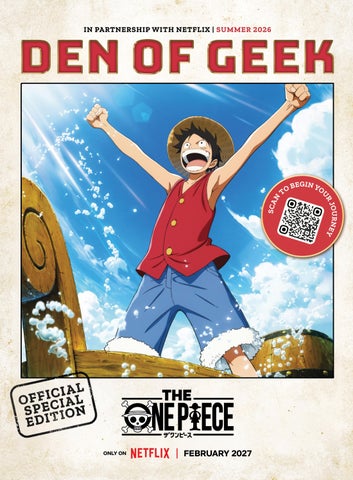
THE ONE PIECE
Learn how Netflix is reinventing a shonen classic for a new generation. PG. 22
BASS X MACHINA
Brian Tyree Henry gets candid about his new steampunk Western anime. PG. 34 4
DEN OF GEEK
BLUE EYE SAMURAI Get a refresher on the sword-slashing storytelling before season two's debut. PG. 40
RAY GUNN
Director Brad Bird breaks down his upcoming animated neo-noir sci-fi mystery. PG. 46
Yaniv Ben-Atia CEO
Matthew Sullivan-Pond PUBLISHER
Chris Longo
CHIEF CREATIVE OFFICER E D ITO R IAL David Crow SENIOR EDITOR-AT-LARGE Alec Bojalad MANAGING EDITOR Michael Ahr NEWSLETTER EDITOR ART Lucy Quintanilla CREATIVE DIRECTOR Jessica Koynock ART DIRECTOR
SAKAMOTO DAYS
Meet the colorful assassins and convenience store employees just in time for season two. PG. 6
Kyle Christine Darnell MAGAZINE PRODUCTION
LEGO ONE PIECE
Sarah Litt MAGAZINE COPY EDITOR
P R O D UC T IO N
Rosie Fletcher MAGAZINE SUB EDITOR
Everything you need to know about One Piece's exciting collaboration with LEGO. PG. 28
P HOTO & VID E O P R O D UC T IO N Nick Morgulis SENIOR VIDEO PRODUCER Andrew Halley HEAD OF VIDEO PRODUCTION
ON TH E COVE R july variant cover:
The One Piece
august variant cover:
Cyberpunk: Edgerunners
Literally Media is a network of legacy, iconic internet brands, boasting the #1 humor network on comScore, and creating content daily in the meme, comedy and entertainment space. IN PARTNERSHIP WITH NETFLIX
©2026 LITERALLY MEDIA ALL RIGHTS RESERVED
DEN OF GEEK
5
A ss a ss in STUDIES 101 SAKAMOTO DAYS season one introduced many chaotic characters whose stories will get bolder in the upcoming season. Here is a guide to the characters that make the series so entertaining. BY NYLA GILBERT
6
DEN OF GEEK
S
AKAMOTO DAYS looks like a straightforward action-comedy about a retired hitman turned family man. However, the series’ greatest strength lies in its colorful cast of characters, each with their own unique motivations, fighting styles, and emotional depth that push the story further. From legendary hitmen to eccentric allies, and merciless serial killers, every character shapes the chaotic and heartfelt world of SAKAMOTO DAYS. For those looking to understand the personalities that have made this show one of Netflix’s most compelling anime hits, here is a guide to each prominent character in season one and what to expect from them in the upcoming season.
TARO SAKAMOTO The main protagonist of the series, Taro Sakamoto was once considered the best assassin in the world. After meeting his wife Aoi Sakamoto and having their daughter Hana Sakamoto Taro retired from his life of bloody crime to become a contributing convenience-storeowning member of society. That peaceful life gets complicated when a former member of the Order, an elite special unit of the most dangerous assassins in the Japanese Association of Assassins (JAA), places a $1 billion bounty on Sakamoto’s head, forcing him back into the world of highly trained assassins. Taro’s deep respect and love for his wife and her “No Killing” rule have taught him the value of human life. As more and more challenges come into his world, Taro not only abides by his new code but enforces it in those around him. Along the way, he has made new allies, friends, and unofficially-officially adopted some unlikely characters into his own family. Heading into the new season, Taro returns to his past by re-entering the Japan Clear Creation (JCC) school for aspiring assassins, with both Taro and Shin taking the JCC entry test. DEN OF GEEK
7
8
DEN OF GEEK
Shin passed, while Taro was rejected due to the bounty on his head, which forces Taro to disguise himself as his wife so he can go undercover as a teacher, while Shin poses as a student to infiltrate the JCC database.
SHIN ASAKURA Fan-favorite Gen Z deuteragonist, Shin “The Clairvoyant” Asakura is straightforward, honest, and calculating. While serious in battle, Shin is known for his comedic outbursts that make him entertaining. Once an old student and partner of Taro’s, Shin was sent to kill him for his betrayal of leaving the JAA. However, after failing to kill Taro and seeing the importance of Taro in the lives of his family and community,
Shin becomes one of Taro’s greatest defenders. While Shin jokes about Taro’s (who he affectionately calls “Mr. Sakamoto”) weight gain and lax nature since retiring, he has a great deal of respect for the man that Taro has become. In the new season, Shin takes a step to center stage as he goes undercover with Taro inside the JCC. Posing as a student, he has to survive an assassination school with a 10 percent survival/graduation rate while locating the JCC database in order to gain information on Slur.
LU SHAOTANG The daughter of a Triad family, Lu Shaotang is the cheerful clerk of the Sakamoto convenience store alongside Shin. Lu dropped onto the scene, literally, while trying to find and protect her family’s legacy after they were killed defending their family vault. Hunted by the Dondenkai assassins, she meets Taro and Shin, who help her defeat those sent to kill her. A drunken fist-style fighter, Lu’s strength depends on her alcohol levels. In her and Shin’s battle with Saw, one of the four death row serial killers released by Slur to distract the order, she drank a bottle of 200-proof ethanol that saw her battle prowess increase tenfold, with her moving so fast that Saw couldn’t keep up. Viewers can also see her multiple drunk personalities, including “Crying Drunk,” “Angry Drunk,” “Happy Drunk,” and “Triad Drunk.”
HEISUKE MASHIMO Sakamoto’s dead-eye shooting delivery man, Heisuke Mashimo, is a major supporting character in SAKAMOTO DAYS. A low-ranking assassin and talented sniper, he had a hard time finding a job due to the stringency of his skillset, lacking the adaptability of a hand-to-hand combat specialist, and hoped to prove himself by killing Taro and DEN OF GEEK
9
claiming the bounty. He instead finds praise, recognition, and acceptance from Taro, who hires him to work for the convenience store. This turns him from a homeless sniper forced to bunker down on the tops of buildings with his pet bird, Piisuke, into a Sakamoto family member.
undercover in the JCC to get information on Slur. Season one left off with Nagumo and his fellow Order members, Shishiba and Osaragi, having business to take care of in Kyoto. It can be expected that Nagumo’s character arc will pick up there.
NAGUMO
AOI and HANA SAKAMOTO
Current member of the Order and former classmate of Taro’s, Nagumo is a close friend of the Sakamoto family. Having kept contact with Taro after his retirement, Nagumo has known Taro since their enrollment as students at JCC. There, they would be a part of a legendary assassin’s trio, alongside Rion Akao, and become the youngest members of the Order. Nagumo is a master of disguise—being able to not only copy others’ personalities perfectly but also alter the appearances of others. Nagumo is the one who disguises Taro as his wife Aoi so he can go
Aoi Sakamoto is the wife of Taro Sakamoto. She is the reason behind his departure from the assassin’s lifestyle and holds a strict moral code that every member of the Sakamoto family is expected to uphold. She can be extreme in her methods in proving her point, even throwing herself off a building to teach Taro the importance of human life, yet her fearlessness, confidence, and hope are her defining characteristics. Hana Sakamoto is the lovable daughter of Taro and Aoi. She isn’t seen much in the series, but she is shown to be adored by all those around her.
10
DEN OF GEEK
X/SLUR The slippery antagonist of the series, X/Slur is a serial killer set on taking down the JAA. Around the same time Taro’s bounty was placed, Slur wiped out one-fourth of assassins, leaving behind his signature “X” marker at the crime scenes, which he wrote with his victims’ blood. At the conclusion of season one, not much is known about the white-turtleneck-clad killer. In a confrontation between him and Taro, it is revealed that they were in the same class at JCC. However, he was never seen as remarkable then, as Taro, Nagumo, and Rion took the spotlight for their unnatural abilities and rivalry. By the end of season one, Slur has successfully kidnapped Nao Toramaru and Mafuyu Seba, turning them into agents inside the JCC. Slur’s newest nefarious scheme in his battle to dismantle theJAA is one of the many stories to unfold in season two.
Season Two: Enter New Characters— Japan Clear Creation Students & Faculty Season two introduces a new setting, Japan Clear Creation, the school for aspiring assassins, and a band of new characters. Etsuko Satoda, voiced by Misa Watanabe, is a retired assassin and teacher at JCC, teaching assassination practice. Former Order member Yotsumura, voiced by Shinshu Fuji, will be making an appearance this season. Introduced in the last episodes of season one is Akira Akao, the niece of former Order member and friend of Taro and Nagumo, Rion Akao. Akira is set to find her missing aunt, hoping the JCC is the place where she can find more information and develop the skills necessary to embark on her journey to find Rion. SAKAMOTO DAYS Season 2 starts streaming on Netflix in January 2027. DEN OF GEEK
11
12
DEN OF GEEK
Cyberpunk: Edgerunners returns for another round of transhumanism with a brand new set of characters who are pushed to their limits in the techno-dystopia Night City. BY DANIEL KURLAND
N
IME'S RICH RELATIONSHIP with games goes all the way back to the ’80s and has only become more prominent over time. Netflix has found tremendous success with its anime adaptations of iconic gaming franchises such as Castlevania, Devil May Cry, and Arcane. This synergy often feels natural, but it’s still a challenge to pull off in a way that appeals to both seasoned gamers and anime acolytes who have never worked their ways through these virtual worlds. 2022’s Cyberpunk: Edgerunners, a passionate extrapolation of CD Projekt Red's Cyberpunk 2077 RPG, has set new standards regarding video game anime. DEN OF GEEK
13
Even Cyberpunk tabletop RPG creator Mike Pondsmith and acclaimed video game industry visionary Hideo Kojima (Metal Gear Solid, Death Stranding) praised Cyberpunk: Edgerunners as a modern cyberpunk classic and a triumph in world-building. To many, the prospect of returning to Night City for a sequel and losing this magic would be tempting fate. However, leave it to CD Projekt Red and Studio Trigger to find a way for lightning to strike twice and match Cyberpunk: Edgerunners’ excellence, albeit in a brand-new package. Cyberpunk: Edgerunners 2, which drops its entire 10-episode season
this fall, plugs into a brand-new tale of tech-driven revenge, rebirth, and revolution with a fresh cast of characters. If Cyberpunk: Edgerunners’ fans thought David Martinez, Rebecca, and Lucy were a lot to handle, they’ll need to prepare themselves for what Weak Kingsley, D, and Roman Carax bring to the techno table. Cyberpunk: Edgerunners 2’s showrunner and executive producer, Bartosz Sztybor, along with the series’ director Kai Ikarashi tease what fans can expect in their return visit to Night City in what’s guaranteed to be one of 2026’s most talked-about anime.
PHOTO CREDIT: HBO
Set in Cyberpunk 2077’s Night City technocracy, the anime forged a unique path forward with an original story that matches Cyberpunk 2077's ethos rather than a straight adaptation of the video game. Not only did Studio Trigger’s Cyberpunk: Edgerunners resonate with anime fans, accruing nearly 15 million hours of viewing in its first week alone and winning Anime of the Year at 2023’s seventh Crunchyroll Anime Awards, it also led to a symbiotic relationship that saw even more gamers logging into Cyberpunk 2077’s Night City to immerse themselves in this cybernetically-enhanced dystopia.
14
DEN OF GEEK
The first season of Cyberpunk: Edgerunners was such a breakout success. Any time a second season or sequel for a project gets announced, there’s some degree of trepidation over whether it can match its predecessor’s quality. What was the process like putting this second season together, and why was it the right story to tell in this return to Night City? Bartosz Sztybor: I already had ideas
for Edgerunners 2 while writing David’s and Lucy’s story. I already knew that though one story arc was finished, Night City had more stories
GET TO KNOW CYBERPUNK'S
WEAK KINGSLY
Once known as “King,” a veteran edgerunner at the top of his game, Weak now lives in the shadow of his former glory.
DEN OF GEEK
15
GET TO KNOW CYBERPUNK'S
TALIA YANG
Raised in corpo towers but hardened in Maelstrom’s grip, Talia is fiercely independent and steeped in the gang’s hyper-violent, chrome-obsessed culture.
to tell, as there’s so much more to say about the ethos of being an edgerunner. As for the process of finding the right story and style for Edgerunners 2, that was actually rather simple! We knew from the start that it needed to be something completely unique but true to the core pillars of Edgerunners. Of course, there were moments when I had doubts about making that choice. I’ve even had nightmares about it. After all, fans love David and Lucy’s story so much! But we also knew that their story was concluded. Even though some fans ask for David’s resurrection, we should honor his and Edgerunners’ legacy. So to get back to the original question—I wanted to take those core story pillars and themes of Edgerunners and present them from a totally different perspective. With different characters, the audience can see different outcomes that draw from the particular decisions and choices these new characters, new people, make.
Cyberpunk: Edgerunners 2 tells an original story with new characters. With so much changing, were there any particular elements from the past that you knew you needed to include to represent the series’ DNA? Sztybor: Yes, I already mentioned
those story pillars and themes that you knew from Edgerunners, so of course the show had to be about that: edgerunners in Night City. More often than not, cyberpunks are mercs working for fixers, but it’s a group that also includes people who are living on the edge, those who can’t fully cope with the reality around them and try to rebel against it in their own way. Beyond that, there are many more avenues and themes that are part of that DNA. The edgerunners ethos, the sense of sacrifice, different kinds of love in a bleak reality, even a relationship with your parents as
16
DEN OF GEEK
something that makes you who you are. If you recall the very first episode of Edgerunners, with David and his mother Gloria—that scene between them in the car, before the tragic crash occurs—we’re going deeper into moments like that.
You were both involved with Cyberpunk: Edgerunners’ first season. How was that previous experience helpful—and potentially challenging—for returning to this world?
"We’re living a cyberpunk reality right now, so what was a dark future 40 years ago is now super close to reality." — BARTOSZ SZTYBOR
Sztybor: I definitely took all of my
knowledge and experience working DEN OF GEEK
17
with Studio Trigger into Edgerunners 2. Working together with them on Edgerunners opened me up a lot, and I learned so much. Of course, it’s a new creative team for Edgerunners 2, but their processes and the way they understand and interpret the story are rather similar. And it felt great that I could use that experience and knowledge from Edgerunners right away and hit the ground running. Of course, working with a new director is always going to bring a new challenge, too; it’s a new perspective with new ideas, after all. But from the very first meeting with Kai Ikarashi, I had a feeling we had a similar taste in music and movies (and I was right!), so there was a mutual understanding between us and what stories we wanted to tell. Kai Ikarashi: Having worked on
Cyberpunk: Edgerunners as an episodic director, I had a good idea of how to approach the visual style. Whether I chose to deviate from that framework or fit right into it, having that baseline made the process a lot more manageable. As for the story, I
18
DEN OF GEEK
"As for the story, I figured it would be difficult to put together something on par with the original season. And in reality, it truly was challenging." — KAI IKARASHI
figured it would be difficult to put together something on par with the original season. And in reality, it truly was challenging.
How is the version of Night City that’s seen in Cyberpunk: Edgerunners any different from
the first season? Has a lot changed since the first season’s events?
Sztybor: Tricky question; it depends
how deep you want to go when you talk about change. In fact, I’d rather not say and leave this up to the viewers to see for themselves.
GET TO KNOW CYBERPUNK'S
Kai Ikarashi: In my opinion, it hasn't
changed, because a system like that cannot be changed so easily.
Was there ever the temptation to tell a more conventional sequel that’s a direct continuation of the first season or was it important to let those characters rest? Sztybor: Never. Well, only those
recurring nightmares that are whispering... no, screaming into my ear that it should be more conventional... But no, David’s story came to an end. It’s his legacy. At CD Projekt Red, we don’t want to rely on fan service. We want to create new things, explore the unexplored, risk and experiment to always lead, never follow.
D A Snake Nation netrunner with sharp technical skills and a sharper hunger for revenge, D hunts the killer who wiped out his clan.
Curiously, the first season’s intense melodrama and emotional devastation were a huge part of what made Cyberpunk: Edgerunners such a success. Are these tonal elements that have carried over to Cyberpunk: Edgerunners 2? Sztybor: Yes, that’s one of the core
elements of Edgerunners as a series. Of course, we can’t repeat ourselves; we need to surprise fans and play with their expectations, but yes—if you want trauma, Edgerunners will deliver.
Cyberpunk: Edgerunners’ eclectic cast of characters won over fans with their creative designs, which felt unique but also authentic to the cyberpunk experience. What were some of the challenges with designing a whole new cast of characters? Were there any limitations or mandates present or changes that had to be made? Sztybor: One thing that we had to
keep in mind was the Cyberpunk 2077 design style, so every character needed to stay true to the world. But if you look at Doc or Faraday in Edgerunners, both characters DEN OF GEEK
19
GET TO KNOW CYBERPUNK'S
ROMAN CARAX
Roman Carax is a young cinephile chasing real stories in a city that’s abandoned film for braindance. Obsessed with documenting truth, he shadows the lives of others—only to learn that unlike his favorite reels, Night City’s stories are messy, brutal, and rarely tied up with a clean ending.
introduced new design ideas that we then incorporated into our lore. So, we wanted Studio Trigger to have some artistic freedom to explore crazy ideas. But the biggest challenge was the one you already mentioned. How do you make the characters of Edgerunners 2 stand out, and feel interesting in their own right after you’ve already had such an amazing and original cast in Edgerunners? Thankfully, we didn’t let that tame us. We didn’t search for originality just for the sake of it. We knew that edgerunners have their style, so it needs to be recognizable, but we can play with their look here and there. 20
DEN OF GEEK
We’re also introducing types of characters that we were not exploring in Edgerunners, and we have two super wild designs that I think will make fans incredibly excited.
Revenge is a major part of Cyberpunk: Edgerunners’ story. Can you talk about its role this season and why vengeance was important to explore? Sztybor: Revenge was David
Martinez’s drive, and it is one of the core emotions for Edgerunners as a series, so we wanted to explore that further. Revenge itself is also a very
common thing in this world where you need to fight to survive. And sometimes you can hurt someone, even if you had your own good reasons (in a moral sense), the outcome can be perceived as negative for someone else. Moral ambiguity is a very important topic in everything CD Projekt Red works on, and vengeance is a great story engine to explore it. Kai Ikarashi: I believe that revenge
represents a powerful personal emotion that exists independently of any system. That is why it was brought as a theme in Cyberpunk:
Edgerunners 2.
Why do you think the cyberpunk genre is experiencing such a renaissance and appealing to so many people right now? Sztybor: We’re living a cyberpunk
reality right now, so what was a dark future 40 years ago is now super close to reality. On one hand, people see it as a cautionary tale, but on the other hand, it is something that is getting closer and closer, one year or even one week ahead. Cyberpunk is also a tale of humanity and identity, so it perfectly catches the zeitgeist. DEN OF GEEK
21
Netflix's THE ONE PIECE sets sail for a brand-new take on one of anime's most iconic series that's bigger, bolder, and more accessible than ever. BY DANIEL KURLAND
E
IICHIRO ODA'S ONE PIECE ISN'T JUST A groundbreaking pillar of the anime industry, it’s a Guinness World Record-holding pop culture sensation that’s more popular than ever. ONE PIECE’s icon Monkey D. Luffy has proudly been featured in the Macy’s Thanksgiving Day Parade, the series has inspired a New York Fashion Week runway event, and even launched a collaboration with the NBA that recently saw Luffy become an honorary member of the New York Knicks! After 22 seasons, more than 1165 episodes, and 15 movies, it’s hard for ONE PIECE to genuinely do something new at this point. So it’s perhaps only fitting for the swashbuckling shōnen series to go back to where it all began–literally.
"We got a contact from Netflix,” explains George Wada, co-founder and president of WIT Studio. “They asked me if I wanted to challenge myself to a task." And what’s a greater 22
DEN OF GEEK
challenge than reinventing ONE PIECE for a whole new generation of fans? For nearly three decades ONE PIECE has represented the epitome
DEN OF GEEK
23
of action-adventure anime. Monkey D. Luffy and his intrepid Straw Hat Pirate crew have defeated incredible rivals and covered unbelievable ground since the humble start of their voyage. Now, with Oda’s manga soaring to new heights, Netflix anime THE ONE PIECE is a bold new adaptation with cutting-edge visuals and a fresh creative approach. THE ONE PIECE turns the clock all the way back to the original manga’s introductory East Blue Saga in which Luffy assembles his Straw Hat Pirate crew and befriends evergreen allies like Nami and Zoro. Coming from the acclaimed WIT Studio, which is responsible for Ranking of Kings, Great Pretender, Bubble, and Attack on Titan's first three seasons, THE ONE PIECE is guaranteed to be a visually beautiful reinvention of this shōnen staple. The East Blue has never looked so fresh. THE ONE PIECE comes along at a time when modern reboots of cherished classics are having a bit of a moment between Urusei Yatsura, Hell Teacher Nube, Ranma 1/2, and the upcoming Dragon Ball Super reboot. What helps THE ONE PIECE stand out from its peers is the unabashed passion for this exciting vision. “I took this project because I didn’t want anyone else working on it,” admits THE ONE PIECE director Masashi Koizuka (Attack on Titan, Moonrise) who first discovered ONE PIECE when he was a teenager in high school. “I remember the feeling of this new series making a splash even among heavy hitters. It was packed with a sense of wonder, an excitement of facing the unknown.” This passion translates into a unique identity and voice for THE ONE PIECE, albeit a spin that’s still faithful to Oda’s sensibilities. “I had to possess him [Oda] in myself,” explains Kyôji Asano, THE ONE PIECE’s character design and chief animation director on the unusual process of revising an iconic classic. “For these two months, I was 24
DEN OF GEEK
determined to just draw ONE PIECE, which was why I shut myself in.” Koizuka elaborates upon the unusual expectations that arise with any adaptation, let alone for ONE PIECE. “I want you all to express, rather than copy and paste the work,” is advice that Oda wished upon THE ONE PIECE’s staff, according to Koizuka. “For example, it’s creating your interpretation and expression instead of recreating a panel from the manga.” The people working on THE ONE PIECE are genuine fans who have lived and breathed the series. This delicate balance that celebrates the original’s essence, but still pushes the source material forward, is essential for THE ONE PIECE’s success and the whole point of this project. The sense of adventure and enthusiasm from the Straw Hat Pirates transferred over to Koizuka. "It kept me at the edge of my seat every single week, and I remember being hooked to that feeling." Now
he's recreating that experience for a new generation. "If kids across the world could feel the same way I did when I was a high schooler, if they could experience the same thing, I'd love nothing more." THE ONE PIECE does take some liberties with its characters’ designs and the presentation of its iconic story. This 2027 anime doesn’t just redesign the original, but it incorporates quality of life updates that highlight how much the anime industry has evolved in the past 27 years. Additionally, ONE PIECE’s lofty reputation precedes itself. It’s great that there’s so much of ONE PIECE to enjoy, but it's honestly intimidating to just casually jump into an anime after hundreds of episodes. Even with guides that attempt to streamline the ONE PIECE experience, it’s still a lengthy commitment that’s enough to dissuade curious fans. THE ONE PIECE breaks down this barrier and DEN OF GEEK
25
26
DEN OF GEEK
“If kids all across the world could feel the same way I did when I was a high schooler, if they could experience the same thing, I'd love nothing more.” — MASASHI KOIZUKA, DIRECTOR
makes ONE PIECE more accessible than it’s ever been. It is the perfect equalizer for both seasoned Straw Hat Pirate fans and those who have been curious to set sail for the Grand Line. THE ONE PIECE will distill the manga’s first 50 chapters into seven episodes that will accumulate to around 300 minutes. THE ONE PIECE’s first season should conclude around the point in the Baratie Arc when Luffy meets Sanji—an ideal entry point for new fans, and a fresh
lens through which longtime fans can experience the adventure all over again. ONE PIECE’s East Blue Saga would be an unreasonable binge in its current state. However, THE ONE PIECE flips the script and opts for a style of frenzied, serialized viewing. Netflix will be dropping all seven episodes of THE ONE PIECE at the same time in February 2027. A weekly release model wouldn’t have been unheard of, considering that’s how ONE PIECE has aired for decades in Japan. But a deliberate shift to a binge-watch model reflects the more modern sensibility that’s being applied to THE ONE PIECE and why it’s a fresh take on this story for a new time and audience, rather than claiming to be the definitive version of Oda’s story. With well over 1000 chapters of manga to pull from for inspiration, the sky’s the limit for THE ONE PIECE. While there were initially predictions that THE ONE PIECE would be a one-off miniseries, WIT Studio has indicated that they’d like
this version of Oda’s story to run for as long as possible and are interested in bringing all of Luffy’s adventures to life, in time. In fact, the project’s size and scope continued to expand during production. "The series has a runtime of 300 minutes," clarifies Koizuka. "It was originally planned to be shorter than that, but I had so many things I loved and wanted to include, the runtime just kept getting longer and longer." Koizuka and his team were determined to tap into the manga's timeless quality and this story's ability to connect on a universal level, "We want you to experience a new ONE PIECE from the very beginning, all over again." It all feeds into a grander desire for ONE PIECE to evolve into something even greater this decade. Netflix is far from finished with ONE PIECE as its universe continues to grow between the existing anime series, the live-action series, and now THE ONE PIECE. It’s an embarrassment of ONE PIECE riches that’s fit for a king of pirates. DEN OF GEEK
27
BRICKBY-BRICK
Showrunner and executive producer Tom Hyndman shares how LEGO® ONE PIECE puts a fresh spin on the fanfavorite Netflix live-action series. BY SAM STONE 28
DEN OF GEEK
W
ITH LONG-RUNNING MANGA and anime series, waves of merchandising, and an acclaimed live-action adaptation on Netflix, it’s safe to say that ONE PIECE remains a bona fide global phenomenon. Audiences will get to experience the beloved franchise like never before with the Netflix animated special LEGO ONE PIECE, poised to set sail on the streaming service on Sept. 29. The two-part special boasts the main cast from the live-action Netflix series reprising their fan-favorite roles, with Tom Hyndman serving as showrunner and executive producer.
The special has Usopp (Jacob Romero) recount the events of the first two seasons of the live-action series, including how he met and befriended Monkey D. Luffy (Iñaki Godoy) and joined his crew of Straw Hat Pirates. However, while detailing his seafaring adventures in search of the mythical One Piece, it becomes clear that Usopp might not be the most reliable narrator, especially for viewers in the know as to how things actually unfolded. All this is gorgeously rendered in iconic LEGO brick style, with the Netflix special leaning into the family-friendly antics that LEGO projects are known for. In an exclusive interview with Den of Geek, Tom Hyndman shares how he and the creative team reimagined creator Eiichiro Oda’s swashbuckling world to life in LEGO form, blending the signature themes and humor of ONE PIECE with the presentation and tone associated with the LEGO Group. Den of Geek: Tom, what’s your elevator pitch for LEGO ONE PIECE? Tom Hyndman: Shockingly, there are
still people who don't know what ONE PIECE is, so this is a way to bring a younger audience in and provide them with an easier way to get the general layout of at least the first two seasons of the live action. A lot of it hits on the first 200 chapters of the manga. It can be a pretty big lift to really jump into ONE PIECE, so we're hoping we can do it this way, where newer fans can get a real overview of the live action and what DEN OF GEEK
29
that is, with a little bit of fun and a little more humor. For hardcore fans, hopefully, it's a fun alternate version of the first 200 chapters or so, told from Usopp's perspective, which is something that really drew me to the core concept of this, having worked on the first two seasons. It's not just copying and pasting scripts from seasons one and two. We did a big change in a different perspective and had a lot of fun with it, but obviously kept the core of what ONE PIECE is the same, because that's what makes it so wonderful, and such a worldwide phenomenon. How did you thread that narrative needle between creating a standalone story while also creating something for newer viewers, introducing them to ONE PIECE through LEGO minifigures and elements?
The first step was to figure out what exactly we wanted to show in the two episodes. And then, building out from there is, how can we tell this in a new, fun way? That was step two. We have the new fun way that we're gonna say this, we have these fun jokes, now let's figure out what easter eggs we can bring in or the things that weren't in the first season that we could pop in, where people who really know about it are like, “Oh, I know about that!” It's a different perspective, and it brings a lot more humor into it and a lot more silliness. It's just a little bit lighter than the live action. It's just a fun way to do it that hopefully can appeal to everybody, new and returning.
In shifting to Usopp’s perspective, how was it catering to more hardcore ONE PIECE fans who haven’t really seen that change in perspective before?
It was exciting to be able to tell the story where we're keeping the core of it, but we could get a little fabulous. Using LEGO elements, there's a lot of fourth-wall breaking and being able to use that to keep things on track; that was the big thing. Usopp is going absurd, but if he's doing it in front of any of the Straw Hats while telling the story, they will call him out and be like, “That never happened,” and then he'll either change it back to what did happen or be like, “Well, that's how I remember it.” That was what pulled us to it. Jacob Romero is just so fun and really embodies that character, and so to let him cut loose with this new Usopp stuff definitely was also something that we were really looking forward to, because we know he could do
such a phenomenal job at it. Beyond Jacob, you’ve got the main cast reprising their roles for LEGO ONE PIECE, which really underscores how much of an organic extension this is. How was it shaping the story and tone of the special with that in mind?
It honestly made it a lot easier because you know they are all coming in embodying these characters already, so we didn't have to really find anything. There's some fine-tuning with the over-the-topness of LEGO humor. It was more just like, “Okay, you know the line. Just make it a little bit bigger, a little bit more ridiculous.” My hope is that they also had a lot of fun doing this, and, from what I've heard when talking to them, they definitely did. It's like playing the same character, but being able to throw a little different spin on it. It just shows that, yeah, it is part of the
larger Netflix ONE PIECE world and the continuity of having Emily Rudd, Iñaki Godoy, Taz Skylar, Mackenyu, and Mikaela Hoover. It definitely de-stressed my whole situation of worrying if they were going to be able to pull this off. As soon as we knew everybody was doing it, it pretty much answered that question, and
"HOW CAN WE SYNTHESIZE THINGS, MOVE THINGS AROUND, STILL RESPECT EVERY MOMENT OF IT, AND MAKE IT WORK?" – TOM HYNDMAN, SHOWRUNNER AND EXECUTIVE PRODUCER
we could move on to how we were going to make this and write it. ONE PIECE is wacky and over-thetop, while LEGO animated specials have their own distinct sense of humor. How is it meshing those two sensibilities together into something cohesive?
It's like an amp-up effect, where you get the story, and then write the first draft of the script, and the notes are like ‘how can we amp this up and make this a little bit more ridiculous?’ It is this three-step process of figuring out what the script looks like, going in and really fine-tuning every joke and every LEGO moment in every big action scene to really add to it and blow it all out. That is the opportunity that doing this as a LEGO special really lends itself to getting your creative mind just going everywhere. It's really fun to just be like, “Can we do this? Yeah, we can, let's try it out!” The director [Chelsea Ker] and the storyboard artists were so phenomenal at finding things I would have never even thought of. It was also such a wonderful team effort to make this happen and to make it as aligned with the LEGO brand as possible. With ONE PIECE so big and globally recognized, what is your guiding light or North Star in interpreting it in live action or in LEGO form?
The manga is definitely the North Star; everything comes from that. You want to honor it as much as humanly possible while still telling an interesting story that will bring in new people, and it's not just a retread of everything. It was the same in the live action. We have this amazing thing, so how can we synthesize things, move things around, still respect every moment of it, and make it work? I think we did it really well in the live action, and I hope people feel the same about the LEGO version. It's always honoring the manga DEN OF GEEK
31
and putting our own spin on it, but never losing sight of the manga, because I think that's what made the live action work so well. We weren't changing huge things. We were sticking to the story, and then we were finding moments within that story to change it up a little bit, more because we can't do a 100-hour first season of anything, and it's the same with the LEGO specials. We're trying to fit eight hours of television into 27 minutes, so how can we stick to the story and respect it and still cram it into everything? I think we really did a good job of doing that with everything that we did in these two episodes.
In the wider pantheon of the franchise, what do you hope people walk away with after watching LEGO ONE PIECE?
The biggest hope would be that they click off the second episode and then immediately click into the live action or start reading the manga. We want to spread it as far as possible, with this being the easiest way to dip your toes. Hopefully, it inspires people to really dive in, where you get a little taste of it, and then hopefully, love it and want to know everything about this, and then watch a million episodes of the anime or read a million chapters of the manga. ONE PIECE, in all of its forms, has always been about a found family as the Straw Hats come together. How was it maintaining that emotional core in the LEGO special?
It's challenging because of the crammed amount of time, but it's not ONE PIECE without it, so you have to do it. It was finding those very iconic
moments, like Luffy getting the hat from Shanks, things like that, staying true to those moments. Right from the beginning, we had certain things that we wanted to hit, and we're not going to mess with those things. It's not going to be jokey. We want to honor those moments because they are so emotional and intrinsic to the greater story of this. Having those moments still play out in a 90% true fashion, without Usopp getting his hands on them, was a very important thing for us. The found family is the whole thing. It's just these people coming together, and the only way that they will achieve their dreams is by
doing it together. This is not a solo thing. That is such a wonderful message, especially in the world today. That was definitely a big guiding light for us. On a more personal note, when you look at the full breadth of ONE PIECE and having gotten to play in that sandbox creatively, what does ONE PIECE mean to you?
an honor and a privilege, but it's also so much fun to get to do this. It's a beautiful story, and now that I've been in the world a lot more, I know a lot more about it; it's such a positive thing. I think we could use a lot more positive things. To spread that positivity is truly an honor and just a very cool thing to do.
On a strictly personal level, it means just about everything to me, not necessarily even on, like, a story thing, but having been able to be involved in this has completely changed my life. I will never work on something with this kind of footprint ever again. It is such
DEN OF GEEK
33
L AY ING DOW N
THE LA
34
DEN OF GEEK
AW
Brian Tyree Henry, Studio Mir, and Netflix proudly present a new breed of hero who battles outlaws, automatons, and elemental adversaries in a steampunk Western package. BY DANIEL KURLAND
DEN OF GEEK
35
B
RIAN TYREE HENRY has never been afraid to let his geek flag fly. “When I took this show, I remember thinking, ‘I hope I get Black nerd street cred,’” Henry admits. “I’m a Black nerd. I’m a total geek. I love cosplay. I love Comic-Con. I love comics. I love animation. I love anime. I love it. I love it. I love it.” That being said, despite Henry’s enthusiasm, it hasn’t always been easy to find representation in these forms of fandom. 36
DEN OF GEEK
“What I’ve noticed about some of these arenas is that they don’t really reflect how much we really love it. It doesn’t often feel like we are part of the narrative of that story,” he adds about representation. “What’s really great about Bass X Machina is that it’s existing in this land that we created and that’s so intertwined in such a wonderful way. They’re all trying to figure out how to exist in this world that’s denied them something. I’m hoping that fans, episode to episode,
my inner geek want? How do I feed him? How do I shut him up for at least a day or two?’ and this will do it. I'm quite excited to release Bass to the world.” In the case of Bass x Machina, it’s been a three-year-long journey to let Bass Reeves loose and establish a new normal for anime heroes. “I want Bass x Machina to create space for other Black nerds like myself who maybe don’t really feel like they’re seen,” he continues. “I’m hoping that Bass really creates a space and a lane that brings out
“I want it to speak to Black audiences, but I want it to be global as well. I want people to be excited about seeing something so fresh.” — BRIAN TYREE HENRY
can root for somebody that looks like them.” Bass X Machina, an upcoming animated series from Studio Mir that’s set to hit Netflix on Nov. 3, is described by Henry as a “crazy Spaghetti Western, steampunk punk rock” adventure. The series, which Henry executive produces and stars in, follows a heightened version of Bass Reeves, the first Black deputy U.S. Marshal, who fights for justice and his family in a wayward world
that's steeped in danger. The eclectic blend of genres on display in Bass X Machina brings to mind iconic anime space Westerns like Trigun, Cowboy Bebop, and Outlaw Star. It hits all the right bases for a challenging experiment that doesn’t feel the need to limit its options, which is also part of what makes it so exciting. "I always start with my inner nerd with every project that I do,” explains Henry. “I'm like, ‘What does
more stories like this, more adventures like this, and more heroes like this. I want it to speak to Black audiences, but I want it to be global as well. I want people to be excited about seeing something so fresh.” Clearly, Bass X Machina isn’t lacking in ambition, either onscreen or off. It’s a madcap mix of influences, styles, and spectacles that keep the audience’s heart racing from the jump. “We’re gonna make you feel stuff,” teases Henry. “We can say that we really went there and created this badass, funky eclectic brand-new way to tell a story of this historical figure that really existed. And where else better to do it than animation?” “Could a live-action version of this exist? Sure,” Henry adds. “But I DEN OF GEEK
37
“Animation has always, in my mind, been a form of protest against the norm. It can speak and reach people that you never thought would listen to certain beliefs.” — BRIAN TYREE HENRY
38
DEN OF GEEK
think that in the world of animation seeing characters like this exist is so necessary, especially in the time that we’re in now. Animation has always, in my mind, been a form of protest against the norm. It can speak and reach people that you never thought would listen to certain beliefs. Animation just has a further reach than if it were live action.” When it comes to Bass X Machina’s animation, South Korea’s Studio Mir (Devil May Cry, Kong: Skull Island) has gone above and beyond with its work here. Meticulous visuals, radical displays of power, and brutal battles punctuate every episode.
“Each episode is a final boss,” jests Henry in reference to the endless obstacles that Reeves faces on his blood-soaked rampage. “Every story needs a hero and every story needs a villain. The crazy thing about this show is that there are so many villains. Post-Civil War has a lot of villains in it. You’re watching Bass fight through most of that.” And on the topic of the series’ excessive brutality, Henry explains that blood is essential to Bass X Machina’s storytelling. “The overarching theme of the show is about blood. Blood ties. Blood loss. Bloodshed. What it all means. What
it really means to be blood. There will be blood this season.” This contemplative carnage would still hit hard if Bass X Machina were a complete work of fiction. However, it’s even more evocative due to how it holds up a distorted mirror to society. Explains Henry, “We’re dealing with real-life things. We’re dealing with segregation. We’re dealing with oppression. We’re dealing with all these atrocities that happened in this country at this time. After the Civil War was a time of Reconstruction, but it was also covered in so much blood. So much loss.” Henry is
honored to communicate that through genre-bending animation. Henry couldn’t be more thrilled over Studio Mir’s work on Reeves’ revenge, but there’s another aspect of Bass X Machina that he argues is just as important to its identity. “The music is one of my favorite parts,” gushes Henry over Janelle Monáe’s Wondaland collective and their bold work on the series. “We’re using Indigenous music, drums, and sounds. We’re using African instrumentation. We’re also pulling from the funk era, using jazz and hip-hop, and blending tones to really challenge what Westerns can sound
like.” Henry praises Wondaland for not just rising to the storytelling and animation’s level, but actively elevating it. “Do not skip the theme song, I promise you. You’re going to want to watch it every episode.” Brian Tyree Henry couldn’t be prouder of the series they’ve put together and for audiences to finally see Bass Reeves in action. He’s also hopeful that this is just the start of many adventures to come for his metal-armed lawman. “There are so many stories that are waiting for Bass,” he says. “There are so many things to discover.”
DEN OF GEEK
39
WHEN WE LAST LE FT MIZU…
We revisit the stunning swordplay and unforgettable storytelling of Blue Eye Samurai. BY SAM STONE
40
DEN OF GEEK
NEEDS TWO KOMET QUOTE STYLES NEED STORY NEED TWO PULL QUOTES. NEED FINAL SECTION COLOR
I
T'S BEEN THREE YEARS SINCE BLUE EYE SAMURAI DEBUTED ON NETFLIX, and not only is the wait finally almost over, but the second season will be well worth the time taken to develop its return. Created by Amber Noizumi and Michael Green, the award-winning animated series follows a vengeful samurai named Mizu (Maya Erskine) during Japan’s Edo period. Blue Eye Samurai season two will up the ante as the narrative scope goes global, all while the action gets even bigger. So let’s take a look at Mizu’s journey so far.
DEN OF GEEK
41
ENEMIES NEW AND OLD Growing up as a mixed-race Japanese/Caucasian woman, Mizu faced a grueling amount of adversity and discrimination. This fuels a deep-seated fury within her and leads the budding samurai to train under Master Eiji (Cary-Hiroyuki Tagawa), a swordsmith who forges Mizu’s blade from a glowing blue ore found in a meteorite. As an adult, Mizu travels across the Japanese countryside, putting her expert swordplay skills to use while being tracked by a number of old enemies looking to settle their respective scores. Among Mizu’s most prominent rivals from Blue Eye Samurai season one is Taigen (Darren Barnet), someone who bullied Mizu as a child. In the series premiere, Mizu defeats Taigen in a duel, and the young swordsman becomes obsessed with reclaiming his honor and recovering his wounded pride in a rematch against her. Taigen’s vendetta derails his romance with Princess Tokunobu Akemi (Brenda Song), who instead proceeds with an arranged marriage to the shogun’s son.
MIZU ON THE MOVE Mizu is on her own quest, targeting the four European men who stayed in Japan despite its closed borders, with one of the men being Mizu’s biological father. Mizu blames this quartet for the mark of shame that has plagued her upbringing and vows to track each of them down, including their apparent ringleader, Abijah Fowler (Kenneth Branagh). Fowler plots to overthrow the shogunate and replace it with one more open to foreign influence in Japan, putting Mizu in the surprising position of determining the future of the country as she moves to stop him. It’s not only enemies and rivals 42
DEN OF GEEK
who follow Mizu along her journey. The quest is joined by Ringo (Masi Oka), a handless cook who is inspired after witnessing her in action. Despite her misgivings, Mizu agrees to take on Ringo as an apprentice, and he accompanies her on her adventure like a squire. Though Ringo is shocked by how singleminded Mizu’s thirst for revenge is, he continues to help both her and Taigen when they face a mutual threat in Fowler’s explosive scheme.
DEN OF GEEK
43
44
DEN OF GEEK
A FIERY VICTORY AND DEPARTURE The end of Blue Eye Samurai season one is riveting, with Fowler shattering Mizu’s sword before enacting his grand plan, successfully assassinating the shogun, despite Ringo and Taigen’s best efforts. However, Mizu directly confronting Fowler allows the rest of the shogun’s family to escape to safety. Unfortunately, the fire that she sets to stop the villain also rapidly spreads across Edo. In the aftermath, Akemi decides to remain with the shogun’s family despite Taigen pleading with her to rejoin him. Meanwhile, Ringo relocates to the home of Master Eiji, believing Mizu died in the fire.
NEVER ALONE Cornered by Mizu, Fowler claims that she will have to travel all the way to London to track down the remaining two men on her hit list. Furthermore, Fowler makes the shocking claim that the woman Mizu believed to be her biological mother was someone who was hired to raise her, triggering even more questions. Mizu is last seen sailing toward London with an alive but captive Fowler in tow as she moves to face the last two figures in her lifelong feud.
TO PARTS UNKNOWN Even with this expansion of global scope in the story, Blue Eye Samurai season two still has deep roots in Japan. An early clip released from the new season revealed an apparent flashback, with Mizu participating in the storming of a Japanese castle, back when she still had her sword, as deadly as ever. And despite how fiery and intense the season one finale was, there are still plenty of living characters poised to join the new faces being introduced throughout the second season. Blue Eye Samurai has all the intensity and sophisticated storytelling of any number of live-action samurai stories, while taking advantage of the bombastic possibilities of its vibrant and atmospheric animation style. Those qualities are only heightened in a second season that will not just go bigger and bolder with its narrative but deeper into the raw emotional arcs of its main characters. Mizu is out on the high seas, headed for strange lands, but no less determined and utterly driven. And there is still plenty of unfinished business and open questions waiting for her back in Japan, ready to dive into when Blue Eye Samurai returns this year. DEN OF GEEK
45
GUNNING FOR
GREA
46
DEN OF GEEK
ATNESS Brad Bird is realizing a lifelong dream by booting up his Ray Gunn... BY MAX EVRY
P
ASSION PROJECTS IN HOLLYWOOD have a mixed history. For every triumph that spent decades in development, like Avatar or Mad Max: Fury Road, there are the cautionary tales, à la Megalopolis or The Man Who Killed Don Quixote. But if one were going to put money on someone’s passion project paying off, they’d be hard-pressed to find a better bet than Brad Bird, the genius behind Pixar’s two Incredibles flicks and Ratatouille, as well as the live-action Mission: Impossible – Ghost Protocol. With over $3.4 billion in career global box office, Bird is finally cashing in chips on the sci-fi noir Ray Gunn, a project that began development for the filmmaker in the 1990s as a hand-drawn animated feature. It’s remained a dream ever since: an overdeveloped retro-futurist city where aliens and humans co-exist.
“It always felt like we were in opposition to somebody who didn’t get what we were trying to do,” Bird says of Ray Gunn’s long genesis. “You talk about noir, people aren’t going, ‘Oh, well, that’s the greatest thing for little kids.’ But it isn’t for little kids; it’s for people who love movies. There’s always something to overcome if you’re trying to do
something different.” From the outset 30 years ago, Bird’s offbeat vision was always centered on a mystery involving a pop singer named Venus Nova being unraveled by small-time private eye Raymond Gunn and his one-eyed alien partner Eyera. After conceiving early drafts of the screenplay solo, Bird partnered up with Matthew Robbins, DEN OF GEEK
47
the writer/director behind Dragonslayer and Batteries Not Included (the latter of which Bird co-wrote in 1987). Says Bird, “Early on in my career, people didn’t feel comfortable with me writing something alone. They wanted somebody with more experience, which Matthew definitely has. We got along well, so Matthew and I co-wrote the third and fourth drafts of Ray Gunn, then I went on to do five or six drafts after that.” Despite a script that played like 1930s Blade Runner starring Alan Ladd and a snappy extraterrestrial being in place by 1996, with some stunning concept art, Ray Gunn has been a hot potato, passed from Turner Pictures to several iterations 48
DEN OF GEEK
at Warner Bros. until it finally landed at Skydance through its partnership with Netflix. “At one point Warners expressed a lot of interest in doing it and then the pandemic happened,” Bird says of a 2010s iteration of the project. “They got bought by AT&T, and AT&T is not going to make an original film. They want Matrix 17 and Batman 47… they’re a telecom company." Luckily, Bird was able to use his clout to negotiate the project away from WB. But upon finding a new home at Skydance Animation, the powers that be insisted he pivot from 2D animation, with some CG elements for the sake of fluid camerawork, to the modern status quo of all CGI.
“Financial people feel like hand-drawn animation is oldfashioned and not commercially viable, a view I do not share at all… but you swim in the lake you’re in,” Bird acknowledges. “I love CG. I’ve done four films in CG, but I viewed Ray Gunn as a hand-drawn film. I did have to shift it to, ‘How can you make something CG look different from other CG?’ We came up with a good solution. Also, the scale of the film is big, and that kind of stuff CG does really well.” Indeed, after viewing the opening sequence that played at the Annecy animation festival, it’s apparent Ray Gunn will be a visual dazzler. With a voice booming “Welcome to the future,” the movie immerses us in its Art Deco world of flying cars and jet
“EVERY TIME YOU GO OUT WITH A NEW IDEA, YOU’RE SWIMMING AGAINST THE TIDE…” packs. It evokes pre-WWII influences, including architect Hugh Ferriss, industrial designer Raymond Loewy, the comic-book zippiness of Fleischer Studios’ Superman cartoons, and even Fritz Lang’s Metropolis, from which Bird’s city of Metropia gets its moniker. In medias
res, we follow Eyera (Tom Waits) and Raymond (a nod to Chandler, voiced by Sam Rockwell) infiltrating the office of a giant pink alien for clues before tangling with some armed— and literally multi-armed—alien baddies. Right away, we are clued in that
Metropia is a city built on unfettered growth, as indicated by the office existing on the 780th floor of a skyscraper. The atmosphere Bird says he was going for was less Blade Runner and more “Oz, except there’s still corruption in Oz. It is pretty much the movie I wanted to make a long time ago, yet there are issues that seem very contemporary. No matter what the time period, people are their own worst enemy. For every advancement, there’s a dark side people can’t help but gravitate towards for their own interests.” Although it is being released to streaming, the more adult tone of Ray Gunn could be an issue, with Netflix currently equivocating between a PG or PG-13 rating. The latter would keep the film off the DEN OF GEEK
49
same “Kids” profiles that made KPop Demon Hunters their most successful movie ever. One example of how it has been toned down: in the original 1996 script, Vanzine, the aforementioned pink alien, is thrown from her office window to her death (there’s even a chalk outline), but in the finished film Raymond saves her... even though she tried to kill him moments earlier. Bird notes, “I changed that for character reasons. Nobody forced me to do anything. The difference between PG and PG-13 is mild. It’s pretty mainstream stuff, but these films are expensive… how do we protect ourselves against limiting the audience? I view it as, ‘For every kid I lose, I might be able to gain a teenager.’ One film that immediately comes to mind while watching Ray Gunn is 2004’s Sky Captain and the World of 50
DEN OF GEEK
“IT ISN’T FOR LITTLE KIDS, IT’S FOR PEOPLE WHO LOVE MOVIES.” Tomorrow, which borrowed from the same retro-futurist influences. “That had the Fleischer Superman look!” Bird exclaims. “It was painful to watch that come out… ‘They got there first!’ but that’s the movies. Someone else beat us to it because we sat on the runway for a long time.” Fortunately, in Hollywood, no one gets points for being ahead of the curve. Unlike Sky Captain, it appears Ray Gunn has arrived just in time to
delight audiences starved for bold new visions. Our sources tell us an early theatrical test screening played like gangbusters, which Bird says he is very happy about. “Every time you go out with a new idea, you’re swimming against the tide,” he says. “Everybody wants to do a sequel, but they really are nervous about doing originals, despite the fact that every sequel comes from an original at some point.”
52
DEN OF GEEK | SXSW 2026