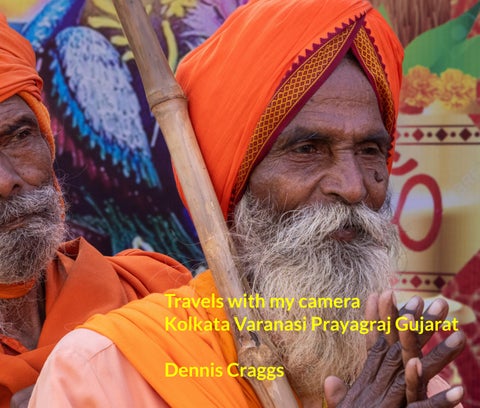
India A week walking the streets, markets and ghats of Kolkata, India A trip to Varanasi and Prayagraj for the Kumbh Mela Hindu festival Time spent with the wonderful tribes of Gujarat Dennis Craggs June 2025
ta, India
vember 2024, I travelled to Kolkata with Mark Seymour and Lightandland together with Iona, tian, Mark and Tom. We suffered flight delays and cancellations, mindless Indian bureaucracy and f premature death in all sorts of ways to enjoy eight days of very pleasant 30degC weather travelling reets on foot, aided by taxi, Uber and bus, dodging dead rats and being sprayed by chicken shit, to meat and fish markets, flower markets, ghats, the book market on College street, the pet market, the r bazaar, railway stations, the railway community and the markets where the Kumartuli clay idols are
ta, which was once the second biggest city in the British Empire, is vivid and very chaotic, colourful, atic and noisy and expresses extremes of wealth and poverty. I came back bowels intact (We found excellent restaurants). It's now so incredibly quiet at home and snowing so I’m planning on a return o Varanasi and Gujarat next year.
ruary 2025, I returned to India with Joe Van Os who runs an American based photographic tour company. a few days in Delhi, we flew to Varanasi, a city on the Ganges river in northern India that has a central place traditions of pilgrimage, death, and mourning in the Hindu world. Kashi, its ancient name, was associated kingdom of the same name of 2,500 years ago. It lies 121km downstream of Prayagraj, our next port of call, the Prayag Maha Kumbh Mela, the largest pilgrimage gathering of humans ever to take place, was ntly being held and accordingly Varanasi itself attracted large numbers of pilgrims to its temples and to the d river Ganges. As befits its great age, the central streets are no more than narrow alleyways so in order to our hotel, we switch from bus to taxi to tuktuk to trike and end with a one hour walk through the ude. I never did figure out how our bags made the trip. For safety reasons, the Government had imposed on the boat operations, some operators flouted the rules and were summarily jailed, following which the boat industry came out on strike and nothing was moving on the river. In the evening we walked along the de Ghats and witnessed Hindu cremations (Disconcertingly held next to the Ghat disco) and the Aarti ony involving the waving of lamps in honour of the sacred Ganges. Early the next morning, we were out on the Ghats witnessing the bathing and other ceremonies and seeing many Sadhus whilst walking the ed alleyways, including here pictured the press of humanity in four columns of devotees waiting to visit the temples. Our guides fortunately were able to direct us to avoid the worst of the congestion.
hen travelled by car to Prayagraj, transferring to tuktuk for the final stretch to our luxury tented mpment on the edge of the pilgrimage site. The 2025 Prayag Maha Kumbh Mela from 13 January to bruary 2025 was the ongoing iteration of the Kumbh Mela, a Hindu pilgrimage festival celebrating a bital revolution of Jupiter around the Sun. It is the world's largest gathering, with an estimated 400 0 million visitors. Under astronomical calculations, the 2025 edition was quite rare as the ellation alignment seen is witnessed only once in 144 years. The site of each Kumbh Mela every year is decided by the astrological alignment of Jupiter, the Sun and the Moon. During the gathering, ns of devotees immerse themselves in the Ganges, Yamuna, and the Saraswati, waters of which are dered holy by the Hindus, symbolising a purification of the soul and a path to attaining Moksha or tion. The Government of Uttar Pradesh set up a temporary city covering 40 km2 to accommodate ms attending the event. The total length of the ghats on the river banks is 12km. About 150,000 were installed to provide accommodation. Free food and accommodation are provided to devotees. ed here are many Sadhus. A Sadhu is a religious ascetic, mendicant or any holy person in Hinduism ainism who has renounced the worldly life. They are sometimes alternatively referred to as yogi, asi or vairagi. Sadhu means one who practises a 'sadhana' or keenly follows a path of spiritual line. A Sadhu's life is solely dedicated to achieving mokṣa (liberation from the cycle of death and h), the fourth and final aśrama (stage of life), through meditation and contemplation of Brahman. us often wear simple clothing, such as saffron-coloured clothing in Hinduism and white or nothing in m, symbolising their sannyāsa (renunciation of worldly possessions). There are also female icants. Unlike skilled workers and professionals, there is no certification for sadhus. So, it is very ult to determine their exact number. According to various assumptions, there are 4 to 5 million in today. They are widely respected for their holiness. It is also thought that the austere practices of adhus help to burn off their karma and that of the community at large. Thus seen as benefiting y, they are supported by donations from many people. There are naked (digambara, or "sky-clad") s who wear their hair in thick dreadlocks called jata. They engage in a wide variety of religious ces. Some practice asceticism and solitary meditation, while others prefer group praying, chanting ditating. They typically live a simple lifestyle, and have very few or no possessions. Many sadhus rules for alms collection, and do not visit the same place twice on different days to avoid bothering sidents. They generally walk or travel over distant places, homeless, visiting temples and pilgrimage es as a part of their spiritual practice. Celibacy is common, but some sects experiment with nsual tantric sex as a part of their practice. Sex is viewed by them as a transcendence from a nal, intimate act to something impersonal and ascetic.
k us six hours to travel 20km to the airport so we missed our flight to Bhuj, our next destination, but xer was on the case, an essential feature of such a trip, and we were rescheduled.
hen flew to Ahmedabad to visit a number of tribes in Gujarat. We first stayed at the Rann Riders t and were visited there for a photo session by members of the Mir Community shown on the ite page. The next day we travelled on to an hotel near Bhuj where our wonderful local team ged for visits to Nirona village, shown on the following six pages, and then we spent time at the hotel a makeshift studio for visits from the local Fakirani Jat, Dhaneta Jat, Kutchi Rabari and Wagadiya i communities whose members have a long tradition of fine embroidery.
included a photo of a member of the Dhaneta Jat tribe. When the women of the tribe get married, tart wearing a heavy gold nose-ring in their left nostril. This nose-ring is so heavy that it must be rted with black threads that are tied at the back to their hair. This ring identifies them as married n of the tribe.
w is a photo of our accommodation near Bhuj, together with an analysis of the water heating system functional). Our flight from Bhuj back to Mumbai was cancelled without notice so our fixers ged car transportation to Rajkot where we finally caught a plane for Mumbai and home.
with flash
with flash
is Craggs