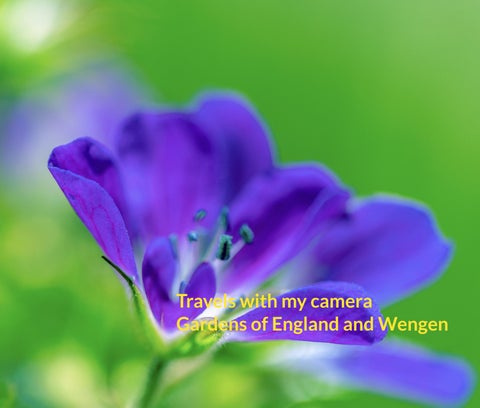
Gardens of England and Wengen This album includes photos taken over a period from 2015 to 2026 at various locations: RHS Wisley, Cliveden, Borde Hill gardens in Sussex, Forde Abbey, Kew, Grey’s Court, Britwell Hill, Iffley meadow (Fritillaries) and Waterperry Gardens in Oxfordshire, Hartslock near Goring (Wild orchids), Hampton Court flower show, Newark Park, Gloucestershire, around Henley and Marlow and in my own garden too. They were taken with my Canon cameras, generally with the Canon 100mm macro 2.8L lens, often with a tripod and on muddy knees. I take some inspiration from Sue Bishop, who I first met at Borde Hill in 2016. As I was contemplating where to point my camera next, she pointed out a tiny mark on a tulip and set me off on a trail of creativity to this day continuing to learn all the time. I have added a number of photos taken in Wengen in 2016 on a trip with Charlie Waite and Sue Bishop. Dennis Craggs March 2021
e Hill gardens in Sussex is a little off the regular beaten track for visitors especially in early spring but was enough there to spend a day practising with a 100mm macro lens. I was motivated to capture arking on this rather magnificent tulip aided by the spots of rain water. Conveniently the tulips were d so it was not necessary to crawl around on the ground to take this and it was possible to use a d.
ove this flower, especially in France, but I also have a few in England that survive the climate. This 5m from my front door so I did not have to go far to capture this in July 2020. It is taken with a o lens on a tripod. The dark background works for me.
ocal point of this photo, taken during lockdown in 2020, is a daylily, a member genus Hemerocallis. The specific flower featured is a vibrant, burnt-orange or ariety in my garden, adorned, possibly by me, with fresh raindrops. It is ifully framed by a soft, out-of-focus background of Perovskia blue spire an sage.
aylily’s Greek botanical name, Hemerocallis, translates directly to "beauty for ". True to its name, each individual flower opens in the morning and etely fades by nightfall. While a single bloom only lasts 24 hours, a mature produces a high succession of buds per stem, keeping the plant colourful for al weeks throughout the summer. Despite the common name and their pet shape, daylilies belong to the Asphodelaceae family and are completely ct from true lilies (like Asiatic or Oriental lilies). is another photo of this plant on the last page.
amera settings are a bit odd, I do not really need to achieve 1/640sec, it was at windy.!
The focal point of this photo, taken during lockdown in 2020, is a daylily, a member of the genus Hemerocallis. The specific flower featured is a vibrant, burnt-orange or red variety in my garden, adorned, possibly by me, with fresh raindrops. It is beautifully framed by a soft, out-of-focus background of Perovskia blue spire Russian sage. The daylily’s Greek botanical name, Hemerocallis, translates directly to "beauty for a day". True to its name, each individual flower opens in the morning and completely fades by nightfall. While a single bloom only lasts 24 hours, a mature plant produces a high succession of buds per stem, keeping the plant colourful for several weeks throughout the summer. Despite the common name and their trumpet shape, daylilies belong to the Asphodelaceae family and are completely distinct from true lilies (like Asiatic or Oriental lilies). There is another photo of this plant on the last page. The camera settings are a bit odd, I do not really need to achieve 1/640sec, it was not that windy.!
s another photo taken amongst the roses in my back garden. I think I might have cheated here by a bit of gardening to add a splash of water. I like filling the frame with a burst of colour with a flush our at the base of the petals and the way the light plays through the water drop. Of such little things easing images made. Well, I like it, anyway.
k this flower is another type of Osteospermum. Here I used a very wide aperture to blur almost thing except the centre of the flower. I may have used a double exposure, I can’t remember, in order ate the soft look in the image or otherwise used a little post processing. I quite deliberately selected position with the stem rising through the centre of the image. I like it of course, otherwise I would ave included it in this collection, but it did not do very well in competition at the Marlow graphic club.
a Holly as it it also known. I have grown this at home without much success but it makes an sting photo at any time, even after it dies back, as it has such an interesting structure. I used a macro a wide aperture so that only the very centre is in focus. I have kept the rest as a soft blur, I may have d around in post processing.
I am again on another trip to Wisley using some of the techniques learnt from Sue Bishop in Wengen luding in the composition the blue flower right up against the camera lens therefore totally out of gives a nice colour combination with the one single white flower head in focus leading the eye to the e of the image.
tulips were grown in a pot close to a pond so I have been able to capture a lue/black background which gives a nice colour combination, yellow standing gainst a blue background. I liked the marking on the side of the tulip and I was s case able to use a tripod to make this composition. There is a tiny bead of in pin sharp focus, I can’t help noticing it. I think I may have splashed a little around but the drops on the front of the tulip are out of focus. I did not e it but the judge to a Marlow photographic competition downgraded it for out of focus. I care only that the marking is in focus. It’s difficult to get thing in focus when you are this close up with a macro lens and nor would I to.
These tulips were grown in a pot close to a pond so I have been able to capture a nice blue/black background which gives a nice colour combination, yellow standing out against a blue background. I liked the marking on the side of the tulip and I was in this case able to use a tripod to make this composition. There is a tiny bead of water in pin sharp focus, I can’t help noticing it. I think I may have splashed a little water around but the drops on the front of the tulip are out of focus. I did not notice it but the judge to a Marlow photographic competition downgraded it for being out of focus. I care only that the marking is in focus. It’s difficult to get everything in focus when you are this close up with a macro lens and nor would I want to.
ose grows about 3m from my back door and I took this photograph on a dull wet day (at least I think ainwater and not the result of a planned spray). Taking photos of flowers is much preferable in ast conditions as their colours tend to look burnt out when in full sun (But rules are made to be n). I have used a more conventional aperture so that the whole of the flower is in focus.
displays gave a great opportunity for some work with the macro lens. The s were often taken hand held with multiple exposures and then blended in shop. It is a bit of hard work doing it this way but I like the end effect and this one for my exhibition at the Mall Gallery..
Their displays gave a great opportunity for some work with the macro lens. The photos were often taken hand held with multiple exposures and then blended in Photoshop. It is a bit of hard work doing it this way but I like the end effect and chose this one for my exhibition at the Mall Gallery..
lilies, Triteleia, are summer-flowering bulbs bearing pretty sprays of flowers at the wiry stems, not dissimilar to those of agapanthus. Dependable and easy to grow, ias make fantastic cut flowers and are attractive to pollinating insects. These are at me in Medmenham. This is one of the photos selected for my exhibition a the Mall es and I sold it!
Triplet lilies, Triteleia, are summer-flowering bulbs bearing pretty sprays of flowers at the top of wiry stems, not dissimilar to those of agapanthus. Dependable and easy to grow, triteleias make fantastic cut flowers and are attractive to pollinating insects. These are at my home in Medmenham. This is one of the photos selected for my exhibition a the Mall galleries and I sold it!
a genus of 260–300 species of flowering plants with showy flowers. It takes me from the name for the Greek goddess of the rainbow and the name may to the wide variety of flower colours found among the many species. They erennial plants, growing from either creeping rhizomes or bulbs. Whatever, do well in my garden in early June.
hoto in the following pages there is one with a spider. I understand it may be mena Vatia or crab spider. Females of this species are attracted by the nce of flowers, though other visual and tactile clues also help them choose a ory suitable to attract prey. These spiders may be yellow or white. This ately depends on the flower on which they are hunting (active camouflage). ger females especially, which may hunt on a variety of flowers such as daisies unflowers, have a strong tendency to adapt to the colour of the surrounding r. However, the colour-changing process is not instant and can require up to ys to complete. If this is so, then in this case, I do not think it is being very ssful here.
Iris is a genus of 260–300 species of flowering plants with showy flowers. It takes its name from the name for the Greek goddess of the rainbow and the name may refer to the wide variety of flower colours found among the many species. They are perennial plants, growing from either creeping rhizomes or bulbs. Whatever, they do well in my garden in early June. In a photo in the following pages there is one with a spider. I understand it may be Misumena Vatia or crab spider. Females of this species are attracted by the fragrance of flowers, though other visual and tactile clues also help them choose a territory suitable to attract prey. These spiders may be yellow or white. This ultimately depends on the flower on which they are hunting (active camouflage). Younger females especially, which may hunt on a variety of flowers such as daisies and sunflowers, have a strong tendency to adapt to the colour of the surrounding flower. However, the colour-changing process is not instant and can require up to 25 days to complete. If this is so, then in this case, I do not think it is being very successful here.
ls me that this a Japanese Anemone (commonly belonging to the species one hupehensis or the hybrid group Anemone × hybrida), also frequently n as a Japanese windflower or thimbleweed.
from its side profile, it shows a delicate, saucer-shaped pink flower with er, silky tepals. In the background, you can see its distinct round, button-like flower buds perched on thin, graceful stems. They are highly popular ceous perennials valued for blooming heavily from late summer through mn (typically August to October), bringing vibrant life to gardens just as earlyer plants begin to fade. They prefer dappled shade or partial sun in moist, draining soil, eventually forming dense, spreading clumps.
AI tells me that this a Japanese Anemone (commonly belonging to the species Anemone hupehensis or the hybrid group Anemone × hybrida), also frequently known as a Japanese windflower or thimbleweed. Seen from its side profile, it shows a delicate, saucer-shaped pink flower with slender, silky tepals. In the background, you can see its distinct round, button-like green flower buds perched on thin, graceful stems. They are highly popular herbaceous perennials valued for blooming heavily from late summer through autumn (typically August to October), bringing vibrant life to gardens just as earlysummer plants begin to fade. They prefer dappled shade or partial sun in moist, well-draining soil, eventually forming dense, spreading clumps.
Ursinum, one with aphidoidea, Newark Park, Gloucestershire
commonly known as wild garlic, complete with added aphid in the bottom left photo. I took these photos in 021 at Newark Park, a National Trust property in Gloucestershire. They are mostly taken from a multiple ure with a macro lens on a wide as wide can be f2.8 aperture to give narrow depth of field. This location was mended on the internet for wild garlic, along with a number of other locations in Gloucestershire, and d, the whole hillside is covered at this time of year.
at do you want to know about the bluebell? Hyacinthoides non-scripta (formerly Endymion non-scriptus or non-scripta) is a bulbous perennial plant, found in Atlantic areas from north-western Spain to the British and also frequently used as a garden plant. It is known in English as the common bluebell or simply bluebell, e which is used in Scotland to refer to the harebell, Campanula rotundifolia. I transplanted a few from the n at my father's house, Southlands, where they use to grow by thousands, and they have gradually spread at d School too, including across the lawn so I cannot cut the grass until May. These photos are mostly multiple ure using a tripod. One or more shots in focus and one or more totally out of focus. Then I used layers in shop to select the parts of the image to be in focus (Usually the stamen on two of the flowers) and leaving ckground a bokeh blur. It's very technical. I have since moved to taking such photos hand held with high r speed and wide aperture so the soft look can be obtained in a single image. It is much simpler and arguably natural looking.
D lockdown was time to stay near home and in June 2021, on mmendation, I found a field of poppies at the bottom of Britwell Hill at the on with the Ridgeway Trail as it passes Britwell Salome in Oxfordshire. I think ivate land here so I am a bit self conscious but when you're taking macro like you're crawling around at ground level and cannot been seen for toffee ay. This was hand held, I took lots (See following page) and this is the one I most.
er rhoeas, with common names including common poppy, corn poppy, corn field poppy, Flanders poppy, and red poppy, is an annual herbaceous species wering plant in the poppy family Papaveraceae. It is notable as an agricultural (hence the common names including "corn" and "field"). Especially in the monwealth, it is used a symbol of remembrance of the fallen soldiers and military during World War I and thereafter. Before the advent of herbicides, s often abundant in agricultural fields, as the plant thrives in areas of bed soil. Flushes of poppies may still appear in fields where herbicides are sed, as well as those in fallow. The corn poppy and its cultivars such as the y poppy are widely grown in gardens, and are frequently found in packets of abelled "wildflower mixes".
ded this in my exhibition.
COVID lockdown was time to stay near home and in June 2021, on recommendation, I found a field of poppies at the bottom of Britwell Hill at the junction with the Ridgeway Trail as it passes Britwell Salome in Oxfordshire. I think it's private land here so I am a bit self conscious but when you're taking macro like this, you're crawling around at ground level and cannot been seen for toffee anyway. This was hand held, I took lots (See following page) and this is the one I liked most. Papaver rhoeas, with common names including common poppy, corn poppy, corn rose, field poppy, Flanders poppy, and red poppy, is an annual herbaceous species of flowering plant in the poppy family Papaveraceae. It is notable as an agricultural weed (hence the common names including "corn" and "field"). Especially in the Commonwealth, it is used a symbol of remembrance of the fallen soldiers and other military during World War I and thereafter. Before the advent of herbicides, it was often abundant in agricultural fields, as the plant thrives in areas of disturbed soil. Flushes of poppies may still appear in fields where herbicides are not used, as well as those in fallow. The corn poppy and its cultivars such as the Shirley poppy are widely grown in gardens, and are frequently found in packets of seed labelled "wildflower mixes". I included this in my exhibition.
lock is a nature reserve on the banks of the Thames near Goring in Oxfordshire and Holmfield is a f Special Scientific Interest near Marlow in Buckinghamshire. I had a bit of a blitz in the Spring of for finding and photographing wild orchids and visited a number of sites owned by wildlife trusts, ing these two. Hartslock has a great view over the river valley but doesn't seem to attract many rs. These are tiny little buggers to photograph so there is alot of crawling around at ground level.
hoto on the top left is of a military orchid (Orchis militaris), or a very similar species within the same . The photo on the bottom left appears to be a pyramidal orchid (Anacamptis pyramidalis).
wo on the right appears to show a Common spotted-orchid (Dactylorhiza fuchsii), or a very closely d wild orchid in the Dactylorhiza genus.
ks AI.
mer 2018 found me on my hands, knees and stomach with my 100mm macro aking photos of flowers in the meadows around the Mannlichen cable car n above Wengen in Switzerland. The trick here seems to be to focus on the n of the flower and keep trying. The very shallow depth of field on the macro an make for a treat and in this case I used a very wide aperture to make it more pronounced. The combination of colour in this very simple image has this one of my perennial favourites.
Summer 2018 found me on my hands, knees and stomach with my 100mm macro lens taking photos of flowers in the meadows around the Mannlichen cable car station above Wengen in Switzerland. The trick here seems to be to focus on the stamen of the flower and keep trying. The very shallow depth of field on the macro lens can make for a treat and in this case I used a very wide aperture to make it even more pronounced. The combination of colour in this very simple image has made this one of my perennial favourites.
e first day of our tour to Wengen with Charlie Waite and Sue Bishop, we ed over to Murren, took the Allmendhubel standseilbahn up and walked back to Murren through the meadows. A great walk, all the better for being hill, lugging the camera kit. This was a composition encouraged by Charlie later tried some dodge and burn at his suggestion, on the mountains in the stance, a step in improving my post processing skills. This is undoubtedly the ime to visit Switzerland for the alpine flowers at their most profuse.
On the first day of our tour to Wengen with Charlie Waite and Sue Bishop, we crossed over to Murren, took the Allmendhubel standseilbahn up and walked back down to Murren through the meadows. A great walk, all the better for being downhill, lugging the camera kit. This was a composition encouraged by Charlie and I later tried some dodge and burn at his suggestion, on the mountains in the mid distance, a step in improving my post processing skills. This is undoubtedly the best time to visit Switzerland for the alpine flowers at their most profuse.
I am lying flat on my stomach crushing as few alpine flowers as possible, using acro lens, the flowers in the foreground right up against the camera lens, with us on the mid ground, a technique encouraged by Sue Bishop. I think the group was here, lined up next to each other. The use of a wide aperture only the mid ground in focus. I do not think a tripod was necessary even had n possible at this low altitude.
Here I am lying flat on my stomach crushing as few alpine flowers as possible, using my macro lens, the flowers in the foreground right up against the camera lens, with a focus on the mid ground, a technique encouraged by Sue Bishop. I think the whole group was here, lined up next to each other. The use of a wide aperture keeps only the mid ground in focus. I do not think a tripod was necessary even had it been possible at this low altitude.
ded this photo in my exhibition so I wanted to establish exactly what it was! ogle search came up with this name but I cannot be sure.
tells me that dryas octopetala, the mountain avens, eight petal mountain, white dryas or white dryad, is an Arctic–alpine flowering plant in the family eae. It is a small prostrate evergreen subshrub forming large colonies. The fic epithet octopetala derives from Greek octo 'eight' and petalon 'petal', ing to the eight petals of the flower, an unusual number in the Rosaceae, e five is the normal number. However, flowers with up to sixteen petals also naturally. As a floral emblem, it is the official territorial flower of the west Territories and the national flower of Iceland. It can also be found in the are some more photos from Wengen on the next page.
I included this photo in my exhibition so I wanted to establish exactly what it was! A Google search came up with this name but I cannot be sure. Wiki tells me that dryas octopetala, the mountain avens, eight petal mountainavens, white dryas or white dryad, is an Arctic–alpine flowering plant in the family Rosaceae. It is a small prostrate evergreen subshrub forming large colonies. The specific epithet octopetala derives from Greek octo 'eight' and petalon 'petal', referring to the eight petals of the flower, an unusual number in the Rosaceae, where five is the normal number. However, flowers with up to sixteen petals also occur naturally. As a floral emblem, it is the official territorial flower of the Northwest Territories and the national flower of Iceland. It can also be found in the U.K. There are some more photos from Wengen on the next page.