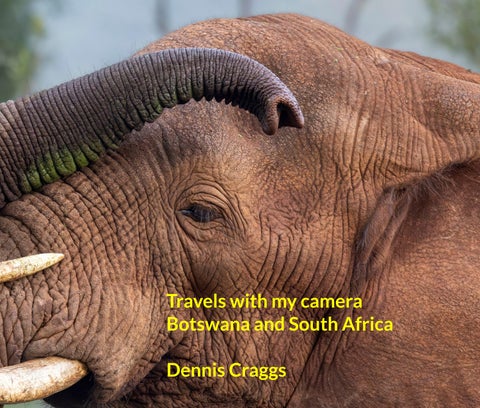
Botswana: Mashatu game reserve Footsteps lodge, Shindi concession Pangolin Lodge, Kisane, Chobe river
South Africa: Zimanga private game reserve, KwaZulu Natal
Dennis Craggs November 2023
vember 2023 I flew to Johannesburg to join a group organised by Back Country Journeys, a U.S. photographic tour company, and lead by Trevor LaClair, whom I have previously met in Death . The group only comprised five of us, Al and John, bosom buddies from Michigan who have left wives behind to escape on safari, Barbara, an heiress from Chicago, for whom every living thing is a and we were constantly reminded of that, and Peggy, a bird expert from Seattle, who made copious each day of our sightings whereas I retained very little recollection of any of the names of the birds w, probably over 140 in Botswana alone. The planning for the trip took some thought. The total t limit for all bags on the charter flights was about 26 kg with tight dimension limits on checked The camera/laptop bag weighed 13 kg so there was little left for general packing but fortunately all dges had laundry facilities and heavy winter clothing was not needed! We spent one night in a nesburg airport hotel and had an orientation meeting. The next morning, we left early for a uled flight to Polokwane, close to the border with Botswana and Zimbabwe. We were picked up by minibus for the two hour drive to the Botswana border, crossed the border with relative ease, were collected in the ubiquitous Toyota Land Cruisers for the drive to the Tuli Safari lodge in the atu game reserve. We spent four nights there. Mashatu Game Reserve is part of the Northern Tuli Reserve and is one of the largest private reserves in southern Africa. Mashatu has three of the Big with rhino and buffalo absent, and elephant and leopard sightings are unparalleled. The exclusivity reserve meant there are few vehicles out on game drives at any one time and we enjoyed some sightings, even more so due to the sparse vegetation. The reserve comprises a diverse wilderness of nah, riverine forest and wetland. Most striking are the sandstone cliffs jutting out of the plains and ry riverbeds, frequented by herds of elephants digging for water. The majestic Nyala berry tree or atu’, found along the rivers, provides shade and food for a variety of animals. We were expecting er temperatures as the climate moved into summer but we had some unsettled rainy weather.
pent some time in the reserve with this wonderful pride of lions. The lion is native to Africa and India. social species: a lion's pride consists of a few adult males, related females, and cubs. Groups of e lions usually hunt together, preying mostly on large ungulates. The lion is an 'apex' predator ugh some lions scavenge when opportunities occur and have been known to hunt humans, although ypically do not actively seek out and prey on them. The lion inhabits grasslands, savannah and shrub It is usually more diurnal than other wild cats, but when persecuted, it adapts to being active at and at twilight. During the Neolithic period, the lion ranged throughout Africa and Eurasia from east Europe to India, but it has been reduced to fragmented populations in sub-Saharan Africa and population in western India. It has been listed as vulnerable on the International Union for ervation of Nature Red List since 1996 because populations in African countries have declined by 43% since the early 1990s. Lion populations are untenable outside designated protected areas. ugh the cause of the decline is not fully understood, habitat loss and conflicts with humans are the est causes for concern.
are some photos of our accommodation.
aily routine included an early morning 5am safari to catch the morning light (When the sun was followed by brunch and a chill out till 3pm for a ‘high tea' snack following which a second safari drive ndertaken until after sunset at about 7:30, in time for dinner and early bed. Trevor took time below ach us some composition skills, thereby demonstrating his ability at graphic presentations. We t missed the warthog on page 55, hidden in his crevasse, although he shot away at great speed, we able to grab a quick shot. The English name refers to their facial wattles, which are particularly ct in males. They also have very distinct tusks, which reach a length of 25 to 65 cm in the males, but ways smaller in the females. They are largely herbivorous, but occasionally also eat small animals. pecies remain fairly common and widespread.
Mashatu, we flew from the Limpopo valley airstrip to the Shindi concession in the Okavango Delta area and at the Footsteps lodge. The Okavango Delta is a vast inland delta formed where the Okavango River es a tectonic trough at an altitude of 930 – 1,000 m in the central part of the endorheic (one of the few or delta systems that do not flow into a sea or ocean) basin of the Kalahari. It is an UNESCO World Heritage ith a wetland system that is largely intact. All the water reaching the delta is ultimately evaporated. Each bout 11 km3 of water spreads over the 6,000 – 15,000 km2 area. Some flood waters drain into Lake Ngami. ea was once part of Lake Makgadikgadi, an ancient lake that had mostly dried up by the early Holocene. We three nights at this lodge, with daily game drives and a boat trip. A highlight of this visit was time spent ite with this rather magnificent solitary young male leopard.
otswana
the Okavango we flew to Kisane in the north east corner of Botswana near the borders with abwe, Zambia and Namibia. Kisane is on the Chobe river. Forming the northern boundary of the e National Park as well as much of Botswana's border with Namibia's Caprivi Strip, the Chobe river remely lush because of its many waterways and draws many animals and birds during the dry n. The river can also be accessed from its Namibian side, and is also quite close to the Victoria Falls. in the Angolan highlands and then twisting along geological fault lines as it winds its way to the ezi River, the Chobe is flanked by riverine forests, floodplains and open woodlands. We spent all of me in the park on our boat on the river which made for some very lazy but exceptionally productive nd game viewing.
Kisane, we flew back to Johannesburg and I ended my tour with BCJ. I then flew down to Durban pent a few days at the Oyster Box hotel before joining a group of sixteen, most of whom I knew, d by Antony Spencer and Justin Reznick to travel for nine days up to the Zimanga private game ve in KwaZulu Natal not far from the Mozambique border. Spread over nearly 70 km2 of pristine eld, with fever tree forests and rolling hills, Zimanga (An anagram for ‘Amazing’) is bisected by the e River and home to a splendid variety of animals and birds. It is much more of a commercial game ng enterprise, as it was developed from scratch from an old sugar plantation and a range of animals imported and are closely managed. We saw rhino for the first time, for example, as they are ded every 3-4 years to discourage poaching. The big cats are fitted with tracking devices so they can ated relatively easily and some of the cheetah were so habituated to humans that we were able to unt the vehicles and approach them. The main attraction of the reserve for photographers however he presence of two overnight hides designed by Bence Mate and located by floodlit water holes e it is possible to camp with all mod cons (Aircon and running water for a start) from late afternoon rly the following morning. There were also two bird hides for daytime use. We felt a little short ed as the weather had been so wet that there were many alternative water sources and animals not attracted to the hides in great numbers. However, on the very last boiling hot day, I volunteered into one night hide by myself and was accordingly rewarded by good sightings. Below is the patio of yster Box and a photo of one of the night hides.
is Craggs