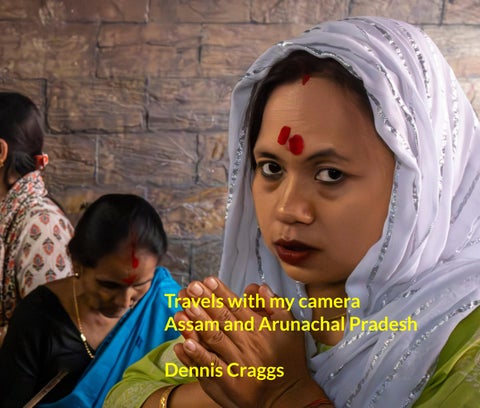
\ A day in the fascinating Kamakhya Temple, Guwahati, Assam A visit to a village on the road to Tezpur Tea plantations of Assam Special time with the Apatani and Nyishi tribes around the Ziro Valley, Arunachal Pradesh A stay on Majuli island, Assam A brief stop over at the Kaziranga National Park Dennis Craggs April 2024
arch 2024 I flew to Guwahati, Assam, India, to join Flavio Bosi and Mark Seymour through andland together with Charlotte, Alison, Ingrid, Janette, John and Linda on a trip to the Ziro Valley r main destination. On our first full day in Assam, we made two trips to the Kamakhya Temple, an tant pilgrimage site and one of the most revered and also one of the oldest of the 51 shaktipeethas es) in India dating to the 8th - 9th c. It is believed that the temple is where parts of Devi Sati’s corpse hile her husband Lord Shiva performed Taandav (A frantic dance). In accordance with religious s (More unusual than most, I think), her genitals and womb fell where the present-day temple is ed. According to legend, the location of the fallen genitalia and the womb was not known till Kamdev, od of Love, went in search of it for a penance. After finding the parts, Kamdev was rid of his curse by Brahma). Thus the place came to be known as Kamakhya. There is no idol of a goddess or a god temple. Instead, in the inner sanctum, there is a yoni or the female genitalia, which is worshipped. nnual festival of Ambubachi Mela celebrates the menstruation of the Goddess. The Temple is the e of the Kulachara Tantra Marga, also known as Shakta Tantrik (one of the later scriptures dealing ially with techniques and rituals including meditative and sexual practices). During the Ambubachi many Tantriks make a pilgrimage here. From the Temple website, I read: “Maa Kamakhya is hipped in the form of the yoni or female vagina/vulva. Kamakhya Maa is not only wise, valiant and ource of creation, she is also very much in touch with her sexuality, fertility and related bodily ons. The name Kamakhya literally means ‘She whose title/definition is Sexual Desire. The name of oddess, Kamakhya, also indicates that she is at once the desired, the desiring and the granter of es. So who better than this very powerful primordial Goddess to grant women with the blessings of ty and children? It is not only the women who can pray here, men having infertility problems can ffer prayers. It is believed that Kamadev the Lord of Love was once cursed by Shiva and lost his y. He prayed to the Yoni at the Kamakhya Temple and regained his virility. This temple is, therefore, a place for both husbands and wives to offer prayers for conceiving a child.” If you have taken all of n, I hope you can still enjoy these photos.
ext day we set out in a convoy of four 4wd Toyotas for the long two day drive up to the Ziro Valley n the foothills of the Himalayas. We crossed the broad Brahmaputra river and on the way we pulled nd walked through the fields on an impromptu visit to a village. We met the ladies celebrating in the unity hall with the patriarch, allegedly 116 years old, and were invited in. "The soul of India lives in ages," declared Mahatma Gandhi at the beginning of 20th c. According to the 2011 census, 69% of ns (around 833 million people) live in 649,481 villages, 236,004 of which have a population of fewer 500.
Boro Baski wrote in 2019 in the Anandabazar Patrika (A widely read Bengali daily):
born in a Santal village in Birbhun District. In my childhood I saw how my mother cleaned the courtyard every ng with cow-dung mixed with black charcoal and water, and how she polished with great care the outer walls of our with red soil. Before the Durga Puja festival there was a rush to paint the walls of the mud-houses with the white the paddy field. During our biggest festival ‘Sorhai’ there were decoration on the walls with flower designs, bird and figures. I saw my mother and sister drawing red and blue lines on the walls by climbing on the bamboo ladder. We ldren used to help them in the work by climbing the ladder. It was such a great fun!
s are changing. Mud houses are being demolished to be replaced with brick houses with the support of the Central nment’s Housing scheme ‘Pradhan Mantri Awas Yojana’. In our village out of hundred families thirty families are g tin or asbestos on their twenty by fifteen feet houses with the financial support of the scheme of rupees one lakh 00] twenty thousand. Many families are trying to collect extra money to put concrete roof on their houses. Those ave not received the government support yet are always gathering around the village elected representatives ver they see the piece of paper in their hands in the village roads and enquiring, is my name in the list? Many have y made prior understanding with their uncles and cousins regarding which house to be demolished to build the brick or on which agricultural land they will build it if they find their name in the list. From kachha to brick house, mud to te road, these changes are definitely a sign of development for a family and the village. The families who have to der rotten thatched roofs during rainy season to them the joy of getting a brick house is enormous. Within 2022 all amilies of the country will be given decent houses. But the issue which does not come in discussion is, besides the ages of living in brick houses the compromise that Santals have to make with their traditional culture and gradual e of mental stress. The disappearance of mud-house from Santal life not only ends the mud-house alone but also eligious and cultural life that are connected to it. And also the centuries-old traditional knowledge and art of g low-cost-no-cost mud-houses and the related skills and crafts, like wall paintings die out. The sources of small e of rearing domestic animals in open courtyard of the mud-house like hen, duck, goat and the pigeons in the n pots under the thatch roof also gets destroyed, because it is difficult to rear such animals in single-room house of f. The families who are trying to collect money to concrete their roof also have to go through huge mental pressure. hey have no idea about the actual cost of the concrete roof they hand over all the government subsidy money and ponsibilities to the mason.
And when the money gets exhausted the mason abandons the work and moves elsewhere. Many such incomplete concrete houses are seen in the villages. Mongal Mardi from Bishnubati village died before completing his house. His son Nirmal could not complete even after mortgaging their agricultural land. Because the foundation he laid with the advice of the mason included the kitchen and toilet along with the two bed rooms of whose cost he could not imagine even in his dream. My neighbour Rashmoni Baski, mother of two children is a daily labour. She started saving money since four years from daily wage to concrete the roof of her house. She completed it two months back but to achieve that she had to sacrifice a lot. Her high school goer son had to discontinue his studies for extra income. Her husband suffered with malnutrition and died of tuberculosis. Now she lives with her children in an incomplete brick house covering the empty door and window holes with old sarees and cement bags. Earlier the roof used to be covered with straw or tiles, now asbestos is used which scientist and environmentalists also have agreed that it causes disease, then why such arrangement to spread the disease? The question is not only of comfort but the way of life. Santals have their own community life that has kept them intact since centuries. Mud-house and the natural environment of the village are all part of that community life. If any one aspect of that component changes their rhythm of life gets affected. With the demand of time the change is inevitable. Santals have already accepted that change. But when the government wants to change the basic component of Santal life why they are not given the opportunity to express their opinion? If development is the goal then government can financially support them in such a way that besides preserving their culture they can build their house and roads according to their aesthetic taste and design. Whether village roads could be build more community friendly with moram instead of making them with stone and cement in these matters villagers can give their opinion. In the matter of their development participation of the Santals is needed. In this way the transition from traditional way of life to modernity could be gradual and less stressful.”
y three of our trip to India we resumed our 4wd convoy for a second day-long drive winding up into astern Himalayas into the state of Arunachal Pradesh to reach our next destination high in the e cold misty Ziro valley at 1,700 m. close to the border with China. Here we spent four days with 0,000 strong Apatani tribe, visiting them in their homes and enjoying their extensive hospitality y in form of home made rice wine. The Apatani worship nature and believe in the sacredness of us totems for good health, safety and prosperity. Most Apatani are followers of the Donyi-Polo faith ray to the sun (Ayo Donyii) and the moon (Atoh Polo). When a misfortune occurs, they believe that are caused by certain spirits and they make appeasement sacrifices of chickens, pigs and other stic animals. Ceremonies are carried out by the Shaman who performs various rituals through ing.
of the women of the tribe wear large nose plugs and face tattoos. According to one legend, the ni women were considered so beautiful that men from other tribes would try to kidnap them and so ders decided to start this practice so as to make them less attractive. According to other stories, the n decided to do it themselves as they believed that the nose plugs and tattoos defined them as bers of the tribe. The nose plugs (Yaping Hullo, made from wood found in the local forests) and os (Tippei, made with a mixture of pig’s fat and soot) were made by the elder women when an ni girl reached about ten years old. The tradition was carried from generation to generation and n who followed it were considered to protect family dignity. However, in the early 1970s, the nment banned the practice so that the tradition has now died out and the remaining marked women ow in their 80s.
rrived in the valley at the start of the Myoko festival, a festival originally developed to promote ration of friendship and harmony between various Apatani villages. This is also the time when new sown in the terraced fields and the Apatani pray for a good crop. The festival rotates between the Apatani villages. We witnessed various ceremonies around the opening of the festival involving the an blessing the ground with rice wine and later sacrificing a chicken and extracting its liver followed parade of tribal members with branches then dancing to invoke the monkey spirit. We made a er of further visits to Apatani villages and I have recorded some of the very friendly people we met
ne of our days in the Ziro valley, we drove out to visit the Nyishi, the largest ethnic group in achal Pradesh. Their population of around 300,000 makes them the most populous tribe in the state. yny is prevalent among the Nyishi. It signifies one's social status and economical stability and also s handy during hard times like clan wars and various other social activities. This practice, however is ishing especially with the modernization and also with the spread of Christianity. They trace their nt patrilineally and are divided into several clans. We spent the morning with them taking photos in traditional costumes. They were proud to model for us although it was a new experience for body and had its challenges! Traditionally, Nyishi plaited their hair and tied it neatly at the forehead ocally-made thread. A brass skewer passes horizontally through the tied hair. Cane rings were worn d the waist, arms and legs. Men wore a cane helmet surmounted with the beak of the great Indian ill. The usage of actual hornbill beaks is discouraged these days due to tough wildlife protection and eing supplanted by beaks made of cane or other materials. The entire headgear/cane helmet itself is y available in the market for purchase. Additional decorations varied depending upon the status of erson and were symbols of manly valour.
four nights in the Ziro Valley, we retraced our steps back down through the Himalayas to the maputra river and spent three nights on Majuli island, a large river island about 250 km from hati. It is formed by the Brahmaputra River to the south and east and other river branches. It is ited by members of the Mising, Deori and Sonowal Kachri tribes. Due to regular flooding in the rainy n and frequent changes in the river, the island experiences significant erosion and has shrunk from km2 in the 18th c. to 352 km2 by 2014. Our hotel was located near a village of the Mising tribe and ent some time walking through there and taking these photos.
isit was timed to coincide with Dol Jatra, also known as Holi, a festival celebrated across India. This al is a symbol of the victory of good over evil and the arrival of spring and is celebrated with great siasm over two days. The night before Holi is called Holika Dahan or "Chhoti Holi" whereby people r around a lit bonfire, symbolising the victory of good over evil and removal of the old and the arrival new. Various rituals are performed around the fire and there is a lot of singing and dancing. The al marks the victory of Lord Vishnu over the demon Holika, who tried to burn Lord Vishnu but ended rning herself. On the following second day, Rangpanchami, people smear each other with coloured ers, and water balloons and water guns are also liberally used. The festival is deeply rooted in the ological stories of Lord Krishna and Radha, where Lord Krishna used to play with colours and smear a's face with them. Special dishes like Pitha, Laru, and Jolpan are prepared and offered to friends and y. We celebrated Rangpanchami with a visit to Dakhinpat Satra, a monastic institution that serves as o-religious and cultural centre. Established in 1584 under the reign of Ahom King Jayadhwaj Singha, prominent centre of cultural and spiritual heritage and includes facilities such as a prayer hall, ential units for devotees, an entrance gate, storage rooms, a museum, a library, a guest house, cow , ponds, open spaces for daily activities, and small kitchen gardens. It is known for its vibrant rations of major festivals. The Satra houses various relics such as a silver stick, stone mortar, Lachit hukan's sword, gold and silver bracelets, sculptures, and 500 scriptures written on Sachi Pat. We ipated in the distribution of coloured powders but I do not have many photos as we were advised take expensive cameras.
g our long drives, we stopped at two Assam tea plantations. Assam tea is a black tea manufactured fically from the plant Camellia sinensis var. assamica, which is indigenous to Assam. It is known for dy, briskness, malty flavour, and strong, bright colour. Assam teas, or blends containing Assam tea, ten sold as "breakfast" teas. This part of India experiences high rainfall; during the monsoon period, ch as 250 to 300 mm of rain falls per day. The daytime temperature rises to about 36 °C creating house-like conditions of humidity and heat which contributes to the tea's unique malty taste. Assam of the most prolific tea-producing regions in the world, collectively yielding approximately 680.5 n kg of tea. The introduction of the Assam tea bush to Europe dates to Robert Bruce, a Scottish turer, in 1823. Bruce found the plant growing wild in Assam while trading in the region and he ed local people (the Singhpos) brewing tea from the leaves of the bush. He procured samples of the s and seeds, which he planned to have scientifically examined. However he died shortly thereafter, ut having seen the plant properly classified and it was not until the early 1830s that Robert's er, Charles, arranged for a few leaves from the Assam tea bush to be sent to the botanical gardens in tta for proper examination. There, the plant was finally identified as a variety of tea but different the Chinese version (Camellia sinensis var. sinensis).
ft Majuli island by ferry across to the south bank of the Brahmaputra. Our final over night stop on ay back to Guwahati and home was at the Kaziranga National Park, home to the great one horned It is found in Nepal, Bhutan and Pakistan as well as Assam, but is confined to the tall grasslands and s in the foothills of the Himalayas. It can run at speeds of up to 40 km/h for short periods of time also an excellent swimmer. It has excellent senses of hearing and smell, but relatively poor eyesight. ver, no more than 2,000 remain in the wild, with only two major populations: Kaziranga National 1,200) and Chitwan National Park, Nepal (600). Despite joint efforts between Bhutan and India, the al of a small population of rhinos living along the Indo-Bhutan border in Manas still remains ful.
is Craggs