Case Study Booklet
In t he s e a r c h o f m e a n in g Fr e e t o e x p l o r e V is ua l s o f l i f e T h e s k e t c hb o o k o f a m a s t er
No 1
5 9 15 24
R e f l e c t i on s t u d i e s In full bloom Wh a t ’ s i n a s o u n d ? Stores
Exhibition Guide
30 35 45 50
SAY IT LOUD Artists:
Khalik Allah Sanford Biggers Trenton Doyle Hancock Alicia Henry Titus Kaphar Kerry James Marshall Alison Saar Betye Saar Hank Willis Thomas Mickalene Thomas Kehinde Wiley
3
Say It
Loud
The exhibition title Say It Loud is taken from the James Brown song (written with his bandleader Alfred “Pee Wee” Ellis), “Say It Loud–I’m Black and I’m Proud,” in the tumultuous year of 1968. Eleven artists explore the complex cultural and political issues still facing America 50 years later. This exhibition illustrates the struggles and achievements of African Americans, and challenges dominant historical perspectives with powerful work that is visceral and squarely focused on narratives of ethnic identity, institutional racism, gender, and beauty, through contemporary art from the collection of Hedy Fischer and Randy Shull, as well as Stanford Biggers and Monique Meloche Gallery, Chicago.
4
LIST OF WORKS Say It Loud
IMAGE
ARTIST
TITLE
MEDIUM
DIMS
Credit
Khalik Allah
Hospital (Frenchie), 2013
Pigment print edition 3/9
14x21in
Courtesy of Hedy Fischer and Randy Shull
Khalik Allah
Untitled, 125th Street, 2014
Pigment print edition 4/9
14x21in
Courtesy of Hedy Fischer and Randy Shull
Sanford Biggers BAM (For Terence) 2016
Bronze with black patina, HD video (35 seconds)
14 1/2 x 4 1/2 x Courtesy of the 4 1/2 inches artist and Monique Meloche Gallery, Chicago
Trenton Doyle Hancock
Torpedoboy Steps and Screws Wearing Some Cutty Black Shoes, 2018
Acrylic, graphite, plastic 60x60x5in tops, and paper collage on canvas
Courtesy of Hedy Fischer and Randy Shull
Trenton Doyle Hancock
When They Found Me I Wasn't There, Version #2, 2016
Acrylic and mixed media on canvas
Courtesy of Hedy Fischer and Randy Shull
72x72in
5
Say It Loud IMAGE
ARTIST
TITLE
MEDIUM
DIMS
Credit
Alicia Henry
Untitled (Blue Nose, Male), 2015
Mixed Media
32x17in
Courtesy of Hedy Fischer and Randy Shull
Titus Kaphar
A Disturbing Silence, 2011
Oil on canvas with antique 52x48x12.5in frame
Courtesy of Hedy Fischer and Randy Shull
6
Say It Loud IMAGE
ARTIST
TITLE
MEDIUM
Kerry James Marshall
Black Beauty (Alana), 2012
Archival digital print
DIMS
Alison Saar
Cotton Demon, 1993
Kaolin, ceiling tin on wood, 55x16x15in cotton boll, glass, branch
+ 27.5x17.5 in
Credit Courtesy of Hedy Fischer and Randy Shull
Courtesy of Hedy Fischer and Randy Shull
7
Say It Loud IMAGE
ARTIST
TITLE
MEDIUM
DIMS
Credit
Rhythm & Blues, 2010
Mixed media assemblage
21x15x20in
Courtesy of Hedy Fischer and Randy Shull
Mickalene Thomas
Liz and Chair with Zebra, 2013
C-print, edition 1/5, 2APs
60x60in
Courtesy of Hedy Fischer and Randy Shull
Mickalene Thomas
Tamika sur une chaise longue Mixed media collage avec Monet, 2011
7.25x10.5 in
Courtesy of Hedy Fischer and Randy Shull
+ Betye Saar
8
Say It Loud IMAGE
ARTIST
TITLE
MEDIUM
DIMS
Credit
Hank Willis Thomas
Black Power, 2005
Lightjet print, edition 4/5
25x40in
Courtesy of Hedy Fischer and Randy Shull
Hank Willis Thomas
life, 2017
quilted prison uniforms
60x35x1.25in
Courtesy of Hedy Fischer and Randy Shull
Hank Willis Thomas
Public Enemy (II), 2016
screenprint on retroreflective vinyl, mounted on dibond
48x71in
Courtesy of Hedy Fischer and Randy Shull
9
TITLE Prince Albert, Prince Consort of Queen Victoria, 2013
t
t
Kehinde Wiley
MEDIUM Oil on canvas
+
ARTIST
DIMS 72x60in
+
t
IMAGE
Credit Courtesy of Hedy Fischer and Randy Shull
10 Allah finished his first film at the age of 19 and after getting it into the hands of the rapper Killah Priest, Allah went on to direct music videos for different members of the Wu-Tang Clan. His filmmaking changed radically after he became a photographer. His 2015 film, Field Niggas, inspired by Malcolm X’s 1963 speech “A Message to the Grassroots,” received numerous awards. His most recent film, Black Mother, premiered at True/False Film Festival in March 2018 and had its New York premiere at New Directors/New Films Festival at The Museum of Modern Art and at Lincoln Center. Allah’s photographs have been included in several group shows and solo exhibitions. His book, Souls Against the Concrete, featuring his portraits of Harlem at night, was published in 2017. Courtesy of Daniel Krieger for The New York Times
Khalik Allah Khalik Allah was born in 1985 in Brookhaven, NY, and lives and works in New York City. With no formal art training, Allah first pursued video work at the age of 14 and then photography, making his first pictures in 2010. He taught himself how to use a camera from watching videos on YouTube and later devoured books at the library on the work of Henri Cartier-Bresson, Robert Frank, Nobuyoshi Araki, Daidii Moriyama, and Bruce Davidson.
Links to videos: Khalik Allah | TIME Lightbox https://www.youtube.com/watch?time_ continue=1&v=UFv7yDOPmKg Khalik Allah’s film “Field Niggas” Preview https://www.youtube.com/watch?v=oRk3gqrpTA&t=1s
11
Ho sp i ta l ( F r e n c h i e ) , 2 0 1 3 Pi g men t pr in t e dit io n 3 / 9 1 4 x 2 1 in U n ti tl e d , 125th S tr e e t, 2 0 1 4 Pi g men t pr in t e dit io n 4 / 9 1 4 x 2 1 in
12
K h al i k A l l ah
About the Work A filmmaker and photographer, Khalik Allah aims to display an untraditional and often paradoxical form of beauty that arises not from perfection, but from imperfection. Both the works are candid photographs taken after dark in which Allah presents unfiltered emotions in bright, highly-contrasted color. Untitled, 125th Street depicts a young girl from Harlem at the corner of 125th and Lexington Avenue. While the darkness makes Allah’s viewers question her presence late at night, the raw happiness in the work quells the viewer’s worries. In Hospital (Frenchie), Allah portrays a man who he became quite familiar with through his work. Called Frenchie, he was a 53-year-old Haitian man who suffered from bipolar disorder and schizophrenia. He is the subject of Allah’s 2013 short film Antonyms of Beauty.
Op p o si t e p a g e : De tai l U n t it led , 125th S tr e e t, 2 0 1 4 P i gm e nt p ri nt e d it io n 4 / 9 14x 2 1 i n De tai l Ho s p it a l (F r e n c h i e ) , 2 0 1 3 P i gm e nt p ri nt e d it io n 3 / 9 14x 2 1 i n
15
14
B A M ( F or Te re n c e ) , 20 1 6 Br o nz e w i th b l a ck pa ti na, H D v i de o 14 X4 . 5X 4. 5 C ou r te s y o f t he ar t i s t a nd Mo ni q ue M el o c he Ga l l ery, C h i ca g o
15
16 Museum of Arts and Design, The Museum of Modern Art, Whitney Museum of American Art, The Studio Museum in Harlem, Museum of Contemporary Art Chicago, and The Art Institute of Chicago.
Links to videos: Ted Talk: https://www.ted.com/talks/sanford_biggers_ an_artist_s_unflinching_look_at_racial_violence/ discussion?referrer=playlist-talks_to_help_you_ understand_s
Sanford Biggers Sanford Biggers was born in 1970 in Los Angeles and lives and works in New York City. He holds a BA from Morehouse College in Atlanta and an MFA from the School of the Art Institute of Chicago, where he sits on the board of governors. Biggers creates work that integrates film, video, installation, sculpture, drawing, original music, and performance. He intentionally complicates subjects such as hip-hop, Buddhism, politics, identity, and art history in order to offer new perspectives and associations for established symbols. His awards and residencies include a fellowship at the American Academy at Rome (201718), the TED2016 Fellows Program, a Joyce Foundation award (2015), and a Creative Capital Foundation grant (2008). His work is in the permanent collections of Equal Justice Initiative’s Legacy Museum, National Museum of African American History and Culture, Virginia Museum of Fine Arts, The
MOTHERLAND ▷ Sanford Biggers| Construction, Deconstruction, Reconstruction http://griotmag.com/en/ motherland-plays-sanford-biggers-cinterviewitaly-american-academy-in-rome/ Article on artwork on view: At Tufts, Sanford Biggers’ ‘BAM’ Series Takes Aim At Police Shootings https://www.wbur.org/artery/2019/10/01/ sanford-biggers-bam-series-tufts
17
BAM (For Terence), 2016 B r o n z e w it h b lac k pat in a, HD v i d eo 14X4.5X4.5 C o u r t e s y o f t h e ar t is t an d Mo n i q u e Mel o ch e G a l l ery, C h i ca g o
18
S a S an f o r d B i g g e r s
About the Work The BAM series is comprised of Biggers’ personal collection of African relics. Each figure is dipped in wax so that its features are indistinguishable and unrecognizable. The figures are later taken to a shooting range where they are shot, which is recorded on a high speed camera. After this, Biggers casts the figures in bronze. The BAM series is a response to the shootings of unarmed Black Americans at the hands of police. BAM (For Terence) is specifically dedicated to Terence Crutcher, a 40-year-old unarmed Black man fatally shot by two police officers in Tulsa, Oklahoma on September 16th, 2016. Learn more about the series here: At Tufts, Sanford Biggers’ ‘BAM’ Series Takes Aim At Police Shootings
Oppo s i te Pa g e BA M (Fo r Teren c e ) , 2 0 1 6 BAM 1 6in a, H D v id e o Br on(F z eorwTi ter h en b lcaec) ,k 2p0at B ron z e w i th b l a c k p a t in a , H D v id e o 14X 4 .5 X 4 .5 14X4 Court.5X e s4.5 y o f t he ar t is t an d M o n iqu e M e lo ch e G a l l ery, C h i ca g o Cour tes y o f the a r t is t an d Mo n iq u e Me lo ch e Ga l l ery, C h i ca go
15
20
Other Resources New Yorker, The Playful Political art of Sanford Biggers, 2018 https://www.newyorker.com/magazine/2018/01/15/the-playful-political-art-of-sanford-biggers Brooklyn Museum educator packet on Biggers https://d1lfxha3ugu3d4.cloudfront.net/education/docs/Biggers_Teachers_Packet.pdf Teacher Resource Packet - CSDT | RPI https://csdt.rpi.edu/culture/scifi/resources/biggers_teacher_resource_packet.pdf Americana Inquiry Guide https://www.pamm.org/sites/default/files/art_inquiry_resource_guide_americana_final.pdf Interview with paper magazine https://www.papermag.com/sanford-biggers-bam-art-1624310839.html Article with IconMann https://www.iconmann.com/home/2018/5/25/sanford-biggers Art21 | Sanford Biggers: Contemporary Mandala and the Hip-Hop Ethos http://magazine.art21.org/2012/03/23/sanford-biggers-contemporary-mandala-and-the-hip-hopethos/#.XbnSKUVKhjQ
21
22 Hancock was featured in the 2000 and 2002 Whitney Biennial exhibitions, becoming one of the youngest artists in history to participate in this prestigious survey. His work will be presented in a solo exhibition at MASS MoCA in 2019. Hancock’s work is in the permanent collections of Dallas Museum of Art; The Museum of Fine Arts, Houston; Modern Art Museum of Forth Worth; The Museum of Modern Art; Whitney Museum of American Art; The Metropolitan Museum of Art; The Studio Museum in Harlem; Brooklyn Museum; San Francisco Museum of Modern Art; Akron Art Museum; and Museum Boijmans Van Beuningen.
Links to videos: https://art.utk.edu/visiting-artist-lecture-trenton-doyle-hancock/
Trenton Doyle Hancock
Trenton Doyle Hancock Art21 https://art21.org/watch/ art-in-the-twenty-first-century/s2/trentondoyle-hancock-in-stories-segment/ Trenton Doyle Hancock: Real Biography | Art21 “Extended Play,” 5 minutes: https://youtu.be/ OgZWl1ut_Jk
Trenton Doyle Hancock was born in 1974 in Oklahoma City; raised in Paris, TX; and lives and works in Houston. He earned his BFA from Texas A&M University and his MFA from the Tyler School of Art at Temple University in Philadelphia. Part fictional, part autobiographical, Hancock’s work pulls from his own personal experience, art historical canon, comics and superheroes, pulp fiction, and myriad pop culture references, resulting in a complex amalgamation of characters and plots possessing universal concepts of light and dark, good and evil, and all the gray in between.
Artist Trenton Doyle Hancock produced by Scott Newman and Marc Santo for Revel In, 5 minutes: https://youtu.be/oAC_7Ceo3Ok Artist Trenton Doyle Hancock discusses his story of the Mounds as it’s told through his paintings. : https://art21.org/read/ trenton-doyle-hancock-storytelling-charactersand-colors/ Trenton Doyle Hancock: Mind of the Mound, 3 minutes: https://youtu.be/OgZWl1ut_Jk
23
D e t a i l s W h en T h e y F ou n d M e I W a sn ’ t T her e, V er si on #2, 2016 1 4 x2 1 i n, Ac rylic an d mix ed me dia o n ca n v a s, 72x72i n
24
T r e n t o n D oy l e H an c o c k
About the work Hancock is known for his visual works that tell stories. Over the past three decades, Hancock has been building out an alternate world, where each work is a part of this ongoing drama, in which beehive-like “Mounds,” representing, in his words, “the Earth and stability,” battle with skeletal “Vegans,” who he describes as “a mob…unleashed to upset that stability.” The Mounds and the Vegans are two forces that are constantly dueling with one another and serve as a representation of the eternal battle between good and evil. These characters are the driving force behind the artist’s meticulously detailed drawings, prints, paintings, and sculptures. Over the course of Hancock’s career, Torpedo Boy (yellow figure), Hancock’s superhero doppelgänger, has figured into most of his stories. This figure is cast as the epic hero who is flawed with very human emotions, foibles, and anxieties that get in the way of his daring attempts to protect the Mounds. His intricate compositions are loaded with imagery from a collection of sources, including: comic books, action figures, religion, motifs from the artist’s childhood, and popular culture. In this work Torpedo Boy, dipicted as a football player, is on the run against the colorless Vegans who attack our hero from all angles.
27
w STEP SA~oscR£WS 1
w<ARING
1/
I(
s"OfS
B AC ll l]l
sot1ECUTTY
TOR PE D O B OY S TE P S A N D S C R E W S W E A R I N G S O ME C UT T Y BLA C K SH OES, 2018 Acry l i c, g ra p hi t e , p l a s t ic t o ps , an d p ap e r c o llag e o n ca n v a s, 60x60x5i n
29
W h e n T h ey Fo u n d M e I W a sn ’ t T h e r e , V e r si o n #2, 2016 14x 21i n , Ac ry l i c a n d mix ed me dia o n c an v as, 72x72i n
27
T r e n t o n D oy l e H an c o c k
About the work The artist has long been admired for his ability to meld deep and personal narratives with a physically rigorous approach to painting. He creates an everexpanding lexicon to tell the tales of the Moundverse and its cast of characters. In this work, Hancock engages the full breadth of his aesthetic arsenal, unfolding his mythology with a pantheon of new quasi-deities and villains alongside Torpedoboy. In the Moundverse, viewers are challenged to think beyond the rigid paradigms that govern how we see the world. These layered works are alive with creatures of all shapes and stripes, striving to make sense of a world spiraling out of control. It’s not all that different — nor any more absurd, strange or surreal — than reality. However, the ambiguity, and not knowing for certain what you are seeing, might leave you feeling uneasy. But that might just be the point; to encourage us to figure out what we think and what might be done. Watch the video: Trenton Doyle Hancock, Mind of the Mound
27
28
.
.
Courtesy of Women’s Studio Workshop
Alicia Henry Alicia Henry was born in 1961 in Chicago and lives and works in Nashville. She received her BFA from the School of the Art Institute of Chicago and her MFA from the Yale School of Art. Alicia Henry has been called an “antiportraitist.” Rather than focusing on unique features or expressive posture to offer insight into a subject’s psychological truth, her figures depict the face as a shield to protect vulnerable aspects of the self. Henry has been the recipient of the 1858 Prize for Contemporary Southern Art award, a Joan Mitchell Foundation Painter and Sculptor grant, Guggenheim and Ford Foundation fellowships, and residencies at the MacDowell Art Colony and the Skowhegan School of Painting and Sculpture. Her work has been in solo and group exhibitions at insitutions such as Cheekwood Museum (2018), Hunter Museum of American
Art (2014), Frist Art Museum (2003), Islip Art Museum (2002), and The Aldrich Contemporary Art Museum (2002). She was a Peace Corps volunteer in Ghana and a volunteer on the Pine Ridge Reservation in South Dakota. She is currently a professor of art at Fisk University in Nashville.
Links to videos: https://youtu.be/0bsc3omkzV8 Hunter Museum of American Art, Artist Alicia Henry Speaks about works and development as an artist, 4 minutes
29
U nti tl e d ( B l u e N o se , M a l e ) , 2015, Mi xed Medi a , 32x17i n
30
31
About the work In Untitled (Blue Nose, Male), Alicia Henry uses the ambiguity of the blue-nosed man to portray a figure without a definite identity. Henry uses texture and mixed media to heighten the “unknown” or “unspecified” parts of her work; she makes the viewer question if this man is even human. This piece, and all her pieces, do not reflect specific subjects, just mere inspirations. The main part of the work, the nose, mimics a clown nose. Henry makes a statement about Black bodies and how they are often discounted for facetious or comedic reasons. The emotion of the face, or lack thereof, is completely undermined by the nose and the polka-dotted collar. She conveys emotional characteristics without human expression. This work interrogates political and cultural notions of household, family, and identity. Henry describes her work as multimedia and anti-portraitist. All of Henry’s works are untitled. Just as her works don’t conform to a specific definition, neither do their titles. Alicia Henry crafts identity from ambiguity. Look at this face: •
Why is it made of fabric?
•
What does it remind you of?
•
What, if anything, does it imply about beauty?
32 Kaphar is a recipient of numerous prizes and awards including a Gwendolyn Knight and Jacob Lawrence Prize, a Creative Capital grant, a Robert R. Rauschenberg Artist as Activist grant, and a Louis Comfort Tiffany Foundation grant. Kaphar’s work has been included in solo and group exhibitions at National Portrait Gallery (2018-19), MoMA PS1 (2015), The Studio Museum in Harlem (2014-15), Savannah College of Art and Design Museum of Art (2012), and Seattle Art Museum (2009). His work is included in the collections of The Museum of Modern Art, Perez Art Museum Miami, Brooklyn Museum, The Studio Museum in Harlem, and Seattle Art Museum, among others.
Links to videos: © Titus Kaphar. Courtesy of the artist and Jack Shainman Gallery, New York.
Titus Kaphar
Titus Kaphar was born in 1976 in Kalamazoo, Ml, and lives and works in New York City and New Haven. He received his BFA from San Jose State University and his MFA from the Yale School of Art. Kaphar’s work interacts with the history of art by appropriating its styles and mediums. It operates on layers of history, remixing traditional styles of portraiture to include subtextual presences of historically marginalized figures. His works have been described as “reconstructive histories,” creating new stories somewhere between fact and fiction to uncover the legacy of historical, cultural, and personal erasure.
Titus Kaphar TED Talk Painter Titus Kaphar | 2018 MacArthur Fellow https://www.ted.com/talks/ titus_kaphar_can_art_amend_ history?language=en
33
A D i stu r b i n g S i l e n c e , 2011, Oi l on c a nv a s w i th a nti que fr a me, 5 2 x 48x 12.5i n
34
T i t u s K ap h ar
About the Work A Disturbing Silence is part of Kaphar’s immersive installation titled “The Vesper Project,” which was inspired by the concept of confabulation, in which one falsely creates or misinterprets a memory. The installation followed the story of the Vesper family, an 1800s family who were able to pass as white despite their mixed heritage making them “negro” in the eyes of the law. The works in his project were mixed with an intricate installation that included the original frame from a 19th century house that gradually became more and more surreal, representing a psychological space in which one slips into madness. Look at this piece: •
The majority of this man’s face is shrouded, leaving only the eyes showing. The covering of fabric and tar is imposed upon him. What does it mean to be covered?
•
What is he able to portray despite the covering? What does it mean that the covering is imposed? Learn more about the Vesper Project:
Opp o s i t e p a ge A Dis t u rb in g S ile n c e , 2011, O i l o n c a n v a s w i th a nti que fr a me, 5 2 x 4 8 x 1 2 . 5 in
37
36
“My introduction was like everybod You see an art hi that has works b and Leonardo da Michelangelo. Ye are great. But I d reflection of mys these things I’m
37
n to art history dy else’s. story book y Rembrandt a Vinci and es, these things don’t see a self in any of looking at.” Kerr y Jam e s M a rsha l l
38
Kerry James Marshall are always, in his words, “unequivocally, emphatically black.” His work is rooted in his life experience. Having been born in the Deep South prior to civil rights and growing up in the tough climate of SouthCentral Los Angeles, near the Black Panthers headquarters, he feels his work has a social responsibility.
©KATHERINE MCMAHON
Kerry James Marshall was born in 1955 in Birmingham, AL. He grew up in South-Central Los Angeles and now lives in Chicago. He studied at the Otis Art Institute (now the Otis College of Art and Design) in Los Angeles, earning his BFA and an honorary doctorate. Marshall is a painter, photographer, printmaker, and installation artist whose remarkable talent has earned him a coveted MacArthur Fellowship. He is known foremost for his large-scale narrative paintings that focus on critical issues of race and history in African American daily life and black subjects excluded from the artistic canon. His black protagonists
The Museum of Contemporary Art, Los Angeles presented Kerry James Marshall: Mastry in 2017, the first major museum survey of the artist’s work, focusing on his paintings from the past thirty-five years. The show first opened at the Museum of Contemporary Art Chicago (2016), followed by The Met Breuer (2016-17). Marshall’s work is in the collections of The Art Institute of Chicago, Los Angeles County Museum of Art, The Metropolitan Museum of Art, Museum of Contemporary Art Chicago, The Museum of Modern Art, National Gallery of Art, San Francisco Museum of Modern Art, The Studio Museum in Harlem, Walker Art Center, and Whitney Museum of American Art, among others.
Links to videos: Kerry James Marshall Art21 https://art21.org/watch/ art-in-the-twenty-first-century/s1/kerry-jamesmarshall-in-identity-segment/ “Kerry James Marshall wants to see black people in art, all the time,” San Francisco Museum of Modern Art, 2 minutes https://www.sfmoma.org/watch/ kerry-james-marshall-wants-to-see-blackpeople-in-art-all-the-time/
39
B l a c k B e a u ty ( A l a n a ) , 2012, A r c hi v a l di g i ta l pr i nt. 27. 5x17. 5 i n
40
41
About the work In Kerry James Marshall’s Black Beauty, Marshall confronts what both Black and Beautiful mean. Marshall’s style makes the work appear very similar to a painting, blurring the lines between the media. In this work, Marshall uses photography to explain what existing in a “colored world” means. The blue lighting of the portrait closely aligns with the the 1980s screenplay titled In Moonlight, Black Boys Look Blue and the 2016 film Moonlight. The theme of blue lighting and references to black skin appearing blue under the moonlight ran throughout both pieces, implying that in the moonlight, Black bodies relate to the world differently. Watch this Video: Moonlight Movie CLIP, Decide for Yourself (2016) - Trevante Rhodes Movie
•
What do you think it means that Black boys look blue in the moonlight?
•
How does it relate to Marshall’s piece?
42
Other Resources For more information on Kerry James Marshall, see www.carnegieinternational.org/html/art/marshall.html VIDEOS AND FURTHER READING https://www.moca.org/storage/app/media/Education/KJM_ClassroomCurricGuide_MOCA_final.pdf Find a good collection of short videos created by museums and the PBS series, Art21: https://www.youtube.com/results?q=art+21+kerry+james+marshall Barbara Isenberg, “For Kerry James Marshall, the mission is clear: Bring portraits of black life into very white museums,” Los Angeles Times, March 7, 2017, accessed March 8, 2017, http://www.latimes.com/entertainment/arts/la-et-cm-kerry-james-marshall-20170307-htmlstory. html Holland Cotter, “Kerry James Marshall’s Paintings Show What It Means to be Black in America,” New York Times, October 20, 2016, accessed March 8, 2017, https://www.nytimes.com/2016/10/21/arts/design/kerry-james-marshalls-paintings-show-what-itmeansto-be-black-in-america.html Victoria L. Valentine, “‘The Figure Remains Essentially Black in Every Circumstance’: Kerry James Marshall Previews His Master Paintings at MCA Chicago”, Culture Type, May 2, 2016, accessed March 8, 2017, http://www.culturetype.com/2016/05/02/the-figure-remains-essentially-black-inevery-circumstance-kerry-james-marshall-previews-his-masterpaintings-at-mca-chicago/.
43
44
“I wanted to ma a story, that wou people. I wanted moved by my wo it was specif ical intentions were matter. I wanted drawn in and aff sculpture.�
45
ake art that told uld engage d them to be ork, whether lly what my or not did not d them to be fected by my A l i s o n Saar
46 was awarded the John Simon Guggenheim Memorial Foundation Fellowship in 1989. In 2012 the United States Artists Program named Saar one of fifty USA fellows. Select public works include: Monument to the Great Northern Migration, Chicago; Swing Low: Harriet Tubman Memorial, Harlem; and Embodied, Los Angeles. Her work is in the permanent collection of The Museum of Modern Art, The Metropolitan Museum of Art, Whitney Museum of American Art, The Studio Museum in Harlem, Los Angeles County Museum of Art, Pennsylvania Academy of the Fine Arts, High Museum of Art, Hirshhorn Museum and Sculpture Garden, and North Carolina Museum of Art, among others.
Links to videos:
Alison Saar Alison Saar was born in 1956 in Laurel Canyon, CA, and lives and works in Los Angeles. She received her BFA in studio art and art history from Scripps College in Claremont, CA, and her MFA from Otis-Parsons Institute (now the Otis College of Art and Design). Her sculptures, installations, and prints incorporate found objects including roughhewn wood, old tin-ceiling panels, nails, shards of pottery, glass, and urban detritus. The resulting figures and objects become powerful totems exploring issues of gender, race, heritage, and history. She has received three fellowships from the National Endowment for the Arts and
Otis College influences of her parents, biracial identity, materials, history, how her life milestones affect her art, banality https://www.youtube.com/watch?v=OlN0RjKsq4 VMFA (she mentions “making love�) goal or her art, ceiling tiles https://www.youtube.com/watch?v=MJ-j1Iqj9eQ Phone interview, technique, method, legacy, themes https://www.youtube.com/ watch?v=oIYNgrPxB78
47
C o tton D e m o n , 1993, K a o l i n, c ei l i ng ti n on w ood, c otton bol l , g l a ss, b r a n c h , 55x 16x 15i n
48
A l i s o n S aa r
About the work Allison Saar’s hand-carved sculpture Cotton Demon is an expression of Black bodies, and an allusion to Central African Kongo Nkisi Nkondi or “power” figures. The figures are believed to control spiritual forces and are used to resolve arguments and avenge crimes. They contain carefully chosen materials in their bellies as well as in their hands. The belly of this figure contains a cotton boll, referencing African American slaves for whom the spirit may be responsible. The figure’s left hand holds a carved stick, turned away from the viewer, while the figure’s right hand is an open palm with jewels embedded in the fingers, almost as if it were offering something to the viewer. The face of the figure is ambiguous, unable to be deciphered or understood, lacking emotion. The lips are metal, nailed into it. Think about it: •
What might the metal mouth mean?
•
What does it mean for the mouth to be nailed shut?
•
What might the hand be giving the viewer?
Op p o s i t e Pa ge – D e t a i l C o t t o n D e m o n , 1993, K a o l i n , c e i l i ng ti n on w ood, c otton bol l , gl a s s , b ra n c h , 55x 16x 15i n
27
50
Other Works http://www.phylliskindgallery.com/artists/as/index.html https://www.crayola.com/lesson-plans/mother--daughter-griots-lesson-plan/ https://nmwa.org/explore/artist-profiles/alison-saar https://bombmagazine.org/articles/thread-to-the-word-alison-saar/ https://hyperallergic.com/440597/i-wanted-to-make-art-that-told-a-story-alison-saar-on-hereloquent-sculptures/ https://blog.nmwa.org/tag/alison-saar/ http://www.daytonartinstitute.org/educator/language_arts/wordshavemeaning-lesson.php https://mashable.com/2016/10/10/black-mental-health-art/#11Ch_ddICiq3
51
Other Resources “Alison Saar” Phyllis Kind Gallery, copyright 2000. http://www.phylliskindgallery.com/artists/as/index.html “Mother & Daughter Griots” Crayola. https://www.crayola.com/lesson-plans/mother--daughter-griots-lesson-plan/ “Alison Saar” National Museum of Women in the Arts. https://nmwa.org/explore/artist-profiles/alison-saar Roach, Hadley. “Alison Saar: Thread to the Word: Alison Saar” BOMB Magazine. 17 November, 2011. https://bombmagazine.org/articles/thread-to-the-word-alison-saar/ Brewer, Gary. “‘I wanted to make art that told a story’: Alison Saar on Her Eloquent Sculptures.” Hyperallergic. 1 May, 2018. https://hyperallergic.com/440597/i-wanted-to-make-art-that-told-a-storyalison-saar-on-her-eloquent-sculptures/ “Director’s Desk: Space Explorers.” Broad Strokes Blog from National Museum of Women in the Arts. published by Women in the Arts, 10 July, 2019. https://blog.nmwa.org/tag/alison-saar/ “Words Have Meaning.” Meet Your Museum: an interdisciplinary guide for teachers from The Dayton Art Institute. Copyright 2010. http://www.daytonartinstitute.org/educator/language_arts/ wordshavemeaning-lesson.php Dupere, Kate. “5 Black Artists Using Their Work to Fight Mental Health Stigma.” Mashable. 10 October, 2016. https://mashable.com/2016/10/10/black-mental-health-art/#11Ch_ddICiq3
52
Artist Betye Saar. Photo: Jason Schmidt.
54 Saar’s solo exhibition Betye Saar: Call and Response will open at the Los Angeles County Museum of Art in 2019.
Links to videos: https://www.youtube.com/ watch?v=2L3Yk3Jfga8 “Betye Saar - Lifetime Achievement in the Arts - MoAD Afropolitan Ball 2017” (Museum of African Diaspora) (2:40)
Courtesy of Roberts & Tilton
Betye Saar Betye Saar was born in 1926 in Pasadena, CA, and lives and works in Los Angeles. Saar received her BA in 1949 from the University of California, Los Angeles. Saar was part of the Black Arts and feminist movements in the 1960s and ‘70s. In the late 1960s, Saar began to collect what are euphemistically known as “black collectibles”everyday objects that featured racist caricatures of African Americans, such as figures of Aunt Jemima and Little Black Sambo. After the assassination of Dr. Martin Luther King, Jr. in 1968, this ephemera became the cultural debris of racism that she would recycle into art. Saar’s work is included in the permanent collections of over sixty museums, including The Metropolitan Museum of Art, Whitney Museum of American Art, The Museum of Modern Art, National Museum of African American History and Culture, and National Gallery of Art.
https://www.youtube.com/ watch?v=4jTZQzQwT_0 “Studio Tour with Betye Saar” (Los Angeles Times) (1:52) https://vimeo.com/40370355 “Betye Saar, Awardee video for the California African American Museum by Ricardo Genzon and Ruth Robinson, 2011” (5:24)
55
Rhy th m & B l u e s, 20 1 0 , M ix e d med i a a ssemb l a g e, 21x15x20i n
56
Rhythm & Blues, 2010, Mixed media assemblage, 21x15x20in
57
About the work Betye Saar works with second hand objects, which she refers to as “black collectibles.” She found this cage and the figure inside it at a flea market. Her power is in her ability to combine black historical objects like these to create a complex piece of art with a new, subversive meaning. For her, cages symbolize the ways that institutions contain and restrict Black bodies. “It is a symbol of abstract expression of confinement or limitation,” she says. In this piece, Saar focuses on the perspective of the chosen “black collectible” in the cage. He is subject to the clown outfit, the restriction of the cage, and the differentiating gaze of those looking at him. Without arms, the figure seemingly has no way to escape. The coals under the figure reinforce its captivity.
58
Resources “Betye Saar.” Artnet. http://www.artnet.com/artists/betye-saar/ “Betye Saar - Lifetime Achievement in the Arts - MoAD Afropolitan Ball 2017.”YouTube, Uploaded by Museum of the African Diaspora MoAD, 27 November 2018, https://www.youtube.com/watch?v=2L3Yk3Jfga8 Ingram, Cindy. “The Liberation of Aunt Jemimah by Betye Saar.” Art Class Curator. 28 February 2017. https://artclasscurator.com/betye-saar-theliberation-of-aunt-jemima/ Genzon, Ricardo and Robinson, Ruth. “Betye Saar, Awardee Video for the California African American Museum.” Vimeo. 14 April 2012. https://vimeo. com/40370355 Guerra, Juvenio L. “The Ordinary Becomes Mystical: A Conversation With Betye Saar.”The Iris. 4 January, 2012. The Getty. http://blogs.getty.edu/iris/ the-ordinary-becomes-mystical-a-conversation-with-betye-saar/ Kentake, Meserette. “Betye Saar.” Kentake Page, 30 July 2015, http:// kentakepage.com/betye-saar/ Smee, Sebastian. “This 93 year old artist has been taking on racism and sexism for decades - and is finally getting her due.” The Washington Post. 25 September 2019. https://www.washingtonpost.com/entertainment/ museums/this-93-year-old-artist-has-been-taking-on-racism-and-sexism-fordecades--and-is-finally-getting-her-due/2019/09/24/4e9552ee-de43-11e98dc8-498eabc129a0_story.html “Studio Tour with Betye Saar.” YouTube, Uploaded by Los Angeles Times, 3 May 2016, https://www.youtube.com/watch?v=4jTZQzQwT_0
59
60
Hank Willis Thomas
63
P u b l i c E nemy (I I ), 2016 screen p ri n t o n retro ref l ecti v e v i ny l , m o unt e d o n dibo nd , 48x71i n
62 Contemporary Art Museum, Brooklyn Museum, The Baltimore Museum of Art, and Nerman Museum of Contemporary Art, among others. Thomas is a recipient of the Guggenheim Fellowship,
https://art.utk.edu/visiting-artist-lecture-trenton-doyle-hancock/
Hank Willis Thomas Hank Willis Thomas was born in 1976 in Plainfield, NJ, and lives and works in Brooklyn. He received his BFA from New York University and his MA/MFA from California College of the Arts. He received honorary doctorates from the Maryland Institute College of Art in Baltimore and the Institute for Doctoral Studies in the Visual Arts in Portland, ME. Thomas is a conceptual artist working with themes related to perspective identity, commodity, media, and popular culture. His work deals with issues of grief, black-on-black violence, the contributions of corporate culture to the crisis of black male identity, and African American representation in advertising and media. Solo exhibitions of his work have been featured at Savannah College of Art and Design Museum of Art, California African American Museum, The Cleveland Museum of Art, The Aldrich
an AIMIA I AGO Photography Prize, and a Soros Equality Fellowship. His work is included in numerous public collections including The Museum of Modern Art, The Solomon R. Guggenheim Museum, Whitney Museum of American Art, Brooklyn Museum, High Museum of Art, North Carolina Museum of Art, and National Gallery of Art.
Links to videos: https://www.youtube.com/ watch?v=jylwR1SuHw4 Virginia Museum of Fine Arts, Black Identity in america https://www.youtube.com/ watch?v=YdR0GOLF918 MoMA Focuses on his work with advertisements
63
P u b l i c E n e m y (I I ), 2016 screen p ri n t o n retro ref l ecti v e v i n yl , mo unt e d o n d ib o n d, 4 8 x71i n
64
Hank Willis Thomas
About the work Hank Willis Thomas’ Public Enemy (II) can only be seen with light. Take a picture of it with flash photography. Notice the child at the forefront of the image, and his hand. This work aligns with a historical perception of Black bodies at the forefront of conflict, guns and authoritative figures in the background. Taken from an archive, this picture reveals a brutal part of a history in the fight for respect of Black bodies. Thomas’ work interrogates notions of what history actually is and who controls it, considering that, without a flash photograph, the meaning is buried. Think about it: •
If history can only be revealed when a flashlight is shone on it, who controls the narrative?
•
Are the Black bodies in control of the narrative? Do they hold the power to reveal the imagery and the true narrative?
•
How does Thomas interrogate these questions? Who is the “Public Enemy?” Watch #InequalityIs: Hank Willis Thomas on the role of artists in fighting inequality
67
P u b l i c Enemy (I I ), 2016 screen p ri n t o n retro ref l ecti v e v i ny l , m o unt e d o n dibo n d , 48x71i n
68
lif e, 2 0 1 7 , q u ilt ed pr is o n u n if o r ms , 6 0x35x1.25i n
Hank Willis Thomas
About the work At first glance, the piece looks like a unified quilt through stitching, built from strips of fabric. Upon closer look, Thomas calls his audience to understand that the fabric is made from strips of prison uniform. Hank Willis Thomas’ Life interrogates norms of the United States prison industrial complex. The unity of the Black and white strips is overcome with the realization of juxtaposition and institutionalized racism that lies beneath the surface.
Watch Artist Hank Willis Thomas @VMFA:
[!) ~·~~ -
•·:.
I
.
.
[!)•
■
67
68
B la c k P o w er, 2 0 0 5 , L ig h t je t pr in t , ed it i o n 4/ 5, 25x40i n .
About the work Hank Willis Thomas’ Black Power references a variety of Black culture. The work exemplifies the essence of Black Power when the subject of the work proudly displays their gold grills while smiling. The grill is a piece of jewerly popular among Black men in Hip Hop culture. Thomas uses the grill as empowering, considering the combination of proud display and the words “Black Power.” In addition, the grill is a status symbol, displaying wealth and commodity culture--a common theme among Thomas’ other works. The grill in Black Power nearly resembles an advertisement, that opposed to the consumerist culture that ignores the complexities of identity and lived experience, is empowering. Thomas invites his audience to consider the ways in which certain demographics are targeted by advertisers and what assumptions those advertisements are based on, specifically regarding the question of identity.
69
Resources Art21 Magazine Article https://magazine.art21.org/2012/10/29/hank-willis-thomas-believe-it/#.XZOr2udKhmA Jack Shainman Gallery https://www.jackshainman.com/artists/hankwillis-thomas/
Thomas mentions DuBois’ idea of ‘double consciousness’ in his work (watch video). Read this W.E.B. DuBois passage from “The Souls of Black Folk” (1903) and learn how DuBois’ explained the concept. “It is a peculiar sensation, this double-consciousness, this sense of always looking at one’s self through the eyes of others, of measuring one’s soul by the tape of a world that looks on in amused contempt and pity. One ever feels his two-ness, an American, a Negro; two souls, two thoughts, two unreconciled strivings; two warring ideals in one dark body, whose dogged strength alone keeps it from being torn asunder. The history of the American Negro is the history of this strife- this longing to attain selfconscious manhood, to merge his double self into a better and truer self. In this merging he wishes neither of the older selves to be lost. He does not wish to Africanize America, for America has too much to teach the world and Africa. He wouldn’t bleach his Negro blood in a flood of white Americanism, for he knows that Negro blood has a message for the world. He simply wishes to make it possible for a man to be both a Negro and an American without being cursed and spit upon by his fellows, without having the doors of opportunity closed roughly in his face.” Du Bois, W. E. B. (1903). p 2-3.The Souls of Black Folk. New York: Dover Publications.
70
“To see yours others to see form of valid interested in mysterious a way we relat other in the
71
self, and for e you, is a dation. I’m n that very and mystical te to each world.� M i cka l e n e Th o ma s
72
Mi cka l en e Th o ma s
(2018); The Museum of Contemporary Art, Los Angeles (2016); Aspen Art Museum (2016); and Aperture Foundation (2016). Her work can be found in the permanent collections of The Art Institute of Chicago; Brooklyn Museum; Detroit Institute of Arts; The Solomon R. Guggenheim Museum; International Center of Photography; Museum of Fine Arts, Boston; Whitney Museum of American Art; The Museum of Modern Art; National Portrait Gallery; and North Carolina Museum of Art; among others.
Links to videos: The Museum of Contemporary Art, Mickalene Thomas. Mickalene Thomas and Rebecca Matalon in Conversation”, moca.org
Mickalene Thomas Mlckalene Thomas was born in 1971 in Camden, NJ, and lives and works in Brooklyn. Thomas received her BFA from the Pratt Institute and her MFA from the Yale School of Art. Thomas constructs complex portraits, landscapes, and interiors in order to examine how identity, gender, and sense of self are informed by the ways women are represented in art and popular culture. She has drawn inspiration from multiple artistic periods and cultural influences throughout Western art history. She models her figures on the classic poses and abstract settings popularized by modern masters as a way to reclaim agency for women who have been presented as objects to be desired or subjugated. Solo exhibitions of her work have included those held at Wexner Center for the Arts (2018); Henry Art Gallery
1. Vimeo: “MICKALENE THOMAS” https://vimeo. com/289057551 18min 22sec long 2. Smithsonian American Art Museum: “Meet The Artist: Mickalene Thomas on ‘Portrait of Mnonja’” https://www.youtube.com/ watch?v=Fm3XvKd_KPs 3min 43sec long 3. Smithsonian American Art Museum: “Meet the Artist: Mickalene Thomas on Her Materials and Artistic Influences” https://www.youtube.com/ watch?v=ZK_kiAklIHA 3min 16sec long
73
Liz and Chair with Zebra, 2013, C-print, edition 1/5, 2APs, 60x60in Tamika sur une chaise longue avec Monet, 2011, Mixed media collage, 7.25x10.5 in
74
M i c k al e n e T h o m a s
Liz and Chair with Zebra, 2013, C-print, edition 1/5, 2APs, 60x60in
75
About the work A contemporary black artist, Mickalene Thomas focuses her work on the exploration of black femininity and sexuality, claiming a space in the artistic world that has been long empty. Thomas was extremely inspired by her mother, who was an assured and glamorous woman who, as Thomas stated, controlled the room as soon as she stepped into it. She recreates the same energy in her work, emphasizing not only beauty, but also strength and power. Thomas furthermore often references or re-stages famous historical paintings in her own photographs, paintings, and collages in which she places black women in the position of white women. She is passionate and concerned with representation in the artistic world, and hopes that her work allows young black girls to see themselves represented in museums. Thomas’s sustained interest in visualizing the black woman’s relationship both to art history and to contemporary culture at large. Watch: Meet the Artist: Mickalene Thomas on Her Materials and Artistic Influences, SAAM
76
M i c k al e n e T h o m a s
About the work Building off of her 2008 photograph Tamika sur une chaise longue, Thomas builds off her photoshoot with Tamika while adding additional elements of famous Monet paintings that are situated in the background, transforming the space and emphasizing its elegance and class. Tamika’s pose references the image of the “odalisque.” Incredibly popular in historic artworks from Jean Auguste Dominique Ingres’ Grande Odalisque and Manet’s Olympia, the odalisque referenced a slave woman in a harem. In comparisons to typical depictions of these women in which they are extremely light-skinned and submissive, Thomas depicts Tamika, a dark-skinned black woman, looking strongly into the viewer’s eyes, depicting her power and control.
79
.
.,
Tamika sur une chaise longue avec Monet, 2011, Mixed media collage, 7.25x10.5 in
Olympia, 1863, Edouard Manet, Musée d’Orsay, Paris.
The pose of Mickalene Thomas’s figure in Tamika sur une chaise longue avec Monet references the common image of the odalisque throughout art history. Odalisque translates to “female slave” or a “woman slave in a harem.” Male artists have depicted women as passive, sexualized objects for centuries. Thomas turns that history on its head by depicting women as empowered and in control.
78
“What I love in takes known c and reorders t way that shed something tha never seen be to consider th slightly differe
79
n art is that it combinations them in a ds light on at they have efore or allows he world in a ent way.� Ke hi n de Wi ley
80
K eh i n d e W i l ey
Kehinde Wiley The exhibition Kehinde Wiley: A New Republic traveled widely, and Wiley’s work is in the permanent collections of numerous prominent institutions including The Jewish Museum; Brooklyn Museum; The Studio Museum in Harlem; Los Angeles County Museum of Art; The Metropolitan Museum of Art; Modern Art Museum of Fort Worth; The Museum of Contemporary Art, Los Angeles; Museum of Fine Arts, Boston; Seattle Art Museum; Virginia Museum of Fine Arts; Hammer Museum; Walker Art Center; North Carolina Museum of Art; and Zabludowicz Collection.
Links to videos: “Kehinde Wiley: A New Republic” video series Virginia Museum of Fine Arts https://www.youtube.com/ watch?v=gx6rGZ4dx2E Kehinde Wiley
Kehinde Wiley was born in 1977 in Los Angeles, and lives and works in New York and Beijing. He received his MFA from the Yale School of Art. Wiley’s figurative paintings and sculptures draw upon historical paintings, placing young black men and women in positions of autonomy, power, and authority. The juxtaposition in these heroic portraits brings them squarely into the twenty-first century, awakening complex conversations that many would prefer remain mute. Wiley’s 2018 presidential portrait of Barack Obama was unveiled at the National Portrait Gallery in Washington, DC, where it is on permanent view. In 2015 he was awarded the US State Department Medal of Arts.
Kehinde Wiley on President Obama’s Official Portrait - CNN https://www.youtube.com/ watch?v=44TTnTO443k
81
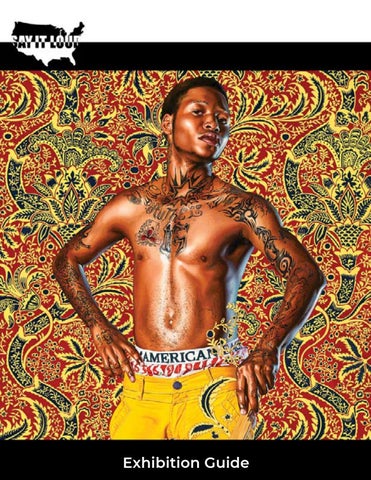
Pri nc e Al b e r t , P r i n c e C o n sor t o f Queen V i c tor i a , 2 0 1 3 , O i l o n c an v as , 7 2 x 6 0 in
82
FRANZ XAVER WINTERHALTER (1805-73) Prince Albert (1819-61) Signed and dated 1842 Oil on canvas | 132.7 x 97.2 cm (support, canvas/panel/str external) | RCIN 401412
83
About the work This portrait is part of Wiley’s series titled The World Stage: Jamaica. This series features Jamaican men and women assuming poses taken from 17th and 18th Century British portraiture. The juxtaposition between the sitter and the historical references questions the relationship between the island and her former colonial power. The subjects’ proud posturing refers to both the source painting and the symbolism of Jamaican culture, with its singular people and specific ideals of youth, beauty, and style. This painting features a young Jamaican man posed as Prince Albert, the husband of Queen Victoria. Wiley took stylistic references from the famous British textile designer William Morris for the intricate background of this work. This piece delivers power from royalty to laity.
Take Note: •
What is similar and different in the original work and Wiley’s version? Watch: Kehinde Wiley ‘The World Stage: Jamaica’ at Stephen Friedman Gallery, London