CYCLES
From Cells to the Cosmos
DenisonMuseum.org
CYCLES
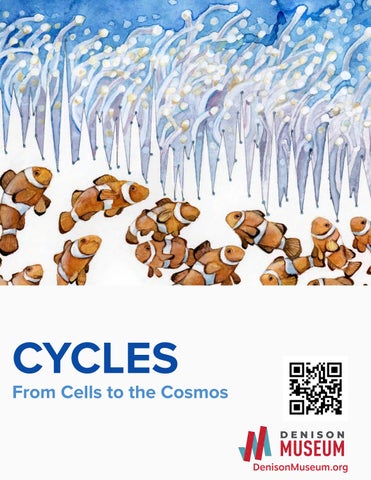
August 27–December 4, 2026 Nothing exists in isolation. Everything is connected. From cells to the cosmos, Cycles reveals the patterns of change that unite art, science, nature, and human experience. Cover image: Jill Pelto Habitat Degradation: Ocean Acidification, Watercolor and Colored Pencil, 2015
UPCOMING EVENTS: Minds Wide Open: Disruptive Technologies
Mon. Sept. 21/ 5:00-6:00pm Pre-Event Al Showcase 4:30-4:55pm Knobel Hall 218 Four Denison professors explore disruptive technologies, from the wheel and printing press to computers and AI, and how they have transformed society.
Allison Leigh Author talk Tues. Sept. 29/ 6:30pm Denison Museum Author of The Misogynists: A Reckoning with Modern Art Sponsored with the Laura C. Harris Series and AHVC
Free & open to the public Family Day Sat. Sept. 26/ 11- 1pm Denison Museum Tours, hands-on activities, art-making, discovery for all ages.
Jill Pelto Artist talk Mon. Oct. 26/7:00-8:00pm Denison Museum Pelto transforms climate and conservation data into paintings that illuminate connections between people and the environment. Sponsored by the Ronneberg Lecture series, Visual Arts, AHVC, Knowlton, King Center
Jill Pelto Artist Workshop Tues. Oct. 27/7:00-8:00pm Knobel Hall
Manhattan Short Film Festival Fri. Oct. 2/ 6:00-9:00pm Slayter Auditorium
Hands-on workshop with the artist, demonstrating how she creates art from data.
View and vote on the finalists in the 29th Annual MANHATTAN SHORT Film Festival.
Sponsored by the Ronneberg Lecture series, Visual Arts, AHVC, Knowlton, and the King Center
Collaging in the Present Moment Thurs. Nov. 12/ 7:00-8:00pm Denison Museum Slow down with a guided meditation, then create your own collage alongside an artist. Co-sponsored with the Hoaglin Wellness Center
Co-sponsored with the Granville Public Library
Third Coast Percussion at the Planetarium Fri. Dec. 4/ 7 & 8pm Planetarium RSVP
Third Coast Percussion performs beneath planetarium visuals exploring the cycles of the Moon, seasons, and stars.
CYCLES From Cells to the Cosmos August 27–December 4, 2026
Nothing exists in isolation. Everything is connected. Every living thing, every ecosystem, every work of art, every scientific discovery, and every planet is part of an interconnected web of change. Cycles explores the patterns that shape our world, revealing how growth, transformation, memory, and renewal connect disciplines too often viewed separately. Bringing together historic and contemporary art, scientific illustration, photography, rare books, film, music, dance, and interactive media, the exhibition reveals unexpected relationships across art, science, history, and the natural world. Artists and scientists share a common pursuit: observing change, recognizing patterns, and asking questions about the world around us. Time is essential to that pursuit. Whether observed through a microscope, telescope, camera, scientific instrument, or an artist's hand, patterns emerge over time. A dividing cell, an insect's metamorphosis, a changing climate, the rhythm of dance, the evolution of music, and the orbit of the Moon reveal transformations unfolding across vastly different scales and spans of time. Throughout the exhibition, artists and scientists offer different ways of seeing these transformations. David S. Goodsell reveals the architecture of living cells, while Jill Pelto and the Woodwell Climate Research Center turn scientific research into visual narratives. Katie Paterson's Earth-Moon-Earth sends Beethoven's Moonlight Sonata between Earth and the Moon, allowing distance and physics to reshape the music. Joe Conzo Jr.'s photographs capture hip hop's evolving relationship among music, dance, community, and identity. Mollie Wolf's WAKE considers water as a life-giving force and repository of memory, while Dan Homan's eclipse photography and John Soderberg's documentation of Ohio's ancient petroglyphs explore celestial and seasonal rhythms. Not every cycle is natural. Francisco de Goya's Disasters of War and Enrique Chagoya's Homage to Goya II confront recurring cycles of violence, asking us to recognize patterns in history so they need not be endlessly repeated. Other works explore identity, ecology, ritual, and cultural memory, reminding us that cycles are not simply processes to observe; they are systems in which we participate. Moving from microscopic life and environmental systems to celestial movement, spiritual traditions, identity, music, and artistic practice, Cycles invites us to discover connections among subjects that may at first seem far apart, and to consider our own place within them. Every ending can become a beginning, every repetition can produce change, and every return can offer a different perspective. We are not separate from these cycles of change; we are part of them. Denison Museum | CYCLES: From Cells to the Cosmos | Page 1
EXHIBITION AT A GLANCE Featured Artists Gavin Baily • Sienna Cenere • Enrique Chagoya • Joe Conzo Jr. • Tom Corby • David S. Goodsell • Francisco de Goya • Naima Green • Dan Homan • Golan Levin • Jonathan Mackenzie • Maria Sibylla Merian • Catherine Opie • Katie Paterson • Jill Pelto • Pablo Picasso • August Johann Rösel von Rosenhof • John Soderberg • Tom Tsai • Ian Van Coller • Michael Wall • Andy Warhol • Mollie Wolf Scientific Collaborators and Contributors Denison University faculty collaborators: Peter Graff, Dan Homan, Andy McCall, John Soderberg, Ksenia Un, Wes Walter, Mollie Wolf • Woodwell Climate Research Center Historic Collections and Cultural Materials Historic natural history books and scientific illustrations • Rare books from the Lloyd Library & Museum • Tibetan ritual objects Lenders Tom Corby, Gavin Baily, and Jonathan Mackenzie • Sienna Cenere • Joe Conzo Jr. Archives • David S. Goodsell • Grinnell College Museum of Art • Dan Homan • Hope College, Kruizenga Art Museum • Kennedy Museum of Art, Ohio University • Golan Levin • Lloyd Library & Museum • Katie Paterson Studio • Jill Pelto • John Soderberg • Mollie Wolf • Woodwell Climate Research Center Acknowledgments The Laura C. Harris Series co-sponsors the presentation of work by Katie Paterson. Special thanks to The Center for Print and Collaborative Arts.
HOW TO USE THIS GUIDE Works are organized by the section headings used in the galleries. Match the section title in this guide to the corresponding gallery area, then use the artist and title to locate an individual work. life and cells • environment and climate • cosmic movement • data and systems • identity and community • music and dance • artistic influence • ritual and renewal
Denison Museum | CYCLES: From Cells to the Cosmos | Page 2
Archaeology / Environmental Cycles John Soderberg (American, born 1966) Sun Cycles: bringing light to Inscription Rock Petroglyphs Inscription Rock: Seasonal Light Study, 2026 Medium: Digital video Courtesy of John Soderberg and Eli Lishack (‘26)
Inscription Rock is located at the water’s edge along the south shore of Kelley’s Island in Lake Erie. Centuries ago, Indigenous people carved their stories into the surface of the rock. Archaeologists call these carvings petroglyphs. In 1852, Henry Schoolcraft commented that Inscription Rock petroglyphs are “by far the most extensive and well sculptured and well-preserved inscription of the antiquarian period ever found in America.” The challenge is that erosion has blunted many of the carvings, and a shelter now blocks the sun from hitting the rock. So, seeing the glyphs as they were intended is impossible today. John Soderberg (Department of Anthropology), along with a team of archaeologists and Denison students, used 3D technologies to create detailed models of the rock surface. Then, we brought those models into a virtual world, recreating the path of the sun at different times of year. The goal is to see how Indigenous people used sunlight cycles to tell stories with these petroglyphs. Watch the video to see some highlights from the project. You are among the first people in living memory to see these carvings come to life as the sun moves. John Soderberg, Associate Professor, Anthropology Sources and further reading: Ohio History Connection
Denison Museum | CYCLES: From Cells to the Cosmos | Page 3
Photos: Eastman’s map.
Denison Museum | CYCLES: From Cells to the Cosmos | Page 4
Photos: view of the island, John doing photogrammetry, view of the rock.
Denison Museum | CYCLES: From Cells to the Cosmos | Page 5
Artistic Cycles Artistic Cycles and Identity Cycles presents two groupings of modern and contemporary artworks that treat artistic inspiration as more than a linear process of passed-down techniques and concerns. Artists such as Naima Green and Enrique Chagoya remix, revolutionize, and reinvent modern interpretations of centuries of artistic production, presenting an artistic lineage that curves and cycles throughout their works. Ksenia Un, Assistant Professor, Art History & Visual Culture These eight works are connected through Enrique Chagoya’s reinterpretation of Francisco Goya’s The Disasters of War. Chagoya transforms Goya’s compositions by incorporating imagery from Andy Warhol and Pablo Picasso, whose works are included here to invite connections across generations of artistic creation.
Far Left Andy Warhol (American, 1928–1987) Electric Chair #77, 1971 Medium: Screenprint, series of ten Dimensions: 35 1/2 x 47 3/4 in. Object/collection no.: 85.028B.I5 Credit/lender: Courtesy of the Kennedy Museum of Art, Ohio University This print, Electric Chair #77, is one of ten prints in a series, each showing the same image with a different color palette. Warhol, known for drawing on commercial and mass media, created the Death and Disaster series; this work features the 1953 press photograph of the execution chamber at Sing Sing Correctional Facility in New York to comment on how repeated exposure to grim or brutal subjects dulls emotional responses. Enrique Chagoya (lower right), in his series, directly references Warhol with his iconic red soup-can stamp. In Chagoya's work, a reporter with the head of a parrot cries out to an audience of other animals. Because parrots are known to repeat words, Chagoya also references the parroting of violent details in the news and media, desensitizing the crowd. Grant Snyder ’26, Denison Museum Intern Sources and further reading: MET
Grid:Top row left to right On view are three prints from Los Desastres de la Guerra, or The Disasters of War, made by Spanish artist Francisco Goya y Lucientes (1746–1828) between 1810 and 1820. The eighty-two prints respond to the horrors surrounding the Peninsular War of 1808–14 between Spain and Napoleonic France and are grouped into three main sections: the effects of the war; the Madrid famine of 1811–12; and the political debates within Spain that followed the expulsion of French forces in 1813.
Denison Museum | CYCLES: From Cells to the Cosmos | Page 6
Francisco de Goya y Lucientes (Spanish, 1746–1828) Thanks for the Millet, first edition ca. 1810–1820; this edition 1906 Medium: Etching and aquatint Dimensions: Sheet: 9 1/4 x 13 1/2 in. (23.5 x 34.29 cm); plate: 5 3/4 x 8 in. (14.61 x 20.32 cm Edition/series: The Disasters of War Object/collection no.: 2017.31.1 Credit/lender: Gift of Mary Neznek in honor of the legacy of A. J. Muste; Courtesy of Hope College, Kruizenga Art Museum This print is one of several in The Disasters of War series that documents the effects of the famine that devastated Madrid in 1811-12 as a result of the Napoleonic invasion. In his effort to portray the plight of those most affected by the war, Goya used aquatint to create high contrasts within the image, thereby drawing the greatest attention to the figures. The fact that the lightest parts of the image, those with little or no aquatint, are in the faces and clothes of the people is no accident; no matter where the viewer looks, the eye is consistently drawn to the figures in the center. Goya wants the viewer to see the misery and suffering of these people for what it is. Madeleine Zimmerman ’20, Hope College Sources and further reading: Library of Congress, Virtual Tour: Goya's "Los Desastres de la Guerra" Francisco de Goya y Lucientes (Spanish, 1746–1828) It Always Happens, designed ca. 1810–1820; this edition 1906 Medium: Etching Dimensions: Sheet: 11 1/4 x 13.9 in. (28.58 x 35.4 cm); plate: 6 7/8 x 8 5/8 in. (17.46 x 21.91 cm Edition/series: The Disasters of War Object/collection no.: 2017.29.1 Credit/lender: Courtesy of Hope College, Kruizenga Art Museum Francisco Goya is widely regarded as the most important Spanish artist of the late 18th and early 19th centuries. His art reflected the political and social upheavals of the time in which he lived. Goya spent the decade between 1810 and 1820 creating a series of eighty-two prints known as The Disasters of War (Los Desastres de la Guerra). These prints were designed in response to Napoleon’s invasion and occupation of Spain in 1808, and Spain’s subsequent struggle for independence. Though he was allowed to retain his position as court painter, Goya was deeply affected by the war and its effects on the population. This series became his way of recording the horrors he witnessed. There are few other depictions of war that are as brutal and unflinching as The Disasters of War. However, the series was never published during his lifetime, most likely because Goya feared a negative political reaction. It Always Happens falls into a sub-category of prints within the series that depict the effects of war on soldiers. This print effectively conveys the pace and chaos of war through the use of short, straight lines that are brittle yet assertive. The lines make it difficult for the eye to settle, further communicating the confusion of war. Madeleine Zimmerman ’20, Hope College Sources and further reading: Library of Congress, Virtual Tour: Goya's "Los Desastres de la Guerra" Denison Museum | CYCLES: From Cells to the Cosmos | Page 7
Francisco de Goya y Lucientes (Spanish, 1746–1828) And This Too, first edition ca. 1810–1820; this edition 1906 Medium: Etching Dimensions: Sheet: 11 1/4 x 14 1/4 in. (28.58 x 36.04 cm); plate: 6 1/4 x 8 5/8 in. (15.72 x 21.91 cm Edition/series: The Disasters of War Object/collection no.: 2017.29.2 Credit/lender: Courtesy of Hope College, Kruizenga Art Museum This print belongs to a subgroup of images within Francisco Goya's Disasters of War series that portray the effects of the Napoleonic invasion on Spanish civilians. The emphasis on the central group of women, whose clothing indicates they are well-to-do, shows that war affects all people, not just the soldiers or the most vulnerable in society. Though the women and children in this print are presumably leaving their homes, there is not the same sense of urgency that is found in many other Disasters of War prints. The women and children appear to be heading towards a darkened sky, suggesting there will be no true escape from the horrors of the war around them. Madeleine Zimmerman ’20, Hope College Sources and further reading: Library of Congress, Virtual Tour: Goya's "Los Desastres de la Guerra"
Bottom row, left to right: Spanish painter Francisco Goya's The Disasters of War was not published until more than thirty years after his death because its prints condemned the brutality and suffering of war. Enrique Chagoya's Homage to Goya II: Disasters of War was created in a very different moment, when museums and galleries regularly exhibit art that questions war, power, and injustice. Rather than asking whether art can challenge institutions like the military or the Catholic Church, Chagoya asks a different question: how can artists first rethink the history and traditions of art itself? Chagoya fills his prints with playful references to famous works of modern and contemporary art. Ksenia Un, Assistant Professor, Art History & Visual Culture
Enrique Chagoya (American, born 1953) Homage to Goya II: Disasters of War, 2003 (Farándula de charlatan) Charlatans show Medium: Aquatint, etching, and rubber stamp Dimensions: Images vary; sheets: 13 x 15 in. (33 x 38.1 cm) Edition/series: Edition 30/30 Object/collection no.: 2007.014.009 Credit/lender: Marie-Louise and Samuel R. Rosenthal Fund; Grinnell College Museum of Art Andy Warhol's famous Campbell's Soup can appears as a red stamp, echoing the stamps beneath some of Goya's original images. While Warhol's work explored consumer culture and mass media, Chagoya’s print questions how modern communication spreads misinformation and spectacle. Denison Museum | CYCLES: From Cells to the Cosmos | Page 8
Ksenia Un, Assistant Professor, Art History & Visual Culture Francisco de Goya y Lucientes (Spanish, 1746–1828) 'Charlatan's show' (Farándula de charlatanes), 1814–15 (published 1863) Medium: Etching Edition/series: The Disasters of War
Sources and further reading: Collection record
Enrique Chagoya (American, born 1953) Homage to Goya II: Disasters of War, 2003 (Plate 77: Que se rompe le cuerde), The Rope is Breaking Medium: Aquatint, etching, and rubber stamp Dimensions: Images vary; sheets: 13 x 15 in. (33 x 38.1 cm) Edition/series: Edition 30/30 Object/collection no.: 2007.014.010 Credit/lender: Marie-Louise and Samuel R. Rosenthal Fund; Grinnell College Museum of Art Chagoya borrows Keith Haring's instantly recognizable drawing style, turning it into a stamp and adding Haring's signature energetic lines around the pope's head. The playful reference invites viewers to consider whether familiar artistic symbols can also challenge religious authority. Ksenia Un, Assistant Professor, Art History & Visual Culture Francisco de Goya y Lucientes (Spanish, 1746–1828) (Plate 77: Que se rompe le cuerde), The Rope is Breaking), 1814–15 (published 1863) Medium: Etching Edition/series: The Disasters of War
Denison Museum | CYCLES: From Cells to the Cosmos | Page 9
Sources and further reading: Collection record Enrique Chagoya (American, born 1953) Homage to Goya II: Disasters of War, 2003 (Plate 67: Esta no lo es menos) This is no less strange Medium: Aquatint, etching, and rubber stamp Dimensions: Images vary; sheets: 13 x 15 in. (33 x 38.1 cm) Edition/series: Edition 30/30 Object/collection no.: 2007.014.005 Credit/lender: Marie-Louise and Samuel R. Rosenthal Fund; Grinnell College Museum of Art
Pablo Picasso's Les Demoiselles d'Avignon (1907) appears upside down. Turning one of the most celebrated paintings of modern art on its head, Chagoya’s caption challenges the masterpiece status of Les Desmoiselles. Ksenia Un, Assistant Professor, Art History & Visual Culture Francisco de Goya y Lucientes (Spanish, 1746–1828) Esta no lo es menos (This Is Not Less So), Plate 67 from Los desastres de la guerra (The Disasters of War), 1814–15 (published 1863) Medium: Etching Edition/series: The Disasters of War
Sources and further reading: Collection record Pablo Picasso (Spanish, 1881–1973) Scène d’Intérieur, 1926 Medium: Lithograph Dimensions: 8 3/4 x 11 in. (22.23 x 27.94 cm) Edition/series: Unsigned Object/collection no.: 1982.012.PP Credit/lender: Gift of Clinton A. Rehling ’39; Grinnell College Museum of Art
Denison Museum | CYCLES: From Cells to the Cosmos | Page 10
Picasso’s Scène d’Intérieur is included here to connect his work with the artistic legacy Chagoya reinterprets nearby. In Chagoya’s print, This is no less strange (bottom row, far right), Chagoya replaces the Virgin Mary in Goya’s original composition with Picasso’s Les Demoiselles d’Avignon. This shift from religious icon to artistic icon invites us to consider how images are borrowed, transformed, and revered across cycles of artistic creation. Grant Snyder ’26, Denison Museum Intern Sources and further reading: Collection search
Denison Museum | CYCLES: From Cells to the Cosmos | Page 11
Cell Cycles and Viruses Top row, left to right: David S. Goodsell (American, born 1958) Kinetochore, 2024 Medium: Scientific illustration / digital print Credit/lender: Illustration by David S. Goodsell, RCSB Protein Data Bank. DOI: 10.2210/rcsb_pdb/goodsell-gallery-050
Kinetochores separate chromosomes when eukaryotic cells divide. This illustration shows a yeast kinetochore (green) attached to a disassembling microtubule (blue). Chromatin is shown at upper right with DNA in yellow and histones in orange. David S. Goodsell Sources and further reading: Work page
David S. Goodsell (American, born 1958) Bacteriophage T4 Infection, 2023 Medium: Scientific illustration / digital print Credit/lender: Illustration by David S. Goodsell, RCSB Protein Data Bank. DOI: 10.2210/rcsb_pdb/goodsell-gallery-048
Snapshots from the life cycle of bacteriophage T4. At left, a bacteriophage (red) is injecting its DNA genome (white) into an Escherichia coli cell. At center, the bacteriophage has taken over the cell, destroying the cellular DNA (purple) and forcing the cell to make many new copies of itself. At right, the bacteriophage produces a channel-forming protein (magenta) that pierces the inner cell membrane, allowing lysozyme enzymes to break down the peptidoglycan sheath (fibrous molecules shown in turquoise between the two cellular membranes) that supports the cell. The cell bursts, releasing several hundred new bacteriophages. David S. Goodsell Denison Museum | CYCLES: From Cells to the Cosmos | Page 12
Sources and further reading: Work page
Center: David S. Goodsell (American, born 1958) JCVI-syn3A Minimal Cell, 2022 Medium: Scientific illustration / digital print Credit/lender: Illustration by David S. Goodsell, RCSB Protein Data Bank. DOI: 10.2210/rcsb_pdb/goodsell-gallery-042
JCVI-syn3A is a minimal cell developed at the J. Craig Venter Institute, with a reduced genome of 493 genes. It was developed in several steps, starting from Mycoplasma mycoides and successively removing non-essential genes. In the most recent step, from Syn3.0 to Syn3A, 19 genes were added back to the cell resulting in more stable morphology and division of the cells. Syn3A cells provide an attractive laboratory for exploring the central processes needed for life and abundant information is available for them, including an extensively-annotated genome, a proteome with molecular abundances, and cryo-EM images of individual cells. The illustration integrates this experimental data to create a cross-section through an entire JCVI-syn3A cell, showing all macromolecules. The cell is depicted just after beginning division. DNA is in bright yellow, DNA-associated proteins are in tan, and DNA-associated enzymes (polymerases and topoisomerases) are in orange. The membrane is in green, with membrane-spanning proteins in a darker shade and lipoproteins in bluer green. RNA, including ribosomes, tRNA and mRNA, are in shades of magenta, and protein synthesis factors are in purple. Enzymes are in shades of blue, with a cooler cobalt blue for enzymes interacting with the protein synthesis machinery, and metabolic enzymes in shades of turquoise. A pdf document is available for download with a detailed key of the molecules that are depicted in the illustration and information on scientific sources for the structures. David S. Goodsell Sources and further reading: Work page
Denison Museum | CYCLES: From Cells to the Cosmos | Page 13
Bottom row, left to right: David S. Goodsell (American, born 1958) Zika Virus, 2016 Medium: Scientific illustration / digital print Credit/lender: Illustration by David S. Goodsell, RCSB Protein Data Bank. DOI: 10.2210/rcsb_pdb/goodsell-gallery-015
Zika virus is shown in cross section at center left. On the outside, it includes envelope protein (red) and membrane protein (magenta) embedded in a lipid membrane (light purple). Inside, the RNA genome (yellow) is associated with capsid proteins (orange). The viruses are shown interacting with receptors on the cell surface (green) and are surrounded by blood plasma molecules at the top. The painting was created as part of the Molecule of the Month on Zika virus. At the 2017 Vizzies, this painting was recognized by the National Science Foundation (NSF) and Popular Science as one of the best science images of the year and selected as the "People's Choice" in the category of illustration. David S. Goodsell Sources and further reading: Work page David S. Goodsell (American, born 1958) Coronavirus Life Cycle, 2020 Medium: Scientific illustration / digital print Credit/lender: David S. Goodsell, RCSB Protein Data Bank; doi: 10.2210/rcsb_pdb/goodsell-gallery-023 Integrative illustration for coronavirus outreach (2020) PLoS Biol 18: e3000815 doi: 10.1371/journal.pbio.3000815
This illustration shows a cross section through a cell infected with a coronavirus such as SARSCoV-2. It shows a time point when the virus is actively replicating, and new viruses are being created. The cell’s molecules are shown in blues and greens, and the viral molecules are shown in pinks and purples. The illustration integrates the current state of knowledge, but many aspects of the virus and its life cycle are still actively being studied, so portions of the painting are
Denison Museum | CYCLES: From Cells to the Cosmos | Page 14
speculative. Additional resources for exploring coronavirus are available at PDB-101 and the main RCSB PDB site. David S. Goodsell Sources and further reading: Work page
Denison Museum | CYCLES: From Cells to the Cosmos | Page 15
Cosmic Cycles Dan Homan (American, born 1972) Professor of Physics and Astronomy, Denison University Eclipse Phases, April 8, 2024 Medium: Composite photograph Credit/lender: Courtesy of the artist Composite image recording the phases just before, during, and after the Great North American Eclipse as the Moon passed the Sun from northern Ohio. Dan Homan
Katie Paterson (Scottish, born 1981) Earth–Moon–Earth (Moonlight Sonata Reflected from the Surface of the Moon), 2007 Medium: Installation with automated piano, music, and two giclée prints Dimensions: Prints: 11.7 x 16.5 in. (29.7 x 42 cm) Credit/lender: Courtesy of Katie Paterson Studio; piano presentation supported by the Laura C. Harris Series Earth-Moon-Earth (E.M.E.) radio is a form of transmission whereby messages are sent in Morse code from Earth, reflected off the surface of the Moon, and then received back on Earth. The Moon reflects only part of the information back: some is absorbed in its shadows or lost in its craters. For this artwork, Beethoven’s Moonlight Sonata was translated into Morse code and sent to the Moon. Returning to Earth fragmented by the Moon’s surface, this historical composition was then re-translated into a new score, the gaps and absences becoming intervals and rests. The “Moonaltered” piece is played on an automated grand piano. Katie Paterson Sources and further reading: Artist work page
Denison Museum | CYCLES: From Cells to the Cosmos | Page 16
Data Science Golan Levin (American, born 1972) Stripe, 1998 Medium: Interactive software Dimensions: Dimensions variable Credit/lender: Courtesy of the artist Stripe (1998) allows its user to paint "chemicals" into a reaction-diffusion simulation. Such simulations are believed to model the formation of leopard spots and zebra stripes; here, their result is a kaleidoscopic pattern of subtly-evolving gradients. (References: Meinhardt 1982; Turk 1991). Golan Levin Sources and further reading: Project page Golan Levin (American, born 1972) Dendron, 2001 Medium: Interactive software Dimensions: Dimensions variable Credit/lender: Courtesy of the artist Dendron is an interactive software artwork, developed in 2001, which allows the user to gesturally engage with "Diffusion-Limited Aggregation" (DLA), an organic simulation of dendritic growth. Dendron was created as a Java programming tutorial for the book "4x4: Generative Design" (Friends of Ed publishers). Golan Levin Sources and further reading: Project page Jill Pelto (American, born 1993) 40 Years in the North Cascades, 2023 Medium: Watercolor, colored pencil, acrylic, and Conté Dimensions: 12 x 16 in. Credit/lender: Courtesy of the artist
In 2023, the North Cascade Glacier Climate Project reached its 40th year. My dad, Dr. Mauri Pelto, began this project in 1984, and every year since he has gone out to measure the changes first hand. 2023 was my 15th year, and I am now the Art Director of the project. The line graph in this piece makes up the top surface of the glacier, and depicts the mass balance data collected by the project from 1984-2022. Mass balance is the health of a glacier: the difference in snowfall gain vs. melt each year. Each August, my dad, myself, and a team spend weeks backpacking and working on the same group of mountain glaciers. This lifelong project has led to over 5,000 miles hikes, over 40,000 measurements taken, and over 700 nights in a tent. This is my updated version of my very first data art painting Glacier Mass Balance. Jill Pelto
Denison Museum | CYCLES: From Cells to the Cosmos | Page 17
Sources and further reading: Artist work page Jill Pelto (American, born 1993) Proxies for the Past, 2015 Medium: Watercolor and colored pencil Dimensions: 10 x 14 in. Credit/lender: Courtesy of the artist
This painting is inspired by the universal unknowns, which humans try to solve by using materials such as ice cores, tree rings, and lichens to date and reconstruct past climate events. Nature reveals some of its’ secrets in these concentric forms, allowing us to determine information such as the data depicted: the average global temperature of Earth from 11,000 years ago to present. Jill Pelto Sources and further reading: Artist work page Jill Pelto (American, born 1993) Habitat Degradation: Ocean Acidification, 2015 Medium: Watercolor and colored pencil Dimensions: 11 x 14 in. Credit/lender: Courtesy of the artist
Separating clownfish from the anemone they live in is a graph line showing the average pH of the ocean from 1998 to 2012. The decrease in global pH is due to atmospheric carbon dissolving into the ocean, which creates carbonic acid and thus a more acidic ocean. Studies on clownfish show that more acidic water alters how their brains’ process information. This affects their ability to avoid predators by detecting noises and find their way home. Ocean water has a lower pH than a fish’s cells, so they take in carbonic acid in order to be in harmony with their environment. Even a small drop in pH requires fish to expend much more energy in order to equilibrate. The clownfish in my watercolor are grouped in confusion, separated from the anemone in which they live. Jill Pelto Sources and further reading: Artist work page Jill Pelto (American, born 1993) Glacier Mass Balance, 2015 Medium: Watercolor and colored pencil Dimensions: 11”x14” Credit/lender: Courtesy of the artist
The surface of this glacier is composed of a line graph of the average mass balance for the mountain glaciers in the North Cascade, WA, from 1980-2014. Mass balance is the annual Denison Museum | CYCLES: From Cells to the Cosmos | Page 18
budget for the glaciers: total snow accumulation minus total snow ablation. Not only are mass balances consistently negative, they are also continually decreasing. This is the very first dataart painting I created, where I realized I could weave graphs into landscapes to help people see them as stories of changes over time. In 2023 I made an updated version of this painting, 40 Years in the North Cascades. Jill Pelto Sources and further reading: Artist work page
Jill Pelto (American, born 1993) Salmon Population Decline, 2015 Medium: Watercolor and colored pencil Dimensions: 11 x 14 in. Credit/lender: Courtesy of the artist
There are many species of salmon, depicted here is a grouping of the Coho species in Washington State from 1980 to 2014. I created this piece after a summer of witnessing heatwaves and drought in the Pacific Northwest. Seeing the rivers and reservoirs looking so barren was frightening; the snowpack in the mountains and on the glaciers supplies a lot of the water for this region, and the additional lack of precipitation has greatly depleted the state’s hydrosphere. The salmon are depicted swimming along the length of the graph, following its current. While salmon can swim upstream, it is becoming more of an uphill battle with lower stream flow and higher temperatures. This image depicts the struggle their population is facing as their spawning habitat declines. Jill Pelto Sources and further reading: Artist work page
Jill Pelto (American, born 1993) Dwindling Migration, 2016 Medium: Watercolor and colored pencil Dimensions: 12 x 18 in. Credit/lender: Courtesy of the artist For sale: $1,750 Caribou migrate long distances seasonally, forming weaving patterns across mountains, bogs, and rivers. The line graph depicted shows the dramatic decline in the George River Caribou Herd from 1980 to the present. They travel huge distances across much of Quebec and Labrador. When I created this painting in 2016, their estimated population was around 14,600. In 2024, this decreased to 8,600. A hunting ban has been issued to help the herd recover, and they will be surveyed again in 2026. Jill Pelto
Denison Museum | CYCLES: From Cells to the Cosmos | Page 19
Sources and further reading: Artist work page Sienna Cenere (American, born 1983) Breathe, 2016 Dimensions: 20”x30” Edition/series: Original drawing Credit/lender: Courtesy of the artist
This tree line was inspired by an EEG reading of Sienna's brain, recorded after completing an 8week Mindfulness-Based Stress Reduction practice coupled with regular access to nature. "Breathe" was created as part of an interdisciplinary project with Dr. Brittany Alperin and NW Noggin, culminating in public SciArt presentations exploring the benefits of self-care for the depressed brain. The drawing was created by hand-writing data from Dr. Alperin's comparative analysis, which showed an 80% improvement in Sienna's alpha-asymmetry, indicating a shift from precognitive withdrawal (as seen in depression and anxiety) to precognitive approach. Sienna also included the chemical formulas for alpha-pinene and geosmin, which are shown to decrease cortisol levels (a stress hormone) and reduce heart rate. Both molecules are readily available to breathe in coniferous forests, which Sienna found greatly reduced her anxiety.
Sienna Cenere is a self-taught artist with a Bachelor of Science in Biology. Her distinctive style, known as numberism, involves meticulously writing thousands of tiny numbers and equations by hand to create meditative and educational artworks. Each piece uses scientific data relevant to the subject's form and function, bridging the gap between art and science. Sienna Cenere Sources and further reading: Artist website
Denison Museum | CYCLES: From Cells to the Cosmos | Page 20
Environmental Cycles Tom Corby, Gavin Baily, and Jonathan Mackenzie The Southern Ocean Studies, 2009-2011 Medium: Real-time multimedia projection Dimensions: Dimensions variable Credit/lender: Courtesy of the artists
The Southern Ocean Studies is part of a series of projects produced with assistance from our partners the British Antarctic Survey, which aims to explore how Climate Models can function as expressive visual and conceptual representations of climate change beyond their original scientific contexts and purpose, i.e. as art media with expressive, conceptual and critical potential. In doing so it presents a possible model of practice for a digital and networked art that seeks to reflect upon the intersections between culture and the technological and cognitive infrastructure of the science of climate change. The project is a wall projected, real-time rendering of data derived from a climate model used to track and predict the impacts of climate change in the Antarctic Circumpolar Current, a key circulation component of the Southern Ocean. This data includes the dynamics of surface wind and current velocity, combined with values for salinity and acidity, all of which are derived from Argo floats in the region. To this we have added our own particle systems, to reanimate the data and enhance the patterning effect of the model's environmental dynamics. The project runs as a live process to produce emergent structure from the interactions between the geophysical couplings described in the model. The flickering constellations of tidal flow, and intricate lattices of polar wind and ocean currents generated by the work, embody the hard data of climate change as felt experience. With this work, we hope to show how the data and models of climate science can be redeployed to develop an eco-tec aesthetic that demonstrates this data's affective, discursive, and poetic dimensions. Tom Corby, Gavin Baily, and Jonathan Mackenzie Notes on the Southern Ocean The Antarctic Circumpolar Current (ACC) is the most significant circulation component of the Antarctic Southern Ocean. It's currents are driven by whipping westerly winds that function to buffer Antarctica's, ice sheets from warm water thus protecting their structural integrity and ultimately preserving the albedo effect of the region. It also operates as a huge carbon sink; the Southern Ocean alone absorbs 15% of the Earth's carbon emissions. Recent research has that has shown that, carbon saturation of the Southern Ocean caused by climate change and changes in levels of ozone, has damaged the marine organisms that provide the mechanisms for it to sequester carbon. Increased acidification caused by carbon saturation impacts on plankton and visa versa ultimately driving up ocean temperatures through a causal chain that reinforces already dangerous rises in the ocean's temperature. These geochemical processes locally lead to ice sheet melt, they also impact on the ecological matrix of the planet writ large, as the ACC operates as a dynamo that interactively feeds the
Denison Museum | CYCLES: From Cells to the Cosmos | Page 21
temperatures of the Earth's oceans with significant global knock-on effects for global temperature and rainfall distribution on a global scale. Tom Corby, Gavin Baily, and Jonathan Mackenzie Sources and further reading: Project page, The Data Imaginaries of Climate Art, video Ian van Coller (South African American, born 1970) Jackson Glacier Ice Arch, Glacier National Park, Montana, 2013 Medium: Archival pigment print Dimensions: Image: 19 3/4 x 32 in. (50.17 x 81.28 cm Object/collection no.: 2017.24.1 Credit/lender: Courtesy of Hope College, Kruizenga Art Museum Global climate change is causing glaciers around the world to melt at an alarmingly rapid rate. Melting glaciers will eventually lead to a dramatic rise in sea levels, and will threaten the fresh water supplies of many countries. This photograph by artist Ian Van Coller belongs to a series that documents the disappearing glaciers in Glacier National Park in northern Montana. In 1880 there are estimated to have been approximately 150 glaciers within the area encompassed by the park. Because of global warming there are now only 25 glaciers remaining in the park, and by the middle of the 21st century there may be none. Melt water from the glaciers plays a critical role in the ecology of Montana and other western states, so the disappearance of the glaciers poses a severe ecological threat to the region. Kruizenga Art Museum Sources and further reading: Collection record
Denison Museum | CYCLES: From Cells to the Cosmos | Page 22
Woodwell Climate Research Center Woodwell Climate Research Center conducts science for solutions at the nexus of climate, people, and nature. They partner with leaders and communities for just, meaningful impact to address the climate crisis. https://www.woodwellclimate.org
Woodwell Climate Research Center ArcticDEM Medium: Satellite-data image Credit/lender: Courtesy of Woodwell Climate Research Center
Art derived from the ArcticDEM dataset, a result of a public/private partnership between Maxar Space Industry (now Vantor) and the U.S. government. We use this data in much of our Arctic research including our AI driven abrupt thaw mapping project. Sources and further reading: Arctic Woodwell Climate Research Center Sea Ice Medium: Satellite-data image Dimensions: 22 x 18 in. Credit/lender: Courtesy of Woodwell Climate Research Center
A winter scene acquired by the Sentinel2 platform (Copernicus Sentinel-2 mission, ESA) for the southern portion of the Yukon-Kuskokwim Delta in southwest Alaska. The image is focused on the village of Kuigilnguq, Alaska. A community that has been losing winter sea-ice at a rapid rate due to climate-driven warming. Sea ice is extremely important for the practice of seal hunting by indigenous people in this region. The Permafrost Pathways project has partnered with people of the community of Kuigilnguq, co-creating climate adaptation strategies for the region. Data sources: Copernicus Sentinel2. Sources and further reading: Permafrost Pathways, Adaptation strategies Denison Museum | CYCLES: From Cells to the Cosmos | Page 23
Woodwell Climate Research Center Kolyma River Medium: Satellite-data image Dimensions: 24 x 32 in. Credit/lender: Courtesy of Woodwell Climate Research Center
The Kolyma River Delta of Northeastern Siberia. This image is from the Landsat platform using bands 3,4,5 to make a ‘false-color’ composite that highlights the difference from the wet and dry land areas. The Russian Northeast science station can be found in this region, along the mains tem of the river just before it splits into two sections. Researchers of the Arctic Great Rivers Observatory project at Woodwell have been working with collaborators in this region since the early 2000s. Data sources: NASA Landsat Mission. Sources and further reading: Arctic Great Rivers
Woodwell Climate Research Center Lena Delta, 2020 imagery Medium: Satellite-data image Dimensions: 24 x 24 in. Credit/lender: Courtesy of Woodwell Climate Research Center
A photorealistic blend of the Lena River Delta in Russia, created from high-resolution cloudfree satellite imagery acquired by the Sentinel2 platform (Copernicus Sentinel-2 mission, ESA) and high-resolution elevation data from the ArcticDEM project (NGA-NSF). The imagery was acquired in March 2020 when the sun has returned from the south (note brightness coming from the SW portion of the image) yet the region was still largely within the grips of winter. The Lena River is part of the Arctic Great Rivers Observatory project at Woodwell. Data sources: Copernicus Sentinel2, ArcticDEM. Sources and further reading: Arctic Great Rivers
Denison Museum | CYCLES: From Cells to the Cosmos | Page 24
Woodwell Climate Research Center Yukon Delta Medium: Satellite-data image Dimensions: 24 x 18 in. Credit/lender: Courtesy of Woodwell Climate Research Center An artistic rendition of the Yukon River Delta in Alaska. By combining bands 4 (red), 3 (green), and 1 (coastal aerosol band) from satellite imagery of the Sentinel2 platform (Copernicus Sentinel-2 mission, ESA), we are able to see sediment within the water. The sediment in this image was recolored to a fire-like yellow to stand out from the surrounding land and deep ocean. Data sources: Copernicus Sentinel2. Sources and further reading: Water Woodwell Climate Research Center Kolyma Delta Medium: Satellite-data image Credit/lender: Courtesy of Woodwell Climate Research Center
The Kolyma River Delta of Northeastern Siberia. This image is from the Landsat platform using bands 3,4,5 to make a ‘false-color’ composite that highlights the difference from the wet and dry land areas. The Russian Northeast science station can be found in this region, along the mainstem of the river just before it splits into two sections. Researchers of the Arctic Great Rivers Observatory project at Woodwell have been working with collaborators in this region since the early 2000s. Data sources: NASA Landsat Mission. Sources and further reading: Arctic Great Rivers
Denison Museum | CYCLES: From Cells to the Cosmos | Page 25
Woodwell Climate Research Center Hurricane Helene Medium: Digital video Credit/lender: Courtesy of Woodwell Climate Research Center
Atmospheric visualization of Hurricane Helene derived from NOAA GOES-16 cloud-moisture data. Watch the video Sources and further reading: How Climate Change is affecting Hurricane season, Data Set,
Denison Museum | CYCLES: From Cells to the Cosmos | Page 26
Mollie Wolf (American, born 1990) WAKE (THEWILDS, iteration III), 2021 Medium: Digital video with sound Credit/lender: Courtesy of Mollie Wolf; featuring Tom Tsai; music by Michael Wall. Filmed in the ancestral lands of the Tongva, Kizh, Yuhaaviatam, Serrano & Vanyume This film concerns itself with water as a spiritual presence and life force. Memory and premonition blend, as a lone traveler reckons with loss. WAKE comments on ways that climate change threatens to disrupt the life-giving powers of our planet’s water. The work references the spiritual, symbolic, metaphysical, and ecological power that water has to heal and transform. The film’s title, WAKE, is a triple-entendre: —(v) to awaken, to become consciously alert; —(n) a gathering of vigil/grief over a lost one; —(n) the aftermath or conditions left behind by a force that has passed, particularly through water. Filmed in 2021, the filmmakers’ travels through the San Gabriel Mountains in Southern California to create this footage occurred in the midst of anxieties surrounding the global pandemic. At the time, the film’s subject (dear friend/collaborator of the director), Tom Tsai expressed an urge to be in running water, to be cleansed, bathed, and transformed by moving water. Wolf was immediately enthused by this idea—the water baby (Pisces) that she is. For much of their filming process, Tsai and Wolf were knee deep in water, their clothes soaking the whole time, and for a few specific shots, Tom was fully submerged in the water (lying down in river beds or standing under a waterfall, pounded by the rushing current). Enduring the cold and bracing against the strong currents required their meditative concentration, as well as willingness to be uncomfortable. After three days of filming in rivers, they spent their last day filming in El Mirage Lake, a dry lake bed in the Mojave Desert, and were immediately aware of an absence of life. The stark difference between the locations is sonically evident in the resulting film: the sound of life near the river (rushing water, tweeting birds, squirrels and chipmunks rustling the nearby bushes)—the fullness of which is experienced in sudden opposition to the almost silence of the dry lake bed (the only sound here is an occasional whistle of the wind, or the shuffling of a tumbleweed rolling across the cracked ground). When making, the collaborators found common ground in their anxieties over the global water crisis, evidence of which they have each experienced firsthand. For Wolf, it was felt as a gradual change to normalcy over the course of her childhood—witnessing drought creep into the daily reality of life in Colorado (the disappointment of less and less snow overtime, performing school drills for flash floods because there was no longer enough vegetation to help the soil absorb rainwater, being taught to use a timer when showering to prevent overconsumption, etc). Then in 2012, Wolf experienced the drought more acutely/traumatically when her family’s home and neighborhood burned in a wildfire. For Tsai, it was witnessing the pollution that has become normal in the oceans and beaches surrounding his home in Taiwan and other coastal regions of Asia, as well as the continually increasing drought conditions drying up lakes and rivers in Southern California, where he currently lives. Mollie Wolf, Visiting Assistant Professor, Dance Sources and further reading: Video Denison Museum | CYCLES: From Cells to the Cosmos | Page 27
Identity Cycles Artistic Cycles and Identity presents two groupings of modern and contemporary artworks that treat artistic inspiration as more than a linear process of passed-down techniques and concerns. Artists such as Naima Green and Enrique Chagoya (Artistic Cycles) remix, revolutionize, and reinvent modern interpretations of centuries of artistic production, presenting an artistic lineage that curves and cycles throughout their works. Naima Green's portrait of Emani and Tangina is much smaller than Catherine Opie's selfportrait Bo, yet both command attention through their careful use of pose and light. Opie’s portraits have been compared to fifteenth and sixteenth century paintings from the Northern Renaissance, suggesting that the art of portraiture continues to draw on visual traditions that span centuries while taking on new meanings in different communities. Green's photograph pays direct homage to Opie's work. Its title, Emani & Tangina, King of Clubs (2019), references Opie's Dyke Deck (1995; reprinted 2025), a series of photographic playing cards she created when her own larger prints were financially out of reach. “The project was about personas,” Opie recalls, “and we had specific categories: couples are hearts, jocks are clubs, femmes are diamonds, and butches are spades. It was all queer play.” Green's portrait is part of Pur·suit (2019), a deck of fifty-four playing cards that, as the artist explains, reimagines Opie's “iconic foundational project” with a new generation of sitters, expanding its vision of queer portraiture and community. What would happen if Pur·suit was combined with Dyke Deck to play a game? How do the playing cards activate the portraits on the wall? Ksenia Un, Assistant Professor, Art History & Visual Culture
Denison Museum | CYCLES: From Cells to the Cosmos | Page 28
Catherine Opie (American, born 1961) Bo, 1994 Medium: C-print Dimensions: Image: 60 x 30 in. (152.4 x 76.2 cm); sheet: 61 x 31 in. (154.94 x 78.74 cm); frame: 61 1/8 x 31 1/8 x 2 in. (155.26 x 79.06 x 5.08 cm) Object/collection no.: 2021.001 Credit/lender: Marie-Louise and Samuel R. Rosenthal Fund; Grinnell College Museum of Art
Opie’s portrait draws on European portrait traditions while foregrounding queer self-fashioning, community, gender performance, and control over representation. Catherine Opie first achieved acclaim for her visionary series of portraits taken in the 1990s of herself and her cohort in the Queer communities of San Francisco and Los Angeles at a dire time in the AIDS pandemic. As friends and acquaintances died and mourned around her in tragic circumstances and numbers, and as those same people were shunned by the public, she captured the marginalized yet proudly defiant in bust and full-length portraits inspired by the great portraits and portraitists of the European Renaissance, notably Hans Holbein's portraits of nobility. But if this is a self-portrait, why is it called Bo? And if portraiture is about identity, what’s with the fake mustache that appears here and throughout the series? Portraiture is not solely about appearance or identity, but one’s power over appearance and identity, and how that power is deployed. The fake mustache is a talisman of identity, performance, gender, gender stereotype, and an accessory to one’s existence incognito. Grinnell College Museum of Art Sources and further reading: Collection search
Denison Museum | CYCLES: From Cells to the Cosmos | Page 29
Catherine Opie (American, born 1961) Dyke Deck — Thirtieth Anniversary Edition, 2025 Medium: Fifty-four printed playing cards, including jokers Dimensions: Each card: 3.5 x 2.5 in. (8.9 x 6.4 cm) Edition/series: Near-facsimile reissue Credit/lender: Museum of Contemporary Art, Los Angeles
First released by MOCA in 1995, Catherine Opie’s Dyke Deck features highly stylized portraits of the artist’s queer community—both friends and strangers, including participants from an open call in San Francisco. Each suit represents a facet of identity and connection: Couples are Hearts, Jocks are Clubs, Femmes are Diamonds, and Butches are Spades. This Thirtieth Anniversary Edition is a near-facsimile of the original, honoring a project that captured the strength, intimacy, and diversity of queer life. From playful poses to strikingly raw imagery, Opie’s portraits reflect the bold self-definition and collective care at the heart of her work. The reissue includes a two-sided insert with Adriene Jenik’s custom “Poke-Her” games and a reproduction of the original call for participants, connecting this new edition to its radical beginnings in San Francisco and Los Angeles. MOCA Sources and further reading: MOCA Store
Denison Museum | CYCLES: From Cells to the Cosmos | Page 30
Naima Green (American, born 1990) Emani & Tangina, King of Clubs, 2019 Medium: Archival inkjet print Dimensions: Image: 7 3/8 x 4 3/4 in. (18.73 x 12.07 cm); frame: 8 1/8 x 5 1/2 in. (20.64 x 13.97 cm) Edition/series: From Pur·suit Object/collection no.: 2022.24 Credit/lender: Courtesy of Hope College, Kruizenga Art Museum
Green’s portrait belongs to a fifty-two-image series celebrating the variety of queer, transgender, non-binary, and gender-nonconforming communities in Brooklyn. This photograph of a lesbian couple belongs to a larger series of portraits created by artist Naima Green to represent the richly multicultural variety of queer, transgender, non-binary, and gender non-conforming people who live in her Brooklyn, NY community. Each of the fifty-two portraits in the series is notionally related to a card in a standard deck of playing cards. The series is an homage to Catherine Opie’s groundbreaking 1995 work Dyke Deck, which similarly featured playing-card portraits of queer women. Although this image was obviously staged in a studio, Green has nevertheless captured a sense of the tender intimacy shared by her two subjects. Kruizenga Art Museum Sources and further reading: Lensculture, Artsy
Denison Museum | CYCLES: From Cells to the Cosmos | Page 31
Hip-Hop Cycles Hip-hop grew into a global phenomenon with the revolution of a turntable—or two turntables and a microphone, to be more precise. The photographs on display capture the early years of hip-hop as it emerged out of the South Bronx and into the Manhattan clubs, where it gained the attention from the underground art and punk scenes and the eye of enterprising record executives. A portal into a pivotal moment in music history, Joe Conzo’s work vividly demonstrates the energy of a nascent genre as it began to spiral into a cultural movement. On view are the defining moments of hip-hop’s foundation: DJs spinning the beats, MCs circled up in their rap cyphers, and b-boys and b-girls floating off the ground performing windmills, helicopters, and backspins. Peter Graff, Visiting Assistant Professor, Music About this collection The archive of photographer Joe Conzo, Jr. includes more than 10,000 negatives and prints. Called "The man who took Hip-Hop’s baby pictures" by the New York Times, Joe Conzo captured images of the South Bronx between 1976 and 1984, including early hip hop jams, street scenes, and Latin music performers and events. These rare images capture Hip Hop when it was still a localized, grassroots culture about to explode into global awareness. Without Joe’s images, the world would have little idea of what the earliest era of hip hop looked like, when fabled DJ, MC, and b-boy/girl battles took place in parks, school gymnasiums and neighborhood discos. More than 6,000 images have been digitized from this collection. Historical context In 1978, while attending South Bronx High School, Conzo became friends with members of the Cold Crush Brothers, an important and influential early Hip Hop group which included DJs Charlie Chase and Tony Tone and MCs Grandmaster Caz, JDL, Easy AD, and Almighty KayGee. Conzo became the group's photographer, documenting their live performances in many of Hip Hop’s legendary early venues, such as the T-Connection, Disco Fever, Harlem World, the Ecstasy Garage, and the Hoe Avenue Boy's Club. He also took pictures of other Hip-Hop artists and groups, including The Treacherous 3, The Fearless 4, and The Fantastic 5. Cornell University Library Sources and further reading: Cornell University Library, Joe Conzo Jr Archive, The Man Who Took Hip-Hop's Baby Pictures
Far Left: top to bottom Joe Conzo Jr. (American, born 1963) Self portrait, Michelangelo Apartments, ca. 1981–1982 Medium: Photograph Object/collection no.: ID JC_07030; Collection 8091; file RMM08091_07030.jpg Credit/lender: Courtesy of Joe Conzo Jr. Archives Sources and further reading: Digital record
Denison Museum | CYCLES: From Cells to the Cosmos | Page 32
Joe Conzo Jr. (American, born 1963) JDL of the Cold Crush Brothers at Club Negril, 1981 Medium: Photograph Object/collection no.: ID JC_01765; Collection 8091; file RMM08091_01765.jpg Credit/lender: Courtesy of Joe Conzo Jr. Archives
Sources and further reading: Digital record
Central Grid: top row from left to right Joe Conzo Jr. (American, born 1963) Yogi of Shack Crew at Club Negril, 1981 Medium: Photograph Object/collection no.: ID JC_01634; Collection 8091; file RMM08091_01634.jpg Credit/lender: Courtesy of Joe Conzo Jr. Archives Sources and further reading: Digital record Joe Conzo Jr. (American, born 1963) Cold Crush Brothers at Club Negril, 1981 Medium: Photograph Object/collection no.: ID JC_00009; Collection 8091; file RMM08091_00009.jpg Credit/lender: Courtesy of Joe Conzo Jr. Archives Sources and further reading: Digital record Joe Conzo Jr. (American, born 1963) The Cold Crush Brothers, South Bronx High School, 1980 Medium: Photograph Object/collection no.: ID JC_00652; Collection 8091; file RMM08091_00652.jpg Credit/lender: Courtesy of Joe Conzo Jr. Archives Sources and further reading: Digital record
Denison Museum | CYCLES: From Cells to the Cosmos | Page 33
Joe Conzo Jr. (American, born 1963) The Cold Crush Brothers at the Zulu Nation Anniversary, Bronx River, 1981 Medium: Photograph Object/collection no.: ID JC_01645; Collection 8091; file RMM08091_01645.jpg Credit/lender: Courtesy of Joe Conzo Jr. Archives Sources and further reading: Digital record
Central Grid: center row from left to right Joe Conzo Jr. (American, born 1963) Cold Crush Brothers at Outer Skates, 1981 Medium: Photograph Object/collection no.: ID JC_04336; Collection 8091; file RMM08091_04336.jpg Credit/lender: Courtesy of Joe Conzo Jr. Archives Sources and further reading: Digital record Joe Conzo Jr. (American, born 1963) The Cold Crush Brothers at Harlem World, 1981 Medium: Photograph Object/collection no.: ID JC_01234; Collection 8091; file RMM08091_01234.jpg Credit/lender: Courtesy of Joe Conzo Jr. Archives Sources and further reading: Digital record Joe Conzo Jr. (American, born 1963) Charlie Chase and Tony Tone of the Cold Crush Brothers with Kool Lady Blue at Club Negril, 1981 Medium: Photograph Object/collection no.: ID JC_01244; Collection 8091; file RMM08091_01244.jpg Credit/lender: Courtesy of Joe Conzo Jr. Archives Sources and further reading: Digital record Joe Conzo Jr. (American, born 1963) JDL and Easy AD of the Cold Crush Brothers at South Bronx High School, 1980 Medium: Photograph Object/collection no.: ID JC_00972; Collection 8091; file RMM08091_00972.jpg Credit/lender: Courtesy of Joe Conzo Jr. Archives Sources and further reading: Digital record
Denison Museum | CYCLES: From Cells to the Cosmos | Page 34
Central Grid: bottom row from left to right Joe Conzo Jr. (American, born 1963) Grandmaster Caz of the Cold Crush Brothers at Skatin’ Palace, 1981 Medium: Photograph Object/collection no.: ID JC_04248; Collection 8091; file RMM08091_04248.jpg Credit/lender: Courtesy of Joe Conzo Jr. Archives Sources and further reading: Digital record Joe Conzo Jr. (American, born 1963) Cold Crush Brothers at Club Negril, 1981 Medium: Photograph Object/collection no.: ID JC_00003; Collection 8091; file RMM08091_00003.jpg Credit/lender: Courtesy of Joe Conzo Jr. Archives Sources and further reading: Digital record Joe Conzo Jr. (American, born 1963) Al Boogie of Shack Crew at Club Negril, 1981 Medium: Photograph Object/collection no.: ID JC_00228; Collection 8091; file RMM08091_00228.jpg Credit/lender: Courtesy of Joe Conzo Jr. Archives Sources and further reading: Digital record Joe Conzo Jr. (American, born 1963) Grandmaster Caz of the Cold Crush Brothers at Harlem World, Easter, 1981 Medium: Photograph Object/collection no.: ID JC_01630; Collection 8091; file RMM08091_01630.jpg Credit/lender: Courtesy of Joe Conzo Jr. Archives Sources and further reading: Digital record
Denison Museum | CYCLES: From Cells to the Cosmos | Page 35
Far right Joe Conzo Jr. (American, born 1963) Unidentified Popper at the Roseland Ballroom, 1982 Medium: Photograph Object/collection no.: ID JC_00104; Collection 8091; file RMM08091_00104.jpg Credit/lender: Courtesy of Joe Conzo Jr. Archives Sources and further reading: Digital record Joe Conzo Jr. (American, born 1963) Unidentified dancer at the Roseland Ballroom, 1982 Medium: Photograph Object/collection no.: ID JC_00065; Collection 8091; file RMM08091_00065.jpg Credit/lender: Courtesy of Joe Conzo Jr. Archives Sources and further reading: Digital record
Denison Museum | CYCLES: From Cells to the Cosmos | Page 36
Life Cycles August Johann Rösel von Rosenhof (German, 1705–1759) De natuurlyke historie der insecten,(The Natural History of Insects) 1764–1768 Medium: Illustrated books, four volumes Dimensions: v. 2.1: 28.6 x 23.5 x 4.5 cm; v. 2.2, 3.1, and 4.1: 28.6 x 23.5 x 5 cm Object/collection no.: QL463.R75 1765 v.2.1, 2.2, 3.1, 4.1 Credit/lender: Courtesy of the Lloyd Library & Museum
Far left wall case v2.1 after pp 220, Damsel Fly, complete metamorphosis (digital volume D2pt.1, after pp. 220)
Central glass case
Far left: v3.1 after pp. 188 (digital volume D3.pt1 after pp. 184, tab XXXV) Wasp Galls
Far right v2.2 after pp. 568 (digital volume D2.pt2 after pp. 568, tab IX) Carrion flower and pollinating fly; complete metamorphosis
Denison Museum | CYCLES: From Cells to the Cosmos | Page 37
Far right wall case v4.1 after pp. 132, Larval instars- woolly bear, Arctiid moths (digital volume D4pt.1, after pp. 132, tab XXIV) This Dutch translation of Rösel’s natural history is celebrated for close life-cycle observation and precise hand-colored insect illustrations. Inspired by Maria Sibylla Merian’s insect studies, miniature painter and naturalist August Johann Rösel von Rosenhof turned his attention to the insects of Germany. Raising and observing insects, he documented their transformations from egg to larva, pupa, and adult. His detailed illustrations unite artistic skill with scientific observation, revealing cycles of growth and change in the smallest creatures. Royal College of Surgeons, Science Photo Library Sources and further reading: Digital copy
Denison Museum | CYCLES: From Cells to the Cosmos | Page 38
Maria Sybilla Merian (German, 1647 – 1717) engraver: Pieter Sluyter (Dutch, 1675 – 1715) Confederate Rose with Androgeus Swallowtail Butterfly, first edition 1705; this edition 1719 Medium: Hand-colored engraving Dimensions: Plate: 11 3/4 x 9.9 in. (29.85 x 25.24 cm); sheet: 21 1/16 x 14 3/4 in. (53.5 x 37.47 cm) Edition/series: From The Metamorphosis of the Insects of Suriname Object/collection no.: 2017.30.1 Credit/lender: Courtesy of Hope College, Kruizenga Art Museum Maria Sibylla Merian, a German-born naturalist and nature artist of the 17th and early 18th centuries, committed her life to studying the metamorphosis of insects. Confederate Rose with Androgeus Swallowtail Butterfly is a hand-colored engraving depicting the complete life cycle of the Androgeus Swallowtail butterfly. Rendering two caterpillars and two butterflies of the same species, Merian depicts the process of metamorphosis. One caterpillar rests on the leaf of a pink confederate rose, and the other makes its way down the flower's stem. Both male and female specimens of the insects are represented, with the male appearing at the bottom of the work and the female resting on the rose. The Androgeus Swallowtail butterflies and caterpillars are shown with the confederate rose because this flower is their host plant in the wild, and thus Merian alludes to the caterpillars' habitat. This print is part of Merian’s Metamorphosis insectorum Surinamensium, an impressive volume of botanical and insect engravings that Merian created after spending three years in Suriname in South America from 1699 to 1701. This research trip and the subsequent publication were major accomplishments and confirm Merian’s position as a pioneering woman in the fields of science and art. Emily Lindbloom ’20, Hope College, Kruizenga Art Museum Designed by German naturalist Maria Sibylla Merian (1647–1717) and engraved by Dutch printmaker Pieter Sluyter (1675–1715). Sources and further reading: Maria Sibylla Merian: pioneering artist of flora and fauna
Denison Museum | CYCLES: From Cells to the Cosmos | Page 39
Maria Sybilla Merian (German, 1647 – 1717) engraver : Pieter Sluyter (Dutch, 1675 – 1715) Okra with Unidentified Insect, 1719 Medium: Hand-colored engraving on laid paper Dimensions: Plate: 11 3/4 x 9.9 in. (29.85 x 25.24 cm); sheet: 21 1/16 x 14 3/4 in. (53.5 x 37.47 cm) Object/collection no.: 2017.30.3 Credit/lender: Courtesy of Hope College, Kruizenga Art Museum
Okra with Unidentified Insect, designed by German naturalist Maria Sibylla Merian (1647–1717) and engraved by Dutch printmaker Pieter Sluyter (1675–1715) alongside colleagues like Joseph Mulder (A skilled Dutch etcher and engraver who, alongside Joseph Mulder, transformed Merian's intricate vellum drawings and field sketches into printable copper plates for her publications). Merian revolutionized scientific illustration by depicting insects interacting directly within their natural ecological habitats rather than as isolated specimens. It was published as Plate 37 in Merian's masterwork, Metamorphosis insectorum Surinamensium (The Metamorphosis of the Insects of Suriname), first printed in Amsterdam in 1705. Sources and further reading: Maria Sibylla Merian: pioneering artist of flora and fauna, Natural History Museum
Denison Museum | CYCLES: From Cells to the Cosmos | Page 40
Maria Sybilla Merian (German, 1647 – 1717) engraver: Pieter Sluyter (Dutch, 1675 – 1715) Grape Vine with Gaudy Sphinx Moth, 1719 Medium: Hand-colored engraving on laid paper Dimensions: Plate: 11 3/4 x 9.9 in. (29.85 x 25.24 cm); sheet: 21 1/16 x 14 3/4 in. (53.5 x 37.47 cm) Object/collection no.: 2017.30.2 Credit/lender: Courtesy of Hope College, Kruizenga Art Museum
Grape Vine with Gaudy Sphinx Moth" is a classic hand-colored engraving from Maria Sibylla Merian's landmark 1705 publication, Metamorphosis Insectorum Surinamensium. The print features a wild Surinamese grape vine (Vitis vinifera) paired with the complete lifecycle (caterpillar, pupa, and adult) of the striking Gaudy Sphinx Moth (Eumorpha labruscae). Sources and further reading: Maria Sibylla Merian: pioneering artist of flora and fauna, Natural History Museum
Denison Museum | CYCLES: From Cells to the Cosmos | Page 41
Religious Cycles Haleqa Hailu Gebra Medhin (Ethiopian, born 1959) Triptych Icon with Scenes from the Life of Christ, 2002 Medium: Pigment on wawa wood Dimensions: 18 1/2 x 12 1/2 x 3/4 in. (46.99 x 31.75 x 1.91 cm) Object/collection no.: 2018.25.16 Credit/lender: Gift of Neal and Elizabeth Sobania; Courtesy of Hope College, Kruizenga Art Museum While the number of figures or stories portrayed in an icon painting can vary, some of the most common subjects include Our Mother Mary and Her Beloved Son, Saint George Slaying the Dragon, and the Crucifixion and Resurrection of Christ. As here, the Virgin Mary frequently appears as a central figure in Ethiopian icons and is typically portrayed with flowing blue robes and a glowing halo surrounding her head. The other passages in this icon depict episodes from the life of Christ. Viewed from top to bottom, the scenes depicted in the central panel below the image of Our Mother Mary and Her Beloved Son are: Christ teaching the saints; Christ gathering the apostles; Christ healing the blind; the arrest of Christ; and Christ carrying the cross. From top to bottom the right panel depicts Satan tempting Christ; Christ transforming water into wine; Christ washing Peter’s feet; and Christ being questioned by Pontius Pilate. The scenes on the left panel depict the crucifixion of Christ; Christ being taken down from the cross; the entombment of Christ; and the resurrection of Christ, represented by the raising of Adam and Eve. Nina Kay ’19, Hope College, Kruizenga Art Museum Ethiopia has been a predominantly Christian nation since the early 4th century CE. The majority of Ethiopian Christians belong to the Ethiopian Tewahedo Orthodox Church. The term Tewahedo means “undivided” and reflects the Church’s belief that Christ’s divine and human natures are perfectly united without separation, without mixture, without confusion and without alteration. This painting depicting scenes from the life of Christ is an icon. Icons are images of important stories from the Ethiopian Bible and other religious texts that are believed to be filled with the spiritual presence of the figures they depict. Traditionally most icons were painted by priests and monks and were used as focal points for veneration and prayer. Today most Ethiopian icons are painted by professional artists, often to sell to tourists or Ethiopians from the overseas diaspora.
Denison Museum | CYCLES: From Cells to the Cosmos | Page 42
Ethiopian artist Icon with Our Beloved Mary and Her Son, and the Crucifixion, 2015 Medium: Pigments on wawa wood Dimensions: 9 x 5 3/4 x 1 in. (22.86 x 14.61 x 2.54 cm) Object/collection no.: 2020.30.18 Credit/lender: Gift of Neal and Elizabeth Sobania; Courtesy of Hope College, Kruizenga Art Museum This icon brings sacred narratives into a portable object intended as a focus for devotion and prayer. Tibetan artist Bardo Ritual Implements, 19th century Medium: Metal Dimensions: 3 1/2 x 8 3/4 x 8 in. (8.89 x 22.23 x 20.32 cm) Object/collection no.: 2018.35.A–K Credit/lender: Courtesy of Hope College, Kruizenga Art Museum In Tibetan Buddhism, these implements are primarily used during the 49-day bardo period, the maximum time a consciousness is believed to wander between death and its next rebirth. Sources and further reading: Death, the Bardo, and Rebirth in Tibetan Buddhism
Denison Museum | CYCLES: From Cells to the Cosmos | Page 43
Tibetan artist The 58 Wrathful Deities of the Guhyagarbha Tantra, 18th–19th century Medium: Pigments and gilding on sized cloth Dimensions: Image: 25 1/2 x 19 1/2 in. (64.77 x 49.53 cm); work: 49 x 35 1/2 in. (1.2 m x 90.17 cm); frame: 55 x 40 in. (1.4 x 1 m) Object/collection no.: 2014.31 Credit/lender: Courtesy of Hope College, Kruizenga Art Museum
The wrathful deities described in the Guhyagarbha Tantra serve as protectors and as focal points for meditation in the Nyingma tradition. The Guhyagarbha Tantra is an important text in the Nyingma tradition of Tibetan Buddhism, describing two sacred diagrams (mandalas) featuring 58 wrathful deities and 42 peaceful deities that provide focal points for meditation and help Nyingma followers advance toward enlightenment. Although the deities appear fierce and frightening, their mission is to protect faithful Buddhists from evil forces and from their own sinful inclinations. Proper understanding of the Guhyagarbha Tantra is achieved through a combination of instruction from a master and prolonged meditation, and paintings like this would traditionally have been shown only to experienced adepts. Hope College, Kruizenga Art Museum Sources and further reading: Peaceful and wrathful Deities of the Bardo
Denison Museum | CYCLES: From Cells to the Cosmos | Page 44