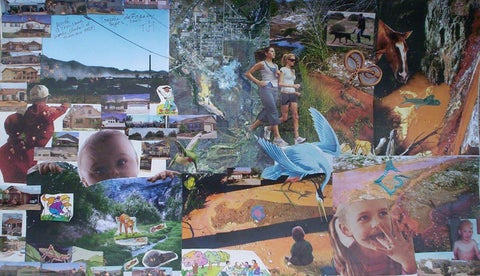
Treesha de France Collage – Photo Voice Statement I began my work in the Dewey-Humboldt community completely because of concern about the local environment and to make our own environmental decisions versus when we were unincorporated and the county made our decisions. The landfill, before my time, was locally opposed but approved by the county. There was a presentation about putting a biomass plant on the smelter site. So, I worked on incorporation and after incorporation I was on the Town Council and implemented the Environmental Issues Advisory Committee, which had a broad mandate, but over time our focus was mainly overtaken by the proposed and ultimate listing of the Iron King Mine and Humboldt Smelter site on the Superfund list. I personally do not live near the source areas, and none of my work was for my benefit. Mainly, I was concerned about children and the elderly, the vulnerable, who coexist with the pollutants and could be irreparably harmed by them, as well as the Agua Fria River, the wildlife and the land. In my official positions, I had spent many years learning unfamiliar things and studying facts and figures, huge documents, looking at diagrams and charts, attending meetings with community members, local, state and federal officials and researchers. I knew a lot of facts and could observe the tailings pile in all its orange glory from Highway 69 and all of Humboldt, as is the cherished crumbling smelter stack, and no one can miss the tsunamis of dust on windy days. Even with all my knowledge and experience about the site, it wasn’t until I was in person, on site, that I really had a full understanding of the state of the land. Meeting with officials and the owner, I stood beside a troubled landfill in its stench. During outings on the Agua Fria Wet Dry Mapping, the DeweyHumboldt Historical Society and Dewey-Humboldt Area Artisans (that I founded), I saw things that impacted me greatly. I saw orange water running through the Chaparral Gulch and towards the narrow but precious Agua Fria River. I saw the enormous mountain of the black other worldly slag “pile” towering over the river, and the big and small chunks of it that had broken off laying all over the landscape and in the river. What I saw, even with what I already knew, was extremely real and shocking. These are forever in my memory. As an artist, I was inspired to present these dramatic and less visible areas of the site as art pieces to Governor Janet Napolitano while she was in the decision-making process about the site listing. EPA relied on her decision. So, I made these two collages and mailed them to her. I have no idea if she received them. One is called “Worth a Thousand Words” and the other called “Governor, We are in Your Hands”. I felt that the numbers and charts and reports she may have been aware of would be complimented, perhaps greatly, by seeing some of what I had seen. I wanted her to see the reality of the situation here and see what would have no end if the site was not cleaned up. I made sure to explain these art pieces were not coming from a government official, but from me, a concerned citizen who felt the need to share with her so she would get the full picture so to speak. I took some of my photographs from site outings and because I often would drive to Humboldt to photograph the dust blowing from the smelter ash and the tailings pile on windy days and send complaints to EPA and ADEQ, I had many photos of dust blowing. I combined these with EPA maps, images I cut out of children’s books, and sprinkled them generously with glitter to represent the dust blowing everywhere, all over everything and everybody. I wanted to include homes, families, horses, wildlife, and community members working, relaxing, playing, gardening, going for walks, etc. They
were maybe 12 x 18 inches or so, not small. In the letter I sent with the collages, I apologized in advance to Governor Napolitano if any glitter got on her or her things and suggested she might think of this as how our community lives with the smelter ash and tailings dust particles. Some of my favorite areas are the baby looking from atop the slag pile, and some of the expressions of concern or discomfort on the children’s faces, the two headed fish in the orange water below the dam, the intermingling of the children and the wildlife with the orange water, and all the normal, wholesome activities citizens are engaging in while being exposed to toxins. As an artist and a musician, some of my creations have focused on social, environmental and public health issues. So, just as I wrote a sing along song about our incorporation negotiations with Prescott Valley (“Prescott Valley Please Stay Home”) and performed it at our incorporation rally, it was natural for me to take the images that were so impactful to me and use them to further inform anyone who sees them. I don’t know how many people have seen orange polluted water flowing below an orange mountain of pollution through a community towards a beautiful river, or seen a slag pile that looks like an ominous black iceberg of death towering over a river and dropping pieces of itself everywhere, but I believe to fully understand such things they must be seen. And be seen in the context of a community where people live their lives, some with no knowledge of what is surrounding their home sweet homes. I would encourage anyone to use art, imagery, music, poetry and creative writing to compliment and humanize the very important numbers, charts, statistics and meetings that environmental work relies on.