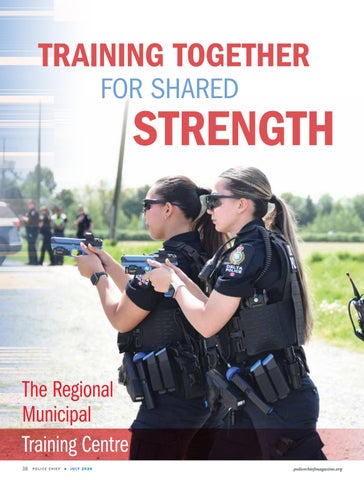
TRAINING TOGETHER FOR SHARED
STRENGTH
The Regional Municipal Training Centre 38
P O L I C E C H I E F H J U LY 2 0 2 6
policechiefmagazine.org
BY
Harj Sidhu, Chief Constable, and Maurice Parry, Inspector, Delta Police Department, British Columbia, Canada
Images courtesy of Delta Police Department, BC
ACROSS CANADA’S BRITISH COLUMBIA (BC), MUNICIPAL POLICE DE PAR TMENTS ARE OPE R ATING IN AN ENVIRON MENT OF EXPANDING REG UL ATORY STANDARDS, INCREAS ING EXPECTATIONS FOR TR ANSPARENCY AND CONTINUE D STAFFING AND FISCAL PRESSURE . BC Provincial Policing
Standards (BCPPS) continue to evolve, particularly in areas such as use of force, documentation, and qualification requirements. At the same time, departments must maintain frontline readiness while managing staffing constraints and rising costs. For midsized municipal departments, the challenge is practical: how to strengthen compliance and improve training quality without duplicating effort or overextending limited resources. In 2019, the Delta Police Department (DPD) began examining these pressures from a governance, strategic, and risk perspective. Rather than expanding training capacity independently, DPD explored whether a shared regional model could improve consistency, reduce duplication, and strengthen oversight. That exploration led to the creation of the Regional Municipal Training Centre (RMTC), a collaborative training framework now involving six municipal and specialized police departments in BC. The RMTC has evolved into a structured regional model designed to enhance standards alignment, operational readiness, and fiscal stewardship while preserving each participating agency’s autonomy.
WHY A REGIONAL MODEL? Several developments shaped the decision to pursue a regional approach. First, BCPPS have expanded in several areas, including useof-force policy, documentation practices, and requalification requirements. These expectations demand consistency and audit readiness across departments. Second, training capacity pressures remain real. The Justice Institute of British Columbia announced a significant expansion in recruit training capacity to address forecasted needs. Even with that expansion, departments must coordinate advanced training, qualification cycles, and operational backfill.
J U LY 2 0 2 6 H P O L I C E C H I E F
39
In response, DPD identified risks associated with isolated training delivery in high-risk areas such as firearms, conducted energy weapon (CEW), control tactics, and de-escalation. Rather than expanding independently, DPD convened neighboring midsized agencies to explore a coordinated regional model to mitigate those risks. Four strategic objectives shaped the RMTC’s development, which officially opened in early 2020: 1. Deliver consistent, evidence-informed, scenario-driven training to strengthen public trust. 2. Align policy and qualifications with BCPPS requirements. 3. Increase training capacity through shared instructors and facilities. 4. Control costs by reducing duplication and standardizing documentation across the departments. The objective was not to centralize policing but to reduce fragmentation in training delivery. To operationalize these objectives, three core design principles guided implementation: 1. Standards Alignment First: Use-offorce policy and training must track or
CURRENT RMTC PARTNERS As of February 2026, the RMTC partner departments and authorized strength are as follows: § Delta Police Department (200) § Metro Vancouver Transit Police (204) § New Westminster Police Department (115) § Organized Crime Department of British Columbia (52) § Port Moody Police Department (53) § West Vancouver Police Department (79) Total sworn complement: 703 Source: Sworn complement figures derived from Police Resources in British Columbia, 2024, Ministry of Public Safety and Solicitor General, Policing and Security Branch; supplemented where necessary by publicly available information and confirmation from participating departments (retrieved February 27, 2026).
40
P O L I C E C H I E F H J U LY 2 0 2 6
exceed BCPPS requirements (e.g., documented requalification cycles, approved lesson plans, and audits). 2. Common Lesson Plans, Local Scheduling: Core curriculum is unified regionally; each department retains control over training calendars and venue choices to fit operational realities. 3. Phased Integration: Begin with policies and curriculum that mitigate the greatest risk exposure, then expand into shared delivery, instructor development, and asset acquisition.
GOVERNANCE MODEL DPD led development of the initial governance framework, which was finalized collaboratively with partner agencies. A formal pathway was established in which an Instructor Working Group, chaired by DPD Inspector Maurice Parry, reports to a Joint Management Team (JMT) steering committee composed of deputy chiefs from each partner department. The working group identifies training risks, develops standardized lesson plans, and recommends policy alignment. The JMT reviews and approves curriculum changes, policy alignment, and cross-department resourcing decisions. This structure provides clear executive oversight consistent with legislative expectations under the BC Police Act and provincial standards. In addition to internal governance, the RMTC engages directly with oversight partners with the goal of transparency. Representatives from the Independent Investigations Office, the Office of the Police Complaint Commissioner, and the Province’s Police Services Branch have been invited to observe training delivery and review curriculum components, including use-of-force instruction. This supports alignment with regulatory expectations, strengthens working relationships, builds confidence in the training provided, and offers informed external perspective that contributes to continuous improvement of the RMTC model.
OPERATIONALIZING THE RMTC The RMTC was operationalized in phases beginning in 2019. The first stage focused on acquiring simulator
technology and facilities. In 2021, the second stage focused on the integrated training model by harmonizing use-of-force policy and qualification requirements across the six partner agencies in alignment with the BCPPS. Requalification cycles, documentation practices, and lesson plan approval processes were standardized to ensure consistency and legal defensibility. High-liability qualification areas— including firearms, CEW, and physical control tactics—were prioritized early in the rollout, as inconsistencies in these areas present immediate operational exposure. With foundational standards aligned, the working group developed common lesson plans with defined competencies and version control processes. These plans were formally linked to standardized after-action training records, strengthening documentation integrity and improving audit readiness and disclosure responsiveness. A shared document platform and centralized training calendar were introduced to enhance coordination. At the same time, each department retained authority over its training calendar and venue decisions. This balance preserved operational continuity while increasing regional alignment. Another major component of operationalization involved the development of the instructor model. Full time instructors remain embedded within their respective departments, maintaining department-specific continuity and accountability. Each partner agency retains its own primary instructors, who are responsible for training delivery and qualification oversight. Part-time instructors from partner departments support regional delivery as needed. This structure allows instructors from one department to assist another during qualification cycles or high-volume training periods, increasing flexibility while preserving local ownership. All instructors operate under a defined mission statement: “To help the officers we train become adaptive, dexterous, and resilient problem solvers.” policechiefmagazine.org
Selecting the right instructors is deliberate. The RMTC appoints respected and credible members to the Instructor Working Group— individuals who are instructionally skilled, trusted by frontline officers, and committed to constructive feedback and professional standards.
RMTC’s flagship initiative. It supports new recruits and experienced officers returning to frontline duties. Delivered three times every year, this two-week program addresses 15 core operational competencies under standardized lesson plans and qualification expectations.
As alignment matured, cross-agency delivery expanded and additional integrated programming was introduced. Current initiatives include the adoption of virtual reality applications, development of a vehicle intervention tactics program, and planning for a Core Investigative Training program.
Serving multiple partner departments across BC, the program provides consistent exposure to high-risk scenarios and reinforces critical decision-making skills. Feedback from participating departments has been positive, and the model has proven adaptable to varying operational contexts.
CORE TRAINING PROGRAMS AND SIMULATOR TECHNOLOGY The RMTC delivers a broad range of training programs across partner departments. A key component of the model has been modernization of training delivery through a simulator. The custom-built simulator supports scenario-based training in de-escalation, use-of-force decision-making, and crisis response. Officers engage in immersive and interactive scenarios that replicate real-world environmental conditions and behavioral cues, allowing instructors to reinforce policy application, articulation, and critical decision-making under stress. Structured debriefing and immediate scenario replay support competency development and reflective learning. Because the simulator is shared across partner departments, members train against common performance expectations while retaining the ability to tailor scenarios to their local context. Evidence-Informed De-Escalation: RMTC de-escalation programming incorporates Integrating Communications, Assessment, and Tactics (ICAT), an evidence-informed curriculum associated with statistically significant reductions in use of force and injury rates in multiple evaluations. An independent evaluation of ICAT implementation within DPD demonstrated positive impacts on officer confidence, decision-making, and perceived ability to manage crisis situations effectively. Core Patrol Training: The Core Patrol Training program is the
Tactical and Reintegration Programs: The RMTC has also accelerated regional adoption of leverage-based control tactics and formalized reintegration training for members returning to operational roles following extended absences or critical incidents. These programs support consistency in high-liability areas while reinforcing officer confidence and readiness.
IMPACTS Collectively, the governance framework, shared curriculum, and coordinated delivery approach have produced organizational effects that extend beyond individual training sessions. While long-term metrics continue to mature, the RMTC model is already producing tangible benefits. First, the model strengthens standards consistency across partner departments. Harmonized use-offorce policies, aligned requalification cycles, standardized lesson plans, and common documentation templates are mapped directly to BCPPS, improving audit readiness and reducing operational risk. Second, the RMTC accelerates adoption of evidence-informed practice. Programs such as ICAT and structured scenario-based training have been integrated regionally, reinforcing decisionmaking skills and promoting consistent instructional approaches across departments.
Law Enforcement Online Training LGBT Community Provided at no cost
Training to Increase Community Engagement & Trust
Liaison
Build an LGBT Liaison Program
Hate Crimes Investigations For law enforcement first responders
Register and begin training today
www.outtoprotect.org
Courses Certified by California P.O.S.T.
www.matthewshepard.org
J U LY 2 0 2 6 H P O L I C E C H I E F
41
Third, the model enhances operational readiness. Core Patrol Training and formalized reintegration programming provide a dependable pathway for new recruits and returning members, ensuring that officers across participating departments train to common qualification standards.
Together, these efficiencies complement provincial investments in recruit training capacity and reinforce governance oversight expectations.
§ Address high-liability qualification areas first. Policy alignment in use of force, firearms, and CEW training reduces operational risk and strengthens board confidence.
LESSONS AND CONSIDERATIONS
Fourth, the RMTC improves equipment and asset coordination. Partnering agencies share equipment specifications, procurement insights, and asset tracking practices. While individually incremental, these efficiencies reduce duplication, improve compatibility, and simplify training logistics over time.
Several lessons have emerged that may assist other chiefs considering a regional training model.
§ Adopt evidence-informed programming. Programs such as ICAT, supported by independent evaluation, strengthen credibility with members and oversight bodies.
Finally, the regional framework advances fiscal and staffing efficiency. Facility costs are allocated proportionally based on sworn complement. Standardized curriculum eliminates parallel lesson plan development. A blended instructor model expands delivery capacity without permanently increasing staffing levels. Coordinated scheduling reduces qualification delays and mitigates overtime exposure.
§ Pursue excellence, not perfection. Regional alignment will not be flawless at the outset. Progress requires deliberate movement toward higher standards rather than waiting for ideal conditions. § Training must be measured by learning, not delivery. As the model evolved, emphasis shifted from simply delivering curriculum to ensuring that members demonstrably achieved the intended competencies. § Establish clear governance and decision rights early. A defined working group to executive pathway prevents delays and supports accountability.
§ Preserve local scheduling authority. Standardized curriculum does not require centralized operational control. Maintaining departmental calendar autonomy supports adoption. § Anticipate implementation challenges. Harmonizing legacy practices requires professional dialogue and patience. Training calendars must accommodate instructor availability and external constraints, and change management requires early engagement with frontline members.
CONCLUSION The RMTC demonstrates how midsized municipal police departments can respond collectively to rising standards, evolving expectations, and fiscal constraints. By aligning policy, standardizing curriculum, adopting evidence-informed training, and sharing instructor capacity, participating agencies have strengthened consistency while preserving local autonomy. For police leaders facing similar pressures, the RMTC offers a practical model: begin with governance clarity, anchor to standards, implement in phases, and measure outcomes over time. Collaboration, when structured deliberately, can strengthen both operational readiness and public confidence.
IACP RESOURCES §
Furthering Evidence-Based Policing Through Effective Leadership
IACPlearn
§
Baseball and Decision-Making in Policing
§
Modern Force Tactics for Safer Policing
www.policechiefmagazine.org
42
P O L I C E C H I E F H J U LY 2 0 2 6
policechiefmagazine.org