CELEBRATING 50 YEARS OF FORGING A NEW PATH IN EDUCATION
EDITOR & DESIGNER Rebecca Orthmann
ALUMNI INTERVIEWS Lee Rector
STUDENT
PROOFREADING
FORM COMPLETIONS
Listed in order of completion date since last Delphian Magazine
Beginner 1
Fox Milner
Beginner 2
Lucas Hoonhoud
Form 1
Lake Brown
Form 2
Melodie Dambrin
Olive Pope
Form 3 Entry
Julian Hoonhoud
Cyan Jayasinha Gray
Form 3
Max Silver
River Brown
Form 4
Desmond Robinson
Ava Silver
Form 5 Entry
Clementine Lindman
Form 5
Luke Robinson
Alice Ott
Juniper Pope
Naomi Orion
Upper School
International Entry
Kitty Liu
Andrea Yu
Damir Yaremych
Kai Mesmer
Cesar Ramirez Valdes
DELPHIAN MAGAZINE
Form 6 Entry
Leona Margo
Natalia Stafford
Rona Onizuka
Natalia Chaparro
Ronald Menard
Oliver Zerman-Moore
Sofie Totpal
Cleo Thornsberry
Matthew Stauffer
Aiden Phillips
Emily Benk
Sloane Scott
Kitty Liu
Vivianne Agami
Teagan Barram
Jonsie McRae
Jet Butterworth
Sasha Dronov
Amity Gallagher
Damon Soler
Ashley Aden
Felix Doheny
Phoebe Latch
Hannah Franklin
Form 6
Piper Mitri
Joy Hwang
Quentin Thornsberry
Lia Ben Dror
Chenoa Lopez
Piper Gibson
Mila Marvin
Dylan Lederer
Olivia Dent
Dan Escalera Ramirez
Lillian Su
Ansel Sessions
Emmett McRae
Elaine Kazmierczak
Boston Brown
Evangeline Bowling
Mila Vysotska
Lia Adams
Caden Kennedy
Isshin Suzuki
Emmery Kugler
Form 7
Olive Karl
Vladimir Bunchuk
Mako Shiozaki
King Kong
Mika Kozhakhan
Jim Cao
Roman Peña
Avery Ott
Chloe Aden
Amelia Peterson
Johnny Lee
Coco Rose-Coates
Reese Wells
Regina Romero Bolaños
Greyson McLean
Tai Jefford
Masha Ershova
Jack Bowling
Edward Su
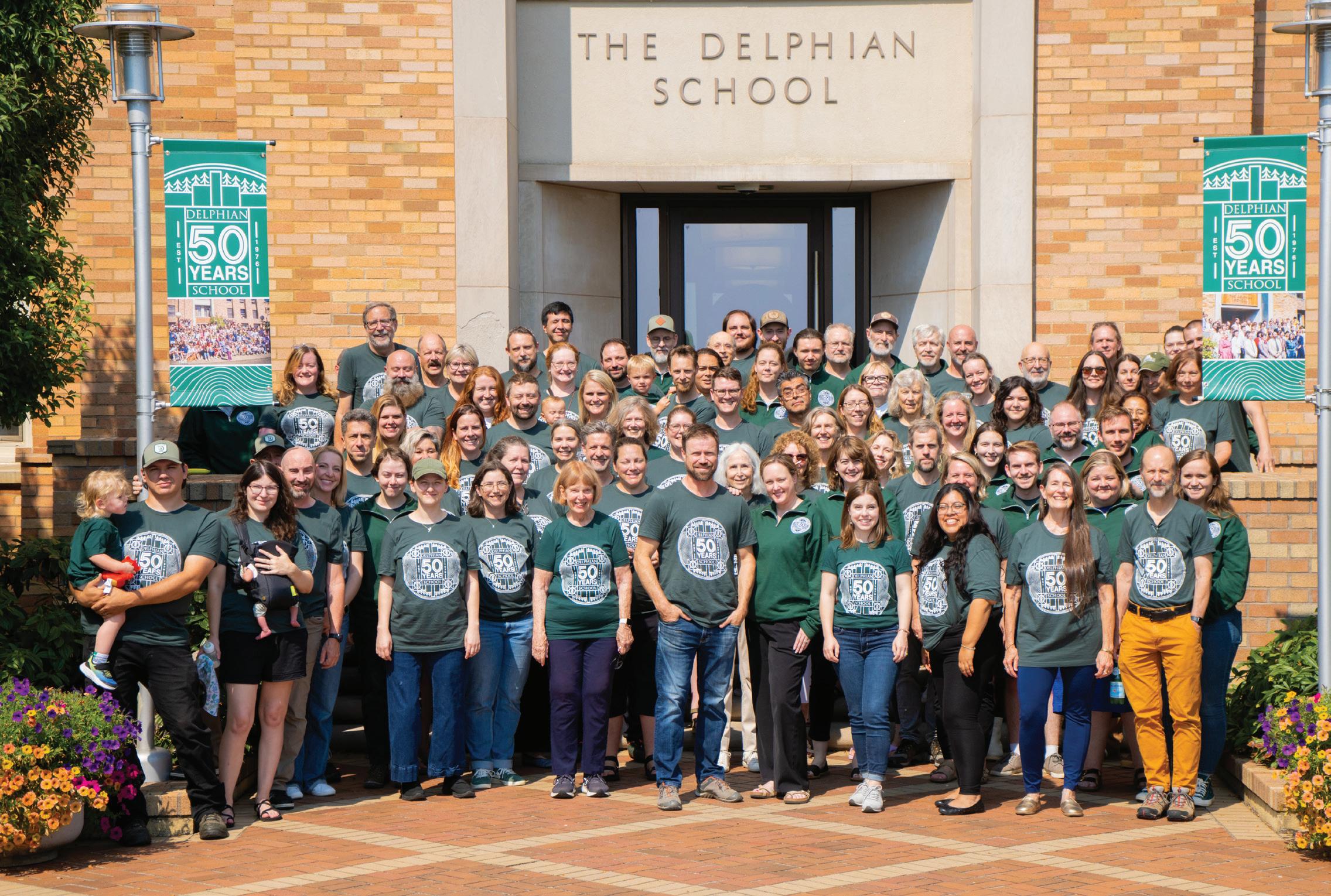
This year is our 50th anniversary. As we take a moment to celebrate our heritage and achievements, we can see that in virtually every measurable way, we are stronger today than at any point in our history. Now it’s time to extend our reach, drawing on our past through an old purpose newly named and newly pursued.
To lay some groundwork to understand where we are headed, I’ll first take you back to our roots.
In 1988 we had one goal:
To help fix this planet through the medium of sane schools.
This goal was supported by seven strategies for its accomplishment, one of which was:
Contribution to the broad recognition of LRH as the source of the only philosophy and technology that makes this possible.
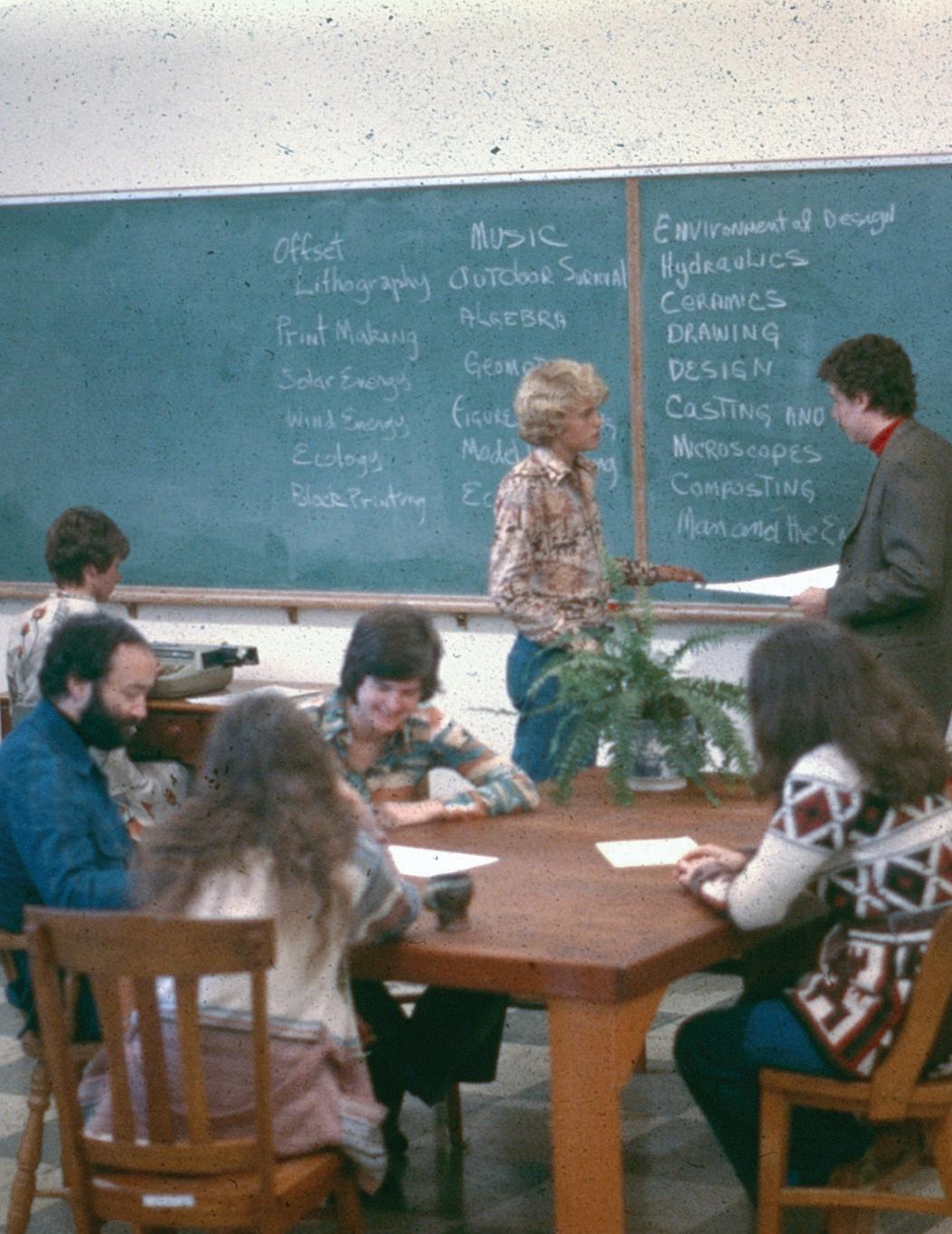
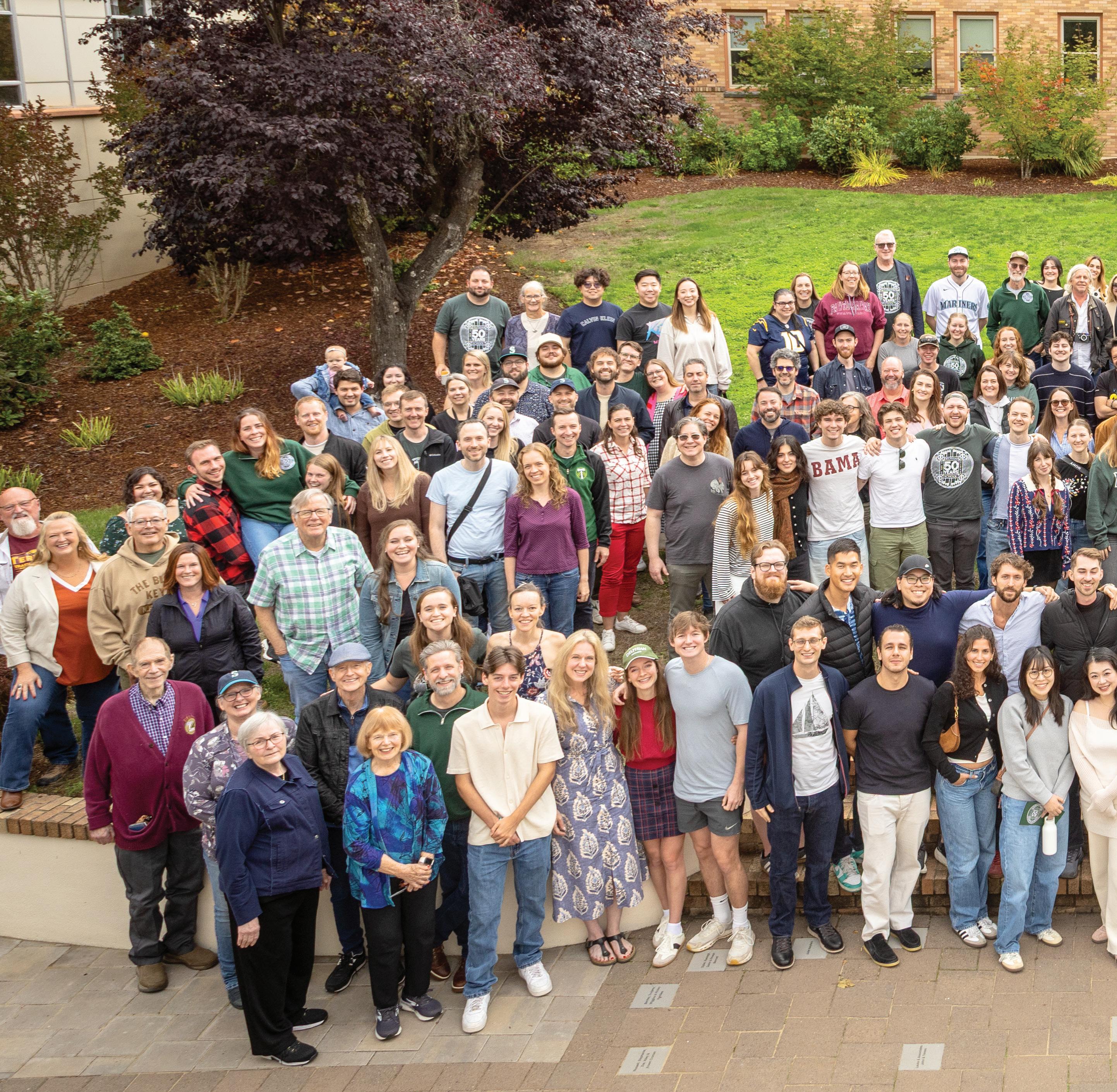
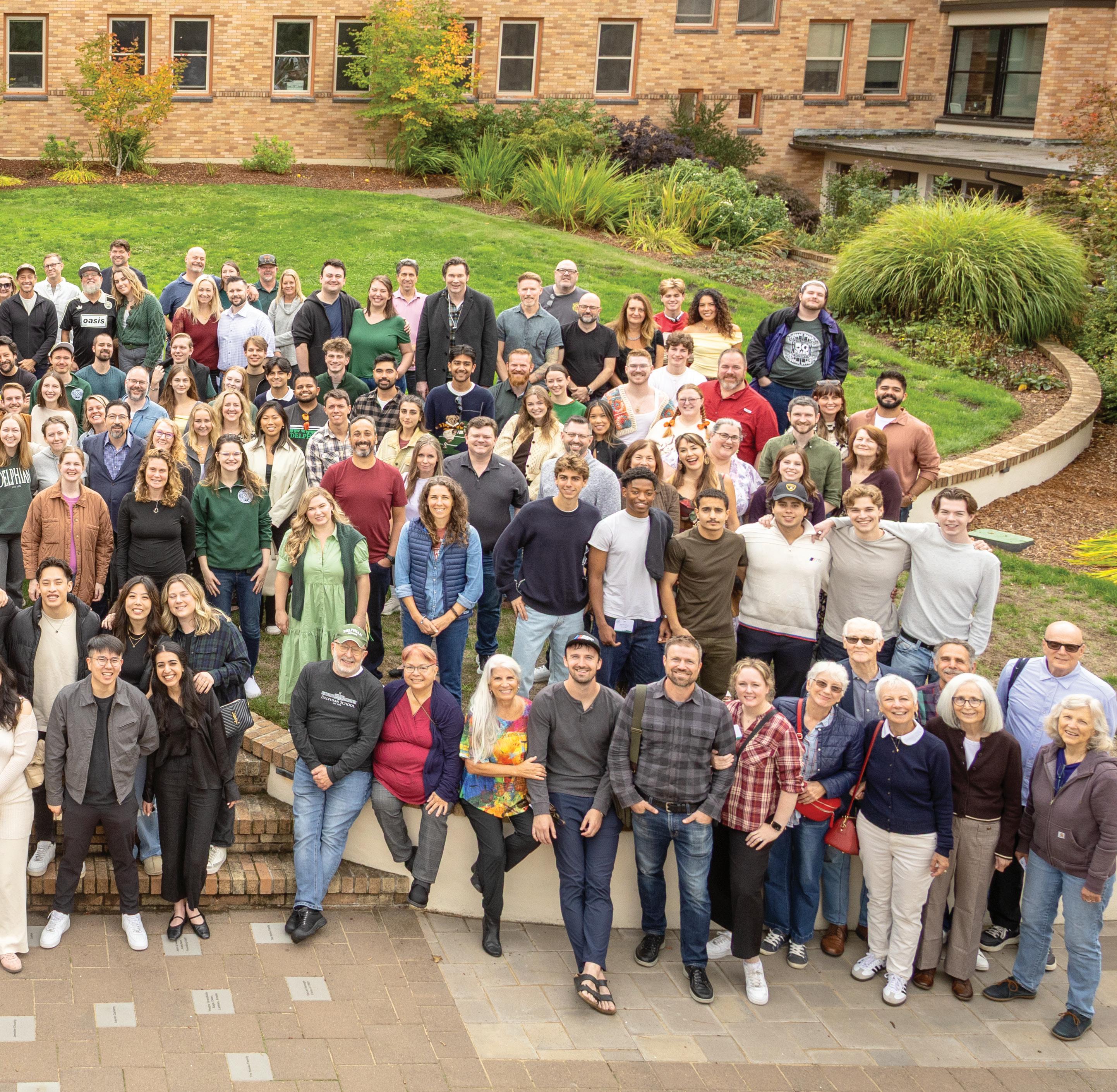
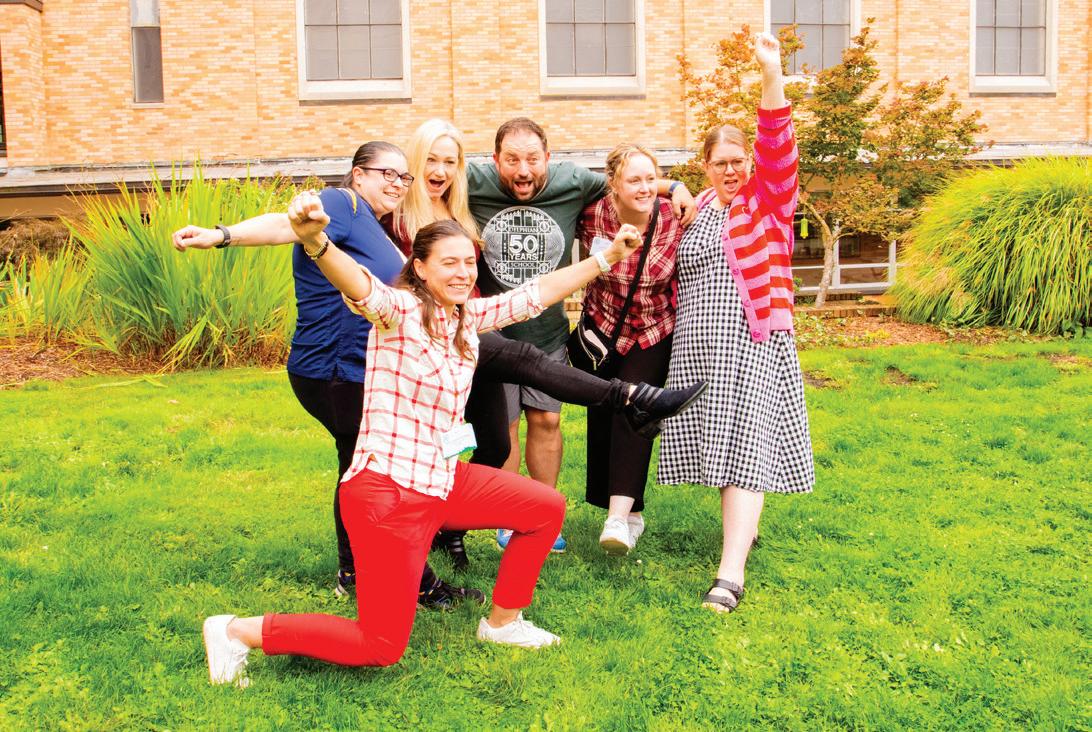
ABOVE: DELPHIAN SCHOOL STAFF, SEPTEMBER 2025 BELOW: CURRICULUM DEVELOPMENT STAFF HARD AT WORK, 1979
I want to make a distinction between two of the words in this purpose: philosophy and technology.
Philosophy can be easily understood as the search for fundamental truth. Fundamental here means “forming the base, from which everything else develops.”
Technology can be easily understood as the specific, codified steps and doingnesses (derived from philosophy, trial and error, or both) that have proven time after time to produce a result when applied exactly.
Though these two definitions are distinct, they may overlap. One would expect a practical philosopher to include the search for specific applications of the discovered truth. And so from philosophy, technology can be both developed and refined.
The early days at Delphian were exciting and challenging. Having recently discovered L. Ron Hubbard’s Study Technology™ for themselves, the founding staff knew that with it, they could create a school far better than anything they had experienced in their own educations.
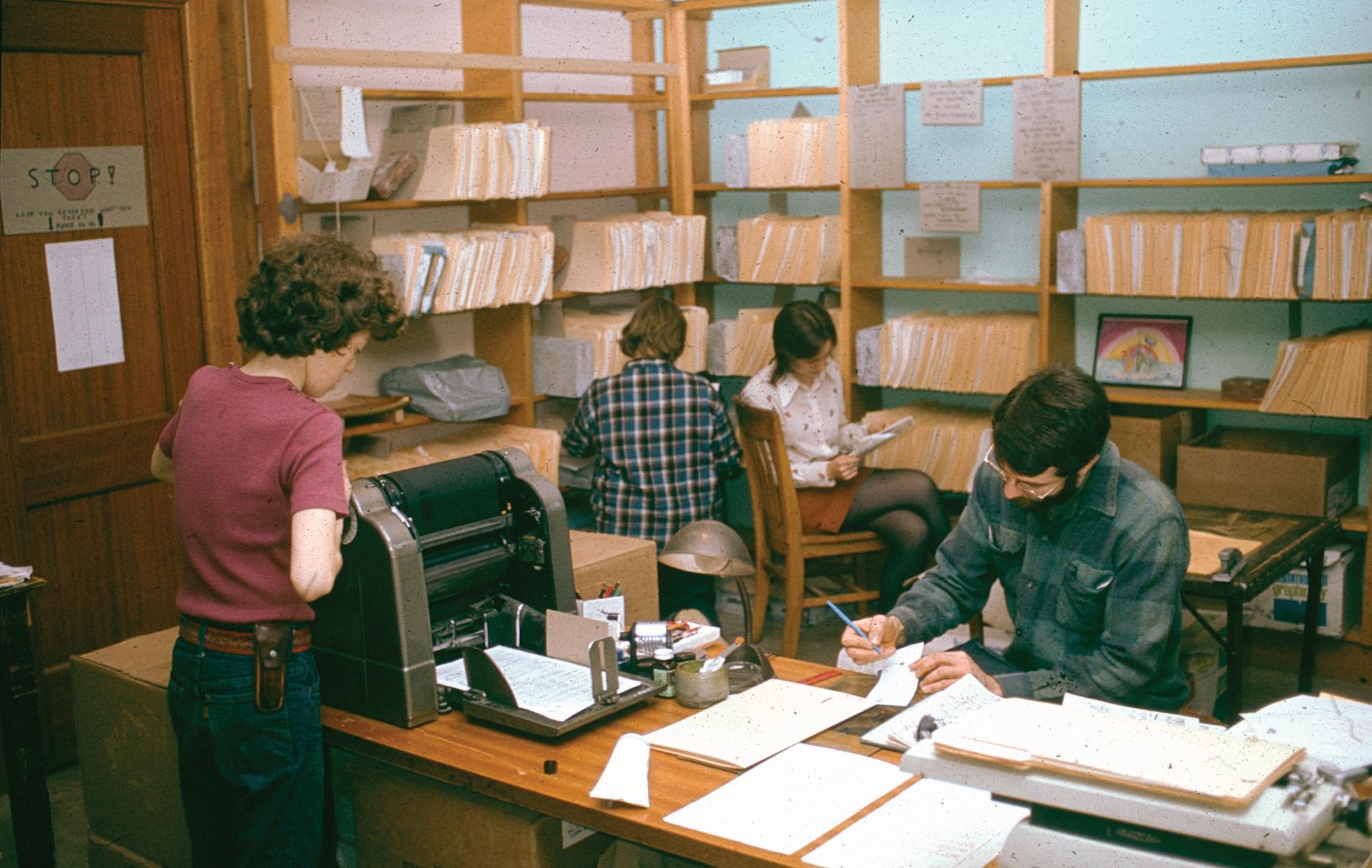
In those early years, founding staff produced our first set of high school graduation requirements. Faculty got fully trained in Study Technology and took on the new role of “supervisors” rather than “teachers” guides to rather than sources of knowledge. The curriculum team wrote hundreds of courses and the K-12 courserooms were set up to get students through those courses with the goal of achieving the graduation requirements.
We published The Learning Book, presenting key elements of Study Technology to arm students with these tools as early as possible.
This era of Delphian progress was driven by the study and application of Study Technology.
By 1982, six years after the school opened, the founding staff believed they had things well in hand—until later that year when a new set of Mr. Hubbard’s books became available, containing lecture transcripts from the early ‘50s. In these, Mr. Hubbard discussed such topics as self-determinism, the purpose of education, the rights of students, the importance of developing the abilities to think, reason and evaluate data, the creation of knowledge, and more.
In other words, he presented a workable philosophy of education.
Through careful study of the new material, the founding staff realized that despite the significant
progress already achieved with Study Technology, they needed to rethink the foundations of the Delphian program entirely.
And so they did.
Over the next few years, the Delphi Program® evolved rapidly.
The magnitude of progress, refinement and improvement made possible by integrating an understanding of the underlying philosophy to their understanding of the technology cannot be overstated. That process made our school what it is today.
So how does this tie in to the evolution of our outreach?
Armed with a deeper appreciation of the underlying philosophy, we then saw a similar evolution. Perhaps most importantly, the role of philosophy was restored to its proper place—preceding the technology. This, in turn, led to a clear strategy for expansion and reaching more people.
Step one is, of course, having the philosophy in a form that can be easily shared and easily understood. We have that now in the Applied Scholastics Educator’s Package, a set of five books developed by the curriculum team at Heron Books.
With these books available, we now have a workable path forward to achieving the goal set in 1988:
To help fix this planet through the medium of sane schools.
In Delphian Magazine issue 129, published in the summer of 2023, there was a highlight about an Applied Scholastics project in Samoa. This project led not with the Study Technology, but instead with seminars teaching Mr. Hubbard’s educational philosophy as presented in Teaching: A New Approach, published by Heron Books.
Today, over 1,500 copies of Teaching: A New Approach have been distributed to Samoan educators.
That project has been more successful, by far, than any previous outreach effort. Leading with the philosophy helped provide a foundation of common purpose to build upon, and the Study Technology is now highly valued and stably in place in classrooms throughout the country. The implementation project is ongoing and has already spanned the tenure of three Prime Ministers, with each new cabinet and parliament wholeheartedly carrying it forward for the benefit of the Samoan people.
Delphian’s future outreach will follow a strategy designed to achieve two objectives:
• To expand and extend our impact on the education sector of society.
• To create wide recognition of the Delphian School as a leader in that sector.
That strategy is all about philosophy.
In one of his 1950s lectures, Mr. Hubbard stated this fundamental truth:
It is a prime purpose of education to increase the self-determinism of the individual.
In that same lecture, this appears:
All education is the education of individuals, not the education of the masses.
To the degree that we can get even just these two ideas more broadly understood and applied by educators in this society, the wacky, assembly-line model of modern schooling will begin to crumble.
To the degree that we can get these ideas across to parents, they will start demanding that schools educate their children as individuals and to the
benefit of their self-determinism. The rehabilitation of self-determinism will become, as it should be, a primary goal.
If we do this right, we’ll increase our influence in the education sector by putting a spotlight on Delphian’s program as a uniquely effective model based on fundamental truths.
Of course, we’re not going to restrict ourselves to just two of Mr. Hubbard’s philosophical principles. There are others, just as powerful, that will form the framework of a brand-new, very broad campaign that we are now embarking upon.
Through this campaign, we’ll walk parents, educators, and students through six fundamental principles of Mr. Hubbard’s philosophy of education—with the school serving as a living example of the results of its application
If we can pull this off, fifty years from now we will be talking about 2026 as the year we launched a movement that put us on track towards the achievement of our ultimate goal: a civilization based in reason
CURRICULUM DEVELOPMENT ROOM, 1979
ALUMNI WEEKEND
WEEKEND 2025
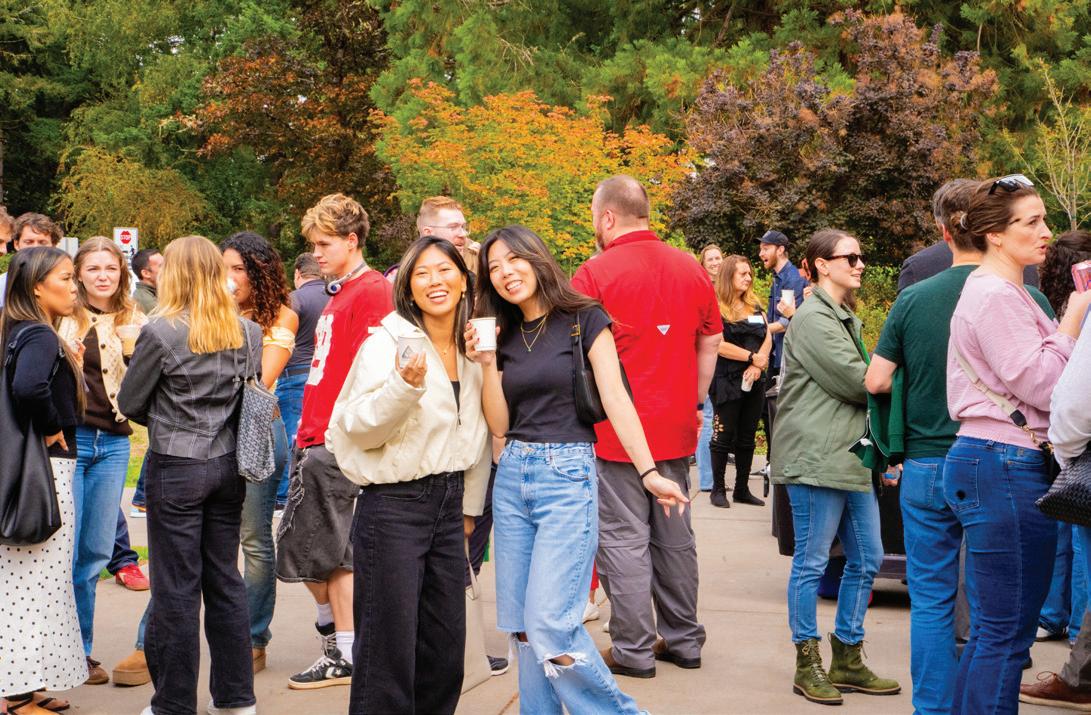
The hill was alive with familiar energy this past October when alumni from across the country and around the world returned to campus for Alumni Weekend 2025. This year’s gathering was particularly momentous as it included additional celebrations to mark the school’s 50th anniversary—a milestone celebrating half a century of the school forging a new path in education. The weekend was the highest-attended on record, with over 250 in attendance. It included many special events and familiar faces, giving alumni the opportunity to reconnect with each other, the school, and current and retired staff.
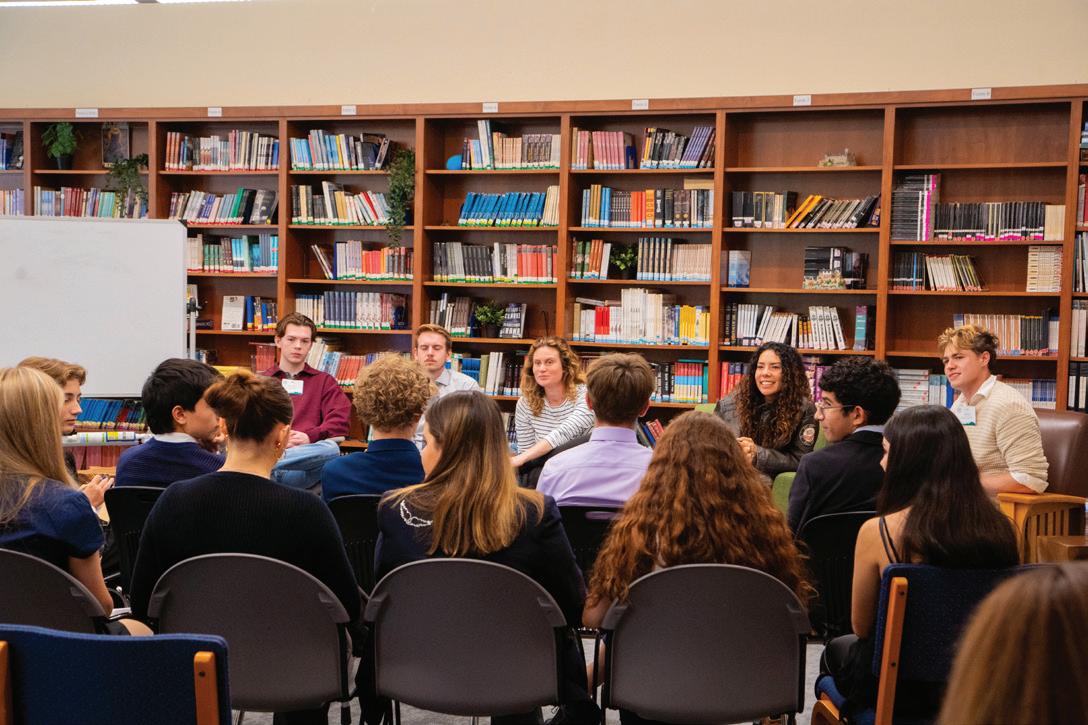
Festivities began on Friday with the traditional Upper School seminars giving alumni a chance to step back into the classroom — this time as practicing professionals — to share their experience and insights with the students.
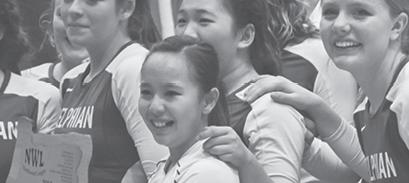
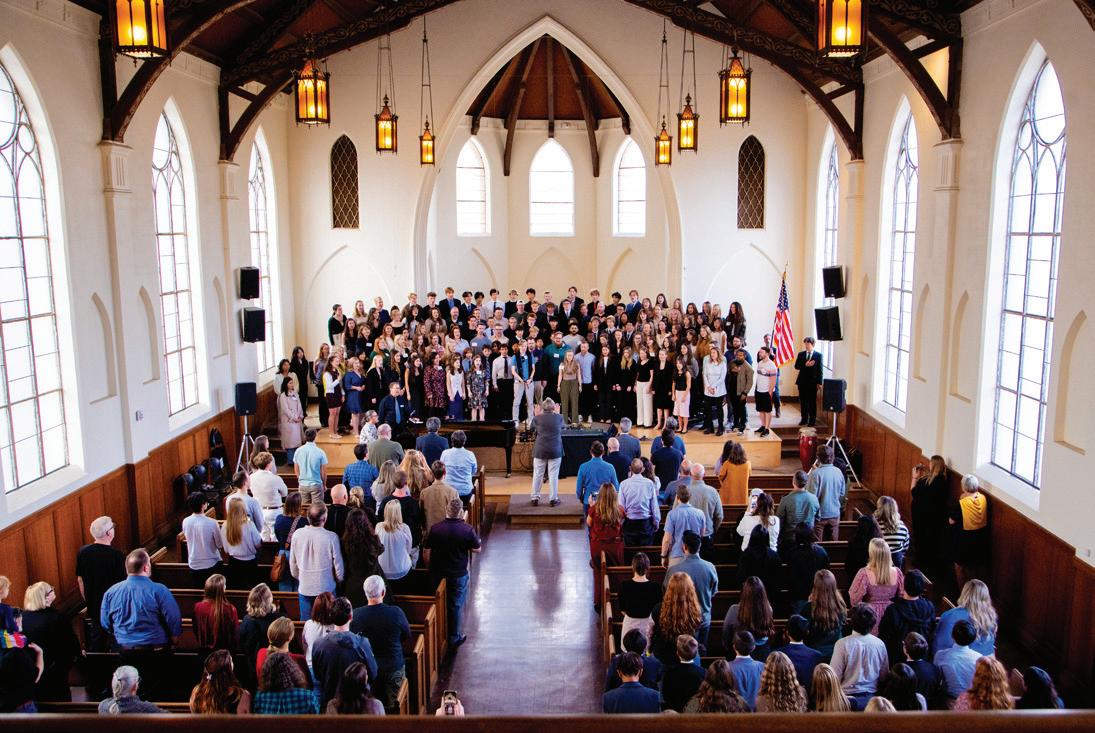
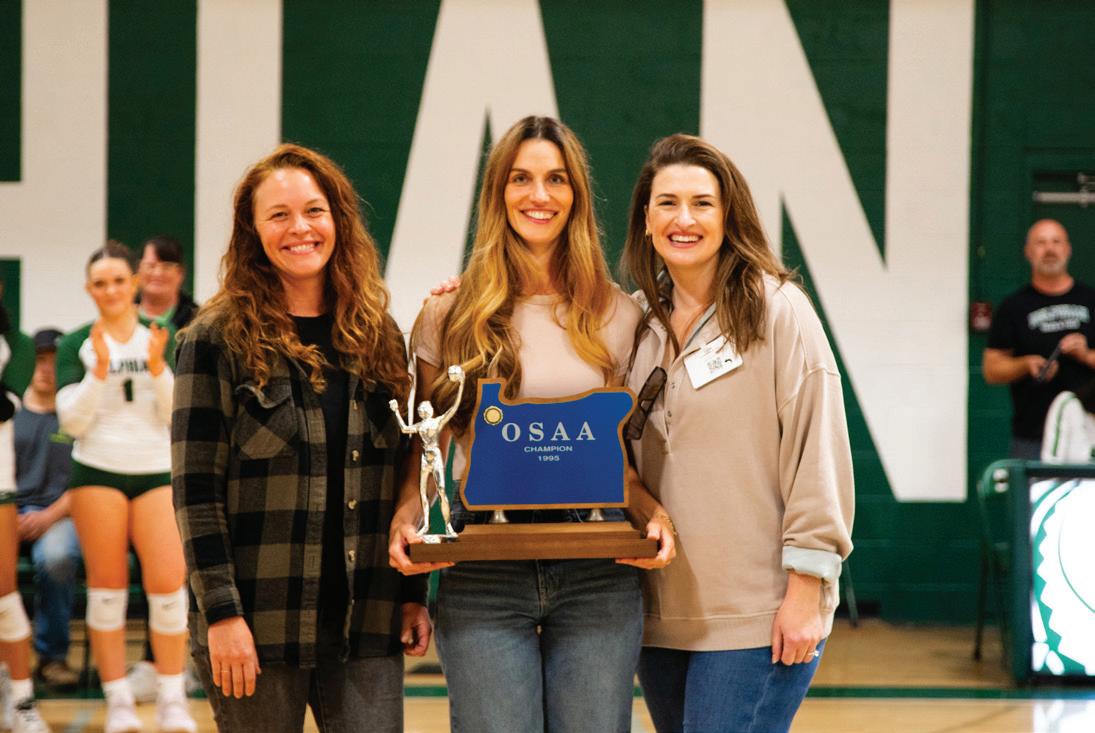
Friday afternoon brought about a series of firsts. The first alumni choir, led by Craig Bader, reunited Delphian singers in the chapel to once again fill the space with song. This was followed by an insightful address by Chairman of the Board Dave Hendry, which sparked discussion on the current landscape of education. From there, alumni headed to the gym to cheer on the varsity volleyball team and recognize alumni players in attendance, including several members of the 1995 state championship team.
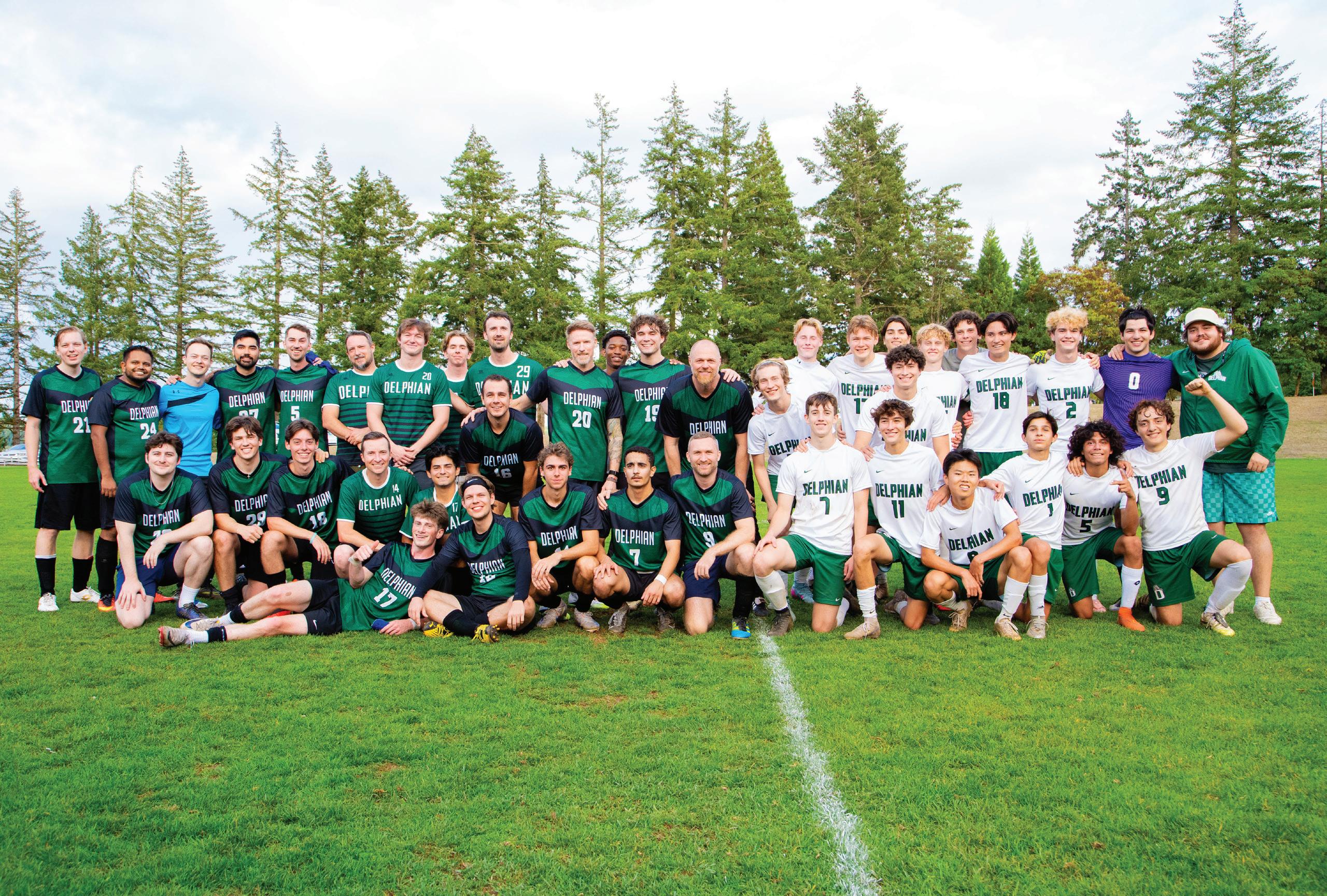
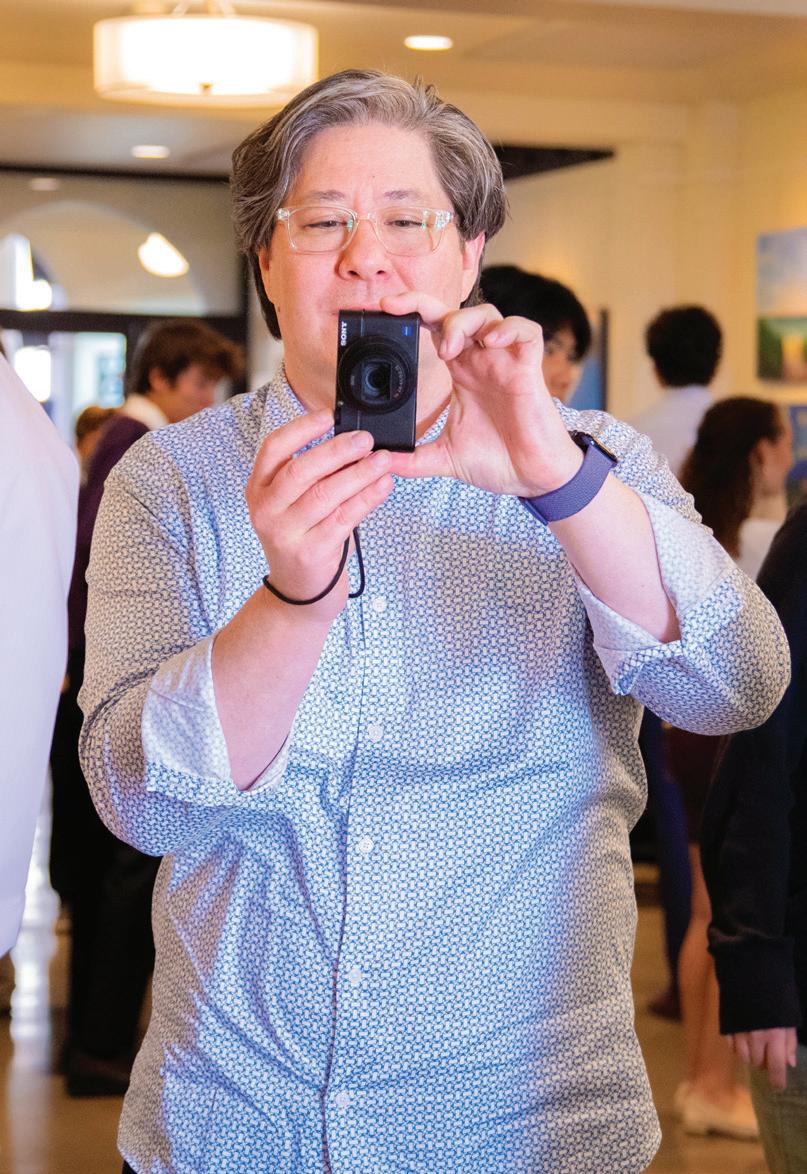
ABOVE: ALUMNI VS STUDENTS SOCCER GAME BELOW: CHRIS UNO, THE ALUMNI ASSOCIATION HEAD, AND OFFICIAL UNOFFICIAL ALUMNI WEEKEND PHOTOGRAPHER
CHOIR REUNION CONCERT LED BY CRAIG BADER
REUNION OF THE 1995 STATE CHAMPION VOLLEYBALL TEAM
25TH REUNION OF THE CLASS OF 2000
ALUMNI SEMINAR FOR STUDENTS IN THE LIBRARY
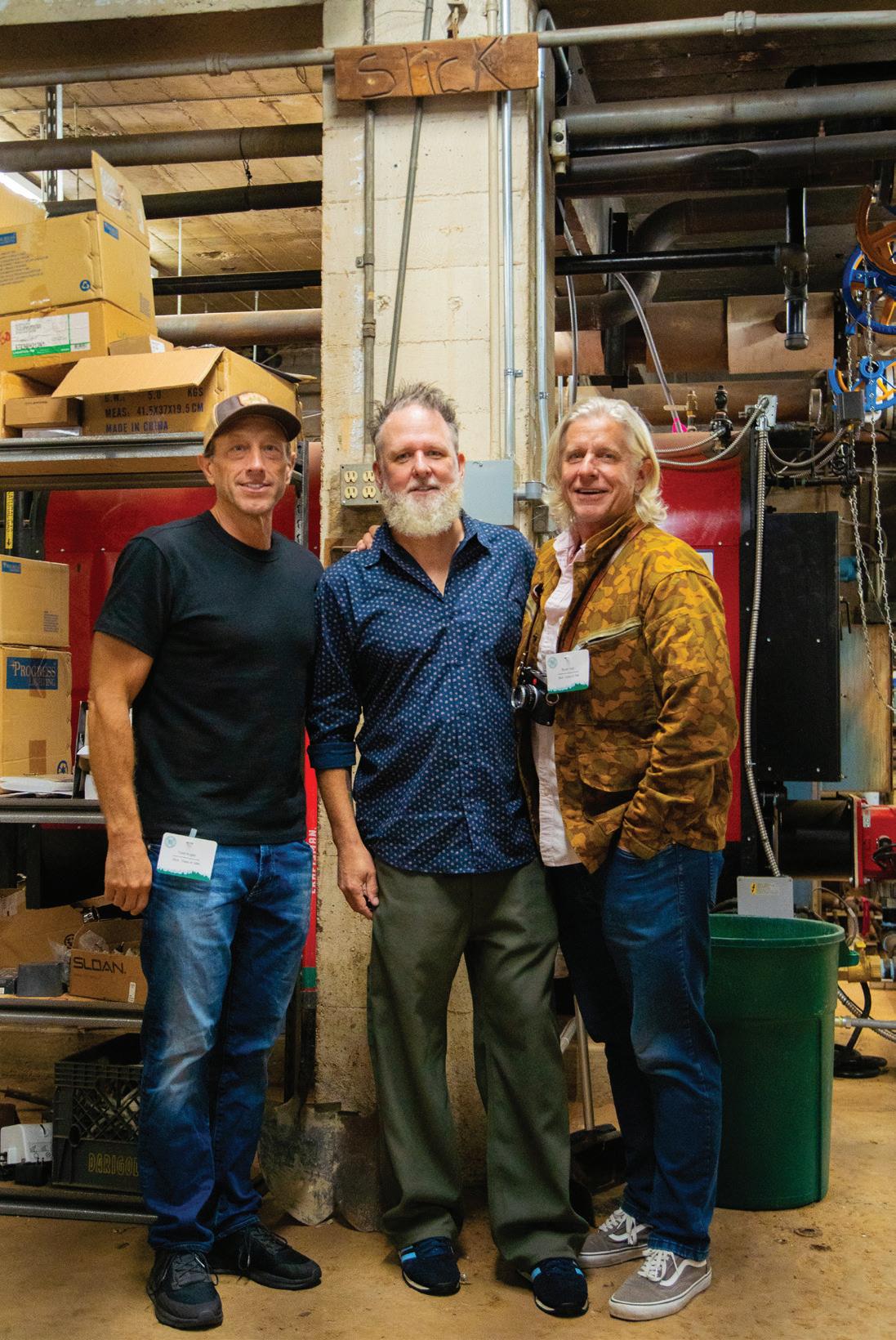
THE SLICKS REUNION IN THE BOILER ROOM WITH THEIR SIGN
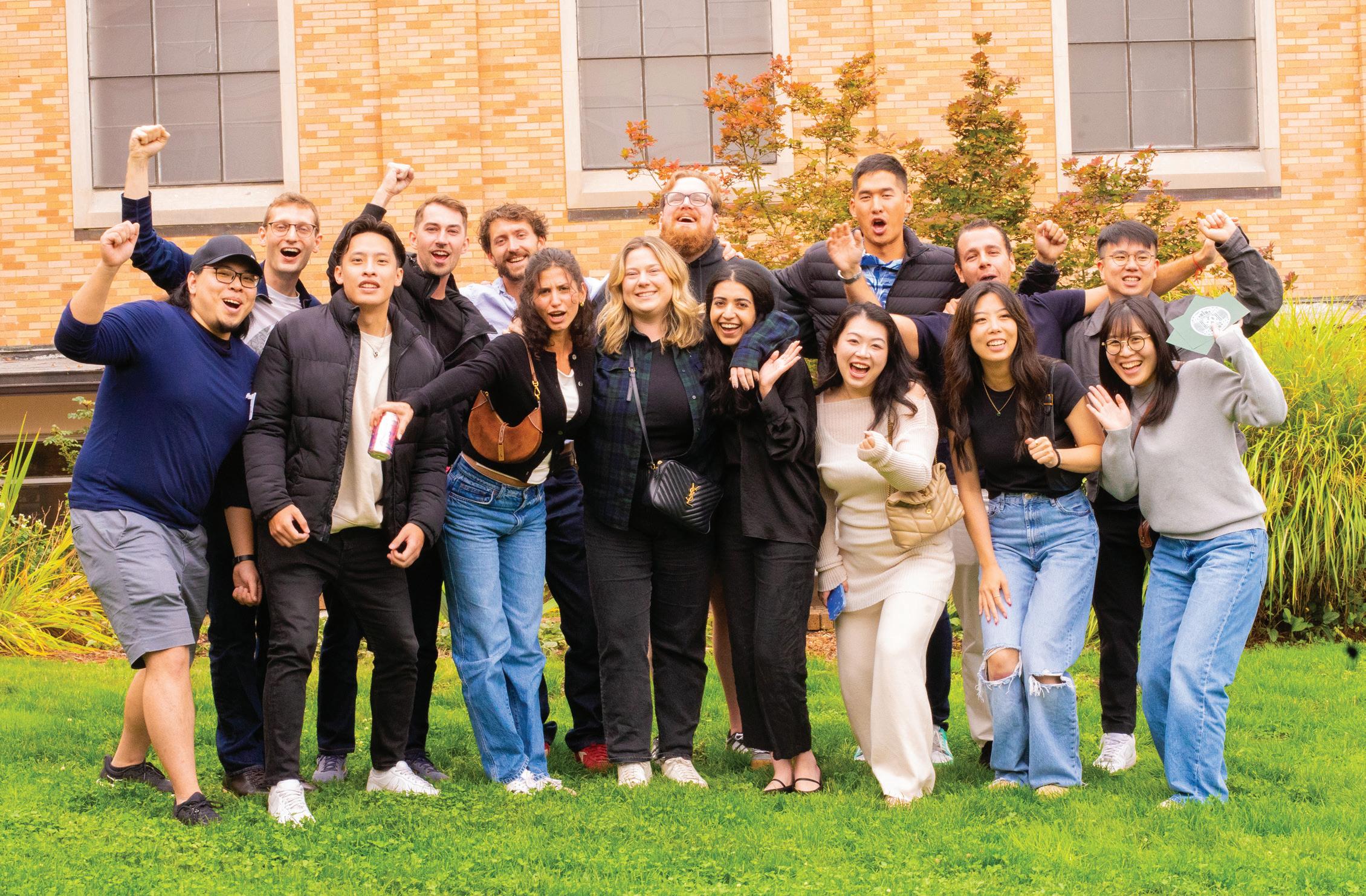
10TH REUNION OF THE CLASS OF 2015
JERRY RIPP AND JOHN FRY GIVING HAY RIDES
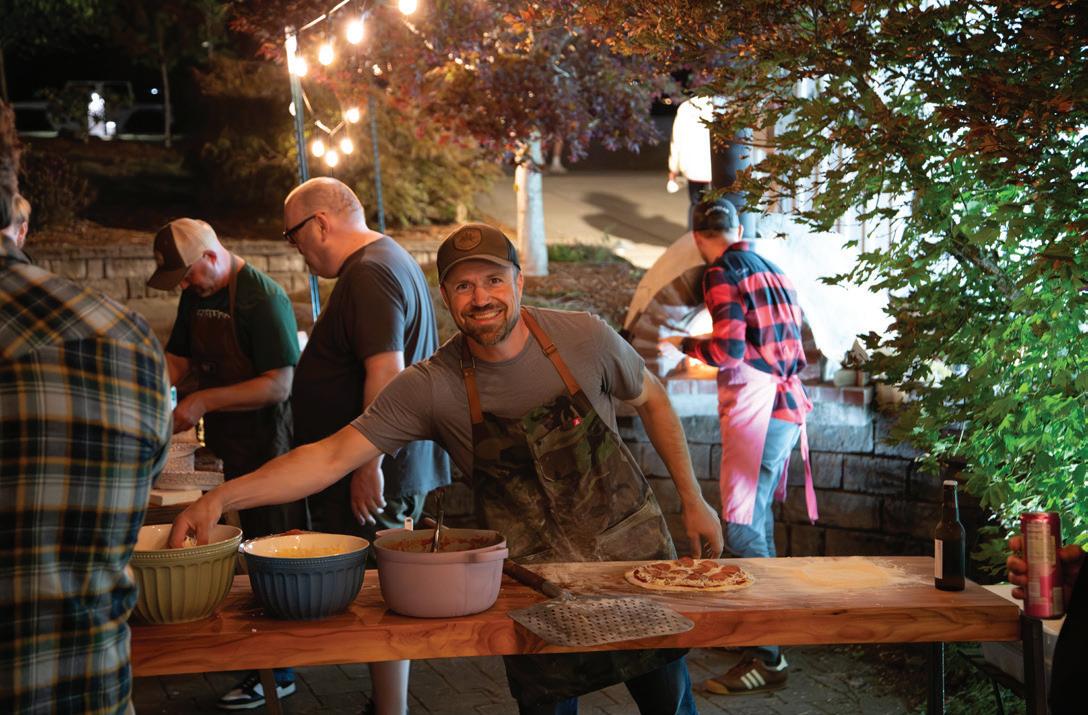
TREVOR OTT MAKING
WOODFIRED
PIZZA
MICHELLE PLATT AND SIENA SCHOFIELD
ALUMNI ENJOYING THE COFFEE BAR
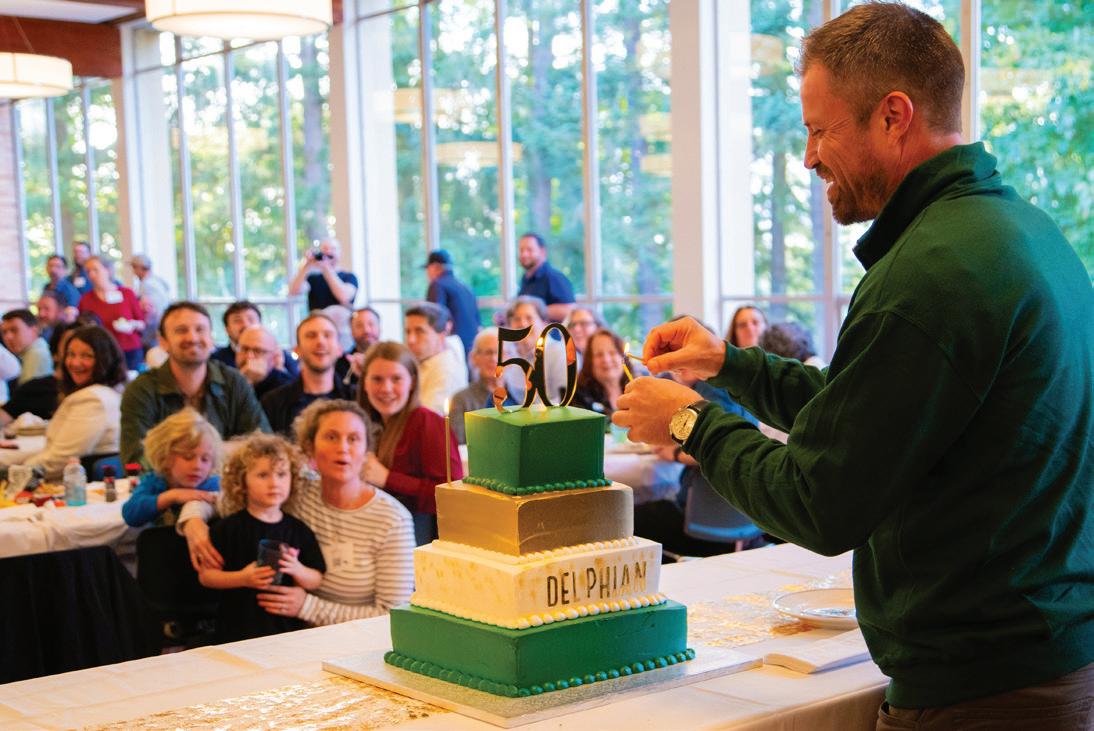
As the sun began to set over the trees, the community gathered for a homestyle turkey dinner, where Head of School Trevor Ott officially cut Delphian’s 50th birthday cake. The evening’s formal highlight was the acknowledgment of alumni volunteers, followed by an exclusive first look at Delphian’s new crest and logo. This was met with resounding applause and excitement. Next up were the roasts celebrating the 10-year reunion of the class of 2015. The night ended with a volleyball game in the gym and a bonfire under the stars complete with s’mores and storytelling.
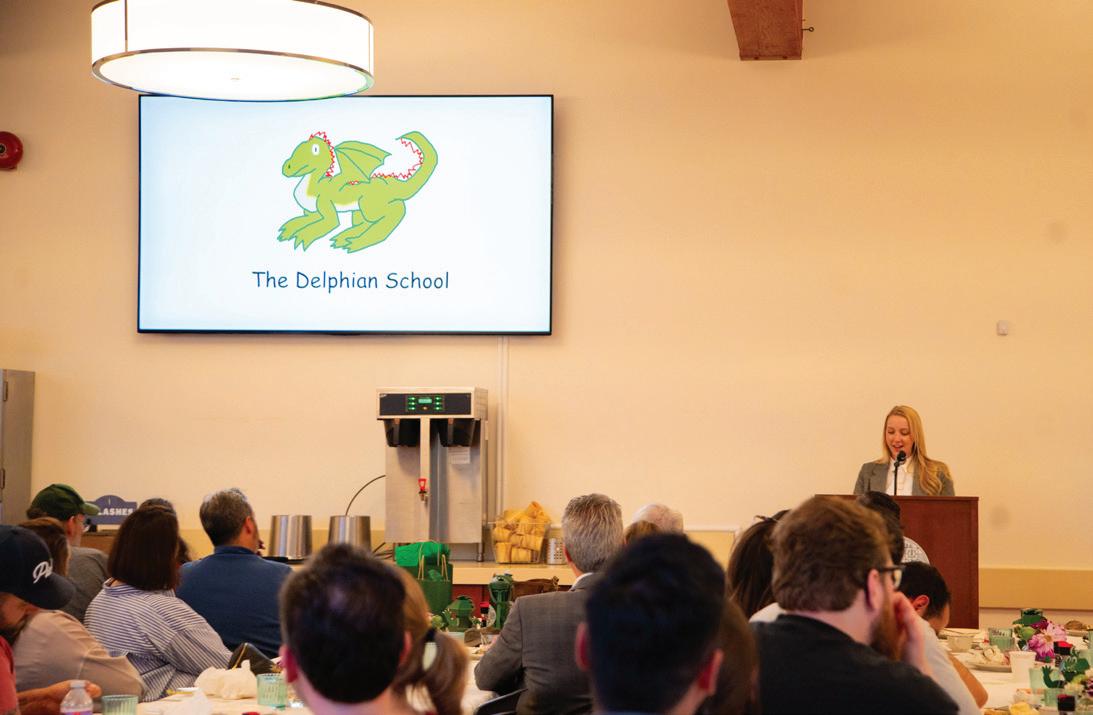
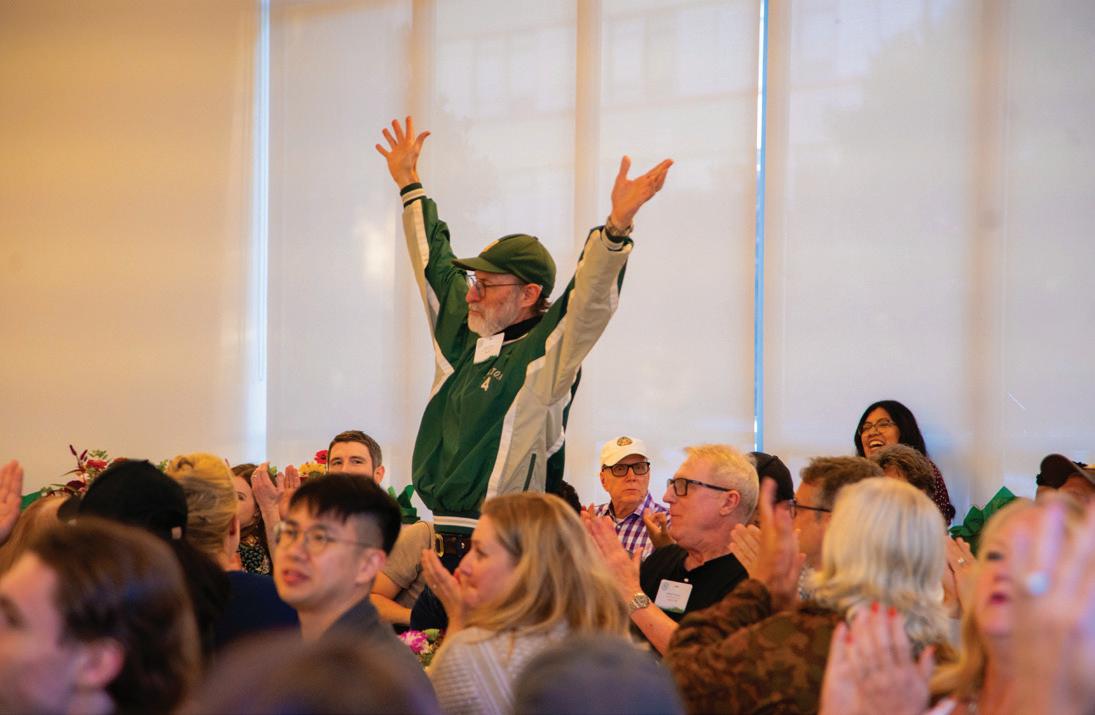
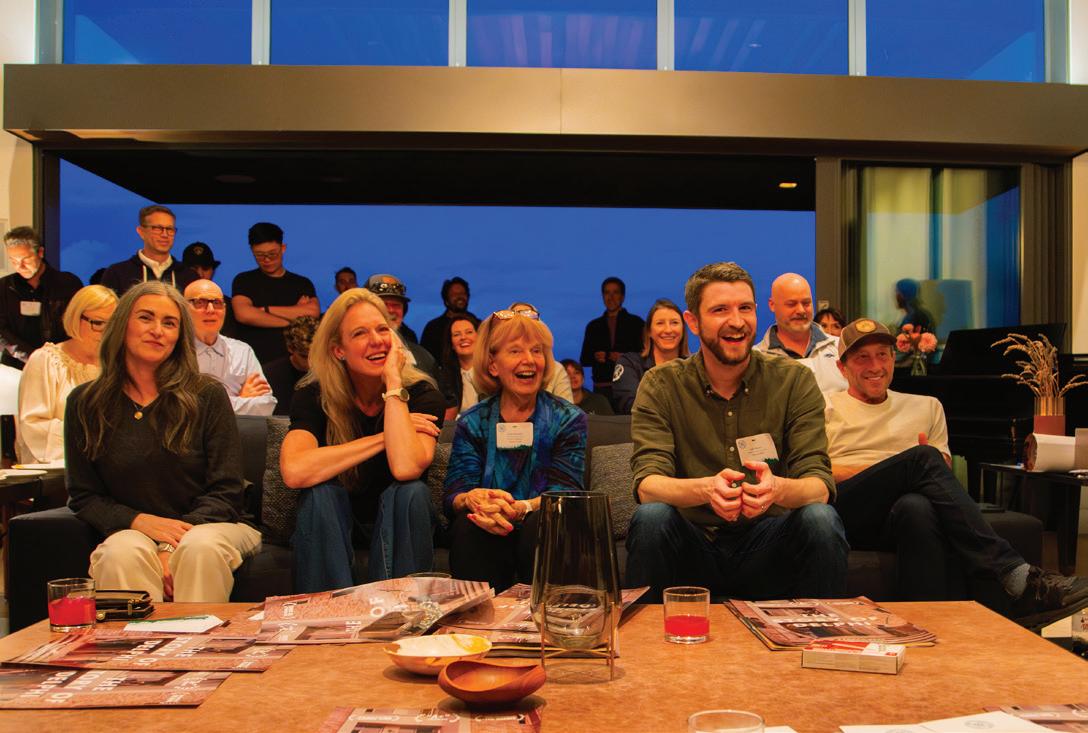
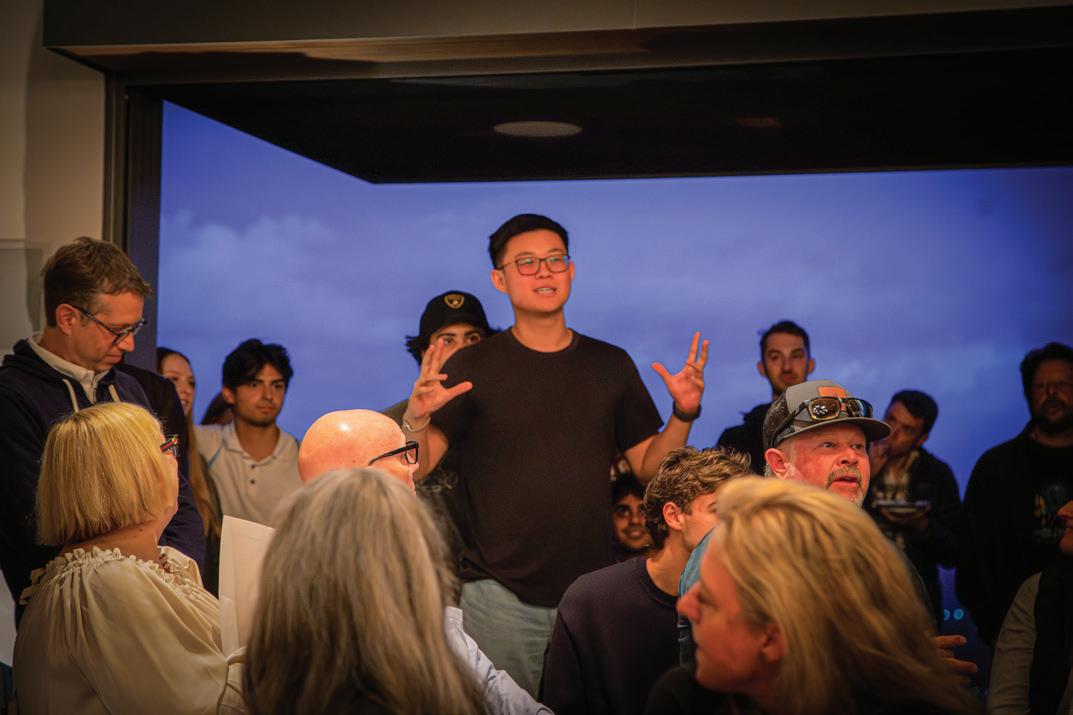
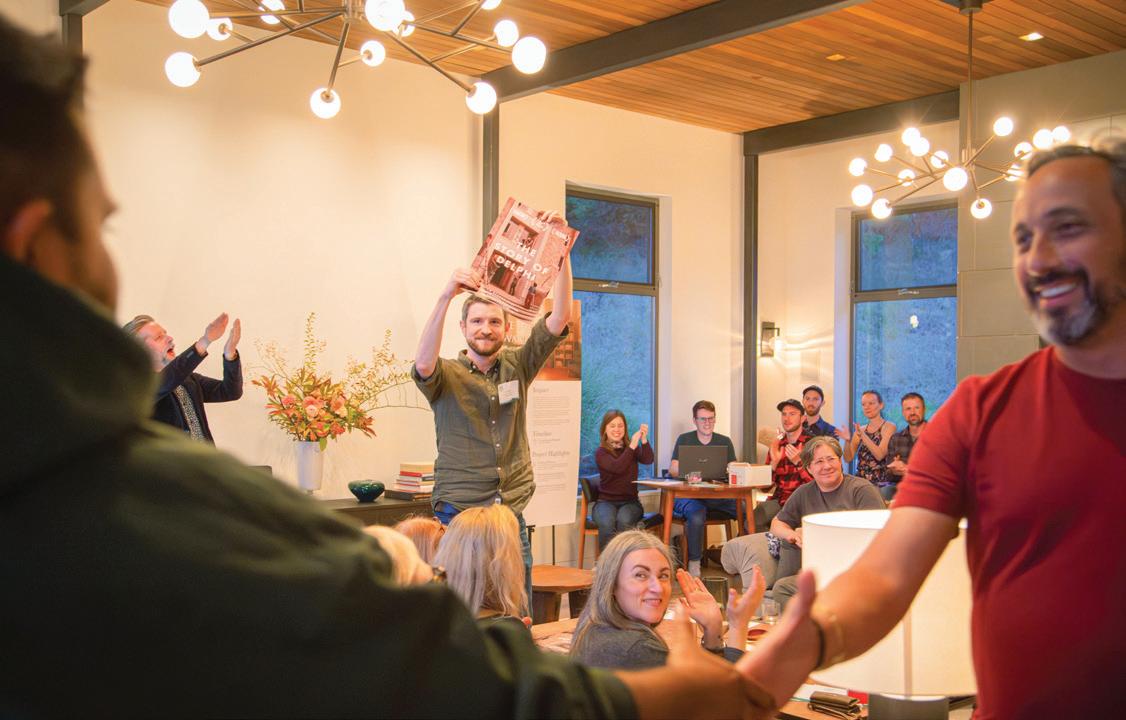
Saturday was a day of active engagement centered on the weekend’s featured event: the annual Alumni Association Meeting brunch. This event included a comprehensive update from Trevor Ott on recent successes, projects, and upcoming plans for the school, as well as an interactive Q&A session with Delphian’s executive leadership. The highlight of the brunch was the premiere of the alumni-created film The Story of Delphi, which acknowledged the founding and longtime staff whose purpose and hard work laid the foundation for the school as it is today. The film was met with a standing ovation and hardly a dry eye in the room.
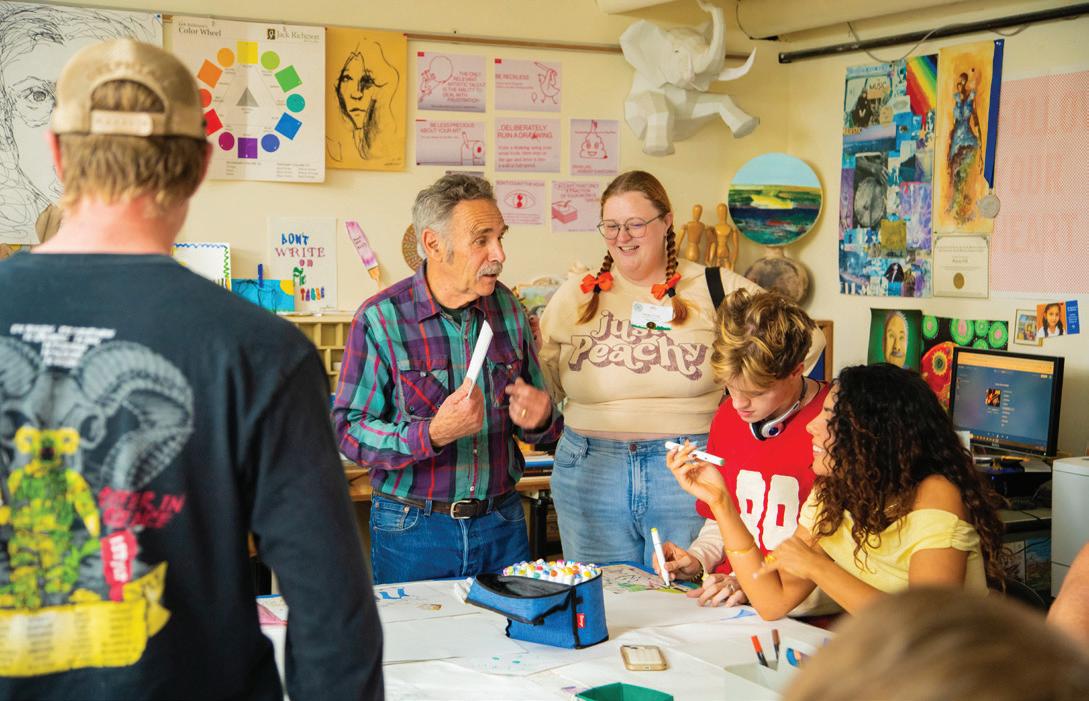
The afternoon offered alumni an opportunity to choose activities such as artisanal coffee and conversation, a pickleball tournament, hayrides led by Jerry Ripp and John Fry, art with Russty Gill, and more. A major highlight was the league-official alumni vs. student soccer game where the alumni took an early 3-0 lead, but the students, with their youthful athleticism and endurance, tipped the final goal count in their favor with a 6-4 win.
Saturday evening featured the Caring for the Future fundraiser reception, live performances at the Saturday Night Performance (SNP), and the student-council-run carnival in the gym. To close out the day, the Head of School welcomed alumni to a gathering at his house for wood-fired pizza, games, snacks and conversation.
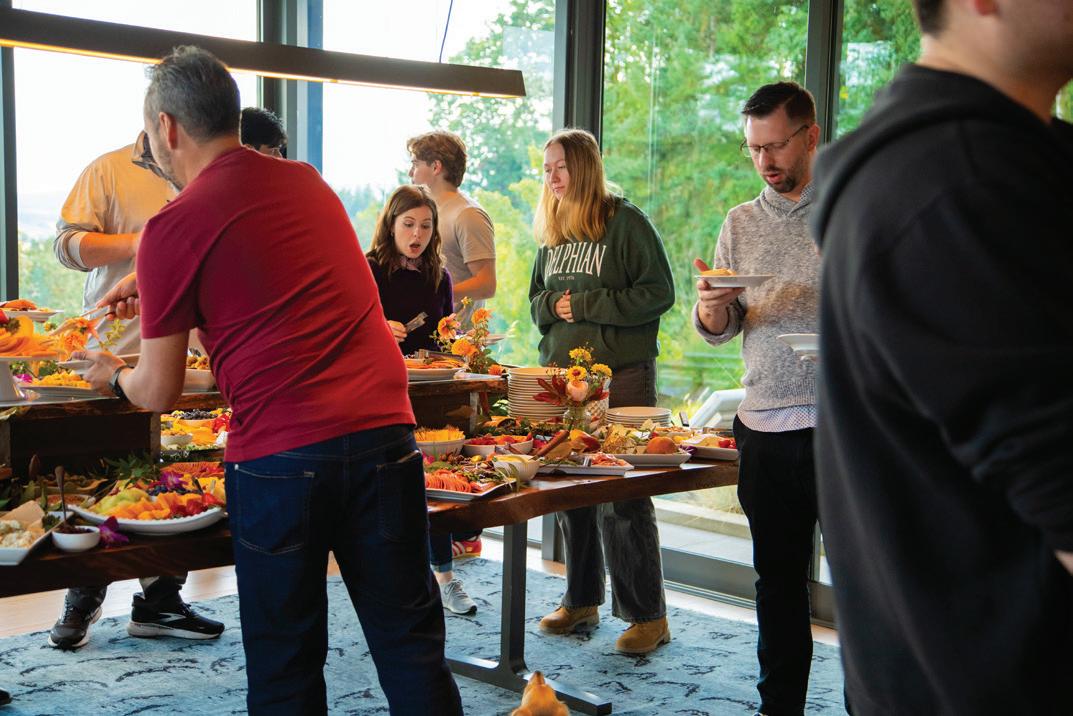
The weekend drew to a close with yet another new event: a casual Sunday morning brunch in the dining room, where professional chef and alumnus Tony Parker introduced the community to “Dragon Toast,” his take on Wildwood Cafe’s French toast. This treat is made from thick slices of artisanal sourdough bread rolled in homemade granola, grilled to golden brown, and served with a dusting of powdered sugar, butter, and warm maple syrup. Dragon Toast provided the perfect excuse for everyone to gather one last time on campus and share a delicious meal with their friends before heading home.
As alumni returned to their lives across the globe, the sentiment was clear: Alumni Weekend 2025 wasn’t just a look back. It was a celebration of the 50 years of pioneering spirit that built the school and a look towards the next 50 years of continuing to forge a path for future generations.
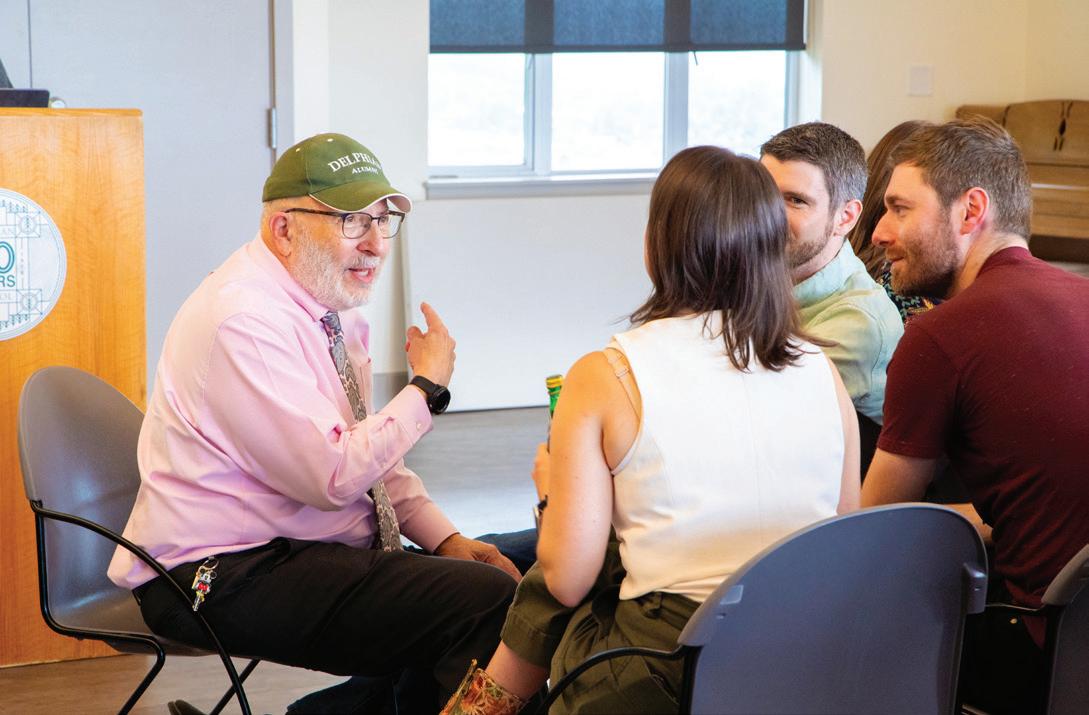
MARK SIEGEL AND ALUMNI
NEW LOGO AND CREST PRESENTATION BY REBECCA ORTHMANN
JAMES HORTON REPRESENTING HIS CLASS
a resoundingsuccess
Alumni Weekend Fundraiser
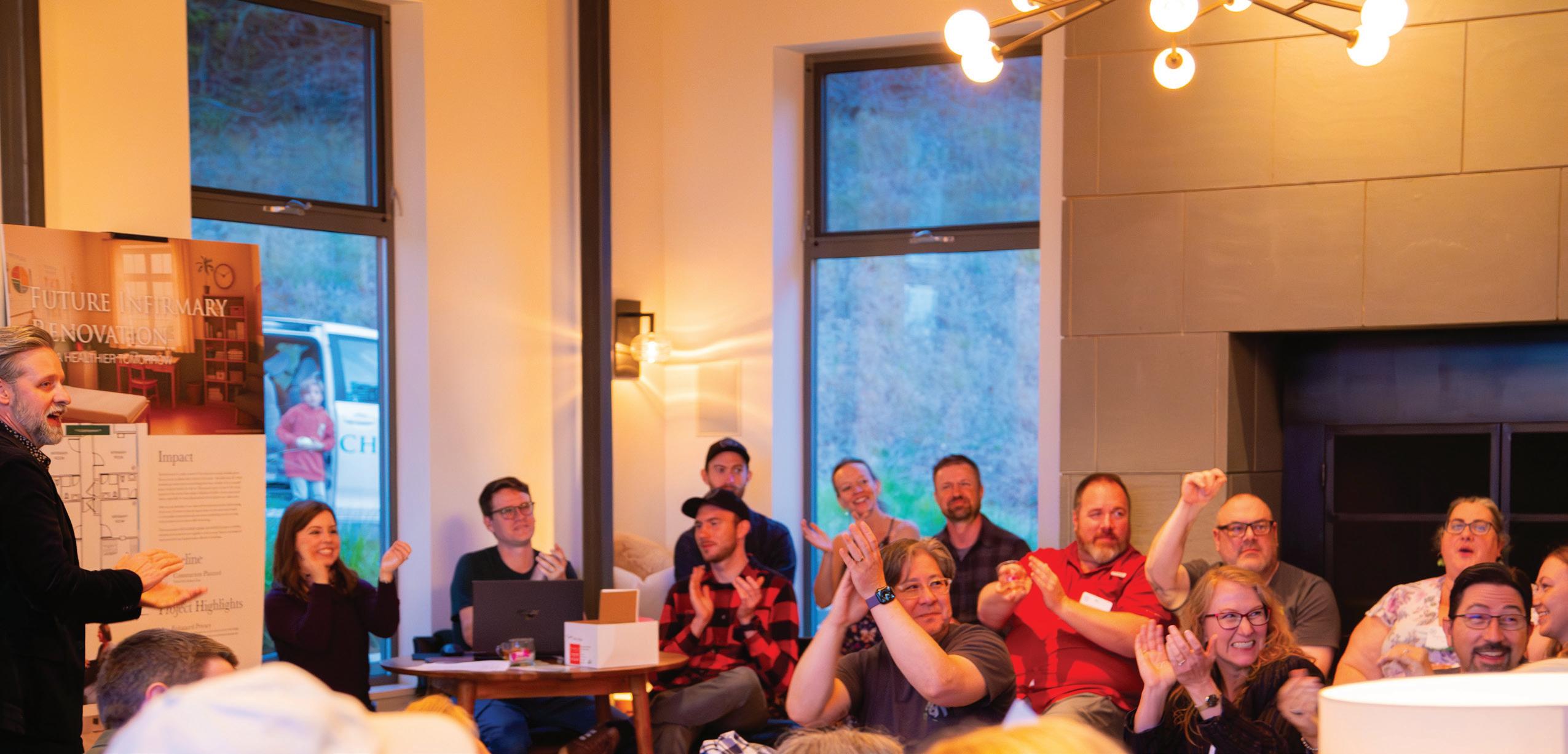
Reflecting on five decades of excellence in education, the 50th Anniversary Alumni Weekend fundraiser became one of the most successful fundraisers in Alumni Weekend history. The event, a resounding success, brought together alumni, families, staff, and friends for a celebration that will be remembered for years to come.
In addition to the highest ever attendance, this year’s fundraiser marked the highest participation ever, with over 140 individual donations, including from many first-time donors. Each contributor received a
commemorative movie poster for The Story of Delphi as a token of appreciation, capturing the spirit and history of the school.
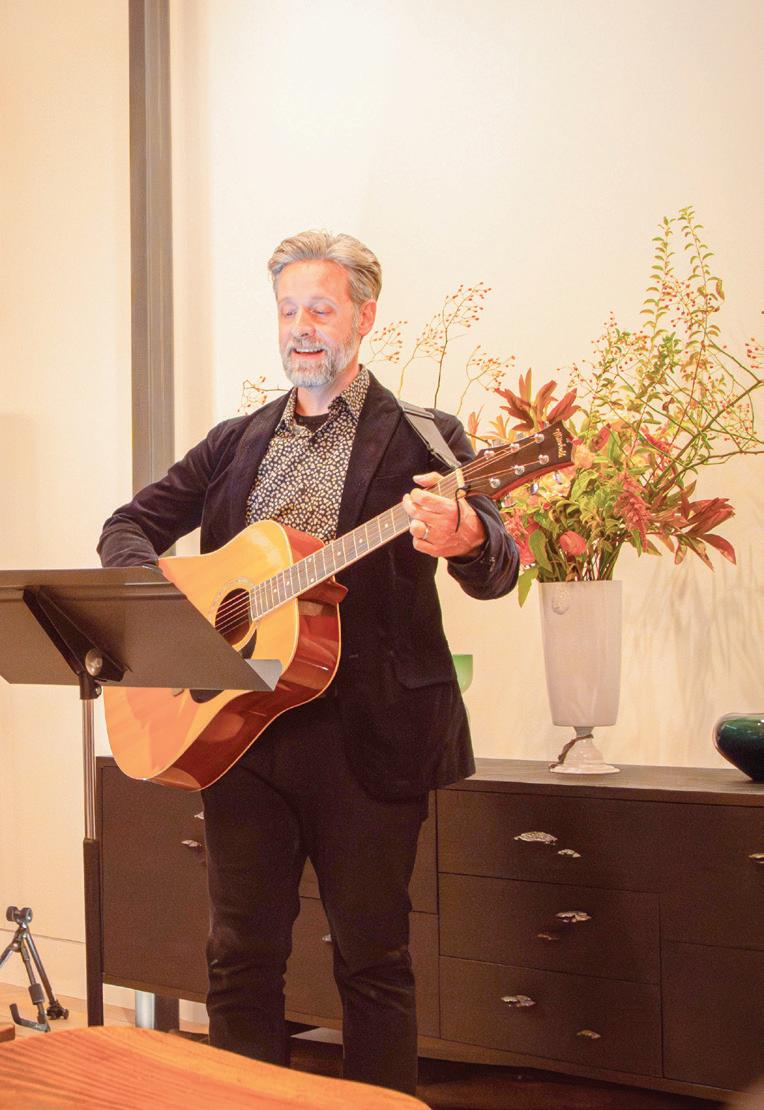
Alumnus Adam Whitworth led the festivities as Master of Ceremonies, delighting guests with his signature energy, heartfelt stories, witty jokes, and even a custom song tailored for the occasion. The event also featured delicious catered food and handmade espressos from a local roaster, adding warmth and flavor to the celebration.
A special milestone was reached when 41 generous individuals joined the 2025 Leadership Society by making gifts of $1,976 or above (a figure chosen to honor the year Delphian was founded). This outstanding show of support demonstrates the enduring commitment and pride shared by the Delphian community.
We extend our deepest gratitude to Jen Anderson and Maxine Anderson for graciously hosting the event. Special thanks also go out to Jen Anderson, Stephanie and Russ Croman, Tami and Dave Robertson, the Jayasinha-Gray family, Todd and Rosy Kugler, Nicole and Rob Adams, Kelly Layton, Diana and Cody Malick, Lisette Nacif, Tony Parker, Chris Uno, Austin and Andria Carroll, Alissa and Ben Schneider-Patrick, Nicole and Josh Benk, and Clem Agami for their generous support and contributions, which helped make the evening truly special.
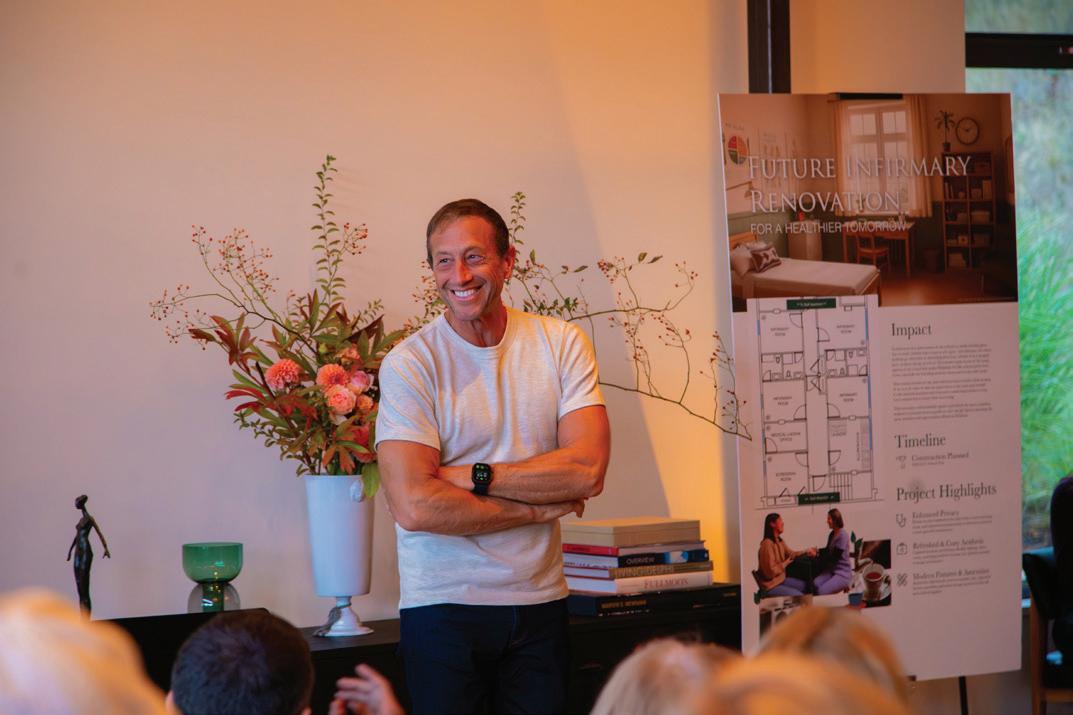
Alumni and Delphians from far and wide contributed $575,000 towards building the next 50 years and beyond. These generous donations contributed significantly to the planned infirmary remodel and to the school’s endowment for long-term investment.
As we look back on this remarkable evening, we celebrate not only the funds raised but the spirit of connection and gratitude that defines Delphian. Thank you to everyone who participated and contributed to this historic occasion. Here’s to the next 50 years!
A curiosity & compassion
Adam Cummings: Bonneville Power Administration is a power wholesaler in the northwest United States. Our service area includes Oregon, Washington, Idaho, and western Montana, as well as small parts of California, Nevada, Utah, and Wyoming. We provide a third of all the electricity to the northwest United States, and our 15,000 miles of high voltage lines make up 75% of the high power grid in the northwest. While we don’t own the dams, our power generation efforts include hydroelectric dams on the Columbia River and Snake River.
DM: What is involved in your role?
AC: I and my team are responsible for the relationship between the power administration and the tribes within our area. This year Bonneville Power Administration will spend $300 million on fish and wildlife mitigation, and much of this work is done with tribes. It is perhaps the largest mitigation program in the country.
My job is to be curious—to learn. The responsible maintenance and construction of our projects has direct impacts on the communities we serve, as well as upon the land and rivers.
DM: What kind of fish and wildlife programs are included?
Interview With Alumnus
Adam Cummings
dam Cummings, who attended Delphian in the mid-90’s, is a Tribal Account Executive for the Bonneville Power Administration. In his work he manages relationships between the power administration and the fifty-three tribes within the administration’s service area. He takes pride that his most important role is to be compassionate and to be curious.
Delphian Magazine: For context, what is Bonneville Power Administration?
AC: Salmon are an excellent example. They hatch and grow in creeks and tributaries. As they grow, they eventually swim downstream to the ocean and mature to adulthood. To spawn, they swim back upstream to where they hatched. Dams inhibit their natural cycle. We care for these ecosystems and help them heal through habitat improvement, hatcheries, and other programs. Fifty percent of this work is done by tribes. Additionally, transmission lines impact tribal interests.
DM: Can you tell us about a recent project?
AC: I recently oversaw a trip by subject experts (foresters, environmental experts, cultural specialists, etc.) to review a plan to rebuild a high voltage transmission line through Montana, which will happen in 2027. The line runs right through tribal lands. There are standards we have to achieve for construction, as well as wildfire risk mitigation. A critical part of this trip was bringing the plan before the tribal council. We learned their concerns, such as the line going through a specific area that was very sacred to the tribe. The tribe is a supportive partner of the project, and it is fulfilling to help the power administration be a supportive partner back to the tribe. Having learned from
this tribe, we can now integrate the respect for their culture and lands into our plan.
History is rife with examples of indigenous tribes and their cultures being ignored and pushed aside. In contrast, our team is constructing a model program for consultation with tribes. It is a point of pride to say that we don’t go forward until everyone is on the same page.
Another example is signage with cultural names and in tribal language. Yet another is protective fencing for burial grounds, petroglyphs, and other important sites.
There are 574 indigenous tribes federally recognized in the United States. They have been here for generations and, in some cases, millennia. To know one is to know only that one. Each culture is unique.
DM: What led you to this career?
AC: In college I earned a Masters in Business Administration. I spent close to a decade in high tech, and whenever I came back to Delphian I brought things like silicon wafers to share with students. I found a sweet spot in coaching, facilitating, change management, and project management. I helped people in the fields of education, nonprofits, and high tech. This led me to Bonneville Power, and they saw a great fit with my skills and passion.
DM: How did Delphian impact you?
AC: I came to Delphian initially for a summer to catch up on my math. I discovered it was the place I needed to be–and little did I know. I was a smooth-talker, but I learned from Terrie Arnold that I had a big misunderstanding about authority. I had it all figured out, and authority was about control. Somehow, Terrie successfully got seventeen-year-old me to realize that authority is not about control; it is about structure and support. This was an “aha” moment for me, and it impacts what I do every day.
DM: What has beens the most important point of the Delphian logo to you?
AC: Integrity. Believe it or not, I was the first student in charge of checking Sunday “white glove.” Previously it had been done by staff. Every Monday morning I
would check every dorm room and ensure it was properly cleaned. I learned to uphold high standards. I didn’t get to be overly strict, nor lenient. I learned for myself what integrity was, and I learned its value for myself and for my group.
I feel extremely fortunate to have attended Delphian. I come back often. It was the first place I felt real connections and shared purpose. It stuck with me. I feel privileged to have had the chance to go to Delphian and, in the words of Spider-Man, “With great power comes great responsibility.”
It is my responsibility to carry forward what I gained to others.
At Delphian, I learned early on about self-determinism and educating myself. I learned to think for myself and be curious, to not be the “victim” of an education or another’s ideas foisted upon me. It’s a place where you get creative space.
DM: Any final thoughts?
AC: I take my work very seriously. I help these tribal communities get the opportunities to carve out their creative spaces and embrace their cultures. Cultures differ. They are unique. Be curious and be compassionate.
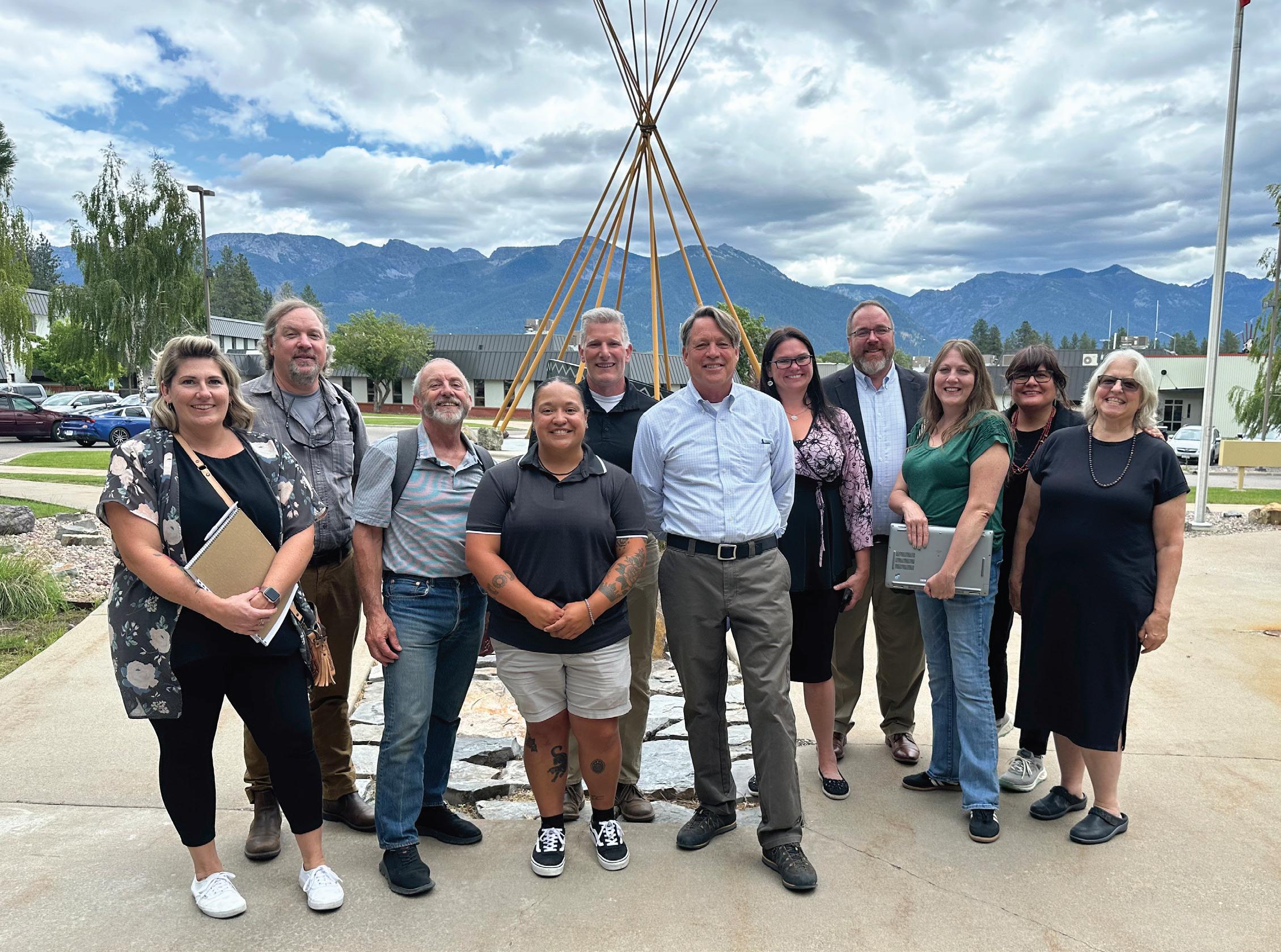
ADAM CUMMINGS (4TH FROM RIGHT) AND HIS TEAM OF SUBJECT EXPERTS VISITING THE CSKT TRIBAL COMPLEX IN PABLO, MONTANA
w th A learn AIng
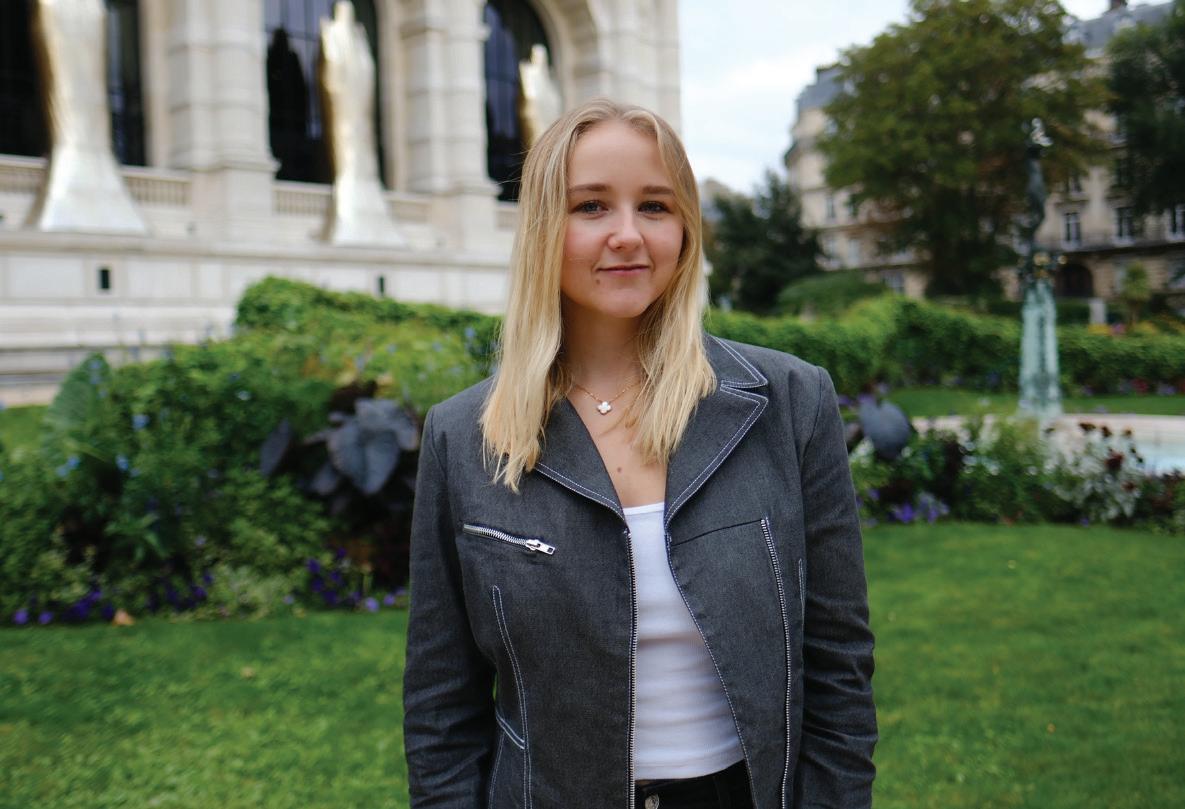
Interview With Alumna Maxine Anderson
M
axine Anderson is a co-founder of the education technology firm Arist. Arist’s unique approach to learning and its use of artificial intelligence make it a potent tool for companies and nonprofits to make their people more confident and effective.
Delphian Magazine: What led you into the world of education technology?
Maxine Anderson: Since my time at Delphian, education has always called to me. A single better decision can change a life. During my gap year before college, I taught in rural Oregon, including at Sheridan High School, Willamina Elementary School, and the Confederated Tribes of Grand Ronde. I loved creating “aha” moments with my students. Through college, I sought solutions to the challenge of how to create “aha” moments at scale.
DM: Where did you go to college?
MA: I went to Babson College, where I earned a Master of Science in Business Administration with a focus on entrepreneurship and business. My co-founders and I met while living in the same dorm community, eTower — a living-learning community for student entrepreneurs all working on different education projects. It was a tight-knit group of builders who lived and worked together.
DM: How does Arist approach education differently?
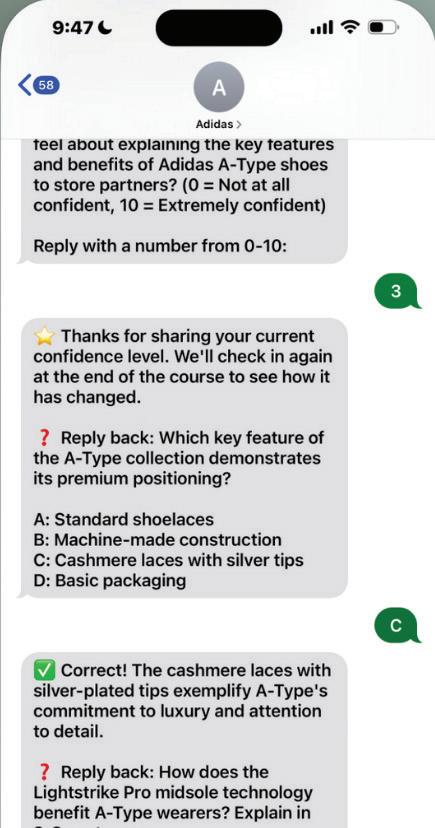
MA: Did you know that the majority of corporate training is forgotten within weeks, according to Harvard Magazine? It is known as the “forgetting curve.” Or that, according to Arist’s research, only 1% of employees complete non-required training?
My co-founders and I started looking for a solution. Michael, my co-founder and our CEO, led a nonprofit called TILE Talks, which helped high school students start entrepreneurship chapters in their schools. A student from Yemen reached out wanting to start a chapter, but because he lived in a war zone with limited internet service, he couldn’t access the
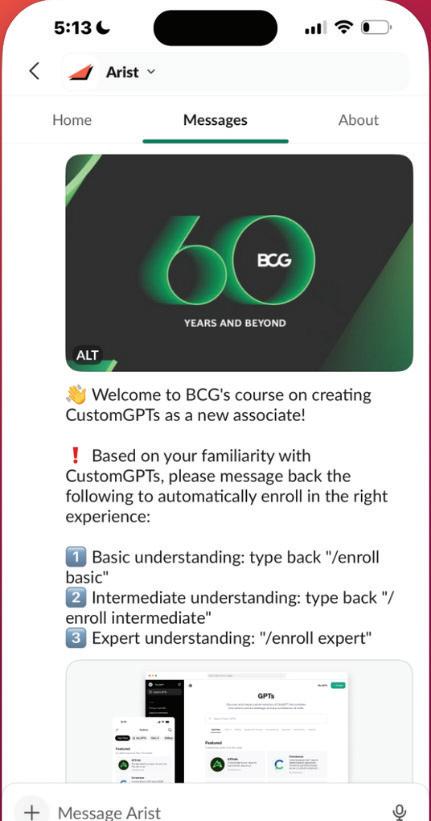
training materials. The only way to reach him was through text, and that’s how the idea for Arist’s no-app learning model began.
DM: Did your education at Delphian influence your approach?
MA: Delphian’s educational model taught me something important, something that is now widely called “thinking with first principles.” That is, throwing out assumptions and building up from the most fundamental parts. I learned to think through a new idea fully, without relying on existing solutions. Delphian’s literature program stressed learning new ideas and then forming my own opinion about them. The importance was not my opinion; it was how wellrounded my reasoning was.
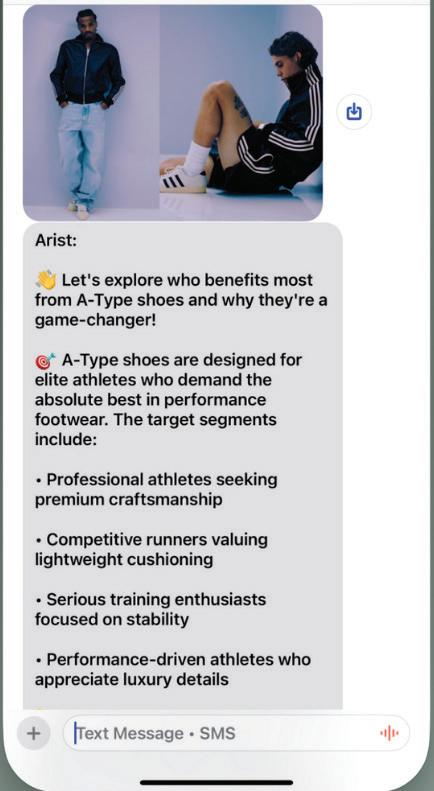
With Arist we developed a unique approach to large-scale learning by providing bite-sized learning moments without the need for specialized apps.
DM: What was your first test case?
MA: Our first test case used Arist to deliver masterclassstyle courses from Harvard and Stanford professors. It wasn’t a great business model, but it validated the learning method. Our first paying customer was a General Motors HR leader who used Arist to deliver a Harvard Business Review executive training course via text to his leadership team.
After that first enterprise deal, we thought selling to large companies would be straightforward, but it wasn’t. Most leaders still believed video training was “innovative enough.” Then COVID hit, and suddenly all those HR teams we’d pitched were struggling to engage remote employees. They called us back, and we realized it was our moment.
We positioned Arist as a more engaging, text-based learning solution. At first, companies used it as an add-on, but we always believed it could replace most traditional training, which is often expensive and ineffective. Once we built a strong enterprise product, the market shifted again. Budgets tightened, so we turned to sales leaders in growing industries who needed fast, scalable enablement for their teams. That’s when Arist started defining a new category: instant enablement. We blended learning, communication, and engagement in one platform.
DM: How did your Delphian communications skills help you?
MA: Delphian helped me find my voice and use communication to solve problems in real time. Through doing challenging projects and leading groups, I got comfortable putting ideas out there and being okay with rejection. That’s a critical skill when you’re building a new company, especially one creating a whole new category.
Beyond that, communication is the key to solving cofounder conflicts, leading teams, and making hard decisions. It’s the foundation for everything.
DM: What kind of results are you seeing?
MA: We’re seeing astonishing results, such as 10x revenue in sales teams. Imagine the impact of a salesperson who is actually confident in the features and benefits of their new product and who gets easilydigestible learning moments on a regular basis. The biggest predictor of success is confidence.
Better yet, we see these results in just 5 to 15 minutes each day over seven days, as opposed to 20+ hours from traditional, and often outdated, training courses.
DM: How does artificial intelligence fit in?
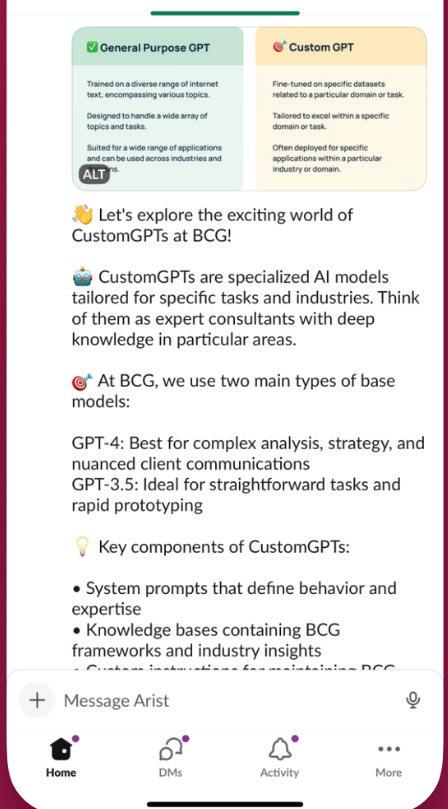
MA: Artificial intelligence allows Arist to create these powerfully compact learning moments. Organizations have massive libraries of information, training materials, brochures, etc., and we can quickly pull out the most important information. To validate data accuracy we include in-line citations so users can dig into the source material, and we use a human review process to verify our AI’s accuracy.
We became the first learning company to build a course generator using OpenAI’s early access API. Since then, we’ve expanded into creating AI agents that can identify workforce needs, generate relevant learning content, and deliver insights through
analytics. We’re still building out that vision.
DM: What’s next for Arist?
MA: Smarter and faster personalizing. We’re just at the beginning of transforming how organizations succeed through effective employee learning. We’re building AI agents that partner with leaders to help teams meet goals through real-time, personalized enablement instead of generic video training that doesn’t drive performance.
DM: How did Delphian prepare you to be an entrepreneur?
MA: Delphian’s education teaches responsibility as a mindset. Its magic rests in how it builds confidence. At Delphian I constantly found myself taking on concepts, books, projects, and responsibilities that I thought were slightly beyond my ability, and then I succeeded at them and discovered I actually did have the ability. If I failed, I failed forward. My confidence grew.
This magic of responsibility as a mindset has proven to be critical for a start-up environment and an entrepreneur mentality. If something needs to be done, I do it—“not knowing” is not a barrier. Coupled with the learning agility —the ability to learn any new skill or topic—made possible by Study Technology™, Delphian truly empowered me to succeed as an entrepreneur.
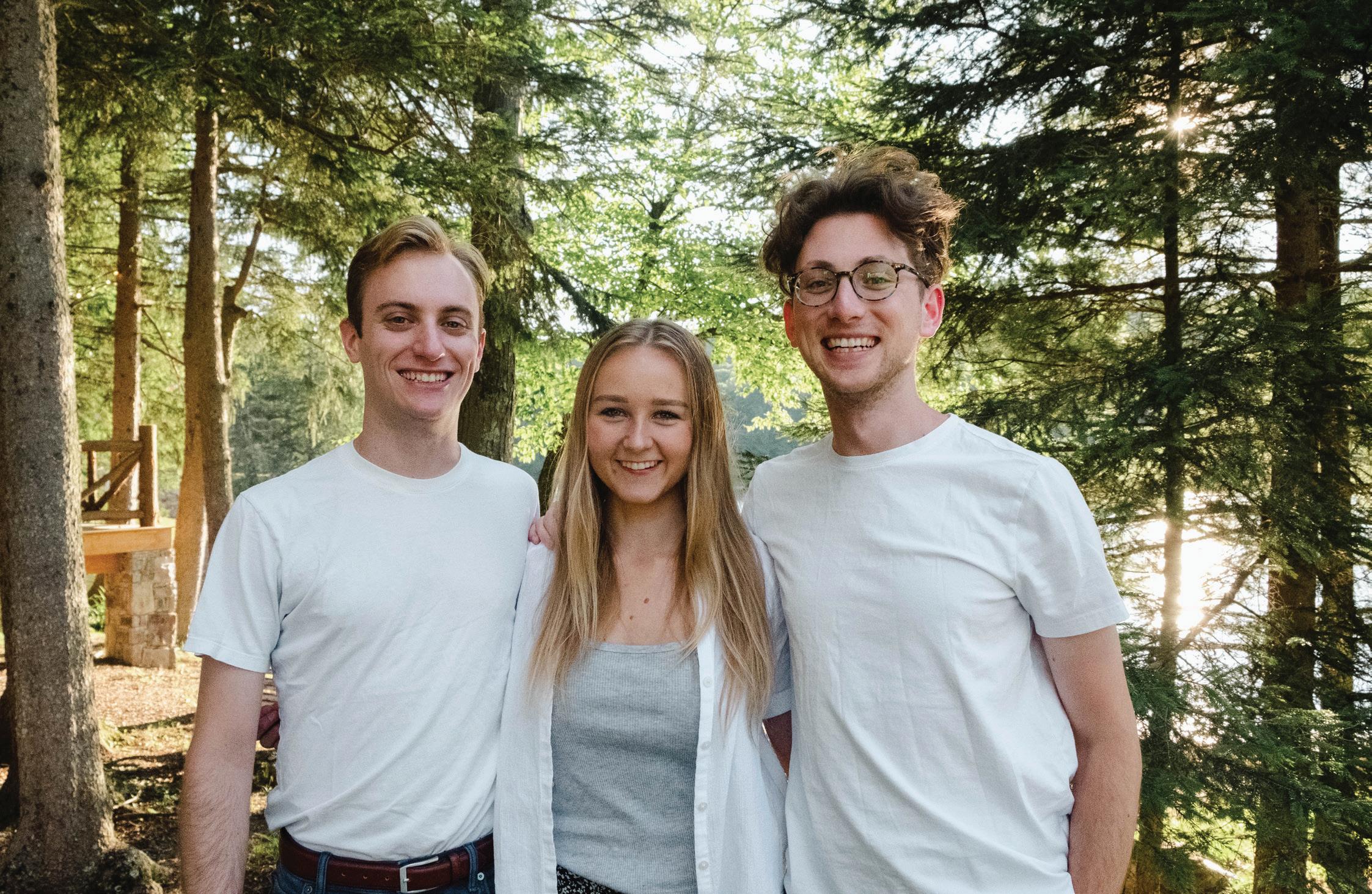
ARIST CO-FOUNDERS L-R: RYAN LAVERTY, MAXINE ANDERSON, AND MICHAEL LOFFE
culture of giving
Today, Tomorrow, Always, Forever
Over the last 50 years, Delphian’s growth has been fueled by generous gifts of time, effort, and money from you, our supporters, friends, and team members. Together, we are creating an educational showplace that serves today’s students while also offering an inspiring model for future generations. It is an honor to participate in this united effort with all of you.
We all have a desire to help within; this purpose pulls us together as a community. As individuals and families contribute, others are moved to do the same. This year’s Alumni Weekend marked the largest attendance at a weekend fundraiser, with record first-time donors and total funds raised.
How you choose to help is up to you. No matter how you choose to contribute, Delphian thanks you, our students thank you, and the thousands of children we will educate long into the future also thank you.
Our donors and volunteers help shape our story across time, from daily needs and transformational campus upgrades to longterm financial strength and a lasting legacy. The following is how your giving creates ripples through the years.
REPORT 2024-2025
Ways to Give:
Today: ANNUAL FUND
Gifts to the Annual Fund go straight to work, supporting new extracurricular programs, facility upgrades, professional development, general operations, and more. These unrestricted donations support our yearly budget. We are especially thankful to our monthly recurring donors who provide steady support.
Tomorrow: CAPITAL FUND
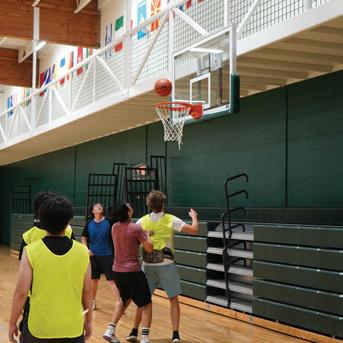
Capital campaigns raise significant funds for major projects which bring our Campus Master Plan to life. These projects, which can last several years, allow us to expand, renovate, and future-proof our campus for generations to come. A great example is our gym upgrade, which included new maple floors, updated bathroom and locker rooms, a reinforced second floor, new bleachers, a rock wall and obstacle course, an indoor second-story running track, and a concession stand.
Always: ENDOWMENT
When you support the endowment, you are directly participating in Delphian’s vision of a civilization based in reason. Investing in the endowment helps secure the school’s long-term financial future. As the fund’s principal balance grows with time and donor support, it generates higher levels of yearly interest that directly supports the school’s operating budget. In this way, the endowment supports every aspect of the school, such as scholarships, equipment, supplies, maintenance, staff development opportunities, promotion and marketing, and student activities.
Forever: LEGACY
Some of the most extraordinary gifts are not given to the students of today, but to the students of tomorrow. The Apollo Legacy Society recognizes those who make Delphian part of their future planned giving in the form of a contribution from an individual or family’s estate.
ONLINE: Go to Delphian.org/Giving to donate by card. If you would like to give on a monthly basis, you can set up monthly recurring donations here, too.
MAIL: Delphian School Development Office, 20950 SW Rock Creek Road, Sheridan, OR 97378
OTHER: To send a bank wire, make gifts of stock or securities, set up matching gifts from an employer, etc., call the Development Office at (503) 843-6954 or email Development@Delphian.org.
THE LEADERSHIP SOCIETY 2024-2025 Special Recognition
Donors who contribute $1,976 or more (in honor of the year of Delphian’s founding) in one calendar year are acknowledged as members of that year’s Leadership Society. Donors contributing $10,000 or more in one calendar year are celebrated for joining that year’s Leadership Society Elite.
LEADERSHIP SOCIETY ELITE
Geoffrey and Susana Hegeman
Ruth Ann Faass
Michael Staples
Jill and Jerry Chen
Arwen and Sky Dayton
Stephanie and Russ Croman
Celina and Jorge Guajardo
Brie Shaffer and Michael Peña
Jeri Slavin and Marty Gottlieb
Rosy and Todd Kugler
Florence Leppert and Martin Leppert
Julia and Holger Peens
Brandy Lewis and Ethan Suplee
Andria and Austin Carroll
Nicole and Rob Adams
Tracee Nichols and Richard Paek
Coleen and Michael Carberry
Catherine Stauffer
LEADERSHIP SOCIETY
Christopher Uno
Berta Frias and Mikel Urizarbarrena
Michelle and Ryan Kugler
1SG Anthony Parker (US Army)
Louis and Heide Peens
Jennifer Anderson
Dan and Melissa Brown
Rossine and Clem Agami
Sheila Auster
Vivian Gray and Adrian Jayasinha
Elizabeth McKevitt
Suzan and Greg Ott
Ellen and Dave Hendry
Mimica and Lukas Ott
Lyne Breault and Mario Cloutier
Juliette Lewis
Ying Fang and Lei Li
Andrea and Dan Maddox
Sherese and Bob Graves
Catherine and Shahab Emrani
Shelby and David Larrabure
Melissa and Josh Ward
Noah Wang
2026 TELETHON FUNDRAISER
securing the future Boosting Cybersecurity at G&W Electric
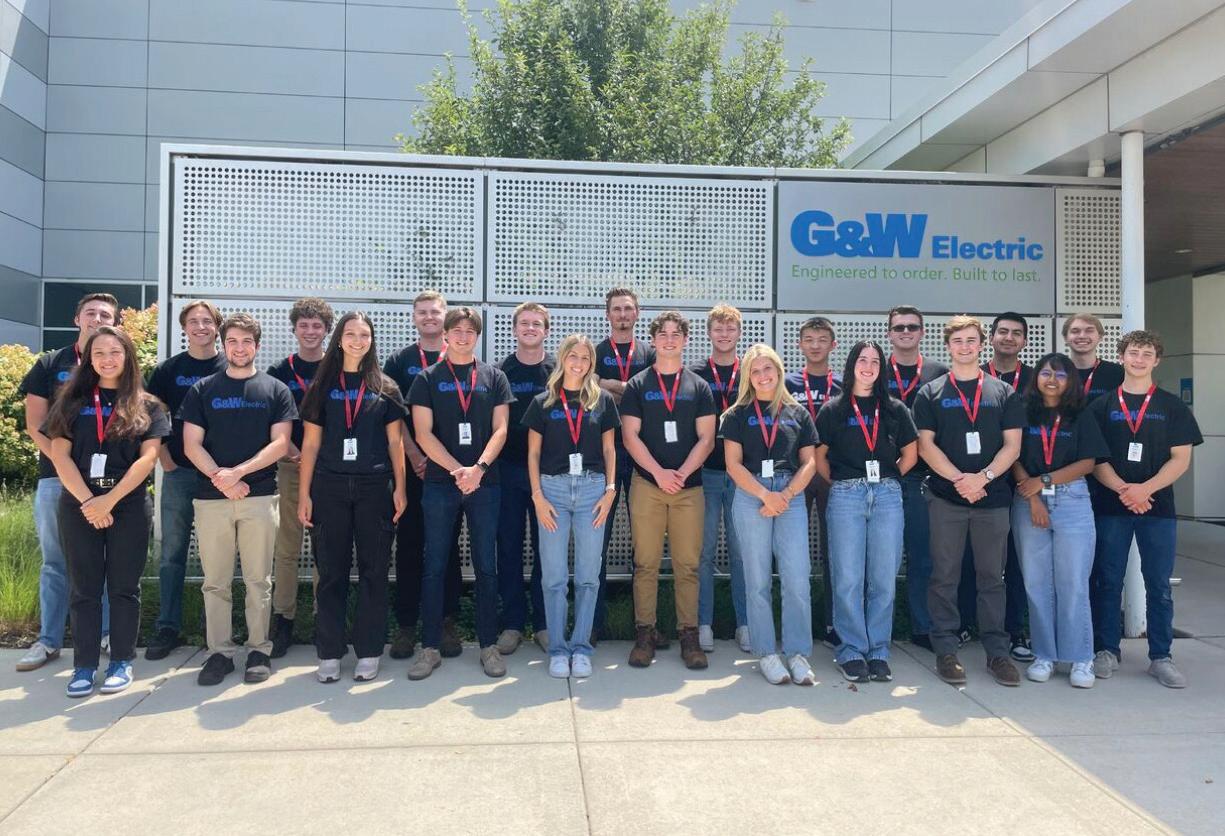
For his Form 7 career interest apprenticeship, senior Jim Cao spent the summer working in the windy city of Chicago, learning more about cybersecurity in preparation for a career after graduation in the ever-evolving world of technology.
Delphian Magazine: Who did you work for during your apprenticeship, and what did you do?
Jim Cao: I worked full-time as a paid intern for two
months over the summer at an electrical accessories company called G&W Electric, in Chicago. I was apprenticed in the cybersecurity and information technology departments. My daily tasks included helping with deployment, essentially setting up and physically connecting employees’ computers to the internet by installing ethernet cables. I also served as a system administrator and helped manage the software they used to minimize security risks.
The company and its employees use over 1,000 software programs, and each must be reviewed and monitored frequently to ensure it is up to date and not vulnerable to online attacks. It was like being a librarian for a giant high-security library full of precious books, but instead of books, I was caring for software. It was my job to ensure none of the “books” were damaged or broken, and to flag them for the IT director to review if they posed a threat to the library as a whole, which could expose the company to serious security risks, such as a data leak.
To learn how to do this, I worked with another intern who helped me understand the basic process. The work involved checking each software product on a website that evaluates it for risks and assigns a 1-10 rating, with ten being the most secure and one the least. If I found software with an unacceptable rating, I flagged it and submitted it to the IT director to review.
DM: How did you choose this apprenticeship?
JC: I’ve always had an interest in the area of technology, and so it was an easy choice to know I wanted to find an apprenticeship in this field. To get the internship, I had to apply for the position, and my dad, who works for G&W Electric as their Vice President of International Sales, helped me navigate that process.
Because it was a paid internship, the experience was like holding a real job. The company provided apartment housing for their interns, so I lived with two intern roommates who were both college students. I used my paycheck to buy food and necessities, too, so it was a very “real-life” experience.
DM: Was the apprenticeship at all challenging?
JC: Yes, I had to learn tons of technical nomenclature I had no idea about before. My supervisor spoke to me using so many words I had no meaning for. I often had to stop him to
ask. “What does this mean? What does that mean?” It was a great learning experience, and he would usually give me a short explanation in addition to the definition. When I wasn’t able to ask, I found myself writing down the words I didn’t know so I could look for them in a dictionary later. Knowing how to use Study Technology™ and using it in this way helped me to get up to speed quickly so I could be successful in the apprenticeship.
DM: What was the training process like compared to what you knew beforehand?
JC: I had no clue about anything to do with coding or cybersecurity before this project, and so I had to learn everything while I was there. Asking lots of questions, researching online, and then just figuring things out helped me improve my understanding of how to use computers to organize software to a whole other degree.
It was a new challenge to learn how to use a computer to organize software as needed. I had to learn how to do more than just work with a website or a system; I had to learn to work with what was behind it. For example, when an average person purchases a computer, they follow the steps the computer’s developer provides to set it up. However, for a large technology company like this one, it’s different. There are special plug-ins and different activation processes
you have to go through to make a company-specific laptop fully operational while keeping it secure for employee use within the company network.
It was a steep learning curve, but I got through it by asking other people in the IT department, researching online, reading the instructions I could find and doing each step carefully as I went along. Balancing the doingness of what I researched or was instructed to do helped me to retain the new information I was learning every day.
DM: What skills proved to be most useful during this apprenticeship?
JC: Mainly my communication skills. It is an everyday tool, but in computer-related departments, it can be forgotten. Doing this project required me to use my communication skills every day. Even though most of my jobs involved sitting and staring at a screen, being able to ask questions out loud served me well. It was an unexpected thing to observe an office environment where, even though we all worked in the same room, my coworkers would send me texts from across the room rather than speaking out loud.
Having good communication skills was also useful when working with clients. There was this one time when a client came into the department and just handed me her laptop, saying, “Can you help me? My laptop is broken.”
CONTINUED ON PAGE 48
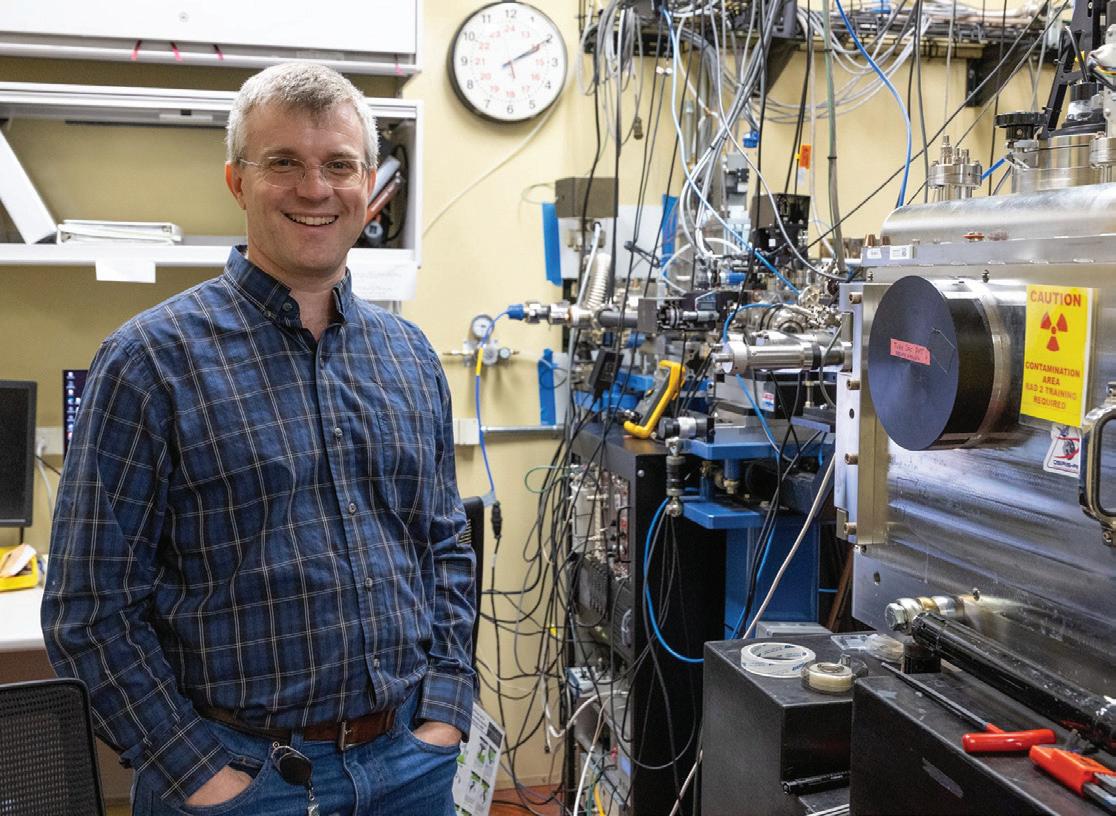
OPPOSITE: JIM CAO ABOVE: JIM CAO (8TH FROM RIGHT) AND FELLOW G&W ELECTRIC INTERNSHIP PARTICIPANTS
a veterinary journey
Immersing in Animal Science in Costa Rica
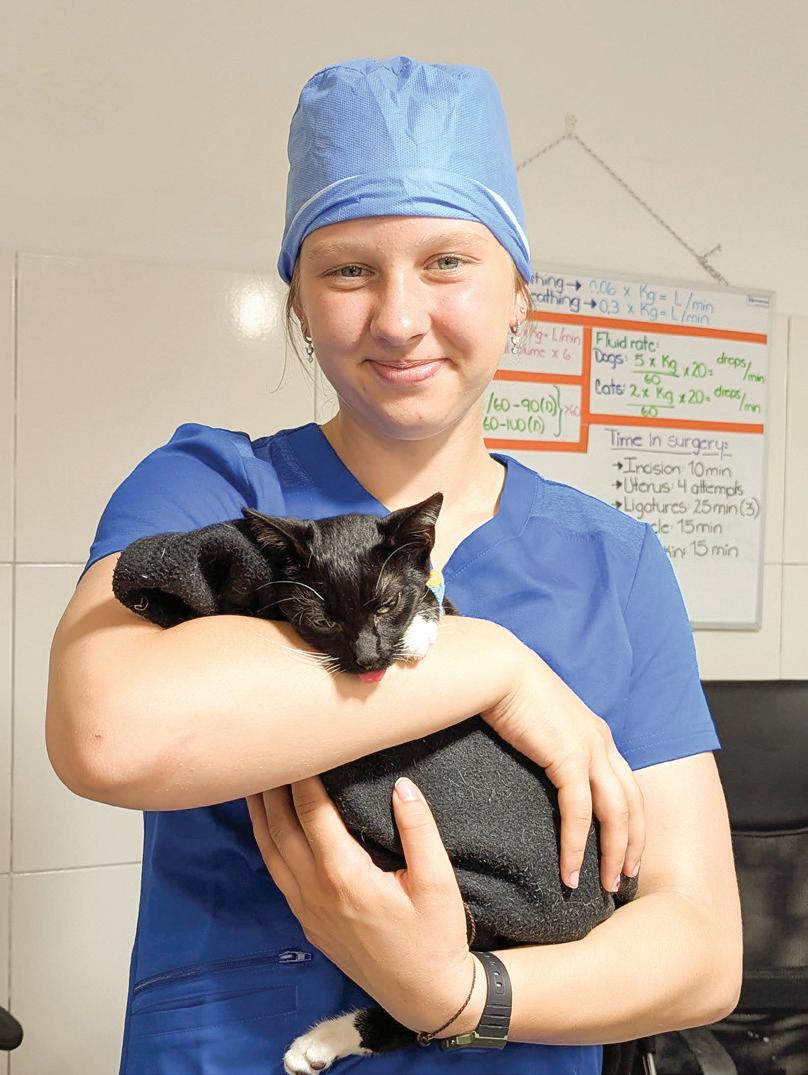
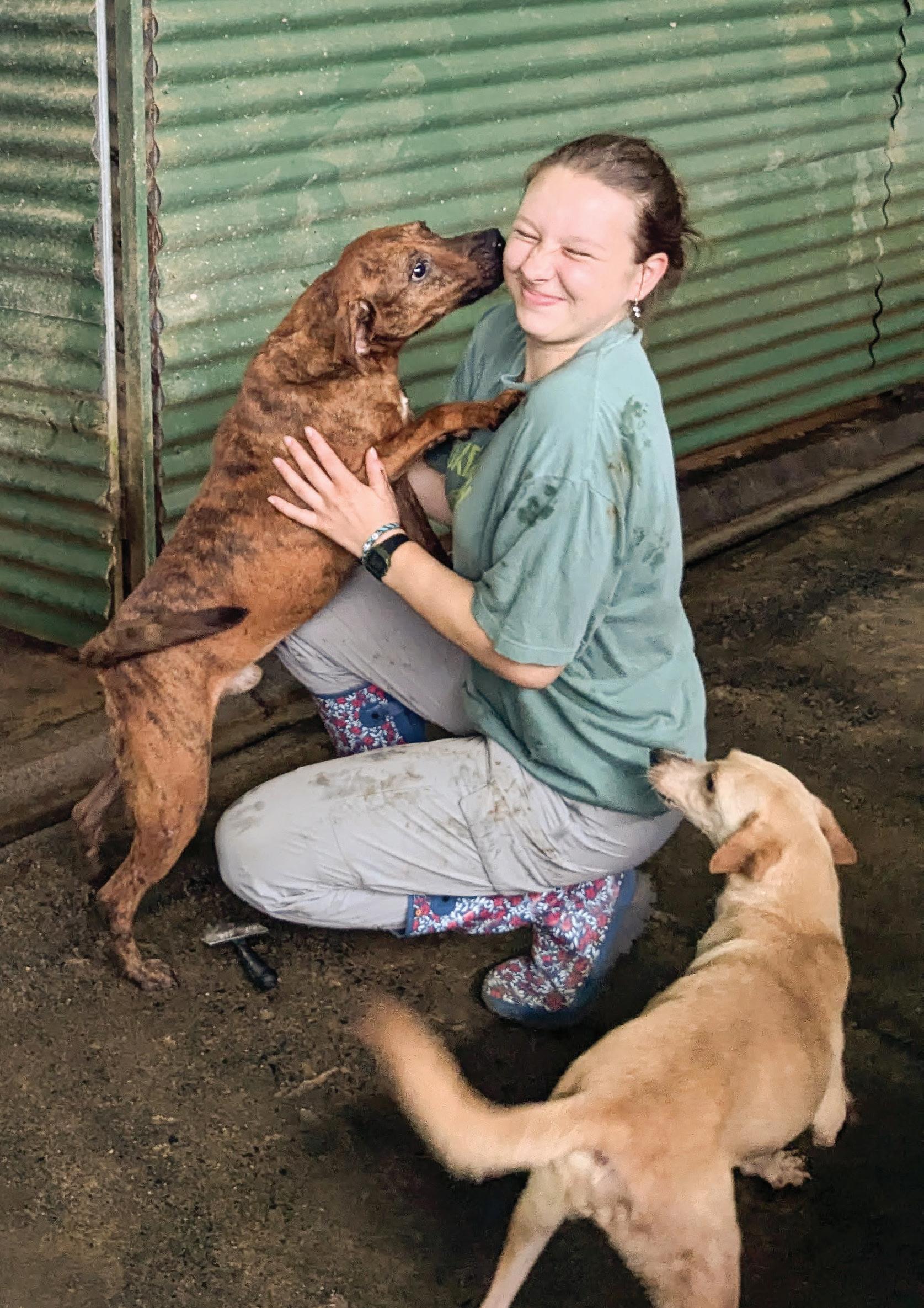
Amelia Peterson, a Form 7 student and aspiring vet, applied and was accepted into a rigorous three-week veterinary apprenticeship program in Costa Rica this past summer, where she gained valuable hands-on experience in animal care under the guidance of experienced professionals. This opportunity presented Amelia with some challenges but ultimately strengthened her dedication to her future career in veterinary sciences. Delphian Magazine: Tell us about your apprenticeship.
Amelia Peterson: This past summer, I was one of 12 students accepted into a 3-week-long veterinary apprenticeship program called Broadreach, based in Costa Rica, where we were trained to assist in the care of small and large animals. I found the apprenticeship online and had to apply for it, just like I would for a college. It was an extremely selective process, as they could accept only 12 of us.
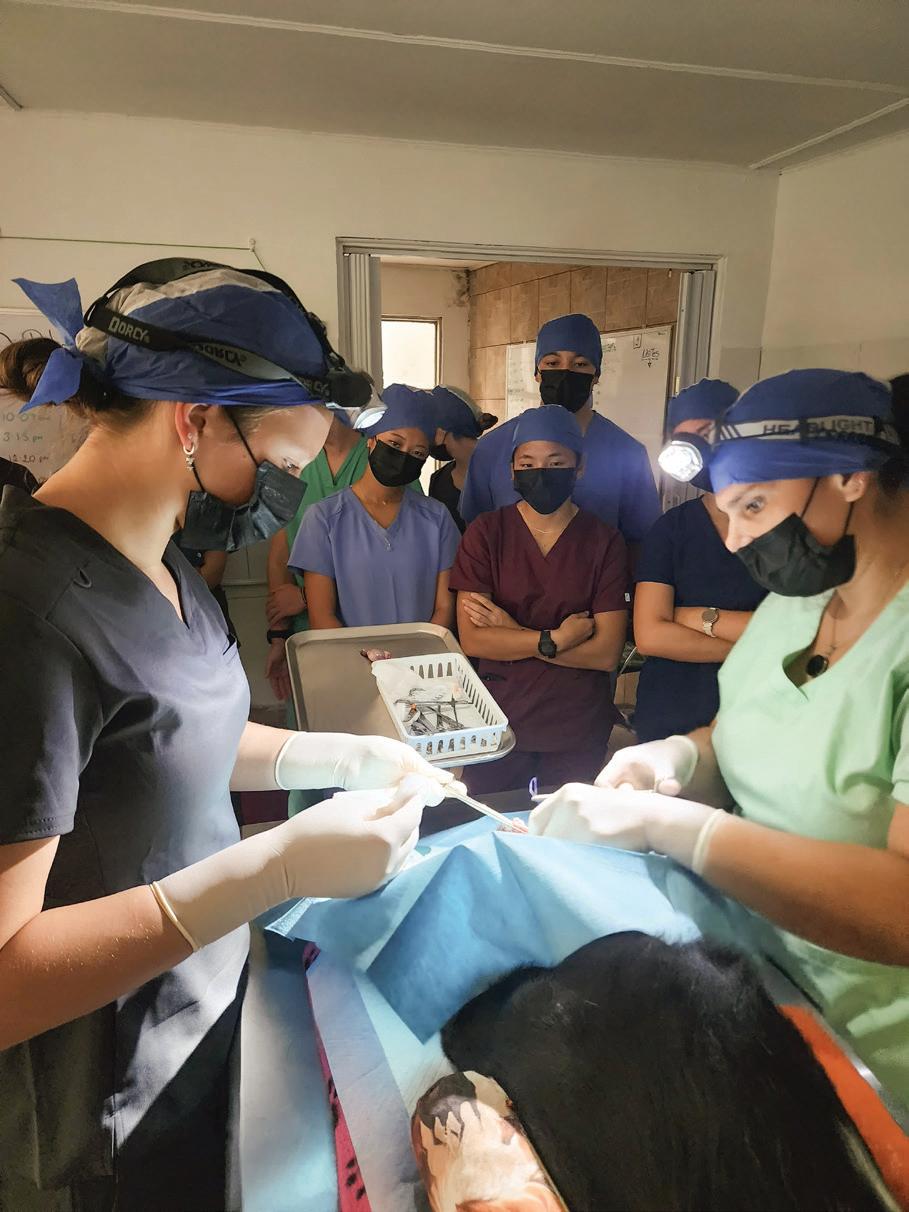
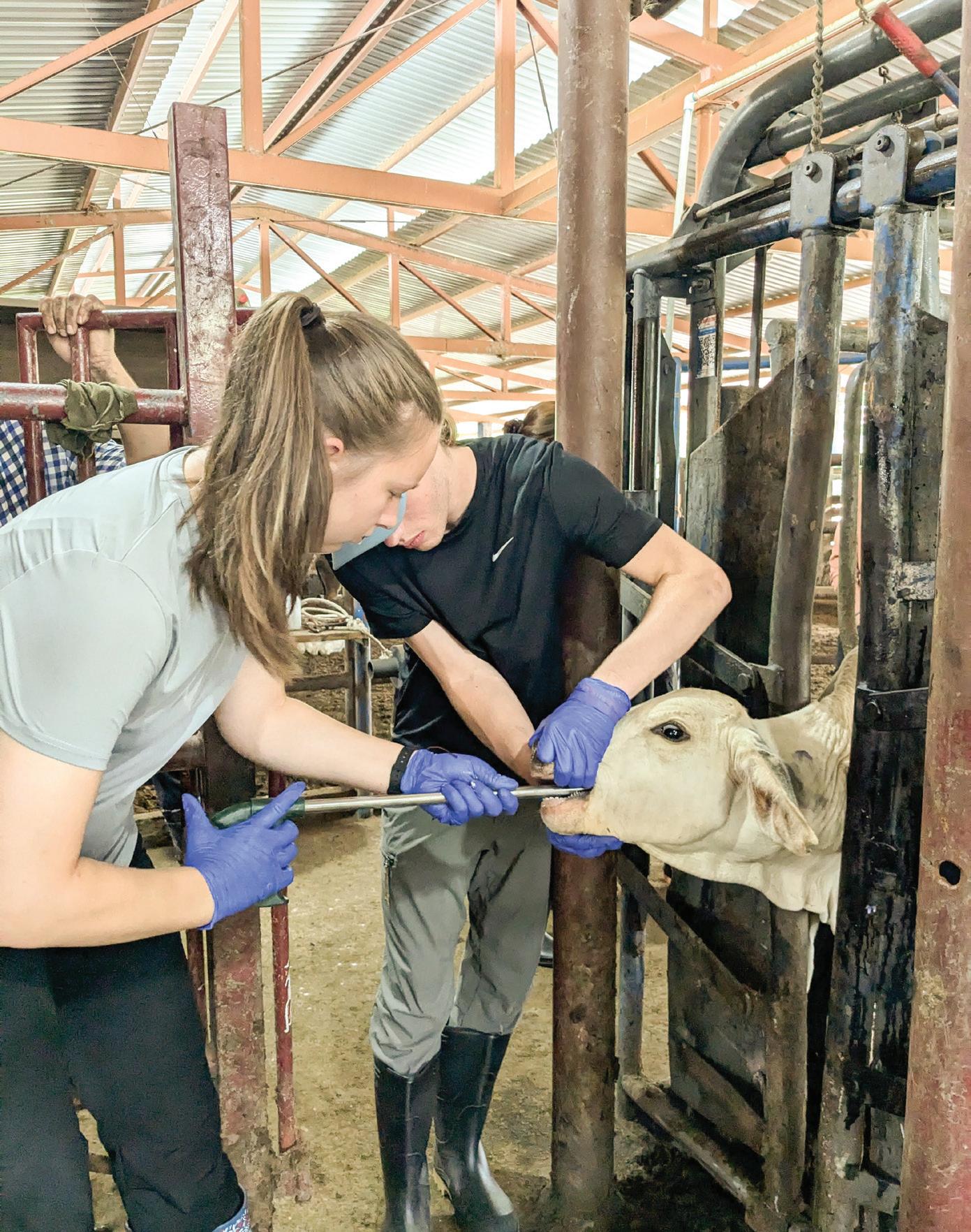
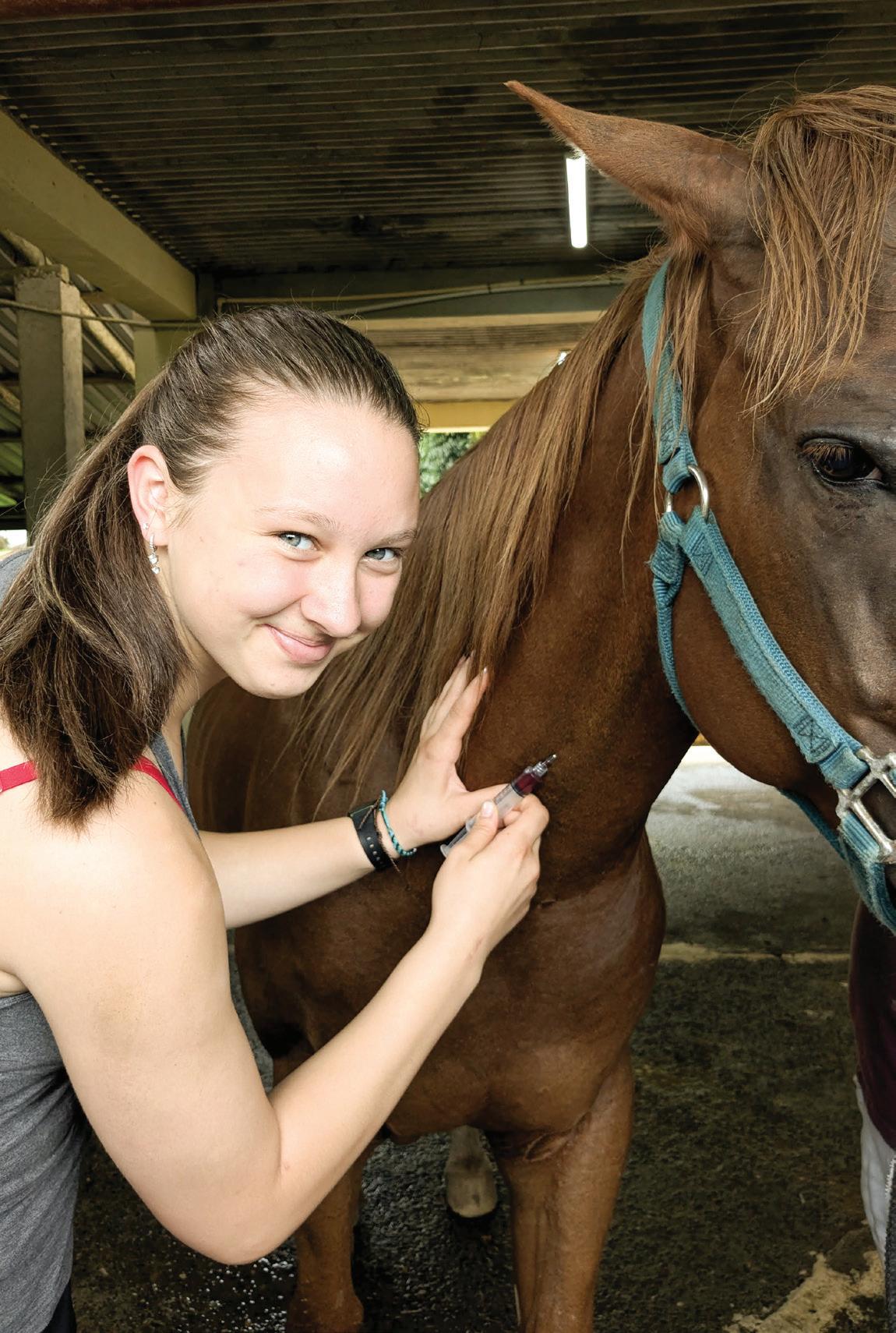
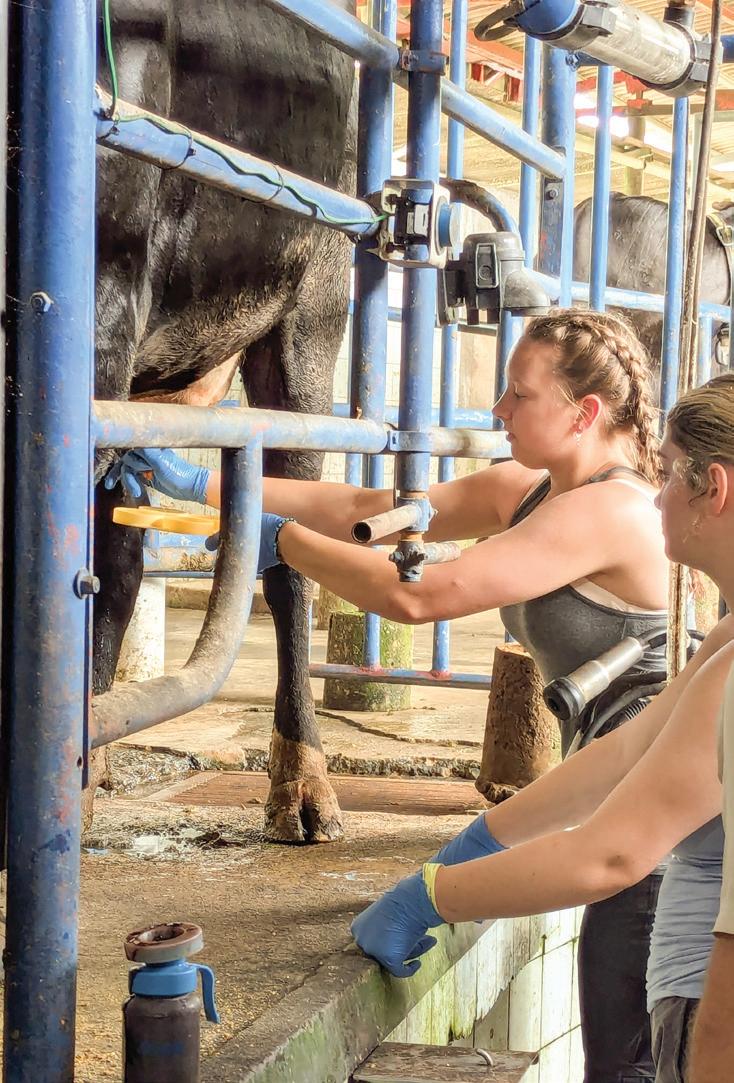
We traveled around the country working with animal care professionals at wildlife rescue centers, private farms, and animal clinics. My group shadowed at five different clinics. When we first began, we mostly helped with small animals, like dogs and cats, as well as exotic animals such as sloths, parakeets, and monkeys. We were able to scrub in and assist with spay and neuter surgery prep and post-op care for a few dogs. Then we transitioned to working with larger animals, such as large dogs, horses, and cows. On the cows and horses, we did many procedures, including microchipping, injections, vaccinations, deworming, and rectal exams.
As part of our daily routine, we were instructed by one of the vets in charge of the trip, and we practiced scenarios with a partner to reinforce what we learned, which we were later tested on. This was neat because the lessons always corresponded with the practical work we would do later in the day or week. If we learned about spaying
ABOVE AND OPPOSITE: AMELIA IN COSTA RICA ON HER INTERNSHIP WITH ANIMAL PATIENTS, FELLOW INTERNS, AND VETERINARY PROFESSIONALS
and neutering one day, we often would actually do spays and neuters the next day. Through these lessons and tests, I also earned three college credits.
The last few days we were there, we stayed on a farm in the middle of nowhere with tons of exotic animals. When we weren’t working with the animals or doing lessons, we volunteered around the farm. I clocked almost 30 hours of community service time.
DM: What did a typical day look like?
AP: It depended on whether we were doing small animals or large animals. On a small-animal day, after breakfast, we’d head straight to the clinic and help till lunch, after which each person in my group would scrub in to assist with pre-op and post-op for a different animal’s surgery. From there, we would head back to our hotel to get our daily lesson.
Our teacher was a veterinarian who specialized in large animals. Still, because you have to study both large and small animals to become a vet, she was very knowledgeable and great at coming up with games and other fun ways for us to remember what we had learned that day.
DM: Was it challenging?
AP: The lessons were challenging as I was learning allnew information, which I was then
melody and perspective
Expanding Skills & Blending Voices
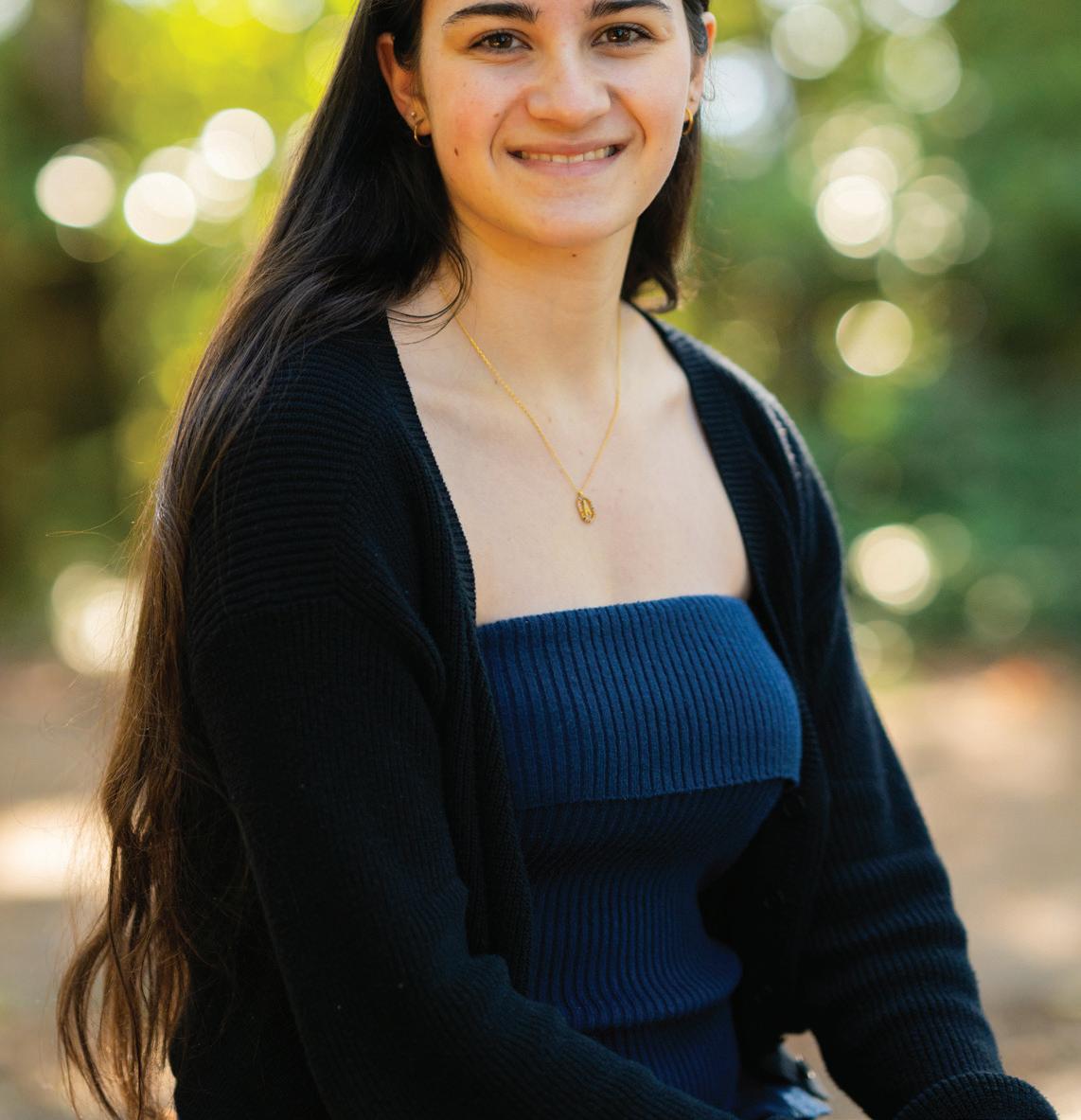
Amelie Rappoport expanded her singing skill set and professional portfolio as a songwriter with the New York Voices.
Delphian Magazine: How did you end up participating in the New York Voices Vocal Jazz Camp?
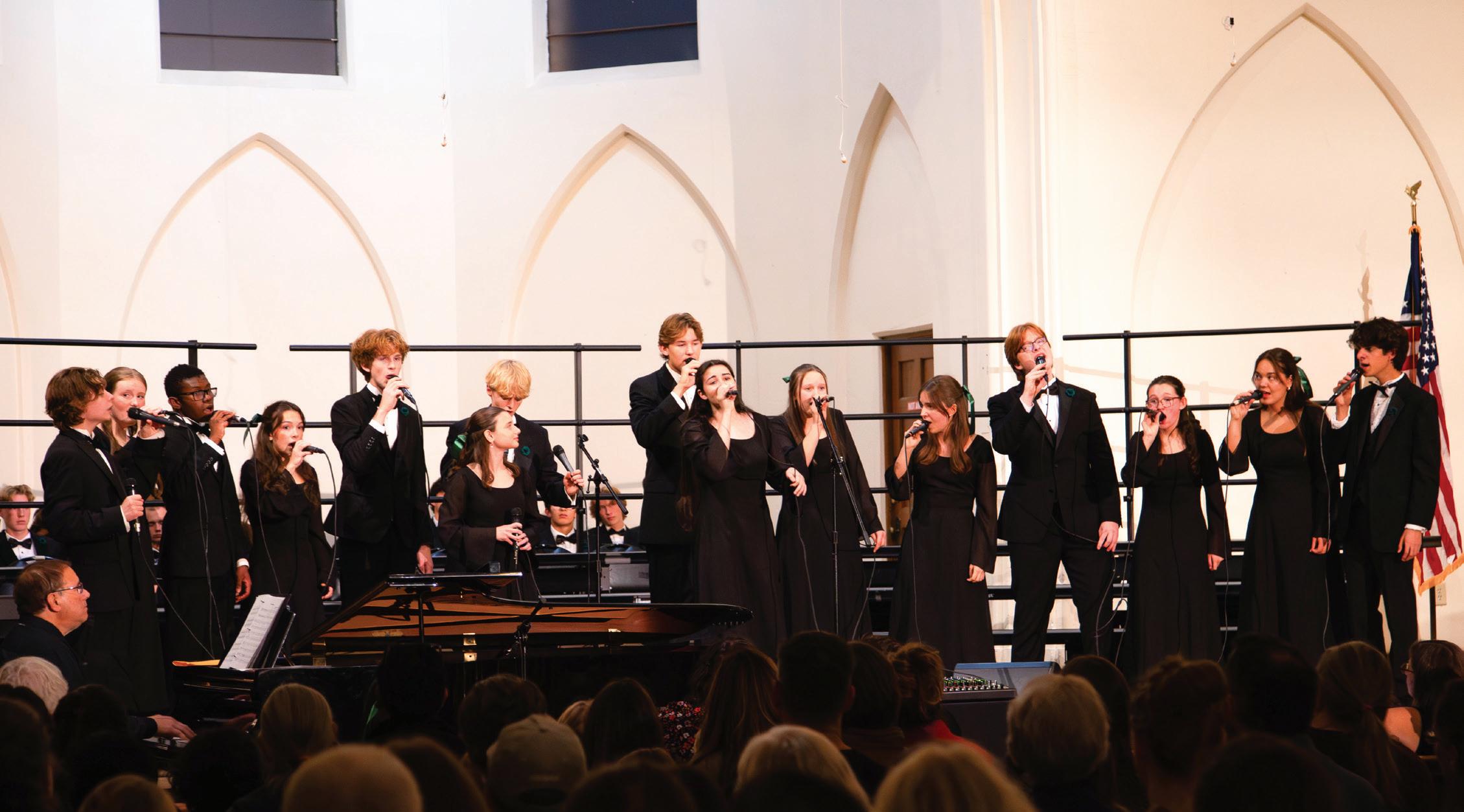
Amelie Rappoport: This past year, after having had the opportunity to open for the Grammy-award-winning vocal jazz group the New York Voices at a local concert, set up through Delphian’s music instructor Dana Libonati, I was invited by Kim Nazarian of the group and encouraged by Dana to apply for the opportunity to participate in a music camp. The camp was held in Michigan and organized by the New York Voices. I was lucky enough to earn a scholarship to attend the camp through submitting an audition tape.
The camp had about 100 participants aged 14-70, making it a very diverse group, and it was a really unique experience to learn alongside so many people with different backgrounds and ages. Of everyone there, only about twenty were in my age group.
DM: What was the camp like?
AR: Through the course of the camp, we were divided into ensemble groups of about twenty and had the opportunity to work one-on-one with each of the four members of the New York Voices on different techniques. The end of the week culminated with a performance where each of our ensemble groups performed, along with some solo acts.
Throughout the camp, I worked with each of the four members of the New York Voices in a specific technical skill-building workshop. Darmon Meader was my ensemble’s director. He instructed us on the technology and the importance of blending vocal parts.
Kim Nazarian taught lessons on being a good member of a quartet and improving your scatting.
Lauren Kinhan taught me how to improve my phrasing, which is how you structure a musical sentence to emphasize certain words and control your volume to better communicate your message.
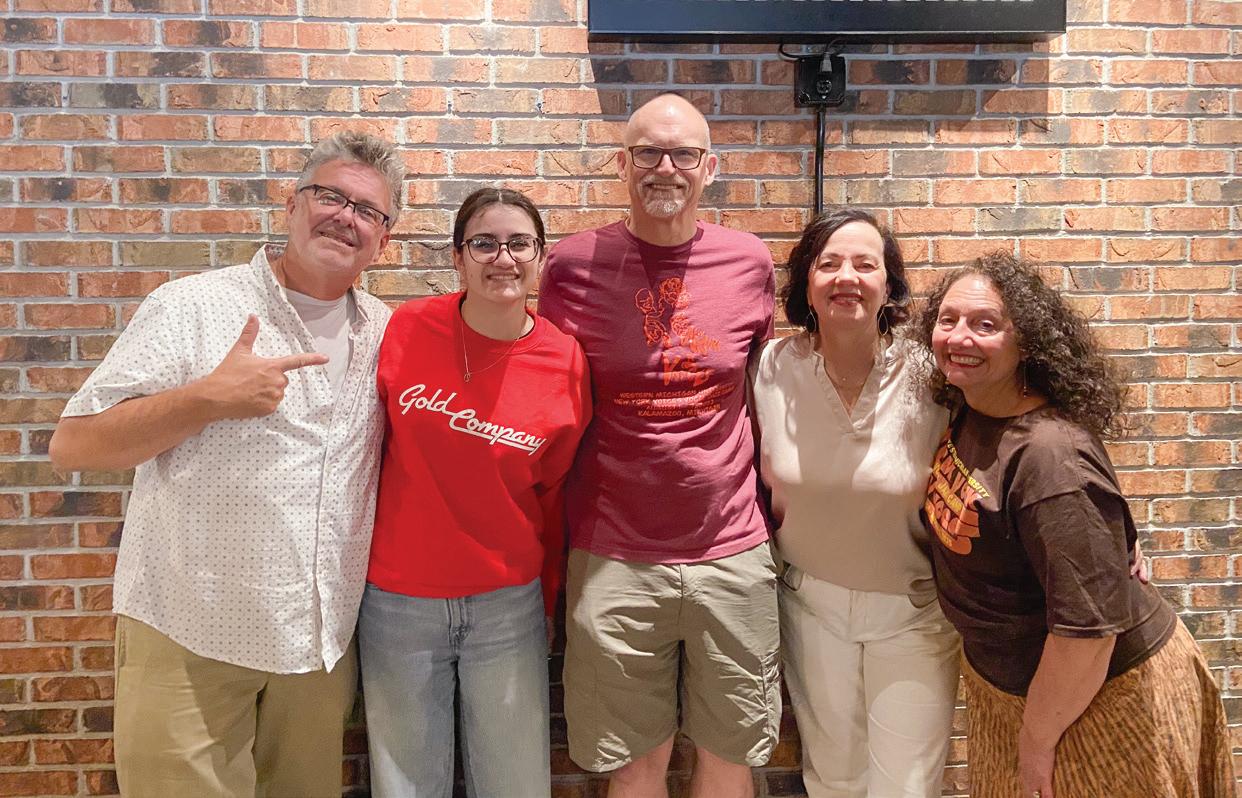
ABOVE: AMELIE RAPPOPORT BELOW: AMELIE RAPPOPORT AND NEW YORK VOICES MEMBERS L-R PETER ELDRIDGE, AMELIE RAPPOPORT, DARMON MEADER, LAUREN KINHAN AND KIM NAZARIAN
Peter Eldridge instructed me in songwriting and taught me several things that helped me improve, including how to turn an idea I had previously dismissed into a song. He helped spin it into something I never thought possible.
At the end of the camp, all the campers put on a concert. I was able to perform with my ensemble and also listen to the other ensembles and solo acts. I was absolutely wowed by the amount of talent present on that stage.
DM: How was this experience different than singing in a Delphian choir?
AR: I’d say the most challenging thing was realizing how much I didn’t know and how much I have to learn. There were so many incredibly talented people there, many of them much better than I. Here at Delphian, I’ve worked hard to become one of the stronger singers in the group, but when I arrived in Michigan, I suddenly found myself at the back of the pack and was challenged to push myself to a new level.
I have heard it said in the music industry that there will always be someone better than you, and through this camp, I learned what that meant. Some of the campers were like me and were at the early stages of their musical careers. In contrast, others had songs on the radio. Still others, I discovered, were about the same age as me but had dedicated so much more time and energy to the art than I have, which showed. It was a humbling experience in that way, but also very motivating.
DM: What was one of your biggest takeaways?
AR: The number one thing it helped me with was that it made me feel more like I could be a professional. As I said, everyone there already knew how to sing and was good; it was more about doing it all professionally. It also helped me with the integrity aspect of making music. I realized the importance of prioritizing myself and my music on the business side of the music industry, especially when record companies get involved. I gained significant insights into how to prioritize the artistic integrity of my music and into best practices for holding my ground.
Seeing the theory of integrity, which I learned about in the classroom at Delphian, and then hearing about its real-life importance from these professionals, gave me a reality check on how essential it truly is. It’s important even in the simplest things, such as caring for and maintaining your voice’s health.
DM: Did this experience change how you’ll approach your future career?
In a practical sense, I learned a lot about how to create what they call a demo tape, which is essentially a short album of your best songs that you can use to promote yourself to anyone and everyone: coffee shops, record labels, live venues, social media—anything. It helped make the process much more real to me of how to promote myself and get myself out there as an artist and a musician. The skills and perspective I gained from this camp will be invaluable to me as I progress towards that goal.
AMELIE RAPPOPORT (CENTER) SINGING A SOLO AT DELPHIAN’S WINTER FESTIVAL, 2025
A organizing success Streamlining a Wedding Business in Australia
longside classmate Tai Jefford, Form 7 student Greyson McLean immersed himself in the inner workings of Maywild, a wedding venue hospitality company, to apply academic concepts to a real-world situation by streamlining the company’s operations.
Delphian Magazine: Where was your apprenticeship?
Greyson McLean: Tai and I spent four days working with Carly Crutchfield, the owner of Maywild—a company that purchases, renovates and operates wedding venues around Sydney, Australia. During our apprenticeship, we stayed and worked at one of their wedding venues, a farmstead in Jervis Bay.
When we first arrived, the venue staff were in the middle of cleanup from a wedding that had just concluded and were preparing for the next wedding, which was to happen the following week.
So it was during the cleanup phase that Carly oriented us to the property, company, and introduced us to the executive team, explaining how the team operates and showing us the ins and outs of the business. She showed us everything about the company, from the food being prepared in the kitchen to the decor, the
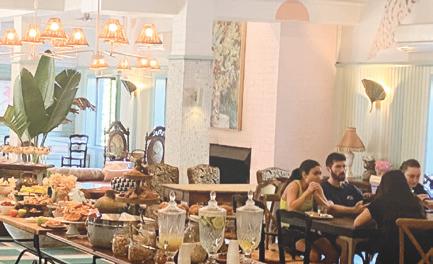
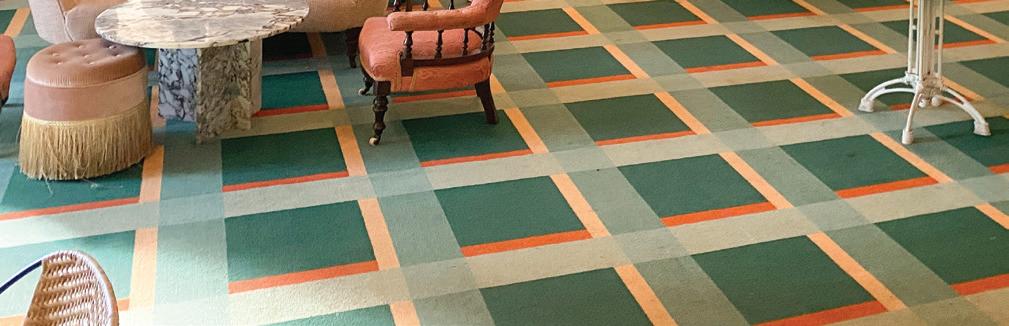
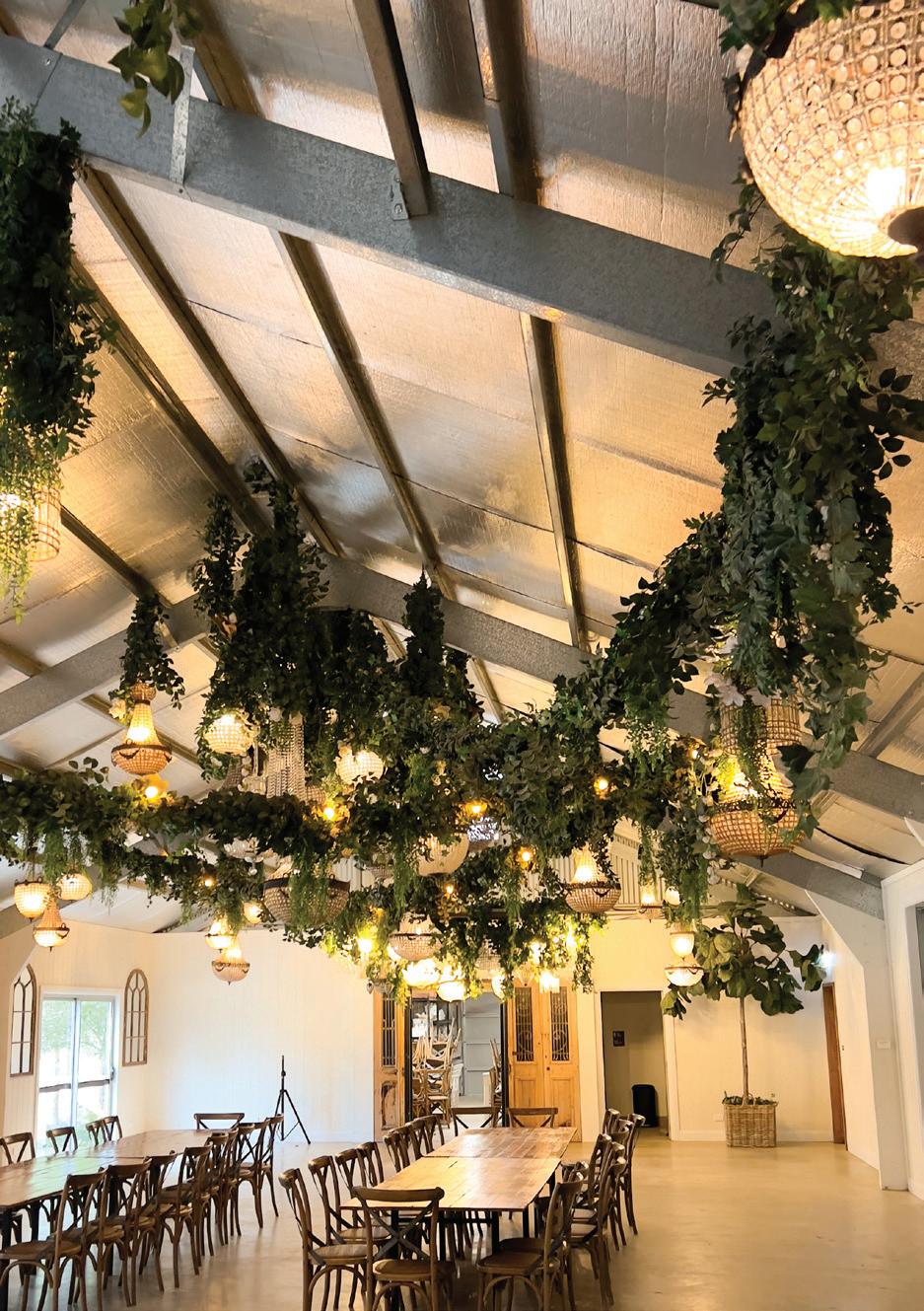
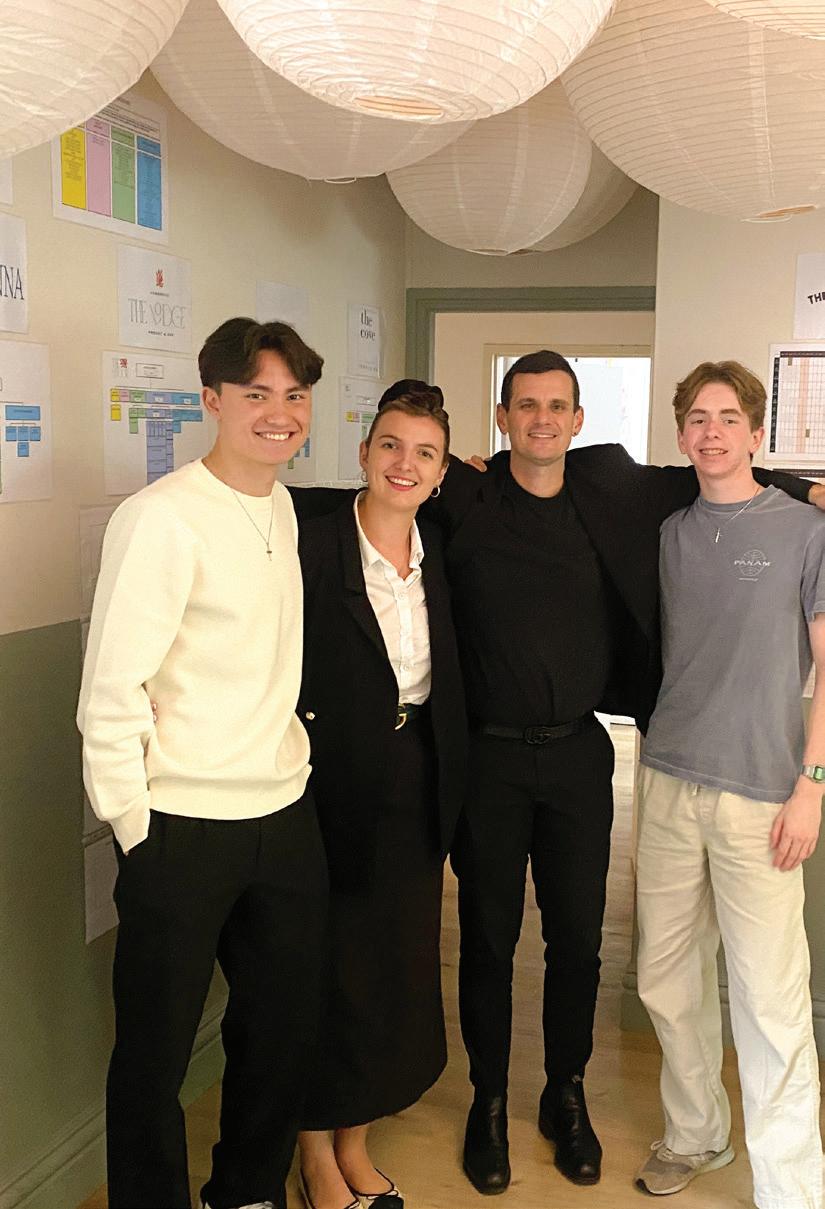
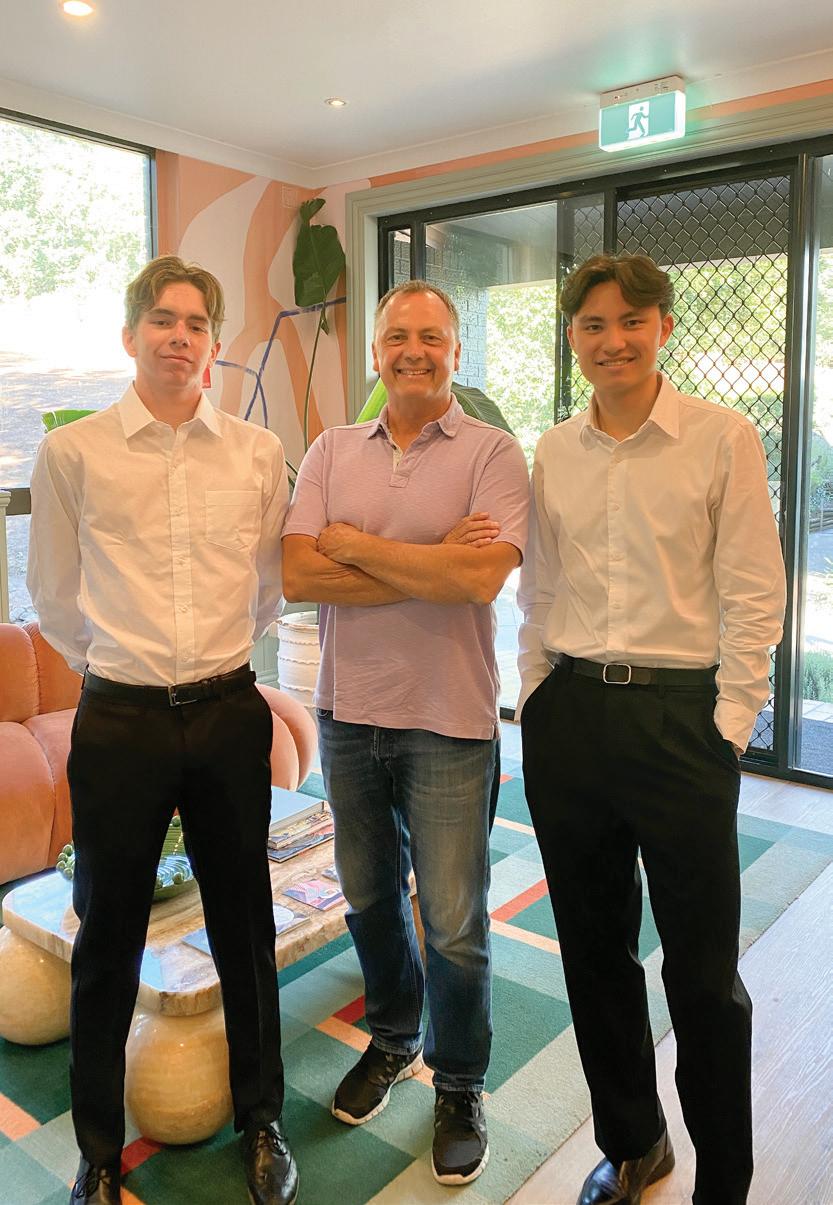
ABOVE: MAYWILD’S JERVIS BAY VENUE LEFT: TAI JEFFORD, EMMA BROWN, MAYWILD’S CHIEF OPERATING OFFICER BRENT MCINNES, AND GREYSON MCLEAN BELOW: GREYSON MCLEAN, TAI’S DAD GRANT JEFFORD, AND TAI JEFFORD
hosting and hospitality of guests, and how to market the venue.
During our first days, we learned how their head of marketing leverages social media for promotion. We were even able to sit in on a meeting with a potential client to learn about the process from inquiry to booking. All of this insight was very educational on how a hospitality-focused event venue company operates from the ground up.
DM: What sort of work did you end up doing?
GM: When we first came in, we were initially going just to help Carly for a few days as executive assistants to learn the ins and outs of her business. Then she found out that we had done Delphian’s Groups and Organization courses, based on the works of L. Ron Hubbard, and that we both had a career interest in business organization. At that point, she asked us to provide an outside perspective and assistance in assessing the systems and operating lines of her business, to organize it better, and to improve efficiency. So from there, we worked with her to apply what we’d learned to help her implement the organizational technology within her company.
DM: How did that go?
GM: After we were oriented to her company and met
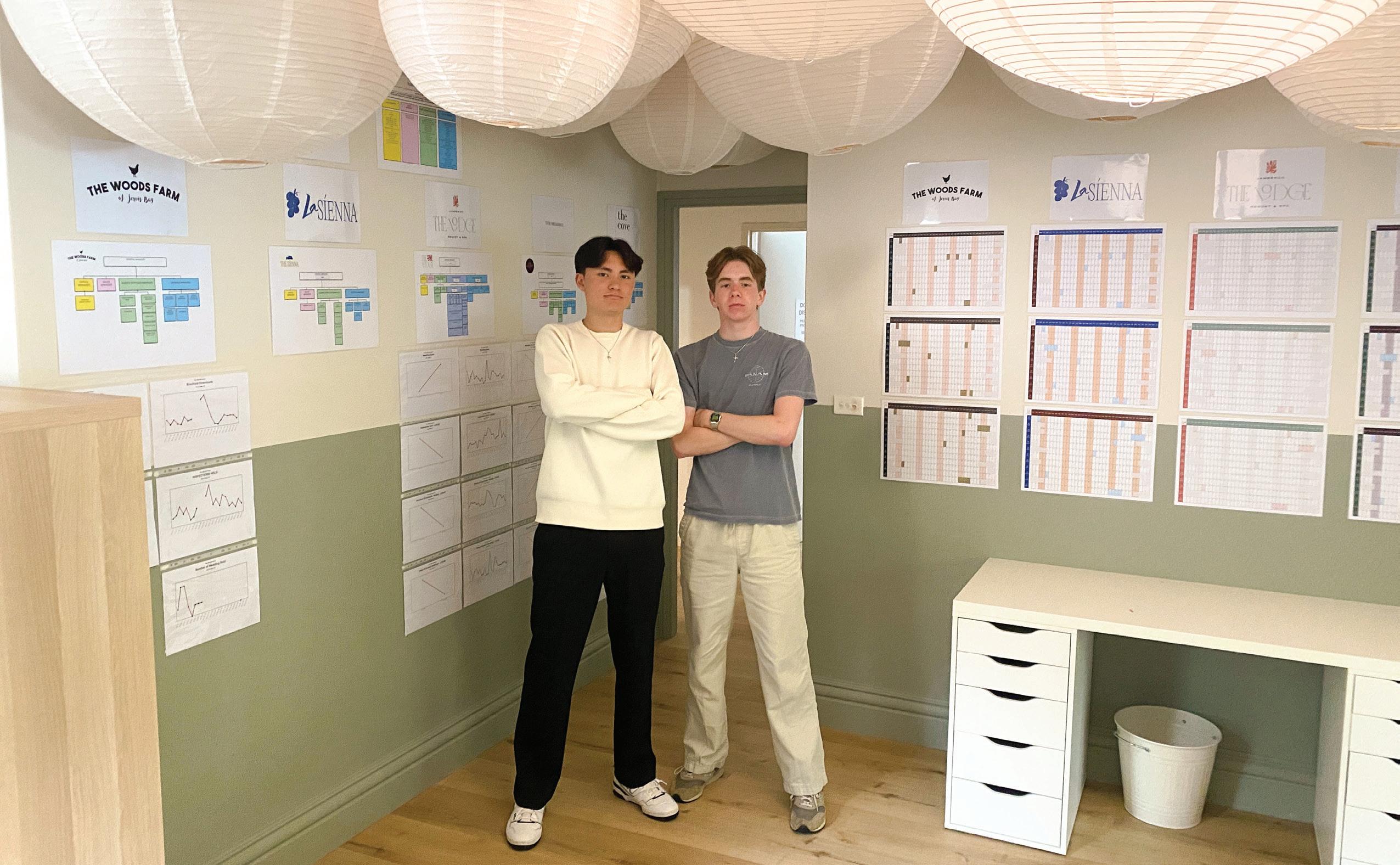
her staff, we began the process of organizing it into the various departments and seven divisions, as explained in one of the Groups and Organization courses we’d studied at school. The result is called an organizing board, which is essentially a company-wide chart that clearly and concisely defines the personnel and operational lines of an organization.
We also helped to name the measurable statistics used to assess production within each department. By defining and mapping this out, our goal was to help Carly with her goals: streamline processes, increase production, and move forward with confidence into the next phase of her company’s expansion.
This process challenged me to apply what I’d learned in the course to real life. It was very different to take the theory from a hypothetical classroom setting to a real company with real people who would need it to really work in their day-to-day lives. It was harder to put together than the organizing boards I’d done in class because I wanted to do everything I could to make sure it was right and would have a positive impact on Carly and Maywild.
DM: Did this change your business outlook?
GM: Before this project, I didn’t realize how much work and how many different jobs CONTINUED ON PAGE 49
TAI JEFFORD AND GREYSON MCLEAN IN MAYWILD’S JERVIS BAY OFFICE
business of brushstrokes
Showcasing Artistic & Entrepreneurial Talent
Form 7 student Roman Peña utilized his creative skills to design a challenging and rewarding career interest project for himself. From painting a single mural to hosting an entire art show, the following interview details Roman’s experience, highlighting the opportunities he had to hone his skills as an artist and a business person.
Delphian Magazine: How did your career interest project start?
Roman Peña: The project began when a family friend, Camilla Banks, received a photo of one of the murals I had painted on a wall in Delphian’s basement from her niece, who was at the school. Camilla then reached out to me to commission a mural for a wall at her company, Ken’s Gutters, which she co-founded and directs.
DM: Was it challenging to create a large mural?
RP: Yes. In fact, the most challenging part was designing it. It was stressful, mainly because it was the first artwork I had done where someone was relying on me not to mess it up. I spent an entire semester — about 80 hours over two months — working through the design process. I was challenged to create
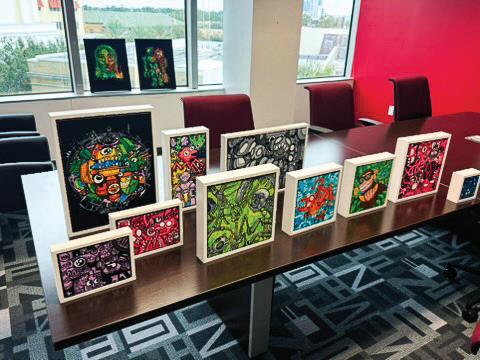
ABOVE, BELOW, AND OPPOSITE: ROMAN’S ART RIGHT: PIPER GIBSON, DELPHIAN STUDENT & ROMAN’S ASSISTANT, AND ROMAN PEÑA IN FRONT OF COMPLETED MURAL AT KEN’S GUTTERS OFFICE
a design that combined my art style with what Camilla wanted for her office wall, which was 9 feet tall by 16 feet wide. I made many smaller versions and even one on canvas with real paint to get the design just right.
DM: How was it painting a mural of that size?
RP: When it was time to paint the mural, I bought all the materials myself and found five people to help me paint portions of it. Even with their help, I estimate I spent 80 hours painting the wall.
Something I didn’t expect was that it pushed me out of my comfort zone by requiring me to paint in an office environment. Gone was the quiet art room where I had made all my mockups and where my art teacher, Trish, had given me constructive feedback. I had to get this huge mural done in an office full of people working, without disturbing them or getting embarrassed if I made a mistake. I found I had to become very extroverted just to do the job.
DM: What did you learn about the business of being a professional artist?
RP: After fully confronting the project’s CONTINUED ON PAGE 49
a night of one acts
Delphian Theater Department’s
Fall Production
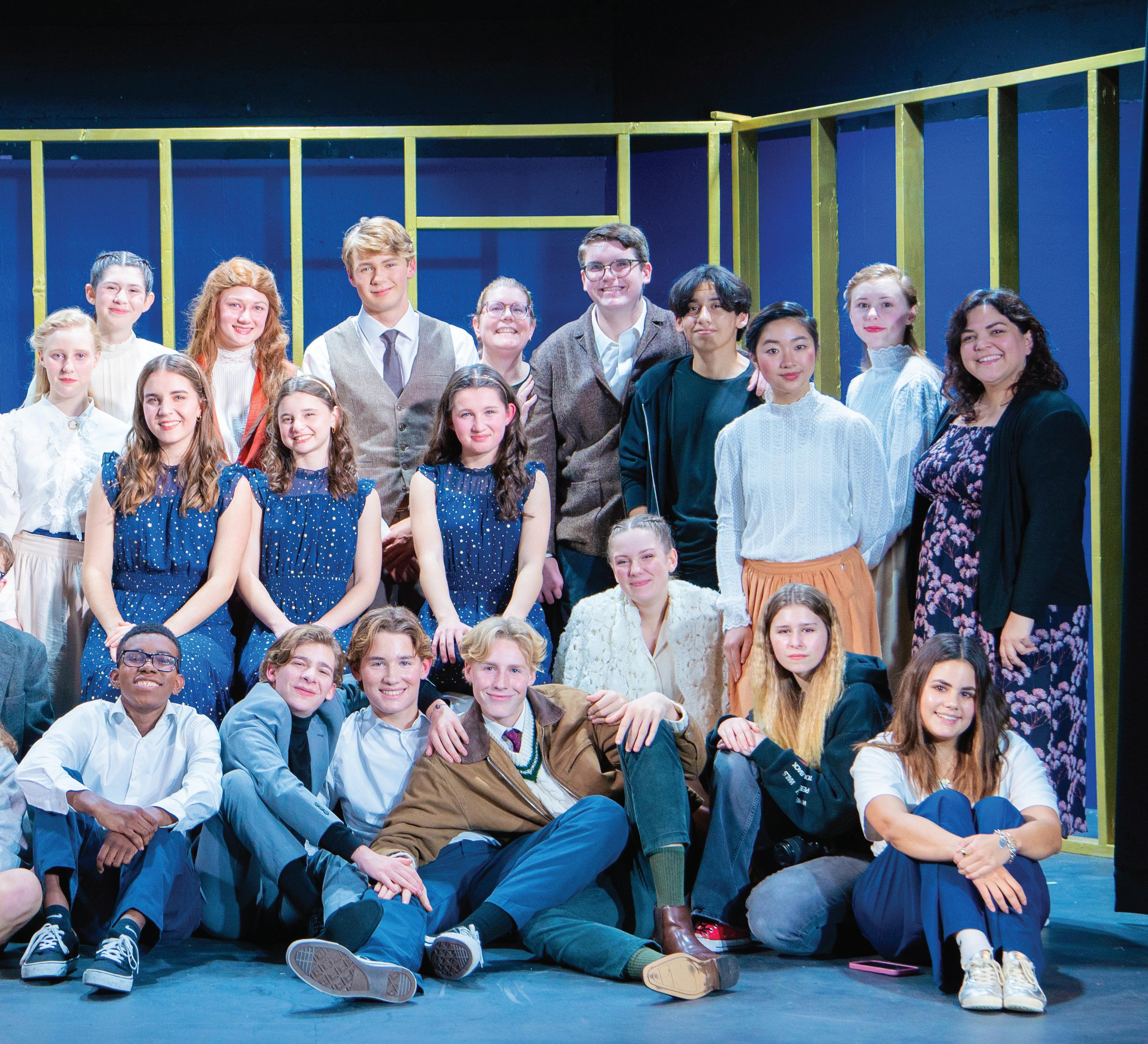
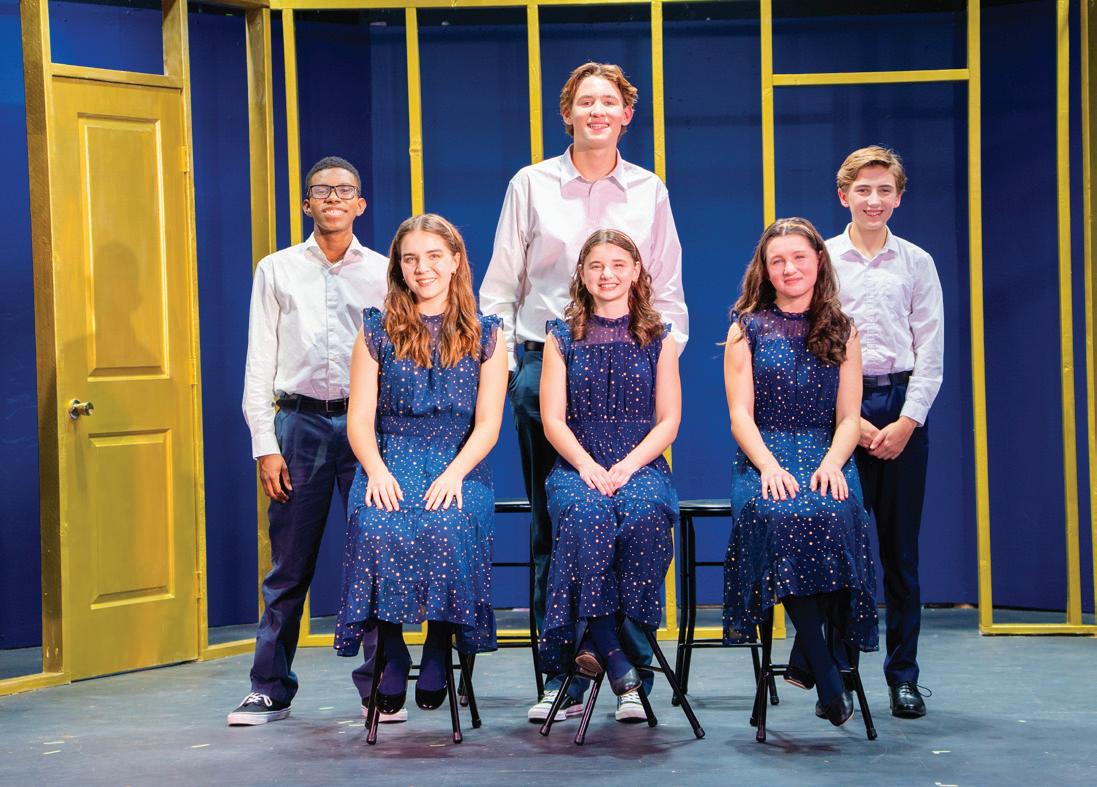
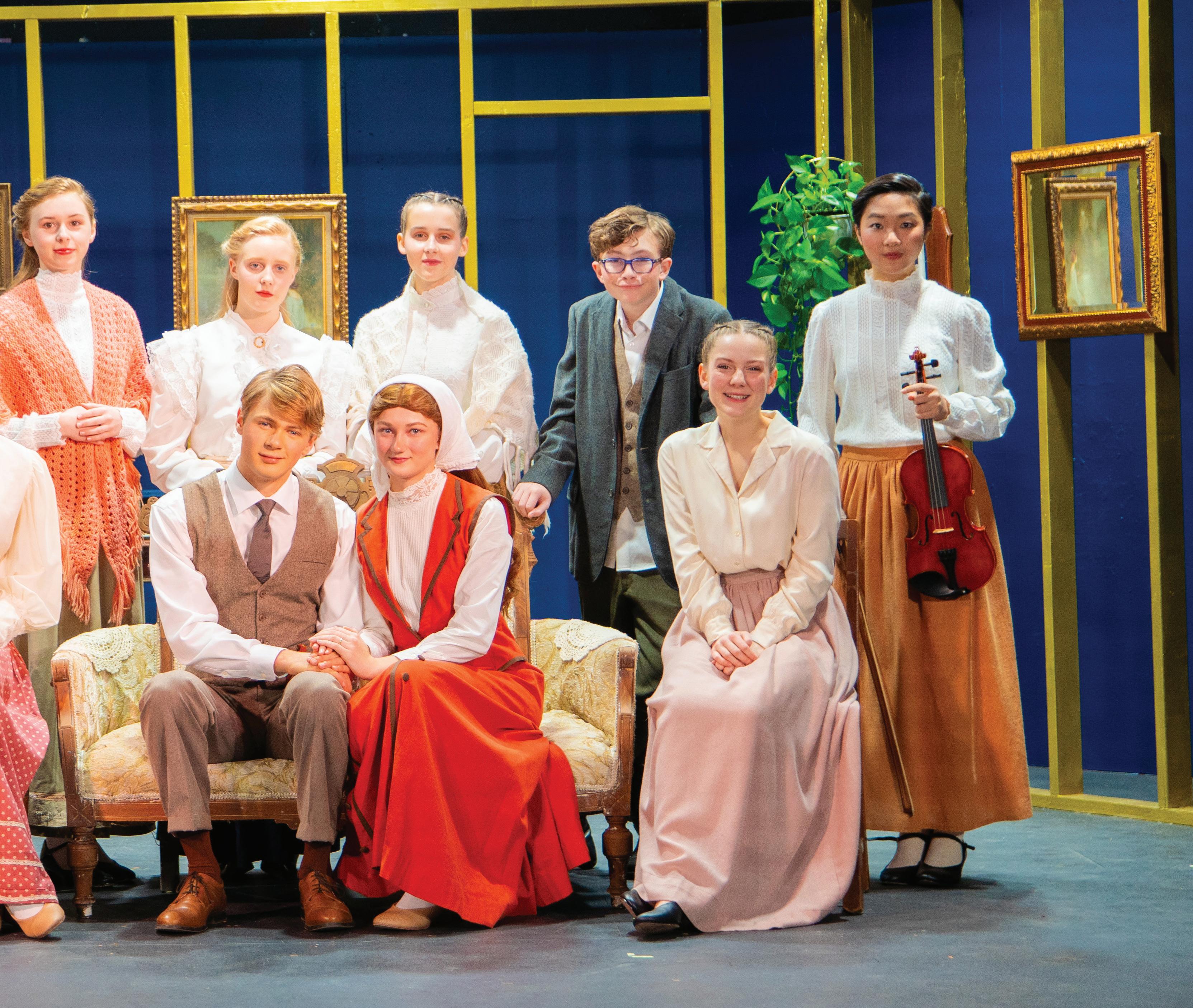
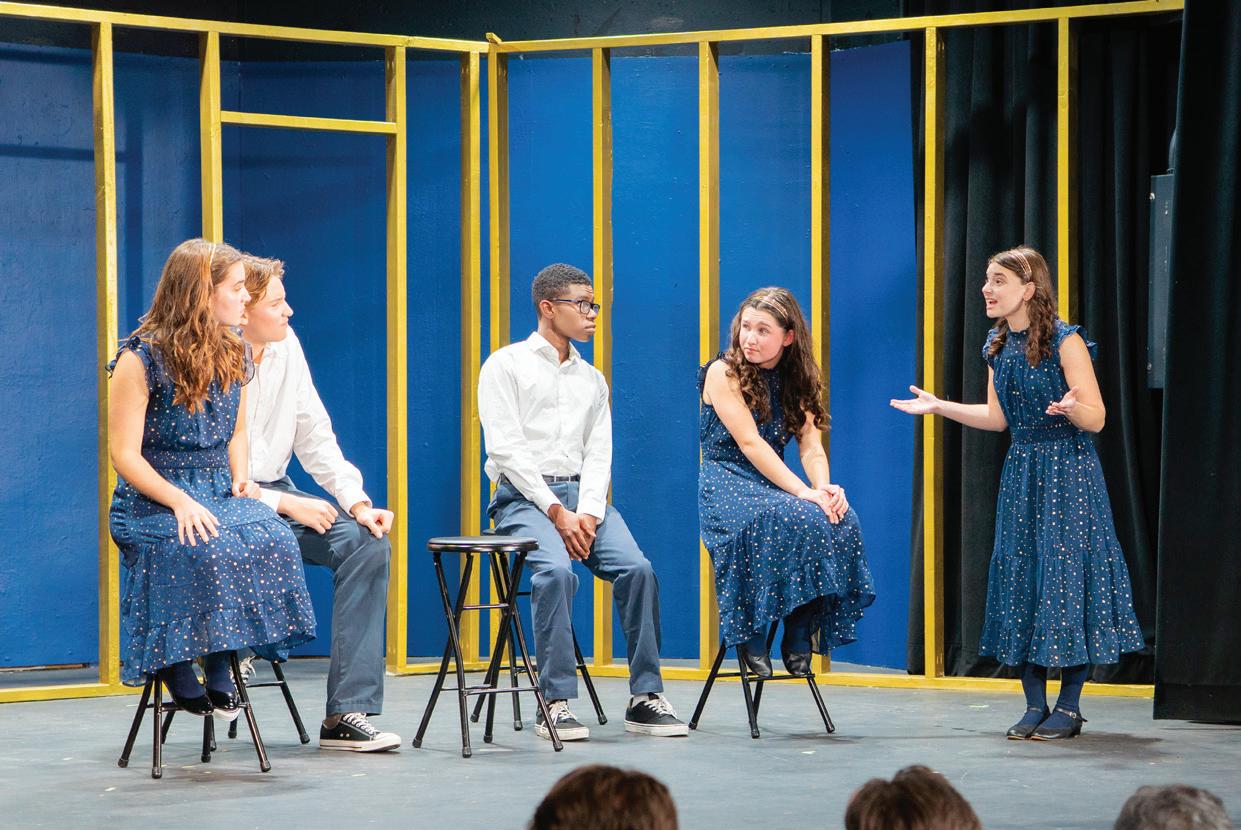
On November 13th and 14th, 2025, the Delphian School’s Little Theater hosted A Night of One Acts, featuring two one-act performances: The Gift of the Magi and A Simple Song. The event served as a milestone for the performing arts department, marking the fifth time A Simple Song has been staged at the school over the past 50 years.
The first performance, The Gift of the Magi, brought O. Henry’s classic story to life. Set in a small but tidy New York City apartment in 1905, the narrative follows newlyweds Della, played by Avery Ott, and Jim, played by Elliot Adams for the Thursday performance and by Nathan Cloutier for the Friday performance. As Christmas approaches, they each
sacrifice and sell their most prized possessions to buy gifts for one another. However, on Christmas morning, they discover the irony of their sacrifices: they have both sold the very items needed to use the gifts they bought for each other.
The second performance, A Simple Song, was a short musical about a group of individuals who communicate through song rather than speaking, written by founding Delphian staff member Alan Rothe. It was originally performed in the 1980s by Melissa McPhail, Bridgette Rappoport, Bill Perpelitt, and Sergio Ruiz. Since then, the one-act musical has been performed approximately once a decade, including in 2008, when alumna and current theater director Melissa Agrillo performed it as a student.
This most recent performance gave a new generation of students the opportunity to transport audiences to an imaginary place and time, thus carrying the tradition forward.
The Night of One Acts was a clear success, blending historical significance with fresh talent. From the classic sentimentality of The Gift of the Magi to the imaginative world-building of A Simple Song, the evening demonstrated the students’ range and the enduring nature of Delphian’s theater department. With a sold-out house and a legacy spanning half a century, the production demonstrated that these stories continue to resonate with new generations of performers and audiences alike.
The Gift of the Magi CAST
Della ....................................................Avery Ott
Special Assistance...........................Mayra Chavez and Dave Scott
ABOVE: THE GIFT OF THE MAGI CAST FRIDAY SHOWING BELOW LEFT: LOGAN SENE BELOW CENTER: A SIMPLE SONG THURSDAY SHOWING BELOW RIGHT: A SIMPLE SONG THURSDAY SHOWING
athletics highlights
Volleyball, Soccer, Cross Country & Basketball
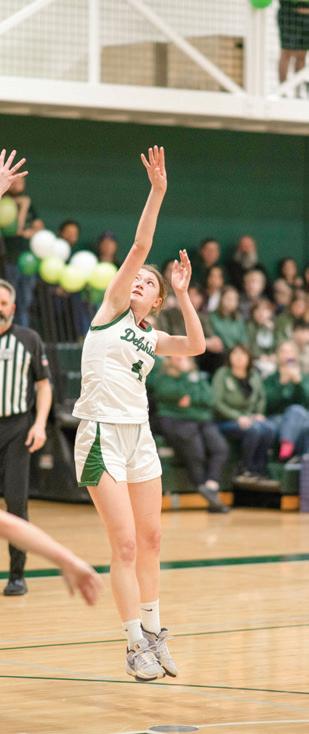
Volleyball’s Triumph: A Stellar 2025 Season
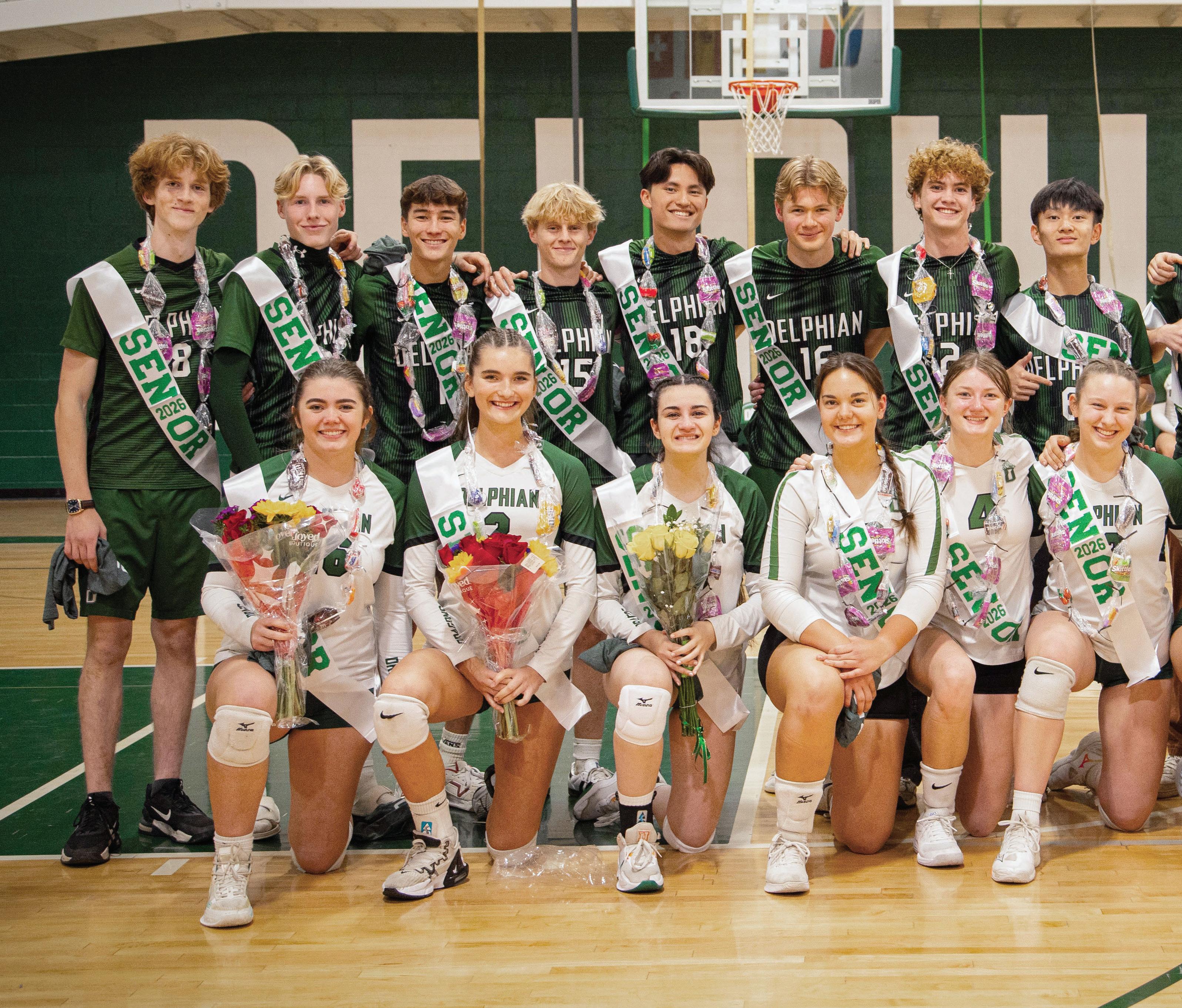
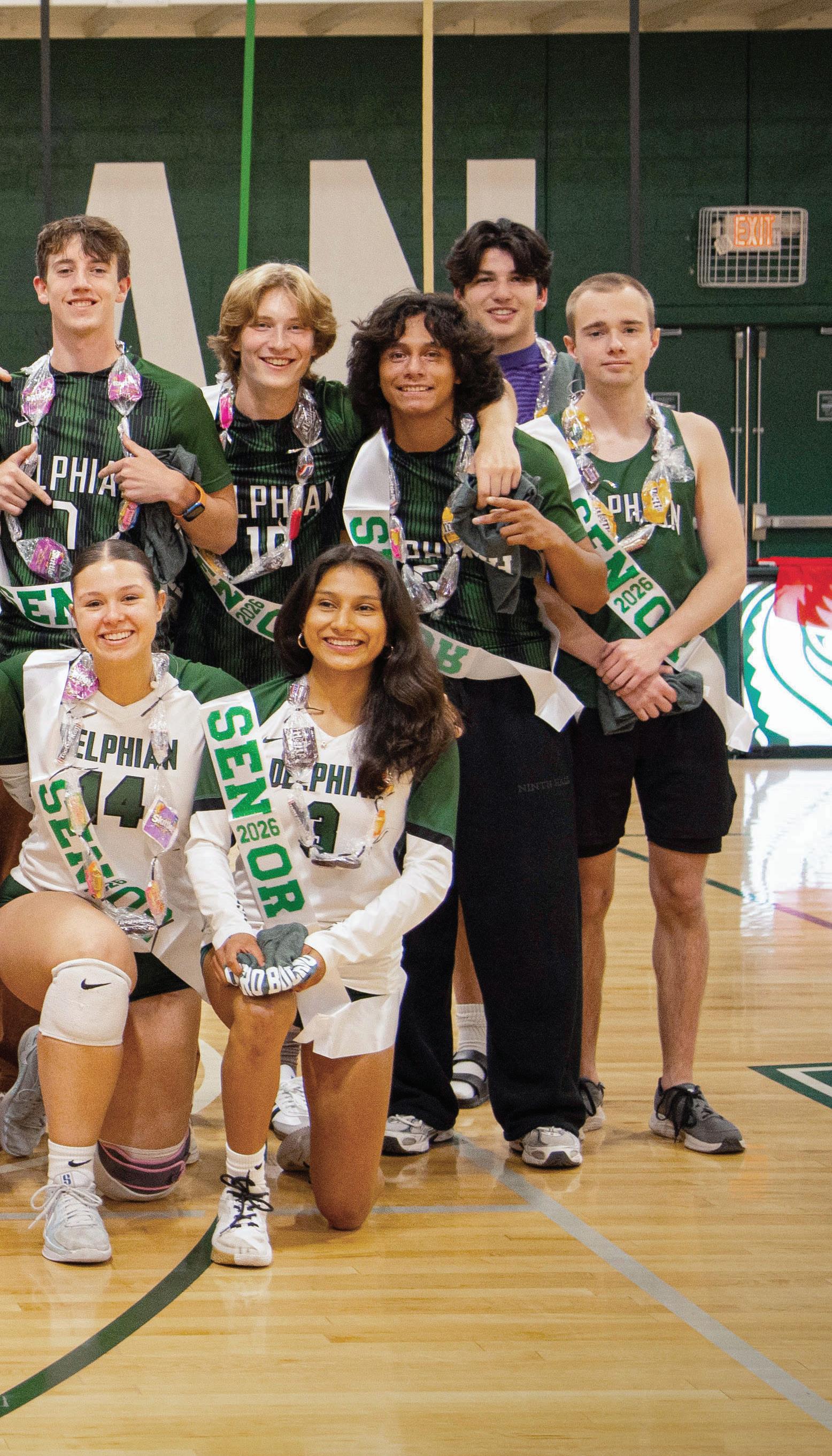
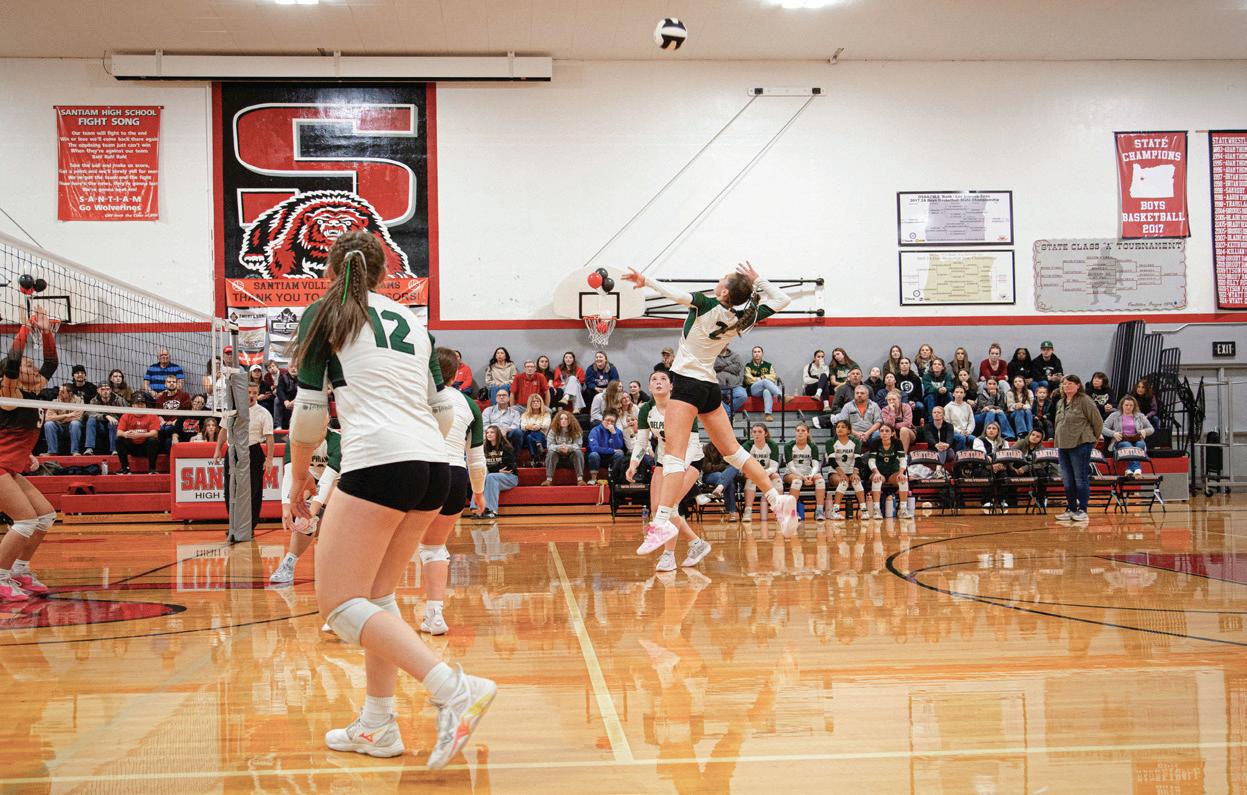
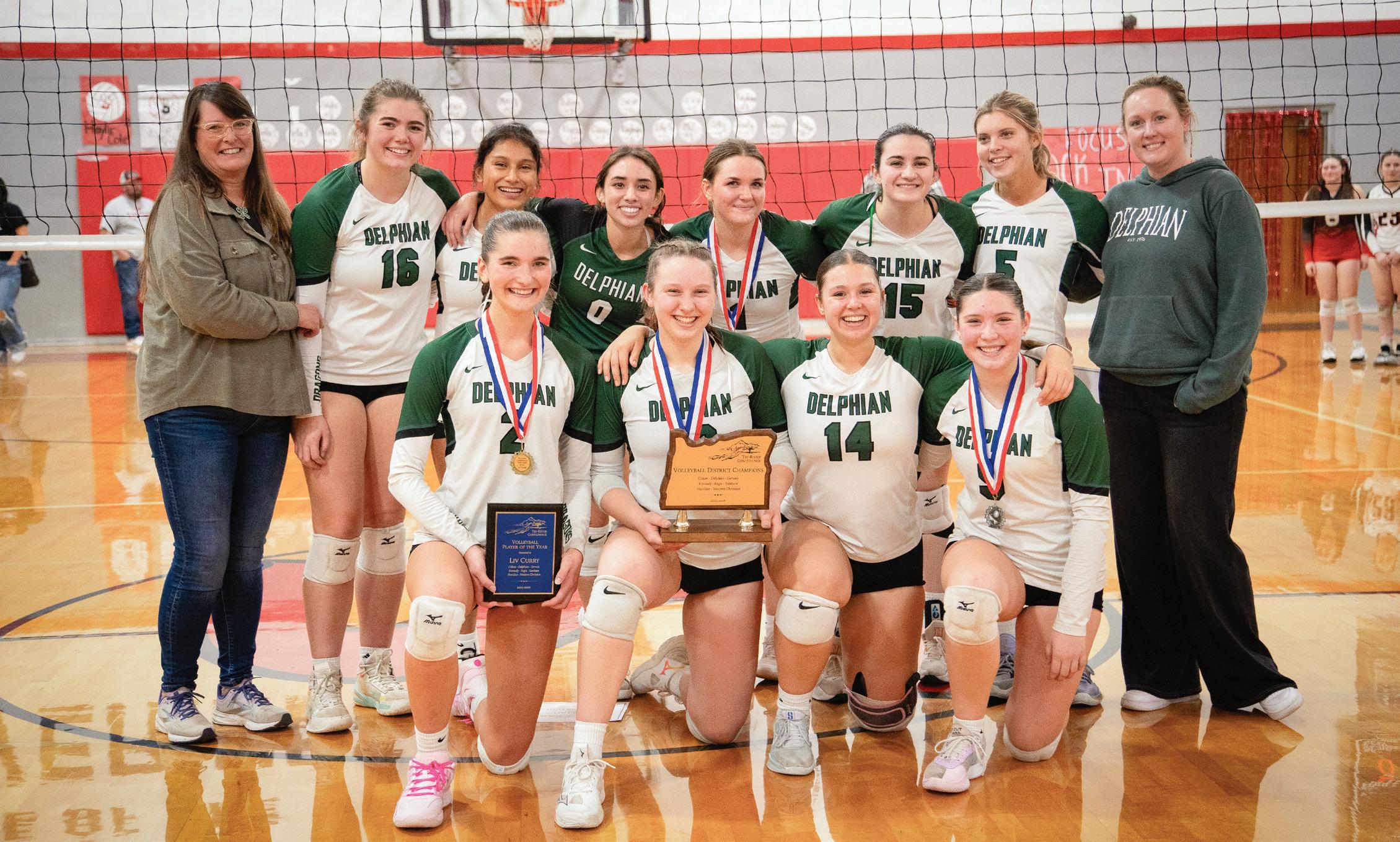
Under head coach Denise Dickey, Delphian’s varsity volleyball team had one of the best seasons in school history, finishing with a 13–1 league record and a 4thplace state ranking.
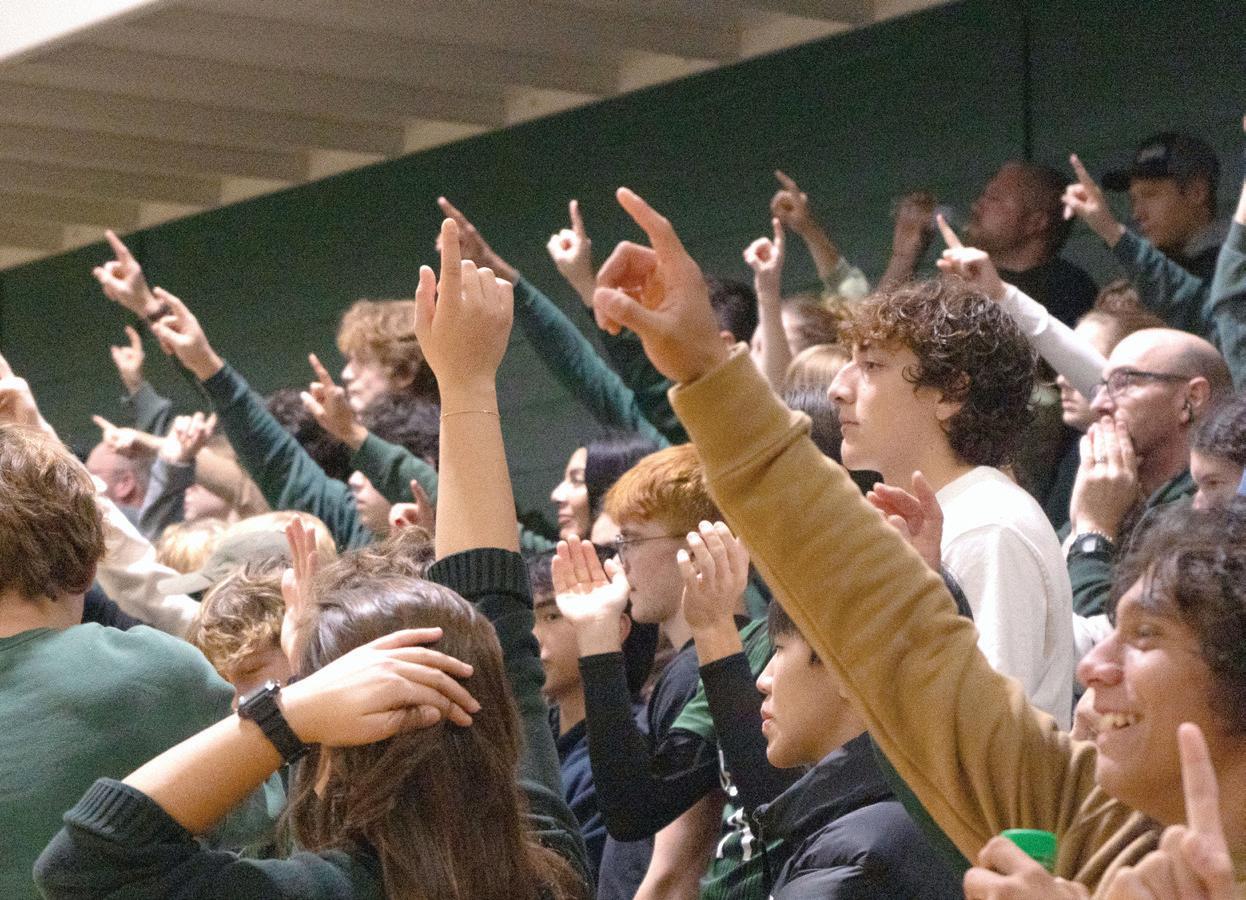
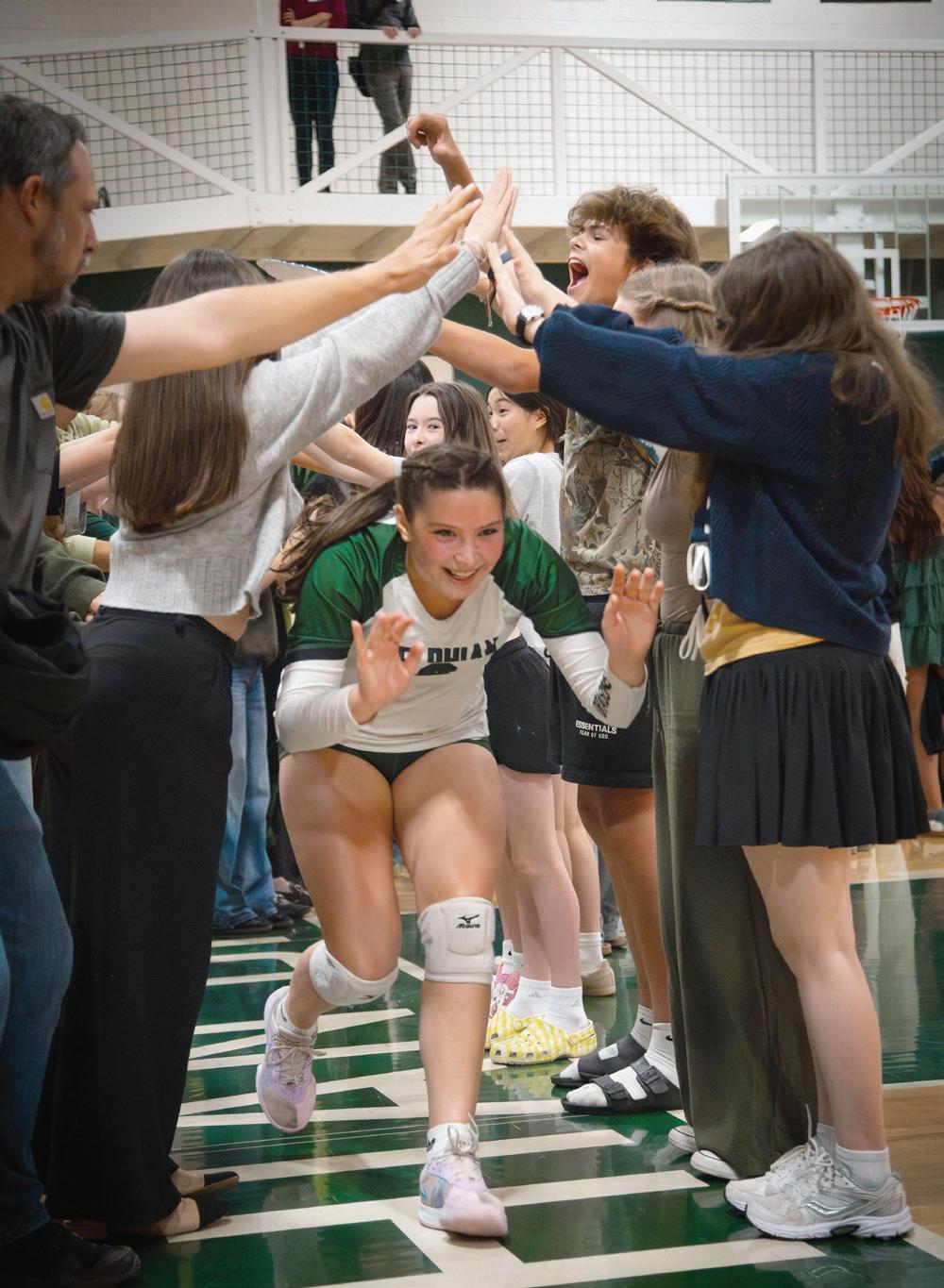
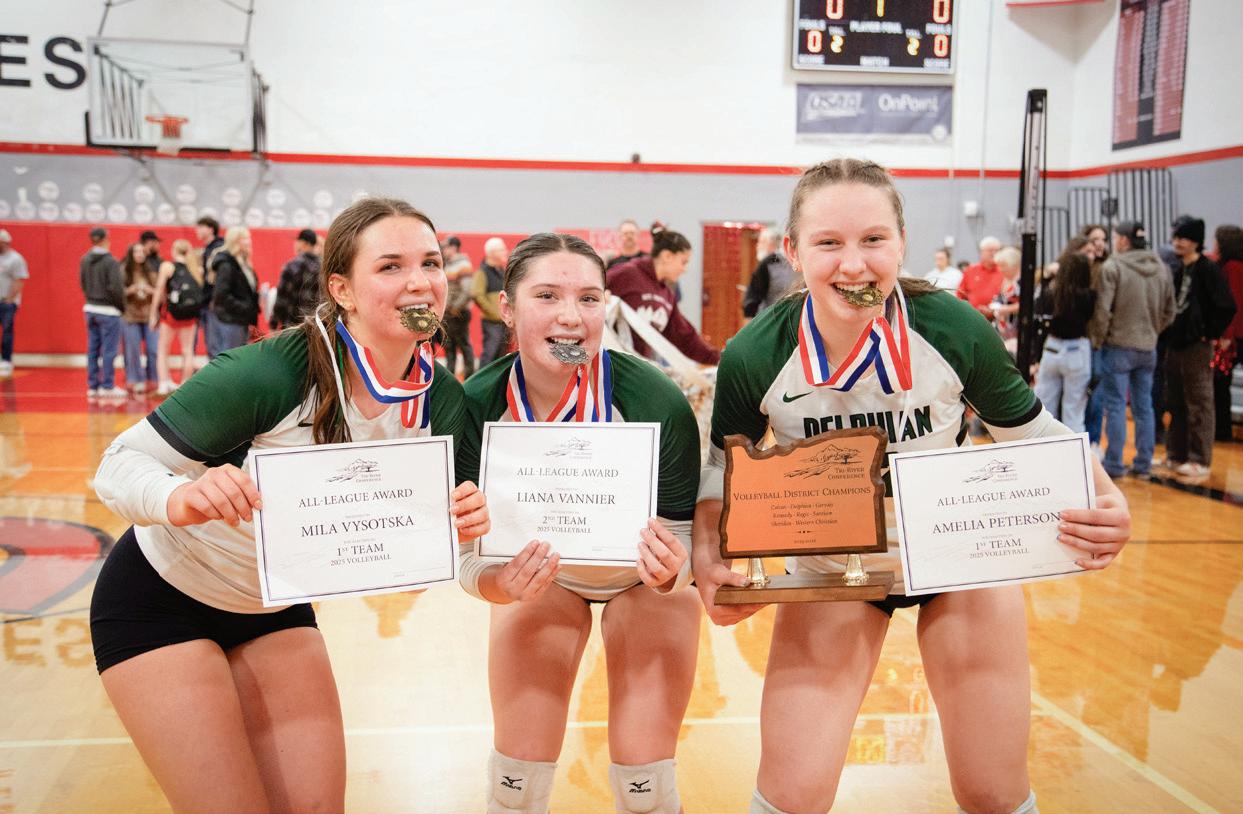
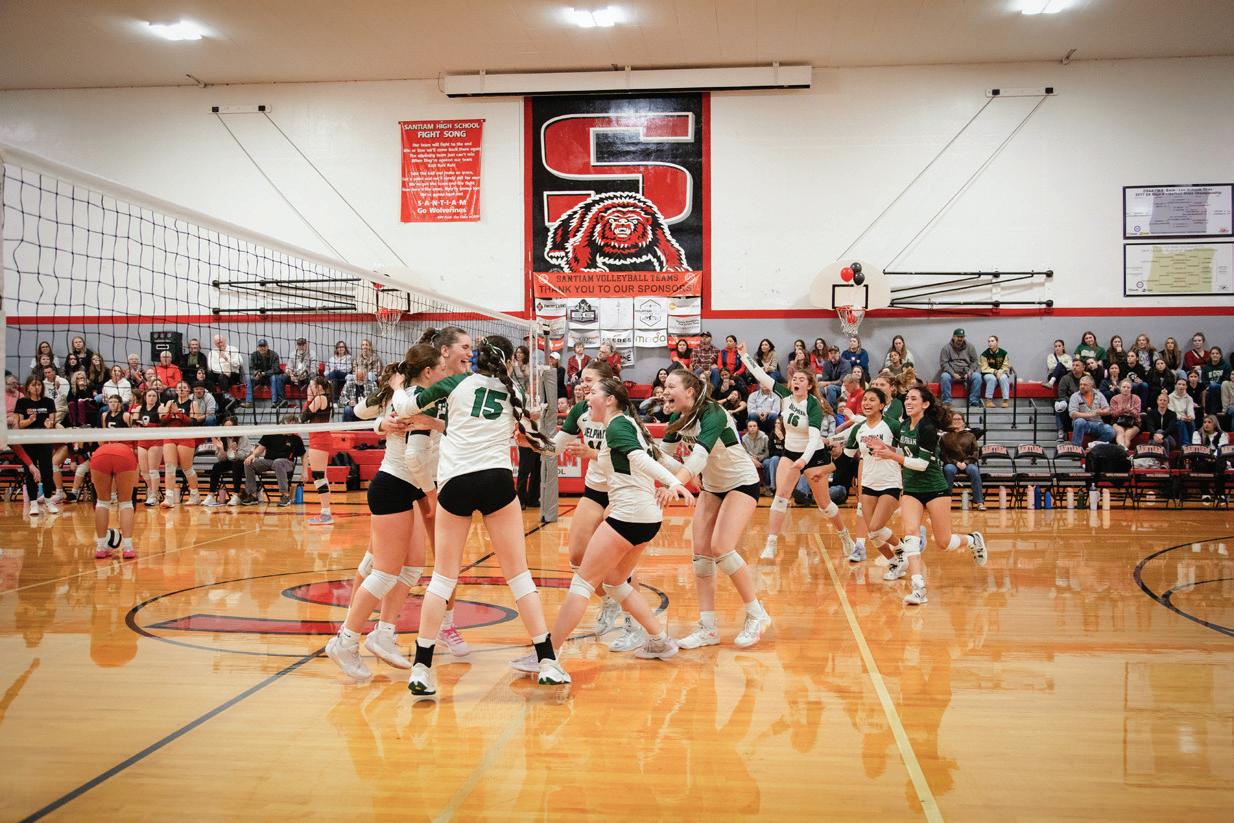
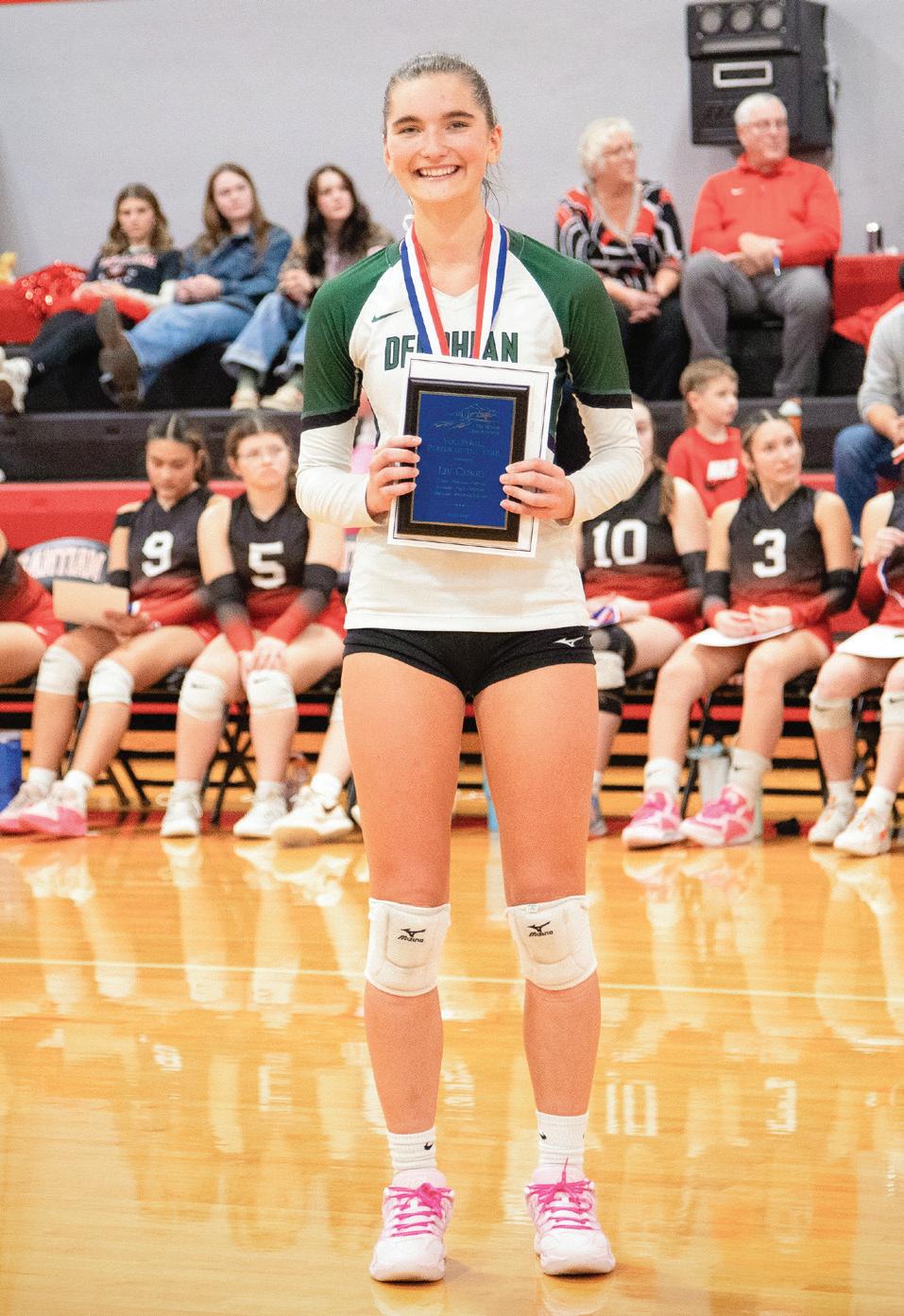
Led by the hard-hitting Tri-River Conference Player of the Year Liv Curry and 1st-Team All-Conference teammates Amelia Peterson and Mila Vysotska, the Dragons cruised through the first half of the season. An October loss to conference rival Santiam forced a playoff rematch on the Wolverines’ home court with the conference championship on the line. With a spirited crowd making the trip, the Dragons won 3–1, earning the school’s first home state playoff game since 2013.
The Dragons carried this momentum into the state playoffs, sweeping Faith Bible 3–0 in the opening round to advance to the quarterfinals. There, the team’s run ended with tough losses to Weston-McEwen and Heppner. Despite the season’s end, it was a great success with a league championship, a trip to the state playoffs, and five all-conference player awards.
Varsity Volleyball Roster:
Isa Del Francia
Mila Vysotska
Liv Curry
Regina Romero Bolaños
Natalia Stafford
Awards
Liana Vannier
Amelia Peterson
Masha Ershova
Amelie Rappoport
Elaine Kazmierczak
Tri-River Conference Player of the Year - Liv Curry
1st Team All League Award - Liv Curry
1st Team All League Award - Mila Vysotska
1st Team All League Award - Amelia Peterson
2nd Team All League Award - Liana Vannier
Honorable Mention All League Award - Amelie Rappoport
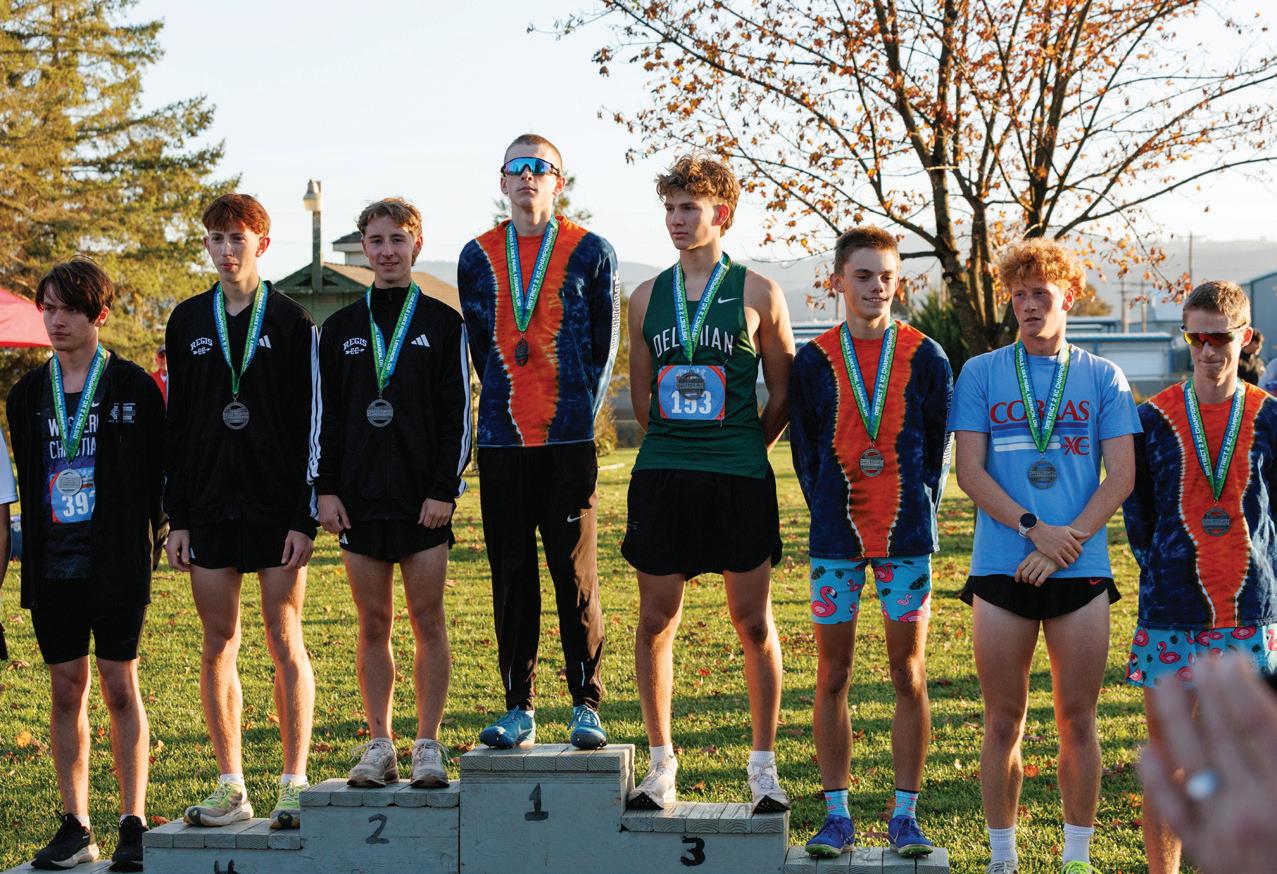
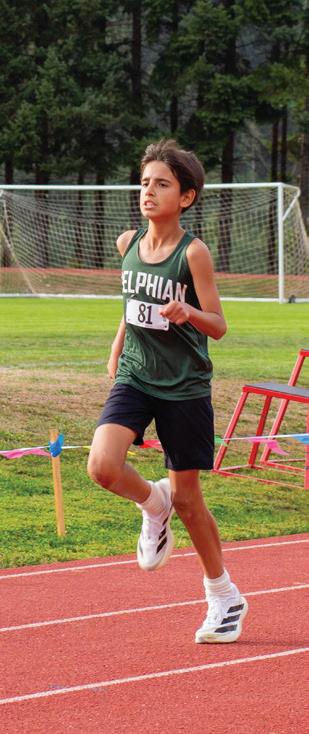
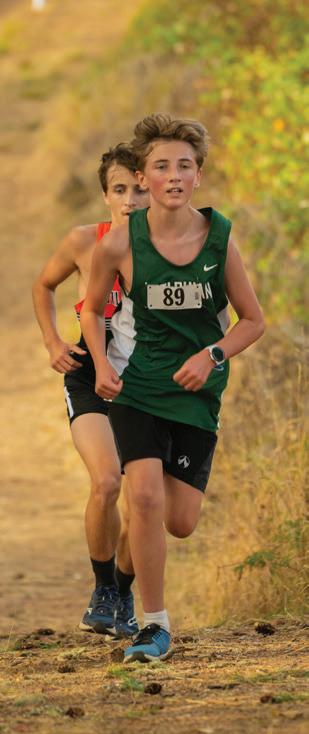
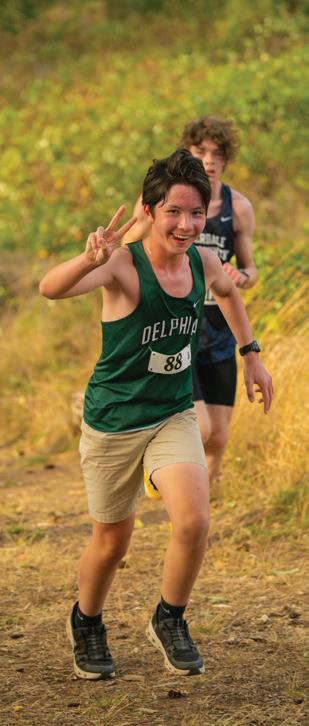
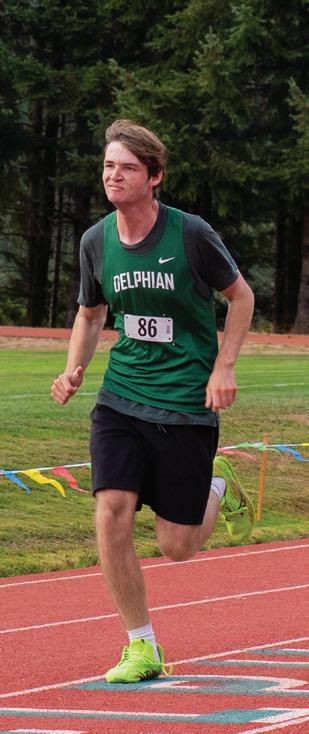
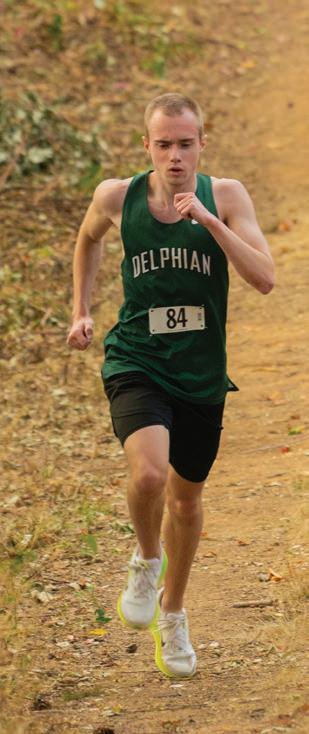
THIS PAGE: LEAGUE PLAYOFF GAME AND AWARDS AT SANTIAM OPPOSITE TOP: BOSTON BROWN AT DISTRICT CROSS COUNTRY RACE RECEIVING 3RD PLACE MEDAL OPPOSITE BOTTOM: DELPHIAN RUNNERS AT HOME “CONQUER THE HILL” CROSS COUNTRY MEET
Cross Country: A Historic Season
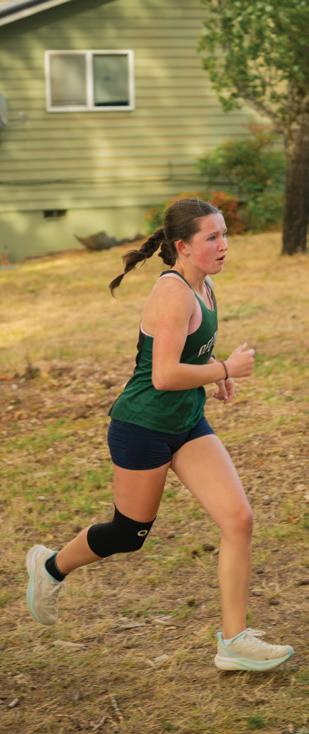
The cross country team enjoyed a landmark season, achieving numerous personal bests and two school records, along with two milestones for the first time since its inception in 2016.
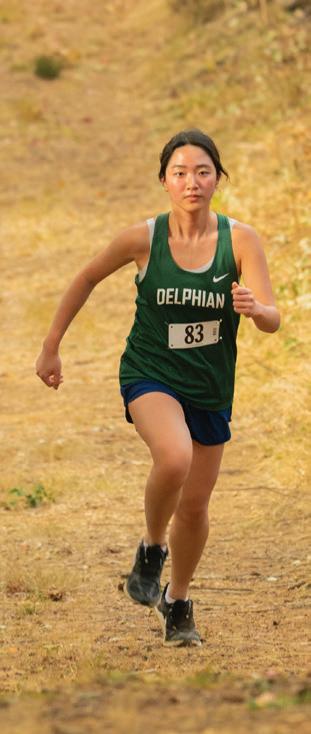
The girl’s team found its stride on October 22 at the Happy Hustle meet in Corvallis. There, Joy Hwang, Mila Marvin, and Rona Onizuka set personal bests (PBs), with Mila establishing a new school record. One week later, these three runners, along with Amity Gallagher, competed in the District 2 Championships in Lebanon. Mila, the team’s top finisher, placed 18th in a field of 98, while Amity set a new PB.
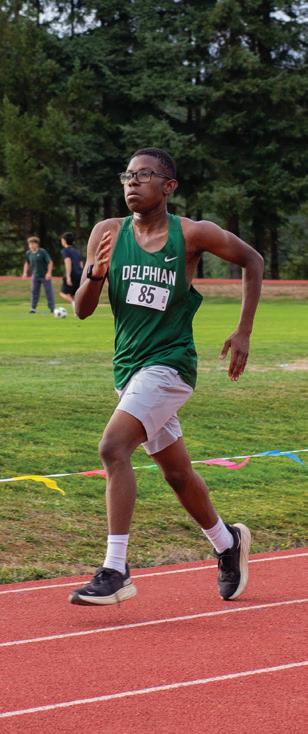
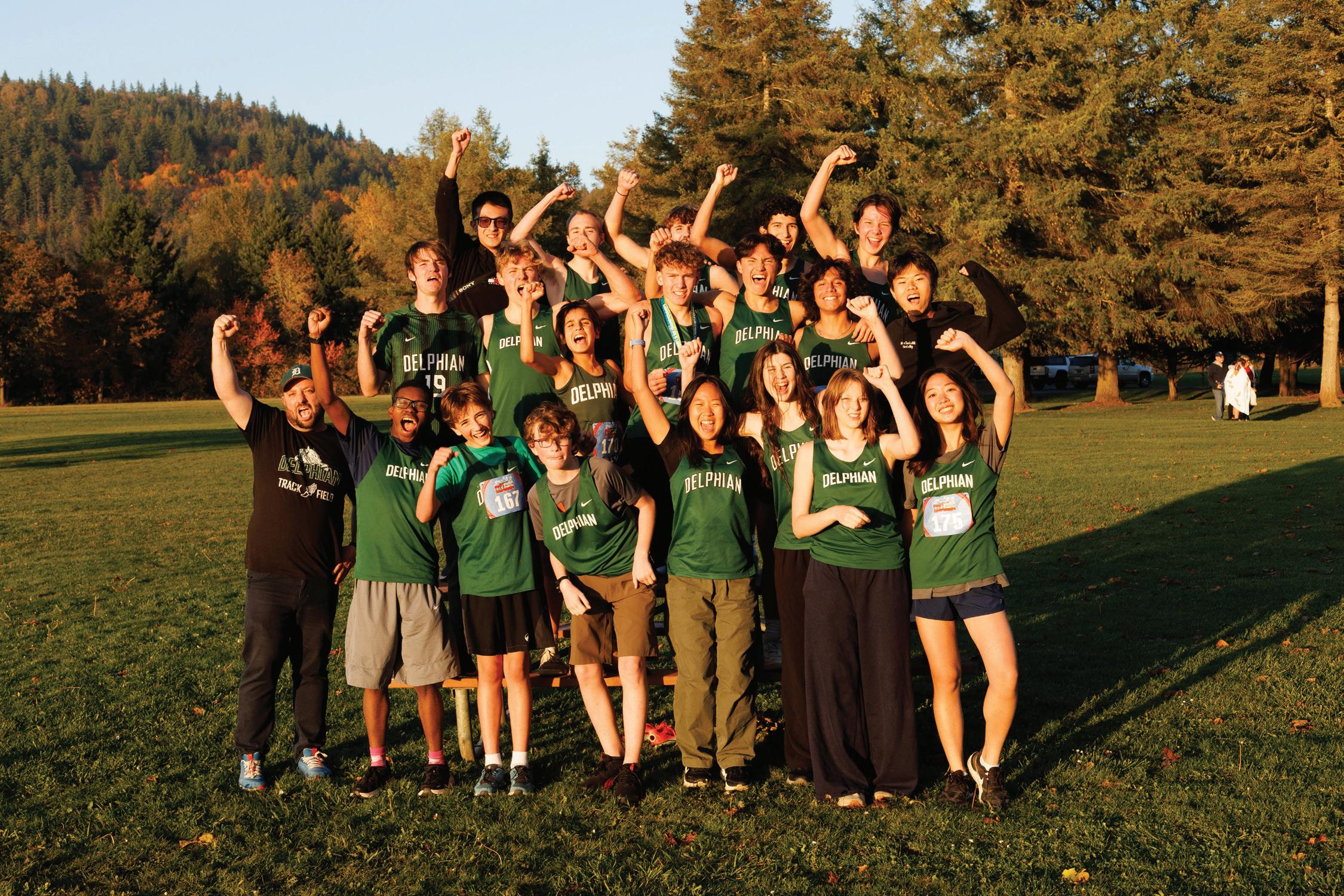
The boy’s team began the season with Boston Brown setting a school record at the September 10 Oktoberfest Invitational. Later, Abraham Tori set a PB at the Happy Hustle meet. At the District 2 Championships on October 29, Nathan Cloutier, Chenoa Lopez, Tai Jefford, and Isshin Suzuki all recorded personal bests. Their combined scores secured third place—the first time in school history that the team has placed in a district meet.
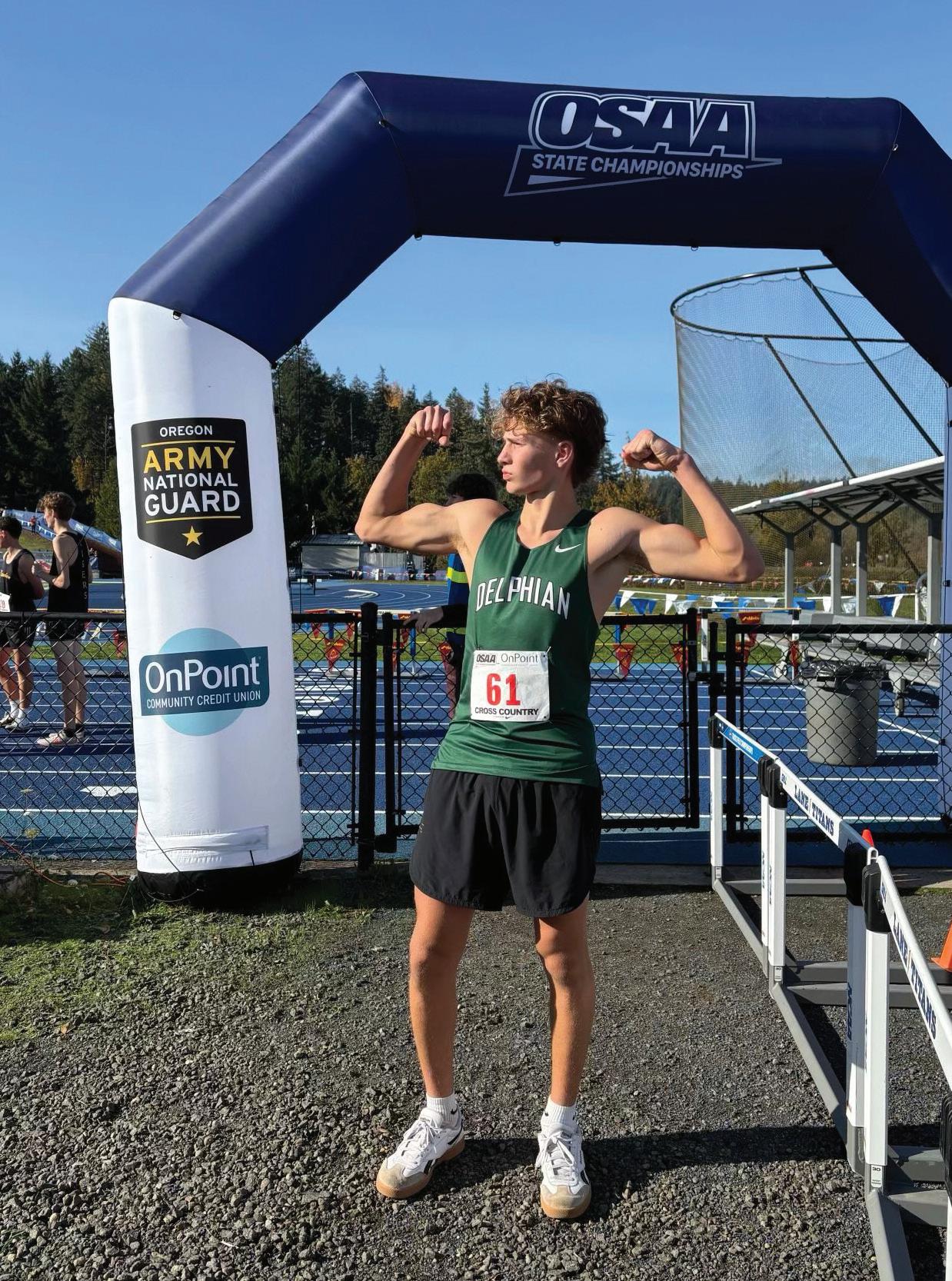
Boston, the pack leader, finished the 5,000 meter district race in 17:16.70. By placing third out of 76 runners, he became the first athlete in Delphian School history to qualify for the state meet. On November 8, at the OSAA State Championships in Eugene, Boston represented the Dragons in the 5,000 meter race with a time of 17:41.59, finishing 29th out of 90 runners.
Cross Country Team Rosters:
Boys:
Elliot Adams
Nico Barram
Oli Beauregard
Jack Bowling
Boston Brown
Vladimir Bunchuk
Nathan Cloutier
Tai Jefford
Jack Kennedy
Dylan Lederer
Chris Lewis
Chenoa Lopez
Tristan Mathews
Ronnie Menard
Kai Mesmer
Aiden Phillips
Romeo Ramelli
Cole Saphire
Ansel Sessions
Isshin Suzuki
Abraham Tori
Alex Valdes Shwetzer
Lachlan Wydro
Girls:
Amy Bianchi
Amity Gallagher
Joy Hwang
Leona Margo
Mila Marvin
Rona Onizuka
Brunella Plascencia Navarro
ABOVE: TEAM PHOTO AFTER THE DISTRICT RACE BELOW LEFT: BOSTON
BROWN COMPLETING THE DISTRICT RACE BELOW RIGHT: BOSTON BEFORE THE STATE CHAMPIONSHIP CROSS COUNTRY RACE
Varsity Soccer Roster:
Cole Saphire
Damon Soler
Cesar Ramirez Valdes
Dylan Lederer
Boston Brown
Diego Orion
Chenoa Lopez
Johnny Lee
Lachlan Wydro
Isshin Suzuki
Leonardo Nahle Guajardo
Luke Falkow
Awards
Mark DeVries
Neo Dirou
Elliot Adams
Oli Beauregard
Jackson Paden
Nathan Cloutier
Henry Gullo
Tai Jefford
Tristan Mathews
Roby Guajardo
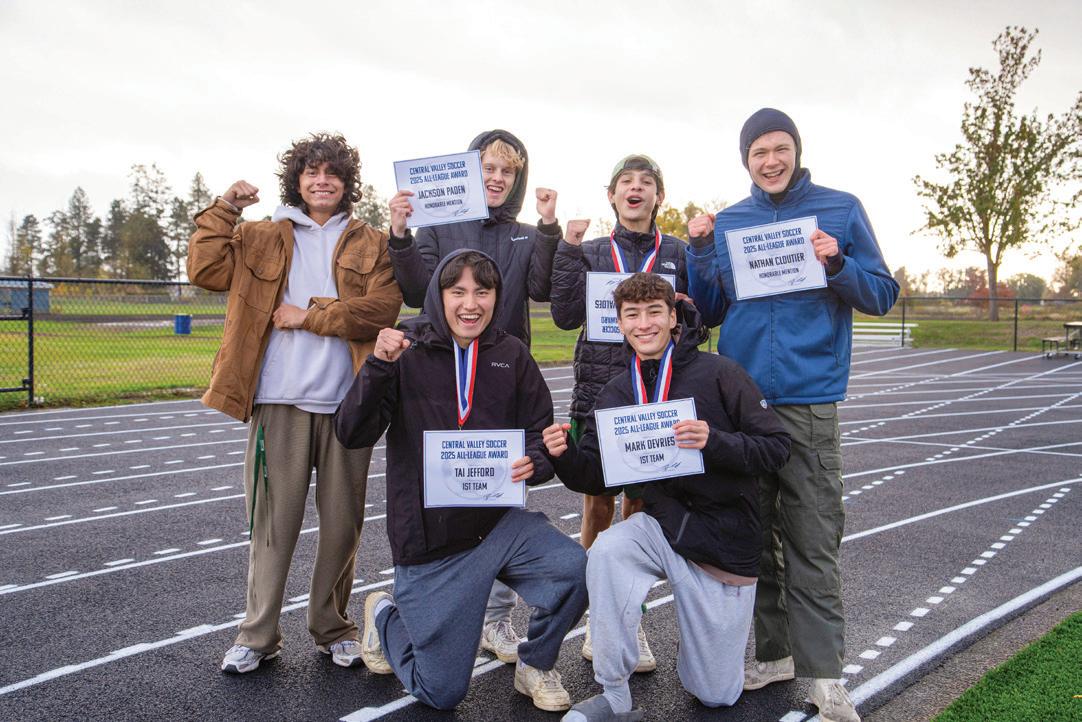
1st Team All League Award - Tai Jefford
1st Team All League Award - Mark DeVries
2nd Team All League Award - Cesar Ramirez Valdes
Honorable Mention All League Award - Nathan Cloutier
Honorable Mention All League Award - Jackson Paden
Honorable Mention All League Award - Chenoa Lopez
Champions of Heart: The 2025 Varsity Boys Soccer Season
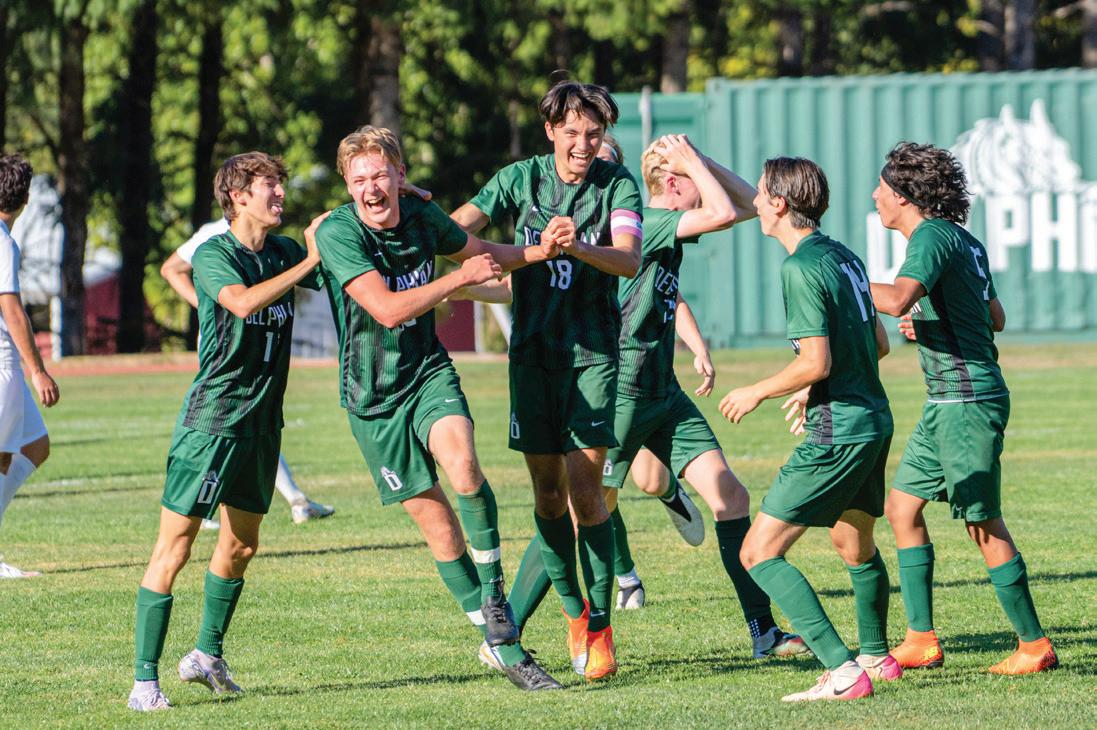
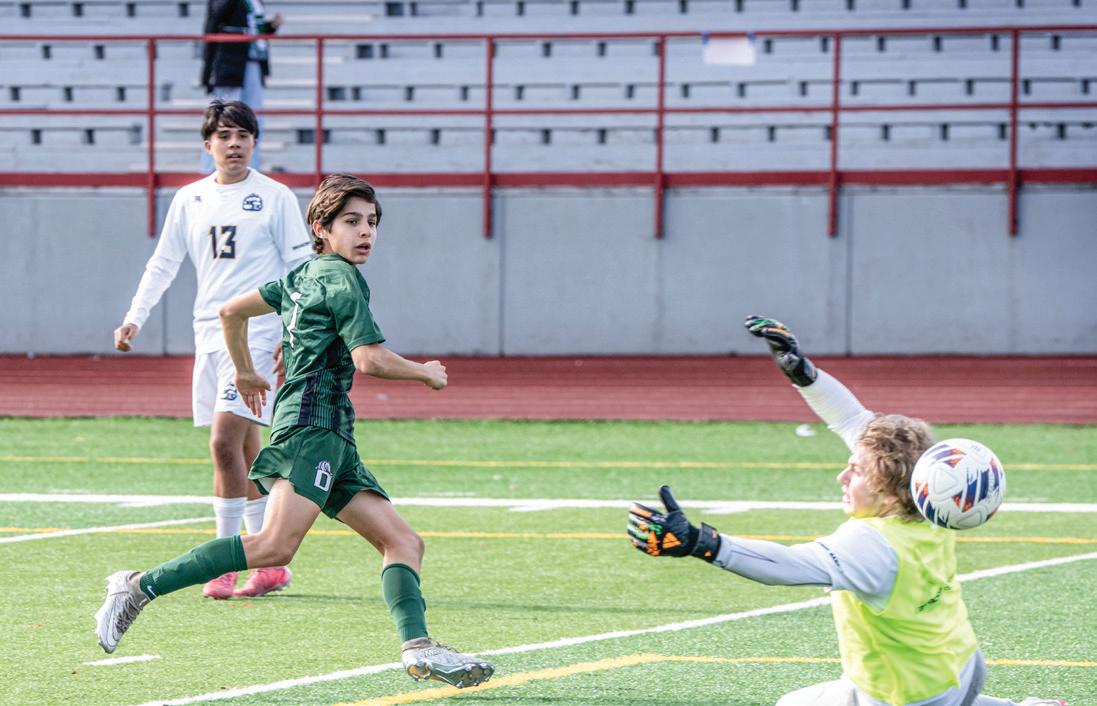
Under the leadership of Coach JJ Gonzalez, the varsity boys soccer team showcased a strong offense and the ability to compete in high-pressure games throughout the season. Season highlight performances included an 8-0 shutout against Gervais and a high-scoring 7-1 victory over Yamhill-Carlton.
While the season had its hurdles, the team demonstrated resilience in tight contests, earning 2-1 wins over Western Christian, Amity, and Portland Christian and placing 16th out of 59 teams in the OSAA 3A/2A/1A league overall.
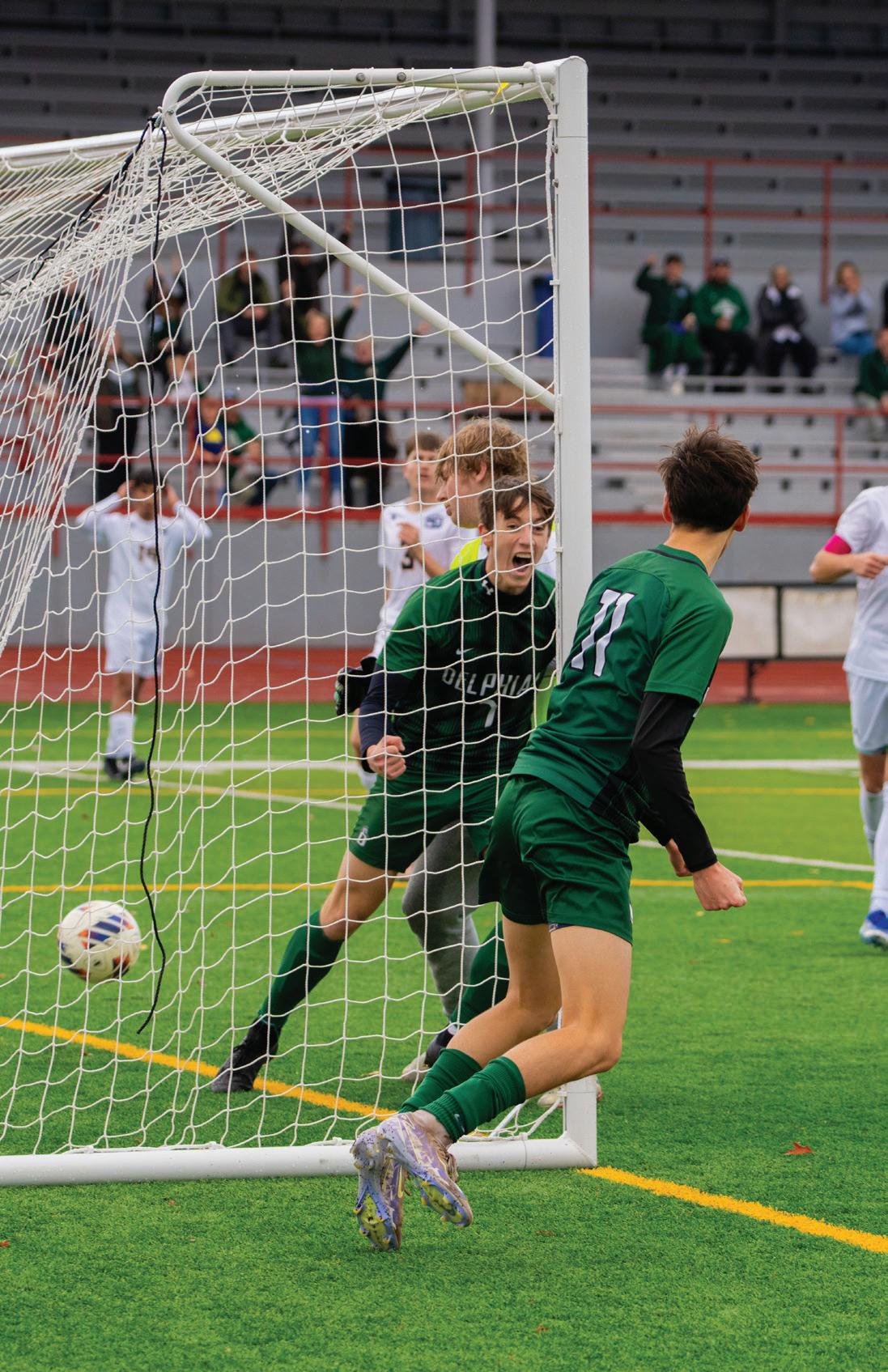
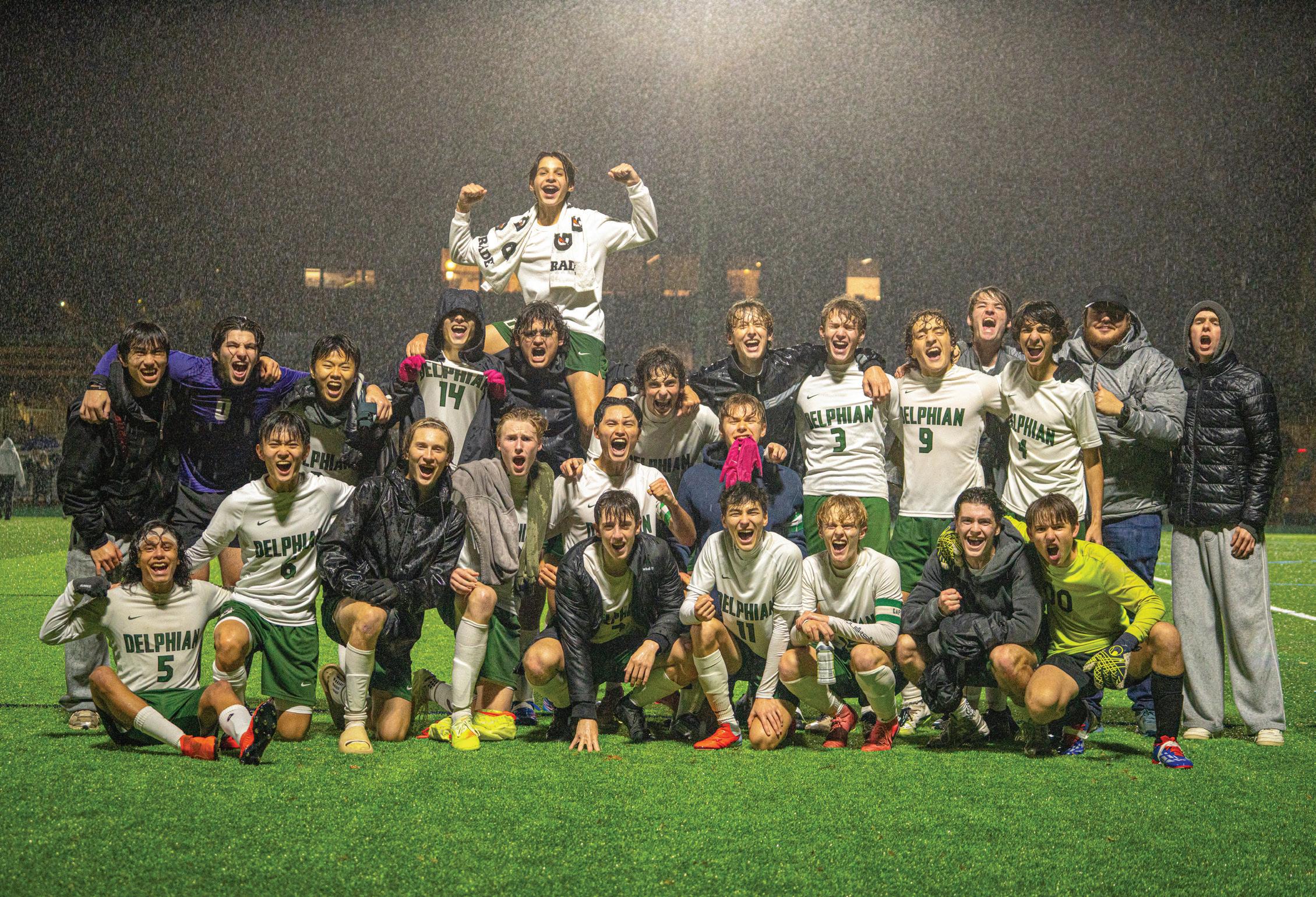
The team entered the playoffs with momentum, with a 2-1 victory over Taft in the first playoff game, followed by a thrilling 3-1 win over Brookings-Harbor in the second state playoff game. The season’s journey came to an end in the second state playoff game against Oregon Episcopal, whose speed and endurance are a challenge to go up against.
Although the season ended earlier than we would have liked, the 2025 team inspired the entire community with their remarkable growth, unbreakable determination, and unwavering support for each other, setting an example of what can be achieved through hard work, unity, and heart.
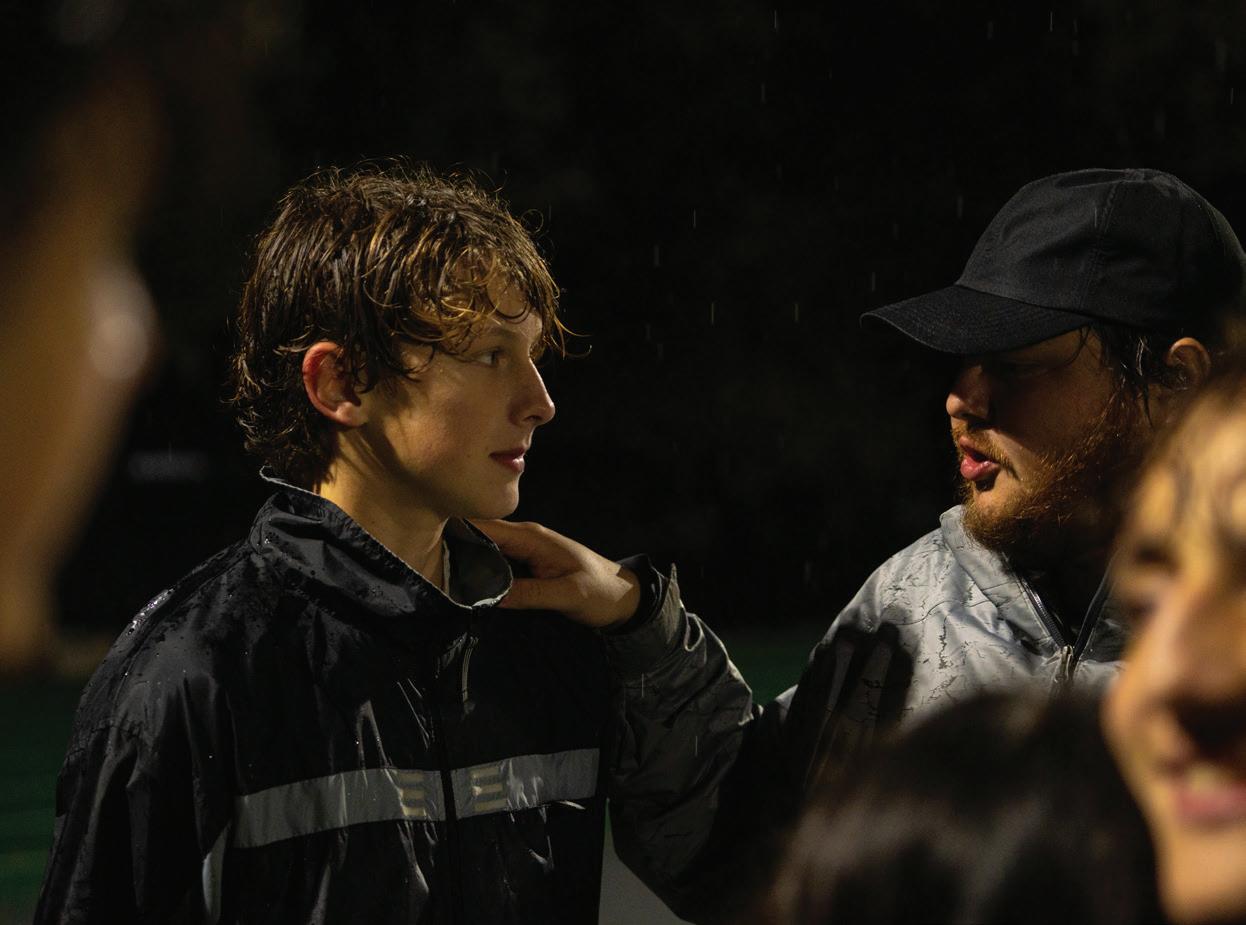
ABOVE: LACHLAN WYDRO AND MARK DE VRIES CELEBRATING SCORING AGAINST BROOKINGSHARBOR BELOW: COACH JJ GONZALEZ AND NEO DIROU AFTER OREGON EPISCOPAL GAME
HOME GAME VS. SISTERS
LEAGUE AWARD WINNERS
CESAR RAMIREZ VALDES SCORING IN BROOKINGS-HARBOR GAME
VARSITY TEAM AFTER OREGON EPISCOPAL GAME
Varsity Basketball Team Rosters:
Girls:
Liv Curry
Amy Guy
Joy Hwang
Luna Jiang
Mila Marvin
Lily Olivares
Avery Ott
Brunella Plascencia
Navarro
Cleo Thornsberry
Sophie Totpal
Liana Vannier
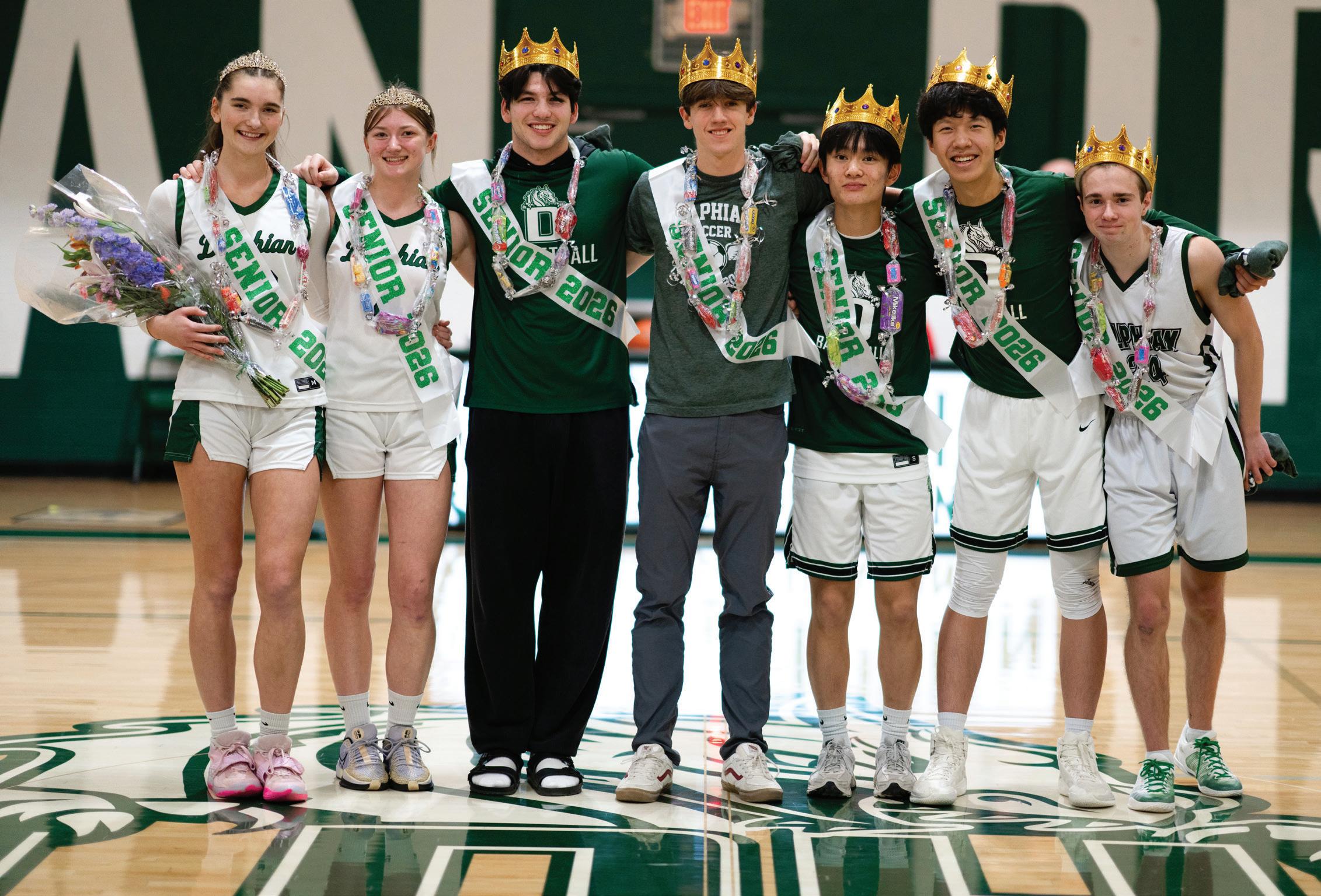
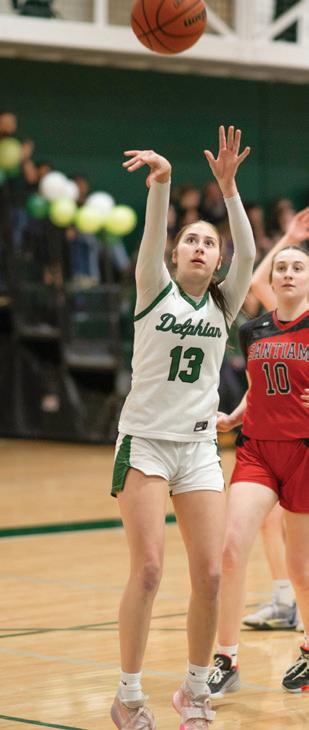
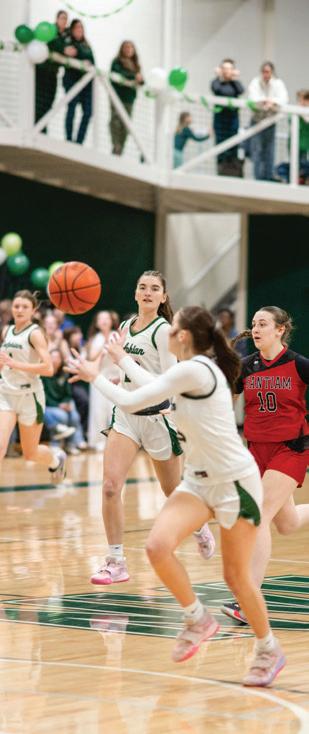
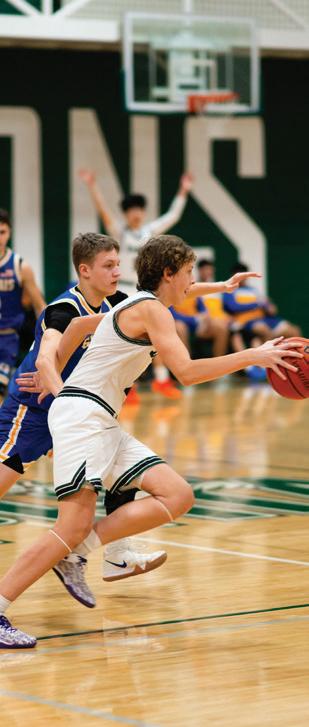
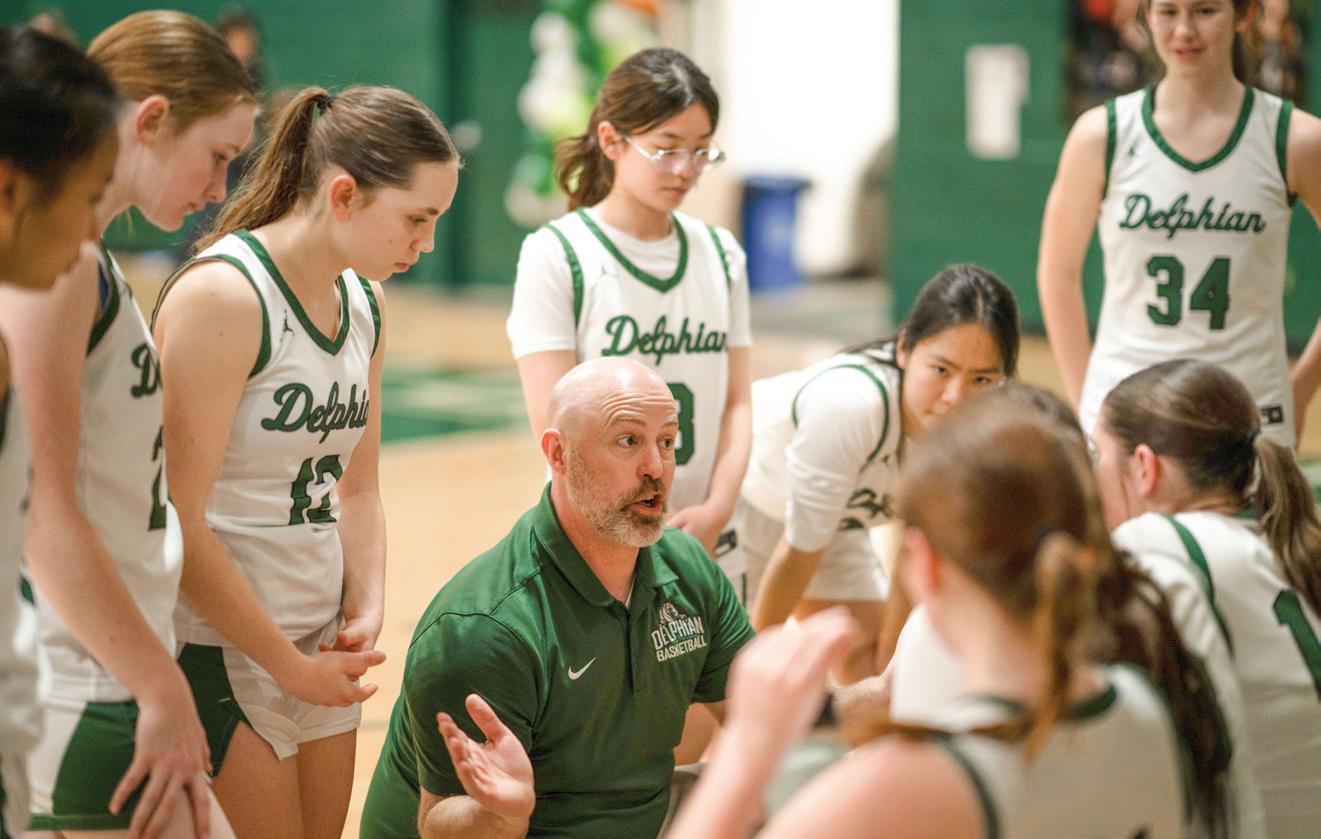
ABOVE: BASKETBALL SENIORS AT SENIOR NIGHT BELOW MIDDLE: HOME GAME PHOTOS AGAINST GERVAIS AND SANTIAM BELOW BOTTOM: GIRLS VARSITY TEAM AND COACH BRANDON LIDGARD
Boys:
Neo Dirou
Henry Gullo
Johnny Lee
David Liu
Romeo Ramelli
Cole Saphire
Brian Tang
Quentin Thornsberry
Lachlan Wydro
From Minimum Requirements to Meaningful Outcomes: A Journey in Leadership business trip 2026
B
usiness Seminar is one of the most popular elective seminars offered at Delphian. It is led by Assistant Head of School Mark Siegel, who has been teaching it for over 30 years. In this seminar, students engage with a challenging curriculum covering business and economic theory. The sessions are lively, featuring discussions and debates, and provide opportunities for students to broaden their understanding of the business world.
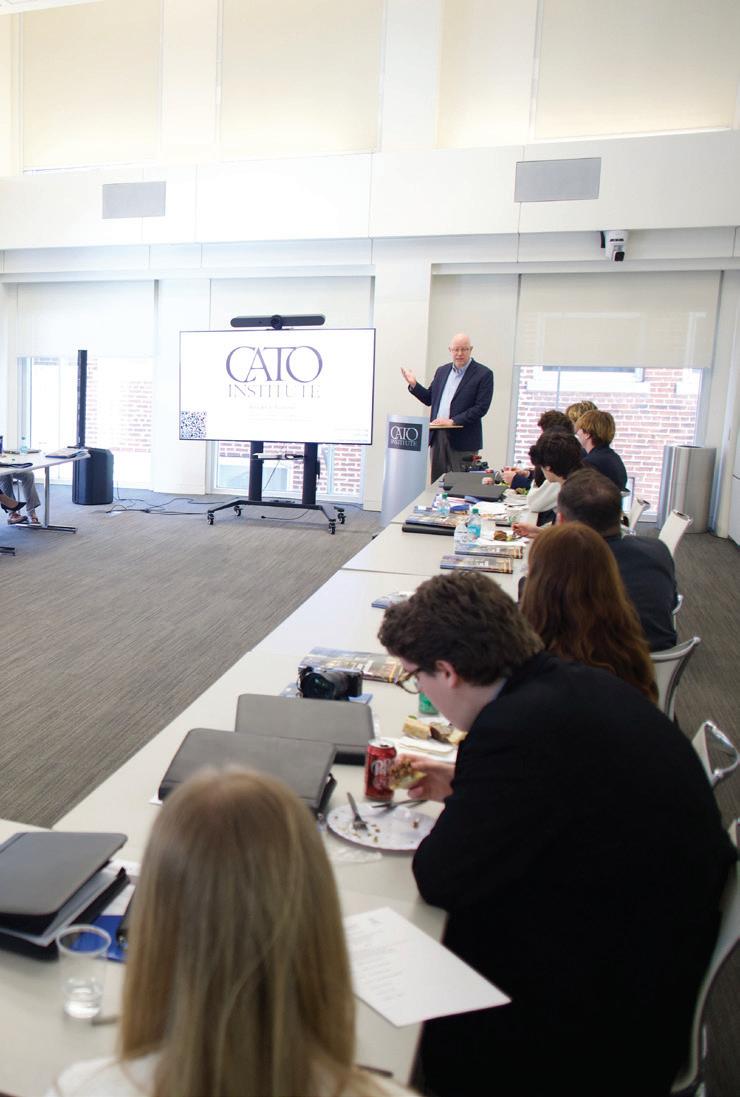
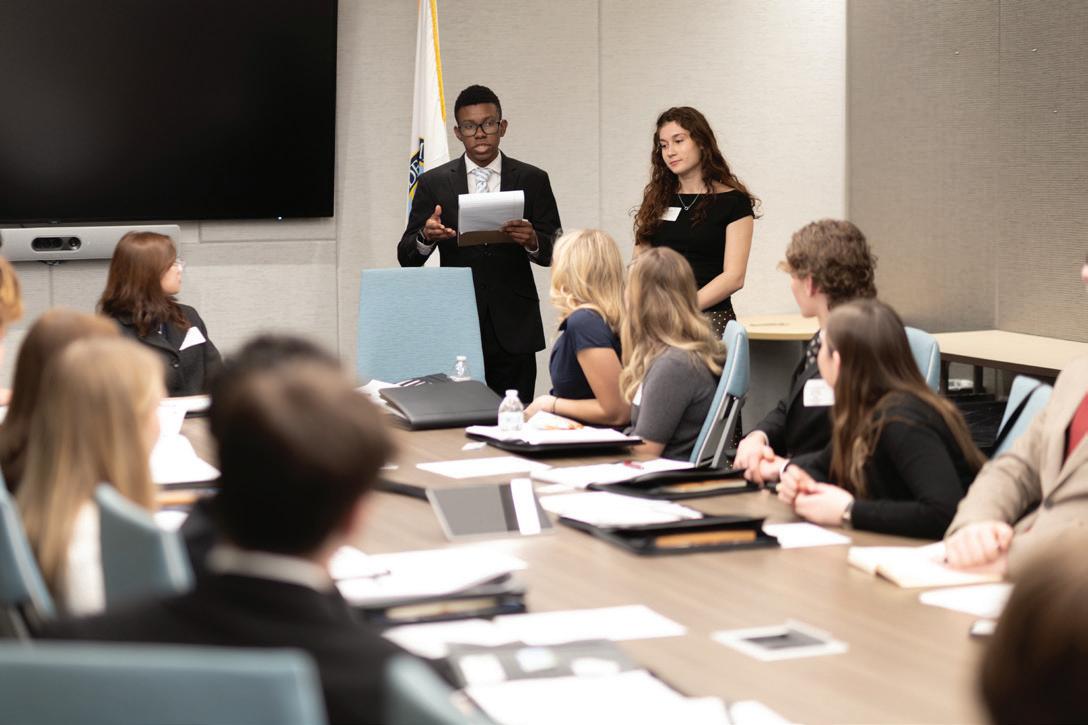
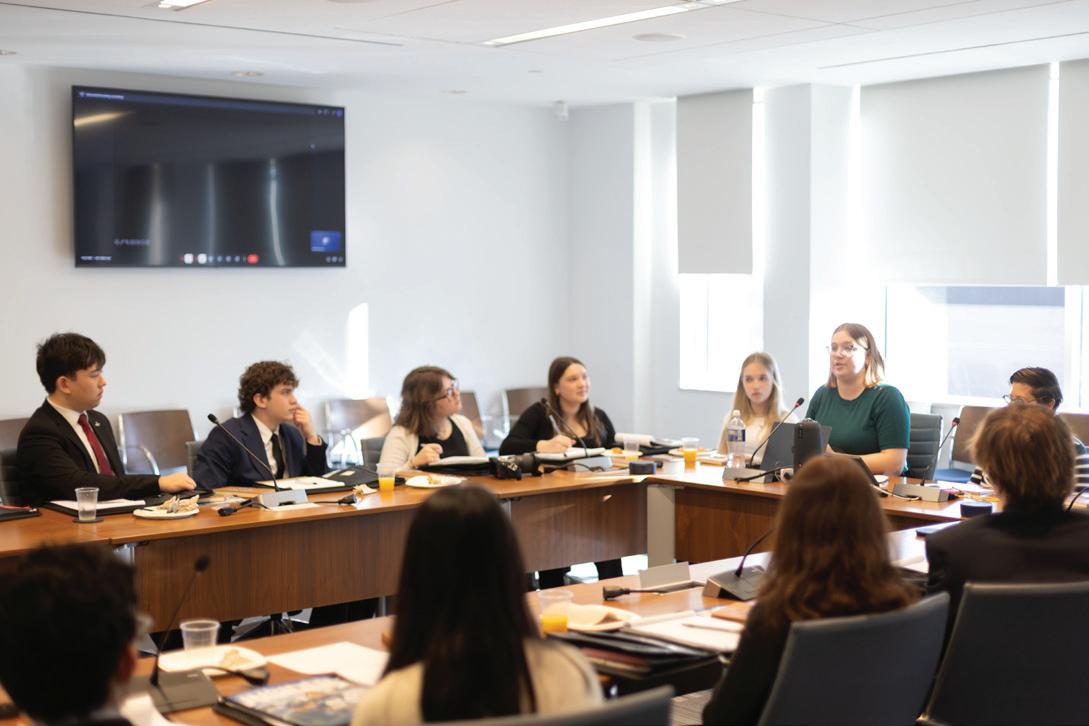
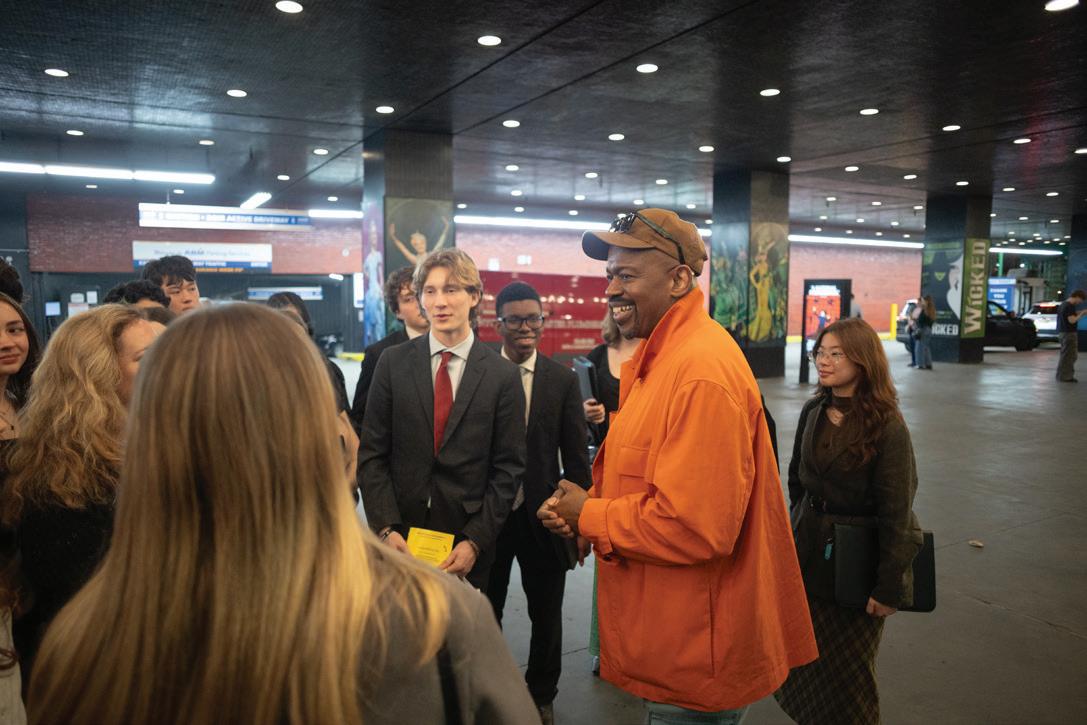
In addition to the seminar, Mark organizes guest speakers, visits to local businesses, and an annual ten-day field trip for the business seminar that takes students to various cities on either the East or West Coast. This trip enhances the business seminar by giving students the opportunity to meet a diverse group of successful entrepreneurs and business professionals. Students learn about various industries and professions while observing how the business and economic principles they study in class are applied in the real world.
Host companies and professionals provide students with an inside look at their daily operations. Students get to see firsthand what these professionals do and how they spend their workdays. The hosts focus on demonstrating how their businesses operate, how their products and services benefit customers, and how they uniquely fit into the broader business landscape.
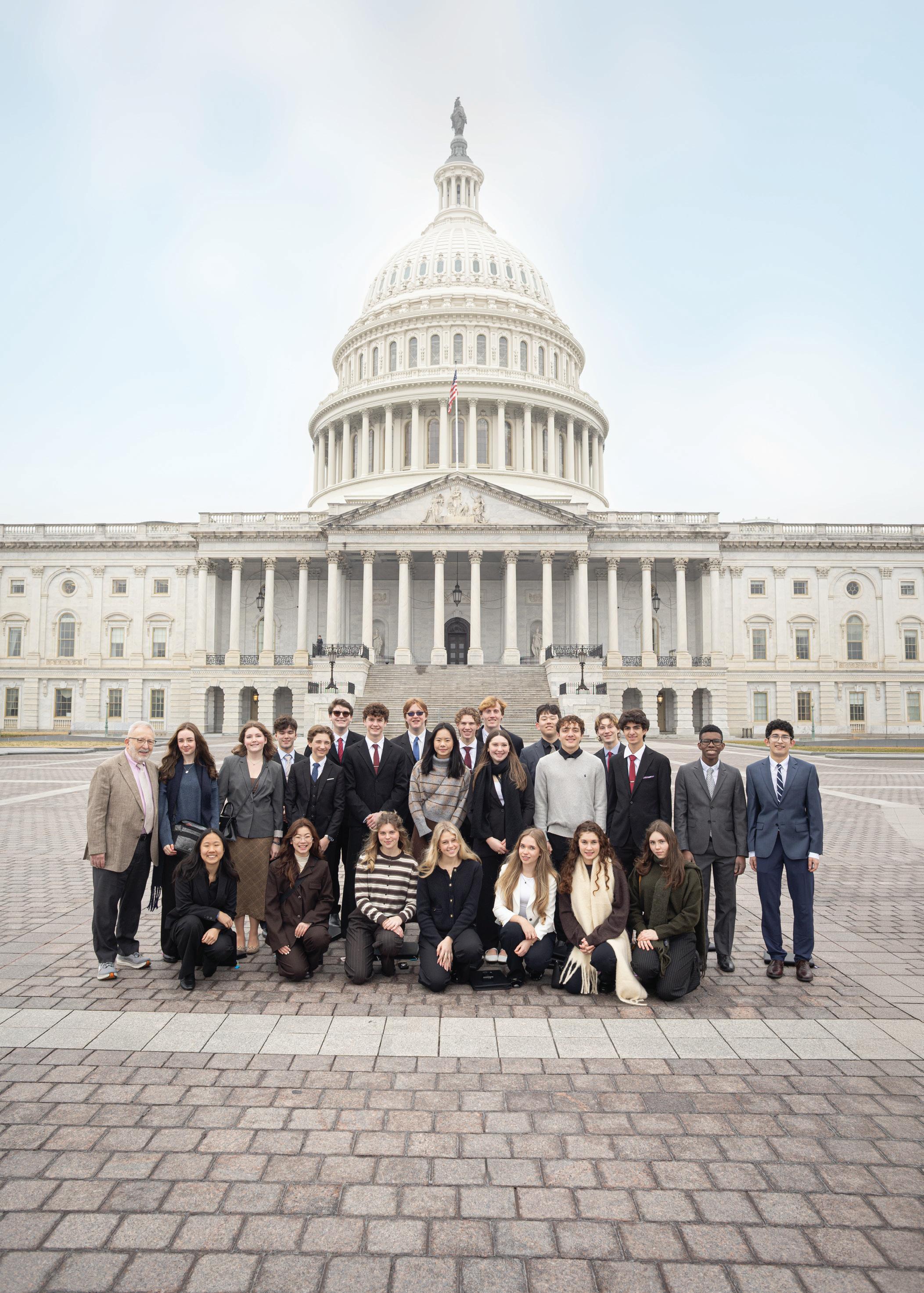
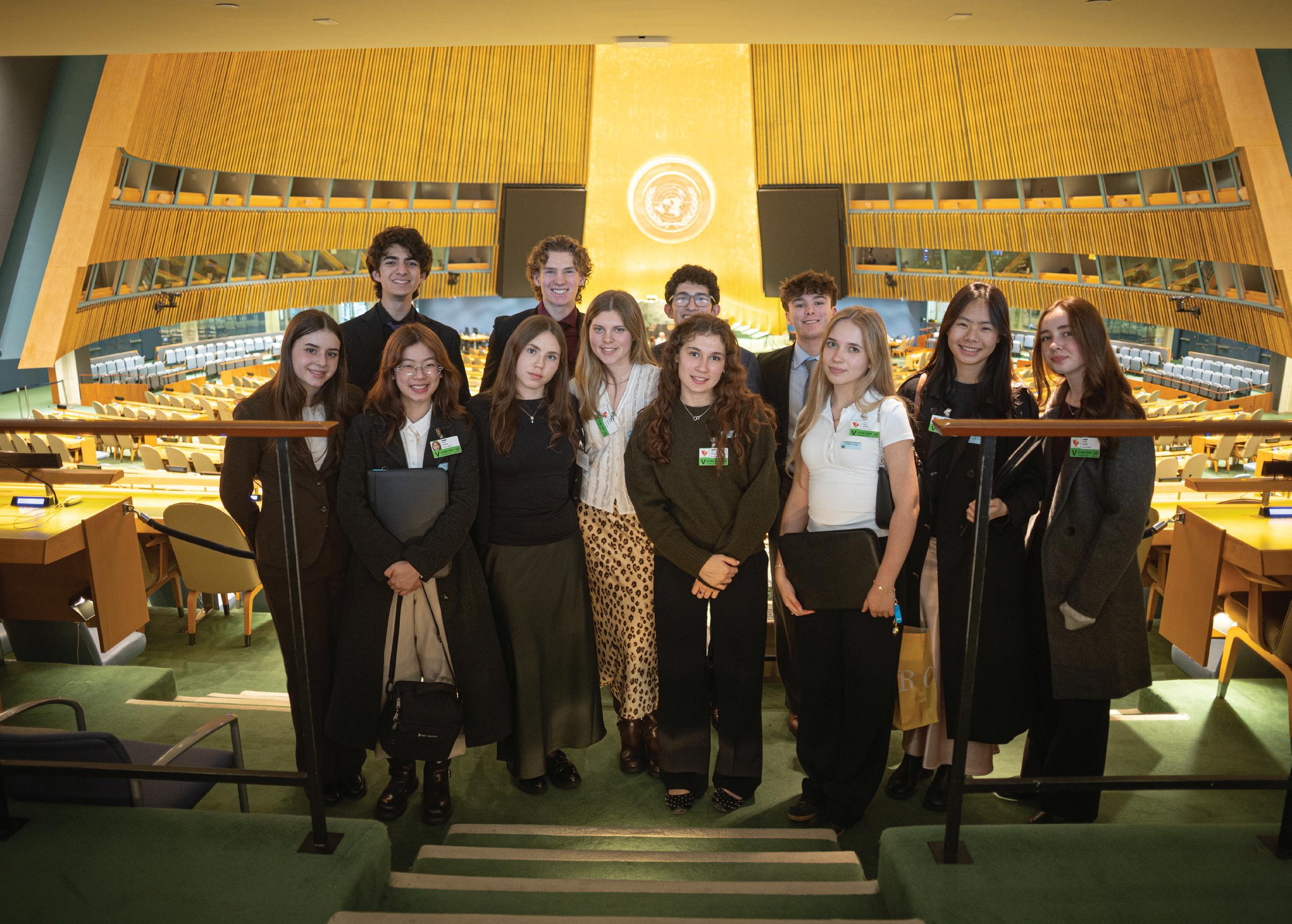
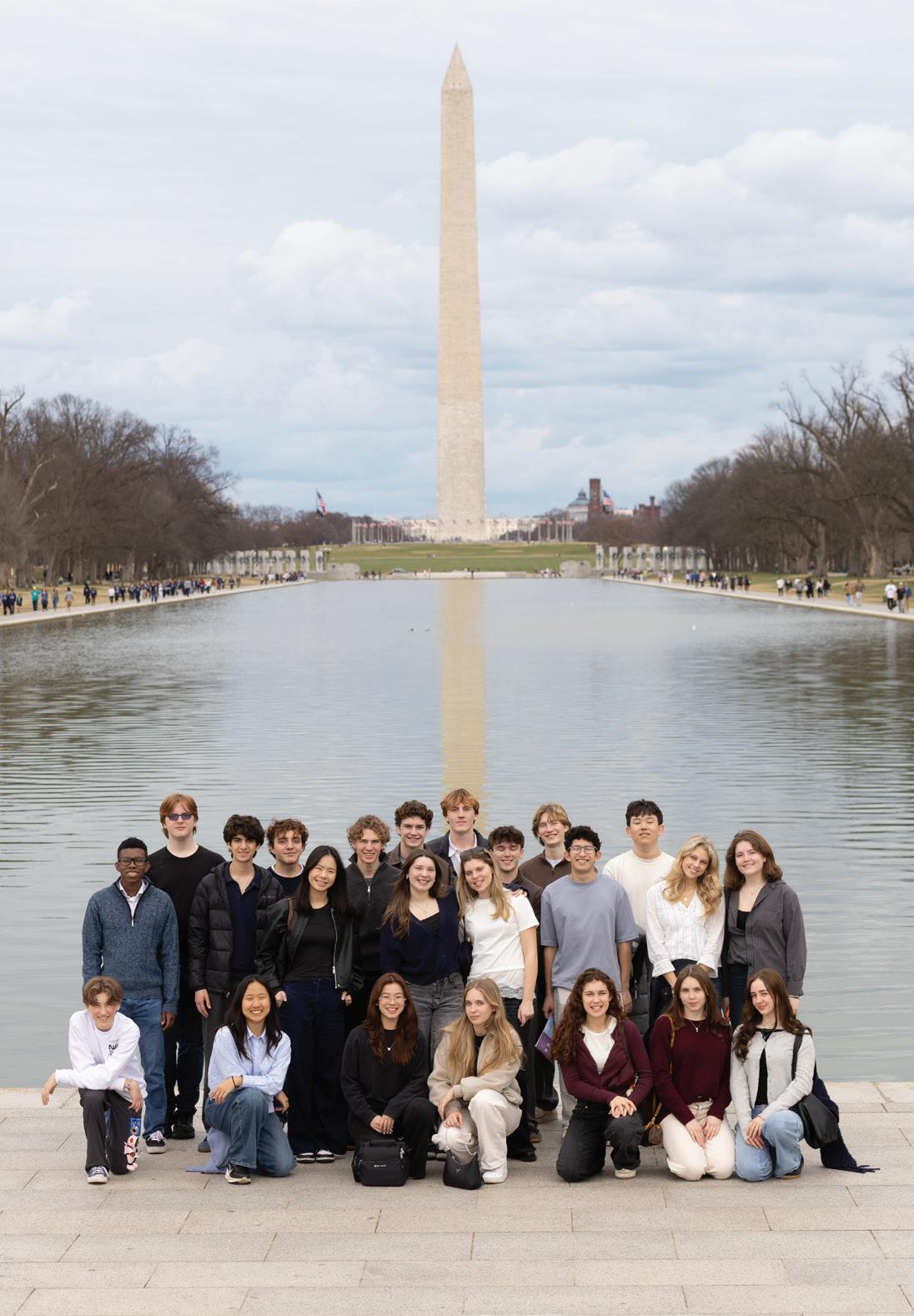
This year’s trip took students to Washington, D.C. and New York City. The agenda was packed with meetings and tours, including visits to the U.S. Department of Education and the Supreme Court.
OPPOSITE TOP: CATO INSTITUTE OPPOSITE MIDDLE: DEPARTMENT OF EDUCATION OPPOSITE BOTTOM: NATIONAL BUSINESS AVIATION ASSOCIATION THIS PAGE STANDING L-R: MARK SIEGEL, AVORY SHAFAR, OLIVIA DENT, ETHAN BRISTOL, ANSEL SESSIONS, BECKETT GAILUNAS, DYLAN LEDERER, ARI CUMMINGS, LUNA JIANG, BOSTON BROWN, EMMETT MCCRAY, LIANA VANNIER, NOAH ORION, LEONARDO NAHLE GUAJARDO, LUKE FALKOW, DIEGO ORION, CHRIS LEWIS, ABRAHAM TORI THIS PAGE KNEELING L-R: JOY HWANG, DORIS HUANG, NATALIA STAFFORD, EMMERY KUGLER, OLYA SUSHKO, LIA BEN DROR, BRUNELLA PLASCENCIA NAVARRO
When students return from the trip, they are asked to write a success story detailing what they learned from the experience. The life-changing realizations and observations are always a highlight to read. Form 7 student Olya Sushko, who also helped to assist Mark organizing the trip, wrote the following after returning from the trip:
“The business trip completely changed my perspective on responsibility and leadership. I got to organize visits, coordinate hotels and transportation, and guide the group. Through this experience, I stepped into a leadership role and learned what it truly means to be accountable–not just for myself, but for others as well.
“Before this project, I hadn’t fully understood the importance of taking charge of my own life, as well as leading others. I hesitated at first about doing this project, thinking about how much work I would have to put in. However, I quickly realized that growth comes from pushing beyond comfort zones and getting challenged rather than avoiding hard projects.
“In the past, I often chose the simplest projects just to meet the minimum requirements. Helping run the business trip changed that idea entirely. It helped me understand the true purpose of the projects in my program–not just as tasks to complete, but as opportunities to develop realworld skills and create meaningful outcomes for my future. Now I feel motivated to take on larger, more challenging projects that result in impactful work.
“I also came to understand how important it is to build strong connections with people. Meaningful relationships lead to success, not only in business but in life. Working with Mark showed me how trust can open many opportunities.
“In the past, I often chose the simplest projects just to meet the minimum requirements.”
“This experience helped me recognize the importance of maintaining a high level of professionalism at all times. The way you communicate, present yourself, and interact with others directly impacts the trust and respect you earn. I learned that professionalism is not just about appearances, but also consistency, reliability, and the ability to build lasting, respectful relationships.
VISIT TO THE UNITED NATIONS L-R RYLEE WELLS, DIEGO ORION, DORIS HUANG, BRUNELLA PLASCENCIA NAVARRO, BOSTON BROWN, NATALIA STAFFORD, ABRAHAM TORI, LIA BEN DROR, ETHAN BRISTOL, OLYA SUSHKO, LUNA JIANG, AVORY SHAFAR
“This project significantly improved my communication, planning, and organizational skills. Most importantly, it deepened my understanding of leadership and its role in any successful business. I learned that effective leadership is not just about giving direction, but about responsibility, initiative, and the ability to bring people together.
“Looking back, choosing to take on this project was one of the most valuable decisions of my Delphian experience. It not only challenged me, but also changed how I approach both my personal growth and future ambitions.”
To all the businesses and people who hosted us:
National Business Aviation Association
US Dept. of Ed., Office of Nonpublic Education
CATO Institute
Joanna and Caesar Vargas
Johanna Almstead
Watch This Ready (Alum Kyle Marvin)
Bryant Park
RBW Lighting Showroom
Etsy (Parent Keith Wells)
YouTube (Gwyneth Wells)
United Nations
Tom’s Sons International Pleating
Bernhardt Design Company
Good Morning America (Eddie Luisi)
Noodle (John Katzman)
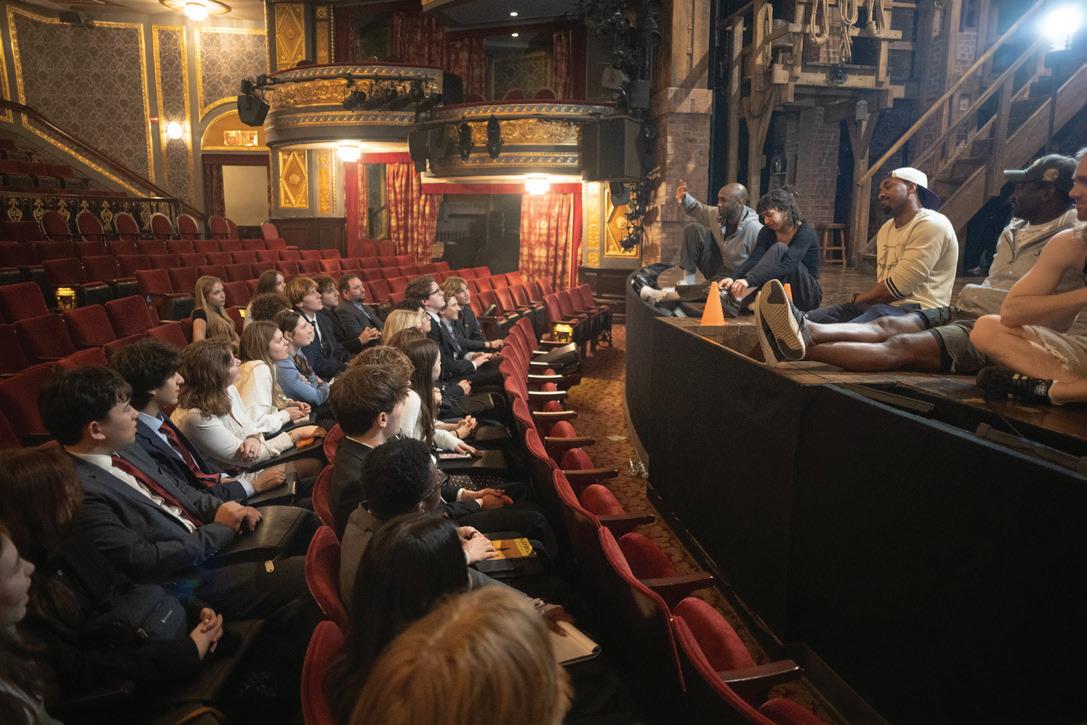
LEFT TOP STANDING L-R: CHRIS LEWIS, ARI CUMMINGS, DIEGO ORION, LEONARDO NAHLE GUAJARDO, LUNA JIANG, BOSTON BROWN, DYLAN LEDERER, LIANA VANNIER, EMMETT MCRAE, ETHAN BRISTOL, LUKE FALKOW, ABRAHAM TORI, NOAH ORION, EMMERY KUGLER, OLIVIA DENT KNEELING L-R: ANSEL SESSIONS, JOY HWANG, DORIS HUANG, OLYA SUSHKO, LIA BEN DROR, BRUNELLA PLASCENCIA NAVARRO, AVORY SHAFAR LEFT BOTTOM: JUST IN TIME CAST MEMBER LANCE ROBERTS ABOVE: VISIT WITH THE CAST OF HAMILTON
expected to be able to apply in a very short amount of time. Plus, there was a midterm test, so the pressure was even higher.
Having completed Delphian’s biology and chemistry courses, especially Human Biology 1 and 2, was really helpful because once you understand the basics, each creature isn’t that different, generally speaking. My knowledge of the basic systems of the human body helped a lot with being able to learn and understand the animals we were studying quickly.
We did lots of practice to help us retain the information we were learning, which helped cement it in my mind and ensured that I wasn’t just studying for memorization. I was also pleased to have my Study Technology ™ skills, as they helped me learn the information for future use rather than just memorize it for the tests. It gave me an advantage over the other kids who used memorization tricks such as flashcards. We were constantly validated for the things we did right, which increased my confidence in myself day by day. By the end of the apprenticeship, I strongly believed in my own ability to learn and figure things out. Having completed Delphian’s Education Handbook course, based on the works of L. Ron Hubbard, I was able to see as it was happening
why this study and practice method they were using was so effective and helpful.
For me, it was really important to really learn everything, as I’ve wanted to be a vet since I was seven years old. Because of this, in every course I take or subject I study, I find a way to relate it to the field of veterinary sciences, and it becomes more interesting to me because I know I will need to apply it later on. Even though we were working and studying a lot every day, it didn’t feel like work; it felt like play.
DM: Did your viewpoint shift at all while you were on this apprenticeship?
AP: Ever since I was little, I’ve been saying I wanted to be a vet. People didn’t believe me and would say things like, “It’s not just puppies and kittens, you know!” And I did know that going in, but this opportunity gave me the chance to really see it in person.
The firsthand perspective I gained, though, helped me solidify my decision further. I woke up excited to go to work every day, even when the work was hard or the jobs were messy. I was excited to be able to help animals be healthier, and their owners be happier. I know I’m on the right path, and I’m excited to pursue it further.
SECURING THE FUTURE
CONTINUED FROM PAGE 23
At first, I had no idea what to do with the broken laptop I was holding, so I just stared at her for a few seconds, totally blank. Then I got myself together and used my communication skills to help diagnose the problem to try and figure out what specifically was broken:
“Are you having a hardware or software issue?” and “When did this problem start?” and “What were you doing when it broke?” Having good communication skills, especially when working with customers and other employees who are having trouble, is really important.
DM: Were there any courses or skills from your time at Delphian that proved useful?
JC: I mentioned earlier that my job was primarily setting up systems to prevent hackers from getting into the company’s system, but I found in studying how to keep hackers out that I was learning a lot about how to hack in. I discovered that my sense of my own ethics and integrity improved after seeing how important they are.
Also, the ability to think critically and solve problems as you learn on the logic courses, based on the works of L. Ron Hubbard, was really useful in working to identify problems and find solutions but also in general because it helps me get through life.
DM: Would you say this apprenticeship made you more or less inclined to work in the field of technology?
JC: I would say I’m more interested now. I really enjoyed the experience of learning how to solve problems using computers; they’re so much more helpful than just using them to be lazy and play video games or scroll TikTok.
Even when presented with a challenging situation—for example, during my internship, when Windows went down after receiving something with a bug, it was quite the event; everything just shut down. I woke up in the middle of the night to my work chat blowing up. It was a stressful few days helping get everything back up and running, but most of the time I was having fun being busy and learning a lot. I wouldn’t mind a job like that in the future.
After graduating Delphian, I plan to go to college to mainly study computer science so I can go into that field somewhere. What specifically, I’m not sure yet, because I’m interested in a wide variety of subjects such as information science, data science, machine learning, artificial intelligence, cybersecurity, computer science and computer engineering to name a few, so something in that direction is my plan.
AMELIA IN COSTA RICA ON HER INTERNSHIP
CHICAGO SKYLINE
ORGANIZING SUCCESS
CONTINUED FROM PAGE 29
there are in the hospitality business. Things I had never thought about, like the lawn and gravel pathways, need to be well-manicured and maintained to ensure the professionalism of the event. The food needs to be not only delicious but also cater to all guests’ preferences and allergies. Depending on the size of the guest list, variables such as the number of facilities staff to the number of wait staff in the kitchen vary dramatically.
For guests, everything works like magic, but behind the scenes, it all has to be carefully planned, organized, and orchestrated to run perfectly; the opportunity to see this side was very cool.
Additionally, by observing Carly, I realized the leadership skills and the magnitude of the work that goes into running a business, and how good you need to be at managing other people to do it well; it was impressive. There are so many things that can go wrong, especially with weddings. I realized how necessary good training and delegation are for your staff to handle situations and problems that may arise.
DM: What were your takeaways from this project?
GM: Putting together an organizing board for a multi-faceted operation like this was really interesting. Though we weren’t there long enough to see it fully put into practice, I gained a new appreciation for the importance and necessity of the administrative tools and information I learned from the Groups and Organization courses. I now have a much better idea of how to lead, realistically structure, and run a group. I also know more about how much importance to place on different things within a business. It gave me a better idea of how to manage a group of that size and opened my eyes to important lessons I’ll be able to take with me to help me build my career and achieve my own goals in the future.
BUSINESS OF BRUSHSTROKES
CONTINUED FROM PAGE 31
scope, I realized I had incorrectly quoted the mural’s price and needed to have an uncomfortable conversation with Camilla to increase it significantly. In the conversation, I had to explain the artwork’s importance, size, and detail, providing enough information and care to help her understand why the price needed to increase without scaring her away from having me do the mural in the first place. This experience, though uncomfortable, helped me better value my art and improve my communication and business negotiation skills.
It was a really important learning experience because I plan to pursue a career as a professional artist after I graduate, and developing my skills as an artist and a business person now will help me build a stable career and dedicate more time to creating my art in the future.
DM: Is the mural still there?
RP: Actually, later the same year, I discovered that Camilla and her company were moving to a new building, and since the mural was directly on the wall, they couldn’t take it with them. So what happened was that Camilla reached out to me about doing an art show in the building before they moved out as a final celebration of the mural.
In planning this event with her, I decided it would be an even cooler
event if I brought some of my other art to show, which scaled into me doing a whole art show for which I had just six months to paint an entire collection, in addition to helping plan the event.
DM: How did the show go?
RP: I invited everyone I knew and anyone else I could think of, even people I hadn’t met before. In general, the show itself was one of the hardest things I’ve ever done. I discovered that being a professional artist who has art shows isn’t just about making art; it’s also about talking to many people about the art I created.
I had to figure out how to present the art in an appealing way that would make them want to buy it. I had to be willing to talk to people I’d never met before and help them find the value in the art for themselves.
Though it wasn’t what I expected, the show went exceptionally well. I sold 17 of the 18 paintings I made, which was a huge accomplishment for me as an artist and as a business person. It was also a good day for my bank account.
DM: Did this project change your view on becoming a professional artist?
RP: Yes, I learned that being a professional artist is a lot of work, but luckily, I also discovered that I know how to work hard. In coming to this realization, the Professional Basics For An Artist course and the Groups and Organization courses, both based on the works of L. Ron Hubbard, had a significant influence on me.
Through Professional Basics For An Artist, I learned to value an artist’s worth in society, which helped me evaluate my own skills and understand my worth. The Groups and Organization courses helped me become more industrious. It wasn’t until these courses that I started to like and appreciate working hard, which, it turns out, is a big part of being a successful artist.
This project also taught me a lot about myself and helped me develop confidence I didn’t previously have in talking to people. I feel much better prepared to enter the art world with this experience and the skills I gained.
DELPHIAN’S CAMPUS MURAL BY ROMAN
ALUMNI NEWS
L-R CHRISTIAN MCBRIDE, LIANA COREA, DAUGHTER OF GRAMMY AWARD WINNING ARTIST CHICK COREA, AND JJ PINKUS (PHOTO CREDIT: RANKIN FOR THE RECORDING ACADEMY® 2026)
Congratulations to alumnus JJ Pinkus (2012) who executive-produced and co-produced a project that just won a Grammy. The project was Trilogy 3, an album by jazz legend Chick Corea with his trio featuring Brian Blade and Christian McBride. The album was nominated for Best Jazz Instrumental Album and Best Jazz Performance (for the track “Windows”), winning in the latter. This marks 29 total wins for Chick Corea and the 6th awarded to him posthumously since JJ took over as President of Chick Corea Productions.
JJ shared special thanks to Chick Corea, who produced three albums/LPs right in the Delphian chapel, on a piano that was made on campus.
Congratulations to alumnus Lee
strong leadership and
student to be recognized on their website’s highlight page in 11 years. Brody is currently a senior at Mercer, preparing to attend law school upon graduation.
Congratulations to Delphi Los Angeles alumnus Zack Gainsforth on the recent publication of several articles which he co-authored on findings from the OSIRIS-REx mission, the latest of which was in Nature Astronomy and received a lot of traction including being featured by UC Berkeley in a news release. Additionally, his team’s work was included as one of the top 10 physics breakthroughs of the year by Physics World.
Read the Nature Astronomy article here:
L-R:
Rector (2009) on his first publication - a short story in a collection titled Murderfish: An Aquatic Anthology
Broderick Workman (2022) was featured by Mercer University for upholding
service on campus. Brody is the first Mercer
Read the Mercer feature here:
ZACK GAINSFORTH AT THE LAWRENCE BERKELEY NATIONAL LABORATORY’S ADVANCED LIGHT SOURCE (PHOTO CREDIT: UC BERKELEY SSL, ALAN TOTH)
Congratulations to alumna Corina Froese (2005) and Davan Milford on the birth of their son Miles Tyson Milford, who was born May 31, 2025.
Congratulations to alumnus Mario Torres (2013) and Ariana Roman on the birth of their son Rafael Torres, who was born May 12, 2025.
Congratulations to alumna Lexie Harrington (2005) and Davis Dixon on the birth of their daughter Quincy June Dixon who was born November 10, 2025.
Congratulations to alumna Jenna Hanson (2010) and alumnus Tony Holesworth (2009) on the birth of their daughter Helly Hanson Holesworth, who was born January 26, 2026.
We love to hear from our alumni! Let us know what you are up to. Email our editor at magazine@delphian.org or message us on social media to be published in the next issue.
Insights from Delphian’s Summer Interns real-world experience
Typically, in their junior year, Delphian Form 7 students complete their Summer at Delphian internship requirement. As interns, these students serve as camp counselors, helping run activities, acting as role models, supervising students and leading activities. Their responsibilities range from assisting the faculty as dorm and bathroom resident assistants to serving as teaching assistants or leading afternoon classes in subjects in which they are uniquely proficient (art, music, film, and so on).
The internship is designed to provide training for students approaching graduation, allowing them to test their communication, leadership, planning, and organizational skills in a real-life setting under the mentorship and guidance of Delphian’s faculty and staff.
The interns, many of whom began their Delphian journey as summer students, bring a unique and essential perspective to the summer program. Their youthful enthusiasm has long been an essential component of how, in one summer, students ages 8-18 discover for themselves that their potential for success is unlimited.
The following interviews highlight the summer experiences of four interns from the 2025 summer term. They share their successes and challenges, providing unique insight into a foundational value of the Delphian program: the value of balancing practical application with theoretical learning. Delphian Magazine: What were your assigned responsibilities during your Summer at Delphian internship?
ABOVE: VICTORIA GUAJARDO CHAPERONING ELEMENTARY AND MIDDLE SCHOOL STUDENTS IN SEATTLE BELOW: SCARLET DOWSWELL CHAPERONING AN ELEMENTARY AND MIDDLE SCHOOL CAMPING TRIP
Amy Guy: In the morning, I worked in the classroom with elementary students, helping them with their coursework. I led a math seminar, guided them through science experiments in the lab, and spent oneon-one time helping them practice their reading and writing skills. I was surprised at how much I enjoyed the elementary school classroom environment. The kids had so much affinity and joy to share. It quickly became one of the more enjoyable parts of my day. Also, their daily hugs were the best!
In the afternoon, I completed my assigned study slot, during which I made progress on my Form 7 program. Then, after dinner, I helped develop and lead engaging activities for the sixty-plus elementary and middle school students to keep them occupied for several hours between dinner and bedtime.
Scarlet Dowswell: My main job was as the Upper School classroom assistant, where I was challenged daily to apply my knowledge of L. Ron Hubbard’s Study Technology™ to help newer students with their academic studies. In many ways, this was easy, but it was also hard, as learning how to use Study Technology for yourself is one thing, but knowing it well enough to help others is a whole other. I worked really hard to study before becoming a classroom assistant. I wanted to strengthen my own skills because I didn’t want to let my students down because of any weaknesses I might have had in the subject.
I also led an afternoon hiking club that later became a pickleball club, and I was a dorm captain for the youngest girls’ elementary school dorm, for girls ages 8-11. Every night, I helped the girls get ready for bed and work through any homesickness or upsets that came up. I also had to wake them up and take them to breakfast every morning to make sure they got to class on time.
Jack Garside: Early in the day I was a science lab assistant. I helped students in the lab with whatever they were studying in their courses and worked to create a fun learning environment where they could explore science.
In the afternoons, I was an assistant instructor in the outdoor classes. I helped students connect with the physical world by exploring campus. Then my team, along with Quentin Thornsberry’s team, built giant wooden boats, which we floated/tried not to sink in the pond. (My team’s boat was, of course, better than Quentin’s.)
Finally, to end the day, I was the dorm captain for over a dozen boys ages 8-11. Each night I helped them with everything from being a friendly advisor to ensuring they got to bed on time, woke up and were
“Though you may hear otherwise, my team’s boat was better than Jack’s team.”
-Quentin Thornsberry
ready for class in the morning, ate a healthy breakfast, etc.
Victoria Guajardo: I started my day with my required study time in the classroom to work on my Form 7 program, then spent the rest of the day assisting the Activities Director, Ally Wain, with planning, organizing, and managing logistics for weekend activities and trips, which was a very challenging job for me.
Before the internship, I was pretty good at getting jobs done, but I could not handle physical labor at all. I hated labor in general. I didn’t like getting my hands dirty. But this job was really great for fixing that. It was a combination of administrative work,
ABOVE: JACK GARSIDE AND HIS TEAM TESTING OUT THEIR BOAT BELOW: QUENTIN THORNSBERRY AND HIS TEAM TESTING OUT THEIR BOAT
which I am very good at, and physical labor, which made up the larger part and was necessary to pull all the summer trips and activities off.
Delphian: In what ways was your summer internship challenging?
Amy: I’d never before been faced with the responsibility of leading such a large group of young people in an activity. This challenged me not only to use my communication skills to get us from point A to point B, but also to do so with a smile and enthusiasm. It pushed me out of my comfort zone, as I’m not naturally an extrovert or even a loud person, but I discovered I could adopt an extroverted personality when needed to be successful.
Scarlet: Overall, I found the experience fun because I love working with kids, but it was a new and challenging experience to be in a position of responsibility where I had to use my communication skills to get the students in my dorm to do tasks they didn’t really want to do, like cleaning their room, brushing their hair, and going to sleep on time.
Jack: Being a dorm captain for young kids was honestly the most challenging, but it was also the most rewarding experience of the summer. It was the most work, but it was also my favorite job.
I discovered that being responsible for kids can be a lot of fun. They’re really funny and sincere at that age. I was able to do fun things like teach them games, share music with them, and build friendships with each of them. However, that age group can also be very mischievous; that part was challenging and kept me on my toes. I’d figure out a solution for a student who was feeling homesick, only to turn around and find one who was refusing to brush their teeth. Each solution was entirely different and challenged me to be creative in finding new ways to help them do what they needed to do every day.
I think part of it was just getting them settled in and used to being here. Once we were oriented and on the same page about each other’s goals and the rules, maybe halfway through the summer, things went pretty smoothly, and we had a great time.
Victoria: For activities, Vadym Pushkin and I were responsible for packing everything, and I mean everything. The six-week summer has a trip or activity each weekend, three of which include multi-day overnight camping adventures, which we had to pack for.
We spent days loading everything onto trucks, such as tents, grills, dish soap, snacks, food seasoning, spare sleeping bags, sleeping pads, first-aid kits,
ABOVE: VICTORIA GUAJARDO, AMY GUY AND A SUMMER STUDENT ON A CAMPING TRIP
drinking water, lanterns, s’mores sticks, spatulas, pans, parchment paper, cooking bowls, silverware, tablecloths, Gatorade, chairs, and so on—everything that you would need for a trip. I also made bus assignment lists for all the students, distributed and collected activity waivers, posted trip itineraries, and promoted the trips to students. Then, when the trips returned to campus, I helped with all the cleanup, including unpacking the trucks, putting supplies away, and cleaning out the tents.
The whole experience was life-changing for me. When I started my internship, I absolutely hated it. I felt like the world was against me for the first few weeks. I wasn’t having fun. Then, after meeting with Sam Silver, the faculty intern advisor, I realized I was the person making myself feel that way, and I could change that. So, I did.
Sam had Vadym and me read a reference from The Essentials of Art course, based on the works of L. Ron Hubbard, titled “Willingness to Demonstrate Ability.” This reference highlights the importance of being willing to do something. Seeing it from a different angle, I was able to make a huge shift in my viewpoint on just being willing to demonstrate an ability. I realized that as long as I was willing to do something, it would all be okay. I just needed to have the willingness to do it. So I decided to take more responsibility for the situation and make it a fun game for myself. As soon as I made that decision, everything became much better and more fun.
Delphian: What did you learn while being an intern?
Scarlet: I think that instead of learning a bunch of new things, I learned how to actually apply a lot of things I already knew. In the Education Handbook for Teens, based on the works of L. Ron Hubbard, you learn how to work with children who don’t want to do something by using good communication. I would do this almost every day with the girls in my dorm to get them to clean.
I also learned more about self-determinism. While being the upper school assistant, I was trying to explain to a student why they needed to make sentences, but I was going about it in the wrong way. Paige Marchele, the academic supervisor I was assisting, worked with me to correct my mistake and to learn how to help students without harming their self-determinism. This was really helpful to me.
Overall, though, I think the base thing I took away from this experience is that I can do more than I thought. Even when I don’t think I should be able to, I can.
Amy: I used to have to take my class to PE every day,
and at first, they kept running away from me. Then I learned to make it a game where they had to line up in a train and follow me down the stairs.
Once we were outside, I let them race me to a tree, where we would then meet together and go the rest of the way to the track. This game allowed me to have control over what was going on while also creating more fun for them. I made games like that all summer, and it showed me that creating fun for the kids can also be fun for me, and it was a win-win because the kids were willing to listen to me when I was willing to be happy and have fun with them.
Jack: I used to think that the only way to get people to follow rules was to be super strict. While I was on this internship, I realized that this approach doesn’t work. I discovered that students wouldn’t listen to me, and I wouldn’t be able to really help them if I were like that. I realized that a softer, gentler approach that uses good communication works much better.
As an intern, the younger students really look up to you. I never realized how much or what that influence would feel like till this experience. There was this one time when a student was having a tough time, and I wanted to help them. By really listening and understanding what they were going through, I was able to approach their problem with them from a shared sense of understanding and reality. By doing that, I helped them come up with a good solution to their problem, which made them happier.
Another time, one of the young students in my dorm was feeling very sad. I kept finding him in the corner of a room, shielding himself, because he didn’t want to be seen crying publicly. I sat down with him to see what was wrong. I then realized that he spoke almost no English. So, I downloaded a translator app, and we got a conversation going through using the translator, and I finally found out what was upsetting him.
Once I found out what was upsetting him, we were able to talk it through and ease his concern. Then we found a shared interest in Yamaha motorcycles, which he loved. It was a win-win. He calmed down and was able to go to sleep, and we had a fun time talking about motorcycles.
Victoria: I learned that I am able to demonstrate any ability that I want. When you are an intern, you are treated like a staff member. From this, I learned what it is like to work in an organization where I am held accountable for a job. I now know how to be 100% responsible for it.
I learned to be better at confronting hard jobs and physical work. I learned how to clean grills. I learned how to put up a tent. I learned how to pack for a large-
scale trip. I learned how to get things done quickly and competently.
Delphian: What was something you didn’t expect from the internship experience?
Scarlet: I realized how important time is. Over the internship, I had a very busy schedule and was almost always doing something productive. Previously, I had a mindset that with a schedule like that, I would feel stuck. Then, because of a chapter I read from The Study Handbook, which is based on the works of L. Ron Hubbard, I realized how my morale increased when I was productive.
With that, I was able to break out of my previous mindset and realize that intentionally choosing to have a productive day can actually be a really good thing. This idea has carried throughout the internship and into the school year. I know that if I start producing things, my morale will go up.
Victoria: I discovered that I can get things done quickly. I used to procrastinate about small things I needed to do, but now I do them with ease. I feel I am more mature and responsible as a result.
Amy: When you’re an intern, you’re treated like staff. I learned that when you have a real job, you have to get the work done, or it won’t get done. This was a much more responsible view than I previously had. I also became more responsible for my environment. I find myself, even today, feeling a sense of responsibility to take care of things in my environment, even if it’s just trash on the ground. I never would have felt that before.
Because I was treated as a staff member during my internship, I discovered what it means to set an example. I still find myself stepping up to be a role model for other students at Delphian. I want the younger students around me to do well, so I try to set a good example for them.
Jack: I realized after the internship, when I went from doing a bunch of work to doing nothing, that it actually doesn’t feel good; it feels bad when your production is lower. It made me want to do more in my free time so I could still work hard even when I “have nothing to do.”
Delphian: What’s one of your favorite memories from the experience?
Victoria: I really liked the middle school trip to Seattle. It was fun because I was a chaperon and got to spend all day with summer students.
I love kids. I’ve always loved kids, and I have always been really good with them. I think one of the reasons I didn’t get a “kid-heavy” job was that Sam,
JACK GARSIDE ON A CAMPING TRIP
AMY GUY LEADING SUMMER GAMES
VICTORIA GUAJARDO LEADING A SAND CASTLE ACTIVITY
my supervisor, and school heads knew I was already good at it and needed a different kind of challenge. But even though I didn’t interact with them as much as the other interns, I still got much better at handling their upsets and even just helping with homesickness.
Scarlet: I loved playing games with the summer students. I also loved the challenge I set for myself: getting enough kids interested in the games I created that they would want to play them themselves. I would often play card games on the buses with the kids, and challenging myself to get them to do so was always fun.
One of my favorite memories of the games I created was during the Middle and Elementary School Seattle Trip, when I got a huge group of kids to play colors together. Colors is a game played in the pool in which, if the color you picked is called out, you have to swim to the other side without getting tagged. It lasted forever and was a lot of fun.
Jack: I specifically had a lot of fun helping lead the outdoor camp. I was a student of the subject myself.
I didn’t know anything about tools or construction before I went in. I didn’t even know that you needed to make a hole before putting the nail through. Over the summer, while helping students to do the same, I learned to use a rivet gun, to do various types of welding, and to construct simple wooden structures using angles and nails.
Amy: I loved going on bus rides with all the kids and entertaining them for a few hours as we drove to wherever we were headed.
One time, another intern and I were on the small bus, and it was very crowded. He was playing music, and we turned it into a whole party. We were all dancing and singing. When the bus parked, nobody wanted to get off. Everyone was getting involved.
I loved the relationships and friendships I made with all the kids. Some of them still reach out. One girl in my class called me five times, the day after she left. Another kid made me a gift in ceramics. Being a summer intern was such a memorable experience for me, one that I will never forget.
SCARLET DOWSWELL LEADING A GAME FOR UPPER SCHOOL STUDENTS
new summer classes
The purpose of Delphian School’s summer program is to challenge young people in and out of the classroom and help them discover that their potential for success is unlimited.
Summer at Delphian is more than just a summer camp. The program balances academic basics alongside plenty of fun, challenging activities, and cultural experiences for students 8-18
“Attending the summer camp program in Oregon literally changed my daughter’s life.”
- Parent
Over 250 courses and classes are offered each summer. Students can get ahead or brush up in specific school subjects. Most importantly, students are introduced to a uniquely effective study method developed by L. Ron Hubbard. In one summer, a young person can learn how to study any subject – a skill that will last a lifetime.
To balance our academic curriculum, students select several elective afternoon classes to attend each day based on their interests. In these classes, they have the opportunity to apply what they’ve learned, develop technical skills through hands-on activities, and tackle rewarding and high-level challenges.
The following is a list of our summer afternoon class and camp offerings for this coming summer, several of which are new!
ABOVE: STUDENTS ON THE SAND DUNES CAMPING TRIP
AFTERNOON CLASSES & CAMPS SUMMER 2026
ADVANCED MATHEMATICS
The advanced mathematics class is designed for Upper School students who have completed Algebra I and wish to explore advanced topics such as fractals, cryptography, and game theory. Led by experienced instructors, students develop technical problemsolving skills through creative, interactive challenges that help them learn to think like mathematicians.
ARCHERY
Archery offers students of all skill and age levels a fun and challenging opportunity to develop self-discipline, patience, and persistence. While enjoying Delphian’s beautiful outdoor campus, students learn fundamental techniques and master the art of the bow.
ART EXPLORATION
The Delphian art room is a vibrant, engaging space for artists of all skill and age levels to explore and create in. Students receive guided instruction in the fundamentals of drawing and have access to professional-grade materials for self-directed projects, all to encourage the development of artistic and technical skills.
ATHLETICS
The summer athletics program provides Middle and Upper School students the opportunity to train with some of Delphian’s junior and senior-level athletes in sports such as volleyball, soccer, tennis, pickleball and basketball. Students build technical skills, improve physical fitness, and develop teamwork, giving them a competitive advantage for their upcoming sports seasons.
AUTO MECHANICS
This hands-on class equips Upper School students with practical automotive skills and knowledge. It covers basic vehicle maintenance, problem-solving, and roadside readiness to help students become confident vehicle owners who can keep their cars on the road and out of the shop.
CERAMICS
The ceramics studio provides a relaxed environment for students of all skill levels and ages to learn, experiment, and master techniques in clay sculpting and pottery, with access to materials, pottery wheels, glazes, skilled instruction, and an on-site kiln for firing finished pieces.
CRAFTS
The craft studio offers a creative environment for Elementary and Middle School students to experiment with various mediums. Guided by skilled instructors, students develop new skills while tackling hands-on projects using a wide variety of materials and techniques.
AFTERNOON CLASSES & CAMPS SUMMER 2026
CULINARY ARTS
This class introduces Upper School students to the world of cooking by teaching them meal planning, kitchen safety, ingredient selection, and the art and science of flavor combinations. Through hands-on projects and individualized instruction, students will build confidence in their culinary skills and create delicious dishes.
CULINARY ARTS FOR YOUNG CHEFS
This class introduces Elementary and Middle School students to the world of cooking by teaching them basic skills such as kitchen safety, ingredient selection, heat management, and fractional measurements. Through hands-on projects and individualized instruction, students will build confidence in their culinary skills and create delicious dishes.
DIGITAL ARTS
The digital arts class invites students of all skill and age levels to explore the unlimited world of technology-based art. It combines lessons and technical skill-building with hands-on projects, giving students the opportunity to deepen their understanding of design principles by creating digital art such as digital illustration, photography, photo editing, animation, and more.
GARDENING
The gardening class offers Upper School students hands-on experience in environmental stewardship. Delphian’s campus serves as a living lab, and students gain a practical understanding of horticulture and soil science while helping to support and maintain the local ecosystem.
HORSE CAMP
The horse camp offers a one-week intensive experience for students of all skill and age levels to learn the fundamentals of equestrian science, engage in hands-on care, and participate in arena and trail riding activities on Delphian’s beautiful 720-acre campus.
MUSIC
The summer music program offers individualized instruction for students of all skill and age levels. Students build their musical abilities through personalized lessons and technical skill-building, and have the opportunity to audition and perform in the summer showcase.
OUTDOOR SKILLS
This class takes Elementary and Middle School students out of the classroom and into the woods to explore Delphian’s beautiful 720-acre campus, which features forests, meadows, creeks, trails, and ponds. With knowledgeable guides, they learn survival skills through daily challenges, activities, and fun scenarios.
OUTDOOR ENGINEERING CAMP
Outdoor engineering is a hands-on, project-oriented camp that offers students ages 11 and older, of all skill levels, the chance to learn the basics of engineering from knowledgeable instructors. Students are challenged to put their creative problemsolving and technical skills to the test, turning raw materials and supplies into largescale functional projects.
STOP MOTION ANIMATION
Stop motion animation provides Elementary and Middle School students with the opportunity to bring their imaginations to life. They learn the fundamentals of storytelling, set design, character creation, editing, and short animation production, and build confidence in taking a multifaceted project from start to finish.
THEATER ARTS
The theater arts class invites Elementary and Middle School students to explore the exciting world of theater, where they can learn the basics of acting and performing on stage. Working as a team, students create characters, rehearse scenes, and prepare a performance for the summer talent showcase.