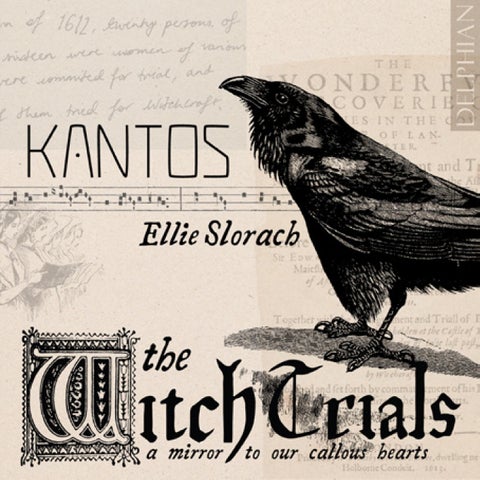
the
1 2
Plainchant Hildegard of Bingen (1098–1179)
Requiem aeternam Quia ergo femina
[1:11] [2:41]
Sarah Keirle-Dos Santos, Felicity Hayward, Eleonore Cockerham solos 3 4
a mirror to our callous hearts
Gregorio Allegri (1582–1652)
5
Ellie Slorach
Their names were … Miserere mei, Deus (verses 1–3, 17–20) Witch Demdike
[1:10] [5:36] [0:56]
Rachel Singer, Will Anderson speakers
director
6
Carlo Gesualdo (1566–1613)
7
O vos omnes Demdike: Killing by Witchcraft
[3:24] [1:00]
Rachel Singer, Felicity Hayward speakers 8
Anna Disley-Simpson (b. 1996)
Double, double toil and trouble * Witch Chattox
Barbara Strozzi (1619–1677)
Che si può fare, Op. 8 No. 6 **
[4:09]
Chattox Confesses
[1:28]
9
[2:39] [0:50]
Louise Ashdown, Jonny Maxwell-Hyde speakers 10
arr. Ellie Slorach (b. 1994) 11
Louise Ashdown, Sarah Keirle-Dos Santos & Josh McCullough speakers
William Byrd (1539/40–1623) Plainchant 14 Rory Wainwright Johnston (b. 1993) 12 13
15 16
Readings in tracks 3, 5, 7, 9, 11 and 15 from Thomas Potts, The Wonderfull Discoverie of Witches in the Countie of Lancaster … (London, 1613)
Giovanni Pierluigi da Palestrina (1525–1594) Camden Reeves (b. 1974)
17 18
Kantos Chamber Choir is incredibly grateful for the generosity of the many individuals and trusts who have supported the creation of this recording, including the Haworth Trust, Rundell Music Trust, Ivor Bolton CBE, Stephen Brosnan, Christine Davison, Ruth Evans, Irene Gibbons, H. Leggat, Penny & Andrew Peters, Lucy Rawcliffe, Ann Storey & Andrew Day, Susan Webster, and many who wish to remain anonymous.
19
Ave verum corpus Ave Maria Ave Maria * The Verdict Sicut cervus
[0:24] [3:11]
Spells, Remedies & Potions * I. Spells II. Remedies III. Potions
[3:13] [3:55] [9:31]
Pendle Hill
[4:19]
Eleonore Cockerham soprano solo
20
Camille Ralphs (b. 1992)
[4:10] [1:06] [4:31]
David Valsamidis speaker Recorded on 17-19 November 2025 in Hallé at St Michael’s, Ancoats, Manchester Producer/Engineer: Paul Baxter 24-bit digital editing: Jack Davis 24-bit digital mixing & mastering: Paul Baxter
Cover: Drew Padrutt/Ailsa Burns Design: Drew Padrutt Booklet editor: Henry Howard Photography: Ben Reason Delphian Records Ltd – Oxford – UK www.delphianrecords.com
21
www.delphianrecords.com
Plainchant
22
In paradisum Amen
Total playing time * premiere recordings ** premiere recording in this arrangement
[1:12] [0:16] [61:03]
Notes on the music How my whispered words make him pale and quake – does he believe they will strike him dead? — Mary Sharratt, Daughters of the Witching Hill (2011)
In 1612 twenty people in Lancashire were put on trial for the supposed crime of witchcraft. Twelve of these were accused at Pendle: one died in prison, and ten were executed; six of them were from the Chattox and Demdike families. An account of this trial and others in the local area, including the witch trials at Samlesbury, was written by Thomas Potts, a clerk at the Lancaster assizes, and published in 1613 as The Wonderfull Discoverie of Witches in the Countie of Lancaster. The spoken passages in this album come from Potts’ testimonies. While these have been somewhat disputed over time (Potts has been described as an ‘active’ yet ‘selective’ reporter of the events) the author’s zeal for the task is indicative of the feverish times. The belief that witchcraft was real had gained considerable traction by 1612. James VI of Scotland had published his Daemonologie in 1597, which represented witches as agents of the Devil: men or women who had renounced God, made demonic pacts, and used evil spirits to cause harm to humans, crops and the greater Christian commonwealth. For James, witchcraft was real and it was spiritual treason. Within a year of coming to the throne as James I of England he passed the Witchcraft Act of 1604.
Among the wider population the fear of witches was caused by a mix of superstition, religious anxiety and the belief that malevolent forces were the cause of misfortune. Many of the accusations in Lancashire and elsewhere arose from the supposed correlation between harsh words – or ‘curses’ – from one party, and illness, death or financial woes suffered by another. Belief that witchcraft was responsible for misfortune could escalate rapidly, especially in small or impoverished communities. Some of the Pendle accused were men, yet it was women – often elderly, poor, and widowed or otherwise single – who bore the brunt of the paranoia. In the introduction to a later edition of The Wonderfull Discoverie (published in 1745) James Crossley looked back with headshaking sorrow at the activities and moral landscape of the 1600s, particularly the behaviour of men. He suggests that anyone inclined to believe the ‘man is a glorious animal’ would have their views challenged by this ‘dark and dismal’ era. Women were victims of a ‘wretched and debasing bigotry’ while ‘man, tyrannizing over the sex he was bound to protect … seems lost in prejudice and superstition and only strong in oppression’. In Shakespeare’s Macbeth (1606), though its witches are depicted more as prophets than malicious spirits, the drama plays on the perceived threat of female power to male autonomy. As the literary critic Janet Adelman wrote in 1996, the witches – like
Lady Macbeth – represent ‘those looming female presences who threaten to control one’s actions, and one’s mind’. This album features a cackling version of the ‘toil and trouble’ chant from Macbeth, gleefully reinforcing this view. The last woman to be executed for witchcraft in the UK was Janet Thorne, burned to death in Dornoch, Sutherland, in 1727. In the years since, women who might have been designated witches began to be considered in a more thoughtful light, taking into account the societal imbalances and sexism at the root of many witch hunts. The link between psychological conditions, such as post-partum psychosis, and accusations of witchcraft has been explored in a recent film directed by Elizabeth Sankey (Witches, 2024) while the word ‘witch’ itself has been reclaimed as a term for female empowerment. Some historians might wince at this, given that most of the seventeenth-century accused were the least powerful in their communities. Nonetheless, there is a strain of emancipated ‘witchiness’ in both literature and in contemporary activist movements. In Pakistan the term for witches (‘churails’) is the name of a television drama and a symbol of feminist rebellion. In the US the annual ‘Trumpkin Smashing’ event – playful, but with serious intent - is described as a ‘witch-in’, including ‘spells’ for undermining the patriarchy.
There is, then, a great sympathy for the witches of the past, both for their historical plight and because witch hunts and debasing bigotries are still with us. This is at the centre of Jenni Fagan’s 2022 novel Hex, in which Iris, a modern-day medium, makes contact with an imprisoned woman on the eve of her execution for witchcraft at the end of the sixteenth century. During the course of their discussion, it turns out that some things haven’t changed (‘We look over our shoulders far too often’, remarks the modern-day medium. ‘We try to look bigger than we are sometimes. At other times we have to be smaller than we are’). A similarly empathic response is at the heart of this album, the subtitle of which is ‘A mirror to our callous hearts’. As in Hex, it is a compassionate dialogue with the past. Accordingly, works from the era of the witch trials sit alongside music written in the last few years. Ellie Slorach’s arrangement of Strozzi’s ‘Che si può fare?’ is an evocative blend of both periods. The texts elevate women, particularly the Virgin Mary, or in some way reflect their experiences, or the judgements made upon them by others. The music expresses yearning, pleading, anxiety, or even downright terror (though the witches themselves are having a whale of a time). Some of the works have gathered an air of mystery or secrecy over the years, such as the Allegri or the Byrd; others have pungent
Notes on the music and distinctive harmonies which seem to capture the unsettling atmosphere of the 1600s. The excerpts from Potts’ Wonderfull Discoverie remind us of the real-world stakes of the seventeenth century witch hunts while the musical numbers act as commentary, or consolation, or a form of comradeship with the plight of the Pendle ‘witches’. *** The sequence of tracks is structured, loosely, as a requiem mass for the dead, opening with ‘Requiem aeternam’ and closing with ‘In paradisum’. Both plainchant numbers are sung ruminatively, the voices improvising around the lines of the chant. Requiem aeternam is followed by one piece that sits outside the chronology of the others. Hildegard of Bingen’s Quia ergo femina (written in the 1100s) is a celebration and elevation of the Virgin Mary, characteristic of Hildegard’s female-centred form of mysticism. The text is sung by a soprano soloist while the other voices intone a monotone E. An additional F lends a touch of spicy dissonance as the text describes how ‘God was made human’ in Mary. Miserere mei, Deus as we know it today is attributed as ‘after’ rather than ‘by’ Allegri due to its historical and musical distance from its original version. Allegri was a priest and member of the Sistine Chapel choir in Rome and composed his Miserere in the 1630s to be
performed – exclusively in the Chapel – during Holy Week. Its particular type of ornamentation was never written down or published, and various tales about the piece and its origins have circulated over the centuries. The version most commonly performed today, with its spine-tingling high C in the solo quartet’s first soprano, dates from a version produced in 1950, itself a combination of other versions from the 1920s and the first published score from the 1770s. As such, it is only loosely related to whatever Allegri sang with his colleagues. Its thrill in performance is due not only to those high Cs, or the delicious ‘crunch’ of suspensions in the inner parts, but to it being a very beautiful piece of music that is not quite what it seems. O vos omnes, anther text associated with Holy Week, is an invitation to observe sorrow. In his setting of 1603 Gesualdo deploys his trademark startling chromaticism, with its woozy lurches from chord to chord. The composer Brett Dean has suggested that it is impossible to separate Gesualdo’s character and behaviour (he had murdered his first wife and her lover in 1590 and had a taste for self-flagellation) from his music; that his anarchic harmonies are part and parcel of his lived extremity. Later in his life, his second wife – infuriated by his endless infidelities – reported two of his mistresses to be tried for witchcraft. In this album, O vos omnes sits between two accounts of the ‘witch’ Demdike, which is presumably no coincidence.
The most famous witches in English literature hiss and whoop in Anna Disley-Simpson’s Double, double toil and trouble, taken from Act IV of Macbeth. They are going about their incantatory business when Macbeth arrives on the scene, asking for their prophecy regarding his fate. These witches do not resemble the unfortunate Demdikes or Chattoxes from Pendle, but are seer-like, suggestive of characters from Greek myth. For DisleySimpson, Shakespeare’s grisly litany of body parts lent itself to a ‘dark and playful’ setting. She imagined how this gruesome text would sound if sung like a ‘twisted nursery rhyme’.
England. Byrd – ‘stubbornly Catholic’ at a time when it was considered treason – had already been arrested for recusancy, or loyalty to the Catholic church. He managed to avoid further persecution due to the previous monarch’s fondness for his music, but his Latin settings were nonetheless confined to private meetings rather than the grandeur of the Chapel Royal. The modest proportions of his Ave verum reflects the small-scale forces for which it was composed, yet it packs a hefty emotional punch in its upward cries of ‘O Jesu’, and its poignant and deeply expressive harmonic clashes.
The text of Strozzi’s Che si può fare? is a narrative of suffering and of despair. The singer cannot breathe in this pitiless world and Ellie Slorach, who arranged the song for Kantos, dramatises this panicked breathlessness. The singers perform a richly harmonised version of the song yet periodically inhale and exhale, sharply, as if in terror. The basses, meanwhile, intone a ground bass of four descending notes, oblivious and relentless throughout. At the words ‘Le stelle rubelle/Non hanno pietà’ (The stars, intractable, have no pity) the lower voices double down the octave, sinking to the absolute depths of their range.
Two versions of the Ave Maria follow: the first is the plainchant, sung by tenors and basses; the second, a meditative response to the chant by Rory Wainwright Johnson. In the latter, the plainchant melody is dismantled into sparse utterances over a continuously held note in the sopranos. At its centre, though, is an elaboration on ‘Sancta Maria, mater Dei’ (Holy Mary, mother of God), the upper voices generating some sumptuous harmonies while the male singers chant the text below as if ‘priests in the sanctuary’, as Wainwright Johnson puts it. It is a solemn plea for peace for those who are about to die. The blunt ‘Verdict’ from the Pendle witch trial comes after. Palestrina’s Sicut cervus, a motet of intense beauty, was chosen for its yearning – thirst, indeed – for the consolations of the divine.
Byrd’s Ave verum corpus is similarly exquisite and similarly expressive of suffering. It was composed in 1605, only a few years after James I’s succession to the throne of
Notes on the music Camden Reeves’ Spells, Remedies & Potions takes us into an imaginary coven – or rather, a coven as might have been imagined by the authors of the 1487 Malleus Maleficarum, who claimed to have discovered the means of identifying witches. Reeves admits that his trio of incantations is partly tongue-in-cheek – he was reminded while reading the treatise of the absurd witch trial in Monty Python and the Holy Grail – but it has a serious point to make at the same time. In giving voice to ‘witches’, he is asking ‘Are these really witches? Or is this a projection of our own irrational fears and prejudices?’ Each movement is constructed around a hexachord (appropriately enough), comprising a sequence of six notes. The soprano voices imitate and heckle each other, often meeting for a semitone clash or, in ‘Remedies’, reaching an absolute fever pitch around a top A (they are also asked to sink down to a bottom A, somewhat outside the standard soprano range). In ‘Spells’ they whisper, with relish, that they resemble ‘beasts’. Their supposed powers are outlined in gleeful canon in ‘Potions’, from causing sterility to bringing on plague, to copulating with the devil and feasting on flesh. This final movement, the longest of the set, is a potent dramatisation of the fears projected onto women who were designated witches.
The solo soprano, having not participated in the rest of the ‘spells’, cuts through the hysteria to deliver an impassioned plea for mercy. The rest of the ensemble finally joins her. Before the concluding plainchant comes a recitation of Camille Ralphs’ ‘Pendle Hill’, taken from her collection Malkin (2015). ‘Pendle Hill’ is the opening poem, a lyrical call-and-response which asks where the accused now lie, each question answered by an echo, mostly a mishearing, of the final word. ‘Listen’, instructs Ralphs at the end, listen to their voices. The collective In paradisum, improvised in the same manner as the opening ‘Requiem’, is a plea for their souls’ rest. I say I am a witch, but it is not really what I believe. We are just women with power and skills and an innate knowledge. That’s what makes us scary. Who are we? We are many. — Jenni Fagan, Hex
© 2026 Lucy Walker Lucy Walker is a musicologist and writer specialising in twentieth- and twenty-firstcentury music. She has written extensively on Britten and is co-editor of Elizabeth Maconchy in Context (CUP, 2026).
Texts and translations 1 Requiem aeternam
Requiem aeternam dona eis, Domine, et lux perpetua luceat eis.
Lord, grant them everlasting rest, and let eternal light shine on them.
Introit at Mass for the Dead
2 Quia ergo femina
Quia ergo femina mortem instruxit, clara virgo illam interemit, et ideo est summa benedictio in feminea forma pre omni creatura, quia Deus factus est homo in dulcissima et beata virgine. Hildegard of Bingen
4 Miserere mei, Deus
Miserere mei, Deus, secundum magnam misericordiam tuam: et secundum multitudinem miserationum tuarum dele iniquitatem meam. Amplius lava me ab iniquitate mea: et a peccato meo munda me. Quoniam iniquitatem meam ego cognosco: et peccatum meum contra me est semper. [...] Quoniam si voluisses sacrificium, dedissem utique: holocaustis non delectaberis. Sacrificium Deo spiritus contribulatus: cor contritum et humiliatum Deus non despicies. Benigne fac Domine in bona voluntate tua Sion: ut aedificentur muri Jerusalem.
Tunc acceptabis sacrificium justitiae, oblationes et holocausta: tunc imponent super altare tuum vitulos. Psalm 50 (Vulgate): 3–5, 18–21 (51: 1–3, 17–20)
For since it was a woman who brought about death, a glorious virgin destroyed it, and therefore is the highest blessing beyond all creation in a woman’s form, for God was made human in the sweetest and blest virgin.
6 O vos omnes
O vos omnes qui transitis per viam, attendite et videte: si est dolor similis sicut dolor meus. Attendite, universi populi, et videte dolorem meum, si est dolor similis sicut dolor meus.
O all you who go by on the road, turn and see: if there is sorrow like the sorrow that is mine. Turn, all people, and see my sorrow, if there is sorrow like the sorrow that is mine.
Second responsory of the second nocturn at matins on Holy Saturday
8 Double, double toil and trouble
God, have mercy on me after your great mercy; and after the multitude of your mercies, blot out my wickedness. Wash me altogether of my wickedness: and clean me of my sin. For I recognise my wickedness: and my sin is against me at all times. […] Since if you had wanted a sacrifice, I would of course have given you one: but you do not delight in burnt offerings. A sacrifice to God is a troubled spirit: you, my God, do not look down on a contrite and downcast heart. Act kindly, Lord, out of your good will,
towards Sion: that the walls of Jerusalem may be built up. Then will you accept a sacrifice of righteousness, gifts and burnt offerings: then will they place bullocks on your altars.
Thrice the brinded cat hath mew’d. Thrice and once the hedge-pig whined. Harpier cries ’Tis time, ’tis time. Round about the cauldron go; In the poison’d entrails throw. Toad, that under cold stone Days and nights has thirty-one, Swelter’d venom sleeping got, Boil thou first i’ the charmed pot. Double, double toil and trouble; Fire burn, and cauldron bubble. Fillet of a fenny snake, In the cauldron boil and bake; Eye of newt and toe of frog, Wool of bat and tongue of dog, Adder’s fork and blind-worm’s sting,
Lizard’s leg and owlet’s wing, For a charm of powerful trouble, Like a hell-broth boil and bubble. Double, double toil and trouble; Fire burn and cauldron bubble. Scale of dragon, tooth of wolf, Witches’ mummy, maw and gulf Of the ravin’d salt-sea shark, Root of hemlock digg’d i’ the dark, Beaten horse’s bloodied shoe, Gall of goat, and slips of yew Silver’d in the moon’s eclipse, Sailor’s skulls from sunken ships, Finger of birth-strangled babe Ditch-deliver’d by a drab, Make the gruel thick and slab: Add thereto a tiger’s chaudron, For the ingredients of our cauldron.
Texts and translations 12 Ave verum corpus
Double, double toil and trouble; Fire burn and cauldron bubble. Cool it with a baboon’s blood, Then the charm is firm and good. William Shakespeare (1564–1616), Macbeth, Act IV, scene i, with additional lines by Jonathan Ainscough (b. 1985)
10 Che si può fare
Sì, sì, penar deggio, che darei sospiri, deggio trarne i respiri. Che si può fare? Le stelle rubelle Non hanno pietà. Che s’el cielo non dà Un influsso di pace al mio penare, Che si può dire? Da gl’astri disastri Mi piovano ogn’hor; Che si può dire? In aspri guai per eternarmi Il ciel niega mia sorte Al periodo vital Punto di morte. Gaudenzio Brunacci (1631–1669)
Yes, yes, I have to suffer, I must sigh, I must breathe with difficulty. What can you do? The stars, intractable, have no pity. Since the gods don’t give a measure of peace in my suffering, What can you say? From the heavens disasters keep raining down on me; Since that treacherous Cupid denies respite to my torture, what can I say? In order to eternalise my trials heaven withholds from me the final period of death to my lifespan. Translation © Richard Kolb barbarastrozzi.com/Cor Donato editions, with permission
Ave verum corpus natum De Maria Virgine, Vere passum, immolatum In cruce pro homine, Cuius latus perforatum Unda fluxit sanguine: Esto nobis praegustatum In mortis examine. O dulcis, O pie, O Jesu fili Marie Miserere nobis. First recorded in an Italian manuscript, 13th century
13/14 Ave verum corpus
Ave Maria, gratia plena, Dominus tecum. Benedicta tu in mulieribus, et benedictus fructus ventris tui Jesus. Sancta Maria, mater Dei, ora pro nobis peccatoribus nunc et in hora mortis nostrae. Amen.
16 Sicut cervus
Sicut cervus desiderat ad fontes aquarum, ita desiderat anima mea ad te Deus. Tract at Mass on Holy Saturday and at the pre-Tridentine Mass for the Dead; text from Psalm 41 (42), Psalterium Romanum: 1
Hail, true body, born of the Virgin Mary, Truly suffering, sacrificed upon the cross for mankind, from whose pierced side flowed a stream of blood: May you whom we have foretasted be there for us in the trial of our death. Sweet, loving Jesus, son of Mary, Have mercy on us.
Hail Mary, filled with grace, the Lord is with you. You are blessed among women, and blessed is Jesus, the fruit of your womb. Holy Mary, mother of God, pray for us sinners, now and in the hour of our death. Amen.
As the stag longs for springs of water, so does my soul long for you, my God.
Texts and translations 21 In paradisum
Spells, Remedies & Potions 17 I. Spells
With a mere touch of the hand, we cause abortions. We shall consume the dead. We cause bubonic plague, and spread disease. For we do copulate with devils, we fornicate with Satan. We drink from skin and eat the dead. We boil the flesh to make a soup to cast a spell. We boil and then consume the flesh to serve his deadly art. We blaspheme Christ and defile all the holy sacraments of Mass, abjure holy Mass. Kyrie eleison. Christe eleison. Kyrie eleison.1 And we shall burn. We must confess or we shall burn to damnation! JESUS NAZARENUS REX JUDAEORUM.2
Spells cast for those who are bewitched by being inflamed with inordinate love or extraordinary hatred. Spells cast for those who are bewitched for the limitation of the generative power. Spells cast by those who by prestidigatory art have lost, or have seemingly been transformed into the shapes of beasts.
18 II. Remedies
Remedies prescribed by Holy Church against Incubus and Succubus devils. Remedies cast against hailstorms and wild animals that are bewitched. Remedies cast for those who are possessed by evil charms and foul hexes. Remedies against the dark; against dark and horrid devils.
19 III. Potions
We cause hailstorms, we raise tempests. We bring sterility in men and animals. For the devils, we kill children, and for the children who are not baptised, we shall devour them. We can transport ourselves from place to place upon the air in body or imagination. We strike horses with madness, we cause trembling in the jawbone. We cause horror in the minds of those who would arrest us. We kill infants in the cradle.
1 Lord have mercy. Christ have mercy. Lord have mercy. 2
Jesus of Nazareth, King of the Jews. Texts freely adapted by the composer from Heinrich Kramer & Jacob Sprenger, Malleus Maleficarum, 1487 (in the English translation by the Revd Montague Summers, 1928)
In paradisum deducant te angeli; aeternam habeas requiem.
May angels lead you into paradise; may you have everlasting rest.
From the final antiphon at Mass for the Dead
Translations from Latin © Henry Howard
Biographies Kantos is a trailblazing vocal ensemble, performing at the cutting edge of the creative scene. We produce vocal performances, shaped by the music and stories we believe in. We think voices are a powerful gateway to our past, present and future, unveiling countless emotions, identities and experiences. The doors to our performances are always open to everyone, whether you’re a veteran concertgoer or seeking something new. Whether we’re performing in a factory space or a spiritual place, the concert hall or a nightclub, we’ll always deliver raw, stunning performances as the most ground-breaking, dynamic and creative vocal artists in the North of England, something that was recognised in 2025 with our first album, In Your Dreams (Delphian DCD34342), released to huge critical acclaim. Performing music by everyone from eleventhcentury visionary saints to genre-bending, experimental rock stars, Kantos prides itself on championing contemporary and wellknown choral music.
Kantos Ellie Slorach is an acclaimed conductor celebrated both in the UK – where she was shortlisted for the 2026 Royal Philharmonic Society Awards – and internationally for her exceptional versatility across orchestral and choral performances. Known for her professionalism and calm leadership in large-scale projects, she excels in integrating multimedia elements, including live music to film programmes. As a dedicated choral specialist, her work spans elite professional vocal ensembles and major symphonic choruses. She maintains a strong commitment to contemporary music, building close collaborative relationships with composers to conduct several world premieres of major new works alongside prominent ensembles and soloists. She co-founded Kantos Chamber Choir in 2015. Under her artistic direction, the choir has become widely recognised for its innovative, sell-out performances in diverse venues ranging from traditional concert halls to nightclubs.
Sopranos Saskia Bibb Emily Brown Gibson Eleonore Cockerham Felicity Hayward Sarah Keirle-Dos Santos Altos Louise Ashdown Jessica Conway Lorna Day Rachel Singer Tenors Will Anderson Jonny Maxwell-Hyde Timothy Peters Basses Sam Gilliatt Jonny Hill Josh McCullough David Valsamidis
In Your Dreams Kantos / Ellie Slorach DCD34342
DCD34213
Kantos Chamber Choir’s Delphian debut is an ambitious reimagining of the choral album as a single, immersive dreamscape. Drifting from the profound to the playful, the familiar to the surreal, In Your Dreams weaves together music, poetry and sonic fragments to explore sleep’s many dimensions. Kantos and its artistic director Ellie Slorach have together built a reputation for boundarypushing projects where concert programming meets theatrical storytelling: here, Shakespeare and Poe sit alongside Whitacre and Vaughan Williams, lullabies dissolve into subconscious murmurs and nonsense songs take on a dream logic of their own. The choir’s distinctive sound, shaped in Manchester’s vibrant vocal scene, finds new expressive extremes in a journey through the uncharted territory between waking and sleeping, sound and silence, sense and mystery.
Shibe’s second Delphian outing is a programme of radical contrasts that showcases virtuosity at both extremes. Where Dreams & Fancies paid homage to the guitar repertoire created by his great predecessor Julian Bream, softLOUD is a mix of electric and acoustic, early and modern, whose contradictions and challenges speak to our own times. The gentle beauty of Scottish lute manuscripts and of two short instrumental solos by James MacMillan is confronted by, and holds its own against, music by New York-based composers Steve Reich (a breathtaking new recording of the nowclassic Electric Counterpoint), Julia Wolfe – a work of cathartic grief and anger originally scored for nine bagpipes – and David Lang, whose electric violin work Killer is iron-clad in its abrupt fury.
‘represents everything one hopes for in contemporary choral artistry – a willingness to push boundaries whilst maintaining the highest musical standards’ — Yorkshire Times, June 2025 Battle Cry: She Speaks Helen Charlston mezzo-soprano, Toby Carr theorbo
Recordings of the Year 2022
Editor’s choice
softLOUD: music for acoustic & electric guitars Sean Shibe
Recordings of the Year 2019
2019 Finalist: Instrumental
Gramophone Awards 2019 – Winner: Concept Album
‘Sean Shibe has made one of the best recordings of Electric Counterpoint ever … I couldn’t take my headphones off’ — Steve Reich
Singing in Secret: clandestine Catholic music by William Byrd The Marian Consort / Rory McCleery
DCD34283
DCD34230
This powerful yet understated recital of seventeenth-century and modern works aims to revisit but also to re-balance the obsession of earlier music with female abandonment and lament. The stories of women such as Dido and Ariadne have been told and retold throughout history. Mezzo-soprano Helen Charlston reconsiders the assumed helplessness of those often seen as being left behind by male adventure and success. A recent work commissioned for Charlston from the composer Owain Park further takes up the challenge of giving ‘abandoned women’ their own platform, as well as exploring new possibilities for an instrumental pairing – that of voice and theorbo – that remains little explored in contemporary music.
In the turbulent religious climate of Elizabethan England William Byrd wrote – and, more audaciously, published – a huge amount of music for the Catholic rite, for services which he and his fellow Catholics had to celebrate clandestinely, in the private houses and chapels of sympathetic noblemen. The cloistered intimacy of those occasions is re-enacted in The Marian Consort’s performances here, and their programme also explores the more coded ways in which Byrd was able to express his faith and his commitment to the recusant cause.
‘surely one of the most exciting voices in the new generation of British singers’ — Gramophone, June 2022, EDITOR’S CHOICE
‘Perhaps the ideal consort for this repertoire, the Marians bring an intimate, individually passionate flavour to Byrd’s Latin works’ — Choir & Organ, May 2020
Alexander McCall Smith &Tom Cunningham:The Okavango Macbeth Beth Mackay, Rónan Busfield, Andrew McTaggart; Mr McFall’s Chamber / Michael Bawtree
House of Wonder: Sally Beamish celebrates 70 years Sally Beamish viola with friends and family DCD34333
DCD34296 (2 discs)
To mark her seventieth birthday, Sally Beamish returns to the instrument that has shaped her musical life: the viola. House of Wonder explores recent works written by Beamish for herself to play, alongside new pieces she has commissioned especially for this recording from her three children – themselves all accomplished musicians – and other close collaborators. Autobiography runs through the programme. Childhood memories surface in Crescent; poetry and jazz inflections shape the intimate cycle Night Songs; and tributes from friends and family expand the viola’s expressive world in unexpected directions. Contributions from Ryan Corbett, Joseph Havlat, Rosalind Ventris, Imogen Whitehead, Stephanie Irvine and the spoken voice of Beamish’s husband Peter Thomson create a circle of musical friendships around Beamish’s playing. Another crucial element is the viola made by Stephanie Irvine in 2014, which inspired her mother’s return to the instrument on which she had first made her career as a performer in the 1980s.
The Macbeth story as played out in a troupe of baboons? This fanciful idea inspired writer Alexander McCall Smith, who had already collaborated with composer Tom Cunningham on the choral song cycles The Painter’s Eye and Scotland at Night (recorded on Delphian DCD34060), with the idea for this unique chamber opera, set in the Okavango Delta in northern Botswana. It centres on the efforts of an ambitious female baboon, Lady Macbeth, to encourage her husband to murder the dominant baboon, Duncan. The opera was premiered in Botswana, in The No 1 Ladies’ Opera House which McCall Smith helped found as a venue for the many talented local singers there, before transferring to this, the first of two Scottish productions to date. ‘there aren’t enough new operas like The Okavango Macbeth out there, with instant appeal across the generations’ — BBC Music Magazine, January 2012
New in June 2026 everything you’ve ever lived Lotte Betts-Dean mezzo-soprano, Dimitris Soukaras guitar
Piazzolla: María de Buenos Aires Valentina Montoya Martínez, Nicholas Mulroy, Juanjo Lopez Vidal narrator, Mr McFall’s Chamber
DCD34348
Regular Delphian collaborator Lotte Betts-Dean has wowed critics with her ethereal, ‘starkly beautiful’ voice. Here, she teams up with outstanding Greek guitarist Dimitris Soukaras to present a terrific array of songs exploring ideas of nostalgia, childhood memory and the state between waking and sleep. Through borrowing, gathering and reimagining, this eclectic album wanders effortlessly through the creative spaces between genres, taking us from Ravel and Britten to Burt Bacharach and Sinéad O’Connor. ‘a varied and imaginative programme impeccably realised by two prodigiously talented young artists … That it works so well is down to the taste and artistry of both’ — Gramophone, November 2025
DCD34186 (2 discs)
Editor’s choice
According to Horacio Ferrer, author of the text for this unconventional ‘operita’, its highly poetic libretto was written ‘not to be understood, but to create emotion and atmosphere’. Piazzolla’s music, too, offers a charged mix of classical forms and Argentinian traditions – milonga, canyengue, tango, candombe, payada ... Mr McFall’s Chamber are joined by regular collaborators and by the narrator Juanjo Lopez Vidal in the work’s first major recording since the 1980s. ‘Rhythms are crisp and precise, and the pristine sound brings out plenty of sharply focused instrumental detail. Montoya Martínez, her voice earthy and lived-in, captures the defiance and vitality that drive María on ... Exhilaratingly done’ — Gramophone, January 2018
DCD34375