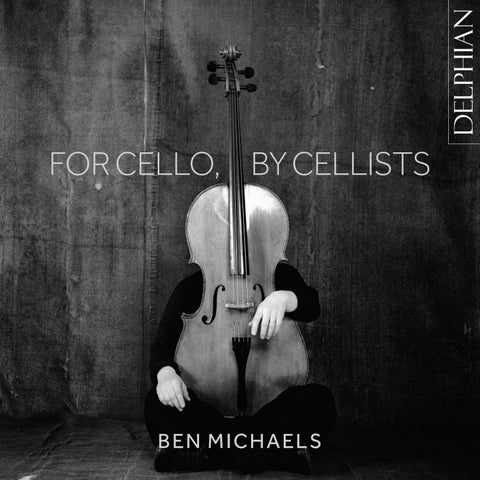
FOR CELLO, BY CELLISTS
BEN MICHAEL S
FOR CELLO, BY CELLISTS BEN MICHAEL S
1 Jakob Kullberg
Single the Sky: A Fever Dream (2024)
[8:05]
2 Laura Moody
Mandala (2024)
[9:54]
3 Ayanna Witter-Johnson
Amethyst Sings (2024)
[6:16]
4 Zoë Martlew
Inila (2023)
[11:53]
Kasei Valles (2023) (1) (2) (3)
[2:50] [2:38] [2:41]
Towards the Flame (2023) I II III IV
[5:37] [7:24] [2:19] [3:27]
Kit Downes 5 6 7
Colin Alexander 8 9 10 11
Total playing time The commissioning of the six works on this album and their recording was made possible by generous support from the Janatha Stubbs Foundation, the British Cello Society and the Marchus Trust. Recorded on 16-18 July 2025 at Robin Chapel, Edinburgh Producer/Engineer: Paul Baxter 24-bit digital editing: Jack Davis 24-bit digital mixing & mastering: Paul Baxter Session photography: Will Coates-Gibson / foxbrush
Artist photography & cover design: Emma Werner Booklet & digipack design: Eliot Garcia Booklet editor: John Fallas Delphian Records Ltd – Oxford – UK www.delphianrecords.com
www.delphianrecords.com @ delphianrecords @ delphian_records
Tracks 1–7 are premiere recordings
[63:12]
Notes on the music Speaking to me about this, his debut solo album, Ben Michaels started by saying that ‘the biggest thing about playing the cello is that at some point you must admit you are an artist, not just that you’re a cellist’. He commissioned six new works for the album, choosing artists for whom the cello just happens to be their chosen medium. Ben’s own voice is revealed through his performance of these new pieces for solo cello, written by cellists, celebrating how different artists use the same instrument to make their own music. Ben was not prescriptive in the way he commissioned the works, only asking for a new solo cello work from each composer and not specifying any other aspect, including duration. When the pieces arrived, many of them contained sounds and ways of moving around the instrument that Ben had never encountered before. I first met Ben in a composition workshop in which teenagers were allowed to ask him to try out any technique or sound they could dream up, so I can personally vouch that this isn’t for his lack of adventurousness up until this point. It’s a testament both to the varied originality of these composers, and to how much there still is to discover about the way the cello works. For soloist and teacher Jakob Kullberg, Single the Sky: A Fever Dream came out
of an improvisation inspired by the poem Speck by Peter Gizzi. It’s a short poem that somehow evokes the expanse of the sky, the tiny speck of a being who observes it, and much else in between in only six lines. As well as this beautifully stark text, Kullberg also drew inspiration from his experiences of lucid dreaming. Talking about himself as a composer, Kullberg mentions how improvisation comes naturally while writing something down is ‘terrifying’. You can feel the improvisatory nature of this work, but the deftness of Kullberg’s technique both as a composer and a cellist hangs in the delicacy of a piece that is somehow all about sound, and yet has a continuous sense of momentum that leads the listener in and through. Underlying the beauty and fragility of this work is a sense of the unsettling dream world it conjures. Before writing Mandala, Laura Moody went to hear Ben perform, and thought he seemed extremely composed in himself and deeply calm. He admitted to her afterwards that inside, he didn’t feel zen at all. This contrast between how Ben felt and how he appeared as a performer piqued her interest. Moody is a composer, often working in theatre, who thinks about music choreographically, and is interested by the bodies which play it. Before writing any notes for the current piece, she created
a mandala – an intricate drawing in a series of intersecting circles, often used to guide meditation. She describes moving her pencil instinctively whilst drawing, creating a choreography in her hand, and how these gestures began to create shapes on the page. Moody then translated each of these drawn shapes into gestures on the cello, each one akin to the eye moving through the shapes of the mandala. The piece is made up of these different sections, each with their own sounds and techniques created by the movement of cello and cellist. It also includes choreographed arm movements for the cellist (naturally, these are only fully perceived in live performance), and the piece as a whole could be described as a dance with the cello that makes sound. Ayanna Witter-Johnson’s Amethyst Sings is a lyrical work, packed full of tunes that make you want to sing them. This comes as no surprise, since its composer can often be heard singing whilst accompanying herself on the cello. She’s been described as blending classical, jazz, reggae, soul and R&B, and while that is one way of describing what you hear here, all of those influences are filtered through her own voice to be something utterly new and personal. It’s a work full of rhythmic grooves, delicate moments, col legno ricochets that require the cellist to virtuosically shoot to the tip of
the bow, slaps on the body of the cello, and more, and yet through all the invention, the structure is simple and effective: chorus and verse with a cadenza in the middle. Talking with Ben about the cello, Witter-Johnson commented that ‘it can do almost anything’, but it’s the variety in texture that keeps her fascinated. The title comes from the amethyst as a metaphor for looking at something beautiful, and finding that the more you look at it, the more beauty you see. Zoë Martlew has, in her own words, ‘always trod an exploratory path with the cello’, and that sense of adventure is at the forefront in Inila. In this work, Martlew pushes us furthest away from what we might imagine a cello to sound like. Sounds of whistling, swirling breath that feel almost like a close-up texture of bow hair – created by bowing clothes pegs attached to the strings – lead us into the work’s sound world. Out of this bed of sound, whispered notes, overtones, slow circles of the finger tips on the wood of the cello and pizzicato punctuation begin to emerge. It’s a very tactile, intensely quiet work, and Ben describes his feeling that in playing it live, the performer gets to experience the work in all its detail: that the piece is almost like a private investigation into the cello and its sounds. On this album, one feels that the detailed, close recording allows the listener almost to hear inside the cellist’s head.
Notes on the music Martlew was inspired to write the piece by an experience in Iowa, in an ancient landscape she describes as ‘shimmering with a force field of silence’. There’s a sense of the ancient and the epic here, with extreme scordatura (detuning of the strings) below microtonal resonances created by the cello’s preparation with clothes pegs. Talking about Inila, Ben remarks that ‘no one but a cellist could have written that piece’. On first listening to the work Ben commissioned from Kit Downes, I wrote a note to myself that it was understated and honest in its simple clarity, gently subversive, suffused with jazz and Bach, and that everything felt almost familiar but slightly unexpected. Learning more about the work, I found out that the title refers to absolutely enormous valleys on Mars – familiar to us earthly beings, but also quite literally alien. Downes is known as a jazz musician who plays solo pipe organ, piano and harmonium improvisations, but he grew up playing cello, and describes writing on and for cello as having a fuzzy familiarity which is quite conducive to a state of creative flow. The work consists of three short pieces, and came into being while Downes was injured with a broken wrist. Every morning while he only had the use of one hand, he would write himself a study or a sketch on the piano, and in the time since then, he’s transformed three
of these sketches into the present collection, Kasei Valles (1–3). The album ends with the exquisitely beautiful Towards the Flame by Colin Alexander. Although Alexander deals with large swathes of time in this work, the structure and shape of each of the movements feels both meticulously crafted and totally organic. His commitment to sound draws the listener into a sense of intense meditative concentration, a focus that feels resonant with the image of a flame in the work’s title. Each new movement picks up the beginning of the sound world the previous one ends on, and takes us off into its own new space. Alexander describes each of the four movements as a different view of fire: a slow explosion, the burning embers, a private prayer and a fire dance. The score is handwritten, and Alexander talks about the slow process of writing as starting from the top and ‘uncovering it along the way’, as if the piece was already there, waiting to be revealed. When you get to know a piece by someone, you get a sense of the things they listen for or pay attention to, what they avoid, and perhaps something about how it is to be alive as that person. An album like this, of music for cello written by cellists, draws the composers, the performer and the listener
even closer in musical intimacy towards that shared understanding. I remember a cellist and PhD candidate in a seminar I was once part of who was studying fingerings in the Italian cellist Alfredo Piatti’s scores, describing how much he learned through physically moving his hands the way the great master had once moved his own. What Ben has created in this album is, of course, more than a cello lesson for future cellists. In the commissioning of this collection of works and its interpretation by a single performer, the physical, technical, musical and artistic are deeply interlinked. © 2026 Freya Waley-Cohen
Freya Waley-Cohen is a British-American composer who currently lives in London. Her music is performed around the world by orchestras, opera companies, ensembles and soloists.
Biography Ben Michaels is a British cellist based in London, passionate about exploring all the ways the cello can be made useful to music. Grateful for a musical life in which collaborations continually shape his way of playing, he is equally likely to be found performing on historical, modern or prepared instruments. In the year between recording and releasing this album, he performed Baroque opera with The English Concert, Berlioz with Simon Rattle and the Orchestra of the Age of Enlightenment, Mozart piano concertos with András Schiff and the Chamber Orchestra of Europe, and world premieres with London Sinfonietta at the Festival Internacional Cervantino in Mexico. He is committed to celebrating the creation of new music, regularly working with composers to premiere or commission new works. In order to pursue contemporary projects, he was awarded the inaugural Keith Harvey Award by the British Cello Society in 2022. Three years later he was invited to become an executive board member of the Society, where he aims to encourage other cellists to explore new music.
Before playing alongside inspiring colleagues, Ben studied at the Royal Academy of Music, where he had regular lessons with Felix Schmidt, John Myerscough and Joseph Crouch. Long before making the decision to study and follow his passion in music, he was particularly thankful for the patience of his father, Joel Michaels, who taught him until he was a teenager. for cello, by cellists is recorded on two instruments: a Gaetano Gadda (1936) generously provided on loan by an anonymous benefactor and an unnamed French cello (c.1860) once belonging to Ben’s father.
Also available on Delphian
Shortlisted –Vocal
Héloïse Werner: close-ups Héloïse Werner and friends
Painted Light Solem Quartet, Ayanna Witter-Johnsonr voice
DCD34312
DCD34308
Héloïse Werner’s first album, Phrases – released on Delphian in June 2022 – was received ecstatically. For her second, she wanted to create a programme with a cohesive narrative arc – a journey, but one that the listener can take in their own time and their own way. For it, she has assembled a group of musicians who share in her concept but also bring to the project their own varied musical personalities to complement Héloïse’s distinctive voice. These collaborators – Colin Alexander, Julian Azkoul, Max Baillie, Kit Downes, Ruth Gibson and Marianne Schofield – stitch their individual contributions into close-ups in colours just as vibrant as Héloïse’s own.
This inventively curated album from the ever-exploratory Solem Quartet presents music that is awash with colour. The refined beauty of Edmund Finnis’s Devotions and stained-glass luminosity of Camden Reeves’s The Blue Windows are complemented by works by Lili Boulanger and Henriëtte Bosmans from the early twentieth century, when the depth and vividness of colour in Impressionist paintings seemed to spill into music. A sense of awed wonder before the natural world informs Ayanna Witter-Johnson’s Earth, for which the Quartet is joined by the composer as vocalist, while Joni Mitchell’s Both Sides Now – heard here in an arrangement by the Quartet’s violinist William Newell – provides a delicate lesson in perspective.
‘jaw-dropping technical agility combined with an innate, instinctive musicality and boundless, breathless creativity’ — Gramophone, August 2024
‘Solem Quartet have produced a thing of beauty … catches your breath for all the right reasons’ — dCS: Only the Music, Classical Choices, October 2023
Beyond Twilight: music for cello & piano by female composers Alexandra Mackenzie, Ingrid Sawers
Beau Soir: Debussy | Satie | Ravel | Poulenc Maciej Kułakowski cello, Jonathan Ware piano
DCD34306
DCD34277
Furthering their longstanding interest in unfamiliar repertoire, cellist Alexandra Mackenzie and pianist Ingrid Sawers have unearthed for this album a treasure trove of short pieces by female composers, some hiding behind bland initials such as ‘A. E. Horrocks’. Dating from the 1880s to the 1950s, these intimate, quietly powerful works include miniatures by the Scottish cellist Marie Dare and two delightful songs by Gwendolen (later Avril) Coleridge-Taylor, here newly transcribed for cello. A total of fourteen works are presented, all but five in premiere recordings.
Acclaimed young cellist Maciej Kułakowski is partnered by pianist Jonathan Ware in an all-French recital programme that mingles the familiar with the reimagined. Elements of ‘Spanish’ style, blues and jazz, and the ironic humour of the Parisian café, encountered in sonatas by Debussy, Poulenc and Ravel (Kułakowski’s cello rendering of the latter’s second violin sonata), are echoed in a brace of shorter works that includes several further transcriptions – of three short pieces by Debussy and of Satie’s Trois Gnossiennes.
‘From a shimmering “Shieling Song” to a shaded sea shanty, Mackenzie plays with appropriate panache’ — BBC Music Magazine, Christmas edition 2023
‘Cellist and pianist convey the meaning of every crescendo or change of tempo, however minimal, proving that tiny details can have huge effects ... The “wackiness” of Debussy, Ravel and Poulenc has rarely been better demonstrated’ — BBC Music Magazine, December 2022, FIVE STARS
DCD34371