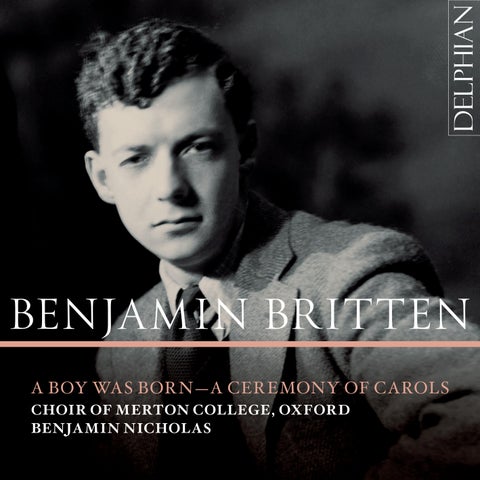
Benjamin britten A BOY WAS BOR N—A CEREMONY OF CAROLS CHOIR OF MERTON COLLEGE, OXFORD BENJAMIN NICHOLAS
Benjamin britten
A Ceremony of Carols, Op. 28 *
(1913 –1976) CHOIR OF MERTON COLLEGE, OXFORD THE GIRL CHORISTERS OF MERTON COLLEGE, OXFORD ** BENJA MIN NICHOLAS
A boy was born, Op. 3
1 Procession
[1:54]
15 Theme: A boy was born
[2:10]
2 Wolcum Yole!
[1:32]
16 Variation I: Lullay, Jesu **
[4:47]
3 There is no rose
[2:45]
17 Variation II: Herod
[2:29]
4 That yongë child
[2:05]
18 Variation III: Jesu, as
[2:35]
Thou art our Saviour
solo: Divine Simbanegavi 5 Balulalow
Cecily Beer harp * François Cloete organ †
[1:29]
solo: Imogen Dowse 6 As dew in Aprille
[1:09]
7 This little babe
[1:36]
8 Interlude
[4:46]
9 In freezing winter night
[4:09]
solos: Evie Holder, Anneka Vetter 10 Spring Carol
[1:21]
solos: Alice Fisher, Estella MacLaren
The Choir of Merton College, Oxford gratefully acknowledges the generosity of The Reed Foundation. With thanks to the Warden and Fellows of the House of Scholars of Merton College, Oxford Recorded on 30 June & 1 July 2025 and 25 March 2026 in the Chapel of Merton College, Oxford Producer/Engineer: Paul Baxter 24-bit digital editing: Jack Davis 24-bit digital mixing & mastering: Paul Baxter Design: John Christ Booklet editor: Henry Howard
Cover photograph: Howard Coster, Benjamin Britten, 1930s. © National Portrait Gallery, London Session photography: Will Coates-Gibson/foxbrush Delphian Records Ltd – Oxford – UK www.delphianrecords.com
delphianrecords.com @ delphianrecords @ delphian_records
11 Deo gracias
[1:22]
12 Recession
[2:01]
13 A Hymn to the Virgin
[3:21]
Verity Sawbridge soprano, Anneka Vetter alto, Kasper Lootens tenor, Tristan Wigley bass 14 A Shepherd’s Carol
Alice Fisher soprano, Anneka Vetter alto, Kasper Lootens tenor, Tristan Wigley bass
[4:30]
Isabella Aravejo treble 19 Variation IV: The Three Kings
[4:25]
20 Variation V: In the bleak
[4:58]
mid-winter ** 21 Variation VI – Finale: Noël! **
[9:55]
Prelude & Fugue on a Theme of Vittoria † 22 Prelude
[1:29]
23 Fugue
[3:34]
24 Festival Te Deum, Op. 32 †
[6:44]
Harriet Twigger-Ross soprano
Total playing time
[77:20]
Notes on the music In his diary entry on Christmas Day 1929, Britten wrote, ‘There is no time in all the year like Christmas, with all its carols & business, bustling and arguments, and it is my favorite [sic] time in the year.’ While evidently a fan of the festive season at the age of sixteen, there is plenty of musical evidence to suggest this remained the case throughout his life. In Britten’s archive there is a very early effort composed in 1923 (when he was ten), grandly titled Christmas Symphony, written for piano and ‘instruments’ and lasting no more than seven bars. Decades later in the 1970s, he started work on an ambitious, multi-evening Christmas Sequence based on the Chester Miracle Plays (though this project was sadly unachieved). In between were two largescale meditations on the nativity, carols from a planned Christmas Oratorio based on a poem by W.H. Auden, a narrative of Saint Nicolas, many carols (including a Ceremony of them), and sundry other works associated with either Advent or the Christmas period. This album features two of the most substantial: A Ceremony of Carols from 1942 and A boy was born from 1933, plus ‘A Shepherd’s Carol’ from the planned Christmas Oratorio. A Hymn to the Virgin is not technically Christmassy, but its references to the birth of Christ associates it with the nativity. Though less seasonal, the Festival Te Deum and
Prelude & Fugue on a Theme of Vittoria, from the same period as A Ceremony of Carols, make fascinating musical complements to the rest of the repertoire. The programme therefore draws on music from two distinct and fascinating periods of Britten’s life. The first, from 1930 to 1933, found Britten leaving school, attending the Royal College of Music and getting published and broadcast for the first time. The second period, from 1942 to 1946, saw his return from the US and a feverish period of creativity that included A Young Person’s Guide to the Orchestra and, with Peter Grimes, the launching of a post-war British operatic scene. Collectively, these choral works reveal a composer hard at work to refine his musical voice and to ensure that the result was performable by choirs. As one who set very high standards, both for himself and others, Britten would periodically grumble about what he considered to be the low level of professionalism among British musicians. But he had more respect for the tradition of British choral music which had remained in robust health for centuries. This perhaps explains the complexity of some of his choral music – A boy was born is a case in point – but also the rewarding challenges of the more straightforward pieces, such as A Ceremony of Carols.
Ultimately, Britten’s aim was to write music that was as characterful as it was ‘useful’, and that would serve a community. To write for a choir was, in many ways, the perfect means of realising this ambition.
two choirs combine in the same musical space. The final word, ‘effecta’, is sung by both choirs then repeated in a spine-tingling final moment by the ‘Latin’ choir, leaning into its exquisitely suspended cadence.
———
A boy was born was completed in 1933 in Britten’s final year at the Royal College of Music, and is generally acknowledged to be one of his most challenging choral works. Apart from the demands made on the SATB choir, the piece requires an extra choir of trebles (this was in fact an aspect that appealed to Benjamin Nicholas, as it allowed Merton College’s girls’ choir to take part in this album). It was first performed in a BBC broadcast on 23 February 1934 by The Wireless Singers, along with the choirboys of St Mark’s, North Audley Street.
Britten composed A Hymn to the Virgin in July 1930 during his final months at Gresham’s School in Holt, confined to bed with illness in the school sanatorium. Having been denied manuscript paper by the matron, Britten was reduced to drawing lines on writing paper, and this first, somewhat wobbly draft is broadly the same as the published version. The result is a beautifully constructed anthem, drawing its English and Latin text from the 1919 Oxford Book of English Verse. It is not clear whether Britten wrote it in anticipation of a performance, though Gresham’s did indeed have a choir (indeed, Britten sang alto in it until his voice broke in early 1929). But it has become a choral staple since its publication in 1935. The Latin lines are continuations, amplifications or echoes of the English phrases, providing a highly effective structure for Britten’s setting in which the main choir is echoed by a smaller group. The first two verses are along the same musical lines, but the tempo and volume increases in the third where the
The seven movements follow a themeand‑variation format, one of Britten’s favourite compositional devices. The theme in the opening movement is extremely simple: a four‑note ‘cell’ setting the words ‘A boy was born’ at the start and ‘Alleluia’ at the end. The variations are based on this four-note sequence, and particularly on its rise and fall of thirds. The ruminative quality of each movement – at times soothing, at others bordering on obsessive – is derived from the repetition and return to elements of the theme. In the first variation (‘Lullay, Jesu’)
Notes on the music undulating thirds form the rocking lullaby of the whole movement, amplified further by the sighing ‘lullays’ which are repeated throughout. By contrast, the repeated ‘Noëls’ in Variation II (‘Herod’), also derived from the downward third, become increasingly hectic. In Variation III (‘Jesu, as Thou art our Saviour’) the choir is anchored to a meditative B throughout, while the theme is concealed within the treble solo. In Variation IV (‘The Three Kings’) the theme is transformed into rapidly flowing quavers while the poem is declaimed in bursts above and below (with a callback to the ‘Noëls’ of Variation II at the mention of ‘Herod, that moody king’). There is a mesmeric quality to Variation V (‘In the bleak mid-winter’), a haunting setting of the Corpus Christi Carol intercut with dreamlike fragments of Christina Rossetti’s poem. As the treble choir sings the Carol the choir’s grip on Rossetti’s text disintegrates further, reduced to a fixation on the words ‘snow on snow on snow on snow’. This variation is one of the most purely beautiful passages of music Britten ever wrote, a demonstration of his particular sensitivity and skill in writing for high voices. Variation VI (‘Finale’) is the longest by some distance and resembles at times a kind of fever dream of the previous movements. Swerving from key to key, the choir takes repetition
to a new level, with fixations on ‘Noël’, ‘Wassail’, ‘Good day’ and ‘Sir Christëmas’ leading to a brisk canter through Thomas Tusser’s poem. The frantic ‘Noëls’ take over once more, building to an exhilarating sense of mayhem, before a call to order by the main theme at ‘Glory to God on high’. What follows is, for the most part, a decorous and rousing conclusion before a final ‘Noël’.
by Alec Robertson, an expert on Gregorian chant. The original opening movement was in fact itself called ‘Hodie Christus natus est’ but was discarded in favour of the gloriously welcoming ‘Wolcum Yole’, composed after Britten’s return to the UK. The alto solo ‘That yongë child’ was also written later, sometime in 1943, as was the harp interlude which is also based on the plainchant melody.
Composed some nine years later, A Ceremony of Carols has quite the backstory. It begins in Halifax, Nova Scotia in March 1942. Britten and his partner Peter Pears were heading back to the UK having spent a formative, sometimes turbulent three years in North America. While hanging around in Halifax before leaving, Britten bought a book called The English Galaxy of Shorter Poems, in which he found several of the texts for A Ceremony of Carols. Armed with this, he began to write the piece on board ship which helped – as he wrote to his friend Elizabeth Mayer – to ‘alleviate the boredom’ (he seems not to have been troubled by the very real danger of U-boat attacks). The work underwent several revisions between the Atlantic crossing, the premiere in Norwich Castle on 5 December 1942, and the version performed today. There was, first of all, no plainchant ‘Procession’ or ‘Recession’. These were added in the winter of 1942/3, and are based on the plainchant ‘Hodie Christus natus est’ sent to Britten
A Ceremony of Carols in its final form is a beguiling combination of mood pieces structured elegantly into two halves with the interlude in the middle. The two playfully vigorous carols – ‘This little babe’ and ‘Deo gracias’ – are placed at the end of each half: the former is a tongue-twisting, ferocious round, while ‘Deo gracias’ is a rhythmically punchy, hectic gallop towards its conclusion. In between are carols of a somewhat unsettling character, such as ‘That yongë child’, with its discordant harmony and spare accompaniment, and ‘In freezing winter night’, chilly with rattling harp trills and ghostly humming. Others are charm itself: the rocking lullaby of ‘Balulalow’, the celebratory choruses and rounds of ‘As dew in Aprille’, and the solo voices of ‘Spring Carol’, weaving sweetly in and out of each other’s lines. Harpists are perennially grateful to this piece, not only for its reliable-as-clockwork appearance every Christmas, but also
for the careful way Britten wrote for the instrument. He had, fortunately, some recent experience to draw on. While living in the US, he was approached by Edna Phillips, the principal harpist of the Philadelphia Orchestra, to write a concerto for her. While he didn’t get around to it in the end, he did acquire a harp manual which stood him in excellent stead for A Ceremony of Carols, especially its interlude in the harp’s ‘home key’ of C flat major. Edna Philips was later quoted as saying: ‘[Britten] used the harp in such an original and wonderful way in [A Ceremony]. It really doesn’t matter that he didn’t accept our commission. That is a great work for harp.’ With Britten’s return to the UK, he and W.H. Auden more or less stopped speaking. Inseparable friends for a heady five or so years, including a wildly bohemian house-share in Brooklyn, their collaboration ground to a halt in 1942. Two years later, however, Auden sent Britten the lengthy poem A Christmas Oratorio, of which Britten set only two sections, A Shepherd’s Carol and ‘Chorale after an Old French Carol’. The former, in a ‘call-and-response’ style, has a distinctly American twang, a legacy of the Britten/ Auden American opera Paul Bunyan. In between the gentle verses, the shepherd’s more free-ranging song rises through the solo vocal parts, from bass up to soprano.
Notes on the music Britten composed the Festival Te Deum in the same year, for St Mark’s, Swindon. It is also unusual in Britten’s catalogue in being so unequivocally jolly (it was perhaps written as a respite from gloom during the composition of Peter Grimes). It is in three sections with a sharing of musical material between the first and third: a chant-like, free-flowing vocal line over a regular pulse of dotted minims in the organ. Having sung the first part in octave unison, or simple canon, the voices begin to harmonise in the dancing middle section. In the final part the organ’s dotted minims resume under a lyrical soprano solo, followed by some luxurious harmonies for the choir while the organ pedal riffs on the opening chant melody. This uncomplicatedly sunny work concludes with a soprano solo, and a soft E major chord. The latest piece recorded here, Prelude & Fugue on a Theme of Vittoria, is for solo organ, and thus a very rare creature in Britten’s catalogue (among the few other
Texts and translations organ works is a Passacaglia, written in the same sick-bed session as A Hymn to the Virgin). It was composed for another parish church, St Matthew’s in Northampton, in 1946 and is based on a theme from Tomás Luis de Victoria’s motet Ecce sacerdos magnus (1585). This theme is the basis of the opening Prelude as well as the intricate Fugue, and Britten handles the counterpoint in both with his usual aplomb. The Prelude is grand and a little austere, while the Fugue builds from an atmosphere of fragility into increasing complexity, the theme at times doing battle with gnarly passages of dissonance. It concludes, however, in an atmosphere of great serenity. © 2026 Lucy Walker Lucy Walker is a writer and musicologist. For many years she worked at The Red House, Britten’s former home in Aldeburgh (now part of Britten–Pears Arts) and has written widely on the composer’s life and music.
A Ceremony of Carols, Op. 28 1/12 Procession / Recession
Hodie Christus natus est: hodie Salvator apparuit: hodie in terra canunt angeli: laetantur archangeli: hodie exsultant justi dicentes: gloria in excelsis Deo. Alleluia! Alleluia! Alleluia! Magnificat Antiphon at Second Vespers of Christmas
Today Christ is born: today appears the Saviour: today the angels sing on earth: the archangels rejoice: today the righteous exult and say: glory to God in the highest. 2 Wolcum Yole!
Wolcum be thou hevenè king, Wolcum Yole! Wolcum, born in one morning, Wolcum for whom we sall sing! Wolcum be ye, Stevene and Jon, Wolcum, Innocentes every one, Wolcum, Thomas marter one, Wolcum be ye, good Newe Yere, Wolcum, Twelfthe Day both in fere, Wolcum, seintes lefe and dere, Wolcum Yole, Wolcum Yole, Wolcum! Candelmesse, Quene of bliss, Wolcum bothe to more and lesse.
Wolcum be ye that are here, Wolcum Yole, Wolcum alle and make good cheer, Wolcum alle another yere. anon., 14th century
3 There is no rose
There is no rose of such vertu As is the rose that bare Jesu. Alleluia. For in this rose conteinèd was Heaven and earth in litel space, Res miranda. By that rose we may well see There be one God in persons three, Pares forma. The aungels sungen the shepherds to: Gloria in excelsis Deo! Gaudeamus. Leave we all this werldly mirth, And follow we this joyful birth. Transeamus. anon., 14th century Res miranda – a wondrous thing; Pares forma – equal in form; Gloria in excelsis Deo – Glory to God in the highest; Gaudeamus – let us rejoice; Transeamus – let us cross over
Texts and translations 4 That yongë child
6 As dew in Aprille
That yongë child when it gan weep With song she lulled him asleep: That was so sweet a melody It passèd alle minstrelsy. The nightingalë sang also: Her song is hoarse and nought thereto: Whoso attendeth to her song And leaveth the first then doth he wrong.
I sing of a maiden That is makèles: King of all kings To her son she ches.
anon., 14th century
He came al so stille To his moder’s bour, As dew in Aprille That falleth on the flour.
gan – began to
5 Balulalow
He came al so stille There his moder was, As dew in Aprille That falleth on the grass.
O my deare hert, young Jesu sweit, Prepare thy creddil in my spreit, And I sall rock thee to my hert, And never mair from thee depart.
He came al so stille There his moder lay, As dew in Aprille That falleth on the spray.
But I sall praise thee evermoir With sanges sweit unto thy gloir; The knees of my hert sall I bow, And sing that richt Balulalow.
Moder and mayden was Never none but she: Well may such a lady Goddes moder be.
James, John and Robert Wedderburn (c.1548)
anon., c.1400
creddil – cradle; spreit – spirit; gloir – glory
makèles – matchless, virginal; ches – chose; bour – bower
7 This little babe
This little babe so few days old, Is come to rifle Satan’s fold; All hell doth at his presence quake, Though he himself for cold do shake; For in this weak unarmed wise The gates of hell he will surprise. With tears he fights and wins the field, His naked breast stands for a shield; His battering shot are babish cries, His arrows looks of weeping eyes, His martial ensigns Cold and Need, And feeble Flesh his warrior’s steed. His camp is pitchèd in a stall, His bulwark but a broken wall; The crib his trench, haystalks his stakes; Of shepherds he his muster makes; And thus, as sure his foe to wound, The angels’ trumps alarum sound. My soul, with Christ join thou in fight; Stick to the tents that he hath pight. Within his crib is surest ward; This little babe will be thy guard. If thou wilt foil thy foes with joy, Then flit not from this heavenly Boy. Robert Southwell (?1561–1595)
9 In freezing winter night
Behold, a silly tender babe, In freezing winter night, In homely manger trembling lies. Alas, a piteous sight! The inns are full; no man will yield This little pilgrim bed. But forced he is with silly beasts In crib to shroud his head. This stable is a Prince’s court, This crib his chair of State; The beasts are parcel of his pomp, The wooden dish his plate. The persons in that poor attire His royal liveries wear; The Prince himself is come from heaven; This pomp is prizèd there. With joy approach, O Christian wight, Do homage to thy King, And highly praise his humble pomp, Wich he from Heaven doth bring. Robert Southwell
Texts and translations 10 Spring Carol
13 A Hymn to the Virgin
Pleasure it is to hear iwis, the birdès sing, The deer in the dale, the sheep in the vale, The corn springing. God’s purveyance for sustenance. It is for man. Then we always to him give praise, And thank him than. William Cornysh (d. 1523) than – then
11 Deo gracias
Deo gracias! Adam lay ibounden, bounden in a bond; Four thousand winter thought he not to long And all was for an appil, an appil that he tok, As clerkès finden written in their book. Ne had the appil takè ben, the appil takè ben, Ne hadde never our lady a ben hevenè quene. Blessed be the time that appil takè was. Therefore we moun singen. Deo gracias! anon., 15th century Deo gracias – thanks be to God
12 see track 1
Of one that is so fair and bright Velut maris stella as the star of the sea Brighter than the day is light, Parens et puella: mother and maiden I cry to thee, thou see to me, Lady, pray thy Son for me, Tam pia, so loving That I may come to thee, Maria! Mary All this world was forlorn Eva peccatrice, through the sin of Eve Till our Lord was yborn De te genetrice. of you his mother With ave it went away hail Darkest night, and comes the day Salutis; of salvation The well springeth out of thee Virtutis. of virtue Lady, flow’r of ev’rything, Rosa sine spina, rose without a thorn Thou bare Jesu, Heaven’s King Gratia divina: by God’s grace Of all thou bear’st the prize, Lady, queen of paradise Electa: chosen one Maid mild, mother es Effecta. you have become Anon. c.1300
14 A Shepherd’s Carol Text copyright W.H. Auden (1907–1973)
A boy was born, Op. 3 15 A boy was born
A boy was born in Bethlehem; Rejoice for that, Jerusalem! Alleluya. He let himself a servant be, That all mankind he might set free: Alleluya. Then praise the word of God who came To dwell within a human frame: Alleluya. Anon., 16th century
16 Lullay, Jesu
Mine own dear mother, sing lullay! Lullay, Jesu, lullay, lullay! So blessed a sight it was to see, How Mary rocked her son so free; So fair she rocked and sang ‘by-by’. ‘Mine own dear son, why weepest thou thus Is not thy father King of bliss? Have I not done that in me is? Your grievance, tell me what it is.’
‘Therefore, mother, weep I nought, But for the woe that shall be wrought To me, ere I mankind have bought. ‘Ah, dear mother! Yet shall a spear My heart in sunder all to-tear; No wonder though I careful were. ‘Now, dear mother, sing lullay, And put away all heaviness; Into this world I took the way, Again to heaven I shall me dress, Where joy is without end ay.’ Anon., before 1536
17 Herod
Noël! Herod that was both wild and wode, Full much be shed of Christian blood, To slay the Child so meek of mood, That Mary bare, that clean may. Herod slew with pride and sin Thousands of two year and within; The body of Christ he thought to win And to destroy the Christian fay. Mary with Jesu forth yfraught, As the angel he taught, To flee the land till it were sought, To Egypt she took her way.
Texts and translations Now Jesus that didst die for us on the Rood, And didst christen innocents in their blood, By the prayer of Thy mother good, Bring us to bliss that lasteth ay.
They took their leave, both old and ying, Of Herod, that moody king; They went forth with their offering by light-a, By the star that shone so bright-a.
Anon., before 1529
Till they came into the place, Where Jesus and His mother was, Offered they up with great solace in fere-a Gold, incense, and myrrh-a.
may – maid; fay – faith; yfraught – burdened; ay – forever
18 Jesu, as Thou art our Saviour
Jesu, Jesu, Jesu, Jesu. Save us all through Thy virtue. Jesu, as Thou art our Saviour That Thou save us fro dolour! Jesu is mine paramour. Blessed be Thy name, Jesu. Jesu was born of a may, Upon Christëmas Day, She was may beforn and ay, Blessed be Thy name, Jesu. Anon., 15th century
19 The Three Kings
There came three kings fro Galilee Into Bethlehem, to that fair city, To seek him that should ever be by right-a, Lord and king and knight-a.
Forth then went these kingës three, Till they came home to their country; Glad and blithe they were all three Of the sight that they had seen bydene-a. Anon., 15th century
In that orchard there was an hall That was hangëd with purple and pall.
Get ivy and hull, woman, deck up thine house, And take this same brawn for to seethe and to souse; Provide us good cheer, for thou knowest the old guise, An in that hall there was a bed, Old customs that good be, let no man despise. It was hangëd with gold so red. At Christmas be merry and thank God of all, In that bed there lieth a knight, And feat thy poor neighbours, the great and the small. His woundës bleeding, day and night. Yea, all the year long have an eye to the poor, And God shall send luck to keep open thy door. By that bedside kneeleth a may, Good fruit and good plenty do well in thy loft, And she weepeth both night and day. Then lay for an orchard and cherish it oft. And by that bedside there standeth a stone, The profit is mickle, the pleasure is much; Corpus Christi written thereon. At pleasure with profit few wise men will grutch. For plants and for stocks lay aforehand to cast, Anon., Corpus Christi Carol, before 1536 But set or remove them, while Twelve-tide do last. make – mate
bydene – together
Thomas Tusser (c.1524–1580) 21 Noël!
20 In the bleak mid-winter
In the bleak mid-winter Frosty wind made moan, Earth stood hard as iron, Water like a stone; Snow had fallen, snow on snow, Snow on snow, In the bleak mid-winter Long ago. Christina Rossetti (1830–1894)
Noël! Wassail! Good day, good day, My Lord Sir Christëmas, good day! Good day, Sir Christëmas our King, For every man, both old and ying Is glad of your coming. Godës Son so much of might From heaven to earth down is light And born is of a maid so bright. Anon., 15th century
Lully, lulley, lully, lulley, The falcon hath borne my make away. He bare him up, he bare him down, He bare him into an orchard brown.
hull – holly; grutch – grumble
Welcome be Thou, heaven-king, Welcome born in one morning, Welcome for whom we shall sing Welcome Yule. Welcome be ye that are here, Welcome all, and make good cheer, Welcome all another year! Welcome Yule. Glory to God on high, and jolly mirth ’Twixt man and man, and peace on earth! Anon., 15th century
Noël! Our King! Hosanna! This night a Child is born.
Texts and translations Wassail, Wassail! … Lully, lulley, lully, lulley, … Noël! Noël! … Herod that was so wild and wode. Mine own dear mother … Jesu, Jesu! … This night a Child is born; This night a Son is given; This Son, this Child Hath reconciled Poor man that was forlorn, And the angry God of heaven. Hosanna, sing Hosanna! Now, now that joyful day, That blessed hour is come, That was foretold In days of old, Wherein all nations may Bless, bless the virgin’s womb. Hosanna, sing Hosanna! Let heaven triumph above, Let earth rejoice below; Let heaven and earth Be filled with mirth, For peace and lasting love Atones your God and you. Hosanna, sing Hosanna! Francis Quarles (1592–1644)
24 Festival Te Deum, Op. 32
We praise thee, O God, we acknowledge thee to be the Lord. All the earth doth worship thee, the Father everlasting. To thee all angels cry aloud, the heav’ns and all the powers therein. To thee cherubin and seraphin continually do cry, Holy, Holy, Holy, Lord God of Sabaoth! Heaven and earth are full of the majesty of thy glory. The glorious company of the apostles praise thee. The goodly fellowship of the prophets praise thee. The noble army of martyrs praise thee. The holy church throughout all the world doth acknowledge thee; the Father of an infinite majesty; thine honourable, true and only Son; also the Holy Ghost, the Comforter. Thou art the King of glory, O Christ. Thou art the everlasting Son of the Father. When thou tookest upon thee to deliver man, thou didst not abhor the Virgin’s womb. When thou hadst overcome the sharpness of death, thou didst open the Kingdom of Heaven to all believers. Thou sittest at the right hand of God in the glory of the Father. We believe that thou shalt come to be our judge. We therefore pray thee, help thy servants, whom thou hast redeemed with thy precious blood. Make them to be numbered with thy saints in glory everlasting.
O Lord, save thy people, and bless thine heritage. Govern them, and lift them up for ever. Day by day we magnify thee; and we worship thy name, ever world without end. Vouchsafe, O Lord, to keep us this day without sin. O Lord, have mercy upon us. O Lord, let thy mercy lighten upon us: as our trust is in Thee. O Lord in Thee have I trusted: let me never be confounded.
Biographies Choir of Merton College, Oxford
Benjamin Nicholas
Described by Gramophone as ‘one of the UK’s finest choral ensembles’, the Choir of Merton College, Oxford is known as one of the most exciting university choirs in the UK. In addition to singing in the thirteenth-century chapel during term, an extensive touring schedule has seen the choir perform in the USA, Japan, Hong Kong, Singapore, France, Germany, Italy, Denmark and Sweden, and in 2016 the choir sang the first Anglican service in St Peter’s Basilica, Rome, which was broadcast on BBC Radio 3. Merton College Choir has performed with a number of major ensembles, including recent concerts with The King’s Singers and the Royal Philharmonic Orchestra, as well as a year-long artistic residency with Britten Sinfonia. The choir has recorded extensively with Delphian Records; in 2020, its recording of Gabriel Jackson’s The Passion of our Lord Jesus Christ (Delphian DCD34222) won the BBC Music Magazine 2020 Choral Award. In 2023 the choir made its debut at London’s Barbican on Good Friday with a performance of Bach’s St John Passion.
Benjamin Nicholas is Reed Rubin Organist & Director of Music at Merton College, Oxford and Music Director of The Oxford Bach Choir. He has held posts at Chichester and St Paul’s Cathedrals and was Director of the Edington Music Festival. As a conductor, he has appeared with the Philharmonia, the City of Birmingham Symphony Orchestra, Royal Philharmonic Orchestra and the BBC Singers, and has premiered the works of numerous composers including Birtwistle, Dove, MacMillan, McDowall, Rutter and Weir. The Girl Choristers of Merton College In 2016 Merton College became the first in the University of Oxford to introduce girl choristers. The twenty-four young singers attend a dozen schools across Oxford and sing Vespers on Mondays and Evensong on Wednesdays during term, as well as joining the College Choir for special services and concerts. The choristers have sung for the Archbishop of Canterbury (the College Visitor), and have sung in the finest sacred music venues in the UK, including Westminster Abbey and St George’s Chapel, Windsor, as well as touring internationally. Recent tours
have seen the choristers perform at St Sulpice, Paris, Nikolaikirche, Leipzig and the Berliner Dom. In recent concerts the choristers have performed with the Philharmonia and the Britten Sinfonia. The choristers record regularly with Delphian Records. Cecily Beer Cecily has held the position of Resident Harpist at The Waldorf Hotel, Covent Garden since 2014, and regularly plays a mixture of private events, solo, ensemble and orchestral engagements. Cecily is also a choral singer, which has resulted in her specialising in music for harp and choir, particularly championing new works written for the combination. She has a particular reputation for her performances of Benjamin Britten’s A Ceremony of Carols which she performs at least half a dozen times a year, and has been featured on Classic FM. She was thrilled to be involved in the creation of Piers Kennedy’s Noel El El for harp and lower voices, written specially for her and the gentlemen of Ensemble Pro Victoria and their director, Toby Ward in 2023 with the brand-new recording released in November 2025 on the Delphian label (DCD34315).
Cecily has featured on a number of varied recordings including The Pearl of Freedom by Joanna Marsh, recorded with the London Mozart Players and Choir of Royal Holloway; a new work, Speciosa by George Arthur, another companion piece to the Britten, for upper voices and harp; a new recording of Paul Mealor’s A Welsh Prayer which reached Number 1 in the Christmas classical charts; and Angelus, released in July 2023, with organist Rupert Gough and soprano Sarah Fox. During 2023 Cecily collaborated with Malakai Bayoh, finalist of Britain’s Got Talent and star chorister treble, for Classic FM and Universal Music. She also featured in Classic FM’s Carols by Candlelight alongside members of the Kanneh-Mason family which was broadcast by Aled Jones on Christmas Eve 2023. In 2024, Cecily released her debut solo EP Carols of the Harp which features new Christmas arrangements for solo harp and the strings of the Chamber Orchestra of London by Thomas Hewitt-Jones, which continues to be heavily included on Classic FM’s festive programming each year.
Choir of Merton College, Oxford
The Girl Choristers of Merton College, Oxford
Sopranos Emma Arthur Lauren Baker † Ottilie Bostridge † Isla Byrne † Francesca Cockcroft † Imogen Dowse Alice Fisher Tatiana Fraser † Evie Holder † Kira Lee Estella MacLaren Maia Pereira * Verity Sawbridge * Matilda Segalini-Bower Francesca Stevenson * Harriet Turnbull † Hattie Twigger-Ross * Amalia Wardle *
Clara Altabaumer Isabella Aravejo Zoe Bingham Raffi Bowen Ophelia Driver Anne Finnis Sayako Flossmann Katerina Goeldener Thompson Margarita Harff Martha Harff Rosie Howard Miuccia Huang Phoebe Hutt Felicity Jones Liucija Kelly Magdalena Kelly Giulia Nassivera Imogen Newbould Beatrice Newland Bika Novruzzada Eliza Remoundos Lizzie Reynolds Abigail Rolfe Esther Samuel Emilia Scaber Zosia Scaber Rhea Schenke Gonis Molly Templeton Bessie Thomas Clara von Delft
Altos LucyAnne Fletcher Robert Foskett Sophie Issott Olivia MacKenzie * Antonia McClintock * Naomi Richards Amelia Ross Divine Simbanegavi Anneka Vetter
* not in A Ceremony of Carols † A Ceremony of Carols only
Tenors Edwards Chesterman Clement Collins Rice Elliott Gregg Kasper Lootens Patrick Maxwell Louis Morford Oscar Tovey Garcia Mark Wang Basses Charlie Bach William Brem Freddy Chelsom Freddie Crowley Sebastian Eatwell Alfred Hopkins Nathaniel Otley Arjun Patel Krishnan Ram Prasad Hugo Till Benedict Verdin Tristan Wigley
Also available on Delphian
GRAMOPHONE Editor's choice
Gabriel Jackson: The Christmas Story Choir of Merton College, Oxford; The Girl Choristers of Merton College, Oxford; Oxford Contemporary Sinfonia / Benjamin Nicholas
Orchestral Anthems Vol. 2 Bairstow – Elgar – Ireland – Stanford – Walton – Wesley Choir of Merton College, Oxford; Britten Sinfonia / Benjamin Nicholas
DCD34331
DCD34351
Long associated with the music of Gabriel Jackson, in 2020 the Choir of Merton College, Oxford and their director Benjamin Nicholas won a BBC Music Magazine Award for their recording of The Passion of our Lord Jesus Christ, a work which grounded its narrative of Christ’s suffering and humanity’s redemption in texts associated with the history of the College. The Christmas Story, again with a libretto assembled by the College’s chaplain the Revd Dr Simon Jones, takes the same approach to tell the story of Christ’s birth. Spanning the period from Advent to Candlemas, it mixes biblical narrative with liturgical texts and four specially commissioned poems by members of the College.
The Choir of Merton College reunites with Britten Sinfonia to explore some much-loved Anglican repertoire in its full orchestral splendour. Stanford in A, as it was originally heard in 1880, reveals its symphonic side, not least in the masterful and eloquently scored Nunc dimittis. Walton’s The Twelve matches W.H. Auden’s striking and dramatic poetry with typically dynamic vocal and instrumental writing; Ireland’s Greater love and Wesley’s mighty Ascribe unto the Lord bring to the anthem tradition a richness of harmony and orchestral colour to which Benjamin Nicholas’s combined forces do full-blooded justice. ‘soaring melodic lines which, for me, enrich and uplift the soul … a beautifully put together album, which puts a totally different light on everything’ — BBC Radio3, Record Review, June 2025
‘The year’s most striking Christmas release … The eclectic music isn’t always comforting but it’s impossible not to be impressed and moved by its pungent force’ — The Times, December 2024 In the Stillness: A Merton Christmas The Girl Choristers and Lower Voices of Merton College, Oxford / Benjamin Nicholas
Bob Chilcott: Christmas Oratorio Sarah Connolly soprano, Nick Pritchard tenor, Neal Davies bass; Choir of Merton College, Oxford / Benjamin Nicholas
DCD34262
DCD34321
In the stillness of a midnight stable, a babe is born … In the stillness of an Oxford chapel on a winter’s afternoon, a girl’s voice sings. The newest star in Oxford’s – and Delphian’s – choral firmament, the girl choristers of Merton College have been singing services under the directorship of Benjamin Nicholas for no more than five years: in their debut album recording, supported by the Lower Voices of Merton College, they tell once more in music from across the centuries the timeless Christmas story of light, hope and joy for a troubled world.
Bob Chilcott’s Christmas Oratorio brings the magic, wonder and joy of a centuries-old story to modern-day life. This first recording reassembles the glittering cast of soloists from the premiere: Nick Pritchard’s Evangelist, intimately accompanied by harp and flute, is joined by mezzo-soprano Dame Sarah Connolly and bass Neal Davies. Benjamin Nicholas’s award-winning Choir of Merton College, Oxford enrich the Christmas story with carols that are sure to become instant favourites. The composer is delighted with the recording, describing it as ‘elegant, well paced and poised … The choir is fabulous – confident and sure’.
‘An atmospheric, beautifully meditative collection from the youngest Oxford collegiate choir’ — Record Review, BBC Radio 3, November 2022
GUARDIAN Best Classical Christmas Album of 2023 PRESTO Recordings of the Week
‘a mighty undertaking … warm and wholesome’ — Presto Music, December 2023, RECORDING OF THE WEEK
Also available on Delphian A Festival of Britten National Youth Choirs of Great Britain / Ben Parry et al.
Nowel: Advent & Beyond Ensemble Pro Victoria / Toby Ward; Cecily Beer harp
DCD34133 (2 discs)
DCD34315
The National Youth Choirs’ thirtieth birthday coincided with Britten’s centenary, and this double album was the result. Over the course of a year, Delphian engineers followed the various choirs on their courses, and all seven groups appear on disc for the first time here – six hundred singers, eight conductors, in three different venues. The vast range of Britten’s choral output encompasses work to match the character of each of the different choirs, from the fresh-faced eagerness of the Training Choirs to the maturity and sophistication of the elite Chamber Choir. The vocal discipline of all these singers, their energy and their sheer enthusiasm are vividly conveyed in this unique double birthday celebration.
Following three acclaimed Delphian recordings of Tudor music, Toby Ward and Ensemble Pro Victoria bring fresh, contemporary colours to the seasons of Advent and Christmas; the mood is quiet anticipation, guarded joy, sometimes even fear and uncertainty, as the Virgin – the spotless Rose at the still centre of it all – sings her son to sleep amidst death and persecution. Rowan Williams narrates the Nativity story, around which the choir weave Hugo Distler’s searching polyphonic variations, while Piers Connor Kennedy’s Nowel el el for harp and six men’s voices was written specially as a companion piece to Britten’s famous carol cycle.
‘the joy of fresh voices cleanly singing a generous cross-section of Britten’s output’ — The Times, November 2013 Benjamin Britten: Canticles James Way tenor, Natalie Burch piano; Lotte Betts-Dean, Hugh Cutting, Ross Ramgobin, Annemarie Federle, Alis Huws DCD34340
GRAMOPHONE Shortlisted in the Song category for the 2025 Awards THE TIMES Classical Albums of 2025
Benjamin Britten’s five Canticles, written for his lover and muse Peter Pears, stand as some of his most intimate and spiritually charged music. Composed across a period of nearly thirty years, they reflect Britten’s evolving response to poetry, religion and the human condition. Tenor James Way and his duo partner and wife Natalie Burch lead an exceptional line-up of musicians in performances that capture the emotional depth and complexity of these unique pieces. The programme also features Priaulx Rainier’s unaccompanied Cycle for Declamation, written for Pears in 1955 – settings of Donne that, in their intensity and introspection, find common ground with Britten’s Canticles. ‘James Way’s instinctive understanding of this stimulating repertoire seems remarkably complete … A joy from start to finish’ — Gramophone, April 2025
‘an exceptional disc in every way … you’ll go a long way to find a programme that has been more thoughtfully and perceptively constructed’ — MusicWeb International, November 2025 Our Indifferent Century: Britten – Finzi – Marsey – Ward Francesca Chiejina, Fleur Barron; Natalie Burch piano DCD34311
In 1914 Thomas Hardy wrote of ‘our indifferent century’; a generation later W.H. Auden urgently sought to fuse the political with the creative. Today, profoundly unsettled by the turn of the world’s politics, three artists respond with a programme that explores the changes and challenges we face presently, but one that also offers hope, levity an even a degree of irreverence, and never loses sight of the joy and beauty of nature. Hardy and Auden found their perfect musical counterparts in the songwriting of Finzi and Britten; in our own times William Marsey and Joanna Ward add their own musical voices of political urgency and wistful yearning. ‘thought-provoking, beautifully executed and timely’ — BBC Music Magazine, December 2023
DCD34370