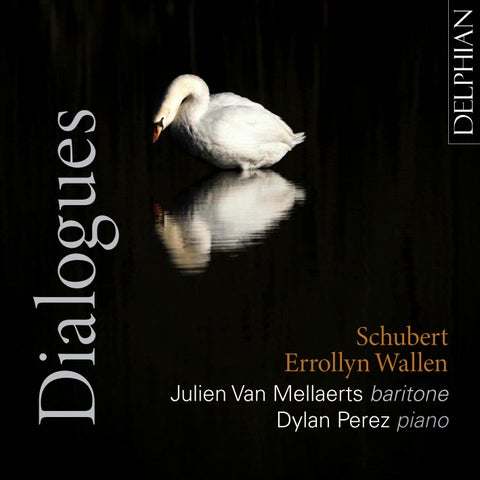
Dialogues
Schubert Errollyn Wallen
Julien Van Mellaerts baritone Dylan Perez piano
Dialogues
1 Errollyn Wallen
Julien Van Mellaerts baritone Dylan Perez piano
Franz Schubert (1797–1828) Errollyn Wallen (b. 1958)
Schwanengesang, D 957 The Lake
Special thanks to the following, without whom this recording could not have happened: The Marchus Trust, Verbier Festival, The Peace and Prosperity Trust, The Hunn Trust, Royal Conservatoire of Scotland; Graham Brookman, Fiona Espenhahn, Malcolm Herring, Jenny Hodgson, Kate Olver, Jeremy Young, Deirdre and Mark Simpson, Anastasia Voronkova, John Wates; and an additional special thanks to Claire Simon for her help throughout the recording process.
Recorded on 23-25 April 2025 in the Parish Church of St Cuthbert, Edinburgh Producer/Engineer: Paul Baxter 24-bit digital editing: Jack Davis 24-bit digital mixing and mastering: Paul Baxter Piano: Steinway & Sons model D, serial no. 600443 (2016) Piano technician: Norman Motion
Design: Eliot Garcia Booklet editor: Henry Howard Cover image: Hansjörg Rath / unsplash Session photography: Sandy Butler Delphian Records Ltd – Oxford – UK
www.delphianrecords.com @ delphianrecords @ delphian_records
The Lake (The Lake, No. 1)
[4:12]
2 Franz Schubert
Liebesbotschaft, D 957 No. 1
[3:14]
3 Franz Schubert
Das Fischermädchen, D 957 No. 10
[2:24]
4 Franz Schubert
Frühlingssehnsucht, D 957 No. 3
[3:41]
5 Franz Schubert
Kriegers Ahnung, D 957 No. 2
[5:21]
6 Errollyn Wallen
Ready (The Lake, No. 4)
[3:40]
7 Franz Schubert
Ständchen, D 957 No. 4
[4:17]
8 Errollyn Wallen
Timeless (The Lake, No. 3)
[3:18]
9 Franz Schubert
Am Meer, D 957 No. 12
[3:56]
10 Franz Schubert
Der Atlas, D 957 No. 8
[2:24]
11 Franz Schubert
Abschied, D 957 No. 7
[4:57]
12 Franz Schubert
Die Taubenpost, D 957 No. 14
[3:58]
13 Franz Schubert
Aufenthalt, D 957 No. 5
[3:33]
14 Franz Schubert
Ihr Bild, D 957 No. 9
[3:12]
15 Errollyn Wallen
All My Life (The Lake, No. 2)
[2:43]
16 Franz Schubert
Die Stadt, D 957 No. 11
[2:42]
17 Franz Schubert
In der Ferne, D 957 No. 6
[5:55]
18 Errollyn Wallen
Courage (The Lake, No. 5)
[4:45]
19 Franz Schubert
Der Doppelgänger, D 957 No. 13
[4:58]
Total playing time All tracks by Errollyn Wallen are premiere recordings
[73:19]
Notes on the music As seems only right and proper for an album entitled Dialogues, it’s clear from my conversation with Julien Van Mellaerts that every part of this project has come from the hard labour of multiple performers, poets and composers. The musicians who began it all were the two we hear: Julien himself, and pianist Dylan Perez. Since 2021, Julien and Dylan have co-curated an annual summer concert series for London’s Opera Holland Park called Opera in Song; and for their 2022 programme, the vision was to include Franz Schubert’s Die schöne Müllerin, Winterreise, and the ‘cycle’ produced by the composer’s publisher after his death, Schwanengesang. ‘But we wanted to present them in different ways,’ Julien explains. ‘So I sang Die schöne Müllerin and we included the poems that Schubert didn’t set.’ The baritone Christopher Purves sat at the side of the stage in an armchair, reading these texts in English, ‘a way to understand the cycle from an older singer’s point of view – someone who might have survived a loss like that.’ Roderick Williams performed Winterreise in an English translation by Jeremy Sams. And for Schwanengesang, Julien and Dylan approached the mezzosoprano Ema Nikolovska and pianist Kunal Lahiry, who suggested a new commission to sit alongside Schubert’s songs. They quickly reached a consensus that Errollyn Wallen
would be the perfect composer to write this companion piece. But this was not simply a commission for a standalone work to sit before or after Schubert. Schwanengesang, as Julien points out, has no narrative: it’s a collection of songs to texts by Ludwig Rellstab, Heinrich Heine and Johann Gabriel Seidl, gathered and issued by the Viennese publisher Tobias Haslinger in May 1829. ‘So we gave Errollyn carte blanche. We said, here are the fourteen songs of Schwanengesang; we want you to create a reflection, to find inspiration in these songs.’ Errollyn was delighted with the commission. ‘I relate to Schubert in a very direct way,’ she says, ‘one songwriter to another. Both of us are trying to get to the heart of the matter – and are always enthralled by the endless possibilities for magic when words are set to music.’ She duly delivered The Lake, five songs written to her own texts – and the performers got stuck in. ‘When we received her score, we decided to change the order that she had originally conceived, to put her music in between Schubert’s songs, and change the order of Schwanengesang,’ explains Julien. ‘We managed to create a story. It’s a loose story – but the whole idea
was to reinvent something that we’ve heard a hundred times, and to change the idea of what a Schubert song recital could be.’ This new programme, Schwanengesang intertwined with The Lake, was premiered at Opera Holland Park on 3 July 2022. Julien and Ema then performed the programme as a shared venture at the Verbier Festival a few weeks later, harmonising some of The Lake as duets, presenting Schubert numbers as dialogues, and splitting the rest into alternating solos. Did Errollyn mind, I wonder, that from the very moment of receiving her score, Julien and his collaborators have been changing it?! ‘Not at all. She basically said, “Look, it’s yours now,” and trusted us with our work. It felt very much like a group project, which was really satisfying.’ The brief for Errollyn’s The Lake was to take the texts of Schwanengesang as her starting point. That’s a rich and varied source, to be sure. Ludwig Rellstab’s poetry is bursting with references to the natural world, and all the songs take place outdoors. The speaker of ‘Liebesbotschaft’ begs a silver brook, bubbling happily in the piano, to take messages to his beloved in her garden. The garden flowers, watered by the brook, will soon be pressed into service as her posy, shrinking the degrees of separation
between them as he murmurs to the water, and the object of his affection. Flowers, brooklets and the golden sun populate ‘Frühlingssehnsucht’ too, as our attention is drawn first to the bursting buds and swelling seeds; then to the woods, hills and bright blue sky above. All is hopeful, the world ready to pop in priapic joy. The impassioned singer of ‘Ständchen’ co-opts rustling trees and singing nightingales to assist him in his serenading, while the weary soldier of ‘Kriegers Ahnung’ sings by a campfire, the flickering firelight reminding him of happier days in the arms of his beloved, resting beside a friendlier hearth. And ‘In der Ferne’ and ‘Aufenthalt’ see their protagonists abandoning known landscapes for the unfamiliar: the sun and stars provide no familiar comfort, the forbidding river and forest offering only a hard rock as a resting place. Even ‘Abschied’, for all that Schubert clothes the words in a sunny score that trips and trots with the rider’s departing horse, is a litany of well-loved places and people now being left behind, because she is no longer here. There is also nothing particularly urban about the ‘happy town’ we leave behind. All is green, with stars and flowers and silver streams setting the scene. The words of Heinrich Heine, by contrast, feel at once more modern – even though he was actually two years older than Rellstab. The landscape of his Lieder is often unknown
Notes on the music and unknowable. Where exactly is ‘Der Atlas’ standing, the world upon his shoulders, as he presents himself as a vision of Greek myth and a character rendered entirely familiar in his pride and heartbreak? ‘Ihr Bild’ is a scene from a dream turned nightmare, the lost lover’s picture floating before the dreamer. While ‘Das Fischermädchen’ and ‘Am Meer’ both take place by water, the locations are in each case the pretext only for intense and heartsore interactions, their lonely protagonists craving company only to find themselves even lonelier than before. Much has been made of the autobiographical nature of poems such as ‘Die Stadt’, the sun beaming down like a spotlight on the place where the speaker’s dreams were crushed. Heine studied at a business school in Düsseldorf from 1814 and then spent several unhappy years working for his uncle’s bank in Hamburg; and he insinuated that many of his poems were ‘set’ in these locations, detailing the realities of his doomed love affairs. The chronology does not stack up in a way that suggests this is wholly true. But in ‘Die Stadt’ we really do seem to be in a place of habitation, even if the urban portrait is incomplete. And then there is ‘Der Doppelgänger’, on a city street in the depths of the night, as the horrified poet comes face to face with his own wretched form. Schubert’s Heine settings are sparse
and unsettling, chords ringing in the bass of the piano as figures scuttle up and down the stave. These songs are restless, uncomfortable and incontrovertibly modern. ‘Imagine what Schubert could have done,’ Julien muses, ‘if he’d lived longer than thirty-one.’ The texts of Errollyn Wallen’s The Lake are full of Schubertian poetic echoes – of night and dreams and shining white skin, of summer happiness gone sour like the weather, the magic of the stars and the nature of home. There’s no sense of pastiche: in fact, several of the songs are based on her own personal experiences. But the opportunity to provide both words and music, with the text as the jumping-off point, has led to a remarkable tapestry of imagery that speaks directly to Schubert’s songs whilst remaining entirely of their own time and place. London is itself a character in ‘All My Life’, which bounces and circles with happiness until nature – the ‘winds of doubt’ and the rain that follows – brings the relationship to a close and renders the city a heartless void. ‘Courage’ flows and pulses as its speaker seeks home, a modern-day Romantic wanderer in search of a new home. Still, crucially, there is hope. Errollyn’s characters speak with determination through heartbreak and, in ‘Ready’, with bravery in the face of vulnerability. And then there is
‘The Lake’ itself, delicate and glimmering, also recalled in ‘Timeless’ as the place ‘where the souls of those who loved do wait.’ So to the question of ordering. ‘I think I’ve done this programme now half a dozen times,’ Julien says, ‘and each time it’s been slightly different.’ As so often, this is all down to a question of performer and audience perspectives. If the point is to bill it as a kind of ‘Schwanengesang-plus’ performance, it makes sense to start with ‘Liebesbotschaft’, to set expectations from the very first bars. But here in Dialogues, we begin with ‘The Lake’. ‘I wanted to set up a soundworld that’s different,’ he says. This particular presentation foregrounds just some of the many dialogues in play, of course: Errollyn and Schubert, poets and composers, performers and creators, pianists and singers … and the dialogue each and every one of those parties also has with each and every listener. The optimism of The Lake is certainly not present in all of Schubert’s Schwanengesang. But there is still Haslinger’s final selection for the opus: Johann Gabriel Seidl’s deeply touching ‘Die Taubenpost’. It should by rights be a kitsch little sweetener, with its gentle chugging and catchy tune as the singer sends his carrier
pigeon on its way. Yet the fragility of this heroic little bird, and the absolute devotion of the lover in his longing, is transformed by Schubert into an irresistible paean to love and faith. In combination, the words and music of Schubert, Wallen, Seidl, Rellstab and Heine are brought together in this album to tell a story of many stories. The dialogues we choose to have with them – the songs that speak particularly to our hearts, and the narratives we detect across the whole – remain entirely up to us. © 2026 Katy Hamilton Katy Hamilton is a music historian, writer and broadcaster. She works concert halls and festivals across the UK and Europe, and is a frequent contributor to BBC Radio 3.
Texts and translations 1 The Lake
I had a dream You were the dream As if in a film I had a dream You were the dream As if you were here … I had a dream, I had a dream, I had a dream. And all was still And night made your skin shine white I knew that all was well As you walked with your back towards me As you walked across the lake in the moonlight across the water. Texts by Errollyn Wallen © Errollyn Wallen, reproduced by kind permission 2 Liebesbotschaft
Rauschendes Bächlein, So silbern und hell, Eilst zur Geliebten So munter und schnell? Ach, trautes Bächlein, Mein Bote sei du; Bringe die Grüße Des Fernen ihr zu.
All ihre Blumen Im Garten gepflegt, Die sie so lieblich Am Busen trägt, Und ihre Rosen In purpurner Glut, Bächlein, erquicke Mit kühlender Flut. Wann sie am Ufer, In Träume versenkt, Meiner gedenkend Das Köpfchen hängt, Tröste die Süße Mit freundlichem Blick, Denn der Geliebte Kehrt bald zurück. Neigt sich die Sonne Mit rötlichem Schein, Wiege das Liebchen In Schlummer ein. Rausche sie murmelnd In süße Ruh, Flüstre ihr Träume Der Liebe zu. Ludwig Rellstab (1799–1860) Translations from the German by Malcolm Wren (schubertsong.uk)
Message of love Babbling little stream, So silver and bright, Are you rushing to my beloved So cheerfully and quickly? Oh dearest little stream Be my messenger; Take my greetings From afar to her. All her flowers Looked after in the garden, Which she so lovingly Wears on her breast, And her roses With their crimson glow, Little stream, refresh them With your cooling waters.
3 Das Fischermädchen
Du schönes Fischermädchen, Treibe den Kahn ans Land – Komm zu mir und setze dich nieder, Wir kosen Hand in Hand. Leg an mein Herz dein Köpfchen Und fürchte dich nicht zu sehr, Vertraust du dich doch sorglos Täglich dem wilden Meer. Mein Herz gleicht ganz dem Meere, Hat Sturm und Ebb’ und Flut, Und manche schöne Perle In seiner Tiefe ruht. Heinrich Heine (1797–1856)
The fisher girl
When she is on the river bank Falling into daydreams Thinking of me As her little head hangs down; Comfort my sweet girl With a friendly glance, For her beloved Will soon be returning.
You beautiful fisher girl, Push the boat onto the land; Come to me and sit yourself down, We shall have a loving chat holding hands.
When the sun begins to set With a reddish glow, Rock my beloved To sleep. Babble and mutter to her In her sweet rest, Whisper to her dreams Of love.
My heart is just like the sea, It has storms, it ebbs and flows, And lots of beautiful pearls Are resting in its depths.
Lay your little head on my heart And do not be too afraid, After all you fearlessly take risks Every day on the wild sea.
Texts and translations 4 Frühlingssehnsucht
Säuselnde Lüfte Wehend so mild, Blumiger Düfte Atmend erfüllt! Wie haucht ihr mich wonnig begrüßend an! Wie habt Ihr dem pochenden Herzen getan? Es möchte euch folgen auf luftiger Bahn! Wohin? Bächlein so munter Rauschend zumal, Wollen hinunter Silbern ins Tal. Die schwebende Welle, dort eilt sie dahin! Tief spiegeln sich Fluren und Himmel darin. Was ziehst du mich, sehnend verlangender Sinn, Hinab?
Grüßender Sonne Spielendes Gold, Hoffende Wonne Bringest du hold. Wie labt mich dein selig begrüßendes Bild! Es lächelt am tiefblauen Himmel so mild Und hat mir das Auge mit Tränen gefüllt. Warum? Grünend umkränzet Wälder und Höh, Schimmernd erglänzet Blütenschnee. So dränget sich alles zum bräutlichen Licht, Es schwellen die Keime, die Knospe bricht, Sie haben gefunden was ihnen gebricht, Und du? Rastloses Sehnen, Wünschendes Herz, Immer nur Tränen, Klage und Schmerz? Auch ich bin mir schwellender Triebe bewusst, Wer stillet mir endlich die drängende Lust? Nur du befreist den Lenz in der Brust, Nur du! Ludwig Rellstab
Longing at springtime Rustling breezes, Wafting so gently, Floral scents Filling the breath! How blissfully you blow on me as you offer your greetings! How have you stirred my beating heart? It would like to follow you on your course through the air! Where to? Little streams, so cheerful, Babbling along, Wanting to go down On their silver paths into the valley. The floating waves, they are hurrying off down there! The fields and the sky are mirrored in them deep down. Why are you pulling me, you mood of longing and yearning, Pulling me down?
Sun with your greeting, Playful gold And hopeful bliss Are what you generously offer. How your blessed gaze refreshes me with its welcome! It is smiling so gently in the dark blue sky And it has filled my eyes with tears! – Why? With a green garland all around Stand the forests and the hills! Shining and glowing there – Snow-like blossom! Thus everything is pushing up towards the bridal light; The seeds are bursting, the buds are breaking open; They have found what they needed: And you? Restless longing! Heart full of desire, At all times nothing but tears, Laments and pain? I too am conscious of a swelling urge! Who is finally going to still this driving desire? Only you can release the spring in my breast, Only you!
Texts and translations 5 Kriegers Ahnung
5 Warrior’s sense of foreboding
7 Ständchen
Serenade
In tiefer Ruh liegt um mich her Der Waffenbrüder Kreis. Mir ist das Herz so bang und schwer, Von Sehnsucht mir so heiß.
Lying around me in deep repose Is the circle of my brothers in arms; My heart feels so anxious and heavy, I am so hot with longing.
Leise flehen meine Lieder Durch die Nacht zu dir, In den stillen Hain hernieder, Liebchen, komm zu mir.
My songs call out gently Through the night as they beseech you; Come down here into the quiet grove of trees, Beloved, come to me!
Wie hab ich oft so süß geträumt An ihrem Busen warm, Wie freundlich schien des Heerdes Glut, Lag sie in meinem Arm.
How often I have dreamt so sweetly On her warm breast! How friendly the glow of the fire appeared When she was lying in my arms!
Flüsternd schlanke Wipfel rauschen In des Mondes Licht, Des Verräters feindlich Lauschen Fürchte, Holde, nicht.
Slender tree tops whisper as they rustle In the moonlight; No hostile traitor is going to overhear, So do not be afraid, my love.
Hier, wo der Flammen düstrer Schein Ach nur auf Waffen spielt, Hier fühlt die Brust sich ganz allein, Der Wehmut Träne quillt.
Here, where the dismal glow of the flames Plays only on our weapons, Here my breast feels totally alone and Tears of melancholy well up.
Hörst die Nachtigallen schlagen? Ach, sie flehen dich, Mit der Töne süßen Klagen Flehen sie für mich.
Can you hear the nightingales singing? Oh, they are beseeching you With the sweet notes of their laments, They are interceding with you on my behalf.
Herz, dass der Trost dich nicht verlässt, Es ruft noch manche Schlacht. – Bald ruh ich wohl und schlafe fest, Herzliebste – gute Nacht!
Heart! May solace never abandon you! Many a battle is still calling you. – I shall soon rest well and sleep tight, Dearest heart – goodnight!
Sie verstehn des Busens Sehnen, Kennen Liebesschmerz, Rühren mit den Silbertönen Jedes weiche Herz.
They can understand the longing of the breast, They are familiar with the pain of love, With their silver notes they stir Every sensitive heart.
Ludwig Rellstab
6 Ready
Are you ready to be judged on your art? Are you ready to be judged for your heart? We have watched the seasons change We have watched the thunder roll right over this land Are you ready to tear down the borders? Now only murmur love. Errollyn Wallen
Lass auch dir die Brust bewegen, Liebchen, höre mich! Bebend harr ich dir entgegen, Komm, beglücke mich. Ludwig Rellstab
Let your own breast be moved too, Beloved, listen to me! I am trembling as I await your response; Come, make me happy!
Texts and translations 8 Timeless
9 Am Meer
When I sing in the night When I glide across oceans and stars See the Northern Lights Touch the Milky Way
Das Meer erglänzte weit hinaus Im letzten Abendscheine, Wir saßen am einsamen Fischerhaus, Wir saßen stumm und alleine.
I am timeless like the water that will carry me home. Home to the Lake
Der Nebel stieg, das Wasser schwoll, Die Möwe flog hin und wieder; Aus deinen Augen, liebevoll, Fielen die Tränen nieder.
where the souls of those who love do wait When I sing in the night When I glide across oceans and stars See the Northern Lights Touch the Milky Way I am timeless like the water that will carry me home. Home to the Lake Errollyn Wallen
Ich sah sie fallen auf deine Hand Und bin auf’s Knie gesunken, Ich hab von deiner weißen Hand Die Tränen fortgetrunken. Seit jener Stunde verzehrt sich mein Leib, Die Seele stirbt vor Sehnen; – Mich hat das unglückseel’ge Weib Vergiftet mit ihren Tränen. Heinrich Heine
By the sea The sea was glistening far into distance In the last of the evening glow; We were sitting by a solitary fisherman’s house, We were sitting mute and alone. The mist rose, the water swelled, The seagull flew back and forth; From your eyes, full of love, Tears fell down. I saw them fall onto your hand, I sank onto my knees; From your white hand I Drank up your tears. Since that moment my body has been decaying, My soul is dying from longing; – The unhappy woman has Poisoned me with her tears.
10 Der Atlas
Ich unglücksel’ger Atlas, eine Welt, Die ganze Welt der Schmerzen muss ich tragen, Ich trage Unerträgliches, und brechen Will mir das Herz im Leibe. Du stolzes Herz, du hast es ja gewollt, Du wolltest glücklich sein, unendlich glücklich, Oder unendlich elend, stolzes Herz, Und jetzo bist du elend. Heinrich Heine
Atlas I am miserable Atlas! a world, I have to bear the whole world of pain, I bear the unbearable, and my heart wants to break – My heart wants to break in my body. You proud heart! actually it is what you wanted, You wanted to be happy, endlessly happy Or endlessly suffering, proud heart, And now you are suffering.
Texts and translations 11
Abschied Ade! du muntre, du fröhliche Stadt, ade! Schon scharret mein Rösslein mit lustigem Fuß, Jetzt nimm meinen letzten, den scheidenden Gruß, Du hast mich wohl niemals noch traurig gesehn, So kann es auch jetzt nicht beim Abschied geschehn, Ade! du muntre, du fröhliche Stadt, ade! Ade! ihr Bäume, ihr Gärten so grün, ade! Nun reit ich am silbernen Strome entlang, Weit schallend ertönet mein Abschiedsgesang, Nie habt ihr ein trauriges Lied gehört, So wird euch auch keines beim Scheiden beschert, Ade! ihr Bäume, ihr Gärten so grün, ade! Ade! ihr freundlichen Mägdlein dort, ade! Was schaut ihr aus blumenumduftetem Haus Mit schelmischen, lockenden Blicken heraus! Wie sonst, so grüß ich und schaue mich um, Doch nimmer wend ich mein Rösslein um, Ade! ihr freundlichen Mägdlein dort, ade!
Ade! liebe Sonne, so gehst du zur Ruh! Ade! Nun schimmert der blinkenden Sterne Gold, Wie bin ich euch Sternlein am Himmel so hold, Durchziehn wir die Welt auch weit und breit, Ihr gebt überall uns das treue Geleit, Ade! liebe Sonne, so gehst du zur Ruh, ade! Ade, du schimmerndes Fensterlein hell, ade! Du glänzest so traulich mit dämmerndem Schein Und ladest so freundlich ins Hüttchen uns ein. Vorüber, ach, ritt ich so manches Mal Und wär es denn heute zum letzten Mal, Ade, du schimmerndes Fensterlein hell, ade! Ade! ihr Sterne, verhüllet Euch grau! Ade! Des Fensterlein trübes, verschimmerndes Licht Ersetzt Ihr unzähligen Sterne mir nicht; Darf ich hier nicht weilen, muss hier vorbei, Was hilft es, folgt ihr mir noch so treu, Ade! ihr Sterne, verhüllet euch grau, ade! Ludwig Rellstab
Farewell Farewell, you cheerful, you jolly town, farewell! My little horse is already pawing the ground with his eager foot; Now take my last, departing greeting. Since you have never yet seen me sad, You cannot see my like that as I take my leave. Farewell, you cheerful, you jolly town, farewell! Farewell, you trees, you gardens so green, farewell! I am now riding along by the silver stream, Ringing out far and wide is my farewell song; You have never heard a sad song, So you will not be given one as I depart. Farewell, you trees, you gardens so green, farewell! Farewell, you friendly girls there, farewell! Why are you looking out from your house surrounded by the scent of flowers With such a mischievous, alluring twinkle in your eyes? I shall greet you as I used to do and look around But I shall never turn my horse around. Farewell, you friendly girls there, farewell!
Farewell, dear sun, as you settle down to rest, farewell! Now the gold of the twinkling stars is glistening. How dear you are to me, you little stars in the sky, We traverse the world far and wide, Everywhere you lead us faithfully. Farewell, dear sun, as you settle down to rest, farewell! Farewell, you bright shimmering window, farewell! You are shining so intimately in the twilight, And you are inviting us into the cottage in such a friendly way, But alas! I have ridden past so many times Can today really be the last time? Farewell, you bright shimmering window, farewell! Farewell, you stars, cover yourselves in grey! – Farewell! The dull, fading light of that little window – You cannot take its place for me you countless stars; If I cannot remain here, I shall have to go away from here, What does it help however faithfully you follow me! Farewell, you stars, cover yourselves in grey! – Farewell!
Texts and translations 12 Die Taubenpost
Pigeon post
Ich hab eine Brieftaub in meinem Sold, Die ist gar ergeben und treu; Sie nimmt mir nie das Ziel zu kurz Und fliegt auch nie vorbei.
I have a carrier pigeon working for me, Which is totally devoted and faithful, It never comes short of the destination for me Nor does it ever fly beyond it.
Ich sende sie viel tausendmal Auf Kundschaft täglich hinaus, Vorbei an manchem lieben Ort, Bis zu der Liebsten Haus.
I send it many thousands of times A day, off on reconnaissance missions, Past many a dear spot Until it comes to my beloved’s house.
Dort schaut sie zum Fenster heimlich hinein, Belauscht ihren Blick und Schritt, Gibt meine Grüße scherzend ab Und nimmt die ihren mit.
There it looks through the window secretly Observing her glances and listening to her steps, It jokingly passes on my greetings And brings hers back with it.
Kein Briefchen brauch’ ich zu schreiben mehr, Die Träne selbst geb’ ich ihr, Oh, sie verträgt sie sicher nicht, Gar eifrig dient sie mir. Bei Tag, bei Nacht, im Wachen, im Traum, Ihr gilt das alles gleich, Wenn sie nur wandern, wandern kann, Dann ist sie überreich. Sie wird nicht müd, sie wird nicht matt, Der Weg ist stets ihr neu, Sie braucht nicht Lockung, braucht nicht Lohn, Die Taub’ ist so mir treu. Drum heg ich sie auch so treu an der Brust, Versichert des schönsten Gewinns; Sie heißt: die Sehnsucht – kennt ihr sie? – Die Botin treuen Sinns. Johann Gabriel Seidl (1804–1875)
I no longer need to write any notes, I just give it my tears themselves: Oh it will definitely not lose those, So eagerly does it serve me. During the day, at night, awake, dreaming, It does not matter: So long as it is travelling, that it is able to travel, Then it has riches aplenty! It does not become tired, it does not become faint, The route is always new to it; It does not need bribes, it does not need wages, That pigeon is so faithful to me!
In return I therefore cherish it faithfully at my breast, Assuring it of the finest reward; It is called – longing! Do you know it? The messenger of the most faithful devotion. 13 Aufenthalt
Rauschender Strom, Brausender Wald, Starrender Fels Mein Aufenthalt. Wie sich die Welle An Welle reiht, Fließen die Tränen Mir ewig erneut. Hoch in den Kronen Wogend sich’s regt, So unaufhörlich Mein Herze schlägt. Und wie des Felsen Uraltes Erz Ewig derselbe Bleibet mein Schmerz. Rauschender Strom, Brausender Wald, Starrender Fels Mein Aufenthalt. Ludwig Rellstab
Where I am staying Roaring river, Rustling forest, Fixed rock Where I am staying. Just as waves Follow waves, My tears flow Endlessly renewed. High in the tree tops There is a swaying movement, In the same way incessantly My heart is beating. And like the rock’s Primeval ore, Forever the same My pain endures. Roaring river, Rustling forest, Fixed rock Where I am staying.
Texts and translations 14 Ihr Bild
15 All My Life
16 Die Stadt
Ich stand in dunkeln Träumen Und starrt’ ihr Bildnis an, Und das geliebte Antlitz Heimlich zu leben begann.
You said your name A glass of wine And we were ours in the summer days.
Am fernen Horizonte Erscheint, wie ein Nebelbild, Die Stadt mit ihren Türmen, In Abenddämmrung gehüllt.
Um ihre Lippen zog sich Ein Lächeln, wunderbar, Und wie von Wehmutstränen Erglänzte ihr Augenpaar.
You laughed and poured another glass And we were ours in the summer days.
Ein feuchter Windzug kräuselt Die graue Wasserbahn; Mit traurigem Takte rudert Der Schiffer in meinem Kahn.
Auch meine Thränen flossen Mir von den Wangen herab – Und ach, ich kann es nicht glauben, Dass ich dich verloren hab. Heinrich Heine
A picture of her In dark dreams I was standing And I was staring at a picture of her, And the beloved face Secretly started to come to life. Around her lips there appeared An amazing smile, And as if lit up by tears of melancholy Her two eyes were shining. My tears too flowed And fell from my cheeks – And, alas, I cannot believe That I have lost you!
The streets were full It was July And we were ours in the summer days. All my life London has surrounded me like a pillow And on London’s pillow, there we lay. Then the winds came. The winds of doubt. It was a shame. We were caught out by the rain Ten umbrellas coats and hats Taxis screeching to the kerb I’ve got to find my own way home. Holding hands with hope London is empty Errollyn Wallen
Die Sonne hebt sich noch einmal Leuchtend vom Boden empor Und zeigt mir jene Stelle, Wo ich das Liebste verlor. Heinrich Heine
The town On the distant horizon There appears, as a hazy image, The town with its towers Shrouded in evening twilight. A damp current of wind ruffles The grey watery track; Rowing with a mournful rhythm is The sailor in my boat. The sun lifts itself up once again Casting light from the ground upwards, And it shows me that spot Where I lost what I most love.
17 In der Ferne
Wehe dem Fliehenden, Welt hinaus Ziehenden! – Fremde Durchmessenden, Heimat Vergessenden, Mutterhaus Hassenden, Freunde Verlassenden Folget kein Segen, ach, Auf ihren Wegen nach! Herze! das sehnende, Auge, das tränende, Sehnsucht, nie endende, Heimwärts sich wendende, Busen, der wallende, Klage, verhallende, Abendstern, blinkender, Hoffnungslos sinkender. Lüfte, ihr säuselnden, Wellen sanft kräuselnden, Sonnenstrahl, eilender, Nirgend verweilender: Die mir mit Schmerze, ach! Dies treue Herze brach, Grüßt von dem Fliehenden, Welt hinaus ziehenden. Ludwig Rellstab
Texts and translations
In a distant place Woe to the person fleeing, Setting off into the world! The person striding amongst strangers, Forgetting home, Hating his mother’s house, Leaving his friends behind. Alas, no blessing follows such a person As he goes on his way! Longing heart, Weeping eyes, Never ending longing Turning back towards home! Seething breast, Fading lament, Twinkling evening star, Sinking into despair! You rustling breezes, Gently rippling waves, Hurrying sunbeams, Never settling to rest: To her who with pain, alas, Broke this faithful heart – Pass on greetings from the person fleeing, Setting off into the world!
18 Courage
Do you know the way the trains are going ’cos I’m Do you know the way I’m out of Do you know the way the sun lies? Do you know the way the wind is blowing? I am … Do you know the way I am Do you know the way the crow flies? Suns go down And the river runs dry The home I knew has fallen down So the mirror I hold is the home in my heart the map I see shows I have no place here Do you know the way or shall I linger Do you? Do you have a need for me here? can we stay this road to courage? I am lost amid this gold, this jewel, I am waiting to be found by a friend I’ve got no home but courage Suns go down And the river runs dry The home I knew has fallen down So the mirror I hold is the home in my heart The map I see shows I have no place here
So the suns may fall So the rivers run dry And this home I knew has fallen down But the mirror I hold is the home in my heart Throw away the map I have a place here Errollyn Wallen 19 Der Doppelgänger
Still ist die Nacht, es ruhen die Gassen, In diesem Hause wohnte mein Schatz, Sie hat schon längst die Stadt verlassen, Doch steht noch das Haus auf demselben Platz. Da steht auch ein Mensch und starrt in die Höhe Und ringt die Hände vor Schmerzensgewalt; Mir graust es, wenn ich sein Antlitz sehe, Der Mond zeigt mir meine eigne Gestalt. Du Doppelgänger, du bleicher Geselle, Was äffst du nach mein Liebesleid, Das mich gequält auf dieser Stelle So manche Nacht, in alter Zeit? Heinrich Heine
The doppelgänger The night is quiet, the alleyways are at rest, My treasure used to live in this house; She left the town long ago, But the house is still standing in the same place. There is a man standing there too and he is staring up high, And he is wringing his hands as a result of overwhelming pain; I feel terrified when I see his face, – The moon shows me my own form. You doppelgänger, you pale guy! Why are you aping my love agony, The pain that tormented me on this spot, So many nights in the old days?
Biographies
Julien Van Mellaerts Praised for his ‘charisma and vocal elegance’ by Das Opernmagazin, the multi-awardwinning New Zealand baritone Julien Van Mellaerts is highly sought after as both a recitalist and on the operatic stage. He won first prize in both the Wigmore Hall International Song Competition and the Kathleen Ferrier Awards, and represented New Zealand at BBC Cardiff Singer of the World in 2019. A graduate of the Royal College of Music International Opera School, and recipient of the Tagore Gold Medal, Van Mellaerts has had great success in recent role and house debuts at the Verbier Festival, Salzburg Mozartwoche, Opéra National de Lorraine, Opera Holland Park and New Zealand Opera. Julien Van Mellaerts was awarded the Kiri Te Kanawa Foundation Laureate 2024, recognising his enterprise and success both on and off stage. In December 2025, he was announced as a trustee of the Laidlaw Opera Trust.
Recent performances include principal roles with Teatro de la Maestranza in Seville (Donizetti), Opera Holland Park (Strauss), New Zealand Opera (Mozart), Wellington Opera (Verdi), Palermo Classica International Festival (Mozart), Theater Ulm (Donizetti), Carmina Burana at the Royal Festival Hall and a Schubert recital at Salle Bourgie in Montreal (on BBC Radio 3 and Radio Canada). This summer marks his sixth season as co-director and co-curator with Dylan Perez of ‘Opera in Song’ at Opera Holland Park, a series of operatically themed recitals. Previous operatic roles include Figaro Le nozze di Figaro and Masetto Don Giovanni at the Salzburg Mozartwoche, Papageno and Masetto at the Verbier Festival, Wozzeck in the New Zealand premiere of Wozzeck, Oreste Iphigénie en Tauride for Opéra National de Lorraine, Count Almaviva Le nozze di Figaro for Opera Holland Park, Silvio I Pagliacci at the Israeli Opera and Duke of Nottingham Roberto Devereux at the Badisches Staatstheater.
Dylan Perez Described as ‘sublime and completely intuitive’ (Sunday Times), pianist Dylan Perez is a recitalist, chamber musician and coach specialising in vocal repertoire who is highly in demand across the UK. Artists with whom he collaborates regularly include sopranos Mary Bevan and Soraya Mafi, mezzosopranos Jess Dandy, Ema Nikolovska and Kitty Whately and bass William Thomas. He enjoys a particularly fruitful performing relationship with his husband, renowned Scottish tenor Nicky Spence.
Dylan is the founder of re-sung, a London based song recital series that focuses on the connection between text and music, with special interest on creating new interpretations of masterworks and championing contemporary songs. In collaboration with Julien Van Mellaerts, he curates Opera in Song for Opera Holland Park – a song recital series that illuminates the operas, characters, and composers appearing during the summer season. Coaching and teaching has become a vital part of Dylan’s musical life. He was recently appointed as a Vocal Coach on faculty at the Royal Conservatoire of Scotland and the Royal Birmingham Conservatoire, as well as being a guest coach at the Royal Academy of Music. Previously, he was on faculty at Trinity Laban Conservatoire. He has lead song projects at RBC, Guildhall School of Music & Drama, and the Royal College of Music. Recent recordings include the complete songs of Samuel Barber (‘Recording of the Month’ in BBC Music Magazine and awarded five stars in the Sunday Times) and Sparks from Ashes, a critically acclaimed collection of Czech and Slovak art songs with Nicky Spence. Future recording plans include songs by Rorem and Caplet.
Also available on Delphian Schubert Lieder: Love’s Lasting Power Harriet Burns soprano, Ian Tindale piano
BEST CLASSICAL ALBUMS of 2024
Day of These Days: The British Isles Reflected in Song Tristan Hambleton baritone, Simon Lepper piano
DCD34251
DCD34359
Love – from many-splendoured and joyous to tragic and rejected, homo- and heterosexual, light-hearted and broken-hearted, heavenly and earthly, innocent and anything but … In their first joint recording, long-term performing partners Harriet Burns and Ian Tindale make a deeply personal choice from Schubert’s lieder, exploring the theme of love, but also the friendships and relationships between poets and the composer out of which he crafted songs of astonishing empathy. International award-winners Ian and Harriet bring an outstanding empathy of their own to songs in which we hear, in Ian’s words, ‘young artists being creative together and exploring things’.
‘Such a morning it is,’ wrote Laurie Lee – and this album, taking its title from his poem, is rooted in such particular moments of lived experience, capturing that fleeting, introspective British light. Bassbaritone Tristan Hambleton and pianist Simon Lepper create a landscape of songs by Britten, Sally Beamish, Judith Weir, Huw Watkins, Tarik O’Regan, Errollyn Wallen and others, many in first recordings, drawn together by themes of time, loss and uncertain footing. Recorded with a close, inward focus, voice and piano search not for display but for connection – a meditation on being, and on what it means, in Robert Louis Stevenson’s words, ‘to know not how it is with you’.
‘There’s little doubt of the strength of this partnership … A very fine disc indeed’ — Gramophone, January 2024
New in March 2026
Voices for solo piano: Smyth – Wallen – Alberga – Beamish – Yi Hanni Liang
Duet: Schumann – Mendelssohn – Cornelius Lucy Crowe soprano, William Berger baritone, Iain Burnside piano
DCD34326
DCD34167
A pioneer of new concert formats, using music to communicate and bring people together, Hanni Liang was long sceptical about the traditional role of recording in progressing an artist’s career. It was her discovery of Ethel Smyth – both as a composer and as a person and a woman, fighting without compromise – that sparked the inspiration that led to Voices. In this album she has created a programme that both champions women’s voices that, without the determination of Smyth and others like her, might otherwise have been silent, and allows her to raise her own voice, reflecting both her European birth and upbringing and her Chinese roots.
Duet singing reached its zenith in the Victorian age, but has since fallen out of fashion. William Berger follows up his acclaimed Delphian debut recital with Iain Burnside, in a programme of duets with the delectably voiced Lucy Crowe that resoundingly demonstrates just how musically rich the genre can be. Published sets and individual songs by Mendelssohn, Schumann and the slightly younger Peter Cornelius span the middle decades of nineteenth-century Germany, and also represent the literary life of the country in that period. Nestled at the end of the disc, ravishingly beautiful and sad, is Schumann’s memorial to his deceased young son.
‘one of the most unhackneyed, unpredictable, well-constructed, musically diverse and interpretatively gratifying piano releases I’ve encountered’ – Gramophone, November 2024
‘In casting, revelatory programming and true vocal chamber music making, this CD is a small miracle to be cherished’ — BBC Music Magazine, September 2016, CHORAL & SONG CHOICE
DCD34369