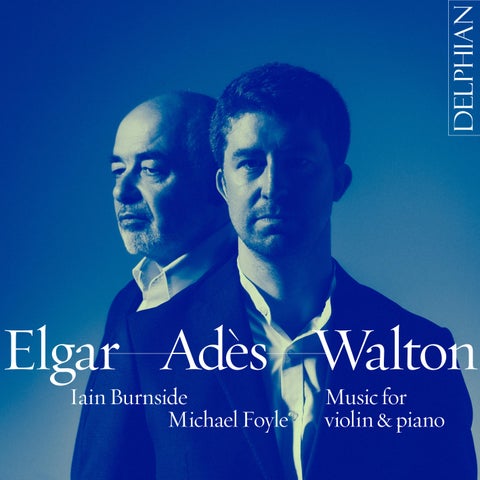
Elgar Adès Walton Iain Burnside Michael Foyle
Music for violin & piano
Edward Elgar (1857–1934)
Elgar Adès Walton
Violin Sonata in E minor Op. 82
1
I. Allegro
[8:23]
2
II. Romance: Andante
[7:50]
3
III. Allegro, non troppo
[9:33]
Thomas Adès (b. 1971)
Suite from The Tempest
4
I. Caliban: ‘This island’s mine’
[2:17]
5
II. Ariel: ‘Full fathom five thy father lies’
[3:21]
6
III. Miranda: Aria & Quintet
[4:28]
7
IV. Caliban & Ariel, Free
[2:58]
William Walton (1902–1983)
Violin Sonata I. Allegro tranquillo
8
[12:43]
II. Variazioni
Michael Foyle violin Iain Burnside piano
Recorded on 16-17 June 2025 in Perth Concert Hall Producer/Engineer: Paul Baxter 24-bit digital editing: Jack Davis 24-bit digital mixing & mastering: Paul Baxter Design: John Christ Booklet editor: Henry Howard
Piano: Steinway Model D, serial no. 626382 (2024) Piano technician: Norman Motion Cover and portrait photography: Andrew Porter Session photography: Will Coates‑Gibson/Foxbrush Delphian Records Ltd – Oxford – UK
delphianrecords.com @ delphianrecords @ delphian_records
9
Tema: Andante
[1:10]
10
1. Poco più mosso
[1:17]
11
2. Quasi improvvisando
[2:19]
12
3. Alla marcia molto vivace
[1:00]
13
4. Allegro molto
[0:35]
14
5. Allegretto con moto
[2:07]
15
6. Scherzando
[0:31]
16
7. Andante tranquillo
[2:28]
17
Coda: Molto vivace
[0:58]
18 Edward Elgar
Chanson de Nuit Op. 15 No. 1
19
Chanson de Matin Op. 15 No. 2 Total playing time
[3:54] [3:11] [71:12]
Notes on the music Edward Elgar composed his Violin Sonata in E minor, Op. 82 in 1918, one of a group of pieces that emerged from Brinkwells, a cottage the composer rented with his wife Alice in the tranquil hills above Fittleworth in Sussex. Keen to escape London and its distractions of doorbell and telephone, Elgar loved being on a working estate, gleaning away with Mr Aylwin the farmer, hearing the tales of the other workers in the fields. It is not the usual image we have of Elgar in this last great phase of his composing life, traditionally viewed as an extended elegy, culminating in the Cello Concerto in E minor, Op. 85 of 1919. This Sonata is one of a triptych of chamber works, with the String Quartet in E minor, Op. 83, and the Piano Quintet in A minor, Op. 84. The prevalence of E and A minor as the tonal centre of these late works is no coincidence. To Elgar the amateur cryptographer, both letters were loaded with significance: EE for the composer himself, with A designating either his wife Alice or – perhaps more likely in the case of the Violin Sonata – his longterm muse Alice Stuart-Wortley, nicknamed ‘Windflower’, whose presence is also deeply felt in the Violin Concerto, Op. 61. The interplay between E and A is a thread that runs throughout the Sonata: the audience settles down for a work in E minor, yet the very first bar launches in with a full A minor chord, marked forte risoluto; the Sonata
will end, some 25 minutes later, with an A to E plagal ‘Amen’ cadence, the composer signing off with his initials in a unison E. Dodging the traditional tonic/dominant axis, and in the process denying the possibility of a conventionally heroic resolution, is the closing act in a work where the tension between passionate melodic activity and more subtle, ambiguous tonal structure never subsides. Elgar took just a few weeks to write the Sonata, in August and September 1918. In the course of its creation, Alice Stuart-Wortley broke her leg and, shortly before completing it, Elgar received the news of the death of Marie Joshua, a faithful friend and supporter of the composer who had accepted his offer of the Sonata’s dedication four days earlier. Like much of Elgar, the work feels full of secrets and no lover of his music can resist the temptation to speculate on these external factors: the central theme of the second movement ‘Romance’, for example, is imbued with tenderness and emotion, so different from the flighty and capricious writing that surrounds it, and when that music returns at the close of the autumnal third movement, the outpouring of passion is overwhelming. ‘It is full of golden sounds … but you must not expect anything violently chromatic or cubist’, Elgar had written in his dedication letter to Marie Joshua, conscious that
Britain’s musical establishment had become enthralled by the latest creations from the composers of the Second Viennese School, or the stories of scandal at Stravinsky’s Rite of Spring première in 1913. But he may well have been aware of Debussy’s Violin Sonata, first performed eighteen months before he wrote his own. The Romance shares a fleetness of foot with Debussy’s second movement, marked Fantasque et léger, exhibiting similar harp-like arpeggiations and quicksilver pizzicato and arco textural shifts. And are the extraordinary whole-tone passages in the third movement, where tonality hangs suspended, responses to Debussy’s perfumed harmonic language as well? The greater backdrop to all of this was the raging of World War One. Debussy, determined to disturb the hegemony of German composers in the realm of instrumental music, defiantly signed off his late chamber works ‘musicien français’, while much of Elgar’s work is imbued with that indefinable quality of ‘Englishness’. From Sussex, he could hear the artillery guns from the Western Front across the English Channel. Nevertheless, he avoided the influence of English folk music in his writing and was a big admirer of Richard Strauss’s orchestral works. Moreover, Marie Joshua was German-born and, through her patronage, Elgar had enjoyed the support
of Hans Richter and the German musical establishment in earlier years. How did Elgar process those final months of war, and do we find his thoughts both expressed and internalised in this Sonata, at once a public and intensely private work? These knotty questions may provide partial explanation, or at least context, for the tangibly complex emotional layers of this late masterpiece. William Walton met Elgar only once, in the gentlemen’s lavatories at a concert for the Three Choirs Festival, exchanging ‘gruff pleasantries’ from adjacent stalls. Though neither may have been in any rush to admit similarities, they shared a lifelong feeling of being outsiders to the musical and social circles in which they increasingly mingled. Elgar, with his Catholic faith in predominantly Anglican England, never quite distanced himself from the childhood memories of using the servants’ entrances to the houses of the wealthy with his father on his piano-tuning rounds; while Walton’s modest Lancashire background drifted into his relying on the aristocratic, artistically prominent Sitwell family for lodgings and financial support, long after he completed his studies. Both were knighted only as they approached their fiftieth birthdays, well after some composer colleagues who have since receded into the citations of musical encyclopaedias.
Notes on the music By a quirk of fate, another Alice, Lady Wimborne, lies at the heart of Walton’s Violin Sonata, begun in 1947 as she started treatment for cancer. Already his muse and lover for over a decade, her treatment in Switzerland posed financial problems for the composer, until a chance meeting with Diana Gould, who would marry Yehudi Menuhin in October of that year. After discreet negotiations, a commission was arranged for Walton to compose a piece for Menuhin and the Hungarian pianist Louis Kentner, soon to be brothers-in-law. The Sonata was duly dedicated to the sisters Diana and Griselda.
The second movement seems intentionally contrarian. Not for Walton the usual variation pattern where a simple tune gradually increases in complexity and figuration; instead, we get a dense, richly harmonised theme redolent of Alban Berg, difficult to absorb on first hearing. Walton proceeds to deconstruct it, to pare it down. And in the course of the seven highly contrasted, distinctly characterised variations that wind their way through a chromatic series that also alludes to the Second Viennese School, he fulfils the functions of slow movement and scherzo, ending with a short, dazzling finale.
This ambitious work was written against the backdrop of Alice’s illness and death. Highly unusual in shape, it comprises two movements of large proportions: a quasisymphonic first movement followed by a Theme and Variations. Beethoven’s last piano sonata, Op. 111 is one prototype, Tchaikovsky’s Piano Trio in A minor, Op. 50 another. Throughout there is a combination of bravura with Walton’s trademark bittersweet lyricism. The writing for both instruments is demanding and often original: there may be no precedent for the striking first movement coda, where soft, arpeggiated, bell-like piano chords underpin the muted violin, soaring up to the heights before putting the movement to rest.
The four-movement Suite from The Tempest is one of a number of pieces where Thomas Adès revisits and affectionately reworks passages from earlier compositions. There is no attempt to condense his three-act opera from 2003. Rather, Adès gives the impression of sending postcards to his instrumentalist colleagues Christian Tetzlaff and Kirill Gerstein. The challenge for the violinist is to recreate particular vocal qualities, whether of Ian Bostridge’s Caliban or Cyndia Sieden’s stratospheric Ariel, here suggested by high, ethereal stopped harmonics. Adès’s endlessly inventive piano writing features subtle asymmetrical pedalling and huge contrasts in texture: a truly twenty-firstcentury reimagining of the orchestra.
The performance is completed with Elgar’s two exquisite miniatures from the tail-end of the nineteenth century, Chanson de Nuit and Chanson de Matin. Night came first, in 1897, with Elgar’s original title of Evensong. He added Morning later, to make a more commercially attractive package for the hardnosed publishers Novello. Deaf to Elgar’s pleas for a higher upfront fee, Novello also convinced him that rendering the titles en français might appeal more to the British buying public. Both pieces are gentle masterpieces. © 2026 Iain Burnside & Michael Foyle
An extra note from the keyboard: As a personal footnote to the Walton Sonata, a final story. When still a schoolboy I was lucky enough to attend the Aldeburgh Festival on their Hesse Student Scheme, a wonderful initiative that endures to this day, allowing young people to go to concerts while helping out with the occasional backstage chore. One such concert was the premiere of Thea Musgrave’s opera The Voice of Ariadne. And one such chore was being given a bottle of champagne as the after-show party got going, and being told to keep everyone’s glass topped up.
After a while I noticed an elderly gentleman sitting on his own in a corner, writing. His glass was empty so I went over, noticing first that he was actually doodling on the back of his cheque book, and then realising that the doodler was in fact a very bored-looking Sir William Walton. By an extraordinary bit of synchronicity I’d actually been learning the piano part of the Violin Sonata, so with the foolhardy courage of the youthful fan-boy I thought this gave me the right to strike up a conversation. The great man was patient and infinitely gracious. Do you have a wide stretch, I asked nervously, as I find a lot of the left-hand chords too big? No, he chuckled, but Louis Kentner does. ‘Dear boy, change whatever you want, leave out anything that doesn’t fit.’ So finally, several decades later, I’ve taken Walton at his word, respacing several left-hand chords in the Variations. It’s an oblique act of homage to a luminary who showed kindness to a gawky teenager. — Iain Burnside
Biographies Interweaving roles as collaborative pianist and Sony Award-winning broadcaster with equal aplomb, Iain Burnside (‘pretty much ideal’ — BBC Music Magazine) is also a master programmer with an instinct for the telling juxtaposition. He has performed in recital with many of the world’s leading singers. Earlier in his career he had the privilege of working with Dame Margaret Price, Victoria de los Ángeles, Galina Gorchakova and Susan Chilcott. More recent collaborations include Rosa Feola, Ailish Tynan, Lawrence Brownlee and Roderick Williams. For Wigmore Hall he has curated a number of recital series, featuring both English and Russian repertoire. Over sixty recordings straddle an exuberantly eclectic repertoire ranging from Beethoven to Judith Weir, with a special place reserved for the highways and byways of English song. Albums of Britten, Finzi, Ireland and Vaughan Williams with Roderick Williams have been critically acclaimed, as have their recordings of the three Schubert cycles. Burnside’s long association with Delphian Records spans both a hugely diverse range of British composers and the complete songs of Rachmaninov (DCD34127, which the Daily Telegraph called ‘electrifying’).
A committed chamber musician, Iain is a founder member of Trio Balthasar, with violinist Michael Foyle and cellist Jonathan Aasgaard. He has served on a variety of international competition juries, among them the Concours Reine Elisabeth in Brussels, Busoni Competition in Bolzano, and Wigmore Hall International Song Competition. Iain is Artistic Director of the Ludlow English Song Weekend and Artistic Consultant to Grange Park Opera. Praised for ‘playing of compelling conviction’ (Daily Telegraph), Michael Foyle won the Netherlands Violin Competition in 2016. His performance of Szymanowski’s First Concerto with the Rotterdam Philharmonic Orchestra led to an immediate debut recital at the Concertgebouw. Since then, he has appeared as soloist with the Royal Philharmonic Orchestra, Polish Baltic Philharmonic, English Chamber Orchestra, London Mozart Players and Münchner Kammerphilharmonie. His debut recital at Wigmore Hall was described by The Strad as ‘full of sparkling detail, with tonal beauty and incisive rhythmic clarity, balancing wit and poetry’.
His concerto and recital career has taken him to Queen Elizabeth Hall, Cadogan Hall, St Martin-in-the-Fields and Buckingham Palace in London, Salle Cortot in Paris, Stephansdom in Vienna, the Great Hall of Moscow Conservatory and New York Chamber Music Festival. His discography includes the complete works for violin by Ravel (featured in Gramophone’s ‘Record of the Month’) and a Beethoven sonata cycle (awarded five stars in BBC Music Magazine) as well as the complete violin and piano music of Penderecki and Lutosławski on Delphian with Maksim Štšura (DCD34237). Michael has premiered works by over thirty living composers (most recently Philip Cashian’s Violin Concerto) and is violinist of Trio Balthasar. In 2016, he became Violin Professor at the Royal Academy of Music (the youngest in the institution’s history) and in 2021 at the Hochschule für Musik und Tanz in Cologne. He is on the Artistic Board of City Music Foundation and is invited to give masterclasses worldwide. He plays a Gennaro Gagliano violin (1750) on loan.
Also available on Delphian Lutosławski / Penderecki: Complete Music for Violin and Piano Foyle–Štšura Duo
William Walton: Complete Song Collection Siân Dicker soprano, Krystal Tunnicliffe piano, Saki Kato guitar
DCD34217
DCD34328
Repression and censorship; optimism and freedom; renewed constraints. If this sounds like a now all too familiar story of political progress achieved and then reversed, Michael Foyle and Maksim Štšura’s compelling survey of chamber works by two of Poland’s leading postwar composers attests that music was there to bear witness to each twist and turn of the tale. Journeying from the post-Stalin thaw of the 1950s and 1960s, through the triumphant re-establishment of democracy and on to the century’s ambivalent end, these vital utterances range from the exploded intensities of Penderecki’s Three Miniatures to the lean, focused expressive charge of Lutosławski’s Partita and the millennial anxieties of Penderecki’s Violin Sonata No 2.
‘These Walton songs are really terrific,’ wrote the great accompanist Gerald Moore; ‘everything WW does is impressive – why the devil doesn’t he write more songs?’ From early experiments, via Edith Sitwell settings that build on the success of Façade, to music for the silver screen and two well-loved cycles heard here in their original intimate versions with piano and guitar, the complete collection fits on a single album. But what an album! Four decades after Walton’s death, three imaginative young artists bring fresh voices to the feast, revelling with infectious enjoyment in the composer’s endlessly beguiling inventiveness and sparkling wit.
EUROPADISC Album of the week
‘The programme is illuminating in its contrasts and for what it reveals about these two very different figures … Foyle and Štšura handle it with commanding aplomb’ — BBC Music Magazine, April 2019
‘I cannot fault Siân Dicker’s imaginative and sympathetic performances of these songs, and her wide-ranging vocal accomplishments. She is an ideal interpreter of Walton’s music. Equally wonderful is the outstanding accompaniment’ — MusicWeb International, January 2025
1919: CODA (Janáček – Boulanger – Debussy – Elgar) Benjamin Baker violin, Daniel Lebhardt piano
Between Two Worlds (YCAT Vol 5) Castalian String Quartet
DCD34288
DCD34272
The works on this recording speak from a decade of both musical and world-historical change. Claude Debussy and Lili Boulanger both died in 1918, two extraordinary careers cut short early; the programme includes some of their last works. Edward Elgar lived on for another fifteen years, but wrote little more to match the four major compositions which emerged from his pen in 1918 and 1919. Leoš Janáček, by contrast, was about to enter an astonishing Indian summer of creativity; his Violin Sonata stands on the cusp.
From the darkness of night emerges day, the cycle of nature tracing the journey of the soul. The finely calibrated emotions of Orlande de Lassus’s song La nuit froide et sombre, and of his near-contemporary John Dowland’s Come, heavy sleep, are made newly vivid in transcriptions by the Castalian String Quartet, framing a programme which exists both inside and beyond time. Profound meditations on immortality and worldliness from Beethoven and Thomas Adès receive readings of extraordinary intensity, the Quartet’s burnished tone and astounding interconnectedness making this a debut that demands to be heard.
‘Baker and Lebhardt, who listen and respond to each other precisely and sensitively, are ideal and impassioned guides’ — The Observer, May 2023
BBC MUSIC MAGAZINE Awards 2023 – Nominated newcomer PRESTO Recordings of the Year, 2022 – Finalist
‘To hear this music, so full of poetry, joy and sorrow, realised to such perfection, felt like a miracle’ — The Observer, January 2020
Also available on Delphian
PRESTO Recordings of the Year, 2016– Finalist
The Airmen: songs by Martin Shaw (1875–1958) Sophie Bevan, Andrew Kennedy, Roderick Williams; Iain Burnside piano
From a city window: songs by Hubert Parry Ailish Tynan, Susan Bickley, William Dazeley; Iain Burnside piano
DCD34105
DCD34117
Despite a compositional career spanning both World Wars, remarkably little is known about Martin Shaw’s music. It has yet to enjoy the revival of interest that has benefited the legacies of close friends such as Ralph Vaughan Williams and John Ireland. Shaw’s songs range from the whimsical and effervescent to the deeply melancholic, and will be a revelation to many. In rescuing these gems from obscurity, Iain Burnside and his first-class singers have given new life to an unjustly neglected figure.
Recorded in the music room of Hubert Parry’s boyhood home, Highnam Court in Gloucestershire, this disc sees three of our finest singers shed illuminating light on an area of the repertoire that has rarely graced the concert hall in recent times. Iain Burnside and his singers rediscover what has been forgotten by historical accident – and what a treasure chest of song they have found! These beautiful performances return Parry’s songs to the heart of his output, where the composer always felt they belonged.
GRAMOPHONE Editor's choice
‘Their style is bold, diatonic and memorably melodic … These performances, with Burnside the immaculate accompanist, are exemplary’ — The Guardian, July 2012
‘The emotional range of these songs, almost faultlessly conceived in terms of textual rhythm, reminds us of just how expert a song-writer and pioneer of the English art Parry was ... The performances are exquisite’ — Gramophone, April 2013
Der Wanderer: Schubert Lieder Roderick Williams, Iain Burnside
Buxton Orr (1924–1997): Songs Nicky Spence, Iain Burnside, Jordan Black, Nikita Naumov, Edinburgh Quartet
DCD34170
DCD34175
Following the critical acclaim for Iain Burnside’s partnership with soprano Ailish Tynan in Schubert songs on Delphian, this second volume sees Burnside partnered by another friend and long-term collaborator, baritone Roderick Williams, whose lovingly designed programme takes its tone from the strand of journeying and farewell that threads through Schubert’s song output. Burnside’s pianism is as masterful and vivid as ever, while the increasingly lauded Williams combines drama and intellect in equal measure.
When Nicky Spence was first shown the score to ‘The Boy in the Train’, the last of Buxton Orr’s Songs of a Childhood, he was transported to the late 1980s – his own childhood in Scotland. ‘Something about Buxton’s sense of humour, excitement and honesty resonated with me,’ Spence says, ‘and fed my desire to discover more about his work. On contacting his widow, I was led to a treasure trove of unrecorded works for voice.’ Sometimes thrillingly complex and always beautiful, and given character and verve by Orr’s delightful setting of the Scots language, this rich body of work has finally found a worthy modern-day advocate.
‘exceptionally imaginative and satisfying’ — BBC Music Magazine, October 2016
‘A revelation. Imagine a gentler, quirkier Britten with dabblings in 12-tone technique and old Scots poems set to generous vocal lines and off-piste instrumentation … Spence himself [is] nimble, direct, deftly playful and expressive with the text’ — The Guardian, March 2017
DCD34363