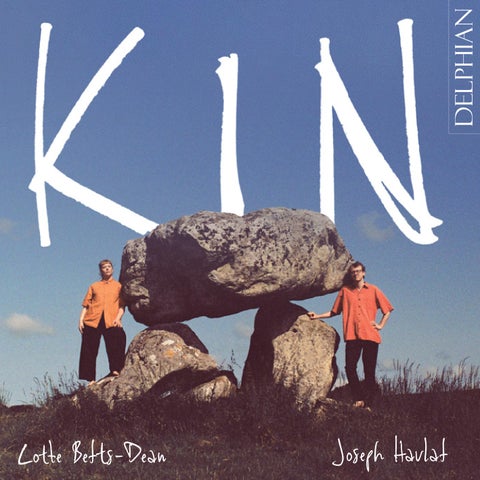
Lot e Betts-Dean
Joseph Havlat
Lotte Betts-Dean mezzo-soprano (except tracks 8 & 27) Joseph Havlat piano 1 2
Josephine Stephenson (b. 1990) Rosemary Lane •° Ernest J. Moeran (1894–1950)
3
Percy Grainger (1882–1961) 4 5 6 7
Parson and Clerk The Shooting of his Dear
[4:05] [2:05] [2:51]
from British Folk-Music Settings The British Waterside The Pretty Maid Milkin’ Her Cow Died for Love The Twa Corbies
[1:51] [1:22] [1:16] [3:15]
Percy Grainger
Scotch Strathspey and Reel
[5:00]
9
Benjamin Britten (1913–1976)
Sally in our Alley
[4:24]
Louise Drewett (b. 1989)
The Lambs on the Hillside •°
[3:14]
Joseph Canteloube (1879–1957) from Chants d’Auvergne 11 Malurous qu’o uno fenno 12 La delaïssádo Béla Bartók (1881–1945) 13 14 15 16 17 18 19 20
Eight Hungarian Folksongs Fekete főd, fehér az én zsebkendőm Istenem, istenem, áraszd meg a vizet Aszszonyok, aszszonyok, had’ legyek társatok Anynyi bánat az szűvemen Ha kimegyek arr’ a magos tetőre Töltik a nagy erdő útját Eddig való dolgom a tavaszi szántás Olvad a hó, csárdás kis angyalom
Joseph Havlat (b. 1994)
Interlude-Premonition (Bystrá voda vylívá)•
Isabella Gellis (b. 1997)
Montreal Songs •°
22 23
8
10
21
[1:39] [5:06]
24 25
Ah ! toi, belle hirondelle The Tree in the Wood Ale vasserlekh
Doreen H. Senior The Broken Ring• (dates uncertain; fl. 1930s–1960s)
[2:07] [4:23] [3:18] [5:40] [3:44]
Ralph Vaughan Williams (1872–1958)
The Maiden’s Lament
[2:29]
27
Michael Finnissy (b. 1946)
How dear to me
[5:09]
28
Ruth Wall (b. 1971)
My Lagan Love•
[3:04]
26
arr. Joseph Havlat
Total playing time
[77:49]
• premiere recording
° commissioned for this project [1:36] [1:33] [1:05] [1:05] [1:13] [1:52] [1:57] [1:13]
Recorded on 21-22 January 2025 at St Cuthbert’s Parish Church, Edinburgh Producer/Engineer: Paul Baxter 24-bit digital editing: Jack Davis 24-bit digital mixing & mastering: Paul Baxter Piano: Steinway model D, serial no 600443 (2016) Piano technician: Norman Motion
Cover photography: Isabella Gellis Session photography: Will Coates-Gibson / foxbrush Design: Drew Padrutt Booklet editor: John Fallas Delphian Records Ltd – Oxford – UK www.delphianrecords.com
www.delphianrecords.com
A note from Lotte As a duo and individually, we have loved international folk music and folksong for as long as we have been playing and singing music. My love of folksong was first awakened as a member of Gondwana Voices Children’s Choir in Australia, where as a tenyear-old I learned folksongs from Bulgaria and the Torres Strait Islands, among others. This interest developed further when, a decade later as an undergrad at Melbourne University, I first got to know and fell in love with Britten’s folksong arrangements (one of which we have included here). Other early discoveries include the arrangements of Ravel and Falla – both of which feature on my most recent Delphian release, everything you’ve ever lived – and Canteloube’s magical Chants d’Auvergne (two of which feature on this collection). In Joseph’s case, the extensive Hungarian folk music collections of Bartók, Kodály and Dohnányi, as well as Janáček’s arrangements of Moravian folk music, captured his twelve-year-old imagination as an already astonishingly talented young pianist, and they have remained within arm’s reach ever since. He has since programmed and recorded several works from these early discoveries, and returns to them constantly, like having a chat with old friends. Needless to say, Joseph’s passion for Hungarian folk music was infectious, and we are especially thrilled to present one of Bartók’s striking and evocative folk cycles on this programme.
Joseph and I met while students at the Royal Academy of Music and first worked together within the context of a new music ensemble; twentieth-century modernism and various contemporary repertoire have been the driving force behind our musical partnership thus far. Together we’ve commissioned, premiered and recorded many new works, and one could argue that it might have made more sense for our first duo album to focus on new music, or the grand cycles of the last century. And yet despite this, without necessarily planning it, it is the evergreen folksong tradition that has quietly crept into the forefront for us, and is what we wanted to share with our listeners first. Folk music by its very nature is innately connected to place and people – collective community, family and heritage. As two non-indigenous white Australians (Joseph’s families are originally Czech and German, while my descent is English and German Ashkenazi) we are perhaps always in search of a sense of homeland or belonging. We have also both left our ancestors’ adopted home of Australia and are still ‘expats’, now living in the UK (though in my case I have partially returned ‘home’!). We have multiple places that feel like home, and are always missing one of them – while on some deeper level perhaps wondering what our true cultural identity is, as offspring of a young country founded on immigration (and, to be
blunt, reprehensible violence towards and suppression of the land’s original inhabitants). I do sometimes wonder if there is some searching for ‘heritage’ or ‘kin’, or a deeper sense of cultural belonging, that lies at the core of our profound love of this musical tradition and our desire to inhabit these songs. Or perhaps it’s simply that we love the tunes. Far more often than not, folk melodies and lyrics are overwhelmingly beautiful in their deceptive simplicity, allowing the arranger seemingly endless creative potential. We wanted to tap into this by curating a varied programme of arrangements both old and new, featuring not only the legends of the tradition such as Bartók and Britten, but newer voices such as Isabella Gellis, Louise Drewett
and Josephine Stephenson, and some lesserknown (and underrated?) figures such as Ernest Moeran and Doreen Senior. Ultimately, KIN is about family: our immediate families, our grandparents, our ancestors, all carrying songs from one generation to the next, all over the world, in all our languages and traditions … but it is also about chosen family. The people you share life, experiences, sights, food and music with, whether related or not. For me, that includes Joseph. We’ve always joked that he is the younger brother I never had, and I the older sister he never had. I love him dearly and am grateful to call him kin. © 2026 Lotte Betts-Dean
Joseph and Lotte would like to thank: the Tait Memorial Trust (especially Eugenie White), who made this recording possible; Norfolk and Norwich Festival, who supported the commission of Rosemary Lane; all of the composerarrangers – especially Isabella, Josephine and Louise for the brand new works (and Isabella also for being our photographer!); Ruth for her arrangement (and for allowing Joseph to shape it further); Franciska Éry for coaching on Hungarian pronunciation; Michael Finnissy for the insightful essay and for his ongoing mentorship to us both; Melanie Barge at Historic England; Irene Brendel for her generosity and hospitality prior to recording; Lotte’s manager Megan Steller for the constant support; our families; and Paul, Will, Polly and John at Delphian
Notes on the music Folksongs relate how common people lived and thought. What happened to them, what pleased them, what terrified them; what brought them joy and what brought them grief. What they understood of science and religion, and what they had of hopes. People who were emerging for the first time as free men or wage labourers, and beginning their long fight for political freedom.
and eventually included 180 or so fascinating compositions incorporating Scottish, Irish, Welsh, English and other European folk musics.
That paragraph, quoted and fragmented from A.L. Lloyd’s book The Singing Englishman, has the typical form of a folksong text: a patchwork of deeply felt, meaningful phrases, strung together in some sort of order, and sung to music which is typically assembled in the same way.
Folk music and folk verse are mostly assembled by an individual singer, drawing material from local or family tradition, or from friends and anyone else they might hear singing. Some of Beethoven’s supposed Scottish tunes originated in Ireland and vice versa. Each individual, here or there, will personalise the word material, altering and adapting it to suit current circumstances – including elements of fantasy, historic narratives, and political events. Similarly with the music: melodic lines or short motifs may be adhered to or altered, new rhythms may replace old, new notes be added or old ones subtracted.
Folksong: in itself much discussed, also misunderstood, living a life, facing the Universe and responding. Throughout history there have been a great many reworkings of folksong material in art music: as the cantus firmus embedded in the texture of medieval motets and mass settings; as the theme for variations in the Buxheimer Orgelbuch or the Fitzwilliam Virginal Book; and so on and on, all over the world. The first notable British collection of supposed folk verse and folk music together was Orpheus Caledonius (1725) – material of Scottish origin, edited by William Thomson. Beethoven’s reworkings of folk material began in 1810 at the instigation of George Thomson,
In folksong there are no absolutely fixed versions; each one has its particularity, however subtle, sophisticated, clumsy or shocking. By the time Beethoven died in 1827 the upheavals of the Napoleonic Wars had been in abeyance for over twelve years. The so-called Industrial Revolution had begun in England about twenty years before he was born in 1770; rural communities had broken apart, been displaced or disappeared entirely. Industry was machine-based, and the agrarian and handicraft traditions threatened. As the twentieth century loomed on the horizon a relatively small group of concerned British citizens decided it was time to gather up those folk materials that had
survived, and somehow preserve them, or at least their memory. Typically these citizens were ladies and gentlemen of financial means, although there were also a number of country parsons, amateurs of art and learning, of broad but perhaps less than coherent knowledge. The enthusiastic and industrious collecting was almost country-wide, but deeply flawed, erratic, unsystematic and prejudiced. There were few who had the necessary skill and imagination to notate music without compromise or inaccuracy. There were few who could resist, by James Reeves’ 1959 account, drastically emending, abridging, restoring, expurgating or wholly rewriting the texts that they heard. In 1895 the Anglican priest and folksong collector Sabine BaringGould wrote that ‘the professional musician of today knows absolutely nothing of English folk music’. Even leading experts felt the need to bring folksong into line with ‘current musical practice’, and there were those who inevitably courted commercial profit and success, or wished to maintain what they thought was an appropriate ethical and racial high ground. Whatever happened subsequently happened just before the first World War. But all was not lost, and the resonances and problems of folk artistry have gone on for a further hundred-plus years. The songs collected here acknowledge their history: improvised or notated. Most of them are arranged by one person with professional compositional expertise, some
working from already published sources, or a different live collector, sometimes with a tune and/or words transmitted by a named folk-singer. A group of new settings were commissioned specially for the recording by Lotte and Joseph, from colleagues and friends who all have extensive knowledge of English and other folk musics. Of the older arrangements, those by Bartók, Grainger, Moeran and Senior are based on material the composers themselves collected on field trips. Grainger’s earliest interest in folksong was spurred on by his recital performances of Grieg’s Norske Folkeviser, Op. 66 and Slåtter, Op. 72. He started notating English folksongs in Brigg (Lincolnshire) in 1905, switching to phonograph recording with wax cylinders from the summer of 1906. Both The British Waterside and The Pretty Maid Milkin’ Her Cow were notated that year, from singing by Samuel Stokes and George Leaning respectively, and the arrangements settled in 1920. Joseph Taylor sang Died for Love to Grainger also in 1906, and the setting was made the following year. No musical material of a traditional origin is used in The Twa Corbies; it sets words found in Sir Walter Scott’s The Minstrelsy of the Scottish Border and was variously composed and scored in London between 1903 and 1909. The composition of Scotch Strathspey and Reel was begun in 1901, at first
Notes on the music following extant published materials and later incorporating a sea shanty, ‘What shall we do with a drunken sailor’, that was sung to Grainger by Mr Charles Rosher. The music mixes Scottish and Irish sources; Grainger observed that ‘Celtic dance-tunes are so alike in their harmonic schemes that any number of them can be played together and mingle harmoniously’. The work was completed in 1911, in a version scored for four men’s voices, five woodwinds, xylophone, concertina, two guitars and eight strings, and the piano version heard here was ‘dished up’ (to use Grainger’s own phrase) between 1937 and 1939. Following the examples of Grainger and of Béla Vikár (1859–1945), Bartók used an Edison phonograph to be scientifically precise in studying his folksong trophies. He distinguished very broadly between old-style (mostly pentatonic) and new-style (post1870) melodies, and also defined, in 1931, two theoretical types of ‘treatment’: firstly, where the accompaniment (here the piano) is of secondary significance; secondly, where the folksong serves as a motivic resource for compositional exploration, the substance built up around it by the piano. The vocal lines of the first five of the Eight Hungarian Folksongs are from tunes collected between 1907 and 1911 in the Csík district of what was then the Kingdom of Hungary (now part of presentday Romania); all are old-style pentatonic (no semitones), and they were initially performed
in the order 1–4–2–3–5. The final three are Székely soldier’s songs collected in 1907–14 and first performed in 1918: modal tunes, sometimes with added semitones. Showing perhaps, in its gentle chromaticism, the influence of John Ireland and Peter Warlock, The Shooting of his Dear – fifth of E.J. Moeran’s Six Folk Songs from Norfolk – was written in 1923. Parson and Clerk of 1931 is a Suffolk folksong ‘by George Hill, Earl Stonhara’, and suitably boisterous and straightforwardly modal in temperament. Ralph Vaughan Williams’ arrangement of The Maiden’s Lament – one of a set of folksongs collected by Maud Karpeles in Newfoundland (then a self-governing British Dominion, later becoming part of Canada) – dates from the mid-1930s. It features a very striking, attenuated, three-part motet-like texture, with the folk tune a centrally placed cantus firmus, and the first and third strophes emphatically centred on repeated Gs in the piano; the second has widely spaced chords, characteristic of Vaughan Williams’ way with harmony. The Broken Ring is also strophic but with judicious changes of layout in each of the eight roughly eight-bar verses. From 1935 to 1940 Doreen Horn Senior, later to become Devon County Music Organiser, collaborated with Helen Creighton on a volume of Traditional Songs from Nova Scotia, providing the melodies (this one ‘from the
singing of Mrs Edward Gallagher of Chebucto Head’) with quite elaborate, almost Brahmsian ‘pianoforte accompaniment’. In Sally in our Alley, both poem and original tune are by the eighteenth-century dramatist Henry Carey (though the melody, with its leap of an octave and a half, allegedly had to be written down by somebody else). Originally part of a theatrical entertainment, the item later became extremely popular in its own right. Benjamin Britten punctuates his arrangement with piano ritornelli whose arpeggiated semiquavers are reminiscent of Beethoven’s setting (last of his Twenty-Five Scottish Songs, Op. 108), while the melody (with bracketed ornamentation) is underpinned by tastefully dissonant chord progressions. The first four series of Joseph Canteloube’s Chants d’Auvergne were written between 1923 and 1930. La delaïssádo is the fourth song in Series 2, and Malurous qu’o uno fenno the fifth of Series 3. Deservedly popular, the composing seems to blend Dacquin’s rhythmic verve and the mysterious poise of early Satie. Post-World War Two composers and their audiences have been given the opportunity to confront and re-examine a far more accessible musical past – one which includes Beethoven and many, many more composers. This is not so much with a view
to engineering stylistic parodies, or in a spirit of nostalgia, but perhaps to help clarify where they stand now, in the midst of information overload. Josephine Stephenson, Louise Drewett, Isabella Gellis and Ruth Wall each make astute use of structurally diffracted, strangely suspended tonalities, where clearly recognisable chords are not quite where one expects them to be, and where elements of musical-pastoral symbolism such as bagpipe fifths, babbling water or distant bird calls are renewed and made once more magical. Stephenson, Drewett and Wall draw on texts and melodies – Rosemary Lane, The Lambs on the Hillside and My Lagan Love – associated with the British Isles, while Gellis’s Montreal Songs reflect, in the composer’s words, ‘an intersection of Montreal identities: French – English – Jewish’. The spontaneous performance of folk musicians lies more deeply buried within Joseph Havlat’s Interlude-Premonition – ‘a partial colourisation of a Czech folksong describing a spring in a meadow’, as Havlat explains, ‘[which] I have rendered as a blurred dream scene, or perhaps a mirage’ – and in my How dear to me, which evokes a melody originally associated with the text ‘Casadh an tSúgáin’ (‘The Twisting of the Rope’) by way of the new words assigned to it in Thomas Moore’s 1895 Irish Song Book. © 2026 Michael Finnissy
Notes on the music
Texts and translations 1 Rosemary Lane
I lived in service in Rosemary Lane, I kept the goodwill of my master and dame; Till a sailor came there one night for to lay, And that was the beginning of my misery. He called for a candle to light him to bed, And likewise a silk handkerchief for to tie up his head, To tie up his head as he used for to do, Says he, ‘Pretty Polly, won’t you come to bed too?’ This girl, feeling young and foolish, she thought it no harm To jump into bed to keep herself warm, But what was done next I’ll never declare, But I wish that short night had been seven long year. It was early next morning the sailor arose, And into her lap he threw handfuls of gold, Saying, ‘This I will give, and more I will do, If you’ll be my Polly wherever I go. ‘And when your baby is born, you put it to nurse, And sit like a lady with gold in your purse; With gold in your purse and milk in your breast, Saying that’s what you’ve got by your sailor in the west.’ And if it’s a boy, he shall fight for the king, And if it’s a girl, she shall wear the gold ring, She shall wear the gold ring and her top-knot shall blow, Saying, ‘That’s what you’ve got by your sailor true blue.’ Trad. English (Somerset)
2 Parson and Clerk
There’s an old clerk in this parish I know very well; He often do toll the eight o’clock bell. He went to the alehouse and got a full pot – And forgot the old church for to lock-a-lock lock. Rilari-liddle la diddle, la diddle la diddle-i-day. A mare and a foal they ran in great speed; The mare from the Bible began for to read. ‘Stay,’ said the foal. ‘Before you begin – Whatever you pray for, I’ll answer “Amen”.’ Rilari-liddle la diddle, la diddle la diddle-i-day. We’ll pray for the millers who grind us our corn, For they are the biggest rogues that ever were born. Instead of one sackful they’ll take two for toll – May the devil take millers! ‘Amen,’ said the foal. Rilari-liddle la diddle, la diddle la diddle-i-day. We’ll pray for the tailors, for they are no men; They’ll buy an old coat and they’ll sell it again. They’ll rub it and scrub it and darn up a hole – May the devil take tailors! ‘Amen,’ said the foal. Rilari-liddle la diddle, la diddle la diddle-i-day. We’ll pray for the publicans who sell us our liquor; Small measure they like, they can fill us the quicker. If you ask them for old beer they’ll draw you the small – May the devil take publicans! ‘Amen,’ said the foal. Rilari-liddle la diddle, la diddle la diddle-i-day. Trad. English (Suffolk)
3 The Shooting of his Dear
O come all you young fellows that carry your gun, I’d have you get home by the light of the sun: For young Jimmy was a fowler, and a-fowling alone, When he shot his own true love in the room of a swan. Then home went young Jimmy with his dog and his gun, Saying, ‘Uncle, dear uncle, have you heard what I’ve done? Cursèd be that old gunsmith that made my old gun – I have shot my own true love in the room of a swan.’ Then out came bold Uncle with his locks hanging grey, Saying, ‘Jimmy, dear Jimmy, don’t you go away: Don’t you leave your own country till your trial come on, For you never will be hangèd for shooting a swan.’ So the trial came on and pretty Polly did appear, Saying, ‘Uncle, dear uncle, let Jimmy go clear: For my apron was bound round me and he took me for a swan.’ And his poor heart lay bleeding for Polly his own. Trad. English (Norfolk)
Texts and translations 4 The British Waterside
Down beyond the British waterside, as I walked along, I overheard a fair maid, she was singing a song. The song that she did sing, and the words rėpėlid she: ‘Of all the lads in Engėland is the sailor lad for me.’
6 Died for Love
replied England
You may know a jolly sailor lad as he walks down the street, He is so neat in his clothing, and so tight on his feet. Hits teeth are white as ivory and his eyes black as sloes; You may know a jolly sailor boy by the way that he goes.
Dig me my grave long, wide and deep; Put a marbil stone at my head and feet. But a turtle-white dove put over above For to let the world know that I died for love.
North Yarmouth is a pretty place, it shines where it stands; The more I look upon it the more my heart burns. If I was at North Yarmouth I should think myself at home, For there I have sweethearts and here I have got none.
Trad. English (Nottinghamshire)
I'll go down to yon British waterside and build my love a touwer Where the lords, dukes and skewiers may all it admire. The King can but love the Queen, and I can but do the same; But you shall be the shepherdess andell I will be your swain.
7 The Twa Corbies
tower squires and
Trad. English (Nottinghamshire)
5 The Pretty Maid Milkin’ Her Cow
It was early one fine summer’s mornin’ When the birds sat and sung odden each bough, I heard a young damsel thės singin’, Thedden as she sat milkin’ her cow.
She sang with a voice so melodious, Which made me scarce able to go, For my heart it ė was smothered ė with sorrow By the pretty maid milkin’ her cow.
on thus Then
ė: see note*
I wish my baby it ė was born, Lyin’ smilin’ on its father’s knee, Addnd I was dead and in my grave, And green gress growin’ all over me.
And grass marble
As I was walking all alane, I heard twa corbies making a mane; The tane unto the t’other say, ‘Where sall we gang and dine today?’
‘Ye’ll sit on his white hause-bane, And I’ll pike out his bonny blue een: Wi’ ae lock o’ his gowden hair We’ll theek our nest when it grows bare.
‘In behint yon auld fail dyke, I wot there lies a new-slain knight; And naebody kens that he lies there But his hawk, his hound, and lady fair.
‘Mony a one for him makes mane, But nane sall ken whare he is gane: O’er his white banes, when they are bare, The wind sall blaw for evermair.’
‘His hound is to the hunting gane, His hawk to fetch the wild-fowl hame, His lady’s ta’en another mate, So we may make our dinner sweet.
Trad. Scottish (found in Walter Scott, The Minstrelsy of the Scottish Border)
ė: see note*
Trad. English (Lincolnshire) * ‘ė’, Grainger writes, ‘is a folksinger’s added “nonsense syllable”.’
Texts and translations 9 Sally in our Alley
Of all the girls that are so smart There’s none like pretty Sally; She is the darling of my heart And lives in our alley. There’s ne’er a lady in the land That’s half so sweet as Sally; She is the darling of my heart And lives in our alley. Of all the days within the week, I dearly love but one day, And that’s the day that comes between A Saturday and Monday. For then I’m dressed all in my best, To walk abroad with Sally; She is the darling of my heart And lives in our alley. When she is by I leave my work, I love her so sincerely: My master comes like any Turk And bangs me most severely; But let him bang his bellyful, I’ll bear it all for Sally; She is the darling of my heart And lives in our alley. My master carries me to church, And often am I blamed Because I leave him in the lurch As soon as text is named. I leave the church in sermon time And slink away to Sally; She is the darling of my heart And lives in our alley.
My master and the neighbours all Make game of me and Sally, And but for her I’d better be A slave and row a galley. But when my seven long years are out, O then I’ll marry Sally; O then we’ll wed and then we’ll bed, But not in our alley! Henry Carey (c.1687–1743)
10 The Lambs on the Hillside
The lambs on the hillside dance in heather, Where rowan grows and warmth on ev’ry flower, Where ships are sailing the oceans. To the church the bride and her party go, And like a picture she rides ahead, And with no voice I will follow, My love is to marry another. Dig the grave where I can rest, Put down flowers and the spring will help them grow. Under green I will lie here forever, Nothing but death will keep her from my mind. Trad. Scottish/Irish
11 Malurous qu’o uno fenno
Malurous qu’o uno fenno, Malurous qué n’o cat ! Qué n’o cat n’en bou uno, Qué n’o uno n’en bou pas ! Tradèra, ladèri dèrèro ladèra, ladèri dèra.
Unhappy is he who has a wife, Unhappy is he who doesn't! He who doesn’t have one wants one, He who has one doesn’t want one!
Urouzo lo fenno Qu’o l’omé qué li cau ! Urouz’ inquèro maito O quèlo qué n’o cat ! Tradèra, ladèri dèrèro ladèra, ladèri dèra.
Happy is the wife Who has the man she wants! Happier still is she Who doesn’t have one!
12 La delaïssádo
Uno pastourèlo èsper’ olaï al capt del bouès Lou galan doguélo, mè né bèn pas !
A shepherdess waits at the edge of the woods For her lover, but he does not come!
« Ay ! souï delaïssado ! Qué n’aï pas vist lou mio galant ; Crésio qué m’aïmábo, è ton l’aïmé iéu! »
‘Ah! I am abandoned! I do not see my beloved; I thought he loved me, I who love him so!’
Luziguèt l’estèlo, aquèlo qué marco lo nuèt, È lo pauro pastoureletto Démourèt à ploura…
A star appears to announce the night, and the poor little shepherdess is left weeping …
Trad. Occitan/Auvergnat (translations: Delphian Records)
Texts and translations Eight Hungarian Folksongs 13 Fekete főd, fehér az én zsebkendőm,
Elhagyott a legkedvesebb szeretőm. Ugy elhagyott, hogy még meg sem siratott, Érzi szívem, nemsokára meghalok.
14 Istenem, istenem, áraszd meg a vizet,
Had’ vigyen el engem apám kapujára; Apám kapujaról anyám asztalára, Had’ tudjak meg immán, kinek adtak férhez. Cifra katonának, nagy hegyi tolvajnak, Ki most ës oda van kërësztútállani; kërësztútállani, embërt legyilkolni, Egy panzer, kettőér nem szán vért ontani.
15 Aszszonyok, aszszonyok, had’ legyek
társatok, Gyermekruhát mosni mivel én is tudok. Sohse láttam lëánybőrt hogy árultak vóna, Sa timárok kordovánnak készítettek vóna! Anyámtól a kontyot sokszor kértem vóna, Ha keze botjától nem irtóztam vóna; Ebek ugatásán gyakran örvendeztem, A legények jönnek, magamban azt véltem.
16 Anynyi bánat az szűvemen
Snow-white kerchief, dark both field and furrow show. He who loved me once has left me lonely now. Silent, tearless, is it so true lovers part? Chill of death I feel upon my breaking heart. Coldly runs the river, reedy banks o’erflowing. River, bear me homeward; stormy floods, enfold me. Bear me to my mother, to my father’s threshold. Let them see my bridegroom, see to whom they sold me. He’s a worthless soldier, robber and mountebank. Close by the mountain road even now he’s hiding. Murdering travellers, if it can profit him. Then with his stolen wealth careless comes riding home. Women, women, listen, let me share your labour. I can rinse and rub as well as any neighbour. Soft as silk and white as milk, maids as sweet as honey. Such I never saw for sale – no, not for any money! If my mother’s wrath I had not so much dreaded, I’d have begged her blessing, and by now be wedded. Dogs begin to bark and lead my heart to drumming. Hark! Along the street the village lads are coming.
Kétrét hajlott az egeken. Ha még egyet hajlott volna: Szűvem ketté hasadt volna.
Skies above are heavy with rain. Sad my heart and weary with pain. Mocking scorn I’ll suffer no more, Or my heart will break for ever.
Én elmegyek közülletek, Isten maradjon veletek. Tőllem több panaszt nem hallasz, Kit hallottál, avval maradsz.
I shall journey far from this place. God protect you, lend you His grace. Home and homestead I must leave too. Those who wronged me still deceive you.
17 Ha kimegyek arr’ a magos tetőre,
Találok én szeretőre kettőre. Ej, baj, baj, baj, de nagy baj, Hogy a babám szive olyan mint a vaj!
If I climb the rocky mountains all day through, Sure I’ll find a sweetheart waiting, maybe two. Ah me, love’s free, will not stray. Why my darling’s so soft-hearted, who can say?
Nem kell nekem sem a kettő, sem az egy, Azt szeretem, aki eddig szeretett. Ej, baj, baj, baj, de nagy baj, Hogy a babám szive olyan mint a vaj!
Try and blame me, fickle name me, if you will; She who loved me first shall prove me faithful still. Ah me, love’s free, will not stray. Why my darling’s so soft-hearted, who can say?
18 Töltik a nagy erdő útját,
Viszik a székely katonát; Viszik, Viszik, szegényeket, Szegény székely legényeket.
All the lads to war they’ve taken, Woods and mountains are forsaken. Lusty lads too young for dying, Soldiers for their homeland sighing.
Ugy elviszik arr’a helyre Hol az út is vérrel festve, Kit a golyó, kit a lándzsa, Kit éles kard öszszevágta.
Far away to war they’re going, Blood upon the road is flowing. Death awaits them, undefended, So both youth and joy are ended.
Texts and translations 19 Eddig való dolgom a tavaszi szántás,
Kertekbe, rétekbe füvet lekaszálás; Immár ökröm hejjin lovam a nyeregbe, Szíjostorom hejjin kantarszár kezembe.
Eljött már az a nap, melyben kell indulni, Házamtól, hazámtól bús szivvel távozni, Kedves szüleimtől sirva elbúcsuzni, Kedves hitestársam árván itt kell hagyni.
Spring begins with labour; then’s the time for sowing. Summer brings green cornfields, meadows ripe for mowing. Though my horse still waits me, bearing bit and bridle, All unyoked my oxen, rake and plough stand idle. Daybreak and rising sun will on the march find me. House and home, sad-hearted, I must leave behind me. From my loving parents sad farewell I’ve taken, And my wife, my dear love, I must leave forsaken.
20 Olvad a hó, csárdás kis angyalom, tavasz akar
Snow is melting, oh my darling, springtime lenni, comes unbidden. De szeretnék kis kertedben rózsabimbó lenni! I would linger like the roses in your garden Nem lehetek énrózsa, elhervaszt Ferenc Jóska hidden. A nagy bécsi háromemeletes magos kaszár Foolish fancy! I must go. Pleasure at an end nyába. must be. Dreary barracks in Vienna’s city, only these Trad. Hungarian; English versions by Nancy Bush await me. (1907–1991)
The melody is hummed rather than sung. The implied text is as follows:
Trad. Czech (translation: Joseph Havlat)
22 Ah ! toi, belle hirondelle, qui vole ici,
Pray, fine swallow, who soars on high, N’as-tu pas vu dans ces îles mon Alexis Amongst these isles, have you seen my dear Qui est parti dans les voyages en ces longs jours ? Alexis, Il te donnera des nouvelles de son retour. Who long since departed on his travels? He’ll surely tell you news of his return. L’oiseau qu’est tout aimable s’est envolé. Avec son léger plumage s’en est allé, The friendly bird takes wing forthwith, A traversé l’eau et la mer sans se lasser, Sleek plumage speeds him on his way, Dessus les mats de cette flotte s’est reposé. ’cross oceans vast, without fatigue, And comes to rest aloft some ships at sea. A-t aperçu la hune d’un bâtiment. Alexis s’y lamente en naviguant. Atop one vessel’s mast he spies Alexis « Parle-moi donc, amant fidèle, parle-moi donc ! Who guides the ship in desperate grief. Je viens de la part de ta belle, dans ces vallons. » ‘Speak to me, faithful lover, pray speak to me! I come from your sweetheart in the valleys.’ L’amant plein de surprise d’entendr’ parler, De savoir des nouvelles d’ sa bien-aimée : Amazed to hear the creature talk «Tu lui diras, belle hirondelle, qu’à mes amours With news of his beloved, the man replies: Je lui serai chaste et fidèle à mon retour. » ‘Tell her, fine swallow, I’ll stay true to her love, Chaste and faithful, until I return.’ Trad. French-Canadian
23 There was a tree grew on the moor,
21 Interlude-Premonition (Bystrá voda vylívá)
Bystrá voda vylívá, všecky lúčky přikrývá…
Montreal Songs*
The clear water pours forth, covering all the meadow …
A very fine tree was he. And the tree grew on the moor, And the moor grew on the ground, And it grew all round and around, And a very fine tree was he. There was a branch upon the tree, A very fine branch was he. And the branch was on the tree, And the tree grew on the moor, And the moor grew on the ground,
And it grew all round and around, And a very fine branch was he. There was a nest upon the branch, A very fine nest was he. And the nest was on the branch … There was an egg upon the nest, A very fine egg was he. And the egg was in the nest … There was a bird in the egg, A very fine bird was he. And the bird was in the egg …
Texts and translations And on that bird there was some down, Some very fine down had he. And the down was on the bird …
There was a feather on the down, A very fine feather was he. And the feather was on the down …
Trad. Newfoundland (collected by Maud Karpeles)
24 Ale vasserlekh flisn avek,
Di gribelekh blaybn leydig. Nito aza mentsh oyf gor der velt, Vos zol farshteyn mayn veytig.
All the rivulets flow away, The little ditches remain empty. There’s not a person in all this world Who can understand my anguish.
Di yorelekh tsi-en, di yorelekh fli-en, Di tsayt geyt avek vi royekh, Un az ikh dermon zikh on dir, mayn zis-lebn, Geyt mir oys der koyekh.
The years go by, they fly away, Time disappears like smoke. And when I remember you, my sweet-life, I am weak with longing.
Un az a meydele shpilt a libe, Shpiln in ir ale farbn. Un az zi shpilt ir libe nit oys – Kon zi kholile nokh shtarbn…
And when a young girl is in love, She is full of glowing colour. But is she is not fulfilled in her love – She could die, Heaven forbid …
Un az di tepelekh trikenen oys, Baybn zey ale leydig. Un az a meydele firt ir libe nit oys, Vert zi farfaln oyf eybig.
And when the little pots dry out, They all remain empty. And when a young girl loses her love, She is lost forever.
Trad. Yiddish (collected by Ruth Rubin)
25 The Broken Ring
As a sailor walked all in a garden, A pretty maid he chanced to spy, And it was for to view her he stepped up to her, And said, ‘Fair maid, fan you fancy I?’
She said, ‘It’s seven years since my love has left me, And seven years since I did him see, And seven more I will wait upon him, Perhaps he’ll come back and marry me.’ ‘Perhaps your lover he is married, And is enjoying wedded bliss, Or perhaps your love he is dead and buried, The heavy ocean rolls o’er his breast.’ ‘If he be married, I hope he’s happy, If he be dead I wish him rest, But for his sake I will never marry, The reason why is I love him best.’ ‘O what if I be your single sailor, The one you don’t expect me to be? O what if I be your single sailor, Who has come back for to marry thee?’ ‘O if you be my single sailor, The one I don’t expect you to be, Show me the ring that was broke between us, And when I see it I will believe.’ He put his hand all in his bosom, His fingers being both brown and small, And he pulled out the token between them broken, And when she see it she down did fall. He picked her up all in his arrums, And said, ‘Fair lady, I’m none the worse, For I have plenty of gold and silver, The stormy ocean I no more will cross.’ Trad. Nova Scotia (from the singing of Mrs Edward Gallagher)
arms
Biographies
Texts and translations 26 The Maiden’s Lament
As I roved out one evening in spring, Down by a silent sweet shady grove, I heard a maiden making sad lament; She cried, ‘Alas, I have lost my love.’ O love is like an unquenching fire, Like a raging fire it seems to burn. Unto my cold grave I will retire; Unto my friends I will ne’er return. Come all you fair maids like me a-dying; It’s now I’m taking my last farewell, And all you small birds round me flying, Let your sweet notes be my passing bell. Trad. Newfoundland (collected by Maud Karpeles)
28 My Lagan Love
Where Lagan stream sings lullaby, There blows a lily fair. The twilight gleam is in her eye, The night is on her hair. And like a lovesick lenan-shee She has my heart in thrall, No life I own, no liberty; For love is lord of all. And sometimes when the beetle’s horn Hath lulled the eve to sleep, I steal unto her shieling low And thru her dooreen peep. There on the cricket’s singing stone She stirs the bogwood fire, And hums in soft sweet undertones The song of heart’s desire. Joseph Campbell (Seosamh MacCathmhaoil; 1879–1944)
Described as ‘a singer of rich and fearless versatility’ (The Guardian) with an ‘arrestingly opulent voice’ (Gramophone), Australian mezzosoprano Lotte Betts-Dean works across a broad repertoire that encompasses contemporary, chamber and early music, as well as art song, opera, oratorio and non-classical collaborations. Lotte has premiered over fifty works and recorded several composer portrait albums, including critically acclaimed releases of Stuart MacRae and Arthur Keegan for Delphian Records, as well as albums celebrating Michael Finnissy (Divine Art / Métier), Catherine Lamb (Another Timbre) and Ian Wilson (Farpoint). She has also recorded for Platoon (Schubert with George Xiaoyuan Fu), BIS (with Brett Dean), Ensemble Q (music by Berio) and Salmon Universe (with Luke Abbott and Jack Wyllie), and a concept album with guitarist Dimitris Soukaras – titled everything you’ve ever lived – was released on Delphian in 2025. Operatic engagements include Bayerische Staatsoper (Brett Dean Of One Blood, Weinberg Die Passagierin), Grand Théâtre de Genève (Matthew Shlomowitz Electric Dreams), Aldeburgh Festival (Colin Matthews A Visit To Friends), State Opera of South Australia (Brett Dean Hamlet) and Opera North/ Shadwell Opera (Isabella Gellis The Devil’s Den), and she is a regular at festivals and venues across the UK, Europe and Australia, including Oxford Song, West Cork Chamber Music, Australian Festival of Chamber Music, Kings Place and Wigmore Hall. In 2024, Lotte
won the Young Artist Award at the Royal Philharmonic Society Awards, with the citation praising her as ‘a visionary performer, initiating one bold collaboration after another’. Joseph Havlat is a pianist and composer from Hobart, Australia, based in London. Working as a soloist and chamber musician for music very new, very old and some things in between, he has performed in major concert venues around the UK, Europe, America, Japan and Australia. Passionate about modern and contemporary music, he has collaborated with composers such as Thomas Adès, Sir Harrison Birtwistle and Hans Abrahamsen, and has given to date over 120 second performances. Among his other recordings are solo albums for Linn (Les Adieux – works by Janáček and Martinů), Métier (Sinner, don’t let this harvest pass – Schumann, Finnissy and Cassandra Miller) and Flung (Isabella Gellis – The Dissolute Society Comprised of All Sorts), and for Delphian, collaborations with the violinist Charlotte SalusteBridoux and the composer Sally Beamish. As a composer his music often explores the sounds of the natural world, imbued with the harsher shapes of human modernity, with a particular interest in his native Tasmania. He has written music spanning forces from solo voice to large ensemble, including for Ensemble x.y, of which he was a founding member.
everything you’ve ever lived Lotte Betts-Dean mezzo-soprano, Dimitris Soukaras guitar
The Past & I: 100Years ofThomas Hardy Lotte Betts-Dean mezzo-soprano, James Girling guitar, Ligeti Quartet
DCD34348
DCD34307
Regular Delphian collaborator Lotte Betts-Dean has wowed critics with her ethereal, ‘starkly beautiful’ voice. Here, she teams up with outstanding Greek guitarist Dimitris Soukaras to present a terrific array of songs exploring ideas of nostalgia, childhood memory and the state between waking and sleep. Through borrowing, gathering and reimagining, this eclectic album wanders effortlessly through the creative spaces between genres, taking us from Ravel and Britten to Burt Bacharach and Sinéad O’Connor.
This collection of new compositions and arrangements by Arthur Keegan – developed in close collaboration with the performers – shows the profound influence of Thomas Hardy’s poetry on composers throughout the twentieth century and into our own era. Hardy’s characteristic themes are present throughout: the relentless passing of time; nature and the changing seasons; the effects on both of the modern world, with its machines and timetables. Keegan’s Elegies for Emma, for voice and guitar, seeks to restore the voice of Hardy’s first wife Emma alongside the regret-filled poems Hardy wrote after her death, while String Quartet No 1 ‘Elegies for Tom’ weaves instrumental meditations on Hardy’s poem ‘Afterwards’ together with interludes setting a later poem by Philip Larkin.
‘a varied and imaginative programme impeccably realised by two prodigiously talented young artists … That it works so well is down to the taste and artistry of both’ — Gramophone, November 2025 Benjamin Britten: Canticles James Way, Lotte Betts-Dean, Hugh Cutting, Ross Ramgobin voices; Natalie Burch piano, Annemarie Federle horn, Alis Huws harp DCD34340
Gramophone Awards 2025 – Shortlisted
Benjamin Britten’s five Canticles, written for his lover and muse Peter Pears, stand as some of his most intimate and spiritually charged music. Composed across a period of nearly thirty years, they reflect Britten’s evolving response to poetry, religion and the human condition. Tenor James Way and his duo partner and wife Natalie Burch lead an exceptional line-up of musicians in performances that capture the emotional depth and complexity of these unique pieces. The programme also features Priaulx Rainier’s unaccompanied Cycle for Declamation, written for Pears in 1955 – settings of Donne that, in their intensity and introspection, find common ground with Britten’s masterpieces. ‘James Way [is] never less than eloquent, and blends wonderfully with the mezzosoprano Lotte Betts-Dean as the voice of God in Abraham and Isaac …’ — The Times, February 2025
Recordings of the Year 2024 – Finalist
‘The performances of James Girling and the Ligeti Quartet are perceptive and sympathetic. Lotte Betts-Dean provides an admirable range of vocal colours and timbres together with excellent, clear diction’ — Gramophone, September 2024 Schubert: Music for Violin and Piano Charlotte Saluste-Bridoux violin, Joseph Havlat piano DCD34325
On this inventively programmed, deeply personal album, Charlotte SalusteBridoux and her duo partner Joseph Havlat interleave three major Schubert works for violin and piano with instrumental versions of his songs, in juxtapositions which bring out both connections and contrasts between them. The genial Sonata in A major sits alongside the dark, dejected yet lyrical ‘Du liebst mich nicht’ (in which Saluste-Bridoux tunes her violin’s lowest string down to D sharp to bring out a raspy, viola-like quality). ‘Sei mir gegrüsst’ is revealed as the melodic source for the late Fantasy in C major, whose ‘Hungarian’ stylistic features are also found in the Rondo in B minor. ‘Searchlight gleam or delicate whisper: Saluste-Bridoux excels at both dynamic extremes. She’s also extremely good at shaping and sustaining long lyrical lines … The track that made my heart somersault was one of the song transcriptions slipped in between … its haunting melody sings out from Saluste-Bridoux’s soulful violin’ — The Times, May 2025
DCD34362