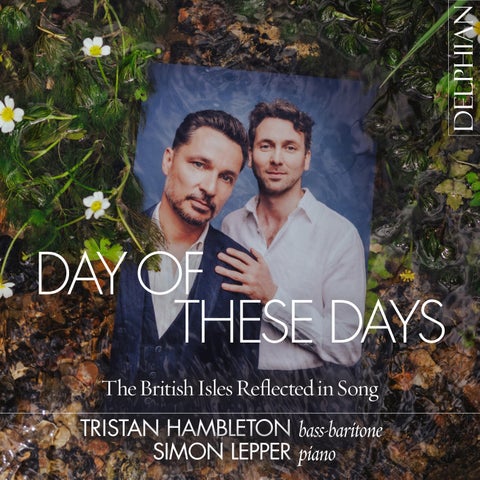
DAY OF THESE DAYS The British Isles Reflected in Song TRISTAN HAMBLETON bass-baritone SIMON LEPPER piano
DAY OF THESE DAYS
TRISTAN HAMBLETON bass-baritone SIMON LEPPER piano
The British Isles Reflected in Song Benjamin Britten (1913–1976)
Evening, Morning, Night (This Way to the Tomb) I. Evening
1 2
[1:28]
15
Richard Sisson (b. 1957)
The silver swan *
[2:40]
16
Huw Watkins (b. 1976)
Look down, fair moon
[2:17]
Huw Watkins
Clown in the Moon
[2:49]
II. Morning
[1:11]
17
III. Night
[1:54]
18
Huw Watkins
Full Moon and Little Frieda *
[2:36]
Benjamin Britten
Nocturne (On This Island)
[4:08]
19
Stuart MacRae (b. 1976)
I know not how it is with you *
[3:24]
5
Sally Beamish (b. 1956)
Day of These Days *
[1:50]
20
James MacMillan (b. 1959)
Scots Song
[4:41]
6
Judith Weir (b. 1954)
Sonnet 116 *
[2:42]
21
Traditional, arr. Benjamin Britten
There’s none to soothe
[1:43]
7
Henry Purcell (c.1659–1695), realised Thomas Adès (b. 1971)
By beauteous softness
[4:17]
22
Errollyn Wallen (b. 1958)
My feet may take a little while
3 4
8
Henry Purcell, realised Thomas Adès Full fathom five
[2:32]
9
Frank Bridge (1879–1941)
Thy hand in mine
[3:03]
10
Frank Bridge
Come to me in my dreams
[3:37]
11
Frank Bridge
Adoration
[3:11]
Tarik O’Regan (b. 1978)
Three Motion Settings *
12
I. In the Attic
[3:08]
13
II. To Whom It May Concern
[1:31]
14
III. What language to speak
[1:59]
Total playing time
[2:57] [59:50]
* premiere recordings
Recorded on 27-29 January 2025 in the Parish Church of St Cuthbert, Edinburgh Producer/Engineer: Paul Baxter 24-bit digital editing: Jack Davis 24-bit digital mastering: Paul Baxter
Design: John Christ Booklet editor: Henry Howard Cover photography: Pablo Strong Session photography: Will Coates-Gibson/foxbrush www.delphianrecords.com
@ delphianrecords.com @ delphianrecords @ delphian_records
Notes on the music I am hugely grateful to Susan Edwards without whose tremendous generosity this recording would not have been possible. I am grateful too for the support of The Francis Routh Trust and the Vaughan Williams Foundation and to all the people who helped fund this disc: Patrick Allies, Rachel Aukett, Andrew Carpenter, Jonathan Darbourne, Duncan Dormor, Paul Ferreira, Robin Greatorex, Diana and Hale Hambleton, Yvonne Jackman, Debbie King, Sue Knight, Betty Makharinsky, Martin Miles, Fergus Morrison, Lancelot Nomura, Louise Parry, Nicola Platman, Melissa Scott, Claire Tanner, Margaret Welfare, Fiona Willsher and other, anonymous donors.
I am grateful to Simon Lepper, Lana Bode and Sam Wigglesworth for contributing to the repertoire research and programming discussions that led to the creation of this album. A huge thank you to Lana for introducing me to Delphian, and to the composers, writers, publishers and rights holders for their art, skill and permission, so allowing this disc to be made; and to Caroline Phillips for her guidance. Thanks also to Aeron Glyn Preston for help preparing the scores; and to Andrew Motion and Errollyn Wallen for permission to reprint their words, and Briony Lawson for permission to reprint those of her father Ronald Duncan. Finally a special thank you to my friends and family for making this journey so enjoyable and to Simon Lepper for your endless patience and musical gifts. Tristan Hambleton
‘Such a morning it is’, wrote Laurie Lee as the first line of his poem Day of These Days. Lee conjures up a flash of time, and the manifold things that can happen within a single moment, most of the verses beginning with a pulsing ‘when’. The moment is morning, the place – presumably – somewhere in Britain. Indeed, all of the songs on this disc are rooted firmly in the British Isles. Eight are recorded here for the first time, and sit among some relatively little-known works by stalwarts of the recorded repertoire such as Benjamin Britten. Yet more broadly, the collection feels profoundly existential, questioning in each song what it is to be in the world right here, right now, on a ‘Day of these days’. Poetically, the songs explore different times of day, the contrast between land, sea and the stars, and the passing of time, both cosmic and in miniature, in which creatures play at least an important role as people. Love, and more particularly its loss, is a running theme, as is nature’s dispassionate gaze at human behaviour. Some verses reach back into the past – there are settings of Shakespeare and nods to the baroque era – while others have bracingly modern concerns. Such poetic terrain is perhaps relatively well-trodden, but the (mostly) unfamiliar music lends the collection a more enigmatic quality. Hidden meanings, as well as a very British kind of sarcasm, suggest that not all is what it seems.
The collection frequently addresses the unknowability of the psyche: the mysteries of our own interior life, and, even more so, that of others. As Robert Louis Stevenson puts it: ‘I know not how it is with you’. Musically, the songs reflect the uncertainty of the words, and are on the melancholy end of the spectrum. Many are in a slow metre, often tending towards minor keys, and the register of the bass-baritone voice can add a dark, sometimes foreboding quality. Around half have been transposed to accommodate the lower voice, but the remaining songs are in their original, published key – or, as in Judith Weir’s Sonnet 116, composed especially for Tristan Hambleton’s voice. But it is not by any means a grim or turgid collection. Rather, the voice and piano frequently find themselves attempting to bridge a gap, or to find common ground. Their registers may be at odds, but they strive for connection. Britten’s Evening, Morning, Night was composed at short notice in 1944 during the composition of Peter Grimes for Ronald Duncan’s drama This Way to the Tomb. The play was described as ‘A masque and anti-masque, the former focussing on the past, the latter inhabiting “the mere present”’. The three songs were performed by the character of Julian, who traversed both time zones. The texts are characteristically
Notes on the music ‘Duncanesque’ in their extravagant imagery: the sun is a ‘red fox’ which ‘tears the throat of the evening’ in the first song; velvet snakes and scarlet stallions populate the second. Other animals appear, such as old owls, sleeping cats, and the more violent hounds which, in the third song, suggest the ‘bullying’ behaviour of night. The music is no less Brittenesque with expansive vocal lines over exuberant arpeggios in the accompaniment in ‘Evening’, plus the merest touch of the blues (a style Britten had experimented with, but would soon give up). ‘Morning’ is infused with playful crossrhythms, giving way to a tender conclusion. Finally ‘Night’ features a passacaglia (a repeated figure in the bass), one of Britten’s favourite devices. Here it is in an unsettling 5/4 time, building in harmonic extremity under the hounds’ ‘bloody jowl and bark’. Another ‘night piece’, considerably softer this time, is Nocturne, from Britten’s cycle On This Island. It is a gorgeous lullaby, a plea to protect all those in the vulnerable state of sleep, including those who are forced to rest ‘in crooked holes’. Britten’s lines rise and fall over simple triads, mirroring the rhythm of Auden’s poem, until a (literally) breathtaking moment at the word ‘lie’. Sally Beamish’s elegant setting of Day of These Days is an evocation of the natural world considerably less red in tooth and claw than Duncan’s. Lilting, rising thirds dominate the piano part, and are frequently
echoed in the vocal line. The interval becomes bound to the idea of capturing an instant, through those repetitions of ‘when’. The passing of time more broadly – into eternity, indeed – is considered in one of Shakespeare’s most famous poems, Sonnet 116. Judith Weir’s setting is intimate (it was commissioned as a wedding gift and performed at the ceremony by Hambleton) yet also quizzical, revolving around the question of what love is, as well as what it isn’t, and aided by a similarly rhetorical piano part. It becomes more emphatic – with some celebratory, bell-like chords – when considering love’s robustness ‘even to the edge of doom’. Purcell composed Now does the glorious day appear as a birthday Ode to Queen Mary in 1689. By beauteous softness is an extract, ‘realised’ from the original bass line and melody by Thomas Adès in 2017. It is more elegiac than festive, dwelling reverently on the ‘sweetness’ of Mary’s reign. Adès’s arrangement lends an off-kilter, lilting quality to the accompaniment, while the bass-baritone register provides further gravity. Adès makes full use of the modern piano’s range in the expressive solo postlude to the song, while in another Purcell realisation, Full fathom five, the left hand plunges, appropriately, into its depths with thunderous octaves towards the end. They add solemnity to the otherwise callous jauntiness
of the vocal part, as The Tempest’s Ariel breezily informs Ferdinand of his father’s drowning.
unfolding in real time. The heavily ironic text of ‘To whom it may concern’ is about ice cream (or is it?) and is attempting to reassure The three love songs by Bridge make an us (perhaps too much) that of course nobody intriguing set. In many ways they represent the will die (or will they?). The jagged piano part, sedate, flowery quality of the Edwardian parlour rather Britten-like, suggests the song is not song. Yet a palpable sense of longing – well really about ice cream (it’s never just about ice served by Bridge’s richly chromatic harmonies cream). As if in confirmation ‘What language – frequently bursts through its confines. to speak’ is a mere four lines from Motion’s Thy hand in mine, setting a somewhat poem A Dream of Peace, a vivid account of conventional poem by Mary Coleridge, the experience of war across at least a century operates from a position of stasis, returning to of conflict. Voice and piano attempt to catch the same note throughout over a lightly pulsing each other’s ‘language’, the voice echoing piano figure. However, both voice and piano the contours of the piano’s harmonies. Yet it range increasingly widely from this static point falls silent after its two questions; the piano’s to deliver the fervent refrain of each verse. continued repetitions and unresolved final Come to me in my dreams has the air of a chord suggest they are unanswerable. schmaltzy drawing-room ballad, but is spiced with dissonance and a turbulent rumbling The Silver Swan is a setting of the in the central section. Adoration builds famous seventeenth-century poem by the from a hushed start to a quite extraordinary contemporary composer Richard Sisson outpouring for the voice, reaching up to an (formerly the ‘widow’ in the cabaret act impassioned high note on the word ‘love’. ‘Kit and the Widow’). The poem’s appeal over the centuries is easy to understand, perhaps Composed almost a century later is another enhanced by its being authored by good old trio of songs. Tarik O’Regan’s Three Motion ‘anon’. As the poet Carol Rumens puts it, Settings are concerned with the aftermath readers ‘dream secretly of poems that elude of love, and with the need to communicate or transcend explanation: poems that just are’, by whatever means possible. ‘In the Attic’ as if this extraordinary ‘swan song’ emerged depicts aching loss through the clothes ‘that out of the ether. Sisson’s version leans less into will never be needed … the hollow invisible its gentle melancholy than others (such as Ned sleeves’. A spare, hesitant accompaniment Rorem’s 1949 version, or Orlando Gibbons’ underpins the vocal line, sounding as if it is famous madrigal) though the swan’s own
Notes on the music utterance has a slightly satirical darkness to it. Overall, the song embodies a gracious, almost relaxed departure from this world – an elegant, swan-like gesture. Huw Watkins casts his eyes upwards in three songs about the moon, setting the words of Ted Hughes, Walt Whitman and Dylan Thomas. The moon is forced to witness something distressing in Whitman’s Look down, fair moon. The voice falls and sighs, beseeching the moon to cast its glance down. It then plunges dramatically down to a gravelly low A before rising fiercely, describing the horror of ‘ghastly, swollen, purple’ faces of the dead, as if shaking a fist at the oblivious sky. Dim your light, the words suggest, as the music fades away. Tears fall elegiacally in a setting of Thomas’s Clown in the Moon, the piano rippling high in its register, while the voice sinks further away at the end of each phrase. Full Moon and Little Frieda, by contrast, is a tender poem: above, the moon witnesses its ‘creation’ of a vivid scene; below, a child is astonished by the moon’s power. The music is introspective and spare, gesturing only briefly at the scurrying nighttime under the moon’s impassive gaze. Stuart Macrae is frequently drawn towards the poetry of Stevenson, once remarking that it was the atmosphere generated by the words rather than necessarily the deeper
meaning that attracted him. In his setting of I know not how it is with you the initial statement seems to permeate the entire song. The questioning, rising vocal line recurs throughout, suggesting not only the mysteries of another person’s interior world, but a more general sense of unknowability.
it in the tenderest of harmonies (‘with much pedal’, as the composer instructs). The piano part is at rhythmic odds with the pulse of the vocal line: a two-to-a-bar beat throwing the waltz-like melody off balance. Despite the warmth of the harmonies, there is a tugging, lurching quality to this song.
Like Stevenson’s verse, the lyrical poetry of William Soutar has also been a rich source for countless composers. He wrote partly in the English language, partly in Scots; in his endeavours to reintroduce the latter, he frequently wrote Scots poems for children. The Tryst, however – which James MacMillan sets as Scots Song – is very much an adult poem: a late-night encounter, passionate in intensity, and never forgotten. The melody is beautifully simple, and MacMillan returned to it several times in other works, including his orchestral work Tryst. Here, transposed down for the bass voice, the verses have a languorous quality while the piano has the job of varying the mood under the melody. An alternating B flat–C, rather like a very slow ticking of a clock, is the principal motif. It becomes lightly syncopated in the early verses yet in the final verse becomes opulently, Edwardianly ornamented, before disappearing, lightly tick-tocking, into silence.
Finally, more soul-searching – or solesearching – can be found in My feet may take a little while, with both words and music by Errollyn Wallen. (Hambleton was undoubtedly drawn to the spirit of this song having walked the Via Francigena from Canterbury to Rome over 80 days in 2022.) The trudging piano part appears mostly unaware of the vocal line above, displaying a stubborn obliviousness to what the heart desires. In the third verse, however, the feet seem to catch on, expanding into gorgeously rich harmonies and sharing the vocal line’s expressiveness. At the end of the song, while the voice resolves neatly onto its final note, the piano hovers, not able to be quite so certain. ‘The more I breathe’, the piano reminds us, ‘the less I know.’
The traditional Scottish There’s none to soothe is a bleak poem, yet Britten bathes
© 2026 Lucy Walker Dr Lucy Walker is a freelance writer specialising in twentieth- and twentyfirst-century music. She is co-editor of the forthcoming Elizabeth Maconchy in Context for Cambridge University Press.
Texts Evening, Morning, Night 1 I. Evening
Morning is only Women bent at the well Lifting their pails full Of their hearts, too heavy.
The red fox, the sun, tears the throat of the evening; makes the light of the day 3 III. Night bleed into the ocean. Night is no more than a cat which creeps The laced grace of gulls lift up to the saucer of light, laps, then sleeps. from the corn fields; Night is no more than the place waves reach fly across the sunset, scarlet their silhouette. with their hands of surf seeking the beach. The old owl, the moon, drifts from Night is no more than the hounds of fear its loose thatch of clouds, with bloody jowl and bark bullying the year. throws an ivory glance on an enamelled sea. Night is no more than my love who lies, Eyes of mice, the stars, from She dreams of a dream, lives, then dies. the privacy of light peep into the darkness with Ronald Duncan (1914–1982), from This Way to the Tomb, reprinted with permission the temerity of night. 2 II. Morning
Morning is only A heron rising With great wings Lifting day into the sky. Morning is only The white plumes of smoke As the velvet snake Night leaves the green valley. Morning is only A scarlet stallion Jumping the ocean, Its mane aflame on the sea.
4 Nocturne (On This Island, No. 4)
Now through night’s caressing grip Earth and all her oceans slip, Capes of China slide away From her fingers into day And th’ Americas incline Coasts towards her shadow line. Now the ragged vagrants creep Into crooked holes to sleep: Just and unjust, worst and best, Change their places as they rest: Awkward lovers like in fields Where disdainful beauty yields:
While the splendid and the proud Naked stand before the crowd And the losing gambler gains And the beggar entertains: May sleep’s healing power extend Through these hours to our friend. Unpursued by hostile force, Traction engine, bull or horse Or revolting succubus; Calmly till the morning break Let him lie, then gently wake. Wystan Hugh Auden (1907–1973). Copyright © 1938 by The Estate of W.H. Auden. Reprinted by permission of Curtis Brown, Ltd. All rights reserved. 5 Day of These Days
Such a morning it is when love leans through geranium windows and calls with a cockerel’s tongue. When red-haired girls scamper like roses over the rain-green grass; and the sun drips honey. When hedgerows grow venerable, berries dry black as blood, and holes suck in their bees. Such a morning it is when mice run whispering from the church, dragging dropped ears of harvest.
When the partridge draws back his spring and shoots like a buzzing arrow over grained and mahogany fields. When no table is bare, and no beast dry, and the tramp feeds on ribs of rabbit. Laurie Lee (1914–1997), Copyright © The Estate of Laurie Lee. Reprinted with permission of Curtis Brown Ltd. 6 Sonnet 116
Let me not to the marriage of true minds Admit impediments; love is not love Which alters when it alteration finds, Or bends with the remover to remove. O no; it is an ever-fixed mark That looks on tempests and is never shaken; It is the star to every wandering bark Whose worth’s unknown, although his height be taken. Love’s not time’s fool, though rosy lips and cheeks Within his bending sickle’s compass come. Love alters not with his brief hours and weeks, But bears it out even to the edge of doom: If this be error and upon me proved, I never writ, nor no man ever loved. William Shakespeare (1564–1616)
Texts 7 B y beauteous softness
By beauteous softness mixed with majesty, An empire over every heart she gains; And from her awful power none could be free. She with such sweetness and such justice reigns. Thomas Shadwell (1642–1692), adapted by Henry Purcell 8 Full fathom five
Full fathom five thy father lies; Of his bones are coral made; Those are pearls that were his eyes; Nothing of him that doth fade, But doth suffer a sea change Into something rich and strange. Sea-nymphs hourly ring his knell: Ding-dong. Hark! now I hear them — Ding-dong, bell. William Shakespeare, The Tempest, Act I, scene ii 9 T hy hand in mine
Thy hand in mine, And through the world we two will go, With love before us as a sign, Our faces set to ev’ry foe. My heart in thine, Through life, through happy death the same, We two will kneel before the shrine, And keep alight the sacred flame. Mary E. Coleridge (1861–1907)
10 C ome to me in my dreams
Come to me in my dreams, and then By day I shall be well again! For then the night will more than pay The hopeless longing of the day. Come, as thou cam’st a thousand times, A messenger from radiant climes, And smile on thy new world, and be As kind to all the rest as me. Or, as thou never cam’st in sooth, Come now, and let me dream it truth; And part my hair, and kiss my brow, And say: ‘My love! why suff’rest thou?’ Come to me in my dreams, and then By day I shall be well again! For then the night will more than pay The hopeless longing of the day. Matthew Arnold (1822–1888) 11 Adoration
Asleep! O sleep a little while, white pearl! And let me kneel, and let me pray to thee, And let me call Heaven’s blessing on thine eyes, And let me breathe into the happy air That doth enfold and touch thee all about, Vows of my slavery, my giving up, My sudden adoration, my great love! John Keats (1795–1821)
Three Motion Settings 12 I. In the Attic
Even though we know now your clothes will never be needed, we keep them, upstairs in a locked trunk.
What did I tell you? No one will die. No licking tongues will melt like candle wax. This is a poem about ice-cream. Do not cry. Andrew Motion, from Salt Water (1997), reprinted with permission 14 III. What language to speak
Sometimes I kneel there touching them, trying to relive time you wore them, to catch the actual shape of arm and wrist.
What language to speak in a world apart? How to describe peace in a heart?
My hands push down between hollow, invisible sleeves, hesitate, then take hold and lift:
Andrew Motion, from Lines of Desire (2010), reprinted with permission
a green holiday; a red christening; all your unfinished lives fading through dark summers entering my head as dust. Andrew Motion (b. 1952), from The Pleasure Steamers (1978), reprinted with permission 13 II. To Whom It May Concern
This poem about ice-cream has nothing to do with government, with riot, with any political scheme. It is a poem about ice-cream. You see? About how you might stroll into a shop and ask ‘One Strawberry Split, One Mivvi.’
15 T he silver swan
The silver swan who living had no note, When death approached unlocked her silent throat; Leaning her breast against the reedy shore, Thus sang her first and last, and sung no more: ‘Farewell all joys! O death come close mine eyes, More geese than swans now live, more fools than wise.’ Anon., before 1612
Texts 16 Look down, fair moon
Look down, fair moon and bathe this scene, Pour softly down night’s nimbus floods, on faces ghastly, swollen, purple; On the dead, on their backs, with their arms toss’d wide, Pour down your unstinted nimbus, sacred moon. Walt Whitman (1819–1892) 17 Clown in the Moon
My tears are like the quiet drift Of petals from some magic rose; And all my grief flows from the rift Of unremembered skies and snows. I think, that if I touched the earth, It would crumble; It is so sad and beautiful, So tremulously like a dream. Dylan Thomas (1914–1953) 18 Full Moon and Little Frieda
A cool small evening shrunk to a dog bark and the clank of a bucket – And you listening. A spider’s web, tense for the dew’s touch. A pail lifted, still and brimming – mirror To tempt a first star to a tremor.
Cows are going home in the lane there, looping the hedges with their warm wreaths of breath – A dark river of blood, many boulders, Balancing unspilled milk. ‘Moon!’ you cry suddenly, ‘Moon! Moon!’ The moon has stepped back like an artist gazing amazed at a work That points at him amazed. Ted Hughes (1930–1998), from Wodwo (1967), published by Faber & Faber 19 I know not how it is with you
I know not how it is with you – I love the first and last, The whole field of the present view, The whole flow of the past. One tittle of the things that are, Nor you should change nor I – One pebble in our path – one star In all our heaven of sky. Our lives, and every day and hour, One symphony appear: One road, one garden – every flower And every bramble dear. Robert Louis Stevenson (1850–1894), from Songs of Travel
20 Scots Song
O luely, luely, cam she in And luely she lay doun: I kent her be her caller lips And her breists sae sma’ and roun’. A’ thru the nicht we spak nae word Nor sinder’d bane frae bane: A’ thru the nicht I heard her hert Gang soundin’ wi’ my ain. It was about the waukrife hour When cocks begin to craw That she smool’d saftly thru the mirk Afore the day wud daw. Sae luely, luely, cam she in Saie luely was she gaen; And wi’ her a’ my simmer days Like they had never been. William Soutar (1898–1943), ‘The Tryst’, from Poems in Scots (1935) 21 T here’s none to soothe
There’s none to soothe my soul to rest, There’s none my load of grief to share, Or wake to joy this lonely breast, Or light the gloom of dark despair. The voice of joy no more can cheer, The look of love no more can warm Since mute for aye’s that voice so dear, And closed that eye alone could charm. Anon., Scottish, published in Robert Archibald Smith (1780–1829) in The Scotish Minstrel (1821–4)
22 My feet may take a little while
My feet may take a little while To walk the way of my beating heart; The more I walk, the more I breathe, The more I breathe, the less I know. There is a song that I was taught, Of hills and streams and all The hopes and fears of living things are written there in me. My feet are slower than my heart, Slower than my dreams, than my will. I’ll walk a million miles, I’ve walked a million miles of innocence. My feet may take a little while To walk the way of my dreaming heart; The more I walk, the more I breathe, The more I breathe, the less I know. Errollyn Wallen, reprinted with permission
Biographies Tristan Hambleton was born in London and became a chorister at St Paul’s Cathedral. He read History of Art at St John’s College, Cambridge and went on to study at Heidelberg University and the Royal Academy of Music, London. He was an academician at Festival d’Aix-en-Provence and Royaumont, a Samling Artist, Equilibrium Artist and a Countess of Munster Trust and ABRSM Scholar, receiving masterclasses from Thomas Allen, Simon Keenlyside and Brindley Sherratt.
Sheibani), Captain Ross in Stuart MacRae’s Anthropocene for Salzburger Landestheater (c. Leslie Suganandarajah, d. Agnessa Nefjodov), Madman and Witness 3 in George Benjamin’s Lessons in Love and Violence for the Mahler Chamber Orchestra (c. Sir George Benjamin, d. Dan Ayling), Father Truelove in Stravinsky’s The Rake’s Progress for the Swedish Chamber Orchestra (c. Barbara Hannigan, d. Josie Daxter), Envy and High Priest in Purcell’s Indian Queen for Opera de Lille and Le Concert d’Astrée (c. Emmanuelle As a soloist Tristan has appeared at the Berlin Haïm, d. Guy Cassiers), Mephistopheles in Philharmonie (Berlin Musikfest), Haus für Schumann’s Scenen aus Goethes Faust for Mozart (Salzburger Festspiele), The Royal Teatro São Carlos Lisbon (c. Graeme Jenkins), Albert Hall (BBC Proms), Elbphilharmonie Herman Ortel in Wagner’s Die Meistersinger and Laeiszhalle Hamburg, Palau de la Música von Nürnberg for The Hallé (c. Sir Mark Elder) and Catalana Barcelona, Chapelle Royale du Château Pluto and Pan in Locke’s Psyche for Ensemble de Versailles, Luxembourg Philharmonie, Correspondances (c. Sébastien Daucé). Örebro Konserthus, Berwaldhallen Stockholm, Kölner Philharmonie, Dortmund Konzerthaus, Simon Lepper read music at King’s College, Essen Konzerthaus, Bozar Brussels, Theater Cambridge and piano at the Royal Academy an der Wien Vienna, Philharmonie de Paris, the of Music with Michael Dussek and later Usher Hall (Edinburgh International Festival), with Ruben Lifschitz at the Fondation Bridgewater Hall and City Halls Glasgow. Royaumont. He is currently Assistant Head of Keyboard (Collaborative Piano) and a Roles include Tom in Verdi’s Un Ballo in vocal repertoire coach at the Royal College Maschera for Welsh National Opera (conductor of Music, London. Since 2003 he has also Carlo Rizzi, director Sir David Pountney), served as an official accompanist for the BBC Marchese in Verdi’s La Traviata for Opéra Cardiff Singer of the World Competition. National de Bordeaux (c. Paul Daniels, d. Pierre Rambert), Karl in David Bruce’s Nothing Simon has performed at leading venues for Glyndebourne (c. Sian Edwards, d. Bijan and festivals across Europe, North America
and Asia. Invitations have included a threeconcert project on the songs of Joseph Marx at Wigmore Hall, recital tours with Stéphane Degout to the Ravinia and Edinburgh Festivals and major opera houses in France, Switzerland and Belgium, and Schubert cycles with Mark Padmore including at the Schubertiade in Hohenems. He has also partnered Karen Cargill, Sally Matthews, Dame Felicity Palmer, Christopher Purves, Christiane Karg, Ilker Arcayürek and Benjamin Appl, with appearances at Carnegie Hall, New York’s Frick Collection, Barcelona, Zürich, San Francisco, Santa Fe and Shenzhen, where he performed the opening recital at the world’s highest concert hall with Aida Garifulina. He is also in demand as a teacher and coach, having given masterclasses at the Mozarteum Salzburg, Fondation Royaumont, La Chappelle, the Samling Foundation and the Oxford International Song Festival. Simon’s discography reflects a wide-ranging repertoire. Highlights include Debussy songs with Gillian Keith and Mahler and French song recordings with Karen Cargill, the complete songs of Jonathan Dove with Kitty Whately, and contemporary violin works with Carolin Widmann, which received a Diapason d’or. Recent releases include Schubert songs with Ilker Arcayürek, a recital disc with Christopher Purves, Poèmes d’un jour with
Stéphane Degout (Gramophone Editor’s Choice), Samuel Coleridge-Taylor songs with Elizabeth Llewellyn, and Burnished Gold, a collection of fin-de-siècle Viennese songs with Robyn Allegra-Parton. https://www.simonlepper.com/
Also available on Delphian Brindley Sherratt: Fear No More Brindley Sherratt bass, Julius Drake piano
Unveiled: Britten – Tippett – Gipps – Browne – Thomas Elgan Llŷr Thomas tenor, Craig Ogden guitar, Iain Burnside piano
DCD34313
DCD34293
Brindley Sherratt’s pre-eminence as an operatic bass is the result of two daring career shifts. Initially trained as a trumpeter, it was only in his mid-thirties that he left the professional security of a position in the BBC Singers to explore the world of opera. Now, the voyage of discovery continues as Sherratt turns to the intimate medium of the song recital. With the superb pianist Julius Drake as collaborator, in Fear No More Sherratt draws on all of his accumulated technical and expressive wisdom in death-haunted songs by Schubert, Mussorgsky and Richard Strauss and a final group of five twentieth-century English songs in which consolation and acceptance are the keynotes.
In Jeremy Sams’ new English-language singing version of Britten’s Seven Sonnets of Michelangelo, the passionate sentiments are unveiled in a way that was not possible in 1940, when Britten wrote the cycle – his first for his partner Peter Pears. Tenor Elgan Llŷr Thomas presents it alongside Michael Tippett’s equally ardent Songs for Achilles and a short item by W. Denis Browne, a close friend of the poet Rupert Brooke, as well as premiere recordings of four Brooke settings by Ruth Gipps and a new song-cycle by Thomas himself, to poems by Andrew McMillan. Tackling themes of love, shame, acceptance, war and death, the programme traverses a history of male homosexuality from necessary discretion to the (relatively) liberated present.
PRESTO Editor's Choice
‘Sherratt’s interpretations have an imposing power all their own, the deep, oaky patina of the voice carrying with it a special emotional weight’— Gramophone, May 2024 Our Indifferent Century: Britten – Finzi – Marsey – Ward Francesca Chiejina, Fleur Barron; Natalie Burch piano DCD34311
In 1914 Thomas Hardy wrote of ‘our indifferent century’; a generation later W.H. Auden urgently sought to fuse the political with the creative. Today, profoundly unsettled by the turn of the world’s politics, three artists respond with a programme that explores the changes and challenges we face presently, but one that also offers hope, levity an even a degree of irreverence, and never loses sight of the joy and beauty of nature. Hardy and Auden found their perfect musical counterparts in the songwriting of Finzi and Britten; in our own times William Marsey and Joanna Ward add their own musical voices of political urgency and wistful yearning. ‘thought-provoking, beautifully executed and timely’ — BBC Music Magazine, December 2023
‘Thomas and Burnside do [the music] full, impassioned justice’ — Presto Music, April 2023, EDITOR’S CHOICE Stuart McRae: Earth, thy cold is keen Lotte Betts-Dean mezzo-soprano, Sequoia
STUART MACRAE
Earth, thy cold is keen
DCD34297
Lotte Betts-Dean Sequoia
PRESTO Recordings of the Year 2023 – Finalist
Entranced by his first encounter with the voice of Lotte Betts-Dean in 2021, Stuart MacRae was inspired to write no fewer than eight vocal works in the space of two years. Sometimes entirely alone, sometimes joined by the composer himself on harmonium or electronics or by the violin-and-cello duo Sequoia (who also contribute two instrumental items), Betts-Dean’s compelling presence is at the very centre of this haunting album, which reveals the extent to which MacRae’s recent music has expanded to embrace folk-like simplicity alongside the modernist techniques of his earlier work. ‘conjures an aural landscape steeped in folk music and medieval lyric, but the result is entirely distinctive and modern … This is music for slow, close listening, beautifully performed’ — The Guardian, August 2023
Also available on Delphian TREE The Hermes Experiment DCD34358
PRESTO Recordings of the Year Winner 2025 – Concept Album THE GUARDIAN Classical Albums of the Year 2025
The Hermes Experiment’s third Delphian album is a meditation on nature, memory and change. Commissioned works and vivid reimaginings are complemented by new compositions by the ensemble’s members, exploring the human instinct to find emotional meaning in the natural world – in birdsong, trees, storms, stars … With its distinctive line-up of clarinet, harp, voice and double bass, the ensemble creates a soundscape by turns intimate, luminous and strange. Joy and grief, fragility and resilience sit side by side in a programme that feels both personal and elemental. ‘a liberating force in contemporary music’ — Guardian, October 2025
Listen. It is here: song cycles by Edward Picton-Turbervill Harriet Burns, Helen Charlston, Alexander Chance, Elgan Llŷr Thomas; Edward Picton-Turbervill piano DCD34345
Listen. It is here is a bold declaration of intent from a compelling new voice in British song. Edward Picton-Turbervill’s music – fresh, distinctive and unapologetically approachable – draws together themes of love and mysticism in settings of poets as diverse as Hildegard of Bingen, Rilke, Selima Hill and Harold Pinter. Fruit of a two-year burst of creative energy after the composer’s return to music, the songs balance emotional immediacy with finely crafted writing for voice and piano. Performed by some of the UK’s most exciting singers, this album announces a striking arrival: a composer writing with sincerity, stylistic clarity, and a clear belief in song’s enduring power to move, to comfort and to connect. New in January 2026
GRAMOPHONE Shortlisted in the Song category for the 2025 Awards THE TIMES Classical Albums of 2025
Benjamin Britten: Canticles James Way tenor, Natalie Burch piano; Lotte Betts-Dean, Hugh Cutting, Ross Ramgobin, Annemarie Federle, Alis Huws
I and Silence: Women’s Voices in American Song Lieberson – Argento – Barber – Copland – Crumb Marta Fontanals-Simmons mezzo-soprano, Lana Bode piano
DCD34340
DCD34229
Benjamin Britten’s five Canticles, written for his lover and muse Peter Pears, stand as some of his most intimate and spiritually charged music. Composed across a period of nearly thirty years, they reflect Britten’s evolving response to poetry, religion and the human condition. Tenor James Way and his duo partner and wife Natalie Burch lead an exceptional line-up of musicians in performances that capture the emotional depth and complexity of these unique pieces. The programme also features Priaulx Rainier’s unaccompanied Cycle for Declamation, written for Pears in 1955 – settings of Donne that, in their intensity and introspection, find common ground with Britten’s Canticles.
The expectations of silence often placed on women historically and politically, and music’s power to break through them, are the themes of this deeply personal recital. Channelling the voices of female writers and musicians, Fontanals-Simmons and Bode include two works which were written for great mezzo-sopranos of the recent past, Dame Janet Baker and Lorraine Hunt Lieberson, while settings of Emily Dickinson and Sara Teasdale fill out a programme which meditates powerfully on loss, vulnerability, tenacity and mindfulness.
‘James Way’s instinctive understanding of this stimulating repertoire seems remarkably complete … A joy from start to finish’ — Gramophone, April 2025
‘Solid vocal production and excellent diction … [FontanalsSimmons] prefers the words and music to do the talking, and they do so eloquently’ — BBC Music Magazine, October 2019
DCD34359