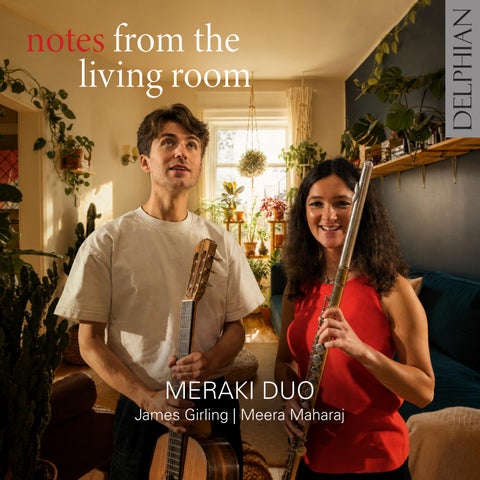
notes from the living room
MERAKI DUO James Girling | Meera Maharaj
notes from the living room
William Grant Still (1895–1978) arr. James Girling
Three Songs Bayou Home If you should go Song for the Lonely
[3:45] [1:28] [2:52]
6
Songs and Dances of the Islands Biguine You know one Joseph Keeba Kalinda
[3:11] [2:39] [4:32]
7 Eleanor Alberga (b. 1949)
Animal Banter
[5:57]
12
Cinq leçons de solfège No 1. Assez vif No 2. Très lent No 3. Lent No 4. Vif No 5. Modéré
[1:09] [2:08] [2:14] [1:32] [2:36]
13 Tōru Takemitsu (1930–1996)
All in Twilight – IV. Slightly fast
[2:46]
Toward the Sea 1. The Night 2. Moby Dick 3. Cape Cod
[3:28] [3:55] [3:43]
Four Macedonian Pieces 1. Zajdi, zajdi 2. Pajdushka 3. Jovka Kumanovka 4. Gajdarsko oro (Bagpiper’s Dance)
[5:24] [4:58] [3:58] [2:23]
1 2 3
Dominique Le Gendre (b. 1960) arr. James Girling 4 5
MERAKI DUO
Olivier Messiaen (1908–1992) arr. James Girling 8
Meera Maharaj flute (tracks 1, 4–12), alto flute (tracks 2–3, 14–20) James Girling guitar
9 10 11
with Roberto Carrillo García double bass (track 7)
Tōru Takemitsu 14 15 16
Miroslav Tadić (b. 1959) 17 18 19
Recorded on 23-25 July 2025 at St Cuthbert’s Parish Church, Edinburgh Producer/Engineer: Paul Baxter 24-bit digital editing: Jack Davis 24-bit digital mixing & mastering: Paul Baxter Session photography: Will Coates-Gibson / foxbrush Cover photograph (artist photo): Will Coates-Gibson
Cover photograph (background): Unsplash / @lydia_mailloux Design: Eliot Garcia Booklet editor: John Fallas Delphian Records Ltd – Oxford – UK www.delphianrecords.com
@ delphianrecords @ delphian_records
20
Total playing time Track 7 – premiere recording of the original version Tracks 1–6, 8–12 are premiere recordings of these arrangements
[64:51]
Notes on the music Despite its title, Notes from the Living Room could be said to have begun its life in a kitchen. When Meraki Duo – flautist Meera Maharaj and guitarist James Girling – were first making music together, they found themselves more often than not rehearsing in one, thus converting the standard definition of ‘chamber music’ into a considerably more informal, cosy domain: one in which music can occur spontaneously, and be enjoyed by the players and by anyone who happens to be listening. Such ideas have continued to inform the Duo’s performing ethos, and reflect the aspirations they have for this, their debut album. ‘Meraki’ is a Greek word, not directly translatable into English, but Maharaj defines it as ‘to do something you love with all your creativity, soul and passion’. While both classically trained, the Duo’s repertoire includes jazz, dance and folk. They express the hope that listeners coming from each of those genres might discover something here to draw them in; conversely, classical enthusiasts will find here much to explore beyond the standard repertoire. Standard repertoire, indeed, is hard to find for this particular combination of instruments. While some of the works recorded here were conceived for flute and guitar (plus double bass in the case of Eleanor Alberga’s
piece), the album also features Girling’s arrangements of music by William Grant Still, Olivier Messiaen and Dominique Le Gendre. These contribute to the expansion of repertoire available for the Duo’s instrumental pairing, and provide some opportunities to be creative with the sonorities of the guitar in particular. In adapting the piano parts of these works for his own instrument, Girling occasionally called on some unusual techniques, to suggest the presence of other instruments while retaining the spirit of the original. But as Le Gendre, a guitarist herself, comments in relation to her pieces: James Girling’s arrangement of my Songs and Dances
The album’s repertoire is modern – at the time of writing, three of the composers are still living, and all apart from Still were born in the twentieth century – yet its immediacy and sensual appeal give it a timeless quality. The portability of the instruments suggests their ability to travel, and to create a performing space pretty much anywhere. This space implies domesticity, but also the possibility of global reach. As the Duo put it, guitar and flute are ‘inherently folk instruments, representing cultural diversity and universal inclusivity’. The ‘living room’ of the album title, for them, evokes ‘those freely accessible spaces common to everyone worldwide, where cultures of all kinds are authentically found and shared’.
composers such as Still). Wordless music, moreover, has a fundamental internationalism, conveying a world beyond language; it can evoke those things which we can all see and hear – animals, the sea, the sound of a voice singing, ‘raindrops, soft from the mist’.* As a kind of governing principle behind the choice of pieces, the Duo kept in mind these lines by Leo Tolstoy: Music is the shorthand of emotion. Emotions, which let themselves be described in words with such difficulty, are directly conveyed to man in music, and in that is its power and significance.
of the Islands, originally composed for clarinet and piano, flows so effortlessly on flute and guitar with Meraki Duo that it sounds as if it had always been conceived for this instrumentation.
The album also features the distinctive sound of the alto flute, not commonly heard as a solo instrument. It lends a sumptuous, sometimes melancholy lustre to Miroslav Tadić’s Four Macedonian Pieces, especially the two song-based numbers, and a somewhat mysterious sonority to the ‘whale’ music of Toru Takemitsu’s Toward the Sea.
Notes from the Living Room is both international and diverse in its origins, consciously centring music by Black and female composers while stretching geographically from the USA and Caribbean to the UK and France, the Balkans, and Japan. The two performers themselves are international: British-born Girling lives in Norway, while Maharaj has Trinidadian heritage, in common with Dominique Le Gendre (the latter two met while working with Chineke! Orchestra, where Maharaj encountered music by global majority
* From the original words of Still’s ‘Song for the Lonely’, by Still’s wife Verna Arvey.
Notes on the music Eleanor Alberga was born in Jamaica, but has lived in the UK for the last fifty years. Described by the BBC’s Kate Molleson as a ‘quietly rebellious composer’, she draws on an eclectic range of influences from Roald Dahl to astronomy to mythology. ‘I’m always stumped’, she said in an interview in 2019, ‘when asked what my music sounds like, or what my style is’; but she suggested that there are two principal strands which shape her ‘sound’: her Caribbean background, which informs rhythm and tonality, and what she called ‘extreme contemporary European music’. The ‘ratio’, or proportion of one to the other, informs the musical atmosphere of individual pieces. The musicologist Kathryn Allwine Bacasmot has suggested that Alberga’s Animal Banter (1989) is a ‘whimsical take’ on the European pastoral tradition, conjuring up not a landscape, but a riotous conversation between farmyard animals. The animal kingdom is something of a feature in Alberga’s catalogue, which includes On a Bat’s Back I Do Fly (2000) and Tiger Dream in Forest Green (2005), as well as an early composition about her pet dog. The ‘banter’ of the present work is a deceptively intricate interchange between flute, guitar and double bass. The harmonic language is straightforward, barely moving out of its lane until a key change in
the final minute, but is given a fascinating complexity by Alberga’s restless rhythms, the time signature roving from five beats in a bar to 11, 12, 13, then seven (or 14 half-beats) for the final section. The voice of each ‘animal’ has a melodic ‘tic’ to which it returns – the flute’s opening E flat/F, for example – but becomes increasingly wild in its ornamentation as the ‘banter’ becomes more heated. Only in the final bar do the animals reach some kind of consensus. Animal Banter also exists in an arrangement for flute, piano and cello, which has been recorded previously; the present recording by Meraki Duo and double bassist Roberto Carrillo García is the first recording of the work in its original scoring. Dominique Le Gendre’s two suites of Songs and Dances of the Islands were inspired by music from Martinique and from Trinidad and Tobago (the composer’s homeland). The first and third of Girling’s arrangements are drawn from the original second suite, for clarinet and piano only; the second is taken from Suite No 1, which additionally includes double bass and percussion. Guitar and flute take the place of piano and clarinet. with the guitarist’s foot stamps supplying percussive effects, in Le Gendre’s gently rhythmic and playful take on the ‘Biguine’ – a dance associated with the Martinique town
of Saint-Pierre, popularised in the 1930s by Cole Porter’s song ‘Begin the Beguine’. Both flute and guitar take on percussive aspects in ‘Kalinda’, the guitarist knocking on the wood of the instrument while the flute deploys ‘tongue pizzicato’ to imitate the plucking of the absent double bass. ‘You know one Joseph Keeba’ adapts a traditional song from Toco in Trinidad (collected by anthropologists Melville and Frances Herskovits), whose lightly mocking tone is the vehicle for a story of a cuckolded husband. Olivier Messiaen’s music is commonly characterised by rich, clustered chords, complex rhythmic patterns, an atmosphere ranging from mesmeric to ecstatic, and a reverential or erotic (or both) subject at the centre. His Cinq leçons de solfège, however, were composed for a very different purpose. Written in 1933, they were originally singing exercises, for wordless voice with piano accompaniment; while they contain some elements of his more usual style, especially in the slow-moving No 2 and sensuously harmonised No 3, they have a lyrical simplicity unusual in his output. The vocal part has been transcribed here for flute, while the guitar takes on the piano role, lending No 4, for example, a touch of a Spanish dance, and No 5 a smoky, latenight feel.
The Bosnian guitarist and composer Miroslav Tadić encourages a certain amount of improvisatory freedom in his Four Macedonian Pieces, two songs and two dances from the former Yugoslavian region. ‘Zajdi, zajdi’ opens with a languorous solo from the alto flute, while the guitar, when it joins, is invited to freewheel around the notated chords. The result is an elegiac and organic response to the song on which it is based, a poem of ageing and the inevitable passage of time. The other song, ‘Jovka Kumanovka’, has a similarly wistful melancholy, set to a characteristic 3+2+2 rhythm, while the dancing ‘Pajdushka’ is based on a punchy 2+3 sequence. The final number in the set is the vigorous ‘Gajdarsko oro’, a ‘bagpiper’s dance’ drawing on Spanish and African styles. The imagery and sonic associations of water are of particular significance to Toru Takemitsu. His 1960 work Water Music, for example, is based entirely on recordings of water droplets, while I Hear the Water Dreaming (1987) evokes an Aboriginal ‘dreamtime’ of water in a landscape where it is scarce. The similarly dreamlike Toward the Sea (1981) was commissioned by the charity Greenpeace as part of its Save the Whales campaign. The titles of the work’s three parts refer to Herman Melville’s great whale of a novel
Notes on the music Moby-Dick, itself a meditation on man’s mystical attraction to the ocean. The musical atmosphere is delicately poised, with pauses more for contemplation than breath, and a ‘dying away’, rather than a more emphatic close, at the end of each movement. The reflective mood is only occasionally ruffled by flutter-tonguing in the alto flute, or a brief jangle from the guitar. Messiaen’s influence hovers over the suspended harmony and the recurring, arrhythmic motifs. Takemitsu’s All in Twilight for solo guitar was composed in 1987 for Julian Bream, one of the most active commissioners of contemporary music in the twentieth century. The fourth movement, fairly conventional by Takemitsu’s standards, is almost Romantic with its sighing inner melody and lightly chromatic underpinning, combined with a touch of nightclub jazz. The opening five-note melody acts as a kind of refrain, returning in the middle, and fading gently away at the end. Girling’s arrangement of Three Songs by William Grant Still is based on an existing adaptation for flute and piano. The original
voice-and-piano songs are infused with an extraordinary sense of longing – for home, for a loved one, for simply the ‘breath of a presence’ – in both their music and their poetry (‘If you should go’ by the Harlem Renaissance poet Countee Cullen; ‘Bayou Home’ and ‘Song for the Lonely’ by Still’s wife Verna Arvey). The songs’ texts share with Takemitsu’s work a metaphorical landscape of water (rain, tears, rivers, oceans …), but even when heard, as here, without words, the fluid melodic lines and deep melancholy combine to powerful effect. These songs seem to represent the heart of Meraki Duo’s intention with this album: a deep desire to connect and to communicate directly from performer to listener, wherever in the world they may be. © 2026 Lucy Walker Lucy Walker is a musicologist and writer specialising in twentieth- and twenty-firstcentury music. She has written extensively on Britten and is co-editor of Elizabeth Maconchy in Context (Cambridge University Press, 2026).
Acknowledgments
Biographies
With deepest thanks to all early supporters and pre-purchasers of this album, above all our Kickstarter Patrons – Hugh Brittain, Hazel and Jim Knowles, Rebecca Knowles and Varun Maharaj, Ajay and Naren Ratan – and the Kickstarter Project Supporters listed on the Delphian website. We simply wouldn’t have been able to complete this project without you.
Winners of the second International Flute & Guitar Chamber Music Competition (Festival Juan Gual Esteve, Spain) in 2023, Meraki Duo have spent a dozen years performing extensively in the UK with programmes which offer a distinctively diverse pairing of flute and guitar. In their recitals, flautist Meera Maharaj regularly extends the expressive range of the duo by featuring the alto flute, while their programmes also incorporate a breadth of arrangements by James Girling, of music spanning as widely as Messiaen, Burt Bacharach and Hermeto Pascoal.
Additional thanks to: Craxton Studios, London, and The Yard, Manchester, for kindly hosting our Kickstarter campaign’s launch concerts; our almae matres, the Royal Northern College of Music and the Royal Academy of Music; Live Music Now, Cavatina Duo, Craig Ogden, Andy Scott, Wissam Boustany, Laura Jellicoe, Michael Cox, Rory Russell, Tom McKinney, Lisa Pring, Rafael Marino Arcaro, the International Guitar Foundation, Thérèse Wassily Saba and countless others who have offered generous support, advice and mentorship to Meraki Duo over the years.
Maharaj and Girling both studied at the Royal Northern College of Music, where they immediately connected through a shared passion for chamber music, jazz, Latin American music traditions and contemporary works. They formed Meraki Duo in 2014, and have since performed year round for recital series from Northumberland to Cornwall, at venues such as Wigmore Hall and Kings Place, and in festivals including Buxton International Festival, Swaledale Festival and London Guitar Festival. Meraki Duo were selected to join the International Guitar Foundation’s Young Artist Platform in 2020. They were finalists in the Royal Over-Seas League Competition (Mixed Ensembles category) in 2019, and competed in the Ligita competition finals in Liechtenstein in 2025.
Biographies As Live Music Now artists since 2018, Meraki Duo also have vast experience bringing performances into the wider community. They are specially trained to give interactive concerts in schools for children with special educational needs and disabilities, and in care homes. Premièred in 2020 via livestream at 1901 Arts Club, London, Meraki Duo’s first substantial commission – À Norte, Rio Preto, by Berlinbased Brazilian composer Rafael Marino Arcaro – was recorded at Goldsmiths Music Studios and released as an EP in 2024. Meera Maharaj enjoys a diverse performing career. Competition successes include first prizes in the Royal Academy of Music Flute Competition and the Dutch International Flute Competition, and the Sussex Prize for Woodwind in the 2023 Royal Over-Seas League Competition. Her duo with pianist Dominic Degavino featured as Countess of Munster Recital Scheme, Tunnell Trust and Park Lane Group artists. She also plays with harpist Lucy Nolan as Hathor Duo, and founded the flexi-ensemble Meliora Collective. She graduated from the RNCM in 2017, having studied there with Wissam Boustany and Laura Jellicoe, and then studied with Michael Cox at the Royal Academy of Music, receiving a Masters with Distinction. Meera has
performed at the Southbank Centre, Wigmore Hall, Kings Place and at the BBC Proms. She is Co-Principal Flute of Chineke! Orchestra. Based in Norway, James Girling is a highly collaborative British performing/recording artist raised on a soffritto of jazz, classical and Brazilian guitar music. He is now an Associate Artist of the RNCM, where he was tutored by Craig Ogden and won the Gold Medal Award. James has headlined festivals, recorded, and been broadcast live on Radio 3 with the BBC Philharmonic, the Hallé and the Royal Liverpool Philharmonic Orchestra’s Ensemble 10:10. As soloist, he made his Wigmore Hall debut in 2017 and has since performed Rodrigo’s concertos across England. Most recently, James made his BBC Proms and Southbank Centre debuts with Paraorchestra, opened WOMEX at the Bridgewater Hall with his twelve-piece Agbeko, sold out at Oslo Jazzfestival with Tjøsvoll/Kompen/Girling, and alongside mezzo Lotte Betts-Dean, Ligeti Quartet and composer Arthur Keegan released the critically acclaimed album The Past & I: 100 Years of Thomas Hardy on Delphian. Born in Tenerife, Roberto Carrillo García started his musical studies at the Conservatorio Superior de Música de Santa Cruz. After graduating on the guitar,
he studied the double bass as well as composing and performing with several ensembles and played in the Orquesta Sinfónica de Tenerife. He subsequently pursued his bass studies at the Royal Northern College of Music, and in 1992 joined the Royal Northern Sinfonia as subprincipal double bass. In Newcastle he was a member of several chamber groups, as bass soloist, viola da gamba and as a guitarist. Subsequent appearances led to him playing guitar concertos with the Royal Northern Sinfonia as well as with other professional, amateur and youth orchestras, with tours to Germany, France, Switzerland and Spain. Roberto has also played as principal guest double bass with the London Symphony Orchestra, L’Orchestre National de France, Mahler Chamber Orchestra, Royal Scottish National Orchestra, Scottish Chamber Orchestra, BBC Scottish Symphony Orchestra, Orquesta Sinfónica de Tenerife and the European Union Chamber Orchestra, touring in South America, Europe, and the Middle and Far East. In September 2001 he became Principal Double Bass of the Hallé, where he stayed for seventeen years. He has taught as professor of double bass at the Royal Northern College of Music and given masterclasses in Spain, Poland and the UK.
He currently teaches double bass, viola da gamba and chamber music at Chetham’s School of Music, Manchester, and coaches with the National Youth Orchestra, NYO Inspire, Aldeburgh Music and Hallé Youth Orchestra. A regular contributor to the Tring Chamber Music Series, he has recently performed Eduard Tubin’s Double Bass Concerto in Poland and given a solo recital in the University of Manchester’s concert series. Very active in the domain of chamber music, he has just returned from Australia, where he performed in the prestigious Australian Festival of Chamber Music in Queensland.
Also available on Delphian
PRESTO Recordings of the Year 2024 – Finalist
The Past & I: 100 Years of Thomas Hardy Lotte Betts-Dean mezzo-soprano, James Girling guitar, Ligeti Quartet
Guacamaya: Songs & Chamber Music from Mexico Jamie MacDougall tenor, Mr McFall’s Chamber
DCD34307
DCD34286
This collection of new compositions and arrangements by Arthur Keegan shows the profound influence of Thomas Hardy’s poetry on composers throughout the twentieth century and into our own era. Keegan’s Elegies for Emma, for voice and guitar, seeks to restore the voice of Hardy’s first wife Emma alongside the regret-filled poems Hardy wrote after her death, while the arrangements include songs by Finzi, Imogen Holst and Ivor Gurney.
Confessing to a thirty-year love affair with the music of Mexico, Scottish tenor Jamie MacDougall enthusiastically joins forces with Delphian regulars Mr McFall’s Chamber, whose involvement in Latin American music goes back nearly as far. The resulting album of songs and chamber music covers the whole of the twentieth century, charting a journey through nationalist, modernist, folk and Aztec influences to the work of Arturo Márquez and Javier Álvarez, two of the most prominent and successful composers in Mexico today.
‘The performances of James Girling and the Ligeti Quartet are perceptive and sympathetic. Lotte Betts-Dean, in addition, provides an admirable range of vocal colours and timbres together with excellent, clear diction’ — Gramophone, September 2024 everything you’ve ever lived Lotte Betts-Dean mezzo-soprano, Dimitris Soukaras guitar DCD34348
James Girling
Regular Delphian collaborator Lotte Betts-Dean has wowed critics with her ethereal, ‘starkly beautiful’ voice. Here, she teams up with outstanding Greek guitarist Dimitris Soukaras to present a terrific array of songs exploring ideas of nostalgia, childhood memory and the state between waking and sleep. Through borrowing, gathering and reimagining, this eclectic album wanders effortlessly through the creative spaces between genres, taking us from Ravel and Britten to Burt Bacharach and Sinéad O’Connor. ‘a varied and imaginative programme impeccably realised by two prodigiously talented young artists … That it works so well is down to the taste and artistry of both’ — Gramophone, November 2025
‘bursting with charm and character … ensemble and singer are well matched. Eight composers are featured in a wide range of styles, from drawing-room to folk, bolero and bordello’ — The Guardian, July 2023
C o n t r a
ContraDANCE MZ Duo DCD34361
DANCE James Girling
MZ Duo
Canadian saxophonist David Zucchi and Spanish accordionist Iñigo Mikeleiz-Berrade bring the unlikely pairing of their instruments to vivid life in this debut recording. Rooted in rhythm and movement, their programme features two new commissions – Aileen Sweeney’s Shetland-inspired The Mirrie Dancers and Alex Paxton’s exuberant Water Butt: lovers, snorkel – alongside the duo’s own reimaginings of Granados’s Danzas españolas, Ravel’s Le tombeau de Couperin and Bartók’s Dance Suite. By turns virtuosic, lyrical and irrepressibly playful, ContraDANCE reveals the astonishing expressive range of a partnership that has already captivated audiences across Europe. ‘MZ Duo’s interpretation is luminous, always in tune with each composer’s language … close, intimate sound and perfect [recording] balance’ — Mundoclasico.com, February 2026
DCD34356