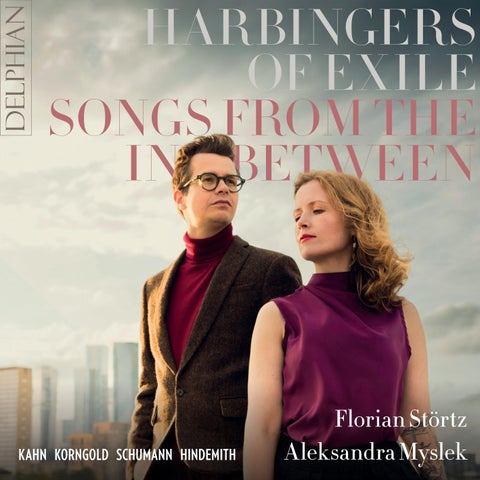
HARBINGERS OF EXILE SONGS FROM THE IN BETWEEN
KAHN KORNGOLD SCHUMANN HINDEMITH
Florian Störtz Aleksandra Myslek
HARBINGERS OF EXILE SONGS FROM THE IN‑BETWEEN
KAHN KORNGOLD SCHUMANN HINDEMITH
1 Robert Schumann (1810–1856)
Stille Tränen Op. 35 No. 10
[4:04]
2 Robert Kahn (1865–1951)
Es war der Tag der weißen Chrysanthemen Op. 61 No. 10
[2:40]
3
Das Glück Op. 65 No. 5 *
Florian Störtz bass-baritone Aleksandra Myslek piano Paul Hindemith (1895–1963)
Drei Hymnen von Walt Whitman Op. 14
16
1. Der ich, in Zwischenräumen, in Äonen und Äonen wiederkehre
[2:13]
[1:37]
17
2. O, nun heb du an, dort in deinem Moor
[3:39]
[2:20]
18
3. Schlagt! Schlagt! Trommeln!
[3:47] [2:24]
4
Am Schlehdorn Op. 57 No. 1 *
5
Der Liebe Macht Op. 55 No. 4
[1:36]
19 Robert Kahn
Allein … Op. 52 No. 5 *
6
Scheuche doch mit deinem Pfeile Op. 34 No. 8
[1:19]
20 Robert Schumann
Mein Wagen rollet langsam Op. 142 No. 4
[3:15]
7
Seliges Vergessen Op. 22/2 No. 2 *
[2:04]
Auf ein schlummerndes Kind Op. 22/2 No. 3 *
[3:07]
21 Robert Kahn
[3:28]
8
Nachtlied Op. 42 No. 8 *
[2:52]
Die leuchtenden Tage Op. 63 No. 3 *
[2:33]
9
Wie doch so still Op. 9 No. 2 *
22 23 Robert Schumann
In der Fremde Op. 39 No. 1
[1:52]
24 Robert Kahn
Über den Bergen Op. 57 No. 7 *
[1:35]
25
Wo wird einst Op. 61 no. 1 *
[2:11]
26
Abendwolken Op. 57 no. 5 *
[2:10]
27 Erich Wolfgang Korngold
Unvergänglichkeit Op. 27 No. 5
[2:10]
10 Erich Wolfgang Korngold (1897–1957) Mond, so gehst du wieder auf Op. 14 No. 3
[4:00]
11 Robert Kahn
Nänie Op. 44 No. 1
[7:02]
12
Herbstgefühl Op. 16 No. 8 *
[1:22]
13
Sehnsucht Op. 42 No. 4 *
[2:30]
14
Roman Op. 52 No. 2 *
[2:42]
15
O weht nicht, ihr Stürme Op. 57 No. 2 *
[1:33]
The artists extend heartfelt thanks to the City Music Foundation for their generous funding, which made this project possible, and deep gratitude to Norbert Meyn for his significant research contributions and unwavering encouragement. Special thanks to Richard Stokes for his invaluable translations and mentorship throughout this journey.
Total playing time
Recorded on 23-25 Jan 2025 in the Parish Church of St Cuthbert, Edinburgh Producer/Engineer: Paul Baxter 24-bit digital editing: Jack Davis 24-bit digital mastering: Paul Baxter Piano: Steinway & Sons model D, serial no. 600443 (2016) Piano technician: Norman Motion
[72:20]
Design: John Christ Booklet editor: Henry Howard Cover: Andrew Porter Session photography: Will Coates-Gibson/Foxbrush Delphian Records Ltd – Oxford – UK www.delphianrecords.com
@ delphianrecords.com @ delphianrecords @ delphian_records
Notes on the music This album presents a rich and colourful selection of songs by Robert Kahn. A nearly exact contemporary of Richard Strauss, Kahn chose a musically conservative path of naturalness, emotional sincerity and deep devotion to the excellent poetry he chose to set. With his extraordinary understanding of the human voice and the possibilities of the modern piano, he created highly compelling compositions that convince through their emotional sincerity and inner authenticity rather than through showmanship or harmonic extremes. He deserves to be recognised as one of the most compelling proponents of the art and tradition of German Lieder in the late nineteenth and early twentieth century. Widely admired in his lifetime but almost forgotten since his shameful removal from the Akademie der Künste (the Prussian Academy of the Arts) in Berlin in 1934 and subsequent emigration to Britain, Kahn’s artistic integrity has endured, and more and more of his highly appealing vocal and chamber works are being performed and becoming available through recordings. This disc is the first substantial recording of songs by Robert Kahn by a baritone, the voice type most of his songs were written for. Born in 1865 into a wealthy Jewish family and educated in Mannheim, Germany, Robert Kahn had early success as a composer, enjoying the support of great musicians such as Joseph Joachim, Hans von Bülow, Clara Schumann
and especially Johannes Brahms, with whom he spent several months in Vienna in 1887. Having completed his studies as a pianist and composer in Berlin and Munich (where he took composition lessons with Joseph Rheinberger) he worked briefly as a repetiteur at the Leipzig Opera, and from 1893 took a permanent role as a highly respected teacher at the Königliche Hochschule für Musik and the Akademie der Künste, publishing a constant stream of Lieder, duets, choral works, sonatas for violin and cello, piano trios and quartets, string quartets, and chamber works for mixed ensembles. As a pianist he partnered with some of the greatest performers of his time, including the baritone Johan Messchaert and the violinists Joseph Joachim and Adolf Busch. Friendships connected Kahn with the poets Gerhart Hauptmann and Christian Morgenstern, whose poetry inspired some of his most powerful work. He was also highly regarded as a teacher of composition, with Wilhelm Kempff, Arthur Rubinstein and Nikos Skalkottas among his many notable students. Kahn was widely recognised, performed and published by major publishers until his vilification by the Nazis from 1933. Having lost his position in public life, Kahn withdrew to his country residence Haus Obdach (Refuge) in Feldberg, about 85 miles north of Berlin, which took its name from one of his most popular songs, Ein Obdach gegen Sturm und Regen
(A Refuge from Storm and Rain, Op. 6 No. 5). Here he organised house concerts for his wider family and began to write piano music, surprised by the ‘bubbling fountain’ of inspiration (as he put it in a letter to his brother Paul) that flowed without the prospect of public performance. In 1939 he was finally forced to leave Germany. Pressured to abandon his home and almost all of his possessions and money, Kahn emigrated to Britain at the age of 73 together with his wife Katharina. With help from his American relatives (his younger brother Otto Kahn had been a successful banker in the US), he was able to settle in a small house in Biddenden, Kent, where he lived in relative isolation and continued to write an average of two piano pieces per week for the next ten years, reaching the staggering total of 1,160 pieces for his unparallelled Tagebuch in Tönen. The selection of Kahn’s Lieder on this disc spans a period from around 1890 (Wie doch so still, Op. 9 No. 2) to 1918 (Das Glück, Op. 65 No. 5). In 1890, the 25-year-old Kahn was working at the Leipzig Opera, but in contrast to the dramatic nature of the music there, a song such as Wie doch so still radiates an almost religious devotion to the purity and intimacy of the lyric art of song. In Herbstgefühl Op. 16 No. 2, published only two years later, the lilting vocal line is caressed by gently undulating arpeggios and complemented by a countermelody in the piano, masterfully
conveying the poem’s dual sense of loss and adoration. Seliges Vergessen and Auf ein schlummerndes Kind (Op. 22/2 Nos 2 and 3), published in 1895 during a highly productive period, are further examples of Kahn’s ability to combine constantly flowing piano writing with fluid, soothing melodic lines, creating touching yet sometimes breathtaking harmonic progressions that pull the listener into the atmosphere of the poem. Scheuche doch nicht mit deinem Pfeile (Op. 34 No. 8, 1901) from the Mörike cycle Liebesfrühling (Spring of Love) takes us into the early twentieth century, when Kahn was teaching at the Königliche Hochschule für Musik in Berlin. His position there gave him stability as well as the freedom to devote time to composition and performance. In this song, the melody builds a grand arch that expands over several phrases, complemented by a joyful and cheeky accompaniment that conveys the spirited nature of the text. Sehnsucht and Nachtlied (Op. 42 Nos 4 and 8, 1904) are further evidence of Kahn’s confidence and maturity as he creates expansive melodic lines that are perfect vehicles for the very best performers. Rather than disrupting and diverging from a treasured tradition, these songs add something innovative, confident and personal to a familiar idiom, providing utter musical satisfaction to performers and audience alike.
Notes on the music In 1903 Kahn was appointed to a professorship at the Berlin Hochschule, and the following period up until the beginning of the First World War is a markedly prolific one, with numerous publications of songs and chamber music. Kahn’s profound setting of Schiller’s Nänie (Op. 44 No. 1, 1905), both a lament for the transience of beauty and an ode to music itself, shows the confidence with which he entered into conversation with the great composers he admired; he must have been familiar with Brahms’s famous choral setting of the same text. Other outstanding examples from this productive period are Kahn’s settings of Leuthold’s Roman (Op. 52 No. 2, 1905) with its darkness and warmth, and Goethe’s Der Liebe Macht (Op. 55 No. 4, 1911), which with its pianistic exuberance and breathless energy perfectly catches both the turmoil created by Cupid and the helplessness of his victim. Am Schlehdorn and Über den Bergen (Op. 57 No. 1 and 7, 1912) are beautifully contemplative and gentle, while O weht nicht, ihr Stürme (No. 2 of the same opus) satisfies deeply with its dramatic gravitas. Wo wird einst (Op. 61 No. 1, 1914) reveals echoes of Bach’s contrapuntal keyboard music – we know that Kahn turned to it in times of crisis, and it later became a feature of many of the piano miniatures in the Tagebuch in Tönen. This highly individual and confident nod to Bach situates Kahn’s work reverently in the context of over 200 years of musical history. The haunting
beauty of Es war der Tag der weißen Chrysanthemen (Op. 61 No. 10, 1914), perhaps the most enchanting and moving song on this disc, represents the pinnacle of Kahn’s achievement during this fruitful period. Die leuchtenden Tage, No. 3 from the cycle Lieder aus Ernster Zeit (Songs from Serious Times, Op. 63, 1915) shows Kahn’s response to the tragic loss of life during World War I. His patriotic empathy with the sacrifice of German soldiers would later gain a sense of bitter irony from the persecution he suffered under the Nazis, a fate he shared with many veterans of Jewish descent. In contrast, the latest-dated song on this recording, Das Glück (Op. 65 No. 5, 1918), shows Kahn at his most joyful, capturing in music the character’s eager anticipation of happiness, with the poem – full of promise – suggesting multiple avenues through which it may blossom. Op. 65 is Kahn’s last published song opus. After World War I, Kahn continued to teach at the Hochschule and the Akademie but changed his compositional focus, publishing several collections of canons (an unusual but compelling form of vocal duet with piano accompaniment), as well as chamber works, choral works and cantatas.
Before writing this essay, I asked Florian Störtz and Aleksandra Myslek what it was like for them to perform Kahn’s songs. For Florian,
the long melodic lines and ample possibilities for expressive word-painting in his music were ‘a real gift’. He also thoroughly enjoyed the ‘baritonal’ nature of the songs which gave him the chance to use his full range, including the lower part of his voice. Aleksandra pointed to the incredible breadth of poets that Kahn chose with his immaculate literary taste, including many female writers. She found the joy and devotion with which Kahn set these poems infectious. Aleksandra also treasured the quality and modernity of his piano writing, informed by his own pianistic experience which empowered him to make the most of the sonorous possibilities of the modern pianos of the time, with their resonant bass register. At the same time as being almost Chopinesque in its pianistic quality, Kahn’s piano writing also has great orchestral depth in a Brahmsian sense, using the full instrument and often repeating the harmony to gain resonance. It also offers ample opportunities for the pianist to enjoy a real duet with the singer. As Aleksandra says, ‘There is almost always some kind of polyphony happening.’ For this album, Florian and Aleksandra also chose a few songs by other composers to highlight musical resonances and, in the case of Korngold and Hindemith, situate Kahn in the context of his contemporaries. The choice of these songs was also informed by their response to Kahn’s life story: being forced
to move and separate from loved ones but also making new discoveries (Schumann’s Mein Wagen rollet langsam, Op. 142 No. 4); a generous outpouring of hidden emotions (Schumann’s Stille Tränen, Op. 35 No. 10); and the effect of war (Hindemith’s three Hymnen von Walt Whitman, Op. 14). For Aleksandra, Hindemith’s powerful, almost pagan and sometimes brutal gestures provide a fascinating contrast to Kahn’s gentle emotionality and confident intellectualism. Fellow émigré Korngold’s Unvergänglichkeit, Op. 27 No. 5, published in 1933 – the year Hitler came to power in Germany – also resonates with Kahn on multiple levels: Kahn’s musical nobility and enduring integrity come to the fore in this context as his music, in Aleksandra’s words, ‘can quickly take the listener to powerful places with often very simple means’. For Florian, this album also has a kind of narrative, contemplating ‘having a place within society, a place within a family’ and then, slowly but surely, ‘seeing that crumble away under your feet’. Florian’s emotional response – as someone born in Germany – to the crude and senseless rejection of Kahn’s warm, rich, and joyful contributions to the cultural life of his homeland influenced the song choices for this album, some of which seem to foreshadow the fate Kahn himself would endure many years later. For Florian and Aleksandra,
Notes on the music introducing Kahn to a large, twenty-firstcentury audience is a mission, driven by the desire to re-establish his name alongside other well-known late romantic composers. They both feel, and I can only agree, that Kahn’s stunningly beautiful, emotionally engaging and text-focused music deserves our attention and ‘really fits in our modern world’. © 2026 Norbert Meyn German-born singer Norbert Meyn is a Repertoire Professor and Research Fellow at the Royal College of Music. From 2019 to 2023 he led the large AHRC-funded research project ‘Music, Migration and Mobility’ (www. rcm.ac.uk/singingasong), which explored the legacies of émigré composers from Nazi Europe in Britain, including Robert Kahn.
Texts and translations 1 Stille Tränen
Silent Tears
Du bist vom Schlaf erstanden Und wandelst durch die Au, Da liegt ob allen Landen Der Himmel wunderblau.
You have arisen from sleep And wander through the meadow, Over all the countryside The sky lies wondrously blue.
So lang du ohne Sorgen Geschlummert schmerzenlos, Der Himmel bis zum Morgen Viel Tränen niedergoss.
While you slumbered free of care And free of sorrow, The sky shed many tears Until morning dawned.
In stillen Nächten weinet Oft mancher aus den Schmerz, Und Morgens dann ihr meinet, Stets fröhlich sei sein Herz.
Many a man in silent nights Will often weep out his sorrow, And then in the morning you imagine His heart is always happy.
Justinus Kerner (1786–1862)
2 Es war der Tag der weissen
Chrysanthemen
That was the day of the white chrysanthemums
Es war der Tag der weissen Chrysanthemen – mir bangte fast vor seiner Pracht, Und dann, dann kamst du mir die Seele nehmen tief in der Nacht.
That was the day of the white chrysanthemums – I was almost afraid of its brilliance, And then, then you came to take my soul At the dead of night.
Mir war so bang, doch du kamst lieb und leise, ich hatte grad’ im Traum an dich gedacht. Du kamst, und leis wie eine Märchenweise erklang die Nacht.
I was so afraid, but you came sweetly and gently, I had been thinking of you in my dreams. You came, and soft as a fairy tune The night rang out.
Rainer Maria Rilke (1875–1926)
Texts and translations 3 Das Glück
Kannst du nicht warten? Irgend einmal muss es ja kommen! Vielleicht kommt’s über’n See geschwommen, Schilf und Seerosen in den Haaren, Oder durch die blaue Luft gefahren, Von vier silberumglitzerten Hengsten gezogen, Oder, gib Acht! Denn diesmal ist’s sicher nicht gelogen: In einer sternklaren Sommernacht Erblüht’s dir wohl mitten im eig’nen Garten … Kannst du nicht warten?
Happiness Can you not wait? It is bound to come one day! Perhaps it will come floating across the lake, Hair garlanded in reeds and water-lilies, Or it will arrive through the azure, Drawn by four silver-gleaming stallions. Or, be on your guard! For this time it is no lie: In a clear starry summer night It will blossom for you in the middle of your own garden … Can you not wait?
Irma Schneider-Schönfeld (1876–1915)
4 Am Schlehdorn
By the blackthorn
Am Schlehdorn, am Schlehdorn – Wisst ihr, wo der steht? Da sprach der Hirtenknabe Sein Morgengebet. Trieb die Schafe dann auf die Weide Hin durch den sonnigen Raum; Über die blühende Heide Träumte sein junger Traum.
By the blackthorn, by the blackthorn – Do you know where it grows? The shepherd lad was saying there His morning prayer. He then drove his sheep onto the meadow Through the sun-drenched land; His young dream was dreaming Above the blossoming heath.
Am Schlehdorn, am Schlehdorn – Wisst ihr, wo der steht? Da sprach eine junge Dirne Ihr Abendgebet.
By the blackthorn, by the blackthorn – Do you know where it grows? A young girl was saying there Her evening prayer.
Und der Wind kam von der Heiden Und küsste ihres Kleides Saum … Die beiden, die beiden Träumten den ersten Traum.
And the wind came from the heath And kissed the hem of her dress … Both of them, both of them Were dreaming their first dream.
Franz Evers (1871–1947)
5 Der Liebe Macht
The Power of Love
Cupido, loser, eigensinniger Knabe! Du batst mich um Quartier auf einige Stunden. Wie viele Tag und Nächte bist du geblieben! Und bist nun herrisch und Meister im Hause geworden!
Cupid, mischievous, capricious boy! You asked me to give you shelter for a few hours. You stayed for so many days and nights! And now you play the tyrant as master of the house!
Von meinem breiten Lager bin ich vertrieben; Nun sitz’ ich an der Erde, Nächte gequälet; Dein Mutwill’ schüret Flamm’ auf Flamme des Herdes, Verbrennet den Vorrat des Winters und senget mich Armen.
I have been banished from my broad bed; I sit now on the ground, passing my nights in torment; Audaciously, you fan the flames in the hearth, Burn my winter supplies and singe me in my wretchedness.
Du hast mir mein Gerät verstellt und verschoben; Ich such’ und bin wie blind und irre geworden. Du lärmst so ungeschickt, ich fürchte, das Seelchen Entflieht, um dir zu entfliehen, und räumet die Hütte.
You have hidden and displaced my belongings; I search as though I’ve gone blind or insane. You bluster so clumsily that I fear my little soul Will flee and, in order to escape you, leave this hut.
Johann Wolfgang von Goethe (1749–1832)
Texts and translations 6 Scheuche doch mit deinem Pfeile
Scare away with your arrow
Scheuche doch mit deinem Pfeile, Scheuch in Eile, Sonne, mein geliebtes Kind, Dass sie flüchte in die Frische Dieser Büsche, Wo die schönen Schatten sind.
Scare away with your arrow, Swiftly scare away The sun, my dear child, That she might take refuge in the freshness Of these bushes, Where the lovely shadows are.
Wenn wir dann zusammen ruhend, Freundlich thuend, Lauschen in der Waldesnacht, Sollst du durch den Busch mit Neide Auf die Freude blicken, Die du mir gebracht.
Then you shall when we, reclining together Flirtatiously, Hearken in the forest night, Gaze with envy through the bushes At the joy You have brought me.
Friedrich Rückert (1788–1866)
7 Seliges Vergessen
Blissful Oblivion
Im Winde fächeln, Mutter, die Blätter, Und bei dem Säuseln Schlumm’re ich ein.
The leaves, O mother, Blow gently in the wind, And as they murmur, I fall asleep.
Über mir schwanken Und spielen die Winde, Wiegen so linde Das Schiff der Gedanken, Wie wenn ohne Schranken Der Himmel mir offen, Dass still wird mein Hoffen Und Frieden ich finde, Und bei dem Säuseln Schlumm’re ich ein.
The winds wave above me And frolic, Cradle so gently My ship of thoughts, As if, without barrier, Heaven opened for me Silently to fufil my hopes, And I find peace, And as they murmur, I fall asleep.
Erwachend dann sehe, Als ob sie mich kränzen, Rings Blumen ich glänzen, Und all’ meine Wehen Verschweben, vergehen, Der Traum hält sie nieder, Und Leben gibt wieder Das Flüstern der Blätter, Und bei dem Säuseln Schlumm’re ich ein.
Waking, I then see Flowers gleaming about me, As though they were garlanding me, And see all my sorrows Float away and vanish, The dream suppresses them, And life is restored Through the whispering leaves, And as they murmur, I fall asleep.
Joseph von Eichendorff (1788–1857)
8 Auf ein schlummerndes Kind
Wenn ich, o Kindlein, vor dir stehe, Wenn ich im Traum dich lächeln sehe, Wenn du erglühst so wunderbar, Da ahne ich mit süssem Grauen Dürft’ ich in deine Träume schauen, So wär’ mir alles, alles klar! Dir ist die Erde noch verschlossen, Du hast noch keine Lust genossen, Noch ist kein Glück, was du empfingst; Wie könntest du so süss denn träumen, Wenn du nicht noch in jenen Räumen Woher du kamest, dich ergingst? Friedrich Hebbel (1813–1863)
To a Sleeping Child When, my little one, I stand before you, When I see you smile in your dream, When you glow so wondrously, Then, I wonder with sweet dread: If I were allowed to look into your dreams, Everything, everything would become clear to me! The world is still a mystery to you, You have not yet enjoyed any pleasure, You have still not felt happiness;. How could you dream so sweetly then, If you were not still passing through those realms From which you came?
Texts and translations 9 Wie doch so still
Wie doch so still dir am Herzen Ruhet das Kind! Weiss nicht, wie Mutterschmerzen So herbe sind. Auf Lippen, Stirne und Wangen Ist schon vergangen Das süsse Rot. Und dennoch heimlicherweise Lächelt es leise – Leise Küsset es der Tod!
How silently How silently the child Nestles against your heart! He does not know how a mother Suffers such bitter pain. His lips, his brow, his cheeks Have already been drained Of that sweet red. And yet the child Smiles gently – Gently Death kisses him!
Emanuel Geibel (1815–1884)
10 Mond, so gehst du wieder auf
Moon, so you rise again
Mond, so gehst du wieder auf Überm dunklen Tal der ungeweinten Tränen! Lehr, so lehr mich’s doch, Mich nicht nach ihr zu sehnen, Blass zu machen Blutes Lauf, Dies Leid nicht zu erleiden Aus zweier Menschen Scheiden.
Moon, so you rise again Over the sombre vale of unwept tears! Teach me, o teach me Not to long for her, To make my blood run pale, Not to suffer this suffering, Caused by two people parting.
Sieh, in Nebel hüllst du dich. Doch verfinstern kannst du nicht den Glanz der Bilder, Die mir weher jede Nacht erweckt und wilder. Ach! im Tiefsten fühle ich: Das Herz, das sich musst’ trennen Wird ohne Ende brennen.
Behold, you veil yourself in mist. But you cannot darken the gleam of images That nightly loom ever more painfully and wildly. Ah! I feel in the depths of my heart That the heart which had to part, Will burn unceasingly.
Ernst Lothar (1890–1974)
11 Nänie
Auch das Schöne muss sterben! Das Menschen und Götter bezwinget, Nicht die eherne Brust rührt es des stygischen Zeus. Einmal nur erweichte die Liebe den Schattenbeherrscher, Und an der Schwelle noch, streng, rief er zurück sein Geschenk. Nicht stillt Aphrodite dem schönen Knaben die Wunde, Die in den zierlichen Leib grausam der Eber geritzt. Nicht errettet den göttlichen Held die unsterbliche Mutter, Wenn er, am skäischen Tor fallend, sein Schicksal erfüllt. Aber sie steigt aus dem Meer mit allen Töchtern des Nereus, Und die Klage hebt an um den verherrlichten Sohn. Siehe! Da weinen die Götter, es weinen die Göttinnen alle, Dass das Schöne vergeht, dass das Vollkommene stirbt. Auch ein Klaglied zu sein im Mund der Geliebten, ist herrlich, Denn das Gemeine geht klanglos zum Orkus hinab. Friedrich von Schiller (1759–1805)
Nänie Even Beauty must die! That which subdues men and gods Does not move the brazen heart of Stygian Zeus. Once only did love touch the ruler of the underworld, And still on the threshold he sternly recalled his gift. Aphrodite does not soothe the lovely youth’s wound, That the boar cruelly inflicted in his tender flesh. The immortal mother does not save the godly hero, When he, dying at the Scaean gate, fulfilled his destiny. But she rises from the sea with all Nereus’ daughters, And the lament starts up for the exalted son. Behold, the gods weep, all the goddesses weep That beauty fades, that perfection dies. Even to be an elegy in the beloved’s mouth is glorious, For the commonplace descends unsung to Orcus.
Texts and translations 12 Herbstgefühl
Autumnal Feeling
Müder Glanz der Sonne! Blasses Himmelblau! Von verklungner Wonne Träumet still die Au.
Weary glow of the sun! Pallid blue of the sky! The meadow is quietly dreaming Of faded joy.
An der letzten Rose Löset lebenssatt Sich das letzte lose, Bleiche Blumenblatt.
From the last rose, Sated with life, The last, loose, pale Flower petal detaches itself.
Goldenes Entfärben Schleicht sich durch den Hain; Auch Vergehn’n und Sterben Däucht mir süss zu sein.
A golden fading Steals through the grove; It seems to me that even Dissolution and dying may be sweet.
Karl Friedrich von Gerok (1815–1890)
13 Sehnsucht
Longing
Sonst wächs’t in meinem Herzen Viel Unkraut, Dorn und Schmerzen – Die Nacht wird lang, die Nacht wird kalt!
Else there will grow in my heart Many weeds, thorns and pain – The night grows long, the night grows cold!
Paul Heyse (1830–1914)
14 Roman
A Novel
Da liegt im Schatten der Linden Einsam das Gotteshaus; Glockenklang mit den Winden Zittert ins Land hinaus.
In the shadow of the lime tree Lies, all alone, the chapel; The sound of bells travels on the winds, Trembling, out into the countryside.
Es sprudeln und plätschern die Bronnen Wohl um die alte Abtei; Im Klostergarten die Nonnen Wandeln zwei um zwei.
The fountains plash and gush All around the old abbey; The nuns in the cloister garden Walk by in pairs.
Die eine, die mich betrachtet, Senkt tiefer den Schleier aufs Kleid; … Doch tiefer noch umnachtet Die Seele mir Reu’ und Leid.
One of them, observing me, Lowers her veil deeper over her habit; … But remorse and suffering Shroud my soul in even deeper darkness.
Der Tag wird kühl, der Tag wird blass, Die Vögel streifen übers Gras; Schau, wie die Halme schwanken Von ihrer Flügel Wanken Und leise wehn ohn’ Unterlass.
The day grows cool, the day grows pale, The birds flit above the grass; See how the blades of grass sway From their whirring wings And softly murmur without cease.
15 O weht nicht, ihr Stürme
O tempests, do not blow
Und Abends spät die Liebe weht Ob meines Herzens Rosenbeet. Die Zweige flüstern und beben, Und hohe Gedanken weben Sich in mein heimlich Nachtgebet.
And Love, late in the evening, Wafts over the rose-bed of my heart. The branches murmur and quiver, And noble thoughts weave Through my secret evening prayer.
O weht nicht, ihr Stürme, Weht nicht so schaurig, Ihr wecket die Schmerzen, Die bittern Schmerzen!
O tempests, do not blow, Do not blow so eerily. You will wake my pain, My bitter pain!
Du fernes Herz, komm zu mir bald, Sonst werden wir Beide grau und alt,
O distant heart, come to me soon, Else we’ll both grow grey and old,
Es rauschen die Bäume, Rauschen und ächzen, Und ach, mein Leid erwachet!
The trees rustle, Rustle and groan, And ah! my suffering stirs!
Heinrich Leuthold (1827–1879)
Texts and translations Es fallen die Tropfen, Die schweren Tropfen, Doch ihr, meine Augen, Ihr armen, bleibt trocken!
The drops fall, The heavy drops. But you, my eyes, my poor eyes, Stay dry!
Anon.
Drei Hymnen von Walt Whitman 16 Der ich, in Zwischenräumen, in
Äonen und Äonen wiederkehre Der ich, in Zwischenräumen, in Äonen und Äonen wiederkehre, Ein unzerstörbarer, unsterblicher Wandrer, Lustvoll, geschlechtlich, mit ursprünglichen, zeugenden Lenden, in süsser Fülle; Der ich, Sänger adamitischer Gesänge, Durch den neuen Garten des Westens, durch die grossen Städte rufe; Und trunken das verkünde, was im Werden ist, dies darbiete und mich selbst. Und mich selbst bade und meine Lieder im Zeugenden, Meine Lieder, die Sprösslinge meiner Lenden. 17 O, nun heb du an, dort in deinem Moor
O, nun heb du an, dort in deinem Moor, Lieber scheuer Sänger! Ich höre dein
Lied, ich vernehme deinen Ruf! Ich höre; ich bin da; ich verstehe dich. Einen Augenblick nur säumte ich. Weil der glänzende Stern mich zurückhielt; Der Stern, mein scheidender Gefährte machte mich säumen. 18 Schlagt! Schlagt! Trommeln!
Ages and ages, returning at intervals Ages and ages, returning at intervals, Undestroy’d, wandering immortal, Lusty, phallic, with the potent original loins, perfectly sweet, I, chanter of Adamic songs, Through the new garden the West, the great cities calling, Deliriate, thus prelude what is generated, offering these, offering myself, Bathing myself, bathing my songs in Sex, Offspring of my loins.
Sing on there in the swamp! Sing on there in the swamp! O singer bashful and tender, I hear
Schlagt! Schlagt! Trommeln! Blast, blast, Hörner! Durch Fenster brecht und Türen Mit unbarmherziger Gewalt; Und in der stillen Kirche Löst die Andacht auf. Stört den Studenten im Hörsaal. Stört das Glück des harmlosen Bräutigams Bei seiner Braut. Den friedlichen Farmer bei Pflug und Ernte Lasst nicht in Ruh. So grimmig schlagt und rasselt, Trommeln! So schrill, ihr Hörner, blast! Schlagt! Schlagt! Trommeln! Blast, Hörner, blast! Durch Handel und Wandel der Städte, Durch Rädergedröhn der Strassen; Sind in den Häusern nächtens Die Betten bereitet? Die Schläfer dürfen In diesen Betten nicht schlafen.
your notes, I hear your call, I hear, I come presently, I understand you, But a moment I linger, for the lustrous star has detain’d me, The star my departing comrade holds and detains me. Beat! beat! drums! Beat! beat! drums! – blow! bugles! blow! Through the windows – through doors – burst like a ruthless force, Into the solemn church, and scatter the congregation, Into the school where the scholar is studying; Leave not the bridegroom quiet – no happiness must he have now with his bride, Nor the peaceful farmer any peace, ploughing his field or gathering his grain, So fierce you whirr and pound you drums – so shrill you bugles blow. Beat! beat! drums! – blow! bugles! blow! Over the traffic of cities – over the rumble of wheels in the streets; Are beds prepared for sleepers at night in the houses? no sleepers must sleep in those beds, No bargainers’ bargains by day – no brokers or speculators – would they continue? Would the talkers be talking? would the singer attempt to sing?
Texts and translations Die Händler dürfen Handel nicht treiben Would the lawyer rise in the court to Bei Tage; nicht Makler und nicht Spekulanten! state his case before the judge? Wollen sie ihre Geschläfte betreiben? Then rattle quicker, heavier drums Die Redner, wollen sie reden? – you bugles wilder blow.
Kein Licht, kein Strahl, kein Segen Dringt in das Herz mir ein; Und keine Tränen – Allein!
Schicken die Sänger sich an zu singen? Dann wirbelt schneller, lauter, Trommeln! Und wilder, Hörner, blast! Schlagt! Schlagt! Trommeln! Blast, Hörner, blast!
Emmi Destinn (1878–1930)
Was da Verhandlung, und was da Beschwerde! Achtet nicht der Zagen, Auf Klagen nicht und Tränen! Nicht der Bitten des Vaters für den Sohn! Überdröhnt des Kindes Stimme Und der Mutter Flehn! Bahn macht für die Bahren, Die Toten schütten sollen für den Leichenwagen! So rauh euer Dröhnen, Schreckliche Trommeln! Ihr Hörner, so hart euer Blasen! tr. Johannes Schlaf (1862–1941)
Beat! beat! drums! – blow! bugles! blow! Make no parley – stop for no expostulation, Mind not the timid – mind not the weeper or prayer, Mind not the old man beseeching the young man, Let not the child’s voice be heard, nor the mother’s entreaties, Make even the trestles to shake the dead where they lie awaiting the hearses, So strong you thump O terrible drums – so loud you bugles blow.
20 Mein Wagen rollet langsam
Nacht ist’s, die Sterne funkeln Im lichten, kalten Schein, Und hier, im Dunkeln Bin ich, allein!
My carriage rolls slowly
Mein Wagen rollet langsam Durch lustiges Waldesgrün, Durch blumige Täler, die zaubrisch Im Sonnenglanze blühn.
My carriage rolls slowly Through cheerful green woodland, Through flowery valleys Magically blooming in the sun.
Ich sitze und sinne und träume, Und denk’ an die Liebste mein; Da huschen drei Schattengestalten Kopfnickend zum Wagen herein.
I sit and muse and dream, And think of my dear love; Three shadowy forms nod at me Through the carriage window.
Sie huschen und schneiden Gesichter, So spöttisch und doch so scheu, Und quirlen wie Nebel zusammen, Und kichern und huschen vorbei.
They flit by and pull faces, So mocking yet so shy, And whirl together like mist And flit chuckling by.
Heinrich Heine (1797–1856) Walt Whitman (1819–1892) 21 Nachtlied
19 Allein …
No light, no ray, no blessing Penetrates my heart; And no tears – Alone!
Alone … It is night, the stars are sparkling In the bright cold light, And here, in the darkness, I am alone!
Night Song
Nacht, o holde! halbes Leben! Jedes Tages schöne Freundin! Lass den Schleier mich umgeben, Der von deinen Schultern fällt. Nacht, o holde!
Night, O gracious one! half of life! The fair friend of every day! Let your veil envelop me, Cascading from your shoulders! Night, O gracious one!
In dem vollen Arm der Schönen Ruhet jetzt belohnte Liebe; Und nach einsam langem Sehnen
Love is now rewarded In the fair one’s sensual arms; And after much lonely longing,
Texts and translations Bringen auch verschmähtem Triebe Träume jetzt ein Bild der Lust. Nacht, o holde!
Unrequited desire becomes through dreams An image of delight. Night, O gracious one.
Es schleicht mit leisen Schritten Die List in deinen Schatten; Sie suchet ihren Gatten, Den Trug! – Im stillsten Winkel Entdeckt sie ihn! Und freudig Drückt sie ihn an die Brust.
Stealth now steals silently Into your shadow; She seeks her husband, Deceit! – In the quietest corner She discovers him! And joyfully, She clasps him to her breast.
Nacht, o holde! halbes Leben! Jedes Tages schöne Freundin! Lass den Schleier mich umgeben, Der von deinen Schultern fällt. Nacht, o holde!
Night, O gracious one! half of life! The fair friend of every day! Let your veil envelop me, Cascading from your shoulders! Night, O gracious one!
Johann Wolfgang von Goethe
22 Die leuchtenden Tage
The Gleaming Days
Warum die Tage so leuchtend sind Voll überirdischer Pracht? Warum der Abend so seltsam lind, So mondscheindurchflutet die Nacht?
Why do the days gleam so, Full of supernatural splendour? Why is the evening so strangely mild, The night so drenched in moonlight?
Es ist, weil offen das Himmelstor Für uns’re Gefall’nen steht, Es ist, weil Engel- um Engelchor Lichtschimmernd zur Erde geht.
It is, because the gate of Heaven Stands open for our fallen sons, It is, because chorus upon chorus of angels Descend to earth in shimmering light.
Gott Vater sandte die Mütter aus Aufs Schlachtfeld in Feindesland: „Tragt sanft mir meine Söhne nach Haus.“ Gar manche den eig’nen fand.
God the Father dispatched mothers To the battlefields abroad: ‘Carry gently my sons back home.’ Many many mothers found their son.
Melanie von Puttkamer (b. 1864)
23 In der Fremde
In a Foreign Land
Aus der Heimat hinter den Blitzen rot Da kommen die Wolken her, Aber Vater und Mutter sind lange tot, Es kennt mich dort keiner mehr.
From my homeland, beyond the red lightning, The clouds come drifting in, But father and mother have long been dead, Now no one knows me there.
Wie bald, ach wie bald kommt die stille Zeit, Da ruhe ich auch, und über mir Rauscht die schöne Waldeinsamkeit, Und keiner kennt mich mehr hier?
How soon, ah! how soon till that quiet time When I too shall rest Beneath the sweet murmur of lonely woods, Forgotten here as well.
Joseph von Eichendorff
24 Über den Bergen
Über den Bergen, weit zu wandern, Sagen die Leute, wohnt das Glück, Ach und ich ging im Schwarm der andern, Kam mit verweinten Augen zurück. Über den Bergen, weit, weit drüben, Sagen die Leute, wohnt das Glück …
Across the mountains Across the mountains, miles to walk, Is where people say that fortune lies, Alas, when I set out with many others, I came back, eyes red with tears. Across the mountains, far, far yonder, Is where people say that fortune lies …
Carl Busse (1872–1918)
25 Wo wird einst
Wo wird einst des Wandermüden Letzte Ruhestätte sein? Unter Palmen in dem Süden? Unter Linden an dem Rhein?
Where shall the weary traveller Where shall the weary traveller Find his final resting-place? Under palm trees in the south? Under lime trees by the Rhine?
Texts and translations Werd’ ich wo in einer Wüste Eingescharrt von fremder Hand? Oder ruh’ ich an der Küste Eines Meeres in dem Sand?
Will I, somewhere in a desert, Be buried by a stranger’s hand? Or shall I find rest on the shore Of some ocean in the sand?
Und Welten sinken in ein Nichts, Die Meere rauschen dumpf und weit; Deine edlen weissen Hände Sind mir Unvergänglichkeit.
And worlds sink into oblivion, Oceans murmur muffled and far, Your noble white hands are for me Imperishable.
Immerhin! Mich wird umgeben Gottes Himmel, dort wie hier, Und als Totenlampen schweben Nachts die Sterne über mir.
No matter, I shall be surrounded By God’s Heaven, there as here, And, as funeral lamps, the stars Shall float each night above me.
Eleonore van der Straaten (1873–1960)
Translations © Richard Stokes, author of The Book of Lieder (Faber, 2005) and The Complete Songs of Hugo Wolf (Faber, 2021)
Heinrich Heine
26 Abendwolken
Wolken seh’ ich abendwärts Ganz in reinste Glut getaucht, Wolken ganz in Licht zerhaucht, Die so schwül gedunkelt hatten. Ja! mir sagt mein ahnend’ Herz: Einst noch werden, ob auch spät, Wenn die Sonne niedergeht, Mir verklärt der Seele Schatten.
Evening Clouds I see clouds scudding westwards, Drenched in the purest glow, Clouds, that had loured darkly, Now fragmented into light. Yes, my heart foretells: One day, even though late, When the sun goes down, The shadows of my soul will be transfigured.
Ludwig Uhland (1787–1862)
27 Unvergänglichkeit
Deine edlen weissen Hände Legen meine Seel’ zur Ruh’, Wenn sie meinen Scheitel segnen, Schliess’ ich meine Augen zu Und sag’ nur leise: Du!
Imperishable Your noble white hands Lay my soul to rest, As you place them in blessing on my head, I close my eyes And say only: You!
Biographies The German bass-baritone Florian Störtz announced his arrival on the European concert scene with victories at the 2023 International Handel Singing Competition and the 2023 Helmut Deutsch Song Competition. Together with pianist Mark Rogers he also took the Prix de mélodie at the 2023 Lili et Nadia Boulanger competition in Paris and won the Young Artists Platform at the 2024 International Song Festival Zeist (Netherlands).
Florian Störtz has given recitals in Leeds with Graham Johnson, Cambridge with Malcolm Martineau, Vienna with Helmut Deutsch, a German song programme at Carnegie Hall with Renée Fleming’s SongStudio as well as French song recitals at Salle Cortot, Paris and Wigmore Hall. Störtz holds a doctorate in Artificial Intelligence from the University of Oxford and has been commissioned to create and perform AI-generated composition and poetry. Having enjoyed his upbringing Florian Störtz’s 2025–6 season includes in the vocal music environment around important debuts singing in Monteverdi L’Orfeo Trier Cathedral (Germany), he is now based at Glyndebourne under Jonathan Cohen, in London. He is an alumnus of the Royal Bach Matthäuspassion with Collegium Vocale Academy of Music and has received generous Gent under Philippe Herreweghe, Mozart support from the City Music Foundation. Requiem with the Swedish Radio Symphony Orchestra under Maxim Emelyanychev as well as recitals at Wigmore Hall and song festivals in the UK and abroad. Recent engagements include Bach and Charpentier with the Monteverdi Choir under Christophe Rousset at La Scala, Berlioz L’Enfance du Christ with the NFM Wrocław Philharmonic under Paul McCreesh and a selection of Bach cantatas with the Constellation Choir under Sir John Eliot Gardiner.
Aleksandra Myslek received her initial intensive music education in Poland, where she began her career. She developed a deep connection with the music of Fryderyk Chopin, earning recognition for her performances from an early age, winning prizes in national and international competitions and working with renowned pedagogues such as Katarzyna Popowa-Zydroń. After moving to London, she studied with Christopher Elton and Hamish Milne, discovering her passion for collaborating with instrumentalists and singers. This journey led to a lasting friendship with art song’s most beloved specialist Richard Stokes, whose enthusiasm has enriched her musical path. Aleksandra’s interests in humanities, theatre and poetry have shaped her performances, which have taken her across Europe and China. She has played at prestigious venues including Carnegie Hall and Wigmore Hall and is a regular guest at Royal Ballet & Opera in Covent Garden. Her playing has been described as ‘full of rich fluency’ and ‘thrilling virtuosity’ by Sir John Tomlinson, qualities she attributes to the influence of Julius Drake, whose mentorship had a major impact on her.
Active in advocating for human rights, Aleksandra has collaborated with various charities to highlight issues affecting children, working on reports that were addressed to, most notably, the United Nations. She has been involved in outreach initiatives including at the Royal Academy of Music, focusing on widening participation to music education. Over the years, she has benefited from the insights of distinguished artists including Fou Ts’ong, Leon Fleisher and Ferenc Rados, and has appreciated the support of schemes such as the Britten–Pears program, Solti Accademia and the Renée Fleming SongStudio. In her role as a staff pianist at the Guildhall School of Music & Drama, she drew inspiration from working with researcher Norbert Meyn, focusing on the émigré composer Robert Kahn for this debut recording.
DCD34349