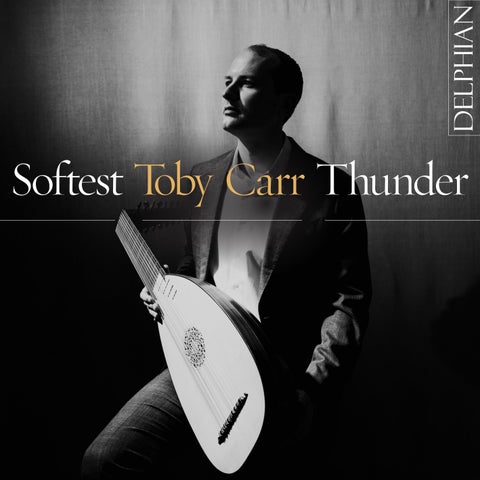
Softest Toby Carr Thunder
Softest Thunder 1 Francis Poulenc (1899–1963)
Sarabande
Toby Carr lute [2:21]
13 Robert Ballard
arr. Toby Carr 2 Robert Ballard II
(c.1572–after 1650)
Grand Ballet de S. Germain, premier chant Ballet des Princes, premier, second & quatres chants Troisiesme & Quatriesme Branles de Village
[4:51]
Gnossienne No 1
Courante ‘Son Adieu’
[1:40]
16 Philip Rosseter (1568–1623)
Prelude
[0:40]
17
Galliard
[3:46]
Aire
[3:36]
(c.1575–1651)
[2:27]
The Prince’s Allmayne
[1:22]
5
Allmayne ‘Hit It and Take It’
[1:54]
6 Daniel Bacheler (1572–1619)
En me revenant
[3:03]
7 John Dowland (1563–1626)
Suzanna Galliard
[2:52]
(The Right Honourable the Lord Viscount Lisle, his Galliard)
Gnossienne No 2
[2:20]
Slow Air
[2:13]
18 John Eccles (1668–1735)
arr. Toby Carr
(from The Mad Lover )
19 Robert Johnson
Galliard ‘My Lady Mildemay’s Delight’
[2:04]
20
Fantasia
[4:17]
21
Galliard
[2:03]
Total playing time
arr. Toby Carr
arr. Toby Carr
[3:26]
15 Ennemond Gaultier
4 Robert Johnson (c.1583–1633)
9 Henry Purcell (1659–1695)
Gymnopédie No 1
14 Erik Satie
arr. Toby Carr
arr. Toby Carr
8 Erik Satie
[3:11]
(from Premier Livre de Tablature de Luth)
(from Diverses Piesces mises sur le Luth) 3 Erik Satie (1866–1925)
Ballet & Huitiesme Courante
(from The Virtuous Wife)
10 Robert Johnson
Pavan
[6:06]
11 Laura Snowden (b. 1989)
Blue
[6:30]
12 John Dowland
Tarleton’s Resurrection
[2:24]
[63:15]
Tracks 2 & 11 are premiere recordings Recorded on 1-3 May 2025 at Crichton Collegiate Church, Edinburgh Producer/Engineer: Paul Baxter 24-bit digital editing: Jack Davis 24-bit digital mixing & mastering: Paul Baxter Cover photograph © Matthew Johnson
Session photography: Will CoatesGibson / foxbrushfilms.com Design: John Christ Booklet editor: John Fallas Delphian Records Ltd – Oxford – UK www.delphianrecords.com
delphianrecords.com @ delphianrecords @ delphian_records
Notes on the music An Englishman has acquired a beautiful old large Bologna lute for me from France […] the best I have ever played. In its belly is housed the softest thunder one can hear. I cannot describe it better. — Constantijn Huygens, 1648
For hundreds of years the lute was among the most important instruments in European musical culture; a vast repertoire is there to be discovered and enjoyed by anyone with the inclination and the time. It feels natural to me to explore, alongside this treasure trove, new music written for the lute, and also to find ways of ‘bridging the gap’ by transcribing and arranging music originally conceived for other instruments. The music on this album can be grouped into four categories: lute repertoire from England and France in the first decades of the seventeenth century, composers such as Robert Johnson, John Dowland and Robert Ballard pushing the Renaissance lute to its zenith; arrangements of later Baroque music by the Restoration-era composers Henry Purcell and John Eccles, beguiling music of rich harmony and rhetorical directness; arrangements of French music by Poulenc and Satie, innovators from the beginning of musical modernism; and finally the singular delight of a new work commissioned specially for this recording from composer and guitarist Laura Snowden. Lute manuscripts often group pieces by tonal centre rather than by genre, meaning works from different times
and in disparate styles might sit side by side. Inspired by this practice, I have grouped pieces together in ways that cut across stylistic and historical divides, creating patterns and shapes in sound and searching for connections which are unique to this recording. The instrument I am playing is a beautiful ten-course Renaissance lute made for me in 2023 by Jiří Čepelák. It is on the large side for a Renaissance lute, and with the longer strings comes a lower pitch and a darker, velvety timbre. The programme of music recorded here has been crafted specifically for this instrument, including the new commission, Laura Snowden’s Blue. Written to complement the older repertoire, Blue is an exploration of a heightened emotional state of longing, familiar from seventeenthcentury music but here expressed in twenty-first-century musical language. Full of radically different techniques from anything found in canonical lute music, the contrast between eras in terms of musical expression is tangible. Ours is an age of extreme subjectivity, and in Blue the feeling of yearning for something or someone is rendered suitably personal and extended to almost unbearable heights, whereas in the seventeenth century the passions, however strong, were expressed through codified means related to rhetorical ideas, maintaining a balance and elegance in even the most
intense work. One is akin to a Shakespearean actor orating to a theatre audience, the other a full-screen cinematic close-up. Four hundred years ago an era, or two, ended. James I of England died in March 1625, and in February 1626 John Dowland, master lutenist of the English Renaissance, followed the king to the grave. The Elizabethan and Jacobean periods had been fruitful for English musical culture in general, and for the lute in particular. Along with William Byrd, Dowland is the most feted of all composers of this ‘golden age’, and both his songs and his instrumental music remain enduringly popular. He is represented here by two works, neither among his best known but both among my favourites. Tarleton’s Resurrection is a short, enigmatic piece, wistful and bittersweet, with a directness that speaks across time to the works by Satie and Poulenc. It is used here as a kind of recovery after the emotional intensity of Blue. The galliard was a lively and popular dance, but in the hands of Dowland it often took on his signature melancholy aspect. The marriage of these opposing forces in the so-called Suzanna Galliard fits with the qualities of the lute, well suited as it is to a middling tempo (too fast creates muddle, too slow and the lack of sustain is unsatisfactory). The madrigal ‘Susanne ung jour’ by Orlando de Lassus was one of the great hits of the late Renaissance,
reworked and pulled about in every form imaginable by musicians for generations, and this melancholy galliard is a skilful recasting of its rich harmonic and melodic material. The names of Robert Johnson, Daniel Bacheler and Philip Rosseter are today some distance more obscure than that of John Dowland. They suffer when compared to the sheer scale and consistent quality of Dowland’s output, but their best work bears any comparison, and in their difference they bring us closer to an understanding of the varied kinds of creativity flourishing in lute music of that time. Robert Johnson was, more than most, born into the life he would go on to lead: his father John Johnson was a court lutenist of some renown, and a composer responsible for scores of works in English manuscripts in the Elizabethan style. The younger Johnson also secured a court position, at a time when increasingly the most fashionable and influential innovations in lute playing were to be found across the channel in France. More than anyone else – at least to judge from the materials that have survived – Robert was able to absorb these new musical and technical innovations and integrate them into the English lute tradition, reaching heights of sophistication unparalleled in the lute music of this country. Although his surviving output is small, it is of extremely high quality, his Fantasia
Notes on the music meriting particular mention for its use of the full compass of the instrument in a way that was genuinely innovative, and for doing so within a serious contrapuntal work which reaches forward towards the later masters of the high Baroque. His other surviving works are all in dance forms, from the serious Pavan to the lively Allmaynes (also known as almans or allemandes) via Galliards which, like Dowland’s, occupy a middle ground which is particularly suited to the lute. Daniel Bacheler was a lutenist and courtier of fame and renown; his salary dwarfed that of most of his contemporaries. Like Johnson he embraced the downward expansion of the lute’s range, as well as the cuttingedge new dances and textures which were coming across the Channel from France. His En me revenant is a setting of a popular tune with increasingly elaborate variations, giving a sense of why his playing was so highly regarded. Philip Rosseter is primarily remembered now for his book of songs, an artistic collaboration with the poet and song-writer Thomas Campion, and his lute solos languish in obscurity across a few manuscript sources. What does remain though is first-rate, and his Galliard plays with the form in a way that goes beyond Dowland’s combination of opposing forces and seems to ask how far you can stretch the idea until it breaks – a sort of meta-galliard.
People often make connections between the pre-Classical musical idiom of the Renaissance and Baroque and the innovations of modernism in the early twentieth century. Much of the activity of modernist innovators was concerned with rendering their music strange, unpredictable and challenging, and in seventeenth century music we have an aesthetic that embodies those qualities without, as it were, having to try. In reacting to what they saw as the emotional excesses of Romanticism, the first wave of modernists reached not just forwards towards a new musical language but also backwards towards the musical aesthetics of the past. From Stravinsky reworking Gesualdo to Paul Hindemith’s place as a performer and impresario in some of the first revivals of early Baroque masterpieces, this desire to move forward by looking back is reminiscent of the way in which early seventeenthcentury composers looked to the ancient world to inspire their own innovations. The work of Erik Satie and Francis Poulenc lies within a tradition of ‘neoclassicism’, although this, like any such label, is apt only up to a point. I hear within Satie’s dreamlike Gnossiennes and Gymnopédies an evocation of the strangeness of the past, and a playful delight in the modern sense of alienation that this imagined past can create in the listener. It is my hope that by pairing them here with
music by Robert Ballard (a sequence of dances from his Diverses Piesces mises sur le Luth and a pair from his Premier Livre de Tablature), these pieces find a context which renders the familiar delightfully strange, and the unknown pleasingly familiar. Ballard was probably a compiler and arranger as much as he was a composer and publisher of lute music – a reminder that ideas of musical authorship do not translate easily across hundreds of years. Courtly dancing was the height of sophisticated entertainment in France at the time, and the dances in Ballard’s lute publications likely record, at least in part, music already heard in these ceremonial entertainments in a variety of forms. Many pieces in lute manuscripts of the first half of the seventeenth century are attributed to ‘Gaultier’, a name shared by at least four lutenist-composers. Courante ‘Son Adieu’ comes from the lutebook of Edward, Lord Herbert of Cherbury, and is most likely an early piece by the most influential of them all, Ennemond or ‘le Vieux’ Gaultier, though Jacques Gaultier, a controversial character who fled a French murder trial to come to England, remains a plausible candidate. Rather than inventing new, strange dance forms like Satie’s, Francis Poulenc played with history by writing a Sarabande, a dance believed to have originated in the New World before being ‘tamed’ and brought
into European musical culture in the seventeenth century, making a gradual journey from a wild and lively dance to something more regal and sedate. It seems that Poulenc had in mind these later sarabandes rather than the form’s more obscure origins, and he renders it strange by constantly changing the rhythmic structures. Any attempt to dance here is on shifting ground. Just as Johnson, Bacheler and Rosseter can languish in the shadow of their more famous contemporaries, John Eccles for a long time was seen as an also-ran in English musical history between the towering figures of Henry Purcell and George Frideric Handel. His output can suffer somewhat from its form, as much of it is incidental music (both vocal and instrumental) for theatrical productions of one kind or another, so the pieces are quite disparate. A suite survives from his incidental music for the 1701 play The Mad Lover, itself a new version by Peter Anthony Motteux of a Jacobean play by John Fletcher. The Aire from that suite is a ground bass of the most charming and beguiling kind, so it is no surprise that it is now one of Eccles’s best-known and most often performed works. It has been suggested that the repeating pattern of a ground represents fate, and the melody our attempts to resist and assert our individuality or agency. Purcell’s Slow Air, while not quite a ground, has a similar sense of inevitability,
Notes on the music and makes use of harmonies which in their simplicity speak to us in a wonderfully direct manner. I first encountered both of these works in chamber-music settings but couldn’t resist making my own solo versions. The lute has a unique sound: strings at low tension, mostly in pairs, are plucked together, sending vibrations through the instrument and out towards your ears. The mark of a skilled luthier is that the thin, delicate wood of the soundboard adds a spark of resonant magic. These vibrations can beguile your ear, provided you are close enough to feel the impact. The lute is not a loud instrument, but its lack of volume is a direct consequence of the properties which also create its unique tonal qualities. In playing a quiet instrument, you get a vivid sense of just how loud the world can be. So, what place for the lute in the twenty-first century? In my own soft way this recording is an attempt at an answer. The repertoire has coalesced naturally: by following my hands and my ears over time spent with this instrument, I have put together something
Biography which I hope can speak as a coherent whole, weaving threads and making connections across time. Above all I want to relish the sound of this instrument, its ‘softest thunder’.
Lutenist and guitarist Toby Carr is known as a versatile and engaging artist, working with some of the finest musicians in the UK and beyond.
© 2026 Toby Carr
While studying the classical guitar at Trinity Laban he was introduced to historical plucked instruments, an interest he pursued during a postgraduate degree at the Guildhall School of Music & Drama, graduating in 2016 and welcomed back as a professor in 2021. Now in demand as a soloist, chamber musician and continuo player, his playing has been described as ‘sensuous and vivid’ (The Guardian), ‘eloquent’ (BBC Music Magazine) and ‘mesmerising’ (Opera Today).
This project would not have been possible without generous support towards production costs from Michael Berman and Katherine Verney and from Angel Early Music, and towards the commissioning of Blue from the Hinrichsen Foundation. My thanks go to them all. Endless gratitude also to my teachers, colleagues, friends and family who have inspired, encouraged and supported me along the way.
Toby has performed with most of the principal period-instrument ensembles in the UK and beyond, as well as with many symphony orchestras, opera and ballet companies. Collaboration is at the heart of his work, from recitals with singers such as Helen Charlston, Alexander Chance and Emma Kirkby, to unique projects such as ‘Cubaroque’ with tenor Nicholas Mulroy and lutenist Elizabeth Kenny, pairing modern Latin American songs with those of the seventeenth-century European tradition.
2022 saw the release of Battle Cry with Helen Charlston on Delphian Records, a recital featuring works by Monteverdi, Strozzi and Purcell alongside a newly commissioned song cycle for mezzo-soprano and theorbo by Owain Park and works for theorbo by Kapsberger and de Visée. Received with universal acclaim, Battle Cry won a Gramophone Award for best concept album and a BBC Music Magazine Award for best vocal album, the only recording to receive both Gramophone and BBC Music Magazine awards that year. In 2023 Drop not, mine eyes, a recording of English lute songs with Alexander Chance, was released on Linn and described as ‘a thing of beauty’ in Gramophone magazine, where it was an Editor’s Choice. Toby is passionate about working with the next generation of musicians. As a professor at the Guildhall School of Music & Drama he works across the strings and historical performance departments, and he has taught at Dartington International Summer School, appeared as a guest lecturer at the Courtauld Institute, and mentored young people for the charity Arts Emergency.
Also available on Delphian
BBC MUSIC MAGAZINE Awards 2023 – Vocal Category Winner GRAMOPHONE Awards 2023 – Winner, Concept Album PRESTO Recordings of the Year, 2022 – Finalist
Battle Cry: She Speaks Helen Charlston mezzo-soprano, Toby Carr theorbo
Tudor Music Afterlives Ensemble Pro Victoria / Toby Ward; Toby Carr lute, Magnus Williamson organ
DCD34283
DCD34295
This powerful yet understated recital of seventeenth-century and modern works aims to revisit but also to re-balance the obsession of earlier music with female abandonment and lament. The stories of women such as Dido and Ariadne have been told and retold throughout history. Mezzosoprano Helen Charlston reconsiders the assumed helplessness of those often seen as being left behind by male adventure and success. A recent work commissioned for Charlston from the composer Owain Park further takes up the challenge of giving ‘abandoned women’ their own platform, as well as exploring new possibilities for an instrumental pairing – that of voice and theorbo – that remains little explored in contemporary music.
Following the freshness and vigour of their quincentenary portrait celebration of Robert Fayrfax, Ensemble Pro Victoria’s second Delphian album brings a similar boldness of approach to a wider-ranging collection, charting some rarely explored territory from a time of great religious, societal and musical change. Broken fragments of huge pre-Reformation works, preserved only in lute tablature; the first reconstruction and recording of some of the earliest Anglican psalm settings ever written; French chansons and motets once popular in England; improvisatory organ verses within Lady Mass movements by Ludford; and an English-texted version of a much-loved Tallis anthem that shows it in a quite different light.
PRESTO Recordings of the Year, 2025 – Finalist GRAMOPHONE Editor's choice
‘surely one of the most exciting voices in the new generation of British singers’ — Gramophone, June 2022, EDITOR’S CHOICE
‘a recording of the highest quality, apt for edification and pleasure’ — Early Music Review, September 2022
17th-Century Playlist Ed Lyon, Theatre of the Ayre
Heinrich Biber: Complete Violin Sonatas – 1681 Bojan Čičić violin, The Illyria Consort
DCD34220
DCD34334 (2 discs)
Tenor Ed Lyon has been one of the UK’s most versatile and soughtafter soloists for over a decade. Now, for Delphian, comes his first solo recording project, inspired by the immediacy, joy and freedom found in seventeenth-century music. Joined by Theatre of the Ayre – a flexible and innovative ensemble led by the lutenist Elizabeth Kenny – he has conceived his very own ‘playlist’: a live mixtape of the songs, simultaneously catchy and sophisticated, which became earworms for the listeners of their day.
Following the chart-topping success of his Bach Sonatas and Partitas and equal acclaim for his recording of Johann Jakob Walther’s Scherzi da violino, Bojan Čičić now turns to Heinrich Biber’s collection of sonatas from 1681 – among the most ambitious and inventive violin works of the seventeenth century. Using unorthodox tuning and bold harmonic invention, Biber expands the instrument’s capabilities, and his improvisatory style, layered textures and intricate counterpoint demand of the player not only virtuosic technical brilliance but an acute sensitivity to affect and sonority. With his Illyria Consort, Čičić brings a clarity and depth to this music, uncovering the sonatas’ rich interplay between intellect, devotion and instrumental theatre.
‘It’s a lovely concept: an album of the seventeenth century’s greatest hits, where only the catchiest, most irrepressibly infectious dances and the swooniest ballads need apply … There’s a real sense of musical camaraderie here – of spontaneous conversations and mutual enjoyment of skill’ — Gramophone, November 2019
‘a triumph … Pretty much everything about this release speaks of an artist entering the golden phase of his career. If it doesn’t win awards, I’ll be astonished’ — Gramophone, July 2025, RECORDING OF THE MONTH
Also available on Delphian
BBC MUSIC MAGAZINE Awards 2018 – Instrumental Category Finalist GRAMOPHONE Editor's choice PRESTO Recordings of the Year, 2017 – Finalist
PRESTO Editor’s Choice – August 2020
Dreams & Fancies: English music for solo guitar Sean Shibe
La Royalle: Music for Kings & Courtiers Gordon Ferries guitars, lute & theorbo
DCD34193
DCD34111
Barely half a century ago, the guitar was such a rarity in the concert hall that even an outstanding player like Julian Bream was remarkable as a pioneer as much as for his exceptional technique and musicality. Today, by contrast, the field is richly populated – thanks not only to Bream’s own inspiring example to younger players but also to the vastly increased repertoire, so much of which he also instigated.
Gordon Ferries’ fifth solo disc for Delphian spans two centuries of music for kings and courtiers. Performing on four instruments matched to the periods in question, and captured in sumptuous recorded sound, Ferries takes in the chansons and elegant counterpoint of 16th-century France’s cultivated humanist courts and the exquisite melancholy and refined dance forms from the private chambers of Louis XIV’s Versailles, and investigates the place of guitar music at the heart of the decadence, sexual intrigue and Baroque splendour of Charles II’s Restoration court.
Yet even in this new heyday for the instrument, Sean Shibe – whose full album debut here nests among four of those Bream-commissioned works a clutch of Dowland pieces from a previous Elizabethan Golden Age – stands out as a truly uncommon talent. ‘I want to hear his interpretation of Britten’s Nocturnal over and over,’ wrote David Nice in an awed recent concert review. ‘This, for me, is the definitive performance.’
‘Ferries is clearly a master of everything he puts his hand to, both technically and in his interpretation of the different styles of music. A delight from start to finish’ — Lute News, November 2012
Ohrwurm Tabea Debus, Jonathan Rees, Alex McCartney
Love and Reconquest: Music of Renaissance Spain Fires of Love
DCD34243
DCD34003
Rising talent Tabea Debus makes an immediate impression as she joins the roster of Delphian house artists, coaxing an astonishing spectrum of moods and timbres from an array of Renaissance and Baroque recorders. Equally astounding is the tightness and responsiveness of her interaction with gamba player Jonathan Rees and lutenist Alex McCartney, while solos for recorder alone bookend the programme chronologically with music from the fourteenth century and the twenty-first.
One of Delphian’s earliest releases. Scottish early music ensemble Fires of Love serve up a feast of songs and ballads from the Spanish Renaissance and early Baroque, with a freshness critic Norman Lebrecht calls simply ‘beautiful’. Repertoire includes works by Luys de Narváez, Miguel de Fuenllana, Luis Milán, Alonso Mudarra and Juan del Encina.
‘There’s a lovely sense of affectionate irreverence … Renaissance and Baroque works are despatched with an almost folky exuberance, and it’s a toe-tapping joy’ — Presto Classical, August 2020, EDITOR’S CHOICE
‘full of vitality and will soon have your foot tapping … delightfully sung’ — Early Music Review, April 2002
DCD34344