1 Sally Beamish (b.1956)
April (2020) for viola & accordion
[4:09]
6
Crescent (2023) for trumpet, viola & piano I. Swing II. Midnight Blue III. Étude IV. Canonbury V. Hide and Seek
[3:25] [3:11] [2:38] [2:51] [3:33]
7 Sally Beamish
Gerropaedie (2008) for viola & harp
[2:13]
8 Sally Beamish
Night Songs (2020) for speaker, viola & piano I. Wide Night
[3:13]
Sally Beamish 2 3 4 5
9 Laurie Irvine (b.1989)
Lurk (2024) for viola & accordion
[3:18]
10 Sally Beamish
Glanz (2016) for solo viola
[3:50]
11 Karin Rehnqvist (b.1957)
Cradle Song (2024) for speaker & viola
[3:57]
12 Stephanie Irvine (b.1995)
House of Wonder (2024) for voice, harp & viola
[3:48]
13 Sally Beamish
Night Songs – II. Tread Softly
[4:02]
14 Joseph Havlat (b.1994)
Aquamarine Depths (2024) for viola & piano
[7:39]
15 Tom Irvine (b.1990)
Where You Are (2024) for solo viola
[3:36]
16 Chris Stout & Catriona McKay (b.1976)
Sally’s Tune (2024) for viola & harp
[3:24]
18
Prelude and Canon (2006, arr. 2020) for 2 violas Prelude Canon
[1:43] [4:28]
@ delphianrecords
19 Sally Beamish
Night Songs – III. Blues
[4:17]
@ delphian_records
20 Sally Beamish
FirstPeace (2024) for solo trumpet
[1:09]
Sally Beamish viola (tracks 1–19) Ryan Corbett accordion (tracks 1, 9) Joseph Havlat piano (tracks 2–6, 8, 13, 14, 19) Stephanie Irvine lever harp (tracks 7, 12, 16), voice (track 12) Peter Thomson speaker (tracks 8, 11, 13, 19) Rosalind Ventris viola (tracks 17–18) Imogen Whitehead trumpet (tracks 2–6, 20)
Sally Beamish 17
Recorded on 2-4 September 2024 at The Menuhin Hall, Cobham, Surrey Producer/Engineer: Paul Baxter 24-bit digital editing: Jack Davis 24-bit digital mixing & mastering: Paul Baxter Piano technician: Julian Day Cover concept and photography / digipack photography © Sarah Hickson
Cover (graphic layout): Will Coates-Gibson Booklet & digipack design: Eliot Garcia Session photography: Will Coates-Gibson / foxbrush Booklet editor: John Fallas Delphian Records Ltd – Oxford – UK www.delphianrecords.com
Total playing time Tracks 2–9, 11–16 & 19–20 are premiere recordings
[70:36] Track 1 is a premiere recording in this arrangement
Cover portraits
Acknowledgments
Notes on the music
Left, from top to bottom Karin Rehnqvist: photo by Filip Erlind Ryan Corbett: photo by Andrej Grilc Rosalind Ventris: photo by Oxford Atelier Peter Thomson: photo by Ashley Coombes
Sally Beamish would like to thank:
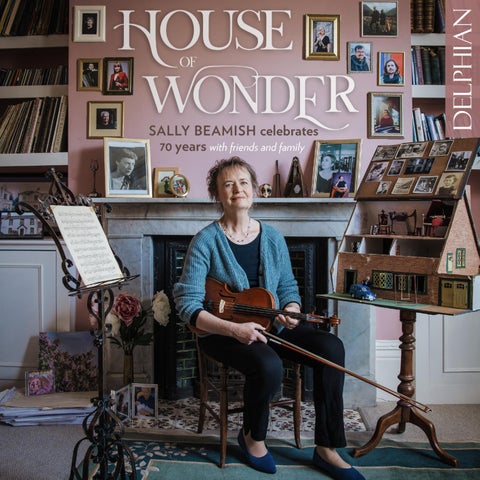
Every facet of this album, curated by Sally Beamish to mark her seventieth birthday, is bound together by threads of autobiography. House of Wonder encompasses childhood, motherhood and marriage; friendship, joy and loss. Its interlocking lines of work and love run through the composer’s story into that of her three children and her first, but surely not last, venture in commissioning other composers. The connections extend to the recording’s cover artwork, which depicts Beamish surrounded by photographs of her children, mother, father, brothers, and fellow composers and performers. She sits beside her old doll’s house, with its miniature music room, flanked by drawings and photographs of Mountfort Crescent in Barnsbury, the north London district where she grew up; of the home she later made in Scotland, with its garden summerhouse where she composed; and of other cherished memories.
Right, from top to bottom Catriona McKay & Chris Stout: photo by Somhairle Macdonald Imogen Whitehead: photo by Helena Cooke Joseph Havlat: photo by Ella Pavlides Laurie Irvine: photo by Laurie Irvine Tom Irvine: photo by Sebastian Page Stephanie Irvine: photo by Mia Marine Drawing of Mountfort Crescent (left alcove, behind music stand): Rupert Smissen Urvanovic LP cover (on floor by fireplace): Sean Patrick Campbell Uncle Bucket CD cover: Laura Davies
Delphian for making this project a reality PRS Foundation’s Women Make Music fund Richard and Helen Sheldon – who live two doors away from the house where I grew up in Mountfort Crescent – for rehearsal space and a warm-up concert My current viola mentors Richard Ireland and Christian Howes Gerry Mattock and Beryl Calver-Jones, who supported my work for 25 years All the composers, who wrote such inspiring pieces for me and for the viola repertoire My fellow performers, whose consummate skill brought the works so vividly to life The Menuhin Hall Physio Dominique Royle, who supported me through my shoulder injury and enabled me to play This album is dedicated to my parents, Tony Beamish and Ursula Snow, and my brothers Oliver and Christopher
One memory, certainly not cherished, concerns the theft in 1989 of Beamish’s viola, a fine instrument by the Florentine maker Giovanni Battista Gabrielli, on loan to her from a benefactor. She and her Scottish husband had considered moving to Scotland with their first baby, but Beamish had been unsure. The theft of the viola seemed a sign that she should make the move, and become a full-time composer. Yet her
diary was filled with dates as a professional violist. The substitute instrument she bought was increasingly sidelined to make way for composing opportunities until, in 1995, it was sold to fund repairs to her Stirlingshire home. ‘It was really painful to stop playing,’ she says – ‘I missed the chamber music so much.’ Beamish was pregnant with the youngest of her three children, Stephanie, when the viola was sold. ‘It turns out that, in a way, I was expecting a viola too!’ She had to wait eighteen years for its delivery, the outcome of Stephanie’s gap-year apprenticeship to the luthier Guust François in Amsterdam. She returned with a viola modelled on an instrument by Gasparo da Salò, but with similar dimensions to the stolen Gabrielli. ‘Stephie was longing for me to try it. I remember being upset because I simply couldn’t play.’ The instrument was loaned to a professional player, until, by chance, Beamish received an invitation from the Swiss Festival Musikdorf Ernen to be its 2015 composer-inresidence, which entailed performing. ‘I said no but then thought: “I have nine months to prepare, so why not give it a go?”’ Dormant skills were slowly revived. ‘I never imagined in my wildest dreams I’d ever play again. It was amazing to do so after twenty years. My mother had just died, and in my first concerts I used her violin bow on Stephanie’s viola. I
Notes on the music could scarcely believe I was playing again.’ After Beamish moved back to England in 2018 the world of playing opened up further to include chamber music with old and new colleagues, interspersed with jazz trio gigs. ‘Getting in touch with the feeling of playing again has informed my composing, as has improvising.’ Unlike the works she composed for world-class soloists, including three concertos, her recent viola music was written for herself to play. ‘I have kept it simpler – as there’s always now the danger I’ll be playing it myself!’ Crescent belongs to her childhood memory store and to the house in Mountfort Crescent where she grew up. Its opening recalls a rusting garden swing, set in motion by extruded viola harmonics and muted trumpet and followed by a lively heterophonic dialogue for viola and piano with trumpet playing tag. The composer notes how ‘my trumpeter brother was crazy about football and bikes. Our younger brother, who has Down’s syndrome and was not yet walking, would laugh and cheer as we invented games to entertain him, one of which involved the swing, a bike, and a football. None of us can remember what the rules were.’ The playful energy of ‘Swing’ yields to ‘Midnight Blue’, where meditative piano chords furnish the foundations of a chaconne, emblematic of the
Bach transcriptions for piano that Beamish played with her paternal grandmother. The title recalls the name bestowed on a favourite velvet jacket by her father, a gentle figure but rather detached from family life. Was it perhaps a remnant of a racy past? ‘This music is about his absence. He was there, but not there, and I only really got to know him after my parents separated in 1976.’ ‘Étude’ springs from a tricky syncopated bowing pattern lifted from Beamish’s recent jazz lessons. The piece also recalls the music-filled Barnsbury house, where her viola or piano practice overlapped with sounds generated by her violinist mother, her father’s flute and her brother’s trumpet. It begins with the business of tuning, signal to the Beamish children that mother would be unavailable for the next hour. Gloom descends over ‘Canonbury’, apt for a piece rooted in its composer’s daily trudge to primary school in that recently war-damaged corner of Islington. The theme of its canon gains a fresh countermelody with each repetition, sometimes agitated, often lugubrious. Mountfort Crescent’s privet-edged central green offered a refuge from school-day drudgery. ‘Hide and Seek’, like ‘Swing’, spins its wistful opening melody from the letters of Beamish’s name, ‘SFBEAmiSH’ (the S’s are represented by
E flat, known as ‘Es’ in German, the H by B natural – again as in German – and the ‘mi’ is E, as in French). The fast music that follows references a children’s dance from Beamish’s recent ballet score, A Christmas Carol. Gerropaedie, its title a play on Satie’s Gymnopédies, began life as an eightiethbirthday gift for Beamish’s close friend and patron Dr Gerry Mattock, a pioneering environmental scientist. The short piece, pensive, unsure of its harmonic home, melancholy yet somehow reassuring, formed an unusual present. Its original version for harp and cello was for Stephanie and her father, the cellist Robert Irvine, to play for Gerry. Night Songs closed a circle of commissions from Mattock that began in 1998 with Bridging the Day for cello and piano. ‘Gerry was like a dad to me and knew all about my composing,’ Beamish reflects. However, until she performed John Joubert’s Exequy in a radio broadcast from the 2019 Ivors Composer Awards, he had never heard her play. He now decided to commission a work to mark her recent second marriage, to the actor and playwright Peter Thomson, and suggested it might be something they could perform together. The piece evolved from Beamish’s lockdown performances in a band with Thomson and the blues guitarist Arthur Dick. ‘That experience of the emotional
power of popular songs had a big effect on my writing,’ she observes. Beamish drafted Night Songs while caring for Mattock during his final illness. Thomson suggested poems to help focus her musical ideas; his recordings of each supplied rhythmic and motivic elements for ‘songs’ in which the viola plays the singer’s part. ‘Wide Night’, in the style of a laidback jazz ballad, draws its recurrent four-note piano motif from the ‘La lala la’ line in Carol Ann Duffy’s love lyric Words, Wide Night. The Celtic reverberations of ‘Tread Softly’ rise in its viola introduction and echo in the rhythms of W.B. Yeats’s Aedh Wishes for the Cloths of Heaven, one of Mattock’s favourite poems. Beamish was midway through drafting the final ‘Night Song’ when Thomson suggested pairing it with W.H. Auden’s Refugee Blues, whose increasingly despairing words are woven into the composition’s fabric in an incisive blues rhythm. Glanz was the first work Beamish wrote for herself as a born-again violist, and pays tribute to another mentor, the composer Peter Maxwell Davies. Beamish gave its premiere during the composer’s memorial concert at St Magnus Cathedral, Kirkwall, performing from behind a pillar to calm her nerves. She associates its title, a German word that
Notes on the music translates as shine, splendour, radiance, brilliance or lustre, with Max’s music, but the word also figures in Richard Dehmel’s poem Verklärte Nacht, inspiration for Arnold Schoenberg’s eponymous composition for strings – the first work Beamish had played in 1988 as principal viola of the Scottish Chamber Orchestra, with Davies conducting. Composed in the form of a passacaglia, Glanz casts a yearning ‘glance’ at two motifs from Schoenberg’s work. House of Wonder stands as its composer’s homage to the summerhouse where her mother spent countless hours, a place of magic to the young Stephanie Irvine. While she knew nothing about what Beamish did there, she realised that whatever it was, it made her happy. ‘When she was seven, I found a message there which she’d written on her own handmade paper: “To Mum I hope you ar having a lovly time / love from Stephanie”. I thought her song might be about feeling excluded – as a working mum, you always wonder if you gave your children enough attention. But it’s quite the reverse: House of Wonder is about this magical feeling of being alone and creating things, in a space that she would want for herself one day.’ Beamish’s sons, Laurie and Tom Irvine, inhabit strikingly different musical worlds. The
former, who works in a school in Sweden, is singer-songwriter with the metal band Uncle Bucket; the latter, based in Copenhagen, has released two albums with the ‘chamber pop’ band Urvanovic, and works across genres as composer and arranger. Lurk, gnarly and tango-like, marked Laurie’s first foray into the soundworld of viola and accordion. The two instruments, he notes, act as characters who retrieve phrases and harmonic ideas ‘that “lurk” in an uncharted and potentially hostile space’, and transform them into a stop-go tango. Where You Are, Tom’s piece, begins as a solemn lament. Fleeting phrases that arise and fade, forever in a state of flux, underline a feeling of disconnection. Emotions surge as the piece grows increasingly agitated, until the pensive mood of its opening returns. This album’s seeds were planted after Beamish gave the world premiere of Crescent at the 2023 Australian Festival of Chamber Music with the Hobart-born, London-based pianist and composer Joseph Havlat and the Australian trumpeter David Elton. ‘I hatched a plan to record Crescent and Night Songs,’ she says, ‘then to commission pieces for my seventieth birthday. It was important to involve my three children and people who are dear to me, and exciting to be able to expand the viola repertoire.’ Beyond her immediate family, Beamish turned to close friends. Her
connection to the Swedish composer Karin Rehnqvist began with their appointment in 1998 as joint composers-in-residence with the Scottish and Swedish Chamber Orchestras. ‘She was the first composer I’d met who was also a mother. Her daughter looked after mine while I was working on an opera, and our four boys became good friends, too. Having heard Night Songs, she said she’d like to write a birthday piece for me that used Peter’s voice.’ Beamish had already supplied the lullaby text for a previous work of Rehnqvist’s, Sleep Now. Reflecting the arrival of a new generation in both their families, Rehnqvist made a new setting of the same text (with improvised additions by Thomson): Cradle Song, a ‘lullaby drama for a grandchild’ which turns from tenderness to exasperation. Havlat’s own Aquamarine Depths, the first of a set of four pieces collectively entitled Old Songs, takes its title from a poem by the Australian Gwen Harwood (1920–1995). It projects Havlat’s intense response to reading her verse, with its rich, romantic imagery, ‘transposed’ into sound rather than ‘set’, as he notes, and conceived as a free-flowing musical ekphrasis, albeit ‘blurring slightly and stepping away from [the text’s] original depictions’. Like its companions in Old Songs, the piece is ‘constructed around
strophic structures’ that ‘imply some imagined sung text, akin to a folk song’. Friendship’s restorative powers condition Sally’s Tune, a spellbinding duet for harp and viola co-created by two leading performers in the Celtic tradition – the lever harp (clàrsach) player and composer Catriona McKay, and the versatile violinist Chris Stout, heir to the tradition of Shetland folk fiddlers. ‘I first met Chris and Catriona in New Lanark when I was mentoring traditional musicians who were beginning to write for orchestra,’ notes Beamish. ‘My nine-year-old daughter [Stephanie] was fascinated by Catriona’s playing, which led to her becoming Catriona’s pupil and mentee.’ Beamish subsequently composed her concerto Seavaigers for McKay and Stout, one of several collaborative projects. April commemorates a Covid pandemic tragedy. It was commissioned by Sound World, a composer-led charity launched to preserve live performances of new classical music at a time when it, like so many spiritually enriching activities, was subject to prohibition. Beamish was asked to create a score for saxophone, percussion and piano; she began work on it in April 2020, shortly after learning of the death from Covid-related pneumonia of jazz pianist and educator
Notes on the music
Texts
Ellis Marsalis Jr., father of her friend, the saxophonist Branford Marsalis. She soon made a version for viola, with a piano part which her long-standing collaborator James Crabb then adapted for accordion. The composition’s heartfelt melodic lines, richly embroidered, unfold above a short sequence of chords, repeated throughout the piece to form a chaconne.
House of Wonder
Sleep Now [Cradle Song]
Down in the garden, all shaded by trees fledgling notes rise, cradled by leaves from the House of Wonder
Sleep now the sun is gone Sleep now the night is here Sleep now today is done.
Peace and reconciliation, the pursuit of social justice and equality, and the cultivation of deep listening have so often touched the work of Sally Beamish, recurrent reflections of her Quaker values. FirstPeace was written in 2024, a year in which peace was but a vanishing hope for millions. Commissioned for the PeaceBugle project, an all too timely initiative designed to turn instruments of war into instruments for Shadows of forgotten ancestors appear to peace, it is performed here on trumpet. pass over Beamish’s Prelude. Its imitative ‘After a thoughtful opening,’ explains the textures prepare the way for the ensuing composer, ‘the word PEACE is spelled out Canon, launched by the second of the two in Morse code, and the ending is the British equal instruments. (Conceived to demonstrate military’s 1918 ceasefire call.’ the tonal qualities of a Stradivarius violin and a new instrument modelled on a Stradivarius, © 2026 Andrew Stewart it also exists in arrangements for two cellos Andrew Stewart is a freelance writer and – as here – for two violas.) The first and classical music journalist. He is also player then takes the lead in the central co-author of the Boutiques trilogy and of slow section, and holds it until both players Suzanne Cooper: Paintings Under the Sparerecall music from the Prelude in a brief coda. Room Bed (both with Mainstone Press). Prelude and Canon embraces elements of traditional Scottish fiddle music and the elaborate melodies of Highland pibroch, which flavour its clear references to the Baroque.
You know the magic of being alone Close the door and worlds start to grow in the House of Wonder
Sleep now Run through the garden down overgrown the birds are quiet paths and and so must you be – ponds warm and brimming with life left alone here is the night and peer through the glass Dark trees sway Silently painting invisible landscapes to a gentle lullaby – Light streaming in onto pages where light here is the night can sing lullaby Down in the garden, all shaded by trees fledgling notes rise, cradled by leaves Today is done from the House of Wonder and tomorrow will be full of light But first you must sleep. © 2024 Stephanie Irvine
© 2015 Sally Beamish Further improvised text by Peter Thomson
Instruments
Biographies
Sally Beamish plays a viola by Stephanie Irvine, 2014, with a bow by Gregor Walbrodt, 2023
Born in Glasgow in 1999, Ryan Corbett is one of the leading accordionists of his generation, praised for his ‘immense virtuosity and musicality’. Winner of the Royal Over-Seas League Gold Medal and the Bromsgrove International Musicians’ Competition, he is the first accordionist selected for the BBC Radio 3 New Generation Artist scheme since its launch in 1999.
Rosalind Ventris plays an 18th-century viola by an unknown maker, probably English or Dutch, with a bow by W.E. Hill & Sons, c.1905 Stephanie Irvine plays a Starfish Glenelle lever harp, 2024 Imogen Whitehead plays a Yamaha Chicago Xeno C trumpet Ryan Corbett plays a Bugari Spectrum accordion, Italy, 2018 Piano: Steinway model D, serial no 610953 (c.2018)
Ryan studied at the Royal Conservatoire of Scotland with Djordje Gajic.
He has appeared as a soloist at major venues including Konzerthaus Berlin and Wigmore Hall, performing across Europe, the USA, South America and China, and is regularly invited to leading UK festivals. His work has been widely broadcast on BBC Radio 3 and 4, BBC Radio Scotland, the BBC World Service, Classic FM and Scala Radio, and he featured in BBC television coverage of the Scottish Coronation of HM King Charles III.
Joseph Havlat is a pianist and composer from Hobart, Australia, who is based in London. He works frequently as a soloist, having given recitals at Wigmore Hall, Queen Elizabeth Hall and Kings Place, and also a chamber musician, having performed with artists such as James Ehnes and Steven Isserlis. He has recorded for LSO Live (the premiere recording of John Adams’s two-piano work Roll Over Beethoven), Métier (music by Michael Finnissy) and Delphian Records (Schubert violin and piano works with Charlotte SalusteBridoux, Eastern European music for clarinet and piano with Jonathan Leibovitz, and the forthcoming KIN, an album of folk and folkinspired music with mezzo-soprano Lotte Betts-Dean), amongst others.
Ryan has premiered major concerto works including Daniel Soley’s Accordion Concerto with Britten Sinfonia and Jay Capperauld’s Galvanic Dances with the National Youth Orchestra of Scotland. He also gave the UK premiere of Mikhail Pletnev’s Accordion Concerto, later recording it with the BBC Symphony Orchestra and Andrew Litton. He has created hundreds of arrangements for solo accordion and a wide range of chamber settings.
Passionate about modern and contemporary music, he has collaborated with composers including Thomas Adès, Sir Harrison Birtwistle, Gerald Barry and Hans Abrahamsen. As a composer himself, his music often explores the sounds of the natural world, imbued with theharsher shapes of human modernity. He has written music spanning from solo voice to large ensemble, including for Ensemble x.y, of which he was a founding member.
Biographies Stephanie Irvine is a harpist and singer based in Gothenburg, Sweden. Originally from Scotland, she started playing the lever harp aged ten, taking lessons with Catriona McKay. As a teenager she studied at Douglas Academy Music School in Milngavie, taking lessons in lever harp as well as classical singing. In 2022 she completed a degree in World Music at the Academy of Music and Drama in Gothenburg, where she studied voice with Ingrid Brännström, focusing on Swedish and Scottish folk song. As well as writing and performing her own music, she works with projects of many genres, including pop and improvised music. She plays in various constellations such as Göteborgs Alternativa Orkester. Stephanie also works as a violin maker and repairer. Peter Thomson grew up in Iran, studied English Literature at Oxford, and began his career as an actor, performing in many West End shows and as a principal actor in several repertory companies. He subsequently became a playwright, drama lecturer and director. He has had over thirty plays produced on BBC radio, and fifteen stage plays around the UK and abroad. On his YouTube channel can be found a series of talks with theatre director Mike Alfreds and
with actors who worked with Alfreds, including Sir Mark Rylance, Michelle Williams and Sir Ian McKellen. Also on the channel are two short films (Bomb, and the awardwinning Mac the Anecdote), some of Peter’s short stories, and a number of poetry readings and talks. Peter has two sons, lives in Brighton, and is married to Sally Beamish, with whom he has worked extensively as librettist and director. He performs regularly as poetry reader, narrator and singer. Recent performances include Peter and the Wolf, Ferdinand the Bull, and Beamish’s narrated pieces The Seafarer and A Christmas Carol. He and Sally have a trio with guitarist Arthur Dick, which specialises in jazz standards and popular repertoire. Violist Rosalind Ventris leads an international career as a soloist and chamber musician, giving recitals at venues such as Wigmore Hall, Bozar (Brussels), and Het Concertgebouw, Amsterdam. She has performed with orchestras such as the European Union Chamber Orchestra, l’Orchestre Royal de Chambre de Wallonie and the Belgian National Orchestra. Rosalind’s debut album SOLA, released on Delphian Records in 2023 and featuring music by leading women composers of the
twentieth and twenty-first centuries, was ‘Instrumental Choice’ in BBC Music Magazine, while the Sunday Times hailed it as ‘rich and illuminating … a uniformly engrossing disc’. As a chamber musician, Rosalind frequently performs as part of the Kaleidoscope Chamber Collective (Associate Ensemble, Wigmore Hall), and Trio Anima. She has collaborated with artists such as Mitsuko Uchida, Tabea Zimmermann and Nicola Benedetti. She has performed at prestigious festivals internationally, including the West Cork, Marlboro, Salzburg and Båstad festivals. Praised for her ‘beguiling’ (Gramophone) and ‘gorgeously full-bodied playing’ (The Guardian), Rosalind is Director of Music at the Yehudi Menuhin School, a Professor of Viola at the Guildhall School of Music & Drama, and Artistic Director of the Cowbridge Music Festival in Wales. She was previously Director of Musical Performance and Performance Studies at the University of Oxford. British trumpeter Imogen Whitehead is in demand across the UK and internationally, enjoying an increasingly diverse career as a soloist, chamber musician and orchestral principal. A passionate advocate for new music, Imogen has premiered numerous
works by composers including Sally Beamish and Stephen Dodgson, many of which are featured on her debut solo album, Connection. Imogen is a particular champion of the flugelhorn – an instrument often overlooked in the classical sphere – and is dedicated to raising its solo profile through new commissions and arrangements. In addition to her position as Principal Trumpet with Britten Sinfonia, Imogen appears regularly as Guest Principal Trumpet with Aurora Orchestra and the London Symphony Orchestra. She has also performed in London’s West End and played on major film soundtracks. Imogen is currently Artist-in-Residence with St Martin’s Voices and a member of the acclaimed wind and brass collective, Neoteric Ensemble. She is deeply committed to music education, community engagement and equal opportunities, serving as an Associate and Mentor for GALSI (Gender and the Large and Shiny Instruments), an initiative promoting gender equality in brass and percussion. In April 2025, Imogen was awarded Associateship of the Royal Academy of Music (ARAM).
Also available on Delphian The Piano Tuner: piano trios from Scotland Beamish – Osborne – Weir Fidelio Trio; Alexander McCall Smith narrator
SOLA: music for viola by women composers Rosalind Ventris DCD34292
DCD34084
Storytelling takes centre stage in the Fidelio Trio’s second recording for Delphian, in which they are joined by Alexander McCall Smith, who narrates Sally Beamish’s evocative The Seafarer Trio with a mingled intimacy and plangency. The comparatively abstract sounds of Nigel Osborne’s The Piano Tuner track a journey into the dark heart of nineteenth-century Burma, while the stories told in Judith Weir’s Zen-inspired Piano Trio Two include that of ‘How grass and trees become enlightened’. ‘as bracing as a splash of water from a Highland stream … The Fidelio Trio gives sure-footed, rhythmically alive, directly communicative performances of all three works’ — International Record Review, December 2010 Voices for solo piano Smyth – Wallen – Alberga – Beamish – Chen Yi Hanni Liang DCD34326
Editor's choice
A pioneer of new concert formats, Hanni Liang was long sceptical about the traditional role of recording in progressing an artist’s career. It was her discovery of Ethel Smyth – both as a composer and as a person and a woman, fighting without compromise – that sparked the inspiration that led to Voices. In this album she has created a programme that both champions women’s voices that, without the determination of Smyth and others like her, might have remained silent, and allows her to raise her own voice, reflecting both her European birth and upbringing and her Chinese roots. ‘one of the most unhackneyed, unpredictable, well-constructed, musically diverse and interpretatively gratifying piano releases I’ve encountered’ — Gramophone, November 2024
Editor's choice
In this largely British and Irish programme of music for unaccompanied viola, Rosalind Ventris sets substantial works by important yet still often overlooked twentieth-century composers – Imogen Holst, Lillian Fuchs, Elizabeth Maconchy, Elisabeth Lutyens and Grażyna Bacewicz – alongside more recent additions to the repertoire from Thea Musgrave, Sally Beamish and Amanda Feery. With several of the composers themselves professional string players, this is, in Ventris’s words, ‘wonderful music – that just happens to be by women composers’. ‘Ventris lavishes gorgeously full-bodied playing, weighty yet poised, on music by eight women. Highlights include a wonderfully idiomatic 1930 Suite by Imogen Holst, taken out of her usual sidekick/daughter context for once and put deservedly in the spotlight’ — The Guardian, February 2023 Stone, Salt and Sky GAIA Duo DCD34263
Award-winning violin and cello duo GAIA have won plaudits for their pioneering programming and bold and daring performances. Their debut album features three works specially written for the duo, and also bears testimony to their championing of works by underrepresented and overlooked voices from classical music’s past. Elements of folk and jazz string-playing styles rub shoulders with traditional chambermusic imperatives in a programme that is full of women’s voices: those of the performers; of composers Sally Beamish, Rebecca Clarke and Elizabeth Maconchy; and of the singers of two Scottish folksongs, taped recordings of which frame Duncan Strachan’s hauntingly evocative Thirteen Ways of Looking at a Blackbird. ‘fiery confidence … Only a few tracks in and you’re transfixed’ — The Scotsman, April 2023, FIVE STARS
DCD34333