VOLUME 26 T ISSUE 2 T WINTER 2016
NEWSLETTER OF THE PARTNERSHIP FOR THE DELAWARE ESTUARY: A NATIONAL ESTUARY PROGRAM
Wet,Wild,Wonderful... By Jennifer Adkins, Executive Director, Partnership for the Delaware Estuary
W
hat would the Delaware Estuary be without its tidal wetlands? Let’s hope we never find out.
This year marks the 20th anniversary of the Partnership for the Delaware Estuary and the Delaware Estuary’s inclusion in the National Estuary Program. And I’m happy to say that over the last 20 years we’ve made incredible progress in understanding the critical role wetlands play, and finding ways to protect and restore them.
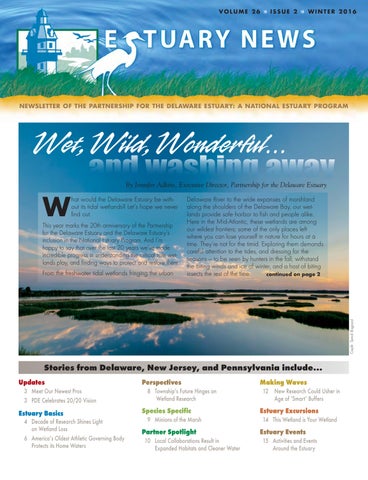
Credit: Sandi Bisgood
From the freshwater tidal wetlands fringing the urban
Delaware River to the wide expanses of marshland along the shoulders of the Delaware Bay, our wetlands provide safe harbor to fish and people alike. Here in the Mid-Atlantic, these wetlands are among our wildest frontiers; some of the only places left where you can lose yourself in nature for hours at a time. They’re not for the timid. Exploring them demands careful attention to the tides, and dressing for the seasons — to be seen by hunters in the fall, withstand the biting winds and ice of winter, and a host of biting insects the rest of the time. continued on page 2
Stories from Delaware, New Jersey, and Pennsylvania include... Updates 3 Meet Our Newest Pros 3 PDE Celebrates 20/20 Vision
Estuary Basics
4 Decade of Research Shines Light on Wetland Loss 6 America’s Oldest Athletic Governing Body Protects its Home Waters
Perspectives 8 Township’s Future Hinges on Wetland Research
Species Specific 9 Minions of the Marsh
Making Waves 12 N ew Research Could Usher in Age of ‘Smart’ Buffers
Estuary Excursions 14 This Wetland is Your Wetland
Partner Spotlight
Estuary Events
10 Local Collaborations Result in Expanded Habitats and Cleaner Water
15 Activities and Events Around the Estuary
...And Washing Away continued from page 1
But for a growing number of paddlers, hunters, birders, hikers, fishermen, and nature-lovers, they’re heaven on Earth. On both sides of the bay, communities are embracing their coastal wetlands for the many benefits they provide, from clean water to flood protection, and fish and wildlife. Tidal wetlands are a key feature of the Delaware Bayshore Initiative in Delaware and Discover Delaware Bay initiative in New Jersey, both of which are strengthening local economies through nature-based tourism. Today we have a growing baseline of data that allows us to develop and measure the effectiveness of wetland restoration tactics. You can read about these and other efforts to protect and enhance our coastal wetlands in this issue of Estuary News. From these data, we’ve also learned that
we’re losing an acre of tidal wetland a day. Sea level rise and more intense storms expected in the future will make these losses even worse if we don’t take action. Can we do what it takes to keep them here for the next 20 years? It’s a daunting challenge; one of many we’ll seek to address in a newly revised Comprehensive Conservation and Management Plan for the Delaware Estuary (see page 3). Look for opportunities in 2016 and 2017 to give your input on what’s needed to keep discovering and improving the health of the Delaware River and Bay. What would the Delaware Estuary be like without wetlands? Let’s make sure we never find out. Join us in celebrating 20 years of progress, and making sure the next 20 is even more successful, especially for our wetlands. n
Check out the Delaware Estuary’s wetlands for yourself. See our tips for trips on page 14. Learn more about the Delaware Bayshore Initiative in Delaware at http://ow.ly/ XZnK2. And explore the new Discover Delaware Bay initiative in New Jersey at DiscoverDelawareBay.org.
Credit: Steve Eng, or Flickr user “seng1011”
Coastal communities in Delaware, New Jersey, and Pennsylvania are collectively losing one acre of wetlands per day. That’s like losing waterfront real estate the size of Lincoln Financial Field — and Philadelphians hate losing.
MEETINGS CONTACT LIST Meetings conducted by the Partnership for the Delaware Estuary’s implementation and advisory committees occur on a regular basis and are open to the public. For meeting dates and times, please contact the individuals listed below: Estuary Implementation Committee Jennifer Adkins, Executive Director (Chair) (800) 445-4935, ext. 102 jadkins@delawareestuary.org
Fish Consumption Advisory Team Dr. Thomas Fikslin, Branch Head (609) 883-9500, ext. 253 thomas.fikslin@drbc.state.nj.us
Monitoring Advisory Committee John Yagecic, Supervisor, Standards and Assessment Section (609) 883-9500, ext. 271 john.yagecic@drbc.state.nj.us
Science and Technical Advisory Committee Dr. Danielle Kreeger, Science Director (800) 445-4935, ext. 104 dkreeger@delawareestuary.org
Toxics Advisory Committee Dr. Thomas Fikslin, Branch Head (609) 883-9500, ext. 253 thomas.fikslin@drbc.state.nj.us
Delaware Estuary Education Network Lisa Wool, Program Director (800) 445-4935, ext. 105 lwool@delawareestuary.org E S T U A RY N E W S T W I N T E R 2 0 1 6 T V O L U M E 2 6
2
Water Quality Advisory Committee John Yagecic, Supervisor, Standards and Assessment Section (609) 883-9500, ext. 271 john.yagecic@drbc.state.nj.us
FOLLOW US ON
T ISSUE 2
UPDATES Meet Our Newest Pros
T
Jeff Long is the Partnership for the Delaware Estuary’s (PDE) new watershed outreach specialist. Jeff collaborates with others to solve environmental problems using education, like our recycling program designed to divert oyster and clam shells from dumps to Delaware Bay.
Credit: Eric Knoll
he Partnership for the Delaware Estuary (PDE) recently welcomed new members to its staff and Board of Directors.
Jeff Long (left) and Michelle Hoover (right) pose by the Partnership for the Delaware
Michelle Hoover is the newest program Estuary’s booth during the Young Innovators Fair in Oaks, Pennsylvania on January 2. specialist at the PDE. Michelle specializes in environmental education, community outreach, and events. Ask its 20-member Board of Directors. New board members Colleen her about the Green City, Clean Waters Art Contest if you are an M. Arnold, Dr. David Bushek, and Laura Copeland began their terms in January. Arnold is the manager of water quality and envieducator in Philadelphia. ronmental compliance at Aqua America. Bushek is the director Lorestine Pittman is the PDE’s new grants coordinator. She brings and an associate professor at Rutgers University’s Haskin Shellfish almost eight years of fundraising experience to the organization. Research Laboratory. Copeland is the public information officer at This includes time at the Girl Scouts of the Florida Panhandle and Philadelphia Water. Florida Agricultural and Mechanical University. Get to know the rest of our people at DelawareEstuary.org/ The PDE benefits greatly from the time and expertise donated by About-Us. n
T
his year the PDE celebrates two important milestones: our 20th anniversary and the start of a process to revise the Comprehensive Conservation & Management Plan for the Delaware Estuary (CCMP). For 20 years, the CCMP has been a critical guiding force for the PDE and other partners working to protect and enhance the Delaware Estuary and its watershed. In 1996, the CCMP was published following an act of Congress and seven years of meetings, planning, research, public input, and more. The Delaware Estuary was deemed to be nationally significant and worthy of inclusion in the U.S. Environmental Protection Agency’s National Estuary Program. And the Partnership for the Delaware Estuary was formed to support its implementation. The result has been 20 years of collaboration across federal, state, and local jurisdictions and unprecedented improvements to the health of the
Delaware Estuary. Core members of this 20 years of success, and planning for 20 collaboration include the: more. For more information on the CCMP, visit DelawareEstuary.org/Plan. n • Delaware Department of Natural Resources and Environmental Control The original signers of the Comprehensive Conservation & Management Plan for the • Delaware River Basin Delaware Estuary use tap water to toast the Commission completion of the Delaware Estuary Program’s planning phase in 1996. From left to right, they • New Jersey Department of include previous Pennsylvania Governor Tom Environmental Protection Ridge, former New Jersey Governor Christine • Partnership for the Delaware Todd Whitman, then-Delaware Governor Tom Carper, and past EPA administrators Estuary W. Michael McCabe and Jean Fox. • Pennsylvania Department of Environmental Protection • Philadelphia Water • Regions 2 and 3 of the U.S. Environmental Protection Agency In 2016, the PDE will host a series of events to celebrate its 20th anniversary and kick off the twoyear CCMP revision process. Please stay tuned to Estuary News and DelawareEstuary.org for your chance to join us in celebrating
E S T U A RY N E W S T W I N T E R 2 0 1 6 T V O L U M E 2 6
3 2
T ISSUE 2
Credit: Neil Benson
PDE Celebrates 20/20 Vision
ESTUARY BASICS
Decade of C Research Shines Light on Wetland Loss
oastal wetlands are those that are influenced by the tides. They include a wide variety of types, some of which are nationally rare. These extend from freshwater areas of the upper estuaries to the saltier areas toward the ocean. The Delaware Estuary is also rather unique in having a near-contiguous fringe of extremely productive coastal wetlands, often referred to as marshes. These wetlands are the factories that support a vibrant commercial and recreational fishery for blue crabs and dozens of fish species. They are the kidneys that help purify our water of pollutants. They capture more carbon pollution than any other natural habitat in our region. And they are the first line of defense against storm surges, helping to break erosive waves and sponge up floodwaters.
Credit: Dr. David Bushek of Rutgers University
By Danielle Kreeger, Ph.D., Science Director, Partnership for the Delaware Estuary, and Martha Maxwell-Doyle, Project Coordinator, Barnegat Bay Partnership
We’re delighted to report that we’ve come a long way in the last decade. In 2008 the Partnership for the Delaware Estuary formed a Mid-Atlantic Coastal Wetland Assessment (MACWA) program. The MACWA is a collaborative, science-based effort to understand and track coastal wetland conditions. We started working closely with the State of Delaware, Barnegat Bay Partnership, and The Academy of Natural Sciences of Drexel University. Together our results have revealed troubling news: • We’re currently losing an acre per day of coastal wetlands in the Delaware Estuary alone. That is almost a football field every day! • Erosion is one of the leading symptoms of this decline in acreage. Although it is a natural feature, erosion in healthy marshes is balanced by just as much accretion (marsh expansion). But in
Goals of the Mid-Atlantic Coastal Wetland Assessment: • track coastal wetland health and extent • perform research to identify causes of decline • encourage collaboration among states and institutions • develop solutions to offset marsh losses in the Mid-Atlantic region
Credit: Barnegat Bay Partnership
Low tide reveals a salt marsh being eaten away by the Maurice River near Bivalve, New Jersey. Erosion like this exceeds 30 feet a year in some spots, largely because rising seas are outpacing marsh “accretion,” or growth.
Ten years ago (winter 2006), we dedicated a newsletter issue to coastal wetland ecology. That issue also identified critical information gaps in our understanding of coastal wetlands. At the time, there was no way to assess whether we were gaining or losing coastal wetlands in our local estuaries, despite mounting evidence of poor marsh health, die-back and widespread erosion. And in areas where we were seeing problems, there was no clear evidence for the causes of impairment.
Rising tides slowly drown the marsh protecting Point Pleasant, New Jersey’s waterfront homes from the sea on September 16. E S T U A RY N E W S T W I N T E R 2 0 1 6 T V O L U M E 2 6
4
T ISSUE 2
Credit: Kenny Smith of the Delaware Department of Natural Resources and Environmental Control
Credit: Jessie Buckner
Tools of the trade: the Delaware Estuary and Barnegat Bay, more than 95% of Aspiring wetland marsh shorelines are currently eroding, and accretion is rare. ecologists must • The health of most of our remaining coastal wetlands is master, from top to bottom: moderately or severely stressed. Studies at more than 350 tape measure, a marsh sites have shown that most are degraded in condition. surface elevation Poor marsh health typically precedes marsh loss. table, real time • The reasons for poor wetland health and loss vary widely kinematic global positioning across the region. These range from development-associated system, vegetation issues in our freshwater tidal wetlands to the inability of salt plot (for plant marshes to keep pace with increasing rates of sea level rise. identification), shovel or plant That’s the bad news. But, the good news is that MACWA inforcoring tool, and mation aids natural resource managers. With it, they can avert more. further declines associated with some stressors that we can control. Examples include development and local impairments from pollutants, mosquito ditching practices, and insufficient sediment (mud) due to dredging. To address stressors that local managers have little control over, such as sea level rise, we are devising new restoration tactics that can help stem losses due to erosion.
MACWA research has also yielded a Marsh Futures planning tool. This matches the most appropriate restoration tactic with local threats to marshes in specific places. This helps to ensure that precious restoration funding is used wisely.
Credit: Kurt Cheng of the PDE
Research is also underway to tally the core benefits of marshes. Examples of these benefits include removing nutrient pollution, capturing carbon pollution, and furnishing protection from storms such as Hurricane Sandy. By understanding these benefits, which can be translated into dollar values, we hope to spur more investments in sustaining our most vital coastal wetlands. In the future, the pace of marsh decline is expected to accelerate as sea level continues to rise faster along the Mid-Atlantic. Marsh losses will be unavoidable in many areas. Therefore, MACWA priorities for the next 10 years will be to:
E S T U A RY N E W S T W I N T E R 2 0 1 6 T V O L U M E 2 6
5 2
Credit: LeeAnn Haaf of the PDE
Credit: Erin Reilly of the Barnegat Bay Partnership
•Stem Losses. The Partnership for the Delaware Estuary and Barnegat Bay Partnership have elevated coastal wetlands as a top priority for protection and restoration. •Refine Predictions. By understanding where and when coastal marshes are likely to drown or be eroded, managers can more clearly decide whether to invest to stem losses or to accept strategic retreat. •Assess Benefits. Coastal wetlands are valuable for society. Enhancing our estimates of flood protection, fisheries production, ecotourism and pollutant removal will help guide management and investment decisions. •Improve Tactics. Many new and exciting tactics have been proposed to help existing coastal wetlands or to encourage their expansion into inland areas. But these are largely untested here. Scientific principles should be used to design the best wetland projects and to gauge how they perform. •Sustain Monitoring. Nothing else is possible if we cannot continue to track changing wetland conditions using the MACWA, which is being embraced from Maryland to New York. For more information on the plant species, diversity, and national rarity of our coastal wetlands, please check out our last wetland-focused issue of Estuary News, available online at ow.ly/Ygx7d. Please also stay tuned to our website and social media for more coastal wetland science updates as we strive to sustain these vital, life-sustaining features of our region. n T ISSUE 2
Credit: Shaun Bailey of the PDE
ESTUARY BASICS America’s Oldest Athletic Governing Body Protects its Home Waters By Alan Robinson, Chair, Schuylkill Navy of Philadelphia’s River Stewards Committee
O
n April 11, 2015 the Schuylkill Navy of Philadelphia’s newly created River Stewards Committee conducted its first riverbank cleanup event. The riverbank cleanup was modest in scope: 20 volunteers addressing one-quarter mile of the Schuylkill River’s west bank downstream from Girard Avenue Bridge and across the river from Philadelphia’s historic Boathouse Row. The cleanup was performed in conjunction with the mayor’s city-wide cleanup and the Schuylkill Action Network’s Schuylkill Scrub. In less than an hour and a half of work, volunteers collected approximately:
with floating bottles following rain storms, we wondered how long it would be until another 4,600 plastic bottles litter the same one-quarter mile of riverbank. What had we really accomplished of lasting value? Not so much. But, we recognized a problem and resolved to learn more about it so as to see if there might be some work of lasting value within our power to achieve. We began by meeting with the public agencies responsible for litter management in and proximate to the Schuylkill River in Philadelphia. They include:
• Philadelphia Water • Philadelphia Parks and Recreation • Philadelphia Streets Department • PennDOT (I-76, U.S. 1) We also met with other organizations, like the: • Schuylkill Action Network • Fairmount Park Conservancy • Philadelphia Canoe Club • United by Blue We learned a lot, we brought leaders of these organizations together in meetings, and we have begun building a task force of partners focusing on this issue throughout the Schuylkill River Valley. Here are some of the things we learned:
Credit: Virginia Vassalotti of the PDE
• 4,600 plastic bottles • 530 aluminum and other metal containers • 180 glass bottles • uncounted amounts of other litter: notably plastic food wrappers, Styrofoam, plastic bags and other plastic objects We felt quite accomplished — 4,600 plastic bottles collected — until we recognized that our work addressed only one-quarter mile along just one bank and the Schuylkill is over 100 miles long. And, since we rowers all too frequently see the river’s surface littered
A Philadelphia storm drain sits clogged with recyclables like aluminum, glass, paper, and plastic. Litter like this can flow into nearby waterways whenever rain and snowmelt overwhelm the sewer system.
Wendy Furry (left) and another volunteer from Pennsylvania’s King of Prussia Mall join the Schuylkill Scrub on May 2 by collecting litter. This trash would otherwise blow or flow into Crow Creek, which empties into the Schuylkill some 20 miles upstream of Philadelphia.
E S T U A RY N E W S T W I N T E R 2 0 1 6 T V O L U M E 2 6
6
T ISSUE 2
Our initial focus has been on the non-tidal Schuylkill from Fairmount Dam upstream to the U.S. 1 Bridge, or the threemile reach that comprises the Fairmount pool rowing course. While there are no natural riverbanks in this reach, there are several areas of emerging wetland vegetation on sediment (mud) flats paralleling the stone-rubble west bank. It is some of these areas that most of the 4,600 plastic bottles were found, in some areas
Credit: Brian Henderson, or Flickr user “stinkenroboter”
Credit: Kelly O’Day
forming almost a plastic pavement. Willow is one of the species growing in areas of flats not completely covered by plastic. Beavers use willows for building lodges and nutrition. And yes, there is an active beaver lodge on one of these willow-covered sediment flats, with a great view of Center City. Eighty-seven percent of the bottles and other containers collected in the April cleanup were plastic. In fact, plastic products represented well over 90% of the litter collected. There may be a lot of paper products and aluminum and glass containers in street litter, but by the time it reaches the riverbanks, it is plastic that remains. Plastic litter comes in two sizes: macro plastic (bottles, Styrofoam cups, convenience food wrappers, plastic bags, etc.) and microplastic (less than 5 mm or 0.2 inches). Microplastics are derived from the physical degradation of macroplastics — yes, a plastic bottle might last 1,000 years, but run one over with a car and microplastics are generated. Scientists have documented how these cause harm to aquatic and marine organisms by physically blocking or damaging feeding appendages or digestive tracts. They also get passed up the food chain. While boaters, rowers and anglers may be the source of some of the litter along the riverbank, the vast majority of it originates on land. Examples include city streets, shopping center and convenience store parking
t Look for these new storm drain markers protecting Philadelphia’s Schuylkill River. Credit: Philadelphia Water
lots, park areas, and roadway curbs. Runoff from rainfall then carries the litter directly to a small tributary or a storm sewer inlet and eventually to a tributary or the river. Thus, the litter problem is similar to other polluted runoff. And, as with those contaminants, the solution lends itself to science (physical, social and political) and engineering. From the perspective of the river and adjacent wetlands, litter — commonly called marine debris or floatables — is a clean water, ecologic and aesthetic issue. In neighborhoods, business districts, and highway shoulders, litter is a quality of life issue. And who is responsible for the litter reaching those paved surfaces? All of us who live, work, recreate and travel throughout the region. So, we learned that, while riverbank cleanups are important, these are not the solution. Stopping litter before it reaches a stormwater inlet or stream is the clean-water solution. Stopping it before or very soon after it becomes litter is the quality of life solution. How do we do this; more street sweeping, returnable bottle laws, more trash barrels, and anti-litter campaigns? The City of Philadelphia is trying mightily to reduce street litter and river floatables. However the magnitude of the problem is greater than the resources they are currently able to put
T
he Schuylkill Navy of Philadelphia, formed in 1858 as the governing body for the rowing clubs and later the associated college and high school crews rowing out of Boathouse Row and nearby boathouses, promotes rowing, rowing safety and interclub relations. It organizes and hosts several annual regattas, including the Stotesbury Regatta, the largest high school regatta in the world. The Schuylkill Navy of Philadelphia is the oldest sport governing body in the United States. A growing element of its mission is stewardship. The Schuylkill Navy River Stewardship Committee was organized in February 2015.
What You Can Do
Help the Schuylkill Navy by joining an army of volunteers participating in the Schuylkill Scrub. Visit SchuylkillScrub.org by May 31 to find dozens of cleanups throughout Southeast Pennsylvania. You can also keep the Schuylkill River clean by marking storm drains with anti-pollution warnings. Discover more on the Partnership for the Delaware Estuary’s website at DelawareEstuary.org, keyword “drain.”
continued on page 13
E S T U A RY N E W S T W I N T E R 2 0 1 6 T V O L U M E 2 6
7 2
T ISSUE 2
PERSPECTIVES
Township’s Future Hinges on Wetland Research
By Ben Stowman, Chair, Maurice River Township Land Use Board
Storm damage still lingers in Matt’s Landing, New Jersey, which sits on the Maurice River’s eastern shore, across from Bivalve (at center). That’s where insufficient dikes nearly allowed the river to change course. This could have relegated Matts Landing to an island. It also could have left the maritime community of Bivalve inaccessible to ships.
A
fter Superstorm Sandy hit the Delaware Bay in October 2012, I remember vividly as we stood on the edge of what was a 100-plus-yard breech of a New Jersey Fish & Wildlife dike in the HeislervilleMatts Landing area. Water was pouring over the breech, filling up the adjacent lagoon, and then cascading over the Cumberland County Road that connected Matts Landing to the “upland.” Both local marina owners, the township, and shortly thereafter the State of New Jersey struggled to repair the gaping hole in that last line of protection to the marsh, commercial businesses, and upland villages. Multiple subsequent extreme moon tides and
December winter storm events breeched that dike and the county road, isolating Matts Landing and those businesses. Final repairs were not completed until April of 2013. The impact was great, but the potential disaster was more far reaching and less realized. The Maurice River that fall and winter came within 30 feet of breeching a second dike to the north of Matts Landing that could have changed the entire course of the river if left to nature. Northwest Reach, Long Reach at Bivalve, the reach at Shellpile, and the Matt’s Landing Reach were all in the precarious position to become “cutoff oxbow meanders.”
E S T U A RY N E W S T W I N T E R 2 0 1 6 T V O L U M E 2 6
8
The impact to Maurice River and Commercial townships, as well as the whole bayshore region, could have been over $100 million per year. This is because of all the marine fisheries, commercial businesses and marinas, and industrial shipyards that would be devastated by such a scenario. Along came the Partnership for the Delaware Estuary (PDE) to assist. The bayshore had, through the years, been working toward restoring the river’s mouth, but the endeavors had not been great enough to stop the year-after-year toll of heavy storm erosion that those cove shorelines had been taking. Their scientists
T ISSUE 2
continued on page 13
Credit: Flickr user “acryptozoo”
Atlantic ribbed mussel, or Geukensia demissa
Minions of the Marsh
By Josh Moody, Restoration Coordinator, and LeeAnn Haaf, Wetland Specialist, both of the Partnership for the Delaware Estuary
O
ne hallmark feature of the Delaware Estuary is the near-contiguous band of salt marshes that fringe the lower portions of the Delaware Bay. Among the grasses of these wetlands is an unlikely hero.
blooms and make the water uninhabitable to fish and other life. Unfortunately, the Delaware Bay is losing approximately an acre per day of marsh and a large portion of this is the marsh edge, where ribbed mussels live. Currently, it is estimated that the Delaware Bay is losing about 70,000 mussels per day. This translates into a loss of 8.4 million liters per day of water filtered, or enough to fill over three Olympic-sized swimming pools. The loss of this benefit is one of the reasons minimizing marshedge erosion is so important.
The ribbed mussel lives half-buried in sediment (mud), attached to the grass by strong, self-produced threads. These mussels are very important for helping the plants maintain good health. They accomplish this by filtering water through their bodies, removing what they need to grow, and then passing the rest onto the plants. The mutual relationship of plants providing a home and mussels providing the plants with nutrients is an important aspect of a healthy marsh.
When ribbed mussels move nutrients from the water to the soil, they become part of a much larger cycle. Similar to the wellknown water cycle, nitrogen is circulated in the environment. It moves from organisms to the soil and back into the atmosphere as nitrogen gas. The same is true for carbon, which is in the atmosphere largely as the infamous greenhouse gas carbon dioxide. Nitrogen gas is drawn from the atmosphere by bacteria and carbon dioxide is drawn in mostly by plants. Like all soil, wetland muck contains a lot of bacteria that process nitrogen, which plants use to grow. When plants die, carbon within them becomes part of the soil. Decay runs in slow motion because these soils are wet, so nitrogen and carbon molecules not used again by plants and bacteria are continuously buried as the cycle continues. continued on page 13
Ribbed mussels live mainly on the marsh edge, spending part of their day submerged by the tide. Because they are numerous, Local shellfish ribbed mussels filter enough water to help make water cleaner. New research at the Partnership for the Delaware Estuary has farmers stake mesh shown that these mussels can remove large quantities of particulate cages or bags (picnitrogen from the water. This nutrient might otherwise cause algal tured) full of juvenile
Credit: Josh Moody of the PDE
Credit: LeeAnn Haaf of the PDE
oysters about one to two feet off the ground in the intertidal zone. This gives them the safety and space they need to grow. It also spares them from filtering too much sand and mud. Thus, they eat more and grow faster. This method is also cheaper than others, provides easy access, and helps oyster shells develop a deeper cup.
Ribbed mussels bind the marsh together using tiny byssal threads. These are one of the strongest materials in the natural world; so strong, in fact, they have inspired medical research on the binding agents used in bone repair.
A ribbed mussel feeds on microscopic organisms and particles as it sucks in water, which it filters clean at the rate of up to two gallons per day.
E S T U A RY N E W S T W I N T E R 2 0 1 6 T V O L U M E 2 6
9 2
T ISSUE 2
PARTNER SPOTLIGHT
Local Collaborations Result Expanded Habitats and Why partner with government and industry? ast year was full of opportunity for members of the Corporate & Community Environmental Stewardship Program, their staffs, partners and the Delaware Estuary.
L
The goal of this program is to bring corporate and community members together to improve their local environment and build relationships. We do this by restoring natural areas that protect wildlife habitats, preserve open space and help keep pollutants from reaching local waterways that flow to the Delaware River and Bay. In some cases these projects may help solve stormwater challenges, reduce the costs of maintaining a property, or increase sustainability.
Connections made with parks Each year, New Castle County, Delaware takes on a project at one of its parks with the help of the Partnership for the Delaware Estuary and its Corporate & Community Environmental Stewardship Program. “The April project at Rockwood Park has been our most detailed and largest restoration project yet,” explained Bernadette Igo, stormwater inspection supervisor with the New Castle County Special Services Department. “Working in cooperation with the Partnership for the Delaware Estuary, volunteers from Bank of America, members of New Castle County’s construction support staff, and Deana Kirk, horticulturist for Rockwood Park, we were able to install over 1,050 plants, as well as many shrubs and trees around the wet pond to create a multi-layered, vegetative buffer system. Not only will it contribute to treating the stormwater runoff from the park, but it will provide additional habitat for the wildlife, reduce the amount of mowing maintenance
(lowering our carbon footprint) and provide a colorful aesthetic environment to the many visitors of the park.” Delmarva Power teamed with Bellevue State Park on May 13 to help protect a small pond from inundation during rainstorms by planting shrubs and trees between a walking path and the pond and shade trees around the volleyball courts. “Delmarva Power volunteers plant trees throughout our service territory, which includes many of Delaware’s State Parks. Our long-standing collaboration with the Partnership for the Delaware Estuary has helped offset carbon emissions through tree-planting efforts,” reported Vicki Land, assistant project manager at Delmarva Power. Sherie Stiles, horticulturist at Bellevue State Park, commented, “The staff and patrons of Bellevue are so appreciative of the time, effort and tree donation from corporate volunteers for the project. It has given life to the grounds surrounding the pond, volleyball courts and meadow.”
Credit: Allison Ostertag
Phasing in habitat improvement October saw the completion of a new phase in a multi-year planting project that the Logan Generating Plant in New Jersey began in 2002. The aim of this project is to convert 31 acres of fallow agricultural fields to native-grass meadows, forest and wetland edges. Over the course of two days in mid-October, 12 staff planted 565 shrubs, 17 trees and thousands of seeds for native grasses, milkweed, goldenrod, mint leaf bee balm and aster. About a dozen employees from Bank of America improve New Castle County’s Rockwood Park by installing plants around a pond on April 17, just days before Earth Day. These plants will help to absorb runoff that might otherwise pollute the pond’s water.
E S T U A RY N E W S T W I N T E R 2 0 1 6 T V O L U M E 2 6
10
Valarie Gill, the facility’s environmental manager, said, “I never thought we would come to the end of the plants. We’d fin-
T ISSUE 2
in Cleaner Water
By Debbie Heaton, Director of Development, Partnership for the Delaware Estuary
Credit: Shaun Bailey of the PDE
ish a pallet and there would be another one waiting in the wings. We couldn’t have done it without all the great planning and organization that went into the project by the PDE. I’m excited to see the results of our efforts this spring and summer and to see all those nasty invasive weeds and plants replaced with native vegetation.”
Credit: Shaun Bailey of the PDE
Bellevue State Park’s popular pond is benefitting from many new trees and shrubs thanks to the hard work of Delmarva Power employees on May 13. Not only will these cleanse water flowing to the pond, they will also supply anglers with shade.
Rebecca Early (left) and Jim Monteleone (right) of Logan Generating Plant install plants on October 13 in Logan Township, New Jersey. These will soon make up a native meadow just steps from the Delaware River, where habitat for wildlife is critical to their survival.
Collecting stormwater In mid-November, Noramco, Inc. was able to realize the completion of a stormwater pond located between their parking lot and the Christina River in Wilmington, Delaware. Recent rainstorms coupled with high tide pushed tidal river water out of a local storm drain. This pond was part of an action plan to prevent future stormwater flooding via this storm drain. Over 500 native plant plugs were planted after heavy equipment was used to contour the pond around the drainage pipes.
Bob Schroeder, environmental, health, safety, & sustainability manager at Noramco, Inc., noted that “Noramco appreciates the Partnership working with us on our site’s rain garden. Their review and recommendations for the rain garden plants was much appreciated. We look forward to the
E S T U A RY N E W S T W I N T E R 2 0 1 6 T V O L U M E 2 6
11 2
T ISSUE 2
spring when the plants will begin to bloom. We also look forward to future projects with the Partnership.” Recycling as a team sport In mid-August, staff from Mannington Mills teamed with PDE supporters to collect aluminum and plastic bottles for recycling at a Phillies vs. Blue Jays game at Citizens Bank Park. Drink bottles like these can get washed into the rivers of the estuary after storms, posing challenges for water treatment plants and fish, animals and birds that live, breed and depend on clean water (see page 6). The balmy night provided the setting for over 35 volunteers to help Phillies fans recycle and a Phillies win capped off the night.
___________ All of these programs were made possible through the Partnership for the Delaware Estuary’s Corporate & Community Environmental Stewardship Program. Member companies work with PDE habitat staff to plan, design and, in most cases, implement the project. The planning for 2016 projects has already begun. Learn more at DelawareEstuary.org/ Corporations. If you are interested in participating, please reach out to Debbie Heaton at (302) 655-4990, extension 120, or DHeaton@DelawareEstuary.org. n
MAKING WAVES
New Research Could Usher in Age of ‘Smart’ By Luc Claessens, Ph.D., Assistant Professor, and Thomas Santangelo, Graduate Student, both of the University of Delaware 30-meter, Fixed-width Buffer
10-meter, Fixed-width & Variable-width Buffer
These maps show part of the West Branch of the Red Clay Creek in Pennsylvania. Together they illustrate how combining fixed-width and variable-width buffers requires less buffer area to achieve the same reduction in nitrogen loads.
I
n the Delaware River Basin, degraded water is often associated with farming activities that contribute excess nutrients to waterways. This is particularly the case in the BrandywineChristina River Basin of Chester and New Castle counties, which has one of the highest amounts of nitrogen entering streams (nitrogen loads) in the eastern United States. One management approach to intercept nitrogen before it enters streams is to restore riparian (riverside) forest buffers. But one size does not fit all. Deciding where to restore buffers is challenging, partly because of large spatial variability in nitrogen removal. The effectiveness of buffers is largely controlled by the width of the buffer combined with the hydrology, or how water flows across the landscape. However, current restoration strategies typically do not consider hydrology, and they generally use fixed-width buffers.
Credit: Dr. Luc Claessens
To guide restoration and conservation, we have developed a decision-support computer model. This model identifies the optimal locations for riparian forest buffers by considering hydrology. We have tested the model on the Brandywine-Christina River Basin. We are using Geographic Information Systems (GIS) software and we developed custom GIS routines. These model the flow of water and nitrogen across the landscape, and estimate the potential removal of nitrogen in riparian forest buffers.
The West Branch of the White Clay Creek flows through a livestock pasture outside New London, Pennsylvania. Current recommendations call for forested buffers no less than 100 feet wide. However, new research shows the benefits of varying the width of these buffers, while lowering costs.
E S T U A RY N E W S T W I N T E R 2 0 1 6 T V O L U M E 2 6
12
T ISSUE 2
Our GIS model can simulate different conservation scenarios, and we can calculate the
Buffers amount of buffering needed to achieve desired reductions in nitrogen loads. The exciting aspect of our GIS model is that it allows us to compare different conservation strategies. This is important because riparian forest buffers have other benefits besides nitrogen removal. Planners may desire to have a minimum buffer width for these other ecosystem services, like stream temperature regulation and wildlife habitat. Using our model we can simulate alternative conservation strategies by combining a minimum fixed-width buffer with variable-width buffers. Our results show that using a variable-width buffer reduces the amount of area needed by 50%. This would be a major cost savings. The other exciting aspect of our model is that we can identify optimal locations for innovative nutrient reduction practices.
America’s Oldest Athletic Governing Body Protects its Home Waters continued from page 7
to the task. Making matters worse, there is a hundred miles of river litter sources upstream and a hundred miles of estuary downstream. Litter is not a new problem. It is a societal problem that many say will never change. Well, second-hand cigarette smoke was a societal problem — that changed. Overflowing sewers are a huge pollution problem that has greatly diminished. So, why can’t we eliminate litter from our riverbanks and rivers? Hence, we are acting by beginning to create a task force and partnership that will bring together the resources, creativity and energy of: •public agencies •nonprofit organizations •for- profit businesses •recreation-based organizations (rowers, kayakers, swimmers, etc.) •individuals
We are currently refining our model and will apply it to other areas. Our geospatial “smart” buffer analysis will aid watershed managers to make well-informed decisions to restore riparian forest buffers and make waterways cleaner. ■
“ Overflowing sewers are a huge pollution problem that has greatly diminished. So, why can’t we eliminate litter from our riverbanks and rivers?”
Acknowledgment: This work was partially funded by the Delaware Environmental Institute’s Environmental Frontiers Grant Program.
We are working together to develop science and engineering-based solutions. This includes the communications, education and societal transformation needed to improve the quality of life in all our communities — residential neighborhoods, business districts, and wetlands alike.
EDITOR’S NOTE: Thomas Santangelo won the Best Student Poster Award at the Delaware Estuary Science & Environmental Summit in January of 2015. In recognition of his accomplishment, the Partnership for the Delaware Estuary is pleased to share his research with Dr. Luc Claessens in Estuary News.
For more information or to become a partner in this growing task force, please contact Alan Robinson at amrobinson101@gmail.com, or visit our Facebook page at Facebook.com/ SchuylkillRiverStewards. n E S T U A RY N E W S T W I N T E R 2 0 1 6 T V O L U M E 2 6
13
Township’s Future continued from page 8
had been taking a large interest in the mouth of the Maurice River even before Sandy, and Dr. Danielle Kreeger had put together a conceptual plan of what could stop the erosion. The PDE worked with our local group, which included Dr. David Bushek from Rutgers University’s Haskin lab at Bivalve. As a result, the conceptual plan was put forward as the number-one priority of the whole bayshore area. But the PDE did not stop there. In 2013, they introduced the Bayshore Sustainable Infrastructure Planning Project. Its aim was to select several marsh locations in Cumberland County’s bayshore and study them to see each respective marsh’s health. Our local group selected the marsh on Northwest Reach’s north shore for the river’s study area. During the summer of 2014, Josh Moody from the PDE led the scientific data collection and analysis, which at 408 data points was quite extensive. The results for those 2.5 acres of marsh near the mouth of river were just what the local knowledge was saying: storm erosion (horizontal marsh loss) was the overwhelming factor of that area. Tucked into the study, it was shown that marsh was actually accreting (vertically growing). Now that was very good news. In all our current meetings with the U.S. Army Corps of Engineers and State of New Jersey, it can be shown scientifically that if the river mouth can be stabilized and a viable course restored with harder, permanent structures, then the marsh can sustain itself. It gives hope for things such as the beneficial use of dredge material, thin-layer spraying and, more importantly, hope that the Maurice River’s mouth can be restored and sustained. n
Minions of the Marsh continued from page 9
Carbon dioxide in the atmosphere and nitrogen in the water are increasing from human activities. This means that wetlands have become very important natural storage and removal facilities. Recent scientific research has found that one acre of tidal salt marsh can contain over 5,500 pounds of carbon. Tidal wetlands can also remove 13-32% of the nitrogen entering waterways. A wetland’s ability to store carbon and nitrogen is one of the many reasons to protect these valuable habitats, as they can help remove extra carbon and nitrogen that otherwise would be harmful to us and our estuaries. n T ISSUE 2
ESTUARY EXCURSIONS This Wetland is Your Wetland By Shaun Bailey, Marketing and Communications Coordinator, Partnership for the Delaware Estuary
The Delaware Estuary is rich with a diversity of wetlands. These range from salt marshes around the lower bay to freshwater marshes along the Delaware River and brackish marshes in between, each with its own distinct ecosystem. These marshes can be hard to find and enjoy. The following are three exceptions to help you get your feet wet: D E L AWA R E
Habitat: Brackish Marsh
Birders can now search the skies over a thousand acres using a single vantage point near Port Penn thanks to a new wildlife viewing platform added by the State of Delaware. Both the platform and surrounding farm are now part of Augustine Wildlife Area’s Ashton Tract, or an area locals call Thousand Acre Marsh. To get there, simply use the former farm’s address: 507 Thorntown Road, Middletown, DE 19709. Then, explore local culture as you venture down the new Delaware Bayshore Byway (Route 9), a key feature of Delaware’s Bayshore Initiative (visit http://ow.ly/XvKd0 for info). From there, your first stop is the Port Penn Interpretive Center and a one-mile wetland trail with stops to see a muskrat skinning
NEW JERSEY
Despite its name, Turkey Point’s main attractions include waterfowl, owls, and other birds of prey. See for yourself at The Natural Lands Trust’s wildlife viewing platform and arched bridge. You can find both in Glades Wildlife Refuge near a town called Dividing Creek. Here you can watch for wildlife and launch your boat, canoe, or kayak (no fishing allowed). Visit NatLands.org, keyword “Glades” for info, including a 10-mile water trail for experienced paddlers. Land lubbers, meanwhile, may instead want to explore the three hiking trails located off Turkey Point Road.
Credit: James Pernol of DelDOT
Habitat: Salt Marsh
Turkey Point inside Glades Wildlife Refuge in Dividing Creek, New Jersey
Credit: Shaun Bailey of the PDE
This is not the Great Plains or some African savanna. It’s a wetland, and it’s closer to home than you may think.
shack and a floating cabin that would make Gilligan and the Skipper jealous.
P E N N S Y LVA N I A
Habitat: Freshwater Tidal Marsh
The new year marked a new era at John Heinz National Wildlife Refuge. That’s because visitors can now access its freshwater tidal marsh better than ever thanks to a brand new boardwalk. This follows 14 months of delicate construction, and for good reason. The Delaware Estuary has lost more than 95% of its freshwater tidal marshes. In fact, only 300 acres or so remain. That should be all the reason visitors need to hike or bike the one-and-a-half-mile journey from the refuge’s parking lot. Those who need more proof have only to look at its pictures online at on.fb.me/1Qcivy9. Please visit FWS.gov/Refuge/ John_Heinz for info and directions. n
The freshwater tidal marsh in John Heinz National Wildlife Refuge in Philadelphia
E S T U A RY N E W S T W I N T E R 2 0 1 6 T V O L U M E 2 6
14
Credit: John Heinz National Wildlife Refuge at Tinicum
P
icture yourself perched at the edge of a great green wilderness. You’re all alone, save for the songs of some far-off birds. The grass is very tall, yet not tall enough to block the setting sun. And an earthiness fills your nose, its odor equal parts land and sea.
A crowd gathers for the grand opening of Thousand Acre Marsh outside Port Penn, Delaware on October 30. This is now part of Augustine Wildlife Area’s Ashton Tract, conveniently located on the new Delaware Bayshore Byway.
T ISSUE 2
ESTUARY EVENTS Netting in the Marsh Tuesdays through Sundays, from 2 to 2:45 p.m.
March Mud
March 12 from 1 to 2:30 p.m. Philadelphia, PA Make some muddy memories at the Wissahickon Environmental Center. Participants will hike through the forest, track wild animals, look for worms, plant seeds and more. Along the way you’ll discover the many differences between clay, sand, and silt, and that’s just for starters. Get all the dirt by calling (215) 685-9285 to register today.
March 19, from 9:30 to 11:30 a.m.
Smyrna, DE Guide your child as they become an official junior refuge manager at Bombay Hook National Wildlife Refuge. This will help them explore the refuge’s 16,000 acres, most of which is wetlands. It will also help them identify the wildlife that calls it home. To register, please call (302) 653-9345 or e-mail tina_watson@ fws.gov. This program is for kids ages 6 to 11.
Credit: Tom David, or Flickr user “tcd123”
Wilmington, DE Untold critters are yours to discover just off the boardwalk at the DuPont Environmental Education Center. No reservation or fee is required. Just stop by to see what mysteries this marshland holds. Please visit http://ow.ly/X7Vtn, keyword “marsh” for details, or call (302) 239-2334.
Spring Family Exploration
Doc’ & Discussion
April 14 at 6 p.m. | Wilmington, DE
Storytelling
March 12, from 2 to 4 p.m.
Bivalve, NJ Listen to old salts recount local history during the Bayshore Center at Bivalve’s next storytelling program. This time the theme is bayshore communities. Visitors are welcome to come early and tour the Delaware Bay Museum. You can also dine on fresh, bay-to-table food at the Oyster Cracker Cafe. Please call (856) 785-2893 for details, or visit BayshoreCenter.org.
Watch the documentary Battle for the Barriers at the Delaware History Museum. Then hear experts discuss how climate change and sea level rise impact Delaware. This will include Jennifer Adkins, executive director of the Partnership for the Delaware Estuary. Among her concerns is the threat these pose to coastal wetlands. Visit DEHistory.org/Calendar-Main for details, as they become available. n
SAVE THE DATE...
Delaware Estuary Science & Environmental Summit January 22-25, 2017
Clean-up Corner RED CLAY VALLEY CLEAN-UP
March 19 New Castle County, DE BrandywineRedClay.org
WALTMAN PARK CLEANUP
March 19 at 9:30 a.m. Millville, NJ CUMauriceRiver.org
SPRING CLEANUP AT SADDLER’S WOODS
April 2, from 9:30 a.m. to 1 p.m. Haddon Township, NJ SaddlersWoods.org
BRANDYWINE STREAMSTEWARDS CLEANUP
April 9, from 8 a.m. to noon Wilmington, DE Nature.org/DEStreamCleanup
CHRISTINA RIVER WATERSHED CLEANUP
April 9, from 8 a.m. to noon New Castle County, DE ChristinaRiverCleanup.org
PHILLY SPRING CLEANUP April 9| Philadelphia, PA PhiladelphiaStreets.com/ Philly-Spring-Cleanup
Credit: Shaun Bailey of the PDE
DARBY CREEK CLEAN-UP
April 23 | Drexel Hill, PA | DCVA.org/Events
CHESTER-RIDLEY-CRUM STREAMS CLEANUP
April 30, from 9 to 11:30 a.m. | Gradyville, PA CRCWatersheds.org/Streams-Cleanup
SCHUYLKILL SCRUB
Ends May 31 | Southeast PA | SchuylkillScrub.org
E S T U A RY N E W S T W I N T E R 2 0 1 6 T V O L U M E 2 6
15 2
T ISSUE 2
US POSTAGE Non-Profit Org PAID Wilmington, DE Permit #1885
Partnership for the Delaware Estuary 110 South Poplar Street, Suite 202 Wilmington, DE 19801 ADDRESS SERVICE REQUESTED
SAVE THE DATE!
JOIN US FOR THE
Experience the Estuary Celebration
observing our
20th ANNIVERSARY on
Thursday, October 6, 2016!
Partnership for the Delaware Estuary, 110 South Poplar Street, Suite 202, Wilmington, DE 19801
The Partnership for the Delaware Estuary: Connecting people, science, and nature for a healthy Delaware River and Bay The Partnership for the Delaware Estuary, Inc. (PDE), is a private, nonprofit organization established in 1996. The PDE, a National Estuary Program, leads science-based and collaborative efforts to improve the tidal Delaware River and Bay, which spans Delaware, New Jersey, and Pennsylvania. To find out how you can become one of our partners, call the PDE at (800) 445-4935 or visit our website at www.DelawareEstuary.org. Partnership for the Delaware Estuary, Inc. Jennifer Adkins, Executive Director Tel: (800) 445-4935 / Fax: (302) 655-4991 E-mail: jadkins@delawareestuary.org
Environmental Protection Agency
Irene Purdy, EPA Region II Tel: (212) 637-3794 / Fax (212) 637-3889 E-mail: purdy.irene@epa.gov Megan Mackey, EPA Region III Tel: (215) 814-5534 / Fax: (215) 814-2301 E-mail: mackey.megan@epa.gov
Pennsylvania
Lori Mohr Department of Environmental Protection Tel: (717) 787-4628 / Fax: (717) 783-4690 Email: laumohr@pa.gov
Delaware
John Kennel Department of Natural Resources and Environmental Control Tel: (302) 739-9255 ext.109 / Fax: (302) 739-7864 E-mail: john.kennel@state.de.us
New Jersey
Jay Springer Department of Environmental Protection Tel: (609) 341-3122 / Fax: (609) 984-6505 E-mail: jay.springer@dep.state.nj.us
Delaware River Basin Commission
Kenneth Najjar Tel: (609) 883-9500 ext 256 / Fax: (609) 883-9522 E-mail: kenneth.najjar@drbc.state.nj.us
E S T U A RY N E W S T W I N T E R 2 0 1 6 T V O L U M E 2 6
16
Philadelphia Water
Kelly Anderson Tel: (215) 685-6245 / Fax: (215) 685-6043 Email: kelly.anderson@phila.gov
Editor
Shaun Bailey, Marketing and Communications Coordinator, Partnership for the Delaware Estuary Estuary News encourages reprinting of its articles in other publications. Estuary News is produced four times annually by the Partnership for the Delaware Estuary, Inc. (PDE), under an assistance agreement (CE-99398513) with the U.S. Environmental Protection Agency (EPA). The purpose of this newsletter is to provide an open, informative dialogue on issues related to the Partnership for the Delaware Estuary. The viewpoints expressed here do not necessarily represent the views of the PDE or EPA, nor does mention of names, commercial products or causes constitute endorsement or recommendation for use. For information about the PDE, call 1-800-445-4935.
T ISSUE 2