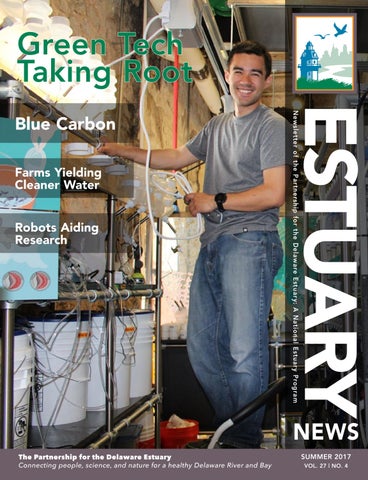
Green Tech Taking Root
Robots Aiding Research
ESTUARY
Farms Yielding Cleaner Water
Newsletter of the Partnership for the Delaware Estuary: A National Estuary Program
Blue Carbon
Symbol Alone
Type Alone
NEWS The Partnership for the Delaware Estuary Connecting people, science, and nature for a healthy Delaware River and Bay
SUMMER 2017 VOL. 27 | NO. 4
DIRECTOR‘S MESSAGE
Experts Using the Outdoors to Innovate Close your eyes and envision “infrastructure” — what do you see? Roads and bridges? Or maybe pipes and treatment plants? Here at the Partnership for the Delaware Estuary (PDE), we see oysters and mussels, plants and soil. This natural infrastructure is just as important, if not more important, to our health and well-being as built infrastructure. At PDE, we’re finding innovative new ways to use natural and nature-based infrastructure to reduce pollution, and much more. Using science, we’re restoring plants and animals in ways that make water cleaner for families and businesses. Nature-based infrastructure is built by people to mimic nature using natural materials and systems to address pollution and other problems; sometimes faster and cheaper than traditional methods. It can be used as an alternative or a complement to more traditional infrastructure. Developing these new tactics requires innovation, science, collaboration, and a balanced approach — all core values of the Partnership for the Delaware Estuary. This issue of Estuary News highlights innovative uses of natural infrastructure by PDE and partners, from the headwaters to Delaware Bay. S
Credit: Shaun Bailey of PDE
By Jennifer Adkins, Executive Director, Partnership for the Delaware Estuary
The U.S. Environmental Protection Agency (EPA) presented an Environmental Champion Award to the Partnership for the Delaware Estuary (PDE) on May 19 at the agency’s Mid-Atlantic Office in Philadelphia. The EPA awarded this honor largely because of PDE’s research on “green”, or natural and nature-based infrastructure.
MEETINGS CONTACT LIST Meetings conducted by the Partnership for the Delaware Estuary’s implementation and advisory committees occur on a regular basis and are open to the public. For meeting dates and times, please contact the individuals listed below: Estuary Implementation Committee Jennifer Adkins, Executive Director (Chair) (800) 445-4935, ext. 102 jadkins@DelawareEstuary.org Monitoring Advisory & Coordination Committee John Yagecic, P.E., Manager, Water Quality Assessment Delaware River Basin Commission (609) 477-7271, ext. 271
john.yagecic@drbc.nj.gov
Toxics Advisory Committee Dr. Thomas Fikslin, Director, Science & Water Quality Management Delaware River Basin Commission (609) 477-7253 thomas.fikslin@drbc.nj.gov Science and Technical Advisory Committee Dr. Danielle Kreeger, Science Director (800) 445-4935, ext. 104 dkreeger@DelawareEstuary.org
SUMMER 2017 | VOLUME 27 | ISSUE 4
Water Quality Advisory Committee John Yagecic, P.E., Manager (Interim Chair), Water Quality Assessment Delaware River Basin Commission (609) 883-9500, ext. 271
john.yagecic@drbc.nj.gov
PARTNERSHIP FOR THE DELAWARE ESTUARY
ESTUARY
2 NEWS
U P D AT E S
After 20 years, the Comprehensive Conservation and Management Plan for the Delaware Estuary (CCMP) is being revised. The Partnership for the Delaware Estuary (PDE) is taking the lead to assemble collective action and enhance the tidal Delaware River and Bay. So far in the revision process, more than 230 experts representing 70 organizations across the Estuary have participated in CCMP revision workshops. These experts contributed their knowledge on the three overarching themes outlined in the revision process. These themes include Clean Water, Strong Communities, and Healthy Habitats. Results emerging from these workshops included crafting a refined list of strategies feasible for implementation. Each strategy Danielle Kreeger of the Partnership for the Delaware Estuary greets experts at a was also assessed and tailored to Dr. Healthy Habitats Workshop on January 9 at the PSEG Energy & Environmental Resource minimize vulnerability to climate Center in Salem, New Jersey. change. The next phase of the CCMP ing techniques through scientific expertise, PDE revision will include stakeholder engagement looks forward to continuing to guide and particsessions. Through a series of open house-style ipate in this process. A revised CCMP will estabworkshops, PDE will reach out to local partners and communities to explore new ideas that have lish measurable targets for the next 10 years to improve habitat, water quality, and community yet to be captured in the revision process. Incorporating the latest research and monitor- resilience in and around the Delaware Estuary. S
HOW YOU CAN HELP u Attend a stakeholder engagement session. Options include: September 12, from 11:30 a.m. to 1:30 p.m. at the Tulpehaking Nature Center in Trenton, New Jersey September 12, from 4:30 to 6:30 p.m. at Silver Lake Nature Center in Bristol, Pennsylvania September 13, from 4:30 to 6:30 p.m. at the Hildacy Farm Preserve in Media, Pennsylvania September 19, from 4:30 to 6:30 p.m. at Ashland Nature Center in Hockessin, Delaware
September 26, from 11:30 a.m. to 1:30 p.m. at the University of Delaware’s Virden Retreat Center in Lewes, Delaware September 28, from 11:30 a.m. to 1:30 p.m. at the Camden County Environmental Center in Cherry Hill, New Jersey September 28, from 4:30 to 6:30 p.m. at Bartram’s Garden in Philadelphia, Pennsylvania October 5, from 4:30 to 6:30 p.m. at the Bayshore Center at Bivalve in Port Norris, New Jersey
Go to: goo.gl/S4ZCm2
PARTNERSHIP FOR THE DELAWARE ESTUARY
SUMMER 2017 | VOLUME 27 | ISSUE 4
ESTUARY
3 NEWS
Credit: Shaun Bailey of PDE
The Estuary’s Future: Your Input Needed
ESTUARY BASICS
Blue Carbon and its Value for Society By Elizabeth Watson, Ph.D., Wetlands Research Section Leader, The Academy of Natural Sciences of Drexel University, and Sunny Jardine, Ph.D., Assistant Professor, University of Washington
“Blue carbon” refers to the carbon found in three major coastal and marine ecosystems: mangroves, sea grasses, and salt marshes. On an acre-by-acre basis, coastal wetlands and sea grass beds absorb more carbon per year than mature rain forests. But rather than primarily storing carbon visibly as towering tree trunks, coastal environments build up carbon stores underground through root growth and through the trapping of sediment (i.e., mud) washed in with the tides. Blue carbon provides important benefits that should be considered in shoreline management. As efforts to offset the impacts of man-made greenhouse gas emissions are on the rise, attention has been increasingly focused on the ability of coastal restoration and enhancement projects to trap (i.e., sequester) carbon. For example, living shorelines, which use native vegetation, oyster reefs, and other materials to protect shorelines from coastal erosion, are an alternative approach to traditional shoreline management that provides carbon benefits.
Coastal restoration and enhancement projects, and green technologies like living shorelines, can help offset climate change by trapping more carbon (i.e., sequestration). Meanwhile, these projects generate other benefits to society, such as: ¡¡ providing critical habitat to fish, crustaceans, birds and marine mammals ¡¡ improving water quality ¡¡ protecting coastal communities from storm surges New research conducted by the Partnership for the Delaware Estuary’s (PDE) staff and collaborators is aimed at producing an inventory of the carbon that is trapped by wetland ecosystems in the Mid-Atlantic region. These researchers also seek to gain a better understanding of the greenhouse gas reduction benefits of wetland and shoreline management and wetland restoration. Led by PDE, this collaboration also includes:
Credit: Dr. Jennifer Howard of Conservation International
Wetlands trap, or “sequester”, carbon when their plants absorb (purple arrows) more of the greenhouse gas than they give off (black arrows). The plants transfer much of this carbon to the soil (red arrows), where it can stay for hundreds or even thousands of years if undisturbed. For details, please see the February 2017 issue of Frontiers in Ecology and its article entitled “Clarifying the role of coastal and marine systems in climate mitigation”.
SUMMER 2017 | VOLUME 27 | ISSUE 4
PARTNERSHIP FOR THE DELAWARE ESTUARY
ESTUARY
4 NEWS
2016
A living shoreline in Heislerville, New Jersey traps carbon dioxide in its plant roots and mud (i.e., sediment) that would otherwise escape and warm Earth’s atmosphere.
¡¡ other National Estuary Program partners (The Center for the Inland Bays and the Barnegat Bay Partnership) ¡¡ the U.S. Environmental Protection Agency’s Office of Research and Development ¡¡ faculty and students at Drexel University, the University of Washington, and University of Delaware Together, we are compiling data on the carbon trapped in the sediments of New Jersey, Delaware, and Pennsylvania and mapping its density in coastal sediments. We are using fieldbased greenhouse gas analyzers to measure gas exchange in wetlands subject to different management practices and exposed to different levels of water quality. This state of the art equipment allows real-time analysis of methane and nitrous oxide, in addition to carbon dioxide. Wetlands emit these gases as a result of the anaerobic (oxygen-deprived) decomposition processes that are common in wetlands. These gases are more potent greenhouse gases than carbon dioxide (25-300 times), and the calculation of the greenhouse gas reduction benefits of wetlands or living shorelines requires their inclusion. In addition, measuring fluxes of these trace gases helps identify how improvements in coastal management can improve the greenhouse gas reduction benefits provided by wetlands. Our research team has also been exploring the net economic benefits from managing shoreline erosion using living shorelines rather than traditional hard structures such as bulkheads. While living shorelines may be more
expensive to install than bulkheads, unlike bulkheads they can trap carbon and provide other valuable ecosystem services. Additionally, wetlands behind a bulkhead can become degraded when bulkheads are installed, leading to less carbon storage. When considering the value of carbon storage to society, we find that the economic benefits from some living shorelines can more than make up for their added installation cost. However, whether or not there are economic gains from living shorelines, based on carbon benefits alone, depends on the materials from which they are constructed. Additional work is needed to value the other ecosystem services living shorelines provide. This will help researchers generate a more complete assessment of the net economic gains from living shorelines as a green technology. This research represents a new collaboration between academic and government scientists with National Estuary Programs that is focused on coastal blue carbon, an emerging global nexus of environmental science, conservation, and policy. Our goals are to: ¡¡ expand understanding of the carbon being trapped in the Mid-Atlantic region ¡¡ identify the impacts of water pollution and management tactics on the carbon trapped in wetlands ¡¡ raise awareness of the greenhouse gas reduction benefits of coastal habitats S
HOW YOU CAN HELP u Talk to people
you know who own seawalls and bulkheads. Ask them if they know the benefits of living shorelines. Go to: goo.gl/5bS3vS
PARTNERSHIP FOR THE DELAWARE ESTUARY
SUMMER 2017 | VOLUME 27 | ISSUE 4
ESTUARY
5 NEWS
Credits: Dr. Danielle Kreeger (left) and Josh Moody (right), both of PDE
2010
M A K I N G WAV E S
Success in the Saucony: Productive Farms Yielding Cleaner Drinking Water
Credit: Tom Davidock
By Virginia Vassalotti, Schuylkill Action Network Coordinator, Partnership for the Delaware Estuary
Wire fencing and concrete ramps minimize cows’ impact on a tributary of the Saucony Creek outside Kutztown, Pennsylvania. Meanwhile, the surrounding plants and trees serve to soak up the nutrients left behind in the manure of livestock.
How we manage land has an impact on water, whether good or bad. Here’s a story of how improving practices on farms led to cleaner, safer drinking water in the borough of Kutztown, Pennsylvania. Kutztown gets its drinking water from groundwater before it is treated. All the land and water that drain to the Saucony Creek (what we call a “watershed”) impacts Kutztown’s groundwater. In the early 2000s, nitrates in Kutztown’s groundwater were approaching an unhealthy level of nearly 8.5 milligrams per liter, or “mg/L” (the regulatory standard is 10 mg/L). As a result, the Borough of Kutztown had to invest in expensive treatment technologies to remove nitrates. So you may ask “What’s the big deal with nitrates?” At high levels, nitrates can impact the body’s capability to bring oxygen to the bloodstream, causing minor symptoms such as headache, fatigue, and dizziness. Nitrates can also cause major symptoms such as seizures, coma, and death. This syndrome affects newborns the most, and because of the lack of oxygen in the bloodstream, one’s body physically turns blue; hence the name of the condition, blue baby syndrome.
Simultaneously, in the Saucony Creek Watershed, the Schuylkill Action Network’s (SAN) partners were hard at work, improving practices on farms. SAN is a collaboration of over 150 members. These members include environmental organizations, agencies, water suppliers, and other partners. Together they are all working to achieve the same goal of a cleaner Schuylkill River Watershed. With “action” being SAN’s middle name, agricultural partners work with farmers to improve practices by: ¡¡ Managing manure in concrete waste-storage systems. That way manure can be used as a natural fertilizer when crops can take up the nutrients as opposed to spreading manure daily when sometimes crops cannot take up nutrients (i.e., during rain events or in the winter) ¡¡ Planting trees, or “riparian buffers”, along streams, to act as a natural filter ¡¡ Keeping cows out of the stream with streambank fencing so there is less manure in streams and cows are not trampling the streambed ¡¡ Planting cover crops and not tilling to keep fertile soil on cropland, not in the stream All of these practices help manage the amount of agricultural pollution coming off of a farm, including the amount of nitrates running off into streams or soaking into groundwater. Over 30 of these projects now exist on 20 farms throughout the Saucony region. As a result, we began to see a decrease in nitrate levels. Now, nitrate levels are steadily at 6 to 6.5 mg/L. Kutztown is now able to save money on treatment costs while ensuring that their water is safer and cleaner for their customers. This truly is a success story of how collaborative partnerships and dedicated funding can lead to clean water! S
HOW YOU CAN HELP u Ask your local conservation district if farmers near you responsibly manage their runoff. Thank farmers who do and support those who desire to make improvements. Go to: SchuylkillWaters.org
SUMMER 2017 | VOLUME 27 | ISSUE 4
PARTNERSHIP FOR THE DELAWARE ESTUARY
ESTUARY
6 NEWS
M A K I N G WAV E S
Robots Changing the Nature of Research By Stephanie Dohner, Doctoral Student, University of Delaware
Remember those great beach days? The sun, the surf, the birds flying about? But what about the bird that was stationary in mid-air? Was that shadow in the shallows just a fish? No need to worry; rather, welcome to the age of robotic studies. Robots are revolutionizing environmental research and monitoring through improved beach mapping. Technological advances are making these systems versatile and economical thanks to tools capable of collecting high-resolution data in areas previously out of reach. Ecologically and economically important areas, like the beach and nearshore, are dynamic locations influenced by waves, winds, as well as storms. The nearshore is considered shallow water where waves begin to shoal (change height) and is typically where swimmers and surfers rest to avoid breaking waves. Rough conditions there make frequent and accurate data collection difficult for scientists, city managers, and engineers. However, accurate mapping of changes in sand volume, shoreline location, and nearshore sand features are vital. These data inform beach management decisions, including methods to protect and repair the coast. Historically, beach mapping was labor inten-
sive and took months or years to compile. This is where robots can save the day. Unmanned aerial systems (UAS), like the DJI Phantom 3 drone, employ cameras to map the beach while autonomous surface vehicles utilize sonar to map the nearshore. During low tide, when the beach is most exposed, aerial drones with GPS (global positioning systems) capture overlapping images of the beach below. The drone can be programmed with specific GPS points and will fly itself over the chosen area. Individual images are then stitched together into one large mosaic using a process known as photogrammetry. Computer software then calculates elevations from the two-dimensional pictures in a similar way as binocular vision enables depth perception.
continued on page 13
Credit: Stephanie Dohner
Credit: Dr. Art Trembanis of the University of Delaware
University of Delaware doctoral student Stephanie Dohner (left) and alumna Danielle Ferraro (right) guide a DJI Phantom 3 drone back to the school’s Marine Operations Building in Lewes, Delaware last March. The drone is equipped with a sophisticated camera for mapping landscapes.
From left to right, then University of Delaware graduate students Jason Button, Danielle Ferraro, and Tim Pilegard pilot an autonomous kayak named Bubbles off Broadkill Beach, Delaware in the spring of 2016. The kayak is equipped with sophisticated devices that map the sea floor with incredible accuracy.
PARTNERSHIP FOR THE DELAWARE ESTUARY
SUMMER 2017 | VOLUME 27 | ISSUE 4
ESTUARY
7 NEWS
SPECIES SPECIFIC
Restoring Nature’s Water Cleansers from the Headwaters to the Bay By Danielle Kreeger, Ph.D., Science Director, Partnership for the Delaware Estuary
Credit: Kurt Cheng of PDE
Water quality in the Delaware River Basin has been greatly improved over the last 50 years. This improvement is thanks in large part to the Clean Water Act and the tireless environmental protection and restoration efforts of so many. But for most of our waterways, there is still a long way to go, and new threats loom, such as climate change and the pressures of continued population growth and development. To sustain forward progress toward compre-
Ribbed mussels filter water at a similar rate to oysters, when submerged. What is more, there are more ribbed mussels in the Delaware Estuary than any other shellfish. This means they collectively filter the most water.
An adult eastern oyster can filter up to 50 gallons of water per day until harvest. This fishery is highly sustainable, because upward of 10 baby oysters, or “spat”, can grow on a single oyster shell.
Credit: Shaun Bailey of PDE
hensive fishable and swimmable waters, we need to double down on our efforts to prevent pollutants from fouling our waters. Another opportunity is to restore nature’s intrinsic ability to self-heal. Referred to as “natural and naturebased infrastructure”, forests and wetlands filter air and water. Once you go below the water’s surface, unseen beds of bivalve shellfish and aquatic plants work to: ¡¡ Sponge up many types of pollutants ¡¡ Reduce erosion (i.e., mud or “sediment” loss) ¡¡ Provide vital habitat for other animals such as fish Dozens of species of bivalve mollusks are native to the Delaware Estuary Watershed. These shellfish include the charismatic and delicious eastern oyster. Lesser known are several
Credit: Kurt Cheng of PDE
An adult freshwater mussel can filter up to 20 gallons of water per day for up to a century. Scientists are also studying whether they can use them to “bioextract” specific pollutants.
species of saltwater clams and mussels and 13 species of freshwater mussels. From headwater streams to the mouth of Delaware Bay, most areas at one time had large beds of bivalves of one species or another. Unfortunately, most of our streams, rivers, lakes and coastal bays have seen dramatic declines or the total elimination of these animals. If you care about clean water, declining shellfish populations should be alarming. Each adult
SUMMER 2017 | VOLUME 27 | ISSUE 4
PARTNERSHIP FOR THE DELAWARE ESTUARY
ESTUARY
8 NEWS
We’re ecstatic to report that this shellfish restoration logjam has finally been broken, at least with respect to freshwater mussels. In April, PENNVEST announced that it would make a major investment in freshwater mussel restoration for the main purpose of promoting cleaner water. The 8-year, $7.9 million project will include construction of a Philadelphia-based mussel hatchery. Scientists at this facility will produce baby mussels, or “seed”. These experts will then rear this seed for eventual release into the Susquehanna and Delaware river basins. PENNVEST is also known as the Pennsylvania Infrastructure Investment Authority. This gov¡¡ Restoring oyster beds in ernment department provides the Delaware Bay with “shell financing communities this will be the sustainable planting”, or strategically need to maintain vital services. placing clean shell on which Examples include drinking water first mussel baby oysters can attach and and sewer improvements, as well grow (pictured) as reduced runoff pollution. restoration ¡¡ Recycling oyster shell and The new Mussels for Clean Water program and reusing it to build living Initiative will also build on past shorelines containing shellfish mussel restoration efforts, such as hatchery in (see page 4 of our summer 2015 by restocking mussels into suitable issue of Estuary News) and ponds. An innovative the world that streams aspect will be to test whether some ¡¡ Stemming the loss of ribbed pollutants can be “bioextracted” is focused mussels in eroding coastal at strategic locations where water wetlands (see page 9 of our on...restoring is polluted. The Partnership for the winter 2016 issue of Estuary Delaware Estuary is now exploring News) nature’s water ways to leverage this Pennsylvania¡¡ Reintroducing freshwater focused investment in Delaware treatment mussels to historic streams and and New Jersey. rivers Numerous hatcheries already capacity.” ¡¡ Researching water filtration exist for producing freshwater musbenefits sels. However, these hatcheries are ¡¡ Finding ways to improve mainly focused on restoring rare shellfish habitats species. The reason is freshwater mussels are the most imperiled animals in North America. To Although there are many barriers and unanour knowledge, this will be the first mussel resswered questions with shellfish restoration, the toration program and hatchery in the world that overall prognosis is good. We now have the is focused on rebuilding beds of both common technology to breed most of these species and rare species for the main purpose of restorin hatcheries, and we’ve developed tactics to ing nature’s water treatment capacity. restore habitats and prioritize areas for restoShellfish restoration is no “magic bullet” that ration. The main challenges are funding and will solve all of our water pollution problems. But building awareness for the value of bivalve when applied in appropriate locations using scishellfish. For example, oyster shell planting in ence-based approaches, investments in shellfish Delaware Bay has been estimated to yield a beds provide a new opportunity to diversify and $25:1 return on investment based on dockside expand our clean water toolkit. S value. Yet, funds for large-scale shell planting have been unavailable since 2011. And no fund- HOW YOU CAN HELP u Become a citizen ing has been available for local mussel hatcherscientist for PDE’s Freshwater Mussel Volunteer ies since 2011. Survey Program. Go to: goo.gl/6kMCLq mussel, clam or oyster filters several gallons of water per day, averaged across the year. Healthy beds of these shellfish can contain tens of thousands of animals per acre. Together they function like natural water filtration plants. Naturally then, their decline means that we need to work that much harder and spend much more money to minimize pollution or mechanically treat our water. Over the past 12 years, PDE and partners have prioritized the protection and restoration of bivalve shellfish as a cost-effective means to achieve cleaner water. Our holistic shellfish restoration strategy includes:
“To our knowledge,
PARTNERSHIP FOR THE DELAWARE ESTUARY
SUMMER 2017 | VOLUME 27 | ISSUE 4
ESTUARY
9 NEWS
POLICY
A National Program for the Entire River Basin
Credit: Andy Arthur, or Flickr user “andyarthur”
From its cold headwaters in New York, renowned for wild trout fishing, to its beautiful coasts that attract beachgoers and birders alike, the Delaware River is truly an incredible resource. Home to important and unique species like the blue crab, trout, and oyster, it is easy to understand how the river and its surrounding land, or “watershed”, is responsible for $25 billion in economic activity and $21 billion in natural benefits each year. Despite this significance, the Delaware River Basin lacked a federal program dedicated to protecting and restoring the entire watershed, from the Estuary to the Upper Basin, until very recently. On its very last day of work in 2016, Congress passed the Delaware River Basin Conservation Act (DRBCA). This law was part of larger legislation known as the Water Infrastructure Improvements for the Nation Act. The DRBCA created, for the first time ever, a non-regulatory program aimed at identifying, prioritizing, and implementing conservation projects throughout the 13,500 square-mile watershed. The importance of this success cannot be understated. The DRBCA was first introduced in 2010 by Congressman Mike Castle. The Coalition for the Delaware River Watershed began advocating for the act’s passage when it was formed in 2012. Over the more than six years that the DRBCA moved through The pristine waters of Russell Brook flow down Russell Brook Falls outside Roscoe, New York. From here it flows to Beaver Kill, the East Branch Delaware River, and downstream past Pennsylvania, New Jersey, and Delaware.
Credit: Carol Brightbill
By Madeline Urbish, Director, Coalition for the Delaware River Watershed at New Jersey Audubon
Paddlers enjoy a South Jersey sunset from their stand-up paddleboards in Delaware Bay. The waters of multiple states converge on this estuary before emptying into the ocean.
Congress, less than 3% of introduced legislation was passed and signed into law. In creating the Delaware River Basin Restoration Program, the DRBCA also authorized a program to support locally-driven restoration work through competitive grants and technical assistance. This incentive-based approach will strengthen exciting efforts across the watershed by leveraging private investment through a 50%, non-federal match requirement. These funds can go to support innovative projects at a local and regional level. Examples include: ¡¡ preventing pollution on cash-strapped family farms (see page 6) ¡¡ replanting riversides, so their trees and plants soak up polluted runoff ¡¡ protecting clean water using high-tech monitoring The Delaware River Basin Restoration Program is headed up by the U.S. Fish and Wildlife Service (FWS). This agency began developing a framework for the program almost immediately after the DRBCA’s authorization. Importantly, the FWS has been actively reaching out to the organizations and governmental entities already working in the watershed to collaboratively shape the program. In particular, the FWS has coordinated closely with the Coalition for the
SUMMER 2017 | VOLUME 27 | ISSUE 4
continued on page 13
PARTNERSHIP FOR THE DELAWARE ESTUARY
E S T U A R Y 10 N E W S
POLICY
Advocates Rally for Delaware’s Water
Credit: Delaware Nature Society
By Brenna Goggin, Director of Advocacy, Delaware Nature Society
People from across Delaware gather for the Clean Water Rally on June 6 outside Legislative Hall in Dover. The Delaware Nature Society organized this rally for its shared Clean Water: Delaware’s Clear Choice campaign.
On June 6, hundreds of Delaware’s strongest clean water advocates came together during the Clean Water: Delaware’s Clear Choice 3rd Annual Clean Water Rally in Dover. The rally, which celebrated the release of the Delaware Clean Water and Flood Abatement Task Force (Task Force) report, urged legislators to implement many of the report’s recommendations. Throughout the rally, one message was clear: we must include green technology when addressing water pollution. The Task Force, made up of representatives from conservation groups, businesses, academia and government, studied Delaware’s most pressing water pollution and supply issues by: ¡¡ Meeting with experts ¡¡ Reviewing data on water pollution and flooding ¡¡ Visiting sites that best illustrate Delaware’s water management issues At its conclusion, the Task Force issued a report which outlines Delaware’s water management issues and makes recommendations on how to address them. People across Delaware recognize that investing in clean water is a necessity. Delawareans also know they must be as efficient as possible with any funds collected for reducing water pollution and flooding. This is why it is incredibly important that we include green infrastructure as part of the plan. There are two ways to approach water management: through “gray infrastructure” and “green infrastructure.” Gray infrastructure is the
traditional pipes, drains and water treatment systems that address all things related to water. Green infrastructure approaches water management in a more natural way by incorporating sustainable solutions in clean water improvements. Examples of green infrastructure include rain gardens, living shorelines (see page 4), permeable pavements (think gravel instead of cement) and restored wetlands. Gray infrastructure has its place. Nevertheless, it is important to recognize that green technology and green infrastructure provides more benefits for its cost and lasts longer — much longer. In fact, these technologies will continue to address water pollution and flooding issues for generations to come. For example, New York City purchased land around its reservoirs in the Catskill Mountains to ensure pollution from nearby roads and lawns does not enter the water supply. While this cost the city $600 million, the capital costs to implement a similar gray infrastructure water management system would cost nearly $6 billion. Additionally, Indianapolis used wetlands and trees to reduce rain and melting snow (i.e., stormwater) flowing into its sewer system. This stormwater reduction allowed the city to use smaller pipes, which, in turn, saved taxpayers nearly $300 million. Clean water is Delaware’s future, and the future includes use of green technology. S
HOW YOU CAN HELP u Learn more
about the Clean Water: Delaware’s Clear Choice campaign on its website. Go to: CleanWaterDelaware.org
PARTNERSHIP FOR THE DELAWARE ESTUARY
SUMMER 2017 | VOLUME 27 | ISSUE 4
E S T U A R Y 11 N E W S
FOR TEACHERS
Insider Advice for Your Outdoor Classroom By Todd Klawinski, Teacher, Caesar Rodney School District
Learning Deck. Throughout the year, including summer break, students can explore the habitats (restored forest, meadow, lowland/pond, and upland area). The teacher can see the entire facility perched upon the deck, or they can be down among the students. Those students who require a more controlled outdoor experience as they continue to develop in maturity Credit: Tom Nutter, courtesy of the Delaware State Chamber of Commerce
Several years ago, when I first started teaching, I knew that, to teach science well, there had to be an outdoor-based laboratory experience for the students. So a couple of teachers, several students, and I proceeded by writing a small grant to be able to purchase some recycled plastic picnic tables and benches to put out by the pond on campus. We built it together and found that having a home base for studying the outdoors was a lot of fun. We also found that immersing ourselves in the real world was very useful to truly understanding what we learned in the classroom. Throughout my teaching career, I’ve seen several versions of outdoor classrooms. These classrooms ranged from simple sitting spaces where one could read a book all the way to fully equipped platforms where students could actually explore waterways and run experiments in real time. Fast forward to today and this is still relevant as a best practice, especially as we really dig in to the Next Generation Science Standards (NGSS). Getting buy-in by our administration was critical. They could see the opportunities not only for cross-curricular education throughout the departments, but also our ability to answer the need for kids getting back outdoors. We worked successfully to obtain grants from Home Depot and Lowe’s to fund Phase 1, Establishment, and Phase 2, Infrastructure. Next, we applied for, and were recognized with, the: ¡¡ Delaware State Chamber of Commerce’s Superstars in Education award in May 2016 for developing The Outdoor Classroom and Community Gardens at Postlethwait Middle School ¡¡ U.S. Department of Education’s Green Ribbon Schools award in May 2017 after working toward greening our campus in preparation for developing an EcoCampus in the near future Getting student buy-in is simple. All we need to do is ask “Who wants to go outside?” But wanting to go outdoors is only half of the equation. Students need to be mentally in a place where they will actually be productive in applying what they have already learned. With this in mind, we have designed and constructed The
Teacher, Todd Klawinski (lower right) leads a lesson in planting beans, lavender, and onions in April of 2016 at The Community Gardens, part of an outdoor classroom at Postlethwait Middle School in Wyoming, Delaware.
can be directed to stay on The Learning Deck during class time where they remain outdoors. Everyone goes outside! Postlethwait Middle School has begun to transform and we are now actively working with NGSS outside of the classroom one lesson at a time. There is a new buzz around our community as this project enters Phase 3: Application/ Curriculum. Most significantly, though, people are increasing the amount of time they are spending outdoors. Outdoor education initiatives on public school campuses are going to be essential to the future of education in the 21st century by: ¡¡ Creating authentic career experiences in STEM fields ¡¡ Developing behavior management partnerships with intensive learning centers ¡¡ Committing to raising environmental awareness and stewardship
SUMMER 2017 | VOLUME 27 | ISSUE 4
continued on page 13
PARTNERSHIP FOR THE DELAWARE ESTUARY
E S T U A R Y 12 N E W S
Insider Advice for Your Outdoor Classroom continued from page 12
Robots Changing the Nature of Research continued from page 7
The national No Child Left Inside movement inspires a return to the land around us, even with some nifty weather-resistant technology in hand on occasion. This can reignite the minds of students and teachers and inspire the creative, out-of-the-box thinking that is so critical to our future. S HOW YOU CAN HELP u Begin planning your outdoor classroom today. Go to: DelawareEstuary.org, keyword “Schoolyard”
Because these aerial surveys are only effective over the land, the survey equipment must take to the water! Autonomous surface vehicles (ASV) carry onboard sonar and GPS systems similar to those on recreational fishing boats, such as a Humminbird echosounder/sidescan combo. Single beam echo sounders send out one “beam” of sound. This sound measures the distance between the sea floor and the ASV. Meanwhile, multibeam measures a wider sector, or “swath”, of sea floor. Together, these devices gather a more complete picture of the depth of the underwater landscape. This depth data is referred to as bathymetry. Inexpensive recreational autopilots such as the Pixhawk from 3DRobitcs allow the user to plan and execute survey missions over specific areas with the ASV. Following computer processing, UAS and ASV data is combined into a single file of elevations, latitudes, and longitudes. The beach elevations and bathymetry are combined to create one continuous elevation surface from land to sea known as a digital elevation model. This is the sunken treasure chest for beach managers! Shoreline locations and beach-face slopes are mapped with centimeter accuracy, sand volume changes can be calculated between two surfaces, and coastal features such as sand bars can be monitored for location and size changes. It’s an exciting time in the coastal community now that robots are able to quickly and accurately map the beach and nearshore. Using robots like aerial drones and ASVs to assess coastal evolution provides beach managers, safety officials, and researchers with accurate data on beach and shore-face changes. Knowing how the beaches are changing improves our understanding of this dynamic region that people will always love.
A National Program for the Entire River Basin continued from page 10 Delaware River Watershed, which led the collective effort that resulted in the DRBCA’s passage late last year. As required by the DRBCA, the FWS has also coordinated with the Partnership for the Delaware Estuary, which oversees the National Estuary Program in the basin. The Coalition for the Delaware River Watershed will continue working with its partners in the river basin and Washington, D.C. Together, we will ensure the program is funded so resources can flow to restoration and protection efforts throughout the region S HOW YOU CAN HELP u Visit the Coalition for the Delaware River Watershed’s website to learn more. Go to: DelRiverWatershed.org/drbca
Credit: Shaun Bailey of PDE
Editor’s Note: Stephanie Dohner won the Best Student Talk Award at the Delaware Estuary Science and Environmental Summit in January. In recognition of her accomplishment, the Partnership for the Delaware Estuary is pleased to share her research in Estuary News. S
HOW YOU CAN HELP u Introduce
children to science, technology, engineering, and math. These subjects are the foundation for the innovations discussed here. Go to: goo.gl/faPKAL
PARTNERSHIP FOR THE DELAWARE ESTUARY
SUMMER 2017 | VOLUME 27 | ISSUE 4
E S T U A R Y 13 N E W S
ESTUARY EXCURSIONS
Delaware Bay Oysters Featured in Philadelphia Airport Display By Jeff Long, Watershed Outreach Specialist, Partnership for the Delaware Estuary
Pictured here in the largest display case is how PDE uses recycled oyster shells in living shorelines (see page 4). The eastern oyster exhibit is expected to remain on display for several more months. If you’re traveling through Philadelphia International Airport, please stop by to see this wonderful exhibit! S
HOW YOU CAN HELP u Tell others to stop by the exhibit by sharing our Facebook post. Go to: goo.gl/XVu4eJgoo.gl/XVu4eJ
Credit: Philadelphia International Airport and Jeff Long of PDE (bottom center only)
In April the Philadelphia International Airport debuted a display on the eastern oyster. This display was made possible thanks to support from the Partnership for the Delaware Estuary (PDE). Other contributors to its creation include the Haskin Shellfish Research Laboratory and the Bayshore Center at Bivalve. The Partnership for the Delaware Estuary thanks Philadelphia International Airport for the chance to display its shellfish restoration work. The exhibit is located past security in Terminal A East, which is mainly used for domestic travel.
SUMMER 2017 | VOLUME 27 | ISSUE 4
PARTNERSHIP FOR THE DELAWARE ESTUARY
E S T U A R Y 14 N E W S
Pennsylvania Coast Day
September 9, from 11 a.m. to 4 p.m. | Philadelphia, PA See the Benjamin Franklin Bridge from a yacht (supplies limited). Splash past a submarine in a kayak, swan boat, row boat or skiff. Then explore the shore, where two dozen marine-themed exhibitors will greet you — with giveaways. These and other attractions will make Pennsylvania’s coast come alive outside the Independence Seaport Museum. For details call (800) 445-4935, extension 112. LINK u DelawareEstuary.org, keyword “Pennsylvania”
Island Birding
Credit: Shaun Bailey of PDE
ESTUARY EVENTS
Credit: Shaun Bailey of PDE
September 23, from 7:45 a.m. to 11 a.m. | Petty’s Island, NJ Discover forbidden Petty’s Island, where access is seldom granted. Those who register are likely to see a variety of birds, all while walking in the footsteps of Benjamin Franklin, Blackbeard the pirate and others, or so legend has it. This excursion is free, but birders must be 12 or older. LINK u PettyIslFallBirds.EventBrite.com, or call (908) 766-5787
American Birding Expo
Credit: Gameface Media, courtesy of Delmo Sports
Escape to Lewes Open Water Classic
September 30, from 8 a.m. to 1:30 p.m. | Lewes, DE Leap from a ferry boat into the beautiful Delaware Bay just a stone’s throw from a lighthouse. It’s all part of this endurance swim spanning either one mile or three; your choice. Those who compete will receive free finisher medals and event photos. LINK u DelmoSports.com/events/escape-lewes-open-waterswim-classic
Credit: Bird Watcher’s Digest
September 29 to October 1 | Oaks, PA Birders will flock to the Schuylkill Riverfront this fall. Together they will venture to Valley Forge National Historical Park for free daily bird walks. Then they will take refuge inside the Greater Philadelphia Expo Center. There exhibitors will greet them, as will noted presenters. Tickets are just $10 per person, and those 16 and younger are free. LINK u AmericanBirdingExpo.com, or call (800) 879-2473
Experience the Estuary Celebration
P L AT I N U M
GOLD
S I LV E R
DuPont: Clear Into the Future
Exelon Generation PSEG
Brown and Caldwell
PARTNERSHIP FOR THE DELAWARE ESTUARY
Credit: Shaun Bailey of PDE
October 11, from 5:30 to 8:30 p.m. | Claymont, DE Dine on fresh Delaware Bay oysters with fellow enthusiasts of the Delaware River and Bay. This fundraiser will take place at The Waterfall, conveniently located off I-95 and I-495. This water-themed venue will house a VIP reception, dinner, auctions, networking, and more. Go to: PDE2017.eventbrite.com
SUMMER 2017 | VOLUME 27 | ISSUE 4
E S T U A R Y 15 N E W S
US POSTAGE Non-Profit Org PAID Wilmington, DE Permit #1885
110 South Poplar Street, Suite 202 Wilmington, DE 19801 ADDRESS SERVICE REQUESTED
HELP US SAVE PAPER. Convert your subscription to email today. It’s easy! Just email ehorsey@DelawareEstuary.org and provide your name and email address. The Partnership for the Delaware Estuary:
Connecting people, science, and nature for a healthy Delaware River and Bay The Partnership for the Delaware Estuary, Inc. (PDE), is a private, nonprofit organization established in 1996. The PDE, a National Estuary Program, leads science-based and collaborative efforts to improve the tidal Delaware River and Bay, which spans Delaware, New Jersey, and Pennsylvania. To find out how you can become one of our partners, call the PDE at (800) 445-4935 or visit our website at www. DelawareEstuary.org. Partnership for the Delaware Estuary, Inc. Jennifer Adkins, Executive Director Tel: (800) 445-4935 / Fax: (302) 655-4991 E-mail: jadkins@DelawareEstuary.org Environmental Protection Agency Irene Purdy, EPA Region II Tel: (212) 637-3794 / Fax (212) 637-3889 E-mail: purdy.irene@epa.gov Megan Mackey, EPA Region III Tel: (215) 814-5534 / Fax: (215) 814-2301 E-mail: mackey.megan@epa.gov Pennsylvania Rhonda Manning Department of Environmental Protection Tel: (717) 772-4472 / Fax: (717) 783-4690 Email: rmanning@pa.gov
Delaware John Kennel Department of Natural Resources and Environmental Control Tel: (302) 739-9255 / Fax: (302) 739-2048 E-mail: john.kennel@state.de.us
Philadelphia Water Kelly Anderson Tel: (215) 685-6245 / Fax: (215) 685-6043 Email: kelly.anderson@phila.gov Editor Shaun Bailey, Marketing and Communications Coordinator, Partnership for the Delaware Estuary
New Jersey Jay Springer Department of Environmental Protection Tel: (609) 341-3122 / Fax: (609) 984-6505 E-mail: jay.springer@dep.state.nj.us Delaware River Basin Commission Kenneth Najjar Tel: (609) 883-9500 ext 256 / Fax: (609) 883-9522 E-mail: kenneth.najjar@drbc.state.nj.us
SUMMER 2017 | VOLUME 27 | ISSUE 4
Estuary News encourages reprinting of its articles in other publications. Estuary News is produced four times annually by the Partnership for the Delaware Estuary, Inc. (PDE), under an assistance agreement (CE-99398513-2) with the U.S. Environmental Protection Agency (EPA). The purpose of this newsletter is to provide an open, informative dialogue on issues related to the Partnership for the Delaware Estuary. The viewpoints expressed here do not necessarily represent the views of the PDE or EPA, nor does mention of names, commercial products or causes constitute endorsement or recommendation for use. For information about the PDE, call 1-800-445-4935.
PARTNERSHIP FOR THE DELAWARE ESTUARY
E S T U A R Y 16 N E W S