VOLUME 26 T ISSUE 4 T SUMMER 2016
NEWSLETTER OF THE PARTNERSHIP FOR THE DELAWARE ESTUARY: A NATIONAL ESTUARY PROGRAM
Partnerships Past, Present, and Future By Jennifer Adkins, Executive Director, Partnership for the Delaware Estuary
W
hat is a partner? A quick search revealed the expected definition: “a person who takes part in an undertaking with others.” But an unexpected one turned up too: “a timber framework secured to and strengthening the deck of a wooden ship around a hole for the mast.”
Credit: Mike Shanahan of The Nature Conservancy
This nautical definition is a great reminder that partnering is not just about having more hands to get more done. Partners make each other stronger, and partnerships make new things possible — like holding up the mast of a ship, to move it forward.
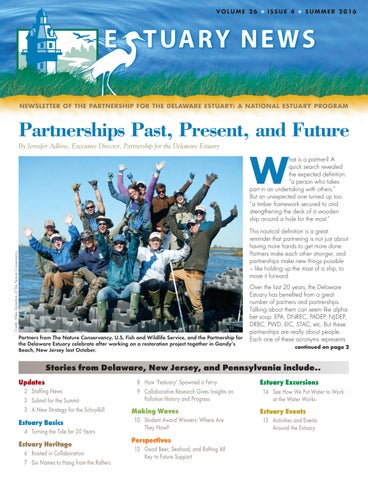
Partners from The Nature Conservancy, U.S. Fish and Wildlife Service, and the Partnership for the Delaware Estuary celebrate after working on a restoration project together in Gandy’s Beach, New Jersey last October.
Over the last 20 years, the Delaware Estuary has benefited from a great number of partners and partnerships. Talking about them can seem like alphabet soup: EPA, DNREC, PADEP, NJDEP, DRBC, PWD, EIC, STAC, etc. But these partnerships are really about people. Each one of these acronyms represents continued on page 2
Stories from Delaware, New Jersey, and Pennsylvania include.. Updates 2 Staffing News 3 Submit for the Summit 3 A New Strategy for the Schuylkill
Estuary Basics 4 Turning the Tide for 20 Years
Estuary Heritage 6 Rooted in Collaboration 7 Six Names to Hang from the Rafters
8 How ‘Festuary’ Spawned a Ferry 9 Collaborative Research Gives Insights on Pollution History and Progress
Estuary Excursions 14 See How We Put Water to Work – at the Water Works
Making Waves
Estuary Events
10 Student Award Winners: Where Are They Now?
15 Activities and Events Around the Estuary
Perspectives 12 Good Beer, Seafood, and Rafting All Key to Future Support
UPDATES
Partnerships continued from page 1 a group of people, working together and with other groups of people, to improve the Delaware Estuary and make people’s lives better.
behind the scenes, talking with Shaun Bailey who authored several of the articles in this issue. We’re also fortunate to have a new generation of people involved; people like Kelly Somers, author of the article on page 12, who brings new ideas and passion to the table.
When we celebrate our 20th anniversary, we celebrate these people; people who have the vision, passion, and perseverance to hold up the mast and keep moving forward; people in agencies that have developed new and better ways to manage our waters, lands, and living resources; in companies that have found new ways to reduce pollution and make products that help the environment; in communities, working together on things like parks and cleanups, and individually to make homes and lawns estuary-friendly. Our progress over the last 20 years would not be possible without all their efforts and support for our work.
We’re seeking input from all of these people and partners as we chart a course for the next 20 years during the revision of the Comprehensive Conservation and Management Plan for the Delaware Estuary (CCMP). If the Partnership for the Delaware Estuary is a ship, the CCMP is its mast — the plan that keeps us moving forward, in the right direction. It’s supported by the hundreds of people that worked together to create it, and the hundreds more contributing to its revision over the next two years.
We are fortunate that a number of the people who founded our organization and made the Delaware Estuary part of the National Estuary Program are still involved. You’ll see some of their names in this issue of Estuary News, in bylines, articles, and quotes. Others you won’t because their contributions were made
If, as Henry Ford once said, “Coming together is a beginning; keeping together is progress; working together is success,” we’re at least two-thirds of the way there! n
Staffing News
S
arah Bouboulis is taking on a new challenge at the Partnership for the Delaware Estuary (PDE). In May she assumed the role of habitat specialist after serving as science planning specialist for one year.
teers helping to beautify landscapes and combat polluted runoff. Look for new faces at the PDE this fall. We’re bringing on a new specialist to take over Sarah’s work tracking the success and evolution of the Comprehensive Conservation and Management Plan for the Delaware Estuary (see page 6). We’re also hiring a new senior watersheds coordinator and watershed planning specialist to round out our team. This comes after bidding a sad goodbye to Tom Davidock and Sari Rothrock who are advancing their careers in New York state and Baltimore, respectively. n
In her new role, Sarah focuses on doing projects that make water cleaner and improve natural habitat. Examples include rain gardens, natural shorelines, and shellfish habitat. To implement these projects, she collaborates with local businesses, schools, and organizations, including those in the Corporate & Community Environmental Stewardship Program. Together they lead volunMEETINGS CONTACT LIST
Meetings conducted by the Partnership for the Delaware Estuary’s implementation and advisory committees occur on a regular basis and are open to the public. For meeting dates and times, please contact the individuals listed below: Estuary Implementation Committee Jennifer Adkins, Executive Director (Chair) (800) 445-4935, ext. 102 jadkins@delawareestuary.org Monitoring Advisory & Coordination Committee John Yagecic, Manager, Water Quality Assessment Delaware River Basin Commission (609) 477-7271
john.yagecic@drbc.nj.gov
Toxics Advisory Committee Dr. Thomas Fikslin, Director, Science & Water Quality Management Delaware River Basin Commission (609) 477-7253
thomas.fikslin@drbc.nj.gov
Science and Technical Advisory Committee Dr. Danielle Kreeger, Science Director (800) 445-4935, ext. 104 dkreeger@delawareestuary.org
Delaware Estuary Education Network Lisa Wool, Program Director (800) 445-4935, ext. 105 lwool@delawareestuary.org Water Quality Advisory Committee Dr. Erik Silldorff, Senior Aquatic Biologist Delaware River Basin Commission (609) 477-7234
erik.silldorff@drbc.nj.gov
FOLLOW US ON:
E S T U A RY N E W S T S U M M E R 2 0 1 6 T V O L U M E 2 6
2
T ISSUE 4
UPDATES
Submit for the Summit
T
Credit: Shaun Bailey of the PDE
he Partnership for the Delaware Estuary welcomes abstracts for its Delaware Estuary Science & Environmental Summit, taking place on January 22-25 at the Grand Hotel in Cape May, New Jersey. This summit attracts more than 250 experts in their fields every two years. Examples include scientists, managers, regulators, educators, and watermen. They enjoy it for its retreat-like atmosphere, variety, and brevity. For example: •Lectures are limited to 15 minutes to allow for maximum sharing •Poster presentations occur over beer, wine, and hors d’oeuvres •Panel discussions often include perspectives from each state in the region •Conversations can continue in Cape May’s exquisite restaurants •The offseason means attendees have the resort town much to themselves Please visit DelawareEstuary.org/summit for an extended deadline and list of topics. n
Marc Zitter (left) of Northern Cape May Sea Farms mingles with Daphne Monroe (center) and Lisa Calvo (right), both of Rutgers University’s Haskin Shellfish Research Laboratory, at the Delaware Estuary Science & Environmental Summit in 2015.
A New Strategy for the Schuylkill
The Partnership for the Delaware Estuary is a founding member of the SAN. However, the real strength of the SAN comes from its many collaborators. Please contact Virginia Richard Widmann from the Philadelphia Canoe Club displays the drone he found on April Vassalotti to join them. You can reach her at 15 while volunteering with the Schuylkill Navy River Stewards Committee. The SAN seeks (800) 445-4935, extension 121. n to engage more paddlers like Widmann by adding a Recreation Workgroup. E S T U A RY N E W S T S U M M E R 2 0 1 6 T V O L U M E 2 6
3 2
T ISSUE 4
Credit: Virginia Vassalotti of the PDE
T
he Schuylkill Action Network (SAN) has released its new five-year strategic plan to improve Pennsylvania’s Schuylkill River Valley. The Schuylkill River is the largest tributary to the Delaware River and Bay, providing about 1 billion gallons of fresh water every day. Among other goals, this plan calls for a new Recreation Workgroup. This new workgroup will focus on engaging ecotourists and the businesses and education centers serving them. The plan also identifies new strategies for workgroups addressing abandoned mines, education and outreach, land protection, pathogens, and stormwater. Strengthening efforts for engaging family farmers and water suppliers is also part of the plan.
ESTUARY BASICS
E S T U A RY N E W S T S U M M E R 2 0 1 6 T V O L U M E 2 6
4
T ISSUE 4
E S T U A RY N E W S T S U M M E R 2 0 1 6 T V O L U M E 2 6
5
T ISSUE 4
ESTUARY HERITAGE
Rooted in Collaboration By Shaun Bailey, Marketing and Communications Coordinator, Partnership for the Delaware Estuary
T
he Partnership for the Delaware Estuary’s roots can be traced to July 18, 1988. That is when the U.S. Environmental Protection Agency (EPA), together with the States of Delaware, New Jersey, and Pennsylvania, signed an agreement to include the Delaware Estuary in the EPA’s new National Estuary Program (NEP). The NEP is a network of organizations established by Congress in 1987 to protect nationally significant estuaries threatened by pollution, development, and overuse.
Then and Now
This historic signing gave birth to the Delaware Estuary Program (DELEP). Its core partners include:
• U.S. EPA’s Regions 2 and 3 • Delaware River Basin Commission • Philadelphia Water • Delaware Department of Natural Resources and Environmental Control • New Jersey Department of Environmental Protection • Pennsylvania Department of Environmental Protection
The original signers of the Comprehensive Conservation & Management Plan for the Delaware Estuary use Philadelphia tap water to toast the completion of the Delaware Estuary Program’s planning phase in 1996. Credit: Neil Benson
The DELEP’s goal was to gain the public’s assistance in developing a management plan for the Estuary’s resources. To do this, they convened a management conference, workshops in thirteen counties, and committees consisting of citizens, regulators, and scientists. Over the next five years, DELEP leaders gathered the public’s input, assessed the environment’s health and, one by one, agreed on plans addressing a variety of concerns. These include land management, water use, habitat and wildlife, toxics, education and involvement, monitoring, and more. When they finished, they put all of these together inside
Representatives of the Delaware Estuary Program use tap water pumped from the Brandywine River to toast their recommitment to working together on December 5, 2014. Credit: Shaun Bailey of the PDE
continued on page 13
Don’t Ruffle Dr. Jonathan Sharp (see next page) and other founders a Blue Hen’s cite insults like these as inspiration for spearheading the Feathers Delaware Estuary Program.
“ The Chesapeake is a sailboat gliding across sun-speckled water at sunset. The Delaware is a tanker lightering its dark oily cargo into a bleak barge in dark gray water.” — 1980s issue of the Delaware State News
“ On the other hand, the Chesapeake is in far better shape than her dirty smaller sister the Delaware Bay.” — May 21, 1971 issue of Science
E S T U A RY N E W S T S U M M E R 2 0 1 6 T V O L U M E 2 6
6
T ISSUE 4
Six Names to Hang from the Rafters By Shaun Bailey, Marketing and Communications Coordinator, Partnership for the Delaware Estuary
A
Awarded February 1, 2011 Dr. Jonathan Sharp retired in 2014 as a professor of oceanography at the University of Delaware. He and his team of researchers have produced over 45 refereed publications and reports on the Delaware River and Bay. This research has allowed him to track and describe the Estuary’s long-term improvement since the 1970s, when Congress passed the Clean Water Act (see page 9).
Credit: The Academy of Natural Sciences
Dr. Jonathan H. Sharp
so polluted fish could not swim between Marcus Hook and Philadelphia. Fortunately, the folks below dedicated their careers to its improvement. These are the recipients of the Partnership for the Delaware Estuary’s Jonathan Sharp Lifetime Achievement Award. Please help us shine a light on their achievements.
Governor Michael N. Castle
Awarded October 14, 2011 Governor Michael Castle is a big booster of the tidal Delaware River and Bay. He led efforts to nominate and qualify it for the U.S. Environmental Protection Agency’s National Estuary Program (see page 6). He advocated on its behalf in the U.S. House of Representatives for 18 years, including introducing the Delaware River Basin Conservation Act in 2010. Six years later this Act may finally get a vote in the U.S. Senate.
Awarded October 9, 2014 Carol Collier served as executive director of the Delaware River Basin Commission (DRBC) for 15 years. During that time she helped protect the Upper Delaware River through a DRBC program called Special Protection Waters. She also helped clean up the Lower Delaware by steering a plan for its PCBs. Both accomplishments will make these waters cleaner for generations to come. Awarded October 9, 2014 Robert Tudor rose to the position of deputy director at both the DRBC and the New Jersey Department of Environmental Protection. His career allowed him to craft long-term plans affecting everything coastal: water, wetlands — even mud (sediment). In the mid-’90s, he was instrumental in involving the public while drafting a plan for returning the Delaware Estuary to health (see page 6). This plan endured for two decades and is only just now being revised.
Dr. Susan Kilham
Credit: Elizabeth Horsey of the PDE
Credit: Elizabeth Horsey of the PDE
Dr. John Kraeuter
Awarded January 28, 2013 If you love local shellfish then you owe Dr. John Kraeuter a seafood dinner. He studied Delaware Bay oysters at Rutgers University for 25 years. He was the lead author on the State of New Jersey’s first aquaculture plan. He investigated other bottom-dwelling, or “benthic,” marine life as well. Examples include clams, horseshoe crabs, and scallops, all of which help to sustain our coastal economy.
Carol R. Collier
Robert Tudor
Credit: Robert Tudor
Credit: Shaun Bailey of the PDE
Credit: Dr. Danielle Kreeger of the PDE
lmost 30 athletes are recognized, their numbers retired, under the lights of four stadiums lining the Lower Delaware River. These athletes returned their franchises to greatness, but what of those who returned the river to greatness? And it is great, especially considering its turnaround. The Delaware River was once
Awarded January 26, 2015 Dr. Susan Kilham of Drexel University is renowned for her studies of the Delaware River and Bay’s natural systems. She helped evaluate their environmental health for the first time in 1996 and guide the “State of the Estuary” reports that followed over the years. Likewise, she has guided over 30 doctoral and masters students, many of whom are internationally acclaimed in their own right. n
E S T U A RY N E W S T S U M M E R 2 0 1 6 T V O L U M E 2 6
7 2
T ISSUE 4
ESTUARY HERITAGE
How ‘Festuary’ Spawned a Ferry By Shaun Bailey, Marketing and Communications Coordinator, Partnership for the Delaware Estuary
L
ast summer more than 17,000 tourists used the Forts Ferry Crossing to travel the tidal Delaware River. This is one of just three ferry routes across the Delaware Estuary. The others are the Cape May-Lewes Ferry and Philadelphia’s RiverLink Ferry, but then, this is common knowledge. What most people don’t realize is how the Forts Ferry Crossing got its start. Meet “Festuary”.
with an opportunity to get a complete picture of the Delaware Estuary’s defense system in just a few hours.” Less than four years later, the Delaware River and Bay Authority assumed control of the Delaware DNREC’s ferry. When it did, it acted on Festuary’s popularity by doubling its route to include Fort Mott State Park.
Credit: Delaware River and Bay Authority
Credit: Delaware River and Bay Authority
Festuary was the brainchild of a group of people who went on to lead the creation of the Delaware Estuary Program (see page 6). This group collaborated to host an event on September 5, 1993. Its purpose was to celebrate the Delaware Estuary’s importance to the tri-state area. What made Festuary unique is how it linked both shores of the Delaware River, as well as an island in the middle. It exposed tourists to three different themes: recreation at Fort DuPont in Delaware City, Delaware; living history at Fort Delaware on Pea Patch Island; and commerce at Fort Mott in Pennsville, New Jersey. It also proved tourists would line up to spend their day exploring up to three forts and their surrounding state parks. And line up they did.
In the years since, the Partnership for the Delaware Estuary has molded Pennsylvania Coast Day (see page 15) in the image of Festuary. Every September Coast Day features the RiverLink Ferry and Patriot Harbor Lines to deliver visitors to Philadelphia, Camden, and the Delaware River.
More than 2,000 people attended Festuary. So many came that its only flaw was long lines for ferry boats. Regardless, they enjoyed:
• Living history demonstrations by Civil War reenactors • Native dances by Lenape Indians • Live music ranging from sea shanties to jazz • Net fishing, or “seining” • Water testing demonstrations
Festuary demonstrated the value of collaboration — a core value of the original Delaware Estuary Program and today’s Partnership for the Delaware Estuary. It got people working together for the environment’s sake, despite state boundaries. These included the:
• Delaware DNREC • New Jersey Department of Environmental Protection • Friends of Fort Mott • Delaware Nature Society • Bayshore Center at Bivalve (then the Delaware Bay Schooner Project) • Many others
Marjorie Crofts helped plan Festuary while partnering to lead the creation of the Delaware Estuary Program. She has since become the director of the Division of Waste and Hazardous Substances at the Delaware Department of Natural Resources and Environmental Control (DNREC). “I know from planning the event with the Fort Mott staff that many from New Jersey had wanted a way to get out to Pea Patch Island without having to drive over to Delaware,” said Crofts. “The ferry provided citizens from both New Jersey and Delaware
Please visit DECitySalemFerry.com or call (800) 643-3779 to follow in the footsteps of revelers at Festuary. n
E S T U A RY N E W S T S U M M E R 2 0 1 6 T V O L U M E 2 6
8
T ISSUE 4
Collaborative Research Gives Insights on Pollution History and Progress By Richard Greene, Ph.D., Engineer, Delaware Department of Natural Resources and Environmental Control Dr. David Velinsky (second from left) from The Academy of Natural Sciences of Drexel University and Dr. Christopher Sommerfield (far right) from the University of Delaware lead others in the collection of sediment (mud) cores from deep below the marshes of the Delaware Estuary in 2008.
Credit: Dr. Richard Greene of the Delaware DNREC
W
etlands have been referred to as the kidneys of the environment based on their ability to capture carbon, nutrients, and contaminants. “Capture” here refers to settling, accumulation and burial of contaminants and elements that sorb (or stick) to suspended and bottom sediments (mud). There are many examples in the Delaware Estuary, including phosphorus, metals, and PCBs (polychlorinated biphenyls), to name a few.
It is important to not only understand current conditions but also long-term trends. An extremely powerful tool that allows us to look into the past is deep sediment cores. Sediment cores, typically between one and one and a half meters long, are collected from the interior of marshes away from major disturbance. They are sliced into sections (e.g., 2 cm-thick intervals), which are then analyzed for ages and This research demonstrates how changes accumulation rates. They are also tested for in management and the natural capacity of marshes have reduced pollution in the contaminants and eleDelaware Estuary over time. Research and ments to produce their results like these are only possible through “pollution histories”. long-term partnerships and collaboration.
Why Does it ‘Mudder’?
• Metals: Starting from before the 1940s to the early 1970s, there was a marked increase in lead concentrations, followed by a rapid decrease starting in the mid-1970s. Deeper samples correspond with the use and local manufacture of tetra ethyl lead as a gasoline additive, followed Between 2001-2009, by the phase out in the researchers from The Academy of Natural Sciences mid-1970s. The onset, peak of Drexel University and the University of Delaware and decline of zinc in a collected roughly 100 sediment cores. They obtained PCBs (polychlorinated biphenyls): Any of a family of indusChurchman’s Marsh core trial compounds used as lubricants, heat-transfer fluids, and these from tide marsh areas spanning the entire track the history of operations Estuary from near the head of tide all the way down plasticizers. PCBs are harmful to fish, invertebrates, birds, and at two National Vulcanized mammals. They also stay in the food chain for many years. to the capes. Here are a few key findings from the Fibre facilities upstream of the Sedimentation: The natural process of particles, like sand, work: marsh. silt and clay, settling to the bottom of a body of water under • PCBs: Most cores • Sedimentation Rates: Sedimentation rates gravity. throughout the Estuary range from 0.3 to 1.0 cm per year, with higher show an onset of PCB in rates observed in the brackish and tidal freshwater PAHs (polycyclic aromatic hydrocarbons): A group of compounds naturally found in fossil fuels and which are produced the 1930s and ’40s, with marshes of the Upper Estuary. during burning. PAHs are also harmful to health. peaks during the 1960s and • Phosphorus: In the freshwater tidal river, there ’70s, followed by gradual was a dramatic increase in phosphorus starting in the late decreases to the surface. This tracks the chronology of its 1940s followed by a substantial decrease in the mid-1970s. production, ban, and controls. Where are the PCBs now? It has These changes coincide with the introduction and removal of been estimated that marshes have accumulated, or “sequested,” phosphorus in detergents.
Ah, Translation Please …
continued on page 13
E S T U A RY N E W S T S U M M E R 2 0 1 6 T V O L U M E 2 6
9 2
T ISSUE 4
MAKING WAVES STUDENT AWARD WINNERS:
Where Are They Now? By Shaun Bailey, Marketing and Communications Coordinator, Partnership for the Delaware Estuary
L
ocal scientists have honored 15 students with awards since 2005. Each presented either a lecture or a poster at the Delaware Estuary Science & Environmental Summit held every two years in Cape May, New Jersey. The next summit is just five months away, on January 22-25 (see page 3).
to not only gain professional experience by presenting my research, but also it introduced me to a wonderful network of professionals in the field, some of whom I still am in contact with today,” said Dann.
Several students pursued careers in education. For example, Jenny Paterno and Jennifer Dann both became environmental educators. Paterno is a program coordinator at Rutgers University’s Haskin Shellfish Research Laboratory. Dann is a watershed specialist at the Washington County Conservation District.
“Having received an award for one of my posters in graduate school demonstrated that I was capable of doing good research and that I would be able to assist my students in not only completing their research, but also presenting it at conferences,” said Hays. Other students pursued careers in research and restoration. Two didn’t have to look far; Kurt Cheng and Joshua Moody both accepted
Credit: Eastern University
Credit: Louisiana Department of Wildlife and Fisheries
“The Summit presented a wonderful experience as a graduate student
Dr. Rebecca Hays even went on to become an assistant professor of biology at Eastern University in Delaware County, Pennsylvania.
Dr. Ramona McCullough
Jennifer Dann (on right)
Credit: Sci-Tek Consultants
Credit: Washington County Conservation District
Dr. Steven Pearson
Dr. Rebecca Hays (left) poses for a photo with students Erin Hillman (middle) and Ryan Mitchell (right) while presenting their research at the Undergraduate Research at the Capitol Pennsylvania event in Harrisburg last April.
E S T U A RY N E W S T S U M M E R 2 0 1 6 T V O L U M E 2 6
10
T ISSUE 4
Credit: ABC 27 News
Credit: Rutgers University
Jenny Paterno
“Doppler Dan” Tomaso
jobs with the Partnership for the Delaware Estuary. Two others hired on with university partners. One is Amanda Wenczel. She is now an aquaculture development specialist with the New Jersey Department of Agriculture. Another is Dr. Ramona McCullough (then Stammermann). She went from studying coastal engineering at Drexel University to working with Philadelphia Water as an employee of SciTek Consultants. For her, the Summit proved pivotal. “I was also able to connect to many people who helped me acquire data that was needed for my research,” said McCullough. “Amongst others, I met people from DNREC who not only gave me the data they already had available, but also supported me with providing a boat, equipment and DNREC employees to actually get the field measurements I needed. Eventually this led to a National Estuarine Research Reserve graduate research fellowship from NOAA.” Unlike the others, Dr. Steven Pearson ventured far south, to the Louisiana Department of Wildlife and Fisheries. “My award enabled the expansion of my dissertation project, which strengthened my research and my skill sets,” said Pearson. Some even blazed their own career paths. For example, “Doppler Dan” Tomaso is now a meteorologist at ABC 27 News in Harrisburg, Pennsylvania. “I produce presentations daily and attending conferences like the Delaware Estuary Science & Environmental Summit prepared me for my career,” said Tomaso. “It also
provided me [with] more ideas for future research work and great memories of presenting my work.”
for information on the Delaware Estuary Science & Environmental Summit, including abstracts for the award-winning presentations below. n
Please visit DelawareEstuary.org/summit
STUDENT AWARD WINNERS YEAR
NAME
ALMA MATER
SUBJECT MATTER
Best Student Talk Award Winners 2015 Kurt Cheng
Drexel University
2013 Elanor Stevens
University of Maryland Macroinvertebrates (tiny aquatic critters)
2013 Daniel Tomaso
Penn State University
Dissolved oxygen
2011 Joshua Moody 2009 Jennifer Dann
Rutgers University University of Delaware
Ribbed mussels Seashore mallow
(then Halchak)
Freshwater mussels
Outstanding Student Talk Award Winners (honorable mention) 2015 Joshua Moody
Rutgers University
Ribbed mussels
2015 Jenny Paterno 2011 Kelley Myers
Rutgers University University of Delaware
Oyster reef habitat Shorebirds’ economic value
(then Appleman)
Best Student Poster Award Winners 2015 Thomas Santangelo
University of Delaware
Riparian buffers (riverside land)
2013 Michael Lang
Villanova University
Wetland nitrogen cycling
2011 Steven H. Pearson
Drexel University
Native and invasive turtles
2011 Ramona McCullough
Drexel University
Sediment transport (flow of mud)
2009 Tatjana Prša
Villanova University
Freshwater marsh bacteria
2009 Rebecca Hays
University of Delaware
Marsh nutrient exchange
(then Stammerman)
Outstanding Student Poster Award Winners (honorable mention) 2015 Kurt Cheng
Drexel University
Asian clams
2015 Amanda Wenczel
Rutgers University
Shellfish farming regulations
Outstanding Undergraduate Student Talk Award Winner 2015 Michael Gasbarro
Ursinus College
E S T U A RY N E W S T S U M M E R 2 0 1 6 T V O L U M E 2 6
11 2
T ISSUE 4
Lagoon bacteria
PERSPECTIVES
Good Beer, Seafood, and Rafting All Key to Future Support By Kelly Somers, Former Fellow, Partnership for the Delaware Estuary
H
appy hours are flooded with folks enjoying “buck-a-shuck” oysters, craft beers and local wines produced right here in the Estuary. Floating down the Brandywine or kayaking on the Maurice is a great outing in the summer for families and students home on college break. This made me wonder, how many of these people know that all of these activities are dependent on healthy waterways, and do they question whether these time-honored activities will be safe in 20 years or if they will be just memories they share with younger generations?
For those who did not care about the state of the Estuary, their reasoning was either that they trusted those who were hired to protect our environment or that they were ignorant to the need for protection and restoration. There appears to be a clear disconnect between people, the environment and the role they play in stewardship. That is to say, all of them want to drink great beer and enjoy a
crab cake from a local bar, but most are not concerned with the threats facing the environment, how it impacts the happiest of hours, and what they can do to protect their favorite pint. As for the future, the responses were split practically down the middle. Some folks believe the future will be better because of all the work done by organizations like
“Without clean water there is no floating down the Brandywine in a tube with your friends.” the Partnership for the Delaware Estuary. Others feel that people will continue to negatively impact this world and our damage will only get worse. Some respondents imagine that 20 years into the future we will be worse off than we are today, and some envision that all of our rivers and streams will be healthy and thriving.
Credit: M. Edlow for VISIT PHILADELPHIA®
To find out what millennials think about protecting and sustaining healthy waters, I did what any good millennial would do; I went on social media to ask others and
find out what they think of our environment and what it will be like in 20 years. The responses varied from a mix of concerns for the health, safety, and enjoyment of their friends and families to an assumption that all that needs to be done is being done.
Discover greater Philadelphia’s clean-water connection for yourself. Pull up a chair at a beer garden or waterfront eatery, sample a craft beer made with local water, and order seafood harvested from the Delaware Estuary. Then ask yourself, “How can I ensure these are available in the future?” E S T U A RY N E W S T S U M M E R 2 0 1 6 T V O L U M E 2 6
12
T ISSUE 4
Looking forward, today’s younger generation will be faced with more difficult environmental issues than ever imagined. It seems what is missing for millennials is the definitive connection between the aspects of life that they enjoy and the cleanliness of the water in their Estuary. Without clean water there is no happy hour. Without clean water there is no floating down the Brandywine in a tube with your friends. Clean water and restoration of the Estuary are goals we all share. The good news is that we all can make decisions every day in the actions we take and the way that we live to help protect the Estuary and the way of life we so enjoy. n
Rooted in Collaboration continued from page 6
one Comprehensive Conservation and Management Plan for the Delaware Estuary. EPA administrators joined each state’s governor to celebrate this feat during a riverfront signing ceremony on September 19, 1996 at Penn’s Landing in Philadelphia.
time employee and one part-time employee.
The DELEP and PDE evolved for eight more years; the DELEP being hosted by the Delaware River Basin Commission in Trenton, New Jersey and the PDE over sixty miles away in Wilmington, Delaware. During this time, it became clear that bringing the two Meanwhile, leaders deemed it wise to together made sense. In 2004 the PDE expand the DELEP to better engage the assumed responsibility for coordinating the public and increase funding. The arrangement they settled on was twofold. The DELEP DELEP. would work side by side with scientists study- Today the PDE has more than 20 employees ing the cleanliness of local waters, and plan- and a 20-member Board of Directors. Their ners addressing conservation, water flow, work is guided by committees consisting of and the impacts of growth. At the same time, academics, regulators, scientists, researchers, a new nonprofit called the Partnership for the and others. And most importantly, the core Delaware Estuary (PDE) would educate the partners of the DELEP still steer their work public and build stewardship. Thus, the PDE to this day, often collaborating to make it was established, its staff consisting of one full- possible. n
Collaborative Research continued from page 9
about 80% of the PCBs released to the Delaware Estuary during that period. Dredging and placement in confined disposal facilities may account for 10% more. • PAHs: The presence of PAH (polycyclic aromatic hydrocarbon) in a St. Jones River core was matched to the gas production log of a former coal gasification plant in Dover, Delaware. Sediment cores tell us pollution controls have lowered the levels of many contaminants in the Estuary over the past 40-50 years. At the same time, existing data indicates there’s still work to be done. n
Estuary News Subscriptions
W
e hope you’ve enjoyed this issue of Estuary News. Get the scoop on all the news and events between issues by visiting DelawareEstuary.org. There you can click on the “Subscribe” button for email updates.
Start or Stop Your Subscription Give a friend a subscription to Estuary News
Name:________________________________________________________________________________ Company______________________________________________________________________________ Address:_______________________________________________________________________________ _____________________________________________________________________________________ City, State, Zip:__________________________________________________________________________ Telephone_________________________Email:________________________________________________ n I no longer wish to receive Estuary News
n Send me Estuary News via email
n Send me Estuary News via mail
n Send me Estuary News via mail and email
Send to: Partnership for the Delaware Estuary 110 South Poplar Street, Suite 202 Wilmington, DE 19801
You can also notify us by sending your request to EHorsey@DelawareEstuary.org
E S T U A RY N E W S T S U M M E R 2 0 1 6 T V O L U M E 2 6
13 2
T ISSUE 4
ESTUARY EXCURSIONS
See How We Put Water to Work – at the Water Works
Credit: Philadelphia Water
Credit: Andrea McClenon, courtesy of Philadelphia Water
By Dionne Watts-Williams, Communications & Special Events Manager, Fairmount Water Works
Sitting above the Schuylkill River is the Fairmount Water Works, which was restored in the 1970s and 1980s. The Philadelphia Museum of Art stands in the background.
The Fairmount Water Works of today is an educational destination that hosts tours for the public and hands-on programs for school children of all ages.
or 200 years, the Fairmount Water Works has stood as an iconic symbol of innovative technology and civic pride, and as a leader in urban environmental education. Today, it epitomizes a model public-private partnership; one that is dedicated to a healthy Schuylkill River and a vibrant Fairmount Park. What’s more, it fosters stewardship of our rivers, streams, estuaries, and other precious shared water resources.
its mission of fostering stewardship of water resources with more than 530,000 visitors.
F
The Fairmount Water Works has operated as: • a pumping station from 1815 to 1909 • an aquarium from 1911 to 1962 • the Kelly Natatorium (pool) until 1972 • an award-winning urban environmental education center, and Philadelphia Water’s public education destination, from 2003 to today Today, as a National Historic Landmark, Civil Engineering Landmark, and National Mechanical Engineering Landmark, the Fairmount Water Works continually finds ways of telling the story of our connection with water. Most recently, the Fairmount Water Works became one of the American Water Works Association’s American Water Landmarks. Excitement at the Fairmount Water Works is everywhere — in the galleries, the theater, special exhibits, and by the river’s edge. Since opening its doors, the Fairmount Water Works has shared
COMING SOON: Philadelphia Water is collaborating with the Partnership for the Delaware Estuary to build the first exhibit hatchery for freshwater mussels – perhaps in the world. For details visit FairmountWaterWorks.org/freshwater-mussel-hatchery.
There’s so much to do at the Fairmount Water Works for kids of all ages. For example: • Science Saturdays: Drop in every Saturday any time between 2-4 p.m. and, together, we’ll explore different aspects of our environment during fun and interactive sessions in our water lab. • Sunday Cinema: Join us every Sunday afternoon for Sunday Cinema, a free series featuring movies and documentaries that surround a water theme. It’s a great family-friendly event, and we’ll show a different movie every month. • Mommies & Minnows, Fathers & Fry: Parents and preschoolers ages three to five can discover new things about water through interactive storytelling, movement activities, arts and crafts, and hands-on experiments. • Tours: The Fairmount Water Works offers guided tours that explore the past, present, and future impact of this National Historic Landmark and its surroundings. • Educational Programs: Tens of thousands of teachers and students have visited and participated in our unique programs. We created these to meld the science, technology, engineering, art, architecture and math (STEAM) behind providing drinking water. We have designed programs that are suitable for all grades and that meet both Pennsylvania and New Jersey educational standards. Take advantage of free general admission to the public and Philadelphia School District student groups. Fees apply for special group tours and student groups outside the city of Philadelphia. Groups of 10 or more must schedule in advance. Call (215) 6850723 to schedule a visit. For more information about the Fairmount Water Works, and what it has to offer, visit FairmountWaterWorks.org. n
E S T U A RY N E W S T S U M M E R 2 0 1 6 T V O L U M E 2 6
14
T ISSUE 4
ESTUARY EVENTS Public Listening Session
Experience the Estuary Celebration
August 11, from 4 to 7 p.m.
October 6, from 5 to 8:30 p.m.
Credit: Shaun Bailey of the PDE
Credit: Elizabeth Horsey of the PDE
Norristown, PA Join the Partnership for the Delaware Estuary for its third and final listening session of the summer. This will take place at the Pennsylvania Department of Environmental Protection’s Southeast Regional Office. There you can voice your concerns for the Delaware Valley’s communities, habitats, and waters. This is step one of a two-year process. It will culminate with a new long-term plan for the tidal Delaware River and Bay. Please visit DelawareEstuary.org for details. Registration is appreciated, but not required.
Pennsylvania Coast Day
September 10, from 11 a.m. to 4 p.m. Credit: Independence Seaport Museum
Philadelphia, PA Visit Pennsylvania Coast Day for free family fun at Penn’s Landing, including boat rides, kids crafts, face painting, pedal boating, exhibits, and more. You can even enjoy a fun, hands-on science lab and much more with your paid admission to the Independence Seaport Museum. Dive in to DelawareEstuary.org for details, or call (800) 445-4935, extension 112.
Blackbird Creek Fall Festival
October 15, from 10 a.m. to 4 p.m. Townsend, DE Surround yourself in autumn colors as you enjoy free hikes, hayrides, live music, kids crafts, and more on the banks of Blackbird Creek. The Partnership for the Delaware Estuary will be among the many exhibitors on hand. Please visit http://1.usa. gov/pA8i1A for details, or call (302) 739-3436.
Credit: Shaun Bailey of the PDE
Philadelphia Cup Regatta
Almonesson, NJ Celebrate the Partnership for the Delaware Estuary’s 20th anniversary on the beautiful Almonesson Lake. Join Honorary Chair, Kathy Klein and other supporters for a reception, dinner, auctions, music, and more. Please visit DelawareEstuary.org/celebration for tickets and sponsorship opportunities, or call (800) 445-4935, extension 114.
September 24-25
Credit: Shaun Bailey of the PDE
Philadelphia, PA Visit the Independence Seaport Museum to see boaters compete for the Philadelphia Cup. The Regatta will feature dozens of sailors racing between the Walt Whitman and Betsy Ross bridges. Most hail from the Delaware River’s many yacht clubs. That’s right, dozens of clubs are nestled on the river’s banks — and you can join them. Discover how at this festive regatta, or just take in the sights. Visit PhillySeaport.org for details, or call (215) 413-8655. E S T U A RY N E W S T S U M M E R 2 0 1 6 T V O L U M E 2 6
15 2
T ISSUE 4
Discover more destinations and events on these great websites:
US POSTAGE Non-Profit Org PAID Wilmington, DE Permit #1885
Partnership for the Delaware Estuary 110 South Poplar Street, Suite 202 Wilmington, DE 19801 ADDRESS SERVICE REQUESTED
Partnership for the Delaware Estuary, 110 South Poplar Street, Suite 202, Wilmington, DE 19801
The Partnership for the Delaware Estuary: Connecting people, science, and nature for a healthy Delaware River and Bay The Partnership for the Delaware Estuary, Inc. (PDE), is a private, nonprofit organization established in 1996. The PDE, a National Estuary Program, leads science-based and collaborative efforts to improve the tidal Delaware River and Bay, which spans Delaware, New Jersey, and Pennsylvania. To find out how you can become one of our partners, call the PDE at (800) 445-4935 or visit our website at www.DelawareEstuary.org. Partnership for the Delaware Estuary, Inc. Jennifer Adkins, Executive Director Tel: (800) 445-4935 / Fax: (302) 655-4991 E-mail: jadkins@delawareestuary.org
Environmental Protection Agency
Irene Purdy, EPA Region II Tel: (212) 637-3794 / Fax (212) 637-3889 E-mail: purdy.irene@epa.gov Megan Mackey, EPA Region III Tel: (215) 814-5534 / Fax: (215) 814-2301 E-mail: mackey.megan@epa.gov
Pennsylvania
Lori Mohr Department of Environmental Protection Tel: (717) 787-4628 / Fax: (717) 783-4690 Email: laumohr@pa.gov
Delaware
John Kennel Department of Natural Resources and Environmental Control Tel: (302) 739-9255 ext.109 / Fax: (302) 739-7864 E-mail: john.kennel@state.de.us
New Jersey
Jay Springer Department of Environmental Protection Tel: (609) 341-3122 / Fax: (609) 984-6505 E-mail: jay.springer@dep.state.nj.us
Delaware River Basin Commission
Kenneth Najjar Tel: (609) 883-9500 ext 256 / Fax: (609) 883-9522 E-mail: kenneth.najjar@drbc.state.nj.us
E S T U A RY N E W S T S U M M E R 2 0 1 6 T V O L U M E 2 6
16
Philadelphia Water
Kelly Anderson Tel: (215) 685-6245 / Fax: (215) 685-6043 Email: kelly.anderson@phila.gov
Editor
Shaun Bailey, Marketing and Communications Coordinator, Partnership for the Delaware Estuary Estuary News encourages reprinting of its articles in other publications. Estuary News is produced four times annually by the Partnership for the Delaware Estuary, Inc. (PDE), under an assistance agreement (CE-99398513) with the U.S. Environmental Protection Agency (EPA). The purpose of this newsletter is to provide an open, informative dialogue on issues related to the Partnership for the Delaware Estuary. The viewpoints expressed here do not necessarily represent the views of the PDE or EPA, nor does mention of names, commercial products or causes constitute endorsement or recommendation for use. For information about the PDE, call 1-800-445-4935.
T ISSUE 4