NEWS
ESTUARY PDE Logos in 4-Color Process
Newsletter of the Partnership for the Delaware Estuary — Host of the Delaware Estuary Program PDE Logos in 4-Color Process THIS IS THE NEW LOGO THIS IS THE NEW LOGO
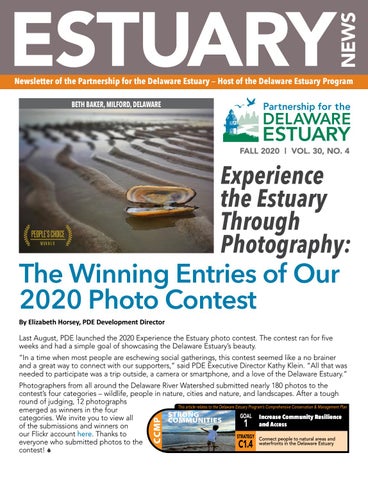
BETH BAKER, MILFORD, DELAWARE
FALL 2020 | VOL. 30, NO. 4 Symbol Alone
Symbol Alone
Experience the Estuary Through Photography: Logo with stacked type
Logo with stacked type
Type Alone
Type Alone
The Winning Entries of Our 2020 Photo Contest By Elizabeth Horsey, PDE Development Director
Last August, PDE launched the 2020 Experience the Estuary photo contest. The contest ran for five weeks and had a simple goal of showcasing the Delaware Estuary’s beauty. “In a time when most people are eschewing social gatherings, this contest seemed like a no brainer and a great way to connect with our supporters,” said PDE Executive Director Kathy Klein. “All that was needed to participate was a trip outside, a camera or smartphone, and a love of the Delaware Estuary.” Photographers from all around the Delaware River Watershed submitted nearly 180 photos to the contest’s four categories – wildlife, people in nature, cities and nature, and landscapes. After a tough round of judging, 12 photographs This article relates to the Delaware Estuary Program’s Comprehensive Conservation & Management Plan emerged as winners in the four GOAL Increase Community Resilience categories. We invite you to view all 1 and Access of the submissions and winners on our Flickr account here. Thanks to STRATEGY Connect people to natural areas and everyone who submitted photos to the C1.4 waterfronts in the Delaware Estuary contest! S
POLICY
In the gloom of the coronavirus pandemic, nature has been an enduring bright spot. When restaurants, stores, and many other businesses closed to the public, people could still take to walking, hiking, and biking on our region’s expansive network of paths and trails to soothe the stay-at-home blues. John Cecil, Vice President of Stewardship for New Jersey Audubon, said staff at several of its bird sanctuaries reported increased numbers of cars in the parking lot and increased visitors on the trails. In late April and May, New Jersey Audubon had to have staff assist with parking cars at its headquarters in Bernardsville, where visitors showed up to enjoy the trails. “Outside of a special event, I’m not sure we’ve ever experienced visitation that required parking management,” Cecil said. This year, nature started getting paid back with the passage of the Great American Outdoors Act. This bill will permanently fund the Land and Water Conservation Fund at $900 million per year and provide $9.5 billion over five years to repair aging infrastructure at national parks, forests, wildlife refuges, and recreation areas, including several in the Delaware River Watershed. According to information from the Coalition for the Delaware River Watershed, the U.S. National Park
P h oto by D a v i d K o ppe se r
Nature Gives Us So Much, and Now a Federal Bill Pays Nature Back
Two people walk a path near Delaware Route 72 in Newark, Delaware. Paths and bike trails became especially popular this spring due to COVID-19 lockdowns.
Service has identified three locations in the Delaware River Watershed in need of funds for deferred maintenance on roads, structures, buildings, and capital improvements. Examples include the Delaware Water Gap National Recreation Area in Pennsylvania and New Jersey, the Upper Delaware Scenic & Recreational River in Pennsylvania and New York, and the First State National Historical Park in Delaware. S This article relates to the Delaware Estuary Program’s Comprehensive Conservation & Management Plan
GOAL
1
Increase Community Resilience and Access
STRATEGY Protect and enhance natural areas and
C1.3
public access
C O M M I T T E E S C O N TA C T L I S T Meetings conducted by the Delaware Estuary Program’s implementation and advisory committees occur on a regular basis and are open to the public. For meeting dates and times, please contact the individuals listed below: Estuary Implementation Committee Kathy Klein, Executive Director (Chair) (800) 445-4935, ext. 102 kklein@DelawareEstuary.org Monitoring Advisory & Coordination Committee Elaine Panuccio, Water Restoration Scientist, Water Quality Assessment Delaware River Basin Commission (609) 883-9500, ext. 307 elaine.panuccio@ .gov
Toxics Advisory Committee Ron MacGillivray, Ph.D. Senior Environmental Toxicologist Delaware River Basin Commission (609) 883-9500, ext. 257 ron.macgillivray@drbc.gov Science and Technical Advisory Committee Danielle Kreeger, Ph.D. Senior Science Director (800) 445-4935, ext. 104 dkreeger@DelawareEstuary.org
FALL 2020 | VOLUME 30 | ISSUE 4
ESTUARY
2 NEWS
Water Quality Advisory Committee John Yagecic, P.E., Manager, Water Quality Assessment Delaware River Basin Commission (609) 883-9500, ext. 271 john.yagecic@drbc.nj.gov FOLLOW US ON:
PARTNERSHIP FOR THE DELAWARE ESTUARY
E D U C AT I O N A N D O U T R E A C H
Salem High School Rain Garden Provides Beauty and Protection
“Into each life, some rain must fall” —Henry Wadsworth Longfellow
Rain is essential to life on earth, but too much “The hope is that we build more rain gardens at water leads to flooding, which washes pollution the school over the years to come, and we can use into rivers and streams. That’s when you need to them as educational tools with the students,” said take steps to implement, what is known in the Rutgers Water Resource Specialist Chris Obropta. water world, as best management practices. “The whole idea is, we get the next generation In August, Partnership for the Delaware Estuary thinking about stormwater management in a and a team from Rutgers University’s Cooperative different way than the way their parents did.” Extension Water Resources Program engineered Theresa Durham, head of the science and installed a rain garden filled with native plants department at Salem High School, helped at Salem High School. coordinate the school’s project. She and A rain garden engineering teacher Paul Bartholomew is a shallow helped install the garden. Bartholomew basin created said topographical maps show that the to collect school building has sunk over the years, stormwater but the rain garden will help the problem. from roofs, “For PDE, this is a really fantastic parking lots, project to manage water quality and or other hard create new STEM (Science Technology surfaces. This Engineering and Math) opportunities for allows water local students to study how humans and to slowly soak nature interact,” said PDE’s Collaborative into the ground Programs Manager Kate Hutelmyer. rather than “Rain gardens like rushing directly this one mimic the Staff from PDE, Salem High into nearby way nature would waterways like School and the Rutgers University handle rainfall, Extension Water the Salem River. Cooperative which protects Resources Program mix sand and Sandy soils and soil for a rain garden in Salem, our streams and water-loving helps alleviate local New Jersey. plants planted flooding issues. in the garden take pollution out of the It also helps put stormwater as it filters into the ground. water back into the Water that soaks into the Salem High aquifer, which is a School rain garden will help recharge the critical source of Kirkwood-Cohansey aquifer, the drinking water drinking water here in South Jersey. And because source to about a million people in southern New the aquifer is connected to the Delaware River, a Jersey. healthy aquifer means a healthier Delaware River Salem High School’s rain garden came about and Bay, which is really important to us.” as part of PDE’s work with the South Jersey PDE gives a huge thanks to Rutgers and Salem Landscape Makeover Project, a collaborative effort High School for their work on the project and the between regional environmental nonprofits funded William Penn Foundation and the National Fish by the William Penn Foundation. The focus of this and Wildlife Foundation for supporting this effort. project is to bring green stormwater techniques Click here to see a video about this project. S to homeowners, municipalities, and school districts throughout South This article relates to the Delaware Estuary Program’s Comprehensive Conservation & Management Plan Jersey. GOAL Improve Public Awareness & Members of the Rutgers University 2 Stakeholder Engagement team also worked directly with Salem High School students to teach STRATEGY Develop and promote programs that engage teachers and schools in them the role of rain gardens in the stewardship of the Delaware Estuary C2.3 environment. PARTNERSHIP FOR THE DELAWARE ESTUARY
ESTUARY
3 NEWS
FALL 2020 | VOLUME 30 | ISSUE 4
SCIENCE
PDE Working with New Castle County on Freshwater Mussel Research A great way to clear one’s mind is to take a eager to find suitable ponds in the region where walk in the park. Wilmington happens to have mussels can be grown. If enough mussels are quite a few parks, and if you have strolled present, they can improve these ponds’ water around Papermill, Rockwood, or Tally Day Park, quality, leading to healthier ecosystems. S you might have noticed something new floating in the pond. Partnership for the Delaware Estuary has several floating baskets at each park containing Alewife Floater (Utterbackiana implicata) freshwater mussels. PDE is working with New Castle County to research how well mussels can grow in stormwater ponds and how they clean the water for fish that live in those ponds. Additionally, PDE scientists are keeping track of water quality, such as temperature and oxygen levels, to ensure the water is safe for mussels. Later, PDE scientists will take water samples back to a lab to analyze how much food is in the water. The microscopic particles that mussels filter and eat can help explain mussel This article relates to the Delaware Estuary Program’s Comprehensive Conservation & Management Plan growth and their potential to reduce GOAL Sustain Flow for Drinking Water pollution in the ponds. 3 and Ecosystems With PDE’s mussel hatchery in development at Bartram’s Garden in STRATEGY Conduct research and monitoring on water quality and habitat requirements Philadelphia, mussel researchers are
W3.2
of estuary-dependent species
SCIENCE
Monitoring at Matt’s Landing
Two PDE living shorelines get their annual health checkup
This fall, two of PDE’s living shorelines in New Jersey had an annual health checkup from PDE’s science team. In mid-September, the team monitored living shorelines Ella at Matt’s Landing in Heislerville and Nantuxent Creek in Rothermel, Money Island. These locations have two of PDE’s older PDE’s Science living shorelines projects constructed in 2010 and 2016, Technical respectively. PDE measures changes in the shoreline’s Analyst, elevation, firmness of the ground, and counts the number measures of shellfish in the overall habitat. Scientists additionally land elevation at check the robustness — density and height — of grass on a living the shoreline and how much the shoreline has moved. shoreline in At Nantuxent, the team added bags of oyster shells to Heislerville, reinforce the shoreline. During the monitoring session, the New Jersey. bags appeared to be doing well and trapping sediment like they are supposed to. Matt’s This article relates to the Delaware Estuary Program’s Comprehensive Conservation & Management Plan Landing is holding its own but will GOAL Increase and Improve Fish and need additional oyster shellbags in the 1 Shellfish Habitat spring. The team will analyze the data it and implement natural and naturecollected and compare it with previous STRATEGY Develop based techniques to stabilize and restore shorelines, and to build and protect data to develop the next steps for H1.3 eroding wetlands, infrastructure, and other key resources managing these shorelines. S FALL 2020 | VOLUME 30 | ISSUE 4
ESTUARY
4 NEWS
PARTNERSHIP FOR THE DELAWARE ESTUARY
E D U C AT I O N A N D O U T R E A C H
DIGGING DEEPER: Getting to the Root of Your Gardening Questions By Sarah Bouboulis, PDE Habitat Project Coordinator Q. Fall is an excellent time to plant standard garden bulbs (tulips, daffodils, etc.), but are there bulbs for native plants that I can grow? — KATE, CAMDEN, DE
A: Great question! There are native plant bulbs that are great to
plant now, but the flowers won’t necessarily come up in the spring with your tulips. Think summer instead. There are a few native lilies that grow from bulbs — Turk’s-cap lily (Lilium superbum), Canada lily (Lilium canadense), and wood lily (Lilium philadelphicum). The first two are 4-to-5-feet tall with nodding flowers. They prefer shade and wetter soils. Wood lilies are only a few feet tall and can tolerate more sun and drier soils. AlTurk’s cap lily is a native flowering bulb you though they come up in the summertime, fall is a great time to plant can plant in your garden now. the bulbs of these beautiful flowers — if you can find them for sale! Squirrels and deer love the bulbs and plants, so you will need to do your best to keep the critters away. You may want to consider spring ephemerals like Dutchman’s breeches (Dicentra cucullaria), spring beauty (Claytonia virginica), and wake-robins (Trillium sps.). Spring ephemerals emerge before trees “leaf-out” to take advantage of the spring sun. They generally bloom and seed all within a few weeks. They can put on a fantastic spring show, particularly under some of your deciduous trees. Afterward, they die back in to the ground, and you may never know they are there until next spring. Be sure to plant some summer flowers nearby to fill the space. This article relates to the Delaware Estuary Program’s Comprehensive Conservation & Management Plan If you have a gardening question GOAL Sustain Flow for Drinking Water for Sarah, contact Sarah Bouboulis 3 and Ecosystems by clicking here where you can also subscribe to our quarterly publication, STRATEGY Conduct research and monitoring on Perennial Pages. S water quality and habitat requirements
W3.2
of estuary-dependent species
OUTREACH & EVENTS
Delaware River Festival: A Virtual Feast for the Eyes This has been a strange year, but that hasn’t stopped us from finding innovative ways to have fun, especially in celebrating the Delaware River. PDE was a proud partner of the 2020 Delaware River Festival with organizations including the Philadelphia Water Department, Center for Aquatic Sciences, Alliance for Watershed Education of the Delaware River, Camden County, and the Independence Seaport Museum. Instead of celebrating the Delaware River for one day, the festival offered a week of 60 free online and in-person events, including birding, kayaking, hikes, yoga, kite flying, a drive-in movie, panel discussions, demonstrations, stories, educational songs for children, and a live music concert. “Although we were disappointed that we could not hold our annual face-to-face celebration along the banks of the Delaware River in Philadelphia and Camden, all of the partners involved with planning the Festival did a fantastic job,” Kathy Klein, Executive Director of PDE, said. “I encourge people to to check out the robust virtual content created for the 2020 Festival that lives on at DelawareRiverFest.org.” We can’t wait for next year’s event This article relates to the Delaware Estuary Program’s Comprehensive Conservation & Management Plan to be just as spectacular! If you missed GOAL Improve Public Awareness & the online events, you could still watch 2 Stakeholder Engagement them through the Delaware River Festival’s YouTube channel here. A STRATEGY Utilize events to increase stewardship video of festival highlights is available C2.2 and engage new people by clicking here. S PARTNERSHIP FOR THE DELAWARE ESTUARY
ESTUARY
5 NEWS
FALL 2020 | VOLUME 30 | ISSUE 4
HAPPENINGS
A River Runs Through It and Motivates It: New Collaborative Forms Around Conservation Goals Bridget Macdonald, U.S. Fish and for the Delaware River Watershed ByWildlife Service Public Affairs Specialist conservation organizations, and local, state, interstate and federal government agencies who are committed to sustaining this watershed,” said Mike Slattery, the Landscape Partnerships Coordinator for the U.S. Fish and Wildlife Service. Slattery is working with a small cohort of other partners to stand up the Collaborative. Slattery explained that one of the Collaborative’s primary charges would be to provide oversight for an existing initiative: the Delaware Watershed Conservation Fund, a grant program launched in 2018 to help achieve the goals of the 2016 Delaware River Basin Conservation Act. The Collaborative will guide the Conservation Fund toward fulfilling a watershed-wide conservation strategy, including setting funding
Partnership for the Delaware Estuary is a proud member of the new Delaware River Watershed Conservation Collaborative (DRWCC), a voluntary partnership created to identify shared goals for conservation, restoration, and recreational access among stakeholders in the watershed.
priorities to ensure that investments reflect shared priorities and contribute to landscape-scale conservation gains. But the Collaborative will address broader needs beyond the grant program, including actively engaging all watershed residents in actions of environmental stewardship that mirror the needs of their communities. Partners who are laying the Collaborative’s groundwork are looking for feedback on foundational documents from other stakeholders in the watershed, including the public. To learn how to provide feedback on the Collaborative’s ‘Mission and Vision” and “Bylaws,” visit http:// www.delriverwatershed. org/drbca, and scroll down to Delaware River Watershed Conservation Collaborative. S
This article relates to the Delaware Estuary Program’s Comprehensive Conservation & Management Plan
GOAL
2
Improve Public Awareness and Stakeholder Engagement
STRATEGY Engage key stakeholders to coordinate
C2.6
FALL 2020 | VOLUME 30 | ISSUE 4
ESTUARY
6 NEWS
science and management of the Delaware Estuary
PARTNERSHIP FOR THE DELAWARE ESTUARY
Ph o t o c o u rt e s y o f t h e U . S . F i s h a n d W i ld l i f e Se r vi c e
How do you make strategic conservation decisions that will sustain wildlife as well as current and future generations? How do you do all that in a watershed covering more than 13,000 square miles in four states? You join forces. Joining forces is the motivation behind the new Delaware River Watershed Conservation Collaborative (DRWCC), a voluntary partnership created to identify shared goals for conservation, restoration, and recreational access among stakeholders in the watershed and accelerate work to achieve those goals together. Partnership for the Delaware Estuary is a proud partner in this initiative. “The Collaborative builds upon years of momentum driven by community members, businesses, recreational interest groups,
E D U C AT I O N A N D O U T R E A C H
Connecting Urban Youth to Waterways across the Delaware River GOAL Improve Public Awareness &
This article relates to the Delaware Estuary Program’s Comprehensive Conservation & Management Plan
Partnership for the Delaware 2 Stakeholder Engagement Estuary recently held its second STRATEGY Utilize events to increase stewardship webinar series. This series was on behalf of the C2.2 and engage new people Urban Waters Federal Partnership for local organizations to share their educational programming stories that connect urban youth to their local waterways. The first webinar took place on Nov. 2 with speakers from the John Heinz National Wildlife Refuge at Tinicum, the Discovery Center in Philadelphia, and the Brandywine River Shad Project. PDE held the second webinar on Nov. 10 with speakers from UrbanPromise and the Center for Aquatic Sciences at Adventure Aquarium, both based in Camden, New Jersey. The third webinar took place on Nov. 17 with speakers from the Delaware Museum of Natural History and the Alliance for Watershed Education of the Delaware River. The Urban Waters Federal Partnership (UWFP) works to restore and reconnect urban communities to their waterways by improving coordination among federal agencies with local and community-led efforts. The Delaware River Urban Waters program is focused within the cities of Wilmington, Philadelphia, Chester, and Camden. Click here to view any of the Urban Waters webinars. You can also go to our YouTube channel. S
Partnership for the Delaware Estuary would like to thank all the organizations who submitted projects that contribute to clean waters, healthy habitats, and strong communities in the Delaware River Watershed. This year, as part of its What’s Your Success Story? contest, PDE heard from 20 partner organizations (acting on behalf of 70 more organizations) with more than 350 projects. PDE will announce top Projects submitted to the Delaware Estuary’s Comprehensive prize winners in the coming months. Conservation Management Plan (CCMP) will benefit all the people who Not only are the submitted projects live, work, and play in the Delaware River Watershed. benefitting millions of people who live, work, and play in the Watershed, they’re contributing to a tracking database and online project map for the Delaware Estuary Program’s Comprehensive Conservation Management Plan (CCMP). The tracking database helps PDE periodically check to see how well it and other key partners in the Watershed are implementing the goals of the CCMP. PDE can also get a better idea of the activities in our region and help identify where This article relates to the Delaware Estuary Program’s Comprehensive Conservation & Management Plan there might be funding and resource GOAL Improve Public Awareness & gaps. 2 Stakeholder Engagement Stay tuned for PDE’s announcement of the top prize winners and their STRATEGY Publish and share outreach materials and incredible success stories in upcoming C2.5 scientific results issues of Estuary News. S PARTNERSHIP FOR THE DELAWARE ESTUARY
ESTUARY
7 NEWS
FALL 2020 | VOLUME 30 | ISSUE 4
Ph ot o b y C a rol Te r sin e
Winning CCMP Success Stories to be Announced this Winter
ESTUARY EVENTS
PDE Has Fun While Raising Funds With a Virtual Experience the Estuary Happy Hour and Online Auction Partnership for the Delaware Estuary raised approximately $21,500 from this year’s Experience the Estuary Celebration, which consisted of an online auction hosted on eBay for Charity and a Spooky Happy Hour, hosted via Zoom. There were 41 items in the auction, and nearly 50 PDE friends and supporters attended the virtual happy hour. The Happy Hour gave PDE supporters a chance to interact with staff and hear from platinum sponsors, Exelon Generation, PSEG, and Aqua. There was a mixology demonstration with
the evening’s signature drink, the Salty Dog, a video about tidal salt marshes, a spooky yet informative video of creepy-crawly Delaware Estuary creatures, and a costume contest for guests and their pets! PDE thanks all the event sponsors for their support and everyone who either made a donation or bid in the auction. Click on the links to view PDE’s Creepy Crawlies of the Delaware Estuary Video and the mixology video. Although the event is over, it’s never too late to donate to PDE. Click here for more information or to make a donation. S
Join the Virtual Science Summit this March Everyone gets the best seat in the house next year when the Delaware Estuary Science and Environmental Summit takes place online from March 1-3. As with previous summits, we’ll have fantastic speakers, poster sessions, networking opportunities, fun activities, and more. And the 2021 Summit will feature a one day Forum on Climate Change and the Delaware River Basin. This exciting addition to the Summit’s program is being hosted by the Delaware River Basin Commission’s Advisory Committee on Climate Change. For all the information, go to our website. S
The Partnership for the Delaware Estuary: Connecting people, science, and nature for a healthy Delaware River and Bay
The Partnership for the Delaware Estuary, Inc. (PDE), is a private, nonprofit organization established in 1996. PDE is the host of the Delaware Estuary Program and leads science-based and collaborative efforts to improve the tidal Delaware River and Bay, which spans Delaware, New Jersey, and Pennsylvania. To find out how you can become one of our partners, call PDE at (800) 445-4935 or visit our website at www.DelawareEstuary.org.
Partnership for the Delaware Estuary, Inc. Kathy Klein Tel: (800) 445-4935 E-mail: kklein@DelawareEstuary.org
Environmental Protection Agency Irene Purdy, EPA Region II Tel: (212) 637-3794 E-mail: purdy.irene@epa.gov Megan Mackey, EPA Region III Tel: (215) 814-5534 E-mail: mackey.megan@epa.gov
New Jersey
Pennsylvania Rhonda Manning Department of Environmental Protection Tel: (717) 772-4472 Email: rmanning@pa.gov
Delaware Kimberly Cole Department of Natural Resources and Environmental Control Tel: (302) 739-9283 E-mail: kimberly.cole@delaware.gov
Jay Springer Department of Environmental Protection Tel: (609) 633-1441 E-mail: jay.springer@dep.state.nj.gov
Delaware River Basin Commission Chad Pindar Tel: (609) 883-9500 ext 268 E-mail: chad.pindar@drbc.gov
Philadelphia Water Department Kelly Anderson Tel: (215) 685-6245 Email: kelly.anderson@phila.gov
Editor Kate Layton Tel: (800) 445-4935 Email: klayton@DelawareEstuary.org
Estuary News encourages reprinting of its articles in other publications. Estuary News is produced four times annually by the Partnership for the Delaware Estuary, Inc. (PDE), under an assistance agreement (CE-993985-15-0) with the U.S. Environmental Protection Agency (EPA). The purpose of this newsletter is to provide an open, informative dialogue on issues related to PDE. The viewpoints expressed here do not necessarily represent the views of PDE or EPA, nor does mention of names, commercial products or causes constitute endorsement or recommendation for use. For information about the PDE, call 1-800-445-4935.
Unless otherwise noted, all photos are property of the Partnership for the Delaware Estuary. FALL 2020 | VOLUME 30 | ISSUE 4
ESTUARY
8 NEWS
PARTNERSHIP FOR THE DELAWARE ESTUARY