2026-2027 School Year
Academic Summary of Changes
● Courses Added:
○ AP Business Principles & Finance
○ Bloomberg Finance
○ Civil Engineering & Architecture
○ Drone Technology & Unmanned Aircraft Systems
○ Medical Interventions
○ Name Change: AI & Cybersecurity
● Courses Retired:
○ AP Computer Science Principles & AP CSP (A)
○ Astronomy
○ Ecology
○ Entrepreneurship
○ French
○ Military History
○ Sociology
● Beginning with the Class of 2027, students must have at least 0.5 credits of Technology as well as a Personal Finance course (also 0.5 credits) as a graduation requirement.

Note: some courses initially listed may not be actually offered depending on enrollment, demand, rooms, and teacher availability.

“It’s a great day to be a Pilot!”
Welcome to the De La Salle Collegiate High School
2026-2027 Academic Policies & Curriculum Guide

De La Salle Collegiate High School has a proud tradition of offering an outstanding program of academic courses, athletic programs, and extracurricular activities. This Academic Policies and Curriculum Guide provides a brief description of every course. Also included is the sequencing of courses designed for each department, as well as our major policies and procedures involving academics. Our curriculum is designed to help all students establish a broad foundation for future learning in college, in the workforce, and beyond. The entire school community is committed to helping all of our students realize their potential academically, spiritually, and athletically as they progress from entering De La Salle as boys to becoming principled young men upon graduation.
High school course selection can play a significant role in a student’s future options. Designing a four-year, goal-oriented plan with a counselor is an important piece in the development of an incoming freshman. We want every student to be prepared for the future and that starts by making informed choices regarding the classes to pursue in high school. For both incoming freshmen and current students, this selection process is comprehensive and involves the student, parents, counselor, and teachers.
In keeping with our mission, vision, and values, we expect all of our students to:
● Accept responsibility for their learning, decisions, and actions;
● Invest their best effort in their academic and co-curricular activities;
● Treat others with consideration and respect;
● Conduct themselves in a way that contributes to a safe and orderly atmosphere while ensuring the rights of others.
~ We look forward to a great and rewarding school year! Go Pilots!!! ~

MISSION STATEMENT
De La Salle Collegiate High School is dedicated to the Catholic education of its diverse students, including the poor and disadvantaged. We are a college preparatory school inspired by the spirit and tradition of St. John Baptist de La Salle, where learning takes place in the presence of God Each student is encouraged to develop his faith, character, intellect, and morality This mission is embodied in the school’s motto: “Builder of Boys. Makers of Men.”
VISION
★ De La Salle Collegiate High School will provide a safe, respectful, and inviting educational Lasallian environment that prepares our students to be literate, faith-oriented, and productive citizens ready for the 21st century.
★ The faculty and staff of De La Salle will foster an environment that promotes the academic, spiritual, physical, and emotional growth of each student
★ De La Salle will be an institution with high expectations where students grow academically, socially, and spiritually through the support of its dedicated faculty
★ We will reinforce and hold dear the Lasallian traditions and values that have made our school unique for generations of students.
★ Respecting each student’s particular learning needs and learning styles, De La Salle will provide a stimulating academic environment, and strong extracurricular opportunities for all, supporting our belief in maximizing each student’s present and future potential
VALUES
★ We will continue to promote the Lasallian value of respect for others throughout the school by addressing the issues of bullying and intolerance.
★ We will encourage our students to be more accountable and responsible for their academic achievement, particularly in the area of integrity
★ We will continue to refine our leadership teams and departmental collaboration in order to improve our professional learning community
★ We will continue to promote the FAST (Freshmen Achievement Starts Today) and SAIL programs for those students who are in need of support
★ We will continue to promote daily classroom prayer
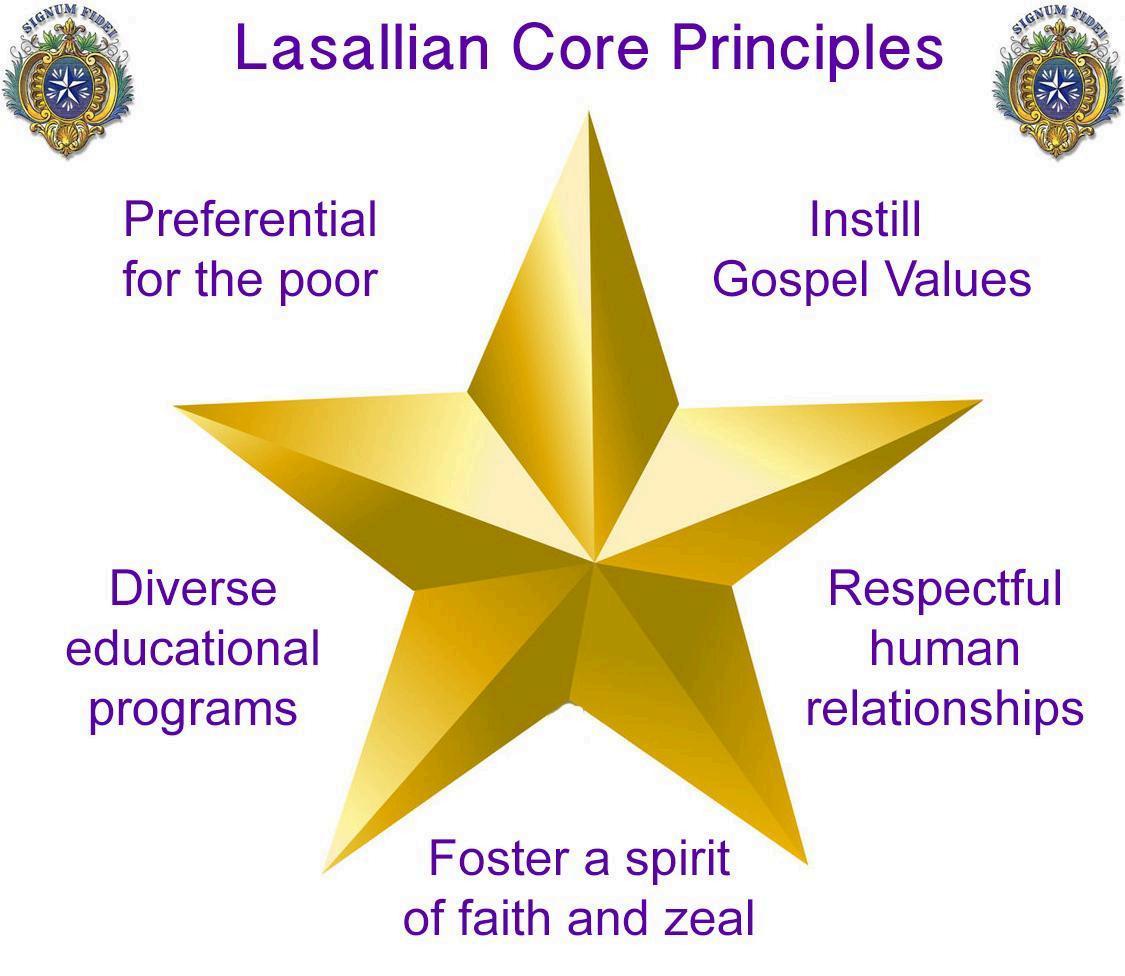
Lasallian Education and Service for Others
As a Christian Brothers’ High School, De La Salle Collegiate continues in the Catholic traditions of the innovative educator St. John Baptist de La Salle, who founded the Brothers of the Christian Schools. De La Salle engages in programs in which students’ personal, social and religious values may take root and in which students may grow in mature attitudes and behavior in all human relationships.
DLS strives to foster an environment of faith that produces a reciprocal respect among all persons in the community and to establish an atmosphere in which community members may openly bear witness to the Gospel values and a preferential option for the poor.
De La Salle Collegiate believes in the power and strength of community building, and shared service experience. It is our intention that each student be given opportunities to experience the qualitative aspect of service, bearing witness to what Jesus calls the two greatest commandments: to love God and to love your neighbor as yourself (Matthew 22:37-39).
De La Salle’s service program strives to increasingly expose students to various community needs and provides opportunities to engage in short and long-term remedies to those needs, including significant direct contact with the needy
Academic Philosophy
The rigorous academic program, combined with the spiritual, moral, physical, and social programs offered at De La Salle Collegiate, helps to form well-rounded young men as they prepare for college and beyond in the Lasallian tradition. Students follow a challenging program to develop skills in critical thinking, communication, and learning. Technology tools and writing are incorporated throughout the curriculum to enhance research, idea development, and presentation skills. Students are encouraged to be inquisitive and open to growth, thus discovering and exploring new ideas and issues. Our highest priority is to offer outstanding teaching in all our courses. De La Salle is characterized by the continual development of excellence in the classroom, the recognition of multiple ways of learning, and the accessibility of the staff to our students.
The first steps toward graduation are taken in the 9th grade when a student begins earning credits. Students and their parents should keep the graduation requirements in mind when selecting courses each term. The graduation requirements for De La Salle students listed below are the minimum It is the responsibility of students to meet with their counselor to ensure course work meets the requirements of their prospective college choice(s). The counseling department assists parents and students navigate curricular and extra-curricular choices toward eventual college acceptance.
To meet De La Salle’s minimum graduation requirements, a student must have earned a total of 26.5 credits in grades 9 through 12 that include the 23.5 required credits listed below plus at least 3 elective credits. Students enrolled into the Freshmen Achievements Starts Today (FAST) program may require at least 24 credits depending on courses added. International students are required to take at least 21 credits. All students must attend classes at DLS for the entire day and take a full class load each year
Senior Status:
No student can be considered a senior unless he can meet all of the graduation requirements within the regular school day and current school year. There are three criteria to determine graduation eligibility: 1) Number of credit hours earned, 2) Credit in requisite coursework and service as delineated, and 3) Passing semester grades in all courses. Students may not graduate early. Students will not be considered a graduate until all exams are completed and passed for credit (D- and higher).
MINIMUM
GRADUATION REQUIREMENTS
Subject Area Description
ENGLISH 4 Credits
MATHEMATICS
4 Credits
THEOLOGY 4 Credits
SCIENCE 3 Credits
SOCIAL STUDIES
3 Credits
FOREIGN LANGUAGE
2 Credits
HEALTH & PHYSICAL EDUCATION
1.5 Credits
ART/MUSIC 1 Credits
TECHNOLOGY
0.5 Credit
ELECTIVES
3.5 Credits
• Mandatory subject for all four years.
• Mandatory subject for all four years
• Mandatory subject for all four years
• Mandatory subject for the first three years
• Mandatory subject for first three years, and
• Economics (junior or senior year),
• U S Government (junior or senior year)
• Must be the same language, consecutive years
• Students enrolled into ESL are not required to learn a third language.
• FAST students enroll during their sophomore and junior years
• 2 years of American Sign Language via My Virtual Academy is acceptable if pre-approved
• One-half PE credit in freshman year.
• One-half PE credit in sophomore year
• One-half credit of health in sophomore year
• One year of art and/or music is required for graduation
• Beginning with the Class of 2027, one half credit technology course is required for graduation
• Various courses
• Beginning with the Class of 2027, one-half credit of Personal (Bloomberg) Finance is required for graduation
Registration
Registration for new classes is an exciting time! It is a time of many important decisions regarding the student’s educational program and realizing his potential. This guide was developed to assist students and their parents in planning their high school curriculum. Students and parents should review the course offerings carefully and give deliberate thought to the student’s aptitude, interests, and plans for the future as they select courses. Parents and students should also be aware that not all courses may be available depending upon resources (teachers, rooms, and demand). Final course schedules are determined by student enrollments and the master schedule. DLS will do everything possible to assist students in reaching their goal of graduating on time; however, it is the responsibility of students and parents to make sure they have the number and type of credits necessary to graduate. The counselors are a valuable asset in this endeavor. As students register for their senior year, they should make certain that they are taking enough credits and types of courses to graduate. If they are unsure of the number or type of credits needed for graduation, students and parents should contact their counselor
Teachers and counselors recommend course placement based on a student’s abilities, past performance, and preparation. Course selection should be based on a student’s aptitudes, interests, and career goals. Students should review their achievement records and discuss their strengths and weaknesses with teachers, counselors, and their parents when deciding future courses. Parents, teachers, and counselors can help in the selection of courses that are meaningful, useful, and appropriate. It is required that our students meet with their counselors to review their course requests. The counselor and student will advise the parents of any changes to the course requests along with the rationale behind the change. Students, with the aid of counselors and teachers, will follow a program of studies that takes into account graduation requirements, scholastic ability, post-high school educational plans, special interests, and the nature and requirements of individual courses.
As a matter of policy, equity, and scheduling constraints—we regret requests for particular teachers cannot be honored. Students are limited to the number of credits they may request due to constraints of scheduling, space, and teachers available in any given year
Courses are offered on three levels: 1) Level One: Traditional College Preparatory, 2) Level Two: Honors and 3) Level Three: Advanced Placement (AP)
Advanced Courses
Honors, Advanced and Advanced Placement (AP)
English Mathematics
Hon. English Literature/Composition 9
Hon English Literature/Composition 10
AP English Language and Composition
AP English Literature and Composition
British Literature 11
Foreign Language
Hon Spanish I, II, & III
AP Spanish IV
Social Studies
Hon World Contemporary Studies
Hon American History
AP European History
AP Microeconomics
AP U S Government
AP U S History
AP Human Geography
AP Psychology
Hon. Algebra I
Hon Modern Geometry
Advanced Geometry
Hon Algebra II and Trigonometry
Hon Pre Calculus
Advanced Algebra II and Trigonometry
AP Calculus AB
AP Calculus BC
AP Statistics
Science
Hon. Biology
Hon Chemistry
Hon Physics
Hon Human Physiology & Anatomy
AP Biology
AP Chemistry
AP Environmental Science
AP Physics 1 (Virtual Option)
Business & Technology
AP Business Principles with Finance
Students seeking enrollment in any Advanced Placement course are required to submit an application for each AP course desired. These forms are available in the counseling office beginning in January and must be approved by a recommending teacher, counselor, parent and student.
Students are encouraged to request Honors, and Advanced Placement courses to be better prepared for college entrance exams and college itself. Students must be enrolled in the Advanced Placement program in order to take the end of course exam for potential college credit. All students who enroll into an AP course are required to take the exam, except for Spanish or unless designated by the teacher. The Spanish teachers recommend individual AP students based upon their professional assessment of the student’s readiness. The foreign language teacher, parent, and student must sign an agreement in order to take the AP foreign language exam by the completion of the course request period in February.
The College Board requires an exam fee for each AP test taken. The amount increases nominally each year (fee is $98 per test) and is billed separately, usually in March. Students wishing to take more than three AP courses in one year require the administration’s approval in advance of registering.
A student may be permitted to take an AP exam if he originally requested the course during the requesting period (usually the previous February), but was unable to be scheduled for the course due to a scheduling conflict. A student may be permitted to take an AP exam if the course is not offered at DLS and he has demonstrated a propensity to pass the exam based upon his academic performance at DLS as well as being sufficiently disciplined to complete the preparation work. In either case (scheduling conflict or course not offered), a written request for an exception to policy to take an AP exam must be made by the student and parent to the department leader no later than October 30th of that particular school year The department leader and assistant principal will then make the final determination and advise the student. If approved, the student shall submit a non-refundable check payable to De La Salle Collegiate High School for the fee associated with taking the exam.
Enrollment in Advanced Placement courses requires a substantial amount of daily preparation and commitment. Students will be expected to complete their assignments and maintain an academic standard. To that end, all students enrolled in ANY AP class are required to carry a “C” or better average throughout the duration of the course. Any student with a failing grade (“F”) at the conclusion of any quarter will be removed from the course and placed in an appropriate replacement course. Similarly, any student with a “D” average may also be removed from the course dependent on a review with the teacher, counselor and Academic Vice Principal.
By choosing to register for classes at De La Salle, both the parents and the student agree to abide by the letter and the spirit of all De La Salle’s Academic Policies and Procedures contained herein.

Incoming Freshmen
New Students
DLS conducts an informational night for the incoming freshman class during an evening session at the school in March. Reviewing this curriculum guide in advance is well worth the time.
The scheduling review process will include curriculum recommendations for parents to consider from admissions and a counselor to provide insight and suggestions. Incoming freshman course requests are considered final upon completion of the evening’s registration program. The admissions department stands ready, throughout the process, to answer any question or provide assistance for parents and students.
We have found that students who have a B average and achieved a sub-score 75 or higher in the High School Placement Test are more likely to succeed in the corresponding subject area’s honors level courses. The content of College Preparatory and Honors classes differs in the pace, depth, and increased individual student responsibility for their own learning.
Students who received an “A” for their final foreign language grade in 8th grade may request, through the admissions director, to take DLS’s end of year exam to place out of the first foreign language year if the student demonstrates mastery as determined by the foreign language department leader. The test must be taken in June prior to the end of the DLS school year. The department leader will make the determination and the admissions department will notify the family. The constructive credit, while counting toward graduation, will not be used in computing the GPA. Placement into year two of the language is predicated on two factors and should not be considered an automatic schedule request adjustment: 1) Passing the examination, and 2) The actual ability to schedule the student into the advanced course as determined by the master schedule.

Transfer Students
As with incoming freshmen, transfer students (regardless of grade level) are registered through the admissions department in much the same manner as the incoming freshmen. Transfer students provide their transcripts and report cards to facilitate the best potential course selections as possible under the presumption the student will graduate from DLS while meeting the school’s graduation requirements. Every attempt will be made to schedule the student into the courses that are required to graduate. The admissions department can provide answers to questions relating to the transfer As a matter of policy, all students new to DLS are on a one semester probationary status in terms of academic performance, attendance, behavior, and the student code of conduct. Acceptance of transferred credits and/or course placement rests with the administration.
International Students

All international students are required to be proficient in English speaking, reading, and writing. Applicants must have either a minimum score of 54 on the Secondary Level English Proficiency (SLEP) exam or a minimum score of 59 on the Test of English as a Foreign Language (TOEFL) test. Students are evaluated upon English proficiency scores, academic grades, and recommendations.
The school reserves the right to require a language proficiency re-test at De La Salle of any international student at the student’s expense. A student who falls below the aforementioned minimum scores may be withdrawn by the school. Any expenses (i.e. return to home country) will be the responsibility of the family and not the school.
International students from non-English speaking countries have a modified curriculum to better situate them for success as they transition into De La Salle. During the first semester, they will have a reduced course load to better focus on language assimilation and coursework expectations. The students will still identify a full course load during initial registration, but may not begin attending certain courses until their second semester The first semester will be the transition term. These students will be scheduled for English as a Second Language, mathematics, science, English, and SAIL (see course description later in the guide) to provide them time to acclimate. The second semester course work will add theology and social studies and any other electives. Students may wish to hire a private tutor to help support their further academic needs.
As English is a second language for the student, they will have already met the foreign language requirement de facto and will be waived from learning a third language unless they choose to do otherwise.
Current Students
Over the years, we have refined our registration process to the point of establishing a quality process that meets everyone’s needs. The typical timeline and major events are:
January: Next year’s course descriptions and curriculum guide published
Teachers make recommendations to students for next year during their classes
Counselors discuss course requests with students
Students discuss choices with parents, teachers, and counselors.
Instructions for how to request classes online posted to the school website.
February: Online course requests open for 5 school days.
Online course requests close. Those not complete are placed on the waiting list.
Course requests reviewed by departments for appropriateness (grades, potential, and prerequisites)
Counselors resolve any discrepancies with parents, students and teachers
Counselors adjust any course requests accordingly
March: Incoming freshmen register course requests with counselors They are considered final once submitted
Needs assessment and resource planning (teachers, materials, rooms), budgeting, allocation begins
Course request verification distributed Requests are not guaranteed, but DLS has over a 95% success rate of all first choices being scheduled
Counselors resolve any discrepancies with parents, students and teachers
Course registration process closed and requests considered final
Work on the master schedule begins
Alternate request choice(s) may be required due to changes in course availability
June 30: Infinite Campus temporarily shut down for scheduling work
August: Schedules are available online (Infinite Campus) and made available online
Infinite Campus access restored
Sept: Friday after Labor Day: Last day for student/parent initiated course changes
Current students register for following year’s courses in February online via Infinite Campus after they have had the opportunity to learn about course content and expectations via the teachers, counselors, and consultation of the curriculum guide in conjunction with their parents. Instructions for registering online are available on the
school’s website or from the counselors. If a student or parent does not have access to the Internet either at home or public library, please contact a school counselor for registration assistance. Parents should carefully review course requests with their son to ensure they understand the rationale behind the request before giving their parental approval. If parents have any questions or problems, they should contact their son’s counselor.
Freshman or sophomore students who request an elective will not be able to take PE due to not enough periods in a day (scheduling limitations). However, freshmen will still be required to complete their PE/Health requirement before graduating.
After the course request deadline passes, the teachers, departments, and counselors will review the requests along with current and past academic performance and prerequisites. If there is a difference in what the parent/student requested and the professional recommendation of the staff, the counselor will contact the family to provide advice and if need be, require a placement waiver request. Course request confirmation notices are distributed thereafter (sophomores, juniors, and seniors) and the counselors must be contacted within 5 school days of receipt if there are any additional concerns. After the course request and verification processes are completed, all course request selections are considered final and cannot be changed due to the master scheduling process.
The final decision for course offerings, student placement, and course changes rest with the school administration. Student schedules are considered final for the entire year once the master schedule is complete and the schedules published.
The importance of careful review before deciding which appropriate courses (and level) to request from the onset cannot be overly emphasized !
Orientation
All orientation sessions are critical to starting the year off ready and complete. Student orientation is scheduled during the week before the first day of classes for students and is considered a school day for attendance Seniors, juniors, and sophomore’s orientation will typically be on the same day and last approximately 90 minutes. More information can be found on the school’s website All students, except the freshmen, are expected to be in dress code (including haircuts) for orientation
The freshmen orientation is more robust to welcome them to De La Salle and to get them acclimated to the school Freshmen are expected to have proper hair cut on this day, however, further dress code expectations will be communicated in advance via the summer mailing Student schedules, along with other informative materials are disseminated online via Infinite Campus on or around August 1st of each year Students are encouraged to review both semesters of their schedules carefully once they receive them.
Advisory
Advisory is designed to help every student establish meaningful connections with both peers and teachers, all in the spirit of St. John Baptist de La Salle. Each student is assigned a Teacher Advisor who remains with them throughout their entire high school career In this way, the advisor becomes well acquainted with each student, both as a person and as a learner The Advisory program fosters a strong sense of community while providing ongoing academic guidance, support, and mentorship. Parents are encouraged to maintain active communication with their son’s Advisor throughout the year.
Technology
De La Salle is committed to leveraging instructional technologies to improve student learning. It is a deliberate decision measured upon educational best-practices rather than what is the latest sensation. The school has a dedicated Wi-Fi network and encourages the use of technology for learning. We continue to discover new ways in which to use technology in and out of the classroom.
One of the viable resources is Google and its suite of capabilities for education in terms of collaboration and ease of use. Each student is provided a De La Salle Google account and is expected to utilize the account for communication with teachers as well as for completing assignments using Google Documents and Google Classroom.
Each student has received access to the following tools:
● Google Classroom: a set of online tools that allows teachers to create lessons, collect student work, grade, and return graded papers Google Classroom is a learning management system (LMS) that aims to simplify creating, distributing, and grading assignments and engaging students in learning online or remotely
● eMail: A secure email address dedicated to DLS, through which teachers can send announcements and students can collaborate on assignments with one another
● Calendar: Students can organize all their schedules and share events and calendars with others.
● Google Drive: A place to store all of your files and the ability to access them from any device You can add the Google Drive App to your mobile devices and have it synced to your Google Drive!
● And a host of other Google web-based applications ☺
Devices
Students are required to purchase and bring their own Chromebooks to school each day No other laptop or tablet is acceptable. De La Salle adds a security level to each Chromebook to control what they can and cannot access.
Technology use in the classroom is at the discretion of each teacher It is incumbent on the student to ensure he understands the acceptable use and protocols of each of his courses as well as the overall school policies. Students are expected to give their full attention to learning while in the class. Hence, students are not permitted to access any technological device unless the teacher specifically gives them instructions to do so and in what manner
Further, since all students will be using Chromebooks, cell phones will be prohibited in the classroom unless the lesson specifically calls for cell phones.
Technology Resources
Mrs. Anderson’s office (in the COMMONS) has access to Chromebooks and printers.Each classroom is equipped with Clear Touch 6000K+ Interactive panels. Clear Touch interactive displays promote truly collaborative participation in the classroom. The panels allow students to collaborate, and teachers to make learning more engaging and promote higher levels of deeper learning.
Parent Partnerships
Parents, teachers, and counselors work in partnership to support each student in reaching his full potential. Active and consistent communication is essential to this collaborative process. Research indicates that students achieve greater academic success when parents maintain regular communication with teachers and are meaningfully involved in the school community While parent-teacher conferences are an important component of this partnership, effective communication extends beyond these scheduled meetings. Ongoing, purposeful communication between parents and teachers plays a critical role in supporting student growth and success. The following tools are provided to help establish and strengthen these professional relationships for the benefit of our students.
Parent Teacher Conferences (PTC)
Parent-Teacher Conferences offer one of the most valuable opportunities for parents and educators to establish a collaborative partnership that supports academic success and sets the foundation for positive, ongoing communication. De La Salle Collegiate conducts conferences in the fall, typically in October. Conference sessions are scheduled by appointment:sometimes in a student-led format, depending on the teacher, which helps reduce the stress associated with a first-come, first-served system. Feedback from families has been overwhelmingly positive. These meetings are designed to provide adequate time for students, parents, and teachers to discuss academic progress, learning styles, and work habits. If additional time is needed, parents are encouraged to schedule a follow-up meeting or phone conversation with the appropriate teacher or counselor
Teacher Course Google Classroom Pages
Each teacher creates, maintains, and actively uses a Google Classroom page for their courses. This platform serves as a key communication tool connecting parents, students, and teachers, and is an effective way for families to stay informed about classroom activities and expectations. Teachers maintain calendars within Google Classroom that include assignment due dates to help students and parents remain up to date and plan ahead. Google Classroom is each teacher’s primary instructional platform, used to share course materials, assignments, and relevant resources. It also provides families with a clear view of current coursework and upcoming expectations.
Infinite Campus (Grades, Attendance, and Conduct)
Google Classroom serves as the primary platform for class assignments and instructional materials, while Infinite Campus provides access to student grades,
attendance, and conduct, typically shortly after they are recorded by teachers. Parents and students are expected to monitor Infinite Campus regularly to stay informed of academic progress. Login credentials are provided during the freshman year in a separate document, and the Technology Department is available to assist with password issues.
Infinite Campus is unavailable annually from July 1 through August 1 due to master scheduling. Families should review all academic, attendance, and conduct information prior to July 1. Student access to Infinite Campus begins on the first day of enrollment and continues through June 30 of the senior year, at which time all senior accounts are closed.
Physical Education
Instruction in Physical Education is provided for all students. Exemptions due to a physical disability require documentation from a licensed physician. If a student requires a temporary exemption from Physical Education due to illness or injury, a written note from a parent or guardian must be submitted to the student’s counselor prior to the class period. Dress requirements will be explained by the teacher on the first day of class; there is no prescribed uniform to purchase. Students may not use the locker room, weight room, or gymnasium unless properly supervised by a teacher.
Non-DLS Courses
Dual Enrollment
Earning college credits while in high school is highly encouraged! DLS suggests that all students maximize their educational opportunities. We have an informal arrangement for courses taught outside of high school hours with the University of Detroit-Mercy and Macomb Community College, among other options. Students are allowed to take up to 10 dual enrollment classes in grades 9-12. This opportunity falls within Michigan’s Public Act 160, the Postsecondary Enrollment Options Act. The stipulations are:
1. The college class must not be offered at De La Salle.
2. The college course must lead towards postsecondary credit, accreditation, certification and/or licensing.
3. Students earned a qualifying score on the ACT, PSAT, or Michigan Merit Exam in the subject that is consistent with the content area of the college class.
Assessment
PSAT8/9 9th Mathematics
PSAT/NMSQ T 10th
TBP
TBP Science Science TBP English English TBP
500 EvidenceBased Reading&Writing Reading 500
PSAT/NMSQ T 11th EvidenceBased Reading&Writing Reading/Writing 500
11th
11th
4. De La Salle will recognize only the content area courses in which a student obtained the minimum qualifying score. Students may enroll into non-tested area courses to attain college credit only as long as it is not listed in #5 below
5. Courses that are considered hobby, craft, recreational or a course that is in the areas of physical education, theology, divinity, or religious education, are not eligible.
6. Fixed number of courses permitted is based upon:
a. A student who first enrolls in a postsecondary course in grade 9 is limited to two courses in his first, second, and third academic year and not more than four courses during the student's fourth academic year
b. A student who first enrolls in a postsecondary course in grade 10 is limited to two courses during his first academic year and not more than four courses during his third and fourth academic years.
c. A student, who first enrolls in a course when the eligible student is in grade 11 or 12, is limited to six courses during either of those academic years and may not exceed the maximum of 10 courses over two years.
7. The post-secondary institution is in Michigan and has agreed to accept dual enrollment students. Each institution may set its own additional readiness indicators.
8. At least one parent or legal guardian must reside in Michigan.
9. Students must be enrolled in both De La Salle, be taking at least one class at De La Salle, and enrolled in the eligible post-secondary institution during the school’s regular academic year (late August through mid-June). Summer courses are not eligible.
10. Students are expected to be at De La Salle for their scheduled courses.
11. Eligible courses are only for postsecondary credit, so students cannot receive high school credit for the courses.
12. Dual enrollment courses are not factored into the De La Salle GPA or listed on transcripts. Students are responsible for having any post-secondary transcripts sent to colleges and provided to De La Salle.
13. Students and parents must meet with their counselor beforehand to complete required forms, discuss readiness, tuition support, procedures, and policies.
The Michigan Department of Treasury will pay the nonpublic school student’s tuition for postsecondary courses, with caveats. The eligible charges include tuition and mandatory course fees, material fees, and registration fees required for enrollment in the course. Eligible charges do not include transportation or parking costs or activity fees. As in the past, a student who fails to complete a paid postsecondary course is responsible to repay the State the fees/tuition not refunded by the postsecondary institution. This includes when a student does not successfully complete a course taken exclusively for postsecondary credit. The tuition rates for De La Salle remain in effect and are not adjusted.
Please contact your counselor if you believe you are eligible and interested in dual enrollment for the following school year. More information is available at the Michigan Department of Education Dual Enrollment at http://tinyurl.com/MIDualEnrollment or the Frequently Asked Questions at http://tinyurl.com/DualEnrollmentFAQ.
Online Learning
DLS will accept (and place on transcripts) online courses from My Virtual Academy (at the family’s expense) if they are not offered at DLS or a scheduling conflict precluded the course from being taken. Regardless of the courses selected, pre-approval is required during the registration process each February for the next school year. Please contact the counseling department for further information.
New incoming freshman students may enroll into American Sign Language (at their expense) as their foreign language requirement. The course grades and credits will be included on the student’s transcripts, but will not be included in the DLS GPA calculations. Students must be preapproved and utilize My Virtual Academy Incoming freshman students must coordinate with their counselors in advance during the course requests registration process. Further, their counselor will serve as their mentor for the course and monitor/report progress. The required two credits must be completed by the first day of the June exams in their junior year in order to be utilized for constructive graduation credit. Students who fail to complete the course will be required to re-complete the two credits of a foreign language via the My Virtual Academy (at their expense) before being eligible for graduation.
Academic Recognition
Honor Roll
Academic honor certificates are presented to students whose semester grade point average is 3.3 (B+) or higher An honors convocation is typically held in the spring of each school year Students with a B+ average in the semester preceding the convocation are invited, as well as students who have earned awards in extracurricular activities such as DECA, Student Council, and Robotics.
National Honor Society
Membership in the National Honor Society is an honor bestowed upon a student. Selection for membership is by a faculty committee and is based on outstanding scholarship, character, leadership and service. Students must be in grades 11 or 12 and have attended De La Salle Collegiate for a minimum of one semester to be eligible. Sophomores and juniors have one academic year to complete the requirements and turn in the NHS application before exams. Seniors will have from August to Mid-January to complete and hand in the NHS application for acceptance. All information for acceptance into the National Honor Society can be found on the application. The
minimum cumulative GPA is 3.500. Students must reapply each year for acceptance to the NHS.
Senior Recognition
Senior final class rankings and superior academic recognition (Cum Laude, Magna Cum Laude, and Summa Cum Laude) are tentatively based on the 7th semester and ultimately determined by a student’s semester grades. Hence class rank and laude status may change based upon the student’s final semester performance.
Valedictorian and Salutatorian
Students’ cumulative GPA up through their 7th semester grades determines Valedictorian and Salutatorian for the graduation ceremony Valedictorian and Salutatorian candidates must have spent at least 3 full years and 7 semesters enrolled at DLS. Final status is determined by student’s semester grades at the end of their senior year
Cum, Magna, and Summa Laude
DLS recognizes three levels of high academic distinction at graduation that is noted on the official transcripts: 1) Cum laude (which means “with praise”), 2) Magna cum laude (which translates to “with great praise”), and 3) Summa cum laude (which translates to “with highest praise”).
Awards are initially determined by a student’s cumulative GPA through his 7th semester and subsequently identified in the graduation program. The final recognition is determined by the student’s graduating cumulative GPA after completing his 8th semester. Qualifying cumulative GPA (there is no rounding of numbers) for each level are:
Cum Laude:
3.300 – 3.599 (Light Blue honor cords awarded at graduation)
Magna Cum Laude: 3.600 – 3.899 (Silver honor cords awarded at graduation)
Summa Cum Laude: 3.900 + (Bronze honor cords awarded at graduation)
Departmental Graduation Merit Awards & Honors Convocation
De La Salle recognizes students for their various successes both in and out of the classroom. The honors convocation is designed to recognize outstanding students and their academic accomplishments throughout their time at De La Salle. Select scholarships and special awards, as well as Merit Awards, are reserved for seniors at graduation. The chart below outlines the criteria for various awards and recognition at both graduation and the honors convocation. Any questions regarding the criteria should be directed to the department leader.
Each department recognizes the top senior student(s) during graduation for how well they achieved in that particular department’s coursework over the course of the senior’s high school career up through their 7th semester. Traditionally, there is only one student for each of the merit positions; first and second. Each department has defined criteria for first in merit recognition. Second in merit recognition uses the same criteria and usually is the student scored second to the one in first place. The department leader resolves ties. Individual departmental merit awards will not occur if there are not any candidates who meet the evaluative criteria.
Department, Extra-Curricular, Scholarship/Award, or Club
Business:
Intro to Business
AP Business Principles & Finance
Accounting
Criteria for 1st & 2nd Merit Awards and Recognition at Graduation for Seniors
Highest Business GPA in at least two years of business courses
-Business Club (Stock Market Clubor Deca) leadership position
-Demonstrate leadership, responsibility, and academic excellence
Fine Arts: Drama
Performance
Awarded as applicable
Senior with a leading role in at least one year as a WAMS Production or performing group
Minimum grade of 95% in performing group
Participation in outside experiences used as a tiebreaker
Criteria for Honors Convocation [Any grade level]
Enrolled in a full year of at least one Business Course
At least 95% average in Business Courses
Participation in Business Curriculum Activities
Not Applicable
Fine Arts: Drama
Technical
Engineering
English
Fine Arts:
Band/Instruments
Awarded as applicable
Senior with at least one year as a WAMS crew chief, or stage manager or other productions affiliated with DLS music department Demonstrates leadership, responsibility, and academic accomplishments.
1st Highest grade average in taking all four Engineering classes, 2nd in merit is second highest in all four Engineering classes If one student has taken all four Engineering classes and obtains a 3 9 (A,A,A,A-) or higher and another student has only taken three classes and has obtained a 4 0 (A,A,A) the student that has taken the four Engineering classes would be awarded the 1st Merit If a tie exists then the student that scores highest on the PLTW EOC (End of course test) would be awarded 1st in merit
Not Applicable until WAMS is revived
Highest two GPAs through the first 3 5 years
One Merit Award chosen for Music
One Merit Award chosen for Art Drama & Vocal Awards chosen when applicable-will vary yr-yr. Music teacher will discuss with department head
Awarded as Applicable
Minimum two years experience in performing groupMinimum grade of 95% in performing groupParticipation in outside experiences used as a tiebreaker
Student that has obtained an A for that year in any of my Engineering classes (Engineering Design, PLTW Intro to Engineering, PLTW Principles of Engineering or Digital Electronics
A- or above for AP A+ for all other courses
High performance
Diversity of in school and/or outside music experience (i.e. students involved in multiple groups)
Studio Art
Intro to Art
Advanced Studio Art & Portfolio
Awarded as Applicable:
Highest Art Dept GPA for the student’s senior year-
Min of two years studio classes
Work ethic within the art classes used to break ties as needed.
Not Applicable
Humanities and Art
Music Appreciation
Vocal
Spanish
Math
Awarded as applicable
Min two year experience in performing group
Participation in outside musical experience as a tiebreaker
Highest Class Average in AP Spanish
Enrolled in AP Calculus AB or AP
Calculus BC
Semester grades in all math course thru 7th semester
Math competition scores
Physical Education & Health Not Applicable
Demonstrated leadership qualities, and general excellence in the area of music
Minimum 99% in the course
Minimum grade of 99% in the course
Minimum grade of 95% in the course
Not Applicable
Minimum 95% Spanish I, II & III College Prep & Honors Courses
Must have been enrolled in an Honors, Advanced or AP Course
Minimum class grades:
Hon Algebra I: 95%
Hon Geometry: 95%
Adv Geometry: 92%
Hon Algebra II: 95%
Adv Algebra II: 92%
Hon Pre-Calc: 95%
AP Stats: 92%
AP Calc AB: 92%
AP Calc BC: 92%
PE: final grade of an A+ Leadership and sportsmanship: based on teacher discretion.
Health any student who achieves a semester grade of 99-100%
Science
Social Studies
Highest grade average in the course
Outstanding Lab Work
Exemplary character & behavior
Leadership role in the classroom discussion
Good attendance
Science Merit Award:
This award is given to the outstanding science student over his 4 years here at DLS These students have usually taken; AP Bio, AP Chem, AP Physics & sometimes AP Environmental Students have demonstrated: highest academic standing, outstanding lab work, exemplary character & behavior, and demonstrated a leadership role in classroom discussion showing their desire to know why more than most.
Minimum of two Social Studies AP classes
Highest GPA for the first 3.5 years in Social Studies courses
AP test performance: average AP score for Social Studies AP tests
3rd marking period of senior year is the tie-breaker
95% for College Prep, Honors & AP Courses
99% for College Prep & Honors Courses
95% for AP courses
Technology A+ for all courses
Theology Recommended by a department member
Exceptional volunteer or community activities.
Positive classroom decorum throughout the years
Exemplary character void of any behavioral or academic integrity issues
Not Applicable
Campus Ministry Not Applicable
Special Awards
DECA Not Applicable
Br Bernard Guzewicz
Named after the late Br Bernard Guzewicz, who served as a Christian Brother at De La Salle for many years before his death in 1985, the award is presented to a senior who represents selfless service to others.
HOSA Not Applicable
Link Crew Not Applicable
A student who exhibits Christian virtues and values, displays strong leadership skills, and is involved in Christian service and liturgical school functions.
Awards for the De La Salle Collegiate
DECA team students that qualified for the state competition by beating 1,000 other local students to advance to the State finals excelling in an online test and a role play scenario assessing their knowledge of a variety of business topics ranging from economics to finance and from human resources to marketing
Not Applicable
National Honor Society Not Applicable
Competing in a HOSA event
Working on a Service Project Office position and highly involved in the chapter
Good academic standing with a 3.0 GPA or higher
May not accrue more than 3 disciplinary/professional infractions (includes dress code & behavioral infractions)
Must be a junior or senior for the current school years Must comply with expectations & attend all events Must be a good role model
Junior/Senior Award
Cumulative GPA of 3 5+
3) Must complete 5 Service Events
Richard Balgenorth Award
Financially assist a graduating DLS senior Seniors submit an essay on the topic : What DLS education has meant to them and a selection committee selects the winner. Senior who represents selfless service to others
Robotics Not Applicable
SAVE Not Applicable
Student Council Not Applicable
4) Must complete 15 tutoring hours
5) Must be in good disciplinary stand (may not have 3 infractions or more infractions) (May not have 9 professionalism infractions)
Not Applicable
Br. George Synan FSC Award
Team Captain/or section leader
Extensive knowledge: building-Design-Business/ or programming
Attended 90% of build sessions/meetings
Helps others learn skills to be successful in robotics
Exceptional leadership in achieving goals of the SAVE Club
Exemplary performance review from Mrs Slusser
Excellent attendance & must be in good academic standing
Has completed 200 points over the course of the year of service related events
Displays excellent leadership & proper behavior-
Typifies unselfish and frequent service on campus not seeking recognition Not Applicable
Student Work, For Learning
All student work is done with student learning in mind. Hence, it needs to be accomplished on time and with scholarly integrity DLS student work falls into one of four purposes: 1) Diagnostic, 2) Introductory, 3) Formative, and 4) Summative. Diagnostic work is to determine and evaluate student knowledge and skills when entering a unit of study Introductory work is to provide opportunities for students to gain background for content to be addressed. Formative work is to provide information and ongoing feedback to teachers and students regarding their ability to demonstrate understanding of content, skills, and processes. Finally, summative work is to evaluate the students’ abilities to demonstrate knowledge and skills and provide the opportunity to apply their skills to new and unique situations. All of the four types are directly related to classroom learning and instruction.
Student Responsibilities
It is the responsibility of the individual student to listen to the teacher’s directions for assignments and remain updated with the teacher’s Google Classroom. If the assignment directions are not clear to the student, it is his responsibility to ask for more information. He should write down the instructions for the work and note the due date either in his planner or web-based calendar. He is responsible for using his time during the school day (free periods) to begin and/or complete class assignments. The student will leave school with the assignment instructions and the materials necessary to complete the tasks outside of the classroom. Students are encouraged to schedule a daily time period to complete work to build solid habits for college and life. He should manage long-term assignments by dividing them into parts and begin work far ahead of the due date. He must complete his own work but can always ask for help from his family and his teachers as needed. He is expected to complete his assignments to the best of his ability and return them when due in a legible manner.
Family/Guardian Responsibilities
Parental support is an essential part of student academic success. It is important that families value student work and reinforce the benefits. Families are encouraged to set up a routine for their sons where they are able to work without interruption and to structure a suitable area for the student where he can study It is recommended that parents monitor student assignments and keep informed about their sons’ grades and credits.
Responsibilities of Teachers
Teachers will assign relevant, challenging and meaningful assignments that reinforce/extend classroom learning based upon the four purposes above. Teachers will communicate clearly the purpose of the assignment. Teachers will provide students with an estimate of the time required to complete the work. Teachers will evaluate student work, provide timely, and constructive information to students. Student work will be linked to course objectives and essential learning. For long-term assignments, teachers will provide due dates for completion of parts of the assignment. Please consult each course’s syllabus for additional information.
Teachers will always respond to questions about the assignments and provide assistance when needed. Teachers will follow up on any parent or student requests for assistance with student assignments. Teachers will involve parents and contact them if a pattern of late or incomplete work develops.
Amount
Student assignments will be a regular event based upon the four purposes. Teachers strive to keep the assignment completion time to less than two hours daily per class. Advanced placement and Honors level work may require more extensive student assignments. A secondary goal is for students to become more proficient in completing their assigned tasks, better able to manage their assignments, and more prepared for college and career The actual time required to complete assignments will necessarily vary with each student’s work habits, academic skill, and class schedule.
Evaluation
Student work tied to the four purposes is an important part of learning. Students are expected to complete and turn in their assignments on time. Further, assignments play an important part in the student’s learning and ability to demonstrate mastery of course content. Parents and guardians will be informed when assignments are incomplete by the teacher. Teachers may design, develop, and utilize rubrics to provide constructive evaluative criteria for feedback. All evaluative instruments will be associated with the De La Salle grading scale.
Scholastic Integrity
A student’s honesty and integrity in his academic work is expected in keeping with the moral and educational philosophy of our Founder De La Salle reserves the right to submit selected pieces of work at random to external bodies, such as turnitin.com, for verification and evaluation of sources. All students are highly encouraged to keep all rough drafts, notes, and sources that are produced while preparing work should the need arise to produce them in defense against academic dishonesty. Any form of dishonesty in doing one’s individual academic work (homework, tests, failure to report, etc.) will be considered a serious violation that will put the student’s attendance at De La Salle at risk. Further, the school reserves the right to include student behavior (including recurring integrity issues) on a student’s official transcript and school record.
The teacher will notify the assistant principal and parents about the matter. The teacher will also document the incident in the student’s official school record. Repeat offenders demonstrate a lack of commitment to the standards and will be subject to expulsion.
These standards may be intuitively understood, and cannot in any case be listed exhaustively. The following examples represent some basic types of behavior that are unacceptable:
1. Cheating: Using unauthorized notes, study aids, or information on an examination; Altering a graded work after it has been returned, then submitting the work for re-grading; Allowing another person to do one's work and submitting that work under one's own name; Submitting identical or similar papers for credit in more than one course without prior permission from the course teacher
2. Plagiarism: Submitting material that in part or as a whole is not entirely one's own work without attributing those same portions to their correct source.
3. Fabrication: Falsifying or inventing any information, data or citation; presenting data that were not gathered in accordance with the standard guidelines that define the appropriate methods for collecting or generating data, and then failing to include an accurate account of the method by which the data were gathered or collected.
4. Obtaining an Unfair Advantage: Stealing, reproducing, circulating or otherwise gaining access to examination materials prior to the time authorized by the instructor; Unauthorized collaborating on an academic assignment; Retaining, possessing, using, or circulating previously given examination materials, where those materials clearly indicate that they are to be returned to the instructor at the conclusion of the examination; or Intentionally obstructing or interfering with another student's academic work.
5. Aiding and Abetting Academic Dishonesty: Providing material, information, or other assistance to another person with knowledge that such aid could be used in any of the violations stated; Providing false information in connection with any inquiry regarding academic integrity.
6. Falsification of Records and Official Documents: Altering documents affecting academic records; Forging signatures of parents; Falsifying information on an official academic document, grade report, letter of permission, petition, waiver form, ID card, or any other official document.
7. Unauthorized Access to Computerized and/or Hard Copies of Academic or Administrative Records or Systems: Viewing or altering computer records; Modifying computer programs or systems; Releasing or dispensing information gained via unauthorized access; Interfering with the use or availability of computer systems or information.
Violations of the De La Salle Scholastic Integrity Policy will be addressed by the student’s teacher, the student’s counselor, and the Vice Principal of Academics. Any student found to be in violation of the policies above may be immediately dismissed from De La Salle Collegiate High School.
Assessing For Learning Grades
The purpose of the traditional letter grade is to indicate the extent to which the student has acquired the necessary knowledge and skills. Teachers assess students continuously to ascertain how proficient they are mastering the academic standards. Teachers will update grades weekly for most assignments. Some assignments may take up to two weeks before being posted due to the complexity, length, and volume of assignments to be assessed. Parents are welcome to contact a teacher directly about
particular assignments after a reasonable amount of time has passed without any posting online.
All courses at DLS use the following grading scale:
Letter grades are interpreted as follows:
A+ = Exemplary work (99-100%)
A = Superior work (92%-98%)
B = Above average work (83%-91%)
C = Average work (74%-82%)
D = Below average work (65%-73%)
F = Below minimum standard, failing work (below 65%)
Any “Incomplete” marking period or semester grade will convert to “F”s after 1 week from the last school day or June 20th (whichever is sooner).
Report Cards
DLS posts marking period reports online shortly after the end of the first and third quarter (approximately every 10 weeks). Please consult the annual calendar for the exact end of terms and grade posting. They may be accessed via Infinite Campus. DLS posts report cards at the end of each semester Only one report card from one semester is posted online at a time. Parents are encouraged to download and save each end of the marking period report card for their records. Report cards will remain available up through the end of June.
Grade Point Average
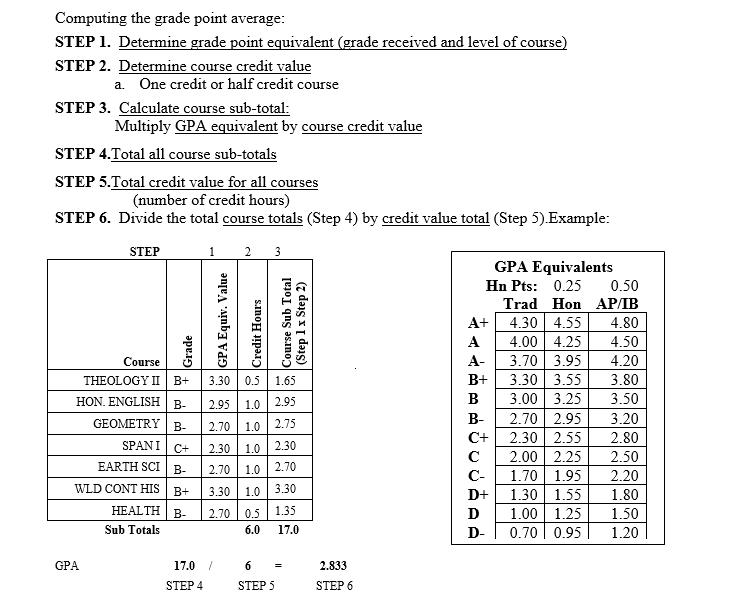
The grade point average is a numerical representation of the student’s average for his academic subjects; GPAs are calculated using grade point equivalents (refer to the existing scale and honor points shown in the bottom right image of this section). Honors level courses are weighted an additional 0.25 points and Advanced/AP are weighted an additional 0.50 points. Physical Education and aides are not part of the grade point average. Cumulative Grade Point Averages, which combines all prior semesters, are updated in Infinite Campus at the end of each semester. The
student’s current cumulative GPA is included on progress reports or report cards. Additionally, the GPA for the most recent semester(s) is listed on report cards under Q2 (Semester 1) and Q4 (Semester 2) as shown on the next page.
The following is an example of how Infinite Campus automatically calculates the GPA for a single semester:
Senior 7th Semester Grades
7th semester grades determine the initial senior ranking and academic recognitions (including valedictorian and salutatorian) for the graduation ceremony They are subject to change based upon final grades at the end of the year The final semester grades for the year are used for determining the end of semester GPAs, rankings, and academic accolades. All students are ranked according to their grades from DLS only, regardless of the number of years attending DLS.
Assessments
Common assessments (formative and summative) are done throughout the quarter for each core course. Common assessments are created collaboratively by the team of teachers responsible for the same course. They help to identify (1) individual students who need additional time and support for learning, (2) the teaching strategies most effective in helping students acquire the intended knowledge and skills, (3) program concerns – areas in which students generally are having difficulty achieving the intended standard – and (4) improvement goals for individual teachers and the team. The assessment aids teachers in helping students learn the essential knowledge and skills during the term rather than at the end of the year after it is too late to adjust strategies.
Formative assessments are frequently utilized during a given marking period to ascertain where a student is in his learning compared to where the teacher feels he should be so that the teacher can adjust to the needs of the student. Formative assessments may, or may not, be “graded.” Their primary purpose is to inform instruction to increase learning. Summative assessments are primarily used to determine what level of mastery a student can demonstrate on the test, quiz, or project.
Semester Exams
Everyone must take semester examinations. The purpose of exams is to ascertain to what degree the student has mastered the essential learning for the course; to reinforce the skill of taking a timed summative assessment similar to what the student will experience at the collegiate level; and to reinforce retention of what was deemed essential/enduring learning to bridge to the next semester, next course, or next grade level. All semester exams are worth 30% of that semester’s grade. Students will only be permitted to take a missed semester exam if they present a written doctor’s note upon their first day back to school justifying the absence as a medical reason. All other reasons (traffic, vacations/trips, overslept, et cetera) for missing a semester exam may result in an “F” for the exam. The exams occur in December for all students, May for the
seniors, and typically in June for underclassmen. The actual dates are published before school begins so parents can avoid any conflicts in their scheduling. Student accounts must be paid to date in order to be permitted to attend the second semester.
Students have the right to know how grades for individual courses are computed, e.g., how much weight is given to homework, to class participation, and to tests. Upon request, a teacher will review an individual student’s grades.
Due to the nature of summative exams, results may be reviewed with the student and parent, but the copying of any aspect of a summative exam in any manner is strictly prohibited.
Transcripts
After graduation, the student may request a complete official transcript to be electronically sent to the college(s) of his choice. There is no charge for this transcript if requested before August 1st. To obtain transcripts, students are required to apply through www.parchment.com Students require their parchment ID number in order to request transcripts.
Official transcripts are only sent directly to educational institutions, agencies, or employers from De La Salle’s mail, fax, or Parchment (Parchment.com). Colleges and other organizations requesting transcripts expect them directly from the school. Official transcripts cannot be directly issued to a parent or student as a matter of policy. Students or parents may, however, request an unofficial transcript through the counseling office or Parchment.
Tuition must be paid to date for transcripts to be released.
Standardized Tests
Standardized, or criterion-based, tests are designed to measure a student’s proficiency level against a set of established criteria, not against fellow students.

One element of student growth is how well they do from year to year on the standardized tests. The SAT Suite of Assessments is an integrated system made up of a series of such tests. The tests measure the same skills and knowledge in ways that make sense for different grade levels, so it's easier for students, parents, and educators to monitor student progress for college and career readiness.
The testing plan at De La Salle is:
STAR: Used to measure student proficiency in reading, math, and early literacy. (Administered three times to students in the Fresh year).
HSPT: This is the high school placement test given in the springtime. Results will be used to determine placement and benchmark where a student is in his learning journey before beginning at De La Salle.
PSAT8/9: The PSAT is a preliminary test for the SAT that tests the same skills and knowledge in a way that makes sense for ninth graders. The purpose of the PSAT 8/9 is to establish a starting point in terms of college and career readiness as students transition to high school.
PSAT/NMSQT: The PSAT is a preliminary test for the SAT that is also used to determine National Merit Scholar Finalists. The test is administered to juniors and sophomores.
SAT: The SAT is a college entrance examination, generally taken during the junior and/or senior year. Students receive a critical reading score, a math score, and a written score. The SAT is not offered at DLS but is given in the area. Some out of state universities use this test. The student must pay a fee.
ACT: The ACT is a college entrance examination generally taken during the junior and again early in the senior year on a Saturday on established national test dates. Students receive scores in English, Reading, Math and Science Reasoning, and a written essay—as well as a composite score. The student must pay a registration fee.
Academic Support
The De La Salle staff is committed to the principle that all students can learn at a high level. To help students achieve academic success, De La Salle has put a number of programs and policies in place:
Teacher Tutoring
All teachers provide tutoring hours outside of class time - either before or after school, or during Power Hour. Departmental tutoring is available during PowerHour on all even number days of the schedule. Students are encouraged to see teachers voluntarily when they need help, but at times teachers may require attendance.
National Honor Society (NHS) Tutors
NHS students provide academic assistance to those students who need it on a pre-arranged basis. NHS students also assist in our academic support programs (FAST and SAIL), both of which are described below
Student Academic Intervention for Learning (SAIL)
Our goal is student learning. This begins with each individual teacher who designs specific learning targets for each class and develops excellent lessons to assist students in mastering the essentials of the course. If students need extra support to succeed, they will enter De La Salle’s “Pyramid of Intervention”, a tiered structure of support for struggling students.
Pyramid of Intervention: Tier I
At the base of the Pyramid is Tier I. Tier I includes all the extra steps taken by a classroom teacher when a student demonstrates a need for extra assistance. Tier I would include:
a. Meeting with / tutoring a student outside of scheduled class time
b. Working with common class teachers to assist the student
c. Arranging for a peer tutor
d. Contacting parents to collaborate on a plan for success
e. Involving the student’s counselor at every step
f. Requiring Tutoring with classroom teacher
Pyramid of Intervention: Tier II
The support programs that are designed to be implemented in addition to all Tier I intervention are part of the second tier of intervention. De La Salle’s Tier II program is named SAIL.
Students may be referred to SAIL because they need extra support despite implementation of all Tier 1 supports and an honest effort to learn. Once enrolled in SAIL, attendance is mandatory For students with an open period, SAIL will take place during that period. For students with no open period, SAIL intervention will occur during PowerHour.
Pyramid of Intervention: Tier III
Some students fail to master the essentials of a class despite all Tier I and Tier II efforts. In such cases, support meetings will be scheduled and must include: the student’s counselor, member(s) of the academic support team, at least one classroom teacher, and an administrator Student performance while receiving Tier III interventions will dictate the appropriateness of continued attendance at De La Salle.
Academic Probation
A student may be placed on academic probation if:
1) The student failed two or more courses for the marking period,
2) The student has a current GPA below 2.0 for the marking period, or
3) The student’s cumulative GPA has fallen below 1.0 as a result of his most recently
completed semester
All students on academic probation are placed in the SAIL program for supplemental academic support for the entire quarter. Progress during and at the end of the quarter will be assessed to determine if support is still necessary. Once placed on academic probation, students who do not improve their academic standing may be dismissed from De La Salle.
Athletics
Athletic and extracurricular activities complement DLS’s academic program and enrich a student’s experience in the formative high school years. Every DLS student involved in any extracurricular activity, including athletics, will have his academic record evaluated weekly and is subject to the same intervention policies as other students in the school. Any DLS student involved in any extracurricular activity, including athletics, must have no more than two at-risk grades at the time of the weekly evaluation in order to be eligible to compete or perform. An at-risk grade is defined as any academic grade that is a “D+” or 73% and lower.
If a student does not meet these requirements, he will be declared ‘ineligible’ until the next grading period. The ineligibility would begin on the Monday and end on the Sunday following the grade check that deemed the student ineligible. Further, a student
must have passed 66% of their scheduled class for the previous semester and participate and complete credit recovery to be immediately eligible for the start of the following school year or semester Students would not be able to participate in any extracurricular without completing all academic requirements needed for the following school year/semester
Fall Sports
Cross
Winter Sports
Freshmen Jr. Varsity Varsity
Spring Sports
Freshmen
Freshmen Jr. Varsity
Extracurricular Activities & Clubs
Academic Clubs and Activities
DECA / Stock Market
Media and Broadcasting Club Jeopardy Tournament Visual Arts
HOSA (Medical club) Rosary
National Honor Society Law (Mock Trial) Club
March for Life Robotics SAVE Club (Environmental) Elementary Guest Readers
Rocketry School Mascot Link Crew Student Council
College Visits World Cultures Club
Pep Band Yearbook
Recreational Clubs and Activities
Ski and Snowboarding Clay Target
School Dances
Intramural Sport Activities
Club
Pong Club Chess Club
Course Change Requests
The course selection process provides numerous opportunities for the student and parents to seek professional advice relative to course selection. Schedule changes are significant for the student, the class to which he moves, and for the teacher who gains a student who is not academically in the same place as the rest of the class. DLS builds the schedule for what was originally requested. Hence, there are no schedule changes except during the second week of each semester only.
Students and parents have a one-time opportunity per semester to request a schedule change during the second week of each semester only Submitting a request does not constitute an entitlement to the change and is not a guarantor of the change. A withdrawal from a course after the deadline will result in a notation of “withdrawal” (D- or higher) or “withdrawal failing” on the student’s transcript. A student who withdraws from a course will not receive any credit for that course. Credit is earned at the completion of a course; no partial credit is awarded of a course. In order to promote academic learning and diligence, schedule changes may not be considered if the student has a passing (“C-“or higher) grade. If a schedule change is approved, the student’s current grade in the class will be transferred to the gaining class to ensure accountability.
There are two categories of course request changes: 1) Student/Parent initiated, and 2) School initiated.
Teacher or Counselor initiated The teacher and counselor will consult about the student’s academic performance. Afterwards, the teacher and counselor will inform the department leader if they conclude a course change is warranted based upon academics after all school academic intervention strategies have been exhausted (teacher-student session, tutoring, academic intervention program, et cetera). The counselor will contact the parents, review the concerns and attempted interventions, and initiate the process if endorsed by the teacher, department leader, counselor, and parent.
Student or Parent initiated The process begins with the student’s counselor
The student or parent should contact his counselor about the concern after addressing academic concerns with the respective teacher and counselor The counselor will meet with the student to discuss the academic concern warranting a change in his schedule. Students having difficulty in a course are expected to seek assistance directly by speaking to the teacher, attempt to develop improved work habits with fellow students
and his counselor, participate in the academic intervention program, and arrange a tutor if necessary through his counselor before requesting a course change.
Remember that course change requests are just that—requests. They are subject to school review, scheduling constraints, and existing school policies. Rest assured that all parties want to best place all students so that they can be challenged and grow toward success. Much deliberate, professional assessment and discussion goes on to best place students in the appropriate courses and we are confident the parents will value our professional recommendations. If, however, a parent wishes to choose a course of action contrary to the professional recommendation of the staff and school, then they assume all responsibilities (grades, scheduling, etc.).
Change Request Form
The request starts and ends with the counselor The counselor must support the move and all parties (teachers, department leaders, counselor, parents, and student) should be in concurrence that the move is in the best interest of the student, subscribes to school policies (graduation requirements, et cetera) and philosophy pertaining to minimizing/justifying schedule changes, and is, in fact, doable. The form should be completed in the proper order and all parties must provide the rationale. It is the counselor’s responsibility to resolve any discrepancies before returning the form to the student to have the parents review and endorse. Counselors should share with the student and parents, if there are unresolved discrepancies as to why the request cannot be supported. The counselor will present the completed request form with all the appropriate prior approvals to the assistant principal. The assistant principal is the final arbitrator.
Curriculum Process
The school reviews the general academic requirements, curriculum, and scope and sequence of De La Salle education yearly and publishes the resulting curriculum guide each Winter A chart summarizing the course offerings is shown below
Business & Technology, Applied Arts (Elective)
2026-27 COURSE OFFERINGS
(Course number) If bold = 1.0 credits
●Intro to Technology (931)
●Intro to Engineering (947)
●Intro to Technology (931)
●Robotics (932)
●Intro to Engineering(947)
●Principles of Engineering (948)
● AI & Cybersecurity (962)
●Drones Tech & Unmanned Aircraft Systems ( 964 )
English (4.0 Credits)
Fine Arts (Visual & Performing) (Elective)
Foreign Language (2.0 Credits)
Math (4.0 Credits)
Physical Ed. (1.5 Credits)
Theology (4.0 Credits)
Science (3.0 Credits)
●Literature/Composition I (212)
●Hon Literature/ Comp I (213)
●Beginning Band (701)
●Concert Band (702)
●Music Appreciation (705)
●Introduction to Art (760)
●Humanities & Art (766)
●Spanish I (415)
●Hon Spanish I (416)
●Algebra IA (310)
●Algebra I (312)
●Hon Algebra 1 (313)
●Advanced Geometry(324)
●Physical Education I (812)
●Old Testament I (110)
●Old Testament II (112)
●Biology (512)
●Hon Biology (513)
●American Literature (226)
●Hon American Literature (227)
●Beginning Band (701)
●Concert Band (702)
●Introduction to Art (760)
●Studio Art I (761)
●Humanities & Art (766)
●Music Appreciation (705)
●Spanish I (415)
●Spanish II (425)
●Honors Spanish II (427)
●Modern Geometry (322)
●Hon Modern Geometry (323)
●Algebra 2 (332)
●Hon. Algebra 2/Trig (333)
●Advanced Algebra 2/Trig (334)
●Physical Education II (822)
●Health Education (825)
●New Testament I (121)
●New Testament II (124)
●Intro Chemistry (532)
●Hon Chemistry (523)
●Aviation Science (557)
●Biomedical Science (558)
●Robotics (932)
●Bloomberg Finance (938)
●Accounting (941)
●Intro to Business/Marketing (942)
●Intro to Engineering (947)
●Principles of Engineering (948)
●AI & Cybersecurity (962)
●AP Business Principles with Finance( 963)
●Drones Tech & Unmanned Aircraft Systems ( 964 )
●British Literature (231 )
●AP English Language (252)
●Beginning Band (701)
●Concert Band (702)
●Studio Art I (761)
●Adv Studio Art (763)
●Portfolio Art (765)
● Humanities & Art (766)
●Music Appreciation (705)
●Spanish II (425)
●Hon Spanish III (435)
●Algebra 2 (332)
●Hon Algebra 2/Trig (333)
●Advanced Algebra 2/Trig (334)
●Pre-Calculus (342)
●Hon. Pre-Calculus (343)
●AP Calculus AB (353)
●Adv Physical Education (845)
●Physical Education II (822)
●Health Education (825)
●Sacraments (134)
●Morality (133)
●Earth & Space Science (522)
●Hon Physics (534)
●Hon Phys/Anatomy (549)
●AP Physics 1 (556)-Virtual
●AP Biology (551)
●AP Chemistry (552)
●AP Env Science (553 )
●Aviation Science (557)
●Biomedical Science (558)
●Medical Interventions (559)
●Robotics (932)
●Bloomberg Finance (938)
●Accounting (941)
●Intro to Business/Marketing (942)
●Principles of Engineering (948)
●Civil Engin & Architecture (950)
●AI & Cybersecurity (962)
●AP Business Principles with Finance (963 )
●Drone Tech & Unmanned Aircraft Systems ( 964 )
●World Literature (241)
●AP English Literature (247)
●Beginning Band (701)
●Concert Band (702)
●Studio Art I (761)
●Adv Studio Art (763)
●Portfolio Art (765)
●Humanities & Art (766)
●Music Appreciation (705)
●Hon Spanish III (435)
●AP Spanish IV (445)
●Integrated Math (341)
●Pre-Calculus (342)
●Hon Pre-Calculus (343)
●AP Calculus AB (353)
●AP Calculus BC (355)
●AP Statistics (352)
●Adv Physical Education (845)
●Religious History & Social Impact (142)
●World Religion (145)
●Earth & Space Science (522)
●Hon Physics (534)
●Hon Phys/Anatomy (549)
●AP Physics 1 (556)-Virtual
●AP Biology (551)
●AP Chemistry (552)
●AP Env Science ( 553 )
●Aviation Science (557)
●Biomedical Science (558)
●Medical Interventions ( 559 )
Social Studies
(3.0 Credits)
● World Contemporary Studies (624)
●Hon World Contemporary Studies (625)
●AP Human Geography ( 655)
●American History (632)
●Hon. American History (633)
●AP U S History (651)
●Economics (630)
●American Government (641)
●Psychology (647)
●AP Government (653)
●AP Microeconomics (654)
Course offerings are subject to change without notice
●Economics (630)
●American Government (641)
●Psychology (647)
●AP Government (653)
●AP Microeconomics (654)
●AP Psychology (650)
School Year 2026-27 Course Offerings
100s-Theology 200s-English
500s-Sciences
Lang.
110–OldTestament I 112-OldTestament II 121-NewTestament I 124-NewTestament II 133-Morality 134-Sacraments
&SocialImpact 145–World Religions
110 – OLD TESTAMENT I
0 5 Credit Grade Offered: 9
Prerequisites: None
This introductory course is designed to explain in detail what it means to be Catholic and Lasallian.The course also serves as an introduction to life of Saint John Baptist de La Salle, the Lasallian Mission and Lasallian educational philosophy that is ingrained in our school The second part of this course gives students a general knowledge and appreciation of the Sacred Scriptures. Through their study of the Bible they will come to encounter the living Word of God, Jesus Christ In the course, they will learn about the Bible, authored by God through Inspiration, and its value to people throughout the world
112 – OLD TESTAMENT II
0 5 Credit Grade Offered: 9
Prerequisites: None
This section is a continuation of the first semester course. This class will provide a deeper understanding of the OId Testament in order for students to gain a working knowledge of Biblical history and how it all fits together. Through their study of the Bible, they will come to encounter the living Word of God, Jesus Christ In the course, they will learn about the Bible, authored by God through Inspiration, and its value to people throughout the world
121– NEW TESTAMENT I
Grade Offered: 10
Prerequisites: None
The purpose of this course is to introduce students to the Mystery of Jesus Christ, the Living Word of God, and the second person of the Blessed Trinity In this course students will understand that Jesus Christ is the ultimate revelation to us from God The course will explore our salvation through the Paschal Mystery, encountering the mystery and glory of the suffering, death, Resurrection, and Ascension of Jesus Christ The course will use the Scriptures as a supplement to the textbook, diving into the Gospels with emphasis on the writings of St Mark and St John
124– NEW TESTAMENT II 0 5
Grade Offered: 10
Prerequisites: None
This course is a continuation of the first semester course This class will provide a deeper understanding of the OId Testament in order for students to gain a working knowledge of Biblical history and how it all fits together Through their study of the Bible, they will come to encounter the living Word of God, Jesus Christ In the course, they will learn about the Bible, authored by God through Inspiration, and its value to people throughout the world
133 – MORALITY 0 5 Credit
Grade Offered: 11
Prerequisites: None
Students face countless choices and challenges in their daily lives This course addresses how a relationship with Christ and the Church can lead to choices that are in accord with God's plan. The students learn what it means to live as a disciple of Christ and how the Church strengthens this discipleship
134 – SACRAMENTS
Grade Offered: 11
Prerequisites: None
0 5 Credit
This course provides an opportunity to encounter Christ in a full and real way The focus of this course is to help the students learn about the Seven Sacraments, especially the Eucharist, in order to enable them to more fully participate in them The course also explores the history, scriptural foundation, and current practices of the sacraments.
142 – RELIGIOUS HISTORY & SOCIAL IMPACT
Grade Offered: 12
Prerequisites: None
0 5 Credit
This course examines the development of religion throughout history, with a focus on religious institutions, beliefs, and practices that have shaped-and been shaped by- major historical events and cultural movements Students will explore early religious communities, the evolution of religious structures and doctrines, and the influence of religion on issues such as social justice, care for the marginalized, and the common good Emphasis is placed on historical analysis, discussion, and reflection to help students understand how religion' s past informs its role in the world.
145 – WORLD RELIGIONS
0 5 Credit Grade Offered: 12
Prerequisites: None
World Religions is a senior theology course which will examine religion through a historical, social, political, and economic lens Students will compare and contrast the different beliefs, cultures, symbols and rituals between the Catholic faith and the different faiths covered in the course By looking at both the origins of the different faiths, students will have a fuller understanding of the beliefs, culture,
and connections these faiths have to the Catholic faith We will cover a variety of religions from all over the world throughout the year, examining each through historical, cultural, and sociological contexts. Units of study will include Judaism, Islam, Hinduism, Eastern Religions, Cults and Modern Religions
212–Comp&LitI 213-Hon.Comp& LitI
226-Amer.Lit 227 –Hon.Amer. Lit.
212
- COMPOSITION/LITERATURE I
Grade Offered: 9
Prerequisites: None
1 Credit
The primary goals of this course are to foster language development through reading, writing, and listening and speaking skills Students will learn the importance of achieving proficiency in the standard usage of language. Through English activities and experiences students will develop skills that will prepare them for the college experience and for their post-college lives A strong emphasis will be placed on drawing conclusions from both fictional and nonfictional works and supporting those conclusions with textual evidence Improving morality, preparing good workers, producing good citizens, and fostering personal growth are additional goals of Freshman English. This course will provide students with the opportunity to develop, explore, and evaluate in order to gain knowledge that can be utilized throughout their lives
213
– HONORS COMPOSITION/LITERATURE I
Grade Offered: 9
1 Credit
Prerequisites: “A” in language arts/writing in 8th Grade, scores of 75 or higher in all three HSPT sub scores (verbal, reading, language), and endorsement of the department chair
The primary goals of this course are to foster language development through reading, writing, and listening and speaking skills Students entering this course should possess strong reading comprehension skills There will be extensive writing assignments and challenging, comprehensive reading Verbal and grammar skills are desired Students will learn the importance of achieving proficiency in the standard usage of language Through English activities and experiences students will develop skills that will prepare them for the college experience and for their post-college lives A strong emphasis will be placed on drawing conclusions from both fictional and nonfictional works and supporting those conclusions with textual evidence Improving morality, preparing good workers, producing good citizens, and fostering personal growth are additional goals of Hon Freshman English This course will provide students with the opportunity to develop, explore, and evaluate in order to gain knowledge that can be utilized throughout their lives As this is an Honors course, the material will be taught more extensively and at a quicker pace than in the traditional 9th Grade English course.
226 – AMERICAN LITERATURE 1 Credit
Grade Offered: 10
Prerequisites: None
Students entering American Literature should be able to demonstrate understanding of the deeper meanings of literary works. Students will need to display a complex understanding of sentence
and paragraph structure along with the ability to develop a point of view through written essays This course primarily studies American literature, cultural thought, and language. The course covers such literary movements/periods as Puritanism, Romanticism, Realism, Naturalism, and Modernism Essays incorporate expository prose assignments and literary analysis Junior English continues to aim to enlarge students’ vocabularies, to reinforce and expand an understanding of basic English grammar, and to develop students who can think critically about literature and express their interpretations in clear, effectively organized, and strongly supported essays
227 – HONORS AMERICAN LITERATURE 1 Credit Grade Offered: 10
Prerequisites: “A” in 9th Grade English (or “B” in Hon 9th Grade English), endorsement of 9th Grade English teacher
Students entering Hon American Literature should be able to read critically and analyze deeply various works of literature and demonstrate strong writing and grammar skills for essays in standard/formal English. This Hon.course primarily studies American literature, cultural thought, and language The course covers such literary movements/periods as Puritanism, Romanticism, Realism, Naturalism, and Modernism. Essays incorporate expository prose assignments and literary analysis. This course continues to aim to enlarge students’ vocabularies, to reinforce and expand an understanding of basic English grammar, and to develop students who can think critically about literature and express their interpretations in clear, effectively organized, and strongly supported essays The Honors American Literature course also includes a research project on some aspects of American literature. This course anticipates greater familiarity with the foundations of literary analysis and thus explores the readings in greater depth than does English 226.
231 – BRITISH
LITERATURE 1
Credit Grade Offered: 11
Prerequisites: None
This junior-level course explores the rich and evolving tradition of British literature from its origin to the modern era, tracing the development of language, culture, and literary forms over centuries Students will study foundational works such as Beowulf and The Canterbury Tales, delve into the timeless plays and poetry of Shakespeare and his Renaissance contemporaries, and engage with the satirical critiques of the Enlightenment Through the Romantic and Victorian periods, students will examine how themes of emotion, individuality, and societal change are reflected in literary masterpieces like Frankenstein and works by Dickens or the Brontës Finally, the course concludes with an exploration of Modernist and contemporary voices, addressing themes of fragmentation, innovation, and societal transformation in texts like Orwell's 1984
Through close reading, literary analysis, and creative projects, students will develop critical thinking, academic writing, and oral communication skills This course emphasizes connections between historical contexts and modern issues, encouraging students to see the relevance of literature to their own lives and the world around them Writing assignments include analytical essays, creative projects, and research-based assessments, fostering an appreciation for British literary heritage and its enduring influence.
231-H BRITISH LITERATURE 1 Credit Grade Offered: 11
Prerequisites: None
This accelerated junior-level course offers a rigorous exploration of British literature from its earliest origins through the contemporary period, emphasizing both the historical development and thematic evolution of literary works Students will engage with complex texts such as Beowulf and The Canterbury Tales, analyze the language and dramatic structure of Shakespeare and his Renaissance peers, and investigate the Enlightenment's social commentary through satire The course continues with a deep examination of Romantic and Victorian literature, focusing on the interplay of emotion, identity, and cultural transformation in works like Frankenstein and selections from Dickens, the Brontës, and Tennyson The study culminates in an analysis of Modernist and postmodern texts, including Orwell’s 1984, with particular attention to narrative innovation, societal critique, and philosophical undercurrents
Honors students are expected to engage in independent reading, lead seminar-style discussions, and demonstrate advanced analytical thinking through frequent and varied writing assignments. These include close-reading essays, original research papers using scholarly sources, and interdisciplinary projects Emphasis is placed on developing a nuanced understanding of how British literature both shapes and reflects intellectual, cultural, and historical movements This course challenges students to make sophisticated connections between literary works and contemporary issues, cultivating the skills necessary for advanced academic inquiry
241 – WORLD LITERATURE 1 Credit Grade Offered: 12
Prerequisites: None
World Literature covers the literary analysis of various works by authors from around the world Additionally, students will cover a variety of writing modes, including narration, description, comparison/contrast, cause and effect, and persuasion and argumentation World Literature also builds upon and reinforces the grammar learned during the first three years of English and then explores the finer points of grammar and varieties of sentence structure The aim of the course is to prepare students for college level writing experiences.
252 - AP LANGUAGE AND COMPOSITION 1 Credit Grade Offered: 11
Prerequisites: “B+” in Hon. Comp & Lit II (10th Grade), endorsement of 10th Grade teacher, endorsement of course teacher, writing sample submitted to AP teacher and approval of department leader
AP Language & Composition- is an introductory college-level composition course. Students cultivate their understanding of writing and rhetorical arguments through reading, analyzing, and writing texts as they explore topics like rhetorical situations, claims and evidence, reasoning and organization, and style
253 – AP ENGLISH LITERATURE AND COMPOSITION
1 Credit Grade Offered: 12
Prerequisites: “B+” in Hon American Literature (11th Grade), endorsement of 11th Grade teacher, endorsement of course teacher, and approval of department leader
Students selecting AP English should be willing and able to respond to familiar and unfamiliar poems, plays, and prose works analytically and critically, both through discussions and in timed and untimed essays, using their mastery of literary terms and key concepts to clarify meaning AP English Literature seeks to prepare students to take the Advanced Placement exam in Literature and Composition and to succeed in college level literature courses. Students examine numerous novels, plays, short stories, and essays and learn to understand how various literary techniques convey meaning and tone in prose and poetry and affect the readers’ interpretations of those works. The aim is for students to develop the ability and willingness to think critically and analytically, and to share thoughts and interpretations both in class discussions and through effectively organized, argued, and supported essays A pre-course reading/writing assignment (summertime) may be required
280 – ENGLISH AS A SECOND LANGUAGE I
0 5 Credit Grade Offered: 9, 10, 11, 12
Prerequisites: Non-United States Citizen
This course will help students to improve their listening, speaking/pronunciation, and reading skills Students will learn to understand more of the English that they hear in various situations They will also learn to speak more clearly so that others can understand them better The first levels will work with conversational English while the higher levels will work with advanced conversation skills and academic English This course may be taken again depending on proficiency levels at the end of the first semester
310-AlgebraIA
323-Honors Geometry 324-Adv.Geometry
334-Adv.Algebra II
353–APCalculus
333-Honors AlgebraII
310 – ALGEBRA IA 1 Credit
Grade Offered: 9
Prerequisites: HSPT and IFMPE scores and recommendation of DLS Academic Assistance Team
To be successful in this course, students must demonstrate improvement in the following skill sets: Math facts, basic computational skills, number sense, addition, subtraction multiplication, and division of integers, fractions, decimals, the number line and properties of numbers, factors, divisibility tests, and prime factorization, exponents, square roots, absolute value, scientific notation, ratios and proportions, percents and order of operations This course is the first of a two year Algebra I course The course will move at a pace to where students will be able to review pre-algebra skills along with covering these Algebra I topics: solving equations, solving and graphing linear equations and inequalities, and solving systems of equations
312 – ALGEBRA I 1 Credit
Grade Offered: 9
Prerequisites: None
To be successful in this course, students should have a mastery of; addition, subtraction, multiplication, and division of integers, fractions, and decimals, the number line and properties of numbers, factors, divisibility tests, and prime factorization and should have been introduced to; GCFs, LCMs, exponents, square roots, absolute value, scientific notation, ratios and proportions, percents, and order of operations This course is intended for students to build a solid foundation of algebraic skills and concepts. By becoming proficient in these skills and concepts, the students can apply them confidently in further math courses Topics covered include; solving equations, solving and graphing linear equations and inequalities, solving systems of linear equations, polynomials, rational expressions, radical expressions, quadratic equations, and algebra word problems
313 – HONORS ALGEBRA I
Grade Offered: 9
1 Credit
Prerequisites: Algebra I in 8th grade, HSPT and IFMPE scores, and approval of department leader
To be successful in this course, students should have mastery of: addition, subtraction, multiplication, and division of integers, fractions, and decimals; exponents, absolute values, and order of operations; solving basic linear equations and linear inequalities The incoming freshman is required to be proficient in the operations on the set of rational numbers and on the basic applications of these operations, i e , percentage problems and simple equation solving The student then proceeds to study variables and algebraic expressions from monomials to polynomials and the operations on them Manipulative skills are emphasized in addition to developing skills in solving open sentences Emphasized
are single variable linear and quadratic equations and some of their applications Also introduced are the concepts of irrational numbers and their operations, two variable sentences and graphing, functions and rational expressions Time and ability permit the introduction of right triangle trigonometry and its applications
322 – MODERN GEOMETRY
Grade Offered: 10
Prerequisites: Algebra I
1 Credit
To be successful in this course, students should have mastered the following: performing addition, subtraction, multiplication, and division with whole numbers, fractions, and decimals; solving linear algebraic equations; isolating variables in a function This course will provide students with the knowledge and fundamentals to continue to develop, and expand upon It will emphasize the student’s knowledge of algebra and deductive reasoning applied to geometric properties The geometric principles studied in this course are applicable to all of the sciences The application of this course material is essential. Emphasis will be placed on: reinforcing basic concepts of Algebra, understanding geometric language, graphing and coordinate Geometry, measurements in two and three dimensions, applying algebraic properties to geometric principles, and applications of geometric properties.
323 – HONORS MODERN GEOMETRY
Grade Offered: 10
Prerequisites: “A-” in Algebra I, approval of department leader.
1 Credit
To be successful in this course, the students should have already mastered the following: basic operations with integers, fractions, and decimals; solving simple algebraic equations; determining relationships between angles, polygons, circles, and three-dimensional shapes Algebra and Geometry are united in a presentation of traditional geometric topics with a view toward coordinate Geometry. Algebraic concepts, such as systems of linear equations, word problems, and graphing serve as a unifying principle. Topics include logic, proof of fundamental theorems, congruences, similarity, area, volume and quadratic equations
324 – ADVANCED
GEOMETRY 1 Credit
Grades Offered: 9, 10
Prerequisites: 9th Grade: Algebra I in 8th grade, HSPT and IFMPE scores, and approval of the department leader
Prerequisites: 10th Grade: “A” in Hon Algebra I, and approval of the department leader
To be successful in this course, the student should have already mastered the following; fractions, decimals, percents, exponents, radicals, solving equations and inequalities, solving and applying proportions, solving and graphing linear equations, solving systems of equations, and factoring all forms of polynomials In addition, he should have been introduced to basic geometric formulas, the quadratic formula, the Pythagorean theorem, data analysis and probability This course is designed for those freshmen and sophomores who have demonstrated a strong proficiency in Algebra I The pace and depth of this course is substantially greater than the Hon Geometry In addition, students will be involved with the following: constructions with a protractor and compass, some independent projects, several math competitions, concentrated problem solving, and an introduction to trigonometry and functions
332 – ALGEBRA II AND TRIGONOMETRY
Grade Offered: 11
Prerequisite: Modern Geometry
1 Credit
To be successful in this course, the students should have already mastered the following: basic operations with integers, fractions, and decimals; solving simple algebraic equations; factoring algebraic expressions. This course requires a fundamental knowledge of Algebra I and Geometry. Through problem solving and theoretical discussion it strives to strengthen the student’s ability to manipulate algebraic symbols, solve complicated equations and simplify algebraic expressions. In addition, the course will help the student to deepen his understanding of the concepts of algebra and the structures and principles, which govern the manipulation of symbols, and how the symbols themselves can be used to record ideas and gain insights into problem solving situations
333
– HONORS ALGEBRA II AND TRIGONOMETRY
1 Credit Grades Offered: 10, 11
Prerequisites: “B” in Hon or Advanced Geometry and approval of department leader
To be successful in this course, students should have mastered the following: perform operations with numbers comfortably and easily; evaluate expressions, with and without variables, using the order of operations; graph basic functions when given an equation or be able to make a table of values; work with and graph linear equations; solve linear equations and simple quadratic equations; factor simple linear and quadratic expressions; know how to work with special right triangles (30-60-90 and (45-45-90) and the Pythagorean Theorem This course places an emphasis on developing mathematical thinking and problem solving It begins with an intense review of the basic concepts of algebra Special attention is placed on polynomial, trigonometric, logarithmic and exponential functions, and their graphs At this level, we treat the calculator as an aid to understanding – not as the central feature of the course Applications from all branches of science are used to show how mathematics is used to model real-life situations Throughout the course, concepts are studied from an algebraic, geometric, numeric and verbal point of view. If time permits, a non-technical approach to such topics as sequences, statistics, and probability is presented
334
– ADVANCED ALGEBRA II AND TRIGONOMETRY 1 Credit
Grades Offered: 10, 11
Prerequisites: 10th Grade: “B+” in Advanced Geometry, and approval of department leader
Prerequisites: 11th Grade: “B+” in Hon. Algebra II or Advanced Geometry, and approval of the department leader
To be successful in this course, students should have mastered the following: perform operations with numbers comfortably and easily; evaluate expressions, with and without variables, using the order of operations; graph basic functions when given an equation or be able to make a table of values; work with and graph linear equations; solve linear equations and simple quadratic equations; factor simple linear and quadratic expressions; know how to work with special right triangles (30-60-90 and (45-45-90) and the Pythagorean Theorem This course places an emphasis on developing mathematical thinking and problem solving It begins with an intense review of the basic concepts of algebra Special attention is placed on polynomial, trigonometric, logarithmic and exponential functions, and their graphs At this level, we treat the calculator as an aid to understanding – not as the central feature of the course Applications from all branches of science are used to show how mathematics is used to model real-life situations Throughout the course, concepts are studied from an algebraic, geometric, numeric and verbal point of view If time permits, a non-technical approach to such topics as sequences, statistics, and probability is presented
342
– PRE-CALCULUS
Grade Offered: 12
1
Credit
Prerequisites: Completion of Algebra II and Trigonometry, endorsement of the teacher, and approval of department leader.
To be successful in this course, the students should have already mastered the concept of functions in various forms including linear, quadratic, polynomials, and exponential. This course begins by reviewing and reinforcing the students’ algebraic and geometric skills Special attention will be paid to pointing out the connection between the algebraic and geometric interpretations of important concepts. The student is then introduced to functions and their graphs with emphasis on: polynomial, trigonometric, exponential, logarithmic, and rational functions. The student should be able to develop mathematical models and use them to interpret real-world problems
343
– HONORS PRE-CALCULUS
Grade Offered: 12
1 Credit
Prerequisites: “B+” in Hon. Algebra II and Trigonometry, approval of the department leader.
To be successful in this course, students should have mastered the following: solving linear and rational equations, graphing linear and quadratic functions, factoring of second- and third-degree
polynomials, understanding the meaning of domain and range, simplifying and rationalizing radicals, using a graphing calculator to graph a function, and identifying the relationships of sides in special right triangles This course is intended for the college-bound senior It provides an intense study of the topics, which are fundamental to the study of calculus Emphasis is placed on functions and their graphs with special attention to polynomial, rational, trigonometric, exponential and logarithmic functions Where possible, concepts are presented from four points of view: geometric (graphs), numeric (tables), symbolic (formulas), and verbally (discussion) Upon completion, students should be able to solve practical problems and use appropriate models for analysis and prediction Graphing calculators are used throughout the course
352 – AP STATISTICS
1
Credit Grades offered: 12
Prerequisites: Honors Geometry & Honors Algebra 2
AP Statistics is an introductory college-level statistics course that introduces students to the major concepts and tools for collecting, analyzing, and drawing conclusions from data. Students cultivate their understanding of statistics using technology, investigations, problem solving, and writing as they explore concepts like variation and distribution; patterns and uncertainty; and data-based predictions, decisions, and conclusions
353 – AP CALCULUS
AB 1
Credit Grades Offered: 11, 12
Prerequisites: “B+” in Advanced Algebra II and Trigonometry, endorsement of the teacher, approval of department leader
To be successful in this course, the student should have a strong background in Algebra, Geometry, Functions, Trigonometry, the Unit Circle and the Graphing Calculator The student should also have shown the ability to reason mathematically, to apply mathematical concepts and processes to solve complex problems, and be able to explain and justify the thinking underlying their work The student is introduced to the concepts of differential and integral calculus Differentiation and integration of algebraic and transcendental (trigonometric, exponential and logarithmic) functions is emphasized along with the fundamental applications of these operations The course emphasizes a multi-representational approach to calculus, with concepts, results, and problems being expressed graphically, numerically, analytically, and verbally. The focus of the course is neither manipulation nor memorization of an extensive taxonomy of functions, curves, theorems, or problem types Through the use of the unifying themes of derivatives, integrals, limits, approximation, and applications and modeling, the course becomes a cohesive whole rather than a collection of unrelated topics
355 – AP CALCULUS BC 1
Credit
Grade Offered: 12
Prerequisites: “B+” in Advanced Placement Calculus AB, endorsement of the teacher, approval of department leader.
To be successful in this course, students should have mastered the following: know the unit circle and basic trigonometric identities; basic integration and differentiation methods of most basic function types; know and be able to use basic approximation methods (such as local linear approximation); be able to work with functions analytically, numerically, verbally, and graphically; be comfortable with the use of a graphing calculator This course is an extension of Calculus AB rather than an enhancement, intended to be both challenging and demanding The course emphasizes a multi-representational approach to calculus, with concepts, results, and problems being expressed geometrically, numerically, analytically, and verbally Topics include parametric, polar, and vector functions, and analysis of their curves, numerical solutions of differential equations using Euler’s Method, L’Hopital’s Rule, including its use in determining limits and convergence of improper integrals and series In addition, methods of integration, logistic differential equations, polynomial approximations and series, and applications of integration, including arc length and finding the area of a region bounded by polar curves
415-SpanishI
445-APSpanish IV
415 – SPANISH I
416-Hon. SpanishI 425-SpanishII 427-Hon. SpanishII 435-Hon. SpanishIII
Grade Offered: 9 (10 for FAST students)
Prerequisites: None
1
Credit
Spanish I is an introductory course focused on developing the four language skills of listening, speaking, reading, and writing, primarily through learning vocabulary on major topics, pronunciation and basic grammar structures – namely the present and the near future - in order to build communicative competence The course also aims to heighten students’ cultural awareness through reading and audiovisual materials in the target language and real-life conversations No prior language experience required This course is designed to prepare students for Spanish II or Honors Spanish II based on their teacher recommendation
416 – HONORS SPANISH I
Grade Offered: 9
1
Credit
Prerequisites: B or higher in a one-year Spanish course meeting everyday in 8th grade or counselor approval
This is a more intensive introductory course focused on developing the four language skills of listening, speaking, reading, and writing, primarily through learning vocabulary on major topics, pronunciation and basic grammar structures – namely the present and the near future - in order to build communicative competence The course also aims to heighten students’ cultural awareness through reading and audiovisual materials in the target language and real-life conversations Students are encouraged to continue studying Spanish at the honors level throughout their language career No prior language experience required This course is designed to prepare students for Spanish II or Honors Spanish II based on their teacher recommendation.
425 – SPANISH II
Grade Offered: 10 (11 for FAST Students)
Prerequisites: Spanish I and teacher endorsement
1 Credit
At the onset of Spanish II, students will be expected to utilize the knowledge gained in Spanish I –namely basic grammar structures including the present tense, pronunciation, and vocabulary on major topics In Spanish II, the four language skills of listening, speaking, reading, and writing are further developed through the learning of new vocabulary and the past tenses in authentic contexts. An increased emphasis is placed on cultural awareness through print and audio texts from internet resources to increase students' knowledge of the products, practices, perspectives of the Spanish-speaking world. This course is for those students who don’t intend to take more than the required two years of Spanish at De La Salle. Those students who wish to continue studying Spanish should seek a teacher recommendation to enroll in Honors Spanish III
427 – HONORS SPANISH II
Grade Offered: 10
Prerequisites: “B” in Spanish I and teacher endorsement
1 Credit
Beginning Hon. Spanish II students will be expected to utilize the knowledge gained at the Spanish I level - namely basic grammar structures including the present tense, pronunciation and
vocabulary on major topics - in order to communicate through reading, writing, speaking and listening at a novice level. In Hon. Spanish II, all four language skills (listening, speaking, reading, and writing) are emphasized, with focus on gaining confidence in these skills in authentic contexts Through learning additional vocabulary and verb tenses, students successfully communicate with their peers in the target language Additionally, an increased emphasis is placed on cultural awareness through print and audio texts from internet resources to increase students' knowledge of the products, practices, perspectives of the Spanish-speaking world This course is designed to prepare students for Honors Spanish III based on their teacher recommendation
435 – HONORS SPANISH III
Grades Offered: 11, 12 (Elective)
Prerequisites: Hon Spanish II and teacher endorsement
1 Credit
Beginning Hon Spanish III, students will be expected to utilize the knowledge gained at the Spanish I and Hon Spanish II levels - namely grammar structures used to express the present, past, and future, pronunciation, and vocabulary on major topics - in order to communicate through reading, writing, speaking and listening at an intermediate level As an advanced language course, Spanish III continues to reinforce and further develop the students’ proficiency in the skill areas of listening, speaking, reading, and writing with more emphasis on oral and written communication There is also a more intense study of reading and listening comprehension through literature, expository texts, and short films from and about Hispanic and Spanish cultures to help further develop students’ skills as well as their global awareness A good portion of the class is conducted in Spanish. There is a more intense and sophisticated study of all new and previously learned grammar and vocabulary This class is taught in order to thoroughly prepare the student to be successful at the AP Spanish IV level.
445 – AP SPANISH IV 1 Credit
Grade Offered: 12 (Elective)
Prerequisites: “B” in Spanish III, teacher endorsement, and approval of department leader
Beginning AP Spanish IV, students will be expected to utilize the knowledge gained at the Spanish I and Hon. Spanish II and III levels - namely grammar structures learned, pronunciation, and vocabulary on major topics - in order to communicate through reading, writing, speaking and listening at an advanced level. While emphasis continues on the development of skills of listening, reading, writing, and speaking in AP Spanish, stress is placed on using these skills together to effectively communicate in various situations and about topics found in the real world. Selected readings from literature and current events are chosen from the textbook and various media sources to further students’ reading comprehension. Listening comprehension is further developed through various audio and visual media including news reports, short, and feature films Students’ writing abilities in Spanish are refined through the composition of various types of essays, stories, and informal communication. Students further develop their speaking skills through class participation and discussion of ideas and the presentation of various oral presentations and projects The class is conducted almost exclusively in Spanish Great emphasis is placed on idiomatic expressions and phrases as well as regional differences of the Spanish language Most grammar that is learned in previous courses is reviewed in depth and is applied in a more sophisticated manner to refine students’ language skills Advanced Placement exam is offered at the instructor’s discretion, but not required for this class
512-Biology
532- Chemistry
552-APChemistry
558-Biomedical Science
513-Honors Biology
534-Honors Physics
553-AP Environmental Science
559-Medical Interventions
522-Earth&Space Science
549-HonorsHuman Physiology/Anatomy
556-APPhysics*
599-LabAssistant
523-Honors Chemistry
551-APBiology
557 Aviation Science
Accommodating requests for more than one science course per semester is challenging, due to scheduling and lab constraints. Requests for more than one science course per semester are granted based on seniority and are not guaranteed.
512
– BIOLOGY
Grade Offered: 9
1 Credit
Prerequisites: combined score of at least 80 (NP) in the quantitative and science option HSPT sub-tests (quantitative + science option = 80 or higher), an HSPT Reading G.E. of 6.5 or higher, This course is designed to enhance students’ understanding of the basic concepts fundamental to all living things. Students investigate a variety of topics including biochemistry, cell structure and function, physiology, genetics, evolution, and ecology Students will further their understanding by engaging in direct study, lecture, and inquiry-based laboratory investigations where they will gain familiarity with a variety of technology and laboratory methods Emphasis will be placed on the application of scientific knowledge to real-world situations.
513
– HONORS BIOLOGY
Grade Offered: 9
1 Credit
Prerequisites: Combined score of at least 120 (NP) in the quantitative and science option HSPT sub-tests (quantitative + science option = 120 or higher), an HSPT Reading G E of 8 0 or higher, an “A” in 8th grade science or Earth Science, and endorsement of eighth grade teacher or Earth Science teacher This course emphasizes molecular biology and is covered at an accelerated pace It requires students to think critically, to inquire, and to link ideas The course bridges current perspectives and understandings across major sub-disciplines of biology such as biochemistry, cell biology, genetics, microbiology, evolution, and human physiology Students will further their understanding by engaging in direct study, lecture, and inquiry-based laboratory investigations where they will gain familiarity with a variety of technology and laboratory methods Emphasis will be placed on the application of scientific knowledge to real-world situations Not offered to students who have taken College Preparatory Biology
522 – EARTH & SPACE SCIENCE
Grade Offered: 11-12
Prerequisites: None
1 Credit
This course is designed to enable students to recognize and understand the processes that occur on the Earth. The course will allow students to increase their power of observation, enhance problem solving skills, and allow them to appreciate the challenges that face the Earth’s environment These skills will be developed through instruction, lab work, audio-visual presentations, direct study, and practice.
523 – HONORS CHEMISTRY 1 Credit Grade Offered: 10
Prerequisites: "A" for both semesters of Biology, or "B" in Hon Biology, with approval of the current science teacher, and “A” in Algebra I (or “B” in Hon Algebra I) with GPA 3 0 or higher Students should pass the 5-question pre-test with at least a 60%
This course is oriented for the college-bound student It introduces the student to basic chemistry It provides a meaningful, goal-oriented approach within a framework of fundamental concepts and principles with practical applications and laboratory work stressed throughout The course strives to build and then strengthen the student’s (1) knowledge of core concepts of the scientific discipline of chemistry, (2) ability to think and work as a scientist, (3) mathematical and reasoning abilities The topics covered include those addressed in the Introductory Chemistry course: a study of matter and energy, atomic theory, chemical reactions, thermodynamics, nuclear chemistry, gasses, phases, chemical bonding, the structure and behavior of matter, acids and bases, and solutions, in more depth and at an accelerated pace, as well as stoichiometry
532 – INTRODUCTORY CHEMISTRY
1 Credit Grade Offered: 10
Prerequisites: None
This course is oriented for the college-bound student. It introduces the student to basic chemistry. It provides a meaningful, goal-oriented approach within a framework of fundamental concepts and principles with practical applications and laboratory work stressed throughout. The course strives to build and then strengthen the student’s (1) knowledge of core concepts of the scientific discipline of chemistry, (2) ability to think and work like a scientist, (3) mathematical and reasoning abilities. The topics covered include a study of matter and energy, atomic theory, chemical reactions, thermodynamics, nuclear chemistry, gasses, phases, chemical bonding, the structure and behavior of matter, acids and bases, and solutions
534 – HONORS PHYSICS
1 Credit Grades Offered: 11, 12
Prerequisites: “B-” or higher in all previous science courses, “B-” or higher in Geometry, and concurrent enrollment in a Trigonometry course; if coming from a College Prep course, approval of the current science teacher needed
This honors level course is targeted for those juniors or seniors who have a strong background in science and algebra It provides a framework of fundamental physics concepts and principles along with practical applications The course is designed to prepare the student for college physics An emphasis is placed on the use of mathematics in formulating physical principles and in problem solving, thus a strong working knowledge of algebra is required The Honors Physics text is a college physics text Areas of study include linear and rotational motion; Newton’s laws; work and energy; momentum; waves and sound; and electricity Laboratory work and projects are stressed throughout
549 – HONORS HUMAN PHYSIOLOGY & ANATOMY
Grade Offered: 11, 12 (Elective)
1 Credit
Prerequisites: “B” in Biology, “B” in AP Biology, “B” in Chemistry, and endorsement of all previous science teachers
This is a one-year Junior/Senior level science elective specially designed for those students working towards a career in a health-related field The course will primarily focus on physiology and the molecular processes, reactions, and structures that allow the human body to function efficiently and maintain homeostasis Human organ systems will be investigated with regard to structure and function This class will complement AP Biology for those students wishing to delve deeper into human anatomy and physiology and will serve as a great introduction to the human body
551 – AP BIOLOGY 1
Grade Offered: 11, 12
Prerequisites: “B” in Biology, endorsement of the teacher, approval of the department leader
Credit
The course is designed to be the equivalent of a college introductory biology course The course follows A P College Board guidelines for both lecture and lab topics Students cultivate their understanding of biology through intensive coursework and inquiry-based investigations as they explore topics like evolution, energetics, information storage and transfer, and system interactions This course includes mandatory summer work before the academic year begins There is potential to earn college credit from successful completion of the AP Biology exam- please contact your prospective college(s) for information regarding their specific policies for earning credits through AP courses
552 – AP CHEMISTRY 1
Credit
Grade Offered: 11,12
Prerequisites: “B” in Algebra 2, “B+” in Hon Chemistry, endorsement of teacher, and approval of department leader
This course focuses on a model of instruction which promotes enduring, conceptual understandings and the chemistry content that supports them. This approach enables students to spend less time on factual recall and more time on inquiry-based learning of essential concepts, and helps them develop the reasoning skills necessary to engage in the science practice used throughout the course. Students who take AP chemistry will develop advanced inquiry and reasoning skills such as designing a plan for collecting data, analyzing data, applying mathematical routines, and connecting concepts in and across domains The result will be readiness for the study of advanced topics in subsequent college courses. A pre-course (summer) problem solving assignment is required.
553-AP ENVIRONMENTAL SCIENCE
Grade Offered: 11, 12
Prerequisites: Biology, Chemistry, prior teacher recommendation
This is an interdisciplinary course in which students relate and apply principles and skills from physical, earth, and biological sciences, along with certain concepts from social studies to understand environmental problems
Students will complete class work and conduct laboratory and field work using scientific methods, critical thinking, decision-making and problem solving techniques to study processes and topics that include: interaction of biotic and abiotic factors in ecosystems; conservation; natural resources and cycles; energy sources and energy flow in ecosystems; the major biomes and their typical plant and animal life forms (including those common locally and regionally); human responsibilities and population dynamics.
556 – AP PHYSICS 1 * 1 Credit
Grades Offered: 11, 12
Prerequisites: “B+” or higher in all previous science courses OR “B-” or higher in Hon. Physics, “B-” or higher in a trigonometry course, endorsement of current science teacher, approval of the department leader
This class serves as an introductory algebra-based physics course with a focus on: kinematics; Newton’s laws of motion; torque; rotational motion and angular momentum; gravitation and circular motion; work, energy and power, linear momentum; and oscillations This class will likely be offered via Michigan Virtual for the coming school year.
557 - AVIATION SCIENCE 0 5 Credit
Grade Offered: 10-12
This course offers an overview of the aviation industry, exploring its history, fundamental principles, and key components Students will gain insights into various aspects of aviation, including aerodynamics, aircraft operations, air traffic control, and aviation safety Through lectures, discussions, and hands-on activities, students will learn about the different types of aircraft, the role of pilots and air traffic controllers, and the regulatory environment governing the aviation industry The course will also cover the impact of aviation on global commerce and tourism, as well as emerging trends in technology and sustainability No
prior knowledge of aviation is required This course is designed for anyone interested in learning about the fascinating world of aviation, from aspiring pilots to aviation enthusiasts.
558 - BIOMEDICAL
SCIENCE
1 Credit Grade Offered: 10-12
The course serves to provide foundational knowledge and skills in fields such as biology, anatomy & physiology, genetics, microbiology and epidemiology as well as engage students in how this content can be applied to real world situations, cases and problems They will work with the same tools and equipment used in hospitals and labs as they engage in relevant hands-on work Students will develop skill in technical documentation to represent and communicate experimental findings and solutions to problems In addition, students will explore how connections to other disciplines such as computer science and engineering shape the future of medicine and practice collaboration techniques that will help them connect with professionals across any field
559 - MEDICAL
INTERVENTIONS
1 Credit Grade Offered: 11-12
Prerequisite: Biomedical Science
This course allows students to explore the prevention, diagnosis, and treatment of disease through the lives of a fictitious family Framed as a “how-to” guide for maintaining health and homeostasis, the course examines infection control, DNA screening, cancer prevention and treatment, and organ failure Students investigate interventions related to immunology, surgery, genetics, pharmacology, medical devices, and diagnostics, ranging from simple tests to complex treatments. Family case studies span generations, highlighting past, present, and emerging biomedical technologies while reinforcing concepts from prior courses and introducing new content. Emphasis is placed on lifestyle choices, preventive care, scientific reasoning, and engineering design Students develop problem-solving, planning, communication, and professional skills through structured activities and open-ended projects. Instructional materials and standards alignment are provided through PLTW resources
599
– STUDENT LAB ASSISTANT
Grade Offered: 12
0
5 Credit
Prerequisites: Approval of the student’s counselor, assistant principal, and supervising teacher Minimum GPA of 2 8 Completed 3 years of science with a C+ or better in all sem
The position of Student Lab Assistant is one of responsibility and is reserved for students with high qualifications and interest in science The student is expected to act as a laboratory assistant to all members of the science department, with one primary supervising teacher The Lab Assistant will assist in setting up laboratory experiments and maintaining laboratory equipment Student will be expected to learn certain lab techniques as well as safety, sometimes in a self-directed manner (reading and watching videos) Student may also be responsible for tasks including, but not limited to: performing safety checks, organizing and sterilizing laboratory glassware, preparing, labeling, and distributing solutions, using computer software, and maintaining a clean and organized laboratory environment. Students should possess a general knowledge of computer and science lab skills and be able to read, understand, and follow directions while working independently. Students should be physically able to lift up to 20 lbs, to use a step ladder, to reach above head, to stand for 30 minutes and be willing to handle chemicals, broken glass, and other lab-related hazards while wearing goggles, apron, and/or gloves while under supervision This is a “pass/fail” course and does not factor into the GPA It does not count toward the minimal graduation credits required, nor does it satisfy any of the 3-credit graduation requirements for science
624-World ContemporaryStudies
625-Hon.World ContemporaryStudies 630-Economics 632-AmericanHistory
633-Hon.American History 641-American Government 647-Psychology
651-APU.S.History
653-APGovernment &Politics
624 – WORLD CONTEMPORARY STUDIES
654-AP Microeconomics
655–APHuman Geography
1 Credit Grade Offered: 9
This course is designed to enable students to enhance their understanding of the interrelatedness of the world's regions, cultures and historical backgrounds The five themes of Geography - location, place, human-environmental interaction, movement and region are emphasized. Through directed study, instruction and practice students will develop basic map skills, critical thinking skills, writing skills, and other general social science skills The course invites active and critical listening, reading, viewing, thinking, discussing, reflecting and writing; asking that learners engage themselves in a quest to become responsible and educated Catholics and citizens
625 – HONORS WORLD CONTEMPORARY STUDIES
1 Credit Grade Offered: 9
This course is designed to enable students to enhance their understanding of the interrelatedness of the world's regions, cultures and historical backgrounds The five themes of Geography - location, place, human-environmental interaction movement and region are emphasized Through directed study, instruction and practice students will develop basic map skills, critical thinking skills, writing skills, and other general social science skills. The course invites active and critical listening, reading, viewing, thinking, discussing, reflecting and writing; asking that learners engage themselves in a quest to become responsible and educated Catholics and citizens. The course will proceed at a faster pace and in more depth than the traditional World Contemporary Studies course
630 – ECONOMICS
0.5 Credit Grades Offered: 11, 12 Prerequisites: None
After a unit on personal finance, students will learn that economics is a social science that is concerned with how resources are used to satisfy people's wants and needs. Economics enables us to understand and deal with problems that arise in our society and the world This class is designed to give students a good, fundamental background of economic and financial principles and concepts so that they can be more informed and better citizens Major emphasis is also placed on the economy of the United States, how it is closely integrated into the world economy and how our economic policies impact other countries and vice versa
632 – AMERICAN HISTORY 1
Credit
Grade Offered: 10, 11
Prerequisites: None
This course is a full year survey of American history from Reconstruction through the War on Terrorism Emphasis is placed on developing careful reading, listening and writing skills, thinking critically, and analyzing primary source documents Yearlong themes of the course include the concept of ‘mission’ in U S History, the growth of federal power at the expense of the states, and America’s gradual development as a world leader
633 – HONORS AMERICAN
HISTORY
Grade Offered: 10, 11
1
Credit
This is a course for Honors level juniors It is a survey of the critical events and individuals; from the U S Civil War through the War on Terrorism, that have shaped modern America Great emphasis is placed on developing careful reading and listening skills, thinking critically, closely examining primary source documents, and on note-taking Yearlong themes of the course include the concept of ‘mission’ in U S History, the growth of federal power at the expense of the states, and America's gradual development as a world leader This course will move at a faster pace, further emphasis will be placed on literary proficiency and more in-depth than the traditional United States History course
641 – AMERICAN GOVERNMENT 0 5
Grade Offered: 11, 12
Prerequisites: None
This required course is concerned with the inner workings of our three main federal branches of government: the legislature, the executive, and the judiciary Personal liberties are thoroughly discussed, and coverage of the operation of our Republican and Democratic parties is included. The intent of the course is to prepare students to fully understand the functions of the American Government and fulfill their role as U.S. citizens.
647 – PSYCHOLOGY 0 5 Credit
Grade Offered: 11, 12 (Elective)
Prerequisites: None
Students will learn to recognize and understand many factors that affect the behavior of humans and other living organisms Topics studied include: motivation, personality, learning, altered states of consciousness, the nervous system, intelligence, social relationships, defense mechanisms, mental illness and mental well-being Class work is supplemented with discussion, experiments, demonstrations, and guest speakers Psychology is the science that studies the behavior and thinking of living organisms
650 - AP PSYCHOLOGY 1 Credit Grades Offered: 12
Prerequisites: None
The AP Psychology course introduces students to the systematic and scientific study of human behavior and mental processes. While considering the psychologists and studies that have shaped the field, students explore and apply psychological theories, key concepts, and phenomena associated with such topics as the biological bases of behavior, sensation and perception, learning and cognition, motivation, developmental psychology, testing and individual differences, treatments of psychological disorders, and social psychology. Throughout the course, students employ psychological research methods, including ethical considerations
651 – AP U.S. HISTORY 1 Credit Grades Offered: 10, 11
Prerequisites: “A-“ in Hon World Contemporary Studies, A in CP World Contemporary Studies or “B-“ in AP European History, endorsement of the teacher, and approval of the department leader
This course is a survey of American History from the colonial period to the present The course prepares students for intermediate and advanced college courses by making demands upon them
equivalent to those made by full year introductory college courses Students will learn to analyze and interpret primary sources including documentary material, maps, statistical tables, editorial cartoons, and photographs In addition, students will read and evaluate the evidence and changing interpretations of important historians Special emphasis is given to clarity of written expression A pre-course (summer) reading and writing assignment is required
652 – AP EUROPEAN HISTORY
1 0 Credit Grade Offered: 11, 12
Prerequisites: A in previous social studies courses, endorsement of the teacher, and approval of the department leader.
This course is a full year survey of European History from 1450 A D to the present The course prepares students for intermediate and advanced college courses by making demands upon them equivalent to those made by full year introductory college courses Students will learn to analyze and interpret primary sources including documentary material, maps, statistical tables, editorial cartoons, and photographs In addition, students will read and evaluate the evidence and changing interpretations of important historians Special emphasis is given to clarity of written expression A pre-course (summer) reading and writing assignment is required
653 – AP GOVERNMENT AND POLITICS
1 0 Credit Grade Offered: 11, 12
Prerequisites: “B” in AP American History or an “A-” in Hon American History or A in CP American History, endorsement of the teacher and approval of the department leader
This course is an analytical perspective on government and politics in the United States The course involves both the study of general concepts used to interpret U S politics and the analysis of specific case studies It also requires familiarity with various institutions, groups, beliefs, and ideas that constitute U S political reality A pre-course reading and writing assignment is required and may be offered 2nd Semester only
654 – AP MICROECONOMICS
0 5 Credit Grades Offered: 11,12
Prerequisites: None
AP Microeconomics is an introductory college-level course that focuses on the principles of economics that apply to the functions of individual economic decision-makers. The course also develops students’ familiarity with the operation of product and factor markets, distributions of income, market failure, and the role of government in promoting greater efficiency and equity in the economy. Students learn to use graphs, charts, and data to analyze, describe, and explain economic concepts
655 – AP HUMAN GEOGRAPHY
1 0 Credit Grades Offered: 9th
Prerequisites: None
TheAPHuman Geography course is equivalent to an introductory college-level course in human geography The course introduces students to the systematic study of patterns and processes that have shaped human understanding, use, and alteration of Earth's surface. Students employ spatial concepts and landscape analysis to examine socio economic organization and its environmental consequences. They also learn about the methods and tools geographers use in their research and applications
701-Beg.Band
760–Introductionto Art
766-Humanities& Art
701 – BEGINNING BAND
Grade Offered: 9 (Elective)
702-ConcertBand
761-StudioArt
703–Marching Band
763-Adv.Studio Art
705–Music Appreciation
765-PortfolioArt
1 Credit
In this course, students will learn, understand, and perform basic music and basic instrument techniques. Students will have the opportunity to learn an instrument from a concert band or orchestra, at the discretion of the director Students will be assessed based on both basic music theory and instrumental technique Students will also be expected to perform in some music department events at the discretion of the director, which will be mandatory, as they are considered part of the grading and performing process
702 – CONCERT BAND
Grades Offered: 9, 10, 11,12 (Elective)
Prerequisites 9th Grade: Advance meeting with teacher
1 Credit
Prerequisites All: Previous training on a band instrument, 701 Beginning Band, attendance at Band Camp (end of July), and endorsement of the teacher
The student learns the techniques necessary to perform in an ensemble The concert band is a performing organization; a student must participate in all engagements Each student is instructed on his individual instrument. The band will function as a pep band during football season and students are expected to attend all band events Hence, all members are required to be in the Pep Band In the event that members join from outside of the class, additional rehearsals may be required before events, which are also mandatory
703 – MARCHING BAND
0 5 Credit Grades Offered: 9, 10, 11, 12 (Elective)
This ensemble is the spirit of De La Salle We provide entertainment and hype at various athletic matches and events, and assist in other areas as well. This band is focused more on the show and the pride that the students feel for their school by utilizing their musical talents This ensemble will meet after school once a week to get the feel for our music as well as addressing marching techniques and showmanship Classes meet after school
705 – MUSIC APPRECIATION
0 5 Credit Grades Offered: 9, 10, 11, 12 (Elective)
This course is a history course focusing on the evolution of music from ancient times to modern rock and roll Students will be assessed on their knowledge of the formation of music in different cultures around the world throughout time They will need to differentiate between the differences in music and be able to spot similarities and differences as well as when in history they could find the type of music In addition to music history, students will be taught to read basic music
760 – INTRODUCTION TO ART 0 5
Credit Grades Offered: 9, 10, 11, 12 (Elective) No Prerequisite
Introduction to Art is a foundational course for other studio art classes and centers on the globally universal building blocks of art These building blocks are called the Elements of Art and include line, shape, form, space, texture, color, and value. How the elements are used in art is called the Principles of Design and includes emphasis, balance, movement, proportion, pattern, unity, and variety Various art media will explore these essential concepts in fun and satisfying ways to help build or solidify artistic vocabulary This course is a prerequisite for Studio Art, Advanced Studio Art, and Portfolio It also fulfills the Fine Arts requirement beginning with the class of 2025.
766 - HUMANITIES & ART
0 5
Credit Grades Offered 9, 10, 11, 12
No Prerequisite
This elective explores the growth and expression of human creativity across time through painting, sculpture, architecture, literature, philosophy, music, dance, film, photography, and theatre Students will study masterpieces in a chronological sequence from ancient civilizations through contemporary times, recognizing the interrelatedness of the arts and the influence of historical and cultural contexts, including the role of religion in shaping creative expression Emphasis will be placed on appreciating the beauty, meaning, and significance of great works and ideas across civilizations Upon completion, students will be familiar with key concepts, movements, and influential creators and thinkers whose contributions are essential to a well-rounded, educated perspective This course fulfills the Fine Arts requirement beginning with the Class of 2025.
761 – STUDIO ART
1.0 Credit Grades Offered: 9, 10, 11, 12 (Elective)
Prerequisites: Introduction to Art (Highly Recommended.)
Studio Art is a broader and deeper exploration of the Elements of Art and Principles of Design Special emphasis is placed on how different continents and cultures have used art over time, especially for spiritual and religious practices Our year-long journey will begin by examining the earliest human art and travel around the globe, and through time to modern, contemporary artists of today. Studio Art is designed to provide a foundation for further advanced courses
763 – ADVANCED STUDIO ART
1 0 Credit Grades Offered: 11, 12 (Elective)
Prerequisites: Intro to Art & Studio Art
Advanced Studio Art builds on Studio Art concepts such as art history, and multi-cultural art forms, This course offers juniors and seniors more opportunities to explore their artistic passion Whether they are interested in a certain culture, period, or artist, extra time can be focused on specific areas of interest This is an advanced class for students who can self-reflect and handle artistic critique Assignments are developed in partnership with the teacher Therefore, regular discussions with the teacher are expected Coursework is customized with a varying amount and size of work for individual students and their needs
765 – PORTFOLIO ART
Grade Offered: 11, 12 (Elective)
Prerequisites: Intro to Art & Studio Art
1 0 Credit
Portfolio Art is an advanced, independent-study course designed for juniors and seniors who may be considering majoring or working in the visual arts It is a full-year course that will result in a digital and/or physical portfolio of work. This portfolio could be used for college applications and/or career opportunities Students are expected to be self-motivated and have prior successful experience in 2-D and 3-D art media. At the end of this course, students will have an increased understanding of their style and goals as an artist .
812 – PHYSICAL EDUCATION I
0.5 Credit Grade Offered: 9
Prerequisites: None
This is a beginning course providing instruction in team and individual sports as well as fitness issues. Basic rules, skills, and game play will be introduced. Activities include, but are not limited to, touch-football, soccer, floor hockey, basketball, and weight training
822 – PHYSICAL EDUCATION II
0.5 Credit Grade Offered: 10
Prerequisites: Physical Education I
This course is a continuation of Physical Education I that provides instruction in team and individual sports as well as fitness issues Basic rules, skills, and game play will be introduced Activities include, but are not limited to, touch-football, basketball, soccer, floor hockey, along with weight training and cardiovascular conditioning
825 – HEALTH EDUCATION
0 5 Credit Grade Offered: 10, 11
Prerequisites: None
This course will enable students to assess their own health status and understand the relationship between daily nutrition and exercise choices and how it relates to their overall quality of life. Preliminary data will be collected reflecting the five areas of health-related fitness; flexibility, muscular strength, muscular endurance, body composition and cardiorespiratory health. The health dynamics curriculum model will be employed resulting in a large portion of the class consisting of strength training or cardiorespiratory training days. The classroom portion will cover training principles as well as components of nutrition
845 – ADVANCED PHYSICAL EDUCATION
0.5 Credit Grades Offered: 11, 12 (Elective)
Prerequisites: Endorsement of the teacher
Team Sports & Health Related Fitness is designed to give our junior/senior athletes a time during the school day to get specific training related to the sport(s) they play as well as developing health related fitness concepts that will help our students grow physically, mentally, spiritually, and socially The purpose of this course is to provide our students with opportunities to advance individual skill levels with a focus on their sport or athletic training goals An emphasis will be placed on each student's individual/team goals and the steps needed to have success
931– Introto Technology&STEM 932-Robotics 938–Bloomberg Finance 941-AccountingI
942–Introto Business
947-PLTWIntroto EngineeringDesign 948-PLTW Principlesof Engineering 950-Civil Engineering& Architecture 962AI&Cybersecurity 963-APBusiness Principles&Finance 964-Drones Technology& UnmannedAircraft Systems
931 – INTRODUCTION TO TECHNOLOGY & STEM
Grades Offered: 9, 10 (Elective)
Prerequisites: None
0 5 Credit
Content for the course is divided into four major units of study that include: an introduction to computer network and technology resources; essential skills and application of both desktop and cloud-based productivity tools used to gather, evaluate and publish information in various digital formats; digital citizenship, where students will study the human, societal, and academic/scholarly issues related to the legal and responsible use of social media, technology and resources obtained online; and, an introduction into numerous disciplines within the information science and technology field, including computer programming, digital image editing, website design, network administration and engineering design principles. This course is delivered utilizing a student-centered approach, where a combination of guided practice, independent investigation, and collaborative inquiry will be utilized to assist students with the acquisition of knowledge and skills, as well as the demonstration of their learning through various work products and assessments
932 – ROBOTICS
Grades Offered: 10,11,12 (Elective)
Prerequisites: None
0 5 Credit
This introductory course is designed as an introduction to robotics. The student will build robots/smart machines using motors and sensors (touch, light and sound) and how to program the robot This course emphasizes creativity, problem solving and teamwork skills. By building robots, the student will easily practice a set of subjects such as Science, Technology, Engineering and Mathematics (STEM) This class will also expose the student to many career opportunities in manufacturing, transportation, surgery, safety, research and mass production of consumer goods This class can fulfill the Technology requirement beginning with the Class of 2027.
938 – BLOOMBERG FINANCE
Grade Offered: 11,12 (Elective)
Prerequisites: None
0 5 Credit
Bloomberg Finance is a hands-on course that teaches students how professionals analyze the stock market and global economy using the same tools found on Wall Street Students use the Bloomberg Terminal to research companies, track markets, analyze financial data, and build investment portfolios The course focuses on real-world skills such as market analysis, financial decision-making, and understanding economic news Students gain practical experience, improve financial literacy, and can earn the Bloomberg Market Concepts (BMC) certification, giving them a strong advantage for college, internships, and future careers in finance and business
941 – ACCOUNTING I 1
Credit
Grades Offered: 11, 12 (Elective)
Prerequisites: None
Accounting I introduces students to fundamental accounting concepts while connecting classroom learning to real-world applications through the analysis of Wall Street Journal articles The course covers key topics such as the accounting cycle, financial statements, ethics in accounting, and the role of bookkeeping in personal and business finances Students will also explore how technology, like accounting software and spreadsheets, is used to manage financial data effectively
With a focus on real-world applications, students will analyze business case studies and engage in hands-on projects like simulations and collaborative exercises The course emphasizes financial literacy, problem-solving, and critical thinking, providing a strong foundation for careers in accounting, finance, or business management By the end, participants will understand how to interpret financial data, prepare essential reports, and appreciate the role of accounting in business decision-making, making it ideal for those pursuing further studies or valuable financial skills.
942 – INTRO TO BUSINESS 1 Credit
Grades offered: 11, 12 (Elective)
The Introduction to Business course offers students a comprehensive overview of the business world, integrating foundational concepts with real-world applications Through the analysis of Wall Street Journal articles, students explore topics such as economic systems, business ownership, marketing, finance, entrepreneurship, and ethics Key areas include understanding supply and demand, market structures, branding, financial literacy, and the impact of businesses on society, fostering critical thinking, problem-solving, and informed decision-making
This course features hands-on projects, simulations, and case studies that apply business theories to practical scenarios Students will engage in career exploration, developing workplace skills like leadership, teamwork, and communication By the end, participants will have a solid foundation in business principles, insight into global economic trends, and the ability to critically evaluate real-world business events, making this course an excellent starting point for advanced studies or careers in business
947 – PLTW INTRODUCTION TO ENGINEERING DESIGN 1 Credit
Grade Offered: 9,10,11 (Elective)
Prerequisites: None
This course is recommended for students who are interested in a career in the field of Engineering Students dig deep into the engineering design process, applying math, science, and engineering standards to hands-on projects. They work both individually and in teams to design solutions to a variety of problems using 3D modeling software, and use an engineering notebook to document their work. This is the first course in a series of three, one per year. Freshmen and sophomore students may take this in lieu of physical education, health, and seminar The course is limited to 20 students as only one can be offered this year. The priority of placement is seniors first, then juniors, followed by sophomore, and finally freshmen This class can fulfill the Technology requirement beginning with the Class of 2027.
948 – PLTW PRINCIPLES OF ENGINEERING
Grade Offered: 10,11,12 (Elective)
Prerequisites: Completion of 947 Intro to Engineering Design
1 Credit
The course exposes students to some of the major concepts that they will encounter in a postsecondary engineering course of study Students have an opportunity to investigate engineering and high tech careers POE gives students the opportunity to develop skills and understanding of course concepts through activity-, project-, and problem-based (APPB) learning Used in combination with a teaming approach, APPB learning challenges students to continually hone their interpersonal skills, creative abilities, and problem-solving skills based upon engineering concepts It also allows students to develop strategies to enable and direct their own learning, which is the ultimate goal of education
Students will employ engineering and scientific concepts in the solution of engineering design problems Students will develop problem-solving skills and apply their knowledge of research and design to create solutions to various challenges Students will also learn how to document their work and communicate their solutions to their peers and members of the professional community Principles Of Engineering is the second of three foundation courses in the Project Lead the Way high school engineering program The course applies and concurrently develops secondary level knowledge and skills in mathematics, science, and technology The course of study includes: Mechanisms, Energy Sources, Energy Applications, Machine Control, Fluid Power, Statics, Material Properties, Material Testing, Statistics, and Kinematics Sophomore students may take this in lieu of physical education and health The course is limited to 20 students due to resources
950 - CIVIL ENGINEERING & ARCHITECTURE 1 Credit
Grade Offered: 12th
Prerequisites: Intro to Engineering Design & Principles of Engineering
Civil Engineering and Architecture (CEA) is a high school level specialization course in the PLTW Engineering Program In CEA students are introduced to important aspects of building and site design and development They apply math, science, and standard engineering practices to design both residential and commercial projects and document their work using 3D architectural design software
Utilizing the activity-project-problem-based (APB) teaching and learning pedagogy, students will progress from completing structured activities to solving open-ended projects and problems that require them to develop planning, documentation, communication, and other professional skills.Through both individual and collaborative team activities, projects, and problems, students will solve problems as they practice common design and development protocols such as project management and peer review.
Students will develop skill in engineering calculations, technical representation and documentation of design solutions according to accepted technical standards, and use of current 3D architectural design and modeling software to represent and communicate solutions
962 - AI & CYBERSECURITY
0 5 Credit Grade Offered: 10th-12th
Prerequisite: None
This course provides a comprehensive introduction to cybersecurity, artificial intelligence (AI), and computer science concepts designed to prepare students for both college pathways and high-demand technology careers Students will develop strong computational thinking and problem-solving skills through hands-on activities and project-based learning.
Students will explore key cybersecurity principles including digital threats, online safety, social engineering tactics, cryptography fundamentals, and strategies used to protect systems, networks, and data Instruction is reinforced through analysis of real-world cybersecurity case studies, helping students understand how cyber incidents occur and how professionals respond.
The course integrates learning modules from the Cisco Networking Academy, exposing students to industry-relevant content and career pathways in cybersecurity, networking, and information technology Students also have the opportunity to earn (2) industry-recognized certificates that validate their IT skills and expand their opportunities through respected coursework and pathways to in-demand technology careers
Students will also examine the growing role of artificial intelligence (AI) in society and technology, including how AI impacts cybersecurity, business, and everyday life Through career readiness projects, students will research AI-driven careers, explore certifications, and build professional skills such as communication, collaboration, and digital responsibility
By the end of the course, students will have a strong foundation in modern technology concepts, cybersecurity awareness, and career pathways within the rapidly evolving digital workforce
963 - AP BUSINESS
PRINCIPLES & FINANCE
Grade Offered: 11,12
Prerequisite: None
AP Business with Finance is a college-level course that helps students understand how
1 Credit
businesses work and how money moves in the real world Students will learn about entrepreneurship, marketing, management, accounting, investing, and personal finance while studying real companies and current economic events The course focuses on hands-on learning through case studies, projects, simulations, and problem-solving activities Students will build skills in critical thinking, data analysis, and decision-making that prepare them for college majors and careers in business, finance, economics, and entrepreneurship
964 - DRONES TECHNOLOGY & UNMANNED AIRCRAFT SYSTEMS 0 5 Credit
Grade Offered: 10-12
Prerequisite: None
Drone Technology and Unmanned Aircraft Systems is a laboratory-based STEM course that explores the physical, natural, and engineering science principles governing the design, construction, operation, and maintenance of unmanned aircraft systems (UAS) Students investigate core concepts from physics, aerodynamics, meteorology, electronics, and systems engineering as they relate to multirotor drone flight and performance.
Through structured, inquiry-based instruction, students analyze forces of flight, energy transfer, propulsion systems, stability and control, navigation, and the interaction between atmospheric conditions and aircraft behavior Emphasis is placed on applying mathematical and scientific reasoning to real-world aviation and engineering problems.
Students engage in hands-on learning using a modular drone kit provided to each student The drone is initially disassembled and reconfigured throughout the course, allowing students to examine how design choices impact aircraft performance, efficiency, and mission suitability Across the term, students complete 15 guided flight investigations and five real-world engineering design challenges that integrate scientific experimentation, data collection, troubleshooting, and iterative problem solving
The course also introduces students to aviation safety, airspace structure, and operational regulations as part of a comprehensive study of modern UAS systems As a culminating application of course content, students are prepared to sit for the FAA Part 107 Remote Pilot Knowledge Test; however, the primary focus of the course remains on scientific understanding, engineering practices, and applied STEM competencies By the end of the course, students will have developed skills in:
● Applying physics and natural science principles to aircraft flight and control
● Engineering design, systems analysis, and technical problem solving
● Drone assembly, maintenance, and performance optimization
● Safe and responsible flight operations
● Data-driven evaluation of engineering solutions
This course is designed to meet high school science and STEM learning objectives while providing students with practical, real-world applications of physical science and engineering concepts relevant to emerging aviation technologies
995 – SAIL (Student Academic Intervention for Learning)
No Credit Grades Offered: 9, 10, 11, 12
Prerequisites: Demonstrated need for additional academic support
This course is designed to provide additional time, support, and structure for those students who need supplemental assistance in mastering the essentials of their courses Students are mandatorily assigned to this course if they are placed on academic probation or if they are in the FAST program In addition, individual teachers may refer students to SAIL once Tier I interventions have proven ineffective This course meets during school, and if needed, after school as well This assistance course does not factor into the GPA nor appear on report cards and transcripts
999 – FAST (Freshmen Achievements Starts Today)
No Credit Grades Offered: 9
Prerequisites: Academic Assistance Team Approval
This course is for those incoming freshman students requiring additional support as identified by their previous course work, personal interviews, and high school placement test scores This course meets for at least one mod during the academic day. In addition, FAST students may be required to attend the After-school Intervention Program which normally meets on Mondays, Tuesdays, Wednesdays, and Thursdays after school. Students enrolled in this course start their foreign language requirement in their sophomore year instead of the freshman year This assistance course does not factor into the GPA nor appear on report cards and transcripts.