Volume 1 Issue No. 1 Official school publication of Regional Science Highschool for Region 2
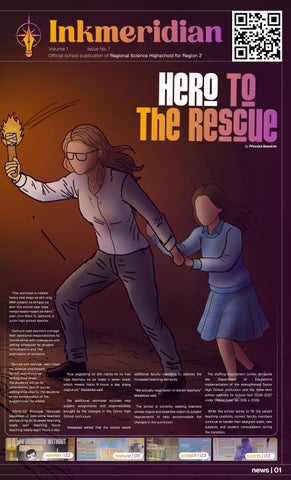
Hero by Princess Baquiran
“The workload is indeed heavy kasi bago sa akin ang MIM subject na binigay sa akin this school year kaya nangangapa-ngapa pa kami,” said Jhun Mark G. Gamurot, a junior high school teacher. Gamurot said teachers manage their additional responsibilities by coordinating with colleagues and setting schedules for student consultations and the submission of revisions. “But we still manage kasi I have my science counterpart for SIP, and of course setting time when the students will go for consultation, and of course setting time also for the deadline
"Kasi pagdating ko dito nakita ko na may mga teachers na six loads o seven loads,
increased teaching demands.
which means halos 8 hours a day silang nagtuturo,” Malabbad said.
of the incorporation of the suggestions,” he added.
additional faculty members to address the
The staffing requirement comes alongside the
Department
of
Education’s
implementation of the strengthened Senior “We actually need seven to eleven teachers,”
High School curriculum and the three-term
Malabbad said.
school calendar for School Year 2026–2027 under DepEd Order No. 009, s. 2026.
The additional workload includes new subject assignments and responsibilities
The school is currently seeking teachers
RSHS-02 Principal Honorato brought by the changes in the Senior High Malabbad Jr. said some teachers School curriculum. are handling six to seven teaching loads, with teaching hours Malabbad added that the school needs reaching nearly eight hours a day.
whose majors and expertise match its subject
While the school works to fill the vacant
requirements to help accommodate the
teaching positions, current faculty members
changes in the curriculum.
continue to handle their assigned loads, new subjects, and student consultations during the transition.
news | 01
Deveoping in Filipino Literacy
Of Grade 12 RSHS students is emerging in English literacy Emerging in Filipino Literacy
03 04
Information without formation
Layout Artists Marian Faye Dela Cruz Angelica Albano
Graphics Artists Marian Faye Dela Cruz Angelica Albano Stefano Diaz
News Writers Angelica Albano Johnrich Coroza Princess Baquiran Precious Joson
Editorial Writers Johnrich Coroza Ertwill Totto
Feature Writers Johnrich Coroza Tim Manaloto Arizha Valdez
Scitech Writers Marian Faye Dela Cruz
enRICHment
by Johnrich Coroza
While fake news races across
of Regional Science High School for
not simply another subject
misleading advertisements, edited
Filipino screens at the speed of a
Region 02 in Tumauini, Isabela, this
competing for a student's time. It
videos, fabricated headlines, AI-
click, the education system is
is more than a change printed on a
teaches students to examine
generated content, and deceptive
quietly taking away one of the few
curriculum guide. It is a change in
sources, identify bias, verify
posts every day. The danger is no
subjects designed to teach
what their final year of Senior High
information, recognize
longer just not knowing, but
students how to catch it. In an age
School may look like, particularly
manipulation, and understand how
confidently believing something
Johnrich Coroza
where information is everywhere
for those covered by the
media shape public opinion. These
false and eventually spreading it. If
Ertwill Totto
but understanding is not, giving
strengthened curriculum. In a
are not optional skills in a society
students are expected to become
Czar Pacunana
students more information without
science-oriented institution where
where one fabricated post can
critical thinkers and digitally literate
Mar Marayag
forming their ability to question it is
students are expected to analyze
influence thousands before the
individuals, they must be given
Khot Tarun
a dangerous contradiction.
information, conduct research, and
truth even has a chance to catch
enough opportunities to learn how
defend conclusions, the ability to
up.
to verify sources, recognize
Angelica Albano Princess Baquiran Ertwill Totto Stefano Diaz
Sports Writer
In partial fulfillment for Media And Information Literacy
Teacher Rogelio Del Rosario Jr.
Under DepEd Order No. 017, s.
determine whether information is
2026, or the Strengthened Senior
credible should not be treated as
DepEd’s reliance on “integration”
and distinguish evidence from
High School Curriculum, the
an afterthought. RSHS 02 itself is a
deserves closer scrutiny. Simply
persuasion.
Department of Education reduced
specialized public secondary
mentioning Media and Information
the former 15 core subjects to five,
school serving the region, making
Literacy competencies in other
The Philippines does not need
including Effective Communication
the question of how these
subjects does not guarantee that
graduates who can simply access
and Mabisang Komunikasyon, as
competencies are preserved
students will receive the same
information faster; it needs
part of its effort to decongest the
particularly significant.
depth, time, and practice. With
graduates who know whether that
teachers already handling
information deserves to be trusted.
Senior High School curriculum.
misinformation and propaganda,
Media and Information Literacy is
DepEd has a point: the old
numerous competencies within
For students preparing to enter
no longer retained as a separate
curriculum was overloaded,
limited class hours, media literacy
universities, workplaces, and a
core subject, with related
fragmented, and left students
could easily become something
society shaped by digital media,
competencies expected to be
carrying too many subjects at once.
briefly discussed rather than a skill
media literacy is not an extra skill
integrated into the new curriculum.
Streamlining it can give learners
consistently developed. If MIL is
but a necessity. A shorter
The transition, however, is being
more room to focus on essential
removed as a separate subject,
curriculum may seem efficient, but
implemented by batch, with Grade
competencies. But cutting
DepEd must prove that integration
if it leaves students less prepared
12 learners in pilot schools
congestion should not mean
can achieve the same or better
to question and verify what they
continuing under the strengthened
cutting away the space where
level of mastery
see, then what was removed was
curriculum in School Year 2026–
students learn how to question the
2027.
information placed in front of them.
For the upcoming Grade 12 learners
Media and Information Literacy is
more than a subject. It was a The need for these skills is even
safeguard. Information without
more urgent outside the classroom.
understanding it’s formation is not
Students encounter political claims,
empowerment; it is exposure.
PlanS without Progress
A Leader, or a laid back Tres Supervisor
by Ertwill Totto
Issues are meant tosettled, be settled, be temporarily solved, when they're popularised fortime. a Issues are meant to be not tonot justto bejust temporarily solved, when they're popularised for a period of
4 5
bythenumbers
RSHS' take on the recent SONA 2026
periodBongbong of time. President Marcos (PBBM)
intended to feed 4.5 million nursery to
a statement that raised many concerns
His concern reflects a larger problem
President Bongbong Marcos (PBBM) plans plans for higher education, and its impacts
And there also the Feeding program grade 1 andisabove pupils to nourish them.
stated students. the incorporation of Artificial among
He’sPBBM’s all talk, but wherepromises. is the action?” with previous Despite
forcurrent higher and education, its impacts on on future and learners. All issues
intended to feed million nursery But wouldn't it be4.5 better to use thoseto
Intelligence (AI) in our Educational system,
plans to address issues such as ghost
currentbe and futureto learners. Alleven issues should brought the light if they
gradefor 1 and above pupils to nourish funds providing the students withthem.
aPrecious statement that raised manya concerns Joshua M. Noses, Grade 12
flood control reflects projectsaand government His concern larger problem with
should be brought to the light even if they are obscure
But wouldn't it be or better to usethe those learning materials improving ARAL
among from students. student the Regional Science High
corruption, many problems PBBM’s previous promises.remain Despite plans
are obscure
funds foras providing the students with program, the majority of learners have
School for Region 02, expressed his
unresolved, leavingsuch people questioning to address issues as ghost flood
During the 2026 State Of the Nation
learning materials improving been found to haveor low literacy the ARAL
Precious Joshuawith M. Noses, Grade 12 disappointment PBBM’sa plans,
whether new promises will truly control projects and government
During the 2026PBBM State failed Of theto Nation Address (SONA) address
program, asand thethe majority of learners proficiency, majority of Gradehave 12
student from Regional Science High particularly histhe proposal to integrate AI
materialize. A planproblems may sound impressive, corruption, many remain
Address (SONA) PBBM failed toissues. address the majority of the educational
been found to have lowSchool literacy Regional Science High students
School for Region 02, expressed that his AI into education. He acknowledged
but without consistent action, it remains unresolved, leaving people questioning
Highly agree with the
the majority the educational issues.of PBBM mainlyofhighlighted the benefits
proficiency, theat majority of Grade 12 are found to and be still the developing
disappointment PBBM’s its plans, can be useful, butwith questioned
only a promise. whether new promises will truly
into the Educational System
PBBM highlighted the benefits his pastmainly and upcoming address to the of
Regional Science High School students stage.
particularlyintegration his proposal to integrate immediate when its misuseAIis
materialize. A plan may sound impressive,
his past andsector. upcoming address PBBM to the Educational For instance
are found to be still at the developing
into education. Heschools. acknowledged that AI already evident in “It’s
but without consistent action, it remains Before presenting another solution,
Educationalhis sector. Forto instance mentioned solution inspire PBBM students
stage. These provided solutions may help
can be useful,that buthe questioned disappointing wants to its push global
only a promise. perhaps the government should first finish
mentioned his solution to inspire 5students to finish college is by sponsoring
address some concerns however there are
immediate integration when misusethe is competitiveness yet does notits address
what it has already started. What happens
to finish college is by sponsoring 5 to be students each barangay ₽100,000,
These provided solutions helpfully still present problems thatmay weren't
already evident schools. “It’sit. responsibility thatincomes with
to the promises of yesterday when the Before presenting another solution,
students barangay ₽100,000, to be known as each Presidential scholars.
address some concerns however there addressed during the SONA. PBBM alsoare
disappointing that he wants to push global actions today remain insufficient? perhapsofthe government should firstAfinish
known as Presidential scholars.
still present problems that weren't fully stated the incorporation of Artificial
competitiveness yet does notaction?” address the He’s all talk, but where is the
plan action is not progress; it is a whatwithout it has already started. What happens
And there is also the Feeding program
addressed during the Educational SONA. PBBM also Intelligence (AI) in our system,
responsibility that comes with it.
gamble. to the promises of yesterday when the
Highly Disagrees with the idea of fully integrating AI into the Educational System
idea of fully integrating AI
Abstain to wether inclusion of AI or not in the Educational System
Majority of RSHS Students disagree with the address of of integrating integrating AIAI in in Educational Educational system system
enRICHment by Johnrich Coroza
There are questions a leader can afford not to answer immediately. But there are questions a leader cannot afford not to understand
..When WhenVice VicePresident PresidentSara SaraDuterte Dutertewas
brush aside. comment” becomes The proposed difficult project to simply is
What does asking: What it mean is Paxfor Silica? Filipino Who workers,
when a leaderand observations, is busy theycarrying should remain a
asked was asked about about Pax Silica Pax Silica whilewhile in The in
expected brush aside. by The the BCDA proposed to attract project is
students,from benefits businesses, it? Who and could be
position, who opinions, not facts is carrying disguised the concerns as
Hague, The Hague, she appeared she appeared unfamiliar unfamiliar with
billions of by expected dollars the BCDA in investments to attract and
communities? affected? What are its risks? What
of the people? conclusions. But his criticism points to
the initiative. with the initiative. “What? “What? Fox Silic?” Fox Silic?” she
potentially billions of dollars create in more investments than 130,000 and
does it mean for Filipino workers,
something worth discussing: when a
asked. she asked. AfterAfter the question the question waswas clarified,
high-qualitycreate potentially jobs. At more thethan same 130,000 time,
Because is and not a guessing students,leadership businesses,
leader is busy carrying a position, who
she replied, clarified, she“Ireplied, have no… “I have I cannot no… I
officials havejobs. high-quality had At to address the sameconcerns time,
game. You cannot represent people communities?
is carrying the concerns of the people?
comment cannot comment on that.”onFor that.” me, For thatme, was that
involvinghave officials water had resources, to address theconcerns
while remaining comfortably unaware
moremore was than than an awkward an awkward moment moment caught
environment, involving water indigenous resources,peoples, the
ofBecause the issues leadership being discussed is not a guessing around
on camera. caught on camera. It was aItreminder was a reminder of whatof
mining, and possible environment, indigenous displacement. peoples, In
them. You cannot represent people game.
happens what happens whenwhen the person the person holding holding the
other words, mining, and possible there aredisplacement. plenty of In
while remaining comfortably unaware
microphone the microphone has has not been not been listening listening to
reasons other words, for Filipinos there are toplenty ask questions. of
Dave the incident of theBasty issuesAbuela being sees discussed around
thethe to conversation. conversation.
reasons for Filipinos to ask questions.
critically, saying he felt that Duterte them.
A leader does not have to know
appeared unconcerned and was
Pax PaxSilica Silicaisisnot notsome someobscure obscurephrase phrase
everything. A leader does I willnot give have herto that. know But a
not Dave showing Basty accountability. Abuela sees the incident
invented overnight. The Philippines
leader should everything. I will know givewhat her that. deserves But ato
He also questioned critically, saying he where
joined the U.S.-led initiative in April
be known. leader should know what deserves to
her priorities felt that Duterte seemed to
2026 as its 13th member, with the
be known.
lie, especially while appeared
partnership focusing on
That is the real problem for me. It is not
her impeachment unconcerned and
semiconductors, artificial intelligence,
embarrassing That is the real to problem say, “I dofor notme. know.” It is
trial was was not showing ongoing.
critical minerals, and advanced
What not embarrassing becomes embarrassing to say, “I do is not when “I
Those are Dave’s accountability.
manufacturing. A proposed high-tech
do not know” know.” What becomes sounds like embarrassing the end of is
personal He also questioned observa-
industrial hub is also being developed
the story when “I dorather not know” than the sounds beginning like the of
tions, and priorities whereher they seem-
in New Clark City.
learvvning. end of the story A leader rather who than is genuinely the
should ed to lie, remain especially while her
concernedof beginning should learvvning. be asking: A leader Whatwho is
opinions, not facts impeachment trial was disguised ongoing. as
And this is where the “I cannot
Pax is genuinely Silica? Who concerned benefits should from it? be Who
conclusions. Those are Dave’s But his personal criticism points to
comment” becomes difficult to simply
could be affected? What are its risks?
something worth discussing: when a
LET THem GrOw Three principals in a year and a half.
Tres
demanding results from them?
process harder. Just as one leader begins to understand the school and develop a direction,
produces results the moment
another arrives and starts the
someone takes the wheel. It is
process again. Programs may
School, the name on the
more like a tree. Before
shift, priorities may change, and
principal’s door has changed
expecting new branches, we
the school community has to
three times: Sir Victor Allam,
have to let the roots settle. A
adjust once more. It is difficult to
followed by Junapoli Tumolva,
new principal needs time to
measure a leader's vision when
and now Honorato Malabad Jr.
understand the teachers, listen
the vision barely has time to
Three leaders, three approaches,
to the students, study the
leave the drawing board.
and three opportunities to shape
school's problems, and learn
the same institution. But with
how everything works before
So as Honorato Malabad Jr.
every change comes a question
deciding what needs to change.
takes the seat after Sir Victor
that deserves more attention:
25-26
by Ertwill Totto
A school is not a machine that
At Regional Science High
?
Allam and Junapoli Tumolva,
Are we giving our leaders
The frequent change in
perhaps the school community
enough time to grow before
leadership can also make that
should not immediately ask,
“What have you accomplished?” Perhaps the better question is, “What are you building?” Then, give that building enough time to stand. Three principals in one and a half years should not make us expect three instant transformations. Instead, it should remind us that leadership needs continuity, patience, and time. Before we demand the branches, let the roots grow.
List of Principals in RSHS bythenumbers
25-26
25-26
Victor Allam
Junapoli
26-27
26-27 Honorato Malabad
4
5
6 PAULitics
For some, acceptance begins not when the world understands them, but when they finally understand themselves. A rainbow is easy to admire from a distance. Its colors are bright, distinct, and impossible to miss. But for people who identify with those colors, being different can feel far less beautiful when the eyes watching them are filled with judgment. Behind the pride, the celebrations, and the growing visibility of the LGBTQ+ community are stories of people who once wondered whether being themselves would cost them the acceptance of the people they loved most. At the Regional Science High School for Region 2, acceptance has gradually found its place in the school community. Celebrations and expressions of support have created spaces where members of the LGBTQ+ community can feel seen. Yet acceptance is not always as simple as colorful banners or supportive words. For some, the hardest person to convince is not a parent, a friend, or a classmate. It is themselves. For Randyjr Dejan, a Grade 12 Vega student, that realization began in junior high school. It came not as a grand announcement, but as a moment of recognition. “Oh my God, this is me. I’m bisexual, and this is me,” he recalled. In that moment, a part of himself that had once seemed confusing finally had a name. But knowing who he was did not immediately erase the fear that came with it. His greatest worry was his father. Raised with traditional beliefs, his father was someone Randy looked up to, making the possibility of rejection feel especially frightening. The fear was not simply about being judged by another person. It was the fear of losing the acceptance of someone whose opinion mattered deeply to him. For a while, the thought of revealing that part of himself carried a weight heavier than the realization itself.
making someone feel that they do not have to hide. Still, acceptance remains complicated when fear enters the picture. The desire to belong can make people question their own identity, wondering whether being honest about themselves will change how others see them. Validation can feel precious, especially when it comes from people whose opinions matter. But no amount of approval, or disapproval, can change the truth of who a person is. Perhaps that is why acceptance should not be measured only by how many people applaud, support, or understand. There will always be people who question what they do not understand. There will always be opinions that cannot be controlled. What can be controlled is whether a person continues to let those opinions determine how they see themselves. For those still struggling to accept their identity, the journey does not have to happen all at once. There is no required timetable for understanding yourself, coming out, or finding the courage to be open. Some people discover themselves early, while others need years to understand the parts of themselves they once feared. What matters is having the freedom to move at a pace that feels safe and honest. And for those standing beside them, acceptance can begin with something as simple as listening. Not every person needs an explanation, a debate, or a lesson about who they are. Sometimes, they simply need someone who will stay. In a world where rejection can make people question their worth, choosing kindness can become a quiet form of courage.
But the rejection Randy feared never became his reality. His father eventually accepted him, while his mother became one of his strongest sources of support. In moments when doubt returned, she reminded him of something he needed to hear, “This is you. Ikaw 'yan. May sarili kang kakayahan.” Her words helped Randy see that being different did not make him less deserving of love, respect, or a place among others.
Randy's journey is not simply about discovering that he is bisexual. It is about discovering that the difference he once feared did not need to be erased. It needed to be understood. His story reminds us that the road to acceptance does not always end when everyone else finally says yes. Sometimes, the most important yes is the one a person learns to give themselves.
His story also reveals that acceptance is not limited to those who belong to the LGBTQ+ community. It can come from anyone willing to understand rather than judge. A friend who chooses to listen, a classmate who refuses to make someone feel ashamed, or a family member who chooses love over prejudice can become part of another person's journey toward selfacceptance. Sometimes, support does not require grand gestures. Sometimes, it simply means
The rainbow, after all, does not ask permission to have different colors. It simply exists as it is. Perhaps people can learn the same lesson, that being different does not make someone incomplete. Acceptance begins when fear no longer gets the final word, when judgment loses its power, and when a person can finally look at themselves and say, without hesitation, “This is me.”
by Tim Manaloto Every summit begins with a climb, and every climb leaves a lesson behind. High above the usual rhythm of school life, the Regional Science High School for Region 2 stands within an upland environment where the mountain is more than part of the scenery. For its students, the climb toward academic excellence happens alongside changing weather, unfamiliar surroundings, demanding responsibilities, and the pressure to keep up. Here, excellence is not simply found in grades, awards, or examinations. It is shaped by the ability to keep moving when the path becomes difficult. For students entering the school, the upland environment offers a different kind of beginning. The cool air and mountainous surroundings can make the campus feel refreshing, but the experience also comes with adjustments. Typhoons can disrupt routines, academic workloads can become demanding, and students must learn to manage responsibilities while adapting to their new environment. The higher the expectations, the steeper the climb can feel. For Donald Batara, a Grade 7 Amethyst student, the first steps toward that climb began with a sense of excitement. “It feels so good; it feels like a fresh air to study here,” he recalled. Arriving at the school gave him a fresh atmosphere and a new place to grow. The mountain surrounding him initially felt like a symbol of a new beginning, a place where he could start another chapter of his education. But every mountain has its slopes, and the excitement of a new beginning eventually met the realities of student life. The weather became one of the challenges, particularly when typhoons disrupted routines, while academic responsibilities continued to demand his attention. What initially felt like a refreshing environment also became a place where Donald had to learn how to withstand pressure. Instead of allowing these difficulties to stop him, Donald began looking beyond the obstacle itself. He started asking not only why something was difficult, but what he could do to overcome it. Through his experiences, he realized that struggling in a new environment was not something unique to him. Every student has a different mountain to climb, and each one requires patience, discipline, and persistence. The climb became visible even in ordinary school experiences. Intramurals gave him memories outside academics, while teachers' expectations taught him discipline. Assignments, responsibilities, and everyday challenges became steps along the way. None of them alone could be considered a summit, but together, they slowly shaped his understanding of what it meant to grow as a student. Excellence, after all, is rarely reached in a single
leap. It is built through repeated efforts, through studying when the lesson is difficult, continuing when the workload becomes heavy, and learning from mistakes instead of allowing them to define one's ability. The mountain does not become smaller simply because someone wants to reach the top. The person climbing it becomes stronger. Donald’s experience reflects the journey of many students who find themselves in an unfamiliar environment. The first days may bring excitement, but eventually, every student encounters moments when the climb becomes tiring. It is during these moments that adjustment becomes important. Asking for help, managing time, learning from others, and finding solutions can turn a steep path into one that can be climbed step by step. The lesson also reaches beyond the school grounds. Everyone has a personal mountain, whether it is academic pressure, family responsibilities, career goals, financial struggles, or the uncertainty of the future. Some climbs are visible to others, while some happen quietly. What matters is not how quickly someone reaches the top, but whether they continue moving despite the difficulties along the way. For students who feel overwhelmed by their own climb, struggling does not mean they are falling behind. There are days when progress may look like completing one assignment, understanding one difficult lesson, or simply showing up despite exhaustion. Small steps still count. A mountain is conquered not by one extraordinary movement, but by countless ordinary ones. For Donald, the mountain surrounding his school has gradually become more than a physical landscape. It represents the challenges that come with learning and the growth that follows from facing them. The difficulties did not disappear, but his perspective changed. What once seemed like obstacles became part of the experience that taught him how to move forward. Perhaps that is what makes this place Mount Excellence. Its peak is not simply a place where the highest grades or greatest achievements are found. It is every student's continuing journey toward becoming better than who they were before. The climb may be long, the weather may change, and the path may become steep, but every step upward carries a lesson. In the end, excellence is not merely about reaching the summit. It is about becoming strong enough to keep climbing.
At first, Zyroll Aquino thought love would be another thing he could fit into his already crowded life. There were classes in the morning, assignments at night, examinations to prepare for, and dreams growing heavier with every school year. Somewhere between all of those, there was her. And for a while, he believed there was enough room for both. He learned to answer messages between classes, make time after school, and carry a relationship alongside the expectations of being a student. Love became part of his routine, woven into the life he was already building. He was young, but he loved as though he had already figured everything out. He hadn't. Like many people who fall in love while still discovering themselves, Zyroll eventually found himself between two futures, the one he was building for himself and the one he was trying to build with someone else. For nearly two years, their relationship became a world of latenight conversations, laughter, ordinary moments turned into memories, and the comfort of having someone there. But relationships are rarely made only of beautiful moments. Misunderstandings came, questions followed, and small arguments began carrying the weight of things left unsaid. Slowly, something that once felt like a place to rest became another thing to carry. For Zyroll, there was another battle happening quietly in the background, academics, the future, and the dream of getting into the university he wanted. There were lessons to understand and examinations to prepare for,
but there was also a relationship that demanded emotional space. Love did not deliberately steal his time. It simply occupied some of it, a message here, an argument there, a night spent thinking about what went wrong instead of what needed to be studied. Eventually, his attention became divided. Perhaps that was one of the hardest truths of growing up, you can love someone sincerely and still lose pieces of yourself in the process. Then came the questions. There were concerns about other people, social-media interactions, a classmate, a follow, a conversation, another confrontation. Things that looked small from the outside began carrying the weight of everything that had already happened inside the relationship. Trust, once shaken, rarely breaks with one sound. Sometimes it cracks quietly. And when trust becomes something that must constantly be defended, love begins to feel less like a home and more like a courtroom. Every action becomes evidence. Every silence becomes suspicious. Every explanation is examined. Zyroll did not wake up one morning and decide that everything they shared meant nothing. Instead, he reached the harder realization that something could have been real and still no longer be right. Then came the conversation neither of them wanted,
7
by Arizha Valdez
“Vroom-vroom.” The engine rumbles, not as a clock, but as a cue for a brand-new day. While the rest of the town remains buried beneath warm blankets, someone’s work has already begun. Under gray skies and cold morning air, the only warmth comes from the engine humming in front of him, ready to carry another passenger through the streets of Tumauini. From the first light of morning until the moon rises, the pedicab becomes more than a means of transportation. It becomes a small moving window into the town, passing between buildings, crossing roads surrounded by maize fields, and carrying students as they make their way to and from school. Along the way come stories, laughter, struggles, and memories, shared between destinations. With every ride, distances seem to shrink, not only because the vehicle moves forward, but because conversations make strangers feel a little more understood.
where certainty was replaced by hesitation, “Ayaw ko na siguro.” It was not the certainty of someone who had never cared, but the uncertainty of someone who had cared for so long that letting go felt almost as frightening as staying. He knew what nearly two years meant, late-night conversations, arguments survived, apologies accepted, and memories that could never happen again in exactly the same way. After the breakup, life refused to pause for heartbreak. Classes continued. Assignments remained. People laughed in hallways. Notifications arrived. The world moved forward with an almost insulting normalcy. Yet heartbreak can make ordinary things feel like evidence. A song could suddenly mean something. A social-media note could change the mood of an afternoon. A new mutual or a follow-back could reopen questions he was trying to bury. For someone trying to move on, the internet can become a courtroom without a judge, filled with assumptions, memories, and questions that rarely receive satisfying answers.
For anyone facing the same struggle, wanting both love and a future is not wrong. But balance requires intention. Give each other room to study, work, rest, grow, and pursue personal goals. Keep the friendships and dreams that existed before the relationship. A healthy love should accompany
growth, not compete with it. If keeping a relationship means constantly sacrificing the future you have worked for, something may need to change. For those already facing the aftermath, moving on does not mean pretending the relationship never mattered. It means accepting that something can be meaningful and still be finished. Do not turn every notification into a confession or every song into a hidden message. Do not keep searching someone's social media for an answer that may never come. Sometimes, closure begins when you stop looking for clues in a story that has already ended. The relationship had its own verdict. Not guilty. Not guilty. Not guilty. Just over. No judge declared it. No courtroom decided it. There was only the quiet understanding between two people who had reached the end of something they once believed would last. And perhaps that is what makes their feelings extra judicial. They were never formally tried, never properly sentenced. They simply remained somewhere between memory and regret, between love and letting go, until one day, the feelings became quieter than the future waiting ahead. Maybe that is the verdict worth keeping, not that love was a mistake, but that love should never cost you the person you are becoming. Sometimes, a love can be genuine, beautiful, and unforgettable, and still not be the place where you are meant to stay.
Among the familiar faces behind the handlebars are the Reyes siblings, whose bond goes beyond blood. Their shared livelihood has become part of the rhythm of their lives, with years of experience shaping the way they serve the people who depend on them. For students, however, they are not simply drivers waiting for passengers. They have become familiar faces, dependable companions, and, in many ways, an extra pair of hands whenever someone needs help. Among them is Bert Reyes, more commonly known as “Kuya Boy,” whose worn hands carry more than the marks of years spent driving. The calluses and lines on his palms seem to map out the countless roads he has traveled and the people he has encountered along the way. Behind the handlebars, he moves with a mixture of patience, courage, and sympathy, treating many of his young passengers not merely as customers, but as people he has grown to care for, often with the simple attitude of treating them “parang anak.” A wave from a familiar passenger is often met with his bright smile. The exchange may last only a few seconds before his hand tightens around the brake and the engine gradually comes to a stop, but for the people who know him, the greeting means more than a simple ride. It is a small reminder that someone is willing to notice when they need a little help. Through the heat of the afternoon and the sudden downpours brought by changing weather, Kuya Boy remains on the road. He does not wear a cape, nor does he claim to be a hero. Instead, he wears practical clothes, grips the handlebars, and drives a modest pedicab that rattles with every bump along the road. Yet within that small vehicle, years of trust have been built between him and the passengers who repeatedly return to his seat.
For Kuya Boy, every passenger carries a different reason for getting on the pedicab. Some are simply trying to get home, while others may be rushing to school, hungry, or facing an unexpected problem. Whatever the reason, he believes that responding to those needs is part of the service he provides. “Tinutugunan namin yan, malay mo emergency, nagugutom o mayroong hinahabol na oras. Kaya sinusundo namin sila kahit umulan, bumagyo bilang responsibilidad. Hindi naman totally na responsibilidad, parang tutugunan lang namin para sa serbisyong gusto namin iparating sa kanila,” he shared. For him, driving is therefore more than a way to earn. It is also a way of giving back to the people who have placed their trust in him. Every ride becomes an exchange, passengers receive transportation and assistance, while he receives the trust and continued support that keeps his livelihood moving. Yet behind the familiar smile and dependable service is a man who once imagined a different life. “Sa akin naman dati hindi naman yan ang gusto ko, ano, work. May pangarap din kami, so yung pangarap namin financially, hindi namin na ano. Kaya ito yung way na kaya naming mabuhay yung family namin,” Kuya Boy said. Like many people, he once carried dreams that did not unfold exactly as planned. Circumstances led him somewhere different, but instead of allowing that difference to define him, he found meaning in the life he was able to build. Perhaps that is what makes the work of drivers like Kuya Boy easy to overlook. From the outside, it may seem like another ordinary job, another pedicab waiting along the roadside, another engine starting before sunrise. But behind the handlebars is someone carrying a family, a livelihood, a history of dreams, and the trust of the people who ride with him. The road does not always lead people where they initially hoped to go. Sometimes, plans change, dreams are postponed, and survival demands a different direction. But along the way, people can still find purpose in what they do. For Kuya Boy, that purpose travels with every passenger, through every rainy morning, every crowded school day, and every familiar face that waves from the roadside. On three wheels, he continues forward, driven by the people who depend on him and the connections he has built along the road.
8 SCITECH
The violent pop that shattered the quiet dusk over Regional Science High School - Region 02 wasn’t just the sound of copper wires frying inside a central power transformer. It was the sound of an entire academic engine grinding to a sudden, terrifying halt.
by Marian Faye Dela Cruz
High above the concrete pavement, a tiny 50-kilovoltampere (kVA) transformer had finally surrendered. For years, as sleek new air-conditioning units were mounted across classrooms, the invisible grid feeding them remained trapped in the past. When the heat surged and two or three heavyduty cooling units kicked on simultaneously, the campus demand skyrocketed to nearly 100 kVA. The mathematical reality was brutal: the school was asking a lightweight system to pull a heavyweight load. In a science high school where lessons run on relentless schedules and high-tech labs, a blackout is a slow-motion disaster. Bypass the bureaucracy, Malabad decided. Morning turned into a flurry of urgent calls directly to the leadership of the Isabela Electric Cooperative (ISELCO), drafting formal petitions while the rest of the students were anxious. "Hindi na talaga sya kayang ayusin kasi sumabog na," Malabad admitted, recalling the mid-day scramble. "Lumampas na sya sa limit. Ever since na nag-start mag-aircon, hindi na kaya kasi walang initial computation." By the afternoon, the gamble paid off. ISELCO service trucks rolled past the school gates, swapping out the charred transformer before the first bell could ring. But Malabad wasn't just patching up a hole. Knowing a second 50 kVA unit on campus was already showing signs of giving out, he immediately ordered a full campus-wide load assessment, petitioning for heavy-duty 100 kVA replacements to permanently shield the school from another surge. Yet, as the scorching heat from the sun bakes the campus, a lingering question hung in the humid air: Why not just suspend
CAN’T E EN
classes and send everyone home? For Malabad, the thought was a non-negotiable line in the sand. Throw open the windows. Let the humid breeze roll in. Grab the paper fans. But keep the chalk moving. Behind that decision sits the unsung, rigid heartbeat of Philippine education: the Budget of Work (BOW). Derived from the DepEd Curriculum Guide, the BOW is a teacher’s sacred roadmap—a day-by-day, hourby-hour ledger of mandatory competencies that must be delivered within tight instructional blocks. "Ang Budget of Work, iyan ang bible ng teacher," Malabad explained, his voice softening with empathy for his faculty. "Once na-disrupt ang classes, ang teacher kawawang maghahabol. Kailangan magdouble topic, kailangan magintervention. Lalo na bagyobagyo nanaman—additional burden iyon." To a student, a blackout feels like an excuse for a free day. To a teacher, a cancelled class is a logistical nightmare—a cascading wave of double-time lectures, rushed exams, and compressed lessons, all while battling the unpredictable cancellations of typhoon season. By the next day, the familiar, low hum of electricity vibrated back through the walls of RSHS 02. The new transformer was humming, the air was cooling, and the threat had passed. It was a quiet victory over a school day crisis—a reminder that while modern power grids can trip under pressure, the human engine driving the school's classrooms refuses to break.
by Princess Baquiran
During recess, the canteen once again becomes a familiar stop for the Regsay students looking for something to eat. Among the choices are packed chips and carbonated beverages that were previously absent from the school shelves. What was once missing from the counters of RSHS-02 canteen, is now back within reach. But as these food items become available, one question remains, can students resist what the canteen makes easiest to grab? Back on the Counter The return of junk food comes years after the Department of Education (DepEd) established guidelines meant to promote healthier food and beverage choices in schools. DepEd Order No. 13, s. 2017, or the Policy and Guidelines on Healthy Food and Beverage Choices in Schools and in DepEd Offices, was implemented to promote healthy and nutritious food choices available for learners and DepEd personnel, and establish standards for foods sold in schools. Under the order, food and beverages are categorized in colors according to their nutritional value. Green foods are encouraged, Yellow foods are to be consumed in moderation, while Red foods are not recommended for sale. The system considers
factors such as sugar, sodium, saturated fat, and trans fat rather than simply labeling a product as “junk food.” The concern goes beyond the snack itself. The food environment surrounding young people can shape what becomes convenient and accessible to them. According to UNICEF Philippines, 74% of children aged 13–15 eat fewer than three portions of vegetables a day, while 38% drink at least one soft drink daily. A Choice within Reach A short survey conducted in Regional Science High School for Region 2 showed that 46.7% identified taste as their biggest consideration when buying snacks, followed by price at 20%, nutritional value at 16.7%, and
availability at 13.3%. The results show that the decision made at the canteen counter is influenced by immediate factors such as flavor, affordability, and accessibility rather than nutrition alone. The challenge may not simply be whether students know what is healthy or not, but if healthier choices can compete with what is affordable and appetizing. The Not-So-Sweet Side The science behind this concern lies in what frequent consumption can do to the wellbeing of the body. According to the World Health Organization, junk foods are also known as discretionary or ultra-processed foods, which contain high levels of fat, free sugars, and sodium, which can be associated with negative health outcomes, when eaten
without moderation. Too much sodium can increase the risk of high blood pressure, while diets high in sugar are associated with a greater risk of unhealthy weight gain and tooth decay. WHO also recommends limiting soft drinks and other sugar-rich beverages and avoiding snacks high in salt and sugar. With these risks in mind, students do not necessarily have to completely avoid junk food. What matters is knowing what they are eating and having healthier options to choose from when they buy food at school. After all, having more choices also means having the responsibility to choose wisely.
And as the last students leave the canteen, the shelves begin to look a little emptier. The wrappers may disappear into trash bins, but the choices remain for the next break. The return of junk food may have changed the choices available, but it does not have to determine the choices students make, especially when healthier options are made just as accessible. Because a healthy diet should not be about resisting every craving, rather it should be about making sure the healthier choice is never the harder one to find.
SCITECH 9
by Ertwill Totto
The sun is unforgiving, the air heavy with heat, and a bottle of water that should have been easy to find suddenly feels like a necessity worth searching for.
9 11 out of
students showed signs of decreased active participation due to dehydration
Flush the Problem :
More Than Just a Dirty Toilet A school restroom may seem disconnected from the classroom, but sanitation is part of the environment in which students learn. The Department of Education's Comprehensive Water, Sanitation and Hygiene in Schools (WinS) Program recognizes access to safe water, adequate toilets, and handwashing facilities as essential components of a clean and safe school environment. The policy also aims to develop proper hygiene and sanitation practices among learners. DepEd's guidelines further emphasize that toilets should be functional, clean, private, adequately ventilated, and provided with facilities for handwashing. These standards exist for a reason.
discomfort. Urine contains nitrogen-containing compounds, and as urine sits and is acted upon by microorganisms, its chemical composition can change and produce stronger odors. Poor ventilation can make these odors linger, particularly in enclosed spaces. This is why ventilation is part of sanitation standards. Philippine school sanitation regulations require toilet rooms to be properly lighted and ventilated, with good ventilation provided through windows or exhaust systems. Ventilation does more than make a restroom smell better. It helps maintain a more comfortable and hygienic environment by allowing air to circulate and reducing persistent moisture and odors. Moisture matters, too.
The World Health Organization identifies school sanitation as an important part of protecting children's health and supporting a conducive learning environment. Poorly maintained toilets can discourage students from using them, while inadequate sanitation and hygiene can increase exposure to infectious and parasitic diseases. A dirty comfort room, therefore, is not simply an eyesore. It can become a health concern.
Damp surfaces can provide conditions favorable to the persistence and growth of microorganisms. WHO's guidance for schools emphasizes regular cleaning of premises, safe waste disposal, and proper wastewater management as components of a healthy school environment.
The Science Behind the Smell That unpleasant restroom odor is more than a matter of
The Invisible Risk The most concerning part of a dirty restroom may be the things students cannot see. Microorganisms can be transferred
by Ertwill Totto through contaminated surfaces and hands. A student touches a faucet, door handle, flush mechanism, or other shared surface, then touches their face or eats without washing their hands properly. This is why handwashing is one of the simplest and most important barriers against the spread of disease. DepEd's WinS program specifically includes handwashing facilities with soap as one of its key sanitation indicators.But having a sink is not enough. Students need access to water and soap, and they need a facility that is clean and functional enough for them to actually use it.When one of these pieces is missing, proper hygiene becomes harder to practice. When Students Choose to Hold It There is another consequence that is easier to overlook. Students may avoid using school toilets when the facilities are dirty, smelly, lack privacy, or do not provide basic supplies.WHO notes that students may avoid school toilets because of poor cleanliness, unpleasant smells, lack of privacy, or the absence of toilet paper, soap, or hand-drying facilities. Toilet avoidance can contribute to problems such as dehydration and urinary or bowel difficulties. A restroom, therefore, is not simply a room with a toilet.It is part of a student's ability to manage basic bodily needs with health, privacy, and dignity.