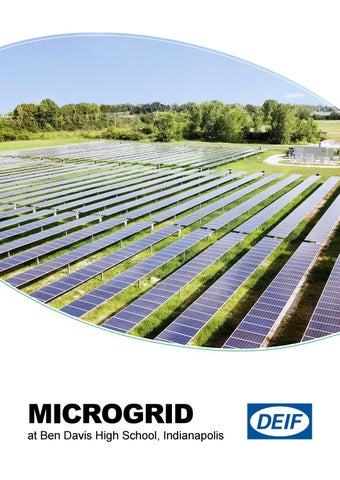
MICROGRID
at Ben Davis High School, Indianapolis
School’s hybrid microgrid showcases ease of resource management ‘DEIF is the brains of the system,’ says the contractor. ‘With DEIF’s help we’ve been able to do strategic management of all these resources.’
The project team from left: Bob Cain (Director of Sales, Girtz), David Stringer (Business Development Manager, DEIF), Brent Beissler (Engineering Manager, Girtz), Greg Taylor (Sales Engineer), Jesus Davila (General Manager, DEIF) and Arash Habibi-Soureh (Distributed Energy Resources Manager, Johnson Melloh Solutions)
School campus with own microgrid Ben Davis High School in Indianapolis, Indiana, USA,
power supply. As the demand reaches a certain set-
has about 4,500 students in in several buildings over
point beyond the solar supply, the system will start the
1.2 million square-feet (110,000 m2). The school
gas generators to take the load. This caps the power
wanted to save on its electricity bill, so has installed
from the local utility, explains Brent Beissler, Engi-
a solar and natural gas generator hybrid system – the
neering Manager at Girtz Industries.
first renewable microgrid of its kind in Indiana. “The electric company bills the school based on the The system consists of a 2 MW solar field, two 750 kW
peak amount of power used each month,” he says. “If
national gas generators, and a connection to the local
you can reduce that peak power, you can reduce your
utility. A peak shaving system controls the school’s
electric bill significantly.” 2
The 2 MW solar, 1.5 MW gas hybrid microgrid system at Ben Davis High School in Indianapolis, Indiana, USA. DEIF controllers manage a peak shaving operation with the intention to save 70% off the school’s electricity bill. 3
The challenge “Our initial concern was how to manage all of these resources effectively and responsibly to produce the most benefits for the school,” says Arash Habibi-Soureh, Distributed Energy Resources Manager at Johnson Melloh Solutions (JMS), the general contractor. JMS tasked Girtz with the gensets, switchgear and controls. “At Girtz Industries, our focus is on generator systems. We’re broadening our product scope into renewables,” says Brent Beissler. “At first, we were going to do the interconnection logic and communication ourselves. But as we got into it, we realized it was a big job.” “So we started to investigate systems that would do that logic for us,” he continues. “That’s where I came across the DEIF microgrid system. It allowed my team to focus on other things. Being able to take that communication portion off my plate was a big deal. It was a real benefit to us.”
DEIF is the brains of this operation. Without DEIF we would have no way to strategically manage the energy and the demand output that’s being created onsite that could be intelligently used by the school. Arash Habibi-Soureh Distributed Energy Resources Manager Johnson Melloh Solutions
4
The solution A DEIF AGC-4 mains controller monitors the school’s power demand and utility power use from a utility pole a short distance from the solar field, explains Brent Beissler. It communicates to the main controls room onsite via fiber link. There, two DEIF AGC-4 automatic genset controllers manage the peak shaving function. They communicate with an additional two ASC-4 solar hybrid controllers, which monitor the solar arrays. “All these DEIFs communicate with one another instantaneously to do the peak shaving function,” he says.
The outcome The school hopes to save 70% from its electricity bill
to the power utility – instead of resources such as
with the hybrid renewables system. In its first months
school programs and teachers.”
of operation, the system is working as planned, says Brent Beissler. “So far, so good.”
“Our most precious resource is kids – students,” he adds. “Being involved in this project makes me feel good and
“The biggest benefit of this system is giving the school
socially responsible. We’re providing a solution that
the tools to intelligently, effectively manage their utility
saves money, energy and the environment. It’s a rare
costs and energy usage,” adds Arash Habibi-Soureh.
triple win today.”
“They’re able to leverage money that would have gone
The project team inspects the cabinets and switchgear for the DEIF ASC-4 solar hybrid controllers – adjacent to the gas gensets and main system controls.
DEIF supplied DEIF supplied 1 AGC Mains, 2 x ASC-4 solar controllers and 2 x AGC-4 genset controllers for the Ben Davis High School solar and natural gas generator hybrid system. For more information on DEIF’s work in hybrid microgrids, please read more here.
The Girtz-JMS-DEIF collaboration with Ben Davis High School resulted in the first hybrid microgrid in Indiana. 6
One of two DEIF AGC-4 controllers onsite manage the communication among the ASC-4 solar hybrid controllers, the AGC-4 mains controller monitoring demand and power from the utility and the two natural gas gensets
One of two ASC-4 solar controllers at the school’s microgrid
Our customer says
DEIF made it very easy to get all the system pieces to work together. It was a perfect fit. Brent Beissler Engineering Manager Girtz Industries
7
View case study on deif.com
View case video
DEIF A/S Frisenborgvej 33, 7800 Skive, Denmark Tel. +45 9614 9614 Learn more at www.deif.com We’re pretty social too