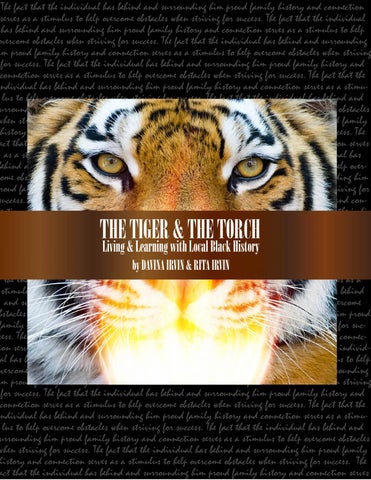
THE TIGER & THE TORCH Living & Learning with Local Black History WRITTEN BY DAVINA IRVIN and RITA IRVIN
definitedirections.com
Copyright Š 2017 Definite Directions Incorporated, Davina Irvin & Rita Irvin ISBN 978-0-9997142-0-1 Published by Definite Directions Incorporated in Christiansburg, Virginia. Printed in the United States of America. For additional information and to place orders, contact us by email at books@definitedirections.com or 540-874-2580 by telephone. All images and poetry are credited to the authors unless otherwise noted. Your emails, Facebook likes and messages, along with invitations to collaborate on future book projects are invited. Visit us online at http://www.definitedirections.com and on Facebook at https://facebook.com/definitedirections.
ď‚– Gratitude ď‚— How this book turned out is much better than we initially imagined. It is the result of lessons learned, challenged ideas and meaningful connections within our community. We are beyond grateful to our family (past & present) for their patience, love and support. Additionally, we want to express further gratitude to a few people and groups by name: Alvin Lester, Angela Banks, Blandine Momulouh-Njua, Christiansburg Town Council, CI Alumni, Corinne Lewis-Rawlins, Curtis Lovett, III, Debbie Sherman-Lee, The Drs. McLaughlin (Gerry, Josetta and Jacqui), Ed Gallimore, Gladys Sokolow, Harkrader, Jason Blyth, John Anderson, JonMarc Mitchell, Jordan Clark, Kim Lee, Lekei Patel, Mrs. Hawley, Nichole Williams, Pamela Hale, Phyllis Albritton, Raymond Jenkins, Sean Spencer, Sharon Scott, Sue Farrar, Tammi Franklin, William Calloway, and Yvonne Alderman who believed in us and in the power of this story before it was published. Finally, we thank you for reading this book.
Contents INTRODUCTION How to Use this Book & The Back Story of Our Story .............................. 8 What We Mean When We Say, “ROAR!” ................................................... 13 Why ROAR? ..................................................................................................... 14 Catalysts for Conversations ............................................................... 15 Baobab 2.0 ............................................................................................. 16 Wise African Sayings that ROAR! ................................................... 16
PART I: L IVING & L EARNING WITH L OCAL B LACK H ISTORY There’s No PLACE Like Home ..................................................................... 24 A PLACE Called Zion’s Hill.............................................................. 26 Ten Ways to be Intentional in Our Communities ............ 28 An Intentional PLACE Called Christiansburg Institute.............. 29 PURPOSE: Signs of Progress ............................................................ 31 LEADERSHIP: From a Distance ....................................................... 33 “The ORIGINAL TUSKEGEE BRICK” .............................. 34 One Building Reduced to Bricks .......................................... 35 Just Us Bricks ........................................................................... 39 ACCESS: Words as Art ....................................................................... 41 Behind Every Good Man........................................................ 47 CHOICE: Live & Learn ....................................................................... 49
Love: The Choice of a Lifetime ............................................. 51 Music: The Choice of a Lifetime .......................................... 52 Ivory Towers for Blacks: HBCUs ......................................... 54 ENGAGEMENT: Finding a Nest...................................................... 57 THE EXODUS .......................................................................... 59 …AND THEN THERE WAS ONE… ................................... 61
PART II: P UT THE "I" IN H ISTORY Let’s Go to the Museum ................................................................................. 67 St. Luke and Odd Fellows Hall + New Town ................................ 69 Anne Spencer House & Garden Museum ...................................... 71 Black History Museum & Cultural Center of Virginia ................ 75 National Museum of African American History & Culture ....... 77
PART III: P AST & P RESENT …M EET F UTURE Past, Present & Future Meet in Richmond, VA ......................................... 83 Past, Present & Future Meet in Charlottesville, VA ................................. 85
PART IV: T HE F INAL ROAR! Where Do We Go from Here? ....................................................................... 88 Celebrations, Conferences & Cultural Events Every Year ...................... 89 Everyone Loves a Good Story...Where’s Yours? ........................................ 90 Additional Resources ..................................................................................... 91 Endnotes ............................................................................................................ 94
INTRODUCTION
THE TIGER & THE TORCH Page | 7
How to Use this Book THE TIGER & THE TORCH is a different kind of book. It is a tool to help people speak up and show up for what matters. It is designed as a roadmap to spark deeper thought and dialogues that will inspire you and others to:
Become more connected in your local community; Encourage the search for truths within our shared history; Provide examples of how local roots empower people; Bring people together to create, restore and preserve noteworthy legacies.
Our content focuses on ideas, experiences and publications by and about Black people. Narratives have a casual and conversational tone that can be read in sequence or read in any order you choose. Although highly visual, there is a hefty factual component to our text. The endnotes contain multiple references to other books, research papers, videos, websites and resources that support the topics covered. These endnotes also list places to visit online and in person.
“IF THERE’S A BOOK YOU REALLY WANT TO READ, BUT IT HASN’T BEEN WRITTEN YET, THEN YOU MUST WRITE IT.” TONI MORRISON 1
T HE B ACK S TORY OF O UR S TORY A significant part of Black history remains buried and it is only through a deliberate and continuous journey that its intrinsic value can be brought to the forefront. As Black people, it is our responsibility to discover and share our untold stories. It is through literal, metaphorical, historical and personal stepping stones that we begin to tread a path for others.
Both Tigers & Fires ROAR! THE TIGER & THE TORCH Page | 8
L ITERALLY S PEAKING Tigers are hunters by nature and tend to live isolated lives. They often stay in certain geographic areas in the wild. 2 Although they are very strong, they are endangered animals and several species are extinct. 3 Even though they are dwindling in number, they continue to be the largest and strongest members of the cat family. Photo Credit: fotolia.com: Oleg Kozlov
The discovery of fire, especially portable fire through torches, 4 transformed civilization. Because of the ability to heat, purge, reshape and provide power, fire remains a practical and symbolic part of our lives. A prime example of this is the torch used in the Olympic Games. It has become internationally known as the official kickoff of the events. Its continued use today exemplifies the appreciation of ancient cultures and time-honored traditions. 5 Photo Credit: fotolia.com: Zora
M ETAPHORICALLY S PEAKING The distinct symbolism in tigers and torches alludes to the essential balance between progress and history. The tiger represents the bold perspectives and vitality of youth. The torch represents the illumination of life experiences that come with age and maturity. Their roar represents the need to communicate and serves as a call to action to be more engaged in our communities.
THE TIGER & THE TORCH Page | 9
THE TIGER SYMBOLIZES STRENGTH , SURVIVAL , AND TENACITY . THE TORCH SYMBOLIZES VISION , LEGACY , AND WISDOM .
H ISTORICALLY S PEAKING Part of the inspiration for our story comes from the history of Schaeffer Memorial Baptist Church and Christiansburg Institute (CI) in Christiansburg, VA. They epitomize what it means to be living and learning with local Black history. The year 2016 marked the 150th anniversaries (sesquicentennials) of these local African American historic landmarks. While the Christiansburg Institute was open, the school mascot was a tiger. Today, the Christiansburg Institute Alumni Association uses a tiger in their logo. A green torch logo is used by Christiansburg Institute Incorporated to celebrate the school’s century of education in Montgomery County, VA, to commemorate its rich legacy and to honor the accomplishments made.
P ERSONALLY S PEAKING We are an atypical mother and daughter pair engaged in our community. We have lived, worked and volunteered together for many years. It’s funny because when we are out and about attending events, meetings or programs separately, one is inevitably asked about the other who is absent. We often have extensive conversations about all kinds of topics and have done so for decades. This was also the case for both of us as we were growing up with our immediate family. Yet through all the meals and the quality time spent with them, we did not discuss how they arrived in the small town we call home and why they decided to stay. We also did not discuss the important roles that they had in our community. The same also held true about the places where we learned, worked and worshipped. Part of that stemmed from their purposeful silence deemed to be in our best interest and part of that stemmed from our delayed curiosity.
THE TIGER & THE TORCH Page | 10
1978 Holmes Family Photo (Pictured Left to Right): Back Row: Nathan Holmes, Verna Holmes, Zimri Holmes, Rosa Holmes and Glen Holmes Middle Row: David Irvin, Rita Irvin holding Davina Irvin, and Michele Clark Holmes
Our people were teachers, cooks, chauffeurs, entrepreneurs and veterans. Our primary inspiration to write comes from them. Their lives were narrow gateways into the essence of knowing the immeasurable value of a strong family, formal and informal education and unwavering faith. It is through their consistency in their public and private lives, along with their practical and inspirational guidance that they established a firm foundation for us growing up that continues to remain rock solid today. Our story is infused with people, places and quotes that have spoken to us over the years by connecting our hearts and minds. It is a commentary that pulls together the past, the present and the future. It is a merger of our history, our beliefs, our knowledge, and our experiences. Nathan Holmes, one of our elders, said it best, “It’s the truth the way I see it.” 6
THE TIGER & THE TORCH Page | 11
Traveling enabled us to make connections outside of our immediate circle of friends and family. It proved to be a significant component in the sharing of this story. We drove thousands of miles, attended multiple conferences, and visited many museums, parks, and other cultural sites. Virginia is rich with history and although our story is steeped in Christiansburg we also provide examples from other places in the state including Blacksburg, Charlottesville, Lynchburg and Richmond along with Washington, DC. Our desire for deeper knowledge and insight into the ongoing roles we have in growing and strengthening our Black community remains. As a community, it is impossible to shape a meaningful future with absolutely no wisdom and understanding of the past or relevance in the present. Let’s ROAR!
Davina& Rita
THE TIGER & THE TORCH Page | 12
What We Mean When We Say, “ROAR!”
RESEARCH
the facts of our heritage.
…study carefully
OVERCOME
the issues of our past.
…deal with successfully or gain control
APPRECIATE
the contributions of our elders.
…understand the worth or importance
REVITALIZE
the relics of our communities.
…make active, healthy, or energetic again
THE TIGER & THE TORCH Page | 13
WHY ROAR? (Research, Overcome, Appreciate & Revitalize) These four words help bring
THE TIGER & THE TORCH
full circle.
RESEARCH asks questions that take us through all sorts of places that we
perhaps would not go. It introduces us to people from the past and others here in the present that we would otherwise not meet. Our stories recount the ways our ancestors embodied the strength, courage and wisdom 7 to OVERCOME their challenges. They understood how the proper perspective of the past allowed for continuous progress in their present and helped to shape our future. As people observe current trends, it becomes evident that relaying our history through multiple mediums helps us achieve more effective community engagement. In doing so, we help others APPRECIATE and share experiences that span generations. It will take people of all ages to correct the current state of abandonment and disrepair of far too many African American cultural icons across the United States. They roar at us like a TIGER. 8 These remaining places, our relics, and the people they represent demonstrate the survival and tenacity of our elders. By definition, a relic is an object surviving from an earlier time, especially one of historical or sentimental interest. 9 Although it is not a common word, it is a common sight to see abandoned and blighted buildings in need of restoration throughout our communities. The sacrifices and experiences of our elders kindled their passion for creating a better life. That same fire now lights a TORCH for us to continue to progress today and demands that we REVITALIZE what remains.
THE TIGER & THE TORCH Page | 14
C ATALYSTS FOR C ONVERSATIONS In certain African communities, there are baobabs that provide a central location for important conversations. A baobab 10 is an extremely large tree. It is full of natural resources that enable people to create staple items such as paper and fabric in order make a living for themselves and their families. It is a source of water, food, and shelter. Because of the size of the tree, it is also used as a community gathering place for learning and worship. Even in harsh times, the tree is built to last and continually provides essentials for living in the African desert. Because of that, it is often called the “Tree of Life". Photo Credit: fotolia.com: Dudarev Mikhail
ROAR! T H I N K A B O U T T H I S A F R I CA N P R O V E R B : “ T R U T H I S L I K E A B A O B A B T R E E ; O N E P E R S O N ’ S A R M S C A N N O T E M B R A C E I T .” 11
Truth takes on many forms and some of our truest stories have the rawest emotions attached. Knowing this makes it easier to filter out the unfamiliar or to avoid what makes us uncomfortable. Although it is possible to quickly see and understand someone else’s point of view, sometimes it takes a long time to fully understand other people’s ideas and experiences. Yet in doing so, we avoid being blind to reality and we become more aware of the common roots we share. Every struggle has a story of its own. The outcome is what usually determines if it is ever told. The more realistic we are with our perspectives about the people and places around us, the more we can begin to fully respect ourselves and others. Moving society forward is an ongoing effort that requires ongoing dialogue. These conversations can be uncomfortable. They also can spark some of the necessary changes in our communities that make them stronger and more welcoming.
THE TIGER & THE TORCH Page | 15
ROAR!
THOUGHTS AND WORDS SHAPE ACTIONS.
ANGELA DAVIS
SAID,
“WE
HAVE TO TALK ABOUT LIBERATING MINDS AS WELL AS L I B E R A T I N G S O C I E T Y .� 12
B AOBAB 2.0 When it comes to Black history, especially local Black history, it’s hard to beat the history of the community being told by the people who have made the place their home. It is often said, “The pen is mightier than the swordâ€? 13 but now thumbs đ&#x;‘?đ&#x;‘?đ&#x;‘?đ&#x;‘? and tweets prove to be a contender. Through social media apps such as Facebook and Twitter it’s possible to share messages and images with the entire world in a matter of seconds. Whether face-to-face or phone-tophone, people are connecting across the globe. Campaigns and causes can be launched, fueled or completely decimated through social media. It truly is a catalyst for conversation and while it can augment our dialogue, it does not replace our need to build stronger relationships and to seek collective wisdom from around the world in the face of adversity.
W ISE A FRICAN S AYINGS THAT ROAR! Africana is a little book full of statements from various peoples in Africa. Editor Karen Liljedahl describes it as, “From deep in the heart of Africa, words of love and wisdom, hope and faith, struggle and success beat constant and true like drums across the plains.� 14 The sayings that follow are ones that we can think about as we ROAR! in our communities. Image Credit: Junie Lee: Africana Book
THE TIGER & THE TORCH Page | 16
KNOW YOURSELF BETTER THAN HE DOES WHO SPEAKS OF YOU. Wolof People
RESEARCH HE WHO ASKS QUESTIONS CANNOT AVOID THE ANSWERS. Cameroonian People THE TIGER & THE TORCH Page | 17
WE CLIMB THE HILL BEFORE WE RECOGNIZE THE LAND. Liberian People
OVERCOME IF YOU UNDERSTAND
THE BEGINNING WELL, THE END WILL NOT TROUBLE YOU. Ashanti Proverb THE TIGER & THE TORCH Page | 18
ALL IS NEVER SAID. Ibo People
APPRECIATE IF YOU WAIT FOR TOMORROW, TOMORROW COMES. IF YOU DON’T WAIT FOR TOMORROW, TOMORROW COMES. Malinke People THE TIGER & THE TORCH Page | 19
ACCOMPLISH DEEDS FIT FOR THE NEXT WORLD, MAKE MUCH PREPARATION. Hausa People
REVITALIZE A GOOD DEED IS SOMETHING ONE RETURNS. Guinean People
THE TIGER & THE TORCH Page | 20
ROAR! RESEARCH THE FACTS OF OUR HERITAGE. RESEARCH ✹ OVERCOME ✹ APPRECIATE ✹ REVITALIZE THE TIGER & THE TORCH Page | 21
ROAR like a tiger when something isn’t right. Change to make the future bright. Carry a torch so others can see the light.
THE TIGER & THE TORCH Page | 22
PART I
Living & Learning with Local Black History in Christiansburg, VA In Christiansburg, VA 15, throughout Black History Month, the town displays banners for the historic Christiansburg Institute (CI). This school was built shortly after the Civil War and educated thousands of Black students from several states. These banners are also sometimes placed on the light posts around the time of the CI Alumni Association Reunions which are traditionally held near the 4th of July. This is one of the ways the town showcases the rich local heritage in Southwest Virginia’s 16 Montgomery County 17. CI Banners on Main Street
THE TIGER & THE TORCH Page | 23
THERE’S NO PLACE LIKE HOME F INDING A PLACE PURPOSE…The reason for which something is done. LEADERSHIP…The capacity of someone to lead. ACCESS…The right or ability of approaching or entering. CHOICE…An option; a decision; an opportunity to choose or select. ENGAGEMENT…Connection or attachment. The essence of PLACE is to be 100% present and plugged into what is important. PLACE pulls together facts and stories to synchronize our history with where we are today and helps to communicate relevance. We can begin to establish our PLACE in the community by taking the time to volunteer with groups that interest us and to determine the needs and interests of the people around us.
D ISCOVERING Y OUR P LACE Look for historic signs & landmarks when you travel. Listen to, read, and watch autobiographical stories. Make time to do and learn something different each day. Visit a library, heritage trail, museum or national park. Support local, non-profit community organizations. Where we are is not who we are; it merely provides the background for our story. The notion of being at home can be both a mindset and an actual location. Each day we can shape our surroundings and our relationships to create the type of life we want.
THE TIGER & THE TORCH Page | 24
Photo Credits: The Story of a Consecrated Life
THE TIGER & THE TORCH Page | 25
A PLACE C ALLED Z ION ’ S H ILL The early foundations of African American education and faith in Christiansburg, VA, are offshoots of the relentless efforts of Rev. Charles Schaeffer. Many years of his life were dedicated to improving the physical, mental and spiritual condition of African Americans throughout Virginia. Two testaments to his impact and resolve are the old Christiansburg Industrial Institute and the Schaeffer Memorial Baptist Church, 18 bearing his name, that stand together atop Zion’s Hill. In The Story of a Consecrated Life, biographer Charles Harrison describes Schaeffer’s 1866 appointment with the Freedmen’s Bureau as, “…a series of providential steps which brought Mr. Schaeffer in direct relations with the field of his future lifework. It is by such seemingly insignificant events as these that our lives are modified, and sometimes the whole current of them changed.” 19 Schaeffer’s PURPOSE extended beyond his work as a public servant through the Bureau of Freedmen, Refugees and Abandoned Lands 20. He was also a teacher and Baptist minister. He displayed LEADERSHIP in his personal, professional, and ministerial life. Although the view from the outside in is never the same as the view from the inside out, Rev. Schaeffer believed that education and faith were essential and should be available to anyone. When he wasn’t traveling out of town, he, along with some of the church members, went throughout the local community sharing Bible stories in pictures and song, thereby granting ACCESS to the church outside of the building. Photo Credits: The Story of a Consecrated Life Title Page (top) and Stained-Glass Window (bottom) at Schaeffer Memorial Baptist Church, Christiansburg, VA THE TIGER & THE TORCH Page | 26
Bronze Bust of Rev. Schaeffer by Larry Bechtel 21 Schaeffer’s letters and journals provided some of the details of hatred and other difficulties he encountered while visiting, ministering, teaching, and constructing buildings, not just in Christiansburg, but in other parts of Virginia. Through it all, he made the CHOICE to continue the pursuit of his life-work. Nearly everything that Schaeffer took on involved some form of local community ENGAGEMENT and visiting other parts of the region. Because of his pursuits, the school and church buildings on Zion’s Hill served as training grounds for many African Americans. They prepared students and disciples to create a new PLACE of learning or worship in their communities. Schaeffer was integral in the founding of the Christiansburg Industrial Institute. If there is one word that could be used to describe how Schaeffer went about bringing c0mmunities closer together, it’s INTENTIONAL.
THE TIGER & THE TORCH Page | 27
T EN W AYS TO BE I NTENTIONAL IN O UR C OMMUNITIES INITIATE
IMPROVISE
to cause or facilitate the beginning of; set going
to make or invent out of what is conveniently on hand
IMPLEMENT
INVITE
INFLUENCE
IMPART
carry out or accomplish
to have an effect on the condition or development of
INCREASE
to communicate the knowledge of
INVEST
to become progressively greater (as in size, number, or intensity)
INTENSIFY
to request the presence or participation of
to commit (money) in order to earn a financial return
INTEGRATE
to unite with something else
to strengthen
BE INTIONAL THE TIGER & THE TORCH Page | 28
A N I NTENTIONAL PLACE C ALLED C HRISTIANSBURG I NSTITUTE
Harkrader 22 1988 Painting of CI Displayed at the Christiansburg Town Hall
The historic Christiansburg Institute was a vibrant school that provided an exceptionally high-quality education to African Americans. It served as an example of what happens when people choose to BE INTIONAL. Christiansburg Institute (CI) housed students and faculty from the surrounding areas and from other states. Several of its graduates later returned to teach at the school or in the local schools of their hometowns. The short ten sentence summary of the century of learning that occurred at CI emphasizes the INTIONAL actions taken by the founders and it highlights a sequential process for being engaged in the community. Even now, the alumni, their descendants, community members and others can continue to be inspired by CI’s history.
THE TIGER & THE TORCH Page | 29
T H E H I S T O R I C C H R I S T I A N S B U R G I N S T I T U T E (1866-1966) The strong desire to learn encouraged African Americans to work with Captain Charles Schaeffer and others who shared their vision to INITIATE formal education in Christiansburg, VA. Resources, support and patience allowed them to IMPLEMENT the plan for Christiansburg Normal Institute’s first brick school building (now called Christiansburg Community Center). Using Hampton and Tuskegee Institutes as models, Booker T. Washington began to INFLUENCE the decisions that would successfully address several economic challenges. The school’s name changed from Christiansburg Normal Institute to Christiansburg Industrial Institute and with focused leadership, the curriculum was adjusted and the community saw the enrollment of the campus INCREASE. The survival of the Institute was seen as activity began to INTENSIFY with new buildings, teacher institutes, a new water system, and farm production. As the enrollment grew beyond building capacity and challenges with the newly formed hospital developed, the need to IMPROVISE became clear. With the changing times, The Friends’ Freedmen’s Association decided to
INVITE the local school board to take the lead in supporting the Institute. Transitions brought a different philosophy and the staff adjusted to IMPART
new educational practices that had an emphasis on preparing students for college.
After the local school boards took over the administration, the Tuskegee model was replaced, “Industrial” was removed from the school name and they chose to INVEST in busing. The school had dual accreditation, additional courses and more extracurricular activities; however, desegregation laws were enforced, the school closed, and students experienced firsthand what it meant to INTEGRATE.
Photo Credit: Virtual Christiansburg Institute Poster
THE TIGER & THE TORCH Page | 30
PURPOSE: S IGNS OF P ROGRESS
Historic Highway Marker 23 at the Intersection of North Franklin Street & Scattergood Drive in Christiansburg, VA
THE TIGER & THE TORCH Page | 31
ROAR!
“LIFE
IS ONE BIG ROAD WITH LOTS OF SIGNS. SO WHEN YOU RIDING
T H R O U G H T H E R U T S , D O N ' T C O M P L I C A T E Y O U R M I N D . F L EE F R O M H A T E ,
M I S C H I E F A N D J E A L O U S Y . D O N ' T BU R Y Y O U R T H O U G H T S , P U T Y O U R V I S I O N TO REALITY. WAKE UP AND LIVE!
B O B M A R L E Y 24
Historic signs are only created when it has been proven that something or someone has made a significant contribution to our history. According to the Virginia Department of Historic Resources, “Virginia's historical marker program is the oldest such program in the nation, beginning in 1927 when a handful of markers were erected along U.S. 1 between Richmond and Mount Vernon.” 25 A search of their database in May of 2016 yielded seventeen results for highway markers in Montgomery County. Of these, there is only one for an African American institution and it is in Christiansburg, VA. According to the National Register of Historic Places, Montgomery County, VA, has about seventy designated historic spots maintained by the National Park Service. 26 Of them, only a handful have a direct connection to the African American experience.
ROAR!
TALKING ABOUT PROGRESS IS CHEAP, IF THERE IS NO VISIBLE
E V I D E N C E O F S U C H . L O O K F O R P R O G R E S S Y O U C A N S E E , HE A R , A N D F E E L W H E N I T C O M E S T O I N V E S T I N G T I ME A N D M O N E Y I N Y O U R C O M M U N I T Y .
When it comes to our history, many of the people and places are no longer around to let us know about what happened during their time. Because of organizations such as the National Park Service and historical highway marker programs, it is easier to discover our shared history through featured key landmarks. Each record of progress started with a purpose, which is still a foundational component for accomplishing things of value today; however, when things are not getting done it is often a result of an absence of a clear purpose. Yet, with the right leadership in charge, things that are seemingly impossible can become possible.
ROAR!
“PROGRESS
I S T H E A T T R A C T I O N T H A T M O V E S H UM A N I T Y ”
M A R C U S G A R V E Y 27 THE TIGER & THE TORCH Page | 32
LEADERSHIP: F ROM A D ISTANCE
Image Credit: Booker T. Washington’s Own Story of His Life & Work 28 One of Christiansburg Institute’s famous leaders was Booker T. Washington. For about 20 years 29 he served as superintendent of the school. During that time, most of his instructions were followed without him being in Virginia. When he was not traveling throughout the United States and other parts of the world, he wrote and worked from Tuskegee, AL. The Montgomery Museum & Lewis Miller Regional Art Center in Christiansburg, VA, mentions him coming to the town a few times during his administration. 30 One of those trips was for the dedication of the Baily Morris Hall. It was through his leadership that the necessary funds were raised for one of the largest structures built on the CI campus. Another example of Booker T. Washington’s leadership skills in action occurred during a brickmaking experiment at Tuskegee. Those early and seemingly futile efforts ultimately turned into a source of revenue that helped fund other campus projects. The account of, The Original Tuskegee Brick tells the story. The making of a good leader is a similar process. Leadership can be difficult and often requires multiple attempts for success to be achieved. Leaders often have to make personal sacrifices and tough decisions often need to be made but they often prove to be for the common good of many.
THE TIGER & THE TORCH Page | 33
“T HE ORIGINAL TUSKEGEE BRICK”
Image Credits: National Park Service Ranger Mitchell, Booker T. Washington National Monument, Hardy, VA 31
The brass plate on the brick reads as follows: “This brick is a living testament to the historical role Tuskegee University played as a bastion of self-help and uplift. The following brief description is taken from Booker T. Washington’s autobiography, “UP FROM SLAVERY”. In the early days of the school, I think my most trying experience was in the matter of brickmaking. We tried several locations before we opened up a pit that furnished brick clay. After a good deal of effort we moulded about twenty-five thousand bricks, and put them into a kiln to be burned. This kiln turned out to be a failure, because it was not properly constructed or properly burned. We began at once, on a second kiln. This, for some reason, also proved a failure. The failure of this kiln made it still more difficult to get the students to take any part in this work. Several of the teachers, however, who had been trained in the industries at Hampton, volunteered their services, and in some way we succeeded in getting a third kiln ready for burning. The burning of a kiln required about a week. Toward the latter part of the week, when it seemed as if we were going to have a good many thousand bricks in a few hours, in the middle of the night the kiln fell. For the third time we had failed. The failure of this last kiln left me without a single dollar with which to make another experiment. Most of the teachers advised the abandoning of the effort to make bricks. In the midst of my troubles I thought of a watch which had come into my possession years before. I took this watch to the city of Montgomery, which was not far distant, and placed it in a pawnshop. I secured cash upon it to the amount of fifteen dollars, with which to renew the brickmaking experiment. I returned to Tuskegee, and with the help of the fifteen dollars, rallied our rather demoralized and discouraged forces and began a fourth attempt to make bricks. This time, I am glad to say, we were successful. Before I got hold of any money, the time limit on my watch had expired, and I have never seen it since; but I have never regretted the loss of it. BOOKER T. WASHINGTON”
THE TIGER & THE TORCH Page | 34
O NE B UILDING R EDUCED
TO
B RICKS The first new building constructed on the Christiansburg Industrial Institute (CII) campus was the Industrial Shop Building (1901) 32. At CII the students practiced what they learned in class to exemplify leadership among their peers and tradesmen in the area.
The shop was actively in use while the school was open; however, upon closure and auction the building went unused for many years. The purchaser of a large portion of the campus later gifted some of it to the Christiansburg Institute Alumni Association (CIAA). To allow for additional land development, this building was moved from its original location to another section of the property owned by CIAA. Due to decades of non-use and because of the move, the building suffered from rapid deterioration and the damage was quite immense. The leadership of CI’s non-profit boards had to make the difficult decision to demolish the building. Only the chimney bricks were salvaged. In 2005, CIAA granted historic easements 33 to the Virginia Board of Historic Resources 34. This is especially important as Christiansburg, VA, continues to grow and develop. These easements will help preserve the cultural and architectural integrity of the remaining campus structure that is awaiting renovation. Photo Credits: Back View of the Industrial Shop Building (top) and Students Working in the Industrial Shop Building (bottom) from The John F. Banks Papers, Virginia State University Special Collections THE TIGER & THE TORCH Page | 35
Photo#1 Credit: Christiansburg Institute: A Proud Heritage Book 35 Photos #2 and #3 by the Authors
THE TIGER & THE TORCH Page | 36
ROAR! OVERCOME THE ISSUES OF OUR PAST. RESEARCH ✹ OVERCOME ✹ APPRECIATE ✹ REVITALIZE THE TIGER & THE TORCH Page | 37
“For me, forgiveness and compassion are always linked: how do we hold people accountable for wrongdoing and yet at the same time remain in touch with their humanity enough to believe in their 36 capacity to be transformed?”
bell hooks
“Either you deal with what is the reality, or you can be sure that the reality is going to deal with you.” 37
ALEX HALEY THE TIGER & THE TORCH Page | 38
J UST U S B RICKS
1901 Industrial Shop Building Chimney Bricks in 2014 There’s an art to making bricks just like there is an art to leadership and making relationships work. Our relationships are either built up or torn down with our words. It is only when we are connected to each other and have full access to the resources that we need that our highest value can be realized. Like people, each brick has nuances. Our perspectives make us unique. Two people can look at the same object and see something completely different.
ROAR!
“LEADERS
SPEND TIME TRYING TO GET OTHERS TO THINK HIGHLY OF
THEM, WHEN INSTEAD THEY SHOULD TRY TO GET THEIR PEOPLE TO THINK MORE HIGHLY OF THEMSELVES. IT'S WONDERFUL WHEN THE PEOPLE BELIEVE IN THEIR
LEADER. IT'S MORE WONDERFUL WHEN THE LEADER BELIEVES IN THEIR PEOPLE! Y O U C A N ' T H O L D A M A N D O W N W I T H O U T S T A Y I N G D O W N W I T H H I M .” 38
B O O K E R T. W A S H I N G T O N Although there are single images, facts, and events, there are always at least two sides to every story. The following poems about the CI Industrial Shop bricks show the differences and similarities in thought between a descendant of a CI Alumna who is a Generation Xer and a Baby Boomer 39 who attended the school.
THE TIGER & THE TORCH Page | 39
ROAR!
“THE
FACT THAT THE INDIVIDUAL HAS BEHIND AND SURROUNDING HIM
PROUD FAMILY HISTORY AND CONNECTION SERVES AS A STIMULUS TO HELP O V E R C O M E O B S T A C L E S W H E N S T R I V I N G F O R S U C C E S S .” 40
BOOKER T. WASHINGTON
Just us bricks. We’re all that’s left. Someone took the time to shape us. Someone built us into something meaningful. We contained the fire, provided warmth and helped to create a wealth of resources for Our Community. Look at us now. We’re disconnected, we’re sitting here waiting for something to happen. People are often just the same. Anyway, I’m just a brick, what do I know? Without strong leadership, without communication, without other raw materials, it’s just us bricks. Let’s rebuild something meaningful on the hallowed ground on which we sit. Please, let’s do more than be just us bricks.
Bricks with over a century of legacy, Bricks that remind us of days gone by-Is it a great beginning or an abrupt ending? It all depends. Can you hear their cry? I wonder how those bricks were viewed decades ago when they were first laid upon the ground? What if those men had ignored the strength within? Or what if they were left alone and never made a sound? How many years since 1966? When is the time for us to address the need? Just exactly what should be important about those bricks? Who will take the lead? By Rita Irvin
By Davina Irvin
ROAR!
“HONESTY
A N D O P E N N ES S I S A L W A Y S T H E F O U N D A T I O N O F
I N S I G H T F U L D I A L O G U E .” 41
bell hooks
THE TIGER & THE TORCH Page | 40
ACCESS:
ROAR!
W ORDS AS A RT
READ
THE AUTOBIOGRAPHIES OF LEADERS YOU ADMIRE.
Samples of Edgar A. Long’s Handwriting from A Vision of Education: Selected Writings of Edgar A. Long, Edited by Anna Fariello
ROAR!
E X P R E S S Y O U R G R A T I T U D E F O R S O M EO N E Y O U R E S P E C T B Y SENDING THEM A HANDWRITTEN THANK YOU NOTE.
THE TIGER & THE TORCH Page | 41
Written words live beyond their writers. Many of our elders are long gone and sometimes all that we have to remember them by are their words. A person’s handwriting says a lot about them. For this reason, being able to see, hear and read things expressed by people in their own words in their own way is a privilege. In A Vision of Education: Selected Writings of Edgar A. Long 42, editor Anna Fariello used Edgar’s handwriting throughout the book. Doing so helps to add visual interest, provides content straight from the source, and uncovers another layer in an historical account of Christiansburg Institute’s longest serving principal. Overall, the collection is a well-thought and organized grouping of autobiographical content mixed with insightful editorial content. The way Anna Fariello brings together his content sheds light on the time period in which he lived from another perspective. During his tenure, Edgar A. Long, demonstrated versatility and artistry through his writings. He provides a glimpse into what it was like living as a Black man in Southwest Virginia shortly after the Civil War and into the 1900’s. Edgar wrote reports, newsletters, sermons, speeches, and poetry with a particular creative flair demonstrating how words can serve as art. Even as a student at Tuskegee Institute, Booker T. Washington commented on Edgar’s published work. Although he didn’t have any formal creative writing training, Edgar attributed his poetic talent to his father “…who though unlettered had a gift for narrating incidents and experiences from his own life that was something wonderful.” 43
“Build the ladder by which we rise from the lowly earth to the vaulted skies; glad of the opportunity to pour into the foundation of the structure of our racial ladder because it gives us hope to believe that by it we shall rise to better things.” Edgar A. Long Quote from the President’s Annual Report/ Negro Teachers’ & School Improvement League of Virginia 44
THE TIGER & THE TORCH Page | 42
EDGAR A. LONG’S “WHAT I CAN DO” POEM I can not be the fountain, whence The rippling waters flow: But I can be the river bed To guide them as they go. I can not be a twinkling star To ‘luminate the night; But I can be a mirror’d lake Reflecting back its light. I can not be a master hand That strikes the notes of praise; But I can be the instrument On which the Master plays. Not unto me the power given To wield the poet’s wand; But I’m content since ‘tis for me To read and understand. The river bed, the mirror’d lake, The instrument, and I, Each has a special work to do As fleeting years go by. Then let me, Lord, my task perform Nor murmer at my fate. “They also serve,” hath well been said, “Who only stand and wait.” Edgar A. Long, “What I Can Do” The Freedman’s Friend III, no7 (1907): 110, Friends Historical Library/Swarthmore College Published in A Vision of Education: Selected Writings of Edgar A. Long 45
THE TIGER & THE TORCH Page | 43
In sharp contrast to Edgar Long’s poetry are the autobiographies of Booker T. Washington. His approach is engaging but very matter-of-fact as he provides a look from the inside out on key events in his life. All in all there were three books: The Story of My Life and Work (1900) 46, Up from Slavery (1901) 47, and My Larger Education: Being Chapters From My Experience (1911) 48. His additional writings are compiled in The Booker T. Washington Papers 49 and span fourteen volumes which exceed 8,000 pages. Yet, the true impact someone has made is not evidenced solely by their own words but also by what others say in their absence. In the introduction to Booker T. Washington’s Own Story of His Life and Work 50, J.L.M. Curry wrote:
“The life of Booker T. Washington cannot be written. Incidents of birth, parentage, schooling, early struggles, later triumphs, may be detailed with accuracy, but the life has been so incorporated, transfused, into such a multitude of other lives,—broadening views, exalting ideals, molding character—that no human being can know its deep and beneficent influence, and no pen can describe it.“Curry also adds, “…his race, through his utterances and labors, has felt an upward tendency, and he himself has been an example of what worth and energy can accomplish and stimulus to everyone of both races, aspiring to a better life…” Words as Art is more than just having things sound good or merely a matter of eloquence or persuasion. Words can bring about freedom & change as well as heal or harm. Using Words as Art is the hallmark of sharing an exceptional story. When it is done correctly, it can bring cohesion to diverse voices. It is through our words that we can effect positive change in our life as well as the lives of others.
ROAR!
“IN
THE
END, WE WILL REMEMBER NOT THE WORDS OF OUR ENEMIES,
B U T T H E S I L E N C E O F O U R F R I E N D S .” 51
MARTIN LUTHER KING, JR.
THE TIGER & THE TORCH Page | 44
ROAR! APPRECIATE THE CONTRIBUTIONS OF OUR ELDERS. RESEARCH ✹ OVERCOME ✹ APPRECIATE ✹ REVITALIZE
THE TIGER & THE TORCH Page | 45
Pictured Left to Right: Booker T. Washington, Margaret Washington, Anna Long, Edgar A. Long, Zimri, Rosa & Zedekiah Holmes
THE TIGER & THE TORCH Page | 46
B EHIND E VERY G OOD M AN There are striking similarities between Booker T. Washington and Edgar A. Long and their wives. The Washingtons and the Longs could be considered African American power couples of their eras. They worked together in high profile education positions before, during, and after their relationships ended. Their commitments to each other and their work ran parallel and extended beyond their lives together.
Booker T. Washington (Left) from “Booker T. Washington’s Own Story of His Life & Work” and Edgar Long (Right) from “A Vision of Education”
Both dedicated their entire lives to educating and uplifting the Black race. They shared the belief that faith, family and community were central to life. They wrote frequently and candidly about their experiences and some of their words were controversial yet full of truth. They believed that knowledge must be paired with action. Both were instrumental in the growth of Christiansburg Industrial Institute. Their wives (Margaret Washington 52 and Anna Long, respectively) were smart and strong Black women with stories of their own accomplishments.
THE TIGER & THE TORCH Page | 47
M A R GA R ET W A S H I N GT O N & A N N A L O N G Margaret Washington and Anna Long worked alongside their husbands. Both men wrote about their wives; however, the amount of information published about them is nowhere near what was recorded about their husbands. After their husbands died and despite the legal, racial and gender barriers pervasive during their lifetimes, these ladies seamlessly, wisely, and boldly took the helm of the institutions their husbands led for many years.
Margaret Washington (Left) from “Booker T. Washington’s Own Story of His Life & Work” and Anna Long (Right) from CIAA 1977 Reunion Souvenir Book
ROAR!
“IF
W O M E N W A N T A N Y R I G H T S M O R E T H A N T H E Y ' S G O T , W HY
D O N ' T T H E Y J U S T T A K E T H E M , A N D N O T B E T A L K I N G A B O U T I T ?”
S O J O U R N E R T R U T H 53
Like Margaret and Anna, but vastly untold, teachers throughout the South were also unsung heroines. 54 They equipped formerly enslaved and uneducated people with the ability to read and write. The words they spoke and the words they wrote painted the landscape for high-caliber education. These women leaders were in charge at work, in their communities and at home. They chose to make their living by empowering others to learn. THE TIGER & THE TORCH Page | 48
CHOICE: L IVE & L EARN
Zimri Holmes Teaching in the Edgar A. Long Building
“I
BELIEVE A TEACHER SHOULD HAVE A GENUINE INTEREST IN TEACHING AND A DEEP LOVE FOR CHILDREN…A TEACHER WHO LOVES HIS STUDENTS WILL REALIZE HE TEACHES PROBABLY MORE BY WHAT HE DOES THAN BY WHAT HE SAYS. TO INSPIRE STUDENTS TO LEARN, I BELIEVE THE TEACHER SHOULD FIND THE RELATION OF THE LESSON T O T H E L I V E S O F T H E L E A R N E R .”
ZIMRI HOLMES
Zimri Holmes was a history and government teacher who taught the history behind phrases and sayings of his time, the history behind current events and the history behind a Sunday school lesson. His classrooms were always a disciplined atmosphere with respect. He often told stories that would connect history with current events. Because his handwriting was terrible, he typed just about everything and almost always wore a suit and tie so as to never create a poor first impression of himself with others. In one of his own “Live & Learn” opportunities, he describes a situation whereby his credentials were called into question. He used the letter to formally correct what he felt was a personal oversight of “not telling the whole story at the beginning.” THE TIGER & THE TORCH Page | 49
Letter Typed by Zimri S. Holmes
THE TIGER & THE TORCH Page | 50
Zimri graduated from Christiansburg Industrial Institute in 1928. He went on to college and graduated from Virginia State College for Negroes, (later renamed Virginia State College, and now called Virginia State University). Upon finishing college, he purposefully decided to return to Christiansburg Institute and teach there. Throughout his career, he pursued additional professional development at Fisk University, Hampton Institute and Virginia Tech. He stayed in the profession for 43 years and missed only 3 days of school. 55 His students knew they were expected to learn from him, and in turn, he also expected to learn from them. His words tended to be few and only what he deemed absolutely necessary, but when he spoke, people listened.
L OVE : T HE C HOICE
OF A
L IFETIME
On a personal note, Zimri got married to Rosa Lee Thomas on July 30, 1940. They went virtually everywhere together during the nearly 50 years they were married. Rosa was also a teacher in Virginia. From an early age she was determined to be a teacher. Her life was marked by decisions that once they were made, there was no going back. As a teenager, the first time she saw Zimri Holmes she knew that she wanted to marry him. Teaching was her life-work, but her husband and extended family were her life. The early choices she made to go into education and to marry Zimri Holmes defined her personal and professional life. “D O N ’ T E V E R T H I N K I F E L L F O R Y O U , O R F E L L O V E R I D I D N ’ T F A L L I N L O V E , I R O S E I N I T .” 56 TONI MORRISON
YOU.
Rosa very much enjoyed being close to family. She built her house next to her inlaws and across the yard from her sister, Verna, and brother-in-law, Nathan Holmes. She also possessed a strong desire and skill to keep track of what was happening within the Black community of Christiansburg, VA. She made it a point to stay connected to her extended family and friends with cards, letters, phone calls, amazing sour cream pound cakes and constantly going places throughout the United States. Ironically though, she never learned how to drive a car.
THE TIGER & THE TORCH Page | 51
She graduated from Virginia State College with a Bachelor of Science degree on May 28, 1956. She completed some coursework for her Master of Science degree, but was so homesick she did not finish her degree. She immediately returned to Cambria, VA 57 which later became part of Christiansburg, VA, and began teaching the Colored Harris Hart Elementary School in Floyd County, VA. 58 Rosa’s career also spanned decades. She was a devoted sister, aunt, wife, sisterin-law, teacher, church member, embroiderer, quilter, award-winning African violet grower and community volunteer. Throughout her life, she spent much of the day reading and preparing for her next Bible study or community event. As she would come across interesting things in the newspaper, she would cut out the articles, date them and put them in a scrapbook. She was very mindful of what she chose. Much of the Holmes’ family history is from her scrapbooks. Some of her other pictures are part of various books such as Images of America: Christiansburg 59 and part of local exhibits and digital archives at Virginia Tech. 60 Her multiple volumes contain every card and letter written while Zimri was in the US Army. She kept just about every program from a special event she attended. The collection also contained obituaries, photos of the family and places where she taught and visited. Each day we have the opportunity to pursue additional knowledge. We choose the people and situations from which we learn. Experience can be a teacher as well; however, sometimes it is only in hindsight that we master the lessons. It is through our daily choices that we set the tone for our lives.
M USIC : T HE C HOICE
OF A
L IFETIME
Like Zimri Holmes, his brother, Zedekiah, graduated from Christiansburg Industrial Institute (CII) and later returned to the school to teach. He taught music and led CII’s band and choir. Let There Be Music: A Biographic Sketch of Zedekiah “Eli” Holmes As Told To Dr. J. Farley Ragland 61 speaks to his professional life and educational philosophy. The book captures the essence of what it was like for him growing up in Christiansburg, VA. He discusses the ongoing emphasis placed on education by his family and his choice of music for his life-work.
THE TIGER & THE TORCH Page | 52
Image Credits: “Let There Be Music: A Biographic Sketch of Zedekiah “Eli” Holmes As Told To Dr. J. Farley Ragland
ROAR!
“EDUCATION
IS THE PASSPORT TO THE FUTURE, FOR TOMORROW
B E L O N G S T O T H O S E W H O P R E P A R E F O R I T T O D A Y .”
M A L C O L M X 62
Zedekiah said, “During my childhood days of growing up there were no integrated schools in my hometown, but there was an elementary school and a high school in our community for the Blacks. All six of the children had an opportunity to attend these schools. My parents were very anxious for all of us to get an education, and they worked very hard to accomplish this for their children.” “My theory about success in life, first believe and trust in the good Lord, second one must possess a certain amount of innate ability, third he must like doing what he is doing, fourth one must believe in himself and last but not least he must be willing to work hard and practice every day.” 63 Zimri and Zedekiah both made those choices and thus, their children along with some of their nieces and nephews found their passions and made their life-work in education and music. Zedekiah had a love and talent for both baseball and music. Because of his dad’s advice and the fact that Blacks were not yet allowed to play for major league teams, he chose to fully pursue music from that point forward. Regardless of what he was doing during college, in the US Army, as a secondary school teacher or a college professor, he was all about music.
THE TIGER & THE TORCH Page | 53
ROAR!
“MUSIC
IS THE MOVEMENT OF SOUND TO REACH THE SOUL FOR THE E D U C A T I O N O F I T S V I R T U E .” 64
PLATO 65
In 1951 he had the opportunity to leave CII and teach in another part of Virginia. In doing so, he said the following about his exodus: “It was difficult to leave Christiansburg Institute because the students, faculty, and the people in the community were wonderful to me. Sometimes in order to make progress, it is important to make a change.” His next gig was at James Solomon Russell High School in Lawrenceville, VA. From there he moved to Tennessee and taught at Knoxville College which is one of the nation’s Historically Black Colleges and Universities (HBCUs). He spent many years there and in the HBCU arena fulfilling his musical dreams and teaching students how to master their musical talents. He retired and returned home to Christiansburg, VA, where his life and love of music began. Perhaps, his story may have gone differently had there been an HBCU in his hometown.
I VORY T OWERS
FOR
B LACKS : HBCU S
Schools like Knoxville College were the only “ivory towers” for people of color during segregation. According to the US Department of Education, “HBCUs are a source of accomplishment and great pride for the African American community as well as the entire nation.” 66 Two articles in Richmond Magazine highlight the history and relevance of these institutions today, especially the ones in Virginia. The first selection, The Fierce Five: Virginia HBCUs 67 talks about why HBCUs were created. The second, fittingly titled, “Education for All: How Historically Black Colleges and Universities in Virginia continue to make quality education an attainable dream for all students”, 68 the present-day value of these schools is described as follows: ,
“HBCUs are very relevant, as we would have very few black teachers, doctors, pharmacists, scientists, etc. without them,” according to Dr. Marybeth Gasman, director of the Penn Center for Minority-Serving Institutions at the University of Pennsylvania and a leading authority on historically black colleges. “Given their resources, research shows that they are THE TIGER & THE TORCH Page | 54
more successful with low-income, students of color. They have equal gains but use fewer resources.” “While challenging, this determination to do more with less is a testament to the commitment these schools have to their students. And while HBCUs are “historically black,” they are open to all and serve a number of students from across the country and the world.”
Virginia Union University Founded in 1865 69
Hampton University
Virginia State University Founded in 1882 70
Virginia University of Lynchburg Founded in 1886 71
Norfolk State University Founded in 1935 73
Founded in 1868 72
AN HBCU IN CHRISTIANSBURG, VA? Christiansburg Institute (CI) had humble beginnings similar to those at both Hampton University 74 in Virginia and Tuskegee University 75 in Alabama. Some of the same people were involved during the same time and doing some of the same things. Given the shared history and connections and CI’s dual accreditation status for college courses, it too had the potential to become one of Virginia’s HBCUs. In the 1990s, a local newspaper ran an article about CI’s potential with the following headline, “Institute accredited first in New River.” This supports the concept and starts out saying,
THE TIGER & THE TORCH Page | 55
“Which school in Montgomery County was the first to gain national prominence? Virginia Tech? No. It was a small, one-room wood frame school in Christiansburg with 12 black students which opened its doors six years before Tech, then known as the Virginia, Agricultural and Mechanical College, began operation in 1872. From this small school grew the Christiansburg Institute which ranked with the Tuskegee Institute in Alabama and the Hampton Institute, as the best black schools in the South around 1900, according to Radford University Librarian Ann Swain. Swain, who has spent several years researching the school’s history, said the school educated blacks for 100 years—from 1866 to 1966— a record unmatched by any similar elementary or secondary school.” 76 Indeed the school was unlike any other in the immediate area. We can only speculate about what could have become of Christiansburg Institute. People had to move on and they did; however, the history remains, the legacy remains and some buildings remain.
ROAR! “W H E R E A T H A M P T O N T H E P E O P L E H A V E G O N E T O S C H O O L ; A T CHRISTIANSBURG
T H E S C H O O L H A S G O N E T O T H E P E O P L E .” 77
E D G A R A. L O N G
THE TIGER & THE TORCH Page | 56
ENGAGEMENT: F INDING A N EST
Bird Nest Found on the CI Campus Grounds (2014)
ROAR!
“YOU
CAN'T WALK ALONE. MANY HAVE GIVEN THE ILLUSION, BUT
N O N E H A V E R E A L L Y W A L K E D A L O N E . M A N I S N O T M A D E T H A T W A Y . EA C H
MAN IS BEDDED IN HIS PEOPLE, THEIR HISTORY, THEIR CULTURE, AND THEIR V A L U E S .� 78
PETER ABRAHAMS
Nests 79 are constructed based upon primitive, instinctual, and age-old practices. There is not a class for birds on building a better and more diverse nest. They do not consider opinions or gather a consensus from other animals regarding what their nest should or should not include. Birds do not question the necessity of a nest. They simply make it happen to protect themselves and their offspring. Oftentimes as people, we can think too much and act too little. Part of this can be attributed to the fact that there are certain behaviors which are innate, whereas others are intellectual. Psychologists refer to this struggle as nature versus nurture, 80 and there is research to support the merits and shortcomings of each. The nest pictured in this section conveys balance between nature and nurture and serves as a metaphor for effective community engagement.
THE TIGER & THE TORCH Page | 57
Community can also be described as a feeling, a mutual connection, or even an emotional space where one feels at home. Because community can also be intangible, the process of creating PLACE (Purpose, Leadership, Access, Choice and Engagement) can be as complex as building a nest. At some point, though, seemingly unrelated experiences can be woven together to make a safe and welcoming place for people to live and learn. An empty nest however conveys the exact opposite and evokes a sense of loss. Yet, it can also represent changes in the environment or changing seasons in life. Sometimes seasons require staying put and other times, seasons require moving elsewhere. Migrations occur because of environmental changes whereby the current conditions aren’t suitable for living. It’s the perpetual coming and going that makes it possible for a bird to determine the ideal location and materials with which to build its home.
Image Credit: Junie Lee: Africana Book
Nests are temporary residences. Once the eggs have been laid and hatch, the nest is often abandoned. 81 The advent of mandated desegregation with the Civil Rights Act of 1964 82 prompted massive societal migrations. Many of the homes that were built by Blacks, financed by Black banks and occupied by Black families were quickly abandoned. The same also held true for businesses, parks and schools. Highways were cut through the middle of predominantly or exclusively Black neighborhoods in the name of progress. Although a new-found freedom began to emerge, engagement took on a new form and many places in the Black community wound up being empty nests.
ROAR! I T ’ S B E E N S A I D T H A T H I S T O R Y R E P E A T S I T S E L F ; H O W E V E R , “THERE
I S N O R E A S O N T O R E P E A T B A D H I S T O R Y .” 83
ELEANOR HOLMES NORTON THE TIGER & THE TORCH Page | 58
THE EXODUS Walking along the grass on what remains of the Christiansburg Institute campus, I looked down and saw a bird’s nest. It struck me as odd. Why would there be a bird’s nest in the middle of a field? At the same time I found it ironic because like the nest, the campus was once a home that is now empty.
First, an opportunity. Obtaining an education… Next, the legality. Mandating full integration… Now, another generation. Discovering the reality… History repeats itself? History corrects itself?
For buildings such as the Christiansburg Community Center on High Street and the Edgar A. Long Building on Scattergood Drive in Christiansburg, VA, these one-of-a-kind historic landmarks continue to have stories to tell. Their existence lets us know that it is still possible for something extraordinary to happen with them; and just like the community came together to build them, it will take the community being fully engaged once again to revitalize them. With what remains throughout the United States, opportunities abound to create experiences that will make great things happen wherever we choose to nest ourselves. When it comes to revitalizing these relics, a clear purpose, visible evidence of moving forward, and sound leadership are essential to create the partnerships that will fully revitalize these structures.
THE TIGER & THE TORCH Page | 59
ROAR! REVITALIZE THE RELICS OF OUR COMMUNITIES. RESEARCH ✹ OVERCOME ✹ APPRECIATE ✹ REVITALIZE
THE TIGER & THE TORCH Page | 60
…AND THEN THERE WAS ONE…
CHRISTIANSBURG INDUSTRIAL INSTITUTE (1866-1950) …AND THEN THERE WAS ONE… One Bureau. One Man. One Town. One Room. One Association. One Building. One Schoolhouse. One Church. One Philosophy. One Campus. One Mansion. One Barn. One Shop. One Dorm. One Hall. One Superintendent. One Principal. One Hospital. One Fire. One Wife. One Vocation. One Legacy.
THE TIGER & THE TORCH Page | 61
O N E S T O R Y , T W O B U I L D I N G S , T H R E E G E N E R A T I O N S L A T ER … Although there are two original buildings remaining today from Christiansburg Industrial Institute (CII), there is but one multi-faceted story. CII’s first building, now called Christiansburg Community Center, is called the Old Christiansburg Industrial Institute along with the Schaeffer Memorial Baptist Church on the National Register of Historic Places. 84 The Christiansburg Community Center is one of the Freedmen’s Bureau school buildings that still stands. Although it is on the opposite side of the tracks from the Christiansburg Institute Campus, its past and its future remain connected because of its shared history. For a season, CII was leased to and managed by the local school boards, while still being owned by the Quakers. According to the National Register of Historic Places’ Final Nomination Form for the Edgar A. Long Building, “This transfer is
significant because it marks the final transition of the school from a private philanthropically supported institution to a public institution. Under this new arrangement, enrollment grew to 340 students, but the industrial and vocational focus of the curriculum diminished. 85
In the deed that documents the transfer 86, the Friends Freedmen’s Association of Philadelphia officially terminated the lease with the schools and completely relinquished all ownership of the CI real estate with the stipulation “that the property should continue to be used for the education of Colored students.” CI officially became the property of the Montgomery County School Board, Pulaski School Board and the City of Radford and “…the dormitories were closed and
students were transported daily to and from school. In 1950 "Industrial" was removed from the school's name and the school took on the characteristics of a regular public high school. The farm operations all but ceased, and the self-help idea was almost totally eradicated. The Civil Rights Act of 1964 marked the school's final days.” 87
From Christiansburg Industrial Institute’s vast campus of almost 200 acres, only the Edgar A. Long Building 7 remains with about four acres of land. The town’s high school, the MCPS (Montgomery County Public Schools) Technology Center, a law office, a daycare, a couple of churches, some industrial lots, housing, and other businesses now occupy the surrounding land that used to be part of the campus.
THE TIGER & THE TORCH Page | 62
Christiansburg Industrial Institute’s First Brick Building on High Street
Christiansburg Industrial Institute’s Last Standing Brick Building on Scattergood Drive
THE TIGER & THE TORCH Page | 63
CHRISTIANSBURG INSTITUTE 1950 Until…
…AND THEN THERE WAS ONE… One Lease. One Gym. One Law. One Closure. One Auction. One Question. One Alumna. One Vision. One Association. One Relic. One Appropriation. One Museum. One Board. One Termination. One Recovery. One Disposal. One Chimney. One History. One Hope. One Revitalization. One Day…
THE TIGER & THE TORCH Page | 64
PART II
THE TIGER & THE TORCH Page | 65
PUT THE “I” IN HISTORY ROAR! “ T H E G R E A T E S T D I S C O V E R Y O F A L L T I M E I S T H A T A P E R S O N C A N C H A N G E H I S F U T U R E B Y M E R E L Y C H A N G I N G H I S A T T I T U D E .” 88
OPRAH WINFREY
W HY THE “I”? The concept of putting the “I” in history means that you begin to make a personal connection with history. It means taking time to sort out fact from fable. It means being open to what you thought was actually true could be entirely false. It means recognizing that history relates to us in the here and now and that what happens today becomes the history of tomorrow. Putting the “I” in history means making the choice to learn from the past, to work in the present and to be willing to lay a foundation for others to make progress in the future. All historic milestones reflect pivotal accomplishments. It is the coming together of people for the same cause that contributes to long overdue freedoms being gained and history being made.
ROAR!
H I S T O R Y I S A L L A R O U ND U S . F I N D I N T E R E S T I N G P L A C ES T O V I S I T .
History occurs when someone decides to sacrifice, persevere, hold out, fight, stand up, think differently, speak, write and in some cases even die for something or someone valuable to them. Decisions are often made in conjunction with strong personal convictions. It is a whole lot easier to say, “Somebody should…” instead of, “I will….” Indeed, there are some individuals who specifically set out to make history; however, many of the major historical events that have occurred resulted from one person’s decision to do something that just so happened to be out of the ordinary. That’s why.
ROAR!
“WHEN
Y O U S T A R T A N EW T R A I L E Q U I P P E D W I T H C O U R A G E ,
STRENGTH AND CONVICTION, THE ONLY THING THAT CAN STOP Y O U I S Y O U !” 89
RUBY BRIDGES
THE TIGER & THE TORCH Page | 66
ROAR!
THINK ABOUT THE PLACES IN YOUR COMMUNITY AND HOW
THIS BOOKER T . WASHINGTON QUOTE APPLIES TO YOU :
“ START
WHERE YOU ARE WITH WHAT YOU HAVE , KNOWING THAT WHAT YOU HAVE IS PLENTY ENOUGH .” 90
Building houses, churches, schools, and meeting places after the Civil War was of paramount importance for the success and survival of African Americans. It is incredible that people raised thousands upon thousands of dollars in an era when many people were making less than a dollar a day. People donated time, skills, materials, money and other resources to establish places that reflected the promise of a better life. They built their communities from the ground up. Unfortunately, it is disheartening to see what some of those places have become. Fortunately, local historical societies, museums and preservation groups dedicate their time and resources to collect and share the artifacts of the people and places gone by.
L ET ’ S G O TO THE M USEUM Museums are not an end but rather the beginning to unearthing the truths buried within our history. Through them we can continue to discover, preserve, and share the richness of the African American culture both now and for generations to come. Museums, books, artwork, houses, gardens, songs and buildings are the result of someone’s dreams. She or he must possess an intense desire to actualize that dream and see its reality AND potentiality. The St. Luke and Odd Fellows Hall in Blacksburg, VA, the Anne Spencer House and Garden Museum in Lynchburg, VA, the Black History Museum and Cultural Center of Virginia in Richmond, VA, and the National Museum of African American History and Culture in Washington, DC, experienced setbacks amidst their progress while completing their building projects. Yet they had a dream, took on the burden and now they will continue to reap the rewards for following through. But until it’s actually done, it can be a burden to the bearer; however, in the end it can prove to be highly rewarding. Langston Hughes’ 91 poem Harlem 92 succinctly describes the bitter sweetness of it all.
THE TIGER & THE TORCH Page | 67
“H A R L E M ”
BY
LANGSTON HUGHES
What happens to a dream deferred? Does it dry up like a raisin in the sun? Or fester like a sore— And then run? Does it stink like rotten meat? Or crust and sugar over— like a syrupy sweet? Maybe it just sags like a heavy load. Or does it explode?
THE TIGER & THE TORCH Page | 68
S T . L UKE AND O DD F ELLOWS H ALL + N EW T OWN BLACKSBURG, VA
Town of Blacksburg’s St. Luke & Odd Fellows Hall Webpage 93 Screenshot of New Town Webpage 94
Screenshots of Blacksburg Museum & Cultural Foundation’s St. Luke & Odd Fellows Hall Webpages 95
THE TIGER & THE TORCH Page | 69
T HE T OWN OF B LACKSBURG & THE M USEUM ROAR! R E S E A R C H
“On March 28, 1905, James Anderson, John Anderson, Gordon Mills, John Rollins, Grandville Smith, and Robert Eaves met at 8:30. James Anderson proposed to the gathered members of the Tadmore Light Lodge 6184 of Grand United Order of the Odd Fellows to purchase a small lot on the corner of Gilbert and Barger streets in the center of New Town, an African American community in Blacksburg, Virginia. The price of $95.00 was agreed upon, as was the formation of a joint stock company with the Saint Francis Council of the Right and Worthy Grand Council of the Independent Order of Saint Luke. Thus began the history of what is commonly called the St. Luke and Odd Fellows Hall in Blacksburg.”
“On September 30, 2004 Montgomery County Judge Grubbs, in response to a petition presented to the court, appointed Beatrice Walker, Walter Lewis, and Aubrey Mills trustees of the Odd Fellows Hall. Efforts to preserve the Hall began in 2002 but faced many obstacles before the appointment of trustees two years later. Based on extensive discussions by legacy relatives, former organization members, and interested citizens, and explorations of strategies to preserve and restore the Odd Fellows Hall, the trustees decided to donate the property to the Town of Blacksburg. The trustees made this offer to the Town with the conditions that the Odd Fellows Hall be restored and dedicated as a part of the Town's museum.” “The St. Luke and Odd Fellows Hall has strong sentimental meaning to the African American community and for all of Blacksburg. It reminisces of a time when the Black community was strong and selfsufficient. There were numerous Black businesses that lined Main Street, College Avenue, Progress Street, Roanoke Street and streets adjacent to Virginia Tech. Members of this community were instrumental in the successes of Blacksburg as a town and of Virginia Tech as an educational institution.” 96
O V E R C O M E
APPRECIATE
REVITALIZE
“In 2009-2010 the Town of Blacksburg restored the St. Luke and Odd Fellows Hall as a museum and activity center to preserve the memories and contributions of the many families who lived in New Town. In 2012, the building became part of the Blacksburg Museum and Cultural Foundation; under its stewardship a committee is developing activities and events for the Hall.” 97
THE TIGER & THE TORCH Page | 70
A NNE S PENCER H OUSE & G ARDEN M USEUM LYNCHBURG, VA
Screenshot from http://www.annespencermuseum.com/ The Anne Spencer House and Garden Museum 98 is a crown jewel in Lynchburg’s Pierce Street Historic District 99. The site is comprised of the Spencer’s historic home, garden cottage, and extensive gardens. It authentically and respectfully continues the legacy of a smart and creative “poet, gardener, wife and mother, librarian, teacher and civil rights activist.” 100 Because of their community partnerships and ongoing efforts, awards, accolades, books and press coverage continue to ROAR! about this local cultural icon.
THE TIGER & THE TORCH Page | 71
A
ROAR!
FROM
THE AMERICAN SOCIETY
OF
LANDSCAPE ARCHITECTS
In 2004 Reuben M. Rainey and Rebecca T. Frischkorn of Charlottesville, VA, won the Communications Award of Honor from the American Society of Landscape Architects for their book, Half My World: The Garden of Anne Spencer, A History and Guide. The 2004 Professional Awards Jury commented: “Great contribution in social-cultural garden scholarship. . . The mix of poetry, personal history, and gardening is irresistible. . . Richly written. . . This book represents an important contribution to the profession and African American studies in general. The authors' writing style is endearing, well organized, and well researched.” 101
A
ROAR!
FROM
THE WASHINGTON POST
In August of 2014, a Washington Post Editor noted, “We’ve written about the Anne Spencer House and Garden Museum, and its Harlem Renaissance poet namesake, often over the years, but thought readers would be interested to see how other media views this Lynchburg gem.” 102
A
ROAR!
FROM
THE LYNCHBURG NEWS
AND
ADVANCE
In September of 2014, Justin Faulconer wrote, “For 37 years, the Anne Spencer House and Garden Museum has been on the National Register of Historic Places and Virginia’s historic registry as the home of one of Lynchburg’s most treasured artists and inspirations.” 103
A
ROAR!
FROM
NEW YORK MAGAZINE’S THE CUT
In February of 2016, the garden cottage was featured in New York Magazine’s The Cut: Inside a Harlem Renaissance Poet’s Retreat. 104 Ten photos, along with commentary from the family about the place and their memories there, provide highlights of what the museum and grounds have to offer its guests.
THE TIGER & THE TORCH Page | 72
Screenshot of Photo Thumbnails from http://www.nymag.com/thecut
T HE A NNE S PENCER H OUSE & G ARDEN M USEUM , I NC . IN T HEIR O WN W ORDS Purpose: To preserve and celebrate, through education and research, the literary, cultural, and social legacy of Anne Spencer, thus memorializing her contributions and those of the Spencer family, to the City of Lynchburg, the Commonwealth of Virginia, and the United States of America. Mission: To engage in a broad range of innovative and traditional educational enterprises that use the Spencer properties, collections, and archives to illustrate and document Anne Spencer's philosophy, vision, and literary accomplishments. Objectives: To deliver learner-centered programs and projects that stimulate creativity, promote historical awareness, and foster respect for the dignity of all people. To encourage, support, and undertake scholarly research that expands, regionally and nationally, recognition and appreciation of the Spencer heritage. To ensure the preservation, security and integrity of the Spencer structures, grounds, materials, and documents 105
THE TIGER & THE TORCH Page | 73
PIERCE STREET HISTORIC DISTRICT
IN
L Y N C H B U R G , VA
Image Credit: The News and Advance of Lynchburg, VA 106 Just outside of Lynchburg’s downtown, there are about five acres of properties with African American historical significance called the Pierce Street Historic District 107. A collection of highway markers 108 flank both sides of the street and a large portion of the properties still stand. Revitalization and maintenance is ongoing and some of the homes continue to be occupied by the descendants of their historic family members.
THE TIGER & THE TORCH Page | 74
B LACK H ISTORY M USEUM & C ULTURAL C ENTER OF V IRGINIA RICHMOND, VA
Screenshot from https://www.blackhistorymuseum.org
BHMVA IN T HEIR O WN W ORDS “The Museum seeks to become a permanent repository for visual, oral and written records and artifacts commemorating the lives and accomplishments of Blacks in Virginia. Our goal is to become a statewide resource on the many facets of Black history through exhibitions, discussions and celebrations.” 109 “The Black History Museum and Cultural Center of Virginia was founded in 1981 by Carroll Anderson, Sr. In 1991, the Museum was opened to the public at 00 Clay Street, in the historic Jackson Ward district of Richmond…” 110 In the spring of 2016, the Museum adopted a new location—the Leigh Street Armory… ” 111 THE TIGER & THE TORCH Page | 75
Black History Museum of Virginia Sign
RESEARCH
“The Museum collects documents, limited editions, prints, art and photographs for use in its Black History Archives program. This program will be of major significance because of the scarcity of written records on the Black experience.” 112
OVERCOME “Like the Jackson Ward neighborhood that surrounds it, the Leigh Street Armory is a survivor. A fire in the mid-1980s damaged the second floor and burned a hole in the metal roof, leaving the interior of the building open to the elements…The building stood padlocked and dark until 2002, when a Save America’s Treasures grant paid for the armory’s stabilization.” 113
APPRECIATE “The museum’s permanent collection is a gateway to the rich history, heritage and significant accomplishments of African Americans in Virginia. The collection includes art, artifacts, textiles, photographs, rare books, music and other items.” 114
REVITALIZE “The energy and pride, the art and performances, state-of-the-art exhibits and state-wide outreach ensure that the Leigh Street Armory is the home of the Black History Museum – Richmond’s and Virginia’s primary center for black history and culture.” 115 THE TIGER & THE TORCH Page | 76
N ATIONAL M USEUM OF A FRICAN A MERICAN H ISTORY & C ULTURE W ASHINGTON , DC
RESEARCH The museum is part of the Smithsonian Institute which is a worldrenowned and authoritative source of historical and scientific information. 116
OVERCOME The museum started out with no money, no artifacts, no building and a lot of controversy. 117
APPRECIATE The museum is deliberate in soliciting and publishing the
perspectives of diverse people, places and stories of the Black experience in the United States over the past few centuries. 118
REVITALIZE The museum now has nearly 37,000 objects in its collection.
With funding and a prominent building on the National Mall, it is solidly positioned to preserve and share these relics in a unique way for many years to come. 119
THE TIGER & THE TORCH Page | 77
NMAAHC IN T HEIR O WN W ORDS “The National Museum of African American History and Culture is the only national museum devoted exclusively to the documentation of African American life, history, and culture. It was established by Act of Congress [sic] in 2003, following decades of efforts to promote and highlight the contributions of African Americans. To date, the Museum has collected more than 36,000 artifacts and nearly 100,000 individuals have become charter members. The Museum opened to the public on September 24, 2016, as the 19th and newest museum of the Smithsonian Institution. There are four pillars upon which the NMAAHC stands: •
It provides an opportunity for those who are interested in African American culture to explore and revel in this history through interactive exhibitions
•
It helps all Americans see how their stories, their histories, and their cultures are shaped and informed by global influences
•
It explores what it means to be an American and share how American values like resiliency, optimism, and spirituality are reflected in African American history and culture
•
It serves as a place of collaboration that reaches beyond Washington, D.C. to engage new audiences and to work with the myriad of museums and educational institutions that have explored and preserved this important history well before this museum was created.” 120
All Images & the Lonnie Bunch Quote are Screenshots from http://nmaahc.si.edu/
THE TIGER & THE TORCH Page | 78
PART III
PAST EXPERIENCES AND OUR PRESENT LIVES, AT THE INTERSECTION OF OUR
WE ALWAYS HAVE THE OPPORTUNITY TO MOVE FORWARD AND CREATE SOMETHING MEANINGFUL
FUTURE
FOR THE . ALTHOUGH NOT ALL MOVEMENT IS PROGRESS, IT AT LEAST INDICATES SOMETHING IS GOING ON.
LIFE
HISTORY
AND HAPPEN. BOTH BUT WHEN IT COMES TO SHARING OUR
EXPERIENCES ACCURATELY,
AUTHENTICALLY, AND HOLISTICALLY, THAT DOESN’T JUST HAPPEN; IT MUST BE DONE INTENTIONALLY. THE BOTTOM LINE IS THAT OUR HISTORY IS PART OF WHO WE ARE AS A NATION. IT’S OUR CHOICE HOW WE INCORPORATE IT INTO OUR
DAILY LIVES.
THE TIGER & THE TORCH Page | 79
PAST & PRESENT…MEET FUTURE African American History is at once African History, Black History, Virginia History, US History and World History. It cannot be fully celebrated within the month of February 121 or solely contained in books. It is a lifelong experience meant to be shared with others. Delving into our history creates a foundational understanding that enables us to make stronger connections between our current experiences and our future endeavors. Some behaviors and events in our lives can often be traced back to something or someone from our history and can provide valuable insight in the here and now. Black history contains beautiful and inspirational accounts of survival, significant accomplishments, extraordinary relationships, exceptional skills and amazing inventions. These feats are attributed to people who chose not to let anything or anyone keep them from living their life fully. These liberated individuals choose to move forward with a purpose. Yet part of what continues to be missing from their stories is how they achieved what many considered to be beyond reach. They achieved a level of freedom unknown to many of their counterparts. Freedom does not begin with laws. Freedom begins with a mindset. People who are free, think and act differently.
ROAR!
“OUR SINGLE MOST IMPORTANT CHALLENGE IS THEREFORE TO HELP
ESTABLISH A SOCIAL ORDER IN WHICH THE FREEDOM OF THE INDIVIDUAL W I L L T R U L Y M E A N T H E F R E E D O M O F T H E I N D I V I D U A L .” 122
NELSON MANDELA
Sometimes there are a series of indirect factors that can impact a person’s ability to exercise freedom and to succeed. Starting back in 1619, Dutch sailors traded enslaved Africans in Jamestown, VA, for food 123 and centuries of institutionalized inferiority began. Today, there are some African Americans who are still affected by how other people define their value. Because of that there are additional challenges to consider. 6F
,,
Emerging research in epigenetics and slavery 124 suggests that the psychological and biological effects of trauma in the offspring of individuals who have lived through such horrific experiences can be seen in the genes of their descendants.
THE TIGER & THE TORCH Page | 80
These studies seek to quantify the longitudinal impact on formerly enslaved persons and their bloodline. Early findings support the idea that some African Americans could be susceptible to what is called post-traumatic slave syndrome. Further study is needed in this field and is currently taking place.
ROAR! “ N O T H I N G I S M O R E D I F F I C U L T T H A N T R Y I N G T O C O R R E C T H I S T O R Y .” 125
MYLES MUNROE
Another phenomenon that reflects the impact of negative experiences involves the behaviors associated with identity. There have been multiple names deemed to be politically correct (PC) for African Americans such as Negro, Colored, Black and Afro-American just to name a few. Each one represents a separate era in our history. In the late 70’s and early 80’s the PC term was Black 126, 127 and it continues to be used now. Why so many names? That question raises concerns inside and outside of the Black community and opens the floor for learning about what it means to be misunderstood and restricted in America. Even still, we have specific contributions to make to the world and should not allow what happened to us in the past interrupt our present or determine our future.
ROAR!
Z O R A N EA L E H U R S T O N
SAID,
“THERE
ARE YEARS THAT ASK
Q U E S T I O N S A N D Y E A R S T H A T A N S W E R .” 128
Over time we will make even greater progress if we deliberately choose to confidently and unapologetically stand together for what’s ours. We must be aware that what we do on the local level shapes our national history and vice versa. We should support the leaders who are answering our questions and solving problems. Better still, we should be leaders who answer questions and solve problems. There is often a single defining moment that permanently alters the trajectory of a major decision or course of action. It is that solitary instance when the light goes on and stays on. This becomes possible when our past and our present purposely converge. From there we can create a monumental future that is rich with history and full of relevance. One person’s story can give a voice to many others.
THE TIGER & THE TORCH Page | 81
Back in the 60s, the United States opened the doors to African Americans at schools, jobs, public facilities and other previously segregated facilities. Although the doors were finally open, in certain places, African Americans remained unwelcome. Ruby Bridges can personally attest to what it felt like to not be welcome in what used to be a segregated white school until she arrived. In 2011, The White House worked with the Norman Rockwell Museum 129 to have, “The Problem We All Live With”, on display and invited Ruby Bridges to meet President Obama and see it there. Image Credit: Official White House Photo by Pete Souza 130 The White House Blog said the following about the painting: "The President likes pictures that tell a story and this painting fits that bill. Norman Rockwell was a longtime supporter of the goals of equality and tolerance. In his early career, editorial policies governed the placement of minorities in his illustrations (restricting them to service industry positions only). However, in 1963 Rockwell confronted the issue of prejudice head-on with this, one of his most powerful paintings. Inspired by the story of Ruby Bridges and school integration, the image featured a young AfricanAmerican girl being escorted to school by four U.S. marshals amidst signs of protest and fearful ignorance. The painting ushered in a new era in Rockwell’s career and remains an important national symbol of the struggle for racial equality." 131 What happened with Ruby Bridges as a child in Louisiana made local, state and national history. Today she is a philanthropist and an activist. 132 Her past experiences and her present work continue to build a better future. One event can reshape the course of an entire nation. One person can make a difference.
THE TIGER & THE TORCH Page | 82
P AST , P RESENT & F UTURE M EET IN R ICHMOND , VA BUILT BY BLACKS BOOK Through books like Built by Blacks: African American Architecture and Neighborhoods in Richmond, readers can discover the overlay of the past, present and future. The Leigh Street Armory is the castle-like structure on its front cover. Picture after picture alludes to the former grandeur of Richmond’s vibrant Black community. Recent photos of buildings call attention to the need for revitalization. Author Selden Richardson’s book played a notable role in generating more awareness and support and the completion of a long overdue renovation. Image Credit: Built by Blacks Book Cover by Marshall Hudson For years the armory was abandoned and although it had some repairs and upgrades, a lot of work still needed to be done. Through strategic partnerships the armory was finally restored and once again ready to serve its community. In 2016, the doors opened and the building took on new life as Virginia’s Black History Museum and Cultural Center. Relics do not revitalize themselves. At the beginning, Selden uses an interesting story about Emily Winfree and the place she called home. The preface that follows lays the basic groundwork for the rest of the book. In doing so, it highlights the crucial role that people have in saving and preserving our relics. Addition to the Black History Museum & Cultural Center of Virginia (Renovated Leigh Street Armory, Richmond, VA)
THE TIGER & THE TORCH Page | 83
Preface of Built by Blacks: African American Architecture & Neighborhoods in Richmond by Selden Richardson _________________________________________________________ “This book traces its origins to a visit to the offices of the Alliance to Conserve Old Richmond Neighborhoods (ACORN)108133 on a rainy Friday afternoon in late 2002 by two frantic residents of the Manchester area of south Richmond. The two warned that a small cottage on Commerce Road was scheduled to be demolished the following Monday. As evidence of the significance of the structure, they presented a copy of the original deed showing the conveyance of the house immediately after the Civil War to a black woman, who signed the document with an “X”. The ACORN staff felt that the woman, named Emily Winfree, may have once been a slave. The architecture of the house itself echoed a typical design of a slave quarters; a single-story frame dwelling of two rooms separated by a dividing wall and a central chimney serving both rooms. Initial research revealed that this was the lone surviving structure in what had been a thriving African American community in lower Manchester. In modern Richmond there is a scarcity of brick versions of this kind of home, let alone a frame example. ACORN saw the rescue of the Winfree Cottage as clearly in line with its mission and as an advocate for old Richmond neighborhoods and took steps to avert the eminent demolition of the house. The Richmond Slave Trail Commission assisted in the rescue by arranging to relocate the house to a vacant lot owned by the city at Seventeenth and Broad Streets. The crisis having passed, ACORN researchers began to investigate Winfree and her house. A remarkable story was revealed, opening a window onto little-known aspects of antebellum cultural history. The cottage did indeed belong to a former slave and was the sole survivor of the neighborhood she knew. Her onetime owner and the father of her five children, purchased the home for her for $800 in 1866. Winfree raised her children in one room of the tiny house while sometimes renting out the other room to make ends meet. Researchers discovered Emily Winfree’s prominent gravesite in Maury Cemetery in south Richmond and her photograph in the collection of the Library of Virginia. They studied the complicated and interwoven genealogy of the Winfree families, black and white. In this process of discovery, Winfree’s story unfolded and became emblematic of the experiences of thousands of Richmonders who populated the city before and after the Civil War.” 134
_________________________________________________________
THE TIGER & THE TORCH Page | 84
P AST , P RESENT & F UTURE M EET IN C HARLOTTESVILLE , VA UNIVERSITY OF VIRGINIA & MONTICELLO
Walkway Stone on the UVA Campus: Image Credit: uvamagzine.org 135 Unearthing the hundreds of years of the experiences of enslaved people before and after the Civil War is an opportunity to fill in critical gaps in African American History. Monticello 136 and the University of Virginia (UVA) 137 in Charlottesville, VA were centuries in the making. Yet, it has not been until recently that they began to do more research and start publicizing the lives of the many African Americans involved in building those places. To begin formally acknowledging the significant role Africans Americans had, there is now a permanent stone in a walkway on the UVA campus. An article in UVA Magazine entitled “Unearthing Slavery� 138 talks about how both organizations began researching their full history and how that stone in the walkway came into existence. The combined significance of the lives of the people who lived and came through these places, in conjunction with the architectural significance of the structures themselves affirms one of the many reasons why Monticello and UVA are on the United Nations Educational, Scientific and Cultural Organization (UNESCO) World Heritage List. 139 This designation places local history on a global platform and broadens the discussion of how African American history connects abroad. THE TIGER & THE TORCH Page | 85
ROAR!
“ BL A C K
P E O P L E S H O U L D H A V E R E C O GN I T I O N F O R T H E M S E L V E S A N D
THEIR BACKGROUNDS AND THEIR RELATIONSHIPS WITH OTHER PEOPLE IN T H E W O R L D A N D T H U S L O S E S O M E O F T H E I R A L I E N A T I O N .” 140
KATHERINE DUNHAM
At Monticello, the Thomas Jefferson Foundation started a history project called “Getting Word”. It successfully merges onsite and online experiences that invite the ancestors of the African Americans who lived there to interact with their history in a truly unique way. The foundation archives those experiences and then shares them with the public. The project started, “…in 1993 to preserve the histories of the African American families at Thomas Jefferson’s Virginia plantation.” 141
Image Credit: Screenshot of https://www.monticello.org/getting-word While UVA and Monticello are still bustling places for people to visit, many other places are not. Throughout the United States, a person can sometimes tell where Black neighborhoods used to be, where growing businesses used to be, and where community gathering places used to be. Unfortunately, sometimes absolutely nothing remains. Yet, there are some lone survivors. These places remind us of previous decades and are a testament to the early sacrifices and accomplishments of our elders. For those African American buildings that remain, they are primarily made of bricks and mortar; however, they represent the fortitude of Black people and being able to successfully bring together the past, the present and the future.
ROAR!
“A
P E O P L E W I T H O U T T H E K N O W L E D GE O F T H E I R P A S T H I S T O R Y ,
O R I G I N A N D C U L T U R E I S L I K E A T R EE W I T H O U T R O O T S .” 142
THE TIGER & THE TORCH Page | 86
MARCUS GARVEY
PART IV
THE FINAL
RESEARCH ✹ OVERCOME ✹ APPRECIATE ✹ REVITALIZE
THE TIGER & THE TORCH Page | 87
W HERE D O W E G O FROM H ERE ? Historical sites, books and museums aren’t the only places that show where significant progress was made or where it can continue. Where we live and where we travel represent ongoing opportunities to see and to demonstrate progress. Instead of quietly letting life pass us by, we can choose to create new experiences to share with each other. In doing so, it becomes easier to work together for the betterment of our communities.
ROAR! “ O U R L I V ES B E G I N T O E N D T H E D A Y W E B E C O M E S I L E N T A B O U T T H I N G S T H A T M A T T E R .” 143
MARTIN LUTHER KING, JR
R EAD BOOKS . V ISIT MUSEUMS . S HARE YOUR STORIES . L EARN WHERE YOU LIVE . G O TO CULTURAL EVENTS .
S PEAK UP FOR THINGS THAT MATTER . F IND YOUR PLACE IN THE COMMUNITY . S EEK WAYS TO BE INTIONAL .
B EGIN TO PUT THE I IN HISTORY.
THE TIGER & THE TORCH Page | 88
C ELEBRATIONS , C ONFERENCES & C ULTURAL E VENTS E VERY Y EAR JANUARY MLK Day of Service http://www.nationalservice.gov/mlkday
JUNE American Black Film Festival http://www.abff.com/
NAACP Image Awards http://naacpimageawards.net/
Juneteenth http://www.juneteenth.com/history.htm
Zora! Festival (Eatonville, FL) http://www.zorafestival.org
JULY Essence Festival http://www.essence.com/festival
FEBRUARY ASALH Annual Black History Luncheon https://asalh100.org/black-historyluncheon/
Black History Month (Canada) https://www.canada.ca/en/canadianheritage/campaigns/black-historymonth.html Black History Month (United States) http://africanamericanhistorymonth.gov/ USPS Black Heritage Stamp Release http://about.usps.com/who-we-are/postalhistory/african-american-stampsubjects.pdf MARCH Virginia Festival of the Book Celebration of the African American Literary (Charlottesville, VA) http://vabook.org/?s=Celebration+of+the+ African+American+Literary APRIL Jazz Appreciation Month http://americanhistory.si.edu/smithsonianjazz/jazz-appreciation-month MAY Sweet Auburn Spring Fest (Atlanta, GA) http://www.sweetauburn.com/
NAACP Annual Convention http://naacpconvention.org/ AUGUST Black Museum Association Conference http://www.blackmuseums.org/annualco nference SEPTEMBER Congressional Black Caucus Conference http://www.cbcfinc.org
Henry St. Heritage Festival (Roanoke, VA) http://harrisonmuseum.com/henry-streetheritage-festival/ OCTOBER Black History Month (United Kingdom) https://en.wikipedia.org/wiki/Black_History _Month NOVEMBER Ebony Magazine Anniversary http://www.blackpast.org/aah/ebonymagazine, http://www.ebony.com DECEMBER Kwanzaa http://www.officialkwanzaawebsite.org/in dex.shtml
THE TIGER & THE TORCH Page | 89
E VERYONE L OVES A G OOD S TORY ...W HERE ’ S Y OURS ?
THE TIGER & THE TORCH Page | 90
A DDITIONAL R ESOURCES All references and resources are available in PDF and as hyperlinks at http://www.definitedirections.com/books.
AFRICAN AMERICAN HERITAGE IN VIRGINIA African American Heritage Park & Alexandria Black History Museum https://www.alexandriava.gov/BlackHistory African American Historic Sites Database http://www.aahistoricsitesva.org/ African American Heritage Tourism http://www.virginia.org/search/?q=african%20american%20heritage , http://www.virginia.org/directory/culturalheritage/africanamerican/ African American Web Directory http://www.blacknews.com/directory/ Black History Museum and Cultural Center of Virginia http://blackhistorymuseum.org/ The Harrison Museum of African American Culture http://harrisonmuseum.com Library of Virginia http://www.lva.virginia.gov, http://www.virginiamemory.com/collections/ Monticello’s Mulberry Row https://www.monticello.org/slavery-at-monticello Pocahontas Island https://en.wikipedia.org/wiki/Pocahontas_Island , http://pocahontasislandmuseum.com/ Richmond City Council Slave Trail Commission http://www.richmondgov.com/commissionslavetrail/, http://www.richmondgov.com/CommissionSlaveTrail/documents/RichmondNeg roBurialGroundReport.pdf Richmond History Trails https://www.visitrichmondva.com/things-to-do/tours-trails/history/ Spotsylvania African American Heritage Trail http://visitspotsy.com/african-american-heritage-trail/ Virginia Department of Historic Resources http://www.dhr.virginia.gov/
THE TIGER & THE TORCH Page | 91
ARCHIVES, BOOKS & ONLINE COLLECTIONS Arcadia Publishing and the History Press African American History Books https://www.arcadiapublishing.com/Search?searchtext=%22Black+History%22%2c +%22African+American%22%2c+%22African+Americans%22&searchmode=anyword &searchoption=allbooks BlackNews.com African American Web Directory http://www.blacknews.com/directory/ Black News, Press, Commentary & Culture http://www.blackpressusa.com/ BlackPast.org: An Online Reference Guide to African American History http://www.blackpast.org Documenting the American South http://docsouth.unc.edu/index.html History.com’s Black History Milestones http://www.history.com/topics/blackhistory/black-history-milestones Library of Congress Web Guides https://www.loc.gov/rr/program/bib/bibguide.html National Archives https://www.archives.gov/research/african-americans Roots: The Saga of an American Family http://www.rootsthebook.com/index.html https://en.wikipedia.org/wiki/Roots:_The_Saga_of_an_American_Family Wikipedia African American History Portal https://en.wikipedia.org/wiki/Portal:African_American
DOCUMENTARIES & TV PRODUCTIONS Hidden Colors http://www.hiddencolorsfilm.com PBS Series: The African-Americans Many Rivers to Cross http://www.pbs.org/wnet/african-americans-many-rivers-to-cross/ Roots Mini Series 1977 http://www.imdb.com/title/tt0075572/ https://en.wikipedia.org/wiki/Roots:_The_Saga_of_an_American_Family Roots Mini Series 2016 http://roots.history.com/
THE TIGER & THE TORCH Page | 92
HISTORIC PRESERVATION RESOURCES Advisory Council on Historic Preservation http://www.achp.gov/ National Conference of State Historic Preservation Officers http://ncshpo.org/ National Historic Preservation Act http://www.achp.gov/nhpa.pdf National Trust for Historic Preservation https://savingplaces.org/ Preserving African American Historic Places http://forum.savingplaces.org/HigherLogic/System/DownloadDocumentF ile.ashx?DocumentFileKey=8a25da05-bc46-3141-bf02ec8e6cb72e0b&forceDialog=0 Preservation Virginia https://preservationvirginia.org/
MUSEUMS & ORGANIZATIONS American Jazz Museum https://americanjazzmuseum.org/ Association for the Study of African American Life and History http://www.asalh.org Black Press of America (National Newspaper Publishers Association) http://www.nnpa.org, http://www.blackpressusa.com Harvest Institute http://www.harvestinstitute.org/ National Archives Museum http://www.archives.gov/museum/ National Black Chamber of Commerce http://www.nationalbcc.org/ National Council of Negro Women http://www.ncnw.org/ National Museum of African-American Music http://nmaam.org/ National Pan-Hellenic Council http://www.nphchq.org/ National Park Service (NPS) http://www.nps.gov, NPS African American Ethnic Heritage Sites https://www.nps.gov/aahistory/ , https://www.nps.gov/parkhistory/categrs/etnc1.htm Smithsonian National Museum of African-American History http://nmaahc.si.edu/ Wikipedia List of African American Museums http://en.wikipedia.org/wiki/List_of_museums_focused_on_African_Americans
THE TIGER & THE TORCH Page | 93
E NDNOTES INTRODUCTION 1Toni
Morrison Quote, https://www.brainyquote.com/quotes/quotes/t/tonimorris387166.html 2 Info about Tigers, https://en.wikipedia.org/wiki/Tiger 3 Facts about Tigers, http://www.defenders.org/tiger/basic-facts 4 Info about Torches, https://en.wikipedia.org/wiki/Torch 5 Olympic Torch Facts, https://stillmed.olympic.org/media/Document%20Library/OlympicOrg/FactsheetsReference-Documents/Games/Torches/Factsheet-The-Olympic-Torch-Relay-April2016.pdf#_ga=1.25858301.1933925914.1470610517 6 Nathan Holmes, Jr., (CII Graduate, Schaeffer Memorial Baptist Church Trustee and Treasurer, Father and Grandfather) to Rita and Davina Irvin 7 India Arie’s (Singer & Songwriter) Strength, Courage & Wisdom Lyrics, https://www.youtube.com/watch?v=xsfKpnHEk1A 8Roaring Tiger Video, https://www.youtube.com/watch?v=ceINiVCHf_w 9Definition of Relic, https://www.google.com/webhp?sourceid=chromeinstant&ion=1&espv=2&ie=UTF-8#q=define%20relic CATALYSTS FOR CONVERSATIONS 10
Definition and Pronunciation of Baobab, http://www.merriamwebster.com/dictionary/baobab 11 Baobab and Truth Analogy, http://www.revelation2seven.org/WebPages/SideLinks/ThaBaobabTree.htm 12 Angela Davis (Political Activist, Scholar & Author) Quote, http://www.brainyquote.com/quotes/quotes/a/angeladavi158900.html 13 Origin of “The pen is mightier than the sword.”, https://www.phrases.org.uk/meanings/the-pen-is-mightier-than-the-sword.html 14Africana Book by by Karen Liljedahl (Editor), Junie Lee (Illustrator), ISBN: 0740714813 PART I: L I V I N G & L E A R N I N G W I T H L O C A L B L A C K H I S T O R Y 15 16
Town of Christiansburg, VA Website, http://www.christiansburg.org Southwest Virginia Tourism Website, http://www.myswva.org
THE TIGER & THE TORCH Page | 94
17
Montgomery County Tourism Website for Christiansburg, VA, http://gotomontva.com/christiansburg A PLACE C A L L E D Z I O N ’ S H I L L 18
National Register of Historic Places Nomination Form, Virginia Department of Historic Resources, http://www.dhr.virginia.gov/registers/Counties/Montgomery/1545004_OldChristiansburgIndustrialInstitute_1979_Final_Nomination.pdf 19 The Story of A Consecrated Life by Charles H. Harrison (Biographer): 1900, https://archive.org/details/storyofconsecrat00harr, ISBN: 1289795541 20 Bureau of Refugees, Freedman, and Abandoned Lands (The Freedman’s Bureau), https://www.archives.gov/research/african-americans/freedmens-bureau 21 Lawrence Reid Bechtel (Sculptor), http://www.bechtelsculpture.com A N I N T E N T I O N A L PLACE C A L L E D C H R I S T I A N S B U R G I N S T I T U T E PURPOSE: SIGNS OF PROGRESS Harkrader (Artist), http://www.harkraderx.com 23 Marker History Website for Christiansburg Industrial Institute, K-68, http://www.markerhistory.com/christiansburg-industrial-institute-marker-k-68/ 24 Bob Marley (Singer & Songwriter) Quote, https://www.brainyquote.com/quotes/quotes/b/bobmarley167100.html , Wake Up & Live Song/Video, Bob Marley You Tube, https://www.youtube.com/watch?v=5PcooSGlYd0 , https://www.youtube.com/watch?v=-A-Ehlnlfxo 25 Commonwealth of Virginia Historical Highway Marker Program, http://www.dhr.virginia.gov/hiway_markers/hwmarker_info.htm 26 National Register of Historic Places Program: Research, https://www.nps.gov/nr/research/, National Register of Historic Places NP Gallery (Digital Assets), http://npgallery.nps.gov/nrhp 27 Marcus Garvey (Jamaican Political Leader) Quote, https://www.brainyquote.com/quotes/quotes/m/marcusgarv379110.html , About Marcus Garvey, https://en.wikipedia.org/wiki/Marcus_Garvey 22
LEADERSHIP: FROM A DISTANCE Booker T. Washington’s Own Story of His Life and Work, Online from Cornell University, https://archive.org/stream/cu31924081309266#page/n0/mode/2up
28
THE TIGER & THE TORCH Page | 95
29
Christiansburg Institute: A Proud Heritage by James Wesley Smith and Amanda Edwin Dehart 30 Booker T. Washington Visits Christiansburg, http://montgomerymuseum.org/learn/montgomery-county/christiansburg 31 Booker T. Washington National Monument, https://www.nps.gov/bowa/index.htm 32 Christiansburg Institute: A Proud Heritage by James Wesley Smith and Amanda Edwin Dehart 33 Virginia Department of Historic Easements Info, http://dhr.virginia.gov/easement/easement.htm 34 Deeds at the Montgomery County Courthouse, Christiansburg, VA Instrument Numbers 2005011944 & 2005015005 35 Christiansburg Institute: A Proud Heritage by James Wesley Smith and Amanda Edwin Dehart 36 bell hooks (Author) Quote: https://www.brainyquote.com/quotes/quotes/b/bellhooks186101.html, About bell hooks, https://en.wikipedia.org/wiki/Bell_hooks 37 Alex Haley (Author) Quote: https://www.brainyquote.com/quotes/quotes/a/alexhaley391560.html , About Alex Haley, https://en.wikipedia.org/wiki/Alex_Haley 38 Booker T. Washington (Educator) Quote: http://www.azquotes.com/quote/844250 39 The Atlantic’s Here is when Each Generation Begins and Ends, According to Facts, http://www.theatlantic.com/national/archive/2014/03/here-is-when-each-generationbegins-and-ends-according-to-facts/359589/ 40 Booker T. Washington (Educator) Quote, Up from Slavery 41 bell hooks (Author) quote, https://www.goodreads.com/quotes/search?utf8=%E2%9C%93&q=%E2%80%9CHonesty+a nd+openness+is+always+the+foundation+of+insightful+dialogue.%E2%80%9D&commit= Search ACCESS: WORDS AS ART A Vision of Education: Selected Writings of Edgar A. Long at the Montgomery Floyd Regional Libraries for reference use http://mfrl.org/ 43 A Vision of Education: Selected Writings of Edgar A. Long, Page 169 44 A Vision of Education: Selected Writings of Edgar A. Long, Page 125 45 Edgar A. Long (Educator & Minister) Poem, “What I Can Do” cited in A Vision of Education: Select Writings of Edgar A. Long by Anna Fariello 42
THE TIGER & THE TORCH Page | 96
46
The Story of My Life and Work by Booker T. Washington (Educator), https://archive.org/details/autobiographysto00wash, ISBN: 1523213175 47 Up from Slavery (Dover Thrift Edition) by Booker T. Washington (Educator), ISBN: 0486287386https://archive.org/details/upfromslaveryan06washgoog 48 My Larger Education: Being Chapters from My Experience by Booker T. Washington (Educator), https://archive.org/details/mylargereducati00washgoog , ISBN: 0486493180 49 The Booker T. Washington Papers, https://www.loc.gov/rr/program/bib/btwashington/, 50 Booker T. Washington’s Own Story of His Life and Work, Online from the Cornell University Library, https://archive.org/stream/cu31924081309266#page/n0/mode/2up 51 Martin Luther King, Jr. (Minister & Civil Rights Leader), https://www.brainyquote.com/quotes/quotes/m/martinluth103571.html BEHIND EVERY GOOD MAN 52
Margaret Washington (Educator), https://en.wikipedia.org/wiki/Margaret_Murray_Washington 53 Sojourner Truth (Evangelist, Abolitionist, Feminist) Quote about Women, http://www.brainyquote.com/quotes/quotes/s/sojournert134528.html, History.com Bio of Sojourner Truth, http://www.history.com/topics/black-history/sojourner-truth 54 Their Story, My Story, Our Story: Oral Histories of African American Women Educators Paradoxical Navigation of Culturally Relevant Pedagogy by Vanessa Sims Tossie, http://digitalcommons.georgiasouthern.edu/cgi/viewcontent.cgi?article=1567&context= etd CHOICE: LIVE & LEARN 55 The News Messenger (Christiansburg, VA), Teacher Ends 43 Year Career, June 19, 1975
L OV E : T H E C H OI CE O F A L I F ET I M E 56
Toni Morrison (Author) Quote, https://www.pinterest.com/explore/black-womenquotes/?lp=true , 57Cambria, VA, https://en.wikipedia.org/wiki/Cambria,_Virginia 58Ross Howell’s commentary on Harris Hart Elementary School, http://www.rosshowelljr.com/tag/harris-hart-elementary/ 59 Images of America: Christiansburg by M. Anna Fariello and Kate Rubick, ISBN: 0738517690
THE TIGER & THE TORCH Page | 97
60Rosa
Holmes’ (Teacher) Scrapbook, Digital Copy from the Christiansburg Institute Collection in the Virginia Tech Library Special Collections Imagebase, https://imagebase.lib.vt.edu/browse.php?folio_ID=/ci/pink
M US I C : T H E C H OI CE O F A L I F ET I M E 61
Let There Be Music: A Biographic Sketch of Zedekiah “Eli” Holmes As Told To Dr. J. Farley Ragland, Self-Published Book 62Malcolm X (Activist) Quote, https://www.brainyquote.com/quotes/quotes/m/malcolmx386475.html 63 Let There Be Music: A Biographic Sketch of Zedekiah “Eli” Holmes As Told To Dr. J. Farley Ragland, Self-Published Book 64 Plato (Philosopher) Quote, https://www.brainyquote.com/quotes/quotes/p/plato159582.html About Plato, http://www.biography.com/people/plato-9442588#background 65 Plato Studied in Africa: The Case for Culturally Inclusive Philosophy, http://hipporeads.com/plato-studied-in-africa-the-case-for-culturally-inclusivephilosophy/, University students demand philosophers such as Plato and Kant are removed from syllabus because they are white, http://www.telegraph.co.uk/education/2017/01/08/university-students-demandphilosophers-including-plato-kant/ , Plato Was Not White, http://www.christianhumanist.org/2014/08/plato-was-not-white/
I VOR Y T O WER S FOR B L ACK S : HBCU S 66
White House Initiative on Historically Black Colleges and Universities, https://sites.ed.gov/whhbcu/one-hundred-and-five-historically-black-colleges-anduniversities/ 67 Richmond Magazine’s, The Fierce Five: Virginia’s HBCUs, http://richmondmagazine.com/news/the-fierce-five-virginia-hbcus/ 68 Richmond Magazine’s Education for All, http://richmondmagazine.com/news/education/education-for-all/ 69 History of Virginia Union University, (HBCU) http://www.vuu.edu/about-vuu/history 70 History of Virginia State University (HBCU), http://www.vsu.edu/about/history/index.php 71About Virginia University of Lynchburg (HBCU), http://www.vul.edu/index.php/aboutvul
THE TIGER & THE TORCH Page | 98
72
Hampton University (HBCU) History, http://www.hamptonu.edu/about/history.cfm History of Norfolk State University (HBCU), https://www.nsu.edu/provost/emeritifaculty/history 74 About Hampton University (HBCU), http://www.hamptonu.edu/about/ 75 About Tuskegee University (HBCU), http://www.tuskegee.edu/about_us/history_and_mission.aspx 76 Institute Accredited First in New River, February 25, 1990 Article, newspaper clipping found in The Holmes Family Archives. The name of the newspaper is unknown. 77 Edgar A. Long (Educator & Minister) Quote, A Vision of Education: Selected Writings of Edgar A. Long, Edited by Anna Fariello 73
ENGAGEMENT: FINDING A NEST Peter Abrahams (South African Novelist) Quote, http://www.brainyquote.com/quotes/quotes/p/peterabrah184166.html 79 Bird’s Nest Pictures, http://www.audubon.org/magazine/march-april-2008/smallmiracles-wonder-birds-nests 80 Nature v. Nurture, http://www.simplypsychology.org/naturevsnurture.html 81 Bird Nesting Info, http://nestwatch.org/learn/general-bird-nest-info/nesting-cycle/ 82 The Civil Rights Act, http://www.history.com/topics/black-history/civil-rights-act 83 Elanor Holmes Norton (Congresswoman) Quote, http://www.brainyquote.com/quotes/quotes/e/eleanorhol190643.html 84 Old Christiansburg Institute & Schaeffer Memorial Baptist Church Historic Landmark Registration Docs, http://www.dhr.virginia.gov/registers/Counties/Montgomery/1545004_OldChristiansburgIndustrialInstitute_1979_Final_Nomination.pdf 85 National Register of Historic Places Nomination form for the Edgar A. Long Building, http://www.dhr.virginia.gov/registers/Counties/Montgomery/1545008_EdgarA.Long_Building_2001_Final_Nomination.pdf 86 Clerk’s Office, Montgomery County Courthouse, Christiansburg, VA 24073, Instrument #1966000939 87 National Register of Historic Places Nomination form for the Edgar A. Long Building, http://www.dhr.virginia.gov/registers/Counties/Montgomery/1545008_EdgarA.Long_Building_2001_Final_Nomination.pdf 78
PART II: P U T T H E I I N H I S T O R Y 88
Oprah Winfrey (Entrepreneur & Philanthropist) Quote: https://www.brainyquote.com/quotes/quotes/o/oprahwinfr387162.html 89 Ruby Bridges (Activist) Quote, http://www.azquotes.com/quote/1370279
THE TIGER & THE TORCH Page | 99
LET’S GO TO THE MUSEUM 90
Booker T. Washington (Educator) Quote: http://www.azquotes.com/quote/823851 Poetry Foundation Biography of Langston Hughes (Poet), https://www.poetryfoundation.org/poems-and-poets/poets/detail/langston-hughes 92 Harlem by Langston Hughes (Poet), https://www.poetryfoundation.org/poems-andpoets/poems/detail/46548 91
S T . L U K E & O D D F E L L O WS H A L L + N E W T O W N 93
Town of Blacksburg Website for St. Luke and Odd Fellows Hall, http://www.blacksburg.gov/community/arts-and-culture/blacksburg-museum-andcultural-foundation/st-luke-and-odd-fellows-hall 94 New Town, Blacksburg, VA, Website, http://newtownblacksburg.com/ 95 Blacksburg Museum and Cultural Foundation Web Page for St. Luke and Odd Fellows Hall, http://blacksburgmuseum.org/about/st-luke-and-old-fellows-hall/ , National Register of Historic Places Registration Form for St. Luke & Odd Fellows Hall, http://www.dhr.virginia.gov/registers/Counties/Montgomery/1500087_OddFellowsHall_2005_NR_final.pdf 96Town of Blacksburg Website for St. Luke and Odd Fellows Hall, http://www.blacksburg.gov/community/arts-and-culture/blacksburg-museum-andcultural-foundation/st-luke-and-odd-fellows-hall 97 Blacksburg Museum and Cultural Foundation Info on St. Luke and Odd Fellows Hall, http://blacksburgmuseum.org/about/st-luke-and-old-fellows-hall/ ANNE SPENCER HOUSE & GARDEN MUSEUM + PIERCE STREET HISTORIC DISTRICT 98
Anne Spencer House Historic Designation Form, http://www.dhr.virginia.gov/registers/Cities/Lynchburg/1180061_Spencer,Anne,House_1976_Final_Nomination.pdf 99 Lynchburg News and Advance Articles on the Anne Spencer House and the Pierce Street Historic District, http://www.newsadvance.com/news/local/area-around-annespencer-house-garden-museum-added-to-national/article_c793864c-37cd-11e4-b06c001a4bcf6878.html, http://www.newsadvance.com/news/local/area-around-annespencer-house-garden-museum-added-to-national/article_c793864c-37cd-11e4-b06c001a4bcf6878.html?mode=imageandphoto= 100 Anne Spencer (Poet), http://annespencermuseum.com/biography.php
THE TIGER & THE TORCH Page | 100
101
Anne Spencer Garden’s American Society of Landscape Architects 2004 Communications Award of Honor, https://www.asla.org/awards/2004/04winners/entry131.html 102 Washington Post August 2, 2014 Article on the Anne Spencer House made available through the Lynchburg News and Advance, http://www.newsadvance.com/lifestyles/poet-anne-spencer-s-harlem-renaissance-stillblooms-in-virginia/article_68cc7c7c-19c3-11e4-80b8-001a4bcf6878.html?mode=story 103 The Lynchburg News and Advance, September 8, 2014, http://www.newsadvance.com/news/local/area-around-anne-spencer-house-gardenmuseum-added-to-national/article_c793864c-37cd-11e4-b06c-001a4bcf6878.html 104 Anne Spencer Garden Space of the Week February 17, 2016 in New York Magazine’s The Cut, http://nymag.com/thecut/2016/02/inside-a-harlem-renaissance-poets-historichome/slideshow/2016/02/17/anne_spencer/1-anne-spencer-space-of-the-week/ 105 The Anne Spencer House and Garden Museum Inc. Overview, http://annespencermuseum.com/foundation.php 106 Pierce Historic District Map in the Lynchburg News and Advance, http://newsadvance.mycapture.com/mycapture/enlarge_remote.asp?source=&remotei mageid=18249027 107 Pierce Street Historic District, Lynchburg, VA, http://www.lynchburgva.gov/piercestreet-renaissance, https://www.nps.gov/nr/feature/places/14000527.htm, https://en.wikipedia.org/wiki/Pierce_Street_Historic_District, https://www.youtube.com/watch?v=BwtNLspNTXU, http://www.dhr.virginia.gov/registers/Cities/Lynchburg/1185238_PierceStreetHD_2014_NRHP_FINAL.pdf, http://www.dhr.virginia.gov/tax_credits/Historic_District_Maps/Lynchburg.pdf 108 Lynchburg News and Advance Article on Additional Highway Markers for Pierce Street Historic District, http://www.newsadvance.com/news/local/two-more-historicalmarkers-slated-for-pierce-street-area/article_d15d0b08-c5db-11e3-aa730017a43b2370.html T H E B L A C K H I S T O R Y M U S E U M & C U L T U R A L C E N T E R OF V I R G I N I A 109
The History of the BHMVA, http://blackhistorymuseum.org/history-of-bhm/ The History of the Black History Museum and Cultural Center of VA (BHMVA), http://blackhistorymuseum.org/history-of-bhm/ 111 The History of the Black History Museum and Cultural Center of VA (BHMVA), http://blackhistorymuseum.org/history-of-bhm/ 110
THE TIGER & THE TORCH Page | 101
112
The History of the Black History Museum and Cultural Center of VA (BHMVA), http://blackhistorymuseum.org/history-of-bhm/ 113 BHMVA History of the Leigh St Armory, http://blackhistorymuseum.org/history-ofleigh-st-armory/ 114 BHMVA Permanent Collection, http://blackhistorymuseum.org/permanent/ 115 BHMVA History of the Leigh St Armory, http://blackhistorymuseum.org/history-ofleigh-st-armory/ SMITHSONIAN’S NATIONAL MUSEUM OF AFRICAN AMERICAN HISTORY & CULTURE 116
Smithsonian Institute Mission, http://www.si.edu/About/Mission The Atlantic’s City Lab, 9 Things You Need to Know about the National Mall’s Newest Museum, by Kriston Capps, http://www.citylab.com/design/2015/05/9-things-you-needto-know-about-the-national-malls-newest-museum/392693/ 118 National Museum of African American History & Culture (NMAAHC) Collection Stories, https://nmaahc.si.edu/explore/stories 119 NMAAHC Collections, https://nmaahc.si.edu/explore/collection 120 About the (NMAAHC), https://nmaahc.si.edu/about/museum 117
P A R T III: P A S T & P R E S E N T …M E E T F U T U R E 121
Black History Month Origins, http://www.history.com/topics/black-history/blackhistory-month 122 Nelson Mandela (Former President of South Africa) Quote, https://www.brainyquote.com/quotes/quotes/n/nelsonmand447261.html 123 PBS Africans in America Series, http://www.pbs.org/wgbh/aia/part1/1p263.html , http://www.pbs.org/wgbh/aia/home.html 124 Scholarly Articles on Epigenetics and Slavery, https://scholar.google.com/scholar?q=epigenetics+and+slavery&hl=en&as_sdt=0&as_vi s=1&oi=scholart&sa=X&ved=0ahUKEwiaia3Ks_nPAhUDKiYKHbMyAlsQgQMIGjAA 125Myles Munroe (Minister) Quote, http://www.brainyquote.com/quotes/quotes/m/mylesmunro699984.html 126 New York Times’, The Case for Black with a Capital B by Lori Tharps, http://www.nytimes.com/2014/11/19/opinion/the-case-for-black-with-a-capitalb.html?_r=0 127 Why I’m Black with a Capital B, http://www.manhattan-institute.org/html/why-imblack-not-african-american-0153.html
THE TIGER & THE TORCH Page | 102
128
Zora Neale Hurston (Novelist) Quote, https://www.brainyquote.com/quotes/quotes/z/zoranealeh133550.html 129 Norman Rockwell Museum, http://www.nrm.org/2011/05/norman-rockwells-theproblem-we-all-live-with-to-be-exhibited-at-the-white-house/ YouTube Video on The Problem We All Live With Painting, https://www.youtube.com/watch?v=l4Trz-ijBYg Norman Rockwell (Artist) Works on Civil Rights, http://www.nrm.org/2016/01/normanrockwell-in-the-age-of-the-civil-rights-movement/ 130 Barack Obama (44th President of the United States) & Ruby Bridges (Philanthropist & Activist) Image Credit, https://obamawhitehouse.archives.gov/sites/default/files/image/image_file/p071511ps0435.jpg 131 The Obama White House Blog Post from July 15, 2011, https://obamawhitehouse.archives.gov/blog/2011/07/15/president-obama-meets-civilrights-icon-ruby-bridges 132 Ruby Bridges (Philanthropist & Activist), https://en.wikipedia.org/wiki/Ruby_Bridges P A S T & P R E S E N T M E E T F U T U R E I N R I C H MO N D , VA 133
Alliance for the Conservation of Old Richmond Neighborhoods (ACORN) joined the Better Housing Coalition on January 31, 2011 and is now part of the Better Housing Coalition’s Center for Neighborhood Revitalization, https://rvanews.com/syndicated/acorn-joins-better-housing-coalition/36420, http://www.betterhousingcoalition.org/ 134Built by Blacks: African American Architecture and Neighborhoods in Richmond by Selden Richardson, Pages 11-12, ISBN: 1596294590 P A S T & P R E S E N T M E E T F U T U R E I N C H A R L O T T E S V I L L E , VA 135
Unearthing Slavery Article Image, http://assets.uvamagazine.org/images/uploads/2013/01Spring/Features/Unearthing/RotundaSlatePlack2.jpg 136 Slavery at Monticello, https://www.monticello.org/slavery-at-monticello 137 University of Virginia’s History of Enslaved People, https://www.washingtonpost.com/news/grade-point/wp/2015/06/24/u-vaacknowledges-its-slave-history/, http://slavery.virginia.edu/, http://uvamagazine.org/articles/unearthing_slavery_at_the_university_of_virginia , http://www.encyclopediavirginia.org/Slavery_at_the_University_of_Virginia
THE TIGER & THE TORCH Page | 103
138
Unearthing Slavery Article Image, http://assets.uvamagazine.org/images/uploads/2013/01Spring/Features/Unearthing/RotundaSlatePlack2.jpg 139 United Nations Educational, Scientific and Cultural Organization World Heritage List, http://whc.unesco.org/en/list, http://whc.unesco.org/en/list/442 140 Katherine Dunham (Dancer, Author, Educator & Social Activist) Quote, https://www.brainyquote.com/quotes/quotes/k/katherined267114.html ; About Katherine Dunham, https://en.wikipedia.org/wiki/Katherine_Dunham 141 Monticello’s Getting Word Website, https://www.monticello.org/getting-word 142 Marcus Garvey (Jamaican Political Leader) Quote https://www.brainyquote.com/quotes/quotes/m/marcusgarv365148.html P A R T IV: T H E F I N A L ROAR! 143
Martin Luther King, Jr. (Minister & Civil Rights Leader) Quote: https://www.brainyquote.com/quotes/quotes/m/martinluth103526.html
THE TIGER & THE TORCH Page | 104