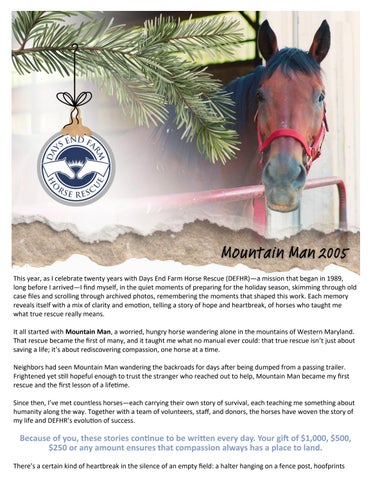
This year, as I celebrate twenty years with Days End Farm Horse Rescue (DEFHR)—a mission that began in 1989, long before I arrived—I find myself, in the quiet moments of preparing for the holiday season, skimming through old case files and scrolling through archived photos, remembering the moments that shaped this work. Each memory reveals itself with a mix of clarity and emotion, telling a story of hope and heartbreak, of horses who taught me what true rescue really means. It all started with Mountain Man, a worried, hungry horse wandering alone in the mountains of Western Maryland. That rescue became the first of many, and it taught me what no manual ever could: that true rescue isn’t just about saving a life; it’s about rediscovering compassion, one horse at a time. Neighbors had seen Mountain Man wandering the backroads for days after being dumped from a passing trailer. Frightened yet still hopeful enough to trust the stranger who reached out to help, Mountain Man became my first rescue and the first lesson of a lifetime. Since then, I’ve met countless horses—each carrying their own story of survival, each teaching me something about humanity along the way. Together with a team of volunteers, staff, and donors, the horses have woven the story of my life and DEFHR’s evolution of success.
Because of you, these stories continue to be written every day. Your gift of $1,000, $500, $250 or any amount ensures that compassion always has a place to land. There’s a certain kind of heartbreak in the silence of an empty field: a halter hanging on a fence post, hoofprints
fading in the dirt, and a horse who doesn’t understand why the person they trusted most hasn’t come back. Some are left when families move away, turned loose to fend for themselves. Others, like Quirky Quigley, are found wandering—thin, confused, and searching for the herd they once belonged to. People sometimes think horses can return to the wild, but they can’t. Domesticated horses don’t know how to find food or water or protect themselves. They wait faithfully for someone who isn’t coming back. Mountain Man was one of the lucky ones. Once loved and handled but discarded when his usefulness ran out, with care and patience he regained weight, trust, and a place to belong. Since then, I’ve met so many horses like Mountain and Quigley—including Eema’s Escape, found roaming a state park with overgrown hooves and ribs showing, yet eyes still soft with trust. To be abandoned and still believe in kindness—that’s the lesson these horses teach me over and over again.
When YOU give your gift of $50, $250, $500 or more, YOU become part of that lesson. You show every horse like Mountain, Quigley, and Eema that compassion still exists. At DEFHR, because of donors like you, we become the ones who show up. We find them on forgotten roads and in empty fields. We bring them food, safety, and a new herd—one they can count on. Neglect is the call we get most often. It’s the quiet suffering that happens slowly, behind barn doors or in overgrown pastures, until one day someone notices. Unlike abuse, neglect isn’t always intentional. Sometimes it comes from life happening: a job loss, a divorce, an illness, or simply someone who believed tomorrow would be better. Other times, it’s a lack of
knowledge—an owner who didn’t know how much a horse eats or how quickly an untreated wound can worsen. And sometimes, it crosses into willful disregard, when carelessness becomes cruelty.
It’s why we call neglect the “catch-all” of rescue. It’s everything from overgrown hooves and empty troughs to fields scattered with the bones of horses no one came for. Every case teaches me something new about people—about how thin the line can be between being a good owner and being overwhelmed. That’s why, at DEFHR, we approach neglect with both accountability and compassion. Because every neglected horse deserves more than rescue—they deserve restoration and renewed hope.
YOUR support of $100, $300, $750 or any amount bridges that gap—from suffering to safety, from fear to freedom. Please give generously today. Neglect isn’t just a failure of care; it’s often a failure of connection. That’s why education, outreach, and early intervention are as important as rescue itself. If we can reach owners before neglect begins, we can spare countless horses from suffering. Abuse, though, is different. It’s intentional. It’s knowing better, but doing it anyway. These are the cases that stay with me the longest—they represent the darkest parts of humanity, the ones that make me ask how and why. The horses can’t speak for themselves. Their bodies become their testimony—the evidence of the life they’ve endured. You see it in the scars, the starvation, the hollow look of a soul that’s been betrayed. I’ll never forget Tinkerbell. Her owner would toss feed just out of reach, watching as the horses strained and pawed to reach what they desperately needed. By the time help arrived, it was too late for the others. Tinkerbell survived, and when I opened the trailer door, she walked straight in—as if she knew it was her only chance. Healing from abuse takes more than food and medicine. It takes time, patience, and trust—rebuilt one
quiet moment at a time. Abuse reveals the cruelty that exists in this world, but rescue proves that compassion is stronger. Some of the hardest rescues to face, though, are the ones where love itself becomes the problem. In 2006, I walked onto a property in Washington County, MD where horses were packed into every available space—some alive, some not. What began as compassion had become chaos. Hoarding isn’t simply having too many animals; it’s a compulsion to acquire and keep, even when care becomes impossible. Good intentions are still there, but the ability to provide is long gone. These cases break my heart because they reveal how deeply human welfare and animal welfare intertwine. Every horse we pull from a hoarding situation represents not just physical rescue, but the untangling of heartbreak, mental illness, and Isolation. That case changed the trajectory of DEFHR. It taught us that compassion must be paired with structure—that love alone isn’t enough to save. Today, we work closely with human-service agencies and law enforcement to intervene earlier and help both people and animals before it’s too late. But perhaps the most painful kind of neglect is when it comes from within our own profession—when those claiming to rescue become the ones doing harm. It happens when donations meant for care are misused or when rescues take in more than they can manage and animals suffer as a result. We call this institutional neglect, and it cuts the deepest. I remember the Berkeley County, WV case—horses once bred to be champions, retired to a rescue that falsified reports, fabricated stories, and betrayed both donors and the animals they promised to protect. That experience reshaped me. It reinforced why accountability and transparency are sacred. True rescue isn’t just about pulling horses from harm—it’s about ensuring they receive the care they need for the long term. Many rescues have a plan for today, but not a sustainable one for tomorrow. At DEFHR, we hold ourselves to a higher standard, because compassion without accountability can still cause harm.
For twenty years, I’ve carried the stories of horses who came to us broken, afraid, and forgotten. I’ve seen what happens when compassion shows up—when fear turns into trust, when a horse takes its first deep breath in safety, when the light returns to it’s eyes. Every horse that steps off a trailer at DEFHR starts a new story, one written by every person who makes it possible: the donor who gives, the volunteer who stays late, the vet who refuses to give up. Together, they write stories of recovery, resilience, and hope. But for every horse who’s found healing, there’s another still waiting—a call not yet answered, a life not yet saved.
Your support allows us to say yes when that call comes. Yes, we have room. Yes, we have the resources. Yes, we will help.
Help make ‘YES’ moments possible. Be part of the next rescue story and make a year-end tax-deductible gift of ANY amount for the horses. Your generosity today ensures we never have to hesitate when a horse needs us tomorrow. Hope isn’t what happens after rescue—it’s what begins rescue. As I look toward the next twenty years, I see not just the horses we’ve saved, but the ones we haven’t met yet—standing in silence somewhere, hungry, hurting, or simply waiting for someone to notice they’re missing. Every year, there are horses we haven’t heard about yet, but who are counting on us long before the call ever comes. And I know, as surely as I know their stories will break our hearts, that their recovery will remind us why this work matters. With your help, we’ll find them. We’ll step into those moments before anyone else does. We’ll bring them home to safety, to warmth, to a place where their story can start over. And we’ll give them what they’ve been waiting for: a herd, a future, and a chance to trust again.
And together, we’ll keep writing stories of hope, healing, and second chances—one horse at a time.
This holiday season, please give the gift of compassion, hope, quality life, and justice. Make a year-end gift of $50, $250, $500, $1,000 or more TODAY! Gratefully yours,
Erin Clemm Ochoa Chief Executive Officer Ph: 301-854-5037 Em: info@defhr.org Web: defhr.org Fb: facebook.com/DEFHR PS: Thank you for being part of every story of hope we get to tell. Your generosity makes this work possible, and I’m so grateful for the compassion you show our horses each year. As we head into the holiday season, I hope you’ll consider making a gift—your kindness today will help carry another horse safely into the new year. Wishing you and your loved ones a joyful holiday and a healthy, peaceful year ahead.