The Official Publication of the National Defense Transportation Association
October 2026
www.ndtahq.com
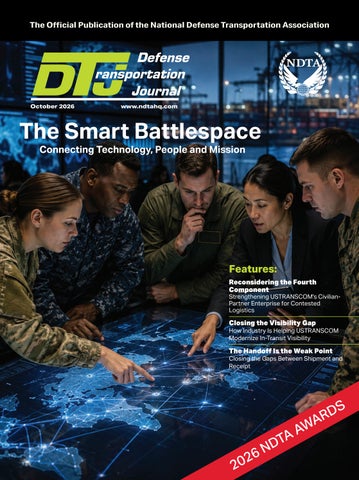
The Smart Battlespace Connecting Technology, People and Mission
Features:
Reconsidering the Fourth Component
Strengthening USTRANSCOM's CivilianPartner Enterprise for Contested Logistics
Closing the Visibility Gap
How Industry Is Helping USTRANSCOM Modernize In-Transit Visibility
The Handoff Is the Weak Point
Closing the Gaps Between Shipment and Receipt
S
6
2 20
D R A W A A T D N
SUPPORTING AMERICA’S SEALIFT READINESS WORLDWIDE
2 | Defense Transportation Journal | OCTOBER 2026
www.apl.com
DTJ INDEX OF ADVERTISERS Alaska Air Cargo..........................................................6 FOUNDATION
American President Lines, LLC...................................2 American Roll-On Roll-Off Carrier (ARC)................. 47
NDTA FOUNDATION HALL OF FAME
Carlile........................................................................ 40 Cervello Global Corporation.................................... 25 Crowley Logistics.........................................................4
The National Defense Transportation Association Foundation recognizes our most special donors for their gracious financial support to academic scholarships supporting our future logistics and transportation leaders.
The Exchange - AAFES............................................. 46
VISIONARY SOCIETY
FedEx Government Services.................................... 48
Contribution over $100K
Freeman Holdings.................................................... 19 Landstar Transportation Logistics..............................9
TRAILBLAZER SOCIETY Contribution $50K - $99,999K
Liberty Global Logistics........................................... 45 Matson...................................................................... 14 National Air Cargo.................................................... 15 The Pasha Group...................................................... 41
PATHFINDER SOCIETY Contribution $25K - $49,999
PODS......................................................................... 39 Port of San Diego...................................................... 23 Sea Cube Containers................................................ 24 Transportation Institute........................................... 44 United Airlines.............................................................5
ANNUAL DONORS Award
2025
Advocate
Kalitta Air NDTA Jacksonville Chapter
Patron
American Roll-On Roll-Off Carrier Group Inc. CSX Maersk Line, Limited
EDITORIAL POLICY
American Roll-On Roll-Off Carrier Group Inc. Enterprise Mobility FedEx
The Defense Transportation Journal is designed as a forum for current research, opinion, and identification of trends in defense transportation and logistics. The opinions expressed are those of the authors and not necessarily of the Editors, the Editorial Review Board, or NDTA.
Kirstin Knott Rob Taylor
Archives are available to members on www.ndtahq.com.
2026
Matson
As the Foundation is funded by voluntary donations, with your support, the Foundation will be empowered to help students for decades to come. Please consider making a tax-deductible contribution to help our future professionals have a future. Visit https://www.ndtahq.com/foundation/ to find out more.
EDITORIAL CONTENT
Barbara Parus, Managing Editor, DTJ NDTA 50 South Pickett Street, Suite 220 Alexandria, VA 22304-7296 703-751-5011 • F 703-823-8761 bparus@ndtahq.com
www.ndtahq.com | 3
A Proven Partner for Mission Critical Logistics End-to-End Multi-Modal Logistics Bulk Fuel Operations DoD Trusted, ISO-Certified Solutions Veteran-led Teams, Dedicated Account Management Vessel Management
crowley.com/government 4 | Defense Transportation Journal | OCTOBER 2026
Global Reach with Resilient, Rapid Response Including in Austere Environments
UNITED HAS YOU COVERED BELOW AND ABOVE THE WING.
www.ndtahq.com | 5
We bring the world. Closer. Freight is never just an object. It’s a promise. A livelihood. And it's our job to make it effortless. That’s why we’ve expanded to 14 international locations across 4 continents—to help make the far away feel right next door. For more information or book a shipment, go to alaskacargo.com. Or call us at 800-225-2752.
6 | Defense Transportation Journal | OCTOBER 2026
October 2026
FEATURES October 2026 • Vol 82, No. 5 PUBLISHER
VADM William A. Brown, USN (Ret.) MANAGING EDITOR
Barbara Parus | bparus@ndtahq.com CIRCULATION MANAGER
Leah Ashe | leah@ndtahq.com PUBLISHING OFFICE
NDTA 50 South Pickett Street, Suite 220 Alexandria, VA 22304-7296 703-751-5011 • F 703-823-8761 GRAPHIC DESIGN & PRODUCTION MANAGER
Susan Hill
ADVERTISING SALES DIRECTOR
RECONSIDERING THE FOURTH COMPONENT: Strengthening USTRANSCOM’s Civilian-Partner Enterprise for Contested Logistics
10
CLOSING THE VISIBILITY GAP: How Industry Is Helping USTRANSCOM Modernize In-Transit Visibility
16
THE HANDOFF IS THE WEAK POINT
20
2026 NDTA AWARDS
26
By Maj. Nichole M. Evans, USAF
By Marty Groover
By Kleiner M. Solano Baldovino
Bob Schotta bschotta@cjp.com
SIGN U TODAYP www.n dtahq.c
ADVERTISING & PRODUCTION Carden Jennings Publishing Co., Ltd. Custom Publishing Division 375 Greenbrier Drive, Suite 100 Charlottesville, VA 22901 434-817-2000 x330 • F 434-817-2020
The S
NDTA’s
DEPARTMENTS
om/the
-source
ource
Officia l News letter Add pu blicatio ns@nd to your ta h email a ddress q.com book
NDTA FOUNDATION HALL OF FAME..................................................................................... 3 Defense Transportation Journal (ISSN 0011-7625) is published bimonthly by the National Defense Transportation Association (NDTA), a non-profit research and educational organization; 50 South Pickett Street, Suite 220, Alexandria, VA 22304-7296, 703-751-5011. Copyright by NDTA. Periodicals postage paid at Alexandria, Virginia, and at additional mailing offices. SUBSCRIPTION RATES: One year (six issues) $40. Two years, $60. Three years, $75. To foreign post offices, $45. Single copies, $6 plus postage. The DTJ is free to members. For details on membership, visit www.ndtahq.com. POSTMASTER: Send address changes to: Defense Transportation Journal 50 South Pickett Street, Suite 220 Alexandria, VA 22304-7296
INDEX OF ADVERTISERS........................................................................................................ 3 PRESIDENT’S CORNER | VADM William A. Brown, USN (Ret.)................................................ 8 CHAPTER SPOTLIGHT.........................................................................................................22 CHAIRMAN’S CIRCLE..........................................................................................................42 HONOR ROLL.......................................................................................................................43 We encourage contributions to the DTJ and our website. To submit an article or story idea, please see our guidelines at www.ndtahq.com/media-and-publications/submitting-articles/.
PRESIDENT’S CORNER The Small Battlespace: Connecting Technology, People and Mission VADM William A. Brown, USN (Ret.) NDTA President & CEO Dear NDTA Team, August and September have been busy months at NDTA Headquarters and have reinforced the tremendous importance of our mission and the partnership between government and industry. Over the past several weeks, NDTA has supported three Executive Working Groups at U.S. Transportation Command, along with numerous NDTA committee and chapter meetings, including the NDTA North Texas Chapter’s recent gathering at Fort Hood, Texas. What I find particularly encouraging is not simply the number of meetings taking place, but the substance of the work being accomplished. Increasingly, these discussions allow government and industry partners to engage directly on operational issues, capabilities, command and control, and the challenges we face in a contested environment. These are not academic discussions. They are about understanding what the Joint Force needs now, what industry can provide, where gaps exist, and how we can work together before a crisis occurs. Like every issue of the DTJ, NDTA brings highly relevant issues to the forefront. Today, artificial intelligence, autonomy, digital logistics, advanced data analytics, and increasingly connected systems are changing military and commercial logistics. But technology alone will not create the advantage we need. The real advantage comes from our ability to connect technology, useful information, organizations and people across the enterprise — and turn that into better and faster decisions. Several articles in this issue explore these challenges from different perspectives. Major Nichole Evans, USAF, examines the role of USTRANSCOM’s industry partners and this critical component of the transportation enterprise in contested logistics. She 8 | Defense Transportation Journal | OCTOBER 2026
We can have extraordinary technology, tremendous commercial capacity, sophisticated data, and highly capable people, but those capabilities only become an operational advantage when we can connect them with purpose. investigates the need for USTRANSCOM to create a new industry “fourth component.” Marty Groover, Chair of NDTA’s Technology Subcommittee, addresses intransit visibility and its potential in his
article, “Closing the Visibility Gap: How Industry Is Helping USTRANSCOM Modernize In-Transit Visibility.” Kleiner Solano Baldovino focuses on another critical vulnerability — the handoff between organizations, systems and missions. Different subjects, but there is a common thread running through all of them: integration and alignment. We can have extraordinary technology, tremendous commercial capacity, sophisticated data, and highly capable people, but those capabilities only become an operational advantage when we can connect them with purpose. That is one reason I remain so encouraged by what I have seen across NDTA.
WELCOME NEW CORPORATE MEMBERS as of October 5, 2026
CHAIRMAN’S CIRCLE
• Sedgwick Government Solutions • Sky Lease I, LLC PRESIDENT'S CIRCLE • FedEx Freight SUSTAINING • Atomus CMMC • CRST Logistics • G-LOGISTIC POLAND SP. Z O. O. • Pacific Air Cargo • Packard Transport, LLC
USTRANSCOM Executive Working Groups, NDTA committees, chapters, and professional events create opportunities for government and industry to work through these challenges together. Relationships developed during peacetime become particularly important when time is short and the mission is difficult. The NDTA North Texas Chapter Meeting held at Fort Hood is a good example. Bringing military, government, and industry professionals together creates more than networking opportunities. We all build understanding of potential needs, capabilities, limitations and roles. As we look toward the future battlespace, we should certainly embrace artificial intelligence, autonomy, advanced analytics, and digital logistics. These technologies will provide capabilities previous generations of logisticians could only imagine. I, for one, look forward to seeing their impact! The objective is decision advantage, operational readiness, and mission success. Technology can help us see more clearly. Data can help us decide more quickly. Automation can help us move with greater speed and precision. But people, partnerships and trust remain the connective tissue that turns those capabilities into results. That is the focus of NDTA and its members, and what we are building every day. Thank you all and warmest regards. I look forward to seeing you at the Fall Meeting! DTJ
THE LANDSTAR ADVANTAGE A recognized industry leader, Landstar provides safe, secure, reliable transportation services delivered by our unique network of independent agents and capacity providers. • One of the industry’s largest van and platform selections with over 78,000 truck capacity providers in network • Expedited cargo vans, straight trucks and tractor-trailers • More than 17,600 pieces of trailing equipment • 9,600 owner-operators leased to Landstar with over 1,200 stepdecks and 960+ flatbed trailers • Drop and hook services • Specialty trailers ranging from beam, blade and Schnabels to double drop, stretch and multi-axles • Secure, dedicated government services with more than 350 AA&E secret cleared teams • Hazmat certified owner-operators • Unit moves with on-site carrier representative
Landstar.com 800-443-6808
LandstarGovtSvcs@landstar.com www.facebook.com/LandstarSystem
www.linkedin.com/company/Landstar
www.ndtahq.com | 9
Reconsidering the Fourth Component:
Strengthening USTRANSCOM’s CivilianPartner Enterprise for Contested Logistics
U.S.
By Maj. Nichole M. Evans, USAF TRANSPORTATION COMMAND (USTRANSCOM) depends on commercial airlines, shipping lines and trucking firms for most of the nation’s surge mobility capacity, sustained through agreements, such as the Civil Reserve Air Fleet (CRAF), Voluntary Intermodal Sealift Agreement (VISA), Voluntary Tanker Agreement (VTA), and Maritime Security Program (MSP). Those agreements were built for a world of predictable mobilization and relative logistical sanctuary. As adversaries increasingly target the Joint Deployment and Distribution Enterprise (JDDE) through cyberattacks, missile threats and market pressure, a recurring concern about readiness and capacity has resurfaced in congressional and military circles, raising the question: Should USTRANSCOM stand up a formal “fourth component” dedicated to civilian-partner readiness? A yearlong study of five contested-logistics events, USTRANSCOM’s 2013-2016 Enterprise Readiness Center and interviews with senior military and industry leaders arrives at a different answer. Commercial capacity was not the constraint in the cases examined. From Desert Storm to today’s Red Sea disruptions, coordination, information sharing and risk alignment across military, interagency, and commercial actors determined outcomes. The fix is not necessarily a new command; it is institutionalizing the integration function USTRANSCOM already has — and doing so before the next crisis, not during it.
10 | Defense Transportation Journal | OCTOBER 2026
WHY THIS MATTERS
For decades, USTRANSCOM has leaned on a quiet bargain: The government maintains contractual access to commercial airlift, sealift and trucking capacity, and industry gets predictable peacetime business in return. That bargain has built CRAF, VISA, VTA and MSP into what the Defense Business Board recently called a “gold standard” of public-private partnership. When activated, these programs have delivered the capacity requested. The assumptions underlying that bargain are eroding. The programs were designed for logistical sanctuary: predictable mobilization timelines, permissive sea lanes, and uncontested skies. Adversaries now have both the means and the stated intent to disrupt the JDDE directly through cyberattacks on carrier networks, missile threats to chokepoints such as the Strait
Developed from joint doctrine principles and supplemented by recurring commercial-readiness concerns identified in government assessments, literature and practitioner interviews, the criteria standardized comparisons among the cases and defined what “civilian-partner readiness” means in practice. Desert Storm proved capacity
Turbo Fusion
Table 1: Criteria for Assessing Case Study Readiness
Case Study Criterion
Purpose
Volume Delivered
Provides a tangible measure of the commercial sector’s actual operational contribution, rather than merely measuring enrolled or theoretically available capacity.
Speed and Scalability of Activation
Integration with Organic Assets Operational Friction
Industry Impact and Incentive Sustainability Adaptability to Permissive vs. Contested Environments
Tests show how rapidly commercial capacity can be mobilized through established mechanisms and whether those mechanisms can scale as operational demand increases.
Evaluates whether commercial capacity operates coherently alongside military airlift, sealift and surface capabilities. Captures coordination, command-and-control, regulatory, classification, information-sharing and other barriers that can impede employment when capacity is available. Recognizes that commercial readiness depends on profitability, risk, incentives, workforce availability and a carrier’s willingness to participate.
Tests on whether mechanisms that work under permissive conditions remain viable when commercial carriers face cyber threats, physical attack, crew risk, insurance constraints or other challenges in contested environments.
Across all five events, capacity was not the binding constraint; readiness depended on how effectively stakeholders shared information, aligned planning horizons and coordinated risk.
of Hormuz and the Red Sea, and market pressure on the airlines and shipping lines the department depends on. Gen. Randall Reed, USTRANSCOM’s commander, has described commercial partners as the command’s “fourth component,” recognizing that the enterprise’s success does not hinge on organic lift alone. That recognition has produced a recurring structural question, debated in Government Accountability Office reports, defense studies and NDTA forums alike: Does closing the gap between peacetime programs and wartime contested conditions require a new organizational entity, or can existing structures be strengthened to do the job? The answer matters. Standing up a new command would consume years while today’s integration problems go unresolved, and diagnosing
the problem correctly is as important as solving it. This article distills what a systematic look at five contested-logistics events and USTRANSCOM’s organizational history reveals about where the actual leverage lies. WHAT THE CASE STUDIES REVEALED
The underlying study examined five events spanning permissive to contested conditions, chosen to reflect the challenges a modern, near-peer contested-logistics scenario would present: Operations Desert Shield and Desert Storm, Operation Allies Refuge, U.S. support to Ukraine, Houthi disruptions of Red Sea shipping, and recent joint mobility exercises. Each event was assessed against six qualitative criteria, summarized in Table 1 above.
Desert Shield and Desert Storm remain the benchmark for what commercial capacity can deliver: CRAF carriers moved 400,000 personnel and 355,000 tons of cargo over 165 days, providing 60% of troop airlift. The operation validated the emergency-preparedness model, but it also occurred in a fully permissive environment along established routes, without cyberthreats, kinetic risk or contested command and control. The friction that did appear — liability, insurance and the postwar bankruptcy of participating airlines — foreshadowed the industry-sustainability questions that recur in every later case. Operation Allies Refuge exposed information friction
Operation Allies Refuge, the 2021 Afghanistan evacuation, showed the same pattern under compressed timelines. CRAF activated within Stage I authorities and, together with volunteer carriers, moved tens of thousands of evacuees in roughly three weeks. The aircraft were never the problem. The friction came from data: DoD’s Global Air Transportation Execution System and Global Decision Support System could not communicate with the State Department’s evacuation tracking system, forcing manual workarounds during peak operations. The inspector general’s account of OAR reads less like a capacity shortfall and more like an integration failure between two bureaucracies that needed to share passenger manifests in real time but could not. Ukraine demonstrated commercial endurance
U.S. support to Ukraine, sustained since January 2022, illustrates a different dimension of the same finding: Commercial sealift, not airlift, carries most of the load. Commercial carriers moved the majority of the more than 313 million pounds of security assistance delivered by December 2022, absorbing surge demand almost invisibly because liner service already operwww.ndtahq.com | 11
not simply a contracting or component responsibility. USTRANSCOM does not have a commercial-capacity problem. It has a persistent-integration problem. THE ENTERPRISE READINESS CENTER: A PRACTICAL LESSON
Mobility Guardian CRAF 747 ates near capacity. The case underscored that readiness for contested logistics depends on policies governing how commercial and organic assets are sequenced relative to one another, not simply on how many ships or planes exist. The Red Sea revealed contestedlogistics realities
The Houthi campaign against Red Sea shipping, which began in late 2023, was the closest the study came to a live contested-logistics stress test. Attacks on a chokepoint carrying roughly 12% of global trade did not produce a capacity crisis; commercial carriers rerouted around the Cape of Good Hope, adding 10 to 15 days of transit time. Instead, the disruption exposed a clearance and information problem: Commercial partners are not automatically eligible for the Top Secret access that would allow them to factor classified threat assessments into routing and insurance decisions. USTRANSCOM responded with recurring classified briefings that shifted from weekly sessions to a sustainable battle rhythm. This treated the disruption as an information-sharing problem rather than a lift problem — and the approach worked. The episode illustrates that contested logistics is as much an enterprise-integration problem as a transportation problem, requiring synchronized decisions among USTRANSCOM, commercial carriers, the Maritime Administration (MARAD), the Joint Staff and industry. Exercises show the enterprise is learning
Finally, recent mobility exercises show USTRANSCOM deliberately building the integration muscle these cases demand. CRAF’s exercise participation, backed by 12 | Defense Transportation Journal | OCTOBER 2026
a decade of recurring drills and cleared industry liaisons, is measurably more mature than sealifts. In sealift, classification barriers and thinner institutional relationships still limit how deeply commercial maritime partners can be brought into planning. Turbo Fusion validated government-owned Ready Reserve Force sealift — a useful but distinct test from validating voluntary commercial capacity. Industry executives interviewed for the study
USTRANSCOM does not have a commercial-capacity problem. It has a persistent-integration problem. were candid: Exercises build readiness only when they are predictable enough to plan for, since short-notice participation creates real opportunity costs against paying commercial obligations. USTRANSCOM’s shift toward publishing longer-range exercise forecasts through NDTA is a direct response. This pattern held across five very different environments spanning more than three decades, from a post-Cold War mobilization to a live contested-maritime crisis. In each, the men and women running CRAF, VISA and their sister programs delivered when called. The recurring failure mode was not “the aircraft weren’t there” or “the ships weren’t available.” It was “we didn’t know soon enough,” “our systems couldn’t talk to each other” or “we didn’t share the same picture of risk.” Friction consistently appeared upstream of activation, not during it. Civilian-partner readiness is therefore an enterprise function,
If civilian-partner readiness is an enterprise function, USTRANSCOM has already tested one organizational approach to managing it. From 2013 to 2016, under Gen. William Fraser III, the command operated an Enterprise Readiness Center (ERC) built explicitly to close the gap between contracting machinery and operational dependence on commercial partners. Reporting directly to the deputy commander, the ERC gave carriers what one former director called “one doorway” into USTRANSCOM, replacing fragmented and sometimes contradictory guidance from AMC, MSC and ARTRANS with a single enterprise-level forum. Its signature innovation was the Private Sector Representative (PSR) program. Industry executives, notably from Maersk Line, were embedded in the ERC as special government employees. Barred from contracts and source selection, they could translate fleet economics and routing decisions into operational risk for senior leaders. The ERC knew that a major carrier was shrinking its DoD-relevant fleet — and what that meant for activation thresholds — well before contracting offices caught up. That was exactly the kind of early warning a persistent-integration model is meant to provide. The ERC also shows what breaks when integration is not institutionalized. It relied heavily on the credibility of a handful of individuals; when they rotated out, no policy or resources sustained the function. The PSR model favored large, wellresourced carriers that could afford to detail senior staff to Scott Air Force Base for months, while smaller firms were priced out. A statutory 130-day cap on embedded service also undercut continuity. The ERC could diagnose problems, including cyber vulnerabilities and mariner shortages, but lacked the authority to fix them as many required actions from the Joint Staff or Congress. When a later commander judged that the center had “run its course,” its functions scattered back into the J-staff, and its integrative effect was never fully replaced. The lesson for today’s debate is direct:
A standing integration function works, but only if it survives the departure of the people who built it. Whatever mechanism carries the ERC’s legacy forward needs institutional authority, dedicated resources and a broader base of participating carriers. RECOMMENDATIONS FOR USTRANSCOM AND INDUSTRY
The case evidence points toward strengthening what already exists rather than building something new. Four actions stand out. First, formally empower the J4/5/7 directorate as USTRANSCOM’s designated integrator for civilian-partner readiness. J4/5/7 already sits at the intersection of logistics, strategic planning, policy, warfighting development, component coordination and industry engagement. It needs the manpower, analytical capacity and standing authority to treat integration as a primary mission rather than an addi-
durable legal authorities and succession planning that does not depend on one person’s tenure. Third, invest in enterprise-level sensemaking — the shared interpretation of risk that allows military planners and commercial executives to operate from the same picture of threats, timelines and expectations. In practice, this means integrating commercial market analysis into planning and contracting, running joint scenario exercises with industry rather than around it, and considering a modernized successor to the PSR concept — one that spreads participation across a sector-based council of cleared advisers rather than relying on a single embedded firm. Fourth, extend integration beyond USTRANSCOM’s walls. Civilian-partner readiness also runs through MARAD, the Office of the Secretary of War’s Industrial Base Policy office and NDTA’s committee structure. External integration deserves the
Bradleys to Ukraine tional duty. Interviewees inside the command described exactly this tension: Staff members juggle near-term operational demands against longer-term integration work, with the latter consistently losing. Second, institutionalize the engagement mechanisms already emerging inside J4/5/7 rather than allowing them to depend on individual initiative. The recurring classified carrier briefings established during the Red Sea disruption and early efforts to embed commercial subjectmatter experts in exercise design are proof of concept. They should become a standing battle rhythm rather than crisis-driven improvisation and should draw lessons directly from the PSR model’s shortcomings: the need for broader carrier participation,
same priority as internal reform: a recurring interagency dialogue on activation and risk sharing, continued co-sponsorship of NDTA’s Fall Meeting, and a dedicated NDTA liaison to keep classified updates and policy direction flowing consistently rather than episodically. For industry, the ask is reciprocal. Sustained participation in CRAF, VISA and related programs depends on predictable demand signals and stable business models as much as patriotism; carriers should address that reality directly with USTRANSCOM rather than treat it as an unstated constraint. Firms should pursue cleared personnel and facility certifications that enable them to join classified threat discussions, since clearance gaps are already
a documented bottleneck in sealift integration. Carriers, including smaller ones historically priced out of programs such as the PSR, should also press for advisory structures that do not favor only the largest firms. None of this requires new legislation, a new command or years of stand-up time. It requires USTRANSCOM and industry to treat integration as a resourced, permanent mission rather than a relationship rebuilt after each crisis. INSTITUTIONALIZING INTEGRATION FOR FUTURE READINESS
The fourth-component debate has been a proxy for a harder question: Does the mobility enterprise take civilian-partner integration seriously enough to institutionalize it, or will it keep relearning the same lessons after every crisis? Desert Storm, Operation Allies Refuge, Ukraine, the Red Sea, and the Enterprise Readiness Center point to the same answer. In the cases examined, commercial carriers delivered capacity when asked; what repeatedly failed was the connective tissue — the information sharing and common understanding of risk that turn available capacity into usable capacity under contested conditions. USTRANSCOM does not need a new component command to solve a capacity problem. It needs to finish the work the Enterprise Readiness Center started and institutionalize that integration function — a faster, more affordable and more evidence-based path to readiness than standing up a fourth component. DTJ ABOUT THE AUTHOR
Maj. Nichole M. Evans, USAF, is a graduate of the Air Force Institute of Technology’s Advanced Study of Air Mobility program. This article is adapted from her graduate research paper, “Integration Over Expansion: Strengthening USTRANSCOM’s Civilian-Partner Enterprise for Contested Logistics” (AFIT-ENS-MS-26-J-009, June 2026). The views expressed are her own and do not reflect the official policy or position of the U.S. Air Force, the Department of Defense or the U.S. Government. www.ndtahq.com | 13
FAST. CONVENIENT. RELIABLE.
Proudly serving our U.S. military throughout the Pacific, Matson is one of the largest and most reliable carriers of sustainment cargo worldwide for the U.S. Transportation Command, consistently earning Monthly Carrier Performance scores rated “Excellent” by USTRANSCOM.
🇺
For more information, speak with one of our shipping experts at (800) 4-MATSON or visit Matson.com.
14 | Defense Transportation Journal | OCTOBER 2026
Globally Positioned Rapid Response Delivering Readiness 13+ Global Operations Hubs 1300+ Personnel To Serve 16 Aircraft (B747F, B777F A330)
ANCHORAGE AMSTERDAM BUFFALO CHICAGO LOS ANGELES
NEW YORK CITY
RZESZÓW FRANKFURT
MADRID
ORLANDO MIAMI
SEOUL MANAMA DOHA DJIBOUTI CITY
DUBAI MUSCAT
BENGALURU
SHANGHAI HONG KONG HANOI CHENNAI
KUALA LUMPUR
TOKYO
TAIPEI
PENANG
SĀO PAULO
AMERICA EUROPE AFRICA
MIDDLE EAST ASIA www.ndtahq.com | 15
Closing the Visibility Gap
How Industry Is Helping USTRANSCOM Modernize In-Transit Visibility
F
or more than three decades, in-transit visibility (ITV) has been the promise the Defense Transportation System (DTS) has made to the warfighter: Know what is moving, where it is, and when it will arrive. The promise has always been easier to state than to keep. The active Radio Frequency Identification (RFID) architecture that underpins today’s ITV capability was designed in the 1990s, depends on fixed interrogators and manual data entry, and loses the thread almost as soon as cargo departs a port of debarkation. Audits going back more than a decade say the same thing in different words. What is different in 2026 is that USTRANSCOM has decided to do something about it. In April, the command convened its Worldwide ITV Strategy Conference at Scott Air Force Base to socialize a modernization strategy built around a simple premise: adopt commercial practice wherever it works, and reserve military-unique solutions for the places where it does not. The NDTA Technology Subcommittee was invited to bring the industry view into that conversation. This article describes what we brought, why it matters, and what the subcommittee will deliver at the NDTA-USTRANSCOM Fall Meeting in Grapevine, Texas, Oct. 26-29, 2026.
16 | Defense Transportation Journal | OCTOBER 2026
The NDTA Technology Subcommittee, the April 2026 Worldwide ITV Strategy Conference, and a white paper on commercial ITV standards By Marty Groover, Chairman, NDTA Technology Subcommittee; Senior Technical Fellow for Industry 4.0, C5MI Insight LLC WHY ITV MODERNIZATION, AND WHY NOW
Contested logistics has changed the ITV problem. The old model assumed a permissive homeland, secure ports, and a network of fixed read points along predictable routes. None of those assumptions survives contact with a peer adversary. Combatant commanders now need to forecast arrival times inside their areas of responsibility with enough confidence to plan power projection, and they need to do it when communications are degraded, when cargo is rerouted around a closed strait, and when the receiving unit’s a Department of Defense Activity Address Code (DoDAAC) changes or is added. The strategy USTRANSCOM briefed in April frames the target state as a technology-agnostic ecosystem of remote monitoring devices feeding a secure data exchange, rather than a single tag on a single reader network. That is an important shift, and it is exactly the shift the commercial transportation industry made 10 years ago. Ocean carriers, Class I railroads, terminals, and freight forwarders no longer compete on whether they can see a container; they compete on how early they can see a disruption and how many options remain when they do. The command was candid about the change imperative it is working against: • Legacy hardware dependence. Unreadable or improperly applied tags,
depleted batteries, and conveyances traveling routes with no interrogators. • Data latency and granularity. A mix of automated and manual entries into the RF-ITV Tracking Portal and IGC limits timing accuracy and shipment detail. • Fragmented governance. No DoWlevel program office for ITV, with authorities spread across OSW, USTRANSCOM, and the Services. • Training and compliance. ITV is not consistently exercised in training continuums, so process discipline erodes at the unit level. None of these are technology problems in the narrow sense. They are integration, data and governance problems, and that is where a body like NDTA, which sits at the seam between the command and the carriers, can be useful. THE SUBCOMMITTEE’S ROLE AT THE APRIL 2026 CONFERENCE
The Technology Subcommittee is chartered under NDTA’s Logistics and Distribution Committee as a catalyst for ideas and information on commercial practice, advising USTRANSCOM and DLA on how to improve the supply chain. For the April conference, we were asked to run a dedicated industry session. We organized it around three questions the command had put to us: What does good look like in commercial freight visibility today? Which
The presenter offered three observations that the subcommittee has since adopted as a useful frame for the whole ITV conversation: • Late recognition is the failure. Disruptions are constant; the variable is how late you realize one is happening. Whoever sees it first has the advantage. • Milestones drive early awareness. Operational events, not coordinates, are what catch problems while options still exist. • Total effective supply is the planning asset. What you have, what is in transit, and when it will be usable, combined into a single number a planner can act on. One data point from a five-month commercial trial illustrated the gap. Across roughly 40,000 containers and more than 20 ocean and rail carriers, the platform achieved better than 99 percent milestone completeness, about three times the coverage the carriers provided directly, and gave every container a 72-hour predictive arrival window. Before that capability, the shipper’s own detection of delays lagged by days, after options had already narrowed. Substitute a theater distribution center for the shipper’s warehouse and the relevance to USTRANSCOM is obvious.
DoW Logistics & Distribution Maturity Model
of those practices are dual use? And what would industry need from the government to deliver them at DoW scale? Our session ran on April 21 and included four elements: • An NDTA overview and the DoW Logistics and Distribution Maturity Model, which the Logistics and Distribution (L&D) Committee uses to describe the progression from reactive, transactionbased tracking to predictive, decisionquality visibility. • The industry view on ITV, a subcommittee-authored perspective on where commercial and military practice have diverged and where they are converging. • A dual-use perspective from Lieutenant General (Ret.) Leo Kosinski, Chief Strategy Officer of Air Space Intelligence and former Joint Staff/J4 Director for Logistics, on adapting commercially
Metric
proven decision-support platforms to multi-echelon military logistics. • A live commercial freight ITV demonstration by Adam Baker, Vice President of Gnosis Freight, showing how milestone-based visibility works in practice across ocean, terminal, and rail legs. The demonstration was the part of the session that generated the most discussion, and it is worth explaining why. The commercial platform shown was not tracking location pings. It was tracking operational milestones, roughly 25 of them per container, from cut-off date through vessel departure, discharge, rail transit, availability for pickup, and empty return. A location ping tells you where a shipment is. A milestone tells you what just happened and what is supposed to happen next, which means a missed milestone surfaces a problem while there is still time to act.
Table 1: Proposed ITV Performance Targets Standard operations
Contingency operations
Data latency
60 minutes or less
15 minutes or less
System availability
99.5%
99.9%
Location update frequency Location accuracy
Coverage (share of shipments)
Item-level resolution Forecast horizon
1 to 4 hours
100 meters or better 95%
High-priority cargo 7 days
15 to 30 minutes
10 meters or better 99%
All mission-critical cargo 72 hours
Table 1. Proposed ITV performance targets from the NDTA Technology Subcommittee white paper. Targets are offered as a starting point for government requirements development, not as a specification.
WHAT THE WHITE PAPER CONTRIBUTES
The subcommittee’s ITV white paper, “InTransit Visibility Requirements for USTRANSCOM: Integrating Commercial and Military Transportation Assets,” has been two years in development and will be released at the Fall Meeting. Its purpose is narrow by design. It does not propose a system, endorse a vendor, or speak for the command. It documents how commercial industry already delivers ITV, in terms the government can use when it writes requirements and contracts, so that the “commercial as possible” half of the strategy has something concrete to point to. The paper is organized around four research questions, drawn from a literature review, commercial carriers, commercial www.ndtahq.com | 17
supply officers, and technology providers, and a review of existing standards including GS1, NATO STANAGs, and commercial EDI: • What data elements and transmission protocols are required for effective ITV across all modes? • How can predictive analytics anticipate shortages before they affect operations? • What contractual mechanisms ensure commercial carrier compliance with ITV requirements? • Which commercial ITV implementations offer viable models for military adaptation? Three contributions stand out. A common milestone vocabulary. The paper defines the transmission milestones for land, air, and maritime moves, from shipment acceptance and geofence events through vessel discharge, customs clearance, and proof of delivery. This is the same milestone discipline the commercial demonstration showed in April, expressed in Defense Transportation Regulation terms. If carriers and the government agree on what a milestone is, the data exchange the strategy envisions becomes a translation problem rather than a negotiation. Tiered performance targets. Rather than a single standard, the paper proposes requirements that scale with the operational situation, so that the cost of visibility matches the risk being managed. Contract language and a carrier certification model. Roughly two-thirds of USTRANSCOM movements touch a commercial carrier, yet the ITV clauses in many transportation contracts predate the API era. The paper’s attachments provide
model clause language for data provision, technical implementation, performance monitoring, and remedies, along with a three-level certification approach (basic, enhanced, priority) that a carrier could be tested against before operational use. This is the piece industry is best positioned to write, because industry already lives under equivalent terms with its largest commercial shippers. WHERE INDUSTRY AND THE COMMAND CONVERGE
Reading the white paper alongside what USTRANSCOM briefed in April, the alignment is closer than either side might have expected two years ago. Both start from data rather than devices. Both assume an API-first, open-standards exchange rather than a proprietary portal. Both accept that the level of visibility should be set by a risk-to-cost comparison and the sensitivity of the cargo, not applied uniformly. And both recognize that the tag is the least interesting part of the problem; the association between the device and the cargo, the harvesting of devices at the end of a move, and the business rules that turn a data point into an action are where programs succeed or fail. WHAT HAPPENS NEXT
The subcommittee’s commitments between now and the Fall Meeting are straightforward: • Finalize the white paper in coordination with USTRANSCOM J5/4 and J4-LT, with a vendor-neutrality review to ensure it reads as an industry consensus document and not a proposal.
Table 2: Where Industry and the Command Converge
Design principle Solution architecture
What is tracked Commercial data
Analytics Governance
USTRANSCOM strategy (as briefed, April 2026)
NDTA white paper
Identity, status, and location from origin to point of need
Operational milestones by mode, with item-level resolution for critical cargo
Technology-agnostic RMD ecosystem feeding a secure data exchange
API-first, modular, tenant-based platform with open data standards
Ingest from NGDS, GHS, USC, DFTS and other contracts; review contract data terms
Model contract clauses and a tiered carrier certification program
Enable ML/AI and predictive logistics from curated data
Consolidate proponency under the JDDC; ITV Sub-Working Group as forum
Predictive ETA and shortage forecasting with a 72hour contingency horizon Cross-functional governance and an ITV center of excellence
Table 2 shows points of convergence between the government strategy and the industry white paper.
18 | Defense Transportation Journal | OCTOBER 2026
• Present the paper at both the Technology Subcommittee and the Logistics and Distribution Committee sessions in Grapevine, Oct. 26-29, 2026, and make it available to the ITV Sub-Working Group and the NDTA membership afterward. • Continue to support the strategy rollout by serving as a standing channel for the command to vet commercial capabilities, in coordination with the USTRANSCOM Transportation and Technology Industry Liaison Office, so that industry input arrives through one door rather than as unsolicited proposals. To be direct, the subcommittee is not writing the government’s requirements, and we are not advocating for any company’s product. USTRANSCOM has an active ITV solicitation, and the integrity of that process matters more than any single idea in our paper. What we can do, and what NDTA was created to do, is to ensure the command has a clear, current, and honest picture of what commercial transportation already does well, so that “commercial as possible, military as necessary” is a decision made with full information. The visibility gap has been documented for 30 years. For the first time, the command has a strategy, the technology has caught up, and industry has a seat at the table. That is not a guarantee of success. It is, however, the best alignment of conditions the DTS has had, and the Technology Subcommittee intends to make the most of it. DTJ ABOUT THE AUTHOR
Marty Groover chairs the NDTA Technology Subcommittee under the Logistics and Distribution Committee and is Senior Technical Fellow for Industry 4.0 at C5MI Insight LLC. He previously served as Operational Technology Leader at Caterpillar. With over two decades as a surface warfare officer in the U.S. Navy, Marty is a recognized thought leader in the SAP partner base. The views expressed are his own and those of the subcommittee and do not represent the position of USTRANSCOM or the Department of War.
LUXURY FBO LOCATIONS
*AEX | *CWF |**FOE |**HSA | *LBB **MWH | *MFR |**NYL | *RIV |**RME *SFB |**SGU | *SYR | *VCV |**PHJR
* LOCATION HOLDS DLA CONTRACT ** RAPID REFUELING AVAILABLE
**ABI | *ARA | *ESF | LCH |**PUB | *SYR
*SBP | SNA
WWW. FREEMANHOLDINGSGROUP. COM
www.ndtahq.com | 19
The Handoff Is the Weak Point Taking a transferable, non-proprietary approach to compliance-integrated coordination in defense-adjacent logistics By Kleiner M. Solano Baldovino, Forward Systems Group, Inc.
A
pallet of aerospace hardware reaches a receiving dock on a Tuesday morning. The packing list says 100 units. The count says 150. The conformity paperwork that traveled with the cargo cites one lot number; the supplier’s invoice cites another. Nothing about the shipment looks wrong from the outside, and every company that has touched it has done its own job correctly. The consignment is bound for a defense services contractor. If it moves as documented, 50 surplus units enter inventory unrecorded. The lot discrepancy becomes permanent because the record that would establish which parts shipped is the record in dispute. A quantity variance can be reconciled later. A traceability break cannot. That shipment did not move. Both problems went back to the supplier, and corrected paperwork arrived before dispatch. That was not vigilance on anyone’s part. The check simply happened before the freight left instead of after. THE FAILURES ARE AT THE TRANSFER
Defense-adjacent cargo is commercial or dual-use freight that is not strictly classified as military weapons or hardware, but it is intimately connected to the defense industry, national security infrastructure, or military supply chains. Cargo like this moves through a chain of independent companies. A single aircraft 20 | Defense Transportation Journal | OCTOBER 2026
component going to a partner-nation air force will pass through the manufacturer or distributor, a warehouse operator, a freight forwarder, one or more carriers, a customs function and, finally, the receiving military activity. Each one is competent inside its own walls, and each is measured on its own performance. The failures are rarely failures of capability. They happen at the transfers, where nobody owns the outcome. Four patterns come up again and again: • Documentation desynchronization. Paperwork moves on a different path from the goods, so conformity records, invoices and license references arrive before or after the material rather than with it. • Late identity verification. Part and serial numbers get reconciled against conformity records after the shipment has moved, which turns verification into an after-the-fact audit. • Chain-of-custody discontinuity. At the air-to-ground handoff, custody passes without a timestamped record, leaving a gap nobody can reconstruct later. • Compliance treated as paperwork rather than as a gate. Export-control classification and hazardous materials declarations get completed as forms instead of satisfied as conditions before movement is permitted. None of this will surprise anyone who has
worked a regulated lane. Executive Order 14017 ordered a review of vulnerabilities across the defense industrial base, and Government Accountability Office (GAO) reporting keeps documenting readiness effects that trace back to coordination and traceability problems rather than to manufacturing capacity. WHY COMPETENCE DOES NOT TRANSFER
Performance in this business is managed through contract-specific procedures and company-specific standard operating procedures, each written for one relationship. None of them travels. An operator can be excellent and still contribute to a failure because the discipline that makes it excellent stops at its own fence line. ONE DESIGN DECISION
A method meant to travel must be built differently. Every control is assigned to a function, never to a job title and never to a named company. A compliance node, an operational node, a carrier, and a program node all exist in a three-person forwarder and in a prime contractor. In the small shop, two of them may be the same person, and the controls don’t change. Adoption can be partial, too. Where most participants are small firms with thin administrative staff, a method that demands reorganization before it pays anything back will not be adopted.
SIX GATES AND ONE RULE
The operational core is a release sequence of six gates. Each has a pass criterion and a responsible function: • G1 — Item classification. Export Control Classification Number (ECCN) or United States Munitions List (USML) classification confirmed; license requirement determined. Compliance node. • G2 — Documentation completeness. Conformity records, invoice and shipping papers present and internally consistent. Operational node. • G3 — Identity verification. Part and serial numbers matched against conformity records and the packing list. Operational node. • G4 — Hazardous materials readiness. Packaging, marking, labeling and segregation verified against Title 49 of the Code of Federal Regulations and the International Air Transport Association Dangerous Goods Regulations. Operational node. • G5 — End user and destination. Consignee, end user and destination screened against the contract and the license scope. Program node. • G6 — Release. All prior gates passed and logged; release authorized and recorded. Compliance node. The gates matter less than the rule behind them. If any gate fails, the shipment is held and goes on to the escalation ladder, and no partial release is allowed for controlled items. A checklist that notes an exception and lets the freight continue isn’t a control. It’s a record of a control that didn’t operate. The ladder gives the stop somewhere to go, with clocks attached: documentation errors and part or serial mismatches inside four hours, a customs hold inside two, a chain-of-custody break inside one, each to a named function. Without owners and response paths, a stop rule just produces stalled freight. WHERE THE GATES SIT AND WHO IMPLEMENTS THEM
The gates sit at the node of the origin: the shipper’s dock, the forwarder’s warehouse, or the consolidation point, whichever is the last place you can fix a discrepancy without recalling freight. G1 through G5 runs there before the carrier is dispatched. G6 authorizes movement. Every later handoff re-verifies only identity and custody. The harder question is: Who imple-
ments them? Today, the honest answer is “nobody.” An operator adopts the sequence on its own authority and applies it to its own outbound traffic. That is a real limitation: voluntary adoption produces no standard across shipping activities, and two forwarders in the same lane may run different sequences, or none at all. Three mechanisms could carry it further, in ascending order of force: • Contractual flow-down. A prime contractor can require the sequence of its subcontractors and forwarders in a statement of work. This is how most compliance behavior actually propagates in this industry. • Association standards. A trade body can publish a voluntary reference sequence, giving small operators something to adopt without inventing it and customers something to ask for. Voluntary standards have changed practice in other transportation sectors without a regulation. • Program or regulatory direction. The Department of Defense could direct it within a program or specify it in a rated order under the Defense Priorities and Allocations System. That is the strongest instrument and the slowest. I would argue against starting at the regulatory end. These controls are not new obligations. They are existing obligations, verified earlier. Mandating a sequence before anyone has run it produces compliance theater. Voluntary adoption, measured and reported, is what would justify a stronger instrument later. WHAT THE GATES ACTUALLY CATCH
The interceptions are unglamorous. Over the past several months, the sequence held consignments for the following reasons, all caught at G2 or G3 before dispatch: • Serial-number ranges transposed between the packing list and the invoice across two separate invoices for the same movement. • Quantities that differ between the packing list and the supplier invoice for the same consignment: 20 units on one document, 63 on the other. • The case that opens this article, a 50unit count variance with a lot number on the physical paperwork that did not match the supplier’s records. These are not sophisticated findings. Each one takes only minutes to fix at origin and would have been expensive to un-
wind downstream. What decides which of those two things happens is not the skill of the person doing the check. It’s whether the check is scheduled before the freight moves or after. IN THE FOREIGN MILITARY SALES CHANNEL
Foreign Military Sales movements change what G5 is for. The end user is fixed by the case designator rather than chosen by the shipper, so the gate stops being a screening exercise and becomes a reconciliation. Does the consignee encoded in the case match the destination on the routing instruction and the end user named in the contract? When those three disagree, the error is almost always in the routing instruction, and it is always cheaper to resolve before the aircraft than after. WHAT TECHNOLOGY CAN AND CANNOT DO
Technology decides whether any of this scales, and the distributed-ledger question is the right one to ask first. A shared, tamper-evident ledger fits the custody problem well. A record that independent parties can all write to and no one can quietly revise is exactly what the air-to-ground handoff lacks today, and timestamped entries visible to shipper, forwarder, carrier and consignee would close a gap that currently cannot be reconstructed. A ledger records a serial number that was checked — and one that was not — with equal permanence. If nobody matched the number on the packing list against the part in the box, the ledger preserves that error forever and makes it harder to correct. Immutability is a property of the record, not of the truth. So, the order matters: gate first, ledger second. G3 establishes that the identity is right, and then the ledger preserves that it was established. The lower-technology pieces deserve more credit than they get. A scanned serial reconciled against the conformity record at the dock, instead of a person comparing two printed lists, removes the transposition and count errors listed above, and that is barcode and database work within reach of a three-person forwarder. Adopt the sequence on whatever you already have, instrument it so the exceptions get counted, and let the technology follow the measurements. An operator who cannot state his documentation exception rate is not ready to choose a platform to reduce it. www.ndtahq.com | 21
MEASURING IT
Five indicators make that possible without reference to anyone else: documentation exception rate, rework caused by compliance friction, escalation inside the stated service level, traceability continuity across handoffs, and recurrence of any top-tier vulnerability. The alternative is a method that reports its own success by describing its own design.
Chapter Spotlight
WHAT THIS IS NOT
Methods like this get oversold, so the limits are worth stating plainly. This is not a compliance program and does not replace one. It does not replace an export-control classification determination, a licensing decision, or a dangerous-goods certification. It audits nobody. It assumes the underlying obligations are already known and correctly applied. What changes is where in the workflow they get verified and who is accountable when verification fails. DTJ
ABOUT THE AUTHOR
Kleiner M. Solano Baldovino coordinates defenseadjacent and export-controlled freight at Forward Systems Group, Inc. in Miami, Fla., including Foreign Military Sales consignments, hazardous materials and shipments controlled under the International Traffic in Arms Regulations.
Texas Regional Meeting Powers Up Military Mobility
NDTA’s 2026 Texas Regional Meeting brought the military, government, industry, education and local communities together at Fort Hood to strengthen the connections that keep people and equipment moving. The gathering began August 26 with a Military Community Engagement Event linking service members, veterans, students, educators and families with career, education and support resources. On August 27, the focus shifted to “Powering the Future of Military Mobility.” Speakers and panelists explored the infrastructure and partnerships behind defense transportation, from Texas
Panel discussion: LTC Darryl Barnett, USA, moderated a discussion with LTC Walter Kruse, USA; Maj. Jonathan Allison; LTC Dezerie Jemmott, USA; and LTC R. Bryan Alexander, USA.
Leadership group: From left to right, VADM Brown, USN (Ret.); Rep. Pete Sessions; Stephen Bullard, NDTA North Texas Chapter president; Lt. Gen. Kevin D. Admiral, USA; and Ernest Bezdek, NDTA Southwest regional president. 22 | Defense Transportation Journal | OCTOBER 2026
ports and rail to passenger travel and emerging technology. The full-day program featured leadership panels, networking and a tour of the Rail Operations Center, where attendees saw the U.S. Army’s first fully battery-powered electric locomotive. Speakers included Lt. Gen. Kevin D. Admiral, USA, VADM William A. Brown, USN (Ret.), and The Honorable Pete Sessions, U.S. Representative, Texas’s 17 Congressional District. The meeting also recognized leaders whose service has strengthened the NDTA community. Across both days, the message was clear: mission readiness depends on strong connections among the people and organizations that move the force. Go to https://ndtanorthtexas.com/texas-regional-meeting-26
Mission Award group: Ernest Bezdek, NDTA Southwest regional president; Mission Award recipient CSM Roy Silva, USA; Renee Ottley, chapter vice president; and Roger Neumann, vice president, The Exchange.
Leadership Award: Rep. Pete Sessions received the State of Texas NDTA Leadership Award.
www.ndtahq.com | 23
SeaCube is proud to support our US Navy and Veteran Families
Visit www.SeaCubeContainers.com for more information seacubecontainers.com 24 | Defense Transportation Journal | OCTOBER 2026
Active FCL CMMC Level 2 (C3PAO) Certified
NISPOM Compliant
FSO Managed
DCAA Compliant
ISO 9001-2015
COMMAND GLOBAL MOVEMENT. FROM SHIPMENT VISIBILITY TO WORKFORCE MOBILITY.
STRATUM-X™ is Cervello Global’s AI-enabled Global Transportation Management System built to orchestrate complex movement operations across carriers, customers, regions, currencies, and mission requirements. QUANTUM-HHG™ extends the platform into military household goods and international corporate global workforce relocation programs – giving leaders the portals, analytics, approved workflows, and operational controls needed to manage people, property, expenses, insurance claims, and outcomes at scale.
QUANTUM-HHG
by Cervello Technologies Military HHG – Corporate Relocations Global Workforce Mobility
Planning – Movement – Dispatch – Routing – Shipment Visibility – Proof of Delivery – Claims Processing Role-based Portals – Global Expense Management – Multi-Currency – Regional Tax & Payroll Compliance
AI-enabled movement orchestration | shipment visibility | role-based expense control | multi-currency treasury support | customer centric relocation workflows | compliance-aware workforce mobility | executive analytics
STRATUM-X™ GTMS Technology | Quantum-HHG™ Workforce Mobility Contact: Sales@go-ct.com or call +1 (727) 303-3001
NDTA Chairman’s Circle Member
www.ndtahq.com | 25
2026 NDTA awards recognize individual and corporate members, as well as chapters and military units, that have excelled in fostering the goals and aims of the Association. We recognize this year’s award winners and thank them for their contributions to the Association, and to the greater logistics and transportation community. JOSEPH A. TORSANI MEMORIAL AWARD FOR LIFETIME SERVICE & ACHIEVEMENT Over the course of decades, COL Joseph A. Torsani, Jr. USA (Ret.), dedicated his time, leadership, and logistics expertise to the National Defense Transportation Association. COL Torsani served tirelessly in key positions at the state and national levels, and truly embodied NDTA’s values and commitment to education, knowledge sharing, and fostering the next generation of professionals. In his memory and in the spirit of his many contributions to the Association, NDTA proudly presents the Torsani Award, the highest honor the Association can bestow, on a special basis to recognize many years of service to and advocacy for the Association.
T
Mr. Will Martin
Director of Military Sales, American President Lines, LLC, and Pacific Region and San Francisco Bay Area Chapter President
he National Defense Transportation Association proudly presents the 2026 Joseph A. Torsani Memorial Award for Lifetime Service and Achievement to Mr. Will Martin for his exceptional contributions to the defense transportation community and steadfast service to NDTA. For more than 25 years, Mr. Martin has served the U.S. ocean transportation industry, supporting the federal government in increasingly responsible roles in stevedoring, sales, operations, and military transportation. He is director of military sales-government trade for American President Lines (APL), where he strengthens industry-government partnerships supporting national security. An NDTA member for more than 17 years, Mr. Martin has demonstrated outstanding leadership at the chapter, regional and national levels. He serves as president of the San Francisco Bay Area Chapter, the Pacific Southwest Region, and the Pacific Region — an unprecedented level of volunteer service. Recruited to NDTA by the late Joseph A. Torsani, Mr. Martin has strengthened partnerships among government, military, and industry throughout the Pacific and Southwest. His leadership has helped sustain chapters in Guam, Japan, Hawaii, and the Republic of Korea while expanding membership, mentoring future leaders and raising tens of thousands of dollars in scholarships. Mr. Martin’s distinguished career, exceptional leadership, and lifelong service exemplify NDTA’s highest ideals. His contributions have strengthened the defense transportation enterprise, advanced the Association’s mission, and set a lasting example of service for future generations.
26 | Defense Transportation Journal | OCTOBER 2026
M
NATIONAL TRANSPORTATION AWARD
r. George Novak is awarded the National Transportation Award in recognition of his extraordinary leadership, unwavering dedication, and distinguished lifetime of service to the U.S. air transportation industry, strengthening the nation’s defense transportation system. Throughout his decades-long career, Mr. Novak has been a tireless advocate for the government-industry partnership, advancing policies and programs that enhance America’s strategic mobility capabilities. His visionary leadership of the National Air Carrier Association has strengthened collaboration among commercial air carriers, government agencies, elected officials, and defense stakeholders, ensuring the readiness and responsiveness of the nation’s air transportation network. His commitment to Mr. George Novak excellence has improved the efficiency, reliability, and resilience of airlift operations supporting miliPresident & CEO, National Air Carrier tary deployments, humanitarian assistance, disaster response, and national emergencies. Through Association his expertise, integrity, and steadfast service, he has fostered innovation, strengthened industry engagement, and advanced solutions to complex transportation challenges affecting national security. His contributions have directly supported the mobility requirements of the Department of Defense (DoD) while reinforcing the indispensable role of commercial aviation in sustaining global mobility operations. Respected throughout the transportation community, Mr. Novak has demonstrated exceptional professionalism, strategic vision, and dedication to mission success. His distinguished achievements reflect great credit upon himself, the National Air Carrier Association, the air transportation industry, and the National Defense Transportation Association.
G
NATIONAL DEFENSE LEADERSHIP AWARD
eneral Jacqueline D. Van Ovost, USAF (Ret.), is awarded the National Defense Leadership Award in recognition of her distinguished service as the 14th commander of U.S. Transportation Command (USTRANSCOM) from October 2021 to October 2024. A visionary leader and steadfast advocate for the nation’s transportation and logistics enterprise, General Van Ovost guided USTRANSCOM through a period of unprecedented operational demand and strategic complexity. Under her leadership, the command delivered responsive, resilient, and globally integrated mobility capabilities supporting military operations, force projection, and humanitarian assistance worldwide. General Jacqueline D. Van Ovost, Recognizing the essential role of industry in national defense, she strengthened partnerships across USAF (Ret.) the Joint Deployment and Distribution Enterprise, advancing collaboration among commercial U.S. Air Force General Jacqueline D. transportation providers, logistics companies, and government agencies. Her commitment to inteVan Ovost, 14th Commander, gration, innovation, and operational excellence enhanced the readiness, capacity, and resilience of the U.S. Transportation Command total mobility enterprise. General Van Ovost also was a dedicated supporter of the National Defense Transportation Association and a strong advocate for the NDTA-USTRANSCOM Fall Meeting, fostering dialogue and trusted relationships among government, industry, and academia. For her exceptional leadership, unwavering commitment to mission success, advancement of government-industry partnership, and enduring contributions to national defense transportation, General Van Ovost is hereby presented the National Defense Leadership Award. NDTA DOD DISTINGUISHED SERVICE AWARD
L Lieutenant General John P. Sullivan, USA 17th Deputy Commander, U.S. Transportation Command
ieutenant General John P. Sullivan, USA (Ret.), is awarded the NDTA DoD Distinguished Service Award in recognition of his distinguished leadership and dedicated service as Deputy Commander, United States Transportation Command (USTRANSCOM). A career Transportation Corps officer, LTG Sullivan built a legacy of excellence in logistics, deployment, distribution, and global mobility operations supporting the Nation’s defense. His experience and strategic vision enabled the successful integration of joint transportation capabilities across the DoD. As Deputy Commander of USTRANSCOM, he provided exceptional leadership of the global mobility enterprise, ensuring the synchronization of air, land, and sea transportation resources to meet national security requirements worldwide. He strengthened collaboration among the Military Services, government agencies, and commercial industry partners, enhancing the readiness and resilience of the defense transportation system. LTG Sullivan championed the vital role of the Nation’s transportation industrial base, advancing government-industry integration and improving the effectiveness of the Joint Deployment and Distribution Enterprise. For his exceptional leadership, dedication to mission success, and enduring contributions to the DoD and the Nation’s transportation enterprise, LTG Sullivan is presented the NDTA DoD Distinguished Service Award.
www.ndtahq.com | 27
DISTINGUISHED GOVERNMENT SERVICE AWARD
C Capt. Stephen M. Carmel
Administrator, Maritime Administration (MARAD), U.S. Department of Transportation
apt. Stephen M. Carmel, Administrator of the Maritime Administration (MARAD), U.S. Department of Transportation, is presented the NDTA Distinguished Government Service Award in recognition of his exceptional leadership, strategic vision, and distinguished service to the Nation’s maritime transportation system. A respected maritime leader and subject matter expert, Capt. Carmel has demonstrated decisive leadership in addressing complex transportation challenges that directly support U.S. national security and economic prosperity. His efforts have strengthened the resilience and effectiveness of the Nation’s maritime transportation enterprise, a critical component of global commerce and military mobility. As Maritime Administrator, he has advanced initiatives to strengthen the U.S. Merchant Marine and maritime industrial base, ensuring their continued viability in support of commercial trade and defense requirements. He has championed collaboration among government, industry, and labor, enhancing readiness, surge capacity, and public-private partnership across the maritime sector. Prior to his appointment, Capt. Carmel served as a principal architect of the Tanker Security Program, helping establish a framework that strengthened the protection and resilience of critical energy transportation and maritime logistics networks. He has also advanced maritime security, operational resilience, and coordination across the broader transportation community. For his exceptional leadership, dedication to strengthening the Nation’s maritime transportation system, and enduring service to the United States, Capt. Stephen M. Carmel is presented the NDTA Distinguished Government Service Award.
M Ms. Kyle Kraft
GovTravels Transportation Academy Education Committee (Industry Representative) and Director of Account Management, Sabre
s. Kyle Kraft, Director of Account Management, Sabre, is presented the National Defense Transportation Association Presidential Award in recognition of her exceptional leadership, dedicated service, and significant contributions to the government passenger travel community. As a valued member of the GovTravels Education Committee, Ms. Kraft played a pivotal role in developing and implementing the GovTravels Travel Academy, a comprehensive five-session, 20-class educational program providing professional instruction and training to nearly 1,000 government and industry representatives each year. Her vision, expertise and commitment helped establish a premier educational platform that strengthens collaboration, knowledge sharing, and mission readiness across the federal and military travel enterprise. In her leadership role at Sabre, she provides executive-level strategic account management for global travel management companies, oversees critical U.S. military and civilian government travel programs, and serves as a trusted liaison to Department of Defense and General Services Administration travel leadership. Ms. Kraft’s efforts have advanced travel program effectiveness through innovation, operational efficiencies, cost-saving initiatives, and technology solutions supporting government travelers worldwide. Through her active participation in NDTA GovTravels programs and dedication to education and professional development, she has made lasting contributions to government travel and the government-industry partnership. Her achievements reflect great credit upon herself, Sabre, and the National Defense Transportation Association.
M Mr. Justin Schiffner
Former Chair, Airline Committee, Government Passenger Advisory Council (GPTAC), and Senior Manager, Military & Federal Government, Southwest Airlines
NDTA PRESIDENT’S AWARD
r. Justin Schiffner is presented with the National Defense Transportation Association President’s Award in recognition of his exceptional service, leadership, and dedication to advancing the government-industry partnership in support of federal passenger travel. As Chair of the Government Passenger Travel Advisory Council (GPTAC) Airline Committee, and Senior Manager, Military and Federal Government for Southwest Airlines, Mr. Schiffner provided outstanding leadership in the airline industry’s engagement with government travel stakeholders. He successfully led collaborative initiatives with the Defense Travel Management Office, the General Services Administration Travel Category Team and commercial airline partners to enhance traveler support, operational readiness, and transportation effectiveness. Under his guidance, the Airline Committee addressed critical passenger travel issues, including military working dog transportation, pet travel policies, baggage programs, air travel booking processes, and other matters affecting government travelers. His efforts fostered meaningful dialogue, improved coordination, and strengthened industry preparedness to support mission requirements. Mr. Schiffner transformed committee meetings into valued educational forums that enhanced understanding across government and industry. He also provided invaluable advice, support, and leadership to numerous NDTA-DTMO GovTravels conferences and educational events, making lasting contributions to the government passenger travel community and events, advancing the objectives of the National Defense Transportation Association. His achievements reflect great credit upon himself, Southwest Airlines, and the National Defense Transportation Association.
28 | Defense Transportation Journal | OCTOBER 2026
NDTA PRESIDENT’S AWARD
M Mr. Greg Harkins
Vice Chair, Government Passenger Travel Advisory Council, and President, CWTSatoTravel
r. Greg Harkins is presented the National Defense Transportation Association President’s Award in recognition of his outstanding leadership, service, and dedication to advancing the government-industry partnership supporting federal passenger travel. As Vice Chair of the Government Passenger Travel Advisory Council (GPTAC) and President of CWTSatoTravel, Mr. Harkins has consistently demonstrated exceptional commitment to the mission and objectives of the National Defense Transportation Association. He has repeatedly stepped forward to assume the responsibilities of GPTAC Chair when needed, providing effective leadership to the Council, the NDTA Board of Directors and the NDTA-DTMO Go Travels program. Mr. Harkins has been a strong advocate for professional development and collaboration, serving as a featured participant in GovTravels general session panels, Young Leader Professional Development programs and Travel Management Company Committee activities. He has further contributed his expertise and leadership to numerous Travel Academy educational sessions, helping develop the next generation of government and industry travel professionals. Through his active involvement in GovTravels planning and execution, he has strengthened communication, enhanced mutual understanding, and fostered closer working relationships across the passenger travel community. His efforts have improved education, collaboration, and passenger travel readiness in support of government missions worldwide. Mr. Harkins’ exemplary service, professionalism, and dedication reflect great credit upon himself, CWTSatoTravel and the National Defense Transportation Association.
M Ms. Cheryl Garcia
Senior Vice President, U.S. Bank
s. Cheryl Garcia, Senior Vice President, U.S. Bank, is presented the National Defense Transportation Association President’s Award in recognition of her outstanding service, leadership, and unwavering support of the defense transportation and logistics community. Over many years, Ms. Garcia has been a resolute advocate for the National Defense Transportation Association and its mission to strengthen collaboration between government and industry partners. Her contributions have been instrumental in planning and executing the annual NDTA-USTRANSCOM Fall Meeting, helping ensure the success of educational, professional development, and industry engagement programs that benefit thousands of transportation and logistics professionals. Ms. Garcia actively participated in planning meetings, Transportation Academy initiatives and general session activities while helping coordinate the participation of key government and industry leaders. As a valued member of the NDTA Logistics and Distribution Committee’s Finance Subcommittee, she provided critical insight and expertise that enhanced collaboration across the defense transportation enterprise. Her efforts also helped facilitate Defense Logistics Agency engagements with leading logistics and transportation companies, fostering greater understanding of commercial supply chain innovations and their application to Department of Defense requirements. Ms. Garcia’s professionalism, dedication, and commitment to advancing government-industry partnerships have strengthened the defense transportation community and brought excellent credit upon herself, U.S. Bank, and the National Defense Transportation Association.
M Mr. Rob Poage
Business Development Manager, Government Services, Bennett Heavy and Specialized LLC
r. Rob Poage, Business Development Manager, Government Services, Bennett Heavy and Specialized LLC, is presented the National Defense Transportation Association President’s Award in recognition of his exceptional leadership, diligence, and commitment to protecting the integrity of the nation’s defense transportation system. Mr. Poage played a significant role in identifying and exposing fraudulent activities conducted by unqualified brokers and transportation providers operating outside established Global Freight Management processes. Through his persistence and professional expertise, he uncovered the use of unqualified drivers, improperly certified trucks and equipment, and the improper award of millions of dollars in government freight shipments, creating significant readiness, safety, and security concerns. His efforts brought critical issues to the attention of government and industry leaders, leading to investigations, inspections and substantial changes to Global Freight Management policies, procedures, and safeguards. The information he uncovered proved instrumental in identifying a widespread national problem and sparked a whole-of-government effort to strengthen oversight and accountability across the transportation enterprise. Mr. Poage’s unwavering dedication, initiative, and service have significantly enhanced the security, reliability, and readiness of the Joint Deployment and Distribution Enterprise. His achievements reflect great credit upon himself, Bennett Heavy and Specialized LLC, and the National Defense Transportation Association.
www.ndtahq.com | 29
NDTA PRESIDENT’S AWARD
M
s. Cheryl Freeman is awarded the National Defense Transportation Association President’s Award in recognition of her exceptional service, dedication, and steadfast support of the government-industry partnership. As Command Ombudswoman (Business and Industry)/ Commercial Activities Group, U.S. Army Transportation Command, she has served as a trusted liaison between the U.S. Army and the National Defense Transportation Association, strengthening collaboration across the Joint Deployment and Distribution Enterprise. Through her efforts, she has been instrumental in planning, coordinating, and executing U.S. Army Transportation Command support to the NDTA-USTRANSCOM Fall Meeting and numerous NDTA-CAS Surface Force Projection conferences and meetings. Ms. Freeman fostered engagement among military leaders, government agencies, and industry partners to address transportation and logistics challenges. Her Ms. Cheryl Freeman Command Ombudswoman (Business leadership enhanced coordination among NDTA, Army Transportation Command and the NDTA Surface Transportation Committee, ensuring dialogue on strategic surface transportation initiatives. and Industry)/CAG, U.S. Army Transportation Command (ARTRANS) She played a vital role in discussions involving commercial trucking, ammunition transportation, strategic seaports, and household goods programs supporting military readiness. Her commitment to collaboration, communication and partnership strengthened government-industry relationships while promoting solutions to complex mobility challenges. She is a great credit to herself, the U.S. Army Transportation Command, and the National Defense Transportation Association.
M
Ms. Sara Fuentes
President, Transportation Institute
s. Sara Fuentes is presented the National Defense Transportation Association President’s Award in recognition of her leadership, advocacy, and dedication to strengthening the nation’s maritime transportation capabilities and readiness. As President of the Transportation Institute and a member of the National Defense Transportation Association, Ms. Fuentes has distinguished herself as a champion of the U.S. maritime industry and its critical role in national security. Through her leadership and collaboration with government and industry stakeholders, she has advanced initiatives that enhance maritime readiness, strengthen the U.S.-flag fleet, and support the nation’s strategic sealift capability. Ms. Fuentes has contributed to professional education and industry awareness through numerous articles published in the Defense Transportation Journal, providing analysis on shipbuilding, the Ships for America Act, the Maritime Action Plan, maritime labor issues, the Jones Act and other national issues. Her efforts have informed policy discussions and increased understanding of challenges and opportunities facing the maritime sector. As a key supporter of the NDTA Military Sealift Committee, she has helped foster engagement with U.S. Transportation Command and the Maritime Administration, strengthening government-industry collaboration in support of military mobility and logistics readiness. Ms. Fuentes’ service, vision, and commitment have made a lasting impact on the defense transportation community and reflect great credit upon herself, the Transportation Institute, and the National Defense Transportation Association.
M Mr. Kevin Myers
Chair, NDTA Household Goods Subcommittee and Senior Manager, Quality Assurance and Partner Liaison, TMM, Inc.
r. Kevin Myers is awarded the National Defense Transportation Association President’s Award in recognition of his leadership, dedication, and service as Chair of the Household Goods Subcommittee. Through his vision and commitment, he strengthened the government-industry partnership supporting the Defense Personal Property Program and military family relocations. Mr. Myers led collaborative efforts to address post-pandemic capacity shortages, transportation market disruptions, and peak-season challenges affecting household goods movements. He provided a forum for USTRANSCOM and industry leaders to identify solutions that improved service delivery and operational readiness. His leadership was instrumental in supporting the transition to the Global Household Goods Contract and then to the Personal Property Activity, ensuring open communication among stakeholders and advancing modernization objectives. He championed industry engagement on Defense Personal Property Program enhancements, shipment visibility, customer satisfaction initiatives, and technology integration. Mr. Myers guided discussions on policy changes, business rules, performance standards, and quality assurance measures that strengthened program effectiveness while sustaining industry participation. Through meetings and subcommittee sessions, he promoted dialogue, problem-solving, and the exchange of best practices across the Joint Deployment and Distribution Enterprise. His efforts contributed to improved support for military members, civilian employees and their families while enhancing transportation readiness. He is a great credit to himself, the Household Goods Subcommittee, and the National Defense Transportation Association.
30 | Defense Transportation Journal | OCTOBER 2026
NDTA PRESIDENT’S AWARD
M Ms. Angie Reno
President, Jacksonville Chapter, and Business Development, Government Services, Expeditors
s. Angie Reno is awarded the National Defense Transportation Association President’s Award in recognition of her leadership, dedication, and service as President of the Jacksonville Chapter. Through her vision and commitment, she guided the chapter through growth, expanded member engagement and increased influence across the defense transportation and logistics community. Under her leadership, the chapter strengthened government-industry-academia partnerships and established itself as a regional forum for collaboration, professional development, and workforce advancement. Ms. Reno championed initiatives that connected students, young professionals, military leaders, government agencies, and industry stakeholders to advance transportation and logistics excellence. She expanded educational outreach, supported scholarships, logistics academies, and JROTC programs, and encouraged the development of future transportation leaders throughout Northeast Florida. Her leadership fostered discussions on emerging technologies, artificial intelligence, transportation readiness, and national security challenges. Ms. Reno’s most significant accomplishment was the successful planning and execution of the Maritime Industrial Base Symposium, which brought together leaders from government, industry, academia, and the military to strengthen America’s maritime capabilities and support national defense objectives. She further demonstrated her commitment to service through support of veterans, military families, and workforce development initiatives benefiting the broader community. Through her efforts, the Jacksonville Chapter evolved into an active and respected organization supporting defense transportation, logistics and maritime collaboration. Ms. Reno’s professionalism, innovation, and commitment reflect great credit upon herself, the Jacksonville Chapter, and the National Defense Transportation Association. INDIVIDUAL DISTINGUISHED SERVICE AWARD
M Mrs. Laura Yarbrough
Secretary, San Francisco Bay Area Chapter
rs. Laura Yarbrough, secretary, San Francisco Bay Area Chapter, is presented the NDTA Individual Distinguished Service Award in recognition of her sustained, outstanding service to the National Defense Transportation Association and her unwavering commitment to the success of the San Francisco Bay Area Chapter. For more than 10 years, Mrs. Yarbrough has demonstrated exceptional dedication, professionalism, and attention to detail as chapter secretary. Throughout her tenure, she has ensured the timely preparation and distribution of monthly secretary reports and advance meeting agendas to the Board of Directors, providing the organizational foundation necessary for effective chapter governance and decision-making. Mrs. Yarbrough has consistently demonstrated outstanding ability in managing, organizing, coordinating, and executing the many responsibilities entrusted to her. She has played an indispensable role in the chapter’s premier events, including the Annual Crab Feed and Golf Outing, where she has personally overseen participant registration and check-in accurate accounting and detailed reporting to the treasurer have ensured the integrity and success of these important fundraising activities. Through her dependable leadership, tireless service, and steadfast commitment to excellence, Mrs. Yarbrough has contributed significantly to the continued growth and success of the San Francisco Bay Area Chapter. Her exemplary service reflects great credit upon herself and the chapter and is in keeping with the highest traditions and standards of the National Defense Transportation Association.
M Mr. Grant Davis
Board Member, San Francisco Bay Area Chapter
r. Grant Davis, board member, San Francisco Bay Area Chapter, is presented the NDTA Individual Distinguished Service Award in recognition of his sustained outstanding service to the National Defense Transportation Association and his tireless contributions to strengthening the government-industry partnership throughout the San Francisco Bay Area. Mr. Davis has consistently demonstrated exceptional leadership, dedication, and professionalism in organizing, coordinating, and executing chapter programs and events with outstanding results. As chairman of the NDTA San Francisco Bay Area Annual Golf Outing, he skillfully coordinated with the golf course on scheduling, pricing, and facility support, ensuring the continued success of one of the chapter’s premier events. He also played a pivotal role in the chapter’s Annual Crab Feed, managing event logistics, coordinating volunteers, overseeing operations, and helping deliver a highly successful fundraiser. Throughout his service, Mr. Davis has willingly accepted challenging assignments and executed them with enthusiasm, commitment, and diligence. His efforts have strengthened the chapter, enhanced member engagement, and generated vital funding to support chapter programs and scholarships that help develop future transportation and logistics leaders. Mr. Davis’s exemplary service, unwavering dedication and significant contributions reflect great credit upon himself, the San Francisco Bay Area Chapter, and uphold the highest traditions and standards of the National Defense Transportation Association. www.ndtahq.com | 31
YOUNG EXECUTIVE OF THE YEAR AWARD
T Industry Awardee: Mr. Ryan Granato
Business Development Executive and Capture Manager, CACI
2026 Industry Awardee
he National Defense Transportation Association proudly recognizes Ryan M. Granato as the Young Executive of the Year for his exceptional leadership, innovation, and commitment to advancing defense transportation and logistics. As the leader of business development and capture efforts at CACI International, Mr. Granato has been instrumental in securing some of the defense industry’s most significant information technology and logistics programs. His leadership of the successful campaign to win the USTRANSCOM Joint Transportation Management System (JTMS) contract will modernize the planning, execution, and tracking of global military transportation operations, directly enhancing warfighter readiness and strategic mobility. He has also played a key role in expanding CACI’s support to the Department of the Air key role in expanding CACI’s support to the Department of the Air Force through the Enterprise IT as a Service (EITaaS) and Base Infrastructure Modernization (BIM) programs. Beyond his professional accomplishments, Mr. Granato is dedicated to developing future leaders through mentorship and distinguished service as a long-time Armed Forces Communications & Electronics Association board member and contributor. His vision, professionalism, and unwavering commitment to strengthening America’s defense transportation enterprise exemplify the highest ideals of the National Defense Transportation Association and make him richly deserving of this honor.
S
2026 Government/Military Awardee
taff Sgt. Amandalee DeJesus is recognized for exceptional leadership, professional excellence and outstanding contributions to the defense transportation and logistics enterprise. During 13 years of distinguished Army service, Staff Sgt. DeJesus has consistently demonstrated superior initiative, technical expertise, and an unwavering commitment to mission accomplishment. From excelling as a motor transport operator and maintaining critical administrative programs to achieving exceptional success as an Army recruiter during a period of historic recruiting challenges, she has repeatedly exceeded expectations. As executive driver for the U.S. Army Transportation Command Command Group (ARTRANS), she expertly coordinated executive transportation for senior leaders and distinguished visitors while managing more than $250,000 annually in Defense Travel System requirements with flawless precision. Her exceptional performance and leadership earned her selection Government/Military Awardee: as an Army mobility warrant officer, recognizing her tremendous potential to lead the Army’s future Staff Sergeant Amandalee transportation force. Beyond her official duties, she strengthened military-community partnerships DeJesus, USA U.S. Army Transportation Command by leading school-supply and back-to-school initiatives benefiting families throughout the Mascout(ARTRANS) ah, Belleville, and O’Fallon communities. Balancing military service, professional development, community leadership, and single parenthood, she exemplifies resilience, integrity, and selfless service. Staff Sgt. DeJesus’s outstanding accomplishments, inspirational leadership and steadfast dedication reflect great credit upon herself, the U.S. Army, and the National Defense Transportation Association.
REGISTER TODAY www.ndtahq.com/ events/gov-travels/ registration
32 | Defense Transportation Journal | OCTOBER 2026
NDTA SCHOLARSHIP RECIPIENTS – NATIONAL LEVEL PROGRAM A
Priya Agrawal, University of Illinois Urbana Champaign Benjamin Bodene, Liberty University Leith Elzie, Great Lakes Maritime Academy Andre Garcia, University of Texas at Arlington (UTA) Zach Hardy, Maine Maritime Academy Andrew Hayden, University of Tennessee, Knoxville Dekon Hulse, Embry-Riddle Aeronautical University Tyler Longwell, University of Tennessee, Knoxville Santino Madello, Worcester Polytechnic Institute Bryce McAnelly, Texas A&M University Robbie McDonough, California State University Maritime Academy Alex Populoh, The Catholic University of America Lucas Scarangello, SUNY Old Westbury Ty Schumann, DePauw University Sejal Sekhar, Cornell University Oscar Svenningsen, University of South Carolina Sydney Valdivia, University of South Florida PROGRAM B
Rylan Benitez, Massachusetts Maritime Academy Leah Boyd, FIT State University of New York Zachary Busch, Emory University Berit Hibbs, Iowa State University Ramez Kranfli, The George Washington University Ewan Kucha, Purdue University Jack Lilly, Massachusetts Maritime Academy Kylie Lorson, The University of Alabama Xavier Lun-Armstead, Santa Clara University Mahlet Malugeta, University of Maryland McKinleigh Meeks, University of Arkansas Monticello Sophia Ramsey, Texas Tech University Kate Reed, James Madison University Alyssa Vandermeuse, University of Wisconsin Eau Claire Brennan Waldrop, Massachusetts Maritime Academy William Wein, Auburn University James Williams III, Texas A&M University - Galveston
CHRISTOPHER NEWPORT UNIVERSITY NATIONAL SECURITY SCHOLARSHIPS
Charlotte Atkinson Lily Knowles
Francisca Pitterle
NDTA ACADEMIC SCHOLARSHIP PROGRAMS NDTA offers four scholarship/tuition assistance programs to NDTA members and their financial dependents, as well as one scholarship program for students at Christopher Newport University. •
ACADEMIC SCHOLARSHIP PROGRAM A: To encourage good college students to study the fields of logistics, transportation, supply chain, physical distribution, and passenger travel services.
•
ACADEMIC SCHOLARSHIP PROGRAM B: To assist high school graduates achieve their academic goals in the fields of business/management, logistics, transportation, supply chain, physical distribution, and passenger travel services.
•
ACADEMIC SCHOLARSHIP PROGRAM C: To encourage good distance learning college students to study the fields of logistics, transportation, supply chain, physical distribution, and passenger travel services.
•
ACADEMIC SCHOLARSHIP PROGRAM D: The Denny Edwards Graduate Scholarship: For graduate degree students majoring in the fields of logistics, transportation, supply chain, physical distribution, and passenger travel services; to provide college scholarship opportunities for NDTA members.
•
CHRISTOPHER NEWPORT UNIVERSITY NATIONAL SECURITY SCHOLARSHIPS: This scholarship will provide financial assistance to students studying in a field that supports the US national defense. Up to three scholarships will be awarded annually to students studying in US national security studies, who are junior fellows in the Center for American Studies at Christopher Newport University.
NDTA scholarship/tuition assistance funds can only be disbursed to an academic institution on behalf of the successful applicant. If the institution is not known at the time an application is submitted, the successful applicant must submit documentation showing that he/she has in fact been accepted by an institution as a full-time student before disbursements can be made.
PROGRAM C
Jason Padama, American Military University PROGRAM D
Le Mar Baliwag, University of Minnesota, Carlson School of Management Lilian Brookie, Saint Leo University Darrall Flowers, SUNY Maritime Tyler Kleinsasser, SD School of Mines & Technology Sierra Lake, Florida International University Chandra Marshall, American Military University Brooks Turcotte, SUNY Maritime
www.ndtahq.com | 33
NDTA FOUNDATION AWARDS 2026 The NDTA Foundation fosters the growth and development of our next generation of logistics and transportation professionals by providing annual academic scholarships. The NDTA Foundation Awards recognize corporate and individual donors who have made a significant and lasting investment in the NDTA Foundation.
NDTA FOUNDATION CORPORATE TRAILBLAZER SOCIETY The NDTA Foundation Corporate Trailblazer Society recognizes donors who have demonstrated a high level of support and generosity to the Foundation for the development of future logistics and transportation leaders. The 2026 award winner is: American Roll-On Roll-Off Carrier
NDTA FOUNDATION ANNUAL AWARDS The NDTA Foundation also recognizes industry and individual donors for their contributions on an annual basis. The 2026 award winners are: Patron American Roll-On Roll-Off Carrier Enterprise Mobility Matson FedEx Advocate Ms. Kirstin Knott Mr. Rob Taylor
NDTA LOGISTICS/TRANSPORTATION INSTRUCTOR OF THE YEAR AWARD In conjunction with the Senior Logistics Chiefs from each of the Services, NDTA sponsors the annual “NDTA Logistics/Transportation Instructor of the Year Awards” to honor the best instructor from each of the service logistics/ transportation schools. Criteria for award selection are established by the military services and include such measures as the individual’s technical knowledge, teaching skills, self-development, and general leadership abilities. ARMY
Chief Warrant Officer 3, Ansgar K. Larson, USA
Instructor, Maritime Intermodal Training Department (MITD), Fort Eustis, VA NAVY
Mr. Matt O’Brien, U.S. Navy Supply Corps School
Instructor: Transportation of Hazardous Materials, Navy Supply Corps School (NSCS), Newport, RI MARINE CORPS
Gunnery Sergeant Kimberly Pabon, USMC
Master Instructor, curriculum developer, and the Operations Chief, Distribution Management Instruction Company (DMIC), Ground Supply School, Marine Corps Combat Service Support Schools (MCCSS), Camp Gilbert H. Johnson, NC AIR FORCE
Technical Sergeant Christian J. Erickson, USAF Non-Commissioned Office in Charge, Ground Transportation Advanced Course, 368th Training Squadron, Fort Leonard Wood, MO
34 | Defense Transportation Journal | OCTOBER 2026
NDTA CORPORATE DISTINGUISHED SERVICE AWARDS The award is presented annually to corporate members that have provided outstanding service in support of NDTA’s goals and programs at the local and national levels.
AAT Carriers, a Covenant Logistics Group Company ADTRAV Travel Management Agility Defense & Government Services Air Transport Services Group, Inc. (ATSG) AIT Worldwide Logistics, Inc. American President Lines, LLC American Roll-On Roll-Off Carrier, LLC Atlas Air Worldwide Avis Budget Group Bennett Family of Companies C5MI CACI International Inc Choice Hotels International Corporate Travel Management (CTM) Crowley CSX Transportation CWTSatoTravel Delta Air Lines DHL Express Enterprise Mobility Europcar Mobility Group FedEx Freeman Holdings Group Global Logistics Providers Hapag Lloyd, USA, LLC ICAT Logistics International Auto Logistics, LLC JET Infrastructure Kalitta Air, LLC Landstar System, Inc. Liberty Global Logistics LLC Maersk Line, Limited Matson, Inc. National Air Cargo, Inc. Omni Air International, LLC The Pasha Group Patriot Maritime Port of Beaumont Port of Corpus Christi Authority The Port of Virginia Radiant Global Logistics, Inc. Sabre SAP Concur SAP Public Services SeaCube Containers SEKO Government, Space and Defense (GSD) SIXT Rent A Car, LLC Sonesta International Hotels Southwest Airlines TOTE Group Transportation Institute Travelport Tri-State Motor Transit Co. U.S. Bank Uber for Business UNCOMN United Airlines UPS US Ocean, LLC World Fuel Wyndham Hotels & Resorts, Inc.
THE
Lieutenant General Edward Honor National Defense Transportation Association Award FOR EXCEPTIONAL ESSAY ON A LOGISTICS AND TRANSPORTATION ISSUE This award is named in honor of Lieutenant General Edward Honor, USA (1933-2008), who was the first African American general officer in the Army Transportation Corps. He served during the Vietnam War as the commander of the 36th Transportation Group and later the 24th Transportation Group. LTG Honor also commanded the 37th Transportation Group in Germany as a Colonel. LTG Honor’s highest positions of command include Commander of the Eastern region, Military Transportation Management Command (MTMC) from 1983 to 1984, Command of MTMC from 1986 to 1987, and Director of Logistics on the Joint Staff from 1987 to 1989. After retiring from the US Army, he served as president of NDTA from 1989 to 2002. Criteria: NDTA requires that the winner is selected from the students enrolled in The Eisenhower School for National Security and Resource Strategy and the topic of the paper is focused on logistics and transportation issues.
Lieutenant General Edward Honor
F LtCol M. Matthew Phelps, USMC
or his essay, “Beyond the Rear Area: Integrating Supply Chain, Infrastructure, and Military Logistics Under Adversarial Threat,” NDTA awarded The Lieutenant General Edward Honor National Defense Transportation Association Award to LtCol M. Matthew Phelps, USMC, on June 5, 2026. He is a 2026 graduate of the Dwight D. Eisenhower School for National Security and Resource Strategy, National Defense University, Fort McNair, Washington, D.C. LtCol Phelps is recognized for his essay addressing the question, “How and why do existing Supply Chain Risk Management, Critical Infrastructure Protections and joint logistics frameworks fail to provide military planners an adequate analytic approach to adversarial disruption of civilian logistics networks that sustain joint operations, and what core characteristics would a purpose-built contested sustainment framework require?”
F Marcus J. Miller
Strategy and Integration Analyst, J3, Defense Logistics Agency
2026 Winner
2026 Runner-Up
or his essay, “The Rise of Data Center—The Fragile Global Supply Chain & Silicon Silk Road,” NDTA awarded The Lieutenant General Edward Honor National Defense Transportation Association Award (Runner-Up) to Mr. Marcus J. Miller, Strategy and Integration Analyst, J3, Defense Logistics Agency, on June 5, 2026. He is a 2026 graduate of the Dwight D. Eisenhower School for National Security and Resource Strategy, National Defense University, Fort McNair, Washington, D.C. Mr. Miller is recognized for his essay addressing the issue, “…that the rapid, uncontrolled expansion of data center infrastructure, while essential for maintaining U.S. technological superiority, has introduced systemic supply chain vulnerabilities…constituting a primary threat to U.S. national security.”
www.ndtahq.com | 35
2026 NDTA MILITARY UNIT OF THE YEAR AWARDS
Since 1966, NDTA has honored the units of the military services that have performed outstanding service in transportation or a related field. These units are selected for this recognition for each of the services.
Army
ARMY ACTIVE COMPONENT
267th Theater Movement Control Element (TMCE), Germany
The 267th Theater Movement Control Element (TMCE) delivered critical strategic support to U.S. and NATO forces across the U.S. Army Europe and Africa (USAREUR-AF) area of operations. The unit orchestrated complex, multidomain movements spanning air, land, sea, and rail throughout Europe and Africa. The unit coordinated the timely movement of personnel and equipment, enabling joint operations with host-nation allies. The 267th TMCE developed and executed all Presidential Drawdown Authority missions, transporting more than $50 billion in assets and equipment globally to support Ukraine. This effort added multilayered deterrence mechanisms, strengthened alliance cohesion, and created force multipliers. The 267th TMCE strategically planned and executed seaport operations throughout the European theater. The unit’s node officers in charge managed cargo and vessels in the seaports of Gdansk, Antwerp, Bremerhaven, and Helsinki, among others. They ensured efficient loading and unloading of goods using cranes, reach stackers, and other specialized heavy machinery. The rail operations team supported every mission through planning and coordination with host nations and rail companies. TMCE rail operators shipped standard goods, hazardous materials, sensitive and classified items, standardized containers, bulk materials, and vehicles. Once unloaded, cargo was transferred to temporary storage in container yards or moved directly to trains for inland distribution. The unit oversaw sustainment operations for the Regionally Aligned Forces in Poland, providing movement control for multiple efforts and strengthening their ability to conduct expeditionary deployment operations. The TMCE supported rotational units, including the 1st Armored Division, 1st Cavalry Division, 36 | Defense Transportation Journal | OCTOBER 2026
and 3rd Infantry Division, with reception, staging, and mastered air, land, rail, and sea. ARMY RESERVE COMPONENT
941st Transportation Company, Charleston, South Carolina
The 941st Transportation Company distinguished itself through exceptional operational readiness, maintenance excellence, and support to Army Reserve transportation operations. The company consistently demonstrated superior technical proficiency, disciplined leadership, and mission-focused execution while strengthening transportation readiness across the Army Reserve. The company’s commitment to equipment readiness earned first place in the 2026 Army Award for Maintenance Excellence (AAME) in the Modified Table of Organization and Equipment (MTOE) Medium category. The recognition reflects the unit’s outstanding maintenance program and ability to maintain a combatready fleet for worldwide deployment and distribution missions. The 941st Transportation Company directly enhanced the readiness of five Army Reserve transportation units. During Operations Cornerstone and Sentinel Justice, company maintenance personnel inspected, serviced, and repaired more than 1,000 tactical vehicles, achieving a 100% Fully Mission Capable rate. The unit also rapidly prepared, cross-leveled, and transferred 70 tactical vehicles to support another transportation company, completing maintenance, staging, and convoy operations within an accelerated 30-day timeline. The company provided personnel and equipment support for Warrior Exercises (WAREX), Combat Support Training Exercises (CSTX), and deployment distribution operations, strengthening collective training and operational readiness across the Army Reserve. The 941st Transportation Company maintained exemplary standards of Soldier readiness, regulatory compliance, and organizational discipline and provided administrative operational assistance throughout the command. Through exceptional maintenance,
operational excellence, support to fellow transportation units and commitment to readiness and service, the 941st Transportation Company advanced Army Reserve transportation capability and mission effectiveness. Its superior performance and dedication to the Joint Deployment and Distribution Enterprise make the 941st Transportation Company deserving of recognition as the National Defense Transportation Association Army Reserve Military Unit of the Year.
Navy
USN ACTIVE COMPONENT
Fleet Logistics Center Jacksonville, Florida
NAVSUP Fleet Logistics Center Jacksonville (FLCJ) has distinguished itself as the premier transportation architect for U.S. and allied forces, enhancing warfighting readiness across a 7.6 million square-mile area of operations through innovative, resilient logistics solutions. During Operations Southern Spear and Southern Guard, NAVSUP FLCJ overcame significant logistical challenges in the U.S. Southern Command area of responsibility. The team established a transformative continental United States-to-Puerto Rico barge route and a mobile fuel depot, dramatically reducing the transportation resupply cycle by 58%. In addition, the team sustained a Joint Task Force in Guantanamo Bay, expertly coordinating the movement of more than 14.6 million pounds of critical cargo. NAVSUP FLCJ spearheaded a transformation of the submarine supply chain with the Submarine Coordinated Allowance (SUBCAL) initiative. By consolidating more than $400 million in material into a single distribution hub, the team enabled streamlined shipment of entire maintenance packages. This strategic move maximized operational availability of the submarine fleet. NAVSUP FLCJ’s experts flawlessly managed 639 unique, high-value cargo shipments worth more than $46 million and provided critical support for 61 active ships. Through meticulous planning and inno-
vation, NAVSUP FLCJ has forged a more robust and agile global logistics network, demonstrating that transportation is a strategic enabler of national power. Its sustained performance reinforces fleet readiness and demonstrates the strategic value of transportation expertise. U.S. NAVY RESERVE
Maritime Expeditionary Security Squadron ELEVEN DELTA (MSRON-11D), Seal Beach, California
Maritime Expeditionary Security Squadron ELEVEN DELTA (MSRON-11D) earned distinction as the 2025 National Defense Transportation Association Military Unit of the Year through exceptional innovation and execution in operational logistics and transportation. Tasked with deploying a 138-person force package to the Horn of Africa, the squadron overcame complex, multiarea-of-responsibility challenges by replacing traditional, fragmented commercial air and cargo shipment methods with a synchronized, military-led solution. Through deliberate coordination with higher headquarters, MSRON11D leveraged Naval Air Logistics Office (NALO) airlift to move personnel and equipment as a cohesive unit, ensuring accountability, efficiency, and mission readiness. This approach yielded decisive results. The squadron completed deployment from San Diego to Camp Lemonnier in just three days, dramatically reducing timelines that typically extend up to five weeks under conventional methods. By aligning equipment delivery with personnel arrival, MSRON-11D enabled a seamless reliefin-place/transfer-of-authority, eliminating operational gaps and enhancing mission continuity. The strategy also generated approximately $250,000 in cost savings by avoiding commercial travel expenses, excess baggage fees, and inefficiencies associated with disaggregated movement. Equally important, MSRON-11D reduced risk by maintaining positive control of personnel and equipment throughout transit, avoiding vulnerabilities inherent in commercial and multileg international shipping. Its proactive coordination in-
stitutionalized more predictable NALO support, creating a scalable model for the Maritime Expeditionary Security Force. MSRON-11D’s performance represents a paradigm shift in expeditionary logistics, delivering increased readiness, reduced cost, and enhanced operational effectiveness.
Marine Corps
MARINE CORPS
Marine Forces Reserve Distribution Management Office, New Orleans, Louisiana
The Marine Forces Reserve Distribution Management Office (DMO) earned recognition for superior achievement in defense transportation from Jan. 1 through Dec. 31, 2025. The Distribution Management Office demonstrated professional excellence in executing a complex transportation program for the Department of War Marine Corps Reserve component. Serving a force dispersed across 48 states and 148 distinct locations, the office managed a combined obligation portfolio of $23,922,196.58, coordinating 3,933 freight shipments totaling 25,390 short tons across hundreds of origin and destination locations and 2,329 personnel movement orders transporting 46,409 Marines and sailors across 778 training events. Sensitive cargo, weapons, and hazardous material movements were accomplished without a safety incident or regulatory violation. The Distribution Management Office served as a key stakeholder in the planning and execution of the Reserve Mobilization Exercise by executing a complex rail movement of 4th Light Armored Reconnaissance Battalion vehicles and Quadcon containers from Letterkenny Army Depot to Marine Corps Base Camp Pendleton. The office supported the Integrated Training Exercise, the largest Marine Corps Reserve mobilization exercise, managing approximately 370 truckloads of equipment and the round-trip movement of approximately 4,000 personnel under demanding operational timelines. For the Marine
Corps’ Force Design 2030 initiative, the DMO coordinated the redistribution of equipment and materiel as 4th Marine Logistics Group units were redesignated, legacy sites consolidated, and new organizational locations established across the Reserve force’s 48-state footprint. The office sustained enterprise-wide container readiness across all subordinate commands and processed 253 official passports and 137 visas, enabling Reserve Marines to participate in critical international training. The extraordinary dedication, technical expertise and operational effectiveness of the office reflect great credit upon the United States Marine Corps and the highest traditions of defense transportation service.
Air Force
AIR NATIONAL GUARD
115th LOGISTICS READINESS SQUADRON Air National Guard, Madison, Wisconsin
The 115th Logistics Readiness Squadron showcased its capabilities by spearheading National Guard Bureau support for the largest employment of forces into the Pacific since World War II during Resolute Force Pacific 25.1 (REFORPAC 2025). Logistics planners coordinated movement of 12 F-35 fighters, 250 Airmen and 201 short tons of cargo from two bases to eight geographically dispersed locations, validating theater Agile Combat Employment tactics. A fuels technician corrected electronic point-of-sale deficiencies, ensuring ground fuel availability for vehicles supporting 70 aircraft. Materiel management and traffic management specialists identified theater-specific logistical constraints, improved coordination among three F-35 units, and modified shipping practices to decrease part transportation timelines by 72 hours. The squadron’s culture of excellence was demonstrated by 29% of unit Airmen who deployed to U.S. Central Command in 2025; 17 received the Gallant Unit Award. Airmen at Al Udeid raised the rapid airfield damage recovery vehicle www.ndtahq.com | 37
fleet mission-capable rating by 80% and saved $20 million in procurement costs. Airmen at multiple locations managed 52 million gallons of jet fuel, enabling more than 4,000 combat sorties and 32,000 flight hours in support of three named operations. At home station, the fuels flight issued 3.5 million gallons of aviation fuel supporting 1,995 sorties totaling 3,585 flight hours. Creative thinking led to the use of two loaned refueling trucks to maintain support for Aerospace Control Alert and daily flying operations. Materiel Management trained the 104th and 187th Fighter Wings to induct 75,000 fifth-generation fighter assets valued at more than $27.1 million at each site. The squadron processed 33,234 supply transactions and maintained accountability for $250 million in assigned assets. The Vehicle Management Flight sustained a mission-capable rate above 90% while maintaining 142 vehicle assets valued at $21.1 million, generating 572 work orders and 2,103 maintenance actions. AIR FORCE ACTIVE DUTY
86th Logistics Readiness Squadron, Ramstein Air Base, Germany
The 86th Logistics Readiness Squadron’s bi-lateral team comprised of 474 members distinguished itself through exceptional performance in defense transportation and global mobility operations. As the premier logistics hub for U.S. Air Forces in Europe–Air Forces Africa, the squadron encompasses the Air Force’s second-largest Materiel Management flight, the Department of War’s second-busiest fuel operation, and the largest non-Air Mobility Command air terminal. The unit has requisitioned and distributed to sustain 6,500 sorties and supported 12,000 household goods shipments annually. During Operation Midnight Hammer, they rapidly fueled fourteen KC-46s with 685,000 gallons in under 24 hours, extending a sevenship B-2 strike package to employ the first-ever combat Guided Bomb Unit, which dismantled three Iranian nuclear sites. As United States Transportation Command’s hub during a 300% operation’s surge, they executed the Secretary of War-directed deployment of 323 cargo tons, 367 personnel, and 17 KC-46s, enabling 130 sorties in 35 days which resulted in an Israel-Iran ceasefire. As the 38 | Defense Transportation Journal | OCTOBER 2026
command’s top choice for high-visibility missions, the squadron deployed detachment commanders for Presidential and Vice-Presidential engagements, leading 120 Airmen from eight bases. These actions ensured American representation at Pope Leo XIV’s inauguration, supported trade deals with the European Union and the United Kingdom, and facilitated $1 billion in African aid. They also championed Ukraine Defense Contact Group support, orchestrating fuel and security for 150 leaders from 57 nations: inking a $7 billion defense package. Moreover, the unit also led three North Atlantic Treaty Organization interoperability exercises, deploying 351 Airmen and 16,000 cargo tons in under eight hours to enable bilateral U.S.-Greek training and Poland’s two largest exercises on the Eastern Front. Their long-term strategic planning has been equally critical. The squadron piloted Task Force Cyprus planning, coordinating with three Major Commands to posture 101 Airmen for a potential noncombatant evacuation of 70,000 U.S. citizens from Lebanon during escalated Middle East tensions. Spearheading the first-ever field-level C-130J wing replacement, the team orchestrated a complex, multi-agency effort to return a $90 million aircraft to the sky. AIR FORCE RESERVE
Globally, 291 Airmen deployed in support of Operations Inherent Resolve and Spartan Shield. While deployed, the squadron led a $1.2 billion supply program across Europe, executed 70 strategic equipment transfers, and directed the movement of 32,000 troops and 9.8 million pounds of cargo. They safeguarded $4.8 million in classified aircraft components and transported 242,000 pounds of munitions with zero discrepancies. The squadron achieved a 93% vehicle mission capability rate and modernized training by fielding a virtual reality driving simulator and developing a curriculum adopted at the major command level. They leveraged the Maven Smart System to inform strategic fuel decisions and led a $37 million procurement effort to equip European Command units with modern tactical vehicles and radios. Internally, they corrected 290 Unit Type Code summaries, strengthening deployment accuracy and security. The 934 LRS also excelled in community and Airmen development, mentoring 250 Scouts, raising $1,600 for morale programs, volunteering 500 hours, and certifying 1,500 individuals in life-saving skills.
Coast Guard
934th Logistics Readiness Squadron, MinneapolisSt. Paul Air Reserve Station, Minnesota
COAST GUARD
The 934th Logistics Readiness Squadron delivered exceptional mission support, innovation, and global impact, setting the standard for logistics excellence across the 934th Airlift Wing and the Joint Deployment and Distribution Enterprise. As the Wing’s logistics hub, the squadron executed high-tempo operations that strengthened readiness at home and abroad. During Exercise Atlantic Alliance, the squadron coordinated nine commercial trucks to move over 50 tons of equipment, enabling rapid North Atlantic Treaty Organization deployment. In Exercise Nordic Reach, they manifested and loaded 250 passengers and distributed seven tons of cargo across eight aircraft, demonstrating agile support in Arctic and multinational environments. Their materiel management efforts enabled 235 sorties and 626 flight hours by overseeing more than 5,000 assets valued at $8 million.
In calendar year 2025, Sector Corpus Christi responded to a massive surge in Military Outload (MOL) operations, demonstrating exceptional readiness and operational prowess. The unit led the secure transit and loading of 24 military vessels and more than 12,500 pieces of military cargo, representing 20% and 19% increases in year-over-year throughput, respectively. This effort provided strategic lift support to U.S. European Command (EUCOM) and U.S. Central Command (CENTCOM), reinforcing the unit’s critical role in the global defense transportation network. Sector Corpus Christi established and led a 150-member Unified Command, integrating 15 distinct federal, state, and local agencies. Through Incident Action Plans (IAPs), the sector synchronized a multilayered security posture that included continuous surface patrols, rotarywing air overflights, explosive-detection
Sector Corpus Christi
K-9 teams, and specialized subsurface dive teams, ensuring maritime domain awareness. The unit’s expertise was further demonstrated through support to key allies and events of national importance. Sector Corpus Christi was entrusted with the security and logistical facilitation for three major MOL operations for the British Army’s 3rd (UK) Division, executing these complex outloads and strengthening a vital international partnership. Beyond these strategic lifts, the unit secured critical national infrastructure by providing comprehensive port security during a presidential visit, ensuring zero disruptions to the port’s commercial and military operations. The unit further demonstrated proactive security through a joint Port Threat Assessment with the Naval Criminal Investigative Service (NCIS), an analysis that identified and neutralized vulnerabilities in one of the nation’s most vital strategic seaports. Through these actions, Sector Corpus Christi has met its mission and set a new standard for excellence in defense transportation support. DTJ
MAKE AN IMPACT WITH NDTA
Join the National Defense Transportation Association’s global association of transportation, logistics and passenger travel professionals. Experience competitive benefits, rewarding professional development courses, exciting networking opportunities, and create a strong, efficient transportation system for the United States. Learn more about membership benefits:
Corporate | www.ndtahq.com/membership/corporate Individual | www.ndtahq.com/membership/individual University | www.ndtahq.com/membership/university
JOIN TODAY at ndtahq.com/membership
Helping move our military for over 20 years
EXCLUSIVE OFFER
SAVE UP TO
10% • Active-duty PPM/DITY weight tickets available upon request • No-contact delivery and pick-up
*
• You control the schedule • Flexible, easy storage options • Packing and loading help available
PODS accepts the MILITARY STAR® card
Be sure to visit our booth #620 during the NDTA Expo at the NDTA-USTRANSCOM Fall Meeting 2026
*For local moves, offer includes 10% off initial local delivery and first month’s storage, except when better discounts are in place locally. For moves between two different PODS® company-owned and/or franchise locations, offer includes 10% off first month’s storage, initial delivery, and the cost of long-distance transportation. Must mention promotional code at time of order. Available for a limited time only at participating locations. Offer void where prohibited by law. Cannot be combined with any other offer. Discounts do not apply to any extended delivery fees, if applicable. Please call or visit the PODS website for service locations. Any change to the products, dates, locations, or services by you after the order has been placed may result in a change in pricing and resulting charges as determined by PODS in its sole discretion. ©2026 PODS Enterprises, LLC. PODS® is a registered trademark of PODS Enterprises, LLC. 59550_07 0226
PROMO CODE
NDTA Save when you book at
(866) 556-9574 PODS.com/NDTA
www.ndtahq.com | 39
TRANSPORTATION
CONNECTING THE WORLD TO ALASKA THROUGH SURFACE, AIR, AND OCEAN
Reliable, Sustainable, and Safe!
40 | Defense Transportation Journal | OCTOBER 2026
Honored to Serve Our Military The Pasha Group offers versatile roll-on/roll-off and container shipping services to deliver cargo needs with specialized service you can trust. Pasha is dedicated to supporting military unit movements with professional terminal stevedoring, flexible vessel schedules, and a focus on customer service.
www.ndtahq.com | 41
CHAIRMAN’S CIRCLE
These corporations are a distinctive group of NDTA Members who, through their generous support of the Association, have dedicated themselves to supporting an expansion of NDTA programs to benefit our members and defense transportation preparedness.
AAR AAT Carriers, a Covenant Logistics Group Company ADTRAV Travel Management Agility Defense & Government Services Air Space Intelligence (ASI) Air Transport Services Group. Inc. (ATSG) AIT Worldwide Logistics, Inc. Amazon American President Lines, LLC American Roll-On Roll-Off Carrier, LLC Atlas Air Worldwide Avfuel Bennett Family of Companies BRW CACI International Inc Corporate Travel Management (CTM) Crowley DHL Express Enterprise Mobility Fairwater Federated Maritime, LLC FedEx Freeman Holdings Group Hapag-Lloyd USA, LLC International Auto Logistics, LLC JET Infrastructure Kalitta Air, LLC
KGL KWIK Equipment Sales LLC Landstar System, Inc. Liberty Global Logistics LLC Maersk Line, Limited ManTech Matson, Inc. Naniq Government Services, LLC National Air Cargo, Inc. Omni Air International, LLC The Pasha Group Patriot Maritime Port of Corpus Christi Authority SAP Public Services Sealift, Inc. Sedgwick Government Solutions SEKO Government, Space and Defense SIXT Rent A Car LLC Sky Lease I, LLC Southwest Airlines TOTE Group Tri-State Motor Transit Co. United Airlines UPS US Marine Management, LLC US Ocean
PRESIDENT’S CIRCLE AEG Fuels Air Charter Service Berry Aviation, Inc. BNSF Railway Boeing Company C5MI Cervello Global Corporation CSX Transportation 42 | Defense Transportation Journal | APRIL 2024
CWTSatoTravel Echo Global Logistics FedEx Freight Fluor Geodis Transportation Solutions Global Logistics Providers ICAT Logistics National Air Carrier Association
Norfolk Southern Corporation Ocean Shipholdings, Inc. The Port of Virginia SAP Concur Schuyler Line Navigation Company LLC SeaCube Containers Transportation Institute U.S. Bank
HONOR ROLL SUSTAINING MEMBERS REGIONAL PATRONS OF
AND
ALL OF THESE FIRMS SUPPORT THE PURPOSES AND OBJECTIVES OF NDTA
SUSTAINING MEMBERS
3Sixty ACC Aviation, Inc. Accenture Federal Services Adcock Transport Admiral Merchants Motor Freight, Inc. Aimbridge Hospitality All Aboard America Holdings American Bureau of Shipping American Logistics, Inc. American Maritime Officers American Trucking Associations Applied Research Associates (ARA) Army & Air Force Exchange Service Arven Services, LLC Atomus CMMC ATS Secure Avis Budget Group Baggett Transportation Company Beltway Transportation Service Benchmarking Partners, Inc. Blue Yonder Defense Solutions BNSF Logistics, LLC Boyle Transportation Bridgeway Connects, Inc. Bristol Associates BTX Global Logistics BWH Hotels C5T Corporation Casepoint mLINQs Cavalier Logistics CGI Federal Choice Hotels International Coleman Worldwide Moving Connected Logistics Construction Helicopters, Inc. (d/b/a CHI Aviation) Corporate Apartment Specialists, Inc. CRST Logistics, Inc. Cypress International, Inc. Dash Point Distributing, LLC Delta Air Lines DeSpir Logistics Network DF Young, Inc. Drury Hotels Company, LLC Duluth Travel, Inc. (DTI) Europcar Mobility Group REGIONAL PATRONS
Amyx Apex Logistics International Inc. CakeBoxx Technologies, LLC Cartwright International D&G Solutions Dalko Resources, Inc. Delaware River Stevedores, Inc. EMS Shipping & Trading GmbH
Expedited Transport, LLC Extended Stay America Hotels ForgeTrack Gardian Holdings, LLC Global Secure Shipping G-LOGISTIC POLAND SP. Z O. O. GMR Transport LLC Gnosis Freight Green Motion International Green Valley Transportation Corp. The Hertz Corporation Hilton Worldwide HKA Enterprises Hopper Consulting LLC Hyatt Hotels IHG | IHG Army Hotels Intermodal Association of North America (IANA) International Association of Movers Interstate Moving | Relocation | Logistics Intramotev ISAAC Instruments LLC Island Hospitality Management Jacksonville Port Authority Keystone Shipping Co. Kinedyne Defend Leidos LIMA CHARLIE, INC. LMI LOAD ONE LLC Marine Engineers’ Beneficial Association Mayflower Transit McCollister’s Mercer Transportation Company The MITRE Corporation My Place Hotels of America National Van Lines, Inc. Nexen Air LLC Nika Corporate Housing Northern Air Cargo, LLC Omega World Travel Pacific Air Cargo Packard Transport, LLC Patriot Global Lodging Paxton Van Lines Peraton Perfect Logistics, LLC Perimeter Global Logistics (PGL)
Enterprise Management Systems Gridiron Forwarding Co., Inc. JAS Forwarding Lineage Lion Shipping & Chartering LMJ International Logistics, LLC Lynden, Inc. Move One Overdrive Logistics, Inc. PITT OHIO
Placemakr PODS Enterprises LLC Port of Beaumont Port of San Diego Precision Procurement & Logistics Solutions Prestera Trucking, Inc. Priority Worldwide PTS Worldwide Radiant Global Logistics, Inc. Ramar Transportation, Inc. Red Roof Inn RGC Logistics Group The Rock-It Company Sabre SAIC Savi Scan Global Logistics Sea Express America Corporation dba SEACORP Seafarers International Union of NA, AGLIW Selsi International Inc. SilverDoor Sonesta International Hotels SSA Marine St. Louis Union Station Hotel a Curio Hotel Collection by Hilton StarForce National Corporation Steam Logistics, LLC Stevens Global Logistics, Inc. The Suddath Companies TForce Freight Thinklogical TMM, Inc. Toll Group Trailer Bridge Transglobal Travelport Triton Container International Limited TTX Company Uber for Business UNCOMN, LLC Union Pacific Railroad United Van Lines, Inc. US1 Logistics Women In Trucking Association, Inc. World Fuel XLG Transportation Inc.
Port Canaveral Port of Port Arthur Trans Global Logistics Europe GmbH UNIVERSITIES
Christopher Newport University John D. Odegard School of Aerospace Sciences
Maine Maritime Academy McKendree University NC State University Purdue University Saint Louis University SUNY Maritime College University of Missouri - St. Louis University of St. Thomas www.ndtahq.com www.ndtahq.com| | 43
44 | Defense Transportation Journal | OCTOBER 2026
Liberty Global Logistics LLC A Leading Ocean Shipping & Logistics Company Supporting America at Home and Abroad
libertygl.com 45 www.ndtahq.com |
All honorably discharged Veterans and Department of War civilians/retirees with Common Access Cards (CAC) can shop tax-free at ShopMyExchange.com. In addition, the Department of War expanded in-store military exchange and commissary shopping privileges as well as MWR resale facility use to all Veterans with service-connected disabilities.
SCAN TO LEARN MORE ABOUT THESE BENEFITS, OR VISIT
SHOPMYEXCHANGE.COM/VETS 46 | Defense Transportation Journal | OCTOBER 2026
U.S.-ag transportation &
logistics services from America’s
leading Ro-Ro carrier
For more information, visit ARCshipping.com or call 904-605-3420 www.ndtahq.com | 47
48 | Defense Transportation Journal | OCTOBER 2026