The Official Publication of the National Defense Transportation Association
December 2025
www.ndtahq.com
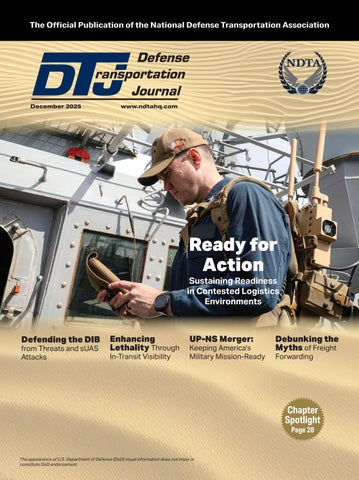
Ready for Action
Sustaining Readiness in Contested Logistics Environments Defending the DIB from Threats and sUAS Attacks
Enhancing Lethality Through
In-Transit Visibility
UP-NS Merger:
Keeping America's Military Mission-Ready
Debunking the Myths of Freight
Forwarding
Chapter Spotlight Page 28
The appearance of U.S. Department of Defense (DoD) visual information does not imply or constitute DoD endorsement.
2 | Defense Transportation Journal | DECEMBER 2025
NDTA Headquarters Staff VADM William A. Brown, USN (Ret.) President & CEO COL Craig Hymes, USA (Ret.) Senior VP, Operations
Claudia Ernst Director, Finance and Accounting
Lee Matthews VP Marketing and Corporate Development Jennifer Reed Operations Manager
Leah Ashe Membership Manager
Rebecca Jones Executive Assistant to the President & CEO Chloe Baker Project Coordinator
FOUNDATION
NDTA FOUNDATION HALL OF FAME The National Defense Transportation Association Foundation recognizes our most special donors for their gracious financial support to academic scholarships supporting our future logistics and transportation leaders.
VISIONARY SOCIETY Contribution over $100K
For a listing of current Committee Chairpersons, Government Liaisons, and Chapter & Regional Presidents, please visit the Association website at www.ndtahq.com.
PATHFINDER SOCIETY
EDITORIAL OBJECTIVES
Contribution $25K - $49,999
The editorial objectives of the Defense Transportation Journal are to advance knowledge and science in defense logistics and transportation and the partnership between the commercial transportation industry and the government transporter. DTJ stimulates thought and effort in the areas of defense transportation, logistics, and distribution by providing readers with:
• News and information about defense logistics and transportation issues • New theories or techniques • Information on research programs • Creative views and syntheses of new concepts • Articles in subject areas that have significant current impact on thought and practice in defense logistics and transportation • Reports on NDTA Chapters
ANNUAL DONORS Award
2024
2025
Advocate
Interstate Moving | Relocation | Logistics National Travel, Inc.
Kalitta Air NDTA Jacksonville Chapter Mr. Ron Perlman, Esq.
Patron
American Roll-On Roll-Off Carrier Group Inc. FedEx Matson United Airlines
EDITORIAL POLICY
The Defense Transportation Journal is designed as a forum for current research, opinion, and identification of trends in defense transportation and logistics. The opinions expressed are those of the authors and not necessarily of the Editors, the Editorial Review Board, or NDTA. EDITORIAL CONTENT
Archives are available to members on www.ndtahq.com.
Barbara Parus, Managing Editor, DTJ NDTA 50 South Pickett Street, Suite 220 Alexandria, VA 22304-7296 703-751-5011 • F 703-823-8761 bparus@ndtahq.com
American Roll-On Roll-Off Carrier Group Inc. CSX Enterprise Mobility FedEx Maersk Line, Limited Matson National Air Cargo, Inc. Paramount Enterprises International
As the Foundation is funded by voluntary donations, with your support, the Foundation will be empowered to help students for decades to come. Please consider making a tax-deductible contribution to help our future professionals have a future. Visit https://www.ndtahq.com/foundation/ to find out more. GIVE HAPPY - The NDTA Foundation is now a vetted charity listed in Combined Federal Campaign! CFC charity code #94212 DEFENSE TRANSPORTATION JOURNAL Statement of Ownership, Management, and Circulation as required by the Act of August 12, 1970; Section 3685, United States Code, for Defense Transportation Journal, published bi-monthly at Alexandria, Virginia, for August 2025. 1. Location of known office of publication: 50 South Pickett St., Suite 220, Alexandria, VA 22304. 2. Location of the headquarters of general business office of the publisher: 50 South Pickett St., Suite 220, Alexandria, VA 22304. 3. Publisher: National Defense Transportation Association, 50 S. Pickett St., Suite 220, Alexandria, VA 22304; Publisher, VADM William Brown, USN (Ret.); Managing Editor, Barbara Parus. 4. Owner: National Defense Transportation Association, 50 South Pickett St., Suite 220, Alexandria, VA 22304-7296 (an incorporated association). 5. Known bondholders, mortgages, and other security holders owning or holding 1 percent or more of total amount of bonds, mortgages or other securities: There are none. 6. Average number of copies each issue during the preceding 12 months: Total 3,610; paid circulation by mail, 3,682; sales through dealers, carrier or other means, 72; free distribution by mail or other means, 62; total distribution 3,744; copies not distributed, 40. Percent paid and/or requested circulation: 98%. Barbara Parus, Managing Editor.
www.ndtahq.com | 3
THE LANDSTAR ADVANTAGE A recognized industry leader, Landstar provides safe, secure, reliable transportation services delivered by our unique network of independent agents and capacity providers. • One of the industry’s largest van and platform selections with over 78,000 truck capacity providers in network • Expedited cargo vans, straight trucks and tractor-trailers • More than 17,600 pieces of trailing equipment • 9,600 owner-operators leased to Landstar with over 1,200 stepdecks and 960+ flatbed trailers • Drop and hook services • Specialty trailers ranging from beam, blade and Schnabels to double drop, stretch and multi-axles • Secure, dedicated government services with more than 350 AA&E secret cleared teams • Hazmat certified owner-operators • Unit moves with on-site carrier representative
Landstar.com 800-443-6808
LandstarGovtSvcs@landstar.com www.facebook.com/LandstarSystem 4 | Defense Transportation Journal | DECEMBER 2025
www.linkedin.com/company/Landstar
SIGN U P T O D AY www.n dtahq.c The S
NDTA’s
FEATURES December 2025 • Vol 81, No. 6 PUBLISHER
VADM William A. Brown, USN (Ret.) MANAGING EDITOR
Barbara Parus | bparus@ndtahq.com CIRCULATION MANAGER
Leah Ashe | leah@ndtahq.com PUBLISHING OFFICE
NDTA 50 South Pickett Street, Suite 220 Alexandria, VA 22304-7296 703-751-5011 • F 703-823-8761 GRAPHIC DESIGN & PRODUCTION MANAGER
Susan Hill
ADVERTISING SALES DIRECTOR
Bob Schotta bschotta@cjp.com
ADVERTISING & PRODUCTION Carden Jennings Publishing Co., Ltd. Custom Publishing Division 375 Greenbrier Drive, Suite 100 Charlottesville, VA 22901 434-817-2000 x330 • F 434-817-2020
om/the
December 2025
-source
ource
Officia l News letter Add pu blicatio ns@nd to your tah email a ddress q.com book
DEFENDING THE ARMY ORGANIC INDUSTRIAL BASE FROM THREATS, including Small, Unmanned Aircraft Systems (sUAS)
10
ENHANCING LETHALITY THROUGH IN-TRANSIT VISIBILITY: Countering Contested Logistics in the Department of War
16
RAILROADS AND READINESS A Legacy of Service and Strength
22
DEBUNKING THE MYTHS OF FREIGHT FORWARDING
24
NDTA YOUNG EXECUTIVE OF THE YEAR AWARD
29
By COL Christopher J. Masson, USA
By Marty Groover
By Kenny Rocker
By Jason Trubenbach
Cover photo by Petty Officer 1st Class Eric Coffer
DEPARTMENTS
NDTA FOUNDATION HALL OF FAME..................................................................................... 3 USPS STATEMENT OF OWNERSHIP...................................................................................... 3 Defense Transportation Journal (ISSN 0011-7625) is published bimonthly by the National Defense Transportation Association (NDTA), a non-profit research and educational organization; 50 South Pickett Street, Suite 220, Alexandria, VA 22304-7296, 703-751-5011. Copyright by NDTA. Periodicals postage paid at Alexandria, Virginia, and at additional mailing offices. SUBSCRIPTION RATES: One year (six issues) $40. Two years, $60. Three years, $75. To foreign post offices, $45. Single copies, $6 plus postage. The DTJ is free to members. For details on membership, visit www.ndtahq.com. POSTMASTER: Send address changes to: Defense Transportation Journal 50 South Pickett Street, Suite 220 Alexandria, VA 22304-7296
PRESIDENT’S CORNER | VADM William A. Brown, USN (Ret.)................................................ 6 CHAPTER SPOTLIGHT........................................................................................................ 28 CHAIRMAN’S CIRCLE......................................................................................................... 32 HONOR ROLL...................................................................................................................... 33
INDEX OF ADVERTISERS..................................................................................................... 34 We encourage contributions to the DTJ and our website. To submit an article or story idea, please see our guidelines at www.ndtahq.com/media-and-publications/submitting-articles/.
PRESIDENT’S CORNER Cargo Is King
VADM William A. Brown, USN (Ret.) NDTA President & CEO Dear NDTA Team, As you know, the 2025 NDTA-USTRANSCOM Fall Meeting was canceled due to the government shutdown. It was a major disappointment. This forum is where our community comes together to address the Department of War’s (DoW’s) logistics and transportation capacity, capability, and readiness. With nearly 90 percent of DoW cargo moving through commercial networks, we depend on close public-private partnerships to ensure secure, resilient, and efficient global movement. The Fall Meeting is a unique venue where government and industry leaders convene across all domains to align, collaborate, and prepare for the demands of competition and conflict. Losing that time mattered — but now is not the moment to dwell on missed opportunities. There is far too much work ahead. As the government reopens, we must move quickly, fully engage, and make use of every venue and partnership available. To that end, I challenge NDTA leadership, our Regional, State, and Chapter Presidents, and our Committee and Subcommittee Chairs to lean in even harder. Work shoulderto-shoulder with government partners. Strengthen relationships. Bring forward solutions. Momentum is our mission. Looking ahead, mark your calendars for these critical events in 2026: • NDTA Europe/Africa Regional Committee Meeting: Jan 20-22 (Sembach, Germany) • NDTA GovTravels: Feb 23-26 (Alexandria, VA) • NDTA Transportation Advisory Board: Apr 29-30 (Florida) • NDTA-CAS Surface Force Projection Meeting: May 18-21 (Newport News, VA) 6 | Defense Transportation Journal | DECEMBER 2025
• NDTA-USTRANSCOM Fall Meeting: Oct 26–29 (Grapevine, TX) These gatherings are not simply meetings; they are opportunities to build readiness, improve alignment, and strengthen the transportation enterprise that underpins national defense. 2026: A YEAR OF OPPORTUNITY
My focus theme for 2026 is simple and foundational: Cargo Is King. In peace, commercial cargo keeps U.S. carriers healthy, competitive, and mission ready. Fleets of ships, aircraft, trucks, and rail assets do not sustain themselves — they require cargo to stay in operation and prepared to surge when our nation calls.
WELCOME NEW CORPORATE MEMBERS as of November 14, 2025
CHAIRMAN’S CIRCLE • CACI International Inc. • KWIK Equipment Sales LLC
SUSTAINING • NorTranss International Transportation • Transglobal
As the Joint Transportation Management System (JTMS) rolls out in 2026, system integrity, security, and transparency are paramount. Cargo is the lifeblood of our logistics ecosystem and protecting it — physically and digitally — is inseparable from mission success. Anything less than secure delivery is failure. TRAINING, TESTING, AND STRENGTHENING THE FOURTH COMPONENT
As one industry leader remarked, without cargo, transportation assets are “lonely places.” As the United States negotiates trade agreements, the Department of Transportation must be at the table. We must secure meaningful participation for U.S. carriers and ensure that strategic mobility remains a national advantage — not an afterthought. Likewise, booking cargo must remain a process of high integrity. Global outsourcing cannot undermine national security. Cargo must move through qualified, legal, and trusted carriers — full stop.
In 2026, a significant slate of military exercises will stress-test the Defense Transportation System across all domains. The goal is clear: Strengthen readiness and resilience across government and industry. These exercises will pressure-test policies, systems, and processes to ensure we are ready for the future fight. NDTA and USTRANSCOM will work in lockstep with our industry partners, integrating efforts across training events, Executive Working Groups, national meetings, and committee forums. Together, we will crawl, walk, and run toward enhanced readiness for the Fourth Component — industry. Stay engaged. Stay optimistic. Stay forward focused. Cargo Is King — and our collective readiness depends on it. All my best to each of you. Please do not hesitate to contact us at NDTA Headquarters! W.A. Brown DTJ
www.ndtahq.com | 7
A Proven Partner for Mission Critical Logistics End-to-End Multi-Modal Logistics Bulk Fuel Operations DoD Trusted, ISO-Certified Solutions Veteran-led Teams, Dedicated Account Management Vessel Management
crowley.com/government 8 | Defense Transportation Journal | DECEMBER 2025
Global Reach with Resilient, Rapid Response Including in Austere Environments
www.ndtahq.com | 9
Defending the Army Organic Industrial Base from Threats Including Small, Unmanned Aircraft Systems (sUAS)
W
By COL Christopher J. Masson, USA
orld Wars I and II demonstrated that the homeland and the defense industrial base (DIB) are vulnerable to attacks. During these wars, German U-boats targeted shipping routes, disrupting the resupply of defense products to the European Theater of War. The DIB encompasses a vast workforce and infrastructure essential for producing and innovating defense capabilities, including government-owned, contractor-operated (GOCO), and privately owned factories, foundries, ports, shipyards, ammunition plants, and public or private research universities. Today, the modern equivalent of the U-boat threat is the asymmetric challenge that small, unmanned aircraft systems (sUAS) pose to the DIB, and the U.S. Army’s organic industrial base (OIB), a critical component of the DIB. This paper examines the strategic importance of the DIB and the Army OIB, explains the threats presented by sUAS, and highlights why both must be protected. Finally, it outlines the Army’s role in determining requirements, improving capabilities, establishing authorities, and clarifying responsibilities to effectively counter sUAS threats and safeguard the OIB within the United States.1
In WWI and WWII, like today, the United States homeland was presumed to be a sanctuary. But attacks from German Uboats proved that the U.S. was vulnerable, leading to an initially struggling response that took time to improve the security of the homeland’s littorals. In 1918, Germany conducted the first large-scale attacks on U.S. home waters, sinking or damaging 23 ships off New Jersey, Delaware, and Maryland, and even shelling Cape Hatteras, N.C., causing public alarm.2 In WWII, Germany launched Operation Paukenschlag (“Drumbeat”) in January 1942. U-boats operated within sight of U.S. shores, sinking merchant ships visible from beaches off Long Island, Cape Hatteras, and Florida. German U-boats torpedoed vessels close to harbors like New York, Norfolk, and Jacksonville, threatening port operations by sinking ships in approaches and anchorages.3 In the first six months of 1942, U-boats sank around 400 ships in American waters, totaling more than 2 million tons of shipping losses — a period German sailors called the “Second Happy Time.”4
10 | Defense Transportation Journal | DECEMBER 2025
The Army OIB manufactures, resets, and maintains Army equipment; this enables the Army to deliver critical materiel and sustainment support to warfighters at the point of need. The Army's OIB consists of depots, arsenals, and ammunition plants.8
https://www.pobtx.com/news-and-media 1
The tanker Penn sylvania Sun to rpedoed by U-571 on 15 Ju ly 1942 6
In both cases, Germany’s objective was to disrupt troop and supply shipping to Europe and generate psychological shock. While the campaigns never strangled U.S. ports, they forced the rapid expansion of convoys, coastal defenses, and anti-submarine patrols.5 The modern version of the Uboat threat is the asymmetrical challenge that sUAS) pose to the DIB and the U.S. Army OIB, as part of the DIB. This paper assesses the strategic importance of the Army OIB and why it must be protected. It outlines sUAS threats, focusing on their size and capabilities. Lastly, it outlines the Army’s role in determining requirements, improving capabilities, establishing authorities, and clarifying responsibilities to effectively address sUAS threats and protect the OIB within the United States. The DIB and Army OIB Enable Combat Power Projection and Resupply The Army OIB is part of the DIB and includes a vast workforce of people, combined with the associated infrastructure required to produce and innovate defense items. Industrial base facilities can be government-owned and government-operated (GOGO), contractor-owned and contractor-operated (COCO), GOCO, privately owned factories, foundries, shipyards, and ammunition plants, and government, public, or private research universities.7 The Army OIB manufactures, resets, and maintains Army equipment; this enables the Army to deliver critical materiel and sustainment support to warfighters at the point of need. The Army’s OIB consists of depots, arsenals, and ammunition plants.8 For example, Red River Army Depot (RRAD) in New Boston, Texas, occupies 15,375 acres, houses over 1,400 buildings, and can rebuild a large variety of vehicle systems and components for the Army, Marine Corps, Air Force, and Navy. Safeguarding this depot is crucial to the Army and joint force. Vulnerabilities for moving combat power to the point of need are U.S. seaports on the littorals. Ports, such the Port of Beaumont in Texas, are vital partners for the U.S. joint force. There is no practical way to move the required quantity of military platforms via air to a war theater; shipping lanes are essential in building combat power and resupplying the theater.
sUAS TYPE Types of sUAS: Multirotor versus Fixed-Wing?
A MULTIROTOR DRONE, also referred to as a multicopter or a multirotor UAV, is an aircraft
that is lifted and propelled by multiple rotors. There are several types:
TRICOPTERS A tricopter is a type of multirotor drone that has three rotors arranged in a triangular shape. It is lightweight and easy to maneuver.
OCTOCOPTER An octocopter has eight rotors. It is very stable and can carry payloads heavier than a hexacopter.
QUADCOPTER The most popular type of multirotor drone is powered by four rotors, arranged in an "X" or "+" configuration for added stability.
HEXACOPTER A hexacopter can carry heavier payloads than quadcopters due to the additional lift generated by the extra rotors.
FIXED-WING DRONES A fixed-wing drone has a rigid wing that generates lift through forward motion. It achieves lift and propulsion through rotating propellers to fly more efficiently and cover longer distances.
Small UAS Can Be Employed for Surveillance, Sabotage, or Direct Attacks The Department of War and the Federal Aviation Administration (FAA) define sUAS as small, unmanned aircraft systems weighing less than 55 pounds. The FAA allows most routine recreational sUAS operations to occur without requiring airworthiness certification so long as the platform is operating in the visual line of sight, where the operator can see the system without obstruction and operate safely.10 All sUAS need to be registered, and there is a set of rules which operators must follow; these can be found on the FAA’s
The purpose of JIATF 401 is to better align authorities and resources to rapidly deliver Joint C-sUAS capabilities, defeat adversary threats, and promote sovereignty over national airspace.17 JIATF 401 will become the linchpin for determining how the joint services protect DIB facilities from sUAS.
DroneZone website.11 Congress created a “carve-out” exception to allow drone operators to fly sUAS under 55 pounds for personal enjoyment without complying with Part 107 — Small Unmanned Aircraft Systems, Code of Federal Regulations (CFR).12 The Air Force Materiel Command published the Air Force SmallUnmanned Aircraft Systems Guide & Reporting Procedures; a portion of this document provides an overview of sUAS types.13 There are over 8,000 sUAS flown within the U.S. on any given day, and over one million drones of assorted sizes registered with the FAA.14 The majority are flown legally and not a threat to national security. But adversaries can employ sUAS for surveillance, sabotage, or direct attacks on critical infrastructure, posing significant risks to the operational readiness and resilience of the DIB and Army’s OIB. Innovations in combat are shifting rapidly, as demonstrated in the ongoing Russo-Ukrainian War. Small UAS are low-cost, low-budget, and easily operated. They can move quickly through airspace, and the launch origin is hard to locate. The most dangerous scenario is employing an sUAS after attaching a munition or chemical agent payload for a kinetic attack. Employing an sUAS with a payload could physically damage DIB and OIB fawww.ndtahq.com | 11
The joint force must bring DIB facilities and partners to the table and assess threats at each location, including depots, arsenals, ammunition plants, and ports.
cilities and reduce the capacity to resupply military formations in conflict. Deterrence is complicated, and it requires coordination and cooperation across the federal interagency and with state and local governments. Acting now will ensure the U.S. is better prepared than the government response in WWI and WWII. The Army Must Be a Proactive Partner in Codifying Authorities, Validating Responsibilities, Understanding Requirements, and Improving Capabilities to Counter sUAS Threats. During WWI and WWII, assuming the continental U.S. was safe led to poor preparation and a disorganized early response — an error we must avoid when addressing sUAS threats today. By mid-1942, the U.S. instituted coastal convoys, air patrols, radar, sonar, and escorts, which drastically reduced successful attacks. Ports, such as New York and Norfolk, were soon fortified with nets, minefields, and patrol crafts to prevent incursions.15 Government efforts had to synchronize authorities and responsibilities from the local to the federal level. The Joint Counter-Small Unmanned Aircraft Systems Office (JCO) was originally led by Department of War efforts to align counter-sUAS authorities and responsibilities. To enhance efficiency, on August 27, 2025, the Department “…
12 | Defense Transportation Journal | DECEMBER 2025
direct[ed] the Secretary of the Army to disestablish the JCO and establish Joint Interagency Task Force 401 (JIATF 401) reporting to the Deputy Secretary [of War].”16 The purpose of JIATF 401 is to better align authorities and resources to rapidly deliver Joint C-sUAS capabilities, defeat adversary threats, and promote sovereignty over national airspace.17 JIATF 401 will become the linchpin for determining how the joint services protect DIB facilities from sUAS. COUNTER Act 1793 Another positive step is Congressional legislation geared towards protecting U.S. assets from incursions via UAS. This Act is cited as the “Comprehensive Operations for Unmanned-System Neutralization and Threat Elimination Response Act,” also known as the “COUNTER Act” 1793 — 119th Congress (2025-2026).18 Its origin was driven by events in New Jersey in November 2024, where drones (sUAS) were spotted over Picatinny Arsenal.19 COUNTER Act 1793 will enhance the “protection of the buildings, grounds, and property to which the public is not permitted regular, unrestricted access and that are under the jurisdiction, custody, or control of the Department.”20 It aims to expand the Department’s authority to neutralize unauthorized drones and it codifies the Secretary’s delegation au-
thority to take required actions and further delegate responsibilities.21 This is complementary to the establishment of JIATF 401. Developing effective firstlevel responses to sUAS kinetic attacks requires further progress in processes, resources, and technology. One way is through Artificial Intelligence (AI). Currently, most counter-UAS systems rely on operators who manually respond. “This information glut not only complicates operator interactions but also slows down accurate decision-making, especially when facing sUAS swarm threats.”22 In large-scale combat, drone swarms would be the most dangerous threat. Small UAS swarms are synchronized and coordinated groups of drones that work in concert to overwhelm a target.23 It is harder to neutralize the entire swarm, and at least a portion of the attacking platforms are likely to reach their destination with a payload. The joint force, through JIATF 401, should focus research and development towards “AI, automation, and advanced algorithms”24 to more effectively counterUAS platforms and respond smartly with technology at installations, rather than relying on countermeasures like ‘dronebusters’ or small arms. These last-line defenses, as part of a layered approach, are important but not ideal.
Ensuring Industrial Base Resilience and Joint Readiness Against sUAS Threats The global security environment remains volatile and dangerous. The U.S. homeland is not immune to kinetic and non-kinetic attacks from rogue actors, terrorists, and peer-adversaries. One low-cost, high-yield method to limit force projection capabilities and reduce resupply to a deployed force is to adversely impact the DIB and the Army OIB within it, through sUAS attacks. Attacks on the homeland reduce war fighting strength, limit force projection via ports, and cripple manufacturing facilities, which cannot be repaired or rebuilt quickly. The Army, as part of the Joint force, needs to be a vital participant on the path forward to enhance U.S. effectiveness to counter sUAS threats; JIATF 401 is the primary way for the Army to understand requirements, improve capabilities, codify
authorities, and validate responsibilities to more effectively counter sUAS threats within the U.S. to protect the Army OIB and the larger DIB. The Joint force must bring DIB facilities and partners to the table and assess threats at each location, including depots, arsenals, ammunition plants, and ports. Second, the Army and Joint force should follow legislative movement on the COUNTER Act 1793 and analyze the Act’s impact on JIATF 401 Interagency collaboration and synchronization. It is imperative that Services develop the right capabilities to gain tactical advantage and technological superiority. These advantages include assessing AI and its applications to counter sUAS threats with systems, algorithms, and robotics, and relying less on manual counterthreat operators. If the Services continue working collaboratively within JIATF 401, leverage
advancements in technology, refine authorities and responsibilities, and consider DIB facilities’ inputs and threat assessments, they will be resourcing DIB facilities with the proper materiel, systems, and training to effectively respond to sUAS incursions and ultimately, securing the DIB within the continental U.S. to effectively project combat power and resupply the Joint force during large-scale combat operations. DTJ ABOUT THE AUTHOR
Colonel Christopher J. Masson, U.S. Army, is an Army War College (AWC) Fellow at the University of Texas at Austin, for the 2025-2026 academic year. After AWC, he will command Red River Army Depot in New Boston, Texas, from Summer 2026-2028. (See References on page 34.)
Dronebuster utilized during a complex training exercise at Muscatatuck Training Center, Indiana, February 2024.25 www.ndtahq.com | 13
Save the Date!
SURFACE FORCE PROJECTION MEETING May 18-21, 2026
Christopher Newport University • Newport News, Virginia
SIKICH STARS CMMC PROGRAM The Sikich STARS (Scope, Train, Assess, Remediate, Support) CMMC readiness program supports clients by simplifying CMMC certification and the implementation of NIST SP 800-171 for protecting Controlled Unclassified Information (CUI), which ultimately protects the battlefield’s warfighter. As part of this program, Sikich assists with scoping the CMMC enclave, completing self-assessment scoring, identifying compliance gaps, completing the Plan of Action and Milestones (POAM) remediation planning, and documenting the System Security Plan (SSP). We also function as your outsourced cybersecurity and risk consulting partner, helping to guide efforts related to achieving and maintaining compliance.
Hover camera over code to learn more
14 | Defense Transportation Journal | DECEMBER 2025
877.403.5227 | securitysales@sikich.com SIKICH.COM
LUXURY FBO LOCATIONS
*AEX | *CWF |**FOE |**HSA | *LBB **MWH | *MFR |**NYL | *RIV |**RME *SFB |**SGU | *SYR | *VCV |**PHJR
**ABI | *ACT | *ARA | *ESF LCH |**PUB | *SYR
* LOCATION HOLDS DLA CONTRACT ** RAPID REFUELING AVAILABLE **SBP | SNA
WWW. FREEMANHOLDINGSGROUP. COM
www.ndtahq.com | 15
Enhancing Lethality Through In-Transit Visibility: Countering Contested Logistics in the Department of War
I
By Marty Groover, C5MI, and NDTA Technology Subcommittee Chair
n an era of great power competition, the Department of War (DoW) faces unprecedented challenges in maintaining global force projection and sustainment. Adversaries are increasingly capable of disrupting logistics operations across multiple domains, a phenomenon referred to as “contested logistics” in section 323 of the FY 2026 National Defense Authorization Act (NDAA). This phenomenon refers to environments where competitors deliberately seek to deny, disrupt, destroy, or defeat friendly force logistics facilities and activities. To address these threats, the United States Transportation Command (USTRANSCOM) will be responsible for the following: 1. Mitigating vulnerabilities and risks associated with contested logistics for the Department of War, and 2. Planning and operations of the Joint Deployment and Distribution Enterprise (JDDE) relating to contested logistics across all domains, including the movement of forces and material from the source of supply to the designated point of need of the commander of the combatant command receiving support. As part of the contested logistics responsibilities, USTRANSCOM is developing a comprehensive In-Transit Visibility (ITV) Modernization Strategy as the DoW’s ITV executive agent. As part of the National Defense Transportation Association (NDTA) Logistics and Distribution Committee, the Technology Subcommit16 | Defense Transportation Journal | DECEMBER 2025
Military intelligence experts checking screens and analyzing real-time data in control room. tee is leveraging industry partners and solutions to examine business and technical requirements already in use commercially for integrating commercial and military transportation assets to support the development of USTRANSCOM’s end-to-end ITV strategy. The Technology Subcommittee developed a draft ITV research paper that identifies the DoW’s current state ITV gaps and identifies commercial capabilities that USTRANSCOM can leverage quickly to create an ITV agility layer that
is agnostic to location sensor data sources to create an ITV common operational picture. It includes advanced analytics and AI technology already in use in the commercial transportation sector. This article explores how USTRANSCOM’s ITV strategy is critical for countering contested logistics while directly supporting the Secretary of War (SECWAR) emphasis on lethality. By modernizing ITV, the DoW can transform its logistics enterprise into a resilient, data-driven ecosystem
that ensures warfighters receive critical materiel from the defense industrial base (DIB) to the AoR point of use, thereby enhancing operational lethality and decision advantage. THE ITV MODERNIZATION STRATEGY: A BLUEPRINT FOR TRANSFORMATION
USTRANSCOM’s ITV strategy marks a decisive shift from legacy systems rooted in 1990s technology to a flexible, technologically agnostic ecosystem. The current ITV capability relies on outdated nodal sensors, manual data entry, and infrastructuredependent tracking, leading to data lags, inaccuracies, and vulnerabilities — particularly in remote or contested areas. Audits since 2013 and recent experimentation highlight shortfalls, such as improperly applied active Radio Frequency Identification (aRFID) tags, depleted batteries, and inconsistent user compliance, which often result in lost visibility after cargo departs aerial or seaports of debarkation. The strategy proposes a comprehensive overhaul, centering on Remote Monitoring Devices (RMDs) — including sensors, tags, and devices tailored to specific use cases and environments. These RMDs prioritize data collection for transmission to a secure integration platform, curating information into an interoperable format for operational decision-making, machine learning (ML), artificial intelligence (AI), predictive logistics, and audit compliance. This approach adopts a “commercial as possible, military as necessary” philosophy, leveraging advancements in commercial transportation while ensuring DoW-specific security and resilience requirements. Key tenets include centralizing program management under the USTRANSCOM Joint Deployment and Distribution Coordinator (JDDC) role and fostering collaboration with stakeholders such as the
Predictive analytics, a core element, leverages historical data, weather forecasts, and carrier performance to anticipate disruptions 72+ hours in advance.
Office of the Secretary of Defense (OSD), the Joint Staff, the Military Services, and Combatant Commands (CCMDs). The vision is a seamless, up-to-real-time ITV capability integrated into the broader Asset Visibility (AV) framework, enabling predictive logistics and dynamic adjustments. As defined in Joint Publication (JP) 4-09, ITV tracks the identity, status, and location of DoW cargo and personnel from origin to point of need — typically the final Department of War Activity Address Code (DoWAAC) — excluding tactical distribution. The NDTA research paper reinforces this by identifying gaps in current systems, including modal fragmentation, data latency exceeding 4 hours, and limited granularity. It advocates for item-level visibility for high-priority classes of supply (e.g., ammunition, medical items) and for performance metrics such as 15–30-minute location updates in contingency operations. By establishing standardized data formats, transmission protocols, and contractual mechanisms for commercial carriers, the paper provides a framework for USTRANSCOM to build a “digital twin” of the Joint Deployment and Distribution Enterprise (JDDE) supply chain, foundational for ML/AI-driven predictive analytics. COUNTERING CONTESTED LOGISTICS: BUILDING RESILIENCE AND PREDICTABILITY
Contested logistics poses a direct threat to DoW operations, as adversaries target supply chains to erode U.S. advantages. The NDAA mandates USTRANSCOM to assess JDDE gaps in projecting, maneuvering, and sustaining forces in such environments, with ITV emerging as “table stakes” for mitigation. Without robust visibility, up to 40% of military materiel could face delays or misrouting during contingencies, as noted in Defense Science Board studies. USTRANSCOM’s ITV strategy counters this by delivering accurate, auditable, secure, and resilient end-to-end data, even in degraded or denied communications. RMDs incorporate multi-layered architectures with GPS/GNSS, satellite communications, inertial navigation for GPSdenied scenarios, and edge computing for local data storage and anomaly detection. This technology ensures uninterrupted coverage across all modes — land, sea, air — and during intermodal transfers, from origin operations such as export customs
ITV tracks the identity, status, and location of DoW cargo and personnel from origin to point of need.
clearance to theater distribution at forward logistics bases. Predictive analytics, a core element, leverages historical data, weather forecasts, and carrier performance to anticipate disruptions 72+ hours in advance, with ETA predictions achieving over 95% accuracy in commercial models adaptable to DoW needs. The NDTA paper highlights commercial partners like Gnosis Freight and Air Space Intelligence (ASI), whose AIpowered platform orchestrates data from ocean carriers, ports, railroads, air cargo, and more into a unified model, reducing manual effort and improving asset utilization. For DoW, this translates into proactive rerouting, resource reallocation, and shortage forecasting based on consumption models that incorporate operational tempo and mission profiles. In contested environments, ITV’s resilience — through hierarchical communications (e.g., 5G/LTE primary, military SATCOM contingency) and zero-trust security — prevents data exploitation. By creating a live digital twin of the JDDE, ITV enables ML/AI to shift from a descriptive to a prescriptive posture, identifying chokepoints and optimizing flows. This technology not only mitigates disruptions but also enables coalition integration, ensuring global force projection remains adaptive and unmatched. SUPPORTING THE SECWAR'S FOCUS ON LETHALITY
The SECWAR’s memorandum, “Directing Modern Software Acquisition to Maximize Lethality,” issued on March 6, 2025, underscores the centrality of software to warfighting superiority and criticizes acquisition delays that disadvantage warfighters. It directs adoption of the Software Acquisition Pathway (SWP) and commercial solutions to deliver capabilities at speed and scale, maintaining the “strongest, most lethal fighting force in the world.” ITV www.ndtahq.com | 17
cast asset arrivals in CCMDs’ Areas of Responsibility (AORs). This predictability refines p o w e r Marty Groover, LCDR, p rojection USN (Ret.), was a 22planning, reyear U.S. Navy Surface ducing vulWarfare Officer, masternerabilities ing complex systems opand amplifyerations. ing decision advantage. Furthermore, ITV’s integration with legacy systems like the Integrated Data Environment/ Global Transportation Network Convergence (IGC) and Joint Operation Planning and Execution System (JOPES) accelerIn Speed of Advance, Marty shares how synchronized ates software-driven reforms. technology and people drive transformative results in the Ultimately, as we define the business rules for ITV during Fourth Industrial Revolution. the transformation, it naturally modernization aligns seamlessly, as it is supports the Joint Transportation Maninherently software-defined, relying on inagement System (JTMS) implementation tegration platforms, APIs, and AI/ML for as it develops the new digital platform to data curation and predictive insights. provide the warfighter the entire JDDE By optimizing logistics, ITV enhances supply chain single version of truth comlethality: Timely materiel delivery ensures mon operational picture (COP). Full inunits maintain combat readiness, directly tegration of ITV into JTMS will transsupporting force projection and sustainform logistics from a vulnerability into a ment. In contested scenarios, real-time visstrategic enabler, empowering warfighters ibility enables dynamic operational adjustto outmaneuver threats and increase lements, allowing commanders to prioritize thality. limited transportation resources and fore-
A UNIFIED PATH TO PREDICTIVE VISIBILITY AND LETHAL JOINT SUSTAINMENT
USTRANSCOM’s ITV strategy, informed by insights from NDTA industry partners, is pivotal for countering contested logistics through resilient, predictive visibility. By addressing legacy shortfalls and embracing commercial innovations, it fortifies the JDDE against disruptions. This effort directly supports SECWAR's lethality imperative by enabling software-agile logistics that sustain a dominant fighting force. As the DoW implements this blueprint, it must prioritize unified action, stakeholder collaboration, and continuous improvement to achieve unmatched global sustainment in an increasingly complex world. The result: a more lethal, adaptive Joint Force ready for future conflicts. DTJ ABOUT THE AUTHOR
Marty Groover, C5MI Senior Technical Fellow, and Chair, NDTA Technology Subcommittee, leads Industry 4.0 initiatives, driving Live Factory®, Live Warehouse®, and Digital Reliability Centered Maintenance® solutions. By converging IT and OT, he creates a “Common Operational Picture” to enhance manufacturing outcomes. A 22-year U.S. Navy Surface Warfare Officer, Marty mastered complex systems operations. At Caterpillar, he served as a 6 Sigma Black Belt, Manufacturing Engineer, and Global ERP Deployment leader. Since joining C5MI in 2018, he has built its Industry 4.0 practice, delivering solutions to major manufacturers.
Register Today! www.ndtahq.com/events/gov-travels
18 | Defense Transportation Journal | DECEMBER 2025
FAST. CONVENIENT. RELIABLE.
Proudly serving our U.S. military throughout the Pacific, Matson is one of the largest and most reliable carriers of sustainment cargo worldwide for the U.S. Transportation Command, consistently earning Monthly Carrier Performance scores rated “Excellent” by USTRANSCOM.
🇺
For more information, speak with one of our shipping experts at (800) 4-MATSON or visit Matson.com.
www.ndtahq.com | 19
TRANSPORTATION
CONNECTING THE WORLD TO ALASKA THROUGH SURFACE, AIR, AND OCEAN
Reliable, Sustainable, and Safe!
20 | Defense Transportation Journal | DECEMBER 2025
Trailer Bridge is positioned to serve as your trusted single-source partner for government operations. Our team of experts leverage their experience and worldwide network to create solutions tailored to your specific needs, from origin to final destination. As a Jones Act provider, we have boots on the ground in the U.S. and stand ready for any project. We pair our assets with those of our industry-leading partners to support the unique needs of our U.S. military and its allies. Rely on us to oversee your freight’s transportation ensuring compliance and efficiency so you can concentrate on the mission.
Our Solutions. • Surface Transportation • Rail • Material Handling • Base Camp & Life Services • Air Transportation • Warehousing • Port & Terminal Operator • Freight Forwarder
+1 (844) 827-4477 | Info@TrailerBridge.com |
www.ndtahq.com | 21
Railroads Readiness
Before the project, Fort Riley could move about 100 railcars in 24 hours. Today, it can prebuild multiple trains and deploy an entire brigade — up to 700 cars — in less than two days. That’s readiness in action.
AND
A Legacy of Service and Strength
M
By Kenny Rocker, Executive Vice President – Marketing and Sales, Union Pacific Railroad Y DAD WAS IN THE ARMY, where he proudly served his country for four years. From the lessons he taught me — and from my own visits to military bases in Texas and Kansas — I’ve learned what it means to be mission driven, the importance of precision, and how to be ready at a moment’s notice. That mindset has always stayed with me, and I see it every day in the work we do at Union Pacific Railroad. For more than 160 years, railroads have helped keep America ready. Since the Civil War, rail has been an essential part of our national defense — moving troops, tanks, fuel, and supplies wherever they need to go. At Union Pacific, our partnership with the military runs deep. Civil War veterans helped lay our first tracks, and today, nearly one in five of our employees has served in uniform or currently serves in the National Guard or Reserves. That shared sense of discipline, teamwork, and focus is part of who we are. It shapes how we think, how we operate, and how we serve. We take real pride in that. Every generation of Union Pacific employees has supported the nation’s defense in one form or another. What started as troop movements and supply trains in the 1800s has become a modern, technology-driven logistics network that keeps America’s military mission-ready.
22 | Defense Transportation Journal | DECEMBER 2025
Photographs by Roger Durfee THE BACKBONE OF READINESS
Across our 23-state network, we move thousands of railcars each year loaded with the equipment that keeps America’s armed forces strong. From Humvees and helicopters to food and fuel, rail is often a critical link in the defense supply chain — connecting the heartland to the front line. Our routes stretch from inland installations to coastal ports in California, Louisiana, and the Pacific Northwest, as well as ports on the Great Lakes. Plus, we’re the only U.S. railroad with access to all six gateways into and out of Mexico. Our footprint gives us the strength to support the Department of War with flexibility and reach when timing is critical. Union Pacific is also the only Class I railroad authorized to exchange billing and shipment information directly with the Department of War’s transportation management system, a distinction built on decades of trust and performance.
That trust isn’t abstract. Whether it’s a single container or a 132,000-lb. Abrams tank, the military knows we’ll get it there safely. That confidence stems from a system that works, and a team with a hustle mindset who cares about getting it right. Behind the scenes, thousands of railroaders play their part. They inspect, maintain, and dispatch the trains carrying our nation’s most vital cargo. They don’t always see where those shipments end up, but they know they’re moving something bigger than freight: They’re moving America’s readiness forward.
EVOLVING TOGETHER As we look ahead, our relationship with the U.S. military is changing, growing stronger, more integrated, and more essential than ever. The proposed merger between Union Pacific and Norfolk Southern represents a new chapter in that relationship. Some see it as a business move. I see it as a strategic advantage for our nation. When approved, this merger will create America’s first coast-to-coast rail network — 50,000 miles of track across 43 states, connecting the Pacific and Atlantic coasts and linking dozens of bases, suppliers, and key ports. When we connect the coasts, we connect the country. That means faster, simpler, more secure movement for our military partners. Today, six major Class I freight railroads operate across North America. When freight needs to cross those boundaries, it often changes hands — sometimes several times. Each transfer adds time, cost, and risk to shipments that can’t afford delays. A unified network will remove those bottlenecks. By reducing handoffs and improving coordination between installations, manufacturers, and ports, we can move cargo faster, with greater reliability and predictability. For America, that translates directly into agility, the ability to respond to global demands without hesitation.
WHAT'S POSSIBLE You don’t have to imagine what this kind of collaboration looks like because it’s already happening. Take Fort Riley in Kansas. Working with the U.S. Army Corps of Engineers, Union Pacific helped expand the base’s rail loading
capacity with 33,000 feet of new track. It’s a $15 million investment that transformed how quickly the base can deploy. Before the project, Fort Riley could move about 100 railcars in 24 hours. Today, it can pre-build multiple trains and deploy an entire brigade — up to 700 cars — in less than two days. That’s readiness in action. Readiness isn’t just a mindset — it’s infrastructure, planning, and execution coming together when it counts. Projects like this show what happens when government and industry share a mission. Smart infrastructure investment doesn’t just improve efficiency; it strengthens national capability.
MOVING WITH TECH The next era of defense logistics will depend on technology and adaptability. Railroads are investing heavily in innovation, from AI and predictive analytics to advanced inspection systems that support our employees and customers. At Union Pacific, we’re applying these tools to enhance safety and make our 32,000-mile network more efficient. Sensors and digital inspection portals help us detect issues before they cause delays. Data analytics allow us to anticipate demand, adjust resources, and keep high-priority shipments moving without interruption. We’re not innovating for innovation’s sake. We’re focused on one thing: performance. When the military calls, our system must work flawlessly. These advances give us the precision and resilience that define a strong national supply chain.
SUPPORTING VETERANS Our relationship with the military is also deeply personal. Veterans have always been at the heart of Union Pacific. Their leadership, focus, and commitment to teamwork make us stronger as a company — and as a community. Through our UPVETS Resource Group, we support veterans transitioning to civilian careers, offer mentoring and development opportunities, and engage in outreach that extends beyond the workplace. Union Pacific has been recognized among the nation’s most military-friendly employers, earning the Department of
War’s Freedom Award and other honors. But more important than the recognition is the daily dedication of the people behind it: the veterans who bring the same integrity and sense of mission they had in service to their work on the railroad. Our veterans bring the same integrity and sense of mission they had in service — and it shows in how they keep our railroad running.
THE SPIRIT OF SERVICE If you’ve ever seen Union Pacific Locomotive No. 1943 — The Spirit — you’ve seen our pride in serving the military. Painted in the colors of all five branches of the armed forces, it’s a moving tribute to those who defend freedom and to the railroaders who help keep America’s rail lines strong. Every time that locomotive rolls down the main line, it turns heads. But more than that, it reminds us what this partnership stands for: service, sacrifice, and strength.
LOOKING AHEAD As global challenges grow more complex, the need for dependable logistics will only intensify. Rail will continue to play a vital role in national defense, not only as a transporter of goods but as a strategic enabler of readiness. Union Pacific will keep investing in the people, technology, and infrastructure that make our network strong. And through our merger with Norfolk Southern, we’ll build an even more capable system — one that moves with precision, scale, and purpose. DTJ ABOUT THE AUTHOR
Kenny Rocker is Executive Vice President, Marketing & Sales at Union Pacific Railroad in Omaha, Neb. He has held this position for eight years and is responsible for the company’s three major business units, along with Marketing and Sales Operations, Commercial Strategy, Union Pacific’s Mexico business and its Loup Logistics subsidiary. He holds a Bachelor of Science degree from Tuskegee University.
www.ndtahq.com | 23
DEBUNKING THE MYTHS of Freight Forwarding
By Jason Trubenbach, Trailer Bridge Europe GmbH
T
he freight forwarding industry plays a critical role in the global supply chain, yet it is often misunderstood. Many shippers and businesses perceive freight forwarders as unnecessary middlemen who inflate costs or obscure transparency in logistics. In reality, freight forwarders serve as essential facilitators who provide expertise, flexibility, efficiency, and integration in the increasingly complex global transportation ecosystem. This article addresses common myths about freight forwarders, provides examples of their value, and recommends strategies to build stronger partnerships between shippers and their forwarding partners.
1
MYTH #
Freight Forwarders Just Add “Margin on Margin”
A persistent misconception is that freight forwarders simply act as intermediaries, adding costs without adding value. The argument is that by working directly with an asset-based carrier, shippers can eliminate the “middleman” and save money.
REALITY: Freight forwarders consolidate shipments, negotiate favorable rates through volume purchasing, and provide access to global networks that most shippers cannot achieve on their own. According to the International Federation of Freight Forwarders Associations (FIATA), forwarders can leverage their relationships with carriers to secure space and service levels that would otherwise be inaccessible to 24 | Defense Transportation Journal | DECEMBER 2025
small and medium-sized businesses.1 Drewry Shipping Consultants has also noted that forwarders play a vital role in stabilizing freight rates for shippers through their contract volumes.2 Freight forwarders collaborate with multiple carriers and try to match your cargo with assets looking for cargo, so they don’t move empty. Additionally, forwarders assume responsibility for compliance with customs regulations, documentation accuracy, and risk management — all areas where mistakes can be costly. A shipper may pay a small administrative fee, but the savings from avoided penalties, improved transit times, and efficient routing often far outweigh any “added margin.”
2
MYTH #
Asset-Based Carriers Always Move Cargo on Their Own Equipment
Another myth is that choosing an asset-based carrier (like a trucking fleet or steamship line) guarantees that the shipment will be transported on that carrier’s assets.
REALITY: Many shippers may also be surprised to discover that asset-based carriers also function as brokers. A large asset-based company does not own assets to park them and wait for your call — those assets are usually dedicated to a customer or lane. A trucking company may contract with independent owner-operators or even competitors when their own fleet is at capacity. Similarly, ocean carriers often participate in vessel-sharing agreements, meaning your cargo may sail on a partner’s
ship rather than the carrier named on the bill of lading.3 This practice is not inherently bad, but it underscores that using an asset-based carrier does not necessarily eliminate intermediaries. Freight forwarders provide transparency and can help shippers understand how and why such arrangements occur.
3
MYTH #
Freight Forwarders Lack Transparency
Some shippers believe that forwarders deliberately obscure costs, timelines, or carrier choices.
REALITY: Leading freight forwarders are investing heavily in digital platforms that provide end-to-end visibility, real-time tracking, and transparent pricing. According to a 2022 report from McKinsey & Company, digital freight platforms are transforming the industry by making data more accessible and enhancing collaboration between shippers and logistics providers.4 Gartner has also reported that shippers increasingly prefer forwarders who invest in technology and visibility tools, citing transparency as a top three decision factor in logistics provider selection.5 Forwarders who prioritize transparency can improve a shipper’s visibility compared to booking directly with multiple carriers, where tracking data is fragmented. For those smaller firms without the budgets to invest in more advanced technologies, persistent communication is key.
4
MYTH #
Freight Forwarders Are Only Useful for International Shipping
Some shippers assume freight forwarders are only relevant for ocean or air freight.
REALITY: Freight forwarders often arrange multimodal solutions, such as combining ocean, rail, and trucking under a single transport contract. In addition, many forwarders also provide broader supply chain services — including domestic trucking, warehousing, and even last-mile delivery — to create a seamless end-to-end logistics solution. This holistic approach enables shippers to benefit from both optimized transport planning and streamlined logistics support across the supply chain. This brings up another key role freight forwarders provide: optimizing solutions specific to the customer and the shipment. If you provide your freight forwarder with as much detail as possible, your forwarder can help you find the best solution or provide an array of options.
5
MYTH #
Large Shippers Don’t Need Freight Forwarders
Big companies with inhouse logistics teams sometimes believe they can manage without a forwarder.
REALITY: Even the largest global shippers rely on freight forwarders, particularly when navigating new markets, complying with local regulations, or managing seasonal surges. Forwarders provide agility that large, structured organizations often lack. They also act as a buffer during market disruptions — such as port strikes, capacity shortages, or geopolitical events — by leveraging their global networks to find alternative solutions quickly. The World Bank’s Logistics Performance Index highlights how forwarders add resilience in emerging markets by bridging gaps in infrastructure and regulation.6 THE TRUE VALUE Freight Forwarders Bring 1. Expertise and Compliance International trade involves complex regulations, customs documentation, and security requirements. Errors can lead to costly fines, delays, or even seizure of goods. For-
warders specialize in these areas, ensuring that shipments are compliant with international trade laws. The World Trade Organization has noted that trade facilitation measures, often coordinated by forwarders, can reduce total trade costs by up to 14% on average.7 2. Access to Global Networks Forwarders maintain relationships with multiple carriers across modes and regions, enabling them to source the best capacity and pricing options. This is particularly valuable during capacity shortages or when entering new markets. 3. Cost Efficiency Through consolidation of shipments, forwarders reduce costs for small and medium-sized businesses. By negotiating volume rates, they also secure competitive pricing that would not be available to individual shippers. Asset-based companies are likely to be more focused on their own efficient operations than optimizing your shipment, especially larger firms. Forwarders can “shop around” for options, especially if you give them time. 4. Flexibility and Problem Solving When disruptions occur — whether from weather, strikes, or geopolitical events — forwarders provide alternatives. Their flexibility ensures continuity of service when direct carrier relationships may falter. The Journal of Commerce frequently reports on forwarders’ role in securing alternative routings during major supply chain disruptions.8 5. Technology and Visibility Modern freight forwarders are investing in platforms that provide real-time tracking, analytics, and reporting, enabling shippers to make informed decisions and improve supply chain efficiency. HOW TO BUILD STRONGER RELATIONSHIPS Between Shippers and Freight Forwarders 1. Prioritize Transparency Shippers should demand visibility into costs, carrier selections, and shipment status. Forwarders should proactively provide this information, leveraging digital tools where possible.
2. Collaborate on Forecasting Sharing demand forecasts and seasonal trends allows forwarders to plan capacity more effectively, which can lead to better pricing and service levels. If you wait until the last minute to communicate your requirements, your forwarder only gets a minute to find you a solution. 3. Communicate as Strategic Partners Regular reviews and open dialogue help both parties align expectations, address issues quickly, and continuously improve performance. Instead of seeing forwarders as transactional vendors, shippers should treat them as strategic partners who contribute to overall supply chain resilience and efficiency. 4. Leverage Technology Together Using shared digital platforms enhances visibility and creates a single source of truth for both parties. This reduces errors, improves accountability, and builds trust. As you build those long-term relationships, consider API integration between your IT systems and your forwarder’s digital platform. BUILDING PARTNERSHIPS that Drive Competition Freight forwarders are far more than middlemen who add costs. They are integrators, facilitators, problem solvers, and trusted partners in a complex, interconnected global supply chain. By dispelling common myths and recognizing the value forwarders bring, businesses can unlock new efficiencies, mitigate risk, and build resilient logistics strategies. DTJ ABOUT THE AUTHOR
Jason Trubenbach, NDTA Chair, Europe & Africa Regional Committee, is a seasoned logistics and supply chain professional with extensive experience in freight forwarding, international trade, and transportation strategy. He has held leadership roles managing global operations and advising shippers on network design, carrier relationships, and digital transformation. Connect with Jason at https://www.linkedin.com/in/jason-trubenbach/ (See References on page 34.)
www.ndtahq.com | 25
26 | Defense Transportation Journal | DECEMBER 2025
SeaCube is proud to support our US Navy and Veteran Families
Visit www.SeaCubeContainers.com for more information seacubecontainers.com www.ndtahq.com | 27
Chapter Spotlight
NDTA Chapters are key to the Association’s educational mission, serving as local venues for professional programs, mentoring, community outreach and networking.
NDTA US Virtual Chapter
In July 2025, Cheryl Bales Inslee stepped up as the new President of the NDTA US Virtual Chapter as its inaugural President, Dr. David Helton, concluded his tenure. Inslee, who learned about NDTA through her service in the U.S. Army Reserves, had served as the chapter’s Vice President since its founding in 2022. On September 23, 2025, the Virtual Chapter hosted a webinar, “Navigating Government Lodging Solutions,” featuring panelists from Cheryl Bales DTMO, GSA, and industry: Kirsten Abbott, DoW Preferred Lodg- Inslee, NDTA ing Program Manager, DTMO; Trevor Edwards, Long Term Lodging US Virtual Program Manager, GSA; Jennifer Miller, FedRooms Program Manager, Chapter GSA; Jason Moore, CEO, Patriot Global Lodging & Chair, NDTA President Long Term Lodging Committee; and Marcus Witowski, Emergency Lodging Program Manager, GSA. The session covered critical topics such as FedRooms, DoW Preferred Lodging, Long Term Lodging, and Emergency Lodging, booking strategies, policy compliance, and technology tools like DTS. The event concluded with Q&A and reinforced the chapter’s mission to connect industry and government through collaborative virtual forums. Learn more about the NDTA US Virtual Chapter at usndtavc.org.
Texas Regional Meeting
NDTA’s first annual Texas Regional Meeting was held at the Texas Capitol’s Legislative Conference Center in Austin, TX, on August 28, 2025. This marquee event was a joint effort among NDTA’s Southwestern Regional leadership and the North Texas, Houston and San Antonio Chapters. Eighty attendees, including military leaders, defense transportation professionals, public agencies, industry partners and NDTA leadership, gathered to discuss current challenges and future opportunities in mobility. The meeting served as a platform for collaboration and dialogue on transportation readiness, infrastructure resiliency, and critical priorities for both our national defense and the Texas economy. Speakers and panelists included: Event host Stephen D. Bullard, NDTA North Texas Chapter President & Director of Business Development, National Air Cargo; Geir-Eilif Kalhagen, Maritime Division Director, Texas Department of Transportation; Philip John Krueger, Chief, Ports for National Defense Program; Michael White, Chief, Texas State Guard; Roger Neumann, VP, Contingency Planning, The Exchange; LTC Dezerie Jemmott, USA, Battalion Commander, 842nd Transportation Battalion; VADM
28 | Defense Transportation Journal | DECEMBER 2025
Want to get involved with a local NDTA chapter? Check out our Chapter listings at www.ndtahq.com/ membership/chapters Or email NDTA HQ at ndtahq@ndtahq.com to get connected.
Be sure to subscribe to The Source email newsletter to stay up to date with all things NDTA!
William A. Brown, USN (Ret.), President & CEO, NDTA; COL Craig Hymes, USA (Ret.), Senior VP, Operations, NDTA; and Ernest Bezdek, Senior Director of Trade Development, Port of Beaumont, and NDTA Texas State President. The event highlighted strengthening coordination between DoW and civilian transportation sectors, and addressed capacity limitations across ports, roadways, and rail, with a focus on planning for future logistics needs amid global uncertainty. Enhancing infrastructure to support rapid military deployment and disaster response was a key topic of discussion. Participants were provided with a tour of the Capitol Building and a Texas history lesson. “Given Texas’ strategic role in the defense supply chain, the strength of our multimodal transportation network, and gateway to USMCA, this event was a powerful acknowledgment of the importance of the region. Continued investment developing Government, Industry, and Military partnerships is key to global success,” said Stephen Bullard, NDTA North Texas Chapter President. The following individuals received awards for their support of the event: Guiseppe Barranco, Marketing & Business Development, Port of Beaumont; Renee Ottley, Director of Global Business Development, Synergy Housing; Sade Chick, Director of Corporate Affairs, Port of Beaumont; and Donovan Ottley, Owner, My Tech Friends. To learn more about NDTA Texas Chapters, visit ndtahq.com/ membership-2/chapters.
Young Executive of the Year Award The NDTA Board of Directors has selected TSgt Christoffe E. Kellman, USAF, HQ USAFEAFAFRICA A4 vehicle fleet planner and Treasurer for the NDTA Rheinland-Pfalz Chapter, as the 2025 National Defense Transportation Association Young Executive of the Year Award winner.
TSgt Christoffe E. Kellman, USAF HQ USAFE-AFAFRICA A4 Vehicle Fleet Planner and Treasurer, NDTA Rheinland-Pfalz Chapter
FOUNDATION
TSgt Kellman distinguished himself by overseeing the functional area manager duties with tasking authority for 800 vehicle management personnel and 9,800 vehicles worth $1.8 billion supporting three Combatant commands and 51 countries, including NATO partners. He led vehicle and vehicle management personnel tasking, supporting 35 critical missions, including four President of the United States visits, Noncombatant Evacuation Operation amid Lebanon crisis, Ukraine support, and Africa operations. He tackled one of the toughest logistical challenges by advocating for the purchase of five European specification aircraft refueling trucks which enhanced the freedom of movement within the European theater, enabling easier support for presidential travel missions, and Agile Combat Employment operations within moments’ notice. TSgt Kellman identified a $1.3 million shipment discrepancy during the Niger unrest. He teamed with HQ Air Force, Air Force Materiel Command, and the 406th Air Expeditionary Wing to recapitalize an 80-vehicle fleet worth $10.3 million for reinforcement of two Air Force Africa units. TSgt Kellman exemplifies an NDTA leader both in the US Air Force and in an NDTA Chapter leadership position. He is a credit to himself, NDTA, and the Air Force, and deserves our thanks and recognition for his efforts to serve our Nation.
Apply for 2026 NDTA Foundation Scholarships, now through Wednesday, April 15, 2026
NDTA is announcing open season for NDTA Foundation Scholarship applications for the 2026-2027 academic year. Applications may be submitted now through April 15 via e-mail at ndtahq@ndtahq.com for our four academic scholarship programs for members and their children: Program A – for currently enrolled college students Program B – for soon-to-be high school graduates accepted at an accredited institution Program C – for currently enrolled distance-learning college students Program D, The Denny Edwards Graduate Scholarship – for graduate (master’s degree) students NDTA offers all scholarship winners a unique opportunity to join our Industry Connect Program (ICP). The ICP links interested students with an industry mentor to help them bridge to the future. NDTA is excited about the education and development of our Nation’s future logistics and transportation leaders! Providing scholarships and the ICP helps us promote learning and professional development. To learn about scholarship qualification details and how to apply, go to www.ndtahq.com/foundation, call us at 703-751-5011 or send us an email at ndtahq@ndtahq.com. Read student testimonials from previous scholarship recipients to learn about the impact it has had on their students. We look forward to hearing from you soon! www.ndtahq.com | 29
Liberty Global Logistics LLC A Leading Ocean Shipping & Logistics Company
Supporting NDTA and the U.S. Warfighter Deployed Globally 30 | Defense Transportation Journal | DECEMBER 2025
IT MATTERS WHERE YOU SHOP! 100% of Exchange earnings support Soldiers, Airmen, Guardians & their families In the last 10 years, the Exchange has generated more than $15 billion in value for the military community Shop tax-free with military-exclusive pricing SCAN TO LEARN MORE ABOUT WHY
IT MATTERS SHOPMYEXCHANGE.COM www.ndtahq.com | 31
CHAIRMAN’S CIRCLE
These corporations are a distinctive group of NDTA Members who, through their generous support of the Association, have dedicated themselves to supporting an expansion of NDTA programs to benefit our members and defense transportation preparedness.
AAT Carriers ADTRAV Travel Management Agility Defense & Government Services AIR ONE Air Space Intelligence (ASI) Air Transport Services Group (ATSG) AIT Worldwide Logistics, Inc. Amazon American President Lines, LLC American Roll-On Roll-Off Carrier Atlas Air Worldwide Bennett Family of Companies BLG Logistics Group AG & Co. KG BRW CACI International Inc. Carlile Transportation Systems, LLC Chapman Freeborn International Ltd. Corporate Travel Management (CTM) Crowley Deloitte DHL Express Enterprise Mobility Fairwater Federated Maritime, LLC FedEx Freeman Holdings Group Gartner, Inc. Global Critical Logistics Hapag-Lloyd USA, LLC
International Auto Logistics, LLC JET Infrastructure Kalitta Air, LLC KGL KWIK Equipment Sales LLC Landstar System, Inc. Liberty Global Logistics LLC Maersk Line, Limited ManTech Matson, Inc. Naniq Government Services, LLC National Air Cargo, Inc. Omni Air International, LLC The Pasha Group Patriot Maritime Port of Corpus Christi Authority SAP Public Services Sealift, Inc. SEKO Government, Space and Defense Sikich SIXT Rent A Car LLC Southwest Airlines TOTE Group Tri-State Motor Transit Co. United Airlines UPS US Marine Management US Ocean
PRESIDENT’S CIRCLE AEG Fuels Air Charter Service Anew Solutions Berry Aviation, Inc. BNSF Railway Boeing Company Cervello Global Corporation Choice Hotels International CSX Transportation 32 | Defense Transportation Journal | DECEMBER 2025
CWTSatoTravel Echo Global Logistics Geodis Transportation Solutions Global Logistics Providers GMR Transport LLC ICAT Logistics National Air Carrier Association Norfolk Southern Corporation Ocean Shipholdings, Inc.
PayCargo LLC The Port of Virginia SAP Concur Schuyler Line Navigation Company LLC Transportation Institute U.S. Bank Western Global Airlines Wyndham Hotels & Resorts, Inc..
HONOR ROLL SUSTAINING MEMBERS REGIONAL PATRONS OF
AND
ALL OF THESE FIRMS SUPPORT THE PURPOSES AND OBJECTIVES OF NDTA
SUSTAINING MEMBERS
3Sixty Able Freight Accenture Federal Services Admiral Merchants Motor Freight, Inc. Aimbridge Hospitality All Aboard America Holdings ALTA Group American Bureau of Shipping American Maritime Officers American Trucking Associations Applied Research Associates (ARA) ArcBest Army & Air Force Exchange Service Arven Services, LLC ATS Secure Avis Budget Group Baggett Transportation Company Bear Cognition Beltway Transportation Service Benchmarking Partners, Inc. Blue Yonder Defense Solutions Boyle Transportation Bridgeway Connects, Inc. Bristol Associates BTX Global Logistics BWH Hotels C5MI C5T Corporation CGI Federal Coleman Worldwide Moving Connected Logistics Construction Helicopters, Inc. (d/b/a CHI Aviation) Council for Logistics Research Cypress International, Inc. D&G Solutions Dash Point Distributing, LLC Delta Air Lines DeSpir Logistics Network Drury Hotels Company, LLC EMS Shipping & Trading GmbH Europcar Mobility Group Evans Transportation Everts Air Cargo REGIONAL PATRONS
Amyx Apex Logistics International Inc. CakeBoxx Technologies, LLC Cartwright International Dalko Resources, Inc. Delaware River Stevedores, Inc. Enterprise Management Systems Gridiron Forwarding Co., Inc.
Expedited Transport, LLC Extended Stay America Hotels FlexCold Global Secure Shipping Green Motion International Green Valley Transportation Corp. The Hertz Corporation Hilton Worldwide Hyatt Hotels Hylant IHG | IHG Army Hotels Intermodal Association of North America (IANA) International Association of Movers Interstate Moving | Relocation | Logistics Intramotev ISAAC Instruments LLC Island Hospitality Management Jacksonville Port Authority (JAXPORT) Keystone Shipping Co. Kinedyne Defend Lansdowne Coach LLC Leidos Lion Shipping & Chartering LMI Marine Engineers' Beneficial Association Mayflower Transit McCollister's Global Services, Inc. Mercer Transportation Company The MITRE Corporation mLINQS My Place Hotels of America National Van Lines, Inc. Nika Corporate Housing Northern Air Cargo, LLC NorTranss International Transportation Omega World Travel ORBCOMM Patriot Global Lodging Paxton Van Lines Perfect Logistics, LLC Perimeter Global Logistics PODS Enterprises LLC Port of Beaumont Port of San Diego Prestera Trucking, Inc.
JAS Forwarding Langowski Logistics Lineage LMJ International Logistics, LLC Lynden, Inc. Move One NorSea Denmark A/S North Carolina State Ports Authority Overdrive Logistics, Inc. PITT OHIO
Priority Worldwide Prosponsive Logistics PTS Worldwide Radiant Global Logistics Ramar Transportation, Inc. Red Roof Inn ReloQuest Sabre SAIC Savi Sea Express America Corporation SeaCube Containers Seafarers International Union of NA, AGLIW Sealink International Inc. Selsi International Inc Signature Transportation Group Sonesta International Hotels Specialized Power Logistics SSA Marine St. Louis Union Station Hotel a Curio Hotel Collection by Hilton StarForce National Corporation Steam Logistics, LLC Stevens Global Logistics, Inc. The Suddath Companies Synergy Global Housing Taft Law thinklogical TMM, Inc. Toll Group Trailer Bridge Transglobal Travelport Triton Container International Limited TTX Company Uber for Business UNCOMN Union Pacific Railroad United Van Lines, Inc. US1 Logistics VisionSafe Women In Trucking Association, Inc. World Fuel – A World Kinect Company XLG Transportation Inc. Xwing Air, Inc.
Port Canaveral Port of Port Arthur Solvera Global Logistics Trans Global Logistics Europe GmbH UNIVERSITIES
Christopher Newport University John D. Odegard School of Aerospace Sciences
Maine Maritime Academy McKendree University NC State University Purdue University Saint Louis University SUNY Maritime College University of Missouri - St. Louis University of St. Thomas www.ndtahq.com www.ndtahq.com| | 33
References for DEFENDING THE ARMY OIB, Page 10 1. Port of Beaumont webpage and news-media subpage, located at https://www.pobtx.com/newsand-media 2. Paul G. Halpern, A Naval History of World War I (Annapolis, MD: Naval Institute Press, 1994), 413–15. 3. Michael Gannon, Operation Drumbeat: The Dramatic True Story of Germany’s First U-Boat Attacks Along the American Coast in World War II (New York: Harper & Row, 1990), 3–22. 4. Clay Blair, Hitler’s U-Boat War: The Hunters, 1939–1942 (New York: Random House, 1996), 465–510. 5. Michael L. Hadley, U-Boats Against Canada: German Submarines in Canadian Waters (Montreal: McGill-Queen’s University Press, 1985), 21–28. 6. Photograph resides in the U.S. Library of Congress and originated via the US Navy, Photographed from a Naval Air Station Key West aircraft; U.S. Library of Congress Prints and Photographs division and at this link: https://loc. gov/pictures/resource/fsa.8e01531/. The U.S. Boiler Pennsylvania Sun was saved and returned to service in 1943. 7. Maiya Clark, The U.S. Defense Industrial Base: Past Strength, Current Challenges, and Needed Change, January 24, 2024 (The Heritage Foundation), 2. 8. U.S. Army Materiel Command, Stand-To! Online, March 25, 2022 (https://www.army.mil/ standto/archive/2022/03/25/). 9. Red River Army Depot, government webpage (https://redriver.army.mil/rradsite/pages/aboutrrad. html). 10. Aeronautical Information Manual (AIM), Federal Aviation Administration (FAA), August 7, 2025, FAA National Headquarters (FOB−10B), Mission Support Services Policy (AJV-P), United States Department of Transportation. 11. Federal Aviation Administration, DroneZone government website (https://faadronezone.faa. gov/#/). 12. Code of Federal Regulations, https://www.ecfr. gov/current/title-14/chapter-I/subchapter-F/part107, September 9, 2025. 13. United States Air Force, Air Force Materiel Command, Identification and Reporting Guide for sUAS, (https://media.defense. gov/2022/Mar/14/2002956012/-1/-1/1/SUAS IDENTIFICATION AND REPORTING GUIDE.PDF/SUAS IDENTIFICATION AND REPORTING GUIDE.PDF), March 14, 2022. 14. Major General Pat Ryder, On-the-Record Press Briefing, Pentagon Press Secretary, (https://www.war. gov/News/Transcripts/Transcript/Article/4005839/ pentagon-press-secretary-maj-gen-pat-ryder-holdsan-off-camera-on-the-record-pr/), December 16, 2024. 15. Samuel Eliot Morison, History of United States Naval Operations in World War II, vol. 1, The Battle of the Atlantic, September 1939–May 1943 (Boston: Little, Brown, 1947), 183–200. 16. Secretary Pete B. Hegseth, Establishment of Joint Interagency Task Force 401, Memorandum for Senior Pentagon Leadership, Commanders of the Combatant Commands, Defense Agency and DoW Field Activity Directors, August 27, 2025, 1.
2026 NDTA National Meetings MAKE AN IMPACT WITH NDTA
Join the National Defense Transportation Association’s global association of transportation, logistics and passenger travel professionals. Experience competitive benefits, rewarding professional development courses, exciting networking opportunities, and create a strong, efficient transportation system for the United States. Learn more about membership benefits: Corporate | www.ndtahq.com/membership/corporate Individual | www.ndtahq.com/membership/individual University | www.ndtahq.com/membership/university
JOIN TODAY at ndtahq.com/membership 17. Secretary Pete B. Hegseth, August 27, 2025, 1. 18. US Congress Bill Tracker, government website, (https://www.govtrack.us/congress/bills/119/s1793/ text). 19. Howard Altman, FAA Insider Opens Up About Drone Incursions Over Military Bases, August 15, 2025. 20. U.S. Congress Bill Tracker, (https://www. govtrack.us/congress/bills/119/s1793/text). 21. U.S. Congress Bill Tracker, (https://www. govtrack.us/congress/bills/119/s1793/text). 22. Dr. Jason Adaska, “Small UAS Swarms and Battle Management: The Evolving Warfare Landscape,” September 10, 2024. 23. Adaska, September 10, 2024. 24. Adaska, September 10, 2024. 25. Security Force Assistance Command (SFAC) Operational Combined Victory (Training and Validation Exercise), Camp Indiantown Gap, Indiana, and Muscatatuck Training Center, Indiana, February 2025.
References for FREIGHT FORWARDING, Page 24
1. International Federation of Freight Forwarders Associations (FIATA), “The Role of Freight Forwarders,” FIATA.org. 2. World Shipping Council, “Vessel-Sharing Agreements in Container Shipping,” worldshipping. org. 3. McKinsey & Company, “Digital logistics: The rise of data-driven freight forwarding,” 2022. Available at: https://www.mckinsey.com/industries/ travel-logistics-and-infrastructure/our-insights/ digital-logistics-the-rise-of-data-driven-freightforwarding 4. Drewry Shipping Consultants, “Annual Review of Liner Shipping and Freight Rates,” 2021. 5. Gartner, “Market Guide for Digital Freight Models,” 2022. 6. World Bank, “Logistics Performance Index 2018,” worldbank.org. 7. World Trade Organization, “Trade Facilitation Agreement Database,” wto.org. 8. Journal of Commerce, “Forwarders’ response to global supply chain disruptions,” joc.com, 2021.
GovTravels February 23-26, 2026
"Navigating New Horizons: Empowering Government and Travel Industry through Education & Training"
Hilton Alexandria Mark Center Alexandria, Virginia
NDTA-CAS Surface Force Projection Meeting May 18-21, 2026
“Projecting Power in a Globally Contested Environment – Ideas into Action!”
Christopher Newport University Newport News, Virginia
NDTA-USTRANSCOM Fall Meeting October 26-29, 2026 Gaylord Texan Grapevine, Texas
www.ndtahq.com
DTJ INDEX OF ADVERTISERS American President Lines, LLC...................................2 American Roll-On Roll-Off Carrier (ARC)................. 35 Carlile........................................................................ 20 Crowley Logistics.........................................................8 FedEx Government Services.................................... 36 Freeman Holdings.................................................... 15 KPMG........................................................................ 26 Landstar Transportation Logistics..............................4 Liberty Global Logistics........................................... 30 Matson...................................................................... 19 National Air Cargo.......................................................9 SeaCube Containers................................................. 27 Sikich LLC................................................................. 14 The Exchange - AAFES............................................. 31 Trailer Bridge............................................................ 21 United Airlines.............................................................7
34 | Defense Transportation Journal | DECEMBER 2025
U.S.-flag transportation & logistics services from America’s leading Ro-Ro carrier
For more information, visit ARCshipping.com or call 904-605-3420 www.ndtahq.com | 35
36 | Defense Transportation Journal | DECEMBER 2025