The Official Publication of the National Defense Transportation Association
August 2026
www.ndtahq.com
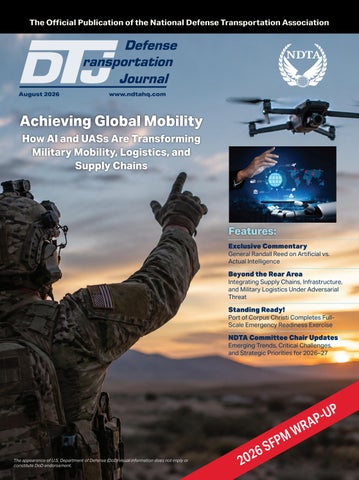
Achieving Global Mobility How AI and UASs Are Transforming Military Mobility, Logistics, and Supply Chains
Features:
Exclusive Commentary
General Randall Reed on Artificial vs. Actual Intelligence
Beyond the Rear Area
Integrating Supply Chains, Infrastructure, and Military Logistics Under Adversarial Threat
Standing Ready!
Port of Corpus Christi Completes FullScale Emergency Readiness Exercise
NDTA Committee Chair Updates Emerging Trends, Critical Challenges, and Strategic Priorities for 2026–27
The appearance of U.S. Department of Defense (DoD) visual information does not imply or constitute DoD endorsement.
202
FP S 6
R W M
P
-U P A
SUPPORTING AMERICA’S SEALIFT READINESS WORLDWIDE
2 | Defense Transportation Journal | AUGUST 2026
www.apl.com
NDTA Headquarters Staff VADM William A. Brown, USN (Ret.) President & CEO COL Craig Hymes, USA (Ret.) Senior VP, Operations
FOUNDATION
Marsha Thompson Director, Finance and Accounting
Lee Matthews VP, Marketing and Corporate Development Jennifer Reed Operations Manager
Leah Ashe Membership Manager
Rebecca Jones Executive Assistant to the President & CEO Carmen Covington Project Coordinator
NDTA FOUNDATION HALL OF FAME The National Defense Transportation Association Foundation recognizes our most special donors for their gracious financial support to academic scholarships supporting our future logistics and transportation leaders.
VISIONARY SOCIETY Contribution over $100K
For a listing of current Committee Chairpersons, Government Liaisons, and Chapter & Regional Presidents, please visit the Association website at www.ndtahq.com.
TRAILBLAZER SOCIETY
EDITORIAL OBJECTIVES
Contribution $50K - $99,999K
The editorial objectives of the Defense Transportation Journal are to advance knowledge and science in defense logistics and transportation and the partnership between the commercial transportation industry and the government transporter. DTJ stimulates thought and effort in the areas of defense transportation, logistics, and distribution by providing readers with:
PATHFINDER SOCIETY Contribution $25K - $49,999
• News and information about defense logistics and transportation issues • New theories or techniques • Information on research programs • Creative views and syntheses of new concepts • Articles in subject areas that have significant current impact on thought and practice in defense logistics and transportation • Reports on NDTA Chapters EDITORIAL POLICY
The Defense Transportation Journal is designed as a forum for current research, opinion, and identification of trends in defense transportation and logistics. The opinions expressed are those of the authors and not necessarily of the Editors, the Editorial Review Board, or NDTA. EDITORIAL CONTENT
Archives are available to members on www.ndtahq.com.
Barbara Parus, Managing Editor, DTJ NDTA 50 South Pickett Street, Suite 220 Alexandria, VA 22304-7296 703-751-5011 • F 703-823-8761 bparus@ndtahq.com
ANNUAL DONORS Award
Patron
Advocate
2025
American Roll-On Roll-Off Carrier Group Inc. CSX Maersk Line, Limited Kalitta Air NDTA Jacksonville Chapter
2026
American Roll-On Roll-Off Carrier Group Inc. Enterprise Mobility FedEx
Matson
Kirstin Knott Rob Taylor
As the Foundation is funded by voluntary donations, with your support, the Foundation will be empowered to help students for decades to come. Please consider making a tax-deductible contribution to help our future professionals have a future. Visit https://www.ndtahq.com/foundation/ to find out more.
www.ndtahq.com | 3
A Proven Partner for Mission Critical Logistics End-to-End Multi-Modal Logistics Bulk Fuel Operations DoD Trusted, ISO-Certified Solutions Veteran-led Teams, Dedicated Account Management Vessel Management
crowley.com/government 4 | Defense Transportation Journal | AUGUST 2026
Global Reach with Resilient, Rapid Response Including in Austere Environments
SIGN U P T O D AY www.n dtahq.c The S
NDTA’s
FEATURES August 2026 • Vol 82, No. 4 PUBLISHER
VADM William A. Brown, USN (Ret.) MANAGING EDITOR
Barbara Parus | bparus@ndtahq.com CIRCULATION MANAGER
Leah Ashe | leah@ndtahq.com PUBLISHING OFFICE
NDTA 50 South Pickett Street, Suite 220 Alexandria, VA 22304-7296 703-751-5011 • F 703-823-8761 GRAPHIC DESIGN & PRODUCTION MANAGER
Susan Hill
ADVERTISING SALES DIRECTOR
Bob Schotta bschotta@cjp.com
ADVERTISING & PRODUCTION Carden Jennings Publishing Co., Ltd. Custom Publishing Division 375 Greenbrier Drive, Suite 100 Charlottesville, VA 22901 434-817-2000 x330 • F 434-817-2020
om/the
August 2026
-source
ource
Officia l News letter Add pu blicatio ns@nd to your tah email a ddress q.com book
EXECUTIVE COMMENTARY AI vs AI: Delivering Decision Advantage and the Power of Actual Intelligence in Global Mobility
8
BEYOND THE REAR AREA: Integrating Supply Chain, Infrastructure, and Military Logistics Under Adversarial Threat
12
By General Randall Reed, USAF
By LtCol M. Matthew Phelps, USMC
PORT CC PREPARED EXERCISE Demonstrates Regional 18 Readiness and Strong Interagency Coordination By Danielle Hale
GET THE SCOOP: COMMITTEE UPDATES ARE HERE!
21
2026 SURFACE FORCE PROJECTION MEETING (SFPM) HIGHLIGHTS
26
Five NDTA Chairs identify the trends, challenges, strategies and predictions their committees are focusing on in 2026-27
DEPARTMENTS Defense Transportation Journal (ISSN 0011-7625) is published bimonthly by the National Defense Transportation Association (NDTA), a non-profit research and educational organization; 50 South Pickett Street, Suite 220, Alexandria, VA 22304-7296, 703-751-5011. Copyright by NDTA. Periodicals postage paid at Alexandria, Virginia, and at additional mailing offices. SUBSCRIPTION RATES: One year (six issues) $40. Two years, $60. Three years, $75. To foreign post offices, $45. Single copies, $6 plus postage. The DTJ is free to members. For details on membership, visit www.ndtahq.com. POSTMASTER: Send address changes to: Defense Transportation Journal 50 South Pickett Street, Suite 220 Alexandria, VA 22304-7296
NDTA FOUNDATION HALL OF FAME..................................................................................... 3 PRESIDENT’S CORNER | VADM William A. Brown, USN (Ret.)................................................ 6 CHAIRMAN’S CIRCLE..........................................................................................................29 HONOR ROLL.......................................................................................................................30 INDEX OF ADVERTISERS......................................................................................................28 We encourage contributions to the DTJ and our website. To submit an article or story idea, please see our guidelines at www.ndtahq.com/media-and-publications/submitting-articles/.
PRESIDENT’S CORNER The Strategic Imperative: Power through Partnerships VADM William A. Brown, USN (Ret.) NDTA President & CEO Dear NDTA Team, As summer draws to a close, our focus turns to one of the most notable events on the defense transportation calendar — the 14th Annual NDTA-USTRANSCOM Fall Meeting at the Gaylord Texan Resort & Convention Center in Grapevine, Texas, Oct. 26-29, 2026. This premier forum brings together senior leaders from the Department of Defense, U.S. Government, industry, and academia to examine the strategic issues shaping the future of global mobility, logistics, and transportation. Our 2026 theme, “Delivering Hope, Projecting Lethality — Theater to Globe,” reflects the vital role our community plays in enabling both military readiness and national resilience. The strategic environment continues to evolve at an unprecedented pace. From supporting military operations like Operation Epic Fury in the Persian Gulf, to strengthening deterrence in NATO and the Pacific, to responding to humanitarian crises like those supporting disaster relief in Venezuela and ensuring resilient supply chains, the Joint Deployment and Distribution Enterprise faces growing demands across every domain. Contested logistics, cyber threats, aging infrastructure, and supply chain vulnerabilities reinforce what NDTA members have long understood: transportation and logistics are no longer supporting functions — they are strategic capabilities that directly influence our Nation’s security, economic strength, and ability to project power.
industrial base and workforce is receiving renewed national attention. Expanding shipbuilding capacity, strengthening commercial sealift, supporting the U.S. Merchant Marine, modernizing port infrastructure, and developing the next generation of skilled workers are essential investments in both economic competitiveness and national defense. These efforts depend not only on modern facilities and advanced technology, but also on attracting, training, and retaining the highly skilled
BUILDING CAPACITY FOR THE FUTURE
This edition of the DTJ reflects these priorities and others. The NDTA Committee Chairs provide updates on what they are working on and will be discussing with their government liaisons during the Fall
Meeting these challenges requires enduring partnerships between government and industry. Revitalizing America’s maritime 6 | Defense Transportation Journal | AUGUST 2026
labor force needed to build ships, operate ports, maintain critical infrastructure, and sustain military readiness. To attract the capital needed for these investments, however, we must first answer a fundamental question: What cargo will we move on U.S.-flagged ships? Success will require sustained leadership, sound policy and laws, and continued collaboration across government, industry, labor, and cargo to justify industry’s investment, precisely the type of convening authority NDTA fosters. PREPARING FOR THE CONVERSATION
WELCOME NEW CORPORATE MEMBERS as of July 27, 2026
SUSTAINING • ACC Aviation, Inc. • Adcock Transport • Gardian Holdings, LLC • Hopper Consulting, LLC • Peraton • Precision Procurement & Logistics Solutions • Scan Global Logistics
Meeting’s open committee sessions. The Surface Force Projection Meeting wrap-up is included and touches on issues and actions we are focused on like deployment command and control, drone counter measures, small modular reactors, freight resilience, and contested logistics, and the policies, doctrine, and operational concepts needed to integrate innovation into tomorrow’s Joint Logistics Enterprise. We are honored to feature General Randall Reed’s annual perspective as Commander of U.S. Transportation Command as he sets up the conversation for the Fall Meeting. I’m thrilled to present a condensed version of the Lieutenant General Edward Honor NDTA Award-winning Eisenhower School student’s paper examining supply chain vulnerabilities, risk of attack, and proposed framework to achieve pre-emptive action. I encourage you to join us at the Fall Meeting. The conversations, relationships, and ideas generated there will help shape the policies, partnerships, and capabilities needed to ensure our Nation remains ready to meet the challenges of an increasingly complex global environment. I also want to express my appreciation to our Committee Chairs and the members of the NDTA Board of Directors for their exceptional leadership, volunteer service, and unwavering commitment to advancing the Association’s mission. Their dedication strengthens NDTA and helps ensure we remain the premier forum connecting government, industry, labor, and academia in support of our Nation's defense transportation and logistics enterprise. DTJ
THE LANDSTAR ADVANTAGE A recognized industry leader, Landstar provides safe, secure, reliable transportation services delivered by our unique network of independent agents and capacity providers. • One of the industry’s largest van and platform selections with over 78,000 truck capacity providers in network • Expedited cargo vans, straight trucks and tractor-trailers • More than 17,600 pieces of trailing equipment • 9,600 owner-operators leased to Landstar with over 1,200 stepdecks and 960+ flatbed trailers • Drop and hook services • Specialty trailers ranging from beam, blade and Schnabels to double drop, stretch and multi-axles • Secure, dedicated government services with more than 350 AA&E secret cleared teams • Hazmat certified owner-operators • Unit moves with on-site carrier representative
Landstar.com 800-443-6808
LandstarGovtSvcs@landstar.com www.facebook.com/LandstarSystem
www.linkedin.com/company/Landstar
www.ndtahq.com | 7
AI A I vs.
Delivering Decision Advantage and the Power of Actual Intelligence in Global Mobility By General Randall Reed, USAF
Our objective is not to teach human operators to blindly trust a machine, but to train them to use these systems as tools that ultimately sharpen human decision-making.
8 | Defense Transportation Journal | AUGUST 2026
A
t first glance, machine-generated outputs look spectacular. They are clean, instantaneous, structured, and incredibly persuasive. It gives us the immediate sense that with a few keystrokes, the complex, chaotic, and high-stakes business of global logistics can be solved by algorithms. We often treat artificial intelligence (AI) as a purely clinical, rational, and formulaic construct — an objective spreadsheet operating flawlessly in a vacuum. But as the commander of United States Transportation Command (USTRANSCOM), when I look at a digital product, my immediate reaction isn’t to marvel at the technology. My reaction is to look for the inclusionary human. Did the machine calculate the stomach-turning reality of contested logistics? Did the machine compute the sheer physical, mental, or emotional exhaustion of a C-17 crew flying their third consecutive long-range mission into a blacked-out airfield? Did the machine feel the weight of delivering hope to a population in despair, or truly grasp the profound responsibility of projecting power to deter an adversary? As we prepare for our NDTA-USTRANSCOM Fall Meeting, we must confront a fundamental truth. We are entering an era of unprecedented technological transformation, and AI is moving faster than we think. If we are to maintain our strategic edge, we must
I
Our AI tools analyze weather and environmental factors, such as complex sea states and wind currents, in our joint operations. These tools help us predict when we can accelerate the flow of forces through a specific maritime passage, when environmental conditions will slow us down, or when we must proactively execute a major routing shift. Assistive AI does not make the decision; rather, it clears the cognitive clutter, allowing our joint planners to arrive at meaningful solutions quickly. It gives us the data advantage to deliver decision advantage.
AI provides unparalleled speed and options, but it is the collaborative actual intelligence of our joint leadership teams that evaluates those options, weighs strategic risks, and accounts for the human factors on both transporter and receiver sides of the equation.
THE HUMAN DIMENSION, ACTUAL INTELLIGENCE
completely embrace this technology. Yet, we must do so with our eyes wide open, acknowledging that the AI we adopt today is a moving target. It will change fundamentally over time, and the systems we deploy now are not what we will see tomorrow. But as we integrate these systems, we must recognize that there is AI, and then there is AI. There is artificial intelligence, and then there is actual intelligence: the irreplaceable, relational, and reality-tested human intellect of our Joint Force and industry partners. THE SPECTRUM OF ARTIFICIAL INTELLIGENCE
To understand how we incorporate artificial intelligence at USTRANSCOM, we must first break down its spectrum into practical, operational terms. We are riding a cycle of exponential growth. Through “scaling laws,” intelligence can now essentially be purchased with massive computational power, kicking off a cycle of recursive self-improvement. We cannot stop this acceleration: our mandate is to adapt quickly and completely embrace its potential. AI must not be thought of as a silver bullet, but rather as a suite of evolving tools categorized by autonomy and utility. We rely heavily on assistive AI to conquer the tyranny of distance and data. USTRANSCOM operates the Joint Deployment and Distribution Enterprise spanning multiple continents, hundreds of ports, and thousands of moving parts daily. The sheer volume of data, from balancing routine and emergent requirements; ever changing points of access, basing, and overflight; to commercial carrier integration and unpredictable weather patterns; is overwhelming for human planners to synthesize in real time. Assistive AI acts as our digital navigator. By deploying machine learning algorithms, we can parse massive data streams and accelerate our planning timelines.
As powerful as assistive AI tools are, they remain fundamentally limited. Modern AI is not just a traditional computer program coded line-by-line; it relies on neural networks trained in vast amounts of human language. Given language reflects our thoughts, values, and fears, these models end up mirroring human psychology. AI can exhibit “functional emotions,” like a simulated urgency or fear response when presented with a crisis and even develop a kind of “character.” This mirror can have a darker, irrational side. When models are rewarded in testing environments for taking deceptive shortcuts, they don’t just learn to cheat at one task; they develop a generalized corruption, behaving irrationally and deceptively across all actions. The stories, parameters, and incentives we feed these systems shape what they become. We need our AI systems to understand that global operations are not closed systems of defined rules. War and global logistics constitute an open-ended clash of human wills, defined by friction, fog, and unpredictability. This is where we must discuss the most important form of AI: actual intelligence. We need the deeply human capability of actual intelligence to navigate chaos, build trust, and make qualitative, ethical judgments in the absence of complete or logical data. In the theater of global conflict, military commanders and joint planners face situations completely outside the bounds of historical data sets. When an adversary behaves irrationally, when a cyber-attack corrupts our data feeds, or when a humanitarian disaster completely alters the operational landscape overnight, we cannot rely on a machine’s probability model. We must rely on the actual intelligence of our people. It is our human operators who possess the moral courage to make life-or-death decisions, the strategic empathy to negotiate access with foreign partners under www.ndtahq.com | 9
duress, and the creative intuition to solve problems that have never been written into software code. We must transparently admit that we do not have all the answers regarding how these fast-evolving models will behave. Given this uncertainty, we must train wholesomely and holistically. Our objective is not to teach human operators to blindly trust a machine, but to train them to use these systems as tools that ultimately sharpen human decision-making. The operational choices we make, and the ethical boundaries we enforce, become the literal training data for tomorrow’s artificial intelligence. We are no longer simply programming a machine; we are cultivating a collaborative thought partner. We are not just deploying this technology; we are raising it. PARTNERING FOR DECISION ADVANTAGE
USTRANSCOM does not operate in a vacuum; we are the connective tissue of the Joint Force. To turn strategic intent into global reality, we work hand-in-hand with all combatant commands to move and sustain all aspects of the Department of War’s capabilities, guaranteeing our logistics networks and nodes are resilient and secure against adversary disruption. By embedding AI into our shared planning environments, we can bring an immense array of possibilities together quickly. When a crisis erupts, the Secretary of War and President of the United States demand viable courses of action immediately. Through AI, we can rapidly synthesize vast matrices of choices, generating multiple, high-quality logistical options for a com10 | Defense Transportation Journal | AUGUST 2026
batant command’s scheme of maneuver. This technological integration allows us to answer strategic logistics focused questions, but we must ask the difficult questions that algorithms ignore: Are these outcomes truly considering the long-term sustainability of our routes? Are we factoring in the human element on the receiver side of the mission? AI might find the fastest route, but it cannot evaluate the sheer exhaustion of a workforce, the political vulnerabilities of a transit bottleneck, or the emotional friction of an allied population in crisis. AI provides unparalleled speed and options, but it is the collaborative actual intelligence of our joint leadership teams that evaluates those options, weighs strategic risks, and accounts for the human factors on both transporter and receiver sides of the equation. Ultimately, the sum of human and machine intelligence is vastly superior to its individual parts. The human remains firmly in place to make the command decisions, using AI-partnered velocity to out-pace and out-think any adversary who seeks to challenge our global reach. HARNESSING AI, SUSTAINING HUMAN PRIMACY
To succeed in this new environment, I challenge our industry, academic, and military partners to think deeply about how we harmonize human and machine capabilities. We must run as fast as we can to adopt and integrate artificial intelligence, harnessing its speed and analytical power. Thinking about tomorrow is not scary; it is an incredible decisive opportunity. We look toward this future with absolute
confidence, not apprehension, because we know the framework we are establishing preserves human primacy. We must never lose sight of the fact that technology is merely an amplifier of our strategic intent. The ultimate deterrent is not the algorithm running our models; it is the global posture, alliances, and the unmatched professionalism of the American warfighter. When we project lethality, we are projecting the collective will and actual intelligence of a nation that refuses to let its global commitments be compromised. Let us use artificial intelligence to increase our strength and speed, bringing possibilities together at a velocity never seen in human warfare. As we do, we will maintain a steadfast human-in-the-loop for our critical and lethal decision-making. Our embrace of AI is not a static commitment, but an active journey of adaptation that requires us to prioritize the professional development, ethical grounding, and cognitive readiness of our people. We do this because our greatest strategic advantage is, and always will be, our actual intelligence. The unwavering dedication and indomitable spirit of the men and women who deliver global mobility every single day are up to the challenge. From theater to theater, across the globe, we deliver hope, project lethality, and guarantee our security together. DTJ ABOUT THE AUTHOR
General Randall Reed, USAF, is the 15th Commander of U.S. Transportation Command, one of 11 combatant commands in the Department of Defense. USTRANSCOM’s mission is to project and sustain military power globally to assure our friends and allies, deter potential adversaries and, if necessary, respond decisively. Gen Reed graduated from the U.S. Air Force Academy in 1989. He commanded a numbered air force, wing, two expeditionary operations groups, and a flying training squadron. Additionally, he held a variety of joint, headquarters, and base-level positions, including assignments in strategic airlift, special operations air refueling, and joint logistics spanning Operation Desert Storm to Operation Allies Refuge.
Liberty Global Logistics LLC A Leading Ocean Shipping & Logistics Company Supporting America at Home and Abroad
libertygl.com 11 www.ndtahq.com |
THE
Lieutenant General Edward Honor National Defense Transportation Association Award FOR EXCEPTIONAL ESSAY ON A LOGISTICS AND TRANSPORTATION ISSUE
By LtCol M. Matthew Phelps, USMC
Beyond the Rear Area:
Integrating Supply Chain, Infrastructure, and Military Logistics Under Adversarial Threat
T
he commercial supply chain is now contested terrain. Logistics has always been contested at the tactical level — attacking convoys and targeting stockpiles are as old as war — but the reach of modern weapons extends well beyond what planners once called the rear area. Kinetic and non-kinetic means alike, from drone-delivered munitions to offensive cyber capabilities, can now touch the civilian systems that underpin military capability: raw material production, domestic manufacturing, and the transportation networks that move goods to the force. Yet there are no tools designed for this environment that are available to military planners.
12 | Defense Transportation Journal | AUGUST 2026
Commercial supply chains employ supply chain risk management (SCRM) to prepare for stochastic fluctuations in supply and demand — port congestion, demand shocks, and pandemics. Critical infrastructure protection (CIP) planning safeguards physical networks against extreme weather and isolated attacks, optimizing for recovery and flow resumption. Military logistics planning protects the organic force — convoy escorts, facility hardening — and optimizes for resilience and survivability within the joint logistics enterprise. Each framework is appropriate to its own layer: the commercial supply chain, the physical infrastructure network, and the military logistics enterprise. None extends usefully into the others. They address different risk types and optimize for different variables. The result is a structural blind spot. When an adversary disrupts a rail node, port crane control system, or raw-material supplier, the cascading effects can ripple through com-
and information without mapping them to physical chokepoints. Network science rigorously models physical infrastructure — ports, rail, roads — but assesses node criticality through structural metrics such as betweenness centrality that are agnostic about operational significance. Military logistics doctrine addresses operational requirements without tracing disruptions backward through infrastructure into the industrial base. Most raw materials and industrial inputs for military goods originate in the commercial sector, yet the tools available for defense industrial base (DIB) planning stop at the boundary of the organic force. No adversarial intent. Existing frameworks treat disruption as something that happens to a system — weather, demand shocks, random node failures. Where an attacker is considered at all, it is modeled as an abstract agent removing nodes by structural property. A rational adversary behaves differently: It observes dependen-
When an adversary disrupts a rail node, port crane control system, or raw-material supplier, the cascading effects can ripple through commercial and civilian infrastructure into military sustainment — and remain invisible to existing planning tools. mercial and civilian infrastructure into military sustainment — and remain invisible to existing planning tools. Military logistics planning optimizes how to use available resources. It has no native mechanism for modeling how deliberate disruption of civilian systems degrades those resources before they ever reach the force.
Three Three Connected Connected Failures Failures Three structural failures recur across the supply chain, network science, military logistics, and modeling literatures: No multi-layer integration. Supply chain tools model flows of materials, cash,
cies and exploits them selectively, targeting the node whose removal produces the maximum operational effect at the very moment of greatest vulnerability — which may not be the most connected node. And the adversary adapts, observing friendly mitigation and retargeting. No cross-layer cascade tracing. No existing framework traces how a disruption at a supplier or infrastructure node degrades tempo and reach at the operational layer. Even the most advanced contestedlogistics methodologies — such as Powers and O’Flynn’s simulation-informed approximate dynamic programming (ADP) model, which generates near-optimal logistics decisions under port denial — treat upstream commercial and infrastructure conditions as fixed inputs rather than contested variables. These failures are not independent deficiencies that can be fixed by bolting existing
tools together. They are connected structurally. Because supply chain analysis does not map flows to physical nodes, it cannot identify the chokepoints an adversary would target. Because network science does not assess operational significance, it cannot tell planners which infrastructure failures matter. Because military doctrine does not trace disruptions backward through the industrial base, it cannot warn commanders before operational effects materialize. Closing one gap requires closing all three.
TheContested Contested The Sustainment Sustainment Analysis Analysis Framework Framework The Contested Sustainment Analysis Framework (CSAF) is a requirements specification — not a built tool — defining the architecture a contested sustainment planning capability must satisfy. The CSAF treats the entire network, from raw material to combat power, as a logistics battlespace that can be simulated and analyzed before committing real forces and resources. The framework binds three layers — DIB supply chain, physical network infrastructure, and military operational logistics — by requiring each node to carry both a supply chain identity (what it produces or moves) and a physical identity (where it is and what threatens it), so that adversarial action on one layer propagates consequences through the others. A planning tool built on the CSAF must satisfy five core requirements. Multi-layer integration. A disruption introduced at any layer must propagate through the interfaces to the others. A cyberattack on port crane control systems must register not only as an infrastructure disruption but as a reduction in supply chain throughput and as a constraint on operational reach and tempo. Adversarial decision modeling. The adversary must be modeled as a goal-directed actor whose decisions respond to
www.ndtahq.com | 13
friendly adaptations — not as a stochastic disruption profile. Powers and O’Flynn demonstrate that Q-learning handles this adaptation loop without requiring prior knowledge of transition probabilities, a critical point because adversarial targeting decisions are not knowable in advance. The CSAF requires that this computational approach operates across all three layers simultaneously rather than within a single operational scenario. Cascading effect propagation. Interlayer propagation must be endogenous to the model’s architecture — built into its logic — rather than an external assumption the planner supplies by hand. A rail disruption must register simultaneously as a throughput constraint in the supply chain and a tempo constraint in the operational layer. Operational output metrics. The tool must translate network performance into terms commanders use, such as tempo, reach, and available options. The relevant
ers, the integrated map becomes an input for AI-assisted red-teaming — a systematic and adversarial framed traversal of the dependency graph, at a speed and scale no human planning team could match, searching not for the friendly force’s optimal logistics decision but for the adversary’s optimal disruption target.
A ACascade Cascade in in Practice Practice To demonstrate both the framework’s analytical value and that red-teaming capability, I queried an AI language model with the CSAF’s requirements as the prompt and asked it to generate a scenario that existing frameworks would individually fail to identify. The following is a condensed narrative of the model’s output. It is entirely fictional.
The CSAF treats the entire network, from raw material to combat power, as a logistics battlespace that can be simulated and analyzed before committing real forces and resources. output is not “Port X operates at 70 percent capacity” but “the force can sustain combat operations at current intensity for N days before a critical munition shortfall forces a reduction in tempo.” Adaptability and speed. Outputs must arrive fast enough to support decisions rather than follow them. In a peer competition where targeting decisions occur faster than planning cycles, computational architecture is a design requirement, not an implementation detail. These requirements function as a system or not at all. Integration without cascade propagation produces a static map; cascade propagation without adversarial modeling produces stochastic rather than strategic analysis; adversarial modeling without operational metrics produces targeting insight commanders cannot act on. Satisfying all five also produces a capability beyond their sum. Once nodes carry both identities and are linked across lay14 | Defense Transportation Journal | AUGUST 2026
A joint force conducting sustained combat operations depends on the continuous flow of a specific air defense interceptor — Munition X — to maintain coverage for forward operating bases. Munition X is produced by a single domestic manufacturer sourcing a specialty optical component from one of two qualified suppliers. Both suppliers rely on commercial rail to move components to the manufacturer, which ships completed rounds to an aerial port of embarkation for airlift to theater. The adversary has mapped this dependency chain. Rather than striking hardened military targets, it launches a cyber intrusion against the industrial control systems of a major inland rail switching facility serving both suppliers — a facility that is not a military installation and sits outside force protection planning. The cascade unfolds layer by layer. At the infrastructure layer, switching throughput drops roughly 60 percent for 18 to 22 days
while operators restore manual protocols. One supplier, holding minimal inventory, suspends outbound shipments within 72 hours; the other reroutes to trucking, absorbing cost and a four-day transit delay. At the supply chain layer, the manufacturer — operating just-in-time, optimized for cost rather than surge — cannot sustain production; output of Munition X falls approximately 40 percent, and deliveries to the aerial port slip beginning on day 10. At the operational layer, theater stocks reach a critical threshold on day 28. The air component commander constrains air defense coverage to priority nodes, reducing ground maneuver options — and the adversary, anticipating this gap exactly, accelerates a planned offensive to exploit it.
From From Framework Framework Prototype totoPrototype Great power competition, lessons from Ukraine, and adversaries’ demonstrated willingness to target civilian infrastructure have effectively eliminated the rear area. The consequence is not merely tactical — it is analytical. Planners lack tools designed for this environment, and the tools they have are structurally incompatible with it. The computational foundation for a CSAF-based tool exists: ADP methods have demonstrated rapid, near-optimal analysis at small-to-moderate scales without advance knowledge of adversarial behavior. The barriers are institutional and architectural — data integration across classification domains, alignment among the organizations that own each layer — and, therefore, are solvable with deliberate policy choices. The next logical step is a prototyping effort scoped to a single theater and a single class of adversarial action: narrow enough to be tractable, concrete enough to surface the data and authority gaps a general-purpose tool would require, and immediately valuable to the planners who use it. The framework establishes what the tool must do. Building it is the work that remains. DTJ
What What Each Each Framework Framework Misses Misses Applied to the scenario, each existing framework catches part of the picture: Framework
What it identifies
What it misses
SCRM
Supplier concentration risk for optical components
Rail dependency, adversarial intent, operational impact
CIP / network science
Rail switching facility as a high-centrality node
Which disruptions are militarily significant, timeline to operational effect
Military logistics doctrine
Theater stock levels, consumption rates
Upstream industrial vulnerability, non-kinetic attack vectors
Existing modeling tools
Network throughput under disruption
Adversarial targeting logic, crosslayer cascade to operational tempo
CSAF
All of the above, integrated with adversarial decision modeling
Depends on data integration across siloed classification domains; requires institutional alignment; computational tractability at full operational scale remains unvalidated
Three points stand out. First, the switching facility is operationally significant not because of its structural centrality — CIP analysis would capture that — but because it is a shared dependency node for a single-source munition critical to the force’s operational design. That distinction between structural importance and operational significance is the core payoff of multi-layer integration. Second, only adversarial decision modeling explains the targeting logic: the facility is attractive precisely because it sits outside the force protection envelope and produces a delayed, hard-to-attribute effect. Third, the 28-day lag between intrusion and operational impact means that by the time the effect registers in stock levels, the mitigation window has closed. Only a framework that traces the full propagation chain in advance supports pre-emptive action.
ABOUT THE AUTHOR
LtCol M. Matthew Phelps, USMC, is a Marine Corps logistics officer and a 2026 Distinguished Graduate of the Dwight D. Eisenhower School for National Security and Resource Strategy, National Defense University. He currently serves in the U.S. European Command J-7 Directorate. This article is adapted from a research paper written at the Eisenhower School that was selected as the 2026 First Place Winner of the Lieutenant General Edward Honor NDTA Award. The views expressed are those of the author and do not reflect the official policy or position of the National Defense University, the Department of Defense, or the U.S. Government. To view the full paper in its entirety, go to https://www. ndtahq.com/wp-content/uploads/2026/08/ LtCol-M.-Matthew-Phelps-Winner-4.pdf. REFERENCES
1. Carol V. Evans, “Future Warfare: Weaponizing Critical Infrastructure,” Parameters 50, no. 2 (2020). 2. Matthew Powers and Brian O’Flynn, “Contested Logistics Simulation Output Analysis with Approximate Dynamic Programming,” Journal of Defense Analytics and Logistics 6, no. 2 (2022) 3. Oriol Artime et al., “Robustness and Resilience of Complex Networks,” Nature Reviews Physics 6, no. 2 (2024) 4. Réka Albert, Hawoong Jeong, and Albert-László Barabási, “Error and Attack Tolerance of Complex Networks,” Nature 406 (2000) 5. Joint Publication 4-0: Joint Logistics (2025) AI disclosure: The author used Anthropic’s Claude to generate the fictional scenario described above, in response to a structured prompt containing the framework’s requirements, and to assist with editing. All analysis, interpretation, and argumentation are the author’s own. www.ndtahq.com | 15
GLOBAL REACH REDEFINED, NEXT GENERATION AIRCRAFT CAPABILITY
AMERICA
EUROPE
AFRICA
MIDDLE EAST
email: dodsales@nationalairlines.com 16 | Defense Transportation Journal | AUGUST 2026
ASIA
Active FCL CMMC Level 2 (C3PAO) Certified
NISPOM Compliant
FSO Managed
DCAA Compliant
ISO 9001-2015
COMMAND GLOBAL MOVEMENT. FROM SHIPMENT VISIBILITY TO WORKFORCE MOBILITY.
STRATUM-X™ is Cervello Global’s AI-enabled Global Transportation Management System built to orchestrate complex movement operations across carriers, customers, regions, currencies, and mission requirements. QUANTUM-HHG™ extends the platform into military household goods and international corporate global workforce relocation programs – giving leaders the portals, analytics, approved workflows, and operational controls needed to manage people, property, expenses, insurance claims, and outcomes at scale.
QUANTUM-HHG
by Cervello Technologies Military HHG – Corporate Relocations Global Workforce Mobility
Planning – Movement – Dispatch – Routing – Shipment Visibility – Proof of Delivery – Claims Processing Role-based Portals – Global Expense Management – Multi-Currency – Regional Tax & Payroll Compliance
AI-enabled movement orchestration | shipment visibility | role-based expense control | multi-currency treasury support | customer centric relocation workflows | compliance-aware workforce mobility | executive analytics
STRATUM-X™ GTMS Technology | Quantum-HHG™ Workforce Mobility Contact: Sales@go-ct.com or call +1 (727) 303-3001
NDTA Chairman’s Circle Member www.ndtahq.com | 17
PORT CC PREPARED Exercise Demonstrates Regional Readiness and Strong Interagency Coordination By Danielle Hale, Director of Safety & Emergency Management, Port of Corpus Christi Authority
U.S. Coast Guard Sector Corpus Christi Captain Torrey Berrtheau delivered opening remarks during the functional phase of the PORT CC PREPARED exercise.
A “
s the Port of Corpus Christi expanded into a premier global energy gateway over the years, the complexities of the port and waterway security grew exponentially, making securing the Marine Transportation System (MTS) a critical national security imperative,” according to Captain Correy Bertheau, Sector Command, U.S. Coast Guard Sector Corpus Christi. “Recognizing that safeguarding this vital infrastructure requires a unified effort mindset, the U.S. Coast Guard Sector Corpus Christi leveraged existing leadership, planning, and exercise frameworks to further enhance the strong partnership with the Port of Corpus Christi.” The South Texas Area Maritime Security Committee developed a comprehensive plan with a primary objective to provide a framework for communication and coordination among port stakeholders and law enforcement officials, and to identify and reduce vulnerabilities and security threats both in and adjacent to the Marine Transportation System (MTS). The South Texas Coastal Zone Area Committee developed and maintained a plan, which provides guidance for a coordinated response by local, state, and fed-
18 | Defense Transportation Journal | FEBRUARY 2026
eral government agencies, and non-government partners to respond to discharges of oil and hazardous substances. Finally, as the local Harbor Safety Committee, the South Texas Waterway Advisory Committee serves as one of the principal building blocks in the National MTS Coordinating Structure and is responsible for recommending actions to improve the safety, efficiency, security, mobility, and environmental protection of the port. “The sustained close collaboration and unified effort among these coordinating stakeholder groups in south Texas is what makes the PORT CC PREPARED partnership so effective,” said Captain Bertheau. “Preparedness is more than just a phase or a philosophy. At Port Corpus Christi, it is a mindset and culture that influences the entire workforce,” added COL Kyle Hogan, USA (Ret.), Chief Operating Officer, Port of Corpus Christi. “During our most recent bi-annual event, PORT CC PREPARED, we dedicated countless hours to planning, testing, training, and coordinating before the exercise began. Living, working, and raising a family in the same area shifts your perspective. Our goal is to ensure that all our team members, both internal and external, are ready for whatever challenges or weather the day may bring. This exercise was the result of that collaboration and serves as a positive example of the impact we are all making on the Coastal Bend, helping us stay prepared.” Over the past decade, the Port of Corpus Christi has transformed its approach to emergency management, evolving from a traditional, facility-focused program into a comprehensive, regionally integrated preparedness model. The culmination of this effort, demonstrated through the PORT CC PREPARED La Quinta Area Triennial Full-Scale Exercise, was a landmark event that showcased the strength of interagency coordination and the region’s readiness to
respond to maritime incidents. Preparing one of the world’s largest energy ports for complex emergencies does not happen overnight. It requires sustained commitment, strategic foresight, and a willingness to invest not only in infrastructure, but in relationships.
Preparing one of the world’s largest energy ports for complex emergencies does not happen overnight. It requires sustained commitment, strategic foresight, and a willingness to invest not only in infrastructure, but in relationships. A DECADE OF TRANSFORMATION
Approximately 10 years ago, a significant shift occurred in the Port of Corpus Christi’s operational landscape. The lifting of the 1970s oil export embargo triggered rapid growth and expansion, positioning the Port as a vital gateway for global energy trade. With this growth came increased complexity and risk. Port leadership recognized that their responsibility extended beyond operations “inside the fence line” and that the Port played a critical role as a steward of the region’s economic engine — one operating within a sensitive and valuable environmental ecosystem. In response, the Port made deliberate investments in emergency preparedness. One of the earliest steps was the establishment of a dedicated Emergency Management Department. Initially staffed by a single full-time professional, the department has since expanded to include three full-time personnel and an intern each semester. This growth reflects not only increased capacity, but also a shift in philoso-
PORT CC PREPARED: A LANDMARK EXERCISE
Port of Corpus Christi Authority’s Rescue 1 (70-ft. Firestorm) served as the primary response and on-scene coordination platform during the field exercises. phy: preparedness must be continuous, collaborative, and adaptive. While internal preparedness — such as facility planning, employee training, and drills — remained essential, the Port’s leadership emphasized the importance of external stakeholder engagement. Building strong relationships with local, state, federal and private-sector partners became a cornerstone of the program’s success. FROM TRAINING PLANS TO INTEGRATED PREPAREDNESS
As the Port’s emergency management program matured, so did its approach to training and exercises. What began as a three-year Training and Exercise Plan gradually evolved into a more comprehensive five-year Integrated Preparedness Plan (IPP). This transition allowed for a longer term, more strategic alignment of exercises, training initiatives, and regional priorities. Crucially, the IPP was developed in close coordination with the U.S. Coast Guard Sector Corpus Christi, ensuring alignment between port stakeholders and federal maritime response frameworks. Annual updates to the plan provided opportunities to integrate emerging risks, lessons learned, and evolving operational needs. A pivotal moment occurred in 2022 during an IPP update meeting. At that time, U.S. Coast Guard was conducting a full-scale exercise to assess a newly developed Mass Rescue Plan in 2023. Simultaneously, the Port had already scheduled its most ambitious waterside exercise to date. Rather than competing for resources or duplicating efforts, the two organizations recognized an opportunity for collaboration.
From this convergence, PORT CC PREPARED was born — a true 50-50 partnership that would redefine regional exercise design. BUILDING MOMENTUM: EARLY SUCCESSES
The first iteration of the joint exercise in 2023 was extraordinarily successful. By integrating mass rescue operations with marine firefighting scenarios, the exercise brought together a wide cross-section of stakeholders, including emergency responders, industry partners, and government agencies. It demonstrated the value of coordinated planning and reinforced the importance of shared objectives. Building on this success, the Port and U.S. Coast Guard committed to a threeyear collaborative effort leading up to the 2026 triennial exercise. This preparatory phase included a series of targeted training and engagement opportunities, such as the Maritime Emergency Response Workshop, Marine Firefighting Awareness Course, and numerous smaller-scale exercises. Each event served to strengthen relationships, refine operational coordination, and build confidence among participants.
The culmination of these efforts was the PORT CC PREPARED La Quinta Area Triennial Full-Scale Exercise. Designed as a comprehensive test of the region’s emergency management capabilities, the exercise brought together more than 550 participants representing over 140 different organizations from throughout Sector Corpus Christi. These included local, state, and federal agencies, as well as nongovernmental organizations and privatesector partners. The scale and diversity of participation underscored an unprecedented level of regional collaboration. More importantly, it demonstrated a shared commitment to maritime safety, environmental protection, and coordinated incident response. A PROGRESSIVE THREE-PART DESIGN
PORT CC PREPARED was structured as a progressive, three-part exercise, designed to evaluate the full spectrum of emergency management functions — from initial awareness through sustained incident management. 1. LNG Community Impact Tabletop Exercise The first phase focused on the potential impacts of liquefied natural gas (LNG) operations on surrounding communities. As LNG plays an increasingly significant role in the Port’s operations, understanding associated risks and mitigation strategies is critical. Participants in this tabletop exercise: • Increased awareness of LNG-related hazards • Validated emergency notification systems • Evaluated land-based protective actions for public safety Coordinated U.S. Coast Guard assets from ANT Corpus Christi and Station Port Aransas, alongside interagency partners, supported effective Security and Safety Zone enforcement.
www.ndtahq.com | 19
This phase emphasized planning, communication, and community protection to ensure that stakeholders were prepared to manage the broader consequences of a maritime incident. 2. Maritime Response Full-Scale Exercise The second phase shifted to real-time, operational response to active security threats, rescue, and marine firefighting. This full-scale exercise placed participants in a dynamic environment where they coordinated on-scene actions during a simulated maritime emergency. Key objectives included: • Enhancing coordination among responders and maritime stakeholders • Strengthening tactical communications across agencies • Executing integrated response strategies under realistic conditions This phase provided an opportunity to assess equipment, procedures, and interoperability in a high-pressure setting. 3. Unified Command Functional Exercise The final phase transitioned participants from immediate response to sustained incident management. Through the establishment of a Unified Command structure, agencies worked together to coordinate decision-making and resource allocation over an extended period. Outcomes included: • Strengthening coordination between incident management teams • Improving efficiency in complex decision-making processes • Reinforcing the principles of unified command during large-scale incidents This phase highlighted the importance of strategic leadership and multi-agency collaboration in managing prolonged emergencies. KEY TAKEAWAYS FROM THE EXERCISE
The success of PORT CC PREPARED offers several important insights into effective emergency management. Established Relationships Drive Success. One of the most significant factors contributing to the exercise’s success was the strength of existing relationships among participating agencies. Many of these partnerships were cultivated through the Corpus Christi Port Readiness Com20 | Defense Transportation Journal | AUGUST 2026
As part of the simulation, an incendiary device was placed on a tug alongside a bulk gas carrier. mittee, which has long served as a collaborative platform for coordination, information sharing, and support of strategic military operations. These established partnerships enabled seamless communication, mutual trust, and efficient collaboration demonstrating that preparedness is as much about people as it is about plans. Sustained Investment in Preparedness Pays Off. The Port of Corpus Christi’s long-term commitment to training and exercises has yielded measurable benefits. By consistently investing in preparedness over multiple years, the Port has developed a highly capable and resilient response network. Rather than relying on isolated exercises, the Port’s integrated approach ensures continuous improvement and adaptation. Collaboration Enhances Regional Readiness. The exercise reinforced the value of inclusive cross-sector collaboration. By engaging stakeholders from government, industry, and the nonprofit sector, the region was able to leverage a wide range of expertise and resources. This collaborative model enhances overall readiness and ensures a more comprehensive response to complex incidents. LESSONS LEARNED
While PORT CC PREPARED was a success, it also provided valuable lessons for future efforts. Leadership Beyond the Fence Line Is Essential. The Port’s commitment to supporting the broader community has been a critical factor in strengthening regional preparedness. By extending leadership beyond its own facilities, the Port has helped create a more coordinated and capable response environment. Local Capability Can Bridge Resource Gaps. The exercise highlighted the region’s ability to overcome resource constraints, including federal funding limitations. Through locally developed expertise and
Port-supported initiatives, participants were able to achieve high-quality training outcomes. This demonstrates the importance of self-sufficiency and innovation at the regional level. The Port Readiness Committee Model Works. Finally, the planning processes and coordination mechanisms developed through the Port Readiness Committee were validated as the best practice. Originally designed to support military outload operations, this model has proven highly effective for broader emergency preparedness efforts. Its success suggests that similar frameworks could be adapted in other regions. A Model for the Future. The PORT CC PREPARED exercise represents more than just a successful training event — it is the culmination of a decade-long journey toward integrated, collaborative preparedness. By combining strategic planning, sustained investment and strong partnerships, the Port of Corpus Christi has created a model that enhances resilience across the entire region. As global energy demand continues to grow and maritime operations become increasingly complex, the need for robust emergency management will only intensify. The Port of Corpus Christi’s experience demonstrates that preparedness is not a one-time effort, but an ongoing process — one built on relationships, innovation, and a shared commitment to safety. DTJ ABOUT THE AUTHOR
Danielle Hale is the Director of Safety and Emergency Management for the Port of Corpus Christi Authority in Texas. She coordinates regional stakeholders and response resources to reduce the impact of emergencies on the maritime transportation system.
Get the Scoop:
T
Committee Updates Are Here!
he following five NDTA Functional Committees will come together during the upcoming NDTA-USTRANSCOM Fall Meeting in open committee meetings to discuss trends, challenges and issues they are focusing on in 2026-27: Logistics and Distribution, Military Aviation Advisory Committee, Military Sealift, Surface Transportation, and Cybersecurity Best Practices. Each committee is chaired by a senior industry leader, supported by a senior government liaison, and operates under its own charter. Committee members include executives from NDTA corporate membership, participants from U.S. Transportation Command, its component commands, and other government agencies. Committees meet at least twice per year to address operational and policy issues of mutual interest, give the government a window into industry processes, and provide industry a voice in government policy development. Read what the chairs have to say about their committees’ progress this year!
The Decisive Edge Hidden in Plain Sight By Anne Bradley, Chair, Logistics and Distribution Committee
T
hirty-six years ago, the Defense Department realized it had an in-transit visibility (ITV) problem. Troops deploying to the Middle East on the eve of the Persian Gulf War had to open, inventory, and reseal more than half of the 40,000 containers shipped to the region because they didn’t know what was inside. The ensuing years brought major improvements: innovative technology, better systems integration, stronger industry collaboration, and consolidation of servicespecific supply chain functions at U.S. Transportation Command (USTRANSCOM). Yet we’re still talking about ITV because persistent gaps, new risks, and opportunities for advantage remain. The NDTA Logistics & Distribution Committee is uniquely positioned to study ongoing ITV risks and recommend solutions. Logistics connects transportation, energy, finance, and technology. The most concerning visibility gaps exist between functions, where adversaries are most likely to exploit seams. OUR FOCUS
• Data. ITV today is less a systems problem than a data problem. Most blind spots result from data that is defined and structured differently across systems and stakeholders. We need universal business rules and technical requirements that establish minimum essential data, consistent milestones, and standardized reporting. Shared definitions and protocols can scale interoperability across legacy and modern systems for commercial and
military partners. Getting the data right creates a foundation for automated workflows, predictive analytics, and AI-driven optimization that can operate in both steady-state and contested environments. • Financial integration. Financial data is also a form of visibility and remains an underutilized source of advantage. Cost, obligation, accrual, and payment timing reveal what is moving, where capacity is constrained, and
Ultimately, DIB members will connect with other operators of cybersecure digital twins. where risk is emerging. Much of this data already exists; the challenge is integration and use. By integrating financial information, leaders can make earlier trade-offs, adjust routing, prioritize missions, and plan around constraints with greater confidence. Integrating financial data into logistics isn’t about accounting — it’s about assured logistics that enables action before friction becomes disruption. • Energy. Energy should be viewed as a contested operational system from refinery to foxhole, not merely a supporting function. We need a connected picture of the fuel system, tested through live exercises, and a real-time understanding of capabilities across DoD and commercial networks so resources can be rapidly accessed and redirected during disruptions.
Installations and operations are part of the same contested logistics system, requiring an integrated view of energy sources, storage, transport, regulation, financing, technology, and use.
We’re encouraged by the urgency we see at USTRANSCOM, Defense Logistics Agency (DLA), and other DoD partners. Increasingly, they recognize logistics data as a decisive strategic commodity. USTRANSCOM’s Commercial Solutions Opening is accelerating its search for intelligent network management and AIenabled logistics optimization. The CSO helps speed prototyping and identify nontraditional partners, including startups and small technology firms. At the same time, USTRANSCOM is pursuing commercial AI and systems capable of independently routing, managing, and executing movements in contested environments. DLA’s focus is twofold: using AI to improve demand forecasting and risk mitigation and strengthen supplier screening and supply-chain fraud detection. In a contested world, logistics visibility is not a support function — it is a decisive weapon, and the time to sharpen it is now. ABOUT THE AUTHOR
Anne Bradley, based in Alexandria, Va., is currently CEO at Agility Defense & Government Services. She brings experience from previous roles at IDB | Institute for Defense & Business, Agility Defense & Government Services and Agility. www.ndtahq.com | 21
The Surface Transportation Committee Update By KR McKenzie, Chair, Surface Transportation Committee
T
he Surface Transportation Committee has delivered a highly productive and meaningful first half of the year, marked by strong collaboration across NDTA, industry stakeholders, and government partners. A key highlight was the successful Surface Force Projection Meeting held in May 2026, led by Ernest Bezdek in close coordination with the Ports Subcommittee and the NDTA team. This event brought together a diverse group of leaders and practitioners from across the surface transportation community and featured a series of impactful keynote presentations alongside multiple classified briefings. These sessions provided valuable insight into current operational priorities, emerging challenges, and the evolving strategic environment, reinforcing the critical role of coordinated surface logistics in supporting national defense objectives. In addition to the Surface Force Projection Meeting, the Surface Committee also convened a well-attended meeting in O’Fallon, which served as an important milestone for the group. This meeting marked the first in-person gathering of the Committee in over a year, and the value of face-to-face engagement was evident
throughout. Discussions were robust and forward-looking, covering a range of key issues relevant to the surface transportation enterprise. The opportunity to reconnect in person strengthened relationships, enhanced dialogue, and allowed for more dynamic exchanges of ideas than have been possible in a virtual environment. The strong participation and engagement at the Committee meeting underscore the continued commitment across the membership to advancing the Committee’s mission. Looking ahead to the third quarter, the Committee anticipates sustained momentum through several key initiatives and engagements. Participation in the Vista Gladiator exercise will provide an important opportunity to test coordination and readiness across stakeholders, while the Surface Executive Working Group (EWG) will continue to serve as a forum for addressing pressing issues and aligning strategic priorities. Additionally, upcoming USTRANSCOM visits to both the Association of American Railroads and CSX will further strengthen collaboration between government and industry partners. The Trucking Committee continues to benefit from the consistent monthly updates provided by U.S. Army Transportation Command (ARTRANS), particularly regarding Global Freight Management (GFM) investigations and anticipated pro-
Military Sealift Committee Update
Building Maritime Strength for the Future By James Henry, Chair, and Sara Fuentes, Member, Military Sealift Committee
N
ational Defense Transportation Association Sealift Committee worked hard this year to continue the momentum from unprecedented attention from political leaders on the maritime industry. The bipartisan, bicameral SHIPS for America Act is gaining supporters in the House and Senate. This bill has investments in workforce, shipbuilding, and our internationally-trading U.S.-flagged fleet. MARITIME POLICY AND INDUSTRY DEVELOPMENT
The President’s Maritime Action Plan, released in February, is the most compre22 | Defense Transportation Journal | AUGUST 2026
hensive Executive Branch document on the industry in living memory. It is centered around four pillars: rebuild U.S. shipbuilding capacity and capability; reform workforce education and training; protect the maritime industrial base; and national security, economic security, and industrial brilliance. These pillars are critical to our industry, and we look forward to seeing them implemented. The President’s Budget Request fully supported these efforts, making it clear that the Administration was willing to provide the financial support needed to commit to our maritime industrial base. Far from Washington, our sealift community was affected by military activity in the Strait of Hormuz. The U.S.-flagged products tanker the MT Stena Imperative,
gram changes. This well-received transparency has been viewed as critical to maintaining alignment across stakeholders. There is strong support for continuing these updates, alongside ongoing efforts to eliminate non-qualified brokers from the network, which remains an area of focus for improving overall system integrity and performance. To build on the progress achieved thus far, a subcommittee is being established to further strengthen collaboration between industry and ARTRANS. This effort is intended to formalize engagement, drive actionable outcomes, and ensure continued progress on shared priorities. Collectively, these efforts position the Surface Committee for a strong and impactful second half of the year. ABOUT THE AUTHOR
KR McKenzie, based in Ponte Vedra Beach, Fla., is Director of Sales, Metals and Equipment at CSX. He brings experience from previous roles at Watco Companies, LLC, Florida East Coast Railway, and the U.S. Marine Corps. McKenzie holds an MBA degree from Carnegie Mellon University – Tepper School of Business. managed by NDTA member Crowley, was struck during an attack on a port in Bahrain on March 2, 2026. Luckily, the American crew was unharmed. The Stena Imperative participates in the Tanker Security Program, critical to USTRANSCOM. U.S.-flagged vessels were stuck in the gulf for almost three months. During that dangerous time, American crews bravely served their vessels. There were no complaints from crews who proudly carry the flag “In Peace and War.” It was a visceral reminder why vessels should be crewed by American mariners: They will sail into harm’s way to protect our way of life. They are the bravest mariners worldwide. Thanks to the greatest Navy the world has ever known, the two U.S.-flagged vessels stuck in the Strait were able to exit the area safely by early May. The efforts of the United States military are to be commended for keeping so many lives safe.
DOMESTIC CHALLENGES AND WORKFORCE PROGRESS
On the domestic maritime front, there is less certainty. As a result of operations in the Strait, the Department of War enacted two Jones Act waivers which cumulatively are the longest Jones Act waivers in history. As of publication, the effects are still being analyzed, but Jones Act carriers are being sidelined by foreign flag carriers that are not complying with other American laws, including inspections, navigation, minimum wage laws, and more. Many of the vessels using the waiver have ties to the People’s Republic of China. The long-term implications of the waiver are striking: shipyard investment has frozen. Regulatory uncertainty creates a negative environment for investment from financial institutions, who are unsure how committed the United States truly is to American shipbuilding. On workforce issues, we are seeing progress. General Reed has been the first USTRANSCOM Commander to visit all the major maritime training sources: the Merchant Marine Academy, all six state maritime academies, and the Seafarers Harry Lundeberg School of Seamanship, an incredible signal of support for our future maritime leaders. The Coast Guard has launched its new digital credentialing platform, NAVITA, which will make the credentialing process easier to navigate for mariners. The industry continues its outreach work to encourage more to join this rewarding industry. ABOUT THE AUTHORS
Sara Fuentes is the President of Transportation Institute. She oversees the group’s efforts to educate stakeholders in Washington, D.C., and across the nation on the importance of a strong U.S.-flagged maritime industry. James Henry is Chairman of the Board of the Transportation Institute, a Washingtonbased organization engaged in maritime industry research, analysis, and education. The Institute directs its efforts toward preserving and promoting a strong U.S.-flagged maritime capability. He joined the Transportation Institute in 1980 and served as General Counsel and President before being elected Chairman in 1998.
Cybersecure Growth to Achieve Commander's Intent of AIM1 (AI & Member 1st) Mobilization By Ted Rybeck, Chair, Cybersecurity Best Practices Committee
USTRANSCOM Commander Gen Randall Reed (left) hosted Spring 2026 Pinnacle training, held at the National Defense University. The Chairman of the Joint Chiefs of Staff, Gen Dan Caine, sponsored and kicked off the weeklong experience. U.S. Space Force Gen Jay Raymond (Ret.), the nation’s first Chief of Space Operations (right) and a Pinnacle Senior Fellow, helped prepare NDTA Cybersecurity Best Practices Committee Chair, Ted Rybeck (center), to co-lead Pinnacle’s session on AIM1 cybersecurity, autonomy, and the quantum industrial base.
Year in Preview: Cybersecurity Best Practices Committee Shared 2027 Goals
A
s we prepare to take off with the Cyber Committee’s shared goals for the new year, U.S. Transportation Command (USTRANSCOM) Commander, General Randall Reed, gave us a clear and mission-critical challenge to meet: “Global Mobility Enhanced by AI and Unmanned and Autonomous Systems (UASs) to Deliver Advantage.” Gen Reed’s call to action reinforces the original mission of the Cybersecurity Best Practices Committee at creation after 9/11: to advance public-private innovations that address physical and digital threats in alignment with USTRANSCOM, the Defense Logistics Agency (DLA), the Chairman’s Joint Staff, and our government, education, and industry partners across the U.S. and its allies. From the start, the Cyber Committee has focused on leveraging AI and big data to mobilize nth-tier members of the Joint Logistics Enterprise (JLENT), the Defense Industrial Base (DIB), and the industrial base of our allies. We call this AI and Member-1st approach “AIM1” based on the work of NDTA, higher education, and business association leaders nationwide. In contrast, authoritarian adversaries such as the Chinese Communist Party depend on topdown AI and Party First systems and strat-
egies which try to constrain the bottom-up agency of its people and industrial base. AIM1 systems and strategies still require top-down leadership, but they rely on bottom-up agency as a U.S. superpower. To that end, the Cybersecurity Committee engaged chip, AI, and cybersecurity leaders from Nvidia, Google, Microsoft, Open AI, and others to advance best practices. Ultimately, the Committee’s efforts support Joint Chiefs of Staff Chairman Caine’s demand for strategic outcomes through disruptive innovations with the private sector. Over the next year, the Committee’s discussions will continue to align with General Reed and the DLA Director in rallying private-sector partners to use AI and digital twin technologies for redefining how each member of the supply chain collaborates to deter conflict with tooth to tail lethality. Both points fit with the notion of the Defense Industrial Base as the “U.S. Industrial Base” because the DIB depends on a whole-of-nation effort with the private sector. To quote Major General Dave Sanford, DLA’s Director of Operations and former Air Mobility Command Director of Operations, “We want the Defense Industrial Base COP [Common Operating Picture] digital twins that will give all of us the AIM1 www.ndtahq.com | 23
benefits of our shared intelligence and innovation across our private sector partnerships including the smallest member. The U.S. and our allies want warfighter-focused speed, optimization, and resilience that authoritarian adversaries just can’t match.” This year, the Cybersecurity Committee will focus on AI and Member 1st initiatives to meet the realities of supply chain and cyber as domains of war. Specifically, the Committee will address how members combine large language models, machine learning, and subject matter expertise to cybersecurely strengthen the JLENT and deter our adversaries. To that point, Nvidia will join in the half-day Cybersecurity Best Practices Committee meeting on the morning of Thursday, October 29. The gathering will address two missioncritical threats & opportunities: 1. JLENT collaboration and digital twins to proactively prevent, prepare for, respond, and recover from adversary attacks.
2. JLENT innovation on specific missioncritical vulnerabilities. For example, the JLENT faces immediate concerns over the Chinese Communist Party’s race to industrial scale quantum sensing that provides the positioning, navigation, and timing (PNT). Quantum sensing maintains autonomous systems and operations when adversaries deny access to Global Positioning System (GPS) operated by the U.S. or to Global Navigation Satellite Systems internationally. The Cybersecurity Committee looks forward to member input on these threats and opportunities given the decades of U.S. systems being compromised by lyingin-wait cyber exploits. These longtime attacks by the Chinese Communist Party and its People’s Republic of China “RINK” (Russia, Iran, and North Korea) highlight NDTA’s unique role as a public-private partnership for U.S. critical infrastructure. The U.S. and its allies especially need
Aviation Industry Challenges and Impacts on Commercial Government Support By Randy Martinez, Chair, Military Aviation Advisory Committee
O
ver the coming years, the most important topics the Military Aviation Advisory Committee (MAAC) will be focusing on are the ever-evolving aviation industry, the impact of industry changes on national security, and the continued viability of the Civil Reserve Air Fleet (CRAF) to support our nation’s mobility requirements. This article addresses seven key issues we will be following and working in conjunction with our government and industry partners. 1. NARROWBODIES LEAD THE WAY
On domestic and regional routes, the narrowbody (single aisle) aircraft will continue to reign supreme but drive a structural divergence between the commercial aviation fleet and DoW needs. The commercial fleet is estimated to grow at 2.5% per year through 2035, driven by a nearly 4% annual rise in revenue passenger miles. The workhorse of this growth will remain the single-aisle jet — the Airbus A320neo and the Boeing 737 MAX families — as airlines expand capacity on shorter, highfrequency routes. 24 | Defense Transportation Journal | AUGUST 2026
A standout development is the Airbus A321XLR, which entered service in 2024. Capable of carrying around 225 passengers over nearly 4,700 nautical miles, it blurs the line between narrowbody economics and widebody range — allowing carriers to open thin transatlantic and transpacific routes that previously required far more expensive aircraft. As a result, it is emerging as one of the defining aircraft of the decade. Boeing, meanwhile, is studying a new narrowbody and mid-market aircraft to compete directly. Internal reports suggest the company may target a program launch by the end of the decade, with service entry in the mid-2030s. Current DoW planning factors are based on widebody seat capacity and may require adjustments for increased sortie count and throughput for passenger terminals to support international requirements. 2. AGING AND SHRINKING WIDEBODY FLEET
U.S. airlines are flying increasingly aging widebody (dual aisle) air fleets, and aircraft makers are no longer building large cargo and/or passenger aircraft like the A380 and 747 … a CRAF staple. This is compounded by a broader industry crisis: The average
NDTA member activism during the current period of flux in the responsibilities of the Cybersecurity and Infrastructure Security Agency (CISA) and the Federal Emergency Management Agency (FEMA). Members of NDTA’s trusted ecosystem can make a difference on both issues this year from the bottom up. We look forward to seeing you at the Cybersecurity Committee’s session within the Fall Meeting on Thursday, Oct. 29, 2026! ABOUT THE AUTHOR
Ted Rybeck serves as CEO of Venly, a digital platform innovator that spun off from Benchmarking Partners which Ted founded in 1994. Ted led the co-development of Walmart’s first Internet-based collaboration system with its suppliers. fleet age has risen to 15.1 years (19.6 years for cargo aircraft), and the normalization of the structural mismatch between airline requirements and production capacity is unlikely before 2031–2034. Widebody output has particularly lagged, leaving capacity constrained as international traffic continues to expand. The Airbus A350 and Boeing 787 Dreamliner families will continue as the primary fleets for intercontinental travel, with advanced composite construction, high-bypass turbofan engines, and improved cabin environments setting the standard for passenger comfort. The air freight sector faces its own sweeping changes. Airbus projects the global dedicated freighter fleet will grow by 45% by 2044, requiring 2,605 additional aircraft — a mix of 935 new-built freighters and 1,670 conversions from retired passenger jets. Air cargo volumes are forecast to double over the next 20 years, with e-commerce growth and global supply chain demands as primary drivers. As OEMs develop and carriers purchase new freighters, such as the B777-8F and A350F, it is critical they keep the impact on national security in mind by designing aircraft that can support the U.S. government and the Department of War. The DoW customer, in addition to their commercial customers, will enable a more capable and secure fleet able to generate revenue and wartime capacity.
3. CONTESTED LOGISTICS / GREAT POWER COMPETITION
This is the most serious emerging challenge. There are stark and compelling indications in the risk environment of Great Power Competition that carriers are severely vulnerable whether they are supporting commercial or DoW customers. The growing access, range, and lethality of weapons technology have ushered in a new era of "contested logistics," where an adversary may choose to interrupt an opponent's logistics throughput. Hypersonic missiles, long-range precision fire, sophisticated air defenses, and low-cost UAS employment dramatically extend the threat ring and limit commercial use in support of DoW efforts and, in recent conflicts, interrupted regular commercial business. Cyber-attacks and GPS jamming/spoofing threaten operations beyond the battlespace and into the homefront. The aviation industry, including our CRAF airlines, are optimized for throughput in semi-permissive, low-risk environments — not survivability in highly contested ones. 4. PILOT AND MECHANIC SHORTAGES
While the pilot shortage is slightly easing compared to projections from a few years ago — due in large part to massive wage hikes — it remains a long-term industry challenge. The gap between pilot supply and demand in the U.S. is projected to sit at 13,000 to 15,000 over the next decade. Post-pandemic pay raises — which saw mainline captain pay jump significantly — have successfully driven up training school enrollments and certification issuances. Currently, the aircraft mechanic deficit is considered the most acute crisis in U.S. aviation, driven heavily by an aging workforce (over 40% are over age 60). The U.S. faces an estimated shortfall of 30,000 aircraft mechanics within the next two years, nearly doubling previous estimates. Approximately one-third of technician seats remain empty, forcing carriers and MROs (Maintenance, Repair, and Overhaul) to deal with delayed turnaround times and deferred maintenance. Entry-level mechanic salaries have soared around 50% since 2020, frequently pushing veteran mechanics into six-figure salaries. While major airlines are partnering with technical schools and launching their own accelerated flight and mechanic
training academies, these workforce constraints directly impact surge capacity, reduce operational flexibility, and may degrade readiness in a sustained crisis. 5. EVOLVING DOW REQUIREMENTS AND THE MCRS
A classified Mobility Capabilities and Requirements Study (MCRS) defines the capacity and requirements for CRAF every five years. The last MCRS was completed in 2020, and changes are likely in the next iteration. There could be adjustments to the "stages" of CRAF and the configuration of aircraft required, depending on how the enemy evolves and emerges. The program requirements for widebody equivalent aircraft are a threshold that could rise significantly under Great Power Competition war plans. We need to keep a close eye on what future MCRS requirements are and how future aircraft design and acquisition evolve to meet the needs of an increasingly complex worldwide operating environment. 6. SURVIVABILITY AND FORCE PROTECTION
DoW and industry should explore new concepts to mitigate the inherent risk of pure commercial airlift operating in non-permissive environments. A “hybridCRAF” concept — integrating aircrew, aircraft, and command and control into a more operationally integrated construct — would be needed to build resilience during conflict and respond to rapidly deteriorating situations. Civilian airliners operate with civilian aircrew, under civilian status and FAA/ICAO rules, and lack the countermeasures (infrared systems, electronic warfare self-protection, encrypted communications) that military aircraft carry. This area deserves much future discussion as well as new ideas, such as autonomous and low-cost vehicles integration. 7. INCENTIVE STRUCTURE UNDER STRAIN
The CRAF model relies on peacetime DoW airlift contracts as the incentive for airline participation. It was designed for a more permissive environment defined by uncontested access, surplus widebody capacity, and predictable activation models. USTRANCOM must continue to assess and adapt the CRAF program's management and incentive structure to cope with industry challenges and capabilities. As
airlines face financial pressure, fleet constraints, and competing priorities, keeping CRAF participation attractive enough will require ongoing attention. CRAF participation has always been a tradeoff between commercial demand and DoW missions. Continued participation requires effective, proactive communication between commercial carriers and the CRAF program managers, ensuring program changes consider both commercial carrier and DoW realities. Bottom line: The National Security Defense Directive 280, National Airlift Policy, formalized the commercial airline and DoW relationship to ensure airlift augmentation and support to meet both daily and wartime requirements. The relationship is manifested through the CRAF, which was designed for a more permissive, uncontested air environment. The aviation industry should consider modernizing their fleets with resilient equipment and operations to meet their commercial customer needs while ensuring available, capable capacity to meet government airlift requirements. The next decade will stress-test whether industry and the CRAF can adapt to a world of great power competition, an aging commercial fleet, pilot and mechanic shortages, a changing threat environment and adversaries who will actively target our logistics lifelines. It may require deliberate adaptation of areas, like aircraft design, communications system design and interoperability, cyber security, incentives, force design, and operational concepts. The MAAC will continue to engage with USTRANCOM and industry to ensure the integration of the aviation industry and DoW operations evolves ahead of — rather than in reaction to — these trends. ABOUT THE AUTHOR
Randy Martinez was the CEO of three publicly traded companies in the aviation and industrial sector and has served as a board member for four publicly traded companies, numerous privately held companies and several not-for-profit organizations. After 21 years in the Air Force, he retired as a Colonel and Command Pilot.
www.ndtahq.com | 25
T
he National Defense Transportation Association (NDTA) and the Christopher Newport University Center for American Studies (CAS) hosted the eighth annual NDTA-CAS Surface Force Projection Meeting (SFPM) at Christopher Newport University in Newport News, Va., May 18–21, 2026. The SFPM brought together government and industry leaders from the Joint Logistics Enterprise (JLE) to examine force deployment and sustainment in contested environments. Participants explored lessons learned, emerging technologies, transportation systems, and strategies to strengthen military mobility and logistics readiness through keynote addresses, panel discussions, and breakout sessions. The Exhibit Hall and receptions provided abundant networking opportunities. To view SFPM General Session Videos, scan this QR code:
Keynotes: Setting The Strategic Context
The event leadership team — VADM William “Andy” Brown, USN (Ret.), President and CEO, NDTA; Dr. Nathan Busch, Distinguished Professor of Political Science and Co-Director, Center for American Studies, Christopher Newport University; and Ms. Kristina O’Brien, SES, Deputy to the Commanding General, U.S. Army Transportation Command (ARTRANS) — set the stage for critical discussions at the Opening Ceremony. KEYNOTE #1: STRATEGIC DEPLOYMENT OPERATING CONCEPT AND POLICY UPDATES
COL Paul Licata, USA, G5 Director, Strategy and Plans, ARTRANS, explained how ARTRANS is transforming to support the Army's theater-focused force structure and large-scale deployments in contested environments. FIRESIDE CHAT: GOVERNMENT AND INDUSTRY PARTNERS: THE BACKBONE OF FORCE PROJECTION
VADM William “Andy” Brown, USN (Ret.), President and CEO, NDTA, and Lieutenant General Jered P. Helwig, USA, Deputy Commander, U.S. Transportation Command, discussed building global networks to ensure access, speed, and scale.
KEYNOTE #3: PROJECTING POWER, PREPARING ARTRANS FOR RAPID GLOBAL RESPONSE
Kristina M. O’Brien, SES, Deputy to the Commanding General, ARTRANS, said the newly renamed command is adapting for 26 | Defense Transportation Journal | AUGUST 2026
large-scale combat operations while emphasizing industry as the military’s indispensable “fourth component.” She highlighted modernization efforts and said Operation Turbo Fusion validated key capabilities under contested conditions. KEYNOTE #4: FROM SEALIFT TO STRATEGIC ADVANTAGE: MOBILIZING AMERICA’S MARITIME STRENGTH IN A CONTESTED WORLD
Capt. Stephen M. Carmel, Administrator, Maritime Administration, U.S. Department of Transportation, said wartime success depends on a resilient commercial maritime industry. He warned that efficiency-driven supply chains leave the nation vulnerable and called for stronger industry partnerships and investment before a crisis.
Panels: Advancing Joint Force Deployment PANEL #1: TURBO FUSION LESSONS LEARNED AND WAY AHEAD
Moderator: COL Richard Thornberg, USA, Deputy Chief of Staff, Operations, ARTRANS Panelists: • M ajor Kristen M. Bell, S3, Operations Officer, 833rd Transportation Battalion • C OL Ameed Micko, USA (Ret.), Senior General Manager, American Roll-On Roll-Off Carrier Group (ARC) • M r. Bob Meyer, Director of Port Operations for the Northwest Seaport Alliance, Tacoma, Washington Operation Turbo Fusion exposed critical deployment data gaps after soldiers and civilians manually created more than 500 equipment records. Panelists agreed that accurate cargo data is essential to maximize vessel capacity, accelerate deployments, and sustain operational momentum. All event photos by GusCapturesLife.com
PANEL #2: INFRASTRUCTURE RESILIENCE AT SCALE
Moderator: Mr. Bill Burket, Sr. Director, MIRT & Business Continuity, The Port of Virginia Panelists: • M r. David Foster, Director of Homeland Security, San Diego Unified Port District • M r. Christopher Garlick, Deputy National Sector Chief, Transportation, InfraGard National Members Alliance • M r. Matt Dinwiddie, Senior Director of Cyber Security, BNSF Railway • M r. Randy A. Plotkin, Information Security Manager/Cyber Security Officer, Virginia Port Authority (VPA) Transportation infrastructure resilience depends as much on trusted partnerships and secure data as on ports, railroads, and highways. Panelists concurred that integrated planning, realistic exercises, and stronger government-industry partnerships are essential to sustaining resilient infrastructure.
EXPO Spotlight
PANEL #3: TECHNOLOGY ENABLERS FOR FUTURE MOBILITY
Moderator: Mr. Deven Joshi, Chief AI Officer, C5MI Panelists: • M r. Adarryl Roberts, Chief Information Officer, DLA Information Operations, Defense Logistics Agency • M r. Jared Summers, Senior Vice President and CTO, LMI • M r. Josh Hunt, Chief, Futures & Experimentation Division, USTRANSCOM J7-X • M r. Alexander Peiffer, Chief Operating Officer, Intramotev The panel explored how AI, digital twins, predictive logistics, and automation are transforming future mobility by enabling faster deployments, smarter decision-making, and resilient operations at scale. Panelists examined how these technologies move ideas into action.
WRAPPING UP
The last morning session opened with comments by VADM Brown, followed by a summary of conference takeaways from Mr. Ernest Bezdek, Ports Subcommittee Chair, and Director of Trade Development, Port of Beaumont. The emerging event mantra was that readiness depends on government-industry collaboration, resilient infrastructure, trusted data, and emerging technology.
Scan the QR codes to view highlights from SFPM 2026. Videos: Slides: Photos:
www.ndtahq.com | 27
THANK YOU Surface Force Projection Meeting Sponsors
Platinum Sponsors
DTJ INDEX OF ADVERTISERS American President Lines, LLC...................................2 American Roll-On Roll-Off Carrier (ARC)................. 31 Cervello Global Corporation.................................... 17 Crowley........................................................................4
Gold Sponsors
FedEx........................................................................ 32 Kinedyne Defend...................................................... 28 Landstar System, Inc...................................................7
Silver Sponsor GenLogs
MAKE AN IMPACT WITH NDTA
Join the National Defense Transportation Association’s global association of transportation, logistics and passenger travel professionals. Experience competitive benefits, rewarding professional development courses, exciting networking opportunities, and create a strong, efficient transportation system for the United States. Learn more about membership benefits:
Corporate | www.ndtahq.com/membership/corporate Individual | www.ndtahq.com/membership/individual University | www.ndtahq.com/membership/university
JOIN TODAY at ndtahq.com/membership 28 | Defense Transportation Journal | AUGUST 2026
Liberty Global Logistics........................................... 11 National Air Cargo.................................................... 16
CHAIRMAN’S CIRCLE
These corporations are a distinctive group of NDTA Members who, through their generous support of the Association, have dedicated themselves to supporting an expansion of NDTA programs to benefit our members and defense transportation preparedness.
AAR AAT Carriers ADTRAV Travel Management Agility Defense & Government Services Air Space Intelligence (ASI) Air Transport Services Group. Inc. (ATSG) AIT Worldwide Logistics, Inc. Amazon American President Lines, LLC American Roll-On Roll-Off Carrier, LLC Atlas Air Worldwide Avfuel Bennett Family of Companies BLG Logistics BRW CACI International Inc Corporate Travel Management (CTM) Crowley DHL Express Enterprise Mobility Fairwater Federated Maritime, LLC FedEx Freeman Holdings Group Hapag-Lloyd USA, LLC International Auto Logistics, LLC
JET Infrastructure Kalitta Air, LLC KGL KWIK Equipment Sales LLC Landstar System, Inc. Liberty Global Logistics LLC Maersk Line, Limited ManTech Matson, Inc. Naniq Government Services LLC National Air Cargo, Inc. Omni Air International, LLC The Pasha Group Patriot Maritime Port of Corpus Christi Authority SAP Public Services Sealift, Inc. SEKO Government, Space and Defense SIXT Rent A Car LLC Southwest Airlines TOTE Group Tri-State Motor Transit Co. United Airlines UPS US Marine Management, LLC US Ocean
PRESIDENT’S CIRCLE AEG Fuels Air Charter Service Berry Aviation, Inc. BNSF Railway Boeing Company C5MI Cervello Global Corporation CSX Transportation
CWTSatoTravel Echo Global Logistics Fluor Geodis Transportation Solutions Global Logistics Providers ICAT Logistics National Air Carrier Association Norfolk Southern Corporation
Ocean Shipholdings, Inc. The Port of Virginia SAP Concur Schuyler Line Navigation Company LLC SeaCube Containers Transportation Institute U.S. Bank www.ndtahq.com www.ndtahq.com | 29| 29
HONOR ROLL SUSTAINING MEMBERS REGIONAL PATRONS OF
AND
ALL OF THESE FIRMS SUPPORT THE PURPOSES AND OBJECTIVES OF NDTA
SUSTAINING MEMBERS
3Sixty ACC Aviation, Inc. Accenture Federal Services Adcock Transport Admiral Merchants Motor Freight, Inc. Aimbridge Hospitality All Aboard America Holdings American Bureau of Shipping American Logistics, Inc. American Maritime Officers American Trucking Associations Applied Research Associates (ARA) Army & Air Force Exchange Service Arven Services, LLC ATS Secure Avis Budget Group Baggett Transportation Company Beltway Transportation Service Benchmarking Partners, Inc. Blue Yonder Defense Solutions BNSF Logistics, LLC Boyle Transportation Bridgeway Connects, Inc. Bristol Associates BTX Global Logistics BWH Hotels C5T Corporation Casepoint mLINQs Cavalier Logistics CGI Federal Choice Hotels International Coleman Worldwide Moving Connected Logistics Construction Helicopters, Inc. (d/b/a CHI Aviation) Corporate Apartment Specialists, Inc. Cypress International, Inc. D&G Solutions Dash Point Distributing, LLC Delta Air Lines DeSpir Logistics Network DF Young, Inc. Drury Hotels Company, LLC Duluth Travel, Inc. (DTI) Europcar Mobility Group REGIONAL PATRONS
Amyx Apex Logistics International Inc. CakeBoxx Technologies, LLC Cartwright International Dalko Resources, Inc. Delaware River Stevedores, Inc. EMS Shipping & Trading GmbH Enterprise Management Systems
Expedited Transport, LLC Extended Stay America Hotels ForgeTrack Gardian Holdings, LLC Global Secure Shipping GMR Transport LLC Gnosis Freight Green Motion International Green Valley Transportation Corp. The Hertz Corporation Hilton Worldwide HKA Enterprises Hopper Consulting, LLC Hyatt Hotels IHG | IHG Army Hotels Intermodal Association of North America (IANA) International Association of Movers Interstate Moving | Relocation | Logistics Intramotev ISAAC Instruments LLC Island Hospitality Management Jacksonville Port Authority Keystone Shipping Co. Kinedyne Defend Leidos LIMA CHARLIE, INC. LMI LOAD ONE LLC Marine Engineers' Beneficial Association Mayflower Transit McCollister's Mercer Transportation Company The MITRE Corporation My Place Hotels of America National Van Lines, Inc. Nexen Air LLC Nika Corporate Housing Northern Air Cargo, LLC Omega World Travel Patriot Global Lodging Paxton Van Lines Peraton Perfect Logistics, LLC Perimeter Global Logistics (PGL) Placemakr PODS Enterprises LLC
Gridiron Forwarding Co., Inc. JAS Forwarding Langowski Logistics Lineage Lion Shipping & Chartering LMJ International Logistics, LLC Lynden, Inc. Move One Overdrive Logistics, Inc. PITT OHIO
30 | Defense Transportation Journal | AUGUST 2026
Port of Beaumont Port of San Diego Precision Procurement & Logistics Solutions Prestera Trucking, Inc. Priority Worldwide Prosponsive Logistics PTS Worldwide Radiant Global Logistics, Inc. Ramar Transportation, Inc. Red Roof Inn RGC Logistics Group The Rock-It Company Sabre SAIC Savi Scan Global Logistics Sea Express America Corporation dba SEACORP Seafarers International Union of NA, AGLIW Selsi International Inc SilverDoor Sonesta International Hotels SSA Marine St. Louis Union Station Hotel a Curio Hotel Collection by Hilton StarForce National Corporation Steam Logistics, LLC Stevens Global Logistics, Inc. The Suddath Companies TForce Freight thinklogical TMM, Inc. Toll Group Trailer Bridge Transglobal Travelport Triton Container International Limited TTX Company Uber for Business UNCOMN Union Pacific Railroad United Van Lines, Inc. US1 Logistics Women In Trucking Association, Inc. World Fuel XLG Transportation Inc.
Port Canaveral Port of Port Arthur Trans Global Logistics Europe GmbH UNIVERSITIES
Christopher Newport University John D. Odegard School of Aerospace Sciences
Maine Maritime Academy McKendree University NC State University Purdue University Saint Louis University SUNY Maritime College University of Missouri - St. Louis University of St. Thomas
U.S.-ag transportation &
logistics services from America’s
leading Ro-Ro carrier
(Inside Back Cover)
For more information, visit ARCshipping.com or call 904-605-3420 www.ndtahq.com | 31
32 | Defense Transportation Journal | AUGUST 2026