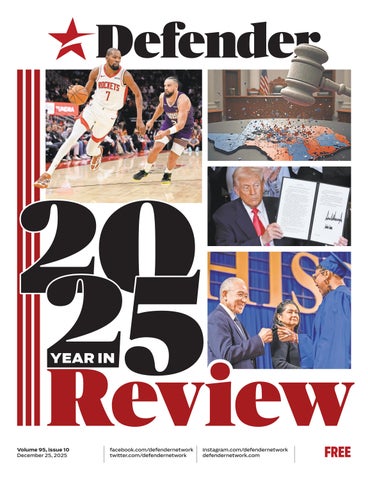
Review eview YEAR IN
Volume 95, issue 10 December 25, 2025
facebook.com/defendernetwork twitter.com/defendernetwork
instagram.com/defendernetwork defendernetwork.com
FREE
2 | December 25, 2025 |
DEFENDER NETWORK
DN Defender Staff Messages Managing Editor
Community
This year stretched The lawmakers and organizus — politically, ecoers fighting voter suppresnomically, emotionally sion, the families holding — yet it also revealed the on during the shutdown, strength and brilliance of the immigrant communities our community in ways demanding humanity, the that left me humbled and experts exposing AI bias, the inspired. From navigating families searching for answers ReShonda Tate life under a shifting politin the bayou body crisis, and ical landscape to living in Trump’s America, the everyday Houstonians who still insisted government shutdowns, immigration battles, on joy. Their courage shaped our coverage and and the economic pressures that Black women reminded me that journalism, at its best, is a face, the Defender had the privilege of telling form of community care. the stories that others overlook and ampliMy takeaway from 2025? That even in the fying the voices that are too often pushed to hardest seasons, our stories are powerful. the margins. Our truth is necessary. And our resilience is What stays with me most are the people: unmatched.
While watching 2025 our superpower, escape unfold, I was keenly aware hatch, and plan of action that the little sliver of for a more empowering democracy this country 2026. More and more, we’re had was being annihilated waking up to the fact that with daily explosions of no one’s coming to save us purposeful harm, injusbut us. The result? There are tice, etc. And having more pockets of Blackfolk relying Aswad Walker information at our fingeron those Kwanzaa princitips makes it easier, rather than harder, to end ples (unity, self-determination, creativity, etc.) an empire right in front of our faces. While to not only survive but thrive. We’ve been drowning in an ocean of misinformation, reconnecting with community, buying Black, “Rome is burning” and we don’t even know it. investing in wellness, and centering our own But what’s clear is that this Project 2025 mad- Black selves. Keeping up and expanding that ness was meant to do us maximum harm, self-determining energy will mean, even while we sleep through the destruction. with more challenges coming, still we’ll rise. Ironically, that destruction spotlighted That’s whassup in 2026.
Lifestyle
Education
It was just the other those who waited too long. day that I said ‘Happy What stood out most was New Year,’ and now I’m how AI stepped out of the back to do it again. I can’t background and took cenbelieve how quickly the ter stage. It shaped scripts, year went by. visuals, music production, ad This year reminded me strategy, and fan engagement. how fast the ground can It helped creators move with Laura Onyeneho shift under our feet. Every more intention and helped story we covered showed some change, but audiences find content that felt personal. the ones that resonated with me the most This was the year AI stopped being a quiet were those shaped by AI. Adapt or get left assistant and became a real creative partner. behind is the moral of the story, and it will be The people who leaned in found new reach, a part of our lives whether we like it or not. new impact, and new confidence in their It was the reality across every corner of work. the media. Audiences moved faster, cre2025 was another learning curve, and I ators worked smarter, and the gap widened look forward to seeing how things unfold in between those who embraced new tools and the months ahead.
Covering education deepened my understandand politics for the Housing of how governance ton Defender this year has decisions impact differbeen both grounding and ent neighborhoods across humbling. Houston. Reporting on Houston As an Indian reporter ISD’s rapid transformaand Report for America tions, the state’s shifting corps member working in Tannistha Sinha accountability landscape, a historic Black newsroom, and the everyday realities facing teachers my reporting was accompanied by a sense and families has reminded me that public of responsibility. The Defender’s legacy education is not an abstract policy arena; demands reporting that is community-cenit is a living system shaped by power and tered and unafraid to interrogate inequity. community voices. This beat has challenged me and stretched On the political side, following local me in a way that has made me a more empaelections, the redistricting saga over con- thetic reporter. I am deeply grateful for the gressional district maps, legislative debates, trust Houston’s communities have placed in and the ripple effects of state oversight have me along the way.
College and Pro Sports
High School Sports
The world of sports constudent-athletes now able to reap tinues to evolve and expand the benefits of their hard work. and it has been an honor Cryer were able to make a to watch it all unfold. The handsome sum along with other contracts are getting bigger, student-athletes from around the expectations are growthe state. And why not? Schools ing, and so is name, image, and coaches have profited nicely and likeness (NIL), revenue off their blood, sweat, and tears. Terrance Harris sharing, and the transfer In 2025, student-athletes gained portal have taken college sports to places we an additional revenue stream with the landnever thought we would see it go. mark NCAA vs. House settlement, which now I've covered the narrative as it shifted from allows Division I schools to share up to $20.5 student-athletes struggling to make ends million in profits with their student-athletes. meet to young athletes being free to hop from It was a no-brainer that schools like Unischool to school in pursuit of untold riches. Stu- versity of Texas, Texas A&M and University of dent-athletes, like former University of Hous- Houston would opt in. Still, even the SWAC, ton star shooting guard L.J. Cryer, have become which includes Prairie View and Texas Southincreasingly affluent, able to spend lavishly on ern, opted into the lawsuit settlement to be themselves while supporting their families. So able to share profits with their student athletes. far, most of the stories have been positive, with Times have definitely evolved.
The 2025 high school to enjoy the recognition sports season brought felt especially meaningful, many memorable as it honored their decades moments, but what I of influence on Houston enjoyed most was seeing athletes and culture. how deeply Houston’s I was also inspired by the historic communities history made on the track, supported their teams. watching Lamar break Jimmie Aggison Watching Third Ward and decade-long droughts by Fifth Ward turn out in large numbers, fill- winning a state title. And few stories resoing stadiums for Jack Yates’ exciting football nated more than Jamall Burnett’s. He proved playoff run and arenas as Wheatley earned that your circumstances do not limit your its spot in the state basketball champion- expectations, showing that belief, discipline, ship, was a strong reminder of how sports and effort can open doors far beyond your can bring together different generations and environment. His journey from standout neighborhoods. athlete to a Darren Walker Scholar at the Highlighting two of the city’s most accom- University of Texas at Austin and future plished and respected coaches was a signif- McCombs School of Business student icant part of the season. Celebrating their embodied the heart of what makes covering achievements while they were still present high school sports so rewarding.
M E R RY C H R I ST M AS & H A P PY KWA N Z A A
December 25, 2025 |
DEFENDER NETWORK
| 3
DN 2025 Review TOP STORIES
Local & State By Aswad Walker
The city of Houston and state of Texas are never short on news, whether good, bad, or ugly. Here are the top local and state happenings in 2025.
District 18 Drama
Certainly, Texas redistricting had an impact on the District 18 race. But even without the redistricting saga, the goings-on in District 18 would still be huge news. Residents of District 18 have been without representation for nearly an entire year. Some of the biggest names in local politics have been involved, seeking to lay claim to one of the nation’s most historic and significant congressional seats. Houston’s former mayor, Sylvester Turner, held the seat for a brief two months before his passing. Rising political stars Amanda Edwards and Christian Menefee, along with Jolanda Jones, joined a field of 16 vying for the seat. Redistricting threw a monkey wrench into things, as Al Green’s constituents shifted and Texas GOP maps moved Green’s home out of District 9. Hence, Green declared to run for the District 18 seat since that’s where the new maps place his home (which hasn’t moved). And now that the SCOTUS has sided with the racist maps, it’s official that Green will be running to represent District 18. Redistricting, bayou bodies, District 18 drama, and the local impacts of Project 2025 garnered our full attention in 2025. Credit: Gemini AI.
Project 2025 Local Impact
People say local politics impact people more than national politics. That may not be true anymore (if it was ever true). The Trump White House and its Project 2025 agenda had direct impacts on the quality of life for Houstonians. Trump tariffs impacted local businesses and consumers. Texas higher ed was busy mimicking the national crackdown on all things DEI. Section 8 changes are putting thousands at risk of becoming homeless. ICE raids are being welcomed, unlike in Dallas, where that city’s police chief emphatically rejected the collaboration. And Abbott even organized his own crew of ICE-like militarized law enforcement coming to visit Houston.
Texas Redistricting Drama Goes National
Efforts to redraw Texas Congressional maps had a ripple effect that reverberated across the country. Texas House Democrats broke quorum, bringing even more national attention to the issue. You couldn’t turn on national cable news without seeing local lawmakers being interviewed and sharing their perspective on the issue. Other GOP states pledged to follow Texas’s lead. As a result, several Democrat-leaning states (California and Illinois, for example) jumped into the redistricting race. A three-panel federal court out of El Paso said the Texas redistricting map was/is racist, and cannot be used. But in response to Texas Governor Greg Abbott and Lt. Governor Dan Patrick taking this to the SCOTUS, the U.S. Supreme Court sided with the Republicans. And these national efforts were implemented locally. Fort Bend County joined in on GOP redistricting efforts, with help from the federally indicted K.P. George, switching political parties, moving from the Dems to the GOP. Bayou Bodies
The discovery of the body of University of Houston student Jade McKissic sparked nationwide attention to the number of bodies discovered in Houston bayous. The body count of souls lost to Houston bayous in 2025 is enough in and of itself to cause local and national alarm. But the fact that there are so many questions unanswered about these tragic deaths, whether due to a lack of transparency on the part of the city and/or other factors, Houstonians are continuing to talk… and worry.
Credit: ReShonda Tate.
Housing and Homelessness
The twin issues of housing and homelessness seemed to be covered in the Defender every week during 2025. The City of Houston enacted new laws and policies regarding its homeless population. Section 8 changes have thousands worried about whether they and their families will have a roof over their heads by 2026. And at year’s end, residents of Cuney Homes were unsure about when and where they would relocate as plans to renovate Houston’s oldest public housing project were set to be initiated.
Read more in-depth coverage of these stories at DefenderNetwork.com
Cuney Homes residents Irenda Jefferson and Janice Makey. Credit: Aswad Walker
4 | December 25, 2025 |
DEFENDER NETWORK
DN 2025 Review TOP STORIES
Nation nal By ReShonda Tate
As 2025 comes to a close, one thing is clear: this year demanded everything of us. It tested our democracy, our institutions, our economy, and our collective spirit. Yet even amid political upheaval, policy whiplash, and widening inequality, Black communities in Houston and across the country have consistently shown what they have always had — resilience, clarity, creativity, and a deep, unwavering commitment to justice. Here are the stories that shaped 2025, and the moments that shaped us.
Donald Trump, joined by members of his administration and foster care advocates upended a number of lives with his executive orders. Credit: Getty
Families wait in line to get food in Florida. Credit: Getty Government shutdown showdown paralyzes America
What began as a partisan stalemate escalated into a weeks-long federal shutdown, freezing government functions and stretching family budgets to the breaking point. With Black workers comprising a disproportionate share of federal employees, the shutdown hit our community hardest, deepening long-standing wage gaps and financial instability. Many Black families faced impossible choices — juggling overdue bills, relying on already thin emergency savings, or taking on extra jobs just to stay afloat. From missed paychecks to delayed benefits, the fallout underscored not only the human cost of political warfare but the precarious economic tightrope Black households walk even in the best of times. Immigration policy shifts ignite national tension
New border crackdowns, shifting asylum rules, and a series of humanitarian emergencies at the southern border dominated headlines throughout the year. For Afro-Caribbean, African, and Latino immigrant communities across the country, the policy swings sowed fear and uncertainty. At the same time, immigrant-rights advocates and legal aid groups reported record demand as families navigated an ever-changing system that often left them in limbo.
Black women’s unemployment surges
While national unemployment remained relatively stable, Black women experienced a troubling rise in joblessness, pay stagnation, and widening inequities in access to opportunity. Economists pointed to persistent discrimination, childcare shortages, and pandemic-era setbacks that have yet to fully recover. Many Black women turned to entrepreneurship, gig work, and community support networks to bridge the gap.
Life under Trump: Democracy on the line
The defining story of the year was not just the policies themselves, but the public’s response to them. As the Trump administration ushered in sweeping changes—DOGE-driven federal layoffs, aggressive redistricting efforts, new voter ID requirements, student loan caps that penalized low-income borrowers, and tighter restrictions on education and economic access—the cumulative effect was clear: Entire communities were pushed further from opportunity and political power. Federal layoffs disproportionately affected Black workers. Redistricting weakened Black voting power in key states, while stricter voter ID laws and reduced access to early and mail-in voting created new barriers. Economic pressures deepened as student loan policy shifts hit first-generation college students and HBCU attendees especially hard, narrowing one of the most reliable avenues for upward mobility. At the same time, rollbacks of diversity, equity, and inclusion initiatives limited access to scholarships, contracts, and leadership pipelines that had only recently begun to expand. In schools and workplaces, restrictions on how race and history could be discussed reshaped daily life, leaving educators cautious and students disconnected from their own narratives. But what followed was one of the most powerful demonstrations of democratic resilience we’ve seen in years. Grassroots organizers rose to meet the challenge, mobilizing voters in historic numbers despite unprecedented hurdles. Supreme Court’s landmark decisions reshape civil rights, education
In a series of sweeping rulings, the U.S. Supreme Court redefined the legal landscape. From affirmative action and DEI restrictions to voting map disputes and reproductive rights, the Court’s decisions sent immediate shockwaves through HBCUs, corporate and academic diversity programs, and marginalized communities. For Black students and workers, the rollback of protections felt especially acute — threatening pathways to education, fair hiring, political representation, and body autonomy. HBCUs reported heightened concern about recruitment and funding, while Black-led organizations warned that the rulings could widen already stark inequities for generations. Legal scholars and civil rights groups spent much of the year scrambling to interpret the new limits — and developing strategies to safeguard access and equity in a dramatically altered environment.
More than 300,000 Black women lost employment in 2025. Credit: Getty
Read more in-depth coverage of these stories at DefenderNetwork.com
VOLUME 95, NUMBER 10 - DECEMBER 25, 2025 Publisher | CEO Sonceria Messiah-Jiles Strategic Alllance Clyde Jiles Managing Editor ReShonda Tate Content Manager Terrance Harris Community Reporter Aswad Walker
Culture/Lifestyle Reporter Laura Onyeneho Special Assignments Reporter Tannistha Sinha Sports Terrance Harris Jimmie Aggison Video Editor Bryan Erdy
The Defender newspaper is published by the Houston Defender Newspaper Inc. and audited by Alliance for Audited Media (AAM). Only digital subscriptions are available at: www.defendernetwork.com/subscribe No paper subscriptions available. All materials covered by 2025 copyright. No materials herein may be reproduced without the written permission of the Publisher. 713-663-6996 | P.O. Box 8005, Houston, TX 77288
December 25, 2025 |
DEFENDER NETWORK
| 5
DN 2025 Review
HISD Recap By Tannistha Sinha
In a year defined by sweeping reforms, community tension, and shifting academic priorities, Houston ISD found itself at the center of Texas’ education conversation. From changes in how student progress is measured to ongoing debates over teacher morale and wraparound services, the school district experienced another whirlwind of decisions that touched nearly every campus and family. As 2025 approaches, these five developments stand out for their impact on reshaping classrooms and redefining accountability, revealing the relationship between HISD and the communities it serves.
New HISD trustees elected amid ongoing state takeover
HISD voters elected new trustees in Districts I, V, VI, VII, and IX this year, even as the district remains under Texas Education Agency (TEA) control. Since the 2023 state takeover, a state-appointed Board of Managers has held all governing power, meaning the newly elected trustees cannot set policy, pass budgets, or oversee the superintendent until the intervention ends. Commissioner Mike Morath extended that intervention through June 1, 2027, with HISD required to meet three exit criteria before regaining local control. These include no multi-year academically unacceptable campuses, special education operating in compliance with requirements, and the board’s focus on student outcomes. In the November races, Maria Benzon, Michael McDonough, and incumbent Bridget Wade won Districts V, VI and VII, while Districts I and IX candidates ran unopposed and did not appear on the ballot. The terms for those candidates, Felicity Pereyra and Myrna Guidry, will begin in January.
A new commission examined Miles’ reforms, gathering testimony on teacher turnover, school changes, and community trust. Credit: Tannistha Sinha/Houston Defender
A new commission probed HISD takeover’s impact
A new commission on the HISD Takeover, led by State Sen. Molly Cook, State Rep. Lauren Ashley Simmons, and faith leader Collin Bossen, launched this year to examine the effects of the state’s ongoing intervention in Texas’ largest school district. The commission aimed to rebuild public trust by investigating the conditions under state-appointed leadership and that of Superintendent Mike Miles. During its sessions, residents raised concerns about teacher turnover, library closures, and shifts in specialized programs, while others emphasized the importance of preserving collaboration and community-centered schools. HISD approved $2.1 billion budget as TEA replaced nearly half the board
HISD dissolved wraparound department
HISD’s pivotal year revealed a district in transition, balancing ambitious reforms with mounting community concern. Credit: AP Photos
Miles defended HISD reforms, City Council probed data
HISD’s state-appointed Board of Managers unanimously approved a $2.1 billion budget for 2025-26, just days after the TEA replaced four board members. Superintendent Mike Miles touted the nearly balanced plan, which reduced an initial $246 million deficit to $14.6 million through increased revenue and tighter spending. The budget expands pre-K, special education staffing, teacher pay, and security, while reflecting significant disparities between NES and non-NES campuses: $10,635 per NES student versus $7,103 for others. Cuts target central office departments, transportation and food services.
Read more in-depth coverage of these stories at DefenderNetwork.com
HISD dissolved its Wraparound Services Department and eliminated campus-based wraparound specialists, which catered to students in need of food, clothes, or counseling support, and shifted to a centralized and integrated student support model. District leaders say the change reflects tighter budgets and inconsistent impact from the old system. HISD also expanded its Sunrise Centers network to eight hubs for family services.
HISD Superintendent Mike Miles delivered a data-packed presentation to the City Council, arguing that HISD is achieving historic academic gains under his NES reforms. He highlighted rising test scores, the elimination of F-rated campuses, and a doubling of A and B schools per TEA accountability ratings, crediting strict instructional systems and teacher coaching. This year’s HISD earned a B overall in the ratings, a notch up from recent years. Council members, however, pressed him on safety rules, budget priorities, billboard spending, enrollment declines and whether ratings had risen too quickly to be trusted. While Miles insisted TEA data confirms real progress and pledged all schools will be A or B by 2027.
6 | December 25, 2025 |
DEFENDER NETWORK
| 7
DN 2025 Review 6 | June 26, 2025 |
Centerfolds
Black Male Murders Are we numb to gun violence in Houston?
Take storytelling beyond words
By ReShonda Tate
6 | August 14, 2025 |
If there’s one thing The Defender knows how to do, it’s make a statement — and in 2025, our centerfolds did exactly that. This year, our team delivered some of the most talked-about, shared, and visually striking spreads we’ve ever produced. From bold political moments to vibrant celebrations of Black culture, from game-changing women to groundbreaking investigations, these centerfolds didn’t just decorate our pages; they defined conversations across Houston. They sparked debate, lit up social media, inspired community action, and reminded our readers why Black storytelling, done right, is both art and accountability. As we close out the year, we’re looking back at the centerfolds that stopped the scroll, made you pause, and made you proud. Here are The Defender’s most unforgettable centerfolds of 2025 — the ones that had folks talking long after the paper hit the stands. 6 | July 10, 2025 |
DEFENDER NETWORK
| 7
DN InFocus
Kirbyjon Caldwell From indictment to remorse and renewal
K By Von Jiles
irbyjon Caldwell shares the seven-year journey from head of a mega church, Windsor Village United Methodist Church, to an indictment for defrauding investors of $3.5 million, to a return as a lay pastor. The saga began when, in a historical move, Caldwell paid over $1 million in restitution plus $600,000 in investor fees before being indicted. He was later sentenced to six years in federal prison for conspiracy to commit wire fraud on March 11, 2020. On June 22, 2021, he reported to the Federal Correctional Institution, a low-security facility in Beaumont, TX. While Caldwell was released from prison in September 2024, that release was to home confinement. He recently completed the entirety of his prison term on July 31, 2025. The uniqueness of Caldwell’s conversation with the Defender reveals his innermost thoughts and feelings about The Past: Reflecting on his journey from indictment to serving time in prison; The Present: The Man Today, looking at the challenges he faces re-entering public life and The Future: The Road Ahead, revealing his new goals and initiatives.
Here’s the bottom line. I made some mistakes. The primary mistake I made was not doing a sufficient job of vetting the product, the process, the people, and all of that.” KIRBYJON CALDWELL
Watch the Interview
The Past: Reflecting on his journey DEFENDER: What were you indicted for? What’s the truth, in your own words? Please walk us through the events that led to your conviction. KIRBYJON CALDWELL: Here’s the bottom
line. I made some mistakes. The primary mistake I made was not doing a sufficient job of vetting the product, the process, the people, and all of that. I don’t know if you recall, during the press conference I held….. I had in my right hand about 14 or 15 documents, and I said, I am not guilty because I have 16 contracts in my hand signed by individuals or institutions who have promised to buy the bonds. Little did I know that if a contract does not have a performance date in it, it is not an enforceable agreement. I had 16 agreements, none of which had enforceable contracts. In the court, I was going to plead not guilty up until about seven to 10 days prior to the
trial date. And then I found out that this is a very key word, key phrase - the prosecutors say, if you did not know it, you should have known it and that’s what they pinned on me. You should have known. You went to business school. You should have known. You’ve been doing money deals. You should have known. So, shame on me. I should have known that there were no performance or dates in those contracts. I did not know that. So here we are today. DEFENDER: When you think of those harmed, emotionally or financially, what did you do to settle up, and what did you say to them? CALDWELL: I accept full responsibility for my
actions. It was never my intent to hurt or harm
Caldwell describes his feelings when he heard the judge’s sentence, talks about his first night in prison and what ran through his mind and reflects on the evolution of his faith.
| 7
DN InFocus
Black church business Does it make dollars and spiritual sense?
G
un violence is tearing through Houston’s Black communities with devastating impact, claiming young lives, shattering families and leaving neighborhoods in a state of collective trauma. But now, in addition to the grief, there’s another, more haunting consequence: Numbness. From Third Ward to Missouri City, families are mourning sons, nephews and classmates lost to bullets. The pain is sharp, but
so is the growing sense that, for many, this crisis has become commonplace. “We’ve been going to candlelight vigils for so long, they feel like a routine,” said Tanisha Brooks, a mother of three and longtime Sunnyside resident. “We cry, we pray, we light candles—and then it happens all over again.” Across the country, statistics confirm what many in Houston already know: young Black men are dying at epidemic rates. And many feel like their deaths are met with silence.
6 | October 2, 2025 |
DEFENDER NETWORK
I
By Aswad Walker
s the Black Church focused on a spiritual mission or securing more money? Many Black people asked that question after Pastor Marvin Sapp of The Chosen Vessel Church (Fort Worth) demanded that ushers lock the doors until attendees voluntarily made a collective offering of $40,000. The Sapp incident raises questions about just how clear the general public is on Black Church finances. For centuries, Black churches have played a central role in the social, political and economic lives of their congregants and communities. They have been able to do this largely because of the funding given by members. But with Black church membership or involvement (desirability) declining from 90% in 1996 to 74% today, according to Barna, a national database of spiritual indicators, where will the funds come from for the Black Church to honor its historic spiritual mission? One reason Black people have left the church is their perceived hypocrisy or disillusionment with church leaders’ teachings and actions. Some contend church funds are being used less for ministry and more for building bigger sanctuaries and/or pastor salaries. But is that assertion fair?
There is no one definitive number about the collective income Black churches take in from tithes and offerings. Various articles report that the amount ranges from $2 billion to $19 billion. In 2016, Guardian religion correspondent Harriet Sherwood reported that U.S. religious institutions had a net worth of $1.2 trillion, which did not include a Black Church breakdown of revenue. Whatever that amount is, like all institutions and households, Black churches have bills to pay and operating expenses to cover. The Defender spoke with a few Black pastors to answer questions and demystify Black church finances. What most don’t know
When asked what it is about church finances that most people don’t know or understand, Dr. Rudy Rasmus, didn’t mince words. Rasmus, co-founder of St. John’s Downtown, said, “Many people wrestle with the fact that the inner workings of a church is actually a business. In other words, revenue is generated from the generosity of the constituents and operating expenses are the same as any other business (utilities, mortgages, etc.). “The debate usually surrounds pastoral compensation and benefits in relation to other industries.”Johnny Ogletree, pastor of First Metropolitan Church (8870 W. Sam
Houston Pkwy North, Houston, 77040), echoed Rasmus’s sentiments. “What most people don’t understand about church finances is the business aspect of what needs to be done to run a modern ministry,” shared Ogletree. “Of course, we know that there’s a spiritual component to everything that we do. But there are business organization types of things that have to happen. “Just like every home has income and expenses, churches have those as well. We monitor staff. We also have the responsibility, in this modern age also of property, and being responsible for managing property, and also debt that comes along sometimes with property and owning buildings, as well.”
treasure is, there your heart will be also’ (Matt.6:21), there is an inescapable correlation between the way funds are expended and the expressed priorities of any business or church entity.”
Central to the angst of Black people who left the church is the issue of the intersection of faith and institutional finances—in other words, the belief that church funds are used less to strengthen congregants’ faith than for other reasons. All about the money? Ogletree identified that intersection as Ogletree and Rasmus took two different property management. approaches to answering how they respond “The same thing that the Bible to the point made by some that all churches care about is money. teaches us about being good stewards of our money is the same “The institutional church thing that we have to do as a has been its own worst church,” said Ogletree. “We enemy over the years in the look at tithes and offerings, way it has poorly managed and based upon the tithes and branding, and it’s not a new phenomenon,” said Rasmus. offerings, we make budgets. And “My dad taught me as a we do our best to manage the money properly to where we Pastor Johnny Ogletree young person to not trust don’t go over budget. preachers based on his own “And we’re able to do the things that we suspicions of questionable pastoral integrity. have envisioned to do. And every home has “I ultimately became a pastor and spent to do that as well.” my entire career proving to him and othThough that sounds like a list of numbers ers that it can be done with integrity. But to and bottom lines, Ogletree asserts that the answer your question, it’s true, one bad apple presence of the Holy Spirit is also involved. can spoil the bunch,” added Rasmus. “A “There are some things we desire few bad apples (or pastors) have made it harder on the public to do that are outside of the scope image of integral leaders in of what we can financially see. the church industry. An But our faith allows us to be integral church is no more able to continue pressing towards those things that don’t focused on money than any always make financial sense,” other business that has to pay said Ogletree. “Understanding bills.” that we can get close enough to Ogletree said all churches Dr. Rudy Rasmus it from a faith standpoint, where must be concerned with money to the extent that we have expectations that God will provide what’s needed to do the thing money is a tool used for ministry. that’s needed to touch the community in the “There are some things that don’t cost way that the kingdom needs to advance.” money, [like] the heart and those who volRasmus suggested one level of misun- unteer their time to go out and do kingdom derstanding the general public has about work as far as evangelizing or volunteering churches and their finances centers around their time to do kind deeds,” said Ogletree. how he and potentially other pastors view “But almost every aspect of what we do budgets. requires some type of funds. But we depend “Our institutional priorities have always upon the Holy Spirit to be that provider focused on the least empowered persons in to minister to people, to touch people’s our community as our funding priorities,” hearts, to instruct them, and to give them said Rasmus. “Regardless of the size of the the faith enough to desire to be generous, to business, government agency or church, I do the things that are necessary to help the honestly believe budgets are moral docu- community. ments that reflect the heart of the company “But every organization, every business, or institution. even in this economy that we see, has to have “Just as the Bible says, ‘For where your financial resources to do ministry.”
WHERE FINANCES ARE SPENT
Source: The National Study of Congregations’ Economic Practices
Personnel
In By Laura Onyeneho
Black communities, funerals have long been more than ceremonies. They are declarations of faith and communal strength. The “homegoing” tradition rooted in the Black church has carried generations through mourning with music, prayer and praise. But today, grief is changing shape. Rising costs, shifting spiritual beliefs and digital innovation are pushing families to redefine how they honor loved ones. Across the city, funeral homes, cultural centers and families are blending tradition with adaptation. What emerges is not an abandonment of heritage, but a reimagining of it. Justin Mabrie, funeral director at Mabrie Memorial Mortuary, has witnessed the changes up close. His family opened the mortuary in 1997 and he has been working fulltime in the business for the past seven years. “African American funerals are very inclusive; they want the entire family involved in the life celebration,” Mabrie said. “Whether that means waiting until everyone can come in town, having a color theme or putting together a tribute video, families are personalizing services in ways that reflect what was truly important to that loved one.” He says that “celebrations of life” often replace strictly traditional homegoings, especially when families want services outside the church. “If the person didn’t necessarily go to church, we don’t need to have the service at a church,” he said. “It might be more like a reception with beverages, live music and a moment for scripture and memories, really reflective of how that person lived their life.” Cremation, once rare in Black communities, is increasingly common. Economics play a role, but Mabrie emphasized it’s not just about cost-cutting. “Sometimes it’s practical, sometimes it’s financial, but cremation doesn’t mean you
The language of homegoings Homegoing: A funeral that marks returning “home” to God. Repast: Communal meal after a funeral.
49% Facilities
23%
Missions
11%
Programs
11%
Dues
6%
Libation: Ritual pouring of liquid in honor of ancestors. Ancestral veneration: Honoring the dead as spiritual guides.
with the locations, circumstances and victims’ names blending into what feels like an endless trail of bloodshed and grief. “Unfortunately, I think we’ve become immune to it,” said Dr. Howard Henderson, executive director of the Center for Justice Research at Texas Southern University. “It’s become a part of life.” But mental health professionals are divided on whether Americans have truly accepted the violence. “The numbness is not even just desensitization. It’s become a survival instinct,” said Vaile Wright, director of research and special projects at the American Psychological Association. “Because over time, something that is shocking or stressful or terrible becomes less so because you do start to get kind of used to it. With the way that we consume news and consume information right now and how visual it is, it does feel like Howard Henderson it’s happening all the time.”
• Gun violence is the leading cause of death for Black males ages 15 to 34. • Black men ages 18 to 24 are nearly 23 times more likely to die by firearm homicide than their white peers. • Although Black Americans make up 14% of the U.S. population, they account for 60% of annual firearm homicides. • Black youth under 18 are 14.5 times more likely to die by gun homicide than white youth. (Source: Brady United, CDC) According to the Houston Police Department, the city recorded more than 400 homicides in 2023. More than 70% of the homicide victims in Harris County were Black, despite Black residents making up just 20% of the county’s population. It’s all too much
Just keeping track of all the shootings has become overwhelming,
Houston mental health therapist Dauphney Lockridge agreed, but said what looks like numbness may actually be a form of self-protection. “You develop a certain set of skills to cope,” she said. “Maybe it’s turning off the television or choosing not to talk about it. But those are all protective factors. It doesn’t necessarily mean people are numb.”
year that surveyed 100 Black boys and young men in Houston, as well as in Wilmington, Delaware; Jackson, Mississippi and Baltimore, Maryland. The findings point to a cultural and psychological normalization of violence, often reinforced by music,
A crisis rooted in trauma
“It’s not just a public safety issue—it’s a public health crisis,” said Henderson. “Unless you’re talking to the young men and women directly affected, it’s hard to understand how deeply embedded this is in their lives.” Henderson co-authored a study last
Black mourning
African traditions and ancestral continuity That flexibility speaks to a long history of adaptation in Black mourning in Dr. Suzanne E. Smith’s book, To Serve the Living: Funeral Directors and the African American Way of Death. During the pre-Civil War era, enslaved Africans were often prohibited from holding funerals for their loved ones, for fear that gatherings might spark rebellion. Denied the right to grieve openly, they created “hush harbors”, secret spaces where they fused African traditions with Christian practices, singing, praying and lifting the names of the dead in defiance of silence. Those hidden rituals became the foundation of what we know today as the homegoing service, a ceremony rooted in African ancestry and the Black church. Even now, singing gospel hymns, wearing T-shirts honoring the deceased, gathering for the repast and offering final farewells at the casket trace back to that history of resilience. Michael Jones, manager of Lockwood Funeral Home, sees today’s joy-filled services as continuing that legacy.
the homicide rate is highest in our community. Even compared to other marginalized groups with similar socioeconomic status, like Latinos, the rates are strikingly higher. So we have to ask: What’s unique about the Black experience in America that produces these outcomes?” A generation desensitized
Youth advocates say the normalization of violence is among the most dangerous consequences of the crisis. “When the violence becomes background noise, when we stop crying, stop marching, stop caring—it means the system has succeeded in numbing us to our own genocide,” said activist Crystal Campbell, who leads youth healing circles across the city. She said some teens scroll past news of a shooting like it’s celebrity gossip. “They don’t flinch when a classmate dies,” Campbell said. “That’s not normal. That’s trauma.” Asa Singleton, 24, a violence prevention specialist with The Forgotten Third, said many youth he mentors carry guns out of fear, not aggression. “They’re not trying to be shooters,” Singleton said. “They’re trying to stay alive.” New solutions, ongoing struggles
To address the crisis, Harris County launched the R.I.S.E. Empowerment Center in Cypress Station—a one-stop hub for He n d e r s o n s a i d people at risk of committing or becoming untreated trauma, com- victims of violence. The center offers mental pounded by systemic health services, trauma counseling, conflict neglect, is driving much of resolution and job training. the violence. “This is about systemic change,” said “There’s a school of thought, Harris County Commissioner Rodney Ellis. like that proposed by the “You can’t police your way out late Amon Wilson, that argues of trauma. You have to prohomicide is a Black response to vide hope and opportunity.” government disenfranchisement,” The county’s gun buyback Henderson said. “Wherever you program, part of the broader see disinvestment in Black comOne Safe Houston initiative, munities, you see rising homicide has already removed more HOW THE rates. People are frustrated, and than 4,200 firearms, making CITY IS they take it out on each other.” it one of the most effective in WORKING TO He also referenced the work the nation. COMBAT THE Still, Henderson says other of Dr. Joy DeGruy, author of PROBLEM Post-Traumatic Slave Syndrome, systems must also be held noting that the unique historical accountable, which includes and generational trauma experienced property owners. He pointed to the emergby Black Americans cannot be ing use of “premises liability” lawsuits, where overlooked. families sue apartment complexes for failing “It’s not just about guns— to provide adequate safety measures despite it’s about survival, hope- high crime rates. “It’s no different than when big box retaillessness and legacy trauma,” Henderson ers got sued for not ensuring customer said. “No matter where safety,” Henderson said. “Now landlords and you go in this country, property owners are on notice, too.”
6 | July 31, 2025 |
DEFENDER NETWORK
| 7
DN InFocus
Generations reshape traditions of
lose the beauty of a service,” he explained. “You can still have flowers, speakers, a video montage, even a champagne toast. The only difference is you’re not going to the cemetery afterwards.” He added that cremation allows families more time to decide how to honor remains — whether keeping an urn at home, dividing ashes among relatives or traveling to scatter them in meaningful places.
generational trauma and lack of opportunity. “Some of these young men told us, ‘We get it from the music,’” Henderson said. “They listen to songs that glorify violence and, unlike previous generations who knew it was metaphorical, they take it literally.” The study also revealed that many young men first encountered guns before age 15, some as young as 8. And in most cases, the weapon was handed to them by a younger relative, such as an uncle or cousin, who believed it was necessary for protection. “They’re not getting them f rom o l d e r relatives,” Henderson said. “It’s usually someone just a little older who thinks they’re helping.” The trauma beneath the trigger
| 7
DN InFocus Intersection of faith, finance
By the numbers
Demonstrators attend a March for Our Lives rally against gun violence on the National Mall. Credit: Getty
DEFENDER: What impact has this anyone; that was expressed specifically chapter in your life had on your in the fact that I paid everybody back. family, especially your children? They called it restitution. I paid ‘em all back. Before my indictment, I refunded CALDWELL: The most painful days slightly over $1 million to those who in Beaumont were missing the birthdays Caldwell requested their money back. And prior of my family members. Not my birthday, talks about the to sentencing, I paid full restitution to the their birthdays…You don’t get that back. legacy he investors/victims - my half of the restituThanksgivings, those are painful too. hopes to tion and my co-defendant’s portion of the But the Lord blessed me to see another leave and restitution. The government calls them Thanksgiving. Graduations, you don’t get his advice to his victims. I then paid investors slightly those back. My daughter made a stateyounger ment once while I was in Beaumont that over $600,000. What does the $600,000 self. seared my soul. She said, `Daddy, one of represent? That represents the fees that some investors incurred when they pulled the things that I regret most about you money out of their accounts to invest in being in Beaumont is that you are missing this deal. the opportunity to watch me become a young lady.’ I did all that because I thought it was the right You don’t get that back. So, as you can see that those thing to do. At the risk of sounding like a Christian, were the tough parts. You know, one of my children is forging his way which I am, I didn’t want that curse hanging over my children’s heads. It took every penny that I had as an entrepreneur. So, I wasn’t able to help him to do it, but I did it. I’ve had numerous persons, with that. Another was forging his way as a student, including attorneys, say to me, no way in the hell I having to change schools. Driving him to college would’ve paid those folk all that money back. And didn’t get a chance to do that. All because I didn’t I respect that. But I was glad to do it and I would know to look for the missing performance date and do it again. my attorney failed to catch the missing performance dates on the agreements as well. I want to repeat again, I should have known. I accept responsibility The Present: The man today for knowing, but I have to confess in my mind, it’s a steep price to pay. DEFENDER: What’s been the most surprising challenge or joy you’ve Pastor Suzette (Caldwell) has done a phenomenal encountered since re-entering public life? job, particularly considering all the headwinds. She CALDWELL: One comes to mind straight away. didn’t expect to pastor the church. One of our local television affiliates, we all know it is ABC -KTRK Channel 13. Bless their hearts. They The Future: The road ahead reported on the $3.6 million fraud case. They did not report that I paid everybody back…But what I could DEFENDER: What’s next for Kirbyjon not wrap my mind around was why they wanted Caldwell? Are you returning to full-time to say, I stole money from elderly members of the ministry or exploring a new path? church. Now I understand they’ve since printed a CALDWELL: First of all, I’m working on a book retraction. But you know how that goes. Nine mil- – books actually. I think there are books inside lion people heard I stole money from elderly mem- of me. So, I’m excited about that. In terms of my bers, and five people read the retraction. involvement here in the city, I will be doing a lot of As this lie that I stole money from elderly mem- preaching and a lot of teaching. bers at Windsor Village soaked in -- I asked myself, As the lay pastor at Windsor Kirbyjon, why would you feel ashamed if you knew Village, I’m going to be very it wasn’t true? I felt ashamed, even though I knew it involved in the community. I’m wasn’t true. In my mind, I see somebody walking also working closely with the down the street and they say, `There’s that Cald- Kingdom Builder Center, the Caldwell well who stole money from elderly people who building – the KBC has a misshares were their members.’ You know, it’s the elderly sion in and of itself. I’m going other members of Windsor Village part that really got to work very closely with that comments from his me. My Achilles heel, my soft spot is for elderly organization. So, at the end of children and members. What kind of preacher would steal the day, we are going to do all and how from his members? Elderly? Man, that’s not me. we can to impact, in a positive regret and worry And it just hurt my heart. The folk who know me way, and uplift the community hounded came to my defense on social media, as you know. going forward as we have in the him. Bless God for that. past.
DEFENDER NETWORK
| 7
DN InFocus
TOP STORIES
By ReShonda Tate Billingsley
DEFENDER NETWORK
“It goes back to our African roots,” he said. “As a people, we’ve always celebrated life. Funerals bring family members together, whether from across town or across the country. Even with social media and livestreams, that gathering is still sacred.” Na i l a h Ne l s o n , director of Shrine Cultural & Events Center, sees this lineage reflected in today’s celebrations. “It’s not just a death from this life, but an ascension into the ancestral realm,” she said. “The spirit Jones lives on. You can call out your loved one’s name and know they’re all around you.” She says many services today incorporate rituals directly tied to African traditions, such as pouring libations, building altars or calling out ancestors’ Nelson names in unison. Families and guests often wear African attire or dress the deceased in traditional garments. “It connects us to our lineage,” Nelson said. “It’s powerful.”
Tradition meets innovation After emancipation, Black entrepreneurs established funeral homes as some of the first family-owned businesses in America. Because the funeral trade was segregated along racial
lines, Black-owned funeral homes became cultural institutions, places where African Americans could mourn freely, guided by directors who understood their customs. Funeral directors often became community leaders, offering counsel, spiritual care and continuity at a time when little else was secure. Mabrie recognizes that role today. “Some families want to spend, others are cautious. Some prefer tradition, others want more personalized services,” he said. “Our job is to create opportunities so every family can celebrate their loved one’s life in a way that feels right.” Technology has also left its mark. Livestreaming exploded during the pandemic, when gatherings were limited. What once seemed novel is now standard. “That one link gives access to people who can’t be there,” Mabrie said. “The recordings become part of family history.” Generational differences play a role, too. “Older relatives still want the hardcopy funeral program,” Mabrie said. “But younger people are fine scanning a QR code to view it digitally. There’s more comfort with personalization, websites, engravings and creative touches. It’s about reflecting the person’s actual life.” Jones has also tracked dramatic changes in the way services are planned. “When I first started, cremation was about 7% of services. Last year, it was 37%,” he said. “But cremation doesn’t have to mean less celebration. Families can still have viewings, memorials, or life celebrations with music, food and tributes; the only difference is what happens afterward.”
When I first started, cremation was about 7% of services. Last year, it was 37%.” MICHAEL JONES Manager, Lockwood funeral home
He notes that while cost drivess some choices, many families now pre-plan services with cremation in mind, not as a comp promise ns. but as a way to leave clear instruction “It’s like giving your family a hug,,” Jones m in the said. “You take the pressure off them moment of grief.” Generational shifts also shape how families f remember their loved ones. “Elders still want the large printed ffuneral program with photos. Younger p people love getting a digital version straiight to their phone,” he said. “It’s the same ttribute, just offered in ways that speak to diifferent generations.”
Learn about the shift in trends for Black homegoing ceremonies.
Texas Redistricting How we got here and where we are headed
E
By Aswad Walker
verything truly is bigger in Texas — including redistricting drama. According to state lawmakers and community leaders, the current GOP-led effort to redraw Texas’ congressional voting maps—five years ahead of schedule—threatens to silence the voices and votes of millions of Black and Hispanic Texans. The stakes are high. This unprecedented political move, reportedly ordered by President Donald Trump, could set a national precedent for mid-cycle redistricting, potentially protecting the Republicans’ U.S. House control after the 2026 midterms. Many political scientists believe the Republicans are in danger of losing the House due to the national unpopularity of several Trump policies. How did we get here? Redistricting—redrawing state congressional maps—has historically followed the U.S. Census, mandated once a decade since 1790. In 235 years, only once (in 1920) did redistricting not follow a census. But in 2025, Texas is set to buck that trend. The 2020 Census revealed that 95% of Texas’ population growth came from communities of color, particularly Hispanic/ Latino and Black Texans. The state’s population grew by nearly 4 million between 2010 and 2020. The Hispanic/Latino population grew by nearly 2 million, the Black population grew by over 550,000 and the white population increased by only 187,000.
What they’re trying to do is rig our districts. That’s going to come at the expense of Black and Brown communities.” STATE REP. LAUREN ASHLEY SIMMONS
These demographic shifts earned Texas elected Nov. 4, an election that will not be two new seats in the U.S. House of Repre- impacted by the current redistricting efforts. sentatives. But instead of reflecting the diver“When you have four districts, all of them sity behind that growth, the GOP-controlled represented by minority people, and you legislature drew two majority-white hite mak make them your targets, what is it districts, reinforcing Republican ab bout? Racism,” said Rep. Al Green. political power. “This is about racism. We have to At the July 26 Redistrictcall it what it is.” ing Hearing at the University At the Houston hearing on July of Houston, State Rep. Jon E. 26, State Rep. Cody Thane Vasut Rosenthal (Dist. 135) questioned (Dist. 25), chair of the redistrictthe logic. in ng committee, claimed ignorance about why the issue was added to the “When we added the two new dis dis- Al Green abou tricts that were required because we had Special Session agenda—other than that Gov so many new people here, how did id G vernor Abbott put it there. they manage to draw those both Trump has been less subtle. Speaking to reporters, he said he to be majority white districts?” he asked. wants five additional House seats Democrats, a minority in the for Republicans from Texas alone. state legislature, couldn’t stop “Just a simple redrawing, we p the 2021 redistricting plan. In a pick up five seats,” Trump said. “Te dramatic attempt to block the pro-Texas would be the biggest one.” cess, House Democrats fled Aus- Lauren Ashley State Rep. Lauren Ashley SimSimmons tin to break quorum—but after 37 mons (Dist. 146) criticized the move. days, they returned. Governor Gregg “Donald Trump has given an Abbott signed the new maps into o orrder to our governor… ‘Hey, I need law on October 15, 2021. ffive Republican seats out of Texas,’” Lawsuits followed, including Simmons said. “What they’re tryGutierrez v. Abbott and LULAC ing to do is rig our districts. That’s v. Abbott, alleging violations of going to come at the expense of the Voting Rights Act and the Black and Brown communities.” 14th Amendment. Still, the 2021 U.S. Congresswoman Jasmine Crockett Croc (Dist. 30) criticized attempts ed map stood. Republicans defended Jasmine their plan as “race-neutral.” Crockett to frame this issue as mere partisanship at a rally before the July 26 hearing at UH. Why redistrict now? “Some don’t want to talk about This year, the U.S. Departmentt of Justice accused Texas Republirace. They say we’re engaging in cans of creating unlawful, racially iidentity politics and all this other motivated maps. But instead of bullshit,” said Crockett. “But let me b focusing on the missed opporttell you something, that is what the w is. Texas is a majority-minority law tunity to create Hispanic/Latino districts, the DOJ pointed to four statee. They are trying to dilute the Beto Democratic-leaning districts, all held ld voices of the majority in this state.” O’Rourke by people of color: At the same rally, former presidential • District 9 – U.S. Rep. Al Green candidate Beto O’Rourke warned that (Houston) the redistricting push wasn’t just about flipping • District 29 – U.S. Rep. Sylvia Garcia seats. It’s about controlling future elections. (Houston) “They are trying to steal the 2026 elec• District 33 – U.S. Rep. Marc Veasey tion right now, in the summer of 2025,” said (Fort Worth) O’Rourke. “Without these five seats, there is • District 18 – Vacant since U.S. Rep. no way [Trump] can hold onto the majority Sylvester Turner died March 5 in the House.” A new District 18 representative will be O’Rourke believes the consequences extend
State Rep. Armando Walle, US Rep. Jasmine Crockett, State Senator Molly Cook, State Rep. Lauren Ashley Simmons, State Rep. Ron Reynolds, and Dr. James Dixon were on hand for the redistricting rally and the hearing afterward. Credit: Aswad Walker.
beyond Texas. “If we fail to hold these seats… then the consolidation of authoritarian power in this country will be nearly unstoppable,” he said, predicting a future where political opponents are targeted and civil liberties further eroded.
““This is a national-based issue. D Don’t think that Texas is the only state that’s doing this,” Abbott said. “Texas is the first in line because our primaries are earlier.” Many believe other Republiican-led states may follow suit, usi ng “mid-cycle” redistricting to Dr. James Dr consolidate power regardless of popDixon Local, national ulation changes. implications Should the GOP gain five new congresIn an interview with FOX 4 Dallas-Fort sional seats in Texas, it could tip the balance Worth, Abbott downplayed the controversy of the U.S. House, undermining Democratic but confirmed Texas is setting the pace. representation and muting the influence of
voters of color. For Dr. James Dixon, president of the NAACP Houston Branch, the issue is personal and urgent. “You must vote because SNAP is being cut, Medicaid, Medicare,” said Dixon. “Your grandmother, your grandfather, your parents will suffer if you don’t stand up and vote... We’ve got to make it a priority.” Recourse and resistance State Sen. Molly Cook (Dist. 15) and State Rep. Jolanda Jones (Dist. 147) proposed several strategies to push back:
• Breaking quorum again. • Filing new lawsuits. • Demanding statewide hearings that include actual redistricting draft maps. Activists and lawmakers also urge voter education, mass turnout, and community organizing to combat disenfranchisement. “Call your elected officials. Talk to your neighbors. And vote like your life depends on
it—because for many, it does,” said one local organizer after the Houston hearing. Texas has always been a political bellwether, and this year it’s on the frontlines of a fight over representation, power and race. Whether the redistricting push succeeds may not only determine the balance of power in Congress—it may also shape the future of American democracy.
Get a deeper dive into actions community members can take.
8 | December 25, 2025DATE:MMMM D, YYYY% |
DEFENDER NETWORK
DN 2025 Review TOP STORIES
Entertainment
By Laura Onyeneho
This was a year when global stars doubled as hometown economic engines, when Black women shattered barriers across industries, and when artists pushed creative and cultural boundaries with force. It was also a year when the industry confronted hard truths, including moments that compelled a deeper examination of power, accountability, and the evolving expectations of fame. We are reviewing five moments that defined the year in entertainment. These stories carried cultural weight and business impact. They drove the news cycle, reshaped narratives, and showed what happens when Black excellence meets opportunity.
Beyonce wins big at Grammys
Beyoncé’s Album of the Year win for Cowboy Carter was a big moment in music history. For years, fans watched her stack Grammys in every category except the biggest one. In 2025, she finally broke a 25-year dry streak for Black women and became the first Black woman in this century to take home the Recording Academy’s top prize. What made the moment even sweeter was the album’s origin story. Cowboy Carter was born out of feeling pushed out of parts of the music community, yet it became the project that redefined the genre conversation. Only Beyoncé [these days] can make history, spark cultural debate, and boost a city’s economy in one move. Credit: Getty
Ryan Coogler’s film ‘Sinners’ breaks records
Ryan Coogler reminded everyone why he is one of the most important filmmakers of this generation. His latest film, Sinners, became the fourth Coogler project to cross the 100 million dollar mark at the domestic box office, putting him in a category of his own. No other Black director has ever reached that milestone with four films. Black Panther, Wakanda Forever, Creed, and now Sinners show a body of work built on intention, storytelling power, and cultural weight. Coogler also negotiated a historic deal with Warner Bros. for Sinners, retaining intellectual property rights after 25 years and securing a portion of the box office revenue from the first dollar gross. As an original horror film, it delivered the biggest opening for an original movie this decade and proved that audiences still show up for fresh ideas. It was a win for Coogler, a win for creativity, and a reminder of the stories only he can tell.
Kendrick Lamar dominates BET Awards
Kendrick Lamar’s run in 2025 felt like watching a master at work. At the BET Awards, he didn’t just win. He owned the night. His sixth studio album GNX took Album of the Year. “Not Like Us” snagged Video of the Year. And he extended his record with an eighth win for Best Male Hip Hop Artist. Five major wins in one night, added to a career already stacked with accolades, is a great way to top off the year. Kendrick reminded everyone why he sits at the top of the culture. GNX had the streets, the critics, and the charts locked at the same time.
Solange Knowles for Saint Heron has curated a reverent, avant-garde celebration of live performance in all its evolving, transcendent forms. Credit: Getty
Sinners is a way for Coogler to explore the artistic and cultural richness of the Mississippi Delta, which is often overshadowed by its history of trauma and hardship. Credit: Getty
Solange Knowles brings Eldorado Ballroom series home to Houston
Grammy-winning performing artist Solange Knowles brought her creative vision home this year with a performance series that reconnected Houston to one of its most important cultural landmarks. The Eldorado Ballroom is known as the heartbeat of Third Ward’s Black arts community. It came alive again through a partnership between Performing Arts Houston and Solange’s collective, Saint Heron. Solange built versions of the series in New York and Los Angeles, but its return to Houston felt like the moment it was always meant for. The series also honors Black folk and Zydeco music, Black female classical composers, devotional gospel traditions, and contemporary performance art. Fans were introduced to Saint Heron in 2013 as a compilation album through her label, which has evolved from a digital platform for promoting Black artistry into a comprehensive institution that includes a studio, creative agency, library, and art gallery.
Diddy sentenced to prison time
Credit: Getty
Read more in-depth coverage of these stories at DefenderNetwork.com
Sean “Diddy” Combs’s fall reached a definitive point in October 2025 when he was sentenced to 50 months in federal prison after being convicted on two counts of transportation for prostitution under the Mann Act. The judge rejected the defense’s argument that Combs was only a consumer and ruled that his actions involved physical, emotional, and psychological abuse that left lasting trauma. The judge also pointed to Combs’s wealth and influence, noting that he had the power to keep the abuse going. His sentence includes a $500,000 fine and credit for roughly 13 months already served. Combs can earn reductions by completing approved programs while incarcerated. The ruling sent shockwaves through entertainment. For decades, Diddy was viewed as a titan of music, branding, nightlife, and business. His downfall forced a reckoning around accountability and the shifting lines of what fame can protect. It also pushed the industry to confront tough questions about power and responsibility.
December 25, 2025 |
DEFENDER NETWORK
| 9
DN 2025 Review
In Memoriam
The Defender remembers the wellknown men and women who passed away in 2025. They included people of color who were influential in politics, social justice, journalism, education, sports, arts, and entertainment. Though they are no longer with us, their memories live on.
Vivian Ayers Allen – Poet, playwright, Rice University faculty trailblazer, and mother of Debbie Allen and Phylicia Rashad died Aug. 18 at age 102. Roy Ayers – Musician-composer whose hits included Everybody Loves the Sunshine died March 4 at age 84.
Sylvester Turner
George Foreman
Malcolm-Jamal Warner
Jose Griñán
Rod Paige
Willie Belle Boone
Jose Griñán – Former Fox 26 Houston anchor who spent 30 years at the station died May 26 at age 72.
Warren McVea – First Black football player to earn a scholarship at a major Texas university (UH) and who won a Super Bowl with Kansas City died Oct. 19 at age 79.
Angie Stone – Singer whose hits included Wish I Didn’t Miss You and No More Rain (In This Cloud) died March 1 at age 63.
Willie Belle Boone – Powerful Houston political activist and Sunnyside community leader, died July 15 at age 93. H. Rap Brown – Former Black Panther Party and SNCC leader who advocated Black power, died Nov. 23 at age 82. Jerry Butler – Singer known for such hits as Only the Strong Survive and a former Cook County commissioner died Feb. 20 at age 85. Jimmy Cliff – Reggae music pioneer and actor whose hits included You Can Get it If You Really Want died Nov. 24 at age 81. D’Angelo – Grammy-winning R&B singer of Lady, Brown Sugar, and Untitled (How Does It Feel) fame died Oct. 14 at age 51. DJ Unk – Rapper who recorded such hits as Walk It Out and 2 Step died Jan. 24 at age 43. Roberta Flack – Grammy-winning singer known for The First Time Ever I Saw Your Face and Killing Me Softly With His Song died Feb. 24 at age 88. George Foreman – Two-time heavyweight boxing champion, successful entrepreneur, and Houston minister died March 21 at age 76. Mario E. Gomez – Houston corporate communications executive and former broadcast journalist died Aug. 21 at age 68. Jo-Carolyn Goode – Houston Style Magazine managing editor for over 25 years died Nov. 12 at age 48. Irv Gotti – Murder Inc. Records founder who helped launch the careers of Ja Rule and Ashanti died Feb. 5 at age 54.
Alexis Herman – First African American to serve as U.S. labor secretary died April 25 at age 77. Chris Jasper – Isley Brothers member who later formed Isley-Jasper-Isley and recorded Caravan of Love died Feb. 23 at age 73. Willie C. Jordan Jr. – Pioneering Houston architect and one of the first Black University of Texas students died Oct. 3 at age 87. Ananda Lewis – Former host of MTV’s “Total Request Live” and “Hot Zone,” BET’s “Teen Summit” and her own talk show died June 11 at age 52. Jade McKissic – Twenty-year-old University of Houston student was found in Brays Bayou on Sept. 15, with questions surrounding her death.
Sam Moore – Grammy-winning singer and one-half of the duo Sam & Dave of Hold On! I’m Coming, and Soul Man fame died Jan 10 at age 89. Rod Paige – First Black U.S. Education secretary, former HISD superintendent and Texas Southern University dean, athletic director and coach died Dec. 9 at age 92. Alvin Poussaint – Noted psychiatrist, author, professor, and former Harvard Medical School associate dean died Feb. 24 at age 90. Walter Scott – Member of the Whispers, whose hits included And the Beat Goes On and Rock Steady, died June 26 at age 81. Danielle Spencer – Child star who played Dee on TV’s What’s Happening! died Aug. 11 at age 60.
Read more in-depth coverage of these stories at DefenderNetwork.com
Sly Stone – Sly & The Family Stone, whose hits included Family Affair and Everyday People died June 9 at age 82. Sylvester Turner – Houston congressman, former mayor and former state representative died March 5 at age 70. Malcolm-Jamal Warner – Actor who rose to fame as Theo on The Cosby Show died July 20 at age 54. D’Wayne Wiggins – Member of the group Tony! Toni! Toné! of Anniversary and Feels Good fame died March 7 at age 64. Jerry Woodley – Houston sports journalist who was a fixture at college games died Jan. 15 at age 69.
DEFENDER NETWORK
10 | December 25, 2025 |
DN 2025 Review TOP STORIES
College & Pro Sports
By Terrance Harris
Unlike most years, 2025 was potentially transformative on the college and professional sports scenes. We saw the Rockets perhaps take a step up in the NBA title conversation with a blockbuster trade. We are hopeful that the DeMeco Ryans and C.J. Stroud-led Texans can take another step, and we saw Kelvin Sampson and the University of Houston Cougars solidify their place as a national basketball power. Prairie View made a couple of huge coaching hires with football coach Tremaine Jackson and women’s basketball coach Tai Dillard. Texas Southern football coach Cris Dishman accomplished something that hadn’t been done at the Third Ward university since 2000, while Tigers’ basketball coach Johnny Jones continues to reload his program. Here is a look at some of the biggest college and professional sports stories of 2025:
Prairie View A&M makes college coaching hire: Termaine Jackson Most had never heard of Tremaine Jackson, but he was introduced with a flurry as the Panthers’ new head football coach. He came in fresh off an undefeated season and Division II Championship run at powerhouse Valdosta State. He came in talking big and making promises about where PV would be immediately under his control. He said the Panthers would win the SWAC West, win the SWAC Championship, and then move on to Atlanta to play in the Celebration Bowl for the Black national championship. It seemed like talk and bluster until the Panthers made good on all of the rhetoric in Season 1. Houston says goodbye to legendary boxer George Foreman George Foreman was many things to many people: a philanthropist, a man of Faith, and an incredible family man. But in Houston, he was known simply as Champ. The man who won Olympic Gold and then shook up the world by becoming the Heavyweight Boxing Champion before losing the belt in a classic showdown with Muhammad Ali, died on March 21 at the age of 76. The two-time Heavyweight Champion was remembered for all he did for his community, family, and the world during his lifetime.
College controversies in the headlines While there was much to celebrate this year in college athletics, like another run in the NCAA Tournament for the UH highly-ranked Cougars, Prairie View football winning the SWAC West and advancing to the conference championship game, and the TSU football team managing an NCAA-recognized winning season for the first time in 25 years, this year had its share of controversy. TSU: It started with accusations and claims that Texas Southern athletic director and former star basketball player Kevin Granger sexually assaulted a female staffer in the athletic department. Granger, who oversaw tremendous growth in the athletic department, has stepped back from his duties, but the school has remained tightlipped about his future. But veteran athletic administrator Dr. Paula Jackson has stepped in seamlessly as the interim athletic director for now. But the controversy didn’t end there. TEXAS A&M: Later in the year, a routine SEC matchup between Texas A&M and South Carolina turned volatile when a Texas DPS officer made the decision to physically contact a couple of Gamecocks’ players before berating them in the tunnel at Kyle Field during the football game. And just like that, one of the top football programs in the nation was being talked about for all of the wrong reasons.
Read more in-depth coverage of these stories at DefenderNetwork.com
Rockets make blockbuster trade for future Hall of Famer Kevin Durant Last season, the Rockets went from being on the outside looking in when it came to the Western Conference Playoffs to being one of the elite teams as the No. 2 seed. But a quick first-round exit at the hands of the Golden State Warriors convinced general manager Rafael Stone and head coach Ime Udoka to speed up the maturation by pulling off the blockbuster trade of the offseason. The Rockets sent young star Jalen Green and controversial veteran Dillon Brooks, along with some draft picks to the Phoenix Suns in exchange for mega-star and future Hall of Famer Kevin Durant. This was easily the biggest acquisition for the Rockets since convincing James Harden to come aboard from Oklahoma City in 2012. Durant told the Defender that his motivation in joining the Rockets with hopes of adding another NBA title to his resume was the chance to put some respect on his last name.
Kelvin Sampson makes UH a family affair Not only has Kelvin Sampson rebuilt the University of Houston into a national power, but he has done it as a family affair, with his son and daughter going to work with him every day. It has been an unbelievable second chapter of a coaching career for University of Houston men’s basketball coach Kelvin Sampson. But it has been made even better and more memorable because a 70-yearold coach gets to come to work every day with his kids – Lauren and Kellen alongside him. Lauren serves as her father’s chief of staff, and Kellen is the Cougars’ top assistant coach. The family spoke with the Defender about their connection and what it’s like to work together every day.
December 25, 2025 |
DEFENDER NETWORK
| 11
DN 2025 Review
TOP STORIES
High School Sports By Jimmie Aggison
Houston-area high school sports consistently deliver standout performances, close finishes, and storylines that keep fans talking long after the final whistle. The year 2025 was no different, showcasing historic milestones, rising stars, and legendary coaches being honored. Here are five of the most compelling local high school sports stories from 2025.
Booker T. Washington, Bellaire, and Wheatley: HISD lands 3 teams in the state game HISD boys basketball made history in 2025 when Booker T. Washington, Bellaire, and Wheatley all advanced to the state tournament in San Antonio. Bellaire defeated San Antonio Brennan, Booker T. Washington beat Austin LBJ, and Wheatley edged La Marque to secure their spots. A new UIL playoff format, with expanded Divisions I and II, increased statewide opportunities. Booker T. Washington, led by first-year head coach Jessie Shelton, aimed for its first UIL-era championship. Bellaire sought its first boys basketball state title in school history, while Wheatley aimed to add to its legacy of UIL titles.
Baseball, brotherhood, and breaking barriers: Jamall Burnett’s remarkable senior season Though Kashmere’s baseball team finished 0–11, senior captain Jamall Burnett’s season stood out as a symbol of resilience and leadership. As team captain, he emphasized teamwork, communication, and shared responsibility, hitting .333 with 12 RBIs, 21 stolen bases, and a .557 on-base percentage. Off the field, Burnett excelled academically, earning a 3.85 weighted GPA and ranking sixth in his class. He served as a senior leader in Miles Ahead Scholars and acted as an ambassador for Emerge Scholars. His dedication ultimately earned him the Darren Walker Scholarship to the University of Texas at Austin and acceptance into the McCombs School of Business.
Unsung giants help lead Yates to historic 50-point playoff win Jack Yates regained form in 2025, finishing the regular season 11–0, winning the 4A-I Region III District 11 title, and entering the playoffs as the top seed. Despite talk of facing weaker competition, the Lions started the postseason with a commanding 50–24 victory over Needville—their first playoff win in 14 years and their first 50-point postseason game since 1985. A defense that allowed just 64 points all season set the tone, but the offensive line was the real driving force, creating lanes for junior running back Jordan Simmons to energize the attack. Yates exited the playoffs in a close 35–27 loss to Pine Tree, but their turnaround season renewed hope throughout the program. HISD Hall of Honor Inducts Two Titan Coaches of Texas High School Football On August 9, 2025, the Houston ISD Athletics Hall of Honor inducted Tom Nolen and Ray Seals. These coaching legends together earned over 600 wins and dedicated nearly eight decades of service. While at Lamar, Nolen achieved 308 wins and 20 district titles. His 307 UIL victories still stand as the highest in Houston-area history. He also led Lamar to the 2012 6A state championship game before retiring in 2018. Seals coached for 46 years at HISD and transformed Madison High School into a district powerhouse. His career included 212 wins, 21 playoff appearances, 10 HISD Coach of the Year awards, and recognition
as the NFL’s first Don Shula High School Coach of the Year in 2008. Both men called the induction a meaningful milestone in their lives, dedicated to the game and their communities.
Lamar boys win 2025 UIL 6A track & field state title Lamar High School clinched the 2025 UIL 6A boys track & field championship with 34 points, securing bronze in the 4x100-meter relay and gold in the 4x400-meter relay. This victory marked Lamar’s first boys track title since 1956 and ended HISD’s streak without a state championship since 2013. After fine-tuning relay lineups, Lamar ran a blazing 3:08.51 at Regionals, breaking a 31-year-old state record and ranking fifth in U.S. high school history. With only one senior graduating from either relay squad, Lamar enters 2026 positioned for another title run.
Read more in-depth coverage of these stories at DefenderNetwork.com
12 | December 25, 2025 |
DEFENDER NETWORK
MERRY CHRISTMAS & HAPPY KWANZAA