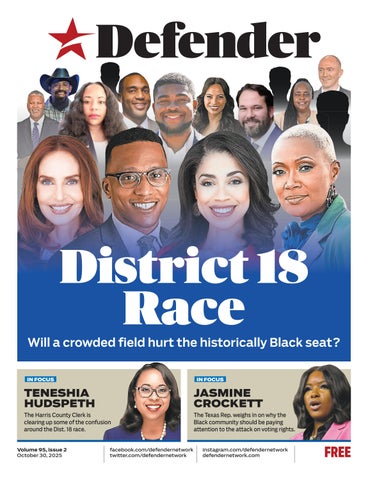
District 18 Race
Will a crowded field hurt the historically Black seat? IN FOCUS
IN FOCUS
TENESHIA HUDSPETH
JASMINE CROCKETT
The Harris County Clerk is clearing up some of the confusion around the Dist. 18 race.
The Texas Rep. weighs in on why the Black community should be paying attention to the attack on voting rights.
Volume 95, issue 2 October 30, 2025
facebook.com/defendernetwork twitter.com/defendernetwork
instagram.com/defendernetwork defendernetwork.com
FREE
2 | October 30, 2025 |
DEFENDER NETWORK
DN To the POINT CONCERTS
THEATER
GOSPEL
Black women may be tempted to sit this election out, but now more than ever, we can’t afford to. Credit: Gemini
Message from the Managing Editor GALAS
Yeah, we have a calendar for Black Events.
check it out
Black women have long been called We’ve proven that when we mobilize, we the backbone of democracy. We organize, don’t just make noise. We move mountains. mobilize, and show up, often carrying our So, as we head toward Nov. 4, this isn’t the communities, our families, and, frankly, this year to grow weary or tune out. The stakes entire nation on our backs. But as another are too high, and the power is too close to election approaches on Nov. 4, it’s time to home. Yes, we needed to rest (and we can face a hard truth: Our political power only find that balance going forward), but right works when we use it…and not just every now, it’s time to go back to work. four years. Here’s how to prepare: Too often, we pour our energy into presVerify your registration. Visit vote.org idential elections, the ones that dominate or texasvotes.gov to make sure your inforReShonda Tate headlines and hashtags, while skipping the mation is current. It’s too late if you’re not local and state contests that quietly shape our everyday lives. registered, but know your status before you go. And especially since after 92% of us tried to save democracy in Research your ballot. Learn who’s running for local offices the last presidential election, it’s tempting to just sit and watch and where they stand on the issues that matter most. these midterms burn. But those so-called “smaller” races are Make a plan. Know where and when to vote, and bring a where the BIGGEST decisions about our futures are made. friend or family member along. The policies that affect our children’s schools, the safety Spread the word. Post reminders. Share resources. Encourof our neighborhoods, the affordability of our housing, and age your group chats, coworkers, and church members to do even our reproductive rights, those decisions start in city halls, the same. school boards, and state legislatures. And when we sit out Basically, do what Black women do. those elections, we hand over control to people who may not If we want better schools, fairer pay, safer communities, and have our best interests at heart. healthcare that values Black women’s lives, we can’t afford to According to data from the Center for American Women sit this one out. We are the architects of our future. And that and Politics, Black women are among the most reliable voting future begins at the ballot box, not just in Washington, D.C., blocs in the country. But voter turnout still dips sharply in but right here at home. midterm and local elections. That means a relatively small That’s why the majority of this edition is dedicated to the group of voters can determine who runs our school districts, election. Because here’s the truth: when we show up, we shift who sets police budgets, and who decides whether our hos- power. Our votes don’t just decide who leads, they determine pitals stay open or close. how we live. And make no mistake, these races are often decided by razor-thin margins. In many majority-Black cities and coun- By the Numbers: Black Women and the Ballot ties, a few dozen votes can change the direction of a commu• In 2020, 68% of eligible Black women voted in the presnity. Imagine the power we’d have if every Black woman who idential election. voted in the last presidential election also showed up for her • In the following midterms, turnout dropped to 43%. city council or state representative race. • Local elections in major Texas counties have been decided We’ve already seen what happens when we do show up. by margins as small as 200 votes. From leaders like Congresswoman Jasmine Crockett here in • Key issues on Texas ballots this year include: maternal Texas, to organizers like LaTosha Brown of Black Voters Matter, healthcare funding, school board accountability, and to the women leading voting drives in churches, sororities, and affordable housing measures. community centers - Black women are changing outcomes.
October 30, 2025 |
DEFENDER NETWORK
| 3
DN InFocus WHY PAY ATTENTION
SCOTUS Voting Rights Attack By ReShonda Tate
Sixty years after the Voting Rights Act transformed America’s democracy, its protections may be on the chopping block once again — and Black voters could pay the price. Last week, the U.S. Supreme Court heard arguments in Louisiana v. Callais, a case that could further weaken one of the last remaining pillars of the landmark 1965 law — Section 2, which prohibits election practices that discriminate based on race. The case centers on Louisiana’s congressional map, where one-third of the population is Black, yet only one of six districts has a Black majority. When lower courts ordered a second majority-Black district, a group of white voters sued, claiming the map was “racist” against them. If the conservative majority strikes down Section 2, it could open the door to even more aggressive gerrymandering — effectively silencing millions of Black voters nationwide. Congresswoman Jasmine Crockett (D-Texas) says the threat couldn’t be clearer. “The Voting Rights Act—should we be concerned? Absolutely,” she told the Defender. “We should have passed the Freedom to Vote Act and the John Lewis Voting Rights Advancement Act to replace the Voting Rights Act they’ve been decimating for years.” Crockett reminded voters that this is not the first time the court has chipped away at the law’s core. “When the guardrails came off in 2013 with Shelby County v. Holder, Texas and other southern states ran amok,” she said.
“We needed those guardrails then — and we need them today.” Section 5, which once required states with histories of racial discrimination to get federal approval before changing voting laws, was gutted in Shelby County. Since then, many states have enacted restrictive laws, from voter ID requirements to purges of voter rolls. Section 2 is now the last line of defense against racial gerrymandering — but Louisiana v. Callais could erase that, too. “Anyone who says we’re in a post-racial society and don’t need Section 2 anymore is ignoring reality,” Crockett added. “My district in Texas is a Section 2 seat. That means African Americans get to decide who goes to D.C. We should always be able to have our voice at the table.” Crockett said that while the Supreme Court’s rulings may erode federal protections, Black voters still have the power to protect their interests at the ballot box. “Everything we need, education access, health care, financial mobility, comes through policy,” she said. “If we don’t vote, we lose our seat at the table.” As local and state elections approach this November, advocates urge Black voters to stay engaged, volunteer as poll workers, and support efforts that safeguard fair elections. History has shown that when turnout is low, the results often fail to reflect the true will of the community. Because as Justice Ruth Bader Ginsburg once warned, throwing away the protections of the Voting Rights Act now would be “like throwing away your umbrella in a rainstorm because you’re not getting wet.”
Rep. Jasmine Crockett (D-TX) warns that the Supreme Court’s latest challenge to the Voting Rights Act threatens to silence Black voters nationwide.Credit: Getty Images
KNOW BEFORE YOU GO
What Black voters should keep in mind Nov. 4 By Raquel Rogers
Voters across Harris County are gearing up to make their voices heard on Nov. 4. This year’s ballot holds major implications for the future of education, housing, healthcare, and local leadership, issues that hit the Black community especially hard. But showing up informed, confident, and ready to vote is just as important as showing up at all. Here are a few things to keep in mind before you head to the polls: Know what’s at stake This election isn’t just about national headlines—it’s about who decides what happens in your neighborhood. From city council and school board members to judges and county commissioners, local leaders shape everything from policing to property taxes. Every box you
check on that ballot has real power to shift how resources reach Black communities. Research the candidates Don’t wait until you’re standing at the ballot to decide. Visit trusted, nonpartisan resources to learn where candidates stand on issues like criminal justice reform, public school funding, and economic development. An informed vote is a powerful vote. Be prepared for long lines—and stay patient Turnout is expected to be strong this year. Pack your patience, bring water, and make it a community moment. Encourage a friend, family member, or elder to come along. Remember: our ancestors stood in longer lines and faced far greater barriers for us to have this right.
ELECTION DAY
Nov. 4, 2025 • 7am-7pm Harrisvotes.org
Watch out for misinformation In the digital age, misinformation spreads fast—especially targeting communities of color. Double-check any messages or posts you see online about voting rules or election updates. Stick to credible sources and avoid sharing unverified information. Make a voting plan Decide in advance when you’re going, who you’re going with, and how you’ll get there.
Whether you’re taking time before work, during lunch, or after school drop-off, scheduling your civic duty helps ensure you don’t miss the moment. Protect your vote If something doesn’t seem right—whether it’s a machine malfunction, intimidation, or confusion about your eligibility—speak up. There are national and local organizations that provide hotlines and legal assistance to ensure every vote is counted. Remember why you’re voting From Reconstruction to the Civil Rights Movement, Black voters have always turned pain into power. Our collective turnout has reshaped cities, rewritten laws, and sent clear messages to those in power: our voices matter.
4 | October 30, 2025 |
DEFENDER NETWORK
DN InFocus 17 propositions on the ballot What Texas voters need to know
Proposition 12 - SJR 27 restructures the State Commission on Judicial Conduct by giving the governor a majority of appointments, or seven out of 13 seats.
By Tannistha Sinha
When Texas voters head to the polls for the Nov. 4 elections, they will face one of the longest ballots of constitutional amendments in state history. Seventeen proposed changes, ranging from property tax relief and infrastructure funding to parental rights and bail reform, will be presented to voters. Property tax relief Seven of the 17 amendments address property tax exemptions and relief measures, which, while beneficial to certain groups, could strain local school funding. Proposition 5 - HJR 99 would exempt retail animal feed from property taxes, reducing operating costs for farmers and retailers but trimming local tax revenue. Proposition 7 - HJR 133 offers a full or partial homestead exemption for surviving spouses of veterans who die from service-related conditions, a measure aiming to help military families. Proposition 9 - HJR 1 raises the exemption on business equipment and inventory to $125,000, offering small business relief but potentially costing local governments millions in lost revenue. Proposition 10 - SJR 84 creates a temporary property tax exemption for homes completely destroyed by fire, offering shortterm relief for rebuilding families. Proposition 11 - SJR 85 increases the school tax exemption for elderly and disabled homeowners from $10,000 to $60,000. Proposition 13 - SJR 2 boosts the statewide homestead exemption from $100,000 to $140,000, an estimated $51 billion reduction in property taxes. Proposition 17 - HJR 34 allows border county residents to exempt property improvements made for “border security infrastructure,” such as fencing or surveillance systems. Fiscal permanence: Banning future taxes Three amendments, Propositions 2, 6, and 8, would permanently ban future forms of taxation.
Investing in education, water and health research Three amendments create new state funds for infrastructure and public programs: Proposition 1 - SJR 59 establishes a permanent technical institution infrastructure fund and the available workforce education fund for Texas State Technical Colleges, seeded with $850 million from general revenue. However, panelists believe embedding funding in the Constitution undermines legislative oversight and fiscal transparency and may make it harder to make changes in the future. Proposition 4 - HJR 7 dedicates a share of the state’s sales tax to the state water fund, a long-term $20 billion effort to finance statewide water infrastructure that launches in 2027. A concern pointed out was the potential displacement of general revenue priorities, with regions like Harris County receiving less. Proposition 14 - SJR 3 launches a Dementia Prevention and Research Fund, transferring $3 billion from state revenue to study Alzheimer’s, Parkinson’s, and related diseases. Texas voters will decide on 17 proposed constitutional amendments this election cycle. Credit: Getty Images
Proposition 2 - SJR 18 locks in tax-free status for realized or unrealized capital gains and preserves Texas’s low-tax environment. While it limits flexibility for future tax policy adjustments, there is no immediate revenue effect, as Texas does not currently tax capital gains; however, it forecloses future revenue potential. Proposition 6 - HJR 4 supports a business-friendly climate by protecting the securities sector from new tax burdens. It also removes a future revenue lever for the state with no immediate impact, thereby limiting future revenue options.
VOLUME 95, NUMBER 2 - OCTOBER 30, 2025 The Defender newspaper is published by the Houston Defender News- paper Inc. and audited by Alliance for Audited Media (AAM). Only digital subscriptions are available at: www.defendernetwork.com/subscribe No paper subscriptions available. All materials covered by 2025 copyright. No materials herein may be reproduced without the written permission of the Publisher. 713-663-6996 | P.O. Box 8005, Houston, TX 77288
Proposition 8 - HJR 2 bans estate or inheritance taxes in the future. It limits long-term revenue flexibility for estate-based taxation with no current tax, but prohibits future revenue sources. Public safety and judicial oversight Two measures address the state’s justice system, stirring debate about safety and due process. Proposition 3 - SJR 5 would allow judges to deny bail to defendants accused of certain felonies based on perceived danger or flight risk.
Parental rights and citizenship Proposition 15 - SJR 34 enshrines parental rights in the Constitution, affirming that “parents are the primary decision-makers for their children.” Supporters frame it as a safeguard against government overreach, but opponents warn it could hinder public health and education interventions. Proposition 16 - SJR 37 clarifies that only United States citizens can vote in Texas elections, a clarification already in the law but now enshrined as a constitutional declaration. Panelists considered this a symbolic, possibly partisan move with no real change.
Publisher | CEO Sonceria Messiah-Jiles
Content Manager Terrance Harris
Strategic Alllance Clyde Jiles
Associate Editor Aswad Walker
Managing Editor ReShonda Tate
Culture/Lifestyle Reporter Laura Onyeneho
Special Assignments Reporter Tannistha Sinha Sports Terrance Harris Jimmie Aggison Video Editor Bryan Erdy
October 30, 2025 |
DEFENDER NETWORK
| 5
DN InFocus Menefee, Edwards lead TX-18 election By Tannistha Sinha
The race to replace the late Congressman Sylvester Turner in Texas’ 18th Congressional District is shaping up to be one of Houston’s most competitive contests in years and one driven squarely by civil rights. A new poll by the Hobby School of Public Affairs at the University of Houston shows Harris County Attorney Christian Menefee and former City Council member Amanda Edwards leading a crowded field heading into the Nov. 4 special election. Menefee draws support from 27% of likely voters, with Edwards close behind at 23%. State Representative Jolanda Jones stands in third place at 15%, while all other candidates remain in the single digits. These include Republican candidate Carmen Maria Montiel (6%), independent candidate George Foreman IV (4%), Gen-Z Democrat Isaiah Martin (4%), and Republicans Carter Page (3%), Ronald Whitfield (2%), and Theodis Daniel (1%). Meanwhile, 2% of voters are divided among the seven other candidates, and 13% remain undecided. With no candidate near the 50% mark required to win outright, an early 2026 runoff appears inevitable.
Amanda Edwards
Christian Menefee
A district in transition Long considered the heart of Houston’s Black political power, TX-18 has historically delivered wide margins for Democrats, a reality reinforced in the survey. The seven Democratic candidates collectively earn 70% support among likely voters, compared with only 12% for Republicans. The district is also demographically distinct, where 43% of likely voters are Black, 39% white, and 14% Latino. Women make up more than half the likely voters, with a majority being over the age of 55, signaling the powerful influence of older Black women at the ballot box. Still, even in a Democratic stronghold, support is far from monolithic. Jones trails Menefee
Jolanda Jones
and Edwards significantly among white voters, but among Black voters, the three candidates are in a near dead heat: 30% for Menefee, 25% for Edwards, and 24% for Jones. Education also emerges as a dividing line. College-educated voters strongly favor Menefee and Edwards over Jones, while among those without a four-year degree, the three are essentially tied. Runoff matchups and favorability advantage Pollsters tested three hypothetical two-person runoff scenarios. Menefee holds narrow leads over both Edwards and Jones. Edwards, meanwhile,
YOUR VOT TE MATTERS S WITH 17 PROPOSED AMENDMENTS, A CONGRESSIONAL DISTRICT SEAT AND OTHER LOCAL RACES, THERE ARE BIG CHANGES ON THE BALLOT. STAY INFORMED AND MAKE YOUR PLAN TO VOTE.
EARLY VOTING
OCT.20-31 ELECTION DAY
NOV.4 FIND IMPORTANT DATES AND DEADLINES
HARRISVOTES.COM 713.755.6965
BROUGHT TO YOU BY THE HARRIS COUNTY CLERK’S OFFICE.
leads Jones by a similar margin. Those dynamics are reflected in how voters view the candidates personally. Both Edwards and Menefee hold very strong favorability ratings, with low negatives and relatively few voters unsure. Jones remains well-known but more polarizing: 51% have a favorable view, while 29% hold an unfavorable view. Republicans, for their part, appear divided and under-recognized. Carmen Maria Montiel, the leading GOP candidate, polls at just 6% and nearly seven out of 10 voters say they do not know enough about her to form an opinion. Even in a theoretical runoff, the Democratic nominee would start with an overwhelming advantage: 67% of voters say they would support whichever Democrat makes the final round over Montiel. Civil rights driving turnout Civil rights and civil liberties dominate the political landscape of the 18th Congressional District. When asked about the most important issue facing the country, 44% of voters, by far the largest share, cite civil rights, far outpacing jobs and the economy (13%), health care (12%), and inflation (11%).
6 | October 30, 2025 |
DEFENDER NETWORK
| 7
DN InFocus
District 18 Race Will a crowded field hurt the historically Black seat?
Vote Intention Among Likely Voters in the November 2025 Texas Congressional District 18 Special Election (%)
T
By Aswad Walker
he race to fill Texas’s 18th Congressional District seat is shaping up to be one of Houston’s most pivotal, and unpredictable, elections in years. The seat, vacant since the March 5 passing of Congressman Sylvester Turner, has left roughly 800,000 residents without federal representation for nearly eight months before the November 2025 special election decides who takes office. But the urgency of the moment isn’t the only factor fueling conversation across the district. It’s also the size of the race. Sixteen candidates—seven Democrats, five Republicans, three Independents, and one Green Party member—are vying to represent a district that has historically been anchored in Black political leadership, dating back to Barbara Jordan’s first election to the seat in 1973. Some voters worry that such a crowded field could split the Democratic vote and open the door for a Republican upset. Others argue that the diversity of choices is a hallmark of democracy in action. Crowded field, high stakes “I first announced my bid to serve the people of the 18th Congressional District on Juneteenth of 2023,” said Amanda Edwards, a former Houston City Councilmember. “I’m focused on the 800,000 people of the 18th Congressional District who have gone without their voice and advocate for federal funding for what will be 18 months over a two-year span.” For State Rep. Jolanda Jones, the size of the race is part of the democratic process. “Any eligible person should be allowed to run if they want to. I’m not afraid of a large field, and I trust the voters,” said Jones, who, along with Edwards and Harris County Attorney Christian Menefee, makes up the three Democrats named as frontrunners by a University of Houston Hobby School of Public Affairs survey. A fourth candidate mentioned was Carmen Montiel, a Republican. Menefee sees competition as a test of leadership. “When I ran in 2020 against a three-term incumbent, we debated the issues, sharpened our values, and I won with 50% of the vote,” said Menefee. “That taught me how to run a strong campaign, how to be strategic, and how to fight hard for people.”
27
Christian Menefee (D)
23
Amanda Edwards (D)
15
Jolanda Jones (D)
6
Carmen Maria Montiel (R)
4 4
George Foreman IV (I) Isaiah Martin (D)
3
Carter Page (R)
2
Ronald Whitfield (R)
1
Theodis Daniel (R)
2
Seven Others (<1%)
13
Unsure
0
Younger candidate Isaiah Martin says the field highlights the high stakes. “It shows how important this moment is and how big the shoes are to fill,” shared Martin. “Our campaign is the one breaking through because we’re bringing grassroots energy to build something bigger than politics-as-usual.” Yet, community leaders like Joetta Stevenson, president of the Greater Fifth Ward Super Neighborhood #55, are frustrated. “Only about five candidates have ever bothered to come ask us what we needed. Too many candidates, too little effort,” said Stevenson. Carroll Robinson, former City Councilman
and TSU professor, noted, “An open congressional seat doesn’t happen often—especially one as historic as CD18. So, it’s expected that a lot of people would run when there’s no incumbent.” Why so many candidates? According to Dr. Michael O. Adams, political science professor at TSU, the special election format itself is part of the reason. “There’s no primary process to narrow the field,” said Adams. “Everyone from all parties goes straight onto the same ballot. That removes the gatekeeping that usually prevents massive pile-ups.”
He adds that the district’s legacy also plays a role. “This is the seat held by Barbara Jordan, Mickey Leland, and Sheila Jackson Lee. It’s one of the most symbolically important Black congressional districts in the country, created after the Voting Rights Act to ensure minority representation in Houston,” said Adams. “A lot of ambitious politicians see this as their one shot.” Another factor, Adams noted, is uncertainty about the district’s future. “With Republicans redrawing boundaries mid-decade, some candidates may think, ‘This could be my only window,’ because by next year, the political landscape could look
completely different.” Could a Republican win? Menefee, who has taken on President Donald Trump and Texas Attorney General Ken Paxton in court and won, is blunt about the Republicans’ chances of winning the seat. “Let’s be clear—this is a 70% Democratic seat,” said Menefee. “A Republican has no shot at winning it. The only way they could make the runoff is if they had one strong candidate with serious fundraising and party consolidation. That’s not what we’re seeing.” Jones agrees.
Rain Eatmon
5
“Even though there are 16 candidates, there’s a top tier of three Democrats and one Republican. There’s no way a Republican can win outright,” said Jones, who made national news during the State Democratic Representatives’ quorum break to protest state GOP redistricting efforts. “This is an overwhelmingly Democratic district.” Martin asserts Democratic disengagement is the bigger danger. “Every voter I talk to has zero patience for Republicans, especially not anyone cozying up to Trump,” said Martin. “The real risk isn’t an overcrowded field—it’s Democrats running the same old playbook and losing people who should be with us.” Former candidate Rain Eatmon, who dropped out earlier this year, said the size of the race did influence her decision. “I didn’t want to run just for the sake of the seat. Oversaturation was a factor,” she said. “I wanted to make sure District 18 had the best representation possible.” Robinson insists, “The size of the field will not open the door to a Republican because Democrats have consolidated behind two to three candidates.” Adams agrees. “It’s highly unlikely. District 18 is one of the most reliably Democratic seats in the state. The real competition isn’t between parties—it’s within the Democratic Party itself,” said Adams. Still, Stevenson cautions against complacency. “Splitting the vote and siphoning support from viable candidates absolutely places CD18 at risk—especially if the Republican base turns out in high numbers,” said Stevenson.
10
15
20
25
30
The turnout factor Turnout could be the real deciding factor. “Low voter turnout opens the door to any of the top three candidates to make the runoff,” said Robinson. Adams added, “When participation drops to 10%, it stops being about broad appeal and starts being about who can actually get people to the polls. Ground game, organization, and name recognition become everything.” He noted that older Black voters have historically been the most consistent participants in low-turnout elections—but confusion over redistricting may further dampen their engagement. “A lot of voters aren’t sure which district they’ll be in next year, and that uncertainty depresses turnout,” shared Adams. “I’m praying for a groundswell of voters who’ve paid attention to the work these candidates have done beyond current campaign rhetoric and drama,” said Stevenson, who is hoping for a late voter surge. Eaton, who is excited by a large field of candidates, hopes to see something beyond voter turnout on Nov. 4. “I hope that every single candidate shows up on Nov. 5 and every day afterwards,” said Eatmon. “We are at a very pivotal point in our country, and we need as many servant leaders as possible to make sure all corners of the 18th and Houston are served and represented.
More election coverage.
Joetta Stevenson
Dr. Michael Adams
Carroll Robinson
8 | October 30, 2025 |
DEFENDER NETWORK
DN InFocus
If you accepted or processed Discover credit cards between 2007–2023, you could be eligible to get a payment from a class action settlement. **YOU MAY BE ENTITLED TO A SETTLEMENT PAYMENT** To receive a payment, file a claim by May 18, 2026.
WHAT IS THIS ABOUT?
Clearing up Dist. 18 confusion By Aswad Walker
Early voting has already begun for this year’s special election, but confusion over who can vote in the District 18 special election still exists. Many people believe the redrawn District 18 maps that Texas’s Governor Greg Abbott signed into law in August are in effect now. But that is not the case. Those “new” District 18 maps won’t go into effect until November 2026. As for this special election, the “old” District 18 map is still in effect. T h e s t or y a n d f ig ht around t he redistricting of Texas congressional voter maps made national news as an example of efforts by Republicans in Texas to reduce Black and Hudspeth Latino voting power in a state where people of color make up the majority. Even after state Democratic lawmakers left the state to block votes on the redistricting bill, it eventually passed by Abbott.. The new congressional redistricting maps, passed by the Texas Legislature during a special session in August, were signed into law by Abbott. However, the new maps (and new districts) will not go into effect until the November 2026 election. But many voters aren’t getting the message. What is adding to the confusion for many is that Houston has a special election for which early voting has already begun, and the official “Election Day” is November
4, 2025. For this special election, currently underway, the old maps remain in effect. However, because the new maps were announced as approved and signed into law in August, many Houston residents mistakenly believe that the new maps (and newly drawn voting districts) are in effect for the current (2025) election. They are not. It was reported to the Defender that even many District 18 residents with a long history of active political engagement erroneously believe that the new maps are already in effect, thereby rendering longstanding District 18 residents ineligible to vote in the current special election. Harris County Clerk Teneshia Hudspeth sought to clarify and address confusion. “The congressional district [18], as it stands today, remains the same and will remain the same if there is a runoff,” Hudspeth told the Defender. Additionally, the implementation of those new maps for the 2026 midterm elections is on hold pending a federal court decision. Lawsuits filed by civil rights organizations argue that the new maps are racially discriminatory and unconstitutional, violating the Voting Rights Act and the equal protection rights of Black and Hispanic voters. In other words, the new voting districts won’t go into effect in November 2026 if civil rights groups that have challenged the legitimacy of the new maps receive a court ruling in their favor. To reiterate, the new maps are not currently in effect. This year’s special election featuring the District 18 race will utilize maps that have been in place since 2021.
CLASSIFIED LEGAL NOTICE NOTICE TO CREDITORS AGAINST THE ESTATE OF BRUCE HARRY ROBERTSON On the 6th day of October 2025, Letters Testamentary for the Estate of BRUCE HARRY ROBERTSON, Deceased, were issued to Suzanne F. Robertson a/k/a Suzanne Fields Robertson by the Probate Court Number Five (5), Harris County, Texas, in Cause Number 537996 upon the docket of said Court. All persons having claims against this Estate are hereby required to present them within the time and manner prescribed by law at the address shown below. The name where claims may be sent is Shawn Williamson, whose address is 24 Greenway Plaza, Suite 1825, Houston, Texas 77046 Office (713) 2970700 x108 /s/ Shawn Williamson, TX Bar Number 24106892.
A proposed class action settlement has been reached in three related lawsuits. The lawsuits allege that, beginning in 2007, Discover misclassified certain Discover-issued consumer credit cards as commercial credit cards, which in turn caused merchants and others to incur excessive interchange fees. The misclassification did not impact cardholders. Discover denies the claims in the lawsuits, and the Court has not decided who is right or wrong. Instead, the proposed settlement, if approved, will resolve the lawsuits and provide benefits to Settlement Class Members.
WHO IS INCLUDED? The Settlement Class includes all End Merchants, Merchant Acquirers, and Payment Intermediaries involved in processing or accepting a Misclassified Card Transaction during the period from January 1, 2007 through December 31, 2023. To view the full Settlement Class definition, including defined terms and excluded entities, go to www.DiscoverMerchantSettlement.com.
WHAT CAN I GET? To receive a settlement payment, with very limited exceptions, you will need to file a claim by May 18, 2026 and/or provide additional information to the Settlement Administrator. Under the proposed settlement, Discover will make payments to eligible Settlement Class Members who submit valid claims. Discover has agreed to pay between $540 million and $1.225 billion plus interest in connection with this settlement. Your settlement payment amount will be calculated based on a variety of factors.
YOUR OTHER OPTIONS. You can file a claim for a payment by May 18, 2026 and/or provide additional information. Alternatively, you can exclude yourself from the settlement by opting out, in which case you will receive no payment under this settlement and retain any right you may have to sue Discover about the claims in these lawsuits or related to the Misclassified Card Transactions. If you do not exclude yourself, and the Court approves the settlement, you will be bound by the Court’s orders and judgments and will release any claims against Discover in these lawsuits or related to the Misclassified Card Transactions. If you do not exclude yourself, you can object to or comment on any part of the settlement. The deadline to either exclude yourself or object to the settlement is March 25, 2026. Visit the website for information on how to exercise these options.
Submit your claim online:
Scan the QR code to file a claim online via your phone, computer, tablet, or other smart device.
Do you have questions or need additional information? Visit Online:www.DiscoverMerchantSettlement.com Email: info@DiscoverMerchantSettlement.com Call: 888-655-3176
October 30, 2025 |
DEFENDER NETWORK
| 9
DN InFocus What Would Be Different
If Kamala won? By Aswad Walker
Despite a hand recount in Rockland County, New York, the Nov. 2024 presidential election ended with Donald Trump defeating Vice President Kamala Harris to become the 47th President of the United States. But just seven months into his second term, widespread criticism—including from former supporters—has sparked a recurring question: What would life be like if Kamala Harris had won?
America under Trump: Seven months in Trump loyalists claim he’s kept key promises: deporting undocumented immigrants, ending “wokeness,” and putting “America First” in global affairs. But critics argue his return has triggered democratic erosion, weakened the rule of law and politicized the Department of Justice. Experts say his second-term tax cuts have ballooned the national debt by trillions, while surveys reveal declining inter nat iona l Tomayia Colvin confidence in U.S. leadership—especially after threats toward allies like Canada and Greenland and chaotic tariff policies. For everyday Americans, Trump’s policies have had tangible impacts. Dr. Malachi Tomayia Colvin, Crawford whose daughter’s USDA scholarship was abruptly canceled then reinstated, said: “Every day it’s like— it can’t possibly be this bad and boom, the Department of Education is letting go of people. This is a complete disaster.” Prairie View A&M history professor Malachi Crawford added: “We’re exhausted—and it’s still early. I worry he’ll sow so much discord that people become numb until the damage is done.” What would have been different under Kamala Harris? Here’s a side-by-side look: Voting Rights & Civil Rights Trump: Eliminated DEI programs and federal diversity offices. Undermined Voting Rights Act enforcement and civil rights oversight. Harris (projected): Advocated expanding voting rights and anti-discrimination protections. Supported DOJ oversight and protection for marginalized communities. Takeaway: Trump rolled back inclusion and civil rights protections; Harris likely would have reinforced them.
Economy & Tax Policy Trump: Passed a $3 trillion tax cut benefiting the wealthy and corporations. Reduced federal workforce through “DOGE” (Department of Government Efficiency). Abolished agencies like USAID and the Consumer Financial Protection Bureau (CFPB). 59% of Americans disapprove of his tariff increases and 55% disapprove of agency cuts. Harris (projected): Supported progressive tax reforms favoring working families. Backed stronger IRS enforcement on high earners. Was likely to expand social programs, Medicaid and the Affordable Care Act. Takeaway: Trump’s policies favored the wealthy and dismantled federal support systems; Harris was expected to strengthen protections for working-class Americans and communities of color. K–12 Education Trump: Planned phase-out of Title I funding for low-income schools (approx. $18B). Proposed turning special education into block grants, reducing federal oversight. Ordered dismantling of the Department of Education, transferring responsibility to states. Signed Executive Order 14190 banning critical race theory, gender curriculum, and empowering federal prosecution of educators supporting LGBTQ+ students. Rescinded Biden-era policies addressing racial disparities in school discipline. Harris (projected): Supported full funding for special education (IDEA), aiming for 40% per-pupil cost coverage. Emphasized social-emotional learning, tutoring, and post-COVID absenteeism recovery. Likely to uphold civil rights enforcement in schools, support inclusive classrooms and equity training. Takeaway: Trump’s education policies reduce protections and funding for vulnerable students, especially Black and LGBTQ+ youth. Harris’s policies likely would have supported civil rights, educational equity and underserved communities. Looking Ahead Trump’s second term has been marked by policy shifts that critics say disproportionately harm working-class, Black, immigrant and LGBTQ+ communities. His base sees him delivering on promises to dismantle “wokeness” and shrink government. But to many Americans, the cost is high: vanishing safety nets, weakened rights and a more divided nation. Had Harris won, supporters believe she would have expanded civil rights, prioritized equity and strengthened America’s democratic foundations. People weigh in.
NOTICE OF PUBLIC HEARING
FOR PROPOSED SERVICE CHANGES
Metropolitan Transit Authority of Harris County, Texas (METRO) Notice is hereby given that the Metropolitan Transit Authority of Harris County, Texas (METRO), will hold a public hearing on Thursday, November 6, 2025, at 12:00 noon to receive public comment on the proposed January 2026 changes to METRO service. The public is invited to attend the hearing and provide comments in person. The public may also join the hearing and provide comments virtually on Zoom at https://us02web.zoom.us/j/86551353132 or by dialing: 346-248-7799 or 888-475-4499 (toll-free), meeting ID: 865 5135 3132. Additionally, if you do not want to provide comments during the public hearing, visit RideMETRO.org/LiveStream to view a livestream of the event. A video recording of the hearing will also be archived on the same page. The proposed service changes may include: Route changes to bus routes 102 and 500; schedule changes to bus routes 6, 9, 28, 54, 56, 82, 99, 153, 217, 221, 222, 228, 265, and 270; and elimination of bus routes 64, 309, 310, 402, and Z-Trip. Copies of proposed route maps and available timetables will be available beginning on Thursday, October 30, 2025, for public review both online and in the lobby of the METRO RideStore located in the Lee P. Brown METRO Administration Building at 1900 Main Street, Houston, Texas 77002, weekdays from 7:00 a.m. to 6:00 p.m. The public hearing on Thursday, November 6, 2025, at 12:00 noon will be held in the 2nd floor boardroom at 1900 Main Street, Houston, Texas (served by bus routes 6, 11, 35, 44, 51, 52, 54, 82, 85, 102, 137, 161, 162, and METRORail).
HOW TO COMMENT ABOUT THE SERVICE CHANGES
If you would like to make public comments in person or virtually, please register as a public speaker with the METRO Board Office at least 48 hours in advance of the hearing. Call 713-739-4834 or send an email to BoardOffice@RideMETRO.org and provide your name, address and telephone number. As explained above, you may attend the public hearing in person or virtually on Thursday, November 6, 2025, to provide comments. If you pre-register, your comments will be heard first at the public hearing. Your name will be called at the appropriate time to make your comments. You may also provide comments by: • Writing to us at METRO, ATTN: January 2026 Service Changes, 1900 Main Street, Houston, TX 77002 • Faxing comments with a subject line referencing "January 2026 Service Changes" to 713-652-7956 • Calling or texting METRO Customer Contact Center at 713-635-4000 • Submitting comments on the METRO website at RideMETRO.org All comments should be submitted to METRO by 10:00 a.m. on Thursday, November 6, 2025.
HELP FOR PEOPLE WITH DISABILITIES
For individuals with disabilities, assistive services or copies of public documents in an alternate format can be provided. Individuals with impairments may call 713-750-4271 a minimum of five (5) working days prior to the public hearing.
LANGUAGE ASSISTANCE
Upon request, METRO provides free language assistance to help patrons who have a limited ability to read, write, speak or understand English, in accordance with its language assistance plan. Please call 713-739-4018 or email METROPublicAffairs@RideMETRO.org to request language assistance or other accommodations at least 48 hours in advance of the hearing.
OTHER
1. This public hearing conforms to requirements described in the Federal Transit Administration's Circular 9030.1E, published January 16, 2014, page VI-7. 2. METRO does not discriminate based on disability in the admission or access to, or in treatment or employment in, its services, programs, and activities. 3. METRO is committed to ensuring that no person is excluded from participation in, or denied the benefits of, its transit services based on race, color, or national origin, as protected by Title VI of the Civil Rights Act of 1964.
RideMETRO.org • Call or text 713-635-4000
10 | October 30, 2025 |
DEFENDER NETWORK
DN Sports Former Prairie View Soccer Star
Kamara Bradley Finds comfort at Texas Southern
By Terrance Harris
If ever there is a full-circle moment, Texas Southern senior women’s soccer player Kamara Bradley is already anticipating one on Oct. 31. That day marks Bradley’s final regular-season, and she can’t help but see the irony of it taking place at the Prairie View A&M Soccer Complex – the very place where her college career started, playing Kamara Bradley for the Panthers as a freshman four years ago. Between then and now, Bradley has endured three coaching changes, two transfers, and now feels the comfort of finally being in a place where she belongs this season. Bradley is coming to grips with the reality that her college career, with all its twists and turns, is coming to an end. “Certain things kind of hit me. This is really it. This is the end of the road for me,” said Bradley, who is in her final year as a graduate student at TSU. “Once (SWAC Tournament) comes around, it will really hit me, and I may be a little sad. “It’s definitely gone by way faster than I would have liked for it to, regardless of how long the seasons feel while I’m playing them. It’s just gone too fast.”
It’s been tough to be a college athlete, especially a soccer player, but I definitely think that the highs will always beat the lows. I love to play the game.” KAMARA BRADLEY
While Bradley’s college career hasn’t gone quite like she envisioned before arriving at Prairie View’s campus, she is grateful for how it’s ending. Bradley has found the coach of her choosing in Danesha Adams and is back playing her more natural forward position, which allows her to be the offensive threat she has always envisioned herself being. The results have justified a difficult decision to switch to the Panthers’ rival school after three years. The Tigers, the defending SWAC regular-season champions, are sitting in third place while Bradley ranks sixth in the conference in goals (5), fifth in shots (31), and seventh in shots on goal (13) coming into the final game of the regular season. “When I was at PV, I was not playing the position that I normally play. I was playing defender,” said Bradley. “Coach Adams gave me the opportunity to play back in my position as a forward again. I feel like it’s helped me a lot, like clarity. Knowing that I really can do this. I feel like that has shown on the field because I have so many goals on this defense so far. “I feel like I was able to bring that offensive force to the team because I wasn’t able to do that at my last school.” After having a successful first two years as an offensive player at Prairie View, the 5-foot-5 Bradley was moved to the defensive side of the field. Her 15 or 16 years of soccer made the transition easier, but it still wasn’t natural. So, with a degree in hand, Bradley decided to transfer elsewhere. She initially landed at Sam Houston State, where Sonia Curvelo, the coach who recruited Bradley to PV but left before Bradley’s freshman year, was now the head coach. The only problem was that while Bradley was getting comfortable with the Bearkats, Curvelo bolted again—this time for San Jose State. Sam Houston State then hired Kendall Ayers, who had spent the last season at TSU, where she guided the Tigers to the regular-season SWAC title. “When I found out she was the coach, I was like, ‘Okay, I kind of have good vibes about this,’ because she came from SWAC and everything,” Bradley said of Ayers. “But I just don’t think we connected, player-tocoach level.” That’s when Bradley’s mom suggested she look into Adams, who had played at
Kamara Bradley has felt more at home playing an offensive role with the Tigers. Credit: TSU Athletics
UCLA back in the day and had been the co-head coach at the University of Pacific and an assistant at the University of Houston before being hired at TSU this past summer. Bradley shot Adams an email, and soon after, conversations took place. Then Bradley landed on campus. And it has been a seamless transition. Adams has put Bradley in positions to be successful, and Bradley has thrived, even when tasked with playing defense from time to time. “She has been a huge addition for multiple reasons,” Adams said. “I just think for her, she needed a new home. She needed a
new place to reinvigorate her career.” Bradley is glad she has ended up with the coach she has and playing with the teammates who have fully embraced her. But it has been quite the journey to finally arrive at this point. “It’s been a lot. Even in just the three years I was at PV, I feel like I went through a lot, too, emotionally and physically, while there,” said Bradley, who will also compete in track and field for the Tigers’ in the spring. “It’s been tough to be a college athlete, especially a soccer player, but I definitely think that the highs will always beat the lows. I love to play the game.”
October 30, 2025 |
DEFENDER NETWORK
| 11
DN Sports
JACK YATES DEFENSE Dominates, restores Third Ward pride
By Jimmie Aggison
Under the Friday night lights, the Jack Yates Lions aren’t just winning; they’re suffocating opponents. In a district where offense often steals the spotlight, Yates’ defense is flipping the script. Led by senior defensive lineman Cortland Blackshire, junior defensive back Aurtrill Watkins and freshman linebacker McKinley Davis, the Lions have turned stinginess into an art form. Through seven games, the Lions’ defense has only allowed 203 rushing yards and 398 passing yards. This defense has quietly become the heart of Yates’ revival and a statement that Third Ward football is once again something to fear. When defensive coordinator Will Smith returned to his alma mater, his goal was simple: To restore Yates’ identity through defense. “I wanted the defense to represent a fast, physical brand of football,” said Smith. “Playing lights out means mistake-free football, limiting opponents and creating turnovers.” Smith’s 3–3–5 scheme replaced last year’s 4–2–5, but the real change came in confidence. “I wanted them to believe in the system so they could play faster,” said Smith. For Blackshire, the shift was about unity. “The intensity changed,” said Blackshire. “We learned each other’s tendencies, played hard, played tough. This team is like a family - the best I’ve been a part of. The coaches are like dads to me; we have everything we need.” For Smith, the transformation started with a mindset and the results speak for themselves. Yates’ defense has been nothing short of dominant. Opponents have been held under 100 yards in multiple games and negative rushing totals have become almost routine. “Negative rushing yards stand out most,” said Smith. “We want to make other teams one-dimensional.” Those results are by design. “Before the season started, our goals were less than 100 rushing yards per game and less than 200 total yards,” said Smith. For the secondary, it’s a source of pride. “I feel great knowing I can count on everybody on the field,” said Watkins, who is part of a unit giving up fewer than 50 passing yards per game. “Teams respect me enough not to throw my way, but I stay locked in and help with run support.” However, behind those numbers lies
The Jack Yates defensive unit has forced teams to be one dimensional by only allowing one 50+ yard rushing game and only two 100 yard passing games through seven weeks of football during the 2025-2026 season. Credit: Jimmie Aggison/Defender
something deeper —a chemistry that blends leadership across classes. This defense thrives on leadership from all directions, seniors, juniors and even freshmen. “I set the tone by being a living example,” said Blackshire. “That means showing up ready to work, studying film and holding myself to the highest standard. The younger guys need to see that dedication.” To Blackshire, wearing “Yates” means “Family. The Texans Way: Us vs. Us.” Watkins has grown into a vocal leader. “I’ve stepped out of my comfort zone, communicating more, encouraging teammates and holding everyone accountable. I’m leading with my voice and my play,” said Watkins. The bond among the three defensive leaders is both tight and personal. “We push each other every day,” said Watkins. “It’s all love and competition. Cortland is my cousin.” For Davis, a freshman adjusting to varsity speed, that mentorship has been vital. “The older guys taught me that effort and accountability matter most,” said Davis. “Don’t let one mistake turn into more;
learn from it.” That blend of experience and youth has created something rare, a defense that feels like family. For Smith, this season represents more than wins; it’s a return home. After stints at Humble High School, Ridge Point, Alief Taylor and Dulles, he returned to Yates, the school he once played for. “It was an opportunity to come back and help them get back to dominance,” said Smith. “No matter where I coached, I’ve always kept an eye on Yates. I’ve known Coach Lewis for over 35 years.” Leading a defense in the same community where he started brings pride and perspective. “It feels good but a little weird,” said Smith. “When I played here, I was an offensive lineman. Over time, I developed a love for defense.” His players see that passion daily. “Coach Smith is hardworking, he’s really a cool guy,” said Blackshire. “You can see his passion in how he pushes us and the energy he brings,” said Watkins. “He loves to joke, but when it’s time to be serious, you’d better lock in.”
Davis agreed. “His passion for the game and for Third Ward makes us play harder, not just for school, but for our community,” he said. For Smith and his players, this isn’t just a season; it’s a mission to restore Yates’ legacy. As the Lions continue their defensive rampage, Smith’s vision remains firm. “I want this defense to be talked about as one of the all-time greats in Yates history,” said Smith. “We’re earning back the respect we deserve. Some people don’t like it, but we’ll keep giving the haters and lovers something to watch.” Blackshire hopes this era will reshape how people view Yates. “When people talk about Yates football, I want them to think of a good school to attend and play football at,” said Blackshire. For Watkins and Davis, it’s about carrying the torch. “I plan to keep building on what we’ve started,” said Watkins. “Stay disciplined, hold everyone accountable and keep the same energy.” “I plan to start next year off strong with the same mindset and higher expectations,” Davis added.
12 | October 30, 2025 |
DEFENDER NETWORK
DN InFocus
Black women voters mobilize to reshape Houston’s future By Tannistha Sinha
As Texas heads toward the Nov. 4 elections, Black women across Houston are aiming to reshape the political landscape. From church pews to small businesses, their message suggests that this election is not just about candidates, but also about their survival and representation. “We gather because the livelihood of Black women and Black girls is under attack,” said Rev. Connie Jackson, pastor of St. John Northwest Church. “For too long, Black women have borne disproportionate burdens, lower wages, higher caregiving responsibilities, health disparities, and exclusion from Jackson decision-making policies. Every election becomes a battleground for our bodies, our futures, and our faith. But hear me, voting is not merely a civic duty. It is an act of resistance, a spiritual declaration. When we cast our ballots, we declare that we will not be silenced, diminished, or erased.”
Leadership in the 18th Congressional District In Houston’s 18th Congressional District, the stakes are especially high. The community has endured the loss of two prominent Black political figures, Congresswoman Sheila Jackson Lee and Congressman Sylvester Turner, within 18 months. Their deaths, coupled with a delayed special election, have left the district without consistent representation for over a year and a half. “They say that this is going to be some of the lowest voter turnout we’ve seen,” said former Houston City Council member Amanda Edwards, now running to fill the vacant seat. “The 18th Congressional District hasn’t had its voice, its vote, its federal advocate for funding. We also know that what has happened in this 18-month period includes the passage of the big beautiful bill that cut $900 billion from Medicaid and $300 billion from SNAP.” Health disparities From the nation’s highest maternal mortality rate to rising unemployment among Black women, the issues driving this election are deeply personal. Local leaders say health equity tops the list. They emphasized the state of maternal health care and abortion laws in Texas, arguing that Harris County hosts the world’s
largest medical center, yet comprises one of the highest numbers of Black maternal deaths. Between 2016 and 2020, in Harris County, Black women had the highest pregnancy-related death rate among all racial and ethnic groups. Moreover, babies born to Black women were the most likely to die in the mother’s womb and had the highest death rate in their first year of life, according to the 2024 Maternal and Infant Health report. For LaToya Eaglin, a small business owner and federal contractor recently diagnosed with breast cancer, the stakes are painfully tangible. “Federal funding is important for everyone,” Eaglin said. “That money goes toward research, diagnostic tools, and education for people in our communities.” Eaglin also emphasized the importance of supporting small, women-owned businesses in underserved communities.
DEI rollbacks Glynda C. Carr, president, CEO, and co-founder of Higher Heights for America, a political action committee dedicated to electing Black women at the federal and statewide levels and as mayors in the 100 most populous U.S. cities, argued that the U.S. is facing a politically and racially regressive moment, w i t h t h r e at s t o decades of progress on civil rights and women’s rights. “We are living in some of the most politically toxic and racially depressive Carr times of our generation,” she said. “We need representatives ready to hit the ground running amidst a government shutdown. It may feel as
though those are being dismantled in this very democracy that we’ve helped to build. Black women…we know that when we fire them up, they don’t go to the polls alone. They bring their house, their block, their church, their sorority, and their union. Every vote matters.” Environmental justice Beyond healthcare and economic access, environmental justice remains an urgent concern, particularly in Houston’s Fifth Ward, a historically Black neighborhood suffering from a decades-long cancer cluster. “I need somebody to back us up,” said Joetta Stevenson, president of the Greater Fifth Ward Super Neighborhood #55 and community advocate. “I needed a powerhouse. And for the past year, we’ve had no one to help us.”