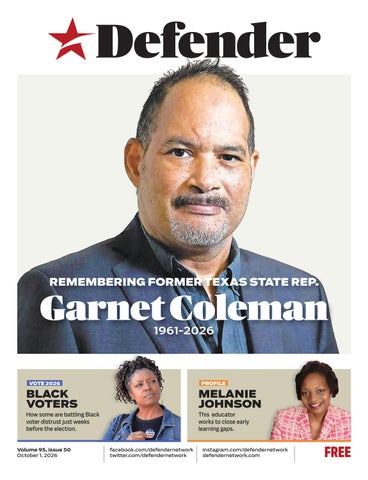
REMEMBERING FORMER TEXAS STATE REP.
Garnet Coleman 1961-2026
VOTE 2026
PROFILE
BLACK VOTERS
MELANIE JOHNSON
How some are battling Black voter distrust just weeks before the election. Volume 95, issue 50 October 1, 2026
This educator works to close early learning gaps.
facebook.com/defendernetwork twitter.com/defendernetwork
instagram.com/defendernetwork defendernetwork.com
FREE
2 | October 1, 2026 |
DEFENDER NETWORK
DN To the POINT Message from the Managing Editor of extraordinary advances and problems humans haven’t figured out yet. But the concerns aren’t CHECK. coming exclusively from YOUR. conspiracy theorists stockVOTER. ing canned beans. Leaders REGISTRATION. and researchers inside the AI industry have warned that And now we have 75,000 increasingly powerful sysmore reasons why. Harris tems require serious attenReShonda Tate County election officials are tion to safety and oversight. processing about 75,000 voter That doesn’t mean we should registration records after a Texas Department of panic, but it dang sure should give us pause. Public Safety system problem prevented some “Nothing to see here” probably isn’t much of an applications and updates from reaching coun- AI policy. ties as expected. I’m not knocking AI usage, but we might Before anybody panics, that does not mean want to pay attention to what people who actu75,000 Harris County residents aren’t reg- ally study this technology are warning us about. istered. Many records may be duplicates or And maybe price a bunker. Just in case. require no changes. About 2,000 require additional review. The Hotel Lobby trend is cute. But… But here’s what matters: The deadline to regI’ll admit it. Some of these Hotel Lobby AI ister for the Nov. 3 election is Oct. 5. So why videos are hilarious. If you’ve been on social leave something this important to chance? media lately, you’ve probably seen them: Cats, Go to VoteTexas.gov, click “Am I Regis- politicians, celebrities and fictional charactered?” and check your status. If something is ters suddenly performing inside that familiar wrong, contact the Harris County voter reg- orange room. istrar. And if you registered or changed your But here’s what a lot of people may not realaddress through DPS, make sure everything ize. That room, those movements and that persays what it’s supposed to say. formance didn’t originate with AI. They belong Then don’t stop with yourself. The Defend- to Quavo and Takeoff, from Migos, and their er’s Round Up Five campaign is asking you to phenomenal BLACK crew. check on five other people. Your children. Your The viral trend is built from their 2022 parents. Your neighbors. Your fellow organiza- COLORS performance of “Hotel Lobby,” tion members. Your group-chat friends who replacing the two Black artists with other people know everything happening on TikTok but and characters while preserving elements of somehow don’t know whether they’re regis- their original performance. Takeoff was killed tered to vote. in Houston just months after it was recorded. We can’t fix every problem with the system. And that makes this feel different to me. But we can make sure we know our own status We’re laughing at AI versions while the origbefore Oct. 5. inal Black creators become almost incidental to the joke. Don’t worry about AI. The president Quavo apparently noticed, too. As the trend says we’re good. exploded, he reposted the original performance I know everybody is worried about the AI with two simple words: “The Original.” apocalypse. Will artificial intelligence take our That’s the larger AI conversation we can’t jobs? Spread misinformation? Launch cyber- ignore. Generative AI doesn’t create from thin attacks? Become so powerful that humans can air. These tools can reproduce voices, faces, no longer control it? movements, styles and creative work that origHave no fear, faithful readers. President Don- inated with actual human beings. Questions ald Trump has weighed in. It’s a “HOAX.” about consent, compensation and ownership Awww. Now we can all stop worrying. aren’t theoretical anymore. They’re sitting right Trump recently dismissed warnings that there in our social media feeds. artificial intelligence could eventually threaten So while you’re enjoying the Hotel Lobby humanity, writing that “AI taking over the videos, remember that once again, Black folks World, destroying Humanity, and all other created the culture. Everybody else found a way things bad, is a HOAX.” He has also argued to remix it. against slowing AI development, saying excessive regulation could hurt the United States in On the Web its technological competition with China. • How can Houston avoid being the next To be clear, the debate over existential AI risk Gary, Indiana? is far from settled. Nobody knows whether we’re • Dept. of Education changes standard for headed toward The Terminator, a productivity school discrimination complaints. revolution or some complicated combination • The unseen costs of our beauty obsession. I don’t know how many different ways I can say this:
October 1, 2026 |
DEFENDER NETWORK
| 3
DN Obit REMEMBERING FORMER TEXAS STATE REPRESENTATIVE
Garnet Coleman dies at 65 receive the award in recognition of their academic performance and understanding of public service. The 2026 recipients included Nekane Diaz Lopez and Michael J. King.
By Aswad Walker
Former Texas State Rep. Garnet Coleman, a longtime Houston legislator whose three decades of public service were marked by a commitment to health care, social justice, voting rights, education, and community development, died Sept. 23, 2026. He was 65. Coleman was born Sept. 8, 1961, in Washington, D.C., to Gloria Jones Coleman and Dr. John B. Coleman. He was raised in Houston, where his father served as chief of obstetrics and gynecology at Riverside General Hospital and became the first African American appointed to the Texas A&M University System Board of Regents in 1977. A proud graduate of Jack Yates Senior High School’s Class of 1979, Coleman initially attended Howard University before returning home. He earned a bachelor’s degree in political science from the University of St. Thomas in 1990 and later completed Harvard University’s Senior Executive Program for State and Local Government. A life in public service Coleman entered electoral politics in 1988 as a delegate to the Texas State Democratic Convention. He became a precinct chair in 1990 and, in 1991, won election to the Texas House, beginning what became a 30-year legislative career representing House District 147 in central and southeast Houston. Coleman quickly demonstrated that public service for him extended beyond the Capitol. That same year, he founded S.M.A.R.T. Kids, a youth development and tutoring program. His legislative work eventually touched some of the most consequential issues facing Texans. He served as chair of the House County Affairs Committee beginning in 2009 and was a senior ranking member of the Public Health Committee. He also served on the House Select Committee for Mental Health and chaired the Texas Legislative Study Group. Coleman was particularly known for his work on health care, mental health, voting and
The influential Texas representative leaves behind a lasting legacy of community development, social justice, and dedicated public service in Houston. Credit: Houston Public Media.
social justice. He also advocated for preserving Texas’s top 10% rule, which provided automatic admission to state universities for the highest-performing students at Texas high schools. He served during President Barack Obama’s administration as a member of the president’s State Legislators for Health Reform and was recognized in 2005 with the Reintegration Award from Eli Lilly and Company for his support of public health programs. Building beyond the Capitol Coleman understood that lasting change required investment in institutions and people. He served as CEO of Apartments for America Inc., a
nonprofit affordable-housing corporation, and served on the boards of organizations including the South Central YMCA, Ensemble Theatre, Third Ward Redevelopment Council and Houston Drug and Alcohol Abuse Council. His relationship with the University of Houston’s Hobby School of Public Affairs was especially significant. Coleman helped secure the Center for Public Policy’s first legislative appropriation in 1999 and remained a driving force behind the center’s evolution into the Hobby School as a stand-alone school in 2016. He also advocated for state funding for the school’s building and mentored Civic Houston Interns and Hobby Fellows in Houston and Austin.
Texas leaders mourn Garnet Coleman.
The school established the Garnet Coleman Award for Student Excellence to honor his legacy and his support for public-service education. Each year, outstanding graduating students
A legacy of service At the conclusion of his legislative career, Coleman had become one of the Texas House’s most senior members. His colleagues and constituents knew him as a legislator deeply connected to the communities he represented. After leaving the Legislature, Coleman continued his work through the Center for Civic and Public Policy Improvement, the “think-and-do tank” he founded to promote human, civic, social and economic justice. State Rep. Ron Reynolds, who represents House District 27, remembered Coleman as “a giant in public service and a true champion for the people of Texas.” “Garnet Coleman devoted his life to fighting for justice, equity, and opportunity for those too often overlooked and unheard,” Reynolds said. “His voice carried weight, his leadership made a difference, and his impact will be felt for generations to come.” That impact can be seen not only in legislation and public policy, but also in the students he encouraged, the institutions he helped build, and the Houston communities he served.
VOLUME 95, NUMBER 50 - OCTOBER 1, 2026 Publisher | CEO Sonceria Messiah-Jiles Strategic Alllance Clyde Jiles Managing Editor ReShonda Tate Associate Editor Aswad Walker Content Manager Terrance Harris
Culture/Lifestyle Reporter Laura Onyeneho Special Assignments Reporter Tannistha Sinha Sports Terrance Harris Jimmie Aggison Video Editor Bryan Erdy
The Defender newspaper is published by the Houston Defender Newspaper Inc. and audited by Alliance for Audited Media (AAM). Only digital subscriptions are available at: www.defendernetwork.com/subscribe No paper subscriptions available. All materials covered by 2026 copyright. No materials herein may be reproduced without the written permission of the Publisher. 713-663-6996 | P.O. Box 8005, Houston, TX 77288
4 | October 1, 2026 |
DEFENDER NETWORK
DN Vote 2026 HOW TO CREATE AN EFFECTIVE
Voting Plan
Sometimes people aren’t apathetic. They’re overwhelmed. This is all the more reason for an organized and detailed voter plan. Keep an election calendar. Follow reliable local election information. Learn the ballot gradually rather than trying to understand everything three days before Election Day.
By Aswad Walker
November will arrive whether voters are ready or not. And in Houston, where elections can include everything from statewide races and congressional contests to judicial seats, school boards, propositions, and local offices, “I’ll figure it out later” is not much of a voting strategy. A better approach is to create an actual voting plan—and encourage family members, friends, and neighbors to do the same. Houston-area voter advocates have repeatedly emphasized that turnout isn’t simply about reminding people to vote. It’s about making sure people know when, where, how, and why they are voting. Here are seven things voters can do now to make their participation in November easier. Check your registration before Election Day Don’t assume your registration is fine because you voted before. This is particularly important in a “blue-voting” city in a GOP (red)-run state. Across the former Confederacy, tens of thousands of registered voters have found their names purged from voting rolls. This being Texas, it’s a good idea to check your voter registration status weekly by visiting www.harrisvotes.com, www.votetexas.gov, or www.hctax.net. Also, make sure your current address is correct, especially if you’ve moved, changed names, or otherwise experienced a change in your circumstances. Know what is actually on your ballot This sounds obvious. It isn’t. Many voters pay attention to presidential or major statewide races while overlooking the offices and propositions farther down the ballot. Those supposedly “smaller” contests can affect courts, schools, transportation, public safety, housing, and other aspects of everyday life. Local voting advocate Zakiya Newman emphasizes the importance of con- Zakiya Newman tinuing voter education beyond registration. “It’s not enough just to register someone,” Newman said. “You have to remind them about election dates, answer questions about IDs, mail ballots—just being a trusted resource.” Before voting, find your sample ballot and research every race and proposition.
Making voting a group activity increases a voting plan’s effectiveness. Credit: Sammy Swae/Unsplash.
Don’t wait until you’re standing in the voting booth trying to decipher political fine print.
“Both Dallas and Williamson county voters have grown accustomed to countywide voting, including on election day,” U.S. Rep. Jasmine Crockett’s campaign said. “This effort to suppress the vote, to confuse and inconvenience voters, is having the intended effect as people are being turned away from the polls.” So, verifying polling locations in Texas must be a daily, almost hourly action. This reality is neither fair nor just. But this is Texas. Thus, an effective voting plan will include a backup voting location and a strategy for sharing accurate information with fellow voters in your network.
Decide when and how you will vote Choose your voting method before Election Day. Will you vote during early voting? On Election Day? By mail, if eligible? Houston voting advocates specifically recommend deciding on a method, reviewing the ballot beforehand, verifying polling locations and hours, and considering early voting to avoid conflicts involving work, transportation, or long lines. HISD Trustee Savant Moore goes even further. “The biggest thing I want you to do, Oct. 19, remember that day,” said Moore. “That is the first day of early voting. Go vote early. All the people who really care about us, the way that they win is through early Savant Moore voting. It’s not going to be Nov. 3. You’ve got to get them in office on Oct. 19 through Oct. 30.” Additionally, a voting plan goes beyond stating, “I’m voting.” A plan states, “I’m voting at 10 a.m. Tuesday at this polling location, and I have my transportation verified.”
Handle logistics, eliminate excuses Transportation. Childcare. Work schedules. Identification. Mail-ballot requirements. These are not minor details. They can determine whether someone actually casts a ballot. Texas voting rules make preparation particularly important. The Defender has reported concerns surrounding identification requirements and the procedural difficulties associated with mail voting. So, solve the practical problems early. Arrange a ride. Confirm identification requirements. Check eligibility for a mail-in ballot if that’s your method of choice. Help an older relative understand the process. Also, help solve transportation issues for those who have no clue how they’ll get to the polls.
Verify polling location— and backup Don’t rely on memory. And don’t rely on the state of Texas. During the March primary elections, voters in two major Texas counties were turned away at polling locations and directed to different precincts due to day-ofelection changes to polling locations. Some state websites even posted incorrect polling location information.
Don’t let election fatigue win With seemingly back-to-back-to-back elections, Houston voters exist within a dangerous cycle of: Register, vote, recover, repeat. “People are tired of voting,” said Tanisha Manning, founder of Engaged Voters. “We shouldn’t be tired of voting. But elections are coming so fast, and we don’t know who or what. It has been confusing.” Her point gets to the heart of voter fatigue:
Make voting a community activity A voting plan becomes stronger when it involves more than one person. Tell your household when you intend to vote. Check on elderly relatives. Talk with friends. Encourage first-time voters to research their ballots. Help people find official election information. Young voters, in particular, benefit from trusted messengers and meaningful engagement. Shekira Dennis argued that young Black voters need trusted people from their communities helping connect them to civic participation. Ariana Phillips, another young Houston civic leader, described the divide among young people: Some don’t believe their vote matters, while others are highly civically engaged. Rather than an excuse, that gap is an opportunity to build community and a larger election plan. Then, work your plan. Voting requires registration, information, preparation, and follow-through. Frustration and distrust can complicate efforts to engage Black voters, particularly younger voters. The challenge, therefore, isn’t merely getting people registered; it’s helping people see civic participation as something concrete and connected to their lives.
VOTING PLAN CHECKLIST Check registration. Research and review the ballot. Choose a voting method. Verify (and reverify) polling location. Arrange transportation. Understand and secure all identification and voting requirements. Remind family and friends. Follow through—vote.
October 1, 2026 |
DEFENDER NETWORK
| 5
JAMES TALARICO HAS A PROVEN RECORD OF
FIGHTING
CORRUPTION TO LOWER YOUR COSTS
VOTE JAMES TALARICO FOR U.S. SENATE!
ELECTION DAY - NOVEMBER 3 EARLY VOTING - OCTOBER 19 - 30
ENDORSED BY:
Rep. Christian Menefee
Texas’ 18th Congressional Dist.
PAID FOR BY TALARICO FOR TEXAS
6 | October 1, 2026 |
DEFENDER NETWORK
| 7
DN Vote 2026
Battlingg Black voter distrust By ReShonda Tate and Tannistha Sinha
B
lack voters have been among the Democratic Party’s most dependable supporters for generations. But loyalty and trust are not the same thing. With less than a month to go before the midterm elections, Black voters and political strategists say years of inconsistent engagement and unmet expectations have left some voters questioning whether the party has earned their continued support. The challenge now is bigger than winning votes. It’s convincing distrustful voters that staying politically engaged is worth it. Communications strategist Ashley Etienne argues that D e m o c r at s h av e spent years taking Ashley Etienne one of their most reliable voting blocs for granted, creating a widening trust gap that threatens the party’s long-term prospects in Texas and nationally.
Black voters remain a critical voting bloc in Texas, but political strategists say candidates must do more than show up during election season to earn their trust and participation. Credit: ChatGPT.
“Trust is the currency of persuasion,” she said. “We’re seeing distrust at an all-time high, especially with Black voters … distrust of the media, institutions, the Democratic Party, self-agreement. Campaigns don’t lose because they fail to talk to voters. They lose because they fail to listen.” Etienne, who served as a senior adviser to Presidents Barack Obama and Joe Biden and communications director for Vice President Kamala Harris, said repairing that relationship requires something considerably more difficult than another campaign advertisement. It requires listening.
Black support remains strong, but not absolute Recent polling suggests Democrats continue to hold a substantial advantage among Black voters heading into November, but that support isn’t universal.A July 2026 Pew Research Center survey found 68% of Black registered voters said they would support the Democratic candidate for U.S. House in their district, compared with 8% who favored the Republican. Another 25% said they were either unsure or would support another candidate.That uncertainty follows some erosion in Democratic support among Black voters in the 2024 presidential election. A Pew analysis of validated voters found 83% of Black voters supported Kamala Harris in 2024, compared with 92% who supported Joe Biden in 2020. Pew found that shift was driven less by individual voters switching from one party to another than by differences in who turned out to vote.The findings don’t suggest Black voters have abandoned Democrats. They do raise questions about whether longstanding party loyalty is enough to guarantee participation.”We’ve been making that same argument decade after decade,” Etienne said. “Those are becoming less persuasive arguments.”Why is trust disappearing? The distrust isn’t necessarily about one candidate or one election. For some Black voters, frustration comes from feeling heavily courted during election season without
Malcolm Yates, ULP’s Strategic Plan Taskforce and Senior Director of PHMC and Kallel Edwards, Black Voters Matter Fund, speak during a community conversation about the distrust of Black voters. Credit: Getty Images.
seeing enough progress afterward on the issues affecting their daily lives. Housing costs remain a concern. So do education, economic opportunity, neighborhood investment, and the cost of everyday necessities. That creates a difficult dynamic for campaigns: Asking voters to participate in a political system that some believe has not delivered enough for them. It also raises a separate question. What happens when frustration with political parties becomes disengagement from the political process altogether? What happens when voters stay home? The answer can become particularly consequential in local elections, where races can be decided by hundreds of votes rather than thousands. Harris County D e m o c r a t i c Pa r t y Chair Traci Gibson has pointed to several 2024 judicial races decided by narrow margins. District judge candidate Elaine Palmer lost by 304 votes, while Jeralynn Manor lost by 647 Traci Gibson votes. Gibson also warned about voters who begin Harris County’s lengthy ballot but don’t finish it.
“If you go into these polls and you vote for the first five people and then you leave, that’s how we get Elaine Palmer losing by about 300 votes,” Gibson said. The larger issue extends beyond any candidate or political party. Judges are elected. School boards make decisions affecting students and families. City and county officials determine how public dollars are spent. State lawmakers decide which bills become state law. Those decisions are made regardless of how many eligible voters participate. For voters distrustful of political parties or government institutions, political participation also doesn’t have to mean unquestioning loyalty to either party. Voters can research candidates individually, compare their positions, attend or watch candidate forums and examine an incumbent’s record against previous campaign promises. They can also learn what the often-overlooked offices farther down the ballot actually control. In that sense, distrust can become a reason for greater scrutiny rather than disengagement. Candidates have work to do, too Responsibility for rebuilding participation doesn’t fall solely on voters. At a recent Third Ward town hall hosted by state Rep. Jolanda “Jo” Jones, Harris County Precinct 7 Constable James “Smokie” Phillips and Houston Black American Democrats,
voters and political strategists called for more sustained campaign engagement. “Investment drives outcomes. If you don’t invest in it, it doesn’t work,” Etienne said. She argued that campaigns spend heavily on polling, consultants, and advertising while directing too little money toward Black-led political infrastructure and organizations with established relationships in Black communities. Shamier Bouie, chair of Houston Black American Democrats, said organizing cannot begin a few months before Election Day. “It’s all about yearround organizing, and increased investment in Black voter outreach … more funding for Black-led organizations Shamier Bouie that have relationships, infrastructure, and experience in effectively engaging Black communities,” Bouie said. The question of investment also surfaced in July when Democratic U.S. Senate candidate James Talarico pledged $25 million toward Black voter outreach. Some voters wanted specifics about where and how that money would be spent. “We still need our kids, we still need our schools equitably funded,” said Augie Cahee, vice president of marketing web delivery at JPMorgan Chase & Co. “So, we want to know what you’re going to do with the money. Don’t stand up and tell me $25 million and you don’t have a plan.” The exchange illustrated the larger trust problem: Voters aren’t simply asking candidates to talk to them. They want to know what happens after the conversation.
From distrust to accountability Karla West, a precinct chair for downtown’s Precinct 16, said responsibility ultimately belongs on both sides. “We fell asleep at the wheel,” West said of voter turnout. But she also challenged political leaders. “The Democratic Party did not say what they would do for you,” West said. “We haven’t heard a plan for years. I’m sick of it. We have to have strategies, we have to have plans, we have to have a mechanism in place for people to feel they are heard.”
Black women are more likely than Black men to say the U.S. political system holds Black people back
% of Black adults who say the political system was designed to hold Black people back a great deal or fair amount
All Black adults
67
Experience discrimination
72
Didn’t experience discrimination
Black, non-Hispanic
54
68
Muitiracial, non-Hispanic Black Hispanic
Men Women
Ages 18-29 30-49 50-64 65+
High school or less Some college Bachelor’s +
Lower income Middle income Upper income
Rep/Lean Rep Dem/Lean Dem
71
53
64 71
65 67 67 72
60 73 72
66 69 74
57 71
Source: Survey of U.S. adults conducted Sept. 12-24, 2023. “Most Black Americans Believe U.S. Institutions Were Designed To Hold Black People Back”
Voter Registration Deadline: Monday, Oct. 5
8 | October 1, 2026 |
DEFENDER NETWORK
DN Feature
Game changers H-Town brothers handle business
By Aswad Walker
Countering negative stereotypes, Black men across Houston are making significant impacts in business, education, mentorship, and civic engagement. Here is how three Houston-area leaders are driving change and uplifting their communities. MARCUS BROWN
Energy Trading & Mentorship
With over two decades in the energy sector, Marcus Brown’s career spans energy trading operations, risk management, and complex software systems consulting. Navigation in physical and paper commodities trading has given him deep expertise in a challenging industry. Beyond career growth, Brown centers his work on mutual mentorship. Early in his career, he mentored intern Latasha Smith at Dynegy, who later became a key advisor to him. Brown actively seeks out young Black professionals to advise while remaining open to learning from younger generations about emerging technologies and shifting cultural landscapes.
MARVIN PIERRE
Wall Street to Youth Empowerment
Originally from South Jamaica, Queens, Marvin Pierre transitioned from high-finance corporate life at Goldman Sachs to education and nonprofit leadership. Holding degrees from Trinity College and a master’s in education from the University of Houston, Pierre refocused his career to change outcomes for young boys of color. Guided by his late mentor Dr. Sam McFadden’s ethos of “lifting as I climb,” Pierre has spent a decade leading Eight Million Stories. The organization supports “at-promise” youth and young adults in reshaping their narratives beyond past circumstances. Driven by faith and his role as a father to his daughter, Aria, Pierre works to build better opportunities for the next generation.
Marvin Pierre. Courtesy: Marvin Pierre.
Words of wisdom
“Serve somebody. Whatever career you choose, find a way to use your gifts to make somebody else’s life better. Success isn’t just about what you can accomplish for yourself; it’s about who you can bring with you along the way.”
Marcus Brown. Courtesy: Marcus Brown.
Words of wisdom
“You do not need to see your entire path before taking the first step. Build your character, learn a valuable skill, remain curious, and become someone others can depend upon. Adopt a belief in ‘ falling forward,’ and ‘leveraging the lesson.’ Take calculated risks where the potential reward is big.” TERRANCE ROBINSON SR. Service & Advocacy
Raised in Houston’s Fifth Ward, Terrance Robinson Sr. overcame early challenges— becoming a father before finishing high school and leaving Prairie View A&M University to serve in the Navy to support his family. After a 20-year career with the Harris County Community Supervision and Corrections Department, he retired as a shift coordinator and took on a role as floor and court security event manager for the Houston Rockets. Encouraged early on by mentor Dr. Theodore Merril, Robinson launched UsAmerica Advocates in 2021 following the murder of George Floyd. The non-profit 501(c) (4) focuses on civic empowerment, community awareness, and youth literacy events in schools, community centers, and churches. Words of wisdom
Home Loans We offer home loan programs designed for every type of borrower. Our experienced loan officers are eager to work with you to find the right mortgage that fits your needs. We have mortgages for: • New Construction • Existing Homes • Refinance of your current home Visit our website or give us a call today. Terrance Robinson Sr. Courtesy: Terrance Robinson Sr.
“Be true to thyself. Don’t be afraid to dream, but more importantly, seek to make it come to fruition. Let determination and passion be your motivation. I live by a code, as every man should. And that is: ‘To achieve, to inspire, to motivate, and to give hope. It is all that I am. It is all that I hope to be.’”
Loans subject to credit approval. This ad is not a commitment to lend. Restrictions apply. Prosperity Bank NMLS ID #466414.
ProsperityBankUSA.com or call 1-800-657-9500
October 1, 2026 |
DEFENDER NETWORK
| 9
DN Profile
WATCH
VIDEO
Melanie Johnson Shares her mission to close early learning gaps
By Tannistha Sinha
Growing up in Tuskegee, Alabama, which ranked among one of the lowest-performing states in the country for education, Dr. Melanie Johnson learned early that systems alone are not enough to educate children. It takes a village, as Johnson herself was once raised in. “There were micro systems on our street, neighbors and teachers who told on you when you didn’t turn in your homework because that’s the beauty of small towns,” she told the Defender. “I learned my love for the sciences in those museums. I learned a lot from the Tuskegee Airmen [African-American military pilots who fought in World War II] who had flown the ‘Red Tails’ to countries and led us in the wars, and then I was fascinated by the Dr. George Washington Carver Museum.” Today, as president and CEO of the Collaborative for Children, an early childhood education nonprofit, Johnson is working to recreate the same setting she grew up in at scale for Houston’s most vulnerable children. The organization also received a contract with Houston ISD to expand its pre-K enrollment, under Senate Bill 1882. Johnson told the Defender it would help both entities. On the one hand, Collaborative for Children’s 125 early learning centers could help boost HISD’s enrollment numbers. On the other hand, Collab can count those students as part of their enrollment. Leveling the playing field Johnson’s path to early childhood leadership was interspersed with degrees and jobs in various fields. After earning a Bachelor’s in International Business from Auburn University and a Master’s in Hospitality Management from the University of Houston, she began her career as an early childhood teacher. Johnson earned her Doctorate in Curriculum and Instruction from Texas Southern University in 2005. It was there she fell in love with the
authenticity of young children, kids who show up in cowboy boots and Superman costumes, being exactly who they wanted to be. It led her to the boardrooms and exhibition halls of Houston’s science institutions. As Director of Education at Space Center Houston, the official Visitor Center for NASA Johnson Space Center, she observed a troubling pattern. Astronauts’ children eagerly raised their hands when asked about rocket boosters, while children from less science-saturated homes sat quietly overlooked. Her response was to build programs specifically for the outliers, including “Diva Design,” a STEM initiative targeting middle school girls who were underperforming on State of Texas Assessments of Academic Readiness (STAAR) science assessments. She later became president and CEO of the John P. McGovern Museum of Health and Medical Science (also known as the Health Museum) before joining Collaborative for Children in 2018.
Building the infrastructure for the future Collaborative for Children, which has been operating in the Greater Houston area for over 35 years, runs its Centers of Excellence program to certify child care centers in high-need zip codes, equipping them with research-backed curriculum, STEAM-based activities, real-time data tracking, and business coaching. Johnson said the organization is now expanding that model beyond formal child care walls, into community centers near low-income housing developments. Johnson wants to be remembered for the impact of her work 10 years from now. “If I were even able to give an opportunity to a handful of children to be able to partake in society in a way that’s as optimally beneficial for them and their families, that wards off the trajectory of poverty for a family, that would be sufficient for me,” she said.
The crisis of kindergarten readiness According to a Good Reason Houston report, out of the students who were assessed for kindergarten readiness across the Houston region, Black and Hispanic students were less likely to be kindergarten-ready than their Asian and white peers. For Johnson, those numbers represent a systemic and educational failure, rooted in the affordability of quality child care and cultural hesitancies around formal early enrollment.
We need parents to understand the criteria for success for their children.” DR. MELANIE JOHNSON
“The adults are where the barriers lie more readily,” Johnson said. “A school district can be more welcoming. We don’t simply need parents to come in and bring cupcakes. We need parents to understand the criteria for success for their children.” Her view is echoed by Michelle Atanu, founder and CEO of Avilo Pediatric Solutions & Consulting, who attended Collaborative for Children’s recent Collab Kid U STEAM event at Rice University with her family. “In communities of color, people just don’t know that this kind of stuff is out there. It’s up to the parent to go find them,” Atanu said she observed. “Organizations like Collaborative for Children do all the marketing, but the parents, the people of color, and underserved people, sometimes they don’t see it.”
Dr. Melanie Johnson’s leadership is rooted in her Tuskegee upbringing. Credit: Collaborative for Children.
10 | October 1, 2026 |
DEFENDER NETWORK
DN Sports
WATCH
VIDEO
Back on The Hill
Joah Bramwell Returns to Prairie View A&M golf
By Terrance Harris
Prairie View A&M University senior golfer Joah Bramwell can’t escape the feeling of being home again on The Hill. It’s definitely a different feeling from when, a couple of years ago, the Cypress native made the difficult decision to uproot his game and himself from Prairie View to head to the University of Central Oklahoma. But two years later, a new coach and a new outlook led Bramwell back to where his collegiate career began. Joah Bramwell “It’s been cool,” Bramwell said. “It’s a lot different than it was my freshman year here. I was the new guy on campus, didn’t know anybody.” It’s a feeling Bramwell never dreamed he would have again. That was until a conversation with then-first-year Prairie View golf coach Kortland Ware at the encouragement of some of his old teammates, including best friend Gage Gallo. Their conversation intrigued both parties and led Bramwell to return to Prairie View this past January. “When he went to his next school, it didn’t quite work out,” Ware said. “But talking to him, talking to his family, and seeing what they embodied, it made sense. “I also looked at his golf game. That really, really matters. It’s not just about all of the other things. We still want good results. “We get along well because of the way he thinks about golf.” That connection went both ways. “A big part of the reason I came back was because of Coach Ware. I had one conversation with him on the phone, and I knew that he was going to help a ton. That was part of the big decision, why I came back was because Coach Ware was here. Talking to a lot of my old teammates who were still here, they obviously love Coach Ware a lot.” Bramwell spent much of the spring season reacclimating and played only the final four tournaments. This summer, however, Bramwell dedicated himself to improving his game, absorbing the new culture around the Panthers’ program, and reconnecting with his new and old teammates. Ware has been so impressed with Bramwell that he has named him team captain. “Being selected as captain is a great honor,” said Bramwell, a finance major. “The
Joah Bramwell Class: Junior Major: Finance Previous School: University of Central Oklahoma High School: Cypress Ranch Accolades: Won the individual title at ‘TheeILove’ Men’s Collegiate Invitational, while leading the Panthers to the team championship.
Joah Bramwell has returned to the Prairie View men’s golf team in full swing after spending a couple of seasons at the University of Central Oklahoma. Credit: Glenn ‘Trey’ Dames.
fact that Coach Ware wants me to lead this team is something I always dreamed of; being a leader, guys looking up to me, guys texting questions, `Hey, when do we have workouts?’ and stuff like that. “It’s a job that he obviously felt that I was fit for, and that is really rewarding to me.” The decision paid off immediately, as the Panthers came out of the gate earlier this month with a victory at Jackson State’s “TheeILove” Men’s Collegiate Invitational, led by Bramwell. The Cy Ranch High School product captured the three-round individual championship with an 8-under-par score, while the Panthers opened their season with a 4-under-par for the first-place overall finish on The Refuge Golf Course in Flowood, Miss. “It’s always something you dream of, winning college tournaments with your team,
best buds, guys that you see more than your family,” Bramwell said. “You spend countless hours with these guys, and you learn to love them like family.” Ware says he wasn’t surprised his team won its first tournament. That was his expectation and vision, and he shared as much with Bramwell and the team. “Coming out of the gate the way that he did, I told him, ‘You’re going to play well here,’” Ware said. “I could see it in the practice round; I could see the focus. We just had to get everybody thinking the exact same way, and that’s what happened.” The hope is that the season-opening win is a precursor to what is to come, as the men’s golf team looks to replicate the success of the women’s program, which won the SWAC Championship in the spring and earned a spot in the NCAA Regional
in Waco. The men came close in the spring, and now, with an infusion of young talent and the return of Bramwell, there is a sense that bigger things are awaiting. “Being able to win early on is kind of setting the standard for the rest of the year,” Bramwell said. “The standard was set really high, and we have to keep pushing ourselves to meet that standard.” Being in a position to do just that has made Bramwell’s decision to return to Prairie View all the more sensible. He didn’t want to just return. He wanted to come back for impact. “To be able to do it when I’m here and back with the team is obviously something that is so cool. It’s almost like you are dreaming. It’s so rewarding,” Bramwell said. “It’s something that you always work towards. It’s something … you aim for the stars.”
October 1, 2026 |
DEFENDER NETWORK
| 11
DN Sports
James Brown Turns hesitation into confidence
By Jimmie Aggison
James Brown once wanted nothing to do with getting hit. That was the main reason the Austin High School senior hesitated to play tackle football. A basketball and flag football player, Brown had spent years using his speed and quickness to avoid contact. But after Coach Stephen Wiggins repeatedly encouraged him to try tackle football, Brown finally made the switch as a junior. Now, the quarterback is using those same instincts to make defenders miss. He showed it in a back-and-forth game against Kashmere, when Austin battled Kashmere before Brown led a late fourth-quarter drive and scored the winning touchdown in a 32-28 victory. “On that last drive, I remember looking at the scoreboard and knowing I had to finish it,” said Brown. “My coach gave me the look and told me to do what I do best, so I did.” The play was a designed run called Sisco Q, but if it broke down, Brown had the freedom to do whatever he needed to score a touchdown. “I just knew we couldn’t work hard all game and then lose,” said Brown. “I knew all eyes were on me, so there wasn’t any time to fold under pressure. I had to rise to it.” During the late fourth-quarter drive, Austin head football coach Jermaine Bluford saw that James had what it took to make the play Austin needed to make. “James is relentless and has proven that no moment is too big for the next,” said Bluford. “What everyone saw on Thursday is what we already knew about him from day one.” Brown’s late-game heroics, however, were a long way from the start of his football journey, when the senior wasn’t sure he wanted anything to do with tackle football. Before playing tackle football, Brown had played flag football in a local league and had spent 10 years immersed in basketball. “The thing that made me hesitant to play football my freshman and sophomore years was getting used to the contact, since it was something I had never experienced,” said Brown. “Not knowing how it would affect my body for basketball was my biggest concern about tackle football, because I was more focused on making it to college through basketball.” In his freshman year, at 5-foot-6 and 138 pounds, Brown was approached by former coach Stephen Wiggins, who spoke with Brown’s mother and convinced her that Brown needed to at least give tackle football a try.
I knew all eyes were on me, so there wasn’t any time to fold under pressure. I had to rise to it.” JAMES BROWN
“He finally got through to my mom about getting me out there for summer workouts, because he saw the type of athlete I was and believed I would be okay,” said Brown. Wiggins had encouraged Brown to play tackle football since his freshman year, but Brown didn’t make the transition until his junior season. Once Brown finally put on the pads, the very thing he had tried to avoid became part of the game he had to learn to embrace. His background in basketball and flag football helped him transition to tackle football. “All of the work I put into basketball really translated to football,” said Brown. “Footwork and sprints; since I’ve been a point guard my whole life, that leadership factor really translated into playing quarterback, because I knew I had to become the person my team could trust and depend on.” Brown began to realize that his speed and ability to make defenders miss could be an advantage against defenders trying to tackle him. “I noticed after my first game in my junior season that it would be a problem for defenders,” said Brown. “I have that confidence in my game and skills that when I touch the ball, nobody can stop me.” “He sees the entire field with or without the football,” said Bluford. “His ability to stop on a dime and accelerate immediately is a weapon.” Brown’s ability to use his speed and shiftiness has continued to develop since he first started playing tackle football. “Because he is a multi-sport athlete, you see it constantly,” said Bluford. “Track and weightlifting have been the biggest contributors to his development.” What began as a reluctance to absorb contact gradually became a different kind of confidence, one built on his use of athleticism to avoid it. “When I first took this job, I gave a detailed
breakdown of the vision I had for James,” said Bluford. “He went from being used in a single role to being weaponized as a threat across the field. He’s consistent in his effort and playmaking ability, while inspiring others and helping elevate their game.” That transformation is something Brown recognizes, both in the way he plays and in the person he has become. “Looking back at the player who was hesitant to play tackle football, I’m very different now, both as a player and as a student,” said Brown. “My confidence is higher, my skills are better, and I feel completely different from that hesitant boy I was.” Brown’s evolution is perhaps best measured not by how often he takes a hit, but by how confidently he now handles the moments that once made him hesitant to play the game. “Scoring the winning touchdown against Kashmere meant a lot to me, given my background in the sport and where I started,” said Brown. “As a senior, I want people to remember how I instill hope in everyone around me and how I show up and show out every time, no matter the circumstances.” The player who once hesitated because he didn’t want to be hit is now the senior quarterback trusted with the ball when the game is on the line. “You’d better know where he is on the field at all times,” said Bluford. “He’s dynamic and only needs a crease to make a play. And 694 total yards and eight touchdowns in three games aren’t mediocre numbers.”
Austin High School senior James Brown scored the go-ahead touchdown and helped lead his team to a 32-28 victory over Kashmere at Barnett Stadium. Credit: Jimmie Aggison/Defender.
12 | October 1, 2026 |
DEFENDER NETWORK
DN Health
A DEFENDER AND KELSEY-SEYBOLD CLINIC ALLIANCE
Prostate Health Can Change Over Time By ROHIT REDDY, MD
Prostate cancer is one of the most common cancers among men in the United States, with about 1 in 8 men diagnosed during their lifetimes. Prostate health can also change over time, and those changes don’t always point to cancer. Still, they can be a reason to check in and discuss what they may mean. Changes Don’t Always Mean Cancer As men age, prostate changes can affect urination. A weaker stream or more frequent urination, especially at night, is usually caused by something other than prostate cancer. Prostate cancer usually has no symptoms in its early stages, so symptoms alone don’t tell the whole story.
Why Conversations Matter Prostate health isn’t the same for everyone. Age and family history can help guide how closely changes are followed. Overall health may also shape which next steps make sense. Black men are twice as likely to die from prostate cancer as White men, according to the American Cancer Society. This difference supports ongoing conversations about individual risk and whether screening may be appropriate. Care Often Happens Over Time Prostate health usually isn’t evaluated in one visit. Ongoing care allows changes to be tracked and recommendations to be adjusted when needed.
American Cancer Society data show that five-year relative survival approaches 100% when prostate cancer is found at an earlier stage, compared with 38% when it has spread to distant parts of the body. These numbers describe outcomes across large groups and can’t predict what will happen for one person. When To Consider a Visit
Rohit Reddy, MD Urology
Kelsey-Seybold Clinic Fort Bend Campus
Urinary changes that don’t improve or begin to interfere with daily life are worth discussing with a urology provider. Prostate Cancer Awareness Month can be a good time to start or revisit that conversation.
Scan to view his online profile.
Kelsey-Seybold Virtual Urgent Care No Driving. No Appointment.
7 days a week • Extended hours • Connect in minutes
Common Conditions Treated Cold, flu, sinus issues
UTIs/yeast infections
Pink eye
Minor injuries
Skin issues
GI symptoms, and more
Virtual Urgent Care is not for life threatening symptoms – call 911 or go to the nearest Emergency Room. Virtual Urgent Care is available to new and current patients located in the state of Texas at time of visit. *Applicable deductibles or co-insurance may apply; please check your specific plan details for more information.
Primary Care Physician Group
Start Urgent Care Video Visit Cost: Primary Care Office Visit Co-Pay*