2025/26
ANNUAL REPORT & ACCOUNTS Company No. 03356526
Published July 2026
02 | Contents
Message from the Chair | 03
CONTENTS
MESSAGE FROM THE CHAIR
Chair’s statement..................................................................... 03 Who we are............................................................................... 04 Our year in numbers................................................................ 06 Myanmar Earthquake Appeal.................................................. 08 Middle East Humanitarian Appeal.......................................... 14 Ukraine Humanitarian Appeal................................................. 20 Turkey-Syria Earthquake Appeal............................................. 24 Our strategy.............................................................................. 28 Pillar 1: Launching appeals.............................................. 30 Pillar 2: Building trust....................................................... 34 Pillar 3: Driving change..................................................... 38 Pillar 4: Sustaining and thriving....................................... 40 Structure, governance and management.............................. 46 Independent auditor’s report.................................................. 54 Accounts .................................................................................. 56
This year sees the 60th anniversary of the first television appeal in support of the Disasters Emergency Committee (Turkey earthquake, August 1966). Over the decades since, DEC appeals have raised more than £2.5 billion through generous donations from the British public at times of major humanitarian crises overseas. The successful history of the broadcast appeals was celebrated this summer at an event jointly hosted by the DEC and the Royal Television Society on 1 July 2026. The broadcast appeals and the strong partnerships that underpin them are as important today as ever. The enduring collaboration between the DEC and the UK’s leading broadcasters plays a crucial role in raising money from a generous UK public and enabling lifesaving aid to be delivered at times of crisis. It was poignant that on the day of the event marking 60 years since our first appeal the DEC launched the Venezuela Earthquake Appeal to support those sadly impacted by the disaster in which thousands were killed or injured. Millions of people are in urgent need of humanitarian aid having lost their loved ones, homes and belongings in the earthquakes. The funds raised will help DEC charities and their local partners provide food, water, shelter, medical care and more in the weeks and months ahead. The year covered in this report began with the launch of the Myanmar Earthquake Appeal across multiple broadcast and digital channels. The appeal has raised over £28 million so far to help those affected by the devastating earthquake that claimed more than 3,000 lives. In the first six months of the response, DEC funds meant over half a million people received urgent and lifesaving aid. The DEC became the world’s fourth largest funder of the humanitarian response following the earthquake. One year on from the disaster, we showcased the impact of UK donations at an outdoor exhibition at St Martin-in-theFields in central London. Images and video stories showed supporters how their donations have helped those affected, and the exhibition was featured in a moving report on the BBC’s The One Show. It highlighted how DEC charities and their local partners are working closely and highly effectively with local communities in Myanmar.
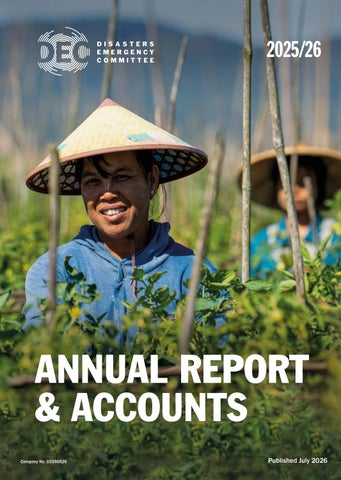
Above: Asmaa and her daughter in central Gaza receive clean water from the local partner of a DEC member charity in November 2025. Displaced families in the area continue to have limited access to water, electricity and essential shelter items. © CESVI Cover image: Daw Nann Mya, a local farmer, inspects the health of her tomato plants in November 2025 after her community received DEC funded support to restore their floating farms, which were severely damaged by the earthquake in Myanmar. © Phyo Maung Maung/Arete/DEC
This year we continued to raise funds for the Middle East Humanitarian Appeal that launched in October 2024. DEC charities and their local partners have been working to support people impacted by conflict in Gaza, Lebanon, the West Bank and Syria.
© Andy Aitchison/DEC Michael Jermey, DEC Chair of Trustees
In December 2025, the UK Government announced it was matching donations to the DEC’s Middle East Humanitarian Appeal up to a further £3 million, to help member charities support vulnerable families through the winter. This support encouraged further donations more than a year after the launch of the appeal. The total raised for the DEC’s Middle East Humanitarian Appeal now stands at over £66 million. During the year, DEC funded programmes came to an end for two of our largest and longest running appeals: the Turkey-Syria Earthquake Appeal response concluded in July 2025, and the Ukraine Humanitarian Appeal response was completed the following month. The DEC has learned a great deal during these two big, successful appeals and as a result has further developed how it raises funds and how it works with members and local partners to deliver high quality aid programmes. I am enormously impressed by the generosity of the UK public and our partners in their response to humanitarian need. Global events and reductions in international aid budgets are presenting enormous challenges. Time and again, when the DEC launches an appeal, the UK public answers the call. The DEC’s work remains unique and essential. This report covers the work that has been done over the past year and our preparations to respond effectively in the future. Thank you for your continuing support of, and trust in, the DEC.
Michael Jermey Chair of Trustees 13 July 2026
All names marked * in this report have been changed to protect identity.
Disasters Emergency Committee – Year to 31 March 2026
Year to 31 March 2026 – Disasters Emergency Committee
04 | Who we are
Who we are | 05
WHO WE ARE The DEC brings together 15 leading UK aid charities to raise funds quickly and efficiently at times of humanitarian crisis overseas. In these times of crisis, people in life-and-death situations need help and our mission is to save, protect and rebuild lives by working with the communities affected. Pooling our resources to work as one, we are pivotal in co-ordinating the UK public’s response to overseas disasters. In collaboration with our Rapid Response Network (RRN) of national media and corporate partners, we raise the alarm to the UK public and set up easy ways to donate. And we have immediate impact. Getting aid to people who need it – fast.
62 years of the DEC
15
member charities
© Carmen Yahchouchi/Fairpicture/DEC DEC CEO Saleh Saeed visits a school in Lebanon where children affected by the conflict receive psychological support sessions run by a DEC charity and their local partner with support from DEC funds, May 2025.
£2.5 billion raised by the DEC
80 appeals
launched since 1963
OUR VISION
OUR MISSION
A world where the impact of disasters on affected communities is minimised by working together through effective humanitarian response and growing resilience.
Together we will raise funds to save, protect and rebuild the lives of people that are impacted by emergencies and major disasters in countries overseas. We will: Raise funds quickly and effectively in large scale humanitarian emergencies Uphold the highest standards of accountability and transparency Learn and share information to promote effective programmes of response.
WHEN WE LAUNCH AN APPEAL We only launch when we know that we can make a difference and add value to the work already being done by our member charities. Our three criteria for launching an appeal help ensure that the DEC launches the right appeals at the right time. Our three appeal criteria are:
1
SCALE The disaster must be on such a scale, and of such urgency, as to call for swift international humanitarian assistance.
OUR BROADCAST PARTNERS:
Disasters Emergency Committee – Year to 31 March 2026
2
3
CAPACITY
SUPPORT
The DEC’s member charities, or some of them, must be in a position to provide effective and swift humanitarian assistance at a scale to justify a national appeal.
There must be reasonable grounds for concluding that a public appeal would be successful, either because of evidence of existing public sympathy for the humanitarian situation or because there is a compelling case indicating the likelihood of significant public support should an appeal be launched. Year to 31 March 2026 – Disasters Emergency Committee
06 | Our year in numbers
Our year in numbers |07
OUR YEAR IN NUMBERS
WHERE WE WORKED IN 2025/26 POLAND
GERMANY CZECH REPUBLIC AUSTRIA
An overview of what we achieved in 2025/26 with our 15 member charities, thanks to our supporters, including the UK public, our Rapid Response Network, the UK, Welsh and Scottish Governments, and other valued partners.
£40.8 million
raised through our appeals (1 April 2025 - 31 March 2026)
£39.3 million
distributed to our 15 member charities for humanitarian response (1 April 2025 - 31 March 2026)
BELARUS RUSSIA
UKRAINE
SLOVAKIA HUNGARY
ROMANIA
SERBIA
MOLDOVA
BULGARIA
Turkey
GEORGIA
CHINA
AZERBAIJAN
TURKEY
(Türkiye)
1 appeal launched
in April 2025 to provide humanitarian support to people affected by the devastating earthquake in Myanmar.
2 responses completed for some of our largest ever appeals, supporting people affected by the Ukraine conflict and the earthquakes in Turkey and Syria.
138 projects providing humanitarian support managed across four appeals, spanning multiple countries.
LEBANON LIBYA
GAZA AND WEST BANK
Occupied Palestinian Territories
INDIA BANGLADESH
MYANMAR SYRIA IRAQ
IRAN
LAOS
THAILAND
JORDAN SAUDI ARABIA
EGYPT DEC funded programme response locations
£600,000 raised to support the DEC’s core operational costs, maximising the funds that go towards appeals and ensuring we are always ready to respond.
TIMELINE OF THIS REPORTING PERIOD April 2025 - March 2026 April 2025 Launch of Myanmar Earthquake Appeal
July 2025 Turkey-Syria Earthquake Appeal programmes end, two and a half years after the earthquakes August 2025 Ukraine Humanitarian Appeal programmes end, after three and a half years of response
Disasters Emergency Committee – Year to 31 March 2026 Disasters Emergency Committee – Year to 31 March 2025
December 2025 UK Government announces second UK Aid Match to the Middle East Humanitarian Appeal up to a further £3 million
24 June 2026 Venezuela earthquake 1 July 2026 Venezuela Earthquake Appeal
Daw Thaung (left) is helped by members of her local women’s group to carry bamboo poles for the construction of her new home in the Inle Lake region of Myanmar. Communities like Daw Thaung’s are being supported by DEC funds to rebuild their homes after the earthquake.
© Phyo Maung Maung/Arete/DEC
08 | Myanmar Earthquake Appeal
Myanmar Earthquake Appeal | 09
MYANMAR EARTHQUAKE APPEAL On 28 March 2025, a powerful 7.7 magnitude earthquake hit central Myanmar, devastating huge areas of the country. Over 3,000 people were killed with hundreds of thousands more losing their homes, businesses, and livelihoods. Before the earthquake, the country was already facing a humanitarian crisis with a third of the population needing humanitarian aid. Following the earthquake, millions more were in need of urgent support. On 3 April 2025, the DEC launched the Myanmar Earthquake Appeal.
SUPPORT FOR THE APPEAL Thanks to support from our public broadcast partners, the appeal was shown on the BBC fronted by actor Hugh Dennis, and on ITV, Sky, Channel 4 and Channel 5 by actor Simon Pegg. Dr Sian Williams, psychologist and broadcaster, presented the appeal on BBC Radio 4 and musician and broadcaster Myleene Klass voiced the appeal on commercial radio. Actors Indira Varma and Christopher Chung fronted the DEC’s appeal launch video on YouTube and across social media channels.
Through its UK Aid Match scheme, the UK Government matched the first £5 million donated by the public to the appeal. Their Majesties The King and Queen were among the first to donate. Our Rapid Response Network (RRN) partner NatWest Group activated a mobile in-app donation feature, raising £1.3 million and helping to boost public donations from launch day. We also saw support from across our RRN partners including Admiral Group, Big Give, Business in the Community, British Airways, Co-op Group, The Co-operative Bank, Morrisons, PayPal, Post Office, Royal Mail and UK Finance. TNT Sports also helped to promote the appeal by featuring a ‘text to donate’ number during their live sport coverage. We were grateful for the generous support of many philanthropists and trusts and foundations, including a significant donation from the Paul Hamlyn Foundation. Despite lower levels of media coverage and public awareness than previous DEC appeals, it raised £16 million by the end of the first week, including funds raised both directly by the DEC (see page 29), by our member charities and our RRN partners. The total raised at the time of publication is £28.2 million.
KEY ACHIEVEMENTS PHASE 1
(April 2025 - September 2025)
Daw Thida is a volunteer for her local village committee in Inle Lake, Myanmar, where the community received DEC funded multi-purpose cash assistance after the earthquake.
KEY ACHIEVEMENTS PHASE 2
159,000
19,300
people reached with improved access to drinking water by rehabilitating water points and water trucking
people reached with water and sanitation support, through installation of latrines, waste management services, and water storage tanks
153,000
18,200
47,600
14,100
people reached with improved access to drinking water by rehabilitating water points and water trucking
people provided with temporary shelter, such as tents, tarpaulins and shelter toolkits, as well as renovations and construction Left: Members of an earthquake affected community receive cash assistance from a DEC member charity in Myanmar in May 2025.
including £5 million matched by the UK Government as part of its UK Aid Match scheme
(October 2025 - March 2026)
22,600
people supported with cash or voucher assistance to meet their specific needs
© DEC charity
£28.2 MILLION RAISED
177,000
people reached with water and sanitation support, through installation of latrines, waste management services, and water storage tanks
Disasters Emergency Committee – Year to 31 March 2026
© Phyo Maung Maung/Arete/DEC
people received mental health and psychosocial support or accessed child-friendly spaces, wellbeing support and community sessions
people reached with healthcare support
© DEC Top: Actor, writer and comedian Hugh Dennis presents the DEC Myanmar Earthquake Appeal on the BBC. Bottom: Actor Christopher Chung appeals for funds on behalf of the DEC on digital and social media channels.
While efforts have been made to avoid counting people twice, some people may have been helped more than once by different member charities.
Year to 31 March 2026 – Disasters Emergency Committee
10 | Myanmar Earthquake Appeal
Myanmar Earthquake Appeal | 11
IMPACT OF THE RESPONSE
A CHALLENGING CONTEXT
In the first six months of the response, DEC charities and their partners delivered lifesaving support and assistance to over half a million people affected by the earthquake.
The ongoing conflict and humanitarian crisis in Myanmar caused additional challenges in getting aid to communities after the earthquake struck. DEC charities and their partners faced significant security and logistical issues including navigating security checkpoints to deliver aid. Post-distribution monitoring also became difficult in some areas where communities were once again displaced due to conflict escalations.
This included giving more than 159,000 people cash assistance so that they could buy essential items to meet their needs such as food, clothes or household goods. More than 47,600 people were provided with temporary shelter, including tents, tarpaulins and shelter kits, as well as support for construction and housing renovations to help rebuild homes and businesses.
DEC charities overcame these challenges by working with local partners. Their expertise enabled real-time information sharing to identify alternative routes where possible and to deliver cash assistance, allowing people to buy what they needed through local markets. Community volunteers also provided support in the distribution of assistance to affected and hard-toreach areas.
The earthquake caused significant damage to water sources and infrastructure, leaving many communities without access to clean water and sanitation. DEC charities restored reliable access to clean drinking water for more than 153,800 people and provided more than 177,000 with sanitation support.
Monsoon rains and flooding also created logistical challenges, particularly around Inle Lake and areas affected by landslides in parts of southern Shan State. DEC charities and their partners re-routed supplies and used boats when necessary.
At the onset of the crisis and throughout Phase 1 (the first six months) of the emergency response, more than 46,800 people were reached with hot meals and food assistance in the form of food baskets and cash or vouchers to buy food. With more than 5,000 people injured, and 748 hospitals damaged, DEC charities quickly collaborated with health partners to deploy mobile medical teams to deliver services across earthquake affected areas. More than 45,200 people benefitted from improved access to primary healthcare, medical supplies, paediatric consultations for infants and nutrition support for young children. DEC charities and their partners quickly established temporary learning spaces and distributed kits for students and teachers so that education sessions could resume. Assistance across education activities, which included first aid, teacher training, and psychosocial support, benefitted over 17,300 individuals. More than 43,100 people affected by the earthquake received mental health and psychosocial support or other protection services. This included setting up child-friendly spaces, case management, wellbeing support, and community awareness raising sessions on gender-based violence, sexual and reproductive health and rights, and the prevention of sexual exploitation and abuse.
Fluctuations in the exchange rate also meant that DEC charities needed to adapt their programmes accordingly. Sometimes this worked favourably, allowing more items to be bought, while at other times prices went up due to inflation. Farmers like Daw Aye Aye (right) are being supported by DEC funds to rebuild their livelihoods in Inle Lake, Myanmar. Women’s groups come together to reestablish floating islands to grow crops for both family consumption and for selling.
12 MONTH EXPENDITURE
12 MONTH EXPENDITURE BY SECTOR
(April 2025 - March 2026)
(April 2025 - March 2026)
Multi-purpose cash
EXPENDITURE £11.1 MILLION Member charities delivered programmes both directly and by working with local, national and other partners.
28%
46%
Shelter & non-food items
17%
Water, sanitation & hygiene
10% Through local/national partners DEC members direct spending Through international/ other partners
© Phyo Maung Maung/Arete/DEC
62%
13%
Livelihoods
6%
Protection
6%
Other
5%
Food 4% Health 2% 0%
Disasters Emergency Committee – Year to 31 March 2026
10%
20%
30%
40%
50%
Year to 31 March 2026 – Disasters Emergency Committee
12 | Myanmar Earthquake Appeal
Myanmar Earthquake Appeal | 13
CASE STUDY Child-friendly spaces In the aftermath of disaster, and for children growing up in conflict or fragile environments, child-friendly spaces provide a safe environment for them to play, learn and receive psychosocial support. These spaces also serve as vital local child protection monitoring hubs as caregivers are trained to spot behavioural changes that may indicate distress, abuse, or exploitation. The earthquakes in Myanmar left many children, like Ma Kyi, traumatised from their experiences. Ma Kyi was able to attend one of the child-friendly spaces set up by a DEC charity in collaboration with churches and local communities. The programme ran one day a week for four weeks, with activities such as drawing and singing. The sessions were focused on helping the children cope with their grief over losing family and school friends, supporting them to overcome their fears, and providing a space where they could play, learn and just be children.
“
After the earthquake, I was scared and worried. Now all those worries are gone.”
© Phyo Maung Maung/Arete/DEC Staff from a DEC member charity provide psychosocial support activities to children at a child‑friendly space in an earthquake affected community in Myanmar.
Ma Kyi (age nine) © Dami Lawal/DEC
Nine-year-old Ma Kyi and her friends participate in a trust-building exercise at a DEC funded child-friendly space.
Images and stories of people supported by donations to the Myanmar Earthquake Appeal on display at an outdoor exhibition at St Martin-in-the-Fields, London, in March 2026.
LEARNING FROM THE RESPONSE SO FAR The DEC is committed to establishing learning from every appeal. In Myanmar, we undertook a review engaging DEC charities and partners to explore the themes of flexible funding, quality partnerships, inclusive programming, and environmental considerations within the response. Some of the key findings from the review include: T he DEC’s flexible funding model enabled speed, reach, and innovation in our member charities’ programming. Through adaptive planning, iterative decision-making and continuous analysis of the context, teams in Myanmar were able to respond to the changing needs of affected communities. L ocal partners and community groups played a crucial role in this response, as first responders, experts of contextual knowledge, and enablers of access to local communities. This is why 60 per cent of funding in Phase 1 was channelled through local partners.
© Phyo Maung Maung/Arete/DEC
Disasters Emergency Committee – Year to 31 March 2026
F ollowing a recommendation that the DEC could build on its progress in adapting to environmental challenges, we published a report on how our member charities engage with the commitments of the Climate and Environment Charter for Humanitarian Organisations, including recommendations for Phase 2 of the response.
LOOKING FORWARD Phase 2 of the DEC funded response in Myanmar began in October 2025 and will continue until March 2027. In March 2026, marking one year since the earthquake, the DEC reported back to supporters on how their donations were being spent through email updates, a digital campaign and an outdoor photo exhibition at St Martin-in-the-Fields in London’s Trafalgar Square. On display from 24 March to 19 April 2026, the exhibition captured stories of resilience, innovation and community spirit in Myanmar, showcasing how DEC charities and their local partners have helped people recover and rebuild. The exhibition was featured on the BBC’s The One Show and the location was an opportunity to engage with our partners and the public on the impact of donations. The appeal remained open for donations during the reporting period, before closing in July 2026. DEC charities and local partners have adapted their programming in Phase 2 of the response according to peoples’ needs. The key priorities are livelihoods, protection, health and water, sanitation and hygiene, as communities rebuild their lives. Learning from the Myanmar earthquake response, particularly on partnering with local organisations, can be directly applied to strengthen the Venezuela earthquake response.
Year to 31 March 2026 – Disasters Emergency Committee
14 | Middle East Humanitarian Appeal
Middle East Humanitarian Appeal | 15
MIDDLE EAST HUMANITARIAN APPEAL Since October 2023, the escalation of conflict has driven a severe humanitarian crisis across Gaza, the West Bank, Lebanon and Syria, resulting in tens of thousands of deaths, widespread injuries and large-scale displacement. Millions of people across the region continue to struggle to meet their most basic needs, with severe shortages of food, clean water, shelter and healthcare. The DEC launched the Middle East Humanitarian Appeal on 17 October 2024. This year, DEC charities and their local partners adapted their humanitarian response as the crisis developed. In August 2025, the UN-backed global hunger monitor, IPC, confirmed famine in Gaza Governorate. More than 500,000 people were facing the most severe level of hunger (IPC Phase 5) where people are at risk of starving, and over one million were in a serious food emergency (IPC Phase 4) where people are not getting enough to eat. A ceasefire was agreed on 10 October 2025 but the humanitarian crisis in Gaza remained catastrophic with over one million people,
nearly half the population, sheltering in overcrowded displacement sites and facing winter storms and floods. Continued restrictions on movement and humanitarian border access further increased the population’s suffering. The latest escalation of conflict in February 2026 also continues to further devastate lives in Lebanon and compound the humanitarian crisis in the country. As of March 2026, 1.2 million people were displaced internally and around 136,000 people have been living in overcrowded collective shelters or sleeping in places like cars and tents by the roadside. Many have nowhere to go and have been displaced multiple times. DEC charities and their local partners adapted their work to distribute emergency aid such as food baskets, hygiene supplies, mattresses, and bedding. The summary below covers the first 12 months of the response, from October 2024 to October 2025, which spans two financial years. Given the scale and severity of need, DEC member charities have so far spent the majority of DEC appeal funding in Gaza.
KEY ACHIEVEMENTS PHASE 1
(October 2024 - April 2025)
487,000 people received food assistance, such
KEY ACHIEVEMENTS PHASE 2
(May 2025 - October 2025)
359,000 people reached with support provided
as hot meals and food baskets
to healthcare facilities, including rehabilitation, essential supplies or primary healthcare support
429,000 people received improved access
125,000 people received improved access to
to drinking water
drinking water
136,000 people reached with information about
56,000 people received food assistance, such as
107,000 people provided with improved access to
23,000 people received essential items, such as
protection and access to gender-based violence services
primary healthcare, through the distribution of medical supplies and medication
Disasters Emergency Committee – Year to 31 March 2026
£66.9 MILLION RAISED Breastfeeding support sessions at this primary healthcare centre run by a DEC member charity are one of the ways DEC funds are being used to help tackle malnutrition in Gaza.
Staff from PARC, a local partner organisation in Gaza, distribute DEC funded dry food parcels in September 2025.
© HelpAge International
© Eyad AlTawil/Save the Children
one or more hot meals or food baskets
clothes, blankets, tents and hygiene kits
including £13 million matched altogether by the UK Government as part of its UK Aid Match scheme
SUPPORT FOR THE APPEAL When the Middle East Humanitarian Appeal launched in October 2024 it raised £20 million in just over a week, thanks to the generous support of the UK public, our Rapid Response Network (RRN) partners, Their Majesties The King and Queen, and the celebrities, influencers and public figures who lent their support to the appeal. Six months into the appeal, more than £45 million had been raised, including £10 million matched by the UK Government through its Aid Match scheme. By August 2025 the catastrophic humanitarian situation had deteriorated even further. The full scale blockade meant extremely limited supplies were getting through to those in need and famine was reported in Gaza for the first time. As a result, the DEC renewed its calls for donations with the support of our broadcast partners who reported on the escalating crisis to the UK public. Donations surged to £55 million in November 2025, over a year into the launch of the appeal. Their Majesties The King and Queen made a third donation to the appeal and in December 2025 the UK Government matched a further £3 million as part of its UK Aid Match scheme. The total raised at the time of publication is £66.9 million.
While efforts have been made to avoid counting people twice, some people may have been helped more than once by different member charities.
Year to 31 March 2026 – Disasters Emergency Committee
16 | Middle East Humanitarian Appeal
Middle East Humanitarian Appeal | 17
IMPACT OF THE RESPONSE
Lebanon
Despite the severe challenges they have faced in delivering aid, DEC charities and their local partners have worked relentlessly and tirelessly throughout the conflict to continue reaching some of the most vulnerable families with lifesaving support.
Despite a ceasefire agreement in November 2024, Lebanon continued to experience persistent airstrikes in the south in 2025. In February 2026, as conflict escalated between Iran and the United States and Israel, Lebanon was drawn into the conflict with airstrikes intensifying across southern Lebanon, Bekaa and Beirut. As of March 2026, 1.2 million people are displaced internally, 285,600 of whom are children while 134,000 people are living in collective shelters. DEC charities are using appeal funds to rapidly adapt their interventions following this recent escalation, responding to the most urgent and evolving needs of affected communities in Lebanon.
Gaza Despite a new ceasefire agreement, by late October 2025, Gaza remained in acute emergency, with only 64 of 181 primary healthcare centres partially functional. Casualties continued to rise, totalling nearly 70,000 killed and over 170,000 injured since October 2023.
Syria
In the first 12 months of the response, DEC charities and their partners worked in extremely challenging situations to deliver urgently needed food to more than 597,000 people, improve water access to more than 434,000 people and provide healthcare facilities and support to more than 413,000 people in Gaza. More than 36,000 people received shelter support items such as mattresses, blankets and warm clothing. More than 28,000 received cash or voucher assistance so that they could meet their most urgent needs based on their priorities.
In September and October 2024, the escalating conflict in Lebanon drove 200,000 people, mainly Syrian returnees and Lebanese refugees, into Syria. By mid-November, new arrivals into Syria from Lebanon exceeded 400,000. Throughout 2025, cross-border displacement between the two countries remained highly fluid, particularly being driven by the major shift in the political landscape in Syria. By the end of March 2026, an additional 189,000 people had entered Syria from Lebanon since the escalation of violence at the start of the month, the majority of whom were women and children. This includes Syrians who had planned voluntary returns from Lebanon, where they were refugees, months ahead but accelerated their movement due to insecurity in Lebanon.
The DEC funded humanitarian response took place during continuous conflict and crisis escalations, as well as during access restrictions including a blockade of aid and other supplies entering Gaza, which drastically impacted aid delivery and worsened the humanitarian crisis. © ActionAid Fresh food and vegetables are distributed in Gaza by the local partner of a DEC member charity supporting women and children in May 2025.
TIMELINE OF EVENTS: DEC MIDDLE EAST HUMANITARIAN APPEAL 2 March 2025 Full scale blockade on supplies entering Gaza is imposed
October 2024 - Phase 1
1 May 2025 Start of DEC Phase 2 recovery projects
West Bank During the first 12 months of the response, attacks across the West Bank increased in both severity and frequency. The northern West Bank experienced an alarming escalation in violence. DEC charities and local partners have focused their efforts on mitigating the severe humanitarian consequences of large-scale displacement by providing emergency support in the form of cash assistance, access to health services, and distributing non-food essential items.
10 October 2025 Ceasefire agreed in Gaza
May 2025 - Phase 2
19 January - 18 March 2025 Temporary ceasefire April - September 2025 agreed in Gaza
August 2025 Famine confirmed in Gaza by IPC Famine Review August - September 2025 Conflict intensifies in Deir al-Balah and Gaza City
December 2025 The UK Government agrees a further £3m UK Aid Match as winter crisis intensifies
2 March 2026 Escalation of conflict in Lebanon results in over a million people internally displaced
Baby Asia with staff member Sarah (left) and midwife Falasteen (right) who delivered her amidst the conflict in Gaza in June 2025. © Sarah Davies/ICRC/British Red Cross
Disasters Emergency Committee – Year to 31 March 2026
Year to 31 March 2026 – Disasters Emergency Committee
18 | Middle East Humanitarian Appeal
Middle East Humanitarian Appeal | 19
LOOKING FORWARD
LEARNING FROM THE RESPONSE SO FAR
The renewed conflict at the start of 2026 in Lebanon has further exacerbated humanitarian needs for displaced families and returnees. Both short term emergency support including water and food is required, in addition to sustained shelter and livelihoods assistance to help families rebuild their lives.
Gaza Duty of Care Fund The Middle East Humanitarian Appeal has been one of the most complex, challenging and dangerous for DEC charities and local partners. Since October 2023, 565 aid workers are reported to have been tragically killed in Gaza,
In Gaza, some DEC charitieshave been afected by a re-registration process with Israel, which means they can no longer get their own supplies into Gaza. These charities and their local partners have been adapting their work to cope with limited deliveries of aid and focusing on support that does not rely on external supplies, such as water trucking, cash assistance, medical care and psychosocial services.
Frontline humanitarian workers in Gaza are delivering lifesaving assistance while facing bombardment, attacks, displacement, and acute shortages, affecting their own basic needs and mental health. Despite this, they continue to work around the clock to support others while facing traumatic experiences themselves and struggling to provide food, water and shelter for their own families. Recognising the extraordinary circumstances in Gaza and listening to frontline workers, the DEC created the Duty of Care Fund. This fund allows DEC charities to apply for a one-off, rapid grant for a proportion of the £399,000 available to support the wellbeing of their staff, partner agency staff, and volunteers, so that they can continue the lifesaving work they are doing.
In early 2026, violence and movement restrictions intensified across the West Bank, keeping tensions high and increasing the risk of further escalation. In Phase 2 of the DEC funded response, member charities have been scaling up their programmes delivering healthcare services, cash assistance, shelter support and distributing non-food items with a particular focus on newly displaced families in the northern West Bank.
Children from displaced families in Lebanon take part in recreational activities to support their mental health through exercises led by trained staff at a child-friendly space.
DEC member charities and their local partners will continue to provide urgent humanitarian assistance and help communities recover in Phase 2 of the response in Gaza, Lebanon, the West Bank and Syria. Phase 2 is due to end in January 2027.
© Lebanese Red Cross Staff from the Lebanese Red Cross visit Ahmad whose apartment in southern Lebanon was severely damaged by an air strike. Ahmad has received DEC funded cash assistance to help cover the cost of his wife’s medication and the rent on their temporary accommodation, September 2025.
12 MONTH EXPENDITURE BY LOCATION (October 2024 – October 2025)
EXPENDITURE £18.4 MILLION Member charities delivered programmes both directly and in partnership with local, national and other partners.
3%
12 MONTH EXPENDITURE BY SECTOR (October 2024 – October 2025)
Multi-purpose cash
32%
Water, sanitation & hygiene
22% 15%
Food
6% Gaza Lebanon West Bank Syria
18% 73%
Shelter & non-food items
12%
Health
12%
Protection
5%
Others
2% 0%
5%
10%
15%
20%
25%
30%
35%
© Save The Children
Disasters Emergency Committee – Year to 31 March 2026
Year to 31 March 2026 – Disasters Emergency Committee
20 | Ukraine Humanitarian Appeal
Ukraine Humanitarian Appeal | 21
UKRAINE HUMANITARIAN APPEAL The response to the launch of the Ukraine Humanitarian Appeal on 3 March 2022 was truly extraordinary, with the total raised surpassing £150 million in the first week alone. By the time fundraising closed in January 2025, an incredible £446.3 million had been raised, making it one of the largest and longest appeals in DEC history. Donations to the appeal closed on 31 December 2024 but programmes continued until the end of August 2025. For three and a half years, 13 DEC charities and their local partners delivered lifesaving support and assistance to those affected by the crisis, including refugees, internally displaced people, and host communities.
IMPACT OF THE RESPONSE More than ten million people were supported with DEC funding across Ukraine, Poland, Romania, Moldova, and Hungary over the entire response period. In the first six months, 13 DEC charities and their local partners provided food, clean water, cash to meet essential needs, help with legal support and much more. The second phase of the response focused on helping people rebuild their lives as well as strengthening the capacity of local services, systems, structures and community groups. This included support with shelter, accommodation and renovation works, mental health and psychosocial support, cash grants to community groups, and many locally-led initiatives.
© Depaul Ukraine
£446.3 MILLION RAISED Staff from a DEC member charity’s local partner delivers essential items to help families in Ukraine prepare for winter.
Women living in a public bomb shelter supported by DEC funds in Kharkiv, Ukraine, make crafts and sew clothes for their community, November 2022.
KEY ACHIEVEMENTS PHASE 1
(March 2022 - August 2022)
1.9 million people provided with improved access to clean water
392,800
people received food assistance, for example hot meals, food packages and groceries
338,000
people provided with cash assistance to meet their basic needs
127,900
people provided with support at transit centres
KEY ACHIEVEMENTS PHASE 2
(September 2022 - August 2025)
1.6 million
people received improved access to clean water
1.5 million
people received protection support, including information about legal assistance and advice
1.2 million
people reached with shelter support, accommodation and renovation works
427,500
people provided with cash and voucher assistance to help them meet their basic needs
© Maciek Musialek/Arete/DEC
Disasters Emergency Committee – Year to 31 March 2026
While efforts have been made to avoid counting people twice, some people may have been helped more than once by different member charities.
including £25 million matched by the UK Government as part of its UK Aid Match scheme
LEARNING THE FROM THE RESPONSE IMPACT OF THE RESPONSE Continuous learning and improvement are integral to the DEC’s approach and embedded in our strategy. Throughout the Ukraine Humanitarian Appeal, independent reviews were commissioned at key milestones to assess performance, examine strategic innovations, inform corrective action during the response itself and identify lessons to be carried forward to future appeals. This structured reflection reinforces accountability to affected populations, enhances quality, strengthens partnerships, and advances the DEC’s commitment to more effective and locally-led humanitarian action. Key learnings from three independent reviews include: I t is important to maintain the DEC’s flexible funding and partnership approach as well as: enhancing contingency planning; establishing direct funding mechanisms for local organisations; strengthening shared learning across members; and supporting coordination among local civil society. The DEC’s convening role and willingness to innovate supports collaboration across members and partners and has reinforced our position as a sector leader in partnership-based humanitarian action. The DEC can continue to establish regular learning exchanges as early as possible during appeals to strengthen opportunities for collaboration and real-time learning. eaningful localisation is achievable in large-scale emergencies, with M locally-led delivery producing more accessible and culturally appropriate support for affected populations. Local and national partners described DEC charities as respectful, trust-based collaborators providing support alongside them and mentoring rather than traditional capacity building. Year to 31 March 2026 – Disasters Emergency Committee
22 | Ukraine Humanitarian Appeal
Ukraine Humanitarian Appeal | 23
REPORTING BACK TO OUR SUPPORTERS
LOOKING FORWARD While DEC funded programmes concluded at the end of August 2025, some DEC charities are continuing to help vulnerable communities rebuild their lives, including through local partners, all while living through this conflict themselves. The World Bank estimated a cost of US $524 billion in construction and recovery needs over the next decade. Throughout the appeal, programmes combined emergency assistance with long-term recovery, inclusion, and community development, ensuring both immediate relief and sustainable impact. DEC charities and their local partners used capacity bridging and exchange of knowledge to develop plans for a response beyond the DEC appeal.
Throughout the appeal we reported back on how donations were being spent and the impact of our support on the communities affected by the conflict. As the appeal came to a close, we updated our website with the latest programme information, created a video to thank supporters and shared case studies about people and communities who have been helped, thanks to the programmes funded by the DEC appeal. During this reporting back campaign, which forms part of the DEC’s strategic commitments, we shared content across our social media channels that drove engagement on our Ukraine Humanitarian Appeal page on the DEC website. Those who wanted to donate were directed to DEC charities that are continuing to work with vulnerable communities in Ukraine and neighbouring countries longer term.
A responsible transition strategy By building strong relationships and sharing their knowledge and learnings, DEC charities were able to ensure that initiatives were taken on by government actors as part of the responsible transition strategy. There continues to be a high demand for services and therefore planning with local institutions was crucial so that communities can continue to be supported. Many DEC members remain active in Ukraine and neighbouring countries, maintaining strong partnership and localisation commitments. These could be ensuring local partners shape the design of projects based on their expert community knowledge, practical support such as good cost recovery for their overheads and pursuing further funding opportunities with their partners.
Following the end of programmes, the DEC commissioned a ten-minute documentary capturing the story of the appeal, from the incredible response of the UK public and institutions, to how it changed the way the DEC works and its lasting impact on programme delivery. The film was shared publicly on DEC channels and remains an important resource, capturing the legacy of the appeal for future reference and learning. Volunteers Tatiana (right) and Janna (left) wait for refugees to collect DEC funded food and hygiene kits at a distribution warehouse in Moldova in August 2022.
TOTAL EXPENDITURE BY SECTOR
TOTAL EXPENDITURE BY COUNTRY (March 2022 – August 2025)
(March 2022 – August 2025)
Multi-purpose cash
34%
Shelter & non-food items
EXPENDITURE £269.9 MILLION Member charities delivered programmes both directly and in partnership with local, national and other partners.
15% 12%
Food
1%
11%
Protection
Ukraine
Water, sanitation & hygiene
8%
Poland Romania
7%
Health
Moldova Regional initiatives Collective initiatives and shared services
4%
Capacity building
6%
4%
13%
Hungary
4%
Education
Livelihoods
© Andreea Campeanu/DEC
3%
56%
17%
3% 2%
Others 0%
5%
10%
15%
20%
25%
30%
35%
Image right: Children take part in a ‘multicultural weekend’ run by the local partner of a DEC charity to support refugees from Ukraine in Poland in March 2025. © Plan International
Disasters Emergency Committee – Year to 31 March 2026
Year to 31 March 2026 – Disasters Emergency Committee
24 | Turkey-Syria Earthquake Appeal
Turkey-Syria Earthquake Appeal | 25
TURKEY-SYRIA EARTHQUAKE APPEAL On 6 February 2023 two powerful earthquakes hit southeast Turkey (now known as Türkiye), with damage reaching into northwest Syria. They were the largest Turkey had seen in 100 years. With around 300,000 buildings destroyed, the destruction left over 17 million people needing urgent humanitarian assistance. The DEC launched the Turkey-Syria Earthquake Appeal on 9 February 2023. Thanks to the generosity of the UK public, it became the third largest appeal in the history of the DEC. The appeal raised £163.8 million in total, including £5 million matched by the UK Government. At the start of this financial year, DEC charities continued to help earthquake affected communities in Turkey and Syria to rebuild their lives by restoring livelihoods, strengthening healthcare facilities and preparing communities to withstand future disasters. DEC funded programmes came to an end in July 2025.
IMPACT OF THE RESPONSE From February 2023 to July 2025, 14 DEC charities and 57 local and national partners reached more than 4.6 million people in Turkey and Syria. In Phase 1, the first six months of the response, urgent needs were prioritised. During Phase 2, from August 2023 to July 2025, the focus shifted to recovery and resilience support in the worstaffected areas. DEC charities and their local partners helped communities to rebuild their livelihoods, restored essential water and sanitation infrastructure and strengthened community resilience through long-term recovery initiatives.
Sevda* (left) and her daughter attend a Women and Children’s Centre at the container camp in Hatay where they were living a year and a half after the earthquake. Sevda described the skills training and support she receives from the DEC member charity’s local partner as life-changing.
A local partner of a DEC member charity provides essential items to earthquake affected families in Syria, February 2023.
KEY ACHIEVEMENTS PHASE 1
(February 2023 - July 2023)
921,000 people provided with access to
1.9 million people provided with access to safe
285,000 people given cash payments or
904,000 people accessed basic health services
269,000 people provided with emergency food
233,000 people received cash assistance provided
parcels or vouchers to buy food
to them or their family members to meet their basic needs
186,000 people provided with hygiene kits
137,000 people provided practical support to
safe drinking water
vouchers to buy food, medicine, clothing and other household items
containing laundry and dishwasher detergents, toothbrushes, toothpaste and soap
© Rami Sabbagh/SEMA
Disasters Emergency Committee – Year to 31 March 2026
KEY ACHIEVEMENTS PHASE 2
(August 2023 - July 2025)
drinking water
including maternity services and mobile clinics
£163.8 MILLION RAISED
including £5 million matched by the UK Government as part of its UK Aid Match scheme
DEC FUNDED PROGRAMMES THE IMPACT OF THE RESPONSE IN SYRIA The earthquakes caused catastrophic destruction in both Turkey and Syria but the immediate aftermath and recovery differed considerably in each country. In Turkey, a swift and organised national response was launched by the Disaster and Emergency Management Authority (AFAD), which provided temporary shelters, the distribution of food, and essential relief to affected communities. In contrast, the response in Syria was hindered by more than a decade of conflict which meant there were limited resources and no national coordination mechanism in place. Communities already displaced by conflict faced even harsher conditions after the earthquake. Given the severity of the situation, more DEC funds were spent on the response in Syria, and the DEC also took the decision to extend its appeal response period by six months to support earthquake affected communities who were further impacted by the political transition in December 2024.
restore their livelihoods or the livelihood of their family, through training, small business grants and agricultural items While efforts have been made to avoid counting people twice, some people may have been helped more than once by different member charities.
Year to 31 March 2026 – Disasters Emergency Committee
26 | Turkey-Syria Earthquake Appeal
Turkey-Syria Earthquake Appeal | 27
LEARNING FROM THE RESPONSE
LOOKING FORWARD
The Turkey-Syria Earthquake Appeal presented several opportunities for learning and improvement throughout the response. A post-appeal review was carried out to capture learnings and reflections and forms part of the DEC’s Accountability Framework.
The people of Turkey and Syria continue to rebuild their lives and their livelihoods. The DEC’s funding transition strategy was integrated into the design of the response to ensure sustainability beyond the closure of DEC funded programmes. In Syria for example, where the crisis continues, this involved strengthening local systems and resilience in order to reduce dependency. As part of the strategy, DEC charities deepened their partnerships with local and grassroots organisations to promote locally-led and community-driven approaches that enhanced sustainability.
Some of the key learnings were: T he flexibility of DEC funds was essential to navigate challenges as the situation changed. It allowed DEC charities and their partners to respond quickly to shifting needs and extend their reach to the most vulnerable communities. C ash assistance can significantly improve access to essential goods and services for people experiencing crisis while simultaneously supporting longer-term recovery.
REPORTING BACK TO OUR SUPPORTERS
C ommunities impacted by a crisis can have highly varied needs depending on their age, gender and other factors. Inclusion worked best when it was built into every step of the programme cycle, from the assessment of needs through to service delivery and ongoing monitoring.
During this reporting back period, which forms part of our strategic commitments, we updated our website with the latest programme information and produced a series of social media posts showing the impact of DEC funded livelihood support programmes in Turkey and Syria through short films and case studies.
Aid workers from a local partner of a DEC member charity help Tawfiq* (left) fill out the necessary forms to collect cash support after the earthquake.
© Ali Haj Suleiman/Fairpicture/DEC
TOTAL EXPENDITURE BY COUNTRY
TOTAL EXPENDITURE BY SECTOR
(February 2023 - July 2025)
(February 2023 - July 2025) Multi-purpose cash
EXPENDITURE £104.5 MILLION
28%
Water, sanitation & hygiene
Member charities delivered programmes both directly and in partnership with local, national and other partners.
21% 15%
Livelihoods
3% 5%
9%
Health Shelter & non-food items
7%
Syria
6%
Food
Turkey Regional initiatives
5%
Protection Education
3%
Capacity building
3%
Others
3% 0%
Disasters Emergency Committee – Year to 31 March 2026
Following the end of programme delivery the DEC commissioned a short film capturing the story of the appeal. It included how learning from the Ukraine Humanitarian Appeal was implemented in the response in Turkey and Syria. The film was shared publicly on DEC channels and remains an important resource, capturing the legacy of the appeal for future reference and learning.
Collective initiatives
29% 63% ©Ozge Sebzeci/Fairpicture/DEC Members of a community affected by the earthquakes in Hatay, Turkey, attend an entrepreneurship class run with support from DEC funds.
5%
10%
15%
20%
25%
30%
Year to 31 March 2026 – Disasters Emergency Committee
28 | Our strategy
Our strategy | 29
OUR STRATEGIC PRIORITIES FOR 2025/26 The first year of our five-year strategy that began in 2024 was primarily focused on laying the groundwork to deliver on our ambitious strategy over the coming years. In year two (2025/26) we ensured our teams were resourced to begin delivering on our priority areas of work and also strengthened our project planning, monitoring and reporting processes. Two years into our five-year strategy, we have accelerated the delivery of the key strategic projects identified in our review. These projects will help us to better deliver against our core mission: to raise funds to save, protect, and rebuild the lives of people impacted by emergencies and major disasters overseas. As we face ever-increasing global political changes and more complex environmental challenges, our strategy will ensure we are delivering on our mission in the most efficient, effective and impactful way possible. Working with our member charities and the Rapid Response Network, our activities are focused on four strategic pillars:
WHY OUR WORK IS IMPORTANT The emergencies we respond to are becoming more frequent and complex, impacted by geopolitics and climate change. With global cuts to aid funding, advances in AI, the rise of misinformation, the shift in how people access and consume media and the needs of our audience changing, our work is more important than ever. As well as the challenges in funding and delivering aid to those in crisis, we face a communications challenge: dispelling disinformation, cutting through the noise and ensuring people’s stories are shared ethically and with agency. As a trusted convenor of 15 of the UK’s leading aid charities, we recognise our shared responsibility with our members to strengthen our collective voice, to share expertise and learnings, and to continually improve our highly effective and impactful sector-leading humanitarian response. Donating through the DEC removes unnecessary competition for funding between aid charities. It also reduces administration costs, improves coordination, collaboration and efficiency while maintaining trust and transparency.
1
2
3
4
When disaster strikes, we get aid to where it is needed - fast. By convening our members at times of crisis to mobilise quickly and galvanising the UK public to donate, we are stronger together.
Be ready to launch the right appeals at the right time using our agreed criteria and working closely with partners.
Build trust among our audience and partners through a ‘whole appeal’ approach to our marketing and communications.
Drive change in the humanitarian sector and increase impact by harnessing our collective impact and supporting a shift of power.
Be a sustainable and thriving organisation that invests in our team’s development, our systems and processes, and evolves our current approach to financing and risk so that we are better able to withstand future unpredictability.
And because every crisis brings learnings, we are always better prepared for the next response.
Children from an earthquake affected community take part in activities at a child-friendly space run by a DEC charity and their local partner with support from DEC funds in Myanmar, November 2025.
HOW WE ARE FUNDED The DEC operates a highly efficient model, keeping costs to a minimum. Our annual costs cover our team and maintenance of infrastructure, which is needed year round to ensure we are always ready to launch appeals. We limit our staffing levels to a core team, currently around 43 people, and bring in additional temporary support for busier appeal periods where needed. The majority of the DEC’s core costs - including staff salaries - are funded by member charity contributions, legacy income, investment returns, and a proportion of Gift Aid raised in appeals.
As part of our current 2024-2029 strategy, we are seeking to move towards a model whereby more of the core operational work of the DEC is funded by strategic donors (such as trusts and foundations, philanthropists, and corporate partners), maximising the funds that go to appeals and ensuring the DEC is always ready to launch effective and efficient responses and can maximise the role it plays in supporting improved humanitarian outcomes across the sector.
HOW WE ALLOCATE APPEAL FUNDS When disaster strikes, we act fast. Our priority is to quickly and efficiently deliver aid and support to those that need it. How funds are allocated to each of our 15 members is based on a calculation of the indicator of capacity (IoC), which is an assessment of each member’s ability to fundraise as well as deliver aid where it is needed. Donations to the appeal are spent on ensuring that communities receive the urgent humanitarian aid they need, as well as support to help rebuild their lives after a disaster.
UK GOVERNMENT AID MATCH AND GIFT AID This year the UK Government pledged a UK Aid Match donation of up to £5 million for the Myanmar Earthquake Appeal, providing further incentive for the UK public to donate. The UK Government also pledged a further UK Aid Match donation of up to £3 million for the Middle East Humanitarian Appeal in December 2025. This brings the total matched up to £13 million since the launch of the appeal. During this financial year, the DEC received Gift Aid reclaims from the UK Government on donations made by UK taxpayers totalling £3.2 million (2025: £8.6 million).
WHAT APPEAL INCOME INCLUDES The total income for each appeal includes both donations made directly to the DEC and donations made to our 15 members, from the point of appeal launch to 31 March 2026. The DEC income includes appeal donations, Gift Aid and legacies. Some appeals’ income spreads over more than one financial year.
TOTAL FUNDS RAISED FOR DEC APPEALS Myanmar Earthquake Appeal
£28.2 million
Middle East Humanitarian Appeal
£66.9 million
Turkey-Syria Earthquake Appeal
£163.8 million
Ukraine Humanitarian Appeal
£446.3 million
Total raised
Total raised
Total raised
Total raised
DEC income: £21.8m Member charities: £6.4m
DEC income: £54.2m Member charities: £12.7m Launch date: 17/10/2024
DEC income: £115.5m Member charities: £48.3m Launch date: 09/02/2023
DEC income: £314.4m Member charities: £131.9m Launch date: 03/03/2022
Launch date:03/04/2025 © Phyo Maung Maung /Arete/DEC
Disasters Emergency Committee – Year to 31 March 2026
Year to 31 March 2026 – Disasters Emergency Committee
30 | Our strategy
Our strategy | 29
PILLAR 1 Be ready to launch the right appeals at the right time
© Andrew Aitchison/DEC
When disaster strikes, we mobilise. This means being ready to launch appeals as soon as our appeal criteria is met following a disaster — maximising opportunities to raise money for communities in crisis. This year we further strengthened this strategic objective by: M aximising appeal income G rowing our partnerships
© Becky Mansell/DEC
O ptimising digital and social channels P rioritising data and targeted technology
Cathxxx © Phyo Maung Maung /Arete/DEC
© Becky Mansell/DEC
© Plan International
Women work together to move bamboo material for house construction. Communities are being supported by DEC funds to rebuild their homes after the earthquake.
GROWING OUR PARTNERSHIPS
MAXIMISING APPEAL INCOME During the period covered in this report, from 1 April 2025 to 31 March 2026, the DEC launched the Myanmar Earthquake Appeal. Thanks to our partners and the generosity of the UK public, the appeal raised £21.8 million in this reporting period. Our Rapid Response Network (RRN), made up of key media and corporate partners, helped to launch and spread the message of the appeal to the UK public, making it easy for them to donate quickly and seamlessly. The Myanmar Earthquake Appeal was also supported by a number of public figures who helped to raise awareness and drive donations. We also continued to raise funds for the Middle East Humanitarian Appeal launched the previous year. After a ceasefire was announced in October 2025, the DEC renewed calls for donations, with significant support from the RRN, Their Majesties The King and Queen, and across the Nations. The UK Government also pledged a further UK Aid Match
Disasters Emergency Committee – Year to 31 March 2026
donation of up to £3 million for the Middle East Humanitarian Appeal in December 2025. One of the many ways funds were raised and matched during this period was through Big Give’s Christmas Challenge that raised more than £200,000 in one week. This year we continued to put a memorandum of understanding in place with all our RRN partners, building on our relationships and ensuring our partners continue to be proud of the support they give us. We also commissioned a significant strategic project that will continue into the next financial year to maximise Gift Aid income even further and make efficiencies in how we manage and claim Gift Aid at the DEC.
Our Rapid Response Network (RRN) partners significantly increase the reach of our appeals as well as making it easy for the UK public to donate through their channels. This year we continued to develop and deepen our partnerships with the RRN and other partners, as well as explore new collaborations with RRN partners, such as the Co-op with the Brewgooder campaign which raised £20,000 through sales of beer in partnership with a Palestinian brewer. Admiral Group supported their first appeal as a RRN member, launching activations to encourage their customers and colleagues to donate to the Myanmar Earthquake Appeal. To increase our engagement on digital platforms, this year we worked with our talent agency to research influencers and content creators, including those who already work with DEC members, in order to identify potential future partnership opportunities that will help the DEC message reach new and wider audiences.
OPTIMISING DIGITAL AND SOCIAL CHANNELS This year we recruited and appointed a new social media manager and invested in training for the communications team and wider colleagues to produce engaging video content on our social media channels to raise awareness, raise funds, attract new followers and report back on campaigns. We also completed a search engine optimisation review to improve and optimise our website and training was delivered to the team, including how to implement the search strategy.
Top image: In September 2025 a host of comedians and TV personalities, including Nish Kumar (pictured) and Dane Buckley, performed at an event to raise money for the Middle East Humanitarian Appeal. Middle image: Catherine West MP, the then Parliamentary Under-Secretary of State at the FCDO, meets with DEC CEO, Saleh Saeed (right), and Chair of Trustees, Michael Jermey (centre), following the launch of the Myanmar Earthquake Appeal, 4 April 2025. Bottom image: Staff and volunteers prepare food parcels that will be distributed in Gaza by a DEC member charity as part of the emergency response programme..
Year to 31 March 2026 2025 – Disasters Emergency Committee
32 | Our strategy
| About the DEC | Annual Report | 35
WHY WE MONITOR EMERGENCIES The DEC monitors major overseas disasters that do not currently meet our appeal criteria but may do so in the future, through early warning data such as food insecurity forecasts and displacement trends. We also conduct monitoring surveys that show how many of our members are currently providing humanitarian assistance and the level of the support provided. This helps us to be ready to mobilise when the time is right to launch an appeal. This year we monitored the drought in the Horn of Africa, Hurricane Melissa in Jamaica and we continue to monitor the humanitarian crisis in Sudan after conflict broke out in April 2023. At the time of publication, more than 8.5 million people in Sudan are internally displaced, and a further four million have fled to neighbouring countries. With limited public awareness of the crisis and our appeal launch criteria not met this year, the DEC provided resources to help coordinate member charities’ work to raise the profile of the disaster (see more under Pillar 3 of the strategic activities page 38). Many DEC charities and their local partners are responding in Sudan and in neighbouring countries to help provide food, protection, shelter, health services and water, sanitation and hygiene kits. Top right: Members of the Rapid Response Team of Ukrainian Red Cross (URCS) train in Odesa where DEC funds supported their operations. Right: DEC CEO Saleh Saeed visited DEC funded projects run by a number of member charities in Lebanon.
© Maciek Musialek/Arete/DEC
© Carmen Yahchouchi/DEC/Fairpicture
Rumeysa, a psychologist from a local partner of a DEC member charity, provides psychosocial support to a mother and child affected by the earthquakes in Turkey.
© Carmen Yahchouchi/DEC/Fairpicture DEC CEO Saleh Saeed visits a DEC charity’s project in Beirut where DEC funds helped the rehabilitation of the storm water system impacted by the conflict, restoring access to clean water for 3,500 residents in the neighbourhood, May 2025.
PRIORITISING DATA AND TARGETED TECHNOLOGY During this reporting period we worked with our Rapid Response Network partners to open donation channels faster at the launch of an appeal. For the Myanmar Earthquake Appeal, Natwest Group’s in-app donation prompt went live on launch day, raising over £1.3 million. We again collaborated with Big Give, raising more than £400,000 through a matched giving campaign. Partners including PayPal, The Cooperative Group, British Airways, The Co-operative Bank, Admiral Group and TNT Sports all enabled donations from their customers. This year we developed our supporter database with more automation of data being imported during DEC appeals. This
results in faster access to accurate data on donations that can be used to maximise fundraising efforts and supporter stewardship. This important area of work is continuing to receive investment into the coming financial year. We also completed guidance and policy work on the responsible use of AI to strengthen the speed, effectiveness and impact of appeals, with a pilot project underway. In March we held an AI inspiration day for staff to help move us along from strategy to implementation.
© Özge Sebzeci/Fairpicture/DEC
Disasters Emergency Committee – Year to 31 March 2026
Year to 31 March 2026 – Disasters Emergency Committee
34 | Our strategy
Our strategy | 33
PILLAR 2 Build trust among our audience and partners
© Huw Owen
Throughout the lifecycle of a DEC appeal — from launch right through to when all the funds have been spent — we update supporters on the impact of their donations, from delivering lifesaving aid in the immediate aftermath of disaster to projects that help people recover and rebuild their lives and livelihoods. This ‘whole appeal’ approach maximises fundraising opportunities beyond the initial launch phase, and includes reporting back to build trust in the effectiveness of humanitarian aid and deepen support for future emergency appeals. To build trust with our supporters, our strategic priorities are:
© Matthew Horwood
I nvesting in our existing and future audiences M obilising a ‘whole appeal’ approach to engage audiences R eimagining our supporter experience D riving timely, impactful and authentic content
© Group Andy Aitchison/DEC © Admiral
© DEC (Left to right) Madara Hettiarachchi (DEC), Magnus Corfixen (Oxfam GB) Wyre Davies (BBC) and Shaima Al-Obaidi (Save the Children) participate in a panel event hosted by the DEC and Admiral Group in Cardiff, April 2026.
INVESTING IN OUR EXISTING AND FUTURE AUDIENCES This year we continued to gather support and strengthen our relationships with audiences in Scotland, Wales and Northern Ireland.
Scotland The Myanmar Earthquake Appeal in Scotland was boosted by enthusiastic support from diaspora students in Glasgow, who created an animation as a fundraiser, which was shared widely among the student community and further raised the profile of the appeal in the media. At the time of publication, the total raised in Scotland for this appeal is £2.4 million. Engagement for the ongoing Middle East Humanitarian Appeal continued throughout the year, which included an appearance at the Scottish Parliament’s External Affairs Committee, where
Disasters Emergency Committee – Year to 31 March 2026
DEC CEO Saleh Saeed and others presented to Members of the Scottish Parliament (MSPs) on how DEC charities and partners were supporting communities in Gaza, despite the significant logistical and security challenges. At the time of publication, the total raised in Scotland for this appeal is £5.6 million. The DEC also provided programme and communications support for the Scottish Government’s Humanitarian Emergency Fund, which supported the response to a number of lower profile emergencies during the past year: in the Democratic Republic of the Congo, Sudan, Afghanistan and Malawi. This work was highlighted at the Beyond Borders Festival in August, a gathering of human rights and peace thought leaders as well as the general public.
Wales
Northern Ireland
In Wales, the Myanmar Earthquake Appeal was marked with a photocall with DEC charities at the Senedd in Cardiff. They were joined by political representatives and members of the diaspora community. The Minister for Social Justice announced a £100,000 donation to the appeal and appeal messages were broadcast across the main media channels. At the time of publication, the appeal had raised £1.5 million in Wales. Work also continued throughout the year on the DEC Middle East Humanitarian appeal, which at the time of publication had raised a total £4.1 million in Wales since its launch.
In Northern Ireland, the DEC brought together staff, members and representatives from the Ireland-Palestine Solidarity Campaign (IPSC), Friends of Palestine and Mothers Against Genocide to update Members of the Legislative Assembly (MLAs) at Stormont, on the DEC’s response in Gaza.
Our Rapid Response Network partner Admiral Group, headquartered in Cardiff, encouraged their employees to support the Myanmar Earthquake Appeal alongside making a donation and amplifying the reach of the appeal to their customer base.
Top right: The DEC special session at the Beyond Borders Festival. Centre: DEC member charities in Wales launch the appeal at the Senedd in Cardiff. Bottom: Members of the Legislative Assembly and group representatives in Northern Ireland attend a presentation on the DEC Middle East Humanitarian Appeal.
At the time of publication, £800,000 million has been raised for the Myanmar Earthquake Appeal and £1.8 million for the Middle East Humanitarian Appeal in Northern Ireland, since their launch.
Year to 31 March 2026 – Disasters Emergency Committee
36 | Our strategy
Our strategy | 37
MOBILISING A ‘WHOLE APPEAL’ APPROACH TO ENGAGE AUDIENCES
DRIVING TIMELY, IMPACTFUL AND AUTHENTIC CONTENT
Reporting back on appeals increases transparency with our supporters and helps build trust and confidence in the humanitarian sector. Some of our reporting back activities this year included an outdoor photo exhibition and digital campaign showing the impact of donations a year after the launch of the Myanmar Earthquake Appeal. After programmes ended for the Turkey-Syria Earthquake Appeal and the Ukraine Humanitarian Appeal, we commissioned documentaries that captured the stories of each appeal and their lasting impact on the DEC.
Last year the DEC worked with sector experts from the University of Arts London to develop a methodology for contributor-centred storytelling that supports the co-creation of content with communities affected by disaster. In October 2025, we put the framework into practice by piloting a co-creation content workshop with a group of displaced women in Beirut, Lebanon. The women, who all received support at a community centre run by the local partner of a DEC member charity, directed and co-produced the content, shaping how their stories - and the impact of the DEC support - would be reported back to our audiences. The content was shared through our usual reporting back channels - including emails, website and social media - and received positive engagement from donors and supporters.
This year we also formalised our process of reporting back on future appeals, building on learning from recent appeals. We produced a campaign toolkit to detail milestones, events, content, and outputs needed to engage and inform our different audiences at key moments of the appeal lifecycle. We are currently working with staff across the Secretariat to embed the whole appeal approach into reporting and are testing various marketing activations when there are spikes in media interest. This work will continue into the next financial year and throughout the rest of this strategic period. We will also review the success and learnings from our reporting back activity to continue to improve their impact and engagement.
REIMAGINING OUR SUPPORTER EXPERIENCE Improving the experience we give to supporters — from donating to reporting back to them throughout the appeal — is key to building their trust and confidence in supporting future emergency responses. This year we embarked on a project to better understand who our supporters are, their motivations to donate to DEC appeals and their supporter experience. The project will continue to develop in the next financial year.
Members of the DEC communications team continue to lead on and actively engage with the humanitarian sector on ethical storytelling practice and learning. In July 2026, the DEC Head of Communications and Content delivered a sector talk on what ethical, inclusive storytelling looks like, including principles for gathering content and imagery that is responsible, authentic and dignified.
“
I was very reluctant to do the pictures [at first]... I did not want to show my face but going through this experience… It was the opposite to what I envisaged… I felt very much at ease.” Abir, contributor at the DEC’s co-creation workshop in Lebanon. © Amy Sheppey/Christian Aid/DEC Abir (left) shares a moment of connection with Rafce, her family’s social worker, at a DEC funded community centre for displaced families in Lebanon, during the DEC’s co-creation workshop, October 2025.
In April 2025 we held a workshop to shape the messaging for legacy fundraising, which will be used in the legacy programme we are developing. The aim is to inspire donors and provide the information they need to confidently leave a gift in their will to the DEC.
CELEBRATING OUR RAPID RESPONSE NETWORK SUPPORT COMMEMORATING AND HONOURING HUMANITARIANS
© Andy Aitchison/DEC HRH The Prince Of Wales attends the launch of the first global memorial to humanitarian aid workers in Gunnersbury Park, London on 1 October 2025. He meets with creator and artist Michael Landy CBE RA, and Tom Fletcher, Under-Secretary-General for UN OCHA, among others.
Disasters Emergency Committee – Year to 31 March 2026
On 1 October 2025, His Royal Highness The Prince of Wales launched a humanitarian memorial at Gunnersbury Park in London. Created by artist Michael Landy, it pays tribute to aid workers who have been killed carrying out their duties and honours and celebrates humanitarians who continue to help others in crisis through the most challenging of circumstances. This memorial was the culmination of many years of work by a committed voluntary board. The DEC supported the work of the board by administrating the funds for the memorial activities.
In May 2025, the DEC co-hosted a reporting back event for our RRN partners with The City of London Corporation. It was held in the Guildhall Crypts of the City of London and attended by 172 participants from across our RRN partners, corporate supporters, and trusts and foundations. The event featured updates from the DEC Middle East Humanitarian Appeal, including an expert panel discussion on the challenges of aid access, supporting the most vulnerable and safeguarding DEC appeal funds. Michael Jermey, Chair of the DEC and former Director of News and Current Affairs at ITV, welcomed everyone and shared the work of the DEC. The expert panel was chaired by Hannah Richards, Director of Communications at the DEC and panellists included Melanie Hind, Honorary Treasurer at the DEC, Madara Hettiarachchi, DEC Director of Programmes and Accountability, Michelle Farrington, Public Health Promotion Lead for Oxfam’s Global Humanitarian Team and Karim Alkassab, Humanitarian Programme Manager for Age International. Year to 31 March 2026 – Disasters Emergency Committee
40 | Our 38 Annual strategy Report | About the DEC |
© Shaima Al-Obaidi / Save the Children
Our strategy | 39
PILLAR 3 Drive change in the humanitarian sector and increase impact
SUPPORTING A SHIFT OF POWER Local partners are usually the first and last responders in a crisis and they have the cultural and contextual knowledge and relationships that mean they are best placed to fully understand and meet the needs of their communities. The DEC is committed to supporting a lasting shift of power knowledge, resources, funds and decision-making ability to local actors.
THE IMPACT OF THE RESPONSE
In the Myanmar Earthquake Appeal response, local partners have been vital, ensuring our collective ability to reach different communities. In the first six months of the programme, 60 per cent of funding went to local actors. We provided spaces to bring these local groups together so that they could shape the response.
The DEC is unique. No other organisation does what we do, bringing together 15 leading UK aid charities, institutional stakeholders, broadcasters and the UK public to respond when disaster strikes. As a trusted convenor, we recognise a responsibility to strengthen the collective voice of all 15 DEC member charities, drive change in the sector, uphold quality standards and increase our impact so that we are accountable to crisis-affected people and they receive more effective support.
The collective initiatives funding stream (see previous page) is a key part of the DEC’s commitment to advancing a more locally-led humanitarian system. While our direct humanitarian funding also contributes to locally-led action, the collective initiatives funding stream is specifically designed to accelerate this progress by investing in approaches that strengthen local leadership and shift power over time. This includes providing flexible grants to civil society organisations, enabling them to build their operational skills, invest in their future and leverage further funding.
CHANGE IMAGE
During this strategic period we are focusing specifically on: Harnessing our collective impact Supporting a shift of power Influencing the sector Exploring and strengthening our climate change and protracted crisis response Across all of this work, our ultimate goal is to improve the lives of people affected by disasters and crises.
A DEC member charity’s local partner delivers clean drinking water to families staying in displacement camps in Gaza, December 2025.
HARNESSING OUR COLLECTIVE IMPACT ‘Collective initiatives’ are joint projects where DEC member charities and their local partners work together to address challenges or gaps in the humanitarian response. This involves piloting new or innovative approaches to programme delivery that aim to make lasting improvements not just in the work of the DEC charities and their partners but also to the wider sector. Following the success of 14 collective initiative projects during the Ukraine Humanitarian and Turkey-Syria Earthquake appeals, the DEC established dedicated funds to invest in innovation and collaborative projects for the Middle East Humanitarian and Myanmar Earthquake appeals, alongside its continued funding of lifesaving emergency response and recovery assistance. For the Middle East Humanitarian Appeal, the DEC is funding four collective initiatives across Gaza, the West Bank and Lebanon. These include helping communities prepare for predictable risks, such as extreme weather conflict escalations, through early
Disasters Emergency Committee – Year to 31 March 2026
© Abood Al Sayd/Arete/DEC
INFLUENCING THE SECTOR warning systems and local response plans; grants for community groups that are already supporting local people; funding and tailored support for women-led organisations; and using technology to improve access to safe water in conflict-affected areas. In the Myanmar Earthquake Appeal response the DEC is funding five initiatives. These include working with communities in the Inle Lake area to prepare for environmental shocks and future crises; a locallyled pooled fund providing grants to local civil society organisations; tailored wellbeing support for people working on the humanitarian response; flexible grants for women-led organisations; and more proportionate due diligence processes to help local organisations access funding and opportunities more easily. Collective initiatives provide the space to do things differently, fostering locally-led approaches, collaboration and leading to lasting, positive changes in how our members and partners work together.
The DEC generates a significant body of evidence and learning, and we are increasingly using this to inform and influence the wider humanitarian sector. In today’s challenging funding landscape, it is more important than ever to push for changes in humanitarian policy and practice to create the conditions for more efficient, effective responses. Our research and learning agenda identifies key priority areas where we aim to drive sector improvement. We have a multi-year partnership with the research organisation the Humanitarian Advisory Group to support this work including a study that is currently underway to explore how organisations fulfil their duty of care toward staff and volunteers working on humanitarian responses. The DEC is committed to being a flexible source of funding and is working to evidence what advantages this can bring such as adaptive programming so that humanitarian actors can better respond to the changing needs of communities in crisis.
EXPLORING AND STRENGTHENING OUR CLIMATE CHANGE AND PROTRACTED CRISIS RESPONSE The DEC monitors a number of large‑scale disasters that do not generate media interest and public awareness. The nature of many crises is becoming increasingly protracted as regions experience long term conflict, often compounded with climate induced risk. The humanitarian sector faces a significant challenge in meeting the basic needs of affected people as these emergencies are also under-resourced. We have a strategic commitment to explore effective ways to drive awareness and funds to these protracted humanitarian emergencies. The DEC is therefore developing and testing potential sector solutions in order to finance large‑scale protracted and neglected crises. In this financial year we established an advisory committee consisting of a range of humanitarian directors from our member charities to advance this work. Understanding climate change and protecting the environment is increasingly important in the humanitarian sector. It is now a DEC membership requirement to be a signatory to the Climate and Environment Charter and we are supporting our members to adopt the commitments of the charter in order to strengthen climate resilience and environmentally responsible programming. Year to 31 March 2026 – Disasters Emergency Committee
40 | Our strategy
Our strategy | 41
PILLAR 4
EVOLVING OUR FINANCIAL AND RISK STRATEGY As a charity, it’s vital that we are a sustainable organisation that is better able to withstand risk and future unpredictability while meeting regulatory and compliance requirements.
Be a sustainable and thriving organisation
This will include evolving our organisational core costs model, revising our reserves policy, investing in financial budgeting, monitoring, and reporting, and establishing a new risk and compliance framework.
We will continue to invest in our capabilities, people and processes to ensure we are a sustainable and thriving organisation able to deliver effectively on our strategy. During this strategic period we are focusing specifically on:
In the previous financial year we evolved our organisational core costs model and began targeted fundraising specifically for the DEC’s core costs, raising £300,000 in the first year. In 2025/26 we surpassed our core costs fundraising target, raising £600,000 thanks to the support of strategic donors including trusts and foundations, philanthropists, and corporate partners. Moving to a model where we fundraise for our core costs means that more public donations can go directly to aid response for DEC appeals.
S upporting our people E mbedding our Environmental, Social and Governance (ESG) commitments E volving our financial and risk strategy I nvesting in our systems and processes
This year we recruited a risk and compliance manager who took up the post in October 2025. We have several initiatives, such as the implementation of a revised risk reporting process, internal audit plan, risk plans for our London office and for travel and security, an updating of our financial crimes policy and mapping of compliance regulations and contracts all on track for 2026/27.
© Phyo Maung Maung
Due to changing priorities, and so that it is informed by the risk strategy project, we have rescheduled the review of our reserves policy until the 2026/27 financial year. © FCDO/DEC
© FCDO/DEC
Hannah Richards, DEC Director of Communications, and other staff meet with FCDO representatives at the DEC’s office in London.
SUPPORTING OUR PEOPLE Our goal is to be a sector-leading employer of choice, protecting our strong organisational culture, investing in our people’s development, and supporting them to feel empowered to thrive. Building on from year one, we embarked on a culture project to undertake a review of the DEC’s values and to create an employee engagement plan that ensures we invest in our people and continuously promote inclusion and belonging. A staff representative group has been established to ensure organisational decisions are shared through meaningful discussion and feedback.
ENVIRONMENTAL, SOCIAL AND GOVERNANCE (ESG) COMMITMENTS
INVESTING IN OUR SYSTEMS AND PROCESSES
As part of our organisational commitment to ESG we will embed improved practices across the secretariat and the membership. This financial year we began the process of drawing on experts to assess our current ESG policies and create an action plan.
In the last financial year we began a Gift Aid process review to maximise the amount of Gift Aid received and to make our processes more efficient. We appointed a HMRC-recognised company that specialises in Gift Aid who have conducted a Gift Aid gap analysis and Gift Aid claim audit report, which will inform our roadmap for 2026/27.
Our ESG commitments include standards for energy usage and travel, for example, but also standards to be applied to external suppliers and to our member agencies.
We are on track with mapping out our business systems across the DEC to ensure they integrate where appropriate, including reviewing how we use Microsoft 365 and how we capture organisational knowledge. We began revising our finance manual, however this has been paused and will be completed in the next financial year.
Daw Win receives treatment from a nurse at a mobile health clinic run by a DEC member charity in Myanmar.
Disasters Emergency Committee – Year to 31 March 2026
© Rita Khinn/Fairpicture/DEC
Year to 31 March 2026 – Disasters Emergency Committee
42 | Our strategy
Thank you | 43
FUNDING THE CORE WORK OF THE DEC The DEC brings together 15 leading UK aid charities, institutional stakeholders, broadcasters and the UK public to respond when disaster strikes overseas. We are a trusted convenor, supporting collaboration, impact and shifts in power dynamics in the aid response. We also recognise a responsibility to strengthen the collective voice of all 15 DEC member charities, sharing our expertise and learnings to make sure we continue to improve our highly effective sector-leading humanitarian response. Our ‘helicopter view’ means we are perfectly placed to drive this forward while also undertaking innovative projects that strengthen and preserve the UK public’s willingness to donate to humanitarian disasters overseas.
Over this strategic period, we are seeking to move towards a model whereby a greater proportion of the core operational work of the DEC Secretariat is funded directly by donors and partners, maximising the funds that go towards DEC appeals.
The DEC Secretariat continues to monitor crises, evaluate past responses and prepare for the next appeal. We remain ready at all times – at full strength, with our team, partners and practices fully tested.
We are grateful to the philanthropists, trusts, foundations and corporate partners who choose to support the core operational work of the DEC. This support is vital to ensuring the DEC is always ready to launch effective and efficient responses and can maximise the role it plays in supporting improved humanitarian outcomes across the sector, driving forward improvements in areas of our research and learning agenda such as localisation and flexible funding.
We operate a highly efficient model, keeping costs to a minimum. Our annual costs cover our core team and maintenance of infrastructure, which is needed year-round to ensure we are always ready to launch appeals.
“
NatWest Group has been involved in supporting the DEC since its launch over 60 years ago and when an appeal is launched we recognise the importance of encouraging our colleagues and customers to get behind the lifesaving fundraising efforts. But the DEC’s work doesn’t just happen when an appeal is on, so we are pleased to have committed to provide ongoing financial support in addition to our appeal response activity. This puts the DEC in an even stronger position to respond when it’s most needed and allows more of the funds raised to go directly to humanitarian relief efforts.”
THANK YOU We would like to thank every individual and organisation who supported our work this year. Special thanks also goes to: BBC
CHK Foundation
Radiocentre
ITV
Coventry Building Society
Royal Mail
Channel 4
Crucible Foundation
Schroders
Channel 5
Greggs
Skipton Building Society
Sky
Guernsey Overseas Aid & Development Commission
The Barratt Foundation
Hiscox Foundation
The Co-operative Bank
Aberdeen
Isle of Man Government
The Co-operative Group
Admiral Group
Leeds Building Society
The Forrester Family Trust
Aspect Capital
Metro Bank
The Herald
Baillie Gifford
Morrisons
The i
Barclays
Natwest Group
The Swire Charitable Trust
Big Give
News Now
TNT Sports
British Airways
Paul Hamlyn Foundation
Transport for London
Business in the Community
PayPal
UK Finance
Charities Aid Foundation (CAF)
Post Office
Virgin Media O2
The first global humanitarian memorial is launched by HRH the Prince of Wales in October 2025 to commemorate humanitarians killed in service and to honour those who continue to put their lives at risk to help others. The DEC supported the Humanitarian Memorial Committee in realising the memorial.
Michael Duncan, Head of Giving Strategy & Programmes, NatWest Group
© Eyad AlTawil/Save the Children Radwa* (centre) and her youngest daughter, Basma*, received vital nutrition support at a primary healthcare centre in Gaza supported by DEC funds, August 2025.
Disasters Emergency Committee – Year to 31 March 2026
© Andy Aitchison/DEC
Year to 31 March 2026 – Disasters Emergency Committee
44 | Board of Trustees
DEC Secretariat | 45
DEC SECRETARIAT
BOARD OF TRUSTEES INDEPENDENT TRUSTEES
MEMBER TRUSTEES (Continued)
KEY MANAGEMENT PERSONNEL
Michael Jermey
Flora Alexander
Saleh Saeed
Chair of Trustees, Independent Trustee
Baroness Farmida Bi Vice Chair, Independent Trustee
Melanie Hind
Honorary Treasurer, Independent Trustee
Peter Barron
Independent Trustee
Julian Douglas
Independent Trustee
Tanya Steele, CBE Independent Trustee © DEC
Membership and Accountability Committee Responsible for developing accountability policy and monitoring member charities and DEC performance against it, and overseeing DEC activity to promote learning and accountability. The committee is also responsible for ensuring our membership criteria are appropriate, making decisions on action with non-performing members and recruitment of independent trustees. It ensures the right policies and procedures including policies and management processes for safeguarding and other serious incidents are in place for the DEC Secretariat. Chair: Baroness Farmida Bi Members 2025/26: Age International, CAFOD, CARE International UK, Plan International UK, Islamic Relief Worldwide, World Vision UK, Peter Barron, Julian Douglas, Melanie Hind, Michael Jermey Audit, Finance, People and Risk Committee Responsible for reviewing draft financial statements and considering the external auditor’s management letter. The committee is responsible for advising trustees on the appointment of external auditors and reviewing external audit plans. It reviews the effectiveness of the internal control and risk management systems and monitors the implementation of audit recommendations. The committee also has a remit to oversee the people strategy and policies of the organisation Disasters Emergency Committee – Year to 31 March 2026
Chair: Melanie Hind Members 2025/26: Action Against Hunger UK, British Red Cross, Christian Aid, Concern Worldwide (UK), International Rescue Committee UK, Oxfam GB, Baroness Farmida Bi Remuneration Committee Responsible for reviewing DEC remuneration policy and practice on an annual basis for recommendation to the full board. Chair: Baroness Farmida Bi Members 2025/26: Action Against Hunger UK, British Red Cross, Melanie Hind, Michael Jermey. Donations Acceptance Committee Responsible for examining and reviewing donations, offers of support or fundraising partnerships under the DEC’s Donations Acceptance Policy when triggered. The committee must also ensure the right policies and procedures in relation to the assessment of donations acceptance are in place for the DEC Secretariat. Chair: Michael Jermey Members 2025/26: Age International, British Red Cross, International Rescue Committee UK, Plan International UK, Tearfund, Baroness Farmida Bi, Melanie Hind.
Hannah Richards
Director of Communications
Islamic Relief Worldwide – Chief Executive (resigned 30/09/25)
Nick Waring
Nadeem Malik
Director of Fundraising and Marketing
Islamic Relief Worldwide – Interim Chief Executive (appointed 1/10/25; resigned 22/12/25)
Iftikhar Ahmad Shaheen Islamic Relief Worldwide – Chief Executive (appointed 23/12/25)
Oxfam GB - Chief Executive (resigned 21/12/25)
MEMBER TRUSTEES and delegates to the Data Protection Steering Group.
Waseem Ahmad
Chief Executive
Director of Finance and Resources
Simon Beresford Madara Hettiarachchi
Director of Programmes and Accountability The trustees and member charities would like to thank the executive team and staff for all the excellent work and their achievements and dedication shown during the year.
Dr Halima Begum
Saleh Saeed, DEC CEO (seated, centre left) and Chair of Trustees Michael Jermey (seated, centre right), with trustees and member charity representatives at the 13 July 2026 board meeting at the DEC office in London.
ROLES OF THE BOARD COMMITTEES
International Rescue Committee UK – Executive Director (appointed 28/04/25)
Jean-Michel Grand
Action Against Hunger UK – Executive Director
Hannah Reardon-Bond ActionAid UK – Co-Chief Executive
Richard Hawkes
Oxfam GB - Interim Chief Executive (appointed 17/03/26)
Jan Oldfield
Oxfam GB - Interim Chief Executive (appointed 22/12/25; resigned 23/01/26)
Joyce Idoniboye
Alison Marshall
Age International – Chief Executive Officer
Oxfam GB - Interim Chief Executive (appointed 23/01/26, resigned 16/03/26)
Béatrice Butsana-Sita
Rose Caldwell
British Red Cross – Chief Executive
Plan International UK – Chief Executive
Christine Allen Dench
Moazzam Malik
CAFOD – Director
Helen McEachern
CARE International UK Chief Executive Officer
Patrick Watt
Christian Aid – Chief Executive Officer
Sayyeda Salam
Concern Worldwide (UK) – Executive Director
Khusbu Patel
International Rescue Committee UK – Interim Executive Director (resigned 27/04/25)
Save the Children UK – Chief Executive
Nigel Harris
Tearfund – Chief Executive (resigned 25/06/25)
Tim Pilkington
Tearfund – Interim Chief Executive (appointed 26/06/25; resigned 15/09/25)
Silas Balraj
Tearfund – Chief Executive (appointed 16/09/25)
Folashade Komolafe
World Vision UK - Chief Executive
IN ADDITION TO KEY MANAGEMENT, STAFF WHO SERVED DURING THE YEAR Grace Akintokun, Sonja Ashbury, Adam Bailey, Edward Beswick, Daniel Brock, Priya Changela, Jerome Combes, Beth Compopiano, Vanessa Comparolo, Phili Cool, Jayne Crow, Sophie Dale, Kate Ellis, Anna Marie Fraine, Samuel Gard, Edward Gillespie, Sarah Gipps, Hannah Hackney Olivia-Jane Hepworth Nelmes, Daniel Johny, Taran Kaler, Sharmeela Karaca, Dulcie Larkin, Dami Lawal, Josefina Mandele, Becky Mansell, Sarah Maynard, Emily McDonnell Thomas, Alexa Netty, Huw Owen, Nikul Patel, Martin Percival, Bex Roberts, Celine Sarmiento, Malak Sherif, Sian Stephen, Pete Teverson, Melissa Varney, Hayley Tocknell, Ella Tomkins, Natasha Tierney, Julie Smith, Adrian Walker, Nathan Williams, Amy Wooldridge, Emily Wright, Shagufta Yaqub.
VOLUNTEERS AND OTHER SUPPORT We were also greatly assisted by a number of volunteers both during and outside of our appeals to whom we are extremely grateful. We are grateful for all the support of our Rapid Response Network, some of whom provide services either free or at reduced costs.
DEC REGISTERED OFFICE 17-21 Wenlock Road, London, N1 7GT
AUDITORS Crowe U.K. LLP 55 Ludgate Hill London EC4M 7JW
National Westminster Bank PLC 250 Bishopsgate London EC2M 4AA Cazenove Capital Management 12 Moorgate London EC2R 6DA
SOLICITORS
BANKERS
Bates Wells & Braithwaite London LLP 10 Queen Street Place London EC4R 1BE
Barclays 1 Churchill Place London E14 5HP
Sidley Austin LLP 70 St Mary Axe London EC3A 8BE Year to 31 March 2026 – Disasters Emergency Committee
46 | Structure, governance and management
Structure, governance and management | 47
STRUCTURE, GOVERNANCE AND MANAGEMENT The DEC has been operating since 1963, and was registered as an independent charity on 4 June 1997. It is incorporated as a company limited by guarantee: we have no share capital, and the guarantee is limited to £1 for each of our 15 member charities. Our governing document is the Memorandum and Articles of Association of the company. The DEC Secretariat has a core staff of 43 people (as at 31 March 2026) who run DEC appeals and oversee the use of DEC funds. The DEC plays a large role in fundraising and communications, but also in oversight and accountability, relating to how money raised is spent, and in promoting standards of good practice among our member charities.
Financial review The financial summary for the year 2025/26 reflects a year when the DEC launched the Myanmar Earthquake Appeal, but continued to receive donations for the Middle East Humanitarian Appeal and released funds to our member charities against existing appeals. The DEC is in the second year of its new five-year strategic period and continues to be in a robust financial position to invest in the strategy and deliver against its overall strategic aims.
Total income received directly by the DEC including Gift Aid and bank interest for the year amounted to £40.8 million (2025: £50.8 million). Of this, the Myanmar Earthquake Appeal (launched April 2025) raised £20.8 and the DEC Middle East Humanitarian Appeal (launched October 2024) raised £15.5 million (2025: £34.9 million). All values include Gift Aid. In addition, the DEC received donations and legacies of £2.0 million (2025: £1.9 million). Total expenditure for the year amounted to £48.2 million (2025: £61.8 million), including £39.3 million (2025: £54.7 million) of appeal funds committed to DEC member charities for use towards humanitarian programmes and for collective initiative projects, £6.6 million (2025: £5.4 million) in costs of raising funds, and £2.3 million (2025: £1.7 million) of other costs.
Total income received directly by the DEC
Gift Aid*
Member charity contributions Legacies
5%
9%
14%
Unrestricted donations*
25% *97% of Gift Aid was transferred to the restricted appeal and allocated to member charities’ responses.
Disasters Emergency Committee – Year to 31 March 2026
This target considers working capital requirements and the need to fund operations in between appeals, and funds to take advantage of any unforeseen opportunities.
On 1 July 2026, the DEC launched the Venezuela Earthquake Appeal. Income and expenditure from this appeal will be shown in the 2026/27 financial statements.
2. Strategic investment fund – £9.2 million (2025: £9.8 million)
Reserves review Reserves at the year end constituted both restricted funds being transferred across to member charities, and unrestricted funds being designated against the strategy and fundraising initiatives. Unrestricted funds of £17.0 million (2025: £17.8 million) have been broken down further into the following three categories: 1. General reserve – £4.8 million (2025: £4.9 million) The trustees have set a target of free reserves (Reserves Policy), which are general funds that are freely available to spend on any of the charity’s purposes and exclude restricted and designated funds and fixed assets held for the charity’s own use. The target range of free reserves (net of designated and general funds) has been set at twelve months’(+/- three months) core overhead costs, which is currently budgeted at £4.8 million for 2026/27.
The Board considers that holding a twelve month reserve is appropriate to allow the charity to manage a period without appeal activity, based on a review of the frequency of appeals in the past. In 2023/24 the Board agreed that the DEC should fundraise directly towards its running costs (core fundraising) reducing reliance charges on appeal income and so the level of operational reserve may reduce.
In 2023/24 the Board designated £10 million to fund the implementation of the DEC’s new five-year strategy, running from 2024/29. This fund will provide the funding to invest in the DEC so it can deliver against its strategic objectives as shown on page 28. The size of the fund has been calculated based on the underlying projects that will be delivered over five years. Initial assessment of budgetary requirements against each project has been made and spend against this fund will be monitored by the Board on a regular basis. 3. Fundraising mitigation fund – £3.0 million (2025: £3.0 million) These funds have been set aside to mitigate the risk that over the five years the new core fundraising activity fails to deliver. Total income included in our five-year financial forecast against this activity is £4.1 million. In 2025/26, we raised £621,000 (2025: £287,000) against a target of £450,000 (2025: £150,000).
DEC EXPENDITURE 2025/26
DEC UNRESTRICTED INCOME 2025/26
Cash investment income
The DEC’s core costs are covered by contributions from our member charities, funds from grants, fundraising for core costs, donations from major donors, legacies and a share of appeal Gift Aid, with appeal-specific costs charged to the related appeal. Cost recovery against our appeals is limited to no more than 50 per cent of the Gift Aid received on each appeal. We also ensure that total DEC costs, both direct fundraising and indirect overhead recovery, totals no more than 20 per cent of DEC income raised. Historically we have achieved maintaining DEC costs at around 9 per cent of DEC appeal income.
47%
£40.8 million
3% 2%
Allocated to members* Cost of raising funds Collective initiatives Support costs & governance Lesson learning & accountability
including Gift Aid and bank interest for the year
Total expenditure by the DEC
7% 12% 76%
£48.2 million
* Member charities may use up to 7% of these funds in the UK to support their response.
Year to 31 March 2026 – Disasters Emergency Committee
48 | Structure, governance and management
The Board, through the Audit, Finance, People & Risk Committee, monitor the reserves of the charity. During the financial year 2026/27 the Board will review the reserves policy to ensure it is fit for purpose. It will also review the designation of reserves following the planned mid strategy review during the second half of the year. Any funds deemed to be surplus will be reallocated by the Board. The reserve balances at 2026/27 year end will reflect both the revised reserves policy and the reallocation of any funds deemed surplus under the new policy.
Governance review The Board has adopted the Charity Governance Code and engages independent consultants to carry out a triennial review of performance against the code. The Charity Governance Code was updated in 2025 to strengthen the existing diversity and integrity principles to reflect evolving best practice. The last DEC review was carried out by Compass Partnership in 2023, who commented that: “We heard much praise for the generally high standard of governance supported by many examples of topics where the Board had added high value”. Recommendations arising from the review were discussed by the Board, with an action plan agreed and progress reported to the Board periodically. Given the plans for an extensive mid-strategy review in November 2026, trustees decided to extend the current governance review period to four years: this will enable the Board to build on findings and actions from the mid-strategy review rather than overlap with it. A full review against the updated Charity Governance Code will be included in the Governance Review in autumn 2027.
Fundraising governance The DEC’s main fundraising activity occurs in the context of DEC appeals, typically closing six months ahead of the end of appeal programming to allow time for all donations to be included in planned programming. Following the decision to launch an appeal for a crisis, we engage energetically with the public and our supporters to draw attention to the humanitarian need and raise money, using a wide range of fundraising approaches, to maximise donations to the appeal. This includes broadcast, print and online advertising, direct marketing activities, engaging with local community and faith groups, and working with partners, businesses, trusts and foundations and philanthropists. Our fundraising activity is carried out by our core staff team, and the DEC does not employ professional telephone or street fundraisers or commercial participants. The DEC complies with all relevant statutory regulations, including the Charities Act 2011, the Data Protection Act 2018 and the Privacy and Electronic Communications Regulations 2003. We always seek to act in ways that are legal, open, honest, and respectful – striving for best practice in fundraising by complying with a range of codes of practice, including being registered with the Fundraising Regulator, and adhering to its Code of Fundraising Practice and Fundraising Promise. We have a Donations Acceptance Policy, which was reviewed in 2026 by the Board
Structure, governance and management | 49
of Trustees, that assesses ethical and reputational concerns, particularly for contributions from the private sector. We are careful to monitor our fundraising activities and provide supporters with help and information via our website, as well as via email, phone and post. The DEC is committed to fundraising in an honest and responsible way. We take care to ensure we act appropriately with people who may be in vulnerable circumstances. The DEC’s Vulnerable Persons Policy outlines how we seek to protect supporters who may be in vulnerable circumstances, detailing how we can identify potential vulnerability and what action we will take. We have a Complaints Policy available on our website and we record and respond to complaints received. In the 2025/26 financial year, the DEC received 3,535 email queries from the public, including 102 complaints, over half of which related to requests to opt out of our marketing materials. Feedback shows a 95.5 per cent satisfaction rate with our responses to the complaints raised.
Board of Trustees The Board of Trustees are directors of the company and, as shown on page 44, comprise six independent trustees (including the Chair of Trustees, Vice Chair and Honorary Treasurer) alongside the Chief Executives of each of the DEC’s member charities. Biographies of trustees are shown on the DEC’s website. Trustees receive no remuneration or any other emoluments from the DEC, but do have voting rights. The Board meets three times each year, as well as on an ad hoc basis as needed to discuss urgent matters relating to DEC appeals.The Board has established sub-committees – Membership and Accountability (MAC); Audit, Finance, People and Risk Committee (AFPR); Remuneration (RemCom); and Donations Acceptance (DAC) – that operate under agreed terms of reference and report back to the full Board.
new trustees, including relevant policies, procedures, governance information and role descriptions. This is revisited after one year to support each trustee’s ongoing learning and development with the DEC.
Remuneration The Remuneration Committee is responsible for reviewing DEC Secretariat remuneration policy and practice on an annual basis for recommendation to the full Board.
The Committee will review the DEC’s reward package which includes salary, pension contribution, annual leave allowances, and opportunities for team and individual learning and development. The DEC’s annual pay review considers pay awards of similar organisations, member charities and the INGO sector, in addition to inflation (includes COL and CPIH). A full pay benchmarking exercise is carried out every four years to ensure we remain competitive, inclusive and remunerate fairly.
MEETING ATTENDANCE AND NUMBER OF TRUSTEES ATTENDING Board of Trustees
Membership and Accountability Committeee
Audit, Finance, People and Risk Committee (AFPR)
Remuneration Committee
Donations Acceptance Committee
100% attendance
100% attendance
100% attendance
100% attendance
100% attendance
16 (out of 21 trustees)
7 (out of 10 trustees)
5 (out of 8 trustees)
4 (out of 5 trustees)
5 (out of 6 trustees)
66%
66%
66%
0%
0%
3 (out of 21 trustees)
2 (out of 10 trustees)
2 (out of 8 trustees)
1 (out of 5 trustees)
1 (out of 6 trustees)
33%
33%
33%
2 (out of 21 trustees)
1 (out of 10 trustees)
1 (out of 8 trustees)
Local villagers and carpenters work together to construct a new bamboo house as part of a rebuilding project supported by DEC funds in Inle Lake, Myanmar, November 2025.
These committees are chaired by independent trustees and also include member trustees, as shown on page 44. Independent trustees hold office for a term of four years. They may then be reappointed for a second term, with provision to extend this second term by up to 12 months, and then retire from office. Member trustees hold office for a term that is related to their roles as chief executive of a DEC member charity. The appointment of new independent trustees is overseen by the Board with support from the MAC, following an analysis of skills, targeted advertising, and an interview process - with diversity and inclusion being taken into account throughout the process. The Chair is nominated by the independent trustees and appointed by majority agreement of the member trustees.
Trustee induction and conduct Trustees sign a Declaration of Interests, Conflicts, Related Party Transactions and continuing compliance with the Fit and Proper Test form that is reviewed annually. New trustees are given a detailed induction by the Chair of Trustees, the DEC’s Chief Executive and senior staff. A trustee handbook is also provided to © Phyo Maung Maung/Arete/DEC
Disasters Emergency Committee – Year to 31 March 2026
Year to 31 March 2026 – Disasters Emergency Committee
50 | Structure, governance and management
| Structure, Governance and Management | 53
Risk management The DEC actively identifies and manages its risks, ensuring that there is effective oversight and monitoring of those risks, and applicable controls, via its risk registers and governance committees. This helps support effective fundraising, stewardship and oversight. The DEC is not operational in aid delivery. Management of risks associated with delivering humanitarian programmes is undertaken by its member charities. However,
the DEC works to maintain oversight of those risks through an assurance system that includes independent reviews and evaluations, regular member reporting and external verification against the Core Humanitarian Standards. The following table outlines the key strategic risks that the DEC’s trustees are currently monitoring. The DEC holds reserves to mitigate against these key risks.
KEY RISKS Risk
Risk mitigation
The risk that a DEC appeal is unsuccessful, or is seen as such, raising a low level of funds. This risk is perhaps greatest in relation to humanitarian crises that arise from conflict or are slow in their onset.
The DEC monitors the onset of crises as they develop, assesses evidence of public interest and empathy and obtains feedback from broadcasters and other third parties before making an appeal in order to maximise the chance of success. © Rita Khinn/Fairpicture/DEC A mother and child from an earthquake affected community receive support from a mobile health clinic run by a DEC member charity in the Mandalay region of Myanmar, May 2025.
The risk that programmes funded by the DEC and managed by member charities fail to deliver the planned benefits to disasteraffected communities, whether due to poor quality or financial losses, including risks of fraud, diversion of funds or safeguarding breaches.
The DEC’s accountability framework and membership review processes help the charity oversee its members’ systems, processes and controls. Part of this framework is an incident reporting process to ensure relevant incidents are promptly reported to the DEC for awareness. The Board has appointed a lead trustee for safeguarding matters and has held meetings for DEC member trustee leads to discuss and share safeguarding best practice. The DEC works closely with members in situations where external factors limit delivery. Member agencies are very experienced in delivering humanitarian assistance in hostile environments, however there will be situations (war, political barriers) that will be beyond the DEC or its members to mitigate.
The risk of a cyber attack that results in unauthorised access, theft of data, or denial of access, resulting in loss of confidence in the DEC, damage to the charity’s reputation, and potential censure by applicable regulators.
In managing this risk, the DEC works closely with fundraising partners and suppliers. The DEC has information security policies in place, carries out staff training, has ongoing monitoring in this area and regularly updates security measures, supported by external suppliers.
The risk that strongly negative media or publicity, whether direct or indirect, causes damage to the DEC’s position with the public, donors or other stakeholders.
The DEC works with members to ensure the highest levels of transparency and to deliver accountability to donors, building on its work on accountability to affected populations. The DEC invests in raising public trust by reporting back on how appeal funds are spent. We require our members to adopt and adhere to the DEC accountability framework across all areas of activity.
The risk of losing ground to a new digital competitor or to changes in news media and public viewing habits towards the DEC’s traditional broadcast appeal.
The DEC continues to invest in development and innovation in fundraising, marketing and communications across digital media. The DEC partners and works with major digital platforms, including social media and search engines, to engage with digital influencers and to work with public broadcasters to increase their digital offering.
The risk that the DEC suffers business interruption resulting in a failure to deliver against its appeal responsibility, due to either a failure of infrastructure or a staffing disruption.
The DEC monitors and improves all critical fundraising systems, ensuring contingencies are in place. All key staff have cover plans in place, with deputies for the chief executive and all directors appointed. Regular wellbeing reviews monitor the mental health of staff, particularly during heightened activity of an appeal.
.
Disasters Emergency Committee – Year to 31 March 2026
Going concern The trustees consider that there are no material uncertainties about the charitable company’s ability to continue as a going concern.
This strategic plan was developed with key stakeholders of the DEC, including member charities, broadcasters, and DEC staff. Risk management processes are set out on page 50 of this report, and the charity’s reserve policy is also detailed on page 47.
In making this judgement, the trustees considered current financial performance, free reserve levels, future cash flow forecasts (one year from account signing date) and the 2026/27 budget.
The Board includes representatives of each of the 15 DEC member charities, who ensure that decisions made are in the best interests of the DEC in the long term.
Investment policy
• Engagement with recipients
Under its memorandum and articles of association, the charity has the power to make investments. The DEC needs to be in a position to enable its member charities to act very quickly in emergencies and therefore has a policy to balance keeping a proportion of funds in instant access and short-term deposits that can be accessed readily, with considerations of high security and investment return. In November 2024, the Board agreed to move a portion of funds into sustainable bonds. At 31 March 2026, the amount invested in bonds totaled £10.4 million (2025: £8.0 million).
Stakeholder engagement The trustees, who are directors for the purposes of the Companies Act, confirm that in accordance with Section 172 (1) of the Companies Act they act in a way they consider most likely to achieve the purposes of the company. In making this assessment, the trustees consider the relevant actions of the Board, and engagement with all stakeholders is described throughout the annual review. Taking the areas required for disclosure in turn: The likely consequences of any decision in the long term Organisational decisions are made by the trustees with reference to the charity’s five-year strategic plan, which is summarised on page 26 of this report.
The DEC Board has made external verification/certification against the Core Humanitarian Standard (CHS) on Quality and Accountability a membership requirement. All DEC member charities have been independently verified or independently certified. As part of this process, member charities are required to ensure that communities and people affected by crises receive assistance appropriate and relevant to their needs. In order to achieve this, member charities are required to engage appropriately with recipients. Member charities communicate, consult and provide for the participation of interested and affected stakeholders, ensuring that their concerns, desires, expectations, needs, rights and opportunities are considered in the establishment, implementation and review of the programmes assisting them. The interests of the company’s employees The DEC had a staff of 43 employees as of 31 March 2026 (2025: 42 employees). The oversight of remuneration is undertaken by the Remuneration Committee, a sub- committee of the Board of Trustees. The charity has employed an HR Manager to provide in-house HR support for the team. Additional staff benefits include discounts for health, wellbeing, personal and financial essentials. We advocate being a Year to 31 March 2026 – Disasters Emergency Committee
52 | Structure, governance and management
flexible and inclusive employer and (currently) expect staff to be in the office two days per month. The DEC carries out regular staff surveys to monitor, amongst other factors, staff wellbeing and assess the effectiveness of hybrid working. The charity is engaged in an Equality, Diversity and Inclusion (EDI) programme, which has included externally facilitated workshops with staff, and the development of a work plan to further cement EDI principles within the DEC, as part of the overall HR strategic plan. This work is being overseen by the Board and supported by the internal HR manager post. T he need to foster the company’s business relationships with suppliers, customers and others The DEC is keen to maintain a positive relationship with its suppliers, ensuring all non-disputed invoices are paid within agreed payment terms. The relationship with our suppliers is key for the DEC, as during appeals we often require our suppliers to turn around services very quickly in order for us to achieve appeal deadlines. DEC staff invest time to meet suppliers outside of appeals to build relationships and seek better ways of working. Any supplier complaints are notified to the director of finance and resources. The DEC’s relationship with its supporters is outlined on page 48 of this report. T he impact of the company’s operations on the community and environment The DEC has offices by Regents Canal, London, between Angel and Old Street. We are looking at ways we can engage positively with the local community. With regards to our impact on the environment, we are looking at ways in which we can move to be carbon zero in the coming years. We expect to make a limited number of visits to countries where DEC member charities are responding as part of an appeal over the coming year. We generally cooperate with international colleagues and partners via virtual meetings as opposed to international travel, but acknowledge the value of field visits in relation to both checking on the work being funded by the DEC and the reporting back of progress to donors. We have engaged local content gathering visits (journalists, photographers) in order to both gain access to remote areas, and to minimise cost and impact of travel. All our furniture, fittings, equipment, and carpet tiles in our office have been transferred from our previous office, thereby reducing waste and cost. We have recycling bins in our office, auto- sensors on lights and centrally controlled air-cooling systems. As the DEC is deemed a large company under the Companies Act criteria, it therefore falls under the reporting requirements of the Streamlined Energy and Carbon Reporting (SECR) legislation. However, as the DEC did not consume more than 40,000 kWh of energy during the financial year, it qualifies as a low energy user and is exempt from reporting under these regulations. DEC member charities are asked at each reporting milestone what measures they are taking to reduce the environmental impact of their work and strengthen affected communities’
Structure, governance and management | 53
resilience to climate change. Over the course of the new strategic period, the DEC will include the Climate and Environment Charter as a membership requirement. This will involve member charities being periodically assessed against the charter’s commitments. The desirability of the company maintaining a reputation for high standards of business conduct The DEC has a policy structure to ensure the management of regulatory and legal risk and is committed to complying with all applicable laws and regulations relating to fraud, bribery, and corruption. T he need to act fairly between members of the company The trustees understand the Charity Commission requirements and understand the need to avoid and manage potential conflicts of interest.
Statement of trustees’ responsibilities The trustees (who are also the directors of the DEC for the purposes of company law) are responsible for preparing the trustees’ report, including the strategic report and the financial statements in accordance with applicable law and UK Accounting Standards (UK Generally Accepted Accounting Practice). Company law requires the trustees to prepare financial statements for each financial year which give a true and fair view of the state of affairs of the charitable company and of its incoming resources and application of resources, including the income and expenditure, for that period. In preparing these financial statements, the trustees are required to:
may differ from legislation in other jurisdictions. The strategic report includes a review of financial performance and of the charity’s reserves position. We have adequate financial resources and are well placed to manage the business risks. Our planning process, including financial projections, has taken into consideration the current economic climate and its potential impact on the various sources of income and planned expenditure. We have a reasonable expectation that we have adequate resources to continue in operational existence for the foreseeable future. We believe that there are no material uncertainties that call into doubt the charity’s ability to continue. The accounts have therefore been prepared on the basis that the charity is a going concern. Insofar as each of the trustees of the charitable company at the date of the approval of this report is aware: There is no relevant audit information (information needed by the company’s auditor in connection with preparing the audit report) of which the company’s auditor is unaware Each trustee has taken all steps that they should have taken as a trustee in order to make themselves aware of any relevant audit information and to establish that the company’s auditor is aware of that information.
Meeting and reporting on public benefit The trustees confirm that they have complied with the duty in section 4 of the Charities Act 2011 to have due regard to the Charity Commission’s general guidance on public benefit, ‘Charities and Public Benefit.’
The structure of the trustees’ annual report includes reporting on our strategic aims, the DEC’s activities and achievements during the year and our plans going forward. We have highlighted how our work furthers our charitable purpose and the significant benefits it brings to: 1. People in developing countries in urgent need of emergency relief, regardless of race, creed or nationality, through the funding provided by DEC appeals to 15 of the UK’s leading humanitarian charities; 2. The promotion of the efficiency and effectiveness of lifesaving assistance and the alleviation of poverty; 3. People in developing countries affected by an emergency situation being involved in the relief effort and being treated with dignity. This trustees’ report, including the strategic report, was approved by the Board of Trustees on 13 July 2026 and signed on its behalf by
Michael Jermey Chair of Trustees
Melanie Hind Honorary Treasurer
1. Select suitable accounting policies and then apply them consistently 2. Observe the methods and principles in the Charities Statements of Recommended Practice (SORP)
Local staff from a DEC charity distribute clean drinking water and mosquito nets to an earthquake affected community in rural Myanmar, April 2025.
3. Make judgements and estimates that are reasonable and prudent 4. State whether applicable UK Accounting Standards and SORP have been followed, subject to any material departures disclosed and explained in the financial statements 5. Prepare the financial statements on the going concern basis unless it is inappropriate to presume that the charity will continue in operation. The trustees are responsible for ensuring that adequate accounting records are kept that disclose with reasonable accuracy at any time the financial position of the charitable company and enable them to ensure that the financial statements comply with the Companies Act 2006. They are also responsible for safeguarding the assets of the charitable company and hence for taking reasonable steps for the prevention and detection of fraud and other irregularities. The trustees are responsible for the maintenance and integrity of the corporate and financial information included on the charitable company’s website. Legislation in the UK governing the preparation and dissemination of financial statements © Nyi Thit/Fairpicture/DEC
Disasters Emergency Committee – Year to 31 March 2026
Year to 31 March 2026 – Disasters Emergency Committee
54 | Independent auditor’s report
Independent auditor’s report | 55
INDEPENDENT AUDITOR’S REPORT To the members of the Disasters Emergency Committee Opinion We have audited the financial statements of Disaster Emergency Committee for the year ended 31 March 2026 which comprise the Statement of Financial Activities, Balance Sheet, Statement of Cash Flows and notes to the financial statements, including significant accounting policies. The financial reporting framework that has been applied in their preparation is applicable law and United Kingdom Accounting Standards, including Financial Reporting Standard 102 The Financial Reporting Standard applicable in the UK and Republic of Ireland (United Kingdom Generally Accepted Accounting Practice). In our opinion, the financial statements: g ive a true and fair view of the state of the charitable company’s affairs as at 31 March 2026 and of the incoming resources and application of resources, including its income and expenditure for the year then ended; ave been properly prepared in accordance with United Kingdom h Generally Accepted Accounting Practice; and ave been prepared in accordance with the requirements of the h Companies Act 2006
Basis for opinion We conducted our audit in accordance with International Standards on Auditing (UK) (ISAs (UK)) and applicable law. Our responsibilities under those standards are further described in the Auditor’s responsibilities for the audit of the financial statements section of our report. We are independent of the charitable company in accordance with the ethical requirements that are relevant to our audit of the financial statements in the UK, including the FRC’s Ethical Standard, and we have fulfilled our other ethical responsibilities in accordance with these requirements. We believe that the audit evidence we have obtained is sufficient and appropriate to provide a basis for our opinion.
Conclusions relating to going concern In auditing the financial statements, we have concluded that the trustees’ use of the going concern basis of accounting in the preparation of the financial statements is appropriate.
does not cover the other information and, except to the extent otherwise explicitly stated in our report, we do not express any form of assurance conclusion thereon. Our responsibility is to read the other information and, in doing so, consider whether the other information is materially inconsistent with the financial statements or our knowledge obtained in the audit or otherwise appears to be materially misstated. If we identify such material inconsistencies or apparent material misstatements, we are required to determine whether this gives rise to a material misstatement in the financial statements themselves. If, based on the work we have performed, we conclude that there is a material misstatement of this other information, we are required to report that fact. We have nothing to report in this regard.
Opinion on other matters prescribed by the Companies Act 2006 In our opinion, based on the work undertaken in the course of the audit: t he information given in the trustees’ report, which includes the directors’ report and the strategic report prepared for the purposes of company law, for the financial year for which the financial statements are prepared is consistent with the financial statements; and t he strategic report and the directors’ report included within the trustees’ report have been prepared in accordance with applicable legal requirements.
Matters on which we are required to report by exception In light of the knowledge and understanding of the charitable company and their environment obtained in the course of the audit, we have not identified material misstatements in the strategic report or the directors’ report included within the trustees’ report. We have nothing to report in respect of the following matters in relation to which the Companies Act 2006 requires us to report to you if, in our opinion:
Based on the work we have performed, we have not identified any material uncertainties relating to events or conditions that, individually or collectively, may cast significant doubt on the charitable company’s ability to continue as a going concern for a period of at least 12 months from when the financial statements are authorised for issue.
dequate accounting records have not been kept, or returns a adequate for our audit have not been received from branches not visited by us; or
Our responsibilities and the responsibilities of the trustees with respect to going concern are described in the relevant sections of this report.
c ertain disclosures of trustees’ remuneration specified by law are not made; or
Other information The trustees are responsible for the other information contained within the annual report. The other information comprises the information included in the annual report, other than the financial statements and our auditor’s report thereon. Our opinion on the financial statements Disasters Emergency Committee – Year to 31 March 2026
t he financial statements are not in agreement with the accounting records and returns; or
e have not received all the information and explanations we w require for our audit
Responsibilities of trustees As explained more fully in the trustees’ responsibilities statement set out on pages 52 and 53, the trustees (who are also the directors of the charitable company for the purposes of company law) are
responsible for the preparation of the financial statements and for being satisfied that they give a true and fair view, and for such internal control as the trustees determine is necessary to enable the preparation of financial statements that are free from material misstatement, whether due to fraud or error. In preparing the financial statements, the trustees are responsible for assessing the charitable company’s ability to continue as a going concern, disclosing, as applicable, matters related to going concern and using the going concern basis of accounting unless the trustees either intend to liquidate the charitable company or to cease operations, or have no realistic alternative but to do so.
Auditor’s responsibilities for the audit of the financial statements Our objectives are to obtain reasonable assurance about whether the financial statements as a whole are free from material misstatement, whether due to fraud or error, and to issue an auditor’s report that includes our opinion. Reasonable assurance is a high level of assurance, but is not a guarantee that an audit conducted in accordance with ISAs (UK) will always detect a material misstatement when it exists. Misstatements can arise from fraud or error and are considered material if, individually or in the aggregate, they could reasonably be expected to influence the economic decisions of users taken on the basis of these financial statements. Details of the extent to which the audit was considered capable of detecting irregularities, including fraud and non-compliance with laws and regulations are set out below. A further description of our responsibilities for the audit of the financial statements is located on the Financial Reporting Council’s website at: www.frc.org.uk/ auditorsresponsibilities. This description forms part of our auditor’s report.
Extent to which the audit was considered capable of detecting irregularities, including fraud Irregularities, including fraud, are instances of non-compliance with laws and regulations. We identified and assessed the risks of material misstatement of the financial statements from irregularities, whether due to fraud or error, and discussed these between our audit team members. We then designed and performed audit procedures responsive to those risks, including obtaining audit evidence, sufficient and appropriate to provide a basis for our opinion. We obtained an understanding of the legal and regulatory frameworks within which the charitable company operates, focusing on those laws and regulations that have a direct effect on the determination of material amounts and disclosures in the financial statements. The laws and regulations we considered in this context were Companies Act 2006, Charities Act 2011 and the Charities SORP (FRS102). We assessed the required compliance with these laws and regulations as part of our audit procedures on the related financial statement items. In addition, we considered provisions of other laws and regulations that do not have a direct effect on the financial statements but
compliance with which might be necessary to the charitable company’s ability to operate or to avoid a material penalty. We also considered the opportunities and incentives that may exist within the charitable company for fraud. The laws and regulations we considered in this context for the UK operations were General Data Protection Regulation (GDPR) and taxation legislation. Auditing standards limit the required audit procedures to identify noncompliance with these laws and regulations to enquiry of the Trustees and other management and inspection of regulatory and legal correspondence, if any. We identified the greatest risk of material impact on the financial statements from irregularities, including fraud, to be within the timing of recognition of appeal income, and the override of controls by management. Our audit procedures to respond to these risks included designing procedures to evaluate the timing and recognition of grant and contract income, enquiries of management and the Audit, Finance, People & Risk Committee about their own identification and assessment of the risks of irregularities, sample testing on the posting of journals, reviewing accounting estimates for biases, reviewing regulatory correspondence with the Charity Commission, and reading minutes of meetings of those charged with Governance. Owing to the inherent limitations of an audit, there is an unavoidable risk that we may not have detected some material misstatements in the financial statements, even though we have properly planned and performed our audit in accordance with auditing standards. For example, the further removed non-compliance with laws and regulations (irregularities) is from the events and transactions reflected in the financial statements, the less likely the inherently limited procedures required by auditing standards would identify it. In addition, as with any audit, there remained a higher risk of non-detection of irregularities, as these may involve collusion, forgery, intentional omissions, misrepresentations, or the override of internal controls. We are not responsible for preventing noncompliance and cannot be expected to detect non-compliance with all laws and regulations.
Use of our report This report is made solely to the charitable company’s members, as a body, in accordance with Chapter 3 of Part 16 of the Companies Act 2006. Our audit work has been undertaken so that we might state to the charitable company’s members those matters we are required to state to them in an auditor’s report and for no other purpose. To the fullest extent permitted by law, we do not accept or assume responsibility to anyone other than the charitable company and the charitable company’s members as a body, for our audit work, for this report, or for the opinions we have formed.
Naziar Hashemi Senior Statutory Auditor For and on behalf of Crowe U.K. LLP London, UK
Year to 31 March 2026 – Disasters Emergency Committee
56 | Accounts
Accounts | 57
Statement of financial activities for the year ended 31 March 2026
Balance sheet at 31 March 2026
(incorporating an income and expenditure account)
Note
Unrestricted funds £’000
Restricted funds £’000
2026 Total £’000
2025 Total £’000
2a
1,984
15
1,999
1,917
Note
Income from: Donations and legacies
£’000
2026 £’000
£’000
2025 £’000
Fixed assets
Charitable activities
Tangible fixed assets
253 8
265
Investments
9
10,430
8,069
10,683
8,334
DEC Middle East Humanitarian Appeal
2b
1,399
14,115
15,514
34,961
DEC Myanmar Earthquake Appeal
2b
1,623
19,194
20,817
-
DEC Turkey-Syria Earthquake Appeal
2b
-
-
-
735
Current assets
DEC Pakistan Floods Appeal
2b
-
-
-
111
Debtors
10
2,257
5,464
DEC Ukraine Humanitarian Appeal
2b
-
-
-
6,821
Cash at bank and in hand
11
33,882
54,969
DEC Emergency Fund
2b
186
234
420
1,412
36,139 60,433
34
Humanitarian Emergency Fund (Scotland)
-
36
36
Humanitarian Emergency Fund (Wales)
-
22
22
22
1,732
238
1,970
4,510
9
35
44
278
6,933
33,889
40,822
50,801
3,330
3,293
6,623
5,412
Cash investments
2c
Other income Total income Expenditure on: Raising funds
Creditors: amounts due within one year
(26,064)
12
(40,694)
Net current assets
10,075
19,739
Total assets less current liabilities
20,758
28,073
20,758
28,073
14
Funds
Middle East humanitarian response programmes
4
111
19,769
19,880
28,109
Myanmar Earthquake Appeal
4
148
18,641
18,789
-
Turkey-Syria Earthquake response programmes
4
-
(64)
(64)
8,539
Pakistan Floods response programmes
4
-
-
-
433
Ukraine humanitarian response programmes
4
-
1,207
1,207
17,850
Previous DEC programmes
4
-
-
-
19
Humanitarian Emergency Fund (Scotland)
-
36
36
34
Humanitarian Emergency Fund (Wales)
-
22
22
22
DEC Humanitarian Memorial Grant
-
201
201
96
1,100
457
1,557
1,281
4,689
43,562
48,251
61,795
114
-
114
(27)
2,358
(9,673)
(7,315)
(11,021)
(3,111)
3,111
-
-
(753)
(6,562)
(7,315)
(11,021)
3
Total expenditure Net gains/(losses) on investments Net income/(expenditure) for the year Transfers between funds
Liabilities
Net assets 3
Charitable activities
Lesson learning and accountability
14
Net movement in funds
Unrestricted funds General reserves
4,829 15
4,920
Designated reserves
15
12,168
12,830 16,997
17,750
3,761 15
10,323
20,758
28,073
Total unrestricted funds Restricted funds
Total funds
The cash at bank and in hand balance mostly represents funds raised during appeals, the disbursement of these funds takes place over the period of the programmes in question. More details are disclosed in note 11 to the financial statements, and the associated member charity creditors in note 12. Approved by the trustees on 13 July 2026 and signed on their behalf by Michael Jermey Chair of Trustees
Melanie Hind Honorary Treasurer
Reconciliation of funds Total funds brought forward
14
17,750
10,323
28,073
39,094
Total funds carried forward
14
16,997
3,761
20,758
28,073
All of the above results are derived from continuing activities. There were no other recognised gains or losses other than those stated above. Comparable information for the year ended 31 March 2025 is shown in note 17 to the financial statements. Movements in funds are disclosed in note 15 to the financial statements. Disasters Emergency Committee – Year to 31 March 2026
Disasters Emergency Committee Company Number 03356526
Year to 31 March 2026 – Disasters Emergency Committee
58 | Accounts
Accounts | 59
Statement of cash flows for the year ended 31 March 2026
Notes to the financial statements for the year ended 31 March 2026 Note
2026 £’000
2025 £’000
Cash flows from operating activities 16
Net cash provided (used in)/by operating activities
(20,750)
(48,757)
Cash flows from investing activities Interest from current asset investments
1,970
4,510
1. ACCOUNTING POLICIES a) Basis of accounting The financial statements have been prepared in accordance with Accounting and Reporting by Charities: Statement of Recommended Practice applicable to charities preparing their accounts in accordance with the Financial Reporting Standard applicable in the UK and Republic of Ireland (FRS 102) (Charities SORP FRS 102), the Financial Reporting Standard applicable in the UK and Republic of Ireland (FRS 102) and the Companies Act 2006.
Purchase of tangible fixed assets
8
(112)
(128)
Purchase of investments
9
(6,525)
(7,705)
Proceeds from sale of investments
9
3,500
500
Assets and liabilities are initially recognised at historical cost or transaction value unless otherwise stated in the relevant accounting policy or note.
Net cash movement in investments
9
830
(887)
b) Public benefit entity
(337)
Net cash provided by investing activities
(3,710)
Change in cash and cash equivalents in the year
(21,087)
(52,467)
Cash and cash equivalents at the beginning of the year
54,969
107,436
Cash and cash equivalents at the end of the year
33,882
54,969
The charitable company meets the definition of a public benefit entity under FRS 102.
c) Going concern The trustees consider that there are no material uncertainties about the charitable company’s ability to continue as a going concern. In making this judgement, the trustees considered current financial performance, free reserve levels, future cashflow forecasts (one year from account signing date) and the 2026/27 budget.
d) Estimates At 1 April 2025 £’000
Cash flows £’000
Other non-cash changes £’000
At 31 March 2026 £’000
Analysis of cash and cash equivalents and of net debt Cash at bank and in hand
54,969
(21,087)
-
33,882
Total cash and cash equivalents
54,969
(21,087)
-
33,882
The financial statements include the following estimates: 1. Legacy recognition. The DEC’s policy on recognition of legacy income is detailed in note 1 e). 2. Allocation to members. The DEC’s policy on allocating appeal funds to members is detailed in note 1 i). 3. Investment income. From the DEC Middle East Humanitarian Appeal onwards, investment income has been treated as unrestricted income towards the whole of the DEC’s work, as detailed on the DEC’s website. Prior to the Middle East Humanitarian Appeal, investment income was restricted to follow the restriction of the original donation. Estimates of the split of investment income across appeals were used where exact figures were not available. Other than the areas of estimation detailed above, the trustees do not consider that there are any other sources of estimation uncertainty at the reporting date that have a significant risk of causing a material adjustment to the carrying amounts of assets and liabilities within the next reporting period.
e) Income Income is recognised when the charity has entitlement to the funds, it is probable that the income will be received and that the amount can be measured reliably. Income includes associated Gift Aid tax reclaims.
Donations to DEC appeals are included as restricted income, used to fund the related disaster response programmes. Associated Gift Aid tax reclaims are included as unrestricted income and then transferred to the related restricted fund for each DEC appeal. Contributions from member charities towards DEC’s appeal preparedness is included as donations and accounted for when received. Income from legacies is included when received from the estate or when the charity is notified by the executor that a distribution will be made. From 1 April 2024, DEC policy was updated to allocate legacy income to unrestircted income, unless the will directs otherwise. Interest on funds held on cash deposit is included when receivable.
f) Donations of services During the year the DEC has benefitted from broadcasting, promotion and donations processing services received free or at discounted rates from various providers. Where the value of the services is quantifiable the value has been attributed to these services in the accounts. The majority of services provided are not reasonably quantifiable and measurable and the cost of identifying them and assessing their value to the DEC would outweigh the benefit to users of the accounts. Therefore these donated services have been omitted. In accordance with the Charities SORP (FRS 102), volunteer time is not recognised. The trustees’ annual report provides more information about their contribution.
g) Fund accounting Restricted funds are used for specific purposes as laid down by the donor or related to a specific DEC appeal. Expenditure which meets these criteria is charged to the fund. Unrestricted funds are donations and other incoming resources received or generated for the charitable purposes. Designated funds are unrestricted funds earmarked by the trustees for particular purposes.
h) Expenditure and irrecoverable VAT
Expenditure is recognised once there is a legal or constructive obligation to make a payment to a third party, it is probable that settlement will be required and the amount of the obligation can be measured reliably. Expenditure is classified under the following activity headings: Costs of raising funds relate to the costs incurred by the charity in encouraging individuals and other third parties to make voluntary contributions to DEC appeals, as well as the cost of any activities with a fundraising purpose.
© Islamic Relief
A DEC charity distributes food parcels and hygiene kits to 1,500 families displaced by the conflict in Lebanon, April 2026.
Disasters Emergency Committee – Year to 31 March 2026
Year to 31 March 2026 – Disasters Emergency Committee
60 | Accounts
Accounts | 61
Notes to the financial statements for the year ended 31 March 2026
Notes to the financial statements for the year ended 31 March 2026
Expenditure on charitable activities includes the funds allocated to DEC member charities towards the costs of delivering disaster response programmes as set out in note i) below. Expenditure is recognised when allocations are confirmed to members because it is at this time that a firm commitment is made by DEC towards the planned programmes of work by members in response to each appeal.
l) Tangible and intangible assets
2. INCOME
Rental charges are charged on a straight line basis over the term of the lease
2a) Donations and legacies
Irrecoverable VAT is charged as a cost against the activity for which the expenditure was incurred.
i) Basis of allocation to member charities Member charities receive a share of the appeal income if they opt into that appeal. A formula known as the Indicator of Capacity (IOC) is used to allocate appeal funds among DEC member charities. DEC informs the member charities of their estimated income from an appeal after one week and commits funds towards disaster relief programmes two weeks after the appeal launch. Further allocations are made as income for specific appeals is received and as the programme is implemented. On board approval, funds may be allocated outside of the IOC formula where required.
j) Allocation of support costs All expenditure is accounted for on an accruals basis and has been classified under headings that aggregate all costs related to that category. Where costs cannot be directly attributed to particular headings they have been allocated to activities on a basis consistent with use of resources. Fundraising expenditure has been shown separately. These costs are incurred in seeking donations and voluntary contributions and do not include the costs of disseminating information in support of the charitable activities. Governance costs are the costs associated with the governance arrangements of the charity which relate to the general running of the charity as opposed to those costs associated with fundraising or charitable activity. Included within this category are costs associated with the strategic as opposed to day to day management of the charity’s activities. Support costs which include costs associated with general management, financial management and accounting, information technology, human resources and premises are allocated across the categories of charitable expenditure, governance costs and the costs of generating funds. Support costs and other core costs are recharged to the restricted fund and will fluctuate annually based on appeal activity during the year. The basis of the cost allocation has been explained in the notes to the accounts.
Leasehold improvements - fi ve years or term of lease if shorter Furniture, fittings and office equipment - fi ve years
Unrestricted £’000
Restricted £’000
2026 Total £’000
2025 Total £’000
1,000
-
1,000
1,000
Member charity contributions
Computer equipment - three years
Legacies
362
15
377
637
Unrestricted donations
622
-
622
280
Website development and software - three years
Total donations and legacies 1,984
15
1,999
1,917
m) Investments Investments are stated at market value at the balance sheet date and the SOFA shows net investment gains and losses arising from revaluation of the investment portfolio and disposals during the year.
2b) Charitable activities Unrestricted Gift Aid
o) Pension contributions The charity has a stakeholder pension scheme and makes defined contributions based on salary. Pension contributions are charged to the statement of financial activities as incurred and attributed to unrestricted and restricted funds in line with other Secretariat staffing costs.
FCDO UK AID Match £’000 3,000
Total Restricted £’000 14,115
2026 Total £’000 15,514
2025 Total £’000 34,961
DEC Middle East Humanitarian Appeal
1,399
DEC Myanmar Earthquake Appeal
1,623
14,194
5,000
19,194
20,817
-
DEC Turkey-Syria Earthquake Appeal
-
-
-
-
-
735
DEC Pakistan Floods Appeal
-
-
-
-
-
111
DEC Ukraine Humanitarian Appeal
-
-
-
-
-
6,821
186
234
-
234
420
1,412
3,208
25,543
8,000
33,543
36,751
44,040
n) Cash at bank and in hand Cash at bank and cash in hand includes cash and short term highly liquid investments with a short maturity of three months or less from the date of acquisition or opening of the deposit or similar account. Cash deposits with maturities above 3 months are shown as current asset investments.
Restricted Appeal donations £’000 11,115
£’000
DEC Emergency Fund Total charitable activities
Gift Aid income represents Gift Aid recovered on donations during the year. It is DEC policy to transfer no less than 50% of Gift Aid recovered into the respective appeal funds. Gift Aid for the current year £3,111,000 (97% of total Gift Aid) was transferred into the respective appeals (2025: £8,672,000 (100% of total Gift Aid)). Details of this transfer can be found in Note 15 to the accounts. Appeal donations includes donations from the general public, trusts and foundations and corporates. The DEC is grateful for the support of the UK Government through its UK Aid Match scheme. During the year, the DEC received matched funds of £8.0m comprising £3.0m for the DEC Middle East Humanitarian Appeal and £5m for the Myanmar Earthquake Appeal (2025: £10.0m for the DEC Middle East Humanitarian Appeal).
The DEC Emergency Fund represents donations from public, trusts and foundations, to support future disasters. Further details of fund movements can be found in Note 15 to the accounts.
k) Operating leases Rental charges are charged on a straight line basis over the term of the lease.
Disasters Emergency Committee – Year to 31 March 2026
Year to 31 March 2026 – Disasters Emergency Committee
62 | Accounts
Accounts | 63
Notes to the financial statements for the year ended 31 March 2026
Notes to the financial statements for the year ended 31 March 2026
2. INCOME (continued)
3. EXPENDITURE (continued)
2c) Other income 2025 Total £’000
Unrestricted £’000
Restricted £’000
2026 Total £’000
Rental income
9
-
9
2
Humanitarian Memorial Grant
-
35
35
276
Total other income 9 35
44
278
In the 2025 financial year a property from a legacy was transferred to the DEC. The property is currently rented and rental income has been received in the year.
3. EXPENDITURE 3a) Total resources expended (current year) Member allocations £’000
Other direct costs £’000
Allocated support costs £’000
2026 Total £’000
2025 Total £’000
-
5,665
958
6,623
5,412
Cost of generating voluntary income Disaster response programmes
4a
36,246
-
-
36,246
50,446
Collective initiative projects
4c
3,057
250
-
3,307
4,234
Humanitarian Emergency Fund (Scotland)
-
36
-
36
34
Humanitarian Emergency Fund (Wales)
-
22
-
22
22
DEC Humanitarian Memorial Grant
-
201
-
201
96
Lesson learning and accountability
-
1,112
445
1,557
1,281
Governance costs
-
168
91
259
270
Total resources expended 39,303 7,454 1,494
48,251
61,795
3b) Total resources expended (prior year)
Cost of generating voluntary income
Member allocation £’000
Other direct costs £’000
Allocated support costs £’000
2025 £’000
-
4,679
733
5,412
Disaster response programmes
4b
50,446
-
-
50,446
Collective initiative projects
4c
4,217
17
-
4,234
Humanitarian Emergency Fund (Scotland)
-
34
-
34
Humanitarian Emergency Fund (Wales)
-
22
-
22
DEC Humanitarian Memorial Grant
-
96
-
96
Lesson learning and accountability
-
940
341
1,281
Governance costs
-
192
78
270
54,663
5,980
1,152
61,795
Disasters Emergency Committee – Year to 31 March 2026
2026 £’000
2025 £’000
423
324
1,071
828
1,494 Total allocated support costs
1,152
Support costs are allocated on the following basis:
Nature of cost
Allocation basis
Staff
Estimate of where staff spend their time
Premises, utilities and other overheads
Actual and estimated usage
Allocated support costs: cost allocation includes an element of judgement and the charity has had to consider the cost and benefit of detailed calculations and record keeping. This allocation includes support costs where they are attributable and are a best estimate of the costs that have been so allocated. The various categories of support costs are described above (see note 1j).
4. DISASTER RESPONSE PROGRAMMES 4a) Disaster response programmes (current year) Appeal funds allocated and committed to participating member charities are as follows: UHA £’000
TSE £’000
MEHA £’000
MEA £’000
2026 Total £’000
2025 Total £’000
Action Against Hunger UK
48
-
534
342
924
1,845
ActionAid UK
73
-
860
857
1,790
2,717
Age International
48
-
534
533
1,115
1,859
British Red Cross
116
-
2,885
2,611
5,612
6,400
CAFOD
66
-
868
823
1,757
2,734
CARE International UK
50
(63)
534
533
1,054
1,919
Christian Aid
99
-
1,205
1,176
2,480
3,966
Concern Worldwide (UK)
48
-
534
473
1,055
1,565
International Rescue Committee UK
88
-
704
805
1,597
2,894
Islamic Relief Worldwide
-
-
824
997
1,821
1,696
Oxfam GB
266
-
2,242
2,017
4,525
5,945
Plan International UK
74
-
1,021
937
2,032
2,729
Save the Children UK
283
-
2,765
2,824
5,872
8,840
Tearfund
-
-
1,233
1,218
2,451
1,991
World Vision UK
80
-
1,057
1,024
2,161
3,346
Total 1,339
(63)
17,800
17,170
36,246
50,446
Year to 31 March 2026 – Disasters Emergency Committee
64 | Accounts
Accounts | 65
Notes to the financial statements for the year ended 31 March 2026
Notes to the financial statements for the year ended 31 March 2026
4b) Disaster response programmes (prior year)
4c) Collective initiative projects
Appeal funds allocated and committed to participating member charities are as follows:
During the year the DEC committed £3,307,000 (2025: £4,234,000) of appeal funds towards collective initiative projects. Collective initiatives support and incentivise innovative, joint programming to increase the impact of DEC funds. This allows the DEC and member charities to jointly address quality and accountability gaps, explore humanitarian innovations and accelerate programming in key areas such as safeguarding, localisation, cash and accountability to affected populations which are all membership-wide priorities. Appeal 2025 2026 Member charity £’000 £’000 or supplier
CIA £’000
UHA £’000
PFA £’000
TSE £’000
MEHA £’000
2025 Total £’000
Action Against Hunger UK
-
702
26
280
837
1,845
ActionAid UK
-
1,077
-
291
1,349
2,717
Age International
-
702
26
294
837
1,859
British Red Cross
-
810
(24)
1,092
4,522
6,400
CAFOD
-
973
39
362
1,360
2,734
CARE International UK
-
735
29
318
837
1,919
Christian Aid
-
1,452
-
626
1,888
3,966
Concern Worldwide (UK)
-
702
26
-
837
1,565
International Rescue Committee UK
-
1,287
45
459
1,103
2,894
Islamic Relief Worldwide
-
-
30
375
1,291
1,696
Oxfam GB
-
1,760
92
580
3,513
5,945
Plan International UK
19
1,109
-
-
1,601
Save the Children UK
-
3,120
85
1,300
Tearfund
-
-
58
World Vision UK
-
1,171
19
15,600
Total
Waterlink: Water access through emergency response, local Innovation, and networked knowledge
Action Against Hunger UK
MEHA
370
-
WISE - Women’s initiatives for sustainability and evidence
Oxfam GB
MEHA
400
-
Locally-led pooled funding for mutual aid in Palestine and Lebanon CAFOD
MEHA
400
-
Locally-led anticipatory action
Christian Aid
MEHA
400
-
Duty of care & wellbeing fund
Available to All members
MEHA
399
-
“The Inle Living Lab” A hub for local leadership, learning, and ecological recovery
ActionAid UK
MEA
250
-
Locally-led pooled fund in Myanmar: Breaking barriers & leading the systems change
Member Charity (Confidential)
MEA
250
-
Enhancing contextualised wellbeing in crisis contexts
Member Charity (Confidential)
MEA
221
-
2,729
Flexible funding initiative for women’s rights and women-led organizations (WROs/WLOs) in Myanmar
Oxfam GB
MEA
250
-
4,335
8,840
Myanmar aid passporting solution (MAPS)
Member Charity (Confidential)
MEA
250
-
-
1,933
1,991
Disaster risk reduction and locally-led anticipatory action
Christian Aid
TSE
-
1,560
-
518
1,657
3,346
Shifting power for resilience and value of local actors
Action Against Hunger
UHA
-
534
432
6,495
27,900
50,446
Flexible funding mechanism for women’s rights organisations in Ukraine Oxfam GB
UHA
-
399
Due diligence passporting and capacity strengthening
Age International
TSE
-
370
Strengthening local response capacities in Romania
ActionAid UK
UHA
-
300
Child protection & safeguarding for children and adolescents
Plan International UK
UHA
(13)
270
Analysing support gaps and access barriers to mental health support
Plan International UK
UHA
(3)
250
Collaborative cash delivery (CCD) Network
Save the Children UK
UHA
(116)
-
Capacity surge initiative
Save the Children UK
TSE
(1)
-
A roadmap for enhancing localised safeguarding
Christian Aid
TSE
-
248
Trauma informed approaches for humanitarian workers
CAFOD
UHA
-
229
Refugee Integration through support and employment (RISE)
International Rescue Committee UK
UHA
-
128
Initiative on harmonisation of due diligence approaches
ActionAid UK
UHA
-
75
Blue sky localisation initiative
Christian Aid
TSE
-
(146)
H2H activation: Specialised services to enhance efficiency, effectiveness and accountability in humanitarian response
H2H
MEA
250
-
Ambidextrous strategy review and MEAL framework
The Research People
UHA
-
5
Ambidextrous strategy review
The Research People
TSE
-
2
Consultancy support for Communicating around Innovation
Charlotte Jenner
UHA
-
10
Total 3,307
4,234
Negative balance represents funds granted to member charities in prior year returned in current year. Note: where no funds have been allocated to a member, this is due to this specific member not taking part in this DEC appeal. Key MEA: Myanmar Earthquake Appeal PFA: Pakistan Floods Appeal MEHA: Middle East Humanitarian Appeal UHA: Ukraine Humanitarian Appeal TSE: Turkey-Syria Earthquake Appeal CIA: Cyclone Idai Appeal
© Phyo Maung Maung /Arete/DEC
© Sarah Davies/ICRC/British Red Cross
A mental health and psychosocial support officer interacts with children during an activity session at the DEC supported Rafah Field Hospital in Gaza, June 2025.
Disasters Emergency Committee – Year to 31 March 2026
In total, the Board agreed in 2024/25 a budget of £2m for the Middle East Humanitarian Appeal (MEHA) & in 2025/26 a budget of £1.5m for Myanmar Earthquake Appeal (MEA). The totals presented above are amounts committed to member charities and suppliers for collective initiative projects in the year to 31st March 2026. All underspends against budget have been distributed to member charities for spend in disaster response programming. Negative balances represent a decrease in total project spend committed in the prior year. Year to 31 March 2026 – Disasters Emergency Committee
66 | Accounts
Accounts | 67
Notes to the financial statements for the year ended 31 March 2026
Notes to the financial statements for the year ended 31 March 2026
5. ANALYSIS OF STAFF COSTS AND THE COST OF KEY MANAGEMENT PERSONNEL
6. TRUSTEES
a) Staff costs were as follows:
2026 2025 £’000 £’000
No trustees received emoluments in the year (2025: nil). No trustees were reimbursed for travel and other expenditure totalled in the year (2025: £nil).
Salaries and wages
Trustees made donations to the Disasters Emergency Committee totalling £500 during the year supporting the DEC Myanmar Earthquake Appeal (2025: £930 for DEC Middle East Humanitarian Appeal). 7. NET INCOME/(EXPENDITURE) FOR THE YEAR IS STATED AFTER CHARGING:
1,980
1,854
National insurance 259
301
Contribution to defined contribution pension schemes
346
208
Temporary and agency staff
276
168
Total 2,861
2,531
b) Employees whose emoluments were equal to or greater than £60,000 per annum 2026 2025 No. No. £130,001 - £140,000
1
-
£120,001 - £130,000
-
1
£90,001 - £100,000
3
1
£80,001 - £90,000
1
3
£70,001 - £80,001
1
-
£60,001 - £70,000
3
3
The highest paid employee is the Chief Executive whose emoluments in the year include a salary of £130,547 (2025: £126,745). In addition the CEO received pension contributions of £17,928 (2024: £15,761) and benefitted from a health care cash plan for annual cost incurred by the employer for £150 (2025: £156) and no other benefits in kind or other remuneration are paid. The total amount of remuneration and benefits paid to the key management personnel were £623,904 (2025: £576,032).
DEC incurred costs for trustees training in the year of £nil (2025: £nil) and trustees travel overseas of £nil (2025: £1,213).
2026 £’000
2025 £’000
Depreciation charge
125
99
Operating lease rentals – premises
174
174
Auditors’ remuneration (excluding VAT) Audit 51
49
Other services
15
22
Furniture, fittings and office equipment £’000
Total £’000
8. TANGIBLE AND INTANGIBLE FIXED ASSETS Leasehold improvements
Website development and software
Computer equipment
£’000
£’000
£’000
184
568
52
60
864
Additions
-
113
-
-
113
Disposals
-
-
-
-
-
184
681
52
60
977
Cost At the start of the year
c) The average number of employees (head count based on number of staff employed) during the year was as follows: 2026 2025 No. No.
At the end of the year
Fundraising and communications
23
21
Depreciation and amortisation
Lesson learning and evaluation
10
9
At the start of the year
Governance
2
2
Disposals
Finance and administration
7
6
Total
42
38
d) The average number of employees (head count based on Full Time Equivalent of staff employed) during the year was as follows: 2026 2025 FTE No. FTE No. Fundraising and communications 22 20 Lesson learning and evaluation
10
9
Governance
2
2
Finance and administration
7
6
Total 41
Disasters Emergency Committee – Year to 31 March 2026
136
356
47
60
599
-
-
-
-
-
Charge for the year
23
99
3
-
125
At the end of the year
159
455
50
60
724
Net book value At the end of the year
25
226
2
-
253
At the start of the year
48
212
5
-
265
37
Year to 31 March 2026 – Disasters Emergency Committee
68 | Accounts
Accounts | 69
Notes to the financial statements for the year ended 31 March 2026
Notes to the financial statements for the year ended 31 March 2026
9. INVESTMENTS
12. CREDITORS: AMOUNTS DUE WITHIN ONE YEAR 2026 £’000
2025 £’000
Fixed asset investments
10,430
8,069
Total
10,430
8,069
2026 £’000
2025 £’000
2026 £’000
2025 £’000
Trade creditors
223
148
Taxation and social security costs
66
52
Due to member charities - Disaster response programmes
23,673
38,819
Collective initiatives creditor
1,942
1,375
Fixed asset investments Other creditors and accruals
160
300
26,064
40,694
Market value at start of year
8,069
-
Additions at cost
6,525
7,705
Sales proceeds
(3,500)
(500)
(831)
887
Net realised investment gains/(losses)
53
4
Net unrealised investment gains/(losses)
114
(27)
10,373
7,182
Less than one year
179
174
57
887
One to five years
762
750
Over five years
139
329
Total 1,080
1,253
Net movement in cash balances
Total
The collective initiatives creditor represents commitments not yet paid and of the creditor balance of £1.9m (2025: £1.4m), amounts due to member charities of £1.7m (2025:1.35m). For further details please see Note 4c.
13. OPERATING LEASE COMMITMENTS
The charity’s total future minimum lease payments under non-cancellable operating leases is as follows for each of the following periods: Market value at end of year 10,430 8,069 Property 2025 2026 £’000 £’000 The market value is represented by: Bonds Cash and cash equivalents
Total 10,430 8,069 The DEC’s investment managers have discretion to manage the investment portfolio within an agreed risk profile and in accordance with our investment policy. The mix of investments and the balance of risk and liquidity is reviewed in the light of the DEC’s long-term financial plans.
10. DEBTORS
The DEC entered into a ten-year lease on 23 December 2021 for the occupation of Unit B, 19-21 Wenlock Road London N1 7GT. The lease contains a tenant break clause at year five. 14. ANALYSIS OF NET ASSETS BETWEEN FUNDS
2026 £’000
2025 £’000
169
269
1,718
4,518
Appeal income receivable
198
379
Legacy income receivable
23
148
Other debtors
149
150
Total
2,257
5,464
2026 £’000
2025 £’000
Cash at bank and in hand
29,693
46,066
Unrestricted Restricted Total Net assets at the end of the year funds funds funds £’000 £’000 £’000
Cash equivalents: Short term deposit (30 days)
4,189
8,903
Tangible fixed assets
265
-
265
Total
33,882
54,969
Fixed asset investments
8,069
-
8,069
Net current assets
9,416
10,323
19,739
Net assets at the end of the year
17,750
10,323
28,073
Prepayments Gift Aid receivable
11. CASH AND CURRENT ASSET INVESTMENTS
Unrestricted Restricted Total funds funds funds £’000 £’000 £’000 Tangible fixed assets
253
-
253
Fixed asset investments
10,430
-
10,430
Net current assets
6,314
3,761
10,075
Net assets at the end of the year 16,997 3,761 20,758
b) At 31 March 2025
The balance in cash and short term deposits represents funds raised during the Middle East Humanitarian Appeal and the Myanmar Earthquake Appeal. While these funds have very largely been committed to member charities towards disaster response programmes, the disbursement of these funds take place over the period of those programmes. Disasters Emergency Committee – Year to 31 March 2026
a) At 31 March 2026
Year to 31 March 2026 – Disasters Emergency Committee
70 | Accounts
Accounts | 71
Notes to the financial statements for the year ended 31 March 2026
Notes to the financial statements for the year ended 31 March 2026
15. STATEMENT OF FUNDS
15. STATEMENT OF FUNDS
a) For the year ended 31 March 2026
b) For the year ended 31 March 2025
£’000
Disaster response programmes £’000
Collective initiatives projects £’000
(35)
19,194
(17,170)
5,364
14,130
DEC Turkey-Syria Earthquake Appeal
73
DEC Pakistan Floods Appeal
At the start of the year
Income
£’000
5,134
1,347
584
3,619
5,364
(6,495)
-
(131)
218
73
4
(432)
-
(114)
(39)
3
8,340
3,497
(15,600)
-
(310)
5,695
1,622
128
-
-
-
(9)
(119)
-
1,755
1,153
-
-
(9)
(1,783)
1,116
DEC next appeal
-
-
-
-
(35)
-
(35)
Previous appeal
-
-
(19)
-
-
19
-
Humanitarian Emergency Fund (Scotland)
-
34
-
-
(34)
-
-
Humanitarian Emergency Fund (Wales)
-
22
-
-
(22)
-
-
-
276
-
-
(96)
-
180
1,078
736
DEC Middle East Humanitarian Appeal
(17,800)
-
(1,194)
1,374
1,874
DEC Turkey-Syria Earthquake Appeal
-
63
-
(48)
(85)
3
DEC Pakistan Floods Appeal
3
-
-
-
-
(3)
-
DEC Ukraine Humanitarian Appeal
DEC Ukraine Humanitarian Appeal
1,622
-
(1,339)
-
(175)
(100)
8
DEC Afghanistan Crisis Appeal
DEC Emergency Fund
1,116
470
-
-
(2)
(460)
1,124
Humanitarian Emergency Fund (Scotland)
-
36
-
-
(36)
-
-
Humanitarian Emergency Fund (Wales)
-
22
-
-
(22)
-
-
180
37
-
-
(201)
-
16
Restricted designated funds:
(27,900)
(2,692)
(2,331)
DEC Humanitarian Memorial Grant
32,337
-
-
DEC Middle East Humanitarian Appeal
-
£’000
£’000
£’000
DEC Myanmar Earthquake Appeal
Resources expended
£’000
Collective initiatives projects £’000
Income
At the end of the year
At the end of the year £’000
Disaster response programmes £’000
At the start of the year
Transfers between funds £’000
Transfers between funds £’000
Restricted funds:
Resources expended
Restricted funds:
DEC Emergency Appeal
£’000
-
-
-
(1,471)
-
1,471
-
DEC Humanitarian Memorial Grant
2,000
-
-
(1,969)
-
(31)
-
Restricted designated funds:
DEC Turkey-Syria Earthquake Appeal
-
-
-
1
-
(1)
-
DEC Middle East Humanitarian Appeal
DEC Ukraine Humanitarian Appeal
-
-
-
132
-
(132)
-
10,323
33,889
36,246
(3,307)
(4,009)
3,111
3,761
DEC Myanmar Earthquake Appeal DEC Middle East Humanitarian Appeal
Total restricted funds Unrestricted funds:
-
-
-
-
-
2,000
2,000
DEC Turkey-Syria Earthquake Appeal
2,129
-
-
(2,031)
-
(98)
-
DEC Ukraine Humanitarian Appeal
3,024
-
-
(2,203)
-
(821)
-
Total restricted funds:
21,094
38,670
(50,446)
(4,234)
(3,452)
8,691
10,323
General reserves
4,920
6,933
-
-
(3,913)
(3,111)
4,829
Unrestricted funds:
Designated reserves
12,830
-
-
-
(662)
-
12,168
General reserves
5,000
12,131
-
-
(3,520)
(8,691)
4,920
Total unrestricted funds
17,750
6,933
-
-
(4,575)
(3,111)
16,997
Designated reserves
13,000
-
-
-
(170)
-
12,830
Total funds
28,073
40,822
(36,246)
(3,307)
(8,584)
-
20,758
Total unrestricted funds
18,000
12,131
-
-
(3,690)
(8,691)
17,750
Total funds
39,094
50,801
(50,446)
(4,234)
(7,142)
-
28,073
Transfer between funds includes transfers from unrestricted funds to restricted funds of £3.1m being unrestricted Gift Aid transferred to restricted appeals, including £1.3m for DEC Middle East Humanitarian Appeal, £1.6m for DEC Myanmar Earthquake Appeal and £0.2m DEC Emergency Fund.
Disasters Emergency Committee – Year to 31 March 2026
Year to 31 March 2026 – Disasters Emergency Committee
72 | Accounts
Accounts | 73
Notes to the financial statements for the year ended 31 March 2026
Notes to the financial statements for the year ended 31 March 2026
The DEC Myanmar Earthquake Appeal was launched on 3 April 2025 and raised £21.8m in this financial year. Of the £21.8m raised, £19.2m was from appeal donations and £1.6m was from Gift Aid. £1.0m was transferred from the DEC Emergency Fund to bring the DEC Emergency Fund to £nil at the point of launch. Net income of £20.2m (represented by £19.2m income & £1.0m transfers) represents total appeal income less core cost recovery and other adjustments. £17.2m was committed to member charities in the year towards disaster response programmes.
16. RECONCILIATION OF NET EXPENDITURE TO NET CASH FLOW FROM OPERATING ACTIVITIES
The DEC Middle East Humanitarian Appeal was launched on 17 October 2024 and raised £15.5m in this financial year. Of the £15.5m raised, £14.1m was from appeal donations, £1.4m was from Gift Aid and £15k was from donations & legacies. Net income of £15.5m (represented by £14.1m income & £1.4m transfers) represents total appeal income less core cost recovery and other adjustments. £17.8m was committed to member charities in the year towards disaster response programmes. Total DEC income raised since launch is £53.6m. The DEC Turkey-Syria Appeal was launched on 9 February 2023 and raised £0m in this financial year, with income channels closing on 31 May 2024. Unspent funds raised in previous years of £85k were transferred to the Emergency Fund for the next appeal. Total DEC income raised since launch is £115.6m.
2025 2026 £’000 £’000
Net (expenditure) for the reporting period (7,315) (11,021) (as per the Statement of Financial Activities) Depreciation charges
125
99
(1,970)
(4,510)
Net (gains)/losses on investments
(167)
23
Decrease in debtors
3,207
16,468
(Decrease)/increase in creditors
(14,630)
(49,816)
Net cash provided by operating activities
(20,750)
(48,757)
Interest from current asset investments
The DEC Pakistan Floods Appeal was launched on 1 September 2023 and raised £0m in this financial year. Unspent funds raised in previous years of £3k were transferred to the Emergency Fund for the next appeal. Total DEC income raised since launch is £38.2m. The DEC Ukraine Humanitarian Appeal was launched on 3 March 2022 and raised £0m in this financial year, with income channels closing on 31 December 2024. £1.3m was committed to member charities in the year, from funds raised in the previous financial year, towards disaster response programmes. Unspent funds raised in previous years of £100k were transferred to the Emergency Fund for the next appeal. Total DEC income raised since launch is £314.4m. Since March 2018 the DEC has had a fund that donors can give to outside of our high-profile appeals. Donations to our Emergency Fund are allocated to the next DEC appeal launched to respond to a crisis overseas, whether it’s a natural disaster, disease outbreak or a crisis fuelled by drought or conflict.
Sisters Ma Yu (right) and Ma Khine’s community of professional weavers received support from a DEC funded project to restore clean drinking water after the earthquake in Myanmar severely damaged their village’s supply.
The DEC Emergency Fund helps us respond quickly and effectively when a crisis hits. Having funds in reserve allows us to get more money where it is needed as quickly as possible to save, protect and rebuild lives by working with the communities affected. The immediate response to any major disaster on this scale is likely to include provision of food, clean water, medicine and shelter - and we provide a full account of how money from the Emergency Fund has been spent as part of our overall appeal funds in our programme reports. Alongside funds donated directly to the Emergency Fund, any surplus unrestricted and undesignated funds in the year, or donations received for closed appeals, are transferred into this fund. In the year, £1.0m was transferred to the DEC Myanmar Earthquake Appeal. The balance of £1.1m will be transferred to the next appeal. On 24 June 2026 an earthquake occurred in Venezuela. On 1 July 2026 the DEC Venezuela Earthquake Appeal was launched. The £1.1m balance in the Emergency Fund was transferred to this appeal. Income and expenditure from this appeal will be shown in the 2026/27 financial statements. General reserve transfers Unrestricted income includes £3.2m of Gift Aid income. Under DEC policy up to 50% of Gift Aid can be retained to cover the core costs of the DEC, during 2025/26 £97,000 has been retained to cover core costs, with 97% of Gift Aid income being allocated to appeal activity. This is shown as a transfer between funds of £3.1m comprising £1.3m to the DEC Middle East Humanitarian Appeal, £1.6m to the DEC Myanmar Earthquake Appeal and £0.2m to the DEC Emergency Fund. The balance on general funds held is £4.8m and in line with the reserves policy of 12 months expenditure costs +/- 3months. Designated funds In 2024 the trustees decided to set aside £10 million to fund the implementation of the DEC’s new five-year strategy, running from 2024 - 2029. This fund, over the five-year strategic period, will provide the funding to invest in the DEC to deliver against its strategic objectives. During 2025/26 £0.7m was spent on projects. An additional £3m has been set aside to mitigate the risk over the strategic period that the new core fundraising activity fails to deliver. The total income included in our five-year financial forecast against this activity is £4.5m. The DEC sees this as high risk activity given that it has no track record in raising funding for DEC costs. Gift Aid tax recoverable on donations to the DEC appeals, although unrestricted, is designated to the relief work respectively in those crisisaffected countries for which DEC appeals are launched. Income accrued for Gift Aid for these appeals has already been transferred from the designated fund to the restricted fund for the DEC Middle East Humanitarian Appeal and the DEC Myanmar Earthquake Appeal.
Disasters Emergency Committee – Year to 31 March 2026
© Phyo Maung Maung /Arete/DEC
Year to 31 March 2026 – Disasters Emergency Committee
74 | Accounts
Accounts | 75
Notes to the financial statements for the year ended 31 March 2026
Notes to the financial statements for the year ended 31 March 2026
17. STATEMENT OF FINANCIAL ACTIVITIES (INCORPORATING AN INCOME AND EXPENDITURE ACCOUNT)
18. RELATED PARTY TRANSACTIONS
For the year ended 31 March 2025
The charity trustees disclosed on pages 44 and 45 include executives of all member charities. The material transactions are disclosed in note 4. The member charities made donations of £1,000k (2025: £1,000k) in the year to the charity. In addition, £25,000 (2025: £44,000) was collected in the year by member charities on behalf of the charity. This was £25,000 for the Myanmar Earthquake Appeal (2025: £nil) and £nil (2025: £44,000) for the Middle East Humanitarian Appeal.
Note
Unrestricted funds £’000
Restricted funds £’000
2025 Total £’000
Income from: Donations and legacies
1,756
161
1,917
DEC Middle East Humanitarian Appeal
2,707
32,254
34,961
DEC Turkey-Syria Earthquake Appeal
310
425
735
8
111
DEC Ukraine Humanitarian Appeal 4,874 1,947
6,821
DEC Emergency Fund
678
734
1,412
Humanitarian Emergency Fund (Scotland)
-
34
34
Humanitarian Emergency Fund (Wales)
-
22
22
1,701
2,809
4,510
2
276
278
12,131
38,670
50,801
2,470
2,942
5,412
Middle East humanitarian response programmes
209
27,900
28,109
Turkey-Syria Earthquake response programmes
10
8,529
8,539
Pakistan Floods response programmes
1
432
433
Ukraine humanitarian response programmes
50
17,800
17,850
Previous DEC programmes
-
19
19
Humanitarian Emergency Fund (Scotland)
-
34
34
Humanitarian Emergency Fund (Wales)
-
22
22
DEC Humanitarian Memorial Grant
-
96
96
Lesson learning and accountability 923 358
1,281
Charitable activities
DEC Pakistan Floods Appeal
Cash investments Other income Total income
103
The Humanitarian Memorial Appeal (HMA) is an initiative to establish a lasting memorial to humanitarian workers, including those killed or injured in the course of helping others. HMA is an unconstituted body run by a steering group comprising 11 individuals. During the prior year, funds were granted to the DEC so that the DEC could enter into contractual agreements to construct the memorial. The memorial has been constructed and most of the funds have been spent. There is a small balance remaining for outstanding payments. 19. TAXATION The Disasters Emergency Committee is a registered charity and as such is potentially exempt from taxation of its income and gains to the extent that they fall within the charity exemptions in the Corporation Taxes Act 2010 or section 256 Taxation of Chargeable Gains Act 1992. No tax charge has arisen in the year. At a child-friendly space in Lebanon, a DEC member charity supports children with recreational activities, drawings, and toys. This gives children a moment to be themselves at the collective shelter for families forced to flee their homes.
Expenditure on: Raising funds
3b
Charitable activities
Total expenditure
3,663
58,132
61,795
Net (losses) on investments (27)
-
(27)
8,441
(19,462)
(11,021)
(8,691)
8,691
-
(250)
(10,771)
(11,021)
Net income/(expenditure) for the year Transfers between funds
15
Net movement in funds Reconciliation of funds Total funds brought forward
15
18,000
21,094
39,094
Total funds carried forward
15
17,750
10,323
28,073
© Save The Children
Disasters Emergency Committee – Year to 31 March 2026
Year to 31 March 2026 – Disasters Emergency Committee
DEC MEMBER CHARITIES
DISASTERS EMERGENCY COMMITTEE 17-21 Wenlock Road, London, N1 7GT Tel: 020 7387 0200 www.dec.org.uk Registered Charity No. 1062638 Company No. 03356526