Magazine Dean Forest Railway
The Journal of the Dean Forest Railway
Issue 75 Summer
RRP £3.00
Magazine
In this issue
About this magazine
From the Editors 1 Chairman's Platform 2 DMU Group Update 6 Membership Matters 10 Parkend Monday Gang 12 Rennes Returns 16 Carriage and Wagon 22 FOPS Update 24 View from the Box 25 The Yellow Peril 28 Beneath Your Wheels 34 DFLG Update 39 In Memoriam 40 Who's Who at the DFR 41
Dean Forest Railway
The Journal of the Dean Forest Railway
The Journal of the Dean Forest Railway is a quarterly publication. © Dean Forest Railway Society CIO, 2026 All rights reserved. No part of this publication may be reproduced, copied or transmitted in any form or means, or stored in any information storage or retrieval system without the written permission of the Dean Forest Railway Society. Views expressed within this publication belong to their individual authors and are not necessarily those of the editors, the Dean Forest Railway family of organisations, the Society or its Trustees. The Dean Forest Railway Society accepts no liability or responsibility for any loss resulting from information provided in this publication. How to submit an article We prefer articles in electronic format (preferably Word) and high-resolution images to be emailed to the editors at: magazine@deanforestrailway.co.uk Or by post to: The Editors, DFR Magazine Dean Forest Railway Society Norchard Forest Road, Lydney, GL15 4ET This issue has been edited and produced by a team of volunteers and Trustees of the Society. Laid out in Adobe InDesign & printed by Solopress.com.
Copy Deadline Please send your reports, letters, comments, photographs and any other content for Issue 75 by, at the absolute latest:
1st August 2026
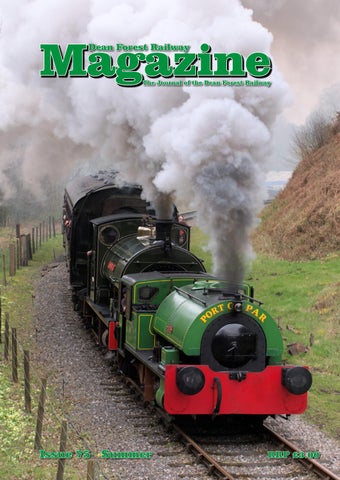
Front cover: On Sunday 29th March, during the Small Engines gala, Amber Whittaker captured Port of Par Bagnall Judy and Uskmouth 1 double-heading out of Norchard past New Mills foot crossing. Rear Cover: On Saturday 28th March, Callum Thompson captured this framed view of the bracket signal at Middle Forge from the cab of Uskmouth 1.
All DFR Society post (donations, membership renewals and general correspondence) should be sent to:
www.dfrsociety.org.uk
DFRS Honorary Secretary (Mrs. S. Williams) 109 Victoria Street Cinderford Gloucestershire GL14 2HU
From the Editors Dear Society Members, Firstly, since the deadline for the last issue, we have sadly lost a number of individuals who were involved with the railway over the years. John Buckley's obituary is included in this issue. We will endeavour to publish the obituaries for Bob Turner, George Locker, Ian Godsave and Gordon Williams as soon as they become available. Secondly, there is always something that needs doing, whether it is public-facing, such as selling raffle tickets on the train, or undertaking operational roles such as Guard or Signalman. If being in the public eye is not your cup of tea, there is also plenty of work behind the scenes repairing and restoring track, locomotives and rolling stock. In the style of the late president of the United States John F Kennedy... my fellow members: ask not what your railway can do for you – ask what you can do for your railway. If you think you could help us with any of these roles, please do get in touch via volunteering@deanforestrailway.co.uk – we’d love to hear from you. The deadlines for remainder of 2026 are as follows: • •
Issue 76, copy date: 1st August Issue 77, copy date: 31st October
As always, members with a valid email address will be sent an electronic copy, with hard copies being mailed to all members at least a week later (except, of course, for those who have opted to receive electronic copies only).
To maintain the standard that you have grown to know and love – we use the same fonts, sizes, and styles throughout: Title: Clarendon Blk BT, size 36pt Body: Gill Sans MT, size 11pt For anyone writing content you can use those parameters, otherwise, please use the regular font in your chosen software, set at size 11pt. Images need to be high-quality. Please make every effort to submit articles and highquality photos – we cannot publish what we do not have! If you're unsure or need any advice, please get in touch! Letters to the Editors should be sent either by email to magazine@deanforestrailway.co.uk or by post to the DFRS Honorary Secretary – letters received by the copy date that can be published will be passed on for an answer (as necessary) and then included near the rear of the issue. The Editors cannot guarantee that an article submitted by the deadline will appear in the next issue of the magazine. This may be due to the time taken to process it, late submission, lack of suitable imagery, space constraints, or a backlog of other submissions that may take priority. We value your support, and remain dedicated to keeping you informed and connected within the railway family. With best wishes
Adam W, Ian & Tim Your editorial team
Above: Seen, left to right, with Uskmouth 1 and a GWR autocoach are Bob Turner, Alan Grimstead, and Peter Skinner. (Photo: R. Lees) DFR Magazine
Issue 75
1
Chairman's Platform Ian Pope gives us an update in his role as Chairman of Forest of Dean Railway Limited. As I write this, the Office of Rail and Road (ORR) investigation into the St Mary's Halt bridge incident has now concluded. Whilst none of us would ever wish to see such an incident occur, we can at least take some comfort from the fact that no-one was injured and that the railway has worked openly and constructively with both the ORR and the Rail Accident Investigation Branch (RAIB) throughout the investigation process.
Whilst the outcome was not one that any of us would have wished for, the open and cooperative approach taken by the railway throughout the investigation was recognised by the inspectors. Given the seriousness of the incident, it is possible that our transparency and willingness to engage fully with the investigation helped to avoid more severe enforcement action under the ORR's Enforcement Policy Statement and Enforcement Management Model.
The ORR has issued the railway with an Improvement Notice following its findings. This is not a matter that any of us should take lightly. The notice requires us to strengthen and formalise our arrangements for the safe operation of non-passenger trains used to transport plant and equipment by rail. In addition, the ORR has identified areas where our wider safety arrangements require improvement, particularly regarding gauge clearances and the training of safety-critical staff and volunteers.
This process has enabled us to focus our efforts and we are now working on the necessary improvements and embedding the lessons learned throughout the organisation. This work has been demanding and, at times, stressful, and will remain so until we have fully complied with the requirements of the Improvement Notice. Nevertheless, it has helped us identify areas where we can improve our procedures, strengthen the railway and build a safer organisation for the future.
It is important that every member and volunteer understands what this means. The Improvement Notice is not directed at one department, one manager, or one individual. It is directed at the railway as a whole. Each and every one of us has a role to play in ensuring that we operate safely, comply with our procedures, and maintain the standards expected of a modern heritage railway.
As we continue with our development ambitions, including work at Lydney Junction and beyond, we must remember that safety and development go hand in hand. One cannot be sacrificed for the other. The railway's future depends not only on expanding and improving our facilities, but also on demonstrating that we are capable of managing those developments safely and professionally.
I am pleased to report that Tim Rudge has now taken on the role of Health & Safety Director. Tim's responsibility is not to introduce unnecessary bureaucracy or prevent people from getting on with their jobs. His role is to help ensure that we all go home safely at the end of the day, every day, and that we as an organisation comply with our legal obligations. I would ask everyone to give Tim their full support and cooperation. If a piece of advice is given or a concern is raised, please do take it seriously.
Before I conclude, I need to correct an error in my previous Chairman's Platform. A vital word was omitted from the sentence: "Remember, arguing or gossiping in public areas does portray the organisation as a whole in a good light." It should, of course, have read "does not portray the organisation as a whole in a good light."
I would like to clarify that by "public areas" I do not mean only those locations on the railway where passengers and visitors may overhear conversations. The same principle The events of the past year have demonstrated that safety applies to social media, as comments made online can be management cannot simply exist on paper. Procedures, seen by a far wider audience than those made face-to-face. risk assessments and rule books are only effective if they are understood, followed and regularly reviewed.Whether Both of these have an impact on how the Dean Forest you are involved in train operations, permanent way, Railway and its umbrella of organisations are perceived by signalling, infrastructure maintenance, restoration work members, volunteers, visitors and our neighbours.We may or administration, the same principle applies. We all have not always agree with one another, but we should always a responsibility to work safely and to challenge unsafe remember that our words and actions, whether on the practices where we see them. railway or online, reflect upon the organisation as a whole. The investigation process has also highlighted the enormous amount of work carried out behind the scenes by members of our management team and volunteers. Countless hours have been spent gathering documentation, reviewing procedures, attending meetings and responding to requests from the investigating authorities.
We are all here because we care about the Dean Forest Railway and want to see it succeed. By working together, supporting one another and maintaining the highest standards of safety, we can ensure that the lessons learned from this incident lead to a stronger, safer and more resilient railway for years to come.
On 21st May, Adam Williams and Adam Dickinson, accompanied by our solicitors, met the ORR inspectors at their Bristol office to hear the findings of the investigation. DFR Magazine
Issue 75
2
DFR Magazine
Issue 75
3
DFR Magazine
Issue 75
4
DFR Magazine
Issue 75
5
DMU Group Update Alan Pace gives an update on the continued work of the DMU Group.
The DMU group were busy over the winter with working days held on most Wednesdays and some Saturdays. Having to work without covered accommodation has made some of the jobs more difficult but we did our best to get things done as and when the weather allowed. A lot of effort has been spent on the rear of E50619, with the large transverse timber and the plates at the bottom of the corridor connection having been fitted. The exterior has been filled and sanded where the new metalwork joins the old, a tedious job but very important in order to obtain a good finish. At the time of writing the majority of the external work on the rear of E50619 has been completed, with the exception of some painting. Good progress had been made on the inside, which will be lined with insulation between the aluminium sheet and the panelling. With all of the new or restored metalwork and woodwork and the high quality workmanship it must be one of the best heritage DMU rear ends in existence! The vehicle will also require a new set of batteries to be fitted before it can be able to return to service. The railway's insurance inspector has paid a visit in order to certify the air tanks and safety valves on the fleet. Following the discovery of a fault, one of the air tanks on M51914 had to be removed and replaced. We have also been working to resolve problems with leaks from the unloader valves that regulate pressure in the air systems. DFR Magazine
Issue 75
Some maintenance and servicing work to prepare vehicles for the 2026 season has been done. During this work a failed driver’s brake feed valve on M56492 was identified. This item has been overhauled, refitted to the vehicle and set up. M56492 also had an electrical fault which needed to be found and fixed and a leaking vacuum pipe which needed to be replaced.Various other jobs such as changing a wiper blade on M51914 and overhaul of electropneumatic valves have been done in between drinking tea and having the occasional bacon butty. In April members of the group attended a session on checking and overhauling door locks given by Steve Beck, a career railwayman. Steve has been a friend of our group for many years; and he provided an interesting course. Some surplus roofing sheets have been used to provide some protection from the weather in an area near our outside workbench. We hope to make further improvements to the DMU depot during the year. Thanks to Nigel Benning, we have enjoyed some group outings to the Gloucestershire Warwickshire Railway and the Paignton and Dartmouth Railway, more are planned. If you would like to know more about our DMUs or perhaps even join our volunteer team, there is normally someone at Norchard on most Wednesdays – so come along for a look around and a chat. Otherwise please do not hesitate to get in touch via dmugroup@deanforestrailway.co.uk – we’d love to hear from you. 6
Above: With the metalwork on E50619 complete, thorough preparation of the bodywork is now required before painting. (Photo: R. Thomasson)
Above: After extensive preparation, the paintwork on E50619 nears completion.The corner has been finished to a high standard, whilst the upper panel awaits painting.
Opposite Page: The failed driver’s brake feed valve from M56492 in the process of being overhauled. (Photo: R. Arthur)
Below: With the exterior work almost done, Chris Blakemore and John Bryan continue to work on the interior E50619. (Photos: R. Thomasson)
DFR Magazine
Issue 75
7
Great Spread: A two-car DMU formed of M56492 and M51914 pauses at Tufts Bridge during a test run. (Photo: A. Pace)
Membership Matters Membership Secretary Adam Williams, gives a brief update on the new membership system.
The 2026 season is now firmly with us and, looking at my notes, it has been quite a while since my last article, so I think it is time to get out the old writing utensils again. Overall, 2026 has started off as another busy year for the railway. Work has progressed across a number of areas of the railway. Some projects have inevitably taken longer than originally planned, the dedication of our volunteers has ensured that progress has continued to be made. I am pleased to report that total membership has grown to over 1,450 members. This is an tremendous achievement and a testament to the continued support enjoyed by the Dean Forest Railway Society. Our aim is not only to maintain this figure but to continue growing our membership wherever possible. In what remains a challenging financial climate for many, this support is more important than ever. There are a few recurring themes, and there are a couple of key points that I would like to reiterate: 1. Please take the opportunity to renew using the online portal: https://dfr.hops.org.uk/membership
5. Please note however that our Bank Accounts are now subject to service charges. When paid in, cheques are each subject to a £0.50 charge, whilst cash is charged at £0.75 per £100. Finally, thank you once again for your continued support throughout the year. Your membership, donations and encouragement are vital in helping us preserve and develop the Dean Forest Railway for future generations to enjoy. •
Heritage Operations Processing System
The DFRS’s membership system is now integrated into Heritage Operations Processing System (HOPS). This means that new members can join, and renewals can be made directly online, with payments handled securely through the integrated Stripe payment processing platform. Members can now view their records, with options to update addresses, contact details, and so on. All members with an email address recorded have now had their HOPS accounts made live, and access details and verification links have been sent out. If you don't think that you have received yours – please get in touch.
2. We accept payments by cheque and postal order, cash Working Volunteers can use their existing HOPS account should only be used at Norchard, in person. Please do to check their membership status. not send cash through the post. Some members still 1. Log on to www.hops.org.uk do this and, unfortunately, the contents do go missing. 2. Select the silhouette in the top right hand corner 3. If you are paying by cheque or postal order, or 3. Select "My DFR Details", please note this page is also completing a standing order mandate, processing can available directly via: www.hops.org.uk/user be made easier if all details are completed correctly. Some banks can be particularly strict and may reject 4. Select the "Membership" tab forms that are incomplete. Please do not send blank At present there isn’t the ability to renew memberships cheques and do not post-date them. from this page. All members have to renew their 4. We cannot accept responsibility for any renewals that go astray in the postal system on their way to or from us. We are aware of ongoing difficulties within the postal service but, importantly, if you have not heard anything from us after 28 days, please do get in touch. DFR Magazine
Issue 75
membership via: https://dfr.hops.org.uk/membership Memberships periods are logged separately, so you will still receive emails about memberships expiring after you have renewed. You can check to see if your renewal has been recorded via: https://dfr.hops.org.uk/account 10
•
But Why HOPS?
The aims of migrating our membership system to HOPS and away from proprietary spreadsheet software are: 1. Enhanced Data and Information Security The HOPS membership management system requires a password protected account with Multi Factor Authentication and the correct access permissions. 2. Improved Data Integrity and Management
Sadly, that is the nature of the regulations, and we would be on the wrong side of the law if we acted otherwise. So, just because you have informed me (as the Membership Secretary for the Society) does not mean that I can inform, say, the DFLG, the DMU Group or even the Company Secretary – unless you specifically instruct me to do so. By the same token, any of those other organisations cannot share your personal data with us unless you specifically instruct them to do so.The instruction doesn’t need to be an essay – a simple endorsement is all that’s needed:
The risk of making accidental changes or deletions is removed and changes now require positive actions. "Please share my change of details or circumstances with Additionally, HOPS records who makes changes and when. all organisations operating under the DFR umbrella." 3. Better Integration of Systems
•
HOPS is used for volunteer management, so it is simple to change a member from a "Non-Working" to "Working".
Members are entitled to a 50% travel discount on normal operating days, on the production of a valid membership card. If booking via the website, use the discount code DFRSMDX4892 when checking out to claim the discount but don't forget to bring your membership card!
Stripe is embedded, so card payments can be taken directly rather than requiring a separate system such as ZoHo. 4. Reduced Dependence on Individuals Whilst I do not yet have any plans, I was surprised to discover, after reviewing my records, that I have now been involved in managing memberships for fifteen years. I was appointed Assistant Membership Secretary in 2011 and later succeeded Bob Bramwell as Membership Secretary upon his retirement a few years later. While having this continuity has been beneficial, it also highlights the importance of ensuring that the membership records and processes are embedded within an organisational system rather than relying on the knowledge, availability, or equipment of one person.
•
Member's Discount Code
Working Member’s Identity Cards
If you are volunteering then you need a Working Member’s Identity Card, if you don’t have one then get in touch! The Identity Card requires an up-to-date digital passport style photograph of you or a ‘selfie’, to ensure that you are recognisable from the image, both in HOPS and on the ID Cards, your photograph must meet these requirements: •
Head only, filling at least 50% of the photo
•
Colour photograph (not black and white) against a plain white or light-coloured background.
•
No hats (religious headwear is permitted).
•
A clear, sharp photograph taken in good lighting (preferably daylight or a well-lit room). Your facial features must be clearly visible. Smiling is welcome.
•
No filters, effects, borders or novelty additions.
•
No props, handheld items or slogans.
•
No other people in the photograph.
The DFRS holds personal information for the provision of goods and services, renewals of membership, distribution of formal documents, newsletters, appeals for financial support and volunteer labour.
•
The photograph must be recent and accurately reflect your current appearance.
•
Glasses may be worn if you usually wear them, but sunglasses are not permitted.
The DFRS complies with its obligations under the Data Protection Act and the General Data Protection Regulation in relation to the keeping of, and provision of access to, the registers of its members. Following Brexit, the EU GDPR and the Data Protection Act 2018 were combined to form the UK GDPR, which has been in force since 2021.
•
The photograph must be in one of the following formats: .png, .jpg, .avif, .webp, .gif or .bmp.
When a new volunteer steps forward to manage the membership, they will be able to learn and follow established processes more easily. This will also reduce operational risk by ensuring that membership data is held within a centrally managed, backed-up system, rather than being dependent on a single individual, their personal devices, and their personal knowledge of the role. •
Privacy Statement & Data Protection
Images that show your personality (like being under an engine or welding) are fun, but they do not help others in identifying you. For ID purposes, clear and simple is best.
So, if you notify us of any change in address or circumstances, Opposite Page: The "Membership" tab as seen by a working unless you instruct us to pass these changes on to other volunteer, it shows entries for both a current and a renewed groups within the railway, we cannot share them! membership – the latter is "Not yet started". The member will still receive a reminder that the first entry is expiring. This might appear callous in difficult circumstances – but (Photo: A. Williams) the law applies even when dealing with bereavements. DFR Magazine
Issue 75
11
Parkend Monday Gang George Smith reports on the activities of the Parkend Monday Gang.
We are still active, although reduced in numbers. For a At present, there are six new boards being made from range of reasons, our last report was during Summer 2025. scratch in the goods shed.The Great Western-style boards are eight feet long and two feet wide. There are two We are now a band of three, as John Goldrick now of these, one each for Norchard and Lydney Town. The volunteers with the Lineside Clearance group. John Phillips Midland Railway-style boards are smaller, being roughly has not attended over the winter months but hopes to four feet long and two feet wide. There are four of these, rejoin us soon. Dave Cross still regularly visits at coffee to be fitted at the same stations. Due to the huge size of time but is no longer able to work. He is driven to Parkend the Lydney Junction board, we have decided not to tackle from his home in Awre by his wife, Ursula, who patiently that one until the others have been completed. sits in the car reading the newspaper while Dave chats with us. I am accompanied by Chris Bladon and Kevin Lea. The backing boards were delivered cut to size and are made of Duraply, a supposedly more weather-resistant Since spring 2025, we, the gang, have erected two new material. Each face of the Great Western boards is edged posts and a single gate across the siding leading into the with mouldings (like a narrow skirting board) and trimmed yard, replacing a double gate that was beyond repair. The along the outside edges. Quadrant moulding was added new gate has been painted with four coats of white paint to form a rain run-off, and struts were fitted behind for and is supported on oak posts. The gate, posts, hardware strengthening. The timber was supplied by Light Fantastic. and paint were funded partly by us and partly through book sales at Parkend. Our thanks go to the Friends of All of the pieces have had to be cut to length, some mitred, and then painted. Anti-knotting solution is applied first, Parkend Station (FOPS) for their continued support. followed by wood primer. One or two coats of undercoat Last autumn, we were asked whether the group could were applied before two coats of gloss. This all takes time! restore the station running-in boards at Whitecroft, Norchard, Lydney Town and Lydney Junction. Most of Great Western boards are black with white surrounds and these boards were in a poor state, having rotted over lettering. The Midland boards have a black reverse side time, with the plywood backing boards delaminating. The and black surrounds, whilst the front face has a grey-green boards at Lydney Town were especially bad, as can be seen background with a yellow inset and black lettering. in the photographs. The boards at Parkend are maintained The lettering is enclosed within a rectangle with curved by FOPS and remain in good condition. edges at the top and bottom. Kevin has made all of the The first board to be tackled was the Great Western one from Whitecroft. It was in fair condition, having only lost one of its letters and suffering badly from peeling paint. Kevin used his scroll saw to create the replacement letter, and the board was given a fresh coat of paint.
letters and surrounds in his workshop at home. The colours of the boards may not be historically accurate, as we have used the same “Lizard” paint used on the buildings at Parkend, together with a yellow paint available from a local hardware shop.
An unexpected funeral in New Zealand, followed by a two-week stopover in Sri Lanka on the return, took me away for the entirety of January. As the board is long and heavy, it did not go back up until February, as it required three pairs of hands: two to lift it and one to fix it in place.
Once these signboards are finished, we will be erecting a second lantern at Whitecroft. If you think that you would be interested in helping out and joining our gang, please do get in touch via volunteering@deanforestrailway.co.uk – we’d love to hear from you.
DFR Magazine
Issue 75
12
Opposite Page: The new yard gate, posts and fence. Above: The Great Western nameboard from Lydney Town. Below: The same board after the fixtures were removed. (Photos: G. Smith)
DFR Magazine
Issue 75
13
Above: The Midland nameboard from Lydney Town. Below: The timber being prepared in the Goods Shed. (Photos: G. Smith)
DFR Magazine
Issue 75
14
Above: The restored nameboards for Lydney Town. Below: The restored nameboard returned to Whitecroft. (Photos: G. Smith)
DFR Magazine
Issue 75
15
Rennes Returns Callum Bayliss gives an update on the return of austerity WD152 "Rennes".
WD152 was built by Robert Stephenson & Hawthorns (RSH) of Newcastle in 1944 to the austerity design, having the works number RSH7139. It was one of the three hundred and seventy-seven built during the Second World War, and one of the ninety that were constructed by RSH.
New lower outer firebox wrapper sections and a new lower throatplate section were fitted, along with a new set of tubes and a new fire hole door ring. Additionally, new fire hole door runners were manufactured, whilst the original gauge frames and safety valves were refurbished.
WD152 gained the named Rennes during 1950 whilst based at the Longmoor Military Railway where locomotives were named after places associated with the Second World War and the Allied campaigns in Europe and North Africa. In this case the locomotive gained the name Rennes after the French city of the same name in the Brittany region.
With the work on the boiler complete, it then underwent several hydraulic tests, during which it was pressurised well above the normal operating pressure with water. With the external boiler inspector happy with the results, multiple out-of-frames steam tests were then undertaken.
WD152 Rennes last ran on the Dean Forest Railway in December 2020, when it was withdrawn from service due to issues with the boiler that the locomotive had borrowed from HE3889 and had been operating with since 2017. The original boiler has since been overhauled, and the locomotive passed its in-steam insurance examination in February this year, marking its return to service. Work on the boiler had been carried out sporadically between other projects since 2018. However, it was found to be in a very poor condition, with the backplate cracked, the inner copper firebox cracked and buckled, and the front tubeplate heavily corroded, amongst other issues. By the end of the overhaul, the inner firebox, foundation ring, backplate, and front tubeplate had all been replaced. DFR Magazine
Issue 75
During early 2024 another Hunslet austerity – HE3163 Sapper had arrived at Norchard for a bottom-end overhaul. By the time we had completed this mechanical overhaul and final assembly during August 2025, Rennes had been out of use for over four years, so the chassis was moved into the restoration shed at Norchard for attention. Work included replacing the axlebox underkeep oil pads, fitting new spring link pins, removing and inspecting the slide valves, and carrying out a deep clean and repaint. One unexpected task that we encountered was having to lift the locomotive completely off its trailing wheelset.This was to replace four original fitted bolts on the left side of the locomotive that had signs of metal fatigue. These bolts can be found beneath the front of where the ashpan would otherwise sit (so are not accessible with the boiler in place) and attach the frame stretcher to the frames. 16
Above: With the out-of-frames tests complete, the boiler cladding was fitted and painted ahead of final assembly. Left: The trailing wheelset is lowered out of the frames in order to access the fitted bolts that hold the frame stretcher. Opposite Page: The original boiler is taken up to full working pressure during one of the out-of-frames steam tests. (Photo: E. Freeman)
DFR Magazine
Issue 75
Below: Before the boiler could be fitted, the reassembled chassis was cleaned down and given a fresh coat of paint. (Photo: C. Bayliss)
17
Above: The metalwork is sanded back ahead of painting. Below: After hours of work, the painting is finally complete. (Photos: C. Bayliss)
DFR Magazine
Issue 75
18
Above: The new paintwork sees daylight for the first time. Below: Rennes is steamed ahead of test running. (Photos: C. Bayliss)
DFR Magazine
Issue 75
19
Great Spread: WD152 (RSH7139) and Pannier No.9681 approaching Oakenhill Wood No.2 crossing. (Photo: P. Wilcox)
Carriage & Wagon Dave Chappell gives a quick update on the latest activities undertaken by the team.
•
4862 – Mark 1 TSO
The refurbishment has progressed to the vestibule at the South end of the carriage.This area was where there were originally two toilets, and the cubicles have been removed making a larger foyer. At one stage using this for a buggy store was suggested but this has yet to be confirmed.
However, these had to be drilled to match the threaded holes in the aluminium window frame. As with the main frames in the rest of the carriage, perspex templates were made to copy the threaded hole alignment from the frame and transfer it to the aluminium panels to clamp the glass.
Some of the threaded sections in the outer frame were no longer usable where steel screws had been inserted in The carriage structure round the cubicles, toilet windows, the past and these has corroded and sheared off when the door frames and the South end partition and carriage end windows were removed. This has required new mounting has meant that a considerable amount of specially shaped holes for the internal struts. timber struts have been required to form the wall framing to which the panelling can eventually be anchored. So far, the larger pane in the bottom half of the window has been glazed, but even this was not without problems... The stack of curved, straight and tapered wooden struts The two window frames in the foyer were not the same awaited preservative treatment and before taking their size! The west window frame was marginally smaller and position within the structure around the window. not truly rectangular, so that the glass would not fit, while The foyer windows are a different design from the main the same size glass fitted perfectly in the East side frame. body of the carriage because of the ventilation grilles and Advice was sought as to the best course of action, and the obscured glass used for the toilet cubicles. The aluminium west window frame was carefully 'adjusted' with an angle frames were devoid of any of the mounting frames or grinder until the glass could be inserted. The glass was still window surrounds, so mounting glazing into the frames tight along the top edge, and so the sealing rubber strip had to be undertaken from first principles. had to be tailored to accommodate this. The piecemeal remnants of an inner window frame were Even with all the custom wooden struts in position there discovered, and these were joined with custom corner are still difficulties or inconsistencies to be overcome. pieces to make an example inner frame. This can be used The communication cord or chain runs in steel tubing as a template to make new inner window frames. along the inside of the carriage, behind the wall panelling. An array of curved and straight aluminium panels were Unfortunately, above the door next to the "west window", created to form the sections to clamp the glass in place. the steel tube was not recessed within the wall panelling. DFR Magazine
Issue 75
22
This means either that the communication cord has to be completely re-installed and holes cut through the carriage structure to accommodate it, or the wall cladding will need a box section formed at ceiling level to hide the steel tube. This latter option is considered to be the simpler alternative and is intended to be the preferred solution. •
4923 – Mark 1 TSO
The rolling programme of carriage repaints has begun, with 4923 being moved into the Blueline building.This will allow Western Steam Engineering to strip back the paintwork and undertake the refurbishment. The carriage appears to have several areas of corrosion to the roof and bodywork which were patched during a previous refurbishment carried out at another railway. The extent of the repairs required may slow the refurbishment programme and delay the carriage’s return to service. During this time, the batteries are also being topped up with distilled water, as half of them are normally inaccessible beneath the low-level platform edge when the carriage is stabled at the end of the operating day. Opposite Page: The oddly sized (and shaped) west window. Right: The wall framing-struts await preservative treatment. Below Right: The reconstructed window frame. Below: The new wall framing-struts are finally in place. (Photos: D. Chappell)
DFR Magazine
Issue 75
23
FOPS Update Stuart Bearne provides an update on the continued endeavours of the Friends of Parkend Station. The ongoing maintenance programme at Parkend has allowed progress to be made on several fronts. The general refurbishment of platform benches, trolleys and tables has proceeded, with bench cast bases receiving particular attention regarding the highlighting of the raised GWR lettering in gold. The platform wooden fencing has now also received a full coat of wood stain. A recent inspection of the footbridge has revealed sections of the main span over the tracks that have suffered severe corrosion. As a result, the intention is to carry out a thorough repair regime, and work on this is already in hand. In the meantime, cosmetic work is being carried out on the steelwork, including the balustrades on the steps up from both platforms. White lining of the platform edges is underway, as is weeding of the track. We have also assisted the S&T Department with repairs to the crossing gates. A number of leaks in the gents have now been fixed, including the fitting of a new cistern. This has allowed floor painting to be carried out. Internally, the floors of the ladies, gents and waiting room have been repainted. The walls of the ladies, together with the white of the window frames throughout the station, have all been refreshed, as has the fireplace located in the waiting room. A general cleaning and tidying-up of the waiting room, together with the reorganisation of the book sales shelving, has resulted in a more presentable appearance in this area, and useful revenue continues to be generated from book sales. Many thanks go to those who have contributed books. The proceeds have enabled materials to be purchased for use in various areas of work.
Above: The floor of the gents being freshened up. Below: The white edge being repainted on platform 2. (Photos: S. Bearne)
Once the cosmetic work on the bridge has been completed, we will address the south end of the Goods Shed, which requires repainting. Any other areas of the station building that need attention will also be dealt with. Now that progress is being made on the occupation of the goods shed by the Museum, clearance of the shed will become a priority. Many items in the main area are not owned by FOPS, so their removal by the appropriate groups would be greatly appreciated. As always, donations of unwanted railway and transport books are very welcome and will find an appreciative home on the shelves of the waiting room at Parkend.All proceeds from sales are then used for maintenance items. We have many jobs on the list and additional manpower would be welcomed – please get in touch. Keeping such a lovely station looking its best is very rewarding. We meet on Tuesday mornings at Parkend Station, and a warm welcome is guaranteed for anyone who would like to come and join our friendly group of FOPS. DFR Magazine
Issue 75
24
View from the Box Adrian Copley, DFR Operating Manager, updates us on the first part of the 2026 season. Mid-January was the first time this year I heard the ‘dawn chorus’, and, having been brought up in the country, I do appreciate the beautiful sound (even at 04:00 in the summer months). It was ruined a week later by those chip-thieving, rubbish-disturbing, noisy gulls! There must have been bad weather at sea... I would have a job for a rifle, but apparently they are a protected species! The daffodils were growing outside my window, which leads to thoughts of spring, bluebells, foxgloves and summer (sunshine please – after all that winter rain). So, March arrived and, on the start of the passenger running season on the 11th, our passengers were treated to 9681 and the newly out-shopped (railway terminology for repairs and repainting) WD152 Rennes double-heading After a successful test, WD152 was quickly off to the Swanage Railway for their gala, which was the same weekend as our Small Engine Gala. This event, held on Saturday 28th and Sunday 29th March and featuring 9681, Uskmouth 1 and Port of Par Bagnall Judy, turned out to be reasonably successful in its new guise! I say new guise because two of the original starring locomotives were unfortunately stopped from running at the last minute. As a result, the timetable team were set another last-minute challenge, which was easily overcome by keeping everything simple, and that worked quite well.
E6003 was pressed into service as soon as all the t’s were crossed and i’s dotted, first on a tanker train and then on a passenger turn while 9681 hauled a Driver Experience Day. The diesel also had to cover for WD152 on the morning of another tanker train day after the latter had just returned from Swanage, and was slow in raising steam. Everything should be good for covering steam services during periods of high fire risk (which could be soon if there is a repeat of last year)! April saw some hot, dry weather and I thought action was going to be necessary. Thankfully the Bank Holiday forecast showed rain, so that thought is on hold for a while, with just a reminder issued to everyone to be careful until we see how much rain falls. Only running a year behind schedule is the repainting of the coaches, but the first one is ‘on shed’ having work done. There is an ordered plan, but that has already changed, although the critical part of the plan is the brake coaches because of the commercial requirements for these. All is in hand as long as everyone reads the Periodic Operating Notice (PON) and Weekly Operating Notice (WON), and we can get things shunted around at Norchard! Below: Judy heads in to Norchard Yard to take on water. (Photo: A. Copley)
On the first day, however, we had a problem (there would be... as I was Duty Officer). There was a road tanker at Lydney Junction to supply the engines with water, but initially it would not work. So, when the diminutive Judy required water, a quick decision was made to amend the timetable: the engine would go to Norchard Low Level ahead of, rather than following, a train to the High Level. Just as everything was arranged, someone produced an adjustable spanner and solved the problem, too late to change everything back timetable-wise. So, don’t leave home without your required tool kit, folks! The rest of the day went fine and ran to time. Yes, I managed to take a couple of photos, and thankfully the sun made an appearance, as well as rain, sleet and even a few snowflakes! In early April our guest Judy departed, with WD152 Rennes returning at the same time. I just happened to be signalman at Lydney Junction when this took place, and I ended up with a lot more lever action than first planned. Things were on edge towards the end of the shift as the lorry with Rennes was a few hours late arriving from Swanage, and other people were standing by as well. There was, of course, the arrival of a diesel to the DFR.We welcomed the transfer of the Class 73 from the Swindon and Cricklade Railway (although the locomotive had paid us a visit in the past for a gala), and straight away there were training and familiarisation runs along the railway. DFR Magazine
Issue 75
25
Above: At Parkend, Judy waits whilst No.9681 arrives. (Photo: M. Lark) Left: Uskmouth 1 departs Norchard High Level. Below: Uskmouth 1 and Judy head for Parkend. (Photos: A. Adams)
DFR Magazine
Issue 73
26
Above: Uskmouth 1 and Judy queue for water at Parkend. Right: An unsung hero of the event – the water bowser. (Photos: A. Clarke) Below: No.9681 heads down towards Norchard Low Level. (Photo: P. Wilcox)
DFR Magazine
Issue 73
27
The Yellow Peril Callum Bayliss gives an introduction to the yellow Hunslet austerity – No.65.
No.65 was built as HE3889 by the Hunslet Engine Company of Leeds in 1964 and was the 483rd austerity locomotive. It also has the sombre title of being the penultimate standard gauge steam locomotive built in Britain for industrial use. The final one – HE3890 is preserved at the Buckinghamshire Railway Centre at Quainton Road. HE3889 was out-shopped on 18th March 1964 and delivered to the National Coal Board Manvers Main Colliery which was located on the Barnsley Coalfield of South Yorkshire.
Upon arrival it was soon discovered to be in very poor mechanical condition but had a good boiler. A search for suitable parts to repair HE3889 then began and sister locomotive HE2857 Swiftsure was acquired from Dodworth Colliery near Barnsley to act as a donor locomotive. However, upon arrival at Cadley Hill Colliery, Swiftsure was found to be in surprisingly better condition than what had been anticipated.The locomotive was returned to working order very quickly, with HE3889 becoming a spare parts donor for both Swiftsure and HE3851 Cadley Hill No.1.
It was built with modifications designed by Argentinian HE3889 was sold in to preservation in 1983, with the engineer Livio Dante Porta including a Kylpor exhaust, a private owner moving it to the Buckinghamshire Railway gas producer combustion system and an underfeed stoker. Centre where it stayed until 1987. From there it then was The Kylpor exhaust had been developed during the 1940s moved to the Rutland Railway Museum at Cottesmore as a refined derivative of the Kylchap exhaust. The latter (now known as Rocks By Rail Living Ironstone Museum) was developed by French engineer André Chapelon during where it was labelled as RRM exhibit No.28. 1926 based on work by Finnish engineer Kyösti Kylälä. The locomotive changed owners during 2010 and it once However, the gas producer combustion system and again took up the role of being a parts donor... this time for underfeed stoker were not as successful as had been HE3163 Sapper, along with HE2857 Swiftsure again! After anticipated on the austerities and many, including HE3889, the sale, it initially moved to the Flour Mill workshops in had these removed in favour of the standard arrangements. Bream before moving on to Peak Rail. It finally arrived at By 1971, HE3889 had become the spare locomotive the Dean Forest Railway in 2015 alongside RSH7139. at Manvers Main and then between 1974 and 1975 it was advertised for sale internally. The locomotive was purchased by the NCB South Midlands area, and it was moved to Cadley Hill Colliery in South Derbyshire. DFR Magazine
Issue 75
After arrival at the DFR, HE3889 was once again used as a donor locomotive for the last time before commencement of restoration works with the boiler temporarily used on RSH7139 (WD152 Rennes) between 2017 and 2020. 28
Above: 09 106 shunts HE3889 at Lydney Junction ahead of road transport to Norchard, the condition of the tyres meant that the locomotive could not be taken back by rail. (Photo: P. Harrison) Opposite Page: Captured at Peak Rail during 2015 are (left to right) HE3889, HE2857 Swiftsure, and HE3883 Lord Phil. (Photo: E. Freeman)
DFR Magazine
Issue 75
Below: With the arrival of HE3889 at Norchard, the saddle tank had to be lifted off and stored with the boiler.The latter was already at Norchard after being used for RSH7139. (Photo: C. Bayliss)
29
In early November the tank, cab roof and cab Sides were removed, followed by the bunker which was duly scrapped due to its poor condition. This has then allowed for removal of the cab and bunker floors (which are only good for scrap) and the associated corroded angle irons. The running plates, slide bars, lifting links, eccentric straps, reverser shaft and brake shaft were then removed to leave an almost bare set of frames. This will allow the inside of the frames to be cleaned back and painted. Most recently the bent front buffer beam has been removed to allow for frame repairs.The buffer beam and associated angle irons will be renewed. When this is completed it will allow us to remove the cylinder block so that the two halves can be split in order to assess its condition. The cylinder block is heavily corroded due to years of water entering the smokebox through the chimney hole before landing on the top of the block and then making its way into the block through the blast pipe opening. The original boiler for RSH7139 was removed from the locomotive shortly after it arrived, but work did not begin until the replacement had issues. By March 2025, work on the original boiler for RSH7139 was advanced, allowing the boiler for HE3889 to be removed. It is in a reasonably poor condition, with it being known already that the inner firebox and front tubeplate will need replacing. Although, there will almost certainly be a lot more work required once the boiler is stripped down and properly assessed.
DFR Magazine
Issue 75
Above: The peeling yellow paint on the cabside panel reveals the original lined green livery from Manvers Main Colliery. Below: The frames have been stripped down and the heavy corrosion to the top of the cylinder block is clearly visible. (Photos: C. Bayliss)
30
Above: With the cab and bunker floor removed, the levels of corrosion to the top of the frames are clearly visible. Below: The boiler for the locomotive spent three years in RSH7139 (WD152 Rennes) before suffering with issues. (Photos: C. Bayliss)
DFR Magazine
Issue 75
31
Historic Spread: No.65 (HE3889) and Swiftsure (HE2857 at Cadley Hill Colliery near Swadlincote, South Derbyshire. (Photo: I. Pope)
Beneath Your Wheels Alex Davies updates us on the continued work at Lydney Junction and at Parkend.
When I signed off last time, we had just completed two jobs in the Parkend area, replacing sleepers on the up line just south of the level crossing and swapping out 85lb rail just south of Whitemead Park foot crossing. Despite the persistent rain and many volunteers being either sick or away, work on replacing 85lb rail continued off and on through the late winter and early spring with the focus moving to the foot crossing at Oakenhill Wood No.2, just north of the Whitecroft telephone exchange. This has long been a problem area, not least because there was a track joint in the middle of the footpath and the footpath itself becomes a water course during periods of heavy rain fall, flooding the track bed. We replaced the existing forty-five foot long rails with longer 95lb rails that allowed us to move the joint clear of the crossing to a point where it can be easily maintained. We also sunk some offcuts of rail into the footpath on the uphill side of the crossing.These will hopefully divert some of the runoff into the cess and away from the track. Unfortunately, the line side team were unable to carry out the more extensive work planned for further up the footpath. The track through the crossing does need lifting slightly but that can’t be done until the ground has dried and we have an excavator on site to do the digging out. In total we replaced around four hundred and fifty feet of rail. This included about one hundred and fifty feet of both rails through the crossing itself and a further one hundred and fifty feet on the ‘down’ rail to the north of the crossing (this section was mismatched with 85lb rail on the down side and 95lb rail on the upside). DFR Magazine
Issue 75
Above: The new container for use by the Permanent Way after arrival and final positioning at Whitecroft yard. Opposite Page: Just to the north of Whitecroft, the 85lb rail through Oakenhill Wood No.2 crossing was replaced. (Photos: A. Davies) Although approximately one thousand feet of rail still needs to be replaced north of the area where we have been working, the work completed there and at Parkend represents a significant step towards eliminating 85lb rail from the main running line. One problem that both we and the S&T team were experiencing was difficulty accessing our containers at Whitecroft by road.The yard access is quite steep and the surface, which was nothing more than a very thin layer of grass and mud on top of stone, proved extremely slippery and difficult for vehicles. The problem was highlighted when the truck that delivered a container for the S&T department struggled to get out after unloading. In early February we engaged CM Contracting to lay a new access track to the ever-growing container farm. The new track has made road access to our tools much easier. Since then, a fourth container for our use has joined the existing three and the S&T container. Our workshop container also boasts solar lighting and battery charging capabilities, although we are also considering installing a permanent mains electricity supply. Unfortunately just as access improved to the containers, we suffered a setback on the rails when our Geismar EGO4 trolley suffered a major failure of its rear axle. 34
DFR Magazine
Issue 75
35
The failure of trolley left us with no means of easily moving tools and materials by rail. The failure occurred at Fish Farm curve as we were heading back to Norchard after a round of site clearing up at Parkend. A bit of ingenuity and muscle power by the team enabled us to get the casualty back to Norchard without needing to call out the cavalry.
The swap proved more difficult than we had expected. Getting the switches out and moving them to their respective new locations was a relatively simple task, completed by a small team in a single day. The problems started when we came to reconnect things. ..
Although the two switches appeared to be identical there Once the damage had been assessed we asked Western were minor geometric differences which resulted in a lot Steam to make a new axle and we took the opportunity to of unplanned fettling work for both ourselves and the S&T carry out other repairs and give the machine a full service. department. That, in turn, meant that the west loop and Platform 2 at Lydney Junction were out of use for the first With the road-rail Land Rover still being restored and no two weeks of the running season. crew for a train, we were limited to using road transport and hand trolleys to access work sites throughout With the work on 17A and 17B completed we turned our February and March. Fortunately, our two primary work attention to a long outstanding requirement, protecting sites, were at Oakenhill Wood No.2 and Lydney Junction, the Network Rail connection from runaways. The space so both sites were easily accessible by both means. between the run round point and the connection is too short to fit a trap point so, instead, we fitted a derailer. Although the railway is closed to normal traffic between January and mid-March the various departments carrying This device, which has now been connected to a single out maintenance programmes means that there are lever ground frame by the S&T department, acts in a inevitable conflicts, and we often have to work around similar way to a trap point but requires a lot less space. each other. This was very much the case with our plans The ground frame allows the derailer arm to be lowered for Lydney Junction during the closed season. The work to allow trains to pass but in normal operation it is raised we had planned here was rescheduled three times to and would throw any wheel striking it off the track. accommodate the needs of other departments. Work on the Geismar trolley was completed during April. As mentioned in my last article, our plan was to swap the As well as replacing the rear axle we also fitted two new switches in points 17A and B so that the worn-out switch wheels to the front axle and changed the main drive belt, on point 17A would become the trap switch on point 17B repaired broken mud guards, adjusted the throttle and – a switch that should never carry any traffic. brakes and fitted a new battery for the lights and horn. Left: The heavily worn switch rail on point 17A has been replaced with the little-worn equivalent from point 17B. Below: The new derailer and associated ground lever. (Photos: A. Davies)
DFR Magazine
Issue 75
36
This battery will be charged by solar power. A panel is being fitted to the roof of the hut at Norchard and will provide a trickle charge when the machine is not in use. Wheels have long been a problem and we were lucky in that we managed to purchase the last three EGO4 wheels that Geismar had in the UK – unfortunately, any future replacement wheels will have to be made to order. Just as our Geismar came back into service I was offered the chance to buy a second one from the Gwili Railway. With the machine costing less than a single new wheel it was too good an opportunity to pass up. Members of the Permanent Way team made the journey to Carmarthen on April 23rd and it now sits in a container at Whitecroft pending assessment. Whether we restore it or simply use it as a source of spares is still to be decided. With the ground starting to dry out we are now resuming our efforts to address drainage issues that we have discovered at Parkend. In Issue 72 of the magazine (during Autumn 2025) I described the work that was carried out last summer to survey and clear the drains and the grips we’d dug to get some of the surface water into the drains.
The drains themselves remain clear but getting the surface water into them remains a challenge. We are currently digging more grips and opening breeches in the old terracotta pipe to direct the water into the main drain. Old paving slabs that have been donated to the railway will be used as shuttering to protect these breeches and prevent the drains from getting blocked. As we move into the late spring, we are starting work at Lydney Junction to assemble the new point for Middle Forge. The plan is to construct the point to ensure that we have all the components and the geometry is right, disassemble it, transport it to Middle Forge and install it in the New Year. It sounds simple but we know it won’t be and the team is already working towards the aim of having the initial assembly completed by July. As well as the major jobs of track maintenance we sometimes get involved in smaller side projects. An example of this was work to reduce the risk of damage to the fence and crossing gate post at Lydney Town. This post, on the tight entrance to SWM ("Thomas’s Yard") is frequently grazed by trucks entering or leaving the yard and the fence has been damaged on several occasions. Below: The broken rear axle on the Geismar trolley. (Photo: A. Davies)
DFR Magazine
Issue 75
37
In an attempt to reduce the damage, we have worked with TEK Fencing to rebate the fence to the inside of the post and clad the post with rubber protectors of the type often seen in multi-story car parks. While this won’t stop trucks striking the post it should reduce the resulting damage. One significant change we are planning for the 2026 season is to carry out our monthly track inspections on Wednesdays when services are running. Whilst the planning is laborious, there are two clear benefits to this: 1. We can observe trains running over sections of the track, placing it under load. 2. It enables us to travel to and from the start and end points of the inspection walks. However, there are safety implications on carrying out inspections on a ‘live’ line and we are currently reviewing operating practices and giving additional training to team members on Lookout and Controller of Site Safety (COSS) procedures as well as reviewing all the points of limited clearance on the line. As I have mentioned previously we have unfortunately, we have lost the volunteer who had been helping us maintain our petrol-driven tools. He did a great job of getting us started on fixing and maintaining the various rail saws, rail drills, sleeper drills and generators that we have.
We require help with maintaining, repairing and refurbishing tools and materials in our workshop container at Whitecroft , which has been fitted with solar lighting and charging equipment and has access to the station building. If anyone is interested in taking on this role, then please get in touch. We also need to refurbish a number of point hand-lever mechanisms so that we can replace failing ones in the yard at Norchard and elsewhere. We are also looking for people to help sort and catalogue the Permanent Way materials that the railway has. In the early days, we (like most infant heritage railways) acquired anything we could from the various railways and engineering firms that were closing at the time. Most was ‘stored’ along the line in case it was ever needed. Now, as a more mature railway, we have a much clearer idea of what materials we will and will not need going forward. The development team has been progressively tidying up the railway (ultimately making it more attractive to our visitors) by recovering materials from various locations and moving them back to Lydney Junction. The items are then inspected and either stored for reuse or disposed of responsibly. This is the sort of activity that could be done on sunny weekend days during the summer, between service trains.
If you think you could help us with any of these tasks, please However he sadly cannot spare us enough time. So, once do get in touch via volunteering@deanforestrailway.co.uk again, we are looking for mechanically minded assistance... – we’d love to hear from you. Below: The gate post protection at Lydney Town. (Photo: A. Davies)
DFR Magazine
Issue 75
38
DFLG Update John Metherall, Secretary of the Dean Forest Locomotive Group (DFLG), provides an update. Twenty-one members attended the AGM of the DFLG which took place at Norchard on Saturday 25th April, and a further 7 members sent their apologies for their absence. Matt Sexton chaired the meeting and after remembering the death in January 2025 of Ian Beaton, our long time treasurer, he expanded on his report which had been previously circulated, adding that: •
5541 – now mothballed and work would not commence until 9682 was completed. However a fund has been set up to purchase long lead time items.
•
9681 – performed well during 2025 and achieved 99 steaming days.
•
9682 – the cylinder block casting is being weathered outside and machining will start later this year. Work continues on the cab and bunker.
•
Sales Coach – this is a major source of income for the Group with net sales exceeding £18,000.
•
Hawksworth Saloon – now owned by the DFLG and generated income for both the DFLG and the DFR. Following the painting of the exterior during 2025, further improvements to the interior are planned.
•
Collett Coach 5863 – purchased for £1.20, and after filling a skip of rubbish is now being used for storage of DFLG materials and the archive. Rotting timber in the sides requires stabilization before further restoration.
•
Fruit D – the van now has a new roof covering and painting was currently underway.
•
Website – Tracy Garrad continues updating the website and Facebook page and has set up a PayPal donating and charity eBay accounts. The website is currently being made more secure.
Above: No.9681 sits patiently at Norchard Low Level. Below: No.9681 under the water column at Parkend. (Photos: M. Lark)
The Examined Accounts had been circulated prior to the meeting and showed the principal sources of income as steaming fees, shop sales and donations to 9682 (£20,531). Over £30,000 was spent on 9682 during the year amounting to 39% of expenditure. Treasurer, Stephen Hawkins stated that this year’s accounts will be submitted using QuickBooks to meet HMRC requirements. Doug Phelps, Rauffe Shirley,Tom Buffin and Hannah Kingdon were re-elected as trustees. Christopher and Hilary Hill acted as scrutineers of the process. The Chairman recorded the death of long-time supporter John Buckley, who was also responsible for bringing the saloon that the DFLG now own to the railway. The Chairman thanked everyone for their support, and specially mentioned Tom Halford and the engineering team and Hilary Hill and the Sales team. Following the meeting Tom Halford provided a guided tour of the workshop. DFR Magazine
Issue 75
39
In Memoriam John Metherall and Berry Parker pay tribute to long-standing member John Buckley.
John’s first involvement with the Dean Forest Railway was when he became a Society member at a meeting of the Bristol Area Group back in 1974. This was the time when the late Peter Skinner was Chairman.
Away from the railway John was actively involved in family life, with four children and a number of grandchildren and great grandchildren – holidays together in the family caravan were always eagerly looked forward to.
During the early days it was all about meetings and slide shows at the RSPCA offices in Gloucester Road, trips to places of railway interest, spreading the word about our aims and fund raising. However, when projects to recover useful items for the railway arose from sites such as Filton and St. Phillips Marsh, John and his sons were there.
John was an instrumental figure in moving the railway forward, and took a positive yet realistic view. He made the effort to attend meetings at Norchard and I know we all will miss his presence. John was a very active man who lived life to the full. He will be greatly missed, not least for his regularly spoken phrase, "Here, guess what?"
In 1976 John offered to audit the books of the Forest Pannier Tank Fund, a task that he undertook up until 2015 when its successor the Dean Forest Locomotive Group (DFLG) became a registered charity.
Rest in Peace John!
John, and a few other stalwarts purchased inspection saloon W80943 and brought it to the railway during 1979, thus founding the Hawksworth Saloon Group. He became treasurer of that Group, a post which he held until very recently. More recently, the Hawksworth Saloon Group has merged to become a part of the DFLG.
Below: John at Parkend with his restored seven-plank wagon. (Photos: A. Buckley)
Above: John in the cab of ex-Port of Bristol Authority diesel locomotive PBA39 (based at the DFR from 1983 to 1998).
However, John's interest in rolling stock didn’t just end with the saloon and over the years he also acquired an eclectic collection of rolling stock. John always helped out at the Transport Rallies that the railway used to hold at Norchard during the 1980s and 1990s. In more recent times he also had a hand in building the facing wall of the new Platform 2 at Lydney Junction. DFR Magazine
Issue 75
40
Who’s Who at the DFR
Don’t miss out! A pictorial celebration of the DFR’s first five decades, containing many previously unseen photographs. £16 for members. Pick up your copy from the shop at Norchard or online (with discount code DFRSMEMBER20) from:
www.dfrsociety.org.uk/shop DFR Magazine
Issue 75
Forest of Dean Railway Ltd Overall strategic management of the railway Chairman: Ian Pope Vice-Chairman: Adam Dickinson Funding Director: Freddie Huxtable Commercial Director: Clive Stainton Development Director: Adam Dickinson Health & Safety Director: Tim Rudge Society Appointed Directors: Adam Williams, Dave Churton David Hurd Appointed Directors: Martin Hillier, Chris Bull Company Secretary: vacant Dean Forest Railway Company Ltd The day to day running of the railway Chairman: Adam Dickinson Operations Director: vacant Finance Director: Cecile Hunt Civil Engineering: vacant Lineside Director: Chris Bull Support Director: Adam Williams Health & Safety Director: Tim Rudge Chief Mechanical Engineer: Adam Dickinson Signal & Telegraph: Steve Harris Carriage & Wagon: John Clarke Electrical: vacant Permanent Way: Alex Davies Telecoms: Rick Gillingham / Charles Bristow Paid Staff General Manager: Peggy Römer Finance Assistant : Pat Graham Commercial Manager: James Graham Administrative Assistant: Rachel Tovey Dean Forest Railway Society Registered Charity 1183538 dedicated to the preservation and development of the DFR. Chairman: Tim McLennan Vice-Chairman: Doug Johnson Treasurer: Tim McLennan Secretary: Sue Williams Membership Secretary: Adam Williams Website Lead: Doug Johnson Social Media: Harry Colley Other Trustees: Dave Churton, Adrian Copley, James Graham, Alan Grant, Martin Hillier, Richard Taylor, Lynne Wentworth Dean Forest Railway Museum Trust Registered Charity 1178157 Chairman: Ian Pope Curator: Christopher Hill Dean Forest Locomotive Group Registered Charity 1164847 Chairman: Matt Sexton Treasurer: Stephen Hawkins Secretary: John Metherall Dean Forest DMU Group Chairman: Chris Bull Treasurer: Malcolm Harding 41