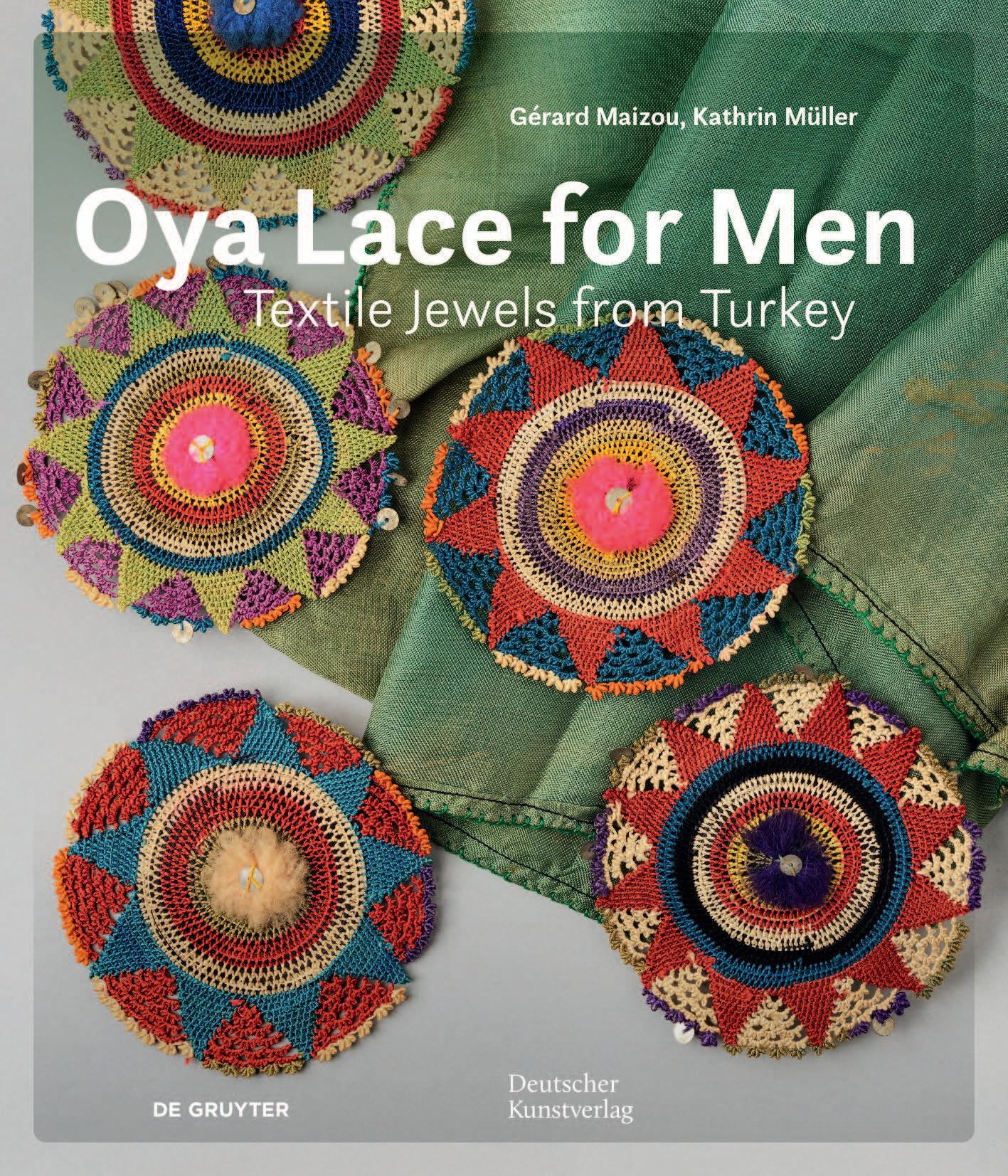
Gérard J. Maizou, Kathrin Müller
Gérard J. Maizou, Kathrin Müller
Edited by Gesellschaft der Freunde
Islamischer Kunst und Kultur e. V. München
Preface 2
Introduction to the Volume 4
Zeybek and Efe in Ottoman and Turkish Societies 7
Excursus 1 Mongolian eagle dancers 13
The Headgear of the Zeybek 14
Excursus 2 Parallels in Central Europe 22
The New Efe Oya 24
Efe Oya – Form and Colour 29
Classification of Efe Oya Lace 39
Differences between Men’s and Women’s Oya 41
Scarves for Efe Oya 41
A Collector of Efe Oya – Zafer Esi 42
Catalogue 47
Descriptions 74
Summary 89
Bibliography 91
Abbreviations 95
Index 97
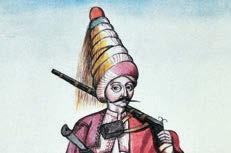
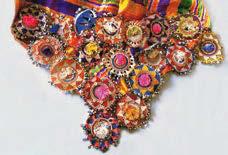
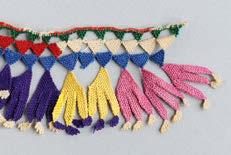
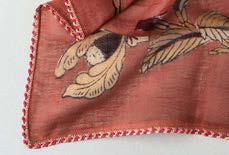
Oya is a type of lace that is common in the Balkans and the eastern Mediterranean. The Turkish word – used here as singular and plural and not translated to English – is derived from Greek oa ‘edge, edge decoration’. The Greek term for this lace, bibila (plural bibiles), on the other hand, is traced back to the Turkish birbire, which is to be understood as ‘one (i.e. knot) after the other’ and refers to the making method. In the countries where this lace is popular, there are usually separate terms, such as the Armenian djanyak, the Bulgarian kene or the Romanian cȋrligel. In western Europe, the lace was called Turkish, Greek, Armenian, Smyrna or Palestinian lace depending on its origin. In museums of the western world, Oya are registered either with the Turkish name or with the Greek term bibila or bebilla
Oya is a needle lace made by women and girls, freely knotted with a sewing needle and a silk thread. This description is the earliest definition of Oya that we have found. It appears in reports on the world exhibitions of the nineteenth century, where this lace was presented and, for example, awarded a gold medal in Paris.1 Even if the term Oya meaning a textile border appears in an older source one day, it was in the nineteenth century that Oya became famous as silk, coloured, three-dimensional needle lace.
Recently, Nurhan Atasoy has been able to document the term oya and oya-edged yemeni in Ottoman probate inventories from the mid-eighteenth century onwards2. However, we do not know what these Oya looked like, what material they were made of and what technique was used to make them and therefore we can only speculate. Consequently, we strictly apply the term ‘Oya’ to the type of lace presented at the above-mentioned world exhibitions, some of which are preserved in western European museums. We do not use the term to describe the borders on the edges of textiles made in earlier times, such as the gold and silver borders on headscarves depicted by the miniature painter Levnî, nor in our investigations do we include the cord borders, which adorned the edges of coat dresses in the nineteenth century as these cord borders employed quite a different technique.3
Later, attempts were made to imitate this lace, making it faster and cheaper to produce, but the term Oya was retained. Crochet hooks or shuttles were used as tools and cotton, flax, and even wool were used as yarn materials. In recent decades, nylon yarn has been used mainly, along with a wide variety of materials, some of which are laboursaving, such as glass,
plastic beads, and sequins, as well as other lightweight objects such as seeds and kernels, cloves, snail or mussel shells, pieces of silkworm cocoons, cardboard or staniol paper and many more.4 Even if these borders have nothing to do with Ottoman needle lace in terms of technique and material, they were initially modelled on and inspired by it, and the manufacturers have continued to use the term Oya.
There is no evidence of Oya in the craftsmanship of central Asia, nor in the ancient cultures of the Orient, among the Assyrians, Egyptians, and Phrygians, as is often claimed. It was not until the early nineteenth century that Oya appeared in paintings and soon thereafter in the first photographs. Oya was certainly inspired by western lace, which had made its triumphal march from Renaissance Venice not only to western Europe, but also eastwards, across the Balkans and into the Aegean islands, where it took on its own form in the form of three-dimensional, colourful lace. The development of the Oya border was certainly fuelled by the long tradition of embroidery. However, this only happened in the Ottoman heartland when western clothing became fashionable in the cities where ribbons, ruffles and other decorative elements were adopted, such as the expensive gold and silver borders seen on the famous miniatures by the Ottoman painter Levnî as early as the eighteenth century.5
Oya lace was an expensive handicraft product, which only rich families could afford, and which was acquired as an exotic curiosity by royal and noble families in the West. As early as the second half of the nineteenth century, simpler versions of Oya became part of folk art. Since the founding of the Turkish Republic in 1923, Oya has been considered a national cultural treasure and has been promoted by the Turkish state through education in schools and the promotion of manufactories. Oya items are preserved in the ethnological museums in Turkish cities, including the Uluumay Museum of Ottoman Folk Costumes and Jewelry in Bursa, the İmren Erşen Oya Museum in Eskişehir, opened in 2022, in the Sabiha Tansuğ collection of the Bademler Arts Village near Izmir, and the Sadberk Hanım Museum in Istanbul, preserving textile treasures of the highest craftsmanship from the times of the Ottoman Empire. Ottoman and Turkish Oya lace is also kept in the depots of numerous museums around the world,6 but is rarely exhibited.
By the nineteenth century, Oya had spread throughout the Ottoman Empire, i.e., in Asia Minor, the Balkans, Greece, the Aegean islands, Palestine, and north Africa, especially Egypt. The exact place of origin can probably not be determined nowadays; it may have been a place in the Balkans, an Aegean island, a manufactory in Constantinople. Today, Turkey is the heartland of Oya from where it spread throughout the world, reaching western countries as well as the Far East, such as South Korea and Japan, where it provides inspiration for local handicrafts. Finally, artists, mostly with a Turkish cultural background, also use Oya in their works.
The use of Oya
Narrow Oya lace was used to decorate clothing as hems on cotton or silk shirts worn by women and men. Oya was seen as strings in women’s hairstyles and as borders around headscarves. The Oya technique was also used to make little drawstring bags, collars, and cuffs, brooches and – as gifts for men – small pouches for mini-Korans, seals, coins, pocket watches and tobacco. The borders on headscarves were often given names, linked to traditional ideas or to special events in everyday life and, as non-verbal communication, these became a visible expression of hopes, wishes, sorrow, and disappointments.7
Today, Oya are still an element of Turkish folk art. Many women wear scarves adorned with Oya in everyday life, while men only use Oya scarves as part of their traditional costume on festive occasions. As fashion accessories, however, today’s designers are creating their own Oya designs, which can be worn by both women and men as they were in Ottoman times.
A very special group of Oya work is made exclusively for men, the ‘Efe Oya’, which decorated the clothing of the Zeybek and their leaders, the Efe, from the end of the nineteenth/beginning of the twentieth century onwards and adorned many
a bridegroom in western Turkey. The Efe Oya differ from the women’s Oya in shape, colour, and design; this volume focuses exclusively on the Efe Oya.
Our project ‘Oya lace’
We have been involved with researching Oya for almost two decades. We have travelled to Turkey many times to learn more about this special craft from collectors and museums. We have also visited museums in western Europe. We have searched through numerous publications in libraries to find historical evidence of Oya and have researched historical depictions of Oya. In the end, so much material was collected that five parts of a book were compiled, five parts that shed light on very different aspects of the subject.
With the support of the Society of Friends of Islamic Art and Culture e.V. Munich we organised the exhibition ‘Oya. From Ottoman fashion to Turkish folk art’ at the ethnological museum in Munich, now Museum Fünf Kontinente [Museum of Five Continents]. We stocked it, curated it and provided it with a catalogue. We also set up a similar exhibition in 2023 as part of the double exhibition ‘Schmuck der Frauen – Stolz der Männer’ at the Städtische Galerie [Municipal Gallery], Traunstein.
About ten years ago, we received an invitation from the then director of the Turkish and Islamic Arts Museum in Istanbul to equip and curate an extensive Oya exhibition in his museum, including items on loan from western museums. He also commissioned us to prepare a basic publication about Oya and a catalogue of the exhibition. Unfortunately, despite the support of the responsible Turkish ministry and the German Embassy in Ankara, this exhibition could not be realised for various reasons. However, the preparatory work for the publication was incorporated into our work Oya Lace –From Ottoman Fashion to Global Textile Art, the fifth part of which is at hand here. We hope that the other parts will follow soon.
1 See part 1 Oya Lace. History, chap. ‘The second half of the nineteenth century’.
2 Atasoy (2024) 54 a and 151 (Appendix 12).
3 Turkish kordon oya(sı), literally ‘cord Oya’, and English ‘cord trimming’ in Görünür (2020) pp. 44a and 45b, cf. the glossary p. 293 ‘Oya’ and p.
297 ‘Needle lace’.
4 See part 3 Oya Lace. Basics, chap. ‘Tools and materials’.
5 See part 1 Oya Lace. History, chap. ‘The eighteenth century’.
6 See part 2 Oya Lace. Collections
7 See part 3 Oya Lace. Basics, chap. ‘Idea’.
least three paintings on this subject: ‘Zeybek lying in wait’ in the year 1869 (fig. 17)21; ‘Tavla playing Zeybek’22 in 1890, and the undated painting of ‘Zeybek’ in a tavern – a lokanta or meyhane – together with a young woman trying out a Zeybek’s costume for fun.23
In the images by Western painters, these soldiers are named ‘Bashi-Bazouk’ (başıbozuk in modern Turkish) – irregular soldiers of the Ottoman army.24 Jean-Léon Gérôme (1824–1904), one of the Paris-based teachers of Hamdi, depicted several Başıbozuks at the end of the 1860s, like the black ‘BashiBazouk’ ( fig. 18) 25. Two paintings from the same period –now in the possession of the Metropolitan Museum of Art in New York – show an identical headdress, the one shown in fig. 18 here and the one in the smaller painting of the same title (26 × 21.6 cm) with the accession no. 2014.435.1. Clearly recognisable is the yellow printed cotton scarf at the top and the rolled, striped silk scarf (kefiye) at the bottom, as well as the rolled and diagonally wrapped scarf. Obviously, the whole headdress, which Gérome had probably brought with him from his stay in Asia Minor, was firmly mounted.
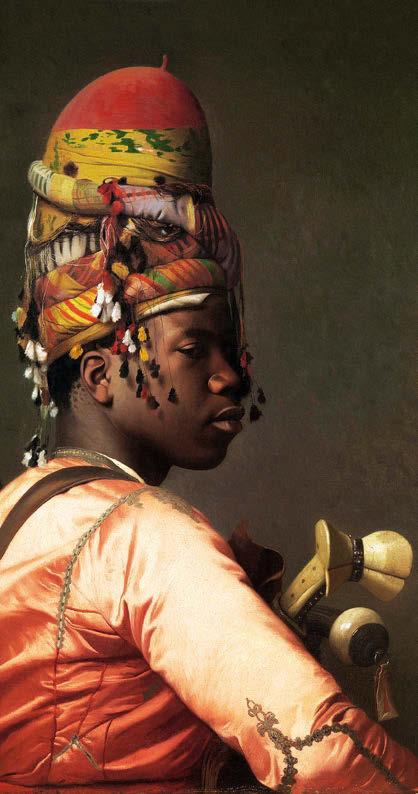
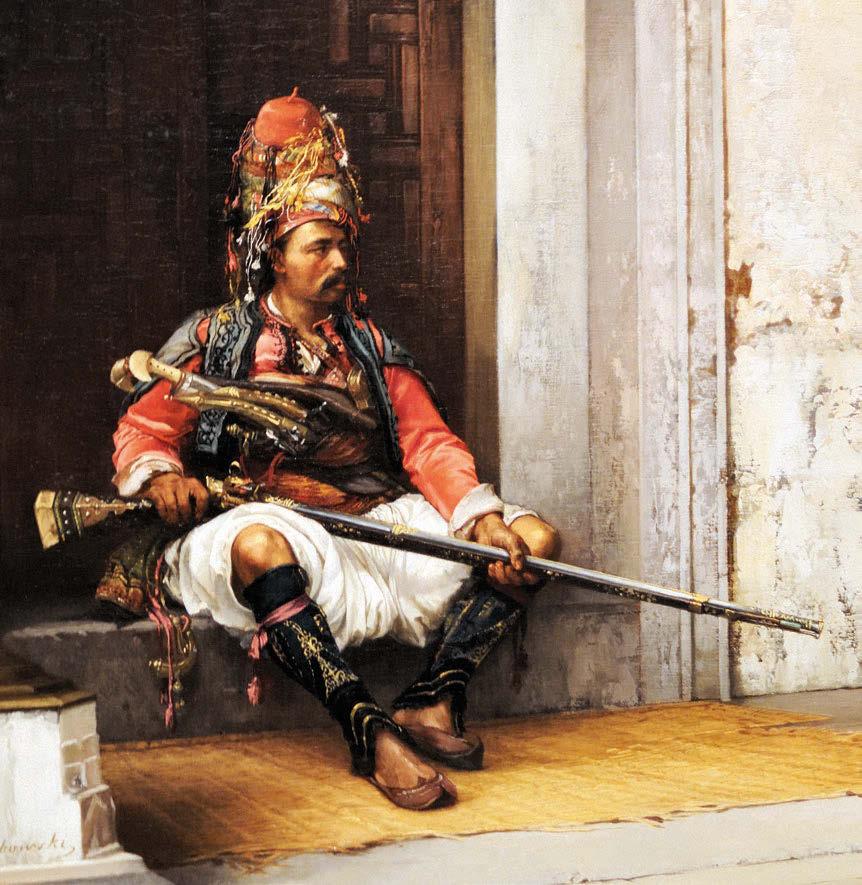
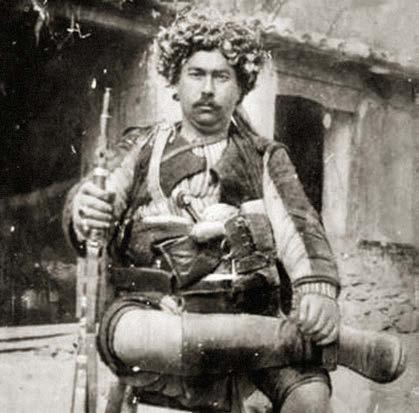
From the beginning to the end of the nineteenth century, there are depictions of the Zeybek wearing a normal fez with an Oya scarf or a special tall headdress with long fringes hanging down to the shoulders. But we do not find the special large and colourful Oya we today know as the typical Efe Oya. Therefore, claims by collectors of owning Efe Oya which are three hundred years old have not been proved. But when did these Oya appear?
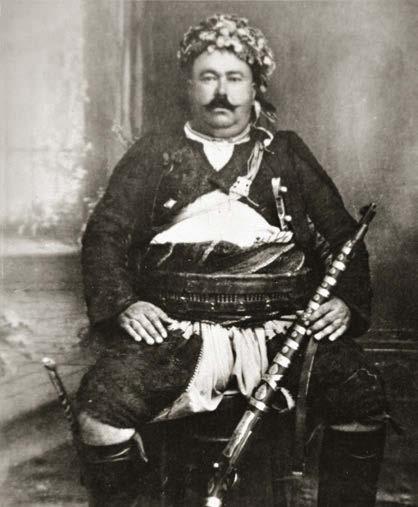
Most of the old black-and-white photographs of Zeybek are undated. It can be assumed that the first ones showing Zeybek with a fez or cap and lush Oya decoration were not taken before the last years of the nineteenth or the early twentieth century. One example of these is the photograph of the young Danişmentli İsmail Efe (fig. 21) who was born in 1878 in Danişment. The earliest reliable proof we can present is the portrait of Yörük Ali Efe (born 1895 in Sultanhisar, died 1951 in Bursa) and his group (fig. 22), dated 12 August 1919. The photographs clearly show the abundance of Oya around the head of the Zeybek.
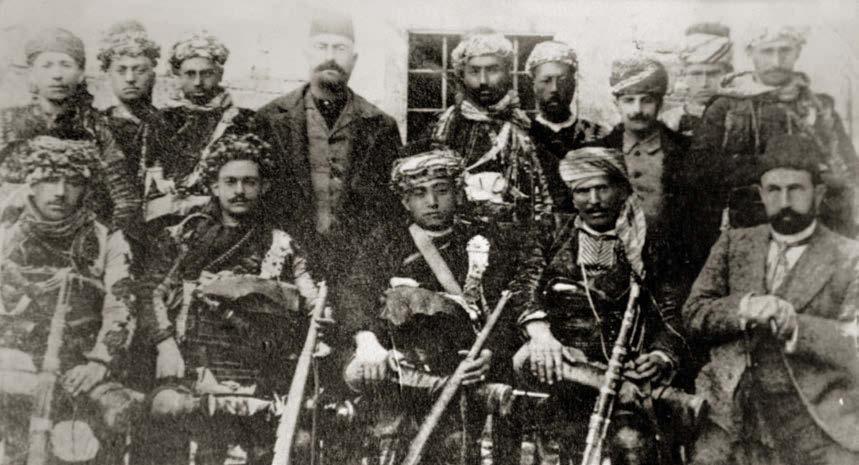
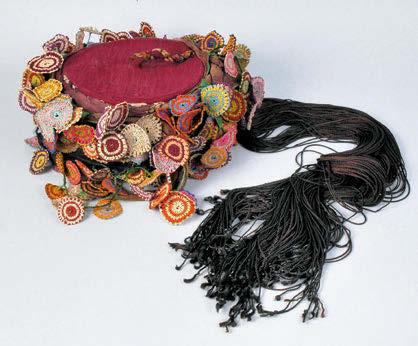
As the exhibits of the ethnological museums in Western Turkey and several private collections show, the Zeybek headgear from the twentieth century consisted of a red fez with a long tassel of black silk cords hanging down from its top, and scarves with Oya bound around the fez (fig. 23). A saying heard in the Turkish Aegean region says that a Zeybek wears four headkerchiefs with different Oya borders – one made by his mother, one by his wife, one by his daughter, and one by a certain lady nobody wants to know. One can imagine what a colourful impression the Zeybek of the early twentieth century made on the people – such as the aforementioned Danişmentli İsmail Efe (died 1946 in Aydın) (fig. 21, 24) 31 or the group of Yörük Ali Efe (fig. 22). The fashion of Zeybek headgear had completely changed since Fenerci Mehmet’s Zeybek of 1811. What was the reason for this development?
There are various theories as to why the Zeybek and their Efe chose Oya for their headdress. One states that the Zeybek used the colourful Oya as camouflage during their raids in the mountains. The ethnologist Sabiha Tansuğ believes that the Efe’s headgear adorned by Oya was inspired by the crowns consisting of fresh wildflowers worn by the people of western Turkey during the Hıdrellez32 festivities in spring.33 This might be possible, but we rather suppose that the increase in the production of Oya during the second half of the nineteenth century could answer our question. Every beautiful headkerchief was decorated with a border of colourful Oya – so why not also the scarves for the Zeybek who obviously like to dress showily with much trumpery?
Certainly, the regional headdress of the bridegrooms also played an important role, exerting influence on the Zeybek headgear. The attire worn by bridal couples was very decorative and full of symbols of fertility. The ethnologist Sabiha Tansuğ published some pictures of Aegean bridegrooms whose headdress did not differ from a Zeybek’s headgear.34 Probably, the simple two-dimensional Oya patterns of triangles, rhombi, discs, made by the semi-nomadic people in the mountains of the Aegean region gave their forms to the Zeybeks’ Oya.
After the Second World War, another development took place within Zeybek costume styles. As tourism in Turkey increased, many American and European groups travelled through Asia Minor, interested not only in the archeological sites, but also
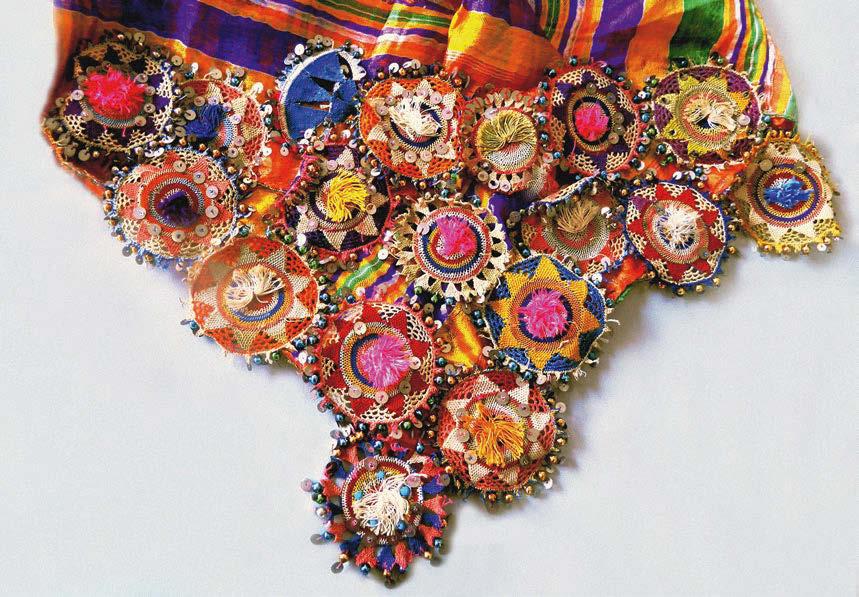
Around twenty years ago, the Turkish market for textile antiquities was dwindling. Genuine old carpets and kilims were sold out, and the famous Ottoman embroideries could no longer be found. Many of the Oya, which were kept in family trousseaux, now started to appear on the market. Soon the prices for the oldest and most beautiful Oya rose, not only for the fine silk Oya from the last decades of the Ottoman era, but also for the colourful Efe Oya. For this reason, reproduction started (fig. 27).
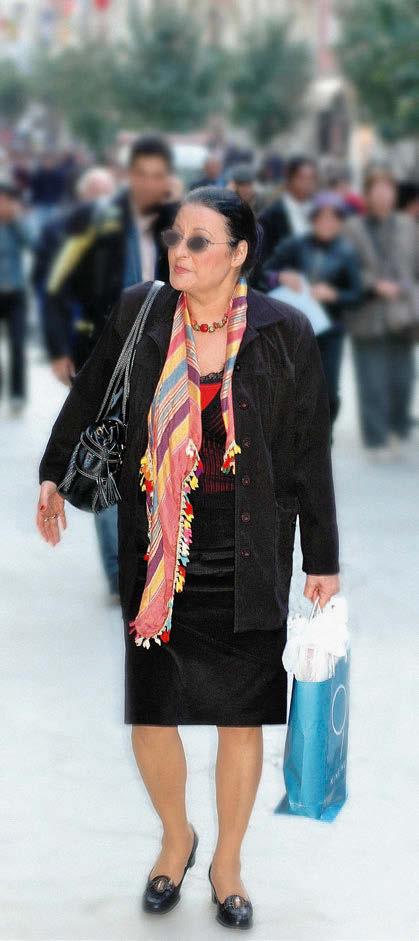
You can now find scarves in markets with one original Efe Oya figure supplemented by the required number of imitated figures. Very recent Oya, made of natural dyed silk and stiffening horsehair, display the traditional patterns and colours, and sometimes it is not easy to discern if the piece is an original from the middle of the twentieth century or a perfect replica. Families of the Aegean region use these Oya in their traditional
events as weddings and circumcision festivities, but also modern city women like to wear them as eyecatching decoration (fig. 28).
Istanbul’s lively, international fashion scene is also inspired by the patterns and colours of Oya. The established fashion designer Gönül Paksoy, for example, uses fabrics from old garments and Oya lace made according to old patterns. She dyes the Oya purchased at the bazaar according to her colour preferences before using them in her creations, as she explained to us.1 Other designers, the younger designers, take a different approach. They have Oya lace produced according to their own designs. Obviously, the designers favour the clear forms of the abstract Efe Oya patterns as a basis.
Hatice Gökçe, who graduated from the Textile and Fashion Design Department at Mimar Sinan Fine Arts University, established her own design atelier in 1998 and won the ‘Best Menswear Design Award’ in the same year. A year later, another important prize followed, awarded in Japan. From 2008 until 2019, Gökçe served as the design coordinator for Argande, a social responsibility project initiated by the United Nations and the GAP administration.2 She still occasionally adds brooches, necklaces and other accessories made of Oya lace to her ladies’ and men’s fashions (fig. 29).
The Armaggan brand has been on the fashion scene of Istanbul for some years now, a label supported by a foundation that promotes the use of natural materials and the production of organic products. At great financial expense, Armaggan has manufactured silk dyed with natural materials. Designers repeat the old patterns and colour combinations, but then allow modern design ideas to be supplemented.
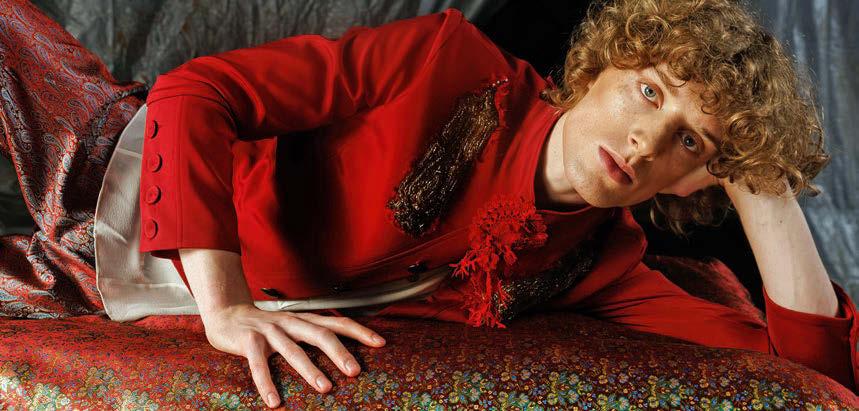
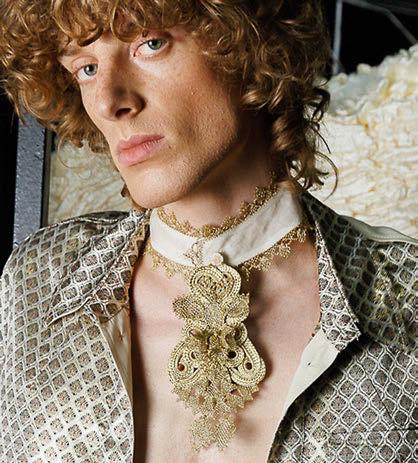
After her initial work on the Turkish fashion scene, fashion designer Hatice Gökçe is now established in avant-garde menswear. She regularly presents her collections at international fashion shows and produces outfits for theatre productions and stage artists. Colleagues say: ‘Her designs incorporate elements inspired by Turkish culture and art, enriched with textile technologies and details based on craftsmanship. Her designs reflect a balance between the harmony of nature and the advancements of technology, as well as between comfort and intricate detailing, opulence and depth.’
Occasionally, we find accessories in her collections that are made using the traditional Oya technique – such as necklaces that are reminiscent of a Western tie ( fig. 33 ) and brooches that are intricately handcrafted (fig. 34).
1 See part 1 Oya Lace. History, chap. ‘Oya in Modern Design’.
2 Kipöz–Atalay (2019) 169.
3 Görünür (2000) [52] ‘long undershirt made of a light fabric made of alternating stripes of silk and cotton’.
4 The influence of the amigurumi figures which originated in Japan is undeniable here.
We can distinguish between two types of Oya lace, which were used by the Zeybek and their leaders for different purposes. There are densely sewn narrow borders around the scarves covering knives and pistols in the belts of the Zeybek, and the more famous large Oya figures decorating the scarves for the headdresses. The feature the Efe Oya have in common is that they are made of silk yarn with a long sewing needle, whereby each figure is created by knot next to knot and row upon row. Oya made with a sewing needle therefore do not differ from women’s Oya in terms of working technique. The patterns are usually dense and tight, horsehair is used to stiffen larger bows and round figures, and in the later twentieth century nylon yarn (fishing line) was also used. Laundry starch and its precursors, egg white and sugar water, as in women’s Oya, are not usually used here.
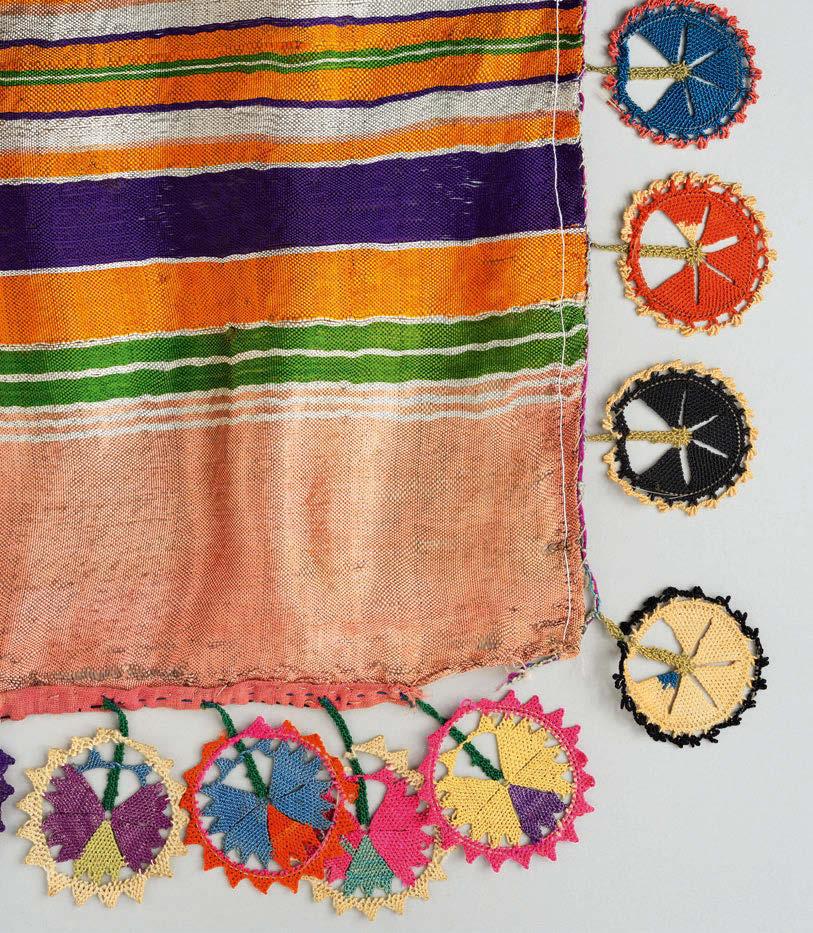
As is the case with Oya work for women, Efe Oya were worked as a string and then sewn to the edge of a scarf or worked directly onto a scarf after it had been rolled all around with silk thread. If the scarf was worn out, the individual Oya
figures were cut off or cut off with the scrollwork, creating a ribbon that could then be sewn onto another scarf.
The mostly striped silk scarves on which the large Efe Oya have been worked are called poşu. Printed cotton scarves were also used, as numerous illustrations here show. The scarves decorated with Oya are wrapped around a cap or fez in such a way that the figures hang down around the head densely (fig. 23-25). The Oya figures give us an impression of stylised blossoms or fruits, combined with associations of male fertility, male fame, and glory, as noted below in each case.
As is usual for handicrafts all over the world – and not just textiles – the patterns are given names. The individual Oya work can also be given a special name, according to a particular situation, according to the wishes and hopes that have been ‘worked into it’. In most cases, the names are not handed down, as Oya works have changed hands several times up to the present day and are rarely passed on with the name. Some of the patterns were related to symbols concerning men and their special qualities of body and character.
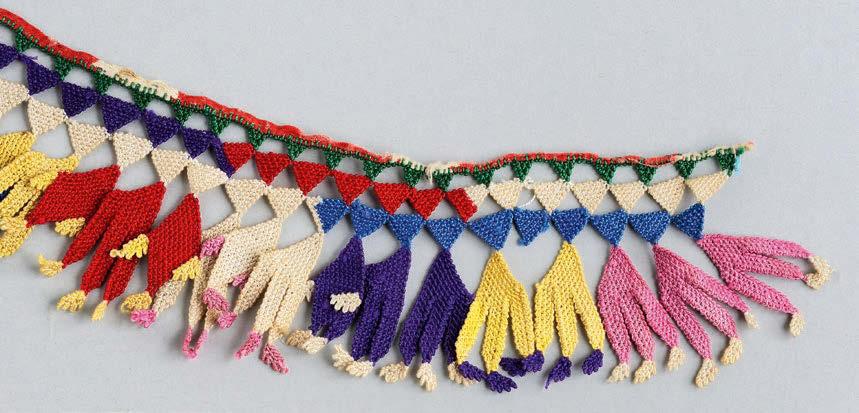
Closed border two-dimensional Oya multi-coloured
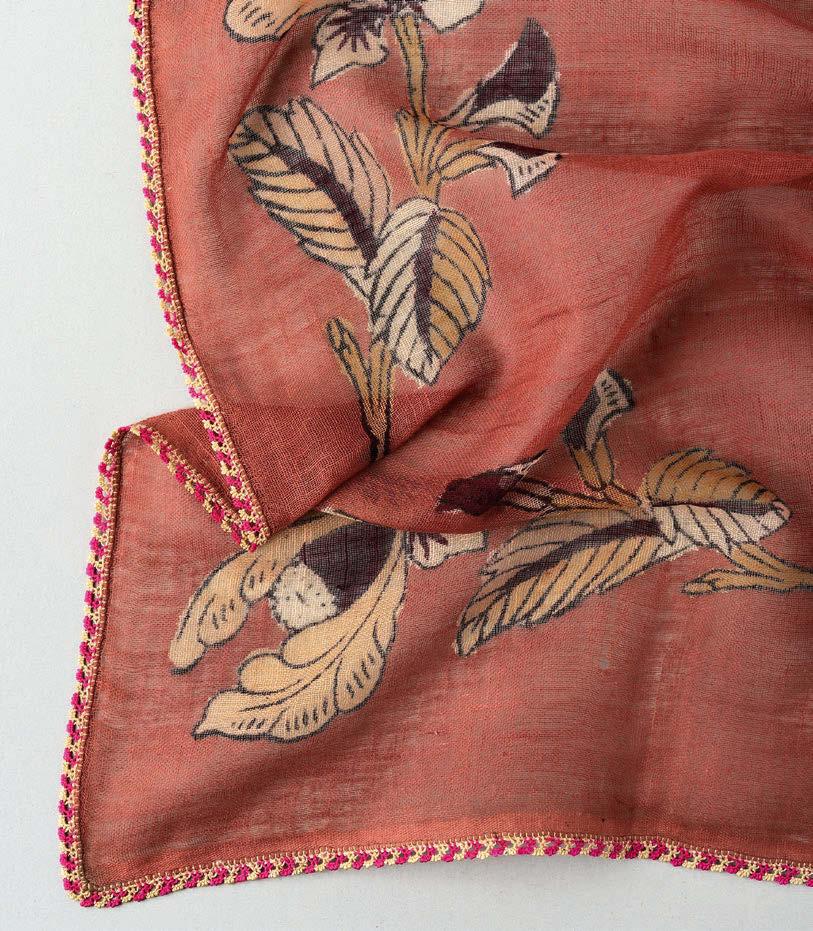
Closed border two-dimensional Oya multi-coloured with colour sections
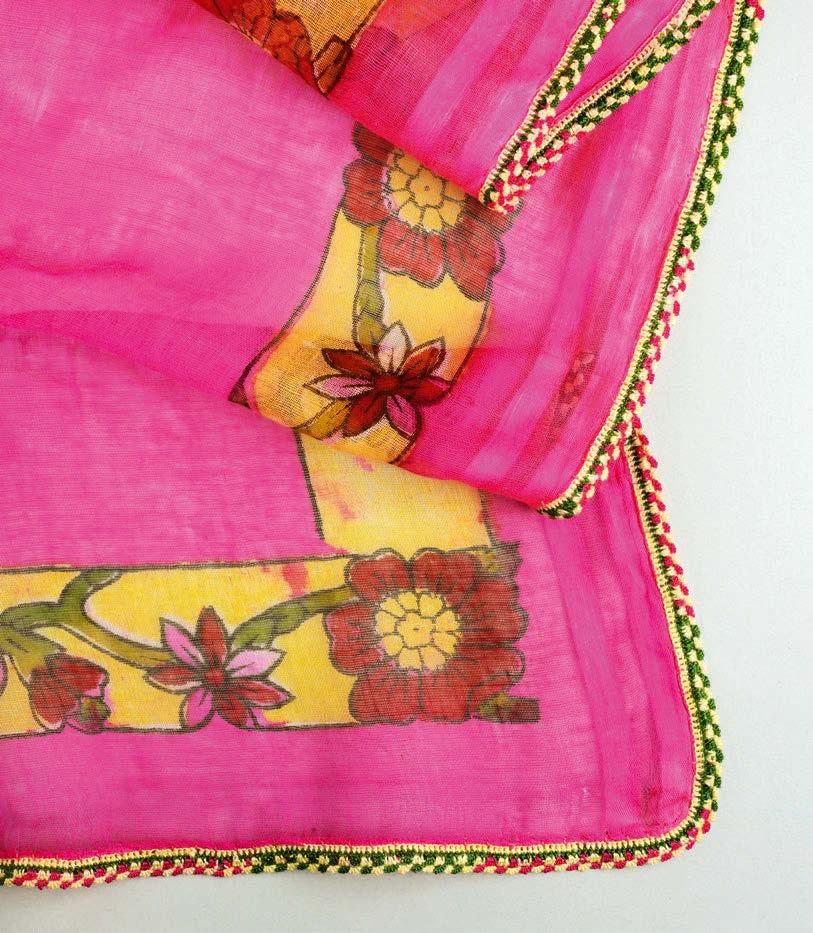
Open border two-dimensional Oya single figure angular form few-coloured
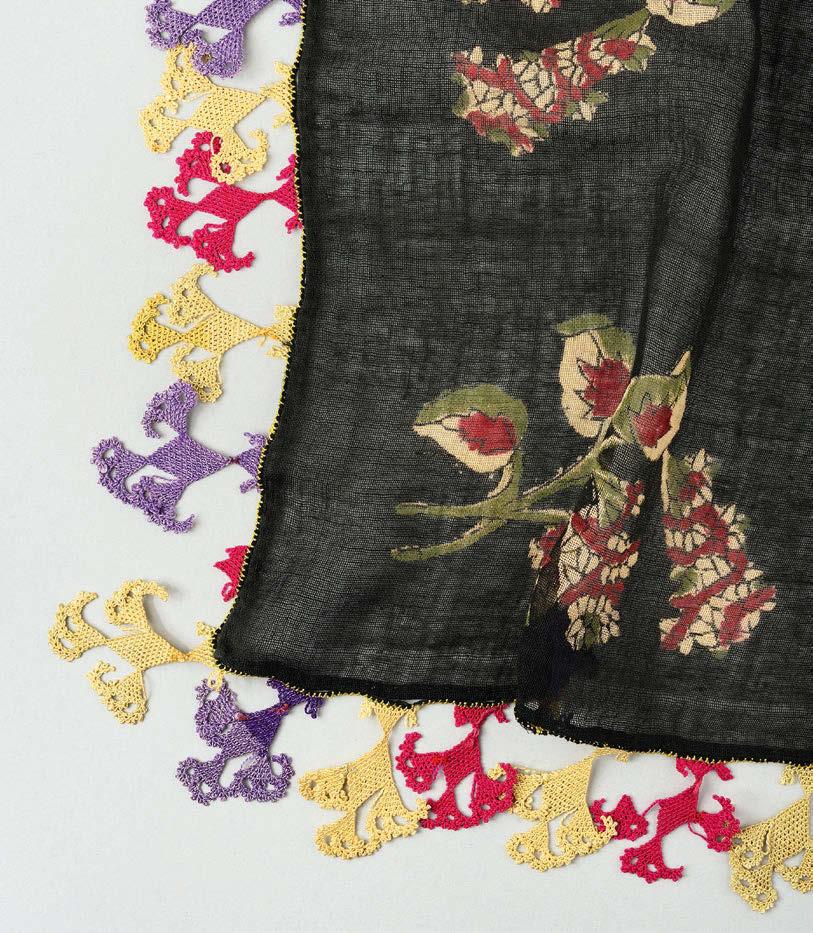
Open border two-dimensional Oya single figure
angular form few-coloured
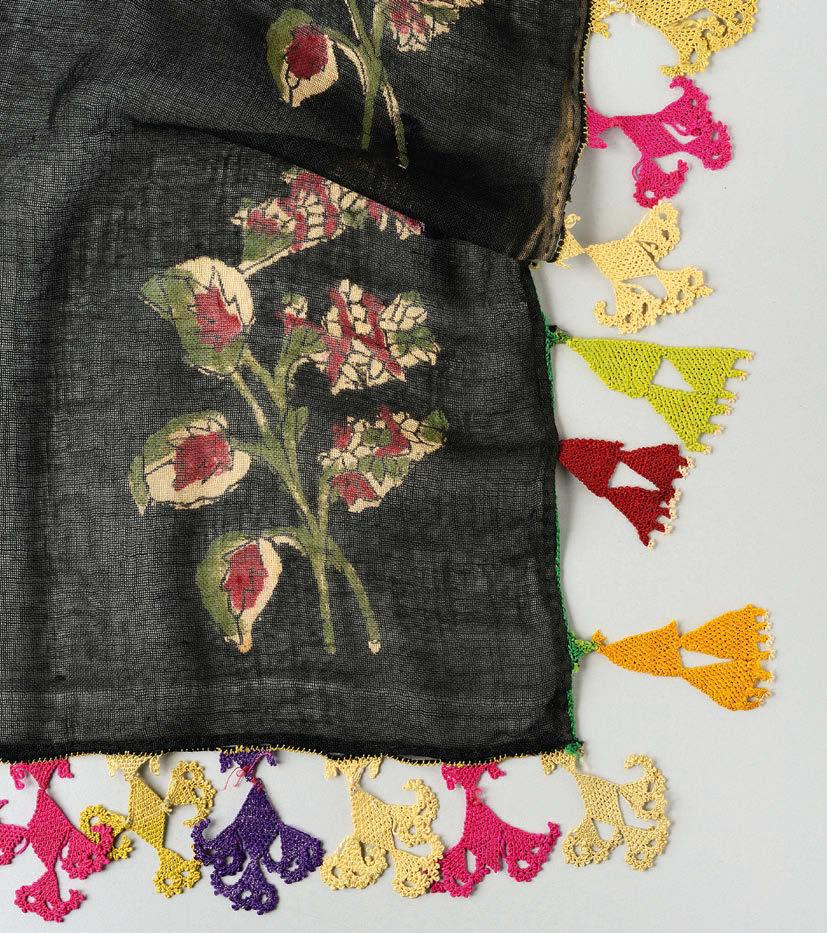
Open border karanfil ‘carnation’ two-dimensional Oya
single figure round form multi-coloured
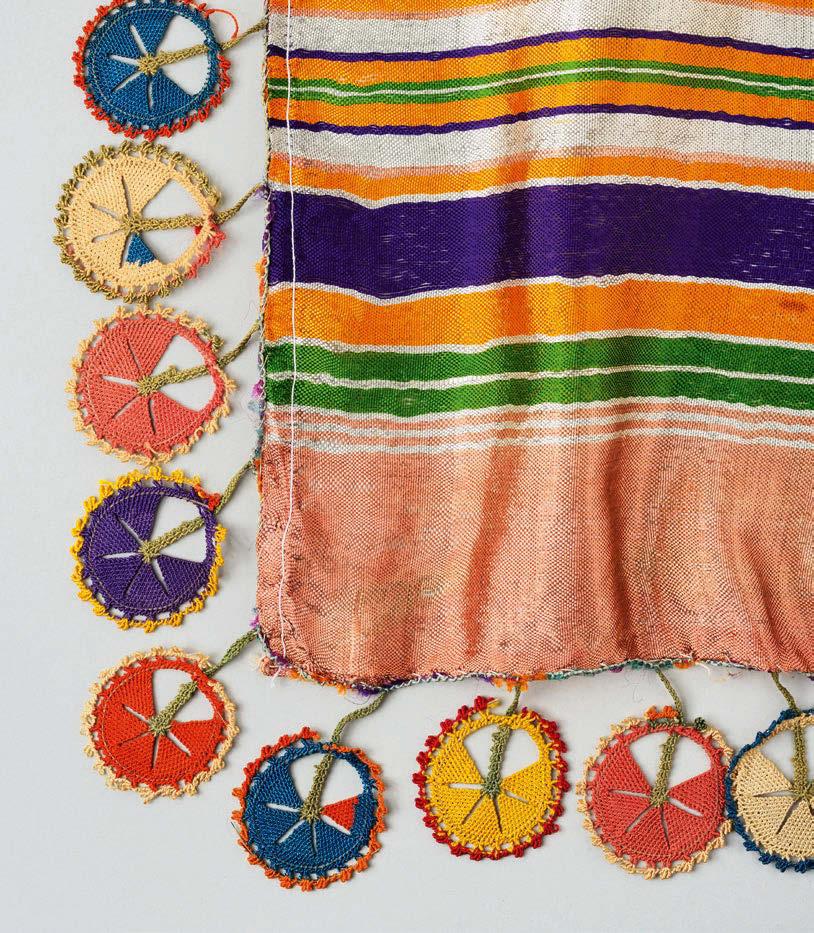
E14.2
Open border karanfil ‘carnation’ two-dimensional Oya
single figure round form multi-coloured