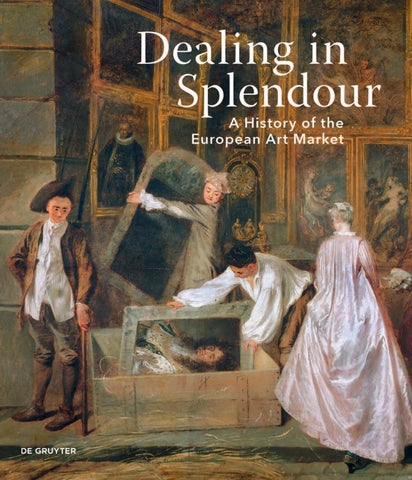
Christian Huemer, Stephan Koja (Eds.)
Dealing in Splendour A History of the European Art Market
4
Christian Huemer, Stephan Koja (Eds.)
CONTENTS
9
Inspiring Relations: Art (History) and the Market
Christian Huemer, Stephan Koja
III ART FAIRS. PRODUCING FOR AN OPEN MARKET 107 Art Fairs in Early Modern Antwerp Filip Vermeylen
I
THE RISE OF THE MULTIPLE. ART TRADE IN ANTIQUITY
25
Collecting and the Art Market in Ancient Rome
Alexandra Bounia
118 Art Fairs Filip Vermeylen 121 Markets for Tapestry. The Antwerp and
Brussels Tapissierspanden, 1554–1700 Koenraad Brosens
II PATRONAGE. PRODUCING ON COMMISSION 47
Commissioned Art and Serial Production. The Art Market in Early Renaissance Florence Susanne Kubersky-Piredda 64
Copies, Imitations, Replicas, Multiples, Series, Editions Susanne Kubersky-Piredda, Patricia Mainardi
67
The Reinvention of the Small Bronze and How It Became a Sought-After Object on the Art Market
Claudia Kryza-Gersch
130 Lotteries Sophie Raux 135 The Artist’s Name as a Brand:
The Brueg(h)el Enterprise
Kim Oosterlinck, Anne-Sophie Radermecker
IV A MASS MARKET FOR THE MIDDLE CLASS 151 Paintings for the People. Mass Consumption
and Display of Art in Seventeenth-Century A msterdam Weixuan Li
85
The Dürer Megastore and Some Practices on the Early Art Market Christof Metzger 98
172 Transport, Art Handling, Logistics Katharina Leithner
Rules and Regulations Filip Vermeylen
5
177 Artistic Production and Innovation in the
Seventeenth-Century Dutch Republic Angela Jager
192 Art as an Investment Kim Oosterlinck
VI AUCTIONS – MARKETING – EXPERTISE 253 Gersaint and the Boom of the Paris Art Market
in the Early Eighteenth Century Sophie Raux
266 Auctions Bénédicte Miyamoto
V
AGENTS – NETWORKS – THE GRAND TOUR
199 Dealers at the Intersection of Art and
Commercial Expansion. The Reach of the A ntwerp-Based Forchondt Family Firm Sandra van Ginhoven
214 Networks and Globalization Sandra van Ginhoven 217 Princes as Collectors and Their Art Agents.
On the Origins of Princely Paintings Galleries in the Holy Roman Empire Virginie Spenlé
230 The Dark Side Koenraad Brosens 233 The Grand Tour Art Market Adriano Aymonino
6
269 The Auctioneer’s Name as a Brand.
James Christie and Art Market Innovations, 1750–1800 Bénédicte Miyamoto
280 Expertise and Trust Anne-Sophie Radermecker 283 Jean-Baptiste Pierre Lebrun. Navigating
the Art Market in Revolutionary Paris Iris Yvonne Wagner 296 Provenance Sandra van Ginhoven
VII EXHIBITION STRATEGIES AND PUBLICITY IN THE INDUSTRIAL AGE 303 Paris 1789–1900. From Picture Shops
VIII EPILOGUE 371 Modernism
Tom Stammers
to Art Galleries Patricia Mainardi
316 The Art Dealer
385 LIST OF EXHIBITS
Simon Kelly 319 Private Exhibitions, Touring Canvases,
eproductive Prints. The Commercialization R of History Painting in the Nineteenth Century
Christian Huemer
424 Bibliography 442 Authors 446 Picture Credits
338 Price-Setting Christian Huemer, Anne-Sophie Radermecker 341 Landscape Painting and ‘Dealing in
Temperaments’ Revisited Simon Kelly
362 Media, Technology and Art Criticism Tom Stammers
7
Christian Huemer, Stephan Koja (Eds.)
Christian Huemer, Stephan Koja
INSPIRING RELATIONS: ART (HISTORY) AND THE MARKET
F
or much of its history as an academic discipline, art history cultivated a deliberate distance from the commercial conditions under which works of art were produced, circulated and acquired. Trade, pricing, speculation and resale were long treated as marginal – or even suspect – phenomena, presumed incompatible with the study of artistic quality. Yet this separation has increasingly proven untenable. Artworks have seldom existed outside systems of exchange, valuation and mediation. Most of the objects admired today in museums entered the world through negotiations that were shaped by institutional frameworks and embedded in complex market environments. To disregard these conditions is therefore not to protect art history’s integrity, but to limit the scope of its understanding. This exhibition and its accompanying publication are grounded in the conviction that the history of art and the history of the art market are inseparable. In the memorable formulation of renowned art historian Michael Baxandall, ‘paintings are among other things fossils of economic life.’1 Markets did not merely respond to artistic innovation: they actively structured it. Dealers, agents, auctioneers, collectors, critics and scholars shaped reputations, directed taste and determined which works were preserved or forgotten. Far
◂ Detail from fig. 1, p. 10
from being peripheral, they were among the most influential actors in the cultural field. Their decisions affected not only prices and careers, but also the formation of canons and the writing of art history itself. Crucially, many of the tools now considered foundational to art history emerged from commercial contexts. Illustrated catalogues, classificatory systems, biographical narratives, catalogues raisonnés, collection catalogues and monographic exhibitions were initially devised to facilitate trade, reduce uncertainty and construct expertise. The boundaries between scholarly and commercial activity were historically far from rigid. A telling example is the collaboration between Wilhelm von Bode and Charles Sedelmeyer in the production of the great eight-volume catalogue raisonné of Rembrandt’s oeuvre (1897–1906): Sedelmeyer, the most influential Rembrandt dealer of his time, financed the costly publication, while Bode – then a leading museum figure and client of the dealer – authored what came to be called the ‘Rembrandt Bible’. Such constellations reveal how the various actors within the art world often depended on one another, pooling resources, authority and knowledge. In this way, these instruments and practices crossed into academic and museum contexts, where they became naturalized as scholarly methods. Recognizing
9
Fig. 1 Tiziano Vecellio, called Titian (c.1488–1576), Jacopo Strada, c.1567/68, oil on canvas, 126 × 95.5 cm, Vienna, Kunsthistorisches Museum, Gemäldegalerie
this genealogy does not diminish their authority; rather, it reveals art history itself as a form of knowledge production that has long been entangled with mechanisms of valuation. Over the past decades, the study of art markets has emerged as one of the most dynamic areas of research in art history and adjacent disciplines. 2 Scholars working in cultural history, economics, sociology, law and the digital humanities have generated a wealth of case studies and methodological innovations. Yet for all this activity, the field remains fragmented. Research has often concentrated on discrete periods or individual actors, making it difficult to identify larger patterns or to distinguish genuine innovation from the reconfiguration of older practices. What has largely
10
Christian Huemer, Stephan Koja
been lacking is a synthetic, longue durée perspective capable of tracing how market mechanisms persist, shift and recur across centuries. 3 This exhibition responds to that need. Rather than offering an encyclopedic account, it proposes a historically calibrated view of the European art market from antiquity to the threshold of the twentieth century – a period which saw the formation of the core institutions, instruments and strategies that continue to structure the market today. This perspective is not confined to painting. Historically, some of the most highly valued and intensively traded works were tapestries, furnishings and complex objects of decorative art – such as the Badminton Cabinet [fig. 4] – whose material richness, craftsmanship and symbolic function meant that they often surpassed easel paintings in both price and prestige. At the same time, the exhibition is shaped by the awareness that the objects preserved in museums represent only a selective remainder of what once circulated on the art market. While art market research has demonstrated that these holdings capture only a part of historical market activity, an exhibition must necessarily work with what has survived and meet expectations of artistic quality. Dealing in Splendour therefore brings together outstanding works that have come down to us, while situating them within broader economic and social contexts, in order to sharpen awareness of the structures, hierarchies and dynamics that shaped artistic exchange – without claiming to reconstruct the market in its entirety. The temporal horizon of this project is framed by two emblematic intermediaries. At one end stands Jacopo Strada (1507–1588) – seen portrayed by Titian holding an ancient sculpture [fig. 1] – a scholar, antiquarian and dealer whose activities exemplify the early modern rediscovery, documen tation and circulation of antiquity within an emerging international art market. Active in the service of leading political
and economic elites, Strada worked for Johann Jakob Fugger and later served the emperors Ferdinand I and Rudolf II, advising on the acquisition, classification and display of ancient works. By combining erudition with commercial expertise, he occupies a formative position at the intersection of scholarship, courtly representation and the art trade. At the other end of this arc stands Ambroise Vollard (1866–1939) [fig. 9], a central figure of the modern art market whose career unfolded alongside profound structural change. Known for championing young and often controversial artists, Vollard shaped the reception of modern painting at a moment when authority shifted from the state-regulated Salon system to a network of independent dealers. The evolution of his Paris enterprise – from selling modern art in his apartment in the early 1890s to his renowned gallery at 6, rue Laffitte (1896–1924) – mirrors Fig. 2 Jacopo Strada (1507–1588) Collection of Designs (Codex Miniatus 21,3), before 1571, manuscript; 41 × 27 cm, third of three volumes, Vienna, Österreichische Nationalbibliothek
Fig. 3 Head of Ephebus on modern bust, 2nd quarter of the 1st century AD–first half of the 2nd century AD, 16th century (bust), white marble, 62 × 64 × 38 cm (bust and base), Turin, Museo di Antichità
this transformation, marking the rise of the commercial gallery as a primary site of artistic mediation. Separated by more than three centuries, Strada and Vollard embody structurally analogous roles within different historical contexts. Together they delineate the chronological and conceptual frame of the present exhibition and catalogue, spanning from the antique luxury market and the world of early modern courts to the emergence of the modern art market around 1900. To make this vast field intelligible, the exhibition is structured around key cities in which decisive innovations became particularly visible. Rome, Florence, Antwerp, Amsterdam, Paris, London and Vienna function as analytical nodes – places where artists, intermediaries, collectors, institutions and audiences clustered, creating dense environments for experimentation and change.4 In such urban contexts, new forms of artistic production and distribution took shape: workshop-based commission systems, early retail markets, art fairs, auction houses, dealers’ galleries, and increasingly specialized publics. These cities were never isolated. They were connected through
Inspiring Relations: Art (History) and the Market
11
Fig. 4 Galleria dei Lavori (founded 1588), Baccio Cappelli (died c.1751); Girolamo Ticciati (1671–1744), Badminton Cabinet, 1720–32, commessi di pietre dure (lapis lazuli, red and green Sicilian jasper, amethyst, quartz, etc.), ebony and gilt bronze, 386 × 233 × 94 cm, LIECHTENSTEIN. The Princely Collections, Vaduz–Vienna
trade routes, correspondence, travel and imitation, allowing ideas, objects and market practices to circulate far beyond local settings. Focusing on these interconnected centres makes it possible to trace how art market mechanisms developed in specific historical contexts while operating within trans regional – and at times global – systems of exchange. At the heart of all art market research lies the fundamental question of how economic conditions shape artistic creativity, cultural consumption and historical visibility. The
12
Christian Huemer, Stephan Koja
exhibition addresses this question through the close examination of concrete events, objects and practices. From the Renaissance onward, workshop practices such as those docu mented by Neri di Bicci reveal how material choices, labour organization and production time directly influenced pricing and valuation. The Van Uffel auction of 1639, attended by Rembrandt, shows how the circulation of major collections could recalibrate artistic horizons. Rembrandt sketched Raphael’s portrait of Baldassare Castiglione [fig. 7, p.159] , noted its price, and later adapted its pose for a self-portrait. Market structures also shaped genre hierarchies and authorship. Still life – long positioned low on the academic ranking scale, frequently done without signatures and always lacking the prestige of other genres – appears in the exhibition in a painterly tour de force of chromatic modulation by Delacroix [fig. 7] . Courbet’s instruction to his dealer in 1863 to either hide a crate of thirty-three flower paintings or stage a ‘mysterious exhibition’ at his place reveals a calculated negotiation of visibility and value. 5 Finally, the repetition of successful a rtistic solutions – from Monet’s serial paintings to Rodin’s Eve [fig. 8] – demonstrates how variation, repetition and d elegated labour became enduring creative strategies rather than compromises of originality. At the same time, the exhibition does not idealize the market. Alongside innovation and cultural exchange, it has always included practices shaped by deception or exploit ation, from forged works to manipulated provenances and strategic misattributions. Addressing these darker dimensions is essential to understanding the full spectrum of market behaviour and to maintaining scholarly integrity. Finally, the project confronts a fundamental challenge inherent in exhibiting the history of the art market. Many of the forces that go to determine artistic value – transactions, negotiations, contracts, correspondence, documentation –
Inspiring Relations: Art (History) and the Market
13
14
Christian Huemer, Stephan Koja
Inspiring Relations: Art (History) and the Market
15
Previous pages Figs. 5, 6 Robert Le Lorrain (1666–1743), left: Bust of Thetis, c.1710/20, bronze, 43 × 24.5 × 23 cm (without base), right: Bust of Apollo, c.1710/20, bronze, 39 × 23.5 × 29.5 cm (without base), LIECHTENSTEIN. The Princely Collections, Vaduz–Vienna
Fig. 7 Eugène Delacroix (1798–1863), Flower Still Life, c.1834, oil on canvas, 74 × 92.8 cm, Vienna, Belvedere
16
Christian Huemer, Stephan Koja
reside not on the surface of the works themselves, but beyond them, in archives and records. An exhibition, unlike a book, cannot reconstruct these processes exhaustively through text alone. Instead, Dealing in Splendour seeks to make them perceptible through objects. By presenting outstanding works of art alongside carefully selected contextual materials, the exhibition allows visitors to encounter the works that generated desire, competition and extraordinary investment, while reflecting on the conditions that produced such value. Their visual and material presence anchors histories that extend beyond the visible image, making tangible the interplay between artistic achievement, market dynamics and cultural meaning – both past and present. The Liechtenstein Princely Collections provide an exceptionally resonant setting for such an inquiry. With a collecting history spanning more than four centuries and an unparalleled continuity of ownership, the collection offers a rare longitudinal perspective on the interaction between collecting strategies and market conditions. Works were acquired through commissions and purchases, retained or exchanged, and – at moments of political and economic crisis – sold in response to specific historical circumstances. The collection’s rich archival holdings illuminate these processes with unusual clarity, while the artworks themselves bear witness to shifting patterns of value, taste and prestige over time. In this sense, the history of the Princely Collections becomes a paradigmatic case study within the broader history of the art market.6 Beyond its historical and analytical ambitions, the exhibition seeks to foster a renewed appreciation of Europe’s shared cultural heritage. By tracing the circulation of artworks across centuries and regions, it invites reflection on what it means to inherit, preserve and transmit cultural wealth today. While Dealing in Splendour examines the mechanisms through which art has been exchanged and
Fig. 8 Auguste Rodin (1840–1917), Eve, 1881, bronze, 174 × 55 × 64 cm, Vienna, Belvedere
Inspiring Relations: Art (History) and the Market
17
18
Christian Huemer, Stephan Koja
Fig. 9 Pierre-Auguste Renoir (1841–1919), Ambroise Vollard, 1908, oil on canvas, 81.6 × 65.2 cm, London, Courtauld Institute of Art
v alued over time, it does not reduce art to a mere commodity or equate cultural significance with commercial worth. Rather, it affirms that the market – however indispensable – has always been only one dimension of art’s cultural resonance. The enduring fascination of this subject lies in the tension between material possession and immaterial value. Artworks may be owned and traded, yet their deeper significance unfolds only through sustained engagement and attentive care. From such encounters arises a form of cultural and intellectual enrichment that transcends economic calculation. Seen from this perspective, great works of art appear not as objects of consumption, but as shared cultural treasures whose significance exceeds the conditions of ownership and unfolds across generations. By illuminating the historical paths through which these works have been created, exchanged and safeguarded, Dealing in Splendour affirms the enduring responsibility of caring for what has been handed down to us. Our special thanks are due to His Serene Highness Prince Hans-Adam II von und zu Liechtenstein and His Serene Highness Hereditary Prince Alois von und zu Liechtenstein for their generous support of this ambitious exhibition project. We are deeply grateful to our co-curator Iris Yvonne Wagner, whose sure judgement and close familiarity with the
holdings of the Princely Collections were central to the development of the exhibition. We further extend our sincere thanks to the many distinguished lenders from the United States, Austria and other European countries whose generosity has made it possible for us to present some of the most celebrated works in the history of art. We are indebted to the authors – renowned experts on the art market from around the world – for their contri butions, grounded in long-term research, and for their sustained engagement throughout the development of this project. The content, structure and methodology of this volume were shaped through a series of collaborative workshops with the active involvement of all contributors. This shared process enabled the identification of common questions, and helped shape the book as a coherent sequence of interrelated narrative strands, interspersed with dedicated thematic 'boxes' that give distilled accounts of recurrent aspects of the art market throughout history and provide points of orientation beyond the individual essays. Our heartfelt thanks go to the team of the Princely Collections, whose commitment and dedication made both the large and complex exhibition and the comprehensive publication possible, and to the team of the publishing house De Gruyter, whose professionalism has ensured the high quality of this handsome volume.
Notes 1 Baxandall 1988, 2. 2 For a discussion, see Huemer and Stammers 2025. 3 For an early attempt at a synthetic narrative, see De Marchi and Van Miegroet 2006c. A representative selection of key writings on art markets across periods can be found in Hulst 2017. For a recent overview from a market-oriented perspective, see Boll 2024.
4 We are especially indebted to Filip Vermeylen, who helped to shape this concept through a series of formative conversations over a period of years. 5 Courbet 1992, no. 63-3. 6 Market developments in the Dutch Golden Age were the focus of an exhibition at the Bucerius Kunst Forum in Hamburg, which drew on numerous loans from the Liechtenstein Princely Collections, see exh. cat. Hamburg 2017.
Inspiring Relations: Art (History) and the Market
19
Networks and Globalization
From Roman antiquity through the early modern era to the nineteenth century and our own times, networks have constantly functioned as the structural backbone of art markets – while globalization, which may be seen as a gradual transformative process, has become a major fact of the modern world. These developments underscore the dual nature of networks, which operate both as practical instruments for logistical coordination and also as cultural conduits that mediate taste and identity across regions. In Roman times, the art market was already characterized by extensive Mediterranean-wide networks linking Rome to Greece and the Hellenistic East. Initially forged through military conquest, these networks brought vast quantities of Greek artworks to Rome and quickly evolved into structured systems of acquisition involving agents, auctioneers, dealers, and even looters. Auctions became public spectacles, and the demand for Greek originals and high-quality copies among the elites drove prices to extraordinary levels. The case of the Roman art market illustrates two enduring principles: first, the necessity of networks of intermediaries for overcoming spatial and informational barriers, connect-
214
ing supply and demand, and second, the circulation of cultural goods within a framework of prestige and symbolic capital as much as of economic value (see Bounia, pp. 25–41). For medieval and Renaissance business people – including those dealing in art – travel was the dominant mechanism for connecting markets. They relied heavily on kinship- based partnerships, which were often short-term and limited in scope.1 However, a number of changes that set in during the fourteenth century had a fundamental impact on the trade dynamics of early modern Europe, most notably: the decline of the Champagne fairs that had linked European economies and guided the activities of travelling merchants; the opening of the sea route from Italy to northern Europe, where Italian merchants established new bases of operation, especially in Bruges; and the competitive pressures within and outside Europe that reduced profits in re- export markets.2 Furthermore, the expansion in trade brought about by new routes combining overland and long-distance maritime routes resulted in a change in its patterns in which the Atlantic seaboard took over the hegemony previously held by the Mediterranean.3
Sandra van Ginhoven
Therefore, to manage greater distances and the growing complexity they faced, early modern European merchants transitioned from being primarily itinerant traders to acting increasingly as sedentary entrepreneurs operating through webs of corres pondents, factors and commission agents. As firms expanded, export activities demanded additional agents to manage risks. In a new division of labour, the various roles previously performed by travelling merchants in charge of all activities in the distribution chain were taken over by separ ate individuals, leading to the growth of commission trade and specialized dealers, including financial, shipping and insurance brokers.4 These transformations were underpinned by innovations in communication and by institutional mechanisms that reduced transaction costs, fostered the development of sophisticated accounting practices and business partnerships, and mobilized unprecedented pools of capital. Early modern merchant networks facilitated the movement not only of commodities but also of ideas, styles and technologies. The same infrastructures that enabled the circulation of spices, and textiles also served the trade in artworks, books and luxury
goods. Case studies of merchant communities – Genoese traders in Seville, for example, Flemish and Dutch networks in Livorno, English chartered companies in the Mediterranean and Levant, or Hanseatic traders in northern Europe – reveal overlapping networks of kinspeople, agents, branches and brokers that not only structured business operations but also enabled cultural exchanges within and across merchant communities at local, regional and interregional levels. The internationalization of the art trade called for new kinds of expertise, including that of the seventeenth- century specialist art dealer who relied on agents abroad to supply information about tastes of local consumers. The role of dealers expanded in the eighteenth century, when the art auction became the main mechanism for redistributing art. 5 Under their direction, a partially integrated auction circuit developed that incorporated Amsterdam, Brussels, London and Paris. 6 With the exponential growth of the Parisian auction market from mid-century, the dealer-expert and the printed auction catalogue took centre stage (chapter VI). However, the French Revolution and the Napoleonic wars disrupted this growth, triggering a massive exodus of artworks from French collections to the British Isles, where by the turn of the century their circulation, driven by dealer-cum-auctioneers and their networks, had cemented London’s ascen dancy on the international scene.7 The nineteenth century intensified and institutionalized earlier dynamics. Networks of galleries, dealers and
auction houses formed dense clusters, with London and Paris – and later New York – acting as global hubs mediating between European, American and Asian markets and other locations. Firms operated transnationally via a web of branches and partnerships, importing and exporting art while leveraging technological innovations such as railways, steamships and telegraph systems that accelerated the circulation of goods and information. Unlike what had been the case in earlier periods, these networks were embedded in formal institutions and supported by standardized practices, including printed catalogues, international exhibitions and world fairs, professionalized marketing, and new modes of knowledge production. 8 These developments reflect the broader trend towards an increasingly industrialized capitalist framework, in which art markets have come to operate alongside other global industries and in accordance with new forms of organizational logic. Globalization has connected people and markets as never before, also raising critical questions about cultural and artistic diversity. Recent scholarship on the linkages between globalization and the cultural sector has described the mechanisms through which cultural goods can become subject to increasing returns and market-size effects, favouring dominant producers and risking homogenization. However, while large markets and technological infrastructures promote convergence, as is for example evident in the international popularity of certain artists and gen-
Fig. 1 Johann Adam Delsenbach (1687–1765), View of the East Indies Ship Everswaart at Middelburg, from ‘Unterschiedl. Prospecten, Gebäude und anderer Curiosen Sachen‘, part 2, no. 24, LIECHTENSTEIN. The Princely Collections, Vaduz–Vienna
res, they also promote heterogeneity through niche strategies and cultural activities rooted in local differenti ation and in practices that remain relatively unaffected by technological change. According to this view, while the art trade influences culture through price changes, market-size effects and social interactions, it also fosters strategies that preserve diversity within global systems.9
Notes 1 Kirshner 1974. 2 Tracy 1990; Van Ginhoven 2017, 146. 3 Burghartz, Burkart and Göttler 2016; North 2010. 4 For more on this scholarship, see Van Ginhoven 2017. 5 Arora and Vermeylen 2012. 6 Schich et al. 2017; De Marchi and Van Miegroet 2006c. 7 Avery-Quash and Huemer 2019. 8 Fletcher and Helmreich 2012; Arora and Vermeylen 2012. 9 Van Hest and Vermeylen 2015; Iapadre 2014; Bisin and Verdier 2014; Acheson and Maule 2006.
215
300
VII Iris Yvonne Wagner
Exhibition Strategies and Publicity in the Industrial Age Jean-Baptiste Pierre Lebrun
301
340
Christian Huemer
Simon Kelly
LANDSCAPE PAINTING AND ‘DEALING IN TEMPERAMENTS’ REVISITED
T
he nineteenth century saw a remarkable rise both in the status and in the commercial value of landscape paintings in France. At the beginning of the century, the genre occupied a lowly role in the hierarchy of the genres. By the end, it had become the focus for the most innovative and avant-garde artistic developments of the day, exemplified by the work of Claude Monet. This essay looks at the role of the art market and its various agents in orchestrating this rise. I focus particularly on the new attention given to the temperament of the individual landscape artist over the course of the century within the market’s complex institutional structures. As art historian Nicholas Green first showed, in a seminal 1987 article, art dealers now foregrounded the idea of ‘dealing in temperaments’, that is to say, the explicit marketing of the personalities of artists for commercial ends.1 In particular, they promoted the temperaments of Barbizon landscape painters by connecting their personalities directly to the nature that they painted. While Green focused on the middle decades of the century, this essay aims to expand his thesis chronologically, both to earlier in the century, looking at a nascent academic sketch market, and to later, examining Impressionist landscape seriality. Building on Green, I focus on the emergence of two market-
◂ Detail from fig. 16, p. 354
ing strategies that would have a continuing significance for the rise of modernism: firstly, the development of the artist biography, foregrounding an artist’s whole career, rather than any single or particular work; and secondly, the emergence of the single-artist gallery exhibition in the 1880s, which a llowed the viewing of an artist’s range and reinforced the idea of a holistic personality. These two strategies privileged the temperament of landscape painters in ways which had never been seen before, bringing additional aesthetic and commercial value to the genre of landscape.
The landscape sketch The commercial speculation in outdoor oil sketches in the early years of the nineteenth century provides valuable context for our understanding of the monographic linking of personality and nature.2 There were important studio sales of the work of the academic landscape painters Pierre-Henri de Valenciennes (1819), Achille-Etna Michallon (1822) and Xavier Leprince (1827), all of which highlighted a growing vogue for plein air sketches. Michallon’s auction, for example, raised 46,000 francs, with the highest prices being paid for the artist’s landscape sketches rather than finished studio pictures.3 While a small and gestural study of the ruins of the ancient
341
Fig. 1 Achille-Etna Michallon (1796–1822), The Ruins of the Theatre of Taormina (Sicily), 1820, oil on paper mounted on canvas, 27 × 38.5 cm, Paris, musée du Louvre
theatre of Taormina in Sicily [fig. 1] sold for 1,000 francs, much larger historical landscapes failed to attract commercial interest.4 Dealers, in turn, now began to specialize in the genre of the sketch. Perhaps most notably, the dealer Moyon had large numbers of oil sketches in his stock by the late 1830s, including over two hundred by the academic landscape
342
Simon Kelly
painter, Jules Coignet, which effectively traced this artist’s extensive travels across Europe.5 Sketches were now viewed as indicative of artist personality. A notice in the 1829 auction catalogue of paintings belonging to the collector Coutan described the sketches on view as the product of ‘manual skill and sentiment [my italics]’.6 One-person auction sales organ-
ized from the 1840s by the Barbizon artists Narcisse-Virgile Diaz de la Peña [fig. 2, 3], Théodore Rousseau and Eugène Lavieille also included large numbers of plein air studies, further promoting the market. Diaz used the strategy most effectively of all, making such studies a central part of the thirteen sales which he organized between 1849 and 1868. As an an onymous critic wrote in 1863 of Diaz’s many colourful outdoor paintings of the forest of Fontainebleau, ‘It seems that when the forest knows that M. Diaz will be coming to sit on his folding stool, open his parasol and use his palette, it shows off its most beautiful emerald satin colours.’7
The Barbizon painters and the rise of the artist biography The idea of commercially promoting the temperaments of individual artists fully developed only in the Second Empire in sustained collaborations between dealers and critics, who were alike responding to the emergence of a newly empirical approach to biography, perhaps most evident in Théophile Silvestre’s pioneering Histoire des Artistes Vivants (1856), which was based on detailed interviews with artists.8 Thereafter, Frédéric Henriet, Philippe Burty, Alfred Sensier and Henri Dumesnil produced biographies of the landscape painters of the Barbizon School, which were often framed as personal memories or ‘souvenirs’.9 All of these writers used similarly empirical approaches and all of them worked closely with art dealers, embodying what sociologists Harrison and Cynthia White long ago described as ‘the dealer-critic system’.10 Sometimes, the art dealer also acted as critic, as in the example of the Belgian dealer Arthur Stevens, who in 1863 wrote a fascinating Salon review for the widely read Le Figaro in which he included unpublished letters by the Barbizon artists that gave new insight into their personalities. For example, he published a letter by Corot which provided a vivid
Fig. 2 Virgilio Narcisso Díaz de la Peña (1807–1876), Inside the Forest, 1861, oil on paper on canvas, 91.5 × 112.5 cm, Vienna, Belvedere
e vocation of the artist’s plein air practice over the course of a single day, beginning with his rising at three in the morning and witnessing the gradual emergence of sunlight (suggested by evocative exclamations of ‘Bing!’) and ending with his sunset viewing of stars glistening on a pond.11 A previously unpublished letter from Rousseau likewise suggested the artist’s meditative, spiritual temperament.12 As Stevens noted, ‘With Corot, nature smiles on you and sends you to sleep; with Rousseau, it dominates you, and carries you to religious reflection.’13 Henriet, a critic with many dealer connections, produced repeated writings on Charles-François Daubigny, which emphasized that the artist’s landscape paintings were based on ‘sensations’.14 ‘Everything in his art,’ Henriet declared
Landscape Painting and ‘Dealing in Temperaments’ Revisited
343
Fig. 3 Virgilio Narcisso Díaz de la Peña (1807–1876), Stormy Sea, c.1871, oil on canvas, 71.7 × 94 cm, Vienna, Belvedere
344
Simon Kelly
Fig. 4 Charles-François Daubigny (1817–1878), Cliffs at Villerville, 1864/72, oil on canvas, 100 × 200 cm, The Hague, Mesdag Collection
efinitively , ‘derives from sensation.’15 The critic provided d evocative descriptions of Daubigny’s outings on his studio boat or of the artist painting outdoors on the large-scale canvas Cliffs at Villerville [fig. 4], despite the presence of cows who threatened to pierce the painting, or even the artist, with their horns.16 The artist’s devotion to plein air study was such, it was suggested here, that he was even prepared to risk physical injury. Recent scholarship has shown that Henriet minimized the importance of the artist’s studio practice but the critic’s convincing evocation of Daubigny’s plein air persona undoubtedly helped to increase commercial interest.17 As Daubigny’s account books reveal, the artist enjoyed great suc-
cess for his landscapes in the 1860s and 1870s [fig. 5]. In the years 1871–1873, for example, he earned 369,800 francs.18 Although landscape painters in nineteenth-century France were predominantly men, the mid-century also saw growing numbers of women landscapists, perhaps most not ably Rosa Bonheur, who carved out a lucrative international market for her landscapes and animal scenes. Bonheur worked closely with the Belgian art dealer Ernest Gambart, who created a cult of celebrity around the young woman artist, particularly in Britain, where he highlighted her commitment to plein air practice. For example, in the late 1850s he encouraged one of his protégés, Frederick Goodall, to pro-
Landscape Painting and ‘Dealing in Temperaments’ Revisited
345
Fig. 5 Charles-François Daubigny (1817–1878), Autumnal Floodplain Landscape, 1867, oil on canvas, 85 × 150 cm, Vienna, Belvedere
duce the picture entitled Rosa Bonheur Painting in the Scot tish Highlands (Indiana University Art Museum), which showed the artist working outdoors alongside horned cows.19 Gambart orchestrated successful visits to Britain by Bonheur in 1855 and 1856, during which she met major artists and critics, including Edwin Landseer and John Ruskin. Bonheur became a transnational example of female empowerment, as attested by the novelist George Eliot’s reaction to seeing the artist’s Spanish Muleteers Crossing the Pyrenees (private col-
346
Simon Kelly
lection, 1857) in Gambart’s French Gallery in 1857: ‘What power!’ she wrote, ‘That is the way women should assert their rights.’20 By 1860, Bonheur had bought a large château on the edge of the forest of Fontainebleau where she entertained patrons from around the world and sold paintings of locations from Scotland to the Pyrenees [fig. 22]. Particular attention in the literature around the ‘dealer- critic system’ has focused on the French dealer Paul Durand- Ruel, who played a leading role in promoting the Barbizon
artists (whom he described as the ‘School of 1830’), alongside his sometimes overlooked but nonetheless charismatic fellow dealer Hector Brame. 21 Durand-Ruel, working closely with critic friends, used the artist biography as an effective tool to promote the work of the artists in his stable. We see this already in 1867 when he collaborated with the critic Philippe Burty, who provided an introduction to an extensive retrospective of 109 paintings by Théodore Rousseau. This show was made up principally of outdoor oil sketches, which reflected the artist’s extensive travels around France. These had been bought jointly by Durand-Ruel and Brame directly from the artist’s studio in June 1867 for 100,000 francs. Among the works on view were several early sketches from Rousseau’s trips to Auvergne in 1830 and to Normandy in 1831 and 1832 [figs. 6, 7, 8]. For Burty such works were ‘the key to his [Rousseau’s] complete oeuvre’ and defined by the ‘sureness and frankness of their effect’.22 The critic emphasized that the artist had previously considered these sketches as private studies which he was only now agreeing to show in public. As a result, they provided special insight into Rousseau’s practice and indeed also attracted considerable commercial interest. 23 The exhibition of the pictures was held in the intimate space of a gentlemen’s club, the Cercle de l’Union Artistique [fig. 9], with the works being hung at head height (rather than being ‘skied’ as they often were at the Salon), allowing them to be carefully studied, particularly within the context of Burty’s biograph ical writing. Durand-Ruel also worked with the critic Alfred Sensier, who produced a much more extensive and empirical biography of Rousseau. This was published first in instalments in the dealer’s own journal, La Revue Internationale de l’Art et de la Curiosité, in 1869–1870, and then in separate book form under the dealer’s imprint as Souvenirs sur Théodore Rous seau, in 1872 [fig. 10]. Sensier’s biography was based on his
Fig. 6 Théodore Rousseau (1812–1867), Mont Saint Michel, c.1832, oil on paper on canvas, 19.7 × 33 cm, private collection
Fig. 7 Théodore Rousseau (1812–1867), The Grotto at Granville, c.1833, oil on paper on canvas, 31 × 42 cm, private collection
Fig. 8 Théodore Rousseau (1812–1867), Le Hameau de Peubrelie (or Le Falgoux) in the Auvergne, c.1830, oil on paper on canvas, 29 × 42 cm, private collection
Landscape Painting and ‘Dealing in Temperaments’ Revisited
347