Contact Zones
Studies in Global Art Edited by Lars Blunck, Bénédicte Savoy, Avinoam Shalem
Volume 9
Christel H. Force, Anna-Carolin Augustin, Katharina Weiler
A Collector’s Odyssey
How Marie-Anne de Goldschmidt-Rothschild Saved Her Paintings from Nazi Looting
The open access publication of this book is made possible by the generous support of the International Music and Art Foundation (IMAF), Vaduz, and a contribution from the German Historical Institute, Washington, D.C.
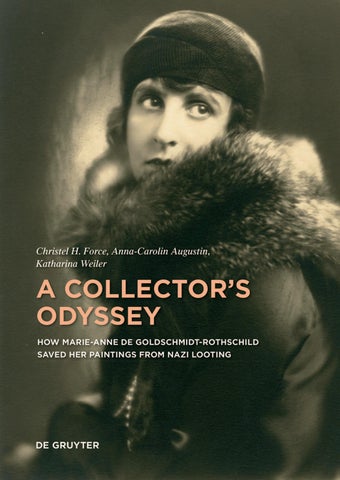
This work is licensed under the Creative Commons Attribution 4.0 International License. For details go to https://creativecommons.org/licenses/by/4.0/. Creative Commons license terms for re-use do not apply to any content (such as graphs, figures, photos, excerpts, etc.) not original to the Open Access publication and further permission may be required from the rights holder. The obligation to research and clear permission lies solely with the party re-using the material ISBN 978-3-11-123929-3 e-ISBN (PDF) 978-3-11-123949-1 DOI https://doi.org/10.1515/9783111239491 ISSN 2196-3746 Library of Congress Control Number: 2026932301 Bibliographic information published by the Deutsche Nationalbibliothek The Deutsche Nationalbibliothek lists this publication in the Deutsche Nationalbibliografie; detailed bibliographic data are available on the Internet at http://dnb.dnb.de. © 2026 Christel H. Force, Anna-Carolin Augustin, Katharina Weiler, published by Walter de Gruyter GmbH, Berlin/Boston, Genthiner Straße 13, 10785 Berlin. This book is published with open access at www.degruyterbrill.com. Copyediting: Ian Copestake Cover image: Photo by Ernst Schneider, Berlin. Portrait of Marie-Anne “Baby” von GoldschmidtRothschild. Collection and reproduced courtesy of Laure de Margerie. Layout and typesetting: 3w+p GmbH, Rimpar Printing and binding: Beltz Grafische Betriebe, Bad Langensalza www.degruyterbrill.com Questions about General Product Safety Regulation: productsafety@degruyterbrill.com
Contents Acknowledgements
1
Introduction 3 Christel H. Force Preliminary Portrayal: Changing Names, French Affinities, and First 49 Paintings Christel H. Force
I Berlin The Art Collector Marie-Anne von Friedländer-Fuld’s Formative Years in the 96 Wilhelmine Empire and the Weimar Republic Anna-Carolin Augustin
II Paris, New York, Los Angeles Rolled Canvases Across Borders: How the Baroness Marie-Anne de Goldschmidt174 Rothschild Saved Her Art Collection (Twice) During the Nazi Era Christel H. Force
III Frankfurt am Main Marie-Anne’s In-Laws: The Systematic Dispossession of the Goldschmidt346 Rothschild Family Under Nazi Duress Katharina Weiler
IV Catalogue Catalogue of Marie-Anne de Goldschmidt-Rothschild’s Collection Christel H. Force Conclusion 549 Christel H. Force Index
561
Image Credits
577
420
Photo by Ernst Schneider, Berlin. Portrait of Marie-Anne “Baby” von Goldschmidt-Rothschild. Collection Laure de Margerie.
Introduction Christel H. Force The story of how the German-born Baroness Marie-Anne de Goldschmidt-Rothschild (January 17, 1892–November 30, 1973) saved herself, her children, and her paintings during the Nazi era has inexplicably remained untold until now.¹ Perhaps the feat was discounted on account of her exceptional privilege and good fortune: it is the atypical case of a Jewish heiress who absconded to America during the war with her most valuable artworks, thereby saving them from Nazi art looting, and her son and daughter from death camps. A story of what might have happened but did not, or a non-story, as some would see it, although avoiding those outcomes was noth ing less than a decade-long odyssey. The exception arguably fails to illustrate the rule —namely the deportation and murder of millions and the systematic dispossession of Jews during the National Socialist era—except that the rule also encompassed diaspo ra for several hundred thousand survivors. Hers is the story of a refugee. And she was not an exception either in the sense that everything else—every single thing she and her mother left behind in Germany, the Netherlands and France—was stolen, in one way or another, before and during her wartime exile. Her story does not exemplify providence or privilege (which played a part) as much as it represents an exploit: it reveals the foresight, determination, perseverance, and resilience exile entailed. Thus far, no one had attempted to determine which paintings this Jewish collector took along as a refugee, how she managed it, or what happened to those artworks.² Perhaps it appeared to be someone else’s story to tell: to the Germans she was natu ralized French; to the French she was born German; to the Americans she was tem porarily an asylum seeker. Getting to the bottom of it required surveying records dis persed across several countries, over two continents. Her name was mentioned here and there but no one had truly pondered who she was and what happened to the art works.³ Piecing her story together and reconstructing it, and the collection, from a transnational perspective is what the authors of the present book have endeavored to do.
1 In 1956, Marie-Anne recounted her experience of the Second World War, albeit parenthetically and cursorily, under a pseudonym, in a book (Gilbert 1956) ostensibly dedicated to the poet Rainer Maria Rilke’s letters to her during the First World War, translated in French. She only mentioned her Van Gogh painting in this book and merely hinted at other artworks. 2 When I started researching Marie-Anne’s collection, there was no relevant information on the web. Since I posted a draft of my research online, Force 2021, much more is available and some of the artworks I identified have been listed on lostart.de (entries by Esther Sabelus and Sabine Rudolph). 3 Prior publications mentioned Marie-Anne from a national perspective and a narrow angle: Berg 1975, Storck 1982, Spiro 2010, and Augustin 2018 from a German perspective; Dédéyan 1963, Dupuis 2021 from a French angle; Gilbert Churchill 2007 and Ward 2020 from a British point of view; Gleizer 2013 from a Mexican one, for instance. Open Access. © 2026 the author(s), published by De Gruyter. This work is licensed under the Creative Commons Attribution 4.0 International License. https://doi.org/10.1515/9783111239491-001
4
Introduction
Not a Biography Our subject is an extraordinary woman—titled, affluent, connected, cosmopolitan, polyglot, clever, determined—who lived through exceptional circumstances, which warrants attention in and of itself. Yet this is not a biography. Biographies tell the story of a remarkable person whose life trajectory (typically from birth to death) and accomplishments are impacted by specific personal, familial, social, and historical circumstances. Biographies also aim to reveal the psychological makeup of a person whose achievements are well known but whose personality and motivations are obs cure.⁴ What this book relates is the entwined story of an art collector and her collec tion over roughly three decades, rather than the story of her life per se. It is a story that is less about her life from beginning to end than it is about what it took to survive and to salvage what mattered most to her. It is a story of agency and will-power per taining to a Jewish-born woman whose youth bridged the Wilhelmine Empire, the Weimar Republic, the Third Reich, and two world wars; a woman who refused to be defined or limited by socio-historical circumstances, let alone hemmed in by misog yny and antisemitism; a woman who was determined and could afford to control her destiny, and, for the sake of self-preservation, relocated from Berlin to Paris, then New York, Los Angeles, and Paris again. Biographies essentially establish a connection between what a person does and what a person is. As the scholar Paula Backscheider explains, they reveal “personality, motives, aspirations, character,”⁵ whereas academic biographies “use the life to enrich our understanding of texts,” or art.⁶ The present exercise is akin to the latter: the “par tial life” of Marie-Anne presented here focuses on outer societal forces rather than inner motivations; it is part socio-cultural history, part material history; it enriches our understanding of the history of collecting. What characterizes the present book arguably befalls all academic biographies, which set themselves apart from the popular genre of historical fiction, namely “an unwillingness to assign and exploit the drama suggested by configurations of facts.”⁷ The consummate biographer does not shy away from the fiction writer’s tricks, in the sense that art consists in conveying the truth through fabrication. Marie-Anne de Goldschmidt-Rothschild’s story would certainly lend itself to novelization; in fact, it is an instance where reality outshines literature, so the narrative would write itself, so to speak. Her life of exceptional privilege through the 1920s, in the vibrant Berlin of the Weimar Republic, set against the Jazz-Age glitz and glamour of Paris; her fortitude in the face of a menacing National Socialist regime in the 1930s; her narrow escape
4 On the expectation that biographers “can deliver the essential person and that there is a core personality” and the belief that “there is a unity and a coherence to personality” and “motives are readable” being in effect a myth, see Backscheider 2001: 93 – 98, 122. 5 Backscheider 2001: xviii. 6 Backscheider 2001: xviii. 7 Backscheider 2001: xix.
Longing, Belonging, and Belongings
5
with some invaluable works of art as the Germans breached frontiers in 1940; and her wartime exile in New York and Beverly Hills are the stuff of epic novels and the best period dramas. But we deliberately made the choice to resist filling the gaps and re fused to embellish the narrative to give it novelistic allure, because the principal merit of Marie-Anne’s story as we tell it, and of her relatives’ stories, is that they are entirely factual. The bare facts are so compelling that they are sufficient to warrant and sus tain the reader’s interest. The greatest strength of the Goldschmidt-Rothschild stories —as told here—is that all the evidence is provided in the footnotes, which scrupulous ly document the primary sources and the scholarship they rest upon. The extant ar chives we drew from arguably represent another story that runs parallel to MarieAnne’s saga—a story of research, discovery, unraveling threads, and weaving them —that is merely hinted at yet pervasive. An attempt was made to pin down Marie-Anne’s particular “ways of understand ing and relating to the world”⁸ during the formative years of her youth. But our main focus was to capture the early twentieth-century German context in which she grew up; in particular the prejudices and barriers Jewish women faced, both before and during the Nazi era; and to expound the discrimination and dispossession she and her in-laws faced, then fled. We adhered to the rigorous interpretation of countless unpublished archival records and presented Marie-Anne’s story, and her relatives’ sto ries, within their socio-historical context, to enlighten rather than to regale the reader.
Longing, Belonging, and Belongings Initially, what motivated the research that led to this book is provenance; that is, the ownership history of works of art: this is what brought Marie-Anne de GoldschmidtRothschild’s experience of exile to light. What it amounts to in the end is the story of an art collector who came of age in Germany, where she faced antisemitism and persecution; who chose to reside in France but was forced to flee in 1940; who sought refuge in the U.S. with an important group of paintings and stayed there throughout the war. The fate of the artworks is inseparable from their owner’s exile, with all the emotional and logistical challenges it entailed. Her experience of the diaspora is a story of longing, belonging, and belongings⁹; a story that lies at the threshold be tween the history of artworks—while in a given collection—and the collector’s life, inasmuch as it informs a facet of art history and exile studies. Our inter-disciplinary approach draws from and feeds into provenance (ownership history), the history of collecting (documenting the shaping, peculiarities, legacy, and dispersal of erstwhile collections), history (examining past events at both national and international levels),
8 Backscheider 2001: 17. 9 This is a variation on the title “Longing, Belonging, and Exclusion in a Global World: Refugees in Past and Present,” of a roundtable at Queen’s University, October 20, 2020, organized by Swen Steinberg and Werner Nell. See also Reuveni and Roemer 2010.
6
Introduction
social history (assessing socio-economic and cultural factors in everyday life), cultural history (analyzing convictions, values, behaviors, experiences), material culture (prob ing the physical remnants of a society to understand people’s lives), and biography (storytelling centered around one person’s life). It illustrates that there is much more to ownership history than that which the succinct format of provenance (a list of names and dates) allows for: when you flesh it out, 10 lines turn into 10 pages, or a whole book.¹⁰ What follows is an account of this Jewish-born woman’s development as a collec tor of modern art while she shuttled between Berlin and Paris; her struggles leading up to and during the exodus, when she fled France with several canvases on the roof of her car; and her wartime exile in the U.S. And with the narrative of this refugee’s particular circumstances comes a reconstruction of the contents and the trajectory of her collection—15 invaluable paintings and an album of Van Gogh letters being the only possessions she managed to save from the extensive, systematic looting of Jewish property in Nazi Germany and Nazi-occupied territories, as well as by the Vichy government in France. Our focus is strictly on that part of her possessions which was saved from misappropriation, as it accompanied her into exile.¹¹ A few other paintings she owned but sold before the war are discussed as well, insofar as they il lustrate the role of critical mentors and dealers. In this book, one social historian and two art historians reconstruct and assess the impact of socio-economic background and historical events on one woman’s life, on her in-laws’ lives, and on their respective collections, to convey what it took to with stand the Nazi campaign of eradication of the Jewish people and culture. This ap proach of the impact of Nazism on collecting dynasties, which expands beyond the my opic consideration of singular objects devoid of affect or context, coincides with the extension of the provenance field to encompass colonial and cultural-patrimony is sues, including native-American heritage or Jewish material culture (Judaica, libraries, archives), for instance, where cultural history factors into the discipline.¹²
A Jewish Woman Collector The spectacularly wealthy Berlin heiress Marie-Anne “Baby” von Friedländer-Fuld owed her fortune to her father, and her successive surnames to three consecutive hus bands.¹³ Her story and her collection, however, were very much her own.¹⁴ Known as
10 On the shortcomings of telegraphic provenance, see Force 2019. See the provenance of each painting in the Catalogue section below, and contextual information in Chapter II. 11 See the Catalogue section below. 12 See for instance Hauser-Schäublin & Prott 2016, and Savoy, Guichard & Howald 2018 for colonial issues, Vizenor 2019 for Native-American culture, and Gallas–Kawalko–Jessen–Weiss 2019 regarding Jewish Cultural Property, to name a few. 13 On her spouses and successive names, see below, Preliminary Portrayal.
A Jewish Woman Collector
7
Marie-Anne de Goldschmidt-Rothschild for most of her life, she was one of the few German women of her time to collect French Post-Impressionism from 1914 through the interwar years,¹⁵ yet her male relatives are better-known. To wit, her father-inlaw Baron Maximilian von Goldschmidt-Rothschild (1843 – 1940) and his three sons, Al bert (1879 – 1941), Rudolf (1881 – 1962), and Erich (1894 – 1987), who had extensive collec tions of (mostly French eighteenth-century) decorative arts, as well as old masters. Erich, Albert, and Maximilian’s are well known through their respective 1931, 1933, and 1950 sale catalogues,¹⁶ and some of their valuable objects can be admired in mu seums today.¹⁷ What the historian James McAuley remarked of a French contempo rary, Baronne Béatrice Ephrussi de Rothschild (1864 – 1934), applies to Marie-Anne: “[D]espite the refinement of her taste, she is still far less known than the men in her family and her world.”¹⁸ While the collection assembled by Marie-Anne’s parents¹⁹ similarly exemplified the established “goût Rothschild,”²⁰ her own was seen as incongruous and daring. Col lecting French Post-Impressionist paintings in Germany around 1918 was still rare and controversial at a time of heightened nationalism, whereas adorning one’s mansion with prized eighteenth-century furnishings was a mark of distinction. The Rothschild
14 This has been misunderstood until fairly recently: Grodzinski 2005: 258, states that Marie-Anne was a collector before WWI, as Rudolf von Goldschmidt-Rothschild’s wife, when Marie-Anne bought her first painting in 1914 (at 22 years old), owned about half of her paintings by 1918, and only married Rudolf in 1923. Grodzinski 2005: 261 also states that in Wilhelmine Germany, “a third of all modernist collections were built [by men] with the contribution of women partners,” among which she lists “Anne-Marie Goldschmidt-Rothschild,” when Marie-Anne married Rudolf von Goldschmidt-Rothschild during the Weimar Republic, and the collection was demonstrably her own. Finally, Grodzinski 2005: 322, states that Marie-Anne “fled at the end of the 1930s to Paris and her art collection was auctioned by Cassirer & Helbig,” when Marie-Anne mostly resided in Paris from the mid-1920s, and it is her mother Milly’s collection that was auctioned off at Van Marle & Bignell (Friedländer-Fuld sale 1941) and several other sales. This type of negligence regarding names and dates added to the confusion. 15 The first collector of Impressionist paintings in Germany was a woman, namely Felicie Bernstein, advised by Charles Ephrussi in Paris; see Barbara Hahn, “Encounters at the Margins: Jewish Salons Around 1890,” in Bilski 1999: 3, 198 – 199. Women collectors of French modernism in Berlin around 1900, such as Felicie Bernstein, Margarete Mauthner, and Magarete Oppenheim are discussed in Augustin 2018: 202 – 242. See also below, Chapter I. 16 Goldschmidt-Rothschild Sale Erich 1931; Goldschmidt-Rothschild Sale Albert 1933; GoldschmidtRothschild Sale Maximilian March 1950; Goldschmidt-Rothschild Sale Maximilian April 1950. Other auction sales are listed in Chapter III below. 17 See Wagner K & Weiler 2023 on Maximilian, and below, Chapter III, on all of them. 18 McAuley 2021: 160. Likewise, Maximilian von Goldschmidt-Rothschild’s daughters, Lili Jeannette Freifrau Schey von Koromla (1883 – 1925) and Lucy Georgine Leontine Spiegl (1891 – 1977) are less known than their brothers. On collectors being traditionally seen as male—in a book dedicated to women collectors among the French Rothschilds—see Pomarède, “Il est fier de sa collection, qui est son autoportrait,” in Prevost-Marcilhacy, Moens & Pomarède 2023: 27. 19 See Friedländer-Fuld Sale 1941. 20 On the “goût Rothschild,” see Prevost-Marcilhacy 2018, Prevost-Marcilhacy 1995, Hall 2014.
8
Introduction
taste was acclaimed and prestigious, while Marie-Anne’s collection expressed her re jection of accepted norms. As Vincent Pomarède noted, the private collector’s mania is often seen as “a nar cissistic, somewhat frivolous amusement,” except when it involves dizzying sums, in which case it commands respect and admiration.²¹ The paintings Marie-Anne collected met with skepticism for a while, and even though they reached relatively high prices by the 1920s, they did not begin to attain the astronomical values of today’s market until after the war. The fact that her small collection was deemed less desirable than the Frankfurt Goldschmidt-Rothschilds’ arguably explains why it drew little at tention for decades. Xenophobia in general,²² antisemitism more specifically, and the labeling of modernism as “degenerate” by the Nazis, followed by the chaos of war, did not help. She has since been vindicated, the market value of her paintings having risen steadily from the moment she acquired them, albeit most dramatically after the collection’s piecemeal dispersal following her death. It could also be argued that Marie-Anne’s collection had not been studied thus far because the role of women in the history of collecting was not acknowledged for a while. The patriarchal society Marie-Anne lived in unquestionably relegated women to the shadows.²³ In the 1800s, art making and art collecting were considered a man’s business, and the accomplishments of women were deemed adjacent (to a fa ther’s or a husband’s), aberrant (if achieved singlehandedly), marginal (7 % of nine teenth-century collections²⁴), and were consequently denigrated. This remained largely true in the first half of the twentieth century, although things began to change. In a book on Rothschild women-collectors, the art historian Denis Laoureux ex plained that men and women (wives, daughters) alike took to collecting art thanks to fortunes amassed (by men) in the industrial age, as a means to proclaim their social standing and assert a personal vision.²⁵ Championing, collecting, and donating art are well-established means to denote wealth and convey education, discernment, a pro gressive outlook, generosity towards the nation, as well as to ensure one’s legacy.
21 Pomarède, cited in note 18 above. As a case in point, when Marie-Anne lent her collection to the museum of San Francisco in 1946, its greatest quality was touted in the press as its being worth one million dollars (a huge sum then). See below, Chapter II. 22 Carl Vinnen’s pamphlet against the growing presence of French art on the German market, “Ein Protest deutscher Künstler” (April 1911), prompted the publication of a rebuttal titled Im Kampf um die Kunst (Munich: Reinhard Piper, June 1911), co-signed by Paul Cassirer, Wilhelm Uhde, Alfred Flecht heim, Max Beckmann, August Macke, Franz Marc, etc., expanded to Deutsche und französische Kunst (Munich: Alfred Walter Heymel, 1911). See Paret 1980: 182 – 199. On the perception of “foreign” mo dernism in Weimar Germany, see Paret 1980; Kern 1989; Bilski 1999; Augustin 2018: 259 – 263. 23 See Denis Laoureux, “Ce que collectionner l’art de son temps signifie quand on est tune femme,” in Prevost-Marcilhacy, Moens & Pomarède 2023: 43. On women collectors, see also Lawrence 1997, Gere & Vaizey 1999, MacLeod 2008, Reist & Mamoli Zorzi 2011, Verlaine 2014, Augustin 2018, and Livingstone 2021. Also see Kaplan & Dash Moore 2011. 24 Laoureux in Prevost-Marcilhacy, Moens & Pomarède 2023: 49. 25 Laoureux in Prevost-Marcilhacy, Moens & Pomarède 2023: 43 – 44.
A Jewish Woman Collector
9
The social and the personal merge when, as the historian Krysztof Pomian pointed out, using masculine pronouns, to the collector, the collection becomes a part or an extension of himself, and for others, [it be comes] his self-portrait composed of objects he chose and exhibited, the expression of his status and his wealth as much as of his interiority: his knowledge, his sensibility, his aspirations, his interests and his tastes.²⁶
Addressing this restrictive pronoun (compounded by the fact that in French, the mas culine gender is grammatically neutral and all-encompassing), for his part Laoureux stated that “the feminist wave that emerged at the end of the nineteenth century and in the first decades of the twentieth was instrumental in freeing women from social conventions”; and that for women, building an art collection meant the attainment of “intellectual stimulation, social legitimation, and personal emancipation.”²⁷ It en abled them to find validation outside the domestic sphere. Along the same lines, in his book on Jewish art collectors in France, McAuley con tended that in the rarefied milieu of the Camondos and Reinachs—a highly privileged social stratum that lavished considerable means on their effort to counter discrimina tion and to integrate French society—the opulent “style Rothschild” meant “a reliance on […] material objects, both as a means of private solace and public self-representa tion.”²⁸ But for women, who experienced the additional burden of a patriarchal soci ety, collecting was “a means of simulating a control over their life.”²⁹ For Jewish
26 Laoureux in Prevost-Marcilhacy, Moens & Pomarède 2023: 46 (citing Pomian); my translation. “Il est fier de sa collection, qui est son autoportrait,” wrote Pomarède, citing Krysztof Pomian, in Prevost-Marcilhacy, Moens & Pomarède 2023: 30. 27 Laoureux in Prevost-Marcilhacy, Moens & Pomarède 2023: 49 (my translation), 50 – 51. 28 McAuley 2021: 163. The same can be said of Germany: on Marie-Anne’s mother Milly von Friedländer-Fuld’s efforts at “aristocratization,” see Augustine 1991: 141. On Jewish businessmen at the German Emperor and King of Prussia Wilhelm II’s court, or Kaiserjuden, including Fritz von Friedländer-Fuld, see Cecil 1967: 98 – 102, 110 – 111. On the Kaiser supporting Maximilian von Goldschmidt-Rothschild against reigning antisemitic sentiment, as reported in the U.S., see “Kaiser Snubs Anti-Semites,” The New York Times, May 14, 1905: 4. On the Kaiser’s “good will to the Jews” and his “counting among his most intimate friends and counsellors men like Albert Ballin and Fritz von Friedländer-Fuld,” see “Women’s Political Salons in Europe a Factor in World Affairs,” The Sun (New York, NY), January 18, 1920: 4; and Arthur N. Davis, “The Kaiser as I Knew Him for Fourteen Years,” Highland Recorder (Monterey, Va.), September 20, 1918, n.p. (mentioning Friedländer-Fuld and the banker von Schwabach). On Jews among the German nobility in the Weimar Republics, see Beucler 1932: 545, 547, 552, 554, 558; and Brenner 1996. For a study of the Jews in France (State Jews as opposed to Court Jews) that offers an interesting pendant, see Birnbaum 1996. 29 McAuley 2021: 172. This argument echoes (and expands) MacLeod 2008 on American women collectors, who argued that “collecting, which provided wealthy women with a private sense of solace, also liberated them to venture into the public sphere and make a lasting contribution.” Prevost-Marcilhacy, Moens & Pomarède 2023, published on the occasion of the exhibition “The Rothschild Collectors: Female Patrons and Donors Par Excellence” at the Musée des Beaux-Arts de Liege – La Boverie Museum, October 21, 2022 – February 26, 2023, organized in partnership with the
A very young Marie-Anne von Friedländer-Fuld with her dog Jerôme. Family archives.
Preliminary Portrayal: Changing Names, French Affinities, and First Paintings Christel H. Force The brief portrayal that follows introduces the primary subject of this book—born Marie-Anne Friedländer (1892 – 1973) in Berlin and eventually known as the Baroness de Goldschmidt-Rothschild in Paris—to convey who she was at a glance, so to speak. The crucial milestones of her life in Germany through the Wilhelmine era (1890 – 1918) and the Weimar Republic (1918 – 1933) can arguably be associated with significant men —father, husbands, mentors, ambassadors—because she was born in a man’s world. Those relationships reveal not only who she was but what she aspired to become, be fore she came into her own. This rough sketch outlines her identity as a woman known under various surnames through the years; it summarizes how she emerged as a col lector, independently from her father or any husband’s taste or influence, but with the guidance of select mentors; and it underscores her perception of herself as an artist, hence the centrality of art in her worldview.
The Many Names of Baby The protagonist of this story was known under various surnames over time, namely Marie-Anne von Friedländer-Fuld, Marianne Mitford (1914 ff), Frau Richard von Kühl mann (1920 – 1923), Baronin Rudolf von Goldschmidt-Rothschild (1923 – 1938), and Marie-Anne de Goldschmidt-Rothschild. The publications she penned appeared under slight variants, namely Marie Anne/Marianne von Goldschmidt-Rothschild¹ or Marie-Anne Friedländer² before the war, and the postwar nom de plume and artist name Marianne Gilbert.³
1 Goldschmidt-Rothschild 1928A; Goldschmidt-Rothschild 1928B; Goldschmidt-Rothschild 1929. 2 Friedländer 1931. 3 Gilbert 1956, Gilbert 1958, Gilbert 1962. She also signed her drawings and paintings “M. Gilbert.” Marie-Anne has occasionally been confused with her sisters-in-law, Miriam Caroline Alexandrine de Rothschild (1884 – 1965) and Marion Hélène Schuster (1902 – 1982)—consecutive wives of Rudolf’s brother Albert von Goldschmidt-Rothschild (1879 – 1941)—who married Albert in 1910 and 1923, respectively. Miriam Caroline Alexandrine went by Alexandrine and should not be confused with the British entomologist Miriam Louisa Rothschild (1908 – 2005) of the banking family of England either. Alexandrine—the French-born daughter of Edmond de Rothschild—also had a collection of PostImpressionist paintings and old masters, which disappeared during the war (Wilson 1994: 372). However, she recovered and gifted some to the Israel Museum in Jerusalem, such as Gauguin, Still Life, 1899, IMJ B66.1041; Cézanne, Country House by a River, 1890, IMJ B66.1043; and Van Gogh, Harvest in Provence, 1888, IMJ B66.1039. Alexandrine fled Paris for Switzerland on June 10, 1940, and by January 1941 her residence at 2 rue Leonard de Vinci had been taken over by the Germans (as per Archives de Open Access. © 2026 the author(s), published by De Gruyter. This work is licensed under the Creative Commons Attribution 4.0 International License. https://doi.org/10.1515/9783111239491-002
68
Preliminary Portrayal: Changing Names, French Affinities, and First Paintings
Figure 0.6: The Sternheim/Friedländer-Fuld/Goldschmidt-Rothschild version (see Plate XVI): Vincent van Gogh (1853 – 1890), L’Arlésienne: Portrait of Madame Ginoux, 1888. Oil on canvas, 92.5 × 73.5 cm (36 1/2 × 29 1/4 in.). Musée d’Orsay, Paris, Donation sous réserve d’usufruit, Mme R. de Goldschmidt-Rothschild, 1952 (RF 1952 – 6). Faille 489.
Francophile Mentors
69
Figure 0.7: The Grönvold/Lewisohn version: Vincent van Gogh (1853 – 1890), L’Arlésienne: Madame Joseph–Michel Ginoux (Marie Julien, 1848 – 1911), Arles, 1888 – 1889. Oil on canvas, 91.4 × 73.7 cm (36 × 29 in.). The Metropolitan Museum of Art, New York, bequest of Sam A. Lewisohn, 1951 (51.112.3). Faille 488.
Max Liebermann, Harry Graf Kessler, Eduard von der Heydt); and the nationalist and antisemitic backlash it triggered, see Bauschinger 2016: 85 – 87
Portrait of Freifrau von Goldschmidt-Rothschild, née von Friedländer-Fuld, c. 1924. Photo by Frieda Riess (1890–1954), Berlin, included in the Riess exhibition at Galerie Alfred Flechtheim, Berlin, November 1925, catalogue no. 55 (as was the portrait of Erich von Goldschmidt-Rothschild’s wife, Gräfin Henckel von Donnersmarck, no. 56). Collection Laure de Margerie.
II Paris, New York, Los Angeles
256
II Paris, New York, Los Angeles: How Marie-Anne Saved Her Art Collection
tube, itself covered in tarp.²⁵² “The cylinder,” she added, “was so large that the canvas es almost laid flat.”²⁵³ The tried-and-true solution of rolling up the canvases had worked in 1934, when she smuggled them to Paris; it would have to do the trick when moving them to New York. In Lisbon, on August 9, 1940, they boarded the SS Quanza—a Portuguese ship “taken out of her usual South African run for a special voyage to evacuate war refu gees from Europe”²⁵⁴—bound for Veracruz via New York (Figure 2.18). Marie-Anne kept the cylinder by her cabin bed, among her personal luggage, as de Hauke suggested he might do a few months prior, albeit apropos a couple of paintings, whereas she transported fifteen. A 10-day crossing followed for passengers who were undoubtedly exhausted, re lieved, optimistic, and anxious in equal measure. On August 19, 1940, The New York Times reported that 196 passengers were about to arrive on the Quanza—that is, the 196 who were bound for the U.S.: The Portuguese passenger liner Quanza of the Companhia Nacional de Navegacao Lisbon […] is expected to dock at 6PM today at Pier 35, Hamilton Avenue, Brooklyn, from Lisbon with 196 pas sengers, of whom sixty-six are in the first class, seventy-six second and fifty-four third class. […] This will be the first time the vessel was called at New York.²⁵⁵
It actually carried 317 passengers, as the same newspaper reported a few days later— mostly Jewish refugees, of which 121 were headed for Veracruz. The passengers includ ed: six [American] ambulance drivers who were captured by the Germans but freed through the ef forts of our State Department; Dutch and Negro seamen whose ship was torpedoed without warn ing; three members of the wealthy Rothschild family […]. The Rothschilds on board were Mrs. Rudolf Goldschmidt-Rothschild of Paris and her two children, Gilbert, 15, and Antoinette, 17 […].²⁵⁶
It was a stressful crossing, of which one garners an idea by perusing the page of The New York Times announcing the Quanza’s arrival, featuring titles such as “Refugee Ship Sunk, Children on Board,” “Swedish Steamer Sunk,” and other U-boat attacks.
252 Gilbert 1956: 117. This does not explain how she carried the two Cranachs, the Hals tondo, the Boudin (see notes 90, 132 above, 435 below), which are painted on wood panels, and the Lautrec, painted on board. She did not mention carrying any paintings in a suitcase or a trunk in her book, but she must have, as well as Van Gogh’s letters (see below), and Rilke’s letters (which she mentions packing, Gilbert 1956: 92). One imagines that she had quite a lot of luggage. 253 Gilbert 1956: 117; my translation. 254 “6 Drivers, Seized by Germans, Here: American Ambulance Drivers Arrive From War Zone.” The New York Times, August 21, 1940: 5. 255 “Portuguese Liner Coming: Quanza Due Here Today from Lisbon With 196 Passengers,” The New York Times, August 19, 1940. 256 “6 Drivers, Seized by Germans, Here: American Ambulance Drivers Arrive From War Zone.” The New York Times, August 21, 1940: 5.
Wartime Displacement: Reaching the U.S. via Lisbon and Veracruz
257
Figure 2.18: The SS Quanza (launched in 1929; scrapped in 1968), a Portuguese passenger and cargo ship that primarily travelled to South Africa, and occasionally to South America, on which Marie-Anne and her children crossed from Lisbon, Portugal, to Veracruz, Mexico, via New York, U.S.A., in August 1940. Family archives.
As the Quanza approached the city, the passengers’ relief must have temporarily muf fled their anxiety. As other refugees described it, from the ship Manhattan must have appeared as a “hazy mirage, titanic and elegant,” surging like “a giant and fantastic growth out of the sea.”²⁵⁷ Sixty-six American citizens disembarked in New York, as well as 130 passengers admitted with proper immigration visas. 121 others who were headed to Mexico had to remain on board. Of those, Marie-Anne and her children, together with Illan Alvarez de Toledo, were the only four people admitted temporarily for 24 hours, including a short, unnecessary stint at Ellis Island.²⁵⁸ Marie-Anne’s facetious account of this stop over was as follows:
257 Two of the descriptions by refugees arriving by ship among others listed in Pfanner 1983: 38, namely by Klaus Mann and Leonhard Frank. 258 According to the first-class manifest of the Quanza arriving in New York on August 19 (Passenger lists New York), Marie-Anne (43) and her children Antoinette de Kuhlman (17) and Viktor Rothschild (15)—accompanied by Illan Pierre Alvarez de Toledo (XI Marqués de Casa Fuerte, 1882 – 1962, of